Dave Ramsey Is Misleading The Public

Dave Ramsey Is Misleading The Public

Flipper/Rehabber · Las Vegas, NV · Member since 2016 · 174 posts · 251 votes

I wanted to address this to educate people who have been mislead by the financial services industry...not just Dave Ramsey 

Step 7 - Build wealth and give. This is where he want's you to "invest in mutual funds," and to be fair real estate (all cash and 5% of your investments). So let's assume the other 90-95% goes into mutual funds. Just go to his website and it's obvious he's drank the mutual fund koolaid. Again, not sure whether he knows how bad his advice is and is lying or is completely ignorant. My guess is it's the former because of the mental gymnastics required for articles like this from his blog.


And if you read the blog post it becomes obvious why I tend to believe he's blatantly lying to his audience and his whole schtick is a rouse. see below

Notice he brushes off the lost decade by saying you have to look at the bigger picture and you can't cherry pick time frames. But that's exactly what he does to make his claim about the 12% average returns. The whole basis for for the blog post and a big part of what he sells to his audience.

But it goes from a subtle white lie to blatant fraud when you look at how he's selling a "12%" return.

Meaning, most of his listeners are unsophisticated, they don't know a 12% drop one year and a 12% gain the next doesn't put you back at zero. They think that their money will just compound at a 12% clip annually. Let's look at reality.

If we took what DR says at face value, the market goes up on average of 12% a year going back to 1923, we should be able to type the value of the 1923 S&P into a compound interest calculator, input 12%, and we should have roughly 3000 (where the S&P is today). I only have data from 1928 on, but I think you'll still get my point. The S&P was 17 in 1928. Let's see what happens...

If what DR says is true, the way he sells it to his audience, if S&P would have to be at 512,000 right now!!! It's at 3000!!!

And I'm not even adjusting for inflation. Adjusted for inflation (meaning 12% annual increases in purchasing power) the S&P would be at over 7,500,000!!! YES, 7.5 MILLION.

You maybe saying to yourself, "what George is saying can't be true" DR would never get away with that much of a lie. Here's why DR can get away with his claims. They're true in literal terms but they're wildly false in the way he presents it to his audience and how his audience perceives what he's saying.

DR presents this 12% claim as though, over the long haul, your money will grow by 12% a year. FALSE! Why? Because when a number is reduced by 10% and then increased by 10% you're not left with the same number...it's lower.

As an example. Take $1000 and decrease it by 50%, you now have $500. Increase that $500 the next year by 60% and you now have a total of $800. A $200 (20%) loss but a 5% average return (-50 + 60 = 10/2 = 5%).

This becomes very clear when we look at graph of annual S&P returns.
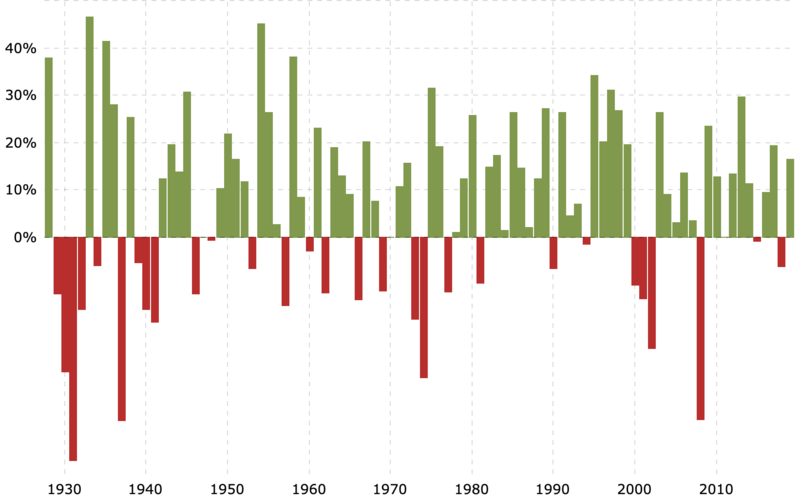

Or better yet, look at an inflation adjusted chart. Please notice how much you'd make if you invested in 1928 and left your money in for 52 years, until 1980.
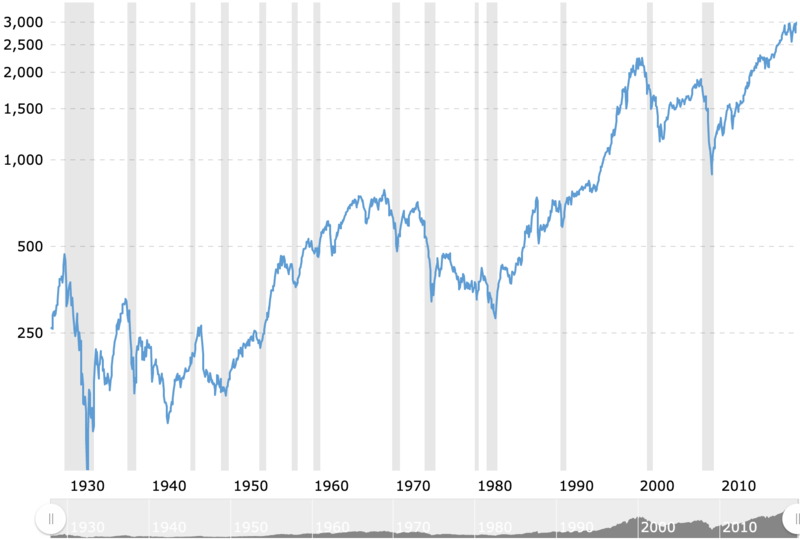
You would've made zero (adjusted for inflation). Dave Ramsey what happened to 12% per year??

What infuriates me the most is he targets people in the south and people who go to church, in other words people with traditional values who are more susceptible to his "be prudent, save money, no debt, invest in mutual fund" snake oil.

To be clear, 10% of what he says is spot on, have a rainy day fund and don't take on consumer debt, but the other 90% is so bad it's completely inexcusable.

If you're one of the millions of Americans, not just DR fans, who have drank the koolaid of the financial services industry and invested into the "safety" of mutual funds, I apologize, I don't relish being the bearer of bad news. But as I said in my first post on this thread, I feel a moral obligation to set the record straight.

Please note: I didn't even hit the tip of the iceberg of why mutual funds are quite possibly the worst investments on a risk/reward basis. I understand I exclusively focused on S&P and mutual funds typically contain bonds. I did this because interest rates have been driven down so low by the Fed, mutual funds no have to overweight equities because they can't get a return from bonds. This problem will be exacerbated if/when US bonds go into a negative yield like Europe and Japan.

I realize this is complex stuff. It's why DR can dupe so many, including maybe himself. I'd like to point out I learned none of the above in college. ;)

If you have any questions don't hesitate to reach out, all my contact info is on my profile.

Good luck,

22Reply
515 views

Most Popular Reply

Rental Property Investor · RVA · Member since 2016 · 5k+ posts · 4k+ votes
7y

I see Dave's advice as being good for those who have problems balancing their checkbooks and generally accumulating money. For those of us who are taking more control of our financial situations, we need to massively upgrade our knowledge and our level of thinking.

See this reply in the discussion

108 Replies

Jump to latestLatest
  • Ontario, Canada · Member since 2019 · 32 posts · 8 votes
    7y

    I did drink the DR koolaid earlier this year but quickly realized that his program is flawed. In the sense that it is not complete. His program is a good debt recovery and money management system but beyond building true wealth and becoming FI, DR's program is but a piece to a puzzle.

    The philosophy of running debt free once you have assets has merit. However, to stay debt free and try to build wealth off your income requires a high paying job to begin with. Leveraged debt, managed well and handled efficently can make for a great builder.

    But many of us know we do not need to get our own money truly involved ;)

  • Flipper/Rehabber · Las Vegas, NV · Member since 2016 · 174 posts · 251 votes
    7y

     So what are the actual returns from the S&P 500 over the last 100 years?  

    The returns normal people care about...how much did my investment actually grow...are measured by CAGR (compound annual growth rate).  Let's explore this and try to discover which approach yields the highest CAGR over the long haul.

    Then let's see where RE fit's into the equation in my opinion.

    To analyze this I compared several approaches.

    1.  Interest rate cycles.  My hypothesis was returns in bull interest rate markets would outperform.  As we all know, interest rates are cyclical, and the run in very long cycles of 20 -30 years.  I found data for interest rates going back to 1790 but could only find CAGR for the market going back to 1871 so that's where I started.  

    Here's the chart of interest rates I used.

    I took each time frame of bear and bull market in rates and plugged those into the CAGR calculator (I included dividends and adjusted for inflation).  Here's a screen shot of the calculator (below).

    And here are the results.

    As you can see, there was a difference, during interest rate bull markets the S&P performed better.  

    Unfortunately it wasn't a significant enough difference to suggest waiting for the start of another bull market in rates to start investing, your cash would be idol for too long eliminating the edge, creating a lower total compounded growth rate.  

    At best I think this is a broad predictor of future expected returns based on current P/E multiples and where we are in the cycle.  This makes sense because a stock is a claim on future cash flows and interest rates are a discount mechanism for future cash flows.  Here's Warren Buffet commenting on this.

    Again, the simple takeaway is, bull market in rates creates tail wind for stock prices, bear market in rates creates head wind for stock prices.  A quick observation of where we are in an interest rate cycle can assist in predicting if future returns will be higher or lower than the historic norm (going back to 1871).  

    FYI, we're 40 years into an interest rate bull market...

    2.  Back test strategy using lows in Shiller P/E ratios.  My hypothesis was investing only when P/E ratios where at their low would give enough of an edge to make it a useful strategy.  

    To test this I used two dates as starting points, 1920 (an absolute low in P/E' ratios) and 1929 (a high in P/E's close enough to do decades long tests).  Heres the chart 

    Please not the difference in P/E's between 1920 and 1929 (above).  Here my results assuming a starting investment of $10,000, adding dividends and adjusting for inflation (below). 

    After each 10 year time frame buying from a low starting point massively out performed.

    But is it realistic for most, who only have roughly 35 years to save, to wait for the next time P/E's go to 5?  Obviously not.  Although this didn't give us an investable strategy it did show that, if possible to deploy, "buy low" works.  

    You maybe saying "Duh George."  But remember, the collective ethos of BP (real estate) and DR (mutual funds) is "buy always."  What's the saying real estate agents have?  "Don't wait to buy real estate, buy real estate and wait?"  I'm sure financial planners have a similar saying. ;) 

    More on this later...

    3. Only buy when P/E's are low, not necessarily at their all time lows.  My next hypothesis was narrowing the wait time to buy.  I wanted to buy when P/E's were below 10 and sell when P/E's were above 20.  In the interim, sit on the cash.  This is very consistent with my RE strategy, which is buy when it's historically cheap, and sell when it's historically high.  

    Let's check out the results, again starting with $10,000, adding dividends and adjusting for inflation.  


       The time frames coincide with the points on the Shiller P/E ratio chart above.  Remember, buy when P/E's dip below 10 and sell when the go above 20.  (I accidentally left out 1878 - 1898 it was 9.8%)

    It worked very well in the sense it gave us multiple entry points.  But did it work better than just buying in 1916 and leaving your money in until 2018?  No.  

    It performed significantly worse (3.2 million compared with 7.1 million), because the strategy of buy under a P/E of 10 and sell at a P/E above 20 has been sitting on cash since 1993.  

    The big problem is the time between when you sell and when you buy...Maybe the numbers do favor those who "don't wait to buy, buy and wait?"

    4.  Buy low, sell high, and but the cash in 6 month treasuries between high and low points.  For my last hypothesis I wanted to see what would happen if we used my buy under 10 and sell over 20 approach combined with putting the cash in 6 month treasuries (to lower inflation risk and provide liquidity without relying on market value of the tbill).  

    I couldn't find data going back to 1916 for 6 month tbills, but what I found showed a rough average of 3% in rate bull markets and 6% in rate bear markets.  I plugged those values into the times the strategy was in cash.  The results are on the spread sheet above.  

    Using this method, starting with $10,000 in 1916, including dividends, adjusted for inflation, at the end of 2018 you'd have $17,426,905.  Compared to $7,112,261 with the traditional buy and hold method.  

    If we're strictly measuring long periods of time, as Dave Ramsey does, the buy low, sell high, and keep your cash in short term treasuries vastly outperforms.  More importantly it's something any average Joe can do.  

    So what about REAL ESTATE?? 

    Bad news fellow real estate investors.  Going back 100 years, comparing decade to decade, if you keep your money in the market 20-30-40 years, the market outperforms (including dividends, adjusted for inflation, NOT including leverage or taxes).  Why?  The same reason the all the strategies above, except the last, underperformed.  Cash, or in this case cash and equity, sit idol too long without the effects of being compounded.  

    Additionally, rents and prices don't really go up, they only keep pace with inflation.  True, both have periods of time when they wildly exceed inflation (like right now) but going back to 1890 they've always mean reverted.  Which makes sense because they're a direct function of real wages...stocks are not.  

    It is true, real estate provides a much better cash on cash return, I'm sure most on BP can get at least 7% cash flow without leverage.  The problem is the amount of time you have to save up that cash flow, or build equity via mortgage payments, to make another investment and start compounding the money.  

    Did I do a spreadsheet for RE?  No.  I didn't need to because doing the homework for the other strategies I knew a 10% yield would never outperform a 7% CAGR unless the money from the yield was constantly being reinvested with the same yield.  Not reinvested once every 2-10 years pending on inflation or real appreciation etc. (to extract and reinvest equity/cash flow).  

    NOTE: I did not factor in leverage and taxes to keep a more apples to apples comparison.  We all know those 2 factors are huge.  

    But wait, I have good news!

    There is one area where real estate will almost always outperform stocks.  

    In 2019, when there's 15 trillion in negative yielding debt in the world, the USD is losing it's grip on world hegemony, US 23 trillion in debt with 100 trillion in unfunded liabilities, the largest debtor nation in world history...I could go on and on.  What's more important CAGR or capital preservation?  

    I'd argue capital preservation.  And in that arena, RE is the champ.  

    As we all know, prior to 2006 the RE market had never gone down in nominal terms.  Even when the bubble burst prices went down by 60% to the market 50%.  Not a big enough difference to make up for the countless times over the last 100 years the market has dropped massively.  

    Bottom line is RE is far less volatile.  And in a world with macro economic conditions as they are today that should take precedence.  

    If you've read this far I sincerely thank you.  I know this is a ridiculously long post but I strongly believe the information is of value because it's so rare to see details and actual data.  I think in depth analysis is the cornerstone to good investment decision making.  

    That said, let me leave you with a chart from Japans Nikkei index as a further counter balance for stocks having a higher CAGR over the long haul.  Notice where the Nikkei was in 1989 and where it is today, 30 years later...lower.  In fact it never got close to the 1989 level again.  Why couldn't the US be the next Japan?  If you give me 3 reasons their economy is worse, I can give you 3 reasons it's better.  And remember, Japan is the largest creditor in the world, the US is the largest debtor in the history of the world.  

    All the results I've given you in this post are from the past, as we all know, the past isn't necessarily a predictor of future events.  If we all lived in Japan in 1989, and made investment decisions based on the last 40 years how well would we of done in the future?  

    I know for a fact, somewhere in Japan in 1989, there was a personal finance talk show host telling all his listeners to buy the Nikkei because you can't go wrong...  ;) 

  • Russell BrazilBusiness Member
    Moderator
    Real Estate Agent · Washington, D.C. · Member since 2012 · 17k+ posts · 30k+ votes
    7y

    Ignoring the use of leverage that is typical in investing in real estate also is going to mute the returns. 3 to 1 or 4 to 1 leverage magnifies those returns obviously proportional to that leverage. So ignoring leverage is ignoring the typical terms that are used to invest in real estate. It would be like ignoring a major component thats typical to equities investmeny such as only looking at dividends or only look at price growth an ignoring dividends. 

    Also peak real estate prices were $257k in q1 2007 and bottom after the crash were $208k in q2 2009. Thats a 19% drop, not 50-60%.  And each of those quarters were sort of peaks high and low even for those years as q1 is each year with lower sample sizes compared to q2, q3 where the samples sizes are significantly larger. When we average the high year of 2007, to the low year of 2009 we come closer to a 10-12% drop depending on if you use the average or the median price points. (Data from St Louis Fed)

  • Springfield, VA · Member since 2019 · 74 posts · 77 votes
    7y

    You're also not factoring in the method most people use to invest (dollar cost averaging), which allows the investor to take advantage of the market's volatility.

    And you didn't factor in the dividend yield on your Nikkei returns. 

  • Investor · Rochester, NY · Member since 2017 · 206 posts · 175 votes
    7y

    @George Gammon

    Nobody is going to be completely right, and nobody is going to be completely wrong. Dave’s advice is extremely powerful for some people who are buried in debt. But some of his advice I don’t agree with and therefore am choosing not to use it.

    For example, I love the debt snowball. I’m currently using it for my car and home loans. I believe I should have everything paid off in 6 years (instead of 30), spending only $300 extra per month.

    I strongly disagree with his mutual fund strategy. I feel that 12% doesn’t exist and mutual funds are risky.

    Here’s my point: Take the pieces of his strategy that make sense for YOU. And then mix in someone else’s advice. At the end of the day you don’t have to be 100% Dave Ramsey. But not all of it is bad.

  • Rental Property Investor · Boston, MA · Member since 2017 · 241 posts · 135 votes
    7y

    @George Gammon

    You can't save your way to wealth, and not leveraging debt is ridiculous. I don't think Dave gets the concept of " life is short", we don't have 300 years to build our businesses so how are you supposed to scale your business without borrowing money from (banks, OP, private loans etc) whatever it may be. 

    I give him credit for helping people who are unable to manage their money however he is bad news for entrepreneurs :) 

  • Property Manager · Idaho Falls, ID · Member since 2019 · 11 posts · 4 votes
    7y

    @George Gammon Why don't you call the show?? Wouldn't it be better to bring this up to him on air and see what he says?? It's not that hard and I bet it would make a great YouTube video. The man is a legend in the industry and I would love to get his opinion because you do bring up some good points!

  • Sand Springs, OK · Member since 2015 · 38 posts · 10 votes
    7y

    Dave Ramsey has an excellent point about not using debt on personal items like cars and such - that's a given.  But he made his fortune by writing a book and selling his personality.  You've got to admit he is very entertaining and likely great at getting people on track with their overspending on a personal level.  But he is wrong about using leverage to buy solid rental properties.  I speak from personal experience about getting on track with my own spending.  It feels great to buy a car with cash and know you saved thousands in interest and can stack that "car payment" money up for a cash flowing asset.

  • Real Estate Agent · Nashville, TN · Member since 2015 · 2k+ posts · 2k+ votes
    7y

    I'm a fan of Dave. Not a die hard believer but I am a fan. A bit biased bc I've hung out on his shooting range, maybe. 

    I've read some of his books. I agree with some of his advice and I disagree with some.

    The issue is that most of us on this website are FAR from the average person when it comes to finances and financial well being. I have heard investors in my circle call him many names and say that anyone that follows his advice is stupid.

    What we fail to realize is that 70% of Americans NEEEEEED to take his advice and do exactly as he says. We don't believe his advice bc we aren't in a million dollars of credit card debt. 

    His advice works for the majority. We are not the majority (financially speaking)

    I will also say that his book smart money, smart kids is the best personal finance book for parents looking to start teaching kids about money (Again, some of the advice I don't agree with, but most of it is sound advice)

  • Real Estate Agent · Nashville, TN · Member since 2015 · 2k+ posts · 2k+ votes
    7y

    @Vuk Milicevic They are hating on your boy.

  • Joe SplitrockPro Member
    Moderator
    Rental Property Investor · Sioux Falls, SD · Member since 2015 · 9k+ posts · 18k+ votes
    7y
    Originally posted by @Leslie Fisher:

    Dave Ramsey has an excellent point about not using debt on personal items like cars and such - that's a given.  But he made his fortune by writing a book and selling his personality.  You've got to admit he is very entertaining and likely great at getting people on track with their overspending on a personal level.  But he is wrong about using leverage to buy solid rental properties.  I speak from personal experience about getting on track with my own spending.  It feels great to buy a car with cash and know you saved thousands in interest and can stack that "car payment" money up for a cash flowing asset.

    He has definitely made money from his financial counseling and books, but he also owns hundreds of single family homes and various other real estate. I am sure you know his story, at age 25 he lost $4M worth of real estate due to bank calling loans and forcing him into bankruptcy. That is why he advocates a no debt strategy. His net worth is around $200M and around $150M of that is real estate. So it is fair to say he speaks from experience too.

    I use leverage too, but it is hard for me to criticize someone who has built that type of rental empire using all cash. 

  • Specialist · Corry, PA · Member since 2015 · 75 posts · 67 votes
    7y

    I would say completely misleading the public might be a little harsh. I give Dave a lot of credit for getting me very interested in personal finance at a young age (I happened to go to a Dave Ramsey church class when I was in early high school with a girlfriend at the time and it helped get me hooked). Getting someone interested in personal finance at a young age may be the most important step so if he is accomplishing that one goal at all then I would say he is doing a very good thing. I think anyone that follows all of his principles will do well and be in a much better financial situation, but I agree that Dave Ramsey should be more of a starting point for someone truly passionate about personal finance and investing rather than a guiding compass.

    My biggest problem with Dave is his lack or transparency when it comes to his mutual funds. He always claims the 12% but never gives any real detail about which funds and their strategies. Yes 12% is possible over a long period of time, but the absolute vast majority of funds come nowhere near this and he speaks about them as if 12% is the norm, which is incredibly misleading. I also agree that not using debt or credit cards at all is too far. Especially with all of the great perks that credit cards offer today (as long as you diligently pay them off every single month - if you don't then you absolutely should not have them)

    However it's not a question of 100% real estate or 100% mutual funds. It should be a balance and low cost mutual funds and ETF's should be apart of everyone's portfolio in addition to real estate. I encourage everyone on this thread to read John Bogle's mutual fund books - absolutely great reads. I personally invest in self storage, rentals, and have a day job and with all of those sources of income I dollar cost average into ETF's and mutual funds (along with reinvesting into those businesses). In fact with my rentals when I look at a property I build the "cost" of dollar cost averaging right into my property analysis as if it were cap ex, repairs, or vacancy expense. Once I own the property I set up automatic deposits into my Vanguard account every month as if it were an actual monthly expense. I only do this with a small portion though as I want to reinvest a lot of the profits right back into more rentals, however like I said it is a balance.

  • Developer · San Diego, CA · Member since 2015 · 1k+ posts · 1k+ votes
    7y

    You are correct, but you're implying the choice is between investing in mutual funds and investing in something else.  That's not the reality for +/- 80% of American workers who say they live paycheck-to-paycheck - the ones who have no real retirement financing plans, who need to work today to eat tomorrow, who are focused on financially making it to next month.  The choice there is between bleeding and not bleeding.  ANY investment is better than bleeding.  And the preferred one would be 

    (A) Easy to understand and 

    (B) Require no maintenance or effort and 

    (C) Be cheap with a decent risk/reward ratio and

    (D) Psychologically make you feel like you're making progress so as to encourage more good behavior

    Buying a mutual fund ticks all those boxes.

  • Rental Property Investor · Kihei, Maui · Member since 2019 · 12 posts · 5 votes
    7y

    @Daniel Townsend couldn't agree more.

  • Real Estate Broker · San Francisco, CA · Member since 2016 · 76 posts · 50 votes
    7y

    One key issue is lack of understanding of consumer debt versus business debt but he fails to make that distinction and the uninformed public is unaware of how the latter works or even that it exists. One loses you money while the other makes you money. One is stupid; one is smart.

  • Flipper/Rehabber · Cincinnati, OH · Member since 2019 · 75 posts · 53 votes
    7y

    @George Gammon I’m just really curious, now that you provided a second tirade about DR and his investment returns...what do you have against him? Are there any parts of his system you do like or think work?

    And what is your goal for posting all this information? So that REI professionals will hate Dave too?

    Stating your motive would be nice.

  • Investor · Gardena, CA · Member since 2017 · 445 posts · 398 votes
    7y

    I wish people would wake up and stop  buying from all the snake oil salesmen pushing their real estate crap through real estate clubs, forums, webinars and podcasts. There is a current thread about why investors fail. It is because a high percent of people are not educated enough, do not have the wisdom to run a business and they are ignorant and naive about the business they want to run. A high percent of people are ignorant enough to pay thousands of dollars to someone who speaks to them for less than 45 minutes.ni don't know what is worse; the ignorant people paying without one minute of thought, or the scumbags taking their money. People are so hungry for knowledge  and wealth and the snake oil salesmen know right where to hit on these people. I get very angry when I see people jumping out of their seats as they literally run to the tables to throw thousands of dollars away.

  • Curt DavisBusiness Member
    Flipper/Rehabber · Memphis, TN · Member since 2008 · 5k+ posts · 2k+ votes
    7y
    All I know is this, Dave Ramsey is probably in a far better financial position than anyone on BP.  Sure he sells courses and materials but what is impressive is the simple teaching for ppl who need a simple financial program to follow and help to have a plan to get out of debt.  I am not saying the info from the original post for this thread does not have any credibility, but someone else would have surely called this out a long time ago.

    Curt Davis - KAIZEN Realty538 Reviews
  • Investor · United States · Member since 2018 · 565 posts · 356 votes
    7y
    Originally posted by @George Gammon:

    I wanted to address this to educate people who have been mislead by the financial services industry...not just Dave Ramsey 

    Step 7 - Build wealth and give. This is where he want's you to "invest in mutual funds," and to be fair real estate (all cash and 5% of your investments). So let's assume the other 90-95% goes into mutual funds. Just go to his website and it's obvious he's drank the mutual fund koolaid. Again, not sure whether he knows how bad his advice is and is lying or is completely ignorant. My guess is it's the former because of the mental gymnastics required for articles like this from his blog.


    And if you read the blog post it becomes obvious why I tend to believe he's blatantly lying to his audience and his whole schtick is a rouse. see below

    Notice he brushes off the lost decade by saying you have to look at the bigger picture and you can't cherry pick time frames. But that's exactly what he does to make his claim about the 12% average returns. The whole basis for for the blog post and a big part of what he sells to his audience.

    But it goes from a subtle white lie to blatant fraud when you look at how he's selling a "12%" return.

    Meaning, most of his listeners are unsophisticated, they don't know a 12% drop one year and a 12% gain the next doesn't put you back at zero. They think that their money will just compound at a 12% clip annually. Let's look at reality.

    If we took what DR says at face value, the market goes up on average of 12% a year going back to 1923, we should be able to type the value of the 1923 S&P into a compound interest calculator, input 12%, and we should have roughly 3000 (where the S&P is today). I only have data from 1928 on, but I think you'll still get my point. The S&P was 17 in 1928. Let's see what happens...

    If what DR says is true, the way he sells it to his audience, if S&P would have to be at 512,000 right now!!! It's at 3000!!!

    And I'm not even adjusting for inflation. Adjusted for inflation (meaning 12% annual increases in purchasing power) the S&P would be at over 7,500,000!!! YES, 7.5 MILLION.

    You maybe saying to yourself, "what George is saying can't be true" DR would never get away with that much of a lie. Here's why DR can get away with his claims. They're true in literal terms but they're wildly false in the way he presents it to his audience and how his audience perceives what he's saying.

    DR presents this 12% claim as though, over the long haul, your money will grow by 12% a year. FALSE! Why? Because when a number is reduced by 10% and then increased by 10% you're not left with the same number...it's lower.

    As an example. Take $1000 and decrease it by 50%, you now have $500. Increase that $500 the next year by 60% and you now have a total of $800. A $200 (20%) loss but a 5% average return (-50 + 60 = 10/2 = 5%).

    This becomes very clear when we look at graph of annual S&P returns.


    Or better yet, look at an inflation adjusted chart. Please notice how much you'd make if you invested in 1928 and left your money in for 52 years, until 1980.

    You would've made zero (adjusted for inflation). Dave Ramsey what happened to 12% per year??

    What infuriates me the most is he targets people in the south and people who go to church, in other words people with traditional values who are more susceptible to his "be prudent, save money, no debt, invest in mutual fund" snake oil.

    To be clear, 10% of what he says is spot on, have a rainy day fund and don't take on consumer debt, but the other 90% is so bad it's completely inexcusable.

    If you're one of the millions of Americans, not just DR fans, who have drank the koolaid of the financial services industry and invested into the "safety" of mutual funds, I apologize, I don't relish being the bearer of bad news. But as I said in my first post on this thread, I feel a moral obligation to set the record straight.

    Please note: I didn't even hit the tip of the iceberg of why mutual funds are quite possibly the worst investments on a risk/reward basis. I understand I exclusively focused on S&P and mutual funds typically contain bonds. I did this because interest rates have been driven down so low by the Fed, mutual funds no have to overweight equities because they can't get a return from bonds. This problem will be exacerbated if/when US bonds go into a negative yield like Europe and Japan.

    I realize this is complex stuff. It's why DR can dupe so many, including maybe himself. I'd like to point out I learned none of the above in college. ;)

    If you have any questions don't hesitate to reach out, all my contact info is on my profile.

    Good luck,

    I agree. Mutual funds are worthless, stocks are worthless, bonds are worthless. Real estate is the way to go for investing and building wealth. And you can have major results before you're 100 years old too which is a bonus.  

  • Investor · Gardena, CA · Member since 2017 · 445 posts · 398 votes
    7y

    Just selling garbage that is worthless!

    He claims you end up paying more and staying in debt longer when you consolidate your bills. This is not true and he has nothing to substantiate what he is selling. 

    People, PLEASE WAKE UP and smell the coffee! These gurus get you all hyped up with their half-truths, you become, enthralled, spell-binded, espellbound, dazzled, bewitched, charmed, captivated, enchanted, fascinated, enraptured, magnetized, hypnotized and you don't know whether to poop or go blind, so you run to the back of the room and can't wait to shell out your cash for nothing you know about.

    And...we have a thread currently going on about why investors fail. Maybe, it is because people can't see their hand in front of their face so they can's make good judgments.

  • Investor · Gardena, CA · Member since 2017 · 445 posts · 398 votes
    7y

    There is so much information available on the internet I can't understand why people are so willing to pay their hard-earned money without knowing who they are paying it to. All you need to do is as very little research. Then, if you still believe the snake oil salesmen you could still save yourself a lot of money and pain by doing more research so you understand enough about the subject. Why do people fail? Because they listen to other people and act on what people tell them vs. taking their personal time to learn by doing very little research.

    You don't have to be a rocket scientist to know that if you have a $30,000 credit card debt with an interest rate of 11% and a $20,000 credit with an interest rate of 14%, then if you consolidate and get a rate of 8% you will save thousands of dollars and pay your loan off faster. If you take one minute of your time and do the math Dave Ramsey tells people he does not know how to do math. His calculations are totally wrong and this misleads people into thinking he has a viable product. If anything, he causes people to lose money.

    Maybe, people just don't like to do the math, or maybe a high percent of people can't.

  • Springfield, VA · Member since 2019 · 74 posts · 77 votes
    7y

    Re debt consolidation, I believe DR recommends against it if you can't pay off the debt in under two years (assuming you really lean into the debt by cutting lifestyle and increasing income), that the savings from the lower interest rate will be largely negligible. I believe he also says that the consolidation gives a false sense of doing something which lessens focus on debt elimination. 

    Four of the things I like about DR's recommendations compared to other advice (including a lot of the advice that I find here) is: less survivor bias, a heavy focus on mentioning the risks of various types of debt, the benefits of using cash, and a focus on wise counsel.

    Re survivor bias, with real estate podcasts, seminars, and books-- you generally only hear the success stories. That's a poor measure of quality. DR's programs are heavily promoted to evangelical churches. While not a perfect measure, following up with the pastor about the difference in the well being of church members, as well as differences in tithes, are more objective measures of success than we generally get in real estate (or in mutual funds for that matter). In addition, DR faces significant competition in this market from other personal finance gurus that cater to this market and are less popularly well known (Blue, Burkett, Pryor, et al). Also, DR started his path as a guru as a financial counselor. Financial counseling is a significant part of his company's business aside from his radio show and books. That's also a reason I prefer the BP forum to many RE podcasts. On the forum people share mistakes they have made and get advice from more experienced people on how to correct or at least mitigate the damage. They also get advice on mistakes before they make them-- and overwhelmingly, that advice is given either without financial motive or from someone who is known in the BP community and is honest about how they make their money. Also, if the question gets asked a lot, that's a good indication that's it's a common issue.

    Second, I find the focus on risk valuable. I have heard from a lot of well meaning RE advisors (including on the BP podcast) talk about taking 401k loans as a way to fund real estate purchases. I have never heard one mention the risks (of the debt in general and of the particular type of risk). I don't believe I've heard one of the more popular experts around here say they got their start in real estate with a 401k loan-- it was generally with a Nickersonesque frugality. DR, on the other hand, loves to point out risks. I want to know the trade offs and prefer to learn from people who've thrived even through downturns. If I just wanted a rosy picture, I'd watch the primaries.

    Third, I like his focus on the benefits of using cash and delaying gratification until you have cash. I won't argue against benefits of making necessary business purchases with credit cards and using the points for a vacation. That can be a win, win, win (someone gets your business, the credit card gets interchange income, and you get points). However, those benefits should be weighed against the benefits of using cash: less chance of impulsive purchases, less debt risk, a greater focus on finding sales, and the ability to demand cash discounts. I'd rather have both tools in my belt. 

    Fourth, I am a big fan of DR's focus on wise counsel. DR doesn't really tell you what mutual funds to invest in to get 12%, he tells you to use an advisor. This, IMHO is smart. A good advisor will help people understand an investment strategy that looks at their entire mutual fund portfolio (even the portions the advisor doesn't control), help get both people on the same page (if dealing with a married couple), and provide education on a strategy to move forward. If left to their own devices, most people (especially guys) chase last year's returns. Isn't it the same in real estate? Ever try to do tax planning with TurboTax?

    He also tells people not to do things they don't understand. Not that that would happen to any of us, we're all awesome.

    Finally, @George Gammon, you've been asked by several posters (including me) to let us know what your interest is, and what you're selling. I'm getting a Whitneyesque vibe from your pitches that I'm used to seeing from whole life salespeople. I hope you prove me wrong.

  • Halifax NS · Member since 2019 · 48 posts · 24 votes
    7y

    @George Gammon when it comes down to it, it's people's own decision on what they want to do. It's everyones job to do their own due diligence. As the late great Jim Rohn said "listen to me and listen to the other lectures. Hear what everyone has to say then make up your mind. Don't be a follower, be a student".

    If people are going to go off of what 1 person says without actually looking into it before hand or any research, well.... best of luck I guess.

  • Investor · United States · Member since 2018 · 565 posts · 356 votes
    7y

    Dave Ramsey's advice for getting out of debt is phenomenal, his advice on giving is phenomenal, his advice on investing is horrible. 

    Him buying all his properties in Cash is setting himself up to get sued. All that equity tied up in each property is a massive liability because a properly crafted lawsuit can gain access to all of it.

    Debt/Leverage is not a problem as long as it's covered by the operating income with enough buffer to weather a bad market. 

  • Developer · San Diego, CA · Member since 2015 · 1k+ posts · 1k+ votes
    7y
    Originally posted by @Mac F.:

    I believe he also says that the consolidation gives a false sense of doing something which lessens focus on debt elimination.  

    Yes.  Human psychology is an under appreciated and incredibly important part of helping people - suboptimal results are better than no results.  DR understands this.  It's the same skill often needed to buy distressed real estate.

Join the conversationCreate a free account to reply, vote on answers and follow this thread.