Denver, CO · Member since 2017 · 102 posts · 48 votes
First of all, I consider myself very smart. I run a very successful company, have always excelled in everything I do (including school), and have even been pretty successful with RE investing & flipping so far (with my husband) but what holds me back is MATH. It is super frustrating because I cannot conceptualize or visualize math at all. I can't think in terms of percentages or ratios, and can't "see" what other people naturally "see" when it comes to numbers. And I don't mean mathematicians, I mean normal everyday people. THIS is what holds me back in real estate investing. I am a creative and massive problem solver. I see all the opportunities in front of me and all the different scenarios but the math part stops me short. I literally would be UNSTOPPABLE if I could conceptualize the math of these deals/situations.
I was listening to a Clubhouse chat with Grant & Elena Cordone and Elena said she doesn't do any of the math because she can't think that way. She let's Grant handle all of that. And I was like... OMG THERE'S SOMEONE LIKE ME???!! So that gives me hope. I feel like if I had a RE Math coach, who would practice with me every day, I might get better at it but I don't think such a person exists. I really need to learn one concept really really well so that I actually understand it and then move on to the next. Just like learning a language or an instrument. Ho hum.
I was talking with a lender today and he asked me some questions that I just felt... stupid answering. I definitely wasn't confident. Anytime I'm chatting with anyone in RE I just feel dumb. Just a Friday rant I guess!
You're not alone. I used to tutor math, and I can tell you that you are not one of the few, you are one of the many. The concepts of math are actually very simple, but math is taught wrong in school...and it has been for years (decades,...maybe centuries). PM me, and I'll give you some tools to help you. REI is nothing but math with dollar signs in front, so it's kind of important. Trust me, I can help you.
@Erik B. Yeah on addition to this people need to understand how the appreciation on property and rents increases works, so to get a bigger picture. At some point rent will cross 1% or if not then property is appreciation is much faster so you are making equity.
For me, my own math issues go right back to family. You may have noticed that people who make, in one way or another, their living out of something tend to be excessively proud of that thing. They form part of their identity, sometimes a very large part, around it. Your electrician will quote you chapter and verse of the national code because he's so proud of his mastery. Your doctor will speak to you using Greek terms as he's supposedly trying to communicate with you. For engineers and coders (who like to call themselves software engineers), oh, they love da math talk.
My brother is a coder. He was the kind of person who, growing up, would only play you in games where he was reasonably certain he would win all the time. For instance, I was two years younger than him, and as soon as I could beat him in chess, he stopped wanting to play. As soon as I grew an inch taller than him, any sort of wrestling was off-limits. I'll bet you know types like this, or are sadly related to them, like me.
In school, my brother was ahead of me, and good at math, and I found that meant that any sort of math achievement on my part would be carefully belittled by him. Did good on a quiz? "That's just stupid kid's stuff." A test? "Maybe next year you'll start doing real math." As my father was a mechanical engineer, my brother's math skills were much ballyhooed in my family. I seemed to have got the message very quickly that my math skills would never be appreciated in my family.
My brother's BS degree is in, predictably Computer Science/Mathematics. I instead studied English Language and Literature. At the end of my BA, faced with the reality that I had no money and the only way to move ahead in the field was to get a PhD in it, I had to take a test called the Graduate Record Examination, which is a lot like the SAT. There's a math section on it, and I studied for it, and for the first time, really, I made my peace with all the crap I went through in high school math. I became really good at quickly adding things up and calculating percentages in my head when I realized that hocus-pocus talk around those things was one of the main ways people get swindled in society. Once I could relate it closely to something I was interested in (how people are controlled and manipulated by the societies they live in), and not the mean little spite on my brother's face when he saw me doing well in math, it was a lot more interesting for me.
I ended up scoring well enough on the GRE math section to get a combined score that took me where I wanted to go. I think I took most of the math monkey off my back.
These days my brother is drowned in debt and working like an animal in the corporate world to pay off his upside-down mortgage on his McMansion and whatever he's still paying on his Tesla, while I am building up my little handyman C-class rental empire slowly and methodically, having realized the market for college literature professors is mighty tight these days and getting worse.
It's really amazing how much sibling rivalry stops bothering you when you have enough money and a quality vision for the future to laugh off the many stupidities of the past.
Julie, math guys are just as silly as the rest of us. They think they're super-special mentally, all the horsepower upstairs in the world -- but they're not and it's laughably obvious at times. Math is their thing, that's it. Some of them are more aware, most are not. That's how it goes. They always want you to have the impression that THEY KNOW THINGS, especially in real estate investing. They talk about BIG DATA and abstruse metrics. But very often, they know squat about houses, residential construction in their area, the history of construction, all kinds of things related the fact that it's called REAL estate for a reason. They ignore how intensively local most forms of real estate investing are until it bites them in the butt, and then they lie to themselves and pass off their over-reliance on numbers and metrics instead of people and relationships as just bad luck.
Math guys will buy a total piece of crap that's guaranteed to lose them money because they have more faith in their spreadsheets than a priest in Christ, they can't even see that the place is falling down. They rely on agents, contractors, inspectors, and lawyers to "do their jobs" when they don't have the foggiest notion of what those jobs entail (nor do they have any real respect for those jobs). Math guys will haughtily inform you that the physical stress they feel at work in their offices and the painful paper cuts they get from handling printouts are JUST THE SAME as a day spent in the trades and the much larger physical risks tradesmen run.
So Julie, you stick to what you need to learn, you keep working at it until you understand it, and you'll soon be laughing as much as I do at some of the math-based lunacies of real estate investing you'll find here on Bigger Pockets.
@Julie Hill Refreshing to see a post such as this. When it comes to investing, math is pretty fundamental to one's success or failure, no doubt.
Now, for you, what you could do is find an underwriter someone who loves spreadsheets and numbers but perhaps doesn't like the other part of the business such as dealing with contractors or design or whatever.
Should you try to learn math and improve your math skills? Absolutely! That said if you feel like you are still struggling after trying several times, it is ok! Just double down on your strengths and hire or find a partner who is good at those skills.
There are many many entrepreneurs who are not very good at math or even dyslexic but they have managed to build very successful businesses, Sir Richard Branson of Virgin being of them.
For real estate entrepreneurs, like us, it is ok to be insufficient on one part of our business. We can't all know it all and do it all. In fact, we are not supposed to.
Well You should be able to do the math on a bar napkin to be an investor . It’s not that difficult , in fact I haven’t found much math in this field that would require anything higher than a 5th grade level and I buy sell rehab and create mortgages
@Joe VilleneuveHi Joe. Could you please share your secret? To a certain extent I can work things in my head but I would like how I can do things faster and confidence in my accurately.
@Tushar P. : syndication, just like any other business, have their own way to manipulate the number and move money from one pocket to another pocket. This kind issue like you've discussed is not a math problem but it's the work of number manipulation by syndicators. Our accredited investor's group for example talked a lot of these and discuss which syndication is treating the investor fairly and which one doesn't.
@Tushar P. : syndication, just like any other business, have their own way to manipulate the number and move money from one pocket to another pocket. This kind issue like you've discussed is not a math problem but it's the work of number manipulation by syndicators. Our accredited investor's group for example talked a lot of these and discuss which syndication is treating the investor fairly and which one doesn't.
This is why it's so important for newer syndication investors to understand the numbers and at least basic underwriting. Don't get too focused on the IRR the syndicator is stating. Learn to understand the underlying assumptions, check their math (or find someone who can help you), and make a decision based on your own analysis.
Correct Taylor, these days I'm assuming if they promised 8%, in reality, it would be 6.5%, and so on. Actually, I found this phenomenon in other businesses too. These days most fund/syndicator return is only 5 to 6%. I know their business is not that good anymore as, during covid, occupancy rate goes well below 70%.Again this is simple math that regular investor just needs to be able to grasp. There's no magic out there, it's just pure math.
Start flipping, start wholesaling, start talking to contractors, start running online estimates, get your real estate license so you have access to MLS comps.
@Joe VilleneuveHi Joe. Could you please share your secret? To a certain extent I can work things in my head but I would like how I can do things faster and confidence in my accurately.
1 - Excel (self taught)...and focusing on the creative strategies based on the math behind how money works. 2 - Understanding the difference between Total Cost and what the actual Cost is to the REI. 3 - Focusing on strategies that bring you exponential returns instead of linear. 4 - Committing to NEVER "spending" your seed money, but "using" it to infiniti. Spending means one use, for one cost for the money. Using it means multiple use of the same money, at only one cost (the initial cost) for that money. This means that no matter what the original cost is, the multiple uses of it makes that initial cost insignificant...as long as the original investment covers that original cost completely. An example of exponential returns would be flipping the cash through a deal. You get the original cash plus its "friends" for the next investments. An example of linear returns, and NOT using the same money again, is the BRRRR method. 5 - Understanding that the asset isn't the property...it's the equity. 6 - Understanding the equity is really cash...that is useless in its dead form. Equity is just the temporary location of your cash, until it grows enough to move forward at 5 times the value it has as equity. Yes, this is also an example of exponential returns through multiple uses of the seed money. 7 - Realizing that equity/cash is a combination of paid for cash (down payments) and free cash (tenant paying down the mortgage and appreciation). 8 - Understanding that using your own money to pay down the mortgage is losing money and adding to the cost to the REI, because the only cost to the REI is whatever the REI pays for out of their pocket in cash. 9 - Understanding that money/cash, no matter what the dictionary says, is a verb...not a noun. When it becomes a noun, you lose. 10 - Understanding how important the connection is between Geometry/Algebra and REI is, and that the only numbers that matter are the ones with Dollar Signs in front, and never base any success on numbers with percentages behind. Percentages lie when used as answers.
Thanks Joe. They are nuggets of wisdom. Some are very basic but it is good to read it every now and then as a reminder to keep myself on track. Wishing you all the best!
What math it is you need is important! Is it the basic arithmetic of adding and subtracting and driving percentages or the sophisticated math that defines rocket propulsion, computer algorithms and logic.
In RE it’s the former and hence every guy even those who could barely keep their eyes open in math class gets in RE after reading some basic advice book from a guru! So you don’t need to know much of math to do RE investing.
As for the latter, darn my nerdy math buddies are now running hot Silicon Valley companies and sitting on 8 figure net worths! Who would have thought math would be such a powerful skill when back then only those who wore nice suits, spoke loud and did a lot of BS usually were the guys getting ahead in life!
Yup.. its just reality that math concepts can be quite tough for many.
I see it all the time with whole sale deals.. IE pay 200k sell for 250k and make 50k with no concept of the expenses that go into it and that that kind of spread equates to maybe 10k profit not 50k
More than that. They don't understand the concept of exponential returns, and rely on percentages in their answers to measure their success. Percentages lie when they are the answer in a REI analysis.
They also accept the answers as givens, instead of the answer being results of the givens...and the variables...and don't realize they can control the variables, because too many live on the right side of the equal sign. The variables, and the control of them, live on the left. If the REI understood the left, instead of taking the quick (lazy), instant gratification the right side gives them, they would see a whole new world of options in REI they never knew were there.
This is why, when asked what books a REI should read, I always give the same answer: Geometry and Algebra. Geometry teaches how to think through a problem, and multi-task it to build a path (plan in REI) to the future answer. Algebra teaches how to apply that plan.
Math is nothing but a series of different languages. No different than French, English (OK, I have to count British English and American English as 2 different languages), etc... Just like those languages, one language can talk to another with the use of an interpreter. Math is no different. You need to interpret each math language into English, and back to math to fully understand math...and the REI needs to be able to be that interpreter.
I blame the way they teach math in school for the struggles found doing this. They teach/use story problems backwards. They should use story problems first to teach the math, instead of teach the math, then apply it to story problems.
Math is in EVERYTHING we do and experience in life.
Yes... and no.
Math is a language. Emotions, the way you feel about a given property, and all qualitative aspects of a given property can be deduced to numbers. For example, you can convert “architectural beauty” of a set of 5 properties into numbers then rank them based on the difference in income they may generate due to this aspect.
I would say that MATH is one or the most important language when it comes to REI, because if you do the math wrong or you do not know how to convert qualitative aspects of a given set of properties into math and rank them, it will cost you money.
For most people maximizing return is the single most important thing. So if you can’t do math, you’re unlikely to achieve your goal if at all or at least not efficiently. Math is critical.
REI fundamentally IS MATH. If you can't do math, all other needed skills (risk management, people management, investment analysis, acquisitions, dispositions, market research etc etc) become useless
missing on your list... time value of money, discounted cash flows, return calculations (COC, IRR, MIRR, etc).
@Jon Q. You are completely right... IT IS A LANGUAGE. And when I read rich dad poor dad I had never even thought about the fact financial literacy is not taught in schools. Just imagine if it was... wow. And I can do math, I just can't conceptualize it. You show me a spreadsheet and it means nothing to me unless I can understand it visually. I guess it's just the way my brain is wired.
@Jim K. I loved reading your reply! I definitely agree with you. I started a company 20 years ago because I knew in my gut I would be successful at it. I knew NOTHING about video production. I taught myself everything. (so there went my bachelors and masters out the window lol) I was passionate about it. Now I feel the same about RE investing. Although my husband is great at the #'s, I really base a deal on my gut. and so far, (knock on wood), we have done pretty well. But man... do I wish I "internalized" all the math I learned in school. But I didn't care. So my passion for learning RE concepts gets clouded because I can't "visualize" the returns or what it means 5 years from now, etc. Sometimes I literally have my husband draw it for me. Anyway... thank you for sharing!!
@Jon Q. You are completely right... IT IS A LANGUAGE. And when I read rich dad poor dad I had never even thought about the fact financial literacy is not taught in schools. Just imagine if it was... wow. And I can do math, I just can't conceptualize it. You show me a spreadsheet and it means nothing to me unless I can understand it visually. I guess it's just the way my brain is wired.
Julie, REI is math. Anyone telling you otherwise, is painting your a rosie, fake picture of REI.
REI is math, market research, investment analysis, risk management, expense management, people management, relationship management, project management, and life management. Ideally, you'd learn to excel at all of these.
If you’re not that skilled in any one, don’t worry, with determination and practice, you can excel further.
It IS taught in schools. Usually in graduate school... see MBA.
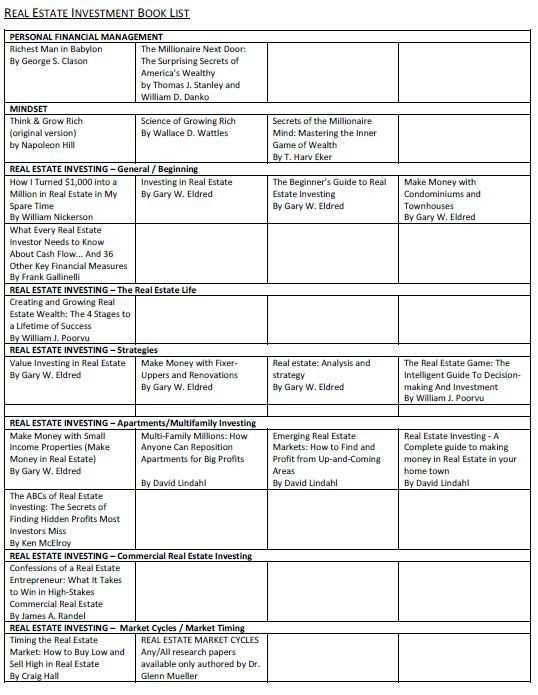
But you can pickup them basics by reading many real estate books (here’s my list below; I recommend reading then in order top to bottom).
Once you practice the MATHS and apply it to actual deals, I’m confident your visual way of learning will help you pick it up. I’m also a visual learner.
@Joe VilleneuveHi Joe. Could you please share your secret? To a certain extent I can work things in my head but I would like how I can do things faster and confidence in my accurately.
there’s no “secret”. The secret is hard work, self-discipline, courage, acting in spite of fear, never ending learning, growth, and constantly striving to achieve your investment goals... and therefore life goals. If there was a “secret” everyone would be doing it.
Yup.. its just reality that math concepts can be quite tough for many.
I see it all the time with whole sale deals.. IE pay 200k sell for 250k and make 50k with no concept of the expenses that go into it and that that kind of spread equates to maybe 10k profit not 50k
More than that. They don't understand the concept of exponential returns, and rely on percentages in their answers to measure their success. Percentages lie when they are the answer in a REI analysis.
They also accept the answers as givens, instead of the answer being results of the givens...and the variables...and don't realize they can control the variables, because too many live on the right side of the equal sign. The variables, and the control of them, live on the left. If the REI understood the left, instead of taking the quick (lazy), instant gratification the right side gives them, they would see a whole new world of options in REI they never knew were there.
This is why, when asked what books a REI should read, I always give the same answer: Geometry and Algebra. Geometry teaches how to think through a problem, and multi-task it to build a path (plan in REI) to the future answer. Algebra teaches how to apply that plan.
Math is nothing but a series of different languages. No different than French, English (OK, I have to count British English and American English as 2 different languages), etc... Just like those languages, one language can talk to another with the use of an interpreter. Math is no different. You need to interpret each math language into English, and back to math to fully understand math...and the REI needs to be able to be that interpreter.
I blame the way they teach math in school for the struggles found doing this. They teach/use story problems backwards. They should use story problems first to teach the math, instead of teach the math, then apply it to story problems.
Math is in EVERYTHING we do and experience in life.
Yes... and no.
Math is a language. Emotions, the way you feel about a given property, and all qualitative aspects of a given property can be deduced to numbers. For example, you can convert “architectural beauty” of a set of 5 properties into numbers then rank them based on the difference in income they may generate due to this aspect.
I would say that MATH is one or the most important language when it comes to REI, because if you do the math wrong or you do not know how to convert qualitative aspects of a given set of properties into math and rank them, it will cost you money.
For most people maximizing return is the single most important thing. So if you can’t do math, you’re unlikely to achieve your goal if at all or at least not efficiently. Math is critical.
REI fundamentally IS MATH. If you can't do math, all other needed skills (risk management, people management, investment analysis, acquisitions, dispositions, market research etc etc) become useless
missing on your list... time value of money, discounted cash flows, return calculations (COC, IRR, MIRR, etc).
EMotions have no place in REI...sorry. It will cause you to rationalize a bad deal.
I said my list was a partial one of a much longer one, so there were a number of things left out. I listed what I thought were the most important.
From you short add ons to my list:
1 - Time/value of money is based on the above list. 2 - Discounted cash flows are part of the Analysis 3 - Return calculations: a - COC is important...and on my extended list, but it is only a part of the bigger picture since it is only factored for the first year. I want to know how fast I get ALL of my cash back. b - IRR and MIRR I ignore because they are percentage that tell me nothing of value in REI. In the stock market yes, in REI they are a waste of time and a distraction from the real important numbers...with dollar signs.
I disagree.
you are an emotional creature. Emotions and intuition DO have a place in REI just like they have a place in the legal profession. Knowing when and how to use emotions as a lawyer is the same as knowing when and how to use emotions in real estate.
It’s about how you use them. Using them mindfully with intent. You need to know what and why you feel them and how to use them when you’re evaluating deals, whether or not to work with particular people etc. Your emotions are informing. You have them for a reason.
If your emotions are not considered, you’re operating as part a human being, and not as a full and dynamic investor. Quantitative should be applied first, qualitative second, including emotions, intuition etc.
NEVER go through with a deal if your intuition is telling you not to. If you do, you’ll regret it.
IRR. I'm shocked if you do not use Internal Rate of Return in your efforts to invest in real estate. This is the best way to evaluate return, which includes discounted cash flowed. If return is not important to you, how do you select among several possible deals?
IRR is used in combination with NPV and CoC. They are used to provide the investor specific information about the nature of each investment, and they provide useful way to compare them. No investor should be in testing in real estate without understanding these performance measurements and how to use them.
I have a similar issue. I just worked with the knowledge I do have and moved at the pace I could understand the deals and have done well. Probably not as great or as fast as some others but I do have financial freedom. I studied different ways of buying and have gone with the ways I feel most comfortable with and do understand. I am conservative and some have laughed at me but in the end my own statistics for myself have increased and I am so happy I followed the routes I did and am where I am today. I use spread sheets and take longer than others to figure a lot out. I don't conceptualize it all either. I know that if I were to sit down and clear up all the terms very thoroughly I would get them with practice. If something sounds too confusing or I can see things are not matching up to what I do know, I don't go with it. Should you find any other way to help you with this besides just sitting down and clearing all the terms very well, let me know. I am also interested.
Ah, as a math teacher, this post feels like the time Cliff Clavin was on Jeopardy. Right up my alley! haha
"I blame the way they teach math in school for the struggles found doing this. They teach/use story problems backwards. They should use story problems first to teach the math, instead of teach the math, then apply"
@Joe Villeneuve You'll be happy to know that they're teaching it this way more and more (at least my math book is set up this way).
"They think they're super-special mentally, all the horsepower upstairs in the world -- but they're not and it's laughably obvious at times."
@Jim K. I'm not sure what you're getting at here?!?! I'm pretty sure that I'm super-special mentally (and if my mom were still alive, she would definitely confirm. However, my wife is on your side. So.... haha.)
I tell my students all the time that their brains are still maturing just like their bodies. I think the biggest problem we have is promoting kids based on age instead of ability/maturity. It's crazy what kids can understand (that they couldn't previously), when their brain is more mature and ready for the information. Some of these kids come to high school at 5' 7" and graduate at 5' 9". Their "short" friend as a freshman go from 5' 4" to 6' 3". Why wouldn't their brains be doing the same thing?
Yup.. its just reality that math concepts can be quite tough for many.
I see it all the time with whole sale deals.. IE pay 200k sell for 250k and make 50k with no concept of the expenses that go into it and that that kind of spread equates to maybe 10k profit not 50k
More than that. They don't understand the concept of exponential returns, and rely on percentages in their answers to measure their success. Percentages lie when they are the answer in a REI analysis.
They also accept the answers as givens, instead of the answer being results of the givens...and the variables...and don't realize they can control the variables, because too many live on the right side of the equal sign. The variables, and the control of them, live on the left. If the REI understood the left, instead of taking the quick (lazy), instant gratification the right side gives them, they would see a whole new world of options in REI they never knew were there.
This is why, when asked what books a REI should read, I always give the same answer: Geometry and Algebra. Geometry teaches how to think through a problem, and multi-task it to build a path (plan in REI) to the future answer. Algebra teaches how to apply that plan.
Math is nothing but a series of different languages. No different than French, English (OK, I have to count British English and American English as 2 different languages), etc... Just like those languages, one language can talk to another with the use of an interpreter. Math is no different. You need to interpret each math language into English, and back to math to fully understand math...and the REI needs to be able to be that interpreter.
I blame the way they teach math in school for the struggles found doing this. They teach/use story problems backwards. They should use story problems first to teach the math, instead of teach the math, then apply it to story problems.
Math is in EVERYTHING we do and experience in life.
Yes... and no.
Math is a language. Emotions, the way you feel about a given property, and all qualitative aspects of a given property can be deduced to numbers. For example, you can convert “architectural beauty” of a set of 5 properties into numbers then rank them based on the difference in income they may generate due to this aspect.
I would say that MATH is one or the most important language when it comes to REI, because if you do the math wrong or you do not know how to convert qualitative aspects of a given set of properties into math and rank them, it will cost you money.
For most people maximizing return is the single most important thing. So if you can’t do math, you’re unlikely to achieve your goal if at all or at least not efficiently. Math is critical.
REI fundamentally IS MATH. If you can't do math, all other needed skills (risk management, people management, investment analysis, acquisitions, dispositions, market research etc etc) become useless
missing on your list... time value of money, discounted cash flows, return calculations (COC, IRR, MIRR, etc).
EMotions have no place in REI...sorry. It will cause you to rationalize a bad deal.
I said my list was a partial one of a much longer one, so there were a number of things left out. I listed what I thought were the most important.
From you short add ons to my list:
1 - Time/value of money is based on the above list. 2 - Discounted cash flows are part of the Analysis 3 - Return calculations: a - COC is important...and on my extended list, but it is only a part of the bigger picture since it is only factored for the first year. I want to know how fast I get ALL of my cash back. b - IRR and MIRR I ignore because they are percentage that tell me nothing of value in REI. In the stock market yes, in REI they are a waste of time and a distraction from the real important numbers...with dollar signs.
I disagree.
you are an emotional creature. Emotions and intuition DO have a place in REI just like they have a place in the legal profession. Knowing when and how to use emotions as a lawyer is the same as knowing when and how to use emotions in real estate.
It’s about how you use them. Using them mindfully with intent. You need to know what and why you feel them and how to use them when you’re evaluating deals, whether or not to work with particular people etc. Your emotions are informing. You have them for a reason.
If your emotions are not considered, you’re operating as part a human being, and not as a full and dynamic investor. Quantitative should be applied first, qualitative second, including emotions, intuition etc.
NEVER go through with a deal if your intuition is telling you not to. If you do, you’ll regret it.
IRR. I'm shocked if you do not use Internal Rate of Return in your efforts to invest in real estate. This is the best way to evaluate return, which includes discounted cash flowed. If return is not important to you, how do you select among several possible deals?
IRR is used in combination with NPV and CoC. They are used to provide the investor specific information about the nature of each investment, and they provide useful way to compare them. No investor should be in testing in real estate without understanding these performance measurements and how to use them.
I invest for dollars, not percentages. The percentages you are saying are important are based on the dollars I say are important. The difference is, I want to know what to dollars are, because the percentages don't tell me what I need to know. I want to know actual numbers...not numbers that are a summary of numbers.
You can have a higher rate of return (pick the rate formula) on Property A than on B, but have a higher actual dollar return on B rather than A. Which one allows you to exponentially move forward faster and better?
For instance, if two investors both start with $100k in cash. One invests in the SM and the other invests in RE. The SM investor gets a return of 15% every year for the next 10 years, and invests the dividend portion (say 5%) back into the SM every time it reaches the minimum required cost of that same investment. The REI only gets a 5% return (appreciation and paydown) with the addition of the cash flow (say $10k/yr on every $100k property bought all cash. Less if bought with debt), and invests the CF back into the same investments at the same cash cost when the accumulated cash equals that cash cost....who ends up with the greater CF and total property/Stock values from the start to the end?