I was curious on what the rate of return would be on real estate from nothing more than principal paydown alone. Turns out it's not that shabby. Using my trusty CCIM Institute financial calculator, if you get a 80% LTV loan with a 20 year amortization, then break even for 20 years while the property gains nothing in value (which never happens over 20 years), the rate of return is still 7.18%.
Yes, it's not a "cash return," it's just "equity and no, it's not incredible by any means, but nothing to sneeze at. The historical average for the stock market is about 10%. (https://www.nerdwallet.com/.../average-stock-market-return) And this is just principal paydown. It doesn't include the appreciation (like the insanity we're seeing now), tax advantages cash flow or the other advantages of buy and hold: https://www.biggerpockets.com/...
It would also be a lower return if you paid it off early as the early payments are mostly interest, but it still shows the power of buy and hold real estate.
Overall, another reason to love real estate.
I went back and read the posts here again. Somehow I got confused (I think) and I apologize. Somewhere I interpreted the paydown we were talking about as coming "out of pocket" and not exclusively coming from the normal mortgage payment that's paid by the tenant's rent money. Of course mortgage paydown is a gain, if the money comes from the rent and not the cash flow or the REI's own personal cash.
As a result, I fired my proof reader (that would be my body double).
@Andrew Syrios very interesting. I just wrote a post about how cash flow is last in our order of priority when we analyze properties.
Good location and predictability are key!
There is NO return from principle paydown...zero. You are gaining equity equal to the amount of money you are spending. In other words, you're buying the equity at face value. Where's the gain?
I was curious on what the rate of return would be on real estate from nothing more than principal paydown alone. Turns out it's not that shabby. Using my trusty CCIM Institute financial calculator, if you get a 80% LTV loan with a 20 year amortization, then break even for 20 years while the property gains nothing in value (which never happens over 20 years), the rate of return is still 7.18%.
Yes, it's not a "cash return," it's just "equity and no, it's not incredible by any means, but nothing to sneeze at. The historical average for the stock market is about 10%. (https://www.nerdwallet.com/.../average-stock-market-return) And this is just principal paydown. It doesn't include the appreciation (like the insanity we're seeing now), tax advantages cash flow or the other advantages of buy and hold: https://www.biggerpockets.com/...
It would also be a lower return if you paid it off early as the early payments are mostly interest, but it still shows the power of buy and hold real estate.
Overall, another reason to love real estate.
Wow, what an awesome idea!
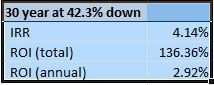
Just for curiosity's sake, I ran the numbers for one of my properties which is performing pretty well. I put 42.3% down, and with a 30 amort (as opposed to a 20 year like yours) I get the following numbers:
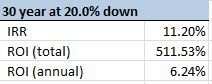
I guess the above pretty much confirms what we already knew....the ROR from principal paydown is much higher when you put down less. I recreated the numbers using 20% down on a 30-year schedule and got the following:
When running the same using a 20 year amort schedule, I actually get numbers a little higher than yours (9.5% ROI), but a little variation is to be expected as we are talking about a very long period of time and there are always subtle nuances in calculating performance (some syndicators are experts at this). I also ran mine using a monthly schedule this using my trusty IRR/ROI table.
EDIT: I just realized your number is IRR also. Since IRR is highly dependent on cash flow, it makes sense that my numbers are a bit higher as I ran mine using a monthly schedule. Anyway, I think folks get the idea!
There is NO return from principle paydown...zero. You are gaining equity equal to the amount of money you are spending. In other words, you're buying the equity at face value. Where's the gain?
From the original post, "Yes, it's not a "cash return," it's just "equity."
Equity is still a gain even if it's not measured as cash until you sell. And this assumes 1) you get an 80% loan and 2) your rental income covers all expenses but there is no cash flow above that. Basically you pay off your loan over 20 years and that return is 7.18% (minus the costs to sell if you realize that gain by selling)
@Andrew Syrios very interesting. I just wrote a post about how cash flow is last in our order of priority when we analyze properties.
Good location and predictability are key!
I agree completely. Cash flow is the cherry on top. It needs to be there to prevent you from needing to refinance/sell (or hold a job) to keep your properties performing, but it's not going to be what gets you rich.
I was curious on what the rate of return would be on real estate from nothing more than principal paydown alone. Turns out it's not that shabby. Using my trusty CCIM Institute financial calculator, if you get a 80% LTV loan with a 20 year amortization, then break even for 20 years while the property gains nothing in value (which never happens over 20 years), the rate of return is still 7.18%.
Yes, it's not a "cash return," it's just "equity and no, it's not incredible by any means, but nothing to sneeze at. The historical average for the stock market is about 10%. (https://www.nerdwallet.com/.../average-stock-market-return) And this is just principal paydown. It doesn't include the appreciation (like the insanity we're seeing now), tax advantages cash flow or the other advantages of buy and hold: https://www.biggerpockets.com/...
It would also be a lower return if you paid it off early as the early payments are mostly interest, but it still shows the power of buy and hold real estate.
Overall, another reason to love real estate.
Wow, what an awesome idea!
Just for curiosity's sake, I ran the numbers for one of my properties which is performing pretty well. I put 42.3% down, and with a 30 amort (as opposed to a 20 year like yours) I get the following numbers:
I guess the above pretty much confirms what we already knew....the ROR from principal paydown is much higher when you put down less. I recreated the numbers using 20% down on a 30-year schedule and got the following:
When running the same using a 20 year amort schedule, I actually get numbers a little higher than yours (9.5% ROI), but a little variation is to be expected as we are talking about a very long period of time and there are always subtle nuances in calculating performance (some syndicators are experts at this). I also ran mine using a monthly schedule this using my trusty IRR/ROI table.
EDIT: I just realized your number is IRR also. Since IRR is highly dependent on cash flow, it makes sense that my numbers are a bit higher as I ran mine using a monthly schedule. Anyway, I think folks get the idea!
Thanks Tony! And yes, IRR is usually similar to ROI unless the cash comes in near the end, since IRR takes into account when you get the money and ROI does not. Since you "get the money" (yes there's no cash here unless you sell or refinance) at the end, I think using IRR is more realistic in this instance.
There is NO return from principle paydown...zero. You are gaining equity equal to the amount of money you are spending. In other words, you're buying the equity at face value. Where's the gain?
From the original post, "Yes, it's not a "cash return," it's just "equity."
Equity is still a gain even if it's not measured as cash until you sell. And this assumes 1) you get an 80% loan and 2) your rental income covers all expenses but there is no cash flow above that. Basically you pay off your loan over 20 years and that return is 7.18% (minus the costs to sell if you realize that gain by selling)
You're buying the equity. That's not a gain. Saving the interest on the loan isn't a gain either...it's just eliminating an expense. Just because you're not paying the interest doesn't mean it's a profit...it's just not a loss.
Appreciation is a gain, but equity payoff using your own money or the cash flow, isn't a gain.
There is NO return from principle paydown...zero. You are gaining equity equal to the amount of money you are spending. In other words, you're buying the equity at face value. Where's the gain?
From the original post, "Yes, it's not a "cash return," it's just "equity."
Equity is still a gain even if it's not measured as cash until you sell. And this assumes 1) you get an 80% loan and 2) your rental income covers all expenses but there is no cash flow above that. Basically you pay off your loan over 20 years and that return is 7.18% (minus the costs to sell if you realize that gain by selling)
You're buying the equity. That's not a gain. Saving the interest on the loan isn't a gain either...it's just eliminating an expense. Just because you're not paying the interest doesn't mean it's a profit...it's just not a loss.
Appreciation is a gain, but equity payoff using your own money or the cash flow, isn't a gain.
If one was paying down the loan completely independent of rental revenue, I would agree. It's just a transfer of assets that does not affect your net worth.
However, if you use half your rental revenue to pay down your principal, then that portion of your gain from the rental revenue would simply be in the form of equity paydown. They both have the same effect on your net worth.
I hate hypotheticals, but just as a simple illustration, if someone gave you $500 as a gift, you could either put it in your pocket or you can use it to pay down your CC debt. Either way, it's still exactly the same benefit.
There is NO return from principle paydown...zero. You are gaining equity equal to the amount of money you are spending. In other words, you're buying the equity at face value. Where's the gain?
From the original post, "Yes, it's not a "cash return," it's just "equity."
Equity is still a gain even if it's not measured as cash until you sell. And this assumes 1) you get an 80% loan and 2) your rental income covers all expenses but there is no cash flow above that. Basically you pay off your loan over 20 years and that return is 7.18% (minus the costs to sell if you realize that gain by selling)
You're buying the equity. That's not a gain. Saving the interest on the loan isn't a gain either...it's just eliminating an expense. Just because you're not paying the interest doesn't mean it's a profit...it's just not a loss.
Appreciation is a gain, but equity payoff using your own money or the cash flow, isn't a gain.
If one was paying down the loan completely independent of rental revenue, I would agree. It's just a transfer of assets that does not affect your net worth.
However, if you use half your rental revenue to pay down your principal, then that portion of your gain from the rental revenue would simply be in the form of equity paydown. They both have the same effect on your net worth.
I hate hypotheticals, but just as a simple illustration, if someone gave you $500 as a gift, you could either put it in your pocket or you can use it to pay down your CC debt. Either way, it's still exactly the same benefit.
No, it's the same thing. Using CF to pay down the principle is still using your money. Cash flow is your money. You are reducing the profit from the cash flow, and just transferring it to the equity. The only difference is when it is in the form of CF, it is liquid and can be invested at a 1 to 5 ratio of cost to value. When you just transfer it to equity, it is buying equity that equity at a 1 to 1 value. Using your cash flow to buy equity is losing money...not gaining it. Let the tenant buy your house for you. That's their job.
There is NO return from principle paydown...zero. You are gaining equity equal to the amount of money you are spending. In other words, you're buying the equity at face value. Where's the gain?
From the original post, "Yes, it's not a "cash return," it's just "equity."
Equity is still a gain even if it's not measured as cash until you sell. And this assumes 1) you get an 80% loan and 2) your rental income covers all expenses but there is no cash flow above that. Basically you pay off your loan over 20 years and that return is 7.18% (minus the costs to sell if you realize that gain by selling)
Equity you pay for isn't a gain unless the value of that equity is greater than the cost.
This is a prime example how %%%% lie.
There is NO return from principle paydown...zero. You are gaining equity equal to the amount of money you are spending. In other words, you're buying the equity at face value. Where's the gain?
From the original post, "Yes, it's not a "cash return," it's just "equity."
Equity is still a gain even if it's not measured as cash until you sell. And this assumes 1) you get an 80% loan and 2) your rental income covers all expenses but there is no cash flow above that. Basically you pay off your loan over 20 years and that return is 7.18% (minus the costs to sell if you realize that gain by selling)
Equity you pay for isn't a gain unless the value of that equity is greater than the cost.
This is a prime example how %%%% lie.
If the asset provides a source of revenue sufficient to pay down the principal and all other costs associated with the property (i.e. pay for the equity) then it effectively is a gain.
There is NO return from principle paydown...zero. You are gaining equity equal to the amount of money you are spending. In other words, you're buying the equity at face value. Where's the gain?
From the original post, "Yes, it's not a "cash return," it's just "equity."
Equity is still a gain even if it's not measured as cash until you sell. And this assumes 1) you get an 80% loan and 2) your rental income covers all expenses but there is no cash flow above that. Basically you pay off your loan over 20 years and that return is 7.18% (minus the costs to sell if you realize that gain by selling)
You're buying the equity. That's not a gain. Saving the interest on the loan isn't a gain either...it's just eliminating an expense. Just because you're not paying the interest doesn't mean it's a profit...it's just not a loss.
Appreciation is a gain, but equity payoff using your own money or the cash flow, isn't a gain.
If one was paying down the loan completely independent of rental revenue, I would agree. It's just a transfer of assets that does not affect your net worth.
However, if you use half your rental revenue to pay down your principal, then that portion of your gain from the rental revenue would simply be in the form of equity paydown. They both have the same effect on your net worth.
I hate hypotheticals, but just as a simple illustration, if someone gave you $500 as a gift, you could either put it in your pocket or you can use it to pay down your CC debt. Either way, it's still exactly the same benefit.
Yes, on a personal home, building up equity by paying down the principal of the loan is nice, but you are just paying for equity. Same is true to a lesser extent on an income property that doesn't cash flow. But on one that does cash flow, the principal paydown can be considered a de facto cash flow or forced savings or equity buildup or whatever you want to call it: A gain.
There is NO return from principle paydown...zero. You are gaining equity equal to the amount of money you are spending. In other words, you're buying the equity at face value. Where's the gain?
From the original post, "Yes, it's not a "cash return," it's just "equity."
Equity is still a gain even if it's not measured as cash until you sell. And this assumes 1) you get an 80% loan and 2) your rental income covers all expenses but there is no cash flow above that. Basically you pay off your loan over 20 years and that return is 7.18% (minus the costs to sell if you realize that gain by selling)
You're buying the equity. That's not a gain. Saving the interest on the loan isn't a gain either...it's just eliminating an expense. Just because you're not paying the interest doesn't mean it's a profit...it's just not a loss.
Appreciation is a gain, but equity payoff using your own money or the cash flow, isn't a gain.
If one was paying down the loan completely independent of rental revenue, I would agree. It's just a transfer of assets that does not affect your net worth.
However, if you use half your rental revenue to pay down your principal, then that portion of your gain from the rental revenue would simply be in the form of equity paydown. They both have the same effect on your net worth.
I hate hypotheticals, but just as a simple illustration, if someone gave you $500 as a gift, you could either put it in your pocket or you can use it to pay down your CC debt. Either way, it's still exactly the same benefit.
Yes, on a personal home, building up equity by paying down the principal of the loan is nice, but you are just paying for equity. Same is true to a lesser extent on an income property that doesn't cash flow. But on one that does cash flow, the principal paydown can be considered a de facto cash flow or forced savings or equity buildup or whatever you want to call it: A gain.
How are you gaining? You are paying for it at face value. You are taking a loss on your personal worth by taking the same money out of your savings (or whatever location it is coming from). This means the equity you are buying is the same money you had in the bank..."Had" being the important word.
To say you are getting a "forced savings" is wrong. You "had" a savings in the bank that was liquid, not in equity it's not. When you move it to equity it's just sitting in a different place. It's the same money, and equal to the exact same value when it was in your bank account. When it's in your bank, liquid, you have the ability to invest it as a 20% DP. This would mean it would be bringing you a property worth 5 times its face value. That's a gain.
There is NO return from principle paydown...zero. You are gaining equity equal to the amount of money you are spending. In other words, you're buying the equity at face value. Where's the gain?
From the original post, "Yes, it's not a "cash return," it's just "equity."
Equity is still a gain even if it's not measured as cash until you sell. And this assumes 1) you get an 80% loan and 2) your rental income covers all expenses but there is no cash flow above that. Basically you pay off your loan over 20 years and that return is 7.18% (minus the costs to sell if you realize that gain by selling)
Equity you pay for isn't a gain unless the value of that equity is greater than the cost.
This is a prime example how %%%% lie.
If the asset provides a source of revenue sufficient to pay down the principal and all other costs associated with the property (i.e. pay for the equity) then it effectively is a gain.
IT's not an additional gain. It's the same gain as the CF you are using to buy it. The gain you had from the CF is simply being transferred to the equity. If you want to take it a step further, it's actually a loss since that equity you bought was already free to you since it was being paid buy the tenant...from the rent money before you got your cash flow.
Your only cost in a positive CF property is the money that comes out of your pocket in the form of cash, since everything else is being paid for by the tenant. Once you start helping the tenant pay for your property, you are just increasing your cost.
Nice post @Andrew Syrios , this is exactly what I have done in the past 10 years. I have invested out of state, bought properties at market prices, and have break-even cash flow, still increased my equity (thus net worth) by 24 folds. Since I am heavily leveraged, I also pulled out a large chunk of equity(about $0.4M) as cash reserve in the last two years. It worked perfectly for me.
Joe likes to use his own definitions that have nothing to do with reality lol.
@Andrew Syrios
Why would you “buy” equity when cash flow can make you more money. For example, if you Invest 100 dollars into your “equity” each month get all that money back in 10- 15 or 20 years, you actually lost money because of the time value of money.
1200 dollars per year x 20 years =$24000
1200 dollars per year INVESTED X 20 years = just over $69,400
Now let’s just say you’re really motivated and you wanna invest those $24,000 into your equity right now, well in 20 years, it would probably would be be equivalent to less than $10,000 when compared to the current years purchasing power.
Equity is dead money that’s not working.
@Joe Villeneuve
Joe what are you not getting about this? This guy is running a hypothetical scenario where if he put 20% down on a rental and it cashflowed $0 and his tenants only payed down the mortgage and capX what his return would look like.
Use a $300,000 purchase price as an example. He puts up $60k + say $10k for closing codts so he is in for $70k. Over the next 30 years his tenants pay his mortgage down to $0.
He now has a $300,000 house fully paid off by someone else for a gain of $230,000.
If you don’t understand this then Im not sure what to tell you…lolol
@Andrew Syrios
Why would you “buy” equity when cash flow can make you more money. For example, if you Invest 100 dollars into your “equity” each month get all that money back in 10- 15 or 20 years, you actually lost money because of the time value of money.
1200 dollars per year x 20 years =$24000
1200 dollars per year INVESTED X 20 years = just over $69,400
Now let’s just say you’re really motivated and you wanna invest those $24,000 into your equity right now, well in 20 years, it would probably would be be equivalent to less than $10,000 when compared to the current years purchasing power.
Equity is dead money that’s not working.
You're not "buying" anything....nobody is suggesting any prepayment of principal or anything like that. You're just making your monthly mortgage payments. Simple as that. What other avenue would you suggest? Stop making our monthly payments? He's simply pointing out that instead of the entire amount of the monthly mortgage being a total loss, some of that payment gets applied to principal. Would you rather have $10,000 in debt or would you rather have $5,000 in debt? I would rather have $5,000, but that's just me. We are allowing our tenants to pay down our debt when we take their rent money and use some of it to make our mortgage payments. If you don't see the benefit in that, no big deal... you still have to make your monthly mortgage payments, right?
Joe likes to use his own definitions that have nothing to do with reality lol.
LoL, I knew I was making a mistake even when typing out my response and posting. I'm well aware of Villeneuve's system.
I think the idea here is using part of the "power of leverage." By using the rental income to pay back/off the loan, you are using somebody else's money to "regain your equity." Its no different as treating net rental income as profit. Meanwhile, the amount of the loan was never your money either --- its still "other people's money." This is still what I thought was part of basic investing where you use the rental income to pay off the loan and other expenses. In 30 years, you have a property free and clear with only the cost of the money you put down and your time.
@Joe Villeneuve
You seem to be thinking he is talking about paying down the principle out of pocket. But he’s talking about the principle paydown that is REQUIRED by the lender. It comes from the tenant and goes to your minimum payment based on the loan amortization schedule.
Equity build-up is not dead money; it is conservatively invested money. To compare equity build-up to alternative higher risk investments that could have been purchased with the positive cash flow is not entirely fair. True opportunity cost is measured by comparing alternative investments with the same level of risk. To see this illustrated assume investor A put $500 positive cash back into equity paydown and investor B bought Enron stock with his cash flow prior to the fall. Who is the happier investor? Paydown using tenant's cash can be a good strategy for the turtles out there. Not so much for the hares.
I think I’m not understanding this correctly, but if we assume 1) cash flow is $0 (i.e. cash covers expense + principal) and 2) property does not appreciate in value, then how is value being created?
Also, paying down the principal of a mortgage does not create financial value.
Think about it from this point of view, if you do a cash deal the IRR should not change. Now leverage magnifies the IRR, so in theory prepaying down a mortgage should hurt your IRR calculation and bring it closer to your cash IRR.
I do agree though, that having less leverage is more prudent. You'll see a lot of the SFH REITs out there operate with significantly less leverage as well
I don't follow accounting rules as well. But, using your assumptions look at it this way. On purchase, you only have a 20% stake in the equity of the property. The bank/lender/noteholder has the other 80%. After 30yr, now you have 100% stake in the property. So, no, on hasn't created an equity, but the equity has "changed hands."