Will COVID-19 Cause a Recession?

Will COVID-19 Cause a Recession?

Adiel GorelPro Member
Real Estate Broker · San Rafael, CA · Member since 2016 · 13 posts · 30 votes

As we all observe and fear the Coronavirus, we see many cities under “shelter-at-home” restrictions, and many “non-essential” businesses closing. Then on the other hand, the Fed lowered rates almost to zero, and mortgage rates, after a short spike, are starting to settle down near the lowest point ever. Some people fear a recession is likely to follow, and if we remember the recession of 2008, I think it’s quite possible. That depends, of course, on the length of the lock-down.

If a recession does occur, let’s point out some of the differences between the recession of 2008 and the next recession, if it hits.

Before the 2008 recession happened, there was a major boom in many states. Home prices in states like Arizona, Nevada and Florida went through the roof. The media was shouting “It’s a bubble! It has to burst!” Prices of homes in Phoenix, for example, nearly doubled from the beginning of 2004 till the middle of 2006. Not all states participated in the party, for example, Texas and Oklahoma have not gone up very much during that time.

When the 2008 recession hit, the markets that went down precipitously were, of course, the exact markets that had participated in the 2004-2006 boom. Places in Arizona, Nevada, Florida, and other states. Prices tanked and crashed quite a bit. However not across the board, states like Texas and Oklahoma did not go down very much during the recession of 2008.

By contrast, at the present time, especially in affordable markets like Oklahoma City, Tulsa, Baton Rouge, Central Florida, parts of Atlanta, Raleigh and others, there are currently no price bubbles. No major boom has happened, Thus the likelihood of a major price crash in such markets is much slimmer than the markets which crashed in the 2008 recession. There are very high priced markets now, the expensive markets in San Francisco, for example (which has already started going down in price last year). In such markets, there may be a stronger effect on prices. Also, when you invest in a brand new home in a good area in Oklahoma and pay $170,000. You are buying the home not much over the basic construction and land cost. Again, the probability of an “intrinsic value” home like this going down much is small. By contrast, a $2M home in San Francisco, which cost $900K to build, has a lot of “air” in the price, with a higher likelihood of prices going down in San Francisco.

The recession of 2008 was created by housing. Lenders released all limits, and loans were made to virtually anyone that was human, almost regardless of credit or ability to pay. Some loans were up to 125% of the value of the house. This bad debt, called “sub-prime”, was then packaged among other debt, and amazingly, the credit agency gave these packages high ratings, as if it was a quality debt product. Then these faulty packages sold on Wall Street, and financial wizards found way to leverage them enormously. Once defaults on the bad loans started to hit, the entire structure unraveled.

By contrast, at the present we are still under the Dodd-Frank Act, which was drafted after the 2008 recession. Borrowing is now much harder and lengthier than it was before the 2008 recession. Even borrowers with great credit are finding the current loan processes frustrating. The amount of sub-prime loans is minuscule relative the period preceding the 2008 recession, and steps were taken to make the abuses with rating agencies be much harder to repeat. Thus the next recession is likely not to be caused by bad loans. It is clear that if another recession comes, its effects on rental home investing will be quite different than the recession of 2008.

I believe that the best way to invest in real estate is to buy brand new homes, in affordable large metropolitan areas, where the rent numbers match well with prices. Then finance the homes with a fixed-rate loan. To the best of my knowledge long term fixed rate loans like we get here in the US don’t exist elsewhere. The monthly payment and the mortgage balance never change with the cost of living, while everything else does. That means inflation constantly erodes the true buying buyer of your debt, making your debt ever smaller in real dollars.

For these kinds of homes, purchased anywhere from $150K to $250K, I believe the effects of the next recession will be minimal. Rates are very low, however, so fixed rate loans will retain these great rates forever.

The act of buying good rental homes in large metro areas and holding them as rental for the long term, where the loan erodes, is a future-changer. It does not change your future instantly or even within a short time, but over the long term, this strategy is a powerful future changer. I have seen people retire well, send kids to college, and look much stronger financially thanks to these simple yet powerful investments.

Since these investments show their power over the long term, and since the interest rates are so favorable now, and since a possible impending recession is unlikely to have effects on prices like the 2008 recession, I believe this would be a good time to invest.

As an extra “bonus”, the virus fear creates more flexibility with sellers, including builders, and the ability to negotiate better prices.

I would be happy to discuss it with anyone who may wish to inquire further.

30Reply
152 views

Most Popular Reply

Columbia, MD · Member since 2018 · 27 posts · 169 votes
6y

We have strong economy ??? Really ? Do we? 10 days after the shut down of the country most Americans did NOT have the money to pay their rent on April 1st .... just freaking 10 days !!! They did not last one month !! San Antonio, food bank, feeds 120k people a week, millions on unemployment, in a few weeks you will hear about families with crazy hospital bills to pay ($20K-30K each) plus some will have funerals to pay for ( 5-10k) and that's while many were without any income coming in. Commercial real-estate owners about to lose their pants during corona epidemic, all those with over leveraged investments and kings of BRRRR will feel the sh** hitting the fan in like 3,2,1.....while rent goes un paid. This was not strong economy to begin with! Homes, cars and student loans leveraged to the brim while most pay the minimum is not a sign of strong economy.This was crap economy on borrowed time and borrowed cheap money. Sorry y'all

See this reply in the discussion

178 Replies

Jump to latestLatest
  • Joseph ODonovanPro Member
    Property Manager · Ridley, PA · Member since 2017 · 427 posts · 449 votes
    6y

    @Adiel Gorel When a neighbor loses his or her job, it's a recession. When you lose your job, it's a depression. It's all relative.

  • Investor/Agent/Entrepreneur · Dallas, TX · Member since 2016 · 464 posts · 564 votes
    6y

    I think we're already in the start of a recession, despite what the equity market has been showing this past week. The market can rally, but there are major economic consequences with unemployment, and all of those jobs sadly will not be coming back in the next few months. I think RE investors will feel the impact starting later this summer, into 2021. The hardest hit I think will be the small businesses, and everyone who has over-leveraged during the past decade. 

  • Investor · Fall River, MA · Member since 2014 · 399 posts · 300 votes
    6y

    @Adiel Gorel thanks for this very informative post!

    Cheers to your success!

  • Ridgewood, NY · Member since 2015 · 50 posts · 14 votes
    6y

    @Joseph Cacciapaglia

    The economy most definitely is not strong its inflated by the Fed. 1/3 of renters did not pay their rent, you can do a quick research on that it will take 30 seconds. We most definitely are headed down a recession.

    Banks are tightening up their lending applications as Chase officially did today. This is because they are weary to lend out any debt. Investors who buy mortgage securities are iffy. The 2008 crash was awful and it was not helped we kicked the debt down the timeline. Corona virus only magnified and accelerated what economist were already seeing fundimentally wrong with U.S.

    Im airing on the side of this being worse than 2008 economically, maybe not as much of a housing buble or forclosures but the issue in america is DEBT.

  • Ridgewood, NY · Member since 2015 · 50 posts · 14 votes
    6y

    @Luke Ski

    Agreed. People don’t understand debt is the issue here. The Fed econic researchers and chairs are men who have algorithms to forsee the future. They have no life experience, never managed a payroll. This is where the country goes wrong. We have a debt crisis, we have an oil crisis, we have a share buy back crisis that incentivizes Corps to prop up stocks rather than invest in the future. Then we go and bail them oht for their poor investment strategies. Let the. Fail. Any major corp who decided to spend 90% of their profits on share buy backs should be allowed to fail such as the airline industry. Major crisis ahead that would gave happened regardless of corona. That just magnified and accelerated. In 2019 US was 90% consumer spending! We did not even have the ability to aupple millions of masks, MASKS that cost 10 cents! The only thing we should be spending trillions of stimulus dollars on is incentives for manufacturing things here and stop being a country of 90% consuming

  • Ridgewood, NY · Member since 2015 · 50 posts · 14 votes
    6y

    @Theresa Harris

    Man the stock market is the worlds greatest ponzi scheme. Inflated markets stocks rising company production NOT. look at the charts. Thats an online casino.

  • Member since 2018 · 6 posts · 13 votes
    6y

    Depression for sure, but this time the frustrating thing is that the impact on real estate, stock markets, dollar value etc.. is going to be hard to discern. Our economies, financial instruments, accounting, market manipulation, crony capitalism, derivates, currency printing and delinking from gold standard leave our economy extremely complicated and fragile compared to 1929 when things were not as complicated. The state of the depressionary cycle will be painful leaving all analysts, economists and estimation models failing repeatedly for the next decade or so. Yet, things will not be as bad where fundamentals are reasonably okay, Real estate is one of them. Post 2009, lessons were learned to a large extent and poor quality buyers and mortgages were flushed out. So the underlying fundamentals are good in real estate except for one aspect - like all other asset classes real estate has also been the victim of cheap money and hence inflated - to that extent, prices should see a correction. However, a crash like 2009 in real estate won't happen due to underlying fundamentals being reasonably okay. Of course, it won't escape some broad correction in addition to just inflated asset values, but historically real estate and gold have always been the store of wealth across centuries and values will come back. If anything, once we hit the hyperinflation phenomenon due to reckless money printing, real estate will shoot up in value. This may be the beginning of the death of other funny money assets inflated out of proportion - stock markets likely will be hit harder due to derivatives - remember Warren Buffett's description that they are financial weapons of mass destruction - that has to come true at some point and the current depression seems like a good time for it. As someone said, this is a correction and survival of the fittest in terms of asset classes, the bad and weak will be flushed out. Some lessons have to be learned by real estate investors too - excessive leverage will be flushed out permanently. Those in the real estate market in the long haul and not so obsessed with just cash flow (without much appreciation value in their properties) will probably make it out better in the end and even with some great opportunities in the years to come. High cash flowing properties, especially multi units that thrive on lower or middle income population may be hard hit due to the recession. It's my experience that such properties more or less appreciate lower than those single family rentals in excellent school districts which do not cash flow as much. Good luck everyone and remember good health and life is more important than money any day.

  • Member since 2020 · 22 posts · 26 votes
    6y

    Absolutely there will be a depression or a strong recession. 80% of new jobs created since the 2009 recession are just gig jobs like Uber, doordash,...low-paying service-oriented jobs. Just LOL @ thinking the US has created any new meaningful manufacturing/programming jobs during the last 10 years. This whole economy/recovery has been propped up by nothing more than a couple of popsicle sticks and rubber bands. I predict a 40% haircut for a lot of properties in urban areas which will last only a short period of time, maybe a few months, before an inevitable rise back to pre-coronavirus levels quickly. 20-30% for more fortunate areas.

  • Ian WalshBusiness Member
    Lender · Philadelphia, PA · Member since 2016 · 2k+ posts · 1k+ votes
    6y

    We really won't know until we see the fall out damage it has done to the economy.  Until then, it is just a guess for everyone.

  • Member since 2018 · 37 posts · 5 votes
    6y

    Pitching in here to stay updated. Thanks for the valuable input. 

  • Joseph CacciapagliaBusiness Member
    Lender · San Antonio, TX · Member since 2020 · 1k+ posts · 1k+ votes
    6y
    Originally posted by @Andrew Galeano:

    @Joseph Cacciapaglia

    The economy most definitely is not strong its inflated by the Fed. 1/3 of renters did not pay their rent, you can do a quick research on that it will take 30 seconds. We most definitely are headed down a recession.

    Banks are tightening up their lending applications as Chase officially did today. This is because they are weary to lend out any debt. Investors who buy mortgage securities are iffy. The 2008 crash was awful and it was not helped we kicked the debt down the timeline. Corona virus only magnified and accelerated what economist were already seeing fundimentally wrong with U.S.

    Im airing on the side of this being worse than 2008 economically, maybe not as much of a housing buble or forclosures but the issue in america is DEBT.

    I've read the 1/3 headline that you're referencing too. The thing is, I spent more than the 30 seconds to "do a quick research", which is what most people are doing. There is a big difference between 1/3 and a majority, which is what the comment I was responding to had said. Also, you should look a little deeper at that number from the National Multifamily Housing Council that is being cited in the 1/3 headline (it was actually 69% by the 5th). In a typical month, only 81-82% of rents would have been collected by the 5th, which is the date that they're using. This is because a lot of people don't have to pay until later, and some are just late payers in general. So, we're not 1/3 off of normal, we've lost 12-13%, from 81-82% in a normal month to 69% this month. This isn't great, but is far from the catastrophe that the comment I was responding to was describing.

    I'm not arguing the fact that we're in a recession. It just has not had the impact on real estate that a lot of people are assuming, at least not yet. I think it's important to talk about facts, not read headlines and jump to conclusions. The National Multifamily Housing Council provided one data point that a lot of people misunderstood and then parroted. I was providing additional data from our own management portfolio and those of several operators I know. What's interesting, is when you look at those portfolios, they are much more in line with the 12-13% decrease than the 1/3 that is being bandied about. I think my numbers were skewed slightly better, because the majority of my contacts are in Texas, which typically does better in a recession.

    Joseph Cacciapaglia powered by Morty
  • Rental Property Investor · Denver · Member since 2019 · 4 posts · 4 votes
    6y

    There will be a recession. It will be worse for CRE office than multifamily residential (mostly because people, in US society at least, don't have the ability to access single-family options that in places where jobs exist). My three scenarios for CRE during the COVID outbreak on CRETech.com

    https://www.cretech.com/directory/company/microshare/news/a-rosie-scenario-that-could-ruin-us-all

  • Brookfield, WI · Member since 2016 · 191 posts · 108 votes
    6y

    I think it will depend on the results of the September elections.  If the status quo remains, then business will have a measure of "certainty" for 3 more years, consumer confidence will return, and the economy will return to how well it was humming along prior to the panic of COVID-19. I think if there is significant turnover, that instantly adds uncertainty, and business is universally adverse to uncertainty (it doesn't really matter the politics, change is change, either way).  Compounded by the fact that at that level the "change" that is expected takes a while to come into focus, until then it is speculation, and the business world has to make worst case assumptions.  So businesses will stock cash, stop re-investing, and maybe even cut back until the uncertainty is gone.  Now the real question, either way, will there be a HOUSING recession?  I suspect there will be a home buying downturn, which would increase rental needs, so, Win-Win?, unless you are banking on appreciation of course. 

  • Rental Property Investor · Gulf Shores, AL · Member since 2019 · 107 posts · 115 votes
    6y

    @Adiel Gorel

    Thank you for your analysis.

    Short response: Broadly speaking, I think you’re on the right track.

    Long response: it’s going to depend. Coronavirus isn’t hitting every geography the same:

    https://apple.news/AxoJ28rO8R_m8Hh-F34P-AQ

    I’m located in Alabama which has a diversified work force, is not significantly exposed to the tourism industry and has a lower population density which means less sickness and thus business closures and diminished economic impact.

    We’re going to be fine, relatively speaking.

    California, New York, Las Vegas, Houston, Seattle, etc. I would NOT want to have a property in any of those cities right now.

  • Real Estate Agent · Houston, TX · Member since 2017 · 290 posts · 233 votes
    6y
    Originally posted by @Reginald Ross:

    @Adiel Gorel

    Thank you for your analysis.

    Short response: Broadly speaking, I think you’re on the right track.

    Long response: it’s going to depend. Coronavirus isn’t hitting every geography the same:

    https://apple.news/AxoJ28rO8R_... located in Alabama which has a diversified work force, is not significantly exposed to the tourism industry and has a lower population density which means less sickness and thus business closures and diminished economic impact.

    We’re going to be fine, relatively speaking.

    California, New York, Las Vegas, Houston, Seattle, etc. I would NOT want to have a property in any of those cities right now.

    I spend a week in Alabama every summer and I'll agree with your post.  

    But interesting your lumped Houston into that list of cities above.  I'm curious... Why?  Oil prices will have repercussions for sure, but assuming restaurants come back in several months, we're strong there and the Medical center is big pull as well. 

     Vegas will struggle BADLY I believe for a while. The Strip has to be a very weird place now a days
     

  • Rental Property Investor · Gulf Shores, AL · Member since 2019 · 107 posts · 115 votes
    6y

    @James De Stefano

    I lumped Houston in there because of the oil and gas exposure

    I also exited my last REI position there back in January.

    I’m in the O&G industry and it’s getting double decimated by the coronavirus fallout AND the OPEC+/oversupply situation.

    I hope I’m wrong but I see Houston experiencing some pain.

  • Real Estate Agent · Lynwood, CA · Member since 2017 · 5 posts · 0 votes
    6y

    This was a good article. I would like to talk more into depth about the current state of the economy. My goal since the start of the year is to live in one unit and rent the other(s) out (House Hack). I am a realtor and investor in California. Over the last three years Ive learned about real estate and now Im ready to take the steps to own my first multi unit property. The last three months I've been learning about wholesaling to gain a different perspective on how to find discounted properties. Since the pandemic hit a lot of home owners that Ive reached out to have said they want to wait to sell their property until after the pandemic hits. 

    I would like to talk more about the perspective of the current state of the economy and strategies about acquisitions goals in the real estate field. 

    Robert Campbell DRE#: 02067990

    Best Regards, 

  • Real Estate Professional · Pittsburgh, PA · Member since 2014 · 18 posts · 3 votes
    6y

    We should just print more money..... Cause that has never caused a problem before......

  • John KosterPro Member
    Investor · Valley Village, CA · Member since 2012 · 147 posts · 142 votes
    6y

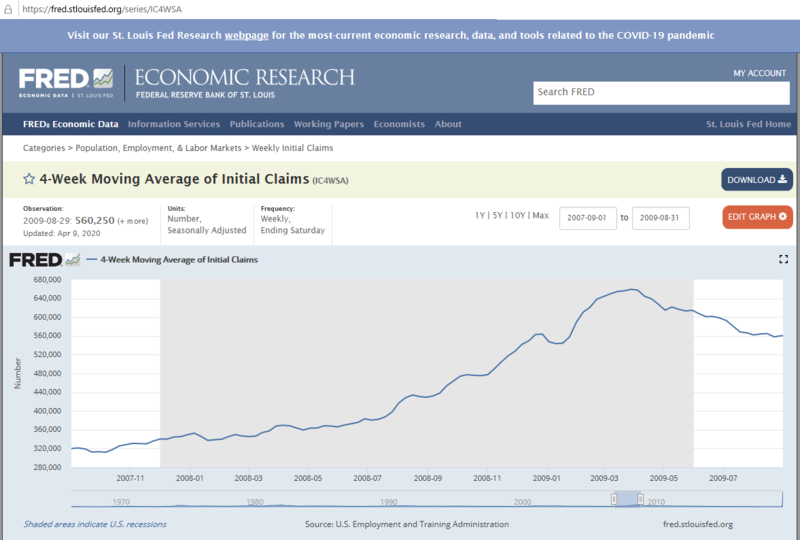
    @Chris Martin What's striking to me about the graphs, is that peak unemployment occurs right AFTER the recession is officially over.   Also, until this past month, the record for weekly unemployment claims was around 650,000.  We have now had 4 straight weeks of 3 million plus!  3 straight weeks of 5 million plus!  8-10x the record.  Every week.  Yikes.  We have a long way to go.

    https://www.marketwatch.com/story/jobless-claims-might-top-5-million-for-third-straight-week-push-unemployment-to-15-2020-04-15?reflink=mw_share_email

  • Investor · Harvest, AL · Member since 2015 · 12 posts · 2 votes
    6y

    Many businesses (large and small) are focused on cash flow, liquidity and solvency.  IMHO, Assets will move from the overleveraged to the underleveraged either by choice (deals) or force (bankruptcies).  

  • Real Estate Syndicator · Milwaukee, WI · Member since 2018 · 1k+ posts · 907 votes
    6y

    @Marcus Johnson No official data released yet, of course.  But it's inevitable at this point.  Check out the recent report the IMF released. 

  • Specialist · Plano, TX · Member since 2020 · 2k+ posts · 861 votes
    6y

    @John Underwood I am right there with you. Great positive outlook on the situation. 

  • Investor · Saint Paul, MN · Member since 2015 · 663 posts · 512 votes
    6y

    @ANDREW

    Yes you should stay out of the stock market. Let my family gain wealth from our bedside without much thought. Please don’t participate in wealth generation.

  • Investor · Willow Spring, NC · Member since 2009 · 5k+ posts · 3k+ votes
    6y
    Originally posted by @John Koster:

    @Chris Martin What's striking to me about the graphs, is that peak unemployment occurs right AFTER the recession is officially over.   Also, until this past month, the record for weekly unemployment claims was around 650,000.  We have now had 4 straight weeks of 3 million plus!  3 straight weeks of 5 million plus!  8-10x the record.  Every week.  Yikes.  We have a long way to go.

    https://www.marketwatch.com/story/jobless-claims-might-top-5-million-for-third-straight-week-push-unemployment-to-15-2020-04-15?reflink=mw_share_email

    Good observation. Indeed, my belief is that the recession is (technically) almost complete, since the 2020Q3 GDP results should show recovery and (plausibly) a small positive Y/Y GDP gain. That doesn't mean economic woes won't continue, they will. For instance, you can see the impact to real estate REITs in their 8-K SEC filings. 

    We have about 10 weeks left in 2020Q2, so we will see how initial claims pan out over the coming weeks. I doubt we'll see 6M in a week again, but there are still millions of oil sector jobs and 'downstream' jobs at risk. The bottom line is that almost all of the job losses will be in the last half of the recession, with many possibly in 2020Q3. 

    Yikes is right.  Below is a weekly claims graph from the last recession, showing the back-end loaded initial claims numbers that continue after the recession is officially over. 

  • Rental Property Investor · San Francisco Bay Area · Member since 2018 · 87 posts · 87 votes
    6y

    We're going to hit 20% unemployment and, with social distancing guidelines expected to remain in affect through the end of 2020 and into 2021, unemployment will stay above 10% at least through the end of the year and most likely until we have a vaccine and it has been widely distributed

Join the conversationCreate a free account to reply, vote on answers and follow this thread.