How Do You Decide When to Refinance vs. Sell?
Lender · NC · Member since 2024 · 344 posts · 115 votes
Hey everyone, I’m curious about how you all decide when to refinance or sell a property you’ve held onto for a while. Do you go by interest rates, property appreciation, or maybe just a gut feeling when it’s time to cash out or reinvest?
I'd love to hear what metrics or signs guide your decision—whether it's ROI, cash flow, or cap rates. Do market conditions, taxes, or potential rental income play a big role for you? Would love to hear your experiences and what's worked best for you!
I look at it as Return on Equity. If a property has a low return on equity, as in low revenue relative to value, it would make more sense to sell because you likely have equity that could be redeployed elsewhere for a better return. If you have a high return on equity, then you are more likely to be making high revenue relative to your existing payment, which means you would be more able to cover the higher payment of a cash out refi and would then have cash to deploy.
This is a general rule and depends on a variety of factors but that would be the framework I would start with. For example, low ROE property could have more appreciation runway to go because it is in such a desirable area, so maybe you would want to hold onto it.
I don't feel the need to to do either of these.
I have good interest rates on my vacation rentals. I don't want to sell because I buy properties that perform that I like. I have no intentions of ever selling.
I buy stuff where I would like to go on vacation.
I don't need any more income so my motivation is buying what I like or acquiring deals.
Hey @Deborah Wodell, that is a nuanced question because a lot of comes down to why you are exploring those options.
Are you trying to get into a different investment?
Are you tired of the work?
Are you losing money now but want to improve cash flow and keep? etc.
Everything you mentioned could play a part, but most of it will be specific to your situation on the why. I'm never a big fan of refinancing unless it is a significant rate change.
If your market is appreciating and you still can handle the work involved, I would hold on and rework the property if needed. If your market is not doing well with no signs of recovery and you want to explore other options, then maybe you can sell or turn it into a mid-term or long-term rental.
I think this is a very personal question and really most of the time my answer would be "it depends". I would not think of either of these options come into my mind such as "I cannot wait to refinance when rates hit X". I do think people whom have purchased in the last 2 years, refi is a strategy as it will increase cashflow. Most of my rates on the investments I currently hold are in mid 4's to low 5's so it is unlikely a refi would benefit me much anytime in the future. If I wanted to access cash it would then be dependent on the deal and I would likely lean towards pursuing a HELOC. I am still bullish on the housing market on a macro level so if I were to sell it would be a decision based on a micro level. I did sell a couple of STR's that performed well during COVID but waned after and invested the equity in other properties better situated for long term success. Again "it depends"

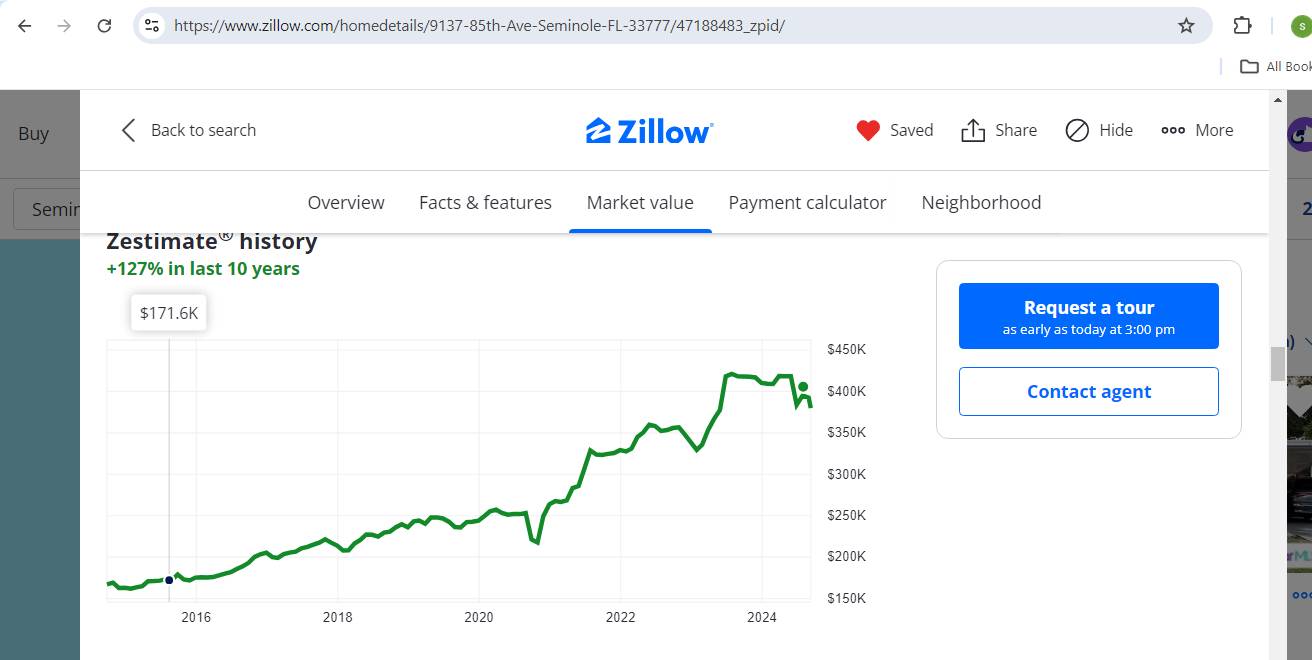
@Deborah Wodell Please see zillow history and Redfin history for that area and see if it improved in value over 10 years and then conclude whether it is worth to keep it as a rental or sell..
Usually to become wealthy one should not sell
Here is a great book for you
https://www.coachcarson.com/building-wealth-one-house-time-j...
I look at it as Return on Equity. If a property has a low return on equity, as in low revenue relative to value, it would make more sense to sell because you likely have equity that could be redeployed elsewhere for a better return. If you have a high return on equity, then you are more likely to be making high revenue relative to your existing payment, which means you would be more able to cover the higher payment of a cash out refi and would then have cash to deploy.
This is a general rule and depends on a variety of factors but that would be the framework I would start with. For example, low ROE property could have more appreciation runway to go because it is in such a desirable area, so maybe you would want to hold onto it.
I am a buy and hold guy like @John Underwood. I am not sure if/when we will see rates like we did before this administration. You never know though.
I don't refinance unless it is a significant rate change. Right now, nothing we own has a mortgage rate above 4%.
Hi Deborah,
When deciding whether to refinance or sell a property, I usually consider a mix of financial metrics and market conditions. Here's what tends to guide me:
1. Interest Rates:
If rates drop significantly, refinancing is a no-brainer to boost cash flow. A lower rate can mean big savings over time, especially if you plan to hold the property long-term.
2. Equity & Appreciation:
If the property has appreciated substantially, I’ll assess whether refinancing to pull out equity or selling outright makes more sense. This depends on my next investment opportunities—can I reinvest that equity for better returns elsewhere?
3. Cash Flow & ROI:
If cash flow is strong, I might lean toward refinancing. If it's getting tight or not meeting my ROI goals, selling to redeploy capital can make sense. I usually track cap rates too—if they drop below what I expect, it could be time to sell.
4. Market Conditions:
If it's a seller's market and prices are peaking, I’ll consider selling to capture maximum value. But in a softer market, I might hold, refinance, and wait for a better time to sell.
5. Taxes:
Capital gains taxes are always a consideration. Using strategies like a 1031 exchange allows you to sell and reinvest in another property while deferring taxes, so I often factor this into decisions.
For me, it's a combination of interest rates, appreciation, and potential cash flow. Gut feeling can play a part, but it's always backed by the numbers!
Curious to hear what drives your decisions!
Best,
Drago
My plan, after I accumulate enough property, is to refinance certain properties each year and collect the tax free "income" from that property and enjoy life. Plans change, no doubt. But if I have 15 properties and they are each on 15 year mortgages, I can refinance a property each year and get a good chunk of tax free money every year. That has been the refinement to my plan recently.
Time to sell is when the projected IRR on an existing property is lower than the projected IRR on a new acquisition.
@Deborah Wodell I like the response that @Drago Stanimirovic provided. Property value will not always grow, depending on the region, local economy and population, they will continue to grow or start to fall. For example, Pittsburg during its Steel industry boom era and Detroit from it's peak auto industry era, properties would have grown value YoY mostly. At one point in time, if you can believe it, Detroit was a more happening place than New York city. Buy and hold at that point time would have been great advise. And as the economy of those cities evolved and started going down, it had a domino effect on rest of the ecosystem.
I would hate to refinance in this market, why would I, no way my interest rates would be better than what they were in 2021. Unless I really need cash for something, I would not refinance.
When should I sell the property? Is the city where your property is located going down the pipe? Are you bored of your investment? Have you found a better place to retain your capital while getting more in returns? These would be the questions I would ask myself. Hope this helps.
I have sold when I have seen a better opportunity elsewhere (1031exchange). Refinancing will kill you in fees if you are not careful. Refinancing is for when you can get lower rates (1.5% to 2% lower) on a longterm hold or to pull equity to redeploy into another asset. The key is to leverage but not over leverage. I have seen a few STRs fire sale in the past 90 days due to over leveraged owners. Most over leveraged owners are like addicted gamblers, they don't believe they have a problem (over leveraged) until the market turns and they go broke/bankrupt.
Really, you always re-finance and keep holding when rates dip significantly & underlying asset has appreciated significantly. You want to likely do these in bunches and work with a lender that'll cut off some of the BS fees.
You only sell when you realize you bought a below tier investment, and roll it into a better one.
You never sell otherwise. Forget that noise.
I've sold a lot since 2017. Looking back I don't regret any of them. They represented headaches and hassles. Does yours do that? What's your first thought when you think of it?
Case by case, one by one, I sold my least favorite smalls by owner as they became vacant while the market was good.
Other cases- hazard insurance was not renewing or placing high subject to repairs/improvements to maintain or the market cap of my commercial apts was rising as fast as interest rates like in '22.
I rarely refinanced unless rates were exceptionally low like in 2012 and later 20 teens. Costs and hassles are high. That's the con of your refi 1 per year plan.
Always consider taxes. I chose to carry contracts/ the paper and exit. 1031 if you want to stay in, but have your replacecement property in mind to avoid becoming a motivated buyer.
@Deborah Wodell you're asking this question in a vacuum.
We have no idea of what your short or long-term goals are.

I don't feel the need to to do either of these.
I have good interest rates on my vacation rentals. I don't want to sell because I buy properties that perform that I like. I have no intentions of ever selling.
I buy stuff where I would like to go on vacation.
I don't need any more income so my motivation is buying what I like or acquiring deals.
That’s a great approach! It’s awesome that you’re in a position where your investments serve both as income generators and personal vacation spots. Out of curiosity, are there any specific locations you're keeping an eye on for future deals?
Hey @Deborah Wodell, that is a nuanced question because a lot of comes down to why you are exploring those options.
Are you trying to get into a different investment?
Are you tired of the work?
Are you losing money now but want to improve cash flow and keep? etc.
Everything you mentioned could play a part, but most of it will be specific to your situation on the why. I'm never a big fan of refinancing unless it is a significant rate change.
If your market is appreciating and you still can handle the work involved, I would hold on and rework the property if needed. If your market is not doing well with no signs of recovery and you want to explore other options, then maybe you can sell or turn it into a mid-term or long-term rental.
I think this is a very personal question and really most of the time my answer would be "it depends". I would not think of either of these options come into my mind such as "I cannot wait to refinance when rates hit X". I do think people whom have purchased in the last 2 years, refi is a strategy as it will increase cashflow. Most of my rates on the investments I currently hold are in mid 4's to low 5's so it is unlikely a refi would benefit me much anytime in the future. If I wanted to access cash it would then be dependent on the deal and I would likely lean towards pursuing a HELOC. I am still bullish on the housing market on a macro level so if I were to sell it would be a decision based on a micro level. I did sell a couple of STR's that performed well during COVID but waned after and invested the equity in other properties better situated for long term success. Again "it depends"
@Deborah Wodell Please see zillow history and Redfin history for that area and see if it improved in value over 10 years and then conclude whether it is worth to keep it as a rental or sell..
Usually to become wealthy one should not sell
Here is a great book for you
https://www.coachcarson.com/building-wealth-one-house-time-j...
Hey everyone, I’m curious about how you all decide when to refinance or sell a property you’ve held onto for a while. Do you go by interest rates, property appreciation, or maybe just a gut feeling when it’s time to cash out or reinvest?
I'd love to hear what metrics or signs guide your decision—whether it's ROI, cash flow, or cap rates. Do market conditions, taxes, or potential rental income play a big role for you? Would love to hear your experiences and what's worked best for you!
The mortgages that I have are in the low 3s, so I'll likely never consider refis. But IF the interest rates were close, I'd certainly consider it, just to deploy all that extra cash on more buys.
I look at it as Return on Equity. If a property has a low return on equity, as in low revenue relative to value, it would make more sense to sell because you likely have equity that could be redeployed elsewhere for a better return. If you have a high return on equity, then you are more likely to be making high revenue relative to your existing payment, which means you would be more able to cover the higher payment of a cash out refi and would then have cash to deploy.
This is a general rule and depends on a variety of factors but that would be the framework I would start with. For example, low ROE property could have more appreciation runway to go because it is in such a desirable area, so maybe you would want to hold onto it.
I am a buy and hold guy like @John Underwood. I am not sure if/when we will see rates like we did before this administration. You never know though.
I don't refinance unless it is a significant rate change. Right now, nothing we own has a mortgage rate above 4%.
Hi Deborah,
When deciding whether to refinance or sell a property, I usually consider a mix of financial metrics and market conditions. Here's what tends to guide me:
1. Interest Rates:
If rates drop significantly, refinancing is a no-brainer to boost cash flow. A lower rate can mean big savings over time, especially if you plan to hold the property long-term.
2. Equity & Appreciation:
If the property has appreciated substantially, I’ll assess whether refinancing to pull out equity or selling outright makes more sense. This depends on my next investment opportunities—can I reinvest that equity for better returns elsewhere?
3. Cash Flow & ROI:
If cash flow is strong, I might lean toward refinancing. If it's getting tight or not meeting my ROI goals, selling to redeploy capital can make sense. I usually track cap rates too—if they drop below what I expect, it could be time to sell.
4. Market Conditions:
If it's a seller's market and prices are peaking, I’ll consider selling to capture maximum value. But in a softer market, I might hold, refinance, and wait for a better time to sell.
5. Taxes:
Capital gains taxes are always a consideration. Using strategies like a 1031 exchange allows you to sell and reinvest in another property while deferring taxes, so I often factor this into decisions.
For me, it's a combination of interest rates, appreciation, and potential cash flow. Gut feeling can play a part, but it's always backed by the numbers!
Curious to hear what drives your decisions!
Best,
Drago
Hi Drago,
Thanks for sharing such a thorough approach! It sounds like you really cover all the bases when making these decisions. I agree—interest rates and equity play a huge role, and it's smart to pull out equity when there’s potential for better returns elsewhere. I’m also a fan of leveraging a 1031 exchange to maximize gains while deferring taxes. Your strategy of blending numbers with a bit of gut feeling really resonates with me.
My plan, after I accumulate enough property, is to refinance certain properties each year and collect the tax free "income" from that property and enjoy life. Plans change, no doubt. But if I have 15 properties and they are each on 15 year mortgages, I can refinance a property each year and get a good chunk of tax free money every year. That has been the refinement to my plan recently.
Time to sell is when the projected IRR on an existing property is lower than the projected IRR on a new acquisition.
if the new deal promises higher returns, it definitely makes sense to consider a switch.That’s a smart way to look at it! Thanks for sharing this one.