Prices keep rising... it's a sellers market... signs of a bubble are pervasive but.. is it a bubble or has the market changed permanently.... thoughts?
To follow up on that, we have to remember to invest in deals, not markets. There is good and bad no matter where you look, deals to be made and avoided everywhere.
I’ve been seeing prices drop locally in Tulsa just this month. It may be that people were pricing so far above the market and they weren’t getting anything, and now having the realization of needing to drop, or the administration, or the COVID concerns lowering with vaccines. All I know is that I’m seeing prices drop.
A key thing to watch is the media will shout from the hill tops "HOUSING PRICES ARE TUMBLING!!!! PRICES DOWN 5% THIS MONTH ALONE!!!!". And what they so conveniently leave out is prices are still 20% higher year over year, 35% higher over 2 years...... I don't know why but it's crystal clear the media really want to sell fear, panic and doom in housing. Whenever they have to report positive numbers in housing they say "well unbelievably" or "Despite everything housing is up...", it's always with this attitude of "damn, why cant we tank the market, just collapse, please collapse". It's weird, I can't put my finger on why or what, but it is the words they use and construct or reporting.
And yes, good catch, prices have been going so wild and stock so low that it's common for grossly over-pricing a property to see how far over market you can get. A TON of novice realtors are now calling people begging for listings promising they will get fantasy numbers, and list it at that, just because it's the only way they can get any listing. Seriously, we are seeing all time record numbers of persons getting realty licenses now so get ready to see stupidity only increase.
Without a "Thanos Snap" alleviating the supply shortage via 100 million instant deaths or so, cost of new units will press prices up as bottom level support. As tax's increase guess what, cost of new units goes up as those added costs have to get priced in.
Is affordability going to become an issue, you-betchya, but what does a person do, choose NOT to have a roof over their head? Where it's going to hit the hardest is in consumer spending! As housing costs take over more and more of a persons income, it means less and less for discretionary spending. Again, roof over head, food, water, it's not optional. How many clothes, shoes, going out to eat or similar, those ARE optional.
Add inflation into the mix, pressing new unit costs even higher, pressing housing cost up even more a % of household income....... We actually got a really good shot under this administration of experiencing a unique kind of stagflation here soon.
in the last 10-13 years home prices keeps on increasing, but do you see same increase in income/salary...I don't see that...that makes it bubble, once temporary job saving is done due to fed interruption, PPP programs etc, and mortgage forbearance is done...
@Raj G.
Well, when Biden gives the first time home buyer significant money to buy their first home or forgive student loan, it means people get free money they can actually use to purchase homes even if their income hasn’t increased a dollar.
Once the interest rate starts going up, people’s purchasing power would go down, but I doubt it would happen any time soon.
@James Hamling - A roof is the most important need but don’t ever discount people’s ability to trade down or share housing. We saw a lot of this after 08. higher end tends to get hardest.
In a lot of Midwestern cities there is a huge supply of roofs, just not necessarily in the areas you would want to live in.
I think prices are at an extreme right now. Could they go up further.... sure, but I think that would be more of a function of interest rates then supply demand.
@Joanne Tsai how much money Biden will give per family/head and how much student loan he will waived off, the way home prices are high today, not sure it will make any impact.
@James Edward does anyone think that (a part of) the lack of inventory is due to all these darn home improvement/house flipper tv shows?!?!
The housing shortage is due to the crash of '07 / '08 when we lost some 80% of home builders and developers. At the time, economists estimated that full recovery would come around 2025. With COVID, that's likely pushed back another four to five years - it's hitting prospective home buyers rather hard.
Lenders are reducing rates to attract borrowers and this is helping to fuel the demand for housing which neither the market nor home builders can supply.
My $0.02 ...
@David Czech what do you think the lasting consequences will be?
@Chuck Patel what do you think will happen to the market when rates go up? Won’t that drive prices down?
@Stephen Spradley well said!!!! I think the key is to be prepared for any move the market makes. Take advantage of rushing prices but be prepared to exploit falling prices too. Time in the market beats timing the market!
@David Czech what do you think the lasting consequences will be?
Lasting consequence will be that we will turn into a nation of renters, with only the upper middle class being able to afford real estate. We are already seeing that. If you live and work in the NY metro area you are easily paying 1800- 2000 / month for rent, so does it really matter if you make 80-100K? Does that really give you the flexibility to go and invest if you wanted to?
Add to that all this money printing which will de-value the dollar and drive up cost of goods, which will make everything more expensive. The pandemic has torn into the fabric of socio-economics in this country and not for the better.
Also, let’s relax about the talks about student loan forgiveness. That would be great but I don’t think it would be a total forgiveness. You would also need a savers mindset that would allow purchasing homes in more expensive markets. It doesn’t mean we’d be handing out mortgages like in ‘08.
@Raj G.
15k on down payment assistance and 10k in student loan. 25k in total for people who can’t save enough for down payment is a big push.
There are plenty of houses which are priced at 100-200k in the country. That’s all they need to get in the market.
@JJ P. Based on your comment, are you saying you think now is a time to buy and hold? BTW... I’m in LA. We should connect.
I absolutely think that this is a time to buy and hold. I just wish I could buy more houses!
If you have the option to hold, let the prices increase around you. We bought a flip house in 2011 or so, right as the 08 crash was ending. Because we were new and inexperienced, the flip house took us nearly a year, I think 10 months, to put on the market. We ended up profiting about 80K. We expected to profit about 40K, but the market was rising and we rode the wave up. In other words, the fact that we were so slow getting the house finished was a blessing. It gained us 40K, double what we expected to make. Now, if we'd held that house as a rental, it would have gained $300K over these 9 years, plus the rent. Three hundred thousand dollars! Think of it! The rent would have probably averaged at least 12K a year gross profit after expenses, that would have been another 100K+ in our pocket over 9 years. I'm rounding down down down at every corner, but it's still very impressive. That's $400K or about $44,000 per year, for just hanging on to it at the right time.
So, as excited as we were to flip a house, the best thing we could have done would have been to ride the tide as it rose. Luckily for us that wasn't our only house. The rest were buy and holds. We leveraged our house and bought everything we could during that time period and they all performed similarly.
In my opinion, now is another good time to hang on to a house. I don't have a crystal ball, but just looking at what's obvious: Prices are up, demand is high, and the housing shortage will persist because the population outpaces it.
@Jessica Wygal
Low interest rates meaning that your debt is less meaning that a buyer is qualified for a higher mortgage. The Fed considering to keep a low interest rates for the short term is a good decision to stimulate real estate and that’s why see higher property values. More people are doing syndication because individually it’s almost impossible with these property values.
The one factor I have yet to see anyone consider in these thought provoking comments is unemployment. Everyone keeps sayings, prices cant drop while there is high demand and low supply, etc. Which is true, but what no one seems to remember from 2008 (I was 18 so paying attention, but not actively investing yet.) Is quick and massive unemployment increases, and while we have had a lot of that this past year with covid, it was mainly lower income, "non-essential" positions.
With that said, I believe the overall economy is in very rough shape, and most of the polices (so far) by the new U.S Administration do not seem to be helping in job creation, just the opposite. Hopefully that trend changes soon, but based on their campaign promises, they look to put a lot of industries and employers out of business. If we do see increased unemployment in essential functions, and at some point they stop propping up the economy with quantitative easing and artificial interest rates, stopped student loan payments, stopped mortgage payments, eviction stops, etc. We could see thousands of people lose their homes, and be searching for employment. Increasing the housing supply, and reducing the pool of qualified buyers, reducing demand. As corporate taxes increase, regulation and cost increases, companies will have to reduce cost and layoff workers. Bank regulation increases, banks stop lending to a large % of borrowers, and interest rates correct to market levels, buyer demand goes down. If gas prices reach $4-5 bucks a gallon again or higher, income taxes increase, hyper inflation continues squeezing medium and lower income families, there is no way they can continue to afford housing at its current trajectory.
Not to be all doom and gloom, but I am a history and economics nerd, I studied this in college, and continue to follow past and current market indicators. I am not an expert, but every tangible factor I can see, looks terrifying.
Now if we transition to a completely government centric market, they may be able to control the downfall more, and that may be what we see the next 4 years. Long story short, this market has countless factors of a bubble economy, and for all of us to think it cant or wont effect the real estate market is naïve. It may not be a 30-50% drop in value like 2008, but it has to correct at some point, and my belief is it will start will true market unemployment, not just a temporary covid issue.
I hope I am wrong, or at a minimum I hope most of us investors are in a position to be ready to invest after the dust settles.
I think real estate like anything runs in Cycles
statistically I have always learned that real estate runs in a seven-year cycle it goes up it goes down and then it goes sideways.
There's a lot of reasons obviously why the market is what it is today and there's a lot of economic emotional and influential drivers that are keeping what we are seeing at this current time a
but just like the way it is today it will change either for the better or for the worse and there's two things I can guarantee
The market will go up and the market will crash at some point in the future. When that happens where it happens and to what extent is like trying to guess the weather
@James Hamling - A roof is the most important need but don’t ever discount people’s ability to trade down or share housing. We saw a lot of this after 08. higher end tends to get hardest.
In a lot of Midwestern cities there is a huge supply of roofs, just not necessarily in the areas you would want to live in.
I think prices are at an extreme right now. Could they go up further.... sure, but I think that would be more of a function of interest rates then supply demand.
As an add-on thought expanding on these items, I reference back to the "Roaring 20's". If one looks back at the historical data of this time period it is arguably the most similar with todays unique makeup. And interestingly enough it too had a very close relationship with world wide pandemic.
I see a very similar setup, including the same disparities widening with a similar ignorance of such.
The economic factors are that of home prices going up, that is simply academic fact. The question is can people afford that incline in prices? And what happens if they can not? Our population is growing at a compounded rate via births and immigration which in and of itself exceeds 100% of quota for immigration thanks to illegal immigration over-capping legal. The growth rate far exceeds the death rate. In 2008 the housing OVER-supply took almost a decade of ramping up building to create, I know as I was involved in the building that entirety of time. We knew there was an over-supply, it was no secret to anyone in the industry only to news media apparently. The collapse was first talked about in NAHB meetings 2 years before the collapse, at least the first I personally heard. At that time the answer to the question of how is this sustainable was "are you making $, do you want to make less? So keep going". This, today, has 0 of those features in housing supply, 0. The shortage is real, and it's only going to get worse before better because we are still at net unit loss on the production levels, labor shortage is an issue but material shortages really hit hard this past year, which are still hitting.
As I said, it's academic fact in large part, what's unknown is the uncharted waters of housing costs being 60%, 65% of a family's income. To say people will just start bunking together like in E.Germany or Soviet Russia, I say yes that could happen and if it does, wow will people be exceptionally unhappy and how horribly bad will things be in the country for it? Think we have social unrest now, yeah, that's an America I will not stick around to see.
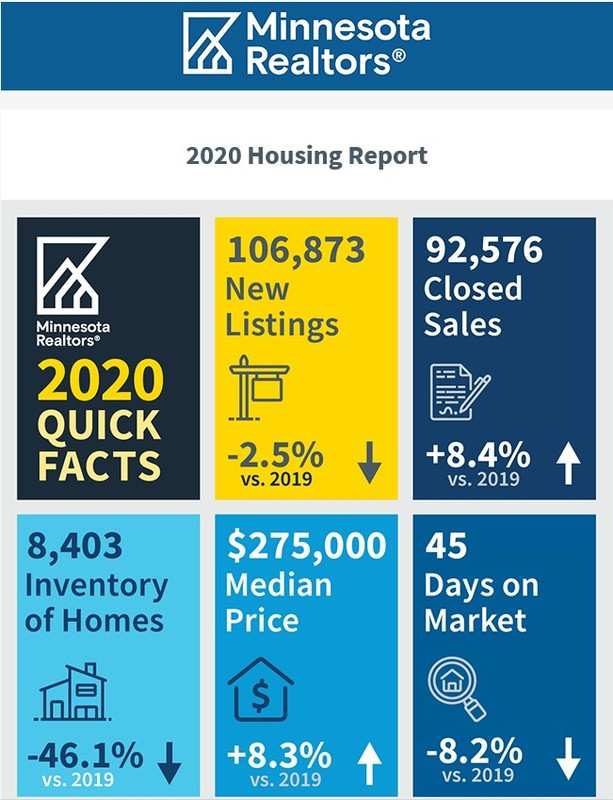
In the State of MN the data is crystal clear that the only "bubble" we are possibly in is an UNDER-value bubble, seriously.
By the numbers review the below final findings and historical comparisons. Inventory of home DOWN -46.1% vs previous year! Thats insane HUGE change, nearly half the availability of home, HALF! So logic would stand sales volume must be half too right... "ERRRR" guess again.
CLOSED SALES UP +8.4% year over year. Now add together JUST those 2 data points, HALF the available properties and MORE closed sales than there was with double availability. That says the velocity of homes sales has MORE than doubled.
Median sale price is up only +8.3% year over year....... I reviewed the NAHB input costs chart recently, material inputs for new unit construction rose by more than 7% across the board in 2020 alone, and in many cases 15% and up. HALF the inventory GONE! Velocity more than double and touching on TRIPLE, avg. days on market less than 45 days AND REMEMBER days on market INCLUDES time awaiting closing so realistically that says avg. days on market to sell is 7-14 DAYS! All of these market forces and median price is up ONLY 8.3%.... By the numbers a person would say that's not going to last and it was the cheaper homes flushing themselves through the system suppressing the actual inflation in home pricing. So in MN, by all measures there HAS been a bubble, a NEGATIVE bubble.
I could go on with even more data points such as we have not seen our winter decline at all, this years winter decline was basically a flat line indicating spring is going to be a rocket up to who knows what record heights. I see new units as the bottom anchor on pricing, and we have not surpassed that average price point of $320k+.
I have heard even recently people saying on BP that MN is declining, quickly, or doing bad.... empty hollow statements of opinion, the numbers below are fact. I am willing to bet if you pull the numbers in your markets you may find more in common with MN than not. And, no matter what it says, FOLLOW THE DATA.
@James Edward The definition of an economic bubble is probably the first thing to address. All a bubble really is is an implausible increase in asset valuation. We as a society do this all the time but the corrections usually take place to bring us back to reality a bit. A bubble forms when expectations are not kept in check via incremental correction. So sure right now asset pricing is high but it's only been short term thus far. I'm not speaking to the stock market, merely real estate. That's a different animal and yes they are connected in a way. With real estate prices tend to be sticky-er. We can't just sell off via a button on an app. Same goes for buying. This market moves in cycles based off societies grander movements. Money market, supply and demand, migration, etc.. Best to read all you can to make an educated decision on it. Either way as an investor there are ways to mitigate "hedge" the downside all whilst still prevailing ahead. Buying well is the objective. That's the end game. 51% wins a day gets you 365% a year. Metaphorically of course. Cheers!
I think the notion that "inventory is so low" and thinking that this means there can't be a crash is really lacking. I can't quote numbers, but I'm pretty sure people were saying the exact same thing in 2005-2008. Inventory is low when demand is high. Demand is incredibly high right now because we've had decreasing interest rates for several years (just had a big drop in the spring of 2020) and everyone with assets feels rich because all asset prices are rising every day. The minute the music stops, suddenly the demand decreases. A decrease in demand means and increase in inventory.
Another thing that I think is leading to decreased inventory is the lack of foreclosures. And this isn't just due to the fact that home prices are increasing which increases equity and makes foreclosures less of a risk. This is due to mortgage forbearance and banks deciding not to foreclose for a time. I'm assuming this will end some day and we'll see somewhat of a surge in foreclosures which will help to decrease home prices.
Good call Lee. The premise that "there can't be a crash - inventory is too low" is farcical. Demand is being amped up by a variety of factors, including easy money and COVID related changes in priorities ... but all of these demand factors are subject to change, just like they always have.
That said, I am worried about the specter of inflation, and RE is a great asset in an inflationary environment. But toddler logic and capital expenditures like real estate are a very dangerous combination!
Best to you and everyone else in this wild and crazy world that is 2021 ...
Good point @Account Closed and I totally agree with you that "RE is a great asset in an inflationary environment." For this reason, I'm still buying apartment buildings right now! But, I'm going in knowing that a crash is absolutely possible.
Great time for sellers to sell multifamily now , right ?