industrial development assistance

industrial development assistance

Member since 2023 · 6 posts · 1 vote

I'm in a red-hot market for industrial spaces right now. I understand real estate in general I don't understand the nuances of commercial/ industrial development which it appears more and more like that's what I'll need to do. I was wondering how people get these types of projects off the ground. if anyone in NY knows developers or investors looking to deploy capital in Ny for an industrial development or has experience in this field feel free to reach out!

1Reply
363 views

Most Popular Reply

Henry ClarkPro Member
Developer · Member since 2020 · 4k+ posts · 4k+ votes
3mo

1.  Look for a large RE firm in your area for that type of product.

2.  Start talking with an Engineer firm that does that type of work.  

3.  Start talking with a Commercial banker in that area who has done this.

The problem is your working with a moving target.   The further up the development path the more you will or won’t participate.

Step 1.   You need to lock down the property.  Either buy it or put an option.  The option will have a time limit.  Or have an extension clause.  The problem with an option is the time limit.  A commercial project can take some time to come to fruition 1 to 3 years.

Step 2.  Engineering and cost estimates.  This is the next step if you want to participate more.  Depending on the project this could be $50,000 to $100,000.  Plus if the building isn’t engineered by the supplier then additional engineering costs.  

Step 3.  You need to identify all of the killer issues sooner than later.  If you haven’t done this before, then you will have to pay the Engineering firm.  

Step 4.  Start

Working with the Commercial Realtor to identify the rental rates, demand and competition.


As you’re doing all of these do Risk assessments.  The dollars are big.  The misses are big.  Understand your risk before you start.  

See this reply in the discussion

17 Replies

Jump to latestLatest
  • Henry ClarkPro Member
    Developer · Member since 2020 · 4k+ posts · 4k+ votes
    3mo

    OP.  What are you bringing to the table?  Money, property, experience, etc.  That will determine how and the degree you enter the market.  If you're talking development versus buying don't do it.  You will have either Cost overruns or Rent up issues.

    • Member since 2023 · 6 posts · 1 vote
      3mo
      Quote from @Henry Clark:

      OP.  What are you bringing to the table?  Money, property, experience, etc.  That will determine how and the degree you enter the market.  If you're talking development versus buying don't do it.  You will have either Cost overruns or Rent up issues.


       I have tons of experience in the field that the project will be used for! I also may have the land locked up soon. the scope of the project is far too large for the money I have myself even in phases.

  • Henry ClarkPro Member
    Developer · Member since 2020 · 4k+ posts · 4k+ votes
    3mo

    1.  Look for a large RE firm in your area for that type of product.

    2.  Start talking with an Engineer firm that does that type of work.  

    3.  Start talking with a Commercial banker in that area who has done this.

    The problem is your working with a moving target.   The further up the development path the more you will or won’t participate.

    Step 1.   You need to lock down the property.  Either buy it or put an option.  The option will have a time limit.  Or have an extension clause.  The problem with an option is the time limit.  A commercial project can take some time to come to fruition 1 to 3 years.

    Step 2.  Engineering and cost estimates.  This is the next step if you want to participate more.  Depending on the project this could be $50,000 to $100,000.  Plus if the building isn’t engineered by the supplier then additional engineering costs.  

    Step 3.  You need to identify all of the killer issues sooner than later.  If you haven’t done this before, then you will have to pay the Engineering firm.  

    Step 4.  Start

    Working with the Commercial Realtor to identify the rental rates, demand and competition.


    As you’re doing all of these do Risk assessments.  The dollars are big.  The misses are big.  Understand your risk before you start.  

  • Ronald RohdePro Member
    Attorney · Dallas, TX · Member since 2016 · 5k+ posts · 2k+ votes
    3mo

    What sub asset type of industrial? I develop industrial in Texas. I have some clients that develop in New York.

    • Member since 2023 · 6 posts · 1 vote
      2mo
      Quote from @Ronald Rohde:

      What sub asset type of industrial? I develop industrial in Texas. I have some clients that develop in New York.

      it would be a specialized warehouse!
    • Ronald RohdePro Member
      Attorney · Dallas, TX · Member since 2016 · 5k+ posts · 2k+ votes
      2mo
      Quote from @George Fuller:
      Quote from @Ronald Rohde:

      What sub asset type of industrial? I develop industrial in Texas. I have some clients that develop in New York.

      it would be a specialized warehouse!

       Ok, that answer makes it worse.

      You talking about cold storage? Dark distribution?

      More specialized is more risk, you haven't shared anything useful with people here who are trying to help you. 

    • Member since 2023 · 6 posts · 1 vote
      2mo
      Quote from @Ronald Rohde:
      Quote from @George Fuller:
      Quote from @Ronald Rohde:

      What sub asset type of industrial? I develop industrial in Texas. I have some clients that develop in New York.

      it would be a specialized warehouse!

       Ok, that answer makes it worse.

      You talking about cold storage? Dark distribution?

      More specialized is more risk, you haven't shared anything useful with people here who are trying to help you. 


      Sorry for being vague earlier — it’s a controlled‑environment warehouse supporting semiconductor supply chain operations. It includes storage of semiconductor slurry in IBC totes (non‑flammable, non‑explosive), so it’s chemical storage but not H3/H4 high‑hazard.


    • Ronald RohdePro Member
      Attorney · Dallas, TX · Member since 2016 · 5k+ posts · 2k+ votes
      2mo
      Quote from @George Fuller:
      Quote from @Ronald Rohde:
      Quote from @George Fuller:
      Quote from @Ronald Rohde:

      What sub asset type of industrial? I develop industrial in Texas. I have some clients that develop in New York.

      it would be a specialized warehouse!

       Ok, that answer makes it worse.

      You talking about cold storage? Dark distribution?

      More specialized is more risk, you haven't shared anything useful with people here who are trying to help you. 


      Sorry for being vague earlier — it’s a controlled‑environment warehouse supporting semiconductor supply chain operations. It includes storage of semiconductor slurry in IBC totes (non‑flammable, non‑explosive), so it’s chemical storage but not H3/H4 high‑hazard.


       Ok, so you're building something for Micron in Clay? Who will be the tenant? 

    • Member since 2023 · 6 posts · 1 vote
      2mo
      Quote from @Ronald Rohde:
      Quote from @George Fuller:
      Quote from @Ronald Rohde:
      Quote from @George Fuller:
      Quote from @Ronald Rohde:

      What sub asset type of industrial? I develop industrial in Texas. I have some clients that develop in New York.

      it would be a specialized warehouse!

       Ok, that answer makes it worse.

      You talking about cold storage? Dark distribution?

      More specialized is more risk, you haven't shared anything useful with people here who are trying to help you. 


      Sorry for being vague earlier — it’s a controlled‑environment warehouse supporting semiconductor supply chain operations. It includes storage of semiconductor slurry in IBC totes (non‑flammable, non‑explosive), so it’s chemical storage but not H3/H4 high‑hazard.


       Ok, so you're building something for Micron in Clay? Who will be the tenant? 


      The tenant is a semiconductor‑support logistics operator — essentially a controlled‑environment 3PL/4PL model serving multiple upstream and downstream suppliers. We’re not representing a single end‑user like ASML or Micron; it’s a multi‑client facility supporting the broader semiconductor ecosystem.
    • Ronald RohdePro Member
      Attorney · Dallas, TX · Member since 2016 · 5k+ posts · 2k+ votes
      2mo
      Quote from @George Fuller:
      Quote from @Ronald Rohde:
      Quote from @George Fuller:
      Quote from @Ronald Rohde:
      Quote from @George Fuller:
      Quote from @Ronald Rohde:

      What sub asset type of industrial? I develop industrial in Texas. I have some clients that develop in New York.

      it would be a specialized warehouse!

       Ok, that answer makes it worse.

      You talking about cold storage? Dark distribution?

      More specialized is more risk, you haven't shared anything useful with people here who are trying to help you. 


      Sorry for being vague earlier — it’s a controlled‑environment warehouse supporting semiconductor supply chain operations. It includes storage of semiconductor slurry in IBC totes (non‑flammable, non‑explosive), so it’s chemical storage but not H3/H4 high‑hazard.


       Ok, so you're building something for Micron in Clay? Who will be the tenant? 


      The tenant is a semiconductor‑support logistics operator — essentially a controlled‑environment 3PL/4PL model serving multiple upstream and downstream suppliers. We’re not representing a single end‑user like ASML or Micron; it’s a multi‑client facility supporting the broader semiconductor ecosystem.

       So get the land under contract, sign a lease with the tenant, you can get financing if the tenant has credit. 

  • Vijay FriedmanBusiness Member
    Miami, FL · Member since 2026 · 766 posts · 123 votes
    2mo
    Quote from @George Fuller:

    I'm in a red-hot market for industrial spaces right now. I understand real estate in general I don't understand the nuances of commercial/ industrial development which it appears more and more like that's what I'll need to do. I was wondering how people get these types of projects off the ground. if anyone in NY knows developers or investors looking to deploy capital in Ny for an industrial development or has experience in this field feel free to reach out!

    @George Fuller
    Industrial development has a pretty different learning curve than residential. Building relationships with experienced developers, local commercial brokers, and lenders early can save a lot of time once you identify a project. Wishing you the best—hope you find a strong team in Upstate NY.

    DreamPoint Capital
  • Henry ClarkPro Member
    Developer · Member since 2020 · 4k+ posts · 4k+ votes
    2mo

    OP.  Post a picture and describe the tenant or market you’re going after.   For example.
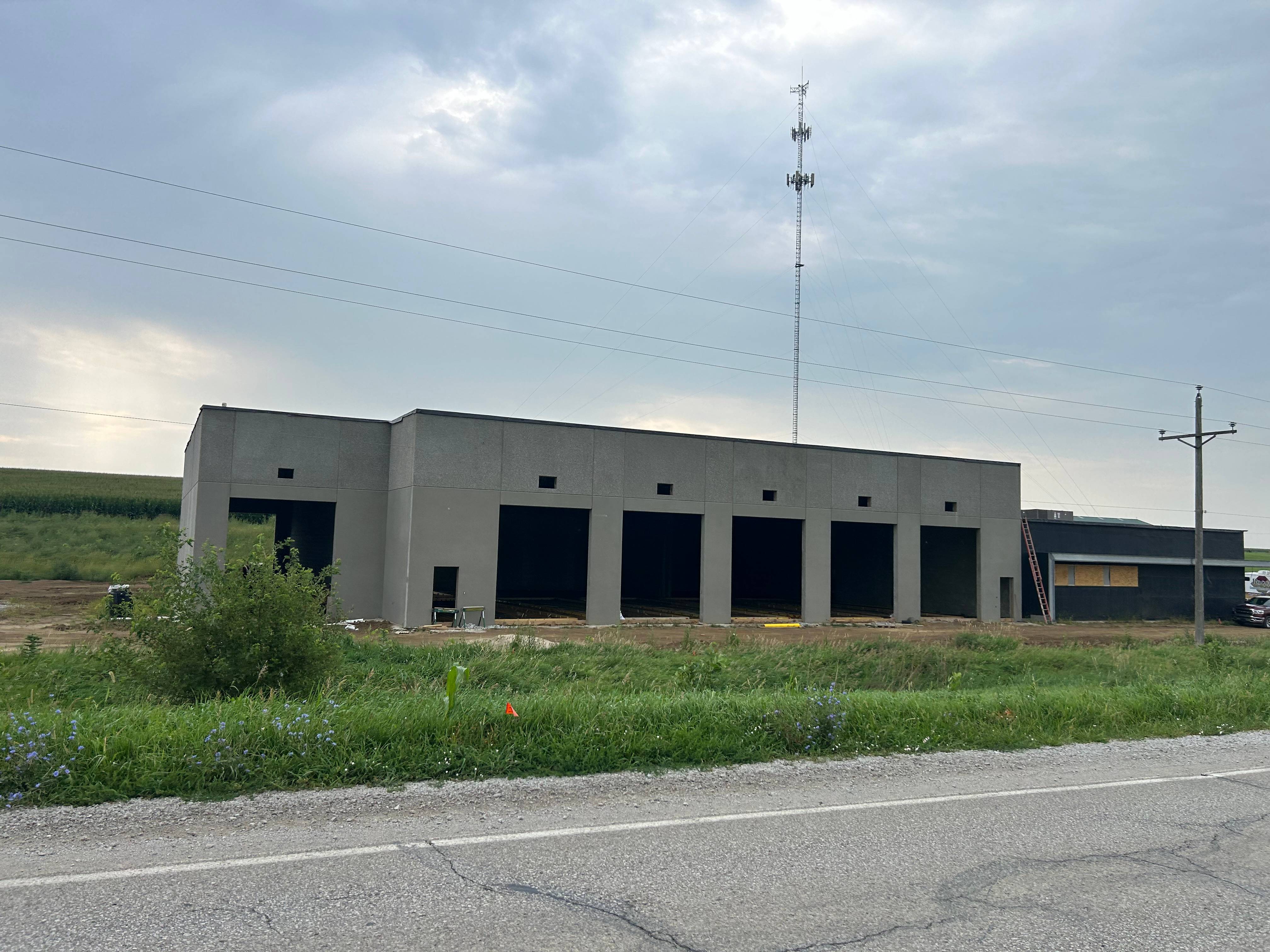
    This is a $5mm structure going up next to one of our lots.  A company is having this built.  Let’s use this to do some Risk assessment of your knowledge before you go down the path.  

    1.  If you OWN the land then disregard the following, you have control up to point x.  Which you said you did not.  It’s very hard to start from a leveraged position.  $1mm piece of land at 7% for 3 years is some change.  An option will also be some change.  Can you handle 3 years of this?

    2.  Do you know your target tenant and market.  Using the picture above.  No docks.  Doors are too tall for small van trucks.  Not enough ground out front for semis.  Eaves are too high unless for say 4 pallet racks high.  But if storage is the issue then too many doorways.  You’re in NY.  Will you have Speed doors for the cold?  Will you have floor drains for the ice snow?  Do you need internal roof support to handle cranes?

    3.  Utilities.  3phase? Fire hydrants required to cover within 300 feet?  Wet or dry fire suppression?  Sewer lift system if not enough drop?  Sewer grinder system?  Retention pond?  Storm sewer system or surface run off?  Main water line access? Soil compaction? Zoning setbacks? Road access out front? One way, cross over, pull out lane, 4 way light,etc.  Each of the above could be $150,000 impacts to your deal analysis. If you don’t know these, then you have to pay an engineer $60,000 to $100,000.

    4.  Market and tenant value adds.   The Engineer, General Contractor, and Building sales person will not build for profit.  You have to know how as the developer.

    5.  Concrete.  25 by 550 feet.  $250,000 quote from the Concrete person I always use.  Get a rough size for the external parking and driveways.  Say 300 x 200.   Get a quote from your concrete guy.  You need to start narrowing down the costs.  Bankers, investors, building manufacturers, GCs will want to know you invested your time into this.

    6.  Building-  Get the numbers in a similar building and size.  Ask someone in your area.  

    7.  Understand your zoning.  Permitted, conditional, rezone, variance, planned zoning, etc.

    8.  Say 20,000 sqft or less.   You can build it and they will come.  100,000 sqft and up are normally customer specific.  Your risk goes really high at that size if you just build it.  

    Go thru the above and see if there are any hard stops from a risk standpoint for you.  If no hard stops then moved forward and start solidifying the above concepts.  

    If you were starting with a duplex and you failed.  You might lose say $20,000.  And you would be okay with the learning experience.

    On the above deal you might lose $200,000 and you are ?????.

    Start small and Make Your Big  Mistakes Early.  

  • Henry ClarkPro Member
    Developer · Member since 2020 · 4k+ posts · 4k+ votes
    2mo

    Then either temperature or humidity controlled or both.  Insulated floors, walls, special lighting, no special water, sewer, electric, etc.  Eave Height? Door height?  Etc.  This will help to narrow the build type and cost.   Also restricts future use.

    Next is your customer value stream.  Will that value stream, relationships, volume match the loan terms in the building and property?  
    Will need to nail that down or the building has far less value and higher risk.  

  • Contractor · Hoosick Falls, NY · Member since 2023 · 27 posts · 5 votes
    2mo

    This is an incredible breakdown, Henry. That specific point regarding 'killer utility and zoning issues' is where so many residential operators completely bleed out when trying to transition into commercial or industrial development.


    Upstate New York is a massive, highly resilient market that constantly goes unnoticed by national capital. Everyone wants to focus entirely on massive, capital-intensive 100,000 sq. ft. distribution spaces, but the real, high-margin bottleneck right now is finding parcels that already possess verified heavy industrial zoning, truck storage compliance, or grandfathered salvage use along secondary and tertiary transit corridors.

    Trying to take raw land through the municipal zoning, engineering, and environmental phase for heavy truck traffic or Industrial Outdoor Storage (IOS) can easily eat 24 months and six figures before you even drop gravel or grade a roadway.

    When you find contiguous parcels in these regional sub-markets that already have those zoning thresholds and road-frontage access locked down, the development timeline shrinks drastically. The underwriting changes completely because you can stabilize the footprint in phases—using the existing industrial infrastructure to generate immediate cash flow while you systematically scale out the surrounding acreage or residential turnarounds.

    Really sharp perspective on the risk metrics here, Henry. Definitely bookmarking this thread to track how your project shapes up, @George Fuller!

  • Ronald RohdePro Member
    Attorney · Dallas, TX · Member since 2016 · 5k+ posts · 2k+ votes
    2mo

    upstate NY has real problems. Even free land my friend has in Syracuse can't be developed into a 12k flex building. Costs are too high for the expected rents. Cap rate is fine, but small projects don't work.

    • Contractor · Hoosick Falls, NY · Member since 2023 · 27 posts · 5 votes
      2mo
      Quote from @Ronald Rohde:

      upstate NY has real problems. Even free land my friend has in Syracuse can't be developed into a 12k flex building. Costs are too high for the expected rents. Cap rate is fine, but small projects don't work.


       You hit on the exact bottleneck plaguing the Upstate corridor, Ronald. Ground-up construction on a small scale is incredibly tough up here because local development costs routinely outpace standard flex rents.

      As a contractor operating in this region, it’s easy to see why making those raw dirt numbers pencil out is such a hurdle. It really highlights why finding and utilizing existing, grandfathered commercial footprints along our active transit corridors is a vastly more practical strategy than trying to tackle a new build from scratch.

      Bypassing the raw build phase completely changes a project's timeline predictability. When you can skip the intense municipal zoning delays and focus purely on optimizing a space that already carries the right footprint, the material logistics and installation sequencing are much easier to control. It's the cleanest way to protect project margins in this current environment.

  • Mark UpdegraffBusiness Member
    Real Estate Broker · Rochester, NY · Member since 2010 · 1k+ posts · 706 votes
    1mo

    @George Fuller — I’m in Rochester and have been involved in industrial real estate/development in Upstate NY. I think Ronald’s comment about getting control of the land and getting the tenant committed is really the heart of it.

    One thing I’d add from experience: I’d be very careful about spending a bunch of money designing the building before you understand exactly what the tenant needs, what they’ll commit to, and who is paying for the specialized improvements.

    We’re working through something similar right now with a rail-served industrial property in PA where a chemical company has specific requirements for containment, tanks, office space, rail access, etc. The economics can change pretty quickly depending on whether the landlord funds the buildout and gets paid back through rent, the tenant funds it, or you structure something closer to a ground lease.

    With something as specialized as what you’re describing, I’d be thinking about the residual value from day one: if this tenant disappears in five years, what is the building worth to the next guy? The more tenant-specific the improvements become, the more important that question gets.

    If you’ve got the land identified and have a real tenant/user behind this, you’re further along than it probably feels. I’d get the tenant requirements, site control, preliminary engineering/costs and lease economics working together before trying to solve the capital stack.

    I’m in Rochester, so not far from you. Happy to connect and compare notes if it’s helpful.

Join the conversationCreate a free account to reply, vote on answers and follow this thread.