Obviously, no two markets are exactly alike. The causes behind today’s high home prices, limited inventory, interest rates, and affordability problems are not identical to what happened before the 2008 crash. Back then, we saw risky lending, excessive speculation, adjustable-rate mortgages, and many people buying homes they ultimately couldn’t afford.
Today, the situation seems more complicated. Home prices have climbed significantly, monthly payments are much higher, and many buyers are struggling to make the numbers work. At the same time, homeowners who locked in very low interest rates may be reluctant to sell, which has kept inventory tight in many markets.
That raises an important question: Are we looking at another major correction, or is this simply a slower market that needs time to adjust?
Personally, I don’t think the current market is an exact repeat of 2008, but I do think there are warning signs worth paying attention to. Affordability is a serious concern, and markets can only remain disconnected from people’s incomes for so long.
Today's market is nothing like 2008. The 2008 market was built on massive mortgage fraud that someone a large professional population recognized and just thought somehow the party would just keep going. Mortgages at 125% LTV with no proof of income? What could go wrong?!
Today's prices are higher. They always are. I don't know that there is any 10-year period in history that real estate didn't appreciate. This is purely a function of supply, demand and personal income. The cure for high prices is high prices. They will come down when the market says it is the right time. I don't see a crash at all unless personal incomes crash. Prices will stay stable or increase so long as people have incomes to pay their mortgages, rents and other bills.
Rates are historically normal. Folks used to 3% and less mortgage rates think they are high. Older folks who experienced 10%+ appreciate them for where they are.
Personal income is up significantly along with property prices. $1 Of personal income enables $4 of purchasing power with a 75% LTV mortgage. Rents are higher too which are what enable investors to afford the properties as rentals. This is how buyers afford those high prices. We hope their incomes hold up or there will be a rise in mortgage foreclosures and evictions. Watch those monthly figures for an early indicator for large scale changes.
I suspect we will see a correction but probably not drops to the extent of 2008. It is different with regard to lending however I think people have maxed out what they can comfortably afford which is problematic if there is any hiccup, What I find interesting is I’m no longer hearing about an inventory problem which I suspected was over inflated anyway. Prices of everything have exploded for sure but I think young Americans have an expectation problem more than an inventory issue . Interesting that stone counters, stainless appliances, multiple bathrooms, luxury vinyl and a brand new car in the driveway are a starter home expectations.
Exactly there is no affordability issue there is a ( I deserve to live in a certain area issue) at least as it relates to a good portion of the country.
the expensive markets like SF bay area prime LA prime NYC Prime DC etc etc have always been expensive and were never affordable for starter homes.
to buy a starter home in those area or a first time buyer took a lot of sacrifice and discipline on the financial side or inheritance. I used to always joke about where i lived in Palo Alto in the 80s prices were already at 400 to 600k for a 1200 sq ft 3 and 1 but buyers they had used toyota camry in the driveways.. Not what you see today with buyers driving expensive cars and going into massive debt for them then try to buy a house.
When I ended up in Portland OR mid 90s prices were about 250 to 300k for a very nice home bay area would have been double to triple but those folks would have two new cars and anRV and maybe a boat. LOL comes down to priorities.
Lastly this is nothing like the GFC I lived through that sucker and credit dried up over night we still have credit its just that the rates are not artifically low like they were post GFC. And folks now dont have a lot of personal knowledge or history of the markets the last 50 years to put it into perspective they only have maybe post GFC to compare to everything.
You're right about expectations being the real issue. I'm seeing borrowers stretched thin trying to afford the "Instagram starter home" with all the upgrades. The granite countertops don't mean much when you're maxed out and one hiccup away from trouble. The inventory narrative definitely shifted fast once rates went up. From my lending side, I'm being more selective now - looking for deals that work with today's numbers, not betting on appreciation
Obviously, no two markets are exactly alike. The causes behind today’s high home prices, limited inventory, interest rates, and affordability problems are not identical to what happened before the 2008 crash. Back then, we saw risky lending, excessive speculation, adjustable-rate mortgages, and many people buying homes they ultimately couldn’t afford.
Today, the situation seems more complicated. Home prices have climbed significantly, monthly payments are much higher, and many buyers are struggling to make the numbers work. At the same time, homeowners who locked in very low interest rates may be reluctant to sell, which has kept inventory tight in many markets.
That raises an important question: Are we looking at another major correction, or is this simply a slower market that needs time to adjust?
Personally, I don’t think the current market is an exact repeat of 2008, but I do think there are warning signs worth paying attention to. Affordability is a serious concern, and markets can only remain disconnected from people’s incomes for so long.
@Star Moses, I try not to build an investment plan around whether the market is about to correct or not. I’ve seen people wait for the “perfect” market, and I’ve also seen people buy because they were convinced prices would keep climbing. Neither approach gives you much control.
For me, the better question is whether the property still makes sense with today’s payment, realistic rent, normal repairs, and enough reserves if something does not go as planned. I also want an exit that does not depend on prices going up next year. If the deal works under conservative numbers, I feel a lot better about it no matter what the larger market decides to do. I like the way you’re looking at the bigger picture without assuming today has to turn into another 2008. General information only, not financial advice.
I completely agree with this approach. Market timing is nearly impossible to get right consistently, and building an investment strategy around predicting corrections or continued appreciation puts you at the mercy of factors outside your control.
The focus on fundamentals whether the property works with realistic numbers for today's payment, rent, and expenses is exactly the right way to evaluate any potential investment. This conservative approach creates a margin of safety that protects you regardless of what the market does.
I particularly appreciate the point about having an exit strategy that doesn't depend on price appreciation. That's the difference between investing and speculating. When your deal works based on cash flow fundamentals rather than market momentum, you're building real wealth rather than gambling on market direction.
The 2008 reference is also important - many investors got burned by assuming the good times would last forever, while others sat on the sidelines waiting for the perfect moment that never came. The middle path of analyzing each deal on its own merits with conservative assumptions seems to be the most sustainable approach.
This kind of fundamental analysis is probably why you're building a private lending business - you understand that sound underwriting based on real numbers beats trying to predict market movements every time."
What aspects of this conservative investment philosophy do you find most valuable for your private lending business?
It feels like the current administration and economic policies are killing first-time buyers. It's creating the biggest stalemate in housing market history. I don't think anyone would disagree with my statement.
It's like driving a car; the administration pushes on the gas (Iran war, tariffs, economic stressors) and the FED pushes on the brakes trying to tame inflation. They keep doing the same over-and-over again, gas-brakes, gas-brakes, all the while the middle class and prospective first time buyer goes broke. How is this sustainable?? How is this going to lower the average age of first time buyers? It's 40 years old now which is insane.
Agree prices of everything are through the roof but there are starter homes for sale in the few areas I keep tabs on. I believe much of the stalemate is that young buyers aren't willing to live in an actual starter home.
Completely disagree with you.. Inflation under the last admin went nuts I think we can all agree to that and this admin brought it down by 50%.. the war ya gas prices are back up to where they were under the last admin.. we have short memories..
REAL estate values start at the land values and farmers or those that own development land create the floor the floor has risen cant force farmers to sell dirt for less because they need to create affordable housing. And then you have government regulations heavily influenced by the last admin that are over the top.. I mean I develop in blue states and red states and I can tell you the Blue states CA OR WA are a nightmare on regs which totally drive up the price of homes for instance in CA new homes have to have a solar component that cost money.. Along with doing full blown EIR's that will cost a developer 200k to over 1 mil before any approvals. who pays for that ??? go to Red state TX and none of this exists. common sense.
And again its not an issue first time buyers can buy in Indy they just dont want to live in the affordable neighborhoods thats the bottom line I mean gosh I fund flippers every week in all these markets and as is homes are being sold for 50 to 100 rehab 30 to 50 so 200k and under all day long if someone cant afford that then they are simply not financially ready for home ownership. Not sure why home owner ship should be a right instead of a privilege for those that get their financial house in order ?
The strongest factual correction is the inflation point: lower inflation is not lower prices. If inflation falls from 9% to 3%, prices are still increasing; they are simply increasing more slowly. That distinction is important when discussing wages, home prices, food, gas, and mortgage affordability we can agree to disagree. We don’t need to have confrontation.
as these people that try to make everything politics, let's keep politics out
Okay. No problem.
Today's market is nothing like 2008. The 2008 market was built on massive mortgage fraud that someone a large professional population recognized and just thought somehow the party would just keep going. Mortgages at 125% LTV with no proof of income? What could go wrong?!
Today's prices are higher. They always are. I don't know that there is any 10-year period in history that real estate didn't appreciate. This is purely a function of supply, demand and personal income. The cure for high prices is high prices. They will come down when the market says it is the right time. I don't see a crash at all unless personal incomes crash. Prices will stay stable or increase so long as people have incomes to pay their mortgages, rents and other bills.
Rates are historically normal. Folks used to 3% and less mortgage rates think they are high. Older folks who experienced 10%+ appreciate them for where they are.
Personal income is up significantly along with property prices. $1 Of personal income enables $4 of purchasing power with a 75% LTV mortgage. Rents are higher too which are what enable investors to afford the properties as rentals. This is how buyers afford those high prices. We hope their incomes hold up or there will be a rise in mortgage foreclosures and evictions. Watch those monthly figures for an early indicator for large scale changes.
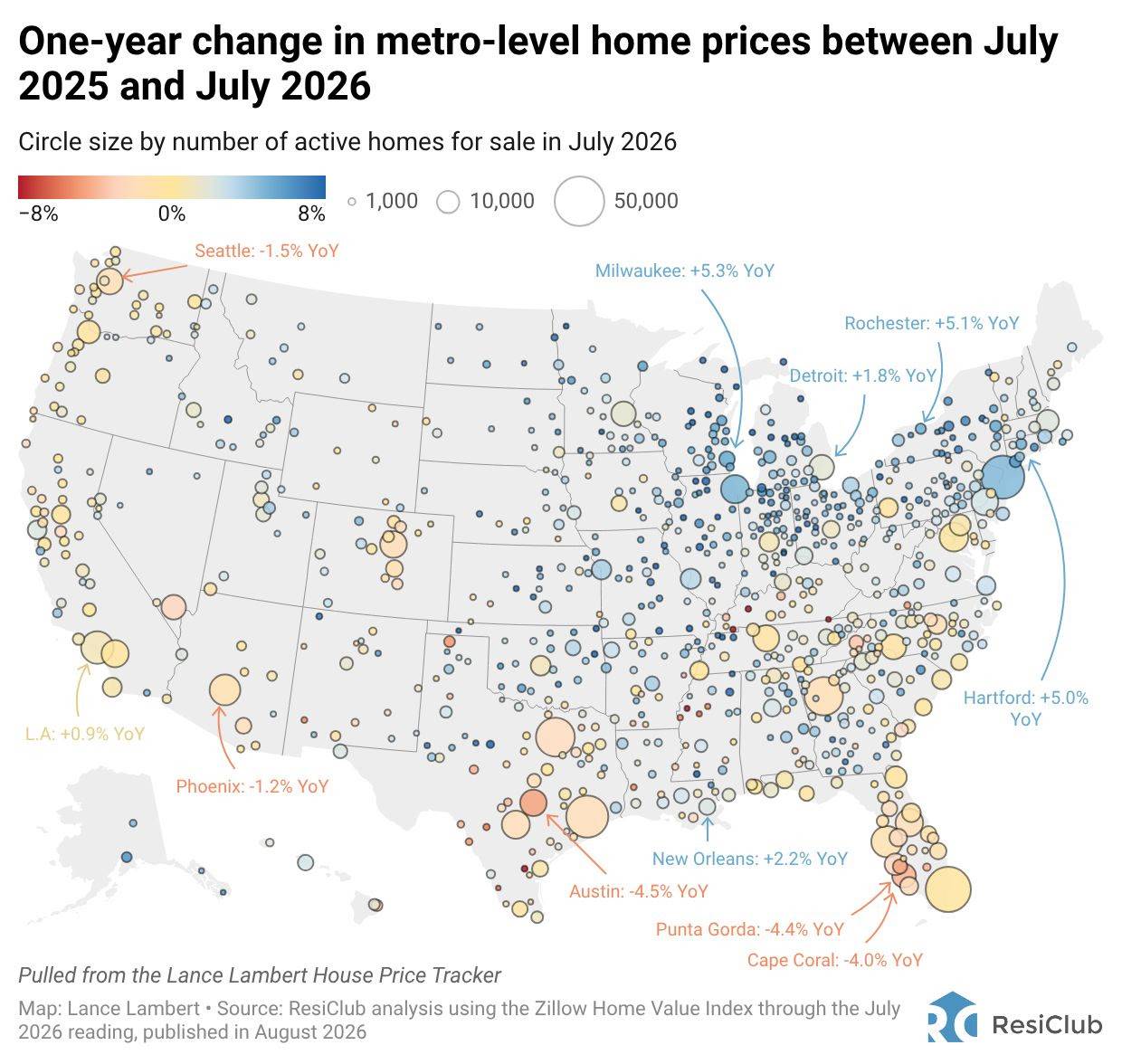
no, the conditions are different. We don't have crazy loans. Anybody that got a loan is cause they can't afford the payments. Some areas have been declining and value, but not crazy mainly Texas West Florida has been hit hard in some parts but I live in East Florida southeast Florida to be exact and we're doing fine. Prices are actually climbing inventory is low not as slow as a few years back but still under five months now interest razor climbing that might put a dent on price, appreciation and affordability but definitely not a 2008 situation
That's interesting about East Florida. Here in Delaware, we're seeing something different inventory jumped nearly 20% recently and prices have been falling since the June peak.
What's concerning me is we actually have the highest foreclosure rate in the country right now. One in every 1,612 housing units in foreclosure this first quarter.
The loans might be solid like you said, but people here are definitely feeling the squeeze with their monthly payments. It's more of an affordability pressure than a 2008 situation, but still worth watching closely.
I don’t see today’s market as a repeat of 2008 either. The lending environment, inventory levels, and homeowner equity are very different.
What I do think is real is the affordability pressure. Here in Metro Detroit, we still have plenty of areas where prices are reasonable compared with larger markets, but the jump in interest rates changed the monthly payment dramatically for a lot of buyers.
That’s the part I think gets overlooked sometimes. A buyer may technically be able to afford the house price, but once you combine the rate, taxes, insurance, and everything else, the payment can tell a different story.
To me, the bigger question now is how long buyers and sellers take to reset their expectations around monthly payment, pricing, and affordability. That adjustment period is what I’m watching most closely.
@Star Moses Maybe not 2008, but there are still real pressure points.
Lending standards are stronger today, and low-rate homeowners are keeping inventory tight in many markets. At the same time, affordability is stretched, and if incomes, rents, and monthly payments stay out of balance, some local markets may have to adjust.
That does not always mean a major crash. It could look more like slower sales, more seller concessions, longer days on market, or price corrections in certain areas.
For investors, this is a good environment to underwrite conservatively and avoid relying too much on future appreciation.
That's such a thoughtful take on what's happening in the market right now. You've really captured the nuance its not about a crash but more of a balancing act happening in real time.
I especially appreciate your point about underwriting conservatively. That's exactly what I've been focusing on too making sure the numbers work with today's reality rather than betting on tomorrow's appreciation.
The slower sales and longer days on market we're seeing actually create opportunities for investors who have their financing ready and don't need to rush. It's almost like the market is giving us time to be more thoughtful about our decisions.
Thanks for sharing such a balanced perspective it's refreshing in a space where people often swing between extremes of either panic or blind optimism.
One thing I'd add from the ground level: 2008 was a supply-and-leverage problem. What I'm watching looks more like a payment-lock problem. My market (Louisville) closed August at 4,490 active listings, up 33% YoY, and 3.5 months of supply, also up ~30% — inventory is genuinely loosening. But pending sales are down 26.3% YoY and days on market are up to 46 (+21%). That's not distressed sellers dumping inventory — new listings are actually up 3.5% YoY too. It's buyers and sellers both stalling, waiting to see who blinks first on rate or price. Median price is still up 1.5% YoY here — no cracking, just molasses. Feels less like 2008 and more like a standoff.
That's a good way to put it a standoff. I'm seeing the same thing here. Sellers aren't distressed enough to drop prices, but buyers aren't willing to pay these rates. Everyone's just waiting to see who moves first.
Okay, let's forget about the 2008 headline - that was a bit clickbaity. We have many issues, but there is literally nothing in this market that looks like 2008.
Affordability is only an issue for first time home buyers who spend their vacation in Italy, get their food door dashed 3 times a week and have an $800 car payment.
We have an expectation problem: home buyers expect luxury, investors expect instant cash flow. Just think for a moment how crazy that actually was 10 years ago to just buy a few houses without much capital and quit your W2. And while it's possible for a young investor to buy several homes, we claim affordability issues??
Home prices can and will not decline. First off, real estate prices are downward sticky: seller will rather wait than agree to sell for a loss. Second, inflation has become a fixture of our economic model and is no longer a temporary issue. The USD is loosing value every month, so that alone makes nominal home prices go up.
Lack of inventory is going to remain an issue for many parts of the country. This keeps upward pressure on prices. We have a few select markets like the FL condo market and parts of Texas, where locally supply exceeds demand. That has caused YoY prices to go down single digits, but they are still massively up compared to 5 years ago.
We have a lot of problems, but a 2008 style real estate market is definitely not one of them!
Marcus agree totally with the expectations and how first time buyers use their financial resources on day to day life. I mean its well documented with folks having a 20 dollar a day coffee habit :)
Not sure if you meant to say home prices can and will not decline or if you meant to say they can decline.. As many markets prices have come down not melt down but down from the highs for sure.. I have been shopping lately for a 1031 exchange and markets I have been looking at from Vegas to Butte Montana all show price reductions on Zillow I dont track retail pricing out east or mid west as the props we fund are heavy duty fixers so cant really judge there. Also many investors that have done flips have ended up having to refi to get out of the short term bridge loan .. Not end of world in most cases they dont have much cash into the deals either forced equity sufficed for the equity needed for the refi..
but from my real world experience the last 60 days looking for properties price reductions are real.. Bought in peak of market in 23 or so and try to sell today and generally speaking with sales costs those will create capital loss's for the sellers.. Which frankly is normal real estate bought to live in at retail prices is rarely going to cover holding and sales costs if you have to exit in a few years.. And for investors you also have recapture so its even worse for investors
Not a typo, but worth explaining for anyone who has not been around as long as you Jay: I am pretty convinced US home prices will not decline. At least not at scale and on a national US level. And - in a way the first time home buyers see a meaningful improvement in affordability. (A temporary -2% YoY price change does not result in improved affordability.)
That does not mean local home prices can't decline: we see that currently in TX and FL, especially the condo market. And it sounds like FL is starting to turn already. In most markets where we see list price reductions, the list price ends up still being at or above last years. And at +2% appreciation you can't sell a house 3 years later and expect to make a profit. The unicorn years of 2021-2023 are over. But even when you look at the price corrections in Austin which was really significant YoY, homes are still selling for a lot more than pre-pandemic.
We also see prices decline in Milwaukee every year in fall by about 5%. Every. Single. Year. I talk to my clients, I show the the chart with the clockwork pattern over the last 10 years, they still tell me they are going to wait until spring LOL - You could literally make a business out of buying in fall and selling in spring.
So local and temporary price corrections, yes. But I can't see it happen on a US national level and and at a scale that makes a meaningful affordability difference for consumers. We would really need a 2008 market for that to happen.
My main reason is inflation: we are currently devaluing the purchasing power of the USD at 3-4% if you believe the gov. Feels like a bit more. And it is only going to get worse, as energy cost is trickling through the system. From my corporate days I can break down how manufacturing cost increases take half a year to reach the retail market. Takes time to announce price increases, goods are still shipped at old prices, inventory throughout the supply chain is still at old cost etc - we have not seen the full impact of global Diesel prices yet. Real estate is a hard asset, it floats with inflation and material and labor cost. We better strap in!
From down here in Broward County buying at tax deed auctions, this doesn't feel like 2008 at all. The fundamentals are completely different. Back then you had liar loans, 125% LTV, and people flipping condos they never actually owned. Today's distressed sellers have massive equity - they just can't access it or can't sell at the price they want through traditional channels.
What I'm seeing on the ground is more of a slow-motion pressure cooker than a crash. Owners who bought in 2020-2021 with 3% money are sitting on huge paper gains but can't sell without giving up that rate. Meanwhile property taxes keep climbing and insurance in South Florida is insane. So they stop paying taxes and eventually the county takes it through a tax deed sale.
That's where the real opportunity is right now - not in betting on a crash, but in being the cash buyer who can close when traditional financing can't make the numbers work. Jay's point about rates being historically normal is spot on. The people who are getting crushed are the ones who structured their entire strategy around 3% money and have no plan B.
Diana's advice about underwriting conservatively and not depending on appreciation is exactly right. The deals I'm looking at at auction need to work at today's replacement cost and today's rental rates. If they don't pencil without betting on the market going up, I pass. That's how you survive any cycle.
That's exactly what I'm seeing too. The distressed sellers today have equity, they're just squeezed between rates, taxes, and insurance. The real opportunity is being the cash solution when traditional financing can't work.
I'm underwriting the same way - deals need to work with today's numbers, not tomorrow's hopes. That's how you actually build wealth that lasts through any cycle.
In 2008 home owners didn't have built up equity in the homes when the market crashed.
Homeowners Now Hold $35.8 Trillion in Equity
The Federal Reserve just added up what every home in America is worth, and how much of it owners actually keep.
Fed just released the numbers (Z.1 report, Sept 2026):
Total value of all U.S. homes: $49.8T (up 2.5% YoY)
Total mortgages/loans against them: $14.0T (up 3.0% YoY)
Net equity owners actually hold: $35.8T (up 2.2% YoY)
Share of homes owned free and clear: 71.9% — 13 straight quarters above 70%
Prices have barely moved this year, but that's not the same as no opportunity. Most owners are still sitting on a huge equity cushion money that can fund a renovation, a down payment on the next property, or just breathing room if things get tight.
Source: Federal Reserve Z.1 and NAHB, September 2026
Those numbers are huge. That massive equity cushion is exactly why this feels different from 2008. Most homeowners aren't underwater they're sitting on a safety net.
What's interesting is how that equity is basically locked up for many. People don't want to sell and give up their 3% rate, but they also don't want to tap that equity with today's higher rates. It's like having money in the bank you can't really access without paying a premium to do so.
That's where the opportunity is for investors who can move quickly and solve problems. While most homeowners are sitting tight, there's always a percentage who need to sell for life reasons - job moves, divorces, health issues. Those are the situations where that equity cushion doesn't help them much if they need to move now.
In 2008 home owners didn't have built up equity in the homes when the market crashed.
Homeowners Now Hold $35.8 Trillion in Equity
The Federal Reserve just added up what every home in America is worth, and how much of it owners actually keep.
Fed just released the numbers (Z.1 report, Sept 2026):
Total value of all U.S. homes: $49.8T (up 2.5% YoY)
Total mortgages/loans against them: $14.0T (up 3.0% YoY)
Net equity owners actually hold: $35.8T (up 2.2% YoY)
Share of homes owned free and clear: 71.9% — 13 straight quarters above 70%
Prices have barely moved this year, but that's not the same as no opportunity. Most owners are still sitting on a huge equity cushion money that can fund a renovation, a down payment on the next property, or just breathing room if things get tight.
Source: Federal Reserve Z.1 and NAHB, September 2026
These statistics show why there's lies, damned lies, and statistics. I'm not going to mak a judgement against the estimated equity value posted, other than to say that's just a WAG totally dependent on the health of the RE market at any one time. I'll assume the indebtedness is correct. That statistic makes it sound like 72% of homes are owned outright, wherein it's really that 72% of all equity is unencumbered by debt. According to the US Census, about 39% of all homeowners had no mortgage. That's a lot different picture. I don't have the numbers but when prices and theoretical values are high you'll always see something similar. I say theoretical because right before the crash I would bet the numbers weren't terribly different.
interest rate has gone up and it will go up again this year. Borrowing cost will go up, I think we we definitely see slow down for sure, but not crash yet in my opinion.
I agree—the comparison to 2008 can sometimes oversimplify what is happening today.
One of the biggest differences is that many existing homeowners are sitting on significant equity and historically low fixed-rate mortgages. That creates a very different dynamic than a market dominated by highly leveraged borrowers and weak underwriting.
For investors, I think the bigger issue today is affordability and cash flow. Higher purchase prices combined with higher borrowing costs mean deals have to be underwritten much more carefully. You can’t assume appreciation will bail out a marginal investment.
I’m watching inventory, price reductions, days on market, rents, insurance and taxes just as closely as interest rates. Real estate is extremely local, and I believe we’re more likely to see certain markets and asset classes experience meaningful adjustments while others remain relatively resilient.
This is a market where buying correctly, maintaining liquidity, and having multiple exit strategies matter more than trying to predict the next crash.
Great analysis you've hit the nail on the head about why comparing today's market to 2008 misses the mark. The 'golden handcuffs effect of homeowners with 3% mortgages who won't sell creates a completely different market dynamic than we saw back then.
I'm especially focused on the cash flow challenges you mentioned. It's like we're playing a completely different game now the old 'buy and pray for appreciation' strategy is dead. I'm seeing investors get burned on deals that would have worked fine three years ago but are bleeding cash today with these rates.
The local market point is huge too. I'm watching some neighborhoods here hold steady while others just 15 minutes away are seeing price reductions pile up. It's like we're micro managing at the ZIP code level now.
Your point about multiple exit strategies is gold. I've started building in worst-case scenarios for every deal - what if rates stay high, what if rents flatten, what if taxes spike? It's not pessimistic, it's just smart business in this market.
We will see corrections mostly in investment circles.
Already seeing some of it via apartments that were overpaid for.
Also seeing some STR foreclosures and short sales that newbies overpaid for.
Just spoke to some newbies 2 weeks ago that thought I had a magical solution for them overpaying on SFRs. They are already in the process of exploring a short sale.
One last sign, that I also saw around 2004-2006: lenders getting more aggressive on their guidelines to keep their deal-flow going.
That rarely ends well...
I think 2008 is the wrong comparison—at least for now. 2008 was fundamentally a leverage/credit failure that created forced sellers. Today looks much more like a liquidity and affordability failure: 30-year mortgages are around 6.95%, sales are weak, and inventory has climbed to 4.9 months, yet mortgage holders are still sitting on a record $18 trillion of equity.
That doesn’t mean prices can’t correct hard in individual markets. But the number I’d watch isn’t just price—it’s forced-sale pressure. Delinquencies, foreclosure starts, inventory and seller concessions rising together would tell us a lot more than “prices are high, therefore 2008.” Right now, some of those stress indicators are rising, but we’re not looking at the same machine that broke in 2008.
OP I would
Stratify the comparison by annual Salary.
$40,000
$80,000
$120,000
$200,000
Today dollars adjust
To 2008.
$40,000- 2008 you could buy multiple
Houses. Now illegal immigration have pushed lower housing costs up. Now you can’t get
The financing. Plus you won’t live 4 or 6 to a house. Forget the politics. We had an infusion of lower income folks.
$80,000- lower priced housing is closed to you. Airbnb has put a ceiling in certain markets.
$120,000- you can have the house, Mercedes, private School with a 3.5% rate. But can’t
Move to a 6.5% rate.
$200,000- can do whatever you want. But you have more investment options and question REI. Living the dream paycheck to paycheck.
Outlook:
6.5% on a 30 year or even 25 year is great. If you think inflation is around 5% or the USD is devaluing 5% per year on top of inflation. That doesn’t matter if you can’t keep a
Job. All depends on if the Tariffs help move us to onshore manufacturing sooner than later.
Stock market. Schiller P/E ratio of 39% is unsustainable within say a year. Say a 60% drop. Then Airbnb, resort Homes, etc will be sold off. Housing inventory will increase.
Baby boomers- can only have $2,000 to their name if they want the government to pay retirement home. At $10,000 per month. Their savings and their homes after tax will get used up in say 2 years for most people. House inventory will increase. Baby boomers are out of the 2008 market impact of investing.
AI- ???!?
Nope. 2026 is not the same as 2008. But it is the same. Changes, pressures, how do you handle ? W hat is your risk tolerance? What is your outlook?
Develop your outlook. Control your downside. Make your adjustments in your investments.
I would argue against that. 2008 was based off of a lot of fraudulent loans at 100% LTV. Today most people have more equity in their properties than ever before because our government loves to print money. While people who bought during the peak are currently underwater, it is still a small subset of the overall real estate market.
Yes there are areas that get hit harder than others but 2008 was across the entire country whereas real estate today I view as more regionalized per metro area.
My personal opinion is we'll be spending the next several years on housing. It stays pretty flat, maybe with slight increases year over year, till that compensation and salaries slowly start increasing to be more in line with historical norms of mortgage payment to income
"That's an interesting take, but I think there are some critical differences between today's market and 2008 that they're overlooking. While it's true that the underlying loan quality is better today, there are other pressures at play that could still trigger significant market corrections.
The equity argument has merit, but we're seeing something unprecedented - homeowners with substantial equity still walking away from properties because they can't afford the payments after rate resets or job losses. This wasn't really a factor in 2008.
What I'm seeing on the ground is that the 'regionalized' nature of today's market cuts both ways. Yes, some metros will hold value better, but the ones that got overheated during the pandemic could see corrections just as severe as 2008, just more geographically concentrated.
The 'flat for several years' scenario feels optimistic to me. With commercial real estate already cracking and consumer debt at all-time highs, I think we could see more volatility than they're anticipating. The mortgage-to-income ratio normalization they mention might happen through home price stagnation, but it could also happen through significant price declines in certain markets.
When you look at the real estate market at large you have 3 major forces:
1.) Demographics (people age, this is an absolute and sets demand)
2.) Housing inventory (the number of roofs vs the number of households - not population!)
3.) New construction (supply)
Everything else is just short term noise: mortgage rates, unemployment rates, inflation etc: while they all impact the housing market for a few months or a year, people adjust and the effect dissipates. In the end supply and demand remains.
As a country we are 3-5 million homes short, because we have underbuilt 300-500k homes every year between 2008 and 2022. And we have oversupply in some places, but homes are just not very mobile. This could all be dwarfed by potential water shortages in the SW - up to 50 million people are at risk, but if only 5 million move, we will see some real estate markets collapse and others explode. We sell about 15,000 homes in Milwaukee every year, if we get an additional 5000 buyers every year home prices would go Austin over night.
And I don't think illegal immigration has much to do with housing prices: they have little money, typically rent and if anything they drive up rents. They will shack up if they have to and work hard to get established. Builders profit from cheap labor. When was the last time you have seen a 3rd generation American work roofing or drywall?
I also don't follow the tariff argument: even if it would bring back more manufacturing, we have a very low unemployment rate, so who is taking these manufacturing jobs? Probably not our unemployed college grads with a degree in basket weaving.
And let's not forget, we outsourced manufacturing, because it was cheaper to make things in low cost countries than in the US. And we like buying cheap things. So if you would somehow teleport these factories back to the US, we would have a hard time staffing them and the production cost would explode with the labor component going 3x to 10x, the products would get multiples more expensive and that would really do a number on inflation.
Inflation will be the most dominate force to watch in the next years. Real estate prices tend to go up with inflation, driven by the cost of materials and labor, new construction prices tend to drag existing home prices with them. This is historically true.
AI will be a massive factor in the labor market, but not now. It will take another 3-5 years until robots gain the physical capability to replace human workers ate large. It starts with self driving taxies, then long distance trucking. The forklift drivers, then logistics workers. Repetitive physical labor in a controlled environment will get lost to automation in a landslide. And for most of us, that is our tenant base. And that's also the consumer demand that carries our GDP, so we will have to find another way to put spending money in their pockets. And we will, I am not worried about that. But the transition period is going to be very messy.
When you look at the real estate market at large you have 3 major forces:
1.) Demographics (people age, this is an absolute and sets demand)
2.) Housing inventory (the number of roofs vs the number of households - not population!)
3.) New construction (supply)
Everything else is just short term noise: mortgage rates, unemployment rates, inflation etc: while they all impact the housing market for a few months or a year, people adjust and the effect dissipates. In the end supply and demand remains.
As a country we are 3-5 million homes short, because we have underbuilt 300-500k homes every year between 2008 and 2022. And we have oversupply in some places, but homes are just not very mobile. This could all be dwarfed by potential water shortages in the SW - up to 50 million people are at risk, but if only 5 million move, we will see some real estate markets collapse and others explode. We sell about 15,000 homes in Milwaukee every year, if we get an additional 5000 buyers every year home prices would go Austin over night.
And I don't think illegal immigration has much to do with housing prices: they have little money, typically rent and if anything they drive up rents. They will shack up if they have to and work hard to get established. Builders profit from cheap labor. When was the last time you have seen a 3rd generation American work roofing or drywall?
I also don't follow the tariff argument: even if it would bring back more manufacturing, we have a very low unemployment rate, so who is taking these manufacturing jobs? Probably not our unemployed college grads with a degree in basket weaving.
And let's not forget, we outsourced manufacturing, because it was cheaper to make things in low cost countries than in the US. And we like buying cheap things. So if you would somehow teleport these factories back to the US, we would have a hard time staffing them and the production cost would explode with the labor component going 3x to 10x, the products would get multiples more expensive and that would really do a number on inflation.
Inflation will be the most dominate force to watch in the next years. Real estate prices tend to go up with inflation, driven by the cost of materials and labor, new construction prices tend to drag existing home prices with them. This is historically true.
AI will be a massive factor in the labor market, but not now. It will take another 3-5 years until robots gain the physical capability to replace human workers ate large. It starts with self driving taxies, then long distance trucking. The forklift drivers, then logistics workers. Repetitive physical labor in a controlled environment will get lost to automation in a landslide. And for most of us, that is our tenant base. And that's also the consumer demand that carries our GDP, so we will have to find another way to put spending money in their pockets. And we will, I am not worried about that. But the transition period is going to be very messy.
Good post Marcus. I agree with most of it but 2 things:
1. Any displaced body has an effect on housing. Less immigrants, illegal or not, means less pressure on rentals, which means flat or declining prices, which means the people at the top that might have been pushed into home ownership even with programs (Fha, USDA, etc) will continue to rent because it's a better value proposition until/unless home prices decline. That's especially true with the newer generations who are accustomed to renting everything and owning nothing.
2. AI is going to take a little time to directly displace manual dexterity labor (ie installing an AC compressor outside) but the job destruction on the professional desk side is real and will be brutal, and a lot of this workforce will be pushed from necessity into that same "safe" blue collar workforce. That will tamp down wages and job growth. Professionals without jobs don't get new roofs, they put a tarp over it. They don't get new AC systems, they open the windows. Etc.