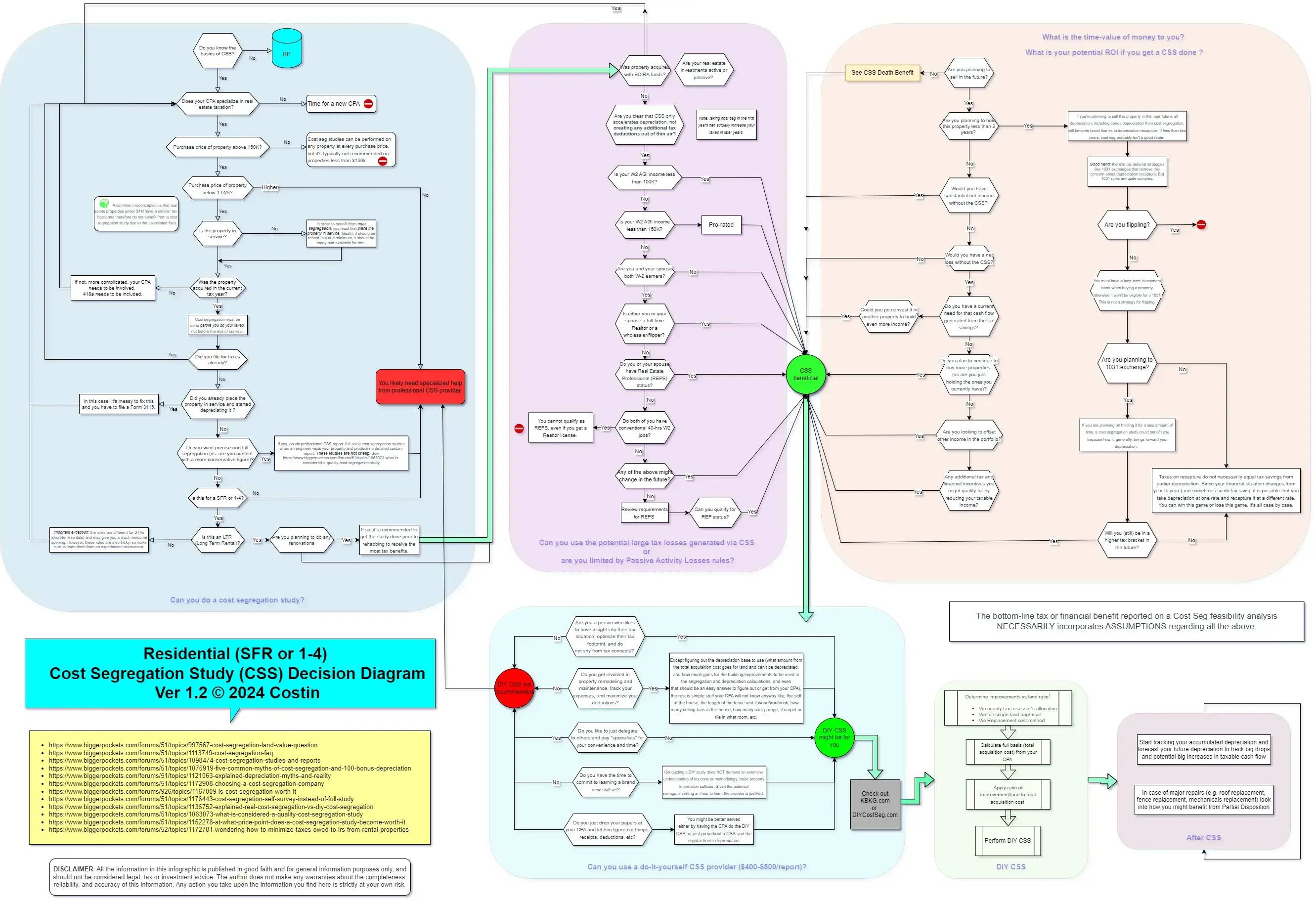
@Michael Doughty I think @Julio Gonzalez has made some solid points here. I'd also add, to do a cost seg. or not depends on a few factors including, but not limited to:
What you are hoping to get out of it (e.g. offset other income in the portfolio, get a big refund to put down on another property)
How long do you plan to hold the property (depreciation recapture of 25% might make this less worthwhile if you sell the property in 2 years)
Did you already place the property in service and start depreciating it for 27.5 years (LTR) or 39 years (STR). In this case, it's messy to fix this and you have to file a Form 3115.
You would consider a 1031 exchange to avoid depreciation recapture.
Type of property (STR or LTR),
How high is your W-2 income / other income
Real Estate Professional Status (REPS) or no REPS
More factors ….
As a result, the cost seg on $300k property might be worth it, but you need to evaluate several factors and whether or not a cost segregation worth it depends on the real estate investor.
. . .
*This post does not create a CPA-client relationship. The information contained in this post is not to be relied upon. Readers are advised to seek professional advice.
Probably not. Consider the land value and improvements value separately (tax assessment is a good place to start but you will need to adjust it). The cost segregation will only help you break down the improvements. On a $300k house, that might only be $200k.
The cost is based on the size and complexity of the property.
Yes! We did it for an STR the year we bought it. We were lucky in that our CPA is very knowledgeable about real estate and was able to do the study for us. What we saved in taxes that first year was three times what we paid for the study. I will say just make sure you are keeping this property for awhile - otherwise you are paying back the accelerated depreciation. This wasn't an issue for us for this home because it will be kept in the family for years and hopefully generations to come - so we thought why not depreciate now!
Your property definitely has the potential to benefit from a cost segregation study. Determining whether to do a cost segregation study or not has a lot variables.
Are you in an area where land is very valuable leaving you with less to depreciate?
How long are you planning to hold this property? If less than two years, cost seg probably isn't a good route.
Are you planning to do any renovations? If so, I always recommend getting the study done prior to rehabbing.
What is your ROI and the amount paid for a cost seg study? Do you have a current need for that cash flow generated from the tax savings? Could you go reinvest it in another property to build even more income? Would you have net income or net loss without the cost seg study?
Are your real estate investments active or passive? Are your losses locked up against your passive income?
There are a lot of factors to consider when get a cost seg study to determine if the benefits outweigh the costs. If you are able to get REPS status, that would help tremendously. Have you obtained any detailed cost/benefit analysis quote? Most cost segregation study companies provide the quote for free. If you need any help or have any questions, feel free to reach out!
@Michael Doughty I think @Julio Gonzalez has made some solid points here. I'd also add, to do a cost seg. or not depends on a few factors including, but not limited to:
What you are hoping to get out of it (e.g. offset other income in the portfolio, get a big refund to put down on another property)
How long do you plan to hold the property (depreciation recapture of 25% might make this less worthwhile if you sell the property in 2 years)
Did you already place the property in service and start depreciating it for 27.5 years (LTR) or 39 years (STR). In this case, it's messy to fix this and you have to file a Form 3115.
You would consider a 1031 exchange to avoid depreciation recapture.
Type of property (STR or LTR),
How high is your W-2 income / other income
Real Estate Professional Status (REPS) or no REPS
More factors ….
As a result, the cost seg on $300k property might be worth it, but you need to evaluate several factors and whether or not a cost segregation worth it depends on the real estate investor.
. . .
*This post does not create a CPA-client relationship. The information contained in this post is not to be relied upon. Readers are advised to seek professional advice.
@Michael Doughty - A lot to factor in. One test I always consider is when I might sell the property. If it is greater than 3 years and I think I can make a better return with the money saved then I'll do it.
Talk to your accountant whether you should get it done as it will depend on several factors.
In short, will the added depreciation from a cost segregation help you? If yes, get it done.
Some instances where a cost segregation will help
1) rental losses would not be considered passive - Real Estate Professional Status or STR being considered active 2) You sold another property that generated passive gain that you want to minimize 3) Your income is below $150,000 and you can utilize some of your rental losses.
As others have said it’s more about you and your plans, income, etc because the question is really is cost seg worth it for me this year on this house. If I were answering that question the answer for me would be yes. I do cost segs on every property I buy and I benefit from those studies in the form of significant tax savings (I use an inexpensive algorithm based study, DM me for the name). Not tax or legal advice so seek your own professionals!
Hey man @Michael Doughty, it's been 2 years now and I'm looking forward how you went from this. In my experience, I have evaluated DIY options, but for me, the potential for error and the lack of defendable documentation outweighed the cost savings. I decided the security of a professional, engineered report was a necessary part of the investment.
Honestly depends on your property type and depreciation strategy. For 300k, most firms charge 3-8k for the study. Quick rule: if you can accelerate 40k+ in depreciation to years 1-7 vs 27.5 years, it usually pays for itself in tax savings. What type of property - residential rental or commercial?
For a 300k property, cost seg usually pays for itself if you've got decent taxable income to offset. The sweet spot is typically 500k+ but depends on your tax situation. Most firms charge 3-8k depending on complexity. What's your current tax bracket and do you have other income to shelter?
on a 300k house the first thing a study needs is your split between land and building, since it only works on the building part, so pull your closing statement and the county assessment to see how that splits. what firms charge mostly comes down to which kind of study you buy. the cheap end applies percentages by property type, the engineered end breaks out flooring, fixtures and site work from your photos and documents. ask any firm for a full sample report before you pay.
(disclosure: basis property group is my company, we do cost seg.) our price is $1,295 if you paid under 300k and $1,895 from 300k to 700k, set before work starts. whether it pays off also depends on how long you hold, bc recapture applies on sale (a 1031 can defer it), and your cpa decides what that means for you.
One thing I'd add, since most of the replies here are from 2024: bonus depreciation is back to 100% for property acquired after Jan 19, 2025, so the first-year number on a $300k house is a lot bigger than it was in the 40% era. But the number only matters if you can actually use the loss — if it's passive and you have no passive income to offset, it just sits there until you do. Before paying for a study, ask for an estimate of how much of the building gets reclassified to 5/7/15-year property; that's what drives the answer. And run the result by your CPA.