Durham NC · Member since 2026 · 15 posts · 7 votes
Hey Everyone, My name is Bryan I’m 20, I stay in the triangle area, and currently in the pre-approval process for my first home. I know prices are high right now, especially in Durham, and I’m not going to pretend that makes this easy. But I’d rather start learning and looking now than wait and hope for rates to drop.
What I’m planning:
Budget of $260-280K, with a 5% conventional loan through the bank I qualify with
Durham is my first choice because it’s close to my job, but I’m open to anywhere in the Triangle
Live in the home for at least a year, then rent it out
A 4-bedroom where I rent by the room, or a townhouse, duplex, or small multifamily where I can rent out the units. Whichever the numbers say works best
Also I would highly appreciated for any guidance or tips for a first rental investment property.
I’m also looking for agents who work with investors, have helped multiple investors buy, and invest in their own rentals too. If that’s you, or you know someone like that, send me a message. I’m talking to a few agents before I choose one.
Starting at 20 with a house hack is a great move, Bryan. I know some investor-minded agents in the Triangle who own rentals themselves. Send me a message and I'll connect you with one.
Hi Bryan, the biggest piece of advice I would give you is to ensure you have LOTS of liquidity on hand for a rental property investment. I would plan to have a minimum of three months of property expenses reserved. All of this should be separate reserves from your personal emergency fund (3-6 months of personal expenses).
Get a first-year budget established for the property you're considering buying. Create estimates for things like rental income, ongoing maintenance expenses, utilities, planned renovations, vacancy rates, etc. Will the estimated cash flow cover all of the property expenses? Ideally, you want a property that's going to give you both "cake and icing," meaning monthly positive cash flow + appreciation. A rental property that requires you to constantly pull from personal assets to cover expenses is not a good investment. Evaluate what type of property management and accounting tools you'll use. Consider the operational aspects of managing a rental property. How will you collect rent? How will you manage tenant communications, screening, etc.? How will you process leases? How will you handle bookkeeping? What kind of insurance coverage will you need?
If you decide to transition this to a rental property, treat it like an actual business. Have separate bank accounts and credit cards for easy tracking of rental income and expenses. Have tools in place to measure the performance of your investment. Consult with an attorney to explore whether establishing an LLC for the property to protect your personal assets from lawsuits would be beneficial. I would also work on building a team of advisors for your real estate business. This should include a financial planner/advisor (ideally a CFP), real estate agents, lenders, attorneys, property managers (if not self-managing), and a real estate-focused CPA to start (super important).
@Bryan Armas, getting pre-approved at 20 puts you years ahead. I'd buy something with a spare room or a second unit, because the first place can become your first rental. I've done house hacking myself, and I'd be open to talking it through if it would help. Are you planning to live in it for at least a year? What strategies are you weighing for this first one?
Living for a year and renting out the room I stay in, obviously a multi or a duplex would be best, since rent can be increase, I’m just waiting if I get the approval from loan officer if I’m able to qualify for a property with units and also in the market that I’m in, it’s not many multi family’s with low price range.
Congrats on starting! I would lean on a duplex as it's easier than having roommates. If you find a larger home then make sure the layout and bathrooms can function with multiple people living there.
Bryan, starting at 20 with a house hack is a smart first move — living in one room and renting the others is how a lot of us got started. Just run the numbers the same way on a $260K house as you would on a $60K one. The 1% rule is my first check: monthly rent needs to be at least 1% of all-in cost. In Memphis I buy single-family under $100K and rent Section 8 at $1,395-$1,950 for a 3BR+, and the refi at 70-80% LTV is what funds the next deal. Durham at $260K-$280K is a different price point, so the rent-by-room math has to actually cover the mortgage, taxes, insurance and vacancy — not just the mortgage. And keep your first deal simple: one house, one strategy, learn the whole cycle before you add a second. What's the rent-by-room total looking like on the ones you're watching?
Appreciate it, James. Good point on running every deal the same way regardless of price. I'm looking at 3-4BR homes around $260-280K in Durham/Raleigh and renting by the room at about $900. That's roughly $2,700 with 3 rooms while I live there, and about $3,700 with 4 rooms once I move out. Against an all-in payment around $2,200-2,300 (mortgage, taxes, insurance), year one is close to break-even once I factor in vacancy and reserves. How do you handle vacancy and CapEx reserves on your Memphis deals?
Hey @Bryan Armas , I think it's a pretty good time to be looking in Durham!
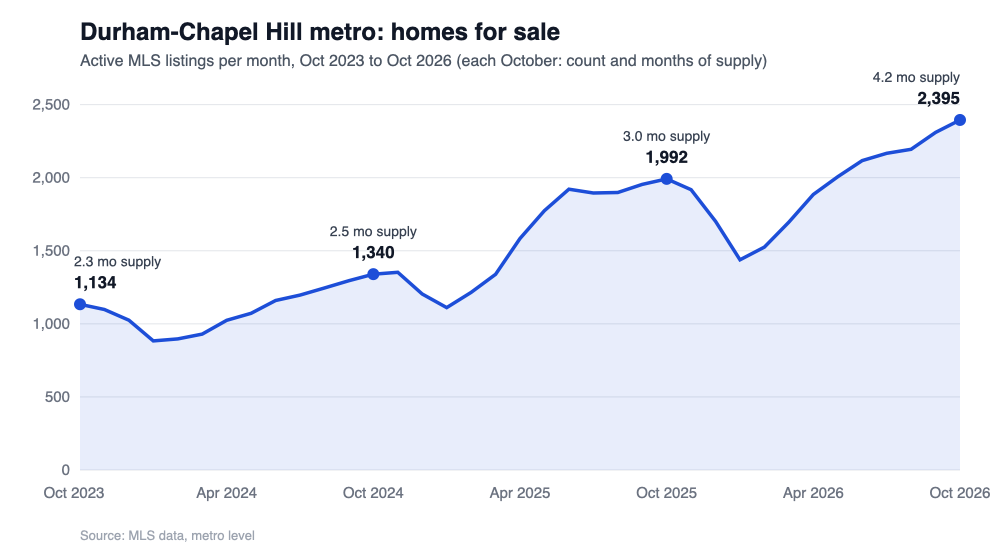
Inventory in the Durham–Chapel Hill area is up to almost 2,400 homes, about 20% higher than last year and more than double what it was three years ago. Months of supply went from 2.3 to 4.2. I've attached a chart showing the trend. Looks like buyers have a bit more negotiating room these days.
One thing I'd consider is asking for seller credits instead of just a lower price. Taking $10K off the price saves you roughly $58/month, while a credit toward closing costs could help you keep more cash in reserve. With less than 10% down, you can generally ask for up to 3% on a conventional loan.
Also, just a small correction: four rooms at $900 would be $3,600, not $3,700. Renting by the room sounds promising, though I'd double-check local room rates before counting on $900 each.
Thanks, Ken. Good catch on the math: 4 x $900 is $3,600. My $3,700 figure was using $925 per room after the first year. The seller credit tip is helpful, and I'll ask for credits instead of only a lower price. I'll also verify room rents in the specific neighborhoods before I count on them. Appreciate the inventory data.
Bryan, good question, and you are right to count it before you buy, not after. I build vacancy and CapEx into the deal up front. The rent has to cover the mortgage, taxes, insurance, and a vacancy and a repair in the same year, or I do not do the deal. That is why I use the 1% rule first and DSCR at 70 to 80% LTV, and why I keep my Memphis houses simple: buy under $100K, ARV $180K to $265K, Section 8 rent $1,395 to $1,950 for 3 bedrooms or more. On a house hack at $260K to $280K, do the same test with your real all-in payment, not just the mortgage. If $2,700 to $3,600 in rent-by-room income only breaks even after vacancy and reserves, the price is too high for the rent. Keep cash reserves lined up before you close, and let the first house teach you the cycle before you add a second.
Starting at 20 with a house hack is a great move, Bryan. I know some investor-minded agents in the Triangle who own rentals themselves. Send me a message and I'll connect you with one.
With your plan, confirm that the 5% conventional preapproval applies to the property type you're considering—single-family, townhome, or 2–4 units—and ask how rent from the other units would be counted. Room-by-room income can be treated differently from rent on a separate legal unit, so don't assume a rent estimate automatically boosts qualifying income. If you buy to live there first and rent it later, ask about that loan's occupancy requirement and what documentation a future lender would need to count the home's rent when you buy again. Keep cash reserves beyond closing for repairs, vacancy, and moving costs, and compare the full payment (taxes, insurance, HOA, utilities) against conservative rent. If you'd like to walk through the scenarios before making an offer, call me; my contact info is in my signature.
One thing ill add to your scenario. If you need the rental income to help you qualify for the mortgage you may want to consider a duplex. You may be able to get credit for a rent by the room if you need this to help you qualify for a mortgage I would run it by your lender to make sure you are not caught off guard.
If I was starting out again with what I know now, I'd look to acquire and owner-occupy a 2-4 unit property with a low-down payment mortgage. FNMA allows 5% down only on 1-2 units, but FHA allows 3.5% down for 2-4 units.
I’d also look into buying an “ugly” property that needs work, thus unqualified for a standard mortgage, which would weed out a lot of competition and push the price lower.
Instead of needing additional cash to cover the renovations, I'd use a renovation mortgage that allows renovation costs to be included in the purchase mortgage. The FHA 203(k) or FNMA HomeStyle Renovation loan are options. They both require you to get bids from licensed contractors for any required work, but after closing you can do the work yourself.
To maximize my cashflow and gain landlording experience, I'd do STR and MTR in the other units, as well as the other bedrooms in my unit.
Since most cities won’t allow basement rental units, I’d consider finishing the basement, just well enough for me to live down there (cities don’t care if owner chooses to live in basement), so I could rent out ALL the units/rooms – for even MORE cashflow!
I'd save all my cash and monitor the value of the property to hopefully refinance to get rid of the monthly PMI/MIP cost and maybe even pull some funds out of the property for my next investment. Of course, I would NOT take a mortgage that rents would NOT support the PITI + vacancy + maintenance.
Depending on how close I was to having 20% equity in the property, I'd consider using some of my cash to pay down the mortgage when I refinanced to get rid of the monthly PMI/MIP. Otherwise, I'd save my cash for the next acquisition.
I’d also be posting, starting NOW, on every social media platform and telling everyone I knew that I was looking for more real estate deals. I’d aim for low downpayment land contracts and lease options.
I’d evaluate if I wanted to repeat the 2-4 unit renovation process again or if I had the 20% down to target 5+ units.
While still living in the property, AFTER any refi, but before moving to the next property, I'd also explore securing a HELOC to tap my equity for emergencies.
Thanks for the detailed breakdown. The rule about never taking a mortgage the rents can't cover, including vacancy and maintenance, is already my baseline. Another commenter said Fannie Mae allows 5% down on 2-4 units, so I'll get the exact terms from my lender in writing. The renovation loan idea is something I'm saving for after I've done the first house hack and built a contractor relationship. Since you've done this, how did you find contractors who would give you bids and work with the renovation loan draws?
Hey Everyone, My name is Bryan I’m 20, I stay in the triangle area, and currently in the pre-approval process for my first home. I know prices are high right now, especially in Durham, and I’m not going to pretend that makes this easy. But I’d rather start learning and looking now than wait and hope for rates to drop.
What I’m planning:
Budget of $260-280K, with a 5% conventional loan through the bank I qualify with
Durham is my first choice because it’s close to my job, but I’m open to anywhere in the Triangle
Live in the home for at least a year, then rent it out
A 4-bedroom where I rent by the room, or a townhouse, duplex, or small multifamily where I can rent out the units. Whichever the numbers say works best
Also I would highly appreciated for any guidance or tips for a first rental investment property.
I’m also looking for agents who work with investors, have helped multiple investors buy, and invest in their own rentals too. If that’s you, or you know someone like that, send me a message. I’m talking to a few agents before I choose one.
Thanks in advance.
Hey Bryan, getting started at 20 is a great move, and I like that you're already thinking about turning your first home into a rental. My advice is to focus on the numbers and buy something that makes sense as both a home and a future investment. I'm an investor and Realtor myself, so I work with buyers looking to build long-term rental portfolios. If you're open to exploring out-of-state down the road, the Midwest has some solid cash-flow opportunities worth looking into as well.
Love that you're starting at 20, Kathleen's point on reserves is spot on. One quick update to what Drew mentioned: conventional now allows 5% down on 2 to 4 units you live in too, not just 1 to 2, so a triplex or quad is on the table with the same type of preapproval. The other thing I'd plan for now is the next one. After your year in the home, you can move out, keep it as a rental, and buy your next place with a low down payment owner occupied loan again. That's how a lot of people build a portfolio from one house hack. Started with a househack myself, both of mine I did the 5% conventional route. Happy to make a recommendation on a Triangle agent too, I'll shoot you a message.
Thanks, Derek, really helpful, and good to know 5% down now works on 2-4 units I live in. I'd appreciate the Triangle agent recommendation, especially someone who owns rentals and has closed house hacks.
Quick take from the insurance side: renting rooms while you live there doesn't fit a standard homeowners policy with many carriers, so tell your agent up front. Ask how roommates are treated for liability, and require each one to carry renters insurance. When you move out, switch it to a landlord policy. Happy to provide more assistance by DM.
Thanks, Owen, that's a good flag. I didn't know a standard homeowners policy can be an issue when renting rooms. I'll bring it up with an agent before I make an offer, and I'll require renters insurance from every roommate. Do you know if carriers in NC commonly write policies for this setup? I'm still early, so I'm just collecting info for now.
Hey Bryan! Love that you're thinking this way at 20! House hacking is a great way to get started in real estate investing.
I'm a real estate investor myself and started house hacking (still do!). I'm also a mortgage broker who works with investors and house hackers. One thing I'd recommend is comparing the financing options on a single family home versus a 2-4 unit property. You may have more flexibility than you think as you can use the rental income from the additional units to qualify and still only need to put down 3-5% down.
I also have a friend who owned a rental portfolio in the triangle area. Happy to ask him if he has any recommendations for investor friendly agents out there. Feel free to DM me if you'd like to connect or bounce around financing ideas. Happy to help!
Thank you, Amber, I really appreciate you taking the time. I'd love to connect with an investor who has real experience in the Triangle, so I'd be grateful if you'd ask your friend whether he'd be open to a short call or a few recommendations for investor-friendly agents. I'll also compare the single family and 2-4 unit financing options like you suggested. I'm sending you a connection request so we can keep talking.
I like your approach, especially starting early and thinking about how the property can become an investment after you move out. At 20, getting into real estate and learning how to analyze deals now puts you in a good position.
One thing I’d recommend is looking beyond just the monthly mortgage payment. Factor in taxes, insurance, maintenance, vacancy, and potential property management costs. Since you're considering renting by the room, make sure there's enough rental demand in the area and check any local rules that might apply. I'd also compare the numbers on a single-family home versus a townhouse or small multifamily to see which makes the most sense long term.
I'm a real estate agent based in Memphis, TN, and I work with investors building long-term rental portfolios, including out-of-state buyers. While the Triangle is your target market, I'd be happy to connect, share some insight from working with investors, and help you think through your first purchase from an investment perspective. Best of luck with the pre-approval process!