How I stress-test an Airbnb deal in about two minutes (example numbers inside)
I see a lot of STR deals here analyzed with one ADR and one occupancy number. That is usually where the trouble starts. I rebuilt the spreadsheet I use for my own deals and for walking other investors through theirs, and I wanted to share the method, because the method matters more than the file.
Everything below is a sample scenario with round example numbers, not a real property or market.
Example: $325,000 purchase, 20% down, 7.25% for 30 years, a 3-bedroom with about $27,000 of furnishing and launch costs and $25,300 of rehab including contingency.
Split the year into seasons. In the example: 4 peak months at $250 a night and 80% occupancy, 4 shoulder months at $200 and 65%, 4 off-season months at $150 and 45%. That blends to roughly $209 a night at 63%. If you only plug in peak numbers, you overstate revenue by thousands.
Find break-even occupancy. This is the occupancy where cash flow after the mortgage hits zero. In the example it is about 52%, against an expected 63%. An 11-point cushion is thin for one bad winter.
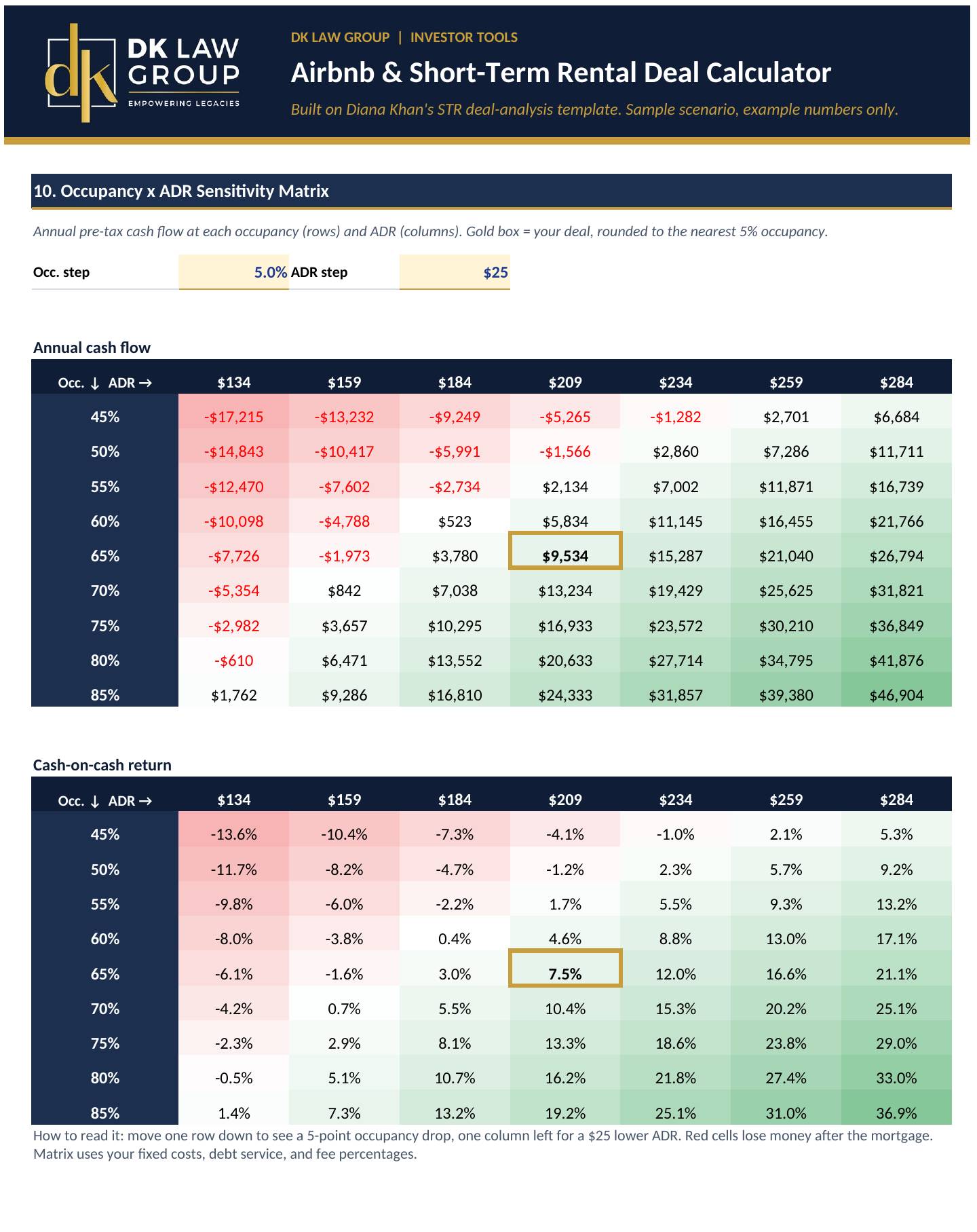
Read the matrix, not the single answer. The screenshot below shows annual cash flow at different occupancy and ADR levels. The gold box (65% and $209) shows about $9,500 a year. One row down (5 points less occupancy) and one column left ($25 less a night) shows about $500.
Price in a manager even if you self-manage. Set the co-host or manager fee to 20% to 25% and see if it still works. Your time is not free, and life changes.
Check Plan B. In the example, long-term rent of $2,100 a month would lose about $667 a month. That deal depends on STR rules staying friendly, which is exactly what you want to know before you buy.
Check DSCR both ways. Some DSCR lenders size the loan on long-term rent, not STR revenue. The example is 1.39x on STR income and under 1.0x on long-term rent.

Before any of this, I run the rules check: zoning, local STR license, primary-residence requirements, HOA or condo rental limits, lodging taxes, and an insurance policy that actually covers paid guests.
If the blank template would help, say so below and I'll share it.
What do you all use for off-season occupancy in your markets?
General information, not legal, tax, or investment advice.
I drafted this with an AI assistant and edited it.


