How I stress-test an Airbnb deal in about two minutes (example numbers inside)

How I stress-test an Airbnb deal in about two minutes (example numbers inside)

Diana KhanPro Member
Attorney · 300 Red Brook Blvd Suite 100 Owings Mills, MD 21117 · Member since 2024 · 898 posts · 325 votes

I see a lot of STR deals here analyzed with one ADR and one occupancy number. That is usually where the trouble starts. I rebuilt the spreadsheet I use for my own deals and for walking other investors through theirs, and I wanted to share the method, because the method matters more than the file.

Everything below is a sample scenario with round example numbers, not a real property or market.

Example: $325,000 purchase, 20% down, 7.25% for 30 years, a 3-bedroom with about $27,000 of furnishing and launch costs and $25,300 of rehab including contingency.

  1. Split the year into seasons. In the example: 4 peak months at $250 a night and 80% occupancy, 4 shoulder months at $200 and 65%, 4 off-season months at $150 and 45%. That blends to roughly $209 a night at 63%. If you only plug in peak numbers, you overstate revenue by thousands.

  2. Find break-even occupancy. This is the occupancy where cash flow after the mortgage hits zero. In the example it is about 52%, against an expected 63%. An 11-point cushion is thin for one bad winter.

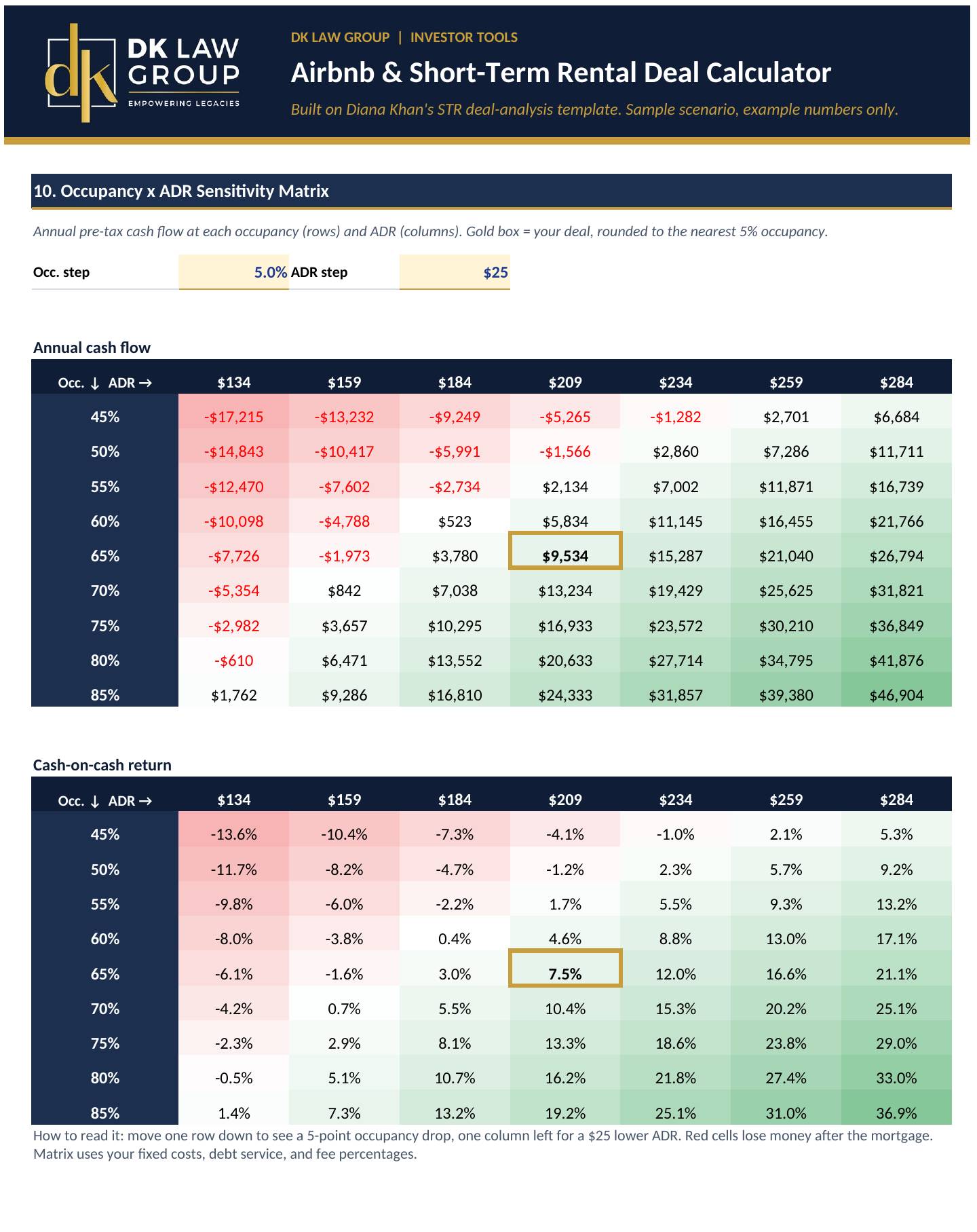
  3. Read the matrix, not the single answer. The screenshot below shows annual cash flow at different occupancy and ADR levels. The gold box (65% and $209) shows about $9,500 a year. One row down (5 points less occupancy) and one column left ($25 less a night) shows about $500.

  4. Price in a manager even if you self-manage. Set the co-host or manager fee to 20% to 25% and see if it still works. Your time is not free, and life changes.

  5. Check Plan B. In the example, long-term rent of $2,100 a month would lose about $667 a month. That deal depends on STR rules staying friendly, which is exactly what you want to know before you buy.

  6. Check DSCR both ways. Some DSCR lenders size the loan on long-term rent, not STR revenue. The example is 1.39x on STR income and under 1.0x on long-term rent.

Before any of this, I run the rules check: zoning, local STR license, primary-residence requirements, HOA or condo rental limits, lodging taxes, and an insurance policy that actually covers paid guests.

If the blank template would help, say so below and I'll share it.

What do you all use for off-season occupancy in your markets?

General information, not legal, tax, or investment advice.

I drafted this with an AI assistant and edited it.

3Reply
890 views

40 Replies

Jump to latestLatest
  • Lisa BenbrookPro Member
    Investor · Central Arkansas · Member since 2025 · 15 posts · 13 votes
    5d

    Hi Diana, this is a great analysis tool. I’d love to have a copy of your blank template. Your sheet accounts for the change in variables that can have a huge impact. Thanks!

    • Diana KhanPro Member
      OP
      Attorney · 300 Red Brook Blvd Suite 100 Owings Mills, MD 21117 · Member since 2024 · 898 posts · 325 votes
      2d
      Quote from @Lisa Benbrook:

      Hi Diana, this is a great analysis tool. I’d love to have a copy of your blank template. Your sheet accounts for the change in variables that can have a huge impact. Thanks!

      Hi @Lisa Benbrook! I just sent you the blank spreadsheet in a private message. Check your inbox when you get a chance. Hope it helps!

    • Member since 2018 · 38 posts · 4 votes
      1d

      Hi Diana, I'd love the spreadsheet if you are still offering. Thanks!

    • Diana KhanPro Member
      OP
      Attorney · 300 Red Brook Blvd Suite 100 Owings Mills, MD 21117 · Member since 2024 · 898 posts · 325 votes
      6h
      Quote from @Scott Duerk:

      Hi Diana, I'd love the spreadsheet if you are still offering. Thanks!

      Hi @Scott Duerk! Of course, I'd be happy to share a copy with you! I've reached my message request limit here on BiggerPockets, so could you please send me a private message first? I'll send you the spreadsheet from there. Thanks so much!

    • Member since 2018 · 38 posts · 4 votes
      1h

      Thanks Diana, says I can't DM with those that I'm not connected to so I've just sent you a request. Thanks in advance!

  • Las Vegas, NV · Member since 2018 · 42 posts · 18 votes
    5d

    Diana, good framework. On off-season occupancy, I don't trust a single market average. What I do:

    Pull comps that actually match (same bedroom count, similar amenities, tight radius) and look at their calendars for the slowest three or four months of the last two years, not the annual number. Then use the weaker of the two years and knock a few more points off for a new listing with no reviews going into its first off-season.

    Look at what those comps did to ADR in the same months. A lot of hosts hold occupancy by cutting rate, so the occupancy figure can look healthier than the revenue really was.

    Check whether midweek is the real problem. In many drive-to markets winter weekends still fill and it's Sunday to Thursday that sits empty, which points to a midterm or minimum-stay fix rather than a worse deal.

    I'd also size the cash reserve off the off-season months alone: how much you'd need to cover each month if they come in 10 points under the model.

    (Drafted with AI help.)

    • Diana KhanPro Member
      OP
      Attorney · 300 Red Brook Blvd Suite 100 Owings Mills, MD 21117 · Member since 2024 · 898 posts · 325 votes
      2d

      @Kent Morgan, I like that you check what hosts charged in those same slow months. The calendar can look pretty full, but I’d want to know how much they had to drop the rate to get there. I like your reserve check too.

  • Ashish AcharyaBusiness Member
    CPA, CFP®, PFS · Sarasota, FL · Member since 2017 · 5k+ posts · 3k+ votes
    5d

    Really useful framework, Diana. The one row I'd add to the matrix is after-tax cash flow, especially for buyers planning to use the STR rules. In your example, the $27K of furnishings and much of the rehab are 5-year property that can be written off in year one, and a cost seg on the building adds more. For an owner who materially participates, that first-year loss can offset W-2 income, which changes how the thin $500 scenario feels. It shouldn't rescue a deal that only works at 65% occupancy, though. It also ties into your Plan B: once the property flips to a long-term lease, future losses become passive, so the tax benefit disappears right when the cash flow does.

    INVESTOR FRIENDLY CPA®4.9244 Reviews
    TaxMD® | Tax Planning Software
    • Diana KhanPro Member
      OP
      Attorney · 300 Red Brook Blvd Suite 100 Owings Mills, MD 21117 · Member since 2024 · 898 posts · 325 votes
      2d
      Quote from @Ashish Acharya:

      Really useful framework, Diana. The one row I'd add to the matrix is after-tax cash flow, especially for buyers planning to use the STR rules. In your example, the $27K of furnishings and much of the rehab are 5-year property that can be written off in year one, and a cost seg on the building adds more. For an owner who materially participates, that first-year loss can offset W-2 income, which changes how the thin $500 scenario feels. It shouldn't rescue a deal that only works at 65% occupancy, though. It also ties into your Plan B: once the property flips to a long-term lease, future losses become passive, so the tax benefit disappears right when the cash flow does.

      Good point @Ashish Acharya. The sheet shows cash flow before taxes, so it’d be helpful to see the after tax number next to it. I’d still want to know how the place holds up if winter is slow.

  • Technology · Vancouver, BC · Member since 2026 · 316 posts · 96 votes
    5d

    Hi @Diana Khan

    Splitting the year into seasons is such a useful habit, and the break-even occupancy line makes the risk really clear. An 11-point cushion sounds comfortable until one slow winter takes most of it.

    One thing I'd add to the matrix is the cost per stay, not just per night. In the off-season, stays tend to get shorter, so the same month carries more turnovers, more cleaning and more guest messages for less revenue. Running the off-season rows with a shorter average stay can push break-even a few points higher than the nightly numbers suggest.

    Really helpful way to look at it.
    Lee

    • Diana KhanPro Member
      OP
      Attorney · 300 Red Brook Blvd Suite 100 Owings Mills, MD 21117 · Member since 2024 · 898 posts · 325 votes
      2d
      Quote from @Lee Futcher:

      Hi @Diana Khan

      Splitting the year into seasons is such a useful habit, and the break-even occupancy line makes the risk really clear. An 11-point cushion sounds comfortable until one slow winter takes most of it.

      One thing I'd add to the matrix is the cost per stay, not just per night. In the off-season, stays tend to get shorter, so the same month carries more turnovers, more cleaning and more guest messages for less revenue. Running the off-season rows with a shorter average stay can push break-even a few points higher than the nightly numbers suggest.

      Really helpful way to look at it.
      Lee

      Good catch @Lee Futcher. Six nights with one guest is one cleaning. Split those same nights into three stays and now you’re paying for three cleanings. I’d like to see how much that changes the break even number.

    • Technology · Vancouver, BC · Member since 2026 · 316 posts · 96 votes
      1d

      Hello @Diana Khan,

      Yes, that's the one that sneaks up on people! Same nights, same rate, but three cleanings instead of one.

      What I'd do is guess the average stay length for each season, figure out how many turnovers that means, and multiply by your cleaning cost. My guess is winter's break even jumps more than anyone expects.

      Would love to see what your numbers show.
      Lee

  • Andrew SteffensBusiness Member
    Tampa, FL · Member since 2022 · 4k+ posts · 3k+ votes
    5d

    Great framework Diana! I also think the seasons is important for investors not great at cashflow management. When I do a projection for a client it is a blended ADR number and I do explain the peak months and slow months but assigning values to those months may help those who are cashflow management challenged.

    • Diana KhanPro Member
      OP
      Attorney · 300 Red Brook Blvd Suite 100 Owings Mills, MD 21117 · Member since 2024 · 898 posts · 325 votes
      2d
      Quote from @Andrew Steffens:

      Great framework Diana! I also think the seasons is important for investors not great at cashflow management. When I do a projection for a client it is a blended ADR number and I do explain the peak months and slow months but assigning values to those months may help those who are cashflow management challenged.

      I see what you mean @Andrew Steffens. The year can look good on paper, but the bills still come every month. Seeing the slow months on their own helps you figure out how much to put aside when bookings are good.

  • Atlanta · Member since 2022 · 726 posts · 650 votes
    5d

    what do you do for a VRBO deal?

    • Diana KhanPro Member
      OP
      Attorney · 300 Red Brook Blvd Suite 100 Owings Mills, MD 21117 · Member since 2024 · 898 posts · 325 votes
      1d
      Quote from @Trent Reeve:

      what do you do for a VRBO deal?

      @Trent Reeve I’d use the same sheet for Vrbo, Trent. I’d just put in the fees I’d pay there.

  • John RacinePro Member
    Rental Property Investor · Casselberry, FL · Member since 2008 · 346 posts · 183 votes
    5d

    Diana, @Kent Morgan touched on the mid-term fix, and that's how I handle it. To your off-season question: I've mostly stopped trying to predict off-season nightly occupancy, because I don't run those months as nightly at all.

    Most of my units run as a mid-term/short-term hybrid. The calendar is set for 30+ day stays with 30-60 day minimums, and short stays only fill gaps of a few days up to two weeks. So the off-season rows in a matrix like yours look different for me. There are fewer nightly bookings to model, and far fewer turnovers, which ties into Lee's point about cost per stay. A slow winter at 45% nightly is a very different number than one work crew on a 60-day stay.

    Two rows I'd add to the stress test:

    • A mid-term row. Price the slow months at a realistic furnished monthly rate (30+ day comps, not nightly ADR) and see what it does to break-even. For a lot of deals it's a better Plan B than the long-term rent number. Stays of 30+ days are often treated differently under local STR rules too, so check that market by market.

    • Extension upside. I leave a 60-day window open after each mid-term stay so guests can extend. One construction crew extended four times and stayed 90+ days. You can't underwrite that, but it's why I'd rather have one long booking in the slow season than chase short ones.

    On the pricing side, PriceLabs handles the minimum-stay logic for me. Dates far out after a mid-term booking keep a long minimum, and as they get closer the minimum drops so the gap can fill with short stays.

    What kinds of markets are you running the template on? Drive-to vacation markets and job-driven markets behave very differently on mid-term demand.

    • Diana KhanPro Member
      OP
      Attorney · 300 Red Brook Blvd Suite 100 Owings Mills, MD 21117 · Member since 2024 · 898 posts · 325 votes
      2d
    • Diana KhanPro Member
      OP
      Attorney · 300 Red Brook Blvd Suite 100 Owings Mills, MD 21117 · Member since 2024 · 898 posts · 325 votes
      2d
      Quote from @John Racine:

      Diana, @Kent Morgan touched on the mid-term fix, and that's how I handle it. To your off-season question: I've mostly stopped trying to predict off-season nightly occupancy, because I don't run those months as nightly at all.

      Most of my units run as a mid-term/short-term hybrid. The calendar is set for 30+ day stays with 30-60 day minimums, and short stays only fill gaps of a few days up to two weeks. So the off-season rows in a matrix like yours look different for me. There are fewer nightly bookings to model, and far fewer turnovers, which ties into Lee's point about cost per stay. A slow winter at 45% nightly is a very different number than one work crew on a 60-day stay.

      Two rows I'd add to the stress test:

      • A mid-term row. Price the slow months at a realistic furnished monthly rate (30+ day comps, not nightly ADR) and see what it does to break-even. For a lot of deals it's a better Plan B than the long-term rent number. Stays of 30+ days are often treated differently under local STR rules too, so check that market by market.

      • Extension upside. I leave a 60-day window open after each mid-term stay so guests can extend. One construction crew extended four times and stayed 90+ days. You can't underwrite that, but it's why I'd rather have one long booking in the slow season than chase short ones.

      On the pricing side, PriceLabs handles the minimum-stay logic for me. Dates far out after a mid-term booking keep a long minimum, and as they get closer the minimum drops so the gap can fill with short stays.

      What kinds of markets are you running the template on? Drive-to vacation markets and job-driven markets behave very differently on mid-term demand.

  • Member since 2026 · 111 posts · 35 votes
    5d

    Thanks for sharing the framework, Diana. The part I use most is the break-even occupancy line, because it turns a guess into a clear test. If the deal only works at peak numbers, I pass, no matter how good the photos look.

    For off-season occupancy, I do not use one market average. I look at similar listings nearby, same bedroom count, and check what they booked in the slow months, not just what they listed for. I also check midweek nights separately from weekends, because in many markets weekends still fill and weekdays are the gap.

    The other number I always add is a reserve for the slow season. I want to know how many months I can cover the mortgage and fixed costs if occupancy drops below break-even. If that answer is uncomfortable, the deal is too tight for me.

    • Diana KhanPro Member
      OP
      Attorney · 300 Red Brook Blvd Suite 100 Owings Mills, MD 21117 · Member since 2024 · 898 posts · 325 votes
      2d
      Quote from @Daniel Jung:

      Thanks for sharing the framework, Diana. The part I use most is the break-even occupancy line, because it turns a guess into a clear test. If the deal only works at peak numbers, I pass, no matter how good the photos look.

      For off-season occupancy, I do not use one market average. I look at similar listings nearby, same bedroom count, and check what they booked in the slow months, not just what they listed for. I also check midweek nights separately from weekends, because in many markets weekends still fill and weekdays are the gap.

      The other number I always add is a reserve for the slow season. I want to know how many months I can cover the mortgage and fixed costs if occupancy drops below break-even. If that answer is uncomfortable, the deal is too tight for me.

      Counting your reserves in months makes a lot of sense @Daniel Jung. It’s an easy way to see how long you can cover the mortgage and bills through a slow stretch.

  • Member since 2020 · 9 posts · 5 votes
    5d

    hey Diana, love how you run a range instead of one ADR and occupancy number. simple change but makes a big difference. learned something valuable, thank you

    • Diana KhanPro Member
      OP
      Attorney · 300 Red Brook Blvd Suite 100 Owings Mills, MD 21117 · Member since 2024 · 898 posts · 325 votes
      2d
      Quote from @Cameron Weston:

      hey Diana, love how you run a range instead of one ADR and occupancy number. simple change but makes a big difference. learned something valuable, thank you

      I’m glad it helped @Cameron Weston! Seeing those numbers side by side makes it much easier to see how much a small change can matter.

  • KiKi ChaseBusiness Member
    Real Estate Agent · Indianapolis, IN · Member since 2022 · 202 posts · 81 votes
    5d

    Diana, I like that you put Plan B in there. Most of the STR deals I see go sideways only worked as one strategy.

    In Indy I don't really trust a single off-season number either. Our demand is very event-driven (conventions, Colts and Pacers games, the 500), so a market average gets pulled up by a handful of huge weeks. What I tell clients is that February is the test. If the house only works on race weekend, it's not a deal.

    The thing I'd add to your Plan B row is midterm. A lot of our owners here run short-term in the summer and switch to 30+ day stays in the winter, mostly traveling nurses on 3 to 4 month contracts. It keeps the furniture working and it's a lot fewer turnovers than Airbnb. It only works if the house is a reasonable commute to a hospital though, so check that before you buy, not after.

    And I'd give HOA bylaws their own line in the rules check. Indiana law limits what cities can do to STRs, but it doesn't override HOA or condo rules, and that's where I see people get burned downtown.

    Brentwood Collective54 Reviews
    View Page
    • Diana KhanPro Member
      OP
      Attorney · 300 Red Brook Blvd Suite 100 Owings Mills, MD 21117 · Member since 2024 · 898 posts · 325 votes
      2d
      Quote from @KiKi Chase:

      Diana, I like that you put Plan B in there. Most of the STR deals I see go sideways only worked as one strategy.

      In Indy I don't really trust a single off-season number either. Our demand is very event-driven (conventions, Colts and Pacers games, the 500), so a market average gets pulled up by a handful of huge weeks. What I tell clients is that February is the test. If the house only works on race weekend, it's not a deal.

      The thing I'd add to your Plan B row is midterm. A lot of our owners here run short-term in the summer and switch to 30+ day stays in the winter, mostly traveling nurses on 3 to 4 month contracts. It keeps the furniture working and it's a lot fewer turnovers than Airbnb. It only works if the house is a reasonable commute to a hospital though, so check that before you buy, not after.

      And I'd give HOA bylaws their own line in the rules check. Indiana law limits what cities can do to STRs, but it doesn't override HOA or condo rules, and that's where I see people get burned downtown.

      “February is the test” is going to stick with me, @KiKi Chase. I like the hospital commute tip, too. That’s an easy thing to check if you’re hoping to rent to traveling nurses.

  • Mike GrudzienPro Member
    Lender · Eugene, OR · Member since 2019 · 2k+ posts · 1k+ votes
    2d

    Good job! Thanks.

  • Member since 2026 · 20 posts · 3 votes
    2d

    we model it off the slowest months of comparable listings not the annual average, and at the lower ADR too since both drop together. what changes the off season most for us is opening a few places up to 1 to 3 month stays (contractors, people between moves)... it fills the quiet weeks without slashing the nightly rate. @Trent Reeve same method works for vrbo, just remember the fee is different, 12% host side on newer bookings with guests paying their own fee on top, so the guest total wont match airbnb.

    • Atlanta · Member since 2022 · 726 posts · 650 votes
      2d

      that was tongue in cheek. You talk about "stress testing and Airbnb deal" its a STR not just an Airbnb

    • Diana KhanPro Member
      OP
      Attorney · 300 Red Brook Blvd Suite 100 Owings Mills, MD 21117 · Member since 2024 · 898 posts · 325 votes
      2d
      Quote from @Clive Titmuss:

      we model it off the slowest months of comparable listings not the annual average, and at the lower ADR too since both drop together. what changes the off season most for us is opening a few places up to 1 to 3 month stays (contractors, people between moves)... it fills the quiet weeks without slashing the nightly rate. @Trent Reeve same method works for vrbo, just remember the fee is different, 12% host side on newer bookings with guests paying their own fee on top, so the guest total wont match airbnb.

      Glad you mentioned people who are between moves, @Clive Titmuss. A furnished place for a month or two makes a lot of sense when you’re waiting for your next home.

    • Member since 2026 · 20 posts · 3 votes
      1d
      Quote from @Diana Khan:
      Quote from @Clive Titmuss:

      we model it off the slowest months of comparable listings not the annual average, and at the lower ADR too since both drop together. what changes the off season most for us is opening a few places up to 1 to 3 month stays (contractors, people between moves)... it fills the quiet weeks without slashing the nightly rate. @Trent Reeve same method works for vrbo, just remember the fee is different, 12% host side on newer bookings with guests paying their own fee on top, so the guest total wont match airbnb.

      Glad you mentioned people who are between moves, @Clive Titmuss. A furnished place for a month or two makes a lot of sense when you’re waiting for your next home.

      Exactly Diana, it's a bigger chunk of demand than most people think...contractors and overseas workers too. They want a proper desk, decent wifi and somewhere to cook, and if you get that right they tend to extend.

  • Rehoboth Beach, Sussex County · Member since 2025 · 1 post · 0 votes
    1d

    Great looking spreadsheet! Please send a copy

    • Diana KhanPro Member
      OP
      Attorney · 300 Red Brook Blvd Suite 100 Owings Mills, MD 21117 · Member since 2024 · 898 posts · 325 votes
      1d
      Quote from @Simon Bowman:

      Great looking spreadsheet! Please send a copy

      Hi @Simon Bowman! Thanks for your interest! Feel free to send me a private message, and I'll be happy to share a copy of the spreadsheet with you!

  • Farzana HossainPro Member
    Member since 2024 · 21 posts · 4 votes
    1d

    Love the seasonal split, Diana. In the Coachella Valley the calendar runs backwards from most markets: summer is the slow season once it hits 110°F, and January through April carries the year, with the April festival weekends as the spike.

    Near Yosemite where I host, it flips again. Summer is peak and winter depends on park access and road conditions.

    For desert deals I model summer separately and assume the pool heater and A/C bills peak in opposite seasons, so utilities swing a lot month to month.

    I also add the permit line items to the expense side. In unincorporated Riverside County the STR Certificate is $1,077 to start and $775 to renew, and there's no renewal grace period anymore.

    Great template, thanks for sharing it.

    • Diana KhanPro Member
      OP
      Attorney · 300 Red Brook Blvd Suite 100 Owings Mills, MD 21117 · Member since 2024 · 898 posts · 325 votes
      6h
      Quote from @Farzana Hossain:

      Love the seasonal split, Diana. In the Coachella Valley the calendar runs backwards from most markets: summer is the slow season once it hits 110°F, and January through April carries the year, with the April festival weekends as the spike.

      Near Yosemite where I host, it flips again. Summer is peak and winter depends on park access and road conditions.

      For desert deals I model summer separately and assume the pool heater and A/C bills peak in opposite seasons, so utilities swing a lot month to month.

      I also add the permit line items to the expense side. In unincorporated Riverside County the STR Certificate is $1,077 to start and $775 to renew, and there's no renewal grace period anymore.

      Great template, thanks for sharing it.

      @Farzana Hossain, that's a great point about utility costs changing with the seasons! It's easy to focus on bookings and forget how much those expenses can change throughout the year. I also like your reminder to include permit fees in the numbers. Thanks for sharing your experience in both markets!

  • Karen CubberleyBusiness Member
    Realtor · Sevierville, TN · Member since 2026 · 63 posts · 22 votes
    12h

    @Diana Khan

    I would absolutely love a copy of your template! Thank you for being willing to share it.

    Shelly and I specialize in working with STR investors here in the Smoky Mountains of Tennessee, and I couldn't agree more with your approach. Too often, investors focus on gross rental revenue without fully understanding seasonal fluctuations, operating expenses, and break-even occupancy.

    I especially appreciate that you've incorporated management fees, sensitivity analysis, and a Plan B. We always encourage our investors to evaluate properties using conservative numbers rather than best-case scenarios.

    I'm always looking for additional tools to help educate our investors and assist them in making informed decisions. I'd love to incorporate your spreadsheet into our due diligence process.

    Thank you for sharing your knowledge and expertise!

    Tennessee Elite Realty 59 Reviews
    View Page
    • Diana KhanPro Member
      OP
      Attorney · 300 Red Brook Blvd Suite 100 Owings Mills, MD 21117 · Member since 2024 · 898 posts · 325 votes
      6h
      Quote from @Karen Cubberley:

      @Diana Khan

      I would absolutely love a copy of your template! Thank you for being willing to share it.

      Shelly and I specialize in working with STR investors here in the Smoky Mountains of Tennessee, and I couldn't agree more with your approach. Too often, investors focus on gross rental revenue without fully understanding seasonal fluctuations, operating expenses, and break-even occupancy.

      I especially appreciate that you've incorporated management fees, sensitivity analysis, and a Plan B. We always encourage our investors to evaluate properties using conservative numbers rather than best-case scenarios.

      I'm always looking for additional tools to help educate our investors and assist them in making informed decisions. I'd love to incorporate your spreadsheet into our due diligence process.

      Thank you for sharing your knowledge and expertise!

      Hi @Karen Cubberley! Thank you so much for your kind words! I really appreciate it, especially coming from someone who works closely with STR investors.

      I'd be happy to share a copy with you! Feel free to send me a private message, and I'll send it over. Hope you and Shelly find it helpful!

  • Member since 2020 · 18 posts · 4 votes
    5h

    Hello Diana....I use a similar analysis for vacation rentals on the Jersey shore. Yours looks more in depth. Love to see the working model if possible. TY

    • Diana KhanPro Member
      OP
      Attorney · 300 Red Brook Blvd Suite 100 Owings Mills, MD 21117 · Member since 2024 · 898 posts · 325 votes
      4h
      Quote from @Jim Given:

      Hello Diana....I use a similar analysis for vacation rentals on the Jersey shore. Yours looks more in depth. Love to see the working model if possible. TY

      Hi Jim! It's great to hear you're using a similar approach for your vacation rentals. I'd be happy to share a copy of the spreadsheet with you! Could you please send me a private message? I'll send it over from there.

Join the conversationCreate a free account to reply, vote on answers and follow this thread.