Remote investing for buy-and-hold strategy

Remote investing for buy-and-hold strategy

Member since 2025 · 9 posts · 8 votes

I am located in California (San Jose area) and my local market is too expensive for real estate investing. I am looking at investing with a buy-and-hold strategy. Since I am no longer limiting myself to local deals, I would like to quickly filter out deals that don't make sense compared to options I may have elsewhere. I was thinking that some rules of thumb may help me with this and give me objective criteria for comparison across states. Something like "ignore deals that have less than "N%" for Cap Rate, or COC, or Return on Equity or ROI or IRR".

1. Does this make sense or should I be approaching this differently?

2. I don't know what threshold value I should use for each of these metrics. Would this be a single set of numbers across all the states or would these numbers have to be specific to any city/state?

3. Am I making things more difficult for myself by thinking of investing anywhere (I still don't have my first property) or should I pick a handful of cities/states to focus on? maybe cities that better support a buy-and-hold strategy? Market picker on bigger pockets has a number of recommendations...

4. For my first property I was thinking of going with a turnkey provider like REI Nation and hopefully learn as I go. The thinking is that a turnkey provider might prevent me from making blunders.

Any suggestions and advice would be highly appreciated!

- Niranjan 

5Reply
106 views

Most Popular Reply

Todd AndersonPro Member
Real Estate Agent · Cape Coral, FL · Member since 2023 · 392 posts · 175 votes
1y

@Niranjan P Ghate

Welcome to the BP community. As you can see, these forms are a great way to get answers to questions to get moving.

You've gotten a lot of great answers to the questions that you posed, and I do think you're thinking about this in the right way. There has to be some obvious indicators to whether you want to go deeper in evaluating a deal. I would agree with what others have said that COC and cap rate are good. Initial indicators of an investment. These two numbers will let you know whether the deal will work. One other number that you brought up that you shouldn't be very concerned with as a buy and hold investor is IRR. this number looks at how the deal should work for you long-term and takes into account the market appreciation.

The investors that I work with who are investing OSS are you interested in finding the best markets for growth of their investment over the hold time.  You will find insight into markets through BP, but make sure it's a market that is growing in both population and employment. This will ensure that you will get in the way of appreciation.

For a buy and hold strategy, I also recommend to the investors that I work with to consider new construction. With this strategy you were able to own a property for the best years of its life. In these years, the maintenance cost are lowest because everything is new.  it also allows you to gain appreciation compared to continued new construction. All direct comparisons will be new to the market and new construction will most likely not get cheaper.

Feel free to connect if you have more questions.

Best of luck

See this reply in the discussion

20 Replies

Jump to latestLatest
  • Realtor · Charlotte, NC · Member since 2023 · 245 posts · 231 votes
    1y

    We work with a lot of out of state and out of country investors. Most of them come to me after they’ve selected a market after thorough research so I would suggest starting there, partner with an agent that knows what they’re doing and has the background to back that up, and find a PM company that will be ready to take the reins so you know what to expect in terms of expenses as well.

    Get as clear as possible about what you’re looking for before wasting too much time with agents and PM companies. You’ll be bogged down with far too much information and will likely confuse yourself more.

    Personally, I don't think a general blanket of X% Cap, COC, etc. works for different states/markets. There are just so many moving parts, expected equity gains, and other variables.

  • Real Estate Agent · Lakeland, TN · Member since 2015 · 214 posts · 105 votes
    1y

    @Niranjan P Ghate I totally understand your dilemma and we work with investors just like you everyday and everyday we also work with investors that were like you are today, but 10 years ago and now how flourishing portfolios today. Just today I spoke with 3 different clients of mine that have had their resident in their rentaL home with us for 8+ years. 

  • Melissa JusticeBusiness Member
    Rental Property Investor · Phoenix, AZ · Member since 2024 · 518 posts · 1k+ votes
    1y

    Hey @Niranjan P Ghate,

    You're thinking about this the right way—seriously, you're ahead of the curve already.

    1. Rules of Thumb? Yes.
    Using metrics is smart for quick filtering. Try: 

    Cap Rate: 6–8%+

    Cash-on-Cash (COC): 7–10%+

    Rent-to-Price: 0.8–1%
    Use them as a guide, not gospel—always follow up with deeper analysis.

    2. Universal or Market-Specific?
    Somewhat both. Use the same baseline across markets, but adjust your expectations depending on the area's appreciation, rent growth, and risk profile.

    3. Too Many Markets = Paralysis
    Start with 2–3 investor-friendly cities (like Birmingham, Cleveland, or Memphis). Learn them well. You’ll move faster with more confidence.

    4. Turnkey = Great First Step
    Turnkey makes sense if you want a smooth entry. Just run your own numbers and vet the provider thoroughly.

    It really comes down to investing in a growing market, in a good neighborhood & building a great team to support you. It can be a lot of time and work if doing it on your own. It's helpful to work with a reputable team. That is what our team at Rent to Retirement has been helping investors to do for a decade now with BP. I'm happy to answer any questions you have about analyzing markets or getting started. Most importantly, choose a market that aligns with your goals!

    Wishing you the best of success!

    Melissa
    Rent to Retirement Investment Strategist

  • Member since 2025 · 9 posts · 8 votes
    1y

    @Jared Smith, I am moving through my first deal with REI Nation. Learning a lot already along the way! I am looking forward to solidifying some of my opinions and having more confidence in my strategy.

  • Member since 2025 · 9 posts · 8 votes
    1y

    @Melissa Justice, Thank you for the response and the advice. I noticed that you work in the NJ area. Do you also work in Birmingham, AL? If not, could you put me in contact with someone who works in that area? I would like to learn more about RentToRetirement...

    REI Nation operates in that area as well and it would be good to get a feel for how they compare with each other.

  • Member since 2025 · 9 posts · 8 votes
    1y

    @Stephanie Walker,

    "Get as clear as possible about what you’re looking for...". That is a great advice. I am trying to learn as much as possible, as quickly as possible. There is so much to learn in this area, that sometimes I feel overwhelmed. That being said, I know that simply waiting till I know more would be a bad idea. I have already made that mistake once... so this time around, I decided to jump in with a safer option and use that experience to learn and get better clarity on what I should really be looking for and refine my plans as I go.

  • Melissa JusticeBusiness Member
    Rental Property Investor · Phoenix, AZ · Member since 2024 · 518 posts · 1k+ votes
    1y

    I will private message you!

  • Kerlous TadresBusiness Member
    Realtor · Columbus, OH · Member since 2023 · 1k+ posts · 1k+ votes
    1y
    Quote from @Niranjan P Ghate:

    I am located in California (San Jose area) and my local market is too expensive for real estate investing. I am looking at investing with a buy-and-hold strategy. Since I am no longer limiting myself to local deals, I would like to quickly filter out deals that don't make sense compared to options I may have elsewhere. I was thinking that some rules of thumb may help me with this and give me objective criteria for comparison across states. Something like "ignore deals that have less than "N%" for Cap Rate, or COC, or Return on Equity or ROI or IRR".

    1. Does this make sense or should I be approaching this differently?

    2. I don't know what threshold value I should use for each of these metrics. Would this be a single set of numbers across all the states or would these numbers have to be specific to any city/state?

    3. Am I making things more difficult for myself by thinking of investing anywhere (I still don't have my first property) or should I pick a handful of cities/states to focus on? maybe cities that better support a buy-and-hold strategy? Market picker on bigger pockets has a number of recommendations...

    4. For my first property I was thinking of going with a turnkey provider like REI Nation and hopefully learn as I go. The thinking is that a turnkey provider might prevent me from making blunders.

    Any suggestions and advice would be highly appreciated!

    - Niranjan 


    Hey there, welcome to the journey! You're asking all the right questions, especially before diving into your first deal—it’s smart that you’re trying to build a solid foundation.

    1. Using rules of thumb is a great way to quickly filter deals. Many investors do this to avoid analysis paralysis. For example, you could say: “I won’t look at anything under a 6% Cap Rate or under 8% Cash-on-Cash Return,” but those thresholds really depend on your goals and the markets you’re targeting. Higher appreciation markets (like parts of CA or CO) might have lower returns but stronger long-term upside, whereas cash flow markets (like the Midwest or Southeast) may offer higher yields but slower appreciation.

    2. Thresholds do vary by market, so I’d recommend adjusting them based on your chosen city. You can use national averages as a baseline, but local data will help you stay realistic and competitive. Try pulling average Cap Rates or rent-to-price ratios for a few cities you’re considering—it’ll help you set better expectations.

    3. Focusing on a few markets (2–3 max at first) will make your life easier. It gives you time to understand those markets, build a local team, and feel confident when a deal hits your inbox. I’m personally investing out of state as well, and narrowing down to just a couple of metros made it way more manageable.

    4. Turnkey is a fine option for a first property—just make sure you vet the provider thoroughly. Some are great, some… not so much. Talk to past clients, check online reviews, and really understand what “turnkey” means for them. Some investors eventually move on from turnkey to build more equity, but it can be a solid intro if your priority is learning without getting overwhelmed.

    Happy to share more based on the markets you’re considering or help review a deal if you want a second set of eyes. Wishing you the best on your first buy-and-hold!

    Kerlous Tadres | Reafco Real Estate539 Reviews
  • Todd AndersonPro Member
    Real Estate Agent · Cape Coral, FL · Member since 2023 · 392 posts · 175 votes
    1y

    @Niranjan P Ghate

    Welcome to the BP community. As you can see, these forms are a great way to get answers to questions to get moving.

    You've gotten a lot of great answers to the questions that you posed, and I do think you're thinking about this in the right way. There has to be some obvious indicators to whether you want to go deeper in evaluating a deal. I would agree with what others have said that COC and cap rate are good. Initial indicators of an investment. These two numbers will let you know whether the deal will work. One other number that you brought up that you shouldn't be very concerned with as a buy and hold investor is IRR. this number looks at how the deal should work for you long-term and takes into account the market appreciation.

    The investors that I work with who are investing OSS are you interested in finding the best markets for growth of their investment over the hold time.  You will find insight into markets through BP, but make sure it's a market that is growing in both population and employment. This will ensure that you will get in the way of appreciation.

    For a buy and hold strategy, I also recommend to the investors that I work with to consider new construction. With this strategy you were able to own a property for the best years of its life. In these years, the maintenance cost are lowest because everything is new.  it also allows you to gain appreciation compared to continued new construction. All direct comparisons will be new to the market and new construction will most likely not get cheaper.

    Feel free to connect if you have more questions.

    Best of luck

  • Real Estate Agent · Memphis · Member since 2021 · 41 posts · 25 votes
    1y

    Hi Niranjan, It has been a pleasure working with you on your first deal. We would love an opportunity to host you in person for a visit to meet our team in person. Please send me a DM to discuss a few convenient dates for your visit. When considering who and where to invest with, verifying your expectations in person will reveal who is structured to provide the out-of-state/passive investment experience you are looking for. 

  • Real Estate Agent · San Jose, CA · Member since 2023 · 181 posts · 104 votes
    1y
    Quote from @Niranjan P Ghate:

    I am located in California (San Jose area) and my local market is too expensive for real estate investing. I am looking at investing with a buy-and-hold strategy. Since I am no longer limiting myself to local deals, I would like to quickly filter out deals that don't make sense compared to options I may have elsewhere. I was thinking that some rules of thumb may help me with this and give me objective criteria for comparison across states. Something like "ignore deals that have less than "N%" for Cap Rate, or COC, or Return on Equity or ROI or IRR".

    1. Does this make sense or should I be approaching this differently?

    2. I don't know what threshold value I should use for each of these metrics. Would this be a single set of numbers across all the states or would these numbers have to be specific to any city/state?

    3. Am I making things more difficult for myself by thinking of investing anywhere (I still don't have my first property) or should I pick a handful of cities/states to focus on? maybe cities that better support a buy-and-hold strategy? Market picker on bigger pockets has a number of recommendations...

    4. For my first property I was thinking of going with a turnkey provider like REI Nation and hopefully learn as I go. The thinking is that a turnkey provider might prevent me from making blunders.

    Any suggestions and advice would be highly appreciated!

    - Niranjan 

    Greeting from San Jose! @Melissa Justice has provided some great advice! Figure out your buybox and adjust based on different markets. As an out-of-state investor myself, I would highly recommend investing in a city that you are familiar with (perhaps you have friends there or have people there who you can trust). That gives you a peace of mind and saves you from potential scammers. For buy-and-hold, you will also have to consider future growth potential so you can benefit from the appreciation. Feel free to DM me or we can grab coffee somewhere nearby. Best of luck!

  • Denise SuppleeBusiness Member
    Realtor · Willow Grove, PA · Member since 2017 · 970 posts · 638 votes
    1y

    @Niranjan P Ghate, Hello, have you ever considered investing in syndicated commercial real estate deals? I operate a co-investing club where we invest in properties all over. We are currently vetting a 250+ unit in Ohio. It is truly passive! I have been involved in investing and managing properties for over 30 years, and I got so tired of tenant's complaints, emergencies and maintenance issues. Investing passively, I do not have that anymore! Feel free to reach out if you have any questions. BEST of luck to you!

    Spark Rental Co-Investing Club577 Reviews
  • Chad HalePro Member
    Property Manager / Investor · San Jose, CA · Member since 2013 · 779 posts · 301 votes
    1y

    @Niranjan P Ghate I hear you on San Jose area being expensive.  Have you talked with any experienced realtors in the area to confirm your ability to participate locally?  It's hard to get in, but once you do it gets easier here.  Not trying to derail your out of state questions...

  • Nicholas L.Pro Member
    Flipper/Rehabber · Pittsburgh · Member since 2018 · 6k+ posts · 5k+ votes
    1y

    @Niranjan P Ghate

    yes, trying to math your way to something is the wrong way to do it.  that will take you to an OOS market you don't know anything about, thousands of miles away, where you'll be sold a property that looks great on paper and then loses you money every month.

    you need to pick a market that is a couple hours away, or in a market where you have family, or a place you'd like to live someday, and build a network there.  otherwise, you'll end up like these folks.

    Sell at a loss or rent at a loss

    https://www.biggerpockets.com/forums/963/topics/1195280-expe...

    https://www.biggerpockets.com/forums/48/topics/1160450-run-i...

    https://www.biggerpockets.com/forums/48/topics/1137397-balti...

    https://www.biggerpockets.com/forums/52/topics/1010977-12-00...

  • Real Estate Consultant · Ann Arbor, MI · Member since 2022 · 461 posts · 250 votes
    1y

    Hi Niranjan in San Jose, California-

    Congratulations on being ready to make your first investment!

    You are asking about a remote strategy for buy and hold investing and thinking about companies that offer "turnkey" deals to avoid making mistakes on your first investment as your market in California is too expensive.

    You are not the only person starting out in an expensive market looking to invest out-of-state.

    While there is nothing wrong with buying "turnkey" investments that a company has packaged, you can do the same thing while being more flexible in the deals you pursue with the strategy of finding an investment friendly Realtor who is an investor themselves and an excellent local property manager in the areas you are interested in.

    You can find these people through Facebook investor groups for the areas, local real estate investor groups in the area, agents who frequently list investment property in the area, and this forum on Bigger Pockets.

    There are several markets in Michigan that will give you strong cashflow with appreciation.

    To Your Success!

  • Memphis, TN · Member since 2024 · 234 posts · 100 votes
    1y

    Hey @Niranjan P Ghate!

    You're thinking about this the right way! Setting objective filters like minimum cap rate or cash-on-cash return (CoC) is smart, especially when evaluating multiple markets from out of state. For a buy-and-hold strategy in affordable, high-yield markets like Memphis, a good baseline might be 7–8% cap rate and at least 8–10% CoC, especially if you're using financing. These numbers can vary by market, but in cities like Memphis where entry prices are lower and demand is strong thanks to major employers like FedEx, St. Jude, and the Ford Blue Oval project. Those returns are still very achievable even with today's interest rates.

    As for investing “anywhere,” it can get overwhelming. I’d recommend narrowing your focus to 2–3 cities that are known for supporting strong buy-and-hold strategies. Memphis is a great example, especially for turnkey investing. It has stable rents, low vacancy, and providers who deliver fully renovated, tenant-ready homes with in-house property management. A good turnkey provider doesn’t just sell you a house, they walk you through the entire process and help you avoid the common pitfalls most first-time out-of-state investors face.

    If you're open to it, I’d be happy to help you compare Memphis deals against what you're seeing elsewhere and share how our turnkey model keeps things simple while generating reliable cash flow. Let’s get you to that first property without the headaches!

  • James WachobBusiness Member
    Real Estate Broker · Memphis, TN · Member since 2015 · 1k+ posts · 887 votes
    1y

    Hello @Niranjan P Ghate,

    I’m based here in Memphis and have been helping out-of-state investors for a little over 20 years now. A lot of folks from California end up looking this way once they realize how far their money can go outside those high-cost markets. You’re definitely not alone.

    Your approach makes sense. Setting some baseline numbers—like a minimum cap rate or cash-on-cash return—can really help you cut through the noise and avoid wasting time on deals that don’t even come close to hitting your goals. Just don’t overthink it too much early on. Those metrics are helpful, but they’re just tools. The more deals you analyze, the better your gut gets at spotting what’s worth a deeper look.

    As far as what those numbers should be, they’re definitely not one-size-fits-all. Every market is its own animal. Here in Memphis, if you’re seeing 5–8% cash-on-cash, you’re in a good spot. You might see higher returns in more challenging neighborhoods, but that usually comes with more risk—tenants turning over often, more repairs, that sort of thing. So yeah, I’d say the numbers should flex depending on the market you’re in, not just be the same across the board.

    Trying to look at the whole country is doable, but it can get overwhelming fast. If I were in your shoes, I’d pick two or three cities that line up with your long-term plan and really get to know those markets. Look for landlord-friendly states, strong rental demand, and decent price-to-rent ratios. Memphis hits those marks for sure, but there are other solid options out there too.

    For your first property, I’d say focus on getting into something solid where you’ve got the right people around you—good property management, reliable boots on the ground, and a support system that’ll keep things from going sideways. Whether you go turnkey, value-add, or somewhere in between, the key is surrounding yourself with folks who know the local game and can keep you from making those “first-timer” mistakes. I’ve seen enough over the years to know that the team you build is just as important as the property you buy.

    Anyway, if you’re looking at Memphis or just want to see what deals actually look like here, happy to share some examples or talk you through what’s working right now. No pressure—always glad to help someone trying to get their start.

  • Drew SygitBusiness Member
    Property Manager · Royal Oak, MI · Member since 2012 · 12k+ posts · 9k+ votes
    1y

    @Niranjan P Ghate you're on the right path, BUT you really can't do this at a national level.

    How many markets do you think you can expertly analyze - quickly?

    So, you should figure out the Class of rentals you want and then pick a market.

    Here's some food for thought:

    Recommend you first figure out the property Class you want to invest in, THEN figure out the corresponding location to invest in.

    Why is Property Class so important for investors to understand and apply in their investing strategies?

    Because the Property Class dictates the Class of the tenant pool that the property will attract.

    The Tenant Class greatly impacts rental income stability and property maintenance/damage by tenants.

    Both Property Class and Tenant Class affect what type of contractors, handymen and property management companies will work on a property.

    If you buy & renovate a property in Class D area to Class A standards, what Tenant Class will rent it?

    Or, if you put several Class D tenants in a Class A four-plex, what do you think will happen to the property?

    So, if you fail to apply the correct assumptions to a property, your expectations won’t be met and it may even be a financial disaster.

    We use the following to rank Property Classes, in order of importance:

    • Property Tenant Pool: closely linked to location, but not always.
    • Property Location: closely linked to tenant pool, but not always.
    • Property Condition & Amenities: it’s important to, “Maintain to the Neighborhood.”

    Key metrics for each Property Class:

    Class A Properties:
    Tenant Pool: Majority of FICO scores 680+, no convictions/evictions in last 7 years.
    Tenant Default: 0-5% probability of eviction or early lease termination.
    Section 8: Class A rents are too high and won’t be approved.
    Vacancies: 5-10%, depending on market conditions.
    Cashflow vs Appreciation: Typically, 3-5 years for positive cashflow, but you get highest relative rent & value appreciation.

    Class B Properties:
    Tenant Pool: Majority of FICO scores 620-680, some blemishes, no convictions/evictions in last 5 years.
    Tenant Default
    : 5-10% probability of eviction or early lease termination.
    Vacancies
    : 10-15%, depending on market conditions.
    Cashflow vs Appreciation: Typically, 1-3 years for positive cashflow, balanced amounts of relative rent & value appreciation.
    Section 8: Class B rents are usually too high for the Section 8 program.

    Class C Properties:
    Tenant Pool: Majority of FICO scores 560-620, many blemishes, but should have no convictions/evictions in last 3 years. Verifying recent 2-years of rental history very important! Same for 2-years of job/income stability.
    Tenant Default: 10-20% probability of eviction or early lease termination.
    Section 8: Class C rents usually meet program requirements, proper screening still recommended.
    Vacancies: 10-20%, depending on market conditions and tenant screening.
    Cashflow vs Appreciation: Should cashflow immediately, at the lower end of relative rent & value appreciation.

    Class D Properties:
    Tenant Pool: Majority of FICO scores under 560, little to no good tradelines, lots of collections & chargeoffs, but should have no convictions/evictions in last 12 months. Verifying last 2-years of rental history and income/employment extremely important to find the “best of the worst”.
    Tenant Default: 20-30% probability of eviction or early lease termination.

    Section 8: Class D rents meet program requirements, often challenges to pass Section 8 inspection.
    Vacancies: 20%+, depending on market conditions and tenant screening.
    Cashflow vs Appreciation: Typically, all cashflow with little, maybe even negative, relative rent & value appreciation.

    Where did we get our FICO credit score information from?

    Check out this chart:

    FICO Score

    Pct of Population

    Default Probability

    800 or more

    13.00%

    1.00%

    750-799

    27.00%

    1.00%

    700-749

    18.00%

    4.40%

    650-699

    15.00%

    8.90%

    600-649

    12.00%

    15.80%

    550-599

    8.00%

    22.50%

    500-549

    5.00%

    28.40%

    Less than 499

    2.00%

    41.00%

    Source: Fair Isaac Company

    Make sure you understand the Class of properties you are looking at and the corresponding results to expect.

    Metro Detroit has 132 cities, the City of Detroit 183 Neighborhoods, which we’re analyzing and classifying. Check out the map on our website where we’ve made this all easy to follow.

    We can also share numerous examples of properties & portfolios we’ve assisted investors with!

    DM us if you’d like to discuss this logical approach in greater detail!

  • Sam McCormackBusiness Member
    Real Estate Agent · Cincinnati, OH/NKY · Member since 2021 · 1k+ posts · 833 votes
    1y
    Quote from @Niranjan P Ghate:

    I am located in California (San Jose area) and my local market is too expensive for real estate investing. I am looking at investing with a buy-and-hold strategy. Since I am no longer limiting myself to local deals, I would like to quickly filter out deals that don't make sense compared to options I may have elsewhere. I was thinking that some rules of thumb may help me with this and give me objective criteria for comparison across states. Something like "ignore deals that have less than "N%" for Cap Rate, or COC, or Return on Equity or ROI or IRR".

    1. Does this make sense or should I be approaching this differently?

    2. I don't know what threshold value I should use for each of these metrics. Would this be a single set of numbers across all the states or would these numbers have to be specific to any city/state?

    3. Am I making things more difficult for myself by thinking of investing anywhere (I still don't have my first property) or should I pick a handful of cities/states to focus on? maybe cities that better support a buy-and-hold strategy? Market picker on bigger pockets has a number of recommendations...

    4. For my first property I was thinking of going with a turnkey provider like REI Nation and hopefully learn as I go. The thinking is that a turnkey provider might prevent me from making blunders.

    Any suggestions and advice would be highly appreciated!

    - Niranjan 


     Figure out of what is most important to you. If you want cash flow, you will likely find yourself in a market with lower purchase prices, like Cleveland, Toledo, Akron, etc.. If you want something that will "appreciate at a higher rate", then you may find yourself in a more expensive market, like Hawaii, Texas, etc.. These markets will have their own trends like very high prices, declining population, high crime, bad economy, no cash flow, bad tenants, etc, etc.. Or markets that are in between the 2 options, those exist too

    This is where you go back and figure out what is most important to you. Prioritize that to find yourself a market, and THEN go about finding your skeleton for combing through properties. If you want to talk more about it, more than happy to call and talk about it, shoot me a message if you like

    Sam McCormack Realtor
    View Page
  • Eric FernwoodBusiness Member
    Realtor · Las Vegas, NV · Member since 2014 · 992 posts · 1k+ votes
    1y

    Hello @Niranjan P Ghate,

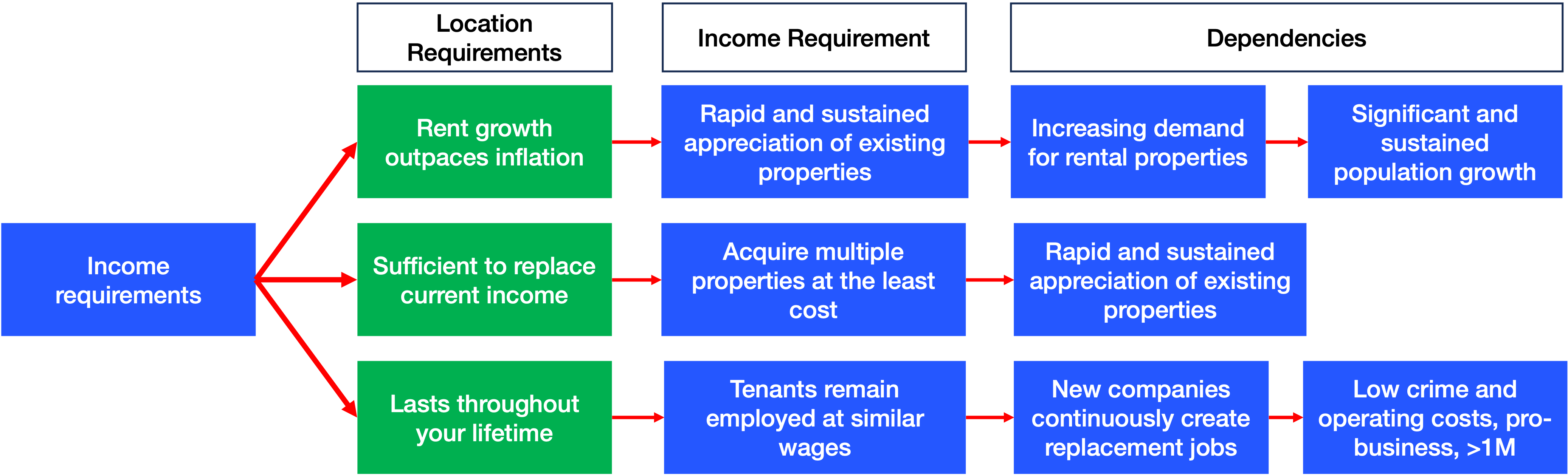
    If your goal is financial freedom, the investment city is the most important decision you will make, not the property. So, set aside all the property evaluation metrics first, and focus on selecting a market(s) that best aligns with your goals. Financial freedom isn't a one-time event; financial freedom requires an income that will enable you to maintain your current lifestyle throughout your life despite inflation driving up prices. You will need an income that meets all the following criteria, which are determined by where you invest. Below is a diagram showing location requirements (click to enlarge).

    Essentially, your investment performance is tied to the economic health and outlook of the markets you invest in.

    To maximize your chances of high performance, select a city that meets the following (basic) criteria.

    Rapid and sustained population growth

    Metro population >1M. Smaller towns often lack the necessary infrastructure to attract jobs.

    Existing property prices appreciate faster than inflation. This enables you to grow your portfolio through accumulated equity rather than relying solely on your savings for investments. Check their pre-COVID track record.

    Low crime. High crime cities do not attract new companies, which are necessary to create replacement jobs as current employers decline.

    Low risk of natural disasters. Almost every week there are reports of cities where fires, floods, hurricanes, tornadoes, and earthquakes destroyed communities, including homes and jobs. So, even if insurance rebuilds your property, there may be no one to rent it.

    No rent control. Many states (including California) have implemented regulations that act as a hidden tax on investors. Rent control can prevent selecting the best tenants, make it difficult to remove non-performing tenants, and cap rent increases below inflation rates. Never invest in any city with any form of rent control.

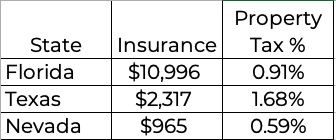
    Low operating costs. Every dollar lost to overhead costs is one less dollar available for living expenses. Below is an overhead comparison of three popular investment states that have no income tax.

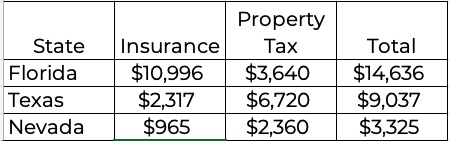
    To put this in perspective, below is the estimated annual operating costs for a $400,000 property.

    Compared to a property in Nevada, properties in other states require additional cash flow to compensate for their higher operating costs.

    • Florida: +$11,311 ($14,636 - $3,325)
    • Texas: +$5,712 ($9,037 - $3,325)

    The takeaway is that operating costs can have a huge impact on financial independence.

    Remote Investing

    Most investors don't live in cities that meet all the requirements for financial independence. Therefore, the real question isn't whether to invest remotely—it's where and how to do it safely.

    After narrowing down the list of cities based on the requirements I listed, find an experienced local investment team. While books, seminars, podcasts, and websites provide valuable general knowledge, you're ultimately investing in a specific property in a specific city. Only an experienced local team can provide the market knowledge and resources essential for success.

    Niranjan, I hope this helps.

    FERNWOOD Team, KW VIP Realty520 Reviews
Join the conversationCreate a free account to reply, vote on answers and follow this thread.