This economy feels like 2007. Am I wrong?

This economy feels like 2007. Am I wrong?

Member since 2019 · 5 posts · 5 votes

Hello BP community,

 Is it me or do the sky high valuations on homes seem similar to the run-up during 2006-2007? It seems like the market is due for a valuation correction, maybe relatively substantial (10-20%)? Economy looks really good, but wages haven't increased enough to support home prices imo. 

 In Denver, home prices have flattened over the last 4-5 months and I've seen a lot of Zillow listings reducing prices. Plus there are a ton of new builds in progress. Anybody think staying on the sideline is better in this environment? Would love to hear what you think.. 

 Although I've owned a duplex since 2012, I've very recently returned to the real estate investing community with the goal of buying a single/multi family distressed property to rehab and rent. Am trying to find my bearings. Thanks.

5Reply
179 views

Most Popular Reply

Mike D'ArrigoPro Member
Turn key provider · San Jose, CA · Member since 2010 · 4k+ posts · 3k+ votes
7y

@Josh Magnus I totally disagree. High prices alone don't lead to the crash we had in 2008 and the factors that did cause the crash don't exist today.

1. We don't have the absurdly loose lending standards we had in "08". Back then there were all the subprime loans where anyone who could fog a mirror got a loan. There were also the adjustable rate, interest only and negative amortization loans that got a lot of people in trouble.

2. We don't have the growth in the money supply in the economy that we did then. The average annual growth rate in the money supply is 6.5%. Just prior to the crash it was over 10%. Today, the growth rate is just 3-4%. At the time of the crash, the supply of money lead to over development of new construction which leads to the 3rd point.

3. New housing starts are down 40% since their peak in 2005. At that time, their were 2.1M new housing starts. Today, that number is about 1.2M new housing starts. 

The reason that so many markets have been seeing so much price appreciation is that there is a real shortage of housing. We've seen that big time in Kansas City and Indianapolis where we operate. Keep in mind that 27% of all markets are still below their 2006 level and many are only at their 2006 peak. You have to look at where prices are today in relation to their 2006 high and not how much they've gone up from their bottom. Some markets lost 50% of their value. That means it takes a 100% increase just to reach their previous peak.

Lastly, you have to consider affordability. In spite of higher prices, all 4 of the regions of the country are still considered affordable to anyone making the median income. That's due to extremely low interest rates. Interest rates were 6.5% at the time of the crash, compared to less than 4% today.

Personally, I think we'll see moderation in prices, and deceleration of the appreciation rate  which we're starting to see now, but I don't see a crash.

See this reply in the discussion

41 Replies

Jump to latestLatest
  • Member since 2019 · 5 posts · 5 votes
    7y

    Thanks everybody for your responses. It sounds like, in general, people are bullish about the market. A few Denver responses seem cautious but bullish as well. 

    I think I'll continue to look, but will be cautious. Thanks again!

  • Investor · Clinton, MS · Member since 2019 · 83 posts · 85 votes
    7y

    @Frank Wong, totally agree with your 2001 statement.  History tells us the market will drop eventually, but subprime crash was under strict conditions that have been accounted for. 

  • Member since 2018 · 214 posts · 175 votes
    7y
    Originally posted by @Josh Magnus:

    Thanks everybody for your responses. It sounds like, in general, people are bullish about the market. A few Denver responses seem cautious but bullish as well. 

    I think I'll continue to look, but will be cautious. Thanks again!

    Most people were very bullish during year 2005 too... but it was the peak, and we all know what happen after it...

  • Flipper/Rehabber · Las Vegas, NV · Member since 2016 · 174 posts · 251 votes
    7y

    Everyone on this thread is asking, and trying to answer, entirely the wrong question.

    Real estate investors are a rare breed. I've never seen a group of "investors" with a more myopic view macro economics and the basic principles of investing?

    To invest in anything well, including real estate, stocks, bonds, currencies, commodities, precious metals, (consistently over long periods of time) the prudent investor buys low and sells high...or what I like to say is "cheap" and "expensive."  Notice I didn't say buys at the bottom and sells at the top.

    My simple point is, real estate investors, as a whole, and on this thread, get fixated on the wrong questions. Is the market going higher? Is the market going lower? Is the market in a bubble? These questions are a fools game. The correct questions to ask are is the market historically cheap? Is the market historically expensive?

    Let's look at an inflation adjusted chart of US housing prices going back to 1890...(unfortunately pics of the charts won't load so I'll provide the link to the charts)

    Real US housing prices 1890-2012

    As you can see housing prices in the US really just kept pace with inflation for over 100 years, with a few exceptions, which mean reverted. Then came the 2000's. We all know what happened then. But looking back on 2006, can anyone say with a straight face, after looking at the chart above, prices weren't expensive? Yet today, for some reason we use 2006 as a benchmark for where housing prices start to become expensive. On this thread you'll see people reference housing prices, in many areas, haven't even got back to 2006 levels, as if prices in 2006 were healthy?

    Prices in 2006 were the equivalent of a natural 150 pound man taking steroids to become 250 pounds. So when the same man, stops the steroids and drops back down to 150 pounds, then starts them again to get back up to 245 pounds, should we say he's healthy because he's not even back to 250 pounds yet? Of course not, so why would we use the high water mark of 2006 as anything other than a warning sign of prices being expensive again?

    And the only argument against this logic would be to say prices weren't artificially high in 2006. Or that real wages have increased as much as housing prices.  Is anyone going to claim that?

    Unfortunately, this chart only goes to 2010 but we all know what prices have done since.  And if you're not clear, heres a chart of current housing prices in Denver relative to 2006.  

    Case Shiller home prices Denver

    Granted, these prices are nominal, but even adjusted for inflation, prices would be far higher than 2006.  

    So again, when we ask the correct question, the answer becomes very clear.  Not are prices going up or are prices going down?...But are prices cheap or are they expensive?  If you buy assets when they're cheap, and sell when they're expensive, you might not catch the bottom or the top, and you might miss a big move, but over the long haul you'll be in the game and you'll make money.  

    So when anyone says "Don't wait to buy real estate, buy real estate and wait..." point them to the chart above showing real prices going back to 1900.  And please note the fact, if you would've bought in 1900 and "waited" until 2012 you would've made exactly zero dollars adjusted for inflation.  

    Nay sayers will point out xyz market has tripled in the last 30 years etc.  And of course one of the main things they ignore is the US (and most of the developed world) has been in a bond bull market since 1980.  In other words, interest rates have gone down for almost 40 years.  Do lower interest rates make mortgage payments lower or higher?? ;)  And lower monthly payments means increased purchasing power, which translates into increased affordability and demand.  But this process works in reverse when interest rates go up.  

    The Fed will most likely start cutting rates again but they've only got 225 basis points until they're at zero and 1600 until they get to 1980-81 highs.  In other words, theres massive asymmetry in rates.  See chart of rates going back to 1971.  

    30 year fixed mortgage rates 1971 - present

    But even if the fed funds rate normalizes and goes back up to 6-7% over the next 10 years.  Where does that put mortgage rates?  maybe 10%ish?  So let's go to a mortgage calculator and look at the payments on you average 300k home.  

    At 30 year 4% and a 20% downpayment, the monthly payments would be approx $1430.  At 7% the payments are $1880.  At 10% payments are $2390.  

    So the question becomes, if the monthly payments on the average home in the US increased by about $1000 a month or 70%, what would the effect most likely be on home prices?  

    To be clear, this thought experiment IS NOT meant to determine if prices are going higher or lower...it's only meant to answer the question are prices currently cheap or expensive on a historical basis.  

    Let's move on to one of the points made several times above that the housing market is NOTHING like it was in 2006.  The main arguments being we don't have as loose lending standards, no excessive growth in money supply, and low supply.  

    1.  Loose lending.  The US had 0% Fed funds rate for 10 years.  Artificially lowering mortgage rates to 3%!  Now a nose bleed level of 4%.  How could one argue artificially lowering mortgage rates to 3% isn't "loose lending"?  You're putting borrowers in a home that they can't afford if the federal is holding down the long end of the yield curve.  So what's the difference if the Fed is doing it or mortgage brokers are doing it?  The net result is the same, people in homes the couldn't afford with market rates, except when the Fed makes lending "loose" it does it for the entire economy, not just housing...which is worse? 

    And let's not forget the entire 30 year fixed rate mortgage is "loose lending."  No where on the planet would banks lend over 30 years at a fixed rate.  Not to mention a 3% fixed rate.  That loan is guaranteed to lose money if inflation exceeds 3%.  This while the government debt is 22 trillion (on balance sheet) and the Fed's stated inflation target is a MINIMUM 2%.  Historically, what's the easiest way for governments to lower their debt load...inflate it away.  So banks are going to lend over 30 years at a 3% rate when the government has no choice but to create inflation?  And let's not even dive into the growing popularity of MMT.  

    My point is, 30 year, fixed rate mortgages would never exist in a free market.  When those go upside down the tax payer will have to bail out Fannie and Freddie again. If F&F aren't bailed out again the 30 year fixed rate lone will be relegated to the history books.  What happens to housing prices then?  And if we do bail them out, it increases our debt which puts upward pressure on rates. (it doesn't mean rates go up, just upward pressure.) 

     Because 10 years of ZIRP (zero percent interest rate policy) and a government fabricated loan, is specifically designed to make lending loose, putting people in homes they can't afford without government intervention...precisely what caused the first housing bubble.  

    2.  Money supply.  Money supply has doubled since 2008.  It took us 216 years for the money supply to reach 7 trillion, and a whopping 10 years for the money supply to double to 14 trillion.  See chart.  I rest my case. 

    Federal Reserve Bank of St. Louis Money Growth Chart

    3.  Low supply.  Commodity traders have a saying..."high prices cure high prices, and low prices cure low prices."  In other words, the higher housing prices go, the greater chance of additional supply hitting the market.  Do you want to bet on prices going higher because of short supply, when prices going higher is a catalyst to more supply coming online?  

    AGAIN, this is not to say we're in a bubble, or that prices are going down, remember, those are the wrong questions to answer. It's simply to say, the market is closer to expensive than cheap.

    If you've read this far, thank you, I saved the best for last.  Nothing has made me more money in biz or investing than understanding the game of blackjack.  Making the smart move is based not on whether you win or lose a hand, but if you played the hand correctly based on probabilities.  Most investors do the opposite, but the very best investors apply this concept religiously.  

    Make the move with the highest probability of winning, every hand, and you'll beat the dealer in the long run.  Make a different move, and although you very well may win the hand, in the long run, you'll go bust.  

    As I stated many times, when considering a real estate purchase ask yourself is it cheap or expensive?  Or in terms of blackjack are you doubling down on an 11 or are you hitting on a 19?  

    Just like buying a property in Denver right now could make you a lot of money, hitting on a 19 could get you a blackjack... ;) 
  • Wholesaler · Arnold, MO · Member since 2013 · 348 posts · 183 votes
    7y

    I know the Dow isn't the market but it's easiest to understand my example.

    Was the Dow cheap or expensive at 5000? Cheap or expensive at 10,000? Cheap or expensive at 15,000?

    Cheap or expensive at 20,000? Or is it all manipulation and the little guy doesn't have a prayer of winning?

  • Jay HinrichsBusiness Member
    Real Estate Consultant · Summerlin, NV · Member since 2014 · 45k+ posts · 66k+ votes
    7y

    @George Gammon  I get the cheap and expensive.. and I for one will always sell when profits are available .. deals can be recreated profits not so much.. 

    Its an interesting debate.. some parts of the country the market peaked for SFR type housing back in the 80s and never recovered and the exiting inventory historically is cheap.. you can buy it for 20 to 40 cents on the dollar of replacement costs. but does that make it a good investment ???

    One thing though for those lucky or smart enough to lock in those 3% 30 year fixed mortgages.. their payments are less than rent.. so unless there is some sort of other life event I think you will see less defaults generally.. and for sure as one that plays in the courthouse steps .. we see this big time..  

    I agree though on rates and affordability in higher priced markets.. part of the DTI issue will cause the public to think about how they manage their income.. Do they buy the nicer car or drive an older car so they can afford the nicer home.. maybe wait on that RV or Boat they want.. discretionary items like these sales could slow a bunch .. at the end of the day people need shelter and with rents sky rocketing in many markets.. rent is higher than man mortgage payments..

  • Member since 2019 · 20 posts · 11 votes
    7y

    In my area (swfl) and the specifics I'm looking at it appears that a market correction has been happening. The interest rate are low, the inventory is low , and houses are taking 8+ months to sell.

    However, I don't think it will be like the previous crash, but  do think there is a correction coming especially with the foreign buyers leaving the market. 

    I have also started getting calls from several different realtors and new constructions builders asking me if I'm interested at looking at properties who I only associated with 2 or more years ago when I looked at one of their listings. out of the blue they are reaching out to me after complete silence for the last 2 years. Interesting enough I'm seeing the local NABOR representatives on the news talking about how different the swfl market is from the rest of the nation and how great things are. The funny thing is that when the market is hot they don't spend their money or time telling people how great it all is. This was something I noticed right before the last crash. 


    However, take that with a grain of salt since those are my own economic tell signs with no actual scientific backing. Just based on some anecdotal observations from the last crash. 

  • Member since 2018 · 214 posts · 175 votes
    7y

    @George Gammon

    I like the word of “probability”.  

    Of course nobody has the crystal ball what will happen the market next year.  However, using probability, the probability that we are closed to the top of the housing market is high...

    Buy low and sell high, this is what most of the investor wants to do, include me, that’s why I’m selling them now, so I can keep my guarantee profit from selling it at a high price today. 

    In today’s market, it would be very difficult and not worth to bet on appreciation anymore because of the probability of appreciation is low.  The only choice many other people said is, play by cash flow properties.  However, how many deals are really cash flow today? Not many, the numbers are very slim.  In addition, although you are lucky to find a cash flow property, since the probability of appreciation is very low, and the escrow transaction and realtors commission fee to sell a property is high like at least 10% (not including tax), in the about declining market, cash flow properties buyer are stuck with the properties for at least 10 years to ensure that it won’t be a loss bet.  

    If a cash flow property buyer sell the same property in less than 10 years, the probability of losing money in this deal is high, why should I buy a cash flow property today?  Higher Probability to win a bet, is to buy it in a buyer market (buy low), and sell it in a seller market (sell high).  

    We are still hot in today‘s Seller market, it is time for me to cash my chips, take my profit, and leave the table.  I don’t want to be the last one who is holding the bag...

  • Chris LopezPro Member
    Real Estate Agent · Denver, CO · Member since 2015 · 1k+ posts · 858 votes
    7y

    @Josh Magnus, since this has turned into an interesting thread, I'm posting data here for the discussion. This is all Denver metro market data...

    The most important thing to look at is supply and demand. That drives price and rent appreciation.

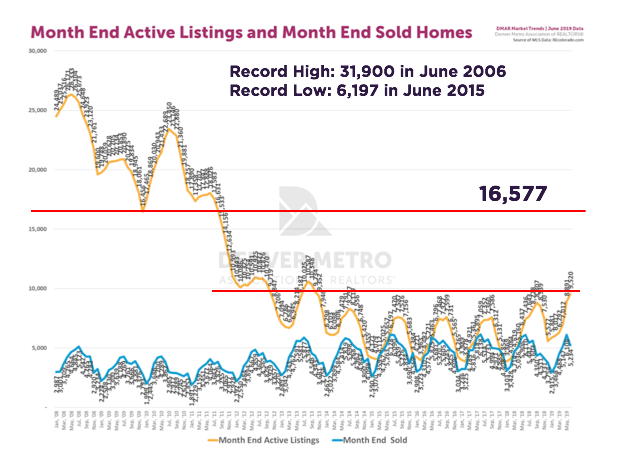
    Active listings (inventory) vs sold homes month over month.

    The yellow line is the total inventory, the blue line is what has sold for each month. Key points:

    • - Compare the properties sold (blue line) around 2008 to the last few years... the total number of sold properties have not increased much!
    • - Inventory has dropped dramatically. Low supply, high demand = appreciation, and rent growth.
    • - The red lines are my annotations, which show the recent inventory for June. Denver hasn't had this much inventory since 2013! 
    • - The peak inventory for June is 31,900, the low is ~6,200. We're a lot closer to the low, not the high. 15000-16000 inventory is near the average and most likely a balanced market (not seller's or buyer's market)
    • Days on market charted 

    Key points:

    • - This chart doesn't show the most recent days on market (DOM), which are currently around 30. Compare 30 to the historical data. We have a long way to until we're out of this seller's market
    • - This correlates with the previous chart. Demand is still great - what does that do to prices and rents?

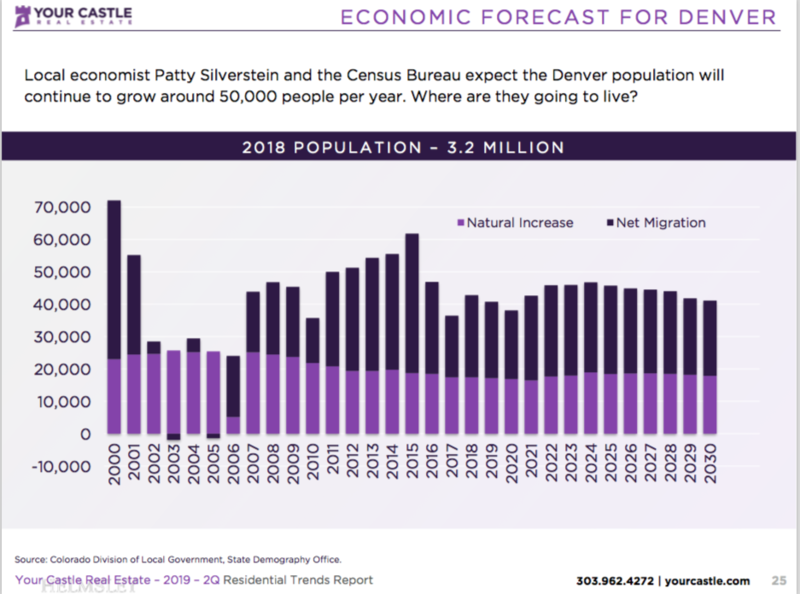
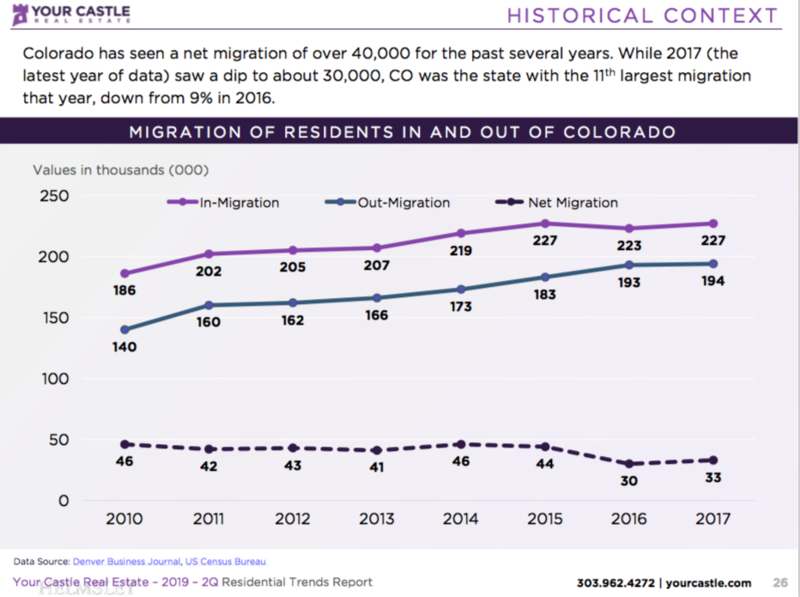
    Population growth Charts

    Key points:

    • - Our population is growing.
    • - It's a younger demographic.
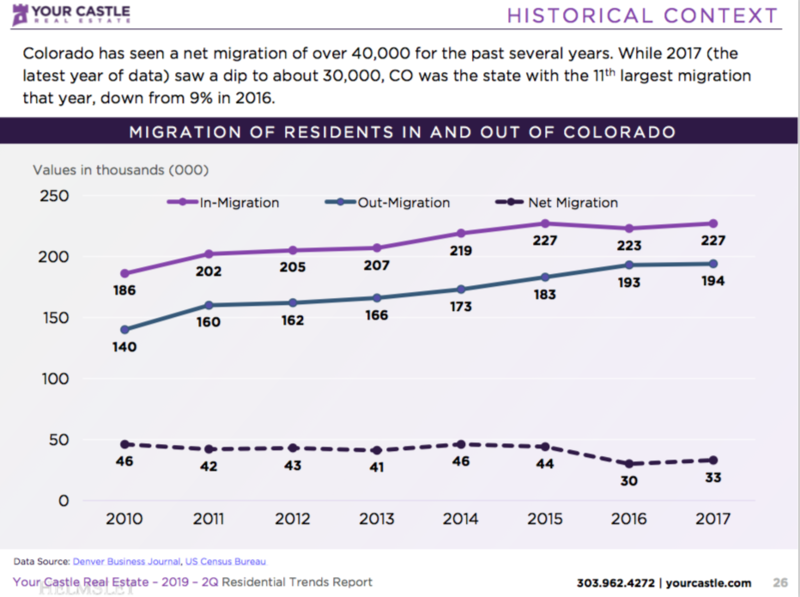
    • - renters are flocking from other cities (still)
    1. Rental Property Investor · South shore, MA · Member since 2017 · 1k+ posts · 1k+ votes
      7y

      Coming from a small manufacturing company standpoint, it feels similar that the economy isn't doing as good as everyone thinks it is. Sales have been way down, and some of our biggest customers have increasingly bought less and less over the past two years. These are the bed bath and beyonds, bluestem brands, etc.

      Home prices are way up and have been climbing rapidly for a while now. Its just a matter of when we will enter a recession. Who knows what it is going to affect the most, way beyond my knowledge. 

    2. Chris LopezPro Member
      Real Estate Agent · Denver, CO · Member since 2015 · 1k+ posts · 858 votes
      7y

      Post #2...
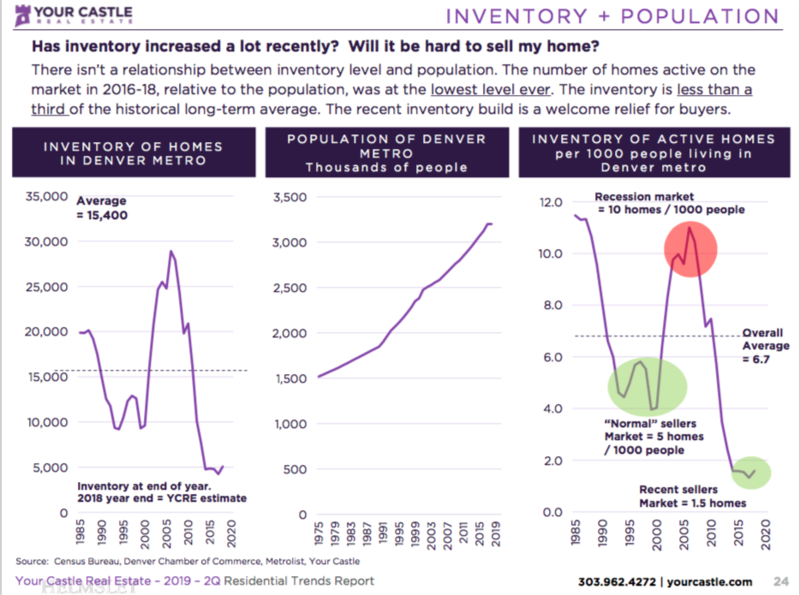
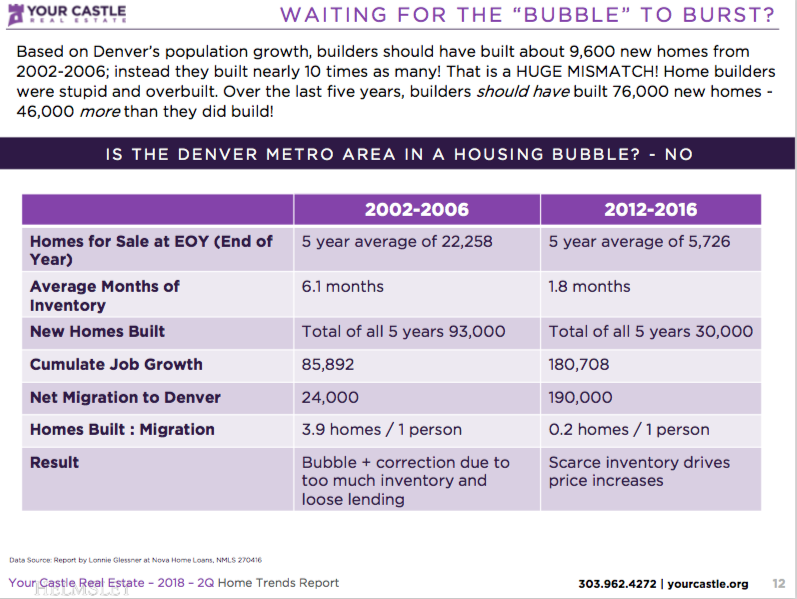
      Data comparing population growth to inventory...

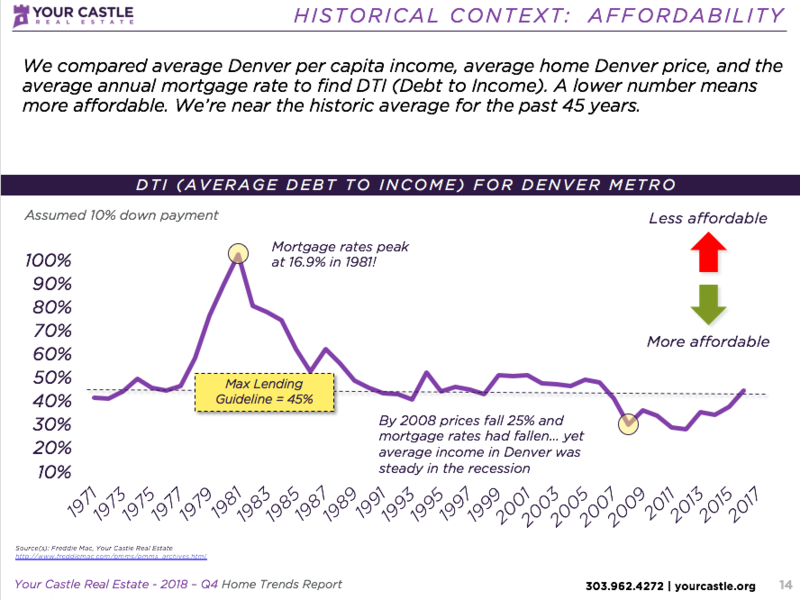
      Affordability based on DTI

      Is Denver in a bubble? The data is a couple years old, but it gets the point across...

      My take aways:

      • Don't time the market, time in the market is way more important.
      • Denver is growing, we'll continue to see long term price and rent appreciation.
      • Yes, it's slowing down then what it has been doing the last few years, but it's still appreciating. 
      • A lot of institutional investors are dumping money into Denver. DO you think they know more than we do... yea. 
      • I'm buying a 850k fourplex now. Why? It's a great long term play.
    3. Chris LopezPro Member
      Real Estate Agent · Denver, CO · Member since 2015 · 1k+ posts · 858 votes
      7y

      Yes, the economy will eventually pull back or flatten out. The economists keep saying it's 2-3 years away... eventually they are right. It reminds of the people three years ago saying they are sitting on the sidelines waiting for the next correction. Well, they missed a lot of wealth creation.

      Remember, cash flow and appreciation are NOT the only ways you make money in real estate.

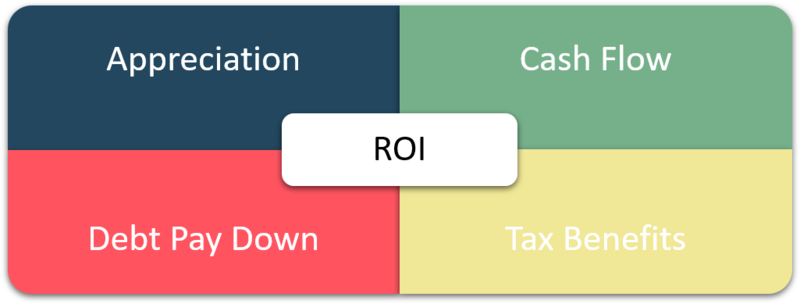
      Below is the Return on Investment Quadrant(TM) from @James Orr. It shows the four ways you make money. The bottom half with debt paydown and tax benefits are NOT market dependent.  You get them every year. It's not uncommon to get a 10%+ return from just those two!

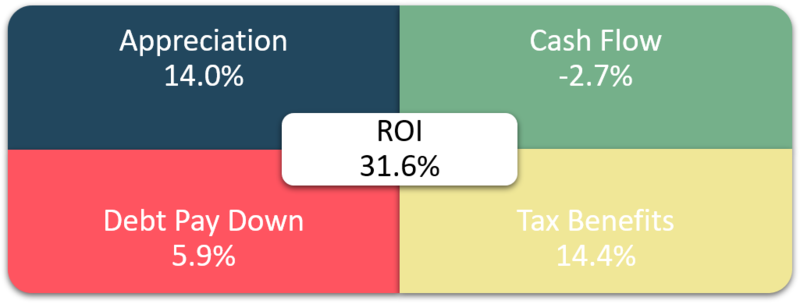
      Below is an interesting example. It's a negative cash flow property on purpose for example ($350k purchase price, -$2k a year) Even with a negative cash flow, it's still a 31% return! When did that become a bad deal? Notice where the majority of return is coming from....

      Now, I don't advocate for buying negative cash flowing properties, but it gets the point across. IF you factor in depreciation, it's actually positive cash flow at year end. What happens over time? Your mortgage is a 30yr fixed that stays the same, well rents go up...

      We're teaching a class on this in a few weeks. If anyone in Denver wants to join, please RSVP https://www.biggerpockets.com/forums/521/topics/731769-roi-quadrant-cash-flow-is-not-everything

    4. Will GastonPro Member
      Rental Property Investor · Columbia, SC · Member since 2010 · 1k+ posts · 2k+ votes
      7y

      @Josh Magnus you may be right. However, there have been dozens of versions of this post in the last 3-4 years. 

    5. Member since 2018 · 214 posts · 175 votes
      7y

      I spoke to a friend who is a realtor last week.  He said that our local market in Las Vegas has been very quiet and fewer activities last few weeks, bad sign during summer time...  hopefully, it will be pick up after this summer???  but usually winter time is much slower than summer time... bigger hope is 2020 Spring...  If 2020 Spring still doesn't pick up, then that is not a really good sign and may have trouble...  Let's pray for 2020 Spring will still be ok... 

    6. Member since 2019 · 1 post · 1 vote
      7y

      Sooner interest rates become insignificant. We are making bold move to invest in properties in order to attain the highest return on investment.  Every economy in US is different.  Here in Tampa Florida prices have gone up considerably but wages have not. The areas with new constructions are happening in undesirable areas where low cost homes or mobile homes reside.  The appraisal values of homes are not consistent with what people can afford. We cannot compare today's situation with the 2007 bubble. The economic situation today is that we are trillions of dollars in debt, the Fed although have low interest rates to stimulate housing spending has also modified their balance sheet.  Although IRS still express that homeowner can deduct mortgage interest, the itemized deductions are  capped for home ownership based on modified gross earnings. So people are going to be more cost conscious when buy homes at higher prices. The economy does not feel like 2007 but gradually may grow closer with greater impact of a downturn. "AGAIN, this is not to say we're in a bubble, or that prices are going down, remember, those are the wrong questions to answer. It's simply to say, the market is closer to expensive than cheap." 

      To investors of real estate the business still viable and profitable but applying the laws of supply and demand will have an impact on housing. The demand will dwindle as home ownership becomes less attractive affordable. If average cost of a house here in Tampa is now $230k and in 5-10 years is $350k who in the world would be able to afford a house.  I lived in Maryland back in 2005 and was able to afford a $250k home with my income because my wages could support it.  The trend for employment today is to create more jobs with less pay. If you pay people less, they will definitely not buy but start to rent because there are no incentives left to buy houses. 

    7. Member since 2018 · 214 posts · 175 votes
      7y

      https://www.google.com/amp/s/s...

      July 2019 Data from California Association of Realtors just came out this morning.  

      SF house price declines year over year again... more bad sign spell out...

      In my market Las Vegas, I feel more like 2006, not 2007 yet, but very close to 2007...

    Join the conversationCreate a free account to reply, vote on answers and follow this thread.