RAD Diversified Review — It Wasn't Pretty

RAD Diversified Review — It Wasn't Pretty

Member since 2023 · 2 posts · 7 votes

I read about RAD through BP and I wanted to leave my review of them for other to be better informed before investing with them. Their salesman (Gregg Poirier) was very easy to get in contact when I was considering investing. He was really pushing me to invest by a certain date to lock in my price before the share price went up. I ended up investing $10,000 into their REIT. Once I invested and was part of the "RADD family," he was very hard to get ahold of. He did confirm that I got into the REIT before the share prices went up. I wasn't able to get access to their portal even though he claimed it had been sent over.

Over a month after my investment, I get a call from RADD telling me that they actually didn't put my money into the REIT. They had oversubscribed the REIT and my money has just been sitting around in a RADD account even though Gregg had told me that my money was invested in the REIT. They claimed they didn't want to tell me that my money was not in the REIT for a month because they first wanted to figure out a solution to offer myself and other customers (red flag). They offered me a promissory note with a 10% interest rate that I believe went for 18 months. They said if there is more space in the REIT later on, the money would then be transferred into the REIT, but they couldn't promise me that I'd be able to get into the REIT. I checked out the terms of the note, it wasn't backed by ANYTHING. It essentially said I trusted them to give me 10%, which as is probably clear by now, they aren't really a trustworthy organization. I asked if I got a refund would I still get an annualized 10% for the amount of time they were sitting on my money, and they wouldn't do that.

After reviewing their terms I asked for a refund. It took me multiple emails and calls for them to get the refund sorted out over the next three weeks. My overall gist of them is that RADD got pretty popular and they don't have proper operations setup to deal with the scale. If you're an accredited investor putting in 6 figures, they might take care of you better, but otherwise I would completely stay away from them. Much better places to put your money with people who are responsive, don't overpromise, and don't continuously give you a runaround.

6Reply
1,176 views

Most Popular Reply

Melanie P.Pro Member
Rental Property Investor · Member since 2023 · 1k+ posts · 922 votes
2y
Quote from @Dutch Mendenhall:
Quote from @Chris Tessmann:

Hey Dutch,

My IC Membership refund was approved 2/13/24, and was advised 2/19/24 that it would be processed that coming Friday (2/23/24). I then sent 6 emails over the next 10 days that were not responded to until the last one on 2/29/24, and was told it didn't go out in the prior week, and that your DoC was "hoping it would go out in this week's batch" (3/1/24). On 3/1/24, your DoC sent me an email stating that "Unfortunately no disbursements will go out this week. That is the only update I can provide today. I am the only person that will be able to update you in this matter. You can continue to reach out to the entire company looking for updates but again I will be the one to reach out as I get further direction."

After a few additional email interactions that same day, your DoC stated "I do not have an answer for you. I depend on another department as well for answers and I too have to wait," and then asked if I would "be open to an installment of a partial payment? So that I can go and ask if that is possible.If not then I will wait." (This is also after I was asked very early on if I would like to put the refund into the REIT instead of a cash refund.)

Since then, I have sent nine additional emails asking for status update with no response from anyone in the thread. 


I started this refund request process 12/29/23 and it has been extremely frustrating in its' own right, to say nothing of the challenges that prompted the refund request being made in the first place. If transparency, responsiveness, and reliability are truly core values for RADD, I would appreciate you seeing to it that this isn't delayed any further. 


Thank you.

Thank you for bringing this matter to my attention. I understand how important it is to resolve this matter promptly.

I want to address your concerns regarding the delay in processing your IC Membership refund. I have been made aware of some issues, including problems related to IRA money movement and incomplete deals, which have contributed to the delay in issuing refunds.

I want to assure you that your refund has been approved, and steps are being taken to expedite the process. As of now, the refund is scheduled to be issued soon. I apologize for the lack of communication and for the inconvenience caused by the delay.

Transparency, responsiveness, and reliability are indeed core values for us at RADD, and I am committed to ensuring that your concerns are addressed promptly and efficiently.

Once again, I apologize for the inconvenience and appreciate your patience and understanding in this matter.

IRA money movement and incomplete deals? Perhaps you can provide a funds tracking and proof of funds to your investor. Show where their money is received and where it is being held now.

A response like this coupled with your inability to issue a refund in dollars makes you sound like a Ponzi scheme that's about to implode on itself. I understand that is not your history, but that is what you sound like today, IMHO.

See this reply in the discussion

166 Replies

Jump to latestLatest
  • Member since 2024 · 33 posts · 3 votes
    2y
    Quote from @Melanie P.:

    @Jay Hinrichs I agree. i'm curious about RAD's answer. I've read stories of investors who wired money, were told the fund was closed and offered a prom note alternative. 

    @Chris Seveney I disagree that their business is at all complicated. Sounds more along the lines of needing new scripts for the sales department and now there's a new investment opportunity. So if recent results in multifamily spook a prospect offer them farmland complete with a cattle brand. Everybody's gotta eat, right? Ridiculous

     @Jay Hinrichs our promissory notes are considered a security.  I don't know all the specifics and the in/out of the process but I will reach out to our Team for more specifics.  

    @Melanie P. you have mentioned our "results" etc. with multifamily in a couple posts now, can you please provide some additional information where we have been active in multifamily properties and have not had success? I called both our VP of Real Estate and our CEO to confirm data on multifamily to ensure there wasn't something I was missing. We do have a very limited multifamily residence properties but not actual apartments. Single family residential continues to be the main component of our investments within RAD Diversified REIT.

    Farmland, ranches, other land for development etc. is the focus within our RAD Diversified Land REIT (RADD America). We believe in Americans purchasing and investing in American farmland and ranches. We have recently added a cattle auction facility near some of our properties in Idaho. Many of our investors have visited the facility and actually many have made trips to the farms in which they invest in.

    Not sure why you feel that is a ridiculous concept unless you much rather see foreign entities and developers procuring farmland for other ventures. 

    Thank you.

  • Member since 2024 · 18 posts · 21 votes
    2y

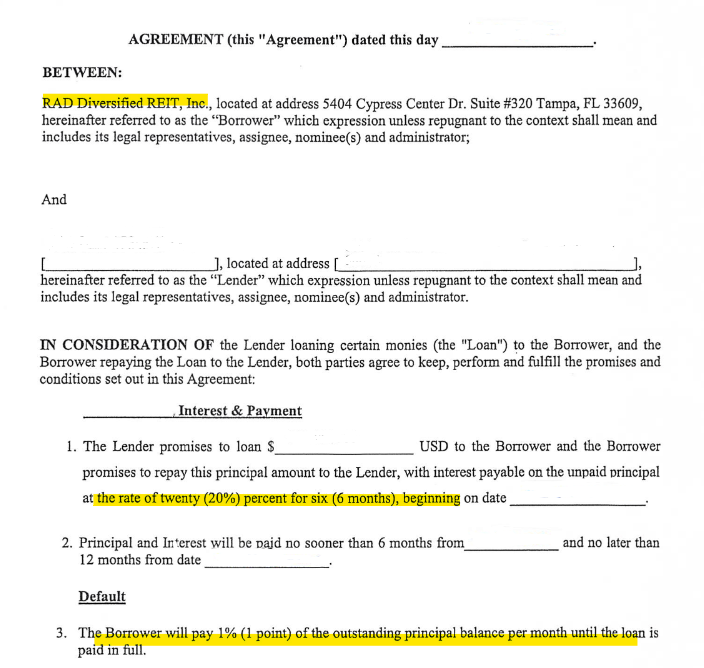
    Redacted. Not paying a friend's principal + 20% interest + points is what RAD is doing.

  • Chris SeveneyBusiness Member
    Moderator
    Investor · VA · Member since 2015 · 21k+ posts · 19k+ votes
    2y

    @Jennifer O.

    That cannot be real.

    They are paying 40% annual interest????

    The default rate is only 1% per month which is 12% annual.

    I assume there are more pages to that agreement

    7e investments53 Reviews
  • Melanie P.Pro Member
    Rental Property Investor · Member since 2023 · 1k+ posts · 922 votes
    2y

    @Jennifer O. Thanks for posting this. I encourage your friend to forward the unredacted prom note to the SEC via this link https://www.sec.gov/tcr Click on Submit a Tip. Your friend should include as many details as possible concerning how they were pitched the investment in the prom note.

    @Brent Mendenhall The best thing for any investor is to avoid your company and those like it out of respect for their investment dollars.

    Why is there no formal agreement between RAD and DDH Fund LP when DDH Fund owes RAD's investors millions of dollars and collects rents on behalf of RAD. What is the purpose of the two million low-interest loan to Seminar Solution LLC? Why couldn't the officers in RAD obtain financing for their primary home from traditional lending sources? Why are there two prom notes to finance residential real estate for the company's officers?

    A review of your offering documents makes clear that investor money is considered game for any purpose. I have serious doubts that the company officers have maintained their fiduciary duty to RAD's investors in many of these related-party transactions. 

    I thought the Philadelphia Inquirer summed up the issues with RAD best: https://www.inquirer.com/business/rad-diversified-brandon-me...

    California man touts business empire built of Philly rowhouses bought at sheriff’s sales. Some are skeptical.

    RAD Diversified is losing money. Some tenants aren’t happy. It calls itself “an incredible company.”

    Some of the rents that RAD Diversified REIT says in SEC filings that it's expecting appear to be overstated, in light of the buildings’ conditions. This boarded-up rowhouse at 4243 Leidy Ave., for example, is said to be earning the company $14,400 a year in rent — even though it has no rental license and its most recent license was as a vacant property. Some of the rents that RAD Diversified REIT says in SEC filings that it's expecting appear to be overstated, in light of the buildings’ conditions. This boarded-up rowhouse at 4243 Leidy Ave., for example, is said to be earning the company $14,400 a year in rent — even though it has no rental license and its most recent license was as a vacant property.Read moreALEJANDRO A. ALVAREZ / Staff Photographer

    When Tylisha Slaughter learned that the West Philadelphia rowhouse she rented was going to be auctioned off in a sheriff’s sale, she sensed opportunity.

    Slaughter, now 30, aimed to buy the home near Cobbs Creek Park on the cheap and restore it from the “slumlord”-like conditions she, her boyfriend, and her two young children had been living in.

    But on the day of the sale, she said, she found herself up against an out-of-towner with lots of money to spend: Brandon “Dutch” Mendenhall.

    "He outbid me," said Slaughter, whose rent has risen from $700 to $900 since Mendenhall's RAD Diversified REIT became her new landlord in late 2019, even as she says her complaints to RAD's property managers about pests and leaky pipes have gone unanswered.

    ADVERTISEMENT

    Slaughter’s home is part of a five-state empire of real estate bought through sheriff’s sales and “We Buy Houses” signs that Mendenhall, RAD’s chief executive, has been selling to investors on Facebook, YouTube, and other social media, touting what he portrays as the venture’s market-beating performance.

    Mendenhall, who is based in Southern California, has described Philadelphia as the biggest market for RAD, a firm founded in Florida that specializes in buying distressed real estate then renting it out. The company and others that he runs own nearly 100 properties across the city’s low-income neighborhoods, records show. RAD’s real estate holdings nationwide were worth some $24 million as of last fall, the company has reported.

    According to one of the 81 ads for RAD running earlier this week on Facebook and its sibling social-media sites, RAD shares surged from $14.23 in January 2021 to $18.52 in January 2022, an increase of 30%.

    “Our returns are so good right now, it makes it hard for people to even believe in them,” Mendenhall boasts in another ad. “That’s frustrating.”

    ADVERTISEMENT

    But RAD’s official disclosures tell a more doleful story than its online ads.

    During the first six months of last year, the most recent period covered in RAD’s latest investors’ circular, filed with the U.S. Securities and Exchange Commission in January, the company’s real estate business lost $1.12 million, although the firm had relatively little debt compared with the stated value of its assets.

    The company also disclosed that it may use new investors’ money to pay dividends to existing ones. Experts say it can be risky for an investment fund to operate this way, since it may require ever more participants to be brought on board, rather than making money from its business.

    More than 60% of RAD's operating expenses in 2020, the most recent period for which the company has released audited financial information, consisted of asset-management fees and other payments to a separate company owned by Mendenhall and other RAD executives called RAD Management LLC, according to an analysis of the financial data.Those fees and payments amounted to more than $730,000 that year, RAD said.

    ADVERTISEMENT

    “We have limited operating capital, few significant assets and limited revenue from operations,” RAD wrote in the January document, which sought to raise up to about $58 million in new funds, for a total of $75 million of company shares. “If we are unable to continue to raise sufficient capital through this offering, there is a strong likelihood our business will fail and you may lose your entire investment.”

    RAD declined to directly answer detailed lists of questions from The Inquirer, saying in a statement that they contain “various inaccuracies.”

    The firm did say it works to “comply with all securities, licensing, landlord-tenant, and other applicable laws and regulations.”

    Now, the SEC wants to tell federal prosecutors about allegations concerning the divergence between RAD’s online pitches and its more downbeat official self-descriptions.

    ADVERTISEMENT

    The allegations are contained in a complaint sent to the SEC by a fraudster-turned-self-styled whistle-blower named Barry Minkow, who said he gathered material from RAD for his report by pretending to be a potential investor in the company.

    Late last month, the SEC asked Minkow for his consent to share the document with the Office of the U.S. Attorney for the Central District of California. Minkow gave his approval, according to copies of the correspondence that he provided to The Inquirer.

    Since finishing his most recent prison stint for fraud and other offenses in 2018, Minkow has established a side business of researching companies he suspects of malfeasance and reporting them to the SEC as a whistle-blower. Whistle-blowers can sometimes claim a cut of what a company disgorges if they provide information used in a successful SEC investigation.

    His report about RAD to the SEC is among 11 complaints he has filed with the agency. Another focused on National Realty Investment Advisors, a New Jersey-based firm with a big Philadelphia property-development footprint that promises large returns to investors on national TV and radio ads. NRIA has denied any wrongdoing and no government action has been taken against it.

    ADVERTISEMENT

    “The sad reality is that many investors are relying upon a complete and total misrepresentation of material facts about the profitability and financial stability of the company to make an investment decision,” Minkow wrote of RAD’s advertisements in an October update to his report to the SEC on that company, originally filed in April. He provided the documents to The Inquirer.

    In a Jan. 20 YouTube video, Brandon “Dutch” Mendenhall encouraged viewers to invest in his real estate company, RAD Diversified REIT. Mendenhall appears in many of the videos posted by RAD to YouTube on a near-weekly basis, and in postings and paid advertisements on Facebook and Instagram. In a Jan. 20 YouTube video, Brandon “Dutch” Mendenhall encouraged viewers to invest in his real estate company, RAD Diversified REIT. Mendenhall appears in many of the videos posted by RAD to YouTube on a near-weekly basis, and in postings and paid advertisements on Facebook and Instagram.Read more

    RAD said in its statement that it strives to make its regulatory filings and offering materials “accurate and complete.”

    RAD “is an incredible company making a positive impact on our investors, team of employees, contractors, neighborhoods, non-profits and more,” Mendenhall said in an email.

    A U.S. Attorney spokesperson declined to say whether the office was conducting an investigation into RAD, citing Justice Department policy not to comment on any investigations that the office may, or may not, be pursuing. An SEC spokesperson also declined to comment.

    No criminal charges or civil complaints are known to have been made against RAD or any of its employees.

    RAD did not directly respond to questions about any potential investigations of the company. “RAD Diversified has and will respond to and cooperate with any requests from pertinent regulatory and law enforcement entities,” it said in its statement. “Terms offered to investors by RAD Diversified are in line with those offered by similar, competitor REITs.”

    John Carney, who helps lead the securities, enforcement, and litigation team at BakerHostetler in New York, said any move by the SEC to share an outside report would not have been taken lightly by the agency. “The fact that the SEC is taking the time to share information with the Department of Justice is a serious step,” said Carney, who previously served as an attorney with both agencies.

    ‘The leading expert’

    In the videos he posts to YouTube on a near-weekly basis, Mendenhall, 42, projects a clean-cut if casual figure, appearing in button-down shirts — only seldom wearing a tie — with a neatly trimmed Vandyke beard as he brightly talks up his business.

    “I’m literally the nation’s leading expert in tax liens and tax deeds,” he boasts in one installment. “So we invest in that exact modality and make more money at it than anybody else.”

    The entrepreneur also appears in many of the ads for RAD across Facebook, Facebook Messenger, Instagram, and other applications.

    The pitches appear to be bearing some fruit: RAD had between 1,500 and 2,000 investors, as of late October, and was adding more at a clip of 200 per month, according to an email from a company official to Minkow. The official believed Minkow to be a potential investor at the time.

    In other videos for one of RAD’s side businesses, a network of leasable off-the-grid-encampments called the American Survivalist Project — “a plan B for when disaster strikes,” according to the venture’s website — Mendenhall’s banter can take a darker turn.

    “One of the scariest things that happen in the worst-case scenarios is people turn on people,” he said in one clip after listing a few such scenarios: a new, more-virulent pandemic; artificial intelligence run amok; nuclear war; or “the real war with China and Russia and cybertechnology and the Cold War.”

    RAD’s survivalist-camp business is in the process of gaining control of 20,000 acres of rural property across multiple sites nationwide, Mendenhall said in an interview last month with the financial blogger and stock picker Jim Woods on Woods’ podcast, Way of the Renaissance Man.

    But the bulk of the business’ holdings consists of residential real estate, filings show. While RAD also concentrates on areas of Texas, Idaho, California, and Florida for its growing portfolio of rental properties, according to the January offering circular, Philadelphia has been its primary locus of activity.

    “Our biggest city is Philadelphia, where we happen to have our longest-running, best team,” Mendenhall said on Woods’ podcast.

    Since their first recorded Philadelphia acquisition in July 2016, RAD and three other funds Mendenhall leads — DHI Holdings LP, DHI Fund LP, and DDH Fund LP — paid a total of more than $5.8 million for at least 96 properties in the city, most of them in struggling neighborhoods such as Parkside in West Philadelphia and East Germantown in the city’s northwest.

    Before 2020, all but four of the Philadelphia properties were bought at sheriff’s sales, records show. But Mendenhall told Woods that the company has had to retool its approach to acquisitions since then in response to pandemic-era freezes on sheriff’s sales.

    “We shifted to a hard-core marketing strategy,” he said. “If you are seeing a billboard of ‘Sell your home’ or ‘We buy houses’ or whatever else, those kinds of things might be us.”

    Lapsed licenses

    Department of Licenses and Inspections records show about half of the Philadelphia properties owned by RAD or other Mendenhall-led funds were granted rental licenses since those businesses acquired them.

    Landlords are required to renew a property’s rental license once a year. The $56-a-unit process requires landlords to be up-to-date on their property taxes and for the properties to be free of any safety or building-code violations.

    Since landlords are not legally permitted to collect rent from tenants of a home with an inactive license, the system is designed to serve as a check on property owners, forcing them to address safety violations and pay their taxes.

    But Philadelphia’s Department of Licenses and Inspections lacks the resources to hunt down property owners who flout those rules, said Karen Guss, a spokesperson for the agency.

    “L&I has to often prioritize, and the things that get prioritized are things like fire safety issues, hazardous buildings,” she said. “License violations, while problematic, isn’t something that automatically jumps to the head of the line.”

    The Mendenhall-led funds also own Philadelphia properties with no license at all. City regulations require some kind of license for most property that is uninhabited or otherwise out of active use for three months or longer.

    Of the funds’ rental licenses, about 40 have lapsed and have not been renewed, but that doesn’t appear to be stopping Mendenhall from accommodating rent-paying tenants at at least some of those properties.

    The Inquirer visited eight properties with lapsed licenses in West and North Philadelphia. One appeared visibly unoccupied, with a mattress and other debris on its porch and its upstairs windows boarded up.

    Of the remaining seven homes, The Inquirer was able to question residents of four about whether they continued to be charged rent.

    All said they had been.

    One tenant, Shanna Anderson, said she stopped being able to afford her $1,750-a-month rent to DHI Fund and RAD at her Parkside rowhouse after losing her job at a real estate brokerage during the pandemic.

    In late November, RAD threatened to evict her if she failed to pay $6,530 owed for unpaid rent since August.

    Her home’s rental license has been inactive since late July, according to L&I records. L&I’s Guss said the property’s owner had unsuccessfully attempted to renew the license. She did not know why the renewal had not gone through, but noted that the property was delinquent on its property taxes.

    In the letter from RAD threatening eviction, which Anderson shared with The Inquirer, the company encouraged her to register for help from the city’s COVID-19 Emergency Rental Assistance Program and provided a link to the program’s website.

    Anderson said the house had been newly renovated when she moved in in 2019, but she noticed some signs of shoddy work, like dips in the floorboards and a bathroom faucet affixed to the kitchen sink.

    Still, she’d had few serious maintenance complaints about the property and found RAD’s property managers to be sufficiently responsive.

    Deteriorating homes

    Slaughter, the tenant who was outbid for her West Philadelphia home by Mendenhall, wasn’t as complimentary. She said she has had to pay out-of-pocket for exterminators and plumbers after getting no response to pest and leaky-pipe complaints to RAD’s property managers.

    Another tenant of a Mendenhall-led fund, Terry Golden, 41, said he has been dealing for about a year with a flooded basement that his property managers have neglected to repair at his 880-square-foot home in West Philadelphia’s Haddington section.

    His living and dining rooms are piled high with belongings he’d previously been storing in the basement: furniture, appliances, trophies from his days coaching little-league football. Other items, such as football equipment from the kids’ league, were destroyed in the flooding, he said.

    More leaks have come from the plumbing between his first and second floors, prompting him to leave his light fixtures hanging unmounted from their wires so they don’t fill with water, he said.

    Clusters of dead insects cling to one section of his ceiling. Golden said he thinks they were attracted to his home by its dampness.

    “They don’t fix things much,” he said of his landlord, whom he pays $1,000 in monthly rent.

    No rental license renewals have been sought for Golden’s or Slaughter’s homes, Guss said.

    RAD did not respond to requests for comment on these and other properties. The company “cares about its tenants” and believes in providing “above standard living conditions,” it said in its statement.

    Other Philadelphia properties owned by RAD or the other businesses have been licensed with L&I as vacant real estate. One of these is at 4243 Leidy Ave., a boarded-up rowhouse across the street from an elementary school in Parkside.

    About a year before DDH Fund bought that house in September 2016, street-level images on the city’s Atlas property-data website show that its windows and doors had been intact. Subsequent images on the site show the property’s progressive deterioration over the years.

    Another property, a three-story rowhouse at 915 Dauphin St. near the Fairhill neighborhood, underwent a similar decline: Seven months after its November 2016 acquisition by DDH, it too had windows and doors. Today, the door is boarded up and there is no glass in the upper-story windows.

    Nicole Lawrence, executive director of the Tenant Union Representative Network, said such deterioration tends to spread blight throughout neighborhoods, diminishing safe, affordable housing opportunities in communities where they’re most needed.

    “As a property continues to sit and become dilapidated, it’s like a cancer,” she said. “It’s just an entire ripple effect.”

    Not your ordinary REIT

    During the Way of the Renaissance Man podcast interview, Mendenhall told host Woods that he came to real estate after an early career coaching college baseball, a grueling vocation that he said left him feeling burnt out.

    Mendenhall did his coaching at the University of San Francisco, according to his biography on RAD’s website. A spokesperson for the school said Mendenhall had not been a paid university employee but had coached as a volunteer in 2001.

    In 2008, he started a seminar program for would-be real estate investors called Tax Auction Advisors, according to company filings.

    His students there coaxed him into starting his first funds, he said in a video on the website for the seminar company, which remains in operation. “‘Put your money where your mouth is,’” he recalled them saying.

    DHI Holdings, DHI Fund, and DDH Fund were formed in the mid-2010s, records show.

    RAD, which was established as a real estate investment trust, or REIT, in November 2019, is now in the process of using company stock to buy the real estate accumulated by those funds, according to the circular.

    About 20 properties bought by other Mendenhall-led funds in Philadelphia were listed in the document under an inventory of RAD’s real estate holdings as of June 30, 2021. Public records, however, show that the other funds remain the documented owners of those properties. There is no record of them being purchased by RAD among the city’s real estate filings. RAD did not respond to a direct inquiry about this discrepancy.

    RAD said in its statement that the founders of the company that handles RAD’s operations, RAD Management, have “significant investing and property management experience.”

    RAD Management is led by Mendenhall and other RAD Diversified executives, according to the circular. These executives receive no salary or other employment benefits from RAD Management but “will realize growth as owners/members” of the firm, according to the document.

    Under RAD Diversified’s registration with the SEC, any investor — not just “accredited” ones with high net worths — can buy shares, as long as the investment doesn’t exceed 10% of their incomes. RAD allows investors to buy in with as little as $1,000, or even less if it so decides, according to the circular.

    In 2020, RAD declared a dividend of 5%, according to its website, despite having no profits that year. No information about dividends in subsequent years could be found in company filings.

    Most REITs are publicly traded, which means that their stock is bought and sold on public exchanges, with their share prices fluctuating according to investor demand.

    RAD, however, is among the relatively small set of property companies known as non-traded REITs, whose stock is acquired directly through brokers, not on the open market. Consequently, it’s up to these companies themselves, not demand from investors, to set the value of their shares.

    Non-traded REITs own about 10% of the $2.5 trillion in real estate assets held by REITs, not counting private ones whose shares are only available to accredited investors, according to the National Association of Real Estate Investment Trusts, a trade group.

    The SEC and the Financial Industry Regulatory Authority, a self-regulatory organization for brokerage firms and exchange markets, issued investor notices in the mid-2010s that warned of potential risks from non-traded REITs.

    They include a lack of clarity as to how shares are valued, difficulties in selling shares readily, high fees often paid to managers with possible conflicts of interest, and the potential that investor cash and loan proceeds can be used to pay dividends during unprofitable periods.

    More recently, high-profile investment firms such as Blackstone Group and Starwood Capital Group have started their own non-traded property trusts with offers to disclose more information, charge fewer fees, and allow shares to be cashed in more frequently. Blackstone's non-traded REIT now owns about half of all the real estate within that sector, according to NAREIT.

    Setting a price

    RAD sets its share price by tallying its net asset value — the total appraised value of its real estate and other assets, minus any money it owes or other liabilities — and dividing that figure by the number of shares it has outstanding, according to the circular.

    The last time it publicly broke down its share-price calculation was on Sept. 30, when the stock was selling at $18.52: a net asset value of $27.3 million divided by 1.47 million shares.

    RAD’s properties are appraised, in part, based on the income they generate as rentals, according to the circular.

    But some of the rents in the document’s inventory of RAD’s holdings appear to be overstated, in light of the buildings’ conditions, as characterized by L&I. The boarded-up rowhouse at 4243 Leidy Ave., for example, is said to be earning the company $14,400 a year in rent — even though it has no rental license and its most recent license was as a vacant property.

    Two more properties, 10 W. Pomona St. in Germantown and 6400 Glenmore Ave. in Elmwood, are listed as delivering “projected” rents of $14,400 and $12,300 a year. L&I has labeled both of them as “unsafe,” meaning the agency found them to be “dangerous to the life, health, property or safety of the public or the occupants of the structure.” The designation means no one can live in them.

    Those safety issues need to be remedied before the properties’ owners can get the go-ahead from L&I for renovations to make them habitable, Guss said. The agency granted a permit for repairs to make the Pomona Street property structurally sound last month, she said.

    The vacant, dilapidated house at 915 Dauphin St., meanwhile, was listed as having a market value of $200,000 in a February 2020 RAD document, about three years after DDH Fund paid $27,000 for that property when images on the Atlas property-data website show it was in better condition.

    Those asset-value calculations are behind RAD’s big stock-value jumps. Its shares surged from $10 around when the company was formed in 2019 to $11.07 in January 2020, to $14.23 in January 2021, to $18.52 until January 2022, according to Facebook and Instagram ads. Last month, it told the SEC that its shares were now worth $19.26.

    But there's a catch: Investors can't exchange their shares for cash at will, as they can with shares of an exchange-traded REIT. Instead, as RAD explains in its circular, investors are given two opportunities each year to cash out their shares.

    The rules surrounding these cash-out opportunities — RAD’s “share-redemption program” — are stringent.

    For one, investors don’t get the full value of their shares if they’ve held them for less than five years. RAD buys them back at a “discount” of up to 4%, according to the circular.

    RAD also caps the amount of stock it will buy back from investors at 10% or less of all the shares it has outstanding, and investors can only sell 25% of their stock at a time, although the company said in another filing that it “routinely” allows investors to cash out all their holdings despite that provision.

    Or the company could decide not to buy back any stock at all.

    “Our manager will reserve the right to reject any share repurchase request for any reason or no reason or to amend or terminate the share redemption program,” the company said. “You may not be able to sell any of your shares back to us, and if you do sell your shares, you may not receive the price you paid upon subscription.”
  • Chris SeveneyBusiness Member
    Moderator
    Investor · VA · Member since 2015 · 21k+ posts · 19k+ votes
    2y
    Quote from @Melanie P.:

    @Jennifer O. Thanks for posting this. I encourage your friend to forward the unredacted prom note to the SEC via this link https://www.sec.gov/tcr Click on Submit a Tip. Your friend should include as many details as possible concerning how they were pitched the investment in the prom note.

    @Brent Mendenhall The best thing for any investor is to avoid your company and those like it out of respect for their investment dollars.

    Why is there no formal agreement between RAD and DDH Fund LP when DDH Fund owes RAD's investors millions of dollars and collects rents on behalf of RAD. What is the purpose of the two million low-interest loan to Seminar Solution LLC? Why couldn't the officers in RAD obtain financing for their primary home from traditional lending sources? Why are there two prom notes to finance residential real estate for the company's officers?

    A review of your offering documents makes clear that investor money is considered game for any purpose. I have serious doubts that the company officers have maintained their fiduciary duty to RAD's investors in many of these related-party transactions. 

    I thought the Philadelphia Inquirer summed up the issues with RAD best: https://www.inquirer.com/business/rad-diversified-brandon-me...

    California man touts business empire built of Philly rowhouses bought at sheriff’s sales. Some are skeptical.

    RAD Diversified is losing money. Some tenants aren’t happy. It calls itself “an incredible company.”

    Some of the rents that RAD Diversified REIT says in SEC filings that it's expecting appear to be overstated, in light of the buildings’ conditions. This boarded-up rowhouse at 4243 Leidy Ave., for example, is said to be earning the company $14,400 a year in rent — even though it has no rental license and its most recent license was as a vacant property. Some of the rents that RAD Diversified REIT says in SEC filings that it's expecting appear to be overstated, in light of the buildings’ conditions. This boarded-up rowhouse at 4243 Leidy Ave., for example, is said to be earning the company $14,400 a year in rent — even though it has no rental license and its most recent license was as a vacant property.Read moreALEJANDRO A. ALVAREZ / Staff Photographer

    When Tylisha Slaughter learned that the West Philadelphia rowhouse she rented was going to be auctioned off in a sheriff’s sale, she sensed opportunity.

    Slaughter, now 30, aimed to buy the home near Cobbs Creek Park on the cheap and restore it from the “slumlord”-like conditions she, her boyfriend, and her two young children had been living in.

    But on the day of the sale, she said, she found herself up against an out-of-towner with lots of money to spend: Brandon “Dutch” Mendenhall.

    "He outbid me," said Slaughter, whose rent has risen from $700 to $900 since Mendenhall's RAD Diversified REIT became her new landlord in late 2019, even as she says her complaints to RAD's property managers about pests and leaky pipes have gone unanswered.

    ADVERTISEMENT

    Slaughter’s home is part of a five-state empire of real estate bought through sheriff’s sales and “We Buy Houses” signs that Mendenhall, RAD’s chief executive, has been selling to investors on Facebook, YouTube, and other social media, touting what he portrays as the venture’s market-beating performance.

    Mendenhall, who is based in Southern California, has described Philadelphia as the biggest market for RAD, a firm founded in Florida that specializes in buying distressed real estate then renting it out. The company and others that he runs own nearly 100 properties across the city’s low-income neighborhoods, records show. RAD’s real estate holdings nationwide were worth some $24 million as of last fall, the company has reported.

    According to one of the 81 ads for RAD running earlier this week on Facebook and its sibling social-media sites, RAD shares surged from $14.23 in January 2021 to $18.52 in January 2022, an increase of 30%.

    “Our returns are so good right now, it makes it hard for people to even believe in them,” Mendenhall boasts in another ad. “That’s frustrating.”

    ADVERTISEMENT

    But RAD’s official disclosures tell a more doleful story than its online ads.

    During the first six months of last year, the most recent period covered in RAD’s latest investors’ circular, filed with the U.S. Securities and Exchange Commission in January, the company’s real estate business lost $1.12 million, although the firm had relatively little debt compared with the stated value of its assets.

    The company also disclosed that it may use new investors’ money to pay dividends to existing ones. Experts say it can be risky for an investment fund to operate this way, since it may require ever more participants to be brought on board, rather than making money from its business.

    More than 60% of RAD's operating expenses in 2020, the most recent period for which the company has released audited financial information, consisted of asset-management fees and other payments to a separate company owned by Mendenhall and other RAD executives called RAD Management LLC, according to an analysis of the financial data.Those fees and payments amounted to more than $730,000 that year, RAD said.

    ADVERTISEMENT

    “We have limited operating capital, few significant assets and limited revenue from operations,” RAD wrote in the January document, which sought to raise up to about $58 million in new funds, for a total of $75 million of company shares. “If we are unable to continue to raise sufficient capital through this offering, there is a strong likelihood our business will fail and you may lose your entire investment.”

    RAD declined to directly answer detailed lists of questions from The Inquirer, saying in a statement that they contain “various inaccuracies.”

    The firm did say it works to “comply with all securities, licensing, landlord-tenant, and other applicable laws and regulations.”

    Now, the SEC wants to tell federal prosecutors about allegations concerning the divergence between RAD’s online pitches and its more downbeat official self-descriptions.

    ADVERTISEMENT

    The allegations are contained in a complaint sent to the SEC by a fraudster-turned-self-styled whistle-blower named Barry Minkow, who said he gathered material from RAD for his report by pretending to be a potential investor in the company.

    Late last month, the SEC asked Minkow for his consent to share the document with the Office of the U.S. Attorney for the Central District of California. Minkow gave his approval, according to copies of the correspondence that he provided to The Inquirer.

    Since finishing his most recent prison stint for fraud and other offenses in 2018, Minkow has established a side business of researching companies he suspects of malfeasance and reporting them to the SEC as a whistle-blower. Whistle-blowers can sometimes claim a cut of what a company disgorges if they provide information used in a successful SEC investigation.

    His report about RAD to the SEC is among 11 complaints he has filed with the agency. Another focused on National Realty Investment Advisors, a New Jersey-based firm with a big Philadelphia property-development footprint that promises large returns to investors on national TV and radio ads. NRIA has denied any wrongdoing and no government action has been taken against it.

    ADVERTISEMENT

    “The sad reality is that many investors are relying upon a complete and total misrepresentation of material facts about the profitability and financial stability of the company to make an investment decision,” Minkow wrote of RAD’s advertisements in an October update to his report to the SEC on that company, originally filed in April. He provided the documents to The Inquirer.

    In a Jan. 20 YouTube video, Brandon “Dutch” Mendenhall encouraged viewers to invest in his real estate company, RAD Diversified REIT. Mendenhall appears in many of the videos posted by RAD to YouTube on a near-weekly basis, and in postings and paid advertisements on Facebook and Instagram. In a Jan. 20 YouTube video, Brandon “Dutch” Mendenhall encouraged viewers to invest in his real estate company, RAD Diversified REIT. Mendenhall appears in many of the videos posted by RAD to YouTube on a near-weekly basis, and in postings and paid advertisements on Facebook and Instagram.Read more

    RAD said in its statement that it strives to make its regulatory filings and offering materials “accurate and complete.”

    RAD “is an incredible company making a positive impact on our investors, team of employees, contractors, neighborhoods, non-profits and more,” Mendenhall said in an email.

    A U.S. Attorney spokesperson declined to say whether the office was conducting an investigation into RAD, citing Justice Department policy not to comment on any investigations that the office may, or may not, be pursuing. An SEC spokesperson also declined to comment.

    No criminal charges or civil complaints are known to have been made against RAD or any of its employees.

    RAD did not directly respond to questions about any potential investigations of the company. “RAD Diversified has and will respond to and cooperate with any requests from pertinent regulatory and law enforcement entities,” it said in its statement. “Terms offered to investors by RAD Diversified are in line with those offered by similar, competitor REITs.”

    John Carney, who helps lead the securities, enforcement, and litigation team at BakerHostetler in New York, said any move by the SEC to share an outside report would not have been taken lightly by the agency. “The fact that the SEC is taking the time to share information with the Department of Justice is a serious step,” said Carney, who previously served as an attorney with both agencies.

    ‘The leading expert’

    In the videos he posts to YouTube on a near-weekly basis, Mendenhall, 42, projects a clean-cut if casual figure, appearing in button-down shirts — only seldom wearing a tie — with a neatly trimmed Vandyke beard as he brightly talks up his business.

    “I’m literally the nation’s leading expert in tax liens and tax deeds,” he boasts in one installment. “So we invest in that exact modality and make more money at it than anybody else.”

    The entrepreneur also appears in many of the ads for RAD across Facebook, Facebook Messenger, Instagram, and other applications.

    The pitches appear to be bearing some fruit: RAD had between 1,500 and 2,000 investors, as of late October, and was adding more at a clip of 200 per month, according to an email from a company official to Minkow. The official believed Minkow to be a potential investor at the time.

    In other videos for one of RAD’s side businesses, a network of leasable off-the-grid-encampments called the American Survivalist Project — “a plan B for when disaster strikes,” according to the venture’s website — Mendenhall’s banter can take a darker turn.

    “One of the scariest things that happen in the worst-case scenarios is people turn on people,” he said in one clip after listing a few such scenarios: a new, more-virulent pandemic; artificial intelligence run amok; nuclear war; or “the real war with China and Russia and cybertechnology and the Cold War.”

    RAD’s survivalist-camp business is in the process of gaining control of 20,000 acres of rural property across multiple sites nationwide, Mendenhall said in an interview last month with the financial blogger and stock picker Jim Woods on Woods’ podcast, Way of the Renaissance Man.

    But the bulk of the business’ holdings consists of residential real estate, filings show. While RAD also concentrates on areas of Texas, Idaho, California, and Florida for its growing portfolio of rental properties, according to the January offering circular, Philadelphia has been its primary locus of activity.

    “Our biggest city is Philadelphia, where we happen to have our longest-running, best team,” Mendenhall said on Woods’ podcast.

    Since their first recorded Philadelphia acquisition in July 2016, RAD and three other funds Mendenhall leads — DHI Holdings LP, DHI Fund LP, and DDH Fund LP — paid a total of more than $5.8 million for at least 96 properties in the city, most of them in struggling neighborhoods such as Parkside in West Philadelphia and East Germantown in the city’s northwest.

    Before 2020, all but four of the Philadelphia properties were bought at sheriff’s sales, records show. But Mendenhall told Woods that the company has had to retool its approach to acquisitions since then in response to pandemic-era freezes on sheriff’s sales.

    “We shifted to a hard-core marketing strategy,” he said. “If you are seeing a billboard of ‘Sell your home’ or ‘We buy houses’ or whatever else, those kinds of things might be us.”

    Lapsed licenses

    Department of Licenses and Inspections records show about half of the Philadelphia properties owned by RAD or other Mendenhall-led funds were granted rental licenses since those businesses acquired them.

    Landlords are required to renew a property’s rental license once a year. The $56-a-unit process requires landlords to be up-to-date on their property taxes and for the properties to be free of any safety or building-code violations.

    Since landlords are not legally permitted to collect rent from tenants of a home with an inactive license, the system is designed to serve as a check on property owners, forcing them to address safety violations and pay their taxes.

    But Philadelphia’s Department of Licenses and Inspections lacks the resources to hunt down property owners who flout those rules, said Karen Guss, a spokesperson for the agency.

    “L&I has to often prioritize, and the things that get prioritized are things like fire safety issues, hazardous buildings,” she said. “License violations, while problematic, isn’t something that automatically jumps to the head of the line.”

    The Mendenhall-led funds also own Philadelphia properties with no license at all. City regulations require some kind of license for most property that is uninhabited or otherwise out of active use for three months or longer.

    Of the funds’ rental licenses, about 40 have lapsed and have not been renewed, but that doesn’t appear to be stopping Mendenhall from accommodating rent-paying tenants at at least some of those properties.

    The Inquirer visited eight properties with lapsed licenses in West and North Philadelphia. One appeared visibly unoccupied, with a mattress and other debris on its porch and its upstairs windows boarded up.

    Of the remaining seven homes, The Inquirer was able to question residents of four about whether they continued to be charged rent.

    All said they had been.

    One tenant, Shanna Anderson, said she stopped being able to afford her $1,750-a-month rent to DHI Fund and RAD at her Parkside rowhouse after losing her job at a real estate brokerage during the pandemic.

    In late November, RAD threatened to evict her if she failed to pay $6,530 owed for unpaid rent since August.

    Her home’s rental license has been inactive since late July, according to L&I records. L&I’s Guss said the property’s owner had unsuccessfully attempted to renew the license. She did not know why the renewal had not gone through, but noted that the property was delinquent on its property taxes.

    In the letter from RAD threatening eviction, which Anderson shared with The Inquirer, the company encouraged her to register for help from the city’s COVID-19 Emergency Rental Assistance Program and provided a link to the program’s website.

    Anderson said the house had been newly renovated when she moved in in 2019, but she noticed some signs of shoddy work, like dips in the floorboards and a bathroom faucet affixed to the kitchen sink.

    Still, she’d had few serious maintenance complaints about the property and found RAD’s property managers to be sufficiently responsive.

    Deteriorating homes

    Slaughter, the tenant who was outbid for her West Philadelphia home by Mendenhall, wasn’t as complimentary. She said she has had to pay out-of-pocket for exterminators and plumbers after getting no response to pest and leaky-pipe complaints to RAD’s property managers.

    Another tenant of a Mendenhall-led fund, Terry Golden, 41, said he has been dealing for about a year with a flooded basement that his property managers have neglected to repair at his 880-square-foot home in West Philadelphia’s Haddington section.

    His living and dining rooms are piled high with belongings he’d previously been storing in the basement: furniture, appliances, trophies from his days coaching little-league football. Other items, such as football equipment from the kids’ league, were destroyed in the flooding, he said.

    More leaks have come from the plumbing between his first and second floors, prompting him to leave his light fixtures hanging unmounted from their wires so they don’t fill with water, he said.

    Clusters of dead insects cling to one section of his ceiling. Golden said he thinks they were attracted to his home by its dampness.

    “They don’t fix things much,” he said of his landlord, whom he pays $1,000 in monthly rent.

    No rental license renewals have been sought for Golden’s or Slaughter’s homes, Guss said.

    RAD did not respond to requests for comment on these and other properties. The company “cares about its tenants” and believes in providing “above standard living conditions,” it said in its statement.

    Other Philadelphia properties owned by RAD or the other businesses have been licensed with L&I as vacant real estate. One of these is at 4243 Leidy Ave., a boarded-up rowhouse across the street from an elementary school in Parkside.

    About a year before DDH Fund bought that house in September 2016, street-level images on the city’s Atlas property-data website show that its windows and doors had been intact. Subsequent images on the site show the property’s progressive deterioration over the years.

    Another property, a three-story rowhouse at 915 Dauphin St. near the Fairhill neighborhood, underwent a similar decline: Seven months after its November 2016 acquisition by DDH, it too had windows and doors. Today, the door is boarded up and there is no glass in the upper-story windows.

    Nicole Lawrence, executive director of the Tenant Union Representative Network, said such deterioration tends to spread blight throughout neighborhoods, diminishing safe, affordable housing opportunities in communities where they’re most needed.

    “As a property continues to sit and become dilapidated, it’s like a cancer,” she said. “It’s just an entire ripple effect.”

    Not your ordinary REIT

    During the Way of the Renaissance Man podcast interview, Mendenhall told host Woods that he came to real estate after an early career coaching college baseball, a grueling vocation that he said left him feeling burnt out.

    Mendenhall did his coaching at the University of San Francisco, according to his biography on RAD’s website. A spokesperson for the school said Mendenhall had not been a paid university employee but had coached as a volunteer in 2001.

    In 2008, he started a seminar program for would-be real estate investors called Tax Auction Advisors, according to company filings.

    His students there coaxed him into starting his first funds, he said in a video on the website for the seminar company, which remains in operation. “‘Put your money where your mouth is,’” he recalled them saying.

    DHI Holdings, DHI Fund, and DDH Fund were formed in the mid-2010s, records show.

    RAD, which was established as a real estate investment trust, or REIT, in November 2019, is now in the process of using company stock to buy the real estate accumulated by those funds, according to the circular.

    About 20 properties bought by other Mendenhall-led funds in Philadelphia were listed in the document under an inventory of RAD’s real estate holdings as of June 30, 2021. Public records, however, show that the other funds remain the documented owners of those properties. There is no record of them being purchased by RAD among the city’s real estate filings. RAD did not respond to a direct inquiry about this discrepancy.

    RAD said in its statement that the founders of the company that handles RAD’s operations, RAD Management, have “significant investing and property management experience.”

    RAD Management is led by Mendenhall and other RAD Diversified executives, according to the circular. These executives receive no salary or other employment benefits from RAD Management but “will realize growth as owners/members” of the firm, according to the document.

    Under RAD Diversified’s registration with the SEC, any investor — not just “accredited” ones with high net worths — can buy shares, as long as the investment doesn’t exceed 10% of their incomes. RAD allows investors to buy in with as little as $1,000, or even less if it so decides, according to the circular.

    In 2020, RAD declared a dividend of 5%, according to its website, despite having no profits that year. No information about dividends in subsequent years could be found in company filings.

    Most REITs are publicly traded, which means that their stock is bought and sold on public exchanges, with their share prices fluctuating according to investor demand.

    RAD, however, is among the relatively small set of property companies known as non-traded REITs, whose stock is acquired directly through brokers, not on the open market. Consequently, it’s up to these companies themselves, not demand from investors, to set the value of their shares.

    Non-traded REITs own about 10% of the $2.5 trillion in real estate assets held by REITs, not counting private ones whose shares are only available to accredited investors, according to the National Association of Real Estate Investment Trusts, a trade group.

    The SEC and the Financial Industry Regulatory Authority, a self-regulatory organization for brokerage firms and exchange markets, issued investor notices in the mid-2010s that warned of potential risks from non-traded REITs.

    They include a lack of clarity as to how shares are valued, difficulties in selling shares readily, high fees often paid to managers with possible conflicts of interest, and the potential that investor cash and loan proceeds can be used to pay dividends during unprofitable periods.

    More recently, high-profile investment firms such as Blackstone Group and Starwood Capital Group have started their own non-traded property trusts with offers to disclose more information, charge fewer fees, and allow shares to be cashed in more frequently. Blackstone's non-traded REIT now owns about half of all the real estate within that sector, according to NAREIT.

    Setting a price

    RAD sets its share price by tallying its net asset value — the total appraised value of its real estate and other assets, minus any money it owes or other liabilities — and dividing that figure by the number of shares it has outstanding, according to the circular.

    The last time it publicly broke down its share-price calculation was on Sept. 30, when the stock was selling at $18.52: a net asset value of $27.3 million divided by 1.47 million shares.

    RAD’s properties are appraised, in part, based on the income they generate as rentals, according to the circular.

    But some of the rents in the document’s inventory of RAD’s holdings appear to be overstated, in light of the buildings’ conditions, as characterized by L&I. The boarded-up rowhouse at 4243 Leidy Ave., for example, is said to be earning the company $14,400 a year in rent — even though it has no rental license and its most recent license was as a vacant property.

    Two more properties, 10 W. Pomona St. in Germantown and 6400 Glenmore Ave. in Elmwood, are listed as delivering “projected” rents of $14,400 and $12,300 a year. L&I has labeled both of them as “unsafe,” meaning the agency found them to be “dangerous to the life, health, property or safety of the public or the occupants of the structure.” The designation means no one can live in them.

    Those safety issues need to be remedied before the properties’ owners can get the go-ahead from L&I for renovations to make them habitable, Guss said. The agency granted a permit for repairs to make the Pomona Street property structurally sound last month, she said.

    The vacant, dilapidated house at 915 Dauphin St., meanwhile, was listed as having a market value of $200,000 in a February 2020 RAD document, about three years after DDH Fund paid $27,000 for that property when images on the Atlas property-data website show it was in better condition.

    Those asset-value calculations are behind RAD’s big stock-value jumps. Its shares surged from $10 around when the company was formed in 2019 to $11.07 in January 2020, to $14.23 in January 2021, to $18.52 until January 2022, according to Facebook and Instagram ads. Last month, it told the SEC that its shares were now worth $19.26.

    But there's a catch: Investors can't exchange their shares for cash at will, as they can with shares of an exchange-traded REIT. Instead, as RAD explains in its circular, investors are given two opportunities each year to cash out their shares.

    The rules surrounding these cash-out opportunities — RAD’s “share-redemption program” — are stringent.

    For one, investors don’t get the full value of their shares if they’ve held them for less than five years. RAD buys them back at a “discount” of up to 4%, according to the circular.

    RAD also caps the amount of stock it will buy back from investors at 10% or less of all the shares it has outstanding, and investors can only sell 25% of their stock at a time, although the company said in another filing that it “routinely” allows investors to cash out all their holdings despite that provision.

    Or the company could decide not to buy back any stock at all.

    “Our manager will reserve the right to reject any share repurchase request for any reason or no reason or to amend or terminate the share redemption program,” the company said. “You may not be able to sell any of your shares back to us, and if you do sell your shares, you may not receive the price you paid upon subscription.”


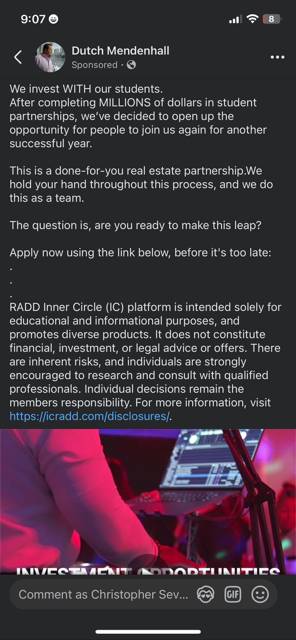
    That's quite a bit of research. Interestingly, I saw a paid ad for their inner circle training program on my FB feed just yesterday. As I mentioned earlier, is this really the CEO's focus? How might their other investors feel about this? To me, it seems a bit out of touch, especially considering they have a fund under subpoena from the commission, have paused distributions and withdrawals, and are behind on compliance items. 

    I would assume they are providing frequent updates to investors on a monthly basis, including status updates, property updates, and fund updates to maintain communication. Those who have invested I am sure can chime in.


    7e investments53 Reviews
  • Jay HinrichsBusiness Member
    Real Estate Consultant · Summerlin, NV · Member since 2014 · 45k+ posts · 66k+ votes
    2y
    Quote from @Chris Seveney:
    Quote from @Melanie P.:

    @Jennifer O. Thanks for posting this. I encourage your friend to forward the unredacted prom note to the SEC via this link https://www.sec.gov/tcr Click on Submit a Tip. Your friend should include as many details as possible concerning how they were pitched the investment in the prom note.

    @Brent Mendenhall The best thing for any investor is to avoid your company and those like it out of respect for their investment dollars.

    Why is there no formal agreement between RAD and DDH Fund LP when DDH Fund owes RAD's investors millions of dollars and collects rents on behalf of RAD. What is the purpose of the two million low-interest loan to Seminar Solution LLC? Why couldn't the officers in RAD obtain financing for their primary home from traditional lending sources? Why are there two prom notes to finance residential real estate for the company's officers?

    A review of your offering documents makes clear that investor money is considered game for any purpose. I have serious doubts that the company officers have maintained their fiduciary duty to RAD's investors in many of these related-party transactions. 

    I thought the Philadelphia Inquirer summed up the issues with RAD best: https://www.inquirer.com/business/rad-diversified-brandon-me...

    California man touts business empire built of Philly rowhouses bought at sheriff’s sales. Some are skeptical.

    RAD Diversified is losing money. Some tenants aren’t happy. It calls itself “an incredible company.”

    Some of the rents that RAD Diversified REIT says in SEC filings that it's expecting appear to be overstated, in light of the buildings’ conditions. This boarded-up rowhouse at 4243 Leidy Ave., for example, is said to be earning the company $14,400 a year in rent — even though it has no rental license and its most recent license was as a vacant property. Some of the rents that RAD Diversified REIT says in SEC filings that it's expecting appear to be overstated, in light of the buildings’ conditions. This boarded-up rowhouse at 4243 Leidy Ave., for example, is said to be earning the company $14,400 a year in rent — even though it has no rental license and its most recent license was as a vacant property.Read moreALEJANDRO A. ALVAREZ / Staff Photographer

    When Tylisha Slaughter learned that the West Philadelphia rowhouse she rented was going to be auctioned off in a sheriff’s sale, she sensed opportunity.

    Slaughter, now 30, aimed to buy the home near Cobbs Creek Park on the cheap and restore it from the “slumlord”-like conditions she, her boyfriend, and her two young children had been living in.

    But on the day of the sale, she said, she found herself up against an out-of-towner with lots of money to spend: Brandon “Dutch” Mendenhall.

    "He outbid me," said Slaughter, whose rent has risen from $700 to $900 since Mendenhall's RAD Diversified REIT became her new landlord in late 2019, even as she says her complaints to RAD's property managers about pests and leaky pipes have gone unanswered.

    ADVERTISEMENT

    Slaughter’s home is part of a five-state empire of real estate bought through sheriff’s sales and “We Buy Houses” signs that Mendenhall, RAD’s chief executive, has been selling to investors on Facebook, YouTube, and other social media, touting what he portrays as the venture’s market-beating performance.

    Mendenhall, who is based in Southern California, has described Philadelphia as the biggest market for RAD, a firm founded in Florida that specializes in buying distressed real estate then renting it out. The company and others that he runs own nearly 100 properties across the city’s low-income neighborhoods, records show. RAD’s real estate holdings nationwide were worth some $24 million as of last fall, the company has reported.

    According to one of the 81 ads for RAD running earlier this week on Facebook and its sibling social-media sites, RAD shares surged from $14.23 in January 2021 to $18.52 in January 2022, an increase of 30%.

    “Our returns are so good right now, it makes it hard for people to even believe in them,” Mendenhall boasts in another ad. “That’s frustrating.”

    ADVERTISEMENT

    But RAD’s official disclosures tell a more doleful story than its online ads.

    During the first six months of last year, the most recent period covered in RAD’s latest investors’ circular, filed with the U.S. Securities and Exchange Commission in January, the company’s real estate business lost $1.12 million, although the firm had relatively little debt compared with the stated value of its assets.

    The company also disclosed that it may use new investors’ money to pay dividends to existing ones. Experts say it can be risky for an investment fund to operate this way, since it may require ever more participants to be brought on board, rather than making money from its business.

    More than 60% of RAD's operating expenses in 2020, the most recent period for which the company has released audited financial information, consisted of asset-management fees and other payments to a separate company owned by Mendenhall and other RAD executives called RAD Management LLC, according to an analysis of the financial data.Those fees and payments amounted to more than $730,000 that year, RAD said.

    ADVERTISEMENT

    “We have limited operating capital, few significant assets and limited revenue from operations,” RAD wrote in the January document, which sought to raise up to about $58 million in new funds, for a total of $75 million of company shares. “If we are unable to continue to raise sufficient capital through this offering, there is a strong likelihood our business will fail and you may lose your entire investment.”

    RAD declined to directly answer detailed lists of questions from The Inquirer, saying in a statement that they contain “various inaccuracies.”

    The firm did say it works to “comply with all securities, licensing, landlord-tenant, and other applicable laws and regulations.”

    Now, the SEC wants to tell federal prosecutors about allegations concerning the divergence between RAD’s online pitches and its more downbeat official self-descriptions.

    ADVERTISEMENT

    The allegations are contained in a complaint sent to the SEC by a fraudster-turned-self-styled whistle-blower named Barry Minkow, who said he gathered material from RAD for his report by pretending to be a potential investor in the company.

    Late last month, the SEC asked Minkow for his consent to share the document with the Office of the U.S. Attorney for the Central District of California. Minkow gave his approval, according to copies of the correspondence that he provided to The Inquirer.

    Since finishing his most recent prison stint for fraud and other offenses in 2018, Minkow has established a side business of researching companies he suspects of malfeasance and reporting them to the SEC as a whistle-blower. Whistle-blowers can sometimes claim a cut of what a company disgorges if they provide information used in a successful SEC investigation.

    His report about RAD to the SEC is among 11 complaints he has filed with the agency. Another focused on National Realty Investment Advisors, a New Jersey-based firm with a big Philadelphia property-development footprint that promises large returns to investors on national TV and radio ads. NRIA has denied any wrongdoing and no government action has been taken against it.

    ADVERTISEMENT

    “The sad reality is that many investors are relying upon a complete and total misrepresentation of material facts about the profitability and financial stability of the company to make an investment decision,” Minkow wrote of RAD’s advertisements in an October update to his report to the SEC on that company, originally filed in April. He provided the documents to The Inquirer.

    In a Jan. 20 YouTube video, Brandon “Dutch” Mendenhall encouraged viewers to invest in his real estate company, RAD Diversified REIT. Mendenhall appears in many of the videos posted by RAD to YouTube on a near-weekly basis, and in postings and paid advertisements on Facebook and Instagram. In a Jan. 20 YouTube video, Brandon “Dutch” Mendenhall encouraged viewers to invest in his real estate company, RAD Diversified REIT. Mendenhall appears in many of the videos posted by RAD to YouTube on a near-weekly basis, and in postings and paid advertisements on Facebook and Instagram.Read more

    RAD said in its statement that it strives to make its regulatory filings and offering materials “accurate and complete.”

    RAD “is an incredible company making a positive impact on our investors, team of employees, contractors, neighborhoods, non-profits and more,” Mendenhall said in an email.

    A U.S. Attorney spokesperson declined to say whether the office was conducting an investigation into RAD, citing Justice Department policy not to comment on any investigations that the office may, or may not, be pursuing. An SEC spokesperson also declined to comment.

    No criminal charges or civil complaints are known to have been made against RAD or any of its employees.

    RAD did not directly respond to questions about any potential investigations of the company. “RAD Diversified has and will respond to and cooperate with any requests from pertinent regulatory and law enforcement entities,” it said in its statement. “Terms offered to investors by RAD Diversified are in line with those offered by similar, competitor REITs.”

    John Carney, who helps lead the securities, enforcement, and litigation team at BakerHostetler in New York, said any move by the SEC to share an outside report would not have been taken lightly by the agency. “The fact that the SEC is taking the time to share information with the Department of Justice is a serious step,” said Carney, who previously served as an attorney with both agencies.

    ‘The leading expert’

    In the videos he posts to YouTube on a near-weekly basis, Mendenhall, 42, projects a clean-cut if casual figure, appearing in button-down shirts — only seldom wearing a tie — with a neatly trimmed Vandyke beard as he brightly talks up his business.

    “I’m literally the nation’s leading expert in tax liens and tax deeds,” he boasts in one installment. “So we invest in that exact modality and make more money at it than anybody else.”

    The entrepreneur also appears in many of the ads for RAD across Facebook, Facebook Messenger, Instagram, and other applications.

    The pitches appear to be bearing some fruit: RAD had between 1,500 and 2,000 investors, as of late October, and was adding more at a clip of 200 per month, according to an email from a company official to Minkow. The official believed Minkow to be a potential investor at the time.

    In other videos for one of RAD’s side businesses, a network of leasable off-the-grid-encampments called the American Survivalist Project — “a plan B for when disaster strikes,” according to the venture’s website — Mendenhall’s banter can take a darker turn.

    “One of the scariest things that happen in the worst-case scenarios is people turn on people,” he said in one clip after listing a few such scenarios: a new, more-virulent pandemic; artificial intelligence run amok; nuclear war; or “the real war with China and Russia and cybertechnology and the Cold War.”

    RAD’s survivalist-camp business is in the process of gaining control of 20,000 acres of rural property across multiple sites nationwide, Mendenhall said in an interview last month with the financial blogger and stock picker Jim Woods on Woods’ podcast, Way of the Renaissance Man.

    But the bulk of the business’ holdings consists of residential real estate, filings show. While RAD also concentrates on areas of Texas, Idaho, California, and Florida for its growing portfolio of rental properties, according to the January offering circular, Philadelphia has been its primary locus of activity.

    “Our biggest city is Philadelphia, where we happen to have our longest-running, best team,” Mendenhall said on Woods’ podcast.

    Since their first recorded Philadelphia acquisition in July 2016, RAD and three other funds Mendenhall leads — DHI Holdings LP, DHI Fund LP, and DDH Fund LP — paid a total of more than $5.8 million for at least 96 properties in the city, most of them in struggling neighborhoods such as Parkside in West Philadelphia and East Germantown in the city’s northwest.

    Before 2020, all but four of the Philadelphia properties were bought at sheriff’s sales, records show. But Mendenhall told Woods that the company has had to retool its approach to acquisitions since then in response to pandemic-era freezes on sheriff’s sales.

    “We shifted to a hard-core marketing strategy,” he said. “If you are seeing a billboard of ‘Sell your home’ or ‘We buy houses’ or whatever else, those kinds of things might be us.”

    Lapsed licenses

    Department of Licenses and Inspections records show about half of the Philadelphia properties owned by RAD or other Mendenhall-led funds were granted rental licenses since those businesses acquired them.

    Landlords are required to renew a property’s rental license once a year. The $56-a-unit process requires landlords to be up-to-date on their property taxes and for the properties to be free of any safety or building-code violations.

    Since landlords are not legally permitted to collect rent from tenants of a home with an inactive license, the system is designed to serve as a check on property owners, forcing them to address safety violations and pay their taxes.

    But Philadelphia’s Department of Licenses and Inspections lacks the resources to hunt down property owners who flout those rules, said Karen Guss, a spokesperson for the agency.

    “L&I has to often prioritize, and the things that get prioritized are things like fire safety issues, hazardous buildings,” she said. “License violations, while problematic, isn’t something that automatically jumps to the head of the line.”

    The Mendenhall-led funds also own Philadelphia properties with no license at all. City regulations require some kind of license for most property that is uninhabited or otherwise out of active use for three months or longer.

    Of the funds’ rental licenses, about 40 have lapsed and have not been renewed, but that doesn’t appear to be stopping Mendenhall from accommodating rent-paying tenants at at least some of those properties.

    The Inquirer visited eight properties with lapsed licenses in West and North Philadelphia. One appeared visibly unoccupied, with a mattress and other debris on its porch and its upstairs windows boarded up.

    Of the remaining seven homes, The Inquirer was able to question residents of four about whether they continued to be charged rent.

    All said they had been.

    One tenant, Shanna Anderson, said she stopped being able to afford her $1,750-a-month rent to DHI Fund and RAD at her Parkside rowhouse after losing her job at a real estate brokerage during the pandemic.

    In late November, RAD threatened to evict her if she failed to pay $6,530 owed for unpaid rent since August.

    Her home’s rental license has been inactive since late July, according to L&I records. L&I’s Guss said the property’s owner had unsuccessfully attempted to renew the license. She did not know why the renewal had not gone through, but noted that the property was delinquent on its property taxes.

    In the letter from RAD threatening eviction, which Anderson shared with The Inquirer, the company encouraged her to register for help from the city’s COVID-19 Emergency Rental Assistance Program and provided a link to the program’s website.

    Anderson said the house had been newly renovated when she moved in in 2019, but she noticed some signs of shoddy work, like dips in the floorboards and a bathroom faucet affixed to the kitchen sink.

    Still, she’d had few serious maintenance complaints about the property and found RAD’s property managers to be sufficiently responsive.

    Deteriorating homes

    Slaughter, the tenant who was outbid for her West Philadelphia home by Mendenhall, wasn’t as complimentary. She said she has had to pay out-of-pocket for exterminators and plumbers after getting no response to pest and leaky-pipe complaints to RAD’s property managers.

    Another tenant of a Mendenhall-led fund, Terry Golden, 41, said he has been dealing for about a year with a flooded basement that his property managers have neglected to repair at his 880-square-foot home in West Philadelphia’s Haddington section.

    His living and dining rooms are piled high with belongings he’d previously been storing in the basement: furniture, appliances, trophies from his days coaching little-league football. Other items, such as football equipment from the kids’ league, were destroyed in the flooding, he said.

    More leaks have come from the plumbing between his first and second floors, prompting him to leave his light fixtures hanging unmounted from their wires so they don’t fill with water, he said.

    Clusters of dead insects cling to one section of his ceiling. Golden said he thinks they were attracted to his home by its dampness.

    “They don’t fix things much,” he said of his landlord, whom he pays $1,000 in monthly rent.

    No rental license renewals have been sought for Golden’s or Slaughter’s homes, Guss said.

    RAD did not respond to requests for comment on these and other properties. The company “cares about its tenants” and believes in providing “above standard living conditions,” it said in its statement.

    Other Philadelphia properties owned by RAD or the other businesses have been licensed with L&I as vacant real estate. One of these is at 4243 Leidy Ave., a boarded-up rowhouse across the street from an elementary school in Parkside.

    About a year before DDH Fund bought that house in September 2016, street-level images on the city’s Atlas property-data website show that its windows and doors had been intact. Subsequent images on the site show the property’s progressive deterioration over the years.

    Another property, a three-story rowhouse at 915 Dauphin St. near the Fairhill neighborhood, underwent a similar decline: Seven months after its November 2016 acquisition by DDH, it too had windows and doors. Today, the door is boarded up and there is no glass in the upper-story windows.

    Nicole Lawrence, executive director of the Tenant Union Representative Network, said such deterioration tends to spread blight throughout neighborhoods, diminishing safe, affordable housing opportunities in communities where they’re most needed.

    “As a property continues to sit and become dilapidated, it’s like a cancer,” she said. “It’s just an entire ripple effect.”

    Not your ordinary REIT

    During the Way of the Renaissance Man podcast interview, Mendenhall told host Woods that he came to real estate after an early career coaching college baseball, a grueling vocation that he said left him feeling burnt out.

    Mendenhall did his coaching at the University of San Francisco, according to his biography on RAD’s website. A spokesperson for the school said Mendenhall had not been a paid university employee but had coached as a volunteer in 2001.

    In 2008, he started a seminar program for would-be real estate investors called Tax Auction Advisors, according to company filings.

    His students there coaxed him into starting his first funds, he said in a video on the website for the seminar company, which remains in operation. “‘Put your money where your mouth is,’” he recalled them saying.

    DHI Holdings, DHI Fund, and DDH Fund were formed in the mid-2010s, records show.

    RAD, which was established as a real estate investment trust, or REIT, in November 2019, is now in the process of using company stock to buy the real estate accumulated by those funds, according to the circular.

    About 20 properties bought by other Mendenhall-led funds in Philadelphia were listed in the document under an inventory of RAD’s real estate holdings as of June 30, 2021. Public records, however, show that the other funds remain the documented owners of those properties. There is no record of them being purchased by RAD among the city’s real estate filings. RAD did not respond to a direct inquiry about this discrepancy.

    RAD said in its statement that the founders of the company that handles RAD’s operations, RAD Management, have “significant investing and property management experience.”

    RAD Management is led by Mendenhall and other RAD Diversified executives, according to the circular. These executives receive no salary or other employment benefits from RAD Management but “will realize growth as owners/members” of the firm, according to the document.

    Under RAD Diversified’s registration with the SEC, any investor — not just “accredited” ones with high net worths — can buy shares, as long as the investment doesn’t exceed 10% of their incomes. RAD allows investors to buy in with as little as $1,000, or even less if it so decides, according to the circular.

    In 2020, RAD declared a dividend of 5%, according to its website, despite having no profits that year. No information about dividends in subsequent years could be found in company filings.

    Most REITs are publicly traded, which means that their stock is bought and sold on public exchanges, with their share prices fluctuating according to investor demand.

    RAD, however, is among the relatively small set of property companies known as non-traded REITs, whose stock is acquired directly through brokers, not on the open market. Consequently, it’s up to these companies themselves, not demand from investors, to set the value of their shares.

    Non-traded REITs own about 10% of the $2.5 trillion in real estate assets held by REITs, not counting private ones whose shares are only available to accredited investors, according to the National Association of Real Estate Investment Trusts, a trade group.

    The SEC and the Financial Industry Regulatory Authority, a self-regulatory organization for brokerage firms and exchange markets, issued investor notices in the mid-2010s that warned of potential risks from non-traded REITs.

    They include a lack of clarity as to how shares are valued, difficulties in selling shares readily, high fees often paid to managers with possible conflicts of interest, and the potential that investor cash and loan proceeds can be used to pay dividends during unprofitable periods.

    More recently, high-profile investment firms such as Blackstone Group and Starwood Capital Group have started their own non-traded property trusts with offers to disclose more information, charge fewer fees, and allow shares to be cashed in more frequently. Blackstone's non-traded REIT now owns about half of all the real estate within that sector, according to NAREIT.

    Setting a price

    RAD sets its share price by tallying its net asset value — the total appraised value of its real estate and other assets, minus any money it owes or other liabilities — and dividing that figure by the number of shares it has outstanding, according to the circular.

    The last time it publicly broke down its share-price calculation was on Sept. 30, when the stock was selling at $18.52: a net asset value of $27.3 million divided by 1.47 million shares.

    RAD’s properties are appraised, in part, based on the income they generate as rentals, according to the circular.

    But some of the rents in the document’s inventory of RAD’s holdings appear to be overstated, in light of the buildings’ conditions, as characterized by L&I. The boarded-up rowhouse at 4243 Leidy Ave., for example, is said to be earning the company $14,400 a year in rent — even though it has no rental license and its most recent license was as a vacant property.

    Two more properties, 10 W. Pomona St. in Germantown and 6400 Glenmore Ave. in Elmwood, are listed as delivering “projected” rents of $14,400 and $12,300 a year. L&I has labeled both of them as “unsafe,” meaning the agency found them to be “dangerous to the life, health, property or safety of the public or the occupants of the structure.” The designation means no one can live in them.

    Those safety issues need to be remedied before the properties’ owners can get the go-ahead from L&I for renovations to make them habitable, Guss said. The agency granted a permit for repairs to make the Pomona Street property structurally sound last month, she said.

    The vacant, dilapidated house at 915 Dauphin St., meanwhile, was listed as having a market value of $200,000 in a February 2020 RAD document, about three years after DDH Fund paid $27,000 for that property when images on the Atlas property-data website show it was in better condition.

    Those asset-value calculations are behind RAD’s big stock-value jumps. Its shares surged from $10 around when the company was formed in 2019 to $11.07 in January 2020, to $14.23 in January 2021, to $18.52 until January 2022, according to Facebook and Instagram ads. Last month, it told the SEC that its shares were now worth $19.26.

    But there's a catch: Investors can't exchange their shares for cash at will, as they can with shares of an exchange-traded REIT. Instead, as RAD explains in its circular, investors are given two opportunities each year to cash out their shares.

    The rules surrounding these cash-out opportunities — RAD’s “share-redemption program” — are stringent.

    For one, investors don’t get the full value of their shares if they’ve held them for less than five years. RAD buys them back at a “discount” of up to 4%, according to the circular.

    RAD also caps the amount of stock it will buy back from investors at 10% or less of all the shares it has outstanding, and investors can only sell 25% of their stock at a time, although the company said in another filing that it “routinely” allows investors to cash out all their holdings despite that provision.

    Or the company could decide not to buy back any stock at all.

    “Our manager will reserve the right to reject any share repurchase request for any reason or no reason or to amend or terminate the share redemption program,” the company said. “You may not be able to sell any of your shares back to us, and if you do sell your shares, you may not receive the price you paid upon subscription.”


    That's quite a bit of research. Interestingly, I saw a paid ad for their inner circle training program on my FB feed just yesterday. As I mentioned earlier, is this really the CEO's focus? How might their other investors feel about this? To me, it seems a bit out of touch, especially considering they have a fund under subpoena from the commission, have paused distributions and withdrawals, and are behind on compliance items. 

    I would assume they are providing frequent updates to investors on a monthly basis, including status updates, property updates, and fund updates to maintain communication. Those who have invested I am sure can chime in.


    Lets keep in mind there is HUGE money in Training far more than owning 200 row houses in Philly etc.  I mean look at Brandon Turner he is now moved to the Training model.. its a very natural progression for those that have huge SM following and in Brandons case very real public perception of a RE Expert. Same thing with someone like Grant Cardone why would he go into the training bizz with billions in RE holdings.. Answer because as stated above nothing is more profitable than high end paid training.. you dont need to buy any real estate.. just have a monster marketing spend and off you go.
  • Melanie P.Pro Member
    Rental Property Investor · Member since 2023 · 1k+ posts · 922 votes
    2y

    @Chris Seveney This one went the other way around. The training/seminar venture was first (2008) and is ongoing. They added the investment arm in 2019. Spent millions every year to market the investments. With the money they raised they bought too little real estate to achieve their investment objectives, have LENT millions to the training company, financed a couple homes (wonder who got those, I can't find where they ever disclosed - but it will come out). What they have left is a multi-million dollar marketing infrastructure to sell to anyone who doesn't bother to use Google before sending off their money. I'm sure those people are out there and RAD is finding them. But it won't be long now.

    This sucker is circling the drain. Hopefully the government will follow through and take action. Every report, tip, and complaint makes that more likely. 

  • Member since 2024 · 33 posts · 3 votes
    2y
    Quote from @Melanie P.:

    @Chris Seveney This one went the other way around. The training/seminar venture was first (2008) and is ongoing. They added the investment arm in 2019. Spent millions every year to market the investments. With the money they raised they bought too little real estate to achieve their investment objectives, have LENT millions to the training company, financed a couple homes (wonder who got those, I can't find where they ever disclosed - but it will come out). What they have left is a multi-million dollar marketing infrastructure to sell to anyone who doesn't bother to use Google before sending off their money. I'm sure those people are out there and RAD is finding them. But it won't be long now.

    This sucker is circling the drain. Hopefully the government will follow through and take action. Every report, tip, and complaint makes that more likely. 

    @Melanie P. The article you post is nearly 2 1/2 years of age. Did you by chance reach out to the author and discuss follow-up discussions with him?  It is easily found by a simple Google search.  The other information you are referencing I am sure you pulled from our offering circular, which is always posted on our website.  As far as your concern on the homes, I have no information on this but I offer you this:  I spoke with our CEO and he is very open to me setting up a Zoom, Google Meet, any venue to INCLUDE a trip to our main office in Tampa FL to meet with him and our Team.  Travel and per diem will be included.  You have also posted some misinformation that I replied back and asked for further details etc. so I could ensure our Team could respond to.  Additionally, you questioned our investments into farms etc. and felt it is strange that we invest in farmland etc.  

    @Chris Seveney I have replied previously (maybe not directly to you) that we hold numerous update calls monthly on our RADD REIT, Inner Circle, RADD Land REIT, ownership in our golf course, farms etc. These calls or lead by either our CEO, VP of Real Estate, etc.

    We did (prior to me joining the Team) start out as a training and education program.  Dutch, our CEO, discusses this regularly on his Podcast, interviews etc.  You can easily access and view these.  Students (who are now invested with RADD) challenged Dutch "put your money where your mouth is" and partner with us on real estate...in a nutshell-the history of the Inner Circle.  Our CEO and Co-founder could easily expound on this and the history. 

    We have been transparent on our current challenges, plan moving forward, actions being taken etc.  I believe it is discussed in other threads or comments within Bigger Pockets.

    @Melanie P. just reach out if you'd like to have further direct discussions with our CEO, I'll make it happen!

  • Member since 2024 · 2 posts · 1 vote
    2y

    From SEC site - https://www.sec.gov/Archives/edgar/data/1721469/000110465924...

    "On June 27, 2024, the board of directors (the “Board”) of RAD Diversified REIT, Inc. (the “Company”) met to consider its Share Redemption Program. Although the Board is beginning to see improved liquidity throughout the Company based on actions it has been and will continue taking, the Board perceives that the real estate market remains relatively stagnant. The Board therefore believes it prudent to proceed cautiously at this time. As a result, the Board decided, in accordance with the terms of its Share Redemption Program, to continue the temporary freeze of the Company’s redemption program. The Company will not process any pending requests that have not been redeemed as of February 1, 2024, nor will it accept any new redemption requests. Pending redemption requests will remain in queue until the Company recommences the redemption program.

    The Board intends to reassess this decision to determine whether to recommence the redemption program no later than January 1, 2025."

  • Melanie P.Pro Member
    Rental Property Investor · Member since 2023 · 1k+ posts · 922 votes
    2y
    Quote from @Account Closed:

    From SEC site - https://www.sec.gov/Archives/edgar/data/1721469/000110465924...

    "On June 27, 2024, the board of directors (the “Board”) of RAD Diversified REIT, Inc. (the “Company”) met to consider its Share Redemption Program. Although the Board is beginning to see improved liquidity throughout the Company based on actions it has been and will continue taking, the Board perceives that the real estate market remains relatively stagnant. The Board therefore believes it prudent to proceed cautiously at this time. As a result, the Board decided, in accordance with the terms of its Share Redemption Program, to continue the temporary freeze of the Company’s redemption program. The Company will not process any pending requests that have not been redeemed as of February 1, 2024, nor will it accept any new redemption requests. Pending redemption requests will remain in queue until the Company recommences the redemption program.

    The Board intends to reassess this decision to determine whether to recommence the redemption program no later than January 1, 2025."


     Unless one of the officers or owners of RAD needs a new house in which case the company has millions available to issue that highly creditworthy individual investor money at below-market interest rates right out of the corporate coffers. It's just the investors who are left to twist in the wind - no need for anyone at RAD to pause their looting during bad times....

    IF RAD DIVERSIFIED TALKED YOU INTO INVESTING AND WON'T RETURN  YOUR MONEY GATHER ALL RELEVANT DOCUMENTS AND CALL (213) 894-2400. This is this US Attorney for the Central District of California. Ask to speak with the duty agent and advise them they received a referral with additional concerns about RAD's operation from the SEC, that you're a victim of RAD and want to give them information about your investment. 


    Anyone who was originally pitched a real estate investment but after sending money were offered a promissory note instead should also call the US Attorney.

  • Member since 2024 · 12 posts · 6 votes
    2y

     Please message me for details of taking action towards RAD for this not to happen to anyone else. 

  • Member since 2024 · 12 posts · 6 votes
    2y
  • Chris SeveneyBusiness Member
    Moderator
    Investor · VA · Member since 2015 · 21k+ posts · 19k+ votes
    2y
    Quote from @Dyanne Christensen:

     What will filing a complaint with the BBB do? Just curious. It may make people feel better but does it actually do anything?

    7e investments53 Reviews
  • Member since 2024 · 33 posts · 3 votes
    2y
    Quote from @Chris Seveney:
    Quote from @Dyanne Christensen:

     What will filing a complaint with the BBB do? Just curious. It may make people feel better but does it actually do anything?


    As of today, I will no longer reply on behalf of RADD as I am no longer with the company.

     @Chris Seveney You are correct, taking the time to post to Better Business Bureau will result in nothing but possibly feeling a bit better (I say that seriously because of how human behavior works).  The BBB accredited status is "revoked" and no action can really be taken other than when I was providing information reference our 1U filing with the SEC so they have the latest information and attempting to assist each input the best I could.  For other concerns, I would and still do advise them to reach out to Investor Relations etc.  I attempted to provide the most transparent and up to date information on this site. 

    @Dyanne Christensen I did reach out to Compliance, Investor Relations, and our COO ref your process yesterday and I feel you will see some type of resolution in near future..I know that doesn't give you much information but Compliance (sorry I don't like mentioning names) stated she has been responding to you and working with Inner Circle lead and the Co-Founder.

  • Jay HinrichsBusiness Member
    Real Estate Consultant · Summerlin, NV · Member since 2014 · 45k+ posts · 66k+ votes
    2y
    Quote from @Brent Mendenhall:
    Quote from @Chris Seveney:
    Quote from @Dyanne Christensen:

     What will filing a complaint with the BBB do? Just curious. It may make people feel better but does it actually do anything?


    As of today, I will no longer reply on behalf of RADD as I am no longer with the company.

     @Chris Seveney You are correct, taking the time to post to Better Business Bureau will result in nothing but possibly feeling a bit better (I say that seriously because of how human behavior works).  The BBB accredited status is "revoked" and no action can really be taken other than when I was providing information reference our 1U filing with the SEC so they have the latest information and attempting to assist each input the best I could.  For other concerns, I would and still do advise them to reach out to Investor Relations etc.  I attempted to provide the most transparent and up to date information on this site. 

    @Dyanne Christensen I did reach out to Compliance, Investor Relations, and our COO ref your process yesterday and I feel you will see some type of resolution in near future..I know that doesn't give you much information but Compliance (sorry I don't like mentioning names) stated she has been responding to you and working with Inner Circle lead and the Co-Founder.


    ya you got thrown into a no win situation best of luck on your new pursuits.
  • Member since 2024 · 33 posts · 3 votes
    2y
    Quote from @Jay Hinrichs:
    Quote from @Brent Mendenhall:
    Quote from @Chris Seveney:
    Quote from @Dyanne Christensen:

     What will filing a complaint with the BBB do? Just curious. It may make people feel better but does it actually do anything?


    As of today, I will no longer reply on behalf of RADD as I am no longer with the company.

     @Chris Seveney You are correct, taking the time to post to Better Business Bureau will result in nothing but possibly feeling a bit better (I say that seriously because of how human behavior works).  The BBB accredited status is "revoked" and no action can really be taken other than when I was providing information reference our 1U filing with the SEC so they have the latest information and attempting to assist each input the best I could.  For other concerns, I would and still do advise them to reach out to Investor Relations etc.  I attempted to provide the most transparent and up to date information on this site. 

    @Dyanne Christensen I did reach out to Compliance, Investor Relations, and our COO ref your process yesterday and I feel you will see some type of resolution in near future..I know that doesn't give you much information but Compliance (sorry I don't like mentioning names) stated she has been responding to you and working with Inner Circle lead and the Co-Founder.


    ya you got thrown into a no win situation best of luck on your new pursuits.

     @Jay Hinrichs Thanks Jay, I will probably bounce back into the government (DOD) with my Special Operations network.  

  • Jay HinrichsBusiness Member
    Real Estate Consultant · Summerlin, NV · Member since 2014 · 45k+ posts · 66k+ votes
    2y
    Quote from @Brent Mendenhall:
    Quote from @Jay Hinrichs:
    Quote from @Brent Mendenhall:
    Quote from @Chris Seveney:
    Quote from @Dyanne Christensen:

     What will filing a complaint with the BBB do? Just curious. It may make people feel better but does it actually do anything?


    As of today, I will no longer reply on behalf of RADD as I am no longer with the company.

     @Chris Seveney You are correct, taking the time to post to Better Business Bureau will result in nothing but possibly feeling a bit better (I say that seriously because of how human behavior works).  The BBB accredited status is "revoked" and no action can really be taken other than when I was providing information reference our 1U filing with the SEC so they have the latest information and attempting to assist each input the best I could.  For other concerns, I would and still do advise them to reach out to Investor Relations etc.  I attempted to provide the most transparent and up to date information on this site. 

    @Dyanne Christensen I did reach out to Compliance, Investor Relations, and our COO ref your process yesterday and I feel you will see some type of resolution in near future..I know that doesn't give you much information but Compliance (sorry I don't like mentioning names) stated she has been responding to you and working with Inner Circle lead and the Co-Founder.


    ya you got thrown into a no win situation best of luck on your new pursuits.

     @Jay Hinrichs Thanks Jay, I will probably bounce back into the government (DOD) with my Special Operations network.  


    Lord Knows the SS could use some help !!!
  • Member since 2024 · 33 posts · 3 votes
    2y
    Quote from @Jay Hinrichs:
    Quote from @Brent Mendenhall:
    Quote from @Jay Hinrichs:
    Quote from @Brent Mendenhall:
    Quote from @Chris Seveney:
    Quote from @Dyanne Christensen:

     What will filing a complaint with the BBB do? Just curious. It may make people feel better but does it actually do anything?


    As of today, I will no longer reply on behalf of RADD as I am no longer with the company.

     @Chris Seveney You are correct, taking the time to post to Better Business Bureau will result in nothing but possibly feeling a bit better (I say that seriously because of how human behavior works).  The BBB accredited status is "revoked" and no action can really be taken other than when I was providing information reference our 1U filing with the SEC so they have the latest information and attempting to assist each input the best I could.  For other concerns, I would and still do advise them to reach out to Investor Relations etc.  I attempted to provide the most transparent and up to date information on this site. 

    @Dyanne Christensen I did reach out to Compliance, Investor Relations, and our COO ref your process yesterday and I feel you will see some type of resolution in near future..I know that doesn't give you much information but Compliance (sorry I don't like mentioning names) stated she has been responding to you and working with Inner Circle lead and the Co-Founder.


    ya you got thrown into a no win situation best of luck on your new pursuits.

     @Jay Hinrichs Thanks Jay, I will probably bounce back into the government (DOD) with my Special Operations network.  


    Lord Knows the SS could use some help !!!

     Yes, definitely at the mid to senior Leadership levels.  For the most part, the guys and girls at the ground level are still great and focused on what they do!  My home is definitely going back to SOF at Fort Liberty (Fort Bragg NC)!!!  

  • Jay HinrichsBusiness Member
    Real Estate Consultant · Summerlin, NV · Member since 2014 · 45k+ posts · 66k+ votes
    2y
    Quote from @Brent Mendenhall:
    Quote from @Jay Hinrichs:
    Quote from @Brent Mendenhall:
    Quote from @Jay Hinrichs:
    Quote from @Brent Mendenhall:
    Quote from @Chris Seveney:
    Quote from @Dyanne Christensen:

     What will filing a complaint with the BBB do? Just curious. It may make people feel better but does it actually do anything?


    As of today, I will no longer reply on behalf of RADD as I am no longer with the company.

     @Chris Seveney You are correct, taking the time to post to Better Business Bureau will result in nothing but possibly feeling a bit better (I say that seriously because of how human behavior works).  The BBB accredited status is "revoked" and no action can really be taken other than when I was providing information reference our 1U filing with the SEC so they have the latest information and attempting to assist each input the best I could.  For other concerns, I would and still do advise them to reach out to Investor Relations etc.  I attempted to provide the most transparent and up to date information on this site. 

    @Dyanne Christensen I did reach out to Compliance, Investor Relations, and our COO ref your process yesterday and I feel you will see some type of resolution in near future..I know that doesn't give you much information but Compliance (sorry I don't like mentioning names) stated she has been responding to you and working with Inner Circle lead and the Co-Founder.


    ya you got thrown into a no win situation best of luck on your new pursuits.

     @Jay Hinrichs Thanks Jay, I will probably bounce back into the government (DOD) with my Special Operations network.  


    Lord Knows the SS could use some help !!!

     Yes, definitely at the mid to senior Leadership levels.  For the most part, the guys and girls at the ground level are still great and focused on what they do!  My home is definitely going back to SOF at Fort Liberty (Fort Bragg NC)!!!  


    well thank you for your service and as I said best of luck. !!!
  • Member since 2024 · 12 posts · 6 votes
    2y

    I feel it's a start of getting them recognized for the wrong they are doing to others and taking their money. A deterrent for others to make the same mistake. The word needs to get out that they are not holding their end of the bargain as promised.  

  • Real Estate Agent · Wilmington, NC · Member since 2016 · 13 posts · 6 votes
    2y
    Quote from @Melanie P.:
    Quote from @Account Closed:

    From SEC site - https://www.sec.gov/Archives/edgar/data/1721469/000110465924...

    "On June 27, 2024, the board of directors (the “Board”) of RAD Diversified REIT, Inc. (the “Company”) met to consider its Share Redemption Program. Although the Board is beginning to see improved liquidity throughout the Company based on actions it has been and will continue taking, the Board perceives that the real estate market remains relatively stagnant. The Board therefore believes it prudent to proceed cautiously at this time. As a result, the Board decided, in accordance with the terms of its Share Redemption Program, to continue the temporary freeze of the Company’s redemption program. The Company will not process any pending requests that have not been redeemed as of February 1, 2024, nor will it accept any new redemption requests. Pending redemption requests will remain in queue until the Company recommences the redemption program.

    The Board intends to reassess this decision to determine whether to recommence the redemption program no later than January 1, 2025."


     Unless one of the officers or owners of RAD needs a new house in which case the company has millions available to issue that highly creditworthy individual investor money at below-market interest rates right out of the corporate coffers. It's just the investors who are left to twist in the wind - no need for anyone at RAD to pause their looting during bad times....

    IF RAD DIVERSIFIED TALKED YOU INTO INVESTING AND WON'T RETURN  YOUR MONEY GATHER ALL RELEVANT DOCUMENTS AND CALL (213) 894-2400. This is this US Attorney for the Central District of California. Ask to speak with the duty agent and advise them they received a referral with additional concerns about RAD's operation from the SEC, that you're a victim of RAD and want to give them information about your investment. 


    Anyone who was originally pitched a real estate investment but after sending money were offered a promissory note instead should also call the US Attorney.


     I tried too call that number. The woman who answered said that department does not handle anything like this , she told me to call my local FBI office and report that I was swindled out of $5K from Radd Reit.

  • Stuart UdisPro Member
    Attorney · Philadelphia · Member since 2018 · 2k+ posts · 3k+ votes
    2y

    @Jay Curley Can you elaborate on how RAD REIT "swindled" you out of $5K? I am not here to support or defend any of RAD's actions. In fact, on numerous occasions I've raised red flags concerning their representations, financial reporting and general investment decisions that were all verifiable through public information and should have given most investors pause before investing. I am merely interested in better understand your investment relationship with the company because I am not clear how the FBI will be able to assist in recovering a $5,000 investment. I know that's not the news you want to hear but perhaps hearing your story will lead to other helpful advice from forum participants.

  • Real Estate Agent · Wilmington, NC · Member since 2016 · 13 posts · 6 votes
    2y
    Quote from @Stuart Udis:

    @Jay Curley Can you elaborate on how RAD REIT "swindled" you out of $5K? I am not here to support or defend any of RAD's actions. In fact, on numerous occasions I've raised red flags concerning their representations, financial reporting and general investment decisions that were all verifiable through public information and should have given most investors pause before investing. I am merely interested in better understand your investment relationship with the company because I am not clear how the FBI will be able to assist in recovering a $5,000 investment. I know that's not the news you want to hear but perhaps hearing your story will lead to other helpful advice from forum participants.


     Sure, I invested 5K into the Radd Reit, They claimed that the share price would be adjusted semi annually. Then this past February the company said that the new improved share price would not be disclosed until further notice and that redemptions would not be available until next year. I have gotten no communication from the company and after seeing some other people experiencing the same I feel that they are scamming. 

  • Chris SeveneyBusiness Member
    Moderator
    Investor · VA · Member since 2015 · 21k+ posts · 19k+ votes
    2y
    Quote from @Jay Curley:
    Quote from @Stuart Udis:

    @Jay Curley Can you elaborate on how RAD REIT "swindled" you out of $5K? I am not here to support or defend any of RAD's actions. In fact, on numerous occasions I've raised red flags concerning their representations, financial reporting and general investment decisions that were all verifiable through public information and should have given most investors pause before investing. I am merely interested in better understand your investment relationship with the company because I am not clear how the FBI will be able to assist in recovering a $5,000 investment. I know that's not the news you want to hear but perhaps hearing your story will lead to other helpful advice from forum participants.


     Sure, I invested 5K into the Radd Reit, They claimed that the share price would be adjusted semi annually. Then this past February the company said that the new improved share price would not be disclosed until further notice and that redemptions would not be available until next year. I have gotten no communication from the company and after seeing some other people experiencing the same I feel that they are scamming. 

    In one of their offerings I believe it was mentioned they have something pending with the SEC (an inquiry or investigation). They have published with the SEC notifications that all withdrawals are frozen. It does not appear there is anything else to report.

    The end conclusion is probably not going to be promising for investors in this fund as Stuart mentioned he had concerns and they also have not submitted audited financials in years which based on my experience from others who do a Reg A and do not submit financials it has meant they are not good. Not saying there financials are not good, but usually if someone is not submitting them and freezing withdrawals there is a reason for it....

    TLDR version: Do not expect your $5k back and write it off as a lesson learned and would not spend anymore $ or time trying to chase it.

    7e investments53 Reviews
  • Member since 2024 · 2 posts · 1 vote
    1y

    Prior to my investment, I asked my advisor, Mark Zabilowicz,  multiple times about the holding period and was consistently assured that I could request the return after six months. However, when I requested the return of my funds on June 26, 2023, that information did not hold true. Since then, I have been repeatedly told that my funds would be forthcoming, only to later hear that all funds are frozen. It has now been 16 months since my initial request, and I am looking for a clear timeline and action to fulfill this commitment.

    I have already filed a complaint with the Department of DPBR Office of Financial Regulation, as RAD now holds an F rating with the Better Business Bureau, and legal actions are being posted. I am not typically litigious, but this situation is unacceptable. I was misled when I made my investment, with Dutch frequently stating in public communications that RAD is “like family” and that funds would be returned easily if needed. However, the reality has proven to be quite different, and I am feeling deceived and deeply frustrated.

    I am prepared to pursue this matter further, including with media outlets if necessary. Holding investor funds without a clear and reliable process for withdrawal reflects poorly on RAD’s reputation and calls into question the ethical nature of its practices. In an industry where trust and reputation are paramount, RAD’s predatory and misleading policies are shocking.

    Additionally, I will be explaining to the FTC that RAD’s practices meet the definition of “Deceptive Practices” as per the Commission’s Policy Statement on Deception, which prohibits material representations or omissions likely to mislead consumers.

    On multiple occasions, I was told there would be no issues in accessing my funds. Yet, when I initiated a withdrawal, I was met with a complex set of terms, penalties, and withholding conditions that were never clearly explained beforehand. I intend to publish these details as part of my review and highlight how, despite reassurances from Dutch, RAD’s policies are designed in a way that restricts access to funds.

Join the conversationCreate a free account to reply, vote on answers and follow this thread.