Why markets with low appreciation grow your net worth twice as fast

Why markets with low appreciation grow your net worth twice as fast

Investor · Indianapolis, IN · Member since 2014 · 208 posts · 137 votes

This post is for those who like digging into the details of how their investments work and optimizing their portfolios through math. TLDR: Your net worth will grow around twice as fast by passively investing in unsexy, low-appreciation markets in the South and Midwest than glitzy, high-appreciation ones in the Sun Belt or on the coasts.

The title might seem counterintuitive, but there's a firm basis for this claim. That's right--high-appreciation markets are not the ones to invest in if you want your net worth to grow passively. Your total return, specifically return on equity, is always lower in these markets, and therefore, your net worth grows more slowly. This is true even if the appreciation is eye-popping.

First, high-appreciation markets generally have low cap rates, meaning low cashflow. These are markets like Austin, Phoenix, Nashville. In Austin, for instance, a home purchased for $400k might rent for $2,200 a month. With a 30-year loan at 7%, a typical interest rate today, you'd have to put down around $255k, nearly 65% of the purchase price, to hit roughly $0 cashflow (at these round numbers, it comes out to around -$328). The upside is that if Austin continues appreciating at the same rate as the last decade, around 7% annually, you'll make $28,000 in appreciation and the principal paydown in the first year will be $1,473. That's a total gain of $29,145 on your equity of $255,000 or a total return on equity of 11.4%. Yes, in spite of the seemingly great appreciation rate of 7%, this return doesn't beat stocks by much, if at all. Again, 7% appreciation, total return of 11.4%.

Now, say you're in an unsexy market that lacks this eye-popping appreciation, but offers higher cap rates, meaning higher cashflow. We're talking places like Cleveland and Memphis. In Memphis, a single family home might sell for $150k and rent for $1500 a month. With a 30-year loan at 7%, you would have to pay the loan down to $115k (a down payment of $35k or around 23%) to keep the cashflow positive (it should end up at about $185). Memphis definitely appreciates, too--over the last decade, it actually appreciated as well as Austin, but since it has recently slowed, we'll use a more conservative rate of 4.5%. That makes for $6,750 in appreciation (4.5% of $150,000), principal paydown is $1,168, and the total gain here is $8,103 on equity of $35,000, or 23.2%. Yes, around 23% is a reasonable rate that you can expect your money to grow at in a place like Memphis--even with modest appreciation of 4.5%.

Though the specific figures will change, this pattern will hold true across any combination of high cashflow/low appreciation and low cashflow/high-appreciation markets. There are various things to be said about the merits of both, but for a passive investor interested in growth, the cashflow-intensive markets that don't appreciate as much are better.

I have assumed in these examples that you are not willing to take on negative cashflow. If you have very high income from other sources or very large reserves, you may be able to leverage yourself to the hilt and take on insane negative cashflow to profit from high appreciation. Also, if your goals are not maximum growth, you could think about parking your money in coastal or Sun Belt markets. I have not taken taxes into account--appreciation gains are not taxed until sale--nor volatility, which is greater for appreciation than cashflow. Also, to get the higher returns I've mentioned, you must be invested in more properties total, meaning more work for you or, preferably, your manager--that's what it takes to get this return. I'm sure that there will be quibbles with these numbers--I don't invest in either of these places and am interested in hearing from those who do if there are any small corrections. The point remains: for people looking for maximum passive growth, the less glamorous, low-appreciation, high-cashflow markets are the place to be.

Oh, to show the work:

Austin

Revenue

Annual revenue $26,400 ($2,200 x 12) less 7% vacancy ($1,848) = $24,552

Expenses

Property tax: $7,000 (1.75% of property value--Austin is high!)

Insurance: $2,300

Turns and maintenance: $4,000

Principal and interest on $145,000 (30 year loan at 7%) = $965 monthly/$11,580 annually

Cashflow: -$328

Principal paydown: $1,473

Appreciation (7% of $400,000): $28,000

Return on equity ($29,145/$255,000): 11.4%

Memphis

Revenue

Annual revenue $18,000 ($1,500 x 12) less 7% vacancy ($1,260) = $16,740

Expenses

Property tax: $1,275

Insurance: $1,100

Turns and maintenance: $5,000 (a little higher in Memphis due to rougher tenant base)

Principal and interest on $115,000 (30 year loan at 7%) = $765 monthly/$9,180 annually

Cashflow: $185

Principal paydown: $1,168

Appreciation (4.5% of $150,000): $6,750

Return on equity ($8,103/$35,000): 23.2%

24Reply
1,160 views

Most Popular Reply

Jay HinrichsBusiness Member
Real Estate Consultant · Summerlin, NV · Member since 2014 · 45k+ posts · 66k+ votes
1y

couple holes in your thesis.

1. I suspect a 400k house in Austin will rent for more than 2500.

2. I suspect a 150k house in Memphis will rent for a tad less than 1500. Also prop taxs could be higher there is double tax in Memphis City and county.

3. Most folks dont buy 400 to 500k SFRs for rentals..

4. 150k home in Memphis is going to have bad debt at some point so your not going to get all that revenue.

Now dont get me wrong I agree on most areas of Texas for out of state owners Prop taxs insurance soil issue exteme weather those are killers on homes.. to me Texans need to buy Texas homes as they dont have any income tax.

See this reply in the discussion

310 Replies

Jump to latestLatest
  • Member since 2025 · 5 posts · 2 votes
    1y

    What I have found over and over in real life and in these forum answers is 

    that you can make $$$ in any market. There is NO one right way to rule them all...

    Its all in the amount of work you put in and the better the deal

    up front, the more $$ you can make in the long run.

    Cash flow markets, appreciation plays. They ALL can work if the deal is right

    • Henry ClarkPro Member
      Developer · Member since 2020 · 4k+ posts · 4k+ votes
      1y
      Quote from @Aaron Barber:

      What I have found over and over in real life and in these forum answers is 

      that you can make $$$ in any market. There is NO one right way to rule them all...

      Its all in the amount of work you put in and the better the deal

      up front, the more $$ you can make in the long run.

      Cash flow markets, appreciation plays. They ALL can work if the deal is right


      The problem is the squirrel squirrel and the shiny object syndrome. People look for what they want. Not all REI strategies work for all people , in all markets at all phases of their RE career.

      I try to look at people’s backgrounds and prior posts to see where they are at when I respond.   Don't want to always start off with my $300 in my pocket, ramen noodles all week, roast a chicken on Sundays for a great story to show perspective every time.  We all have our background stories.   People want to skip that and they shouldn’t.

      My risk tolerance level is far different at 30 versus at 65. Our investment strategy was totally different at 22 versus 30. The economies were different. Our REI knowledge was different.

      People want to jump thru their REI learning and it can't be done. You have to get burned, you have to fail, you have to have bad deals or you won't learn. Many posts on how expensive Mentor training programs are. We didnt use them. We failed and learned. Say $50,000 for a Self Storage learning program. I would say that is cheap. If I mentored people off BP, I would charge $1mm and show them how to pay me plus make money for themselves on the deal.

      So almost all of these posts and there responses can all be 100% right and 100% wrong for the individual OP or other people reading.    But what BP is good for is seeing different approaches and opinions.  

      If I posted our Self storage investments in Iowa were the greatest in the U.S.  And someone from Texas or New Jersey said their market was better who would be right?   They would be right from a monetary standpoint.  I can make twice as much in Texas and 3 times more in New Jersey.  But we live in Iowa and maintain a 40 mile radius.   Our market is better for our situation.

      Back to this post.

      Both can be right. The underlying issue is not the initial investment comparisons. It's what do they do as their second step? Does the low appreciation market person take their higher cashflow and start a second REI deal? Does the high appreciation investment refi and take cash out to put into a second REI? Both can easily earn twice the net worth of the other strategy if they do or don't do the appropriate Scaling steps. That is the magic of REI investing, the Scaling multiplier effect. If you don't have a Scaling strategy you're done at 3 or 4 investments.

  • Eric FernwoodBusiness Member
    Realtor · Las Vegas, NV · Member since 2014 · 1k+ posts · 1k+ votes
    1y

    Hello @Mike D.

    If you're solely focused on immediate cash flow, cities with declining populations like Memphis (down 6% in the last 10 years) and Cleveland (down 7.6% in the last 10 years) typically offer the highest initial cash flow because properties are inexpensive. Why are properties inexpensive? Because there has been little demand for many years.

    However, if you want lifelong financial independence, these markets won't work. Financial independence isn't about reaching a one-time number; it requires income that enables you to sustain your current standard of living for the rest of your life.

    1. Rents Must Outpace Inflation

    As living costs rise, your rental income needs to grow faster than inflation. In expensive cities, rising prices push more people to rent, increasing demand and rents. In low-cost, slow-growth cities, property prices and rents barely rise, so your income loses value over time. Meanwhile, expenses like taxes and insurance typically increase with inflation. At some point, your expenses will exceed your rental income.

    2. Home Prices Must Appreciate Faster Than Inflation

    In slow-growth markets, you must fund each purchase from your savings. For example, if you want $5,000 per month and each property nets $200, you need 25 properties. With a 25% down payment on $200,000 homes, that’s $1.25 million after taxes—unrealistic for most people. In rapidly appreciating markets, you can use equity from one property to buy the next, growing your portfolio with much less cash.

    3. Rental Income Must Last a Lifetime

    Tenants need stable, good-paying jobs to afford rent. In declining cities, companies leave, incomes drop, and city services like police and schools are cut due to falling tax revenue. Skilled and higher-income residents move away, causing a downward spiral of lower rents, higher vacancies, and shrinking property values.

    4. Operating Costs

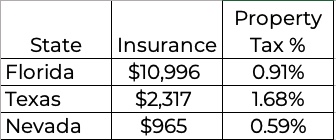
    Operating costs vary tremendously by state. Below is a comparison between Nevada, Texas, and Florida.

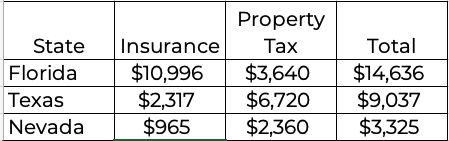
    To put this in perspective, below are the estimated annual operating costs for a $400,000 property.

    Compared to a property in Nevada, properties in other states require additional cash flow to compensate for their higher operating costs.

    • Florida: +$11,311 ($14,636 - $3,325)
    • Texas: +$5,712 ($9,037 - $3,325)

    Summary

    If you only care about initial cash flow, cities with declining populations like Memphis or Cleveland may meet your needs. But if you want lifelong financial independence, these markets cannot provide it, no matter how many properties you own.

    FERNWOOD Team, KW VIP Realty520 Reviews
  • Ian KayPro Member
    Ann Arbor, Ann Arbor · Member since 2024 · 11 posts · 6 votes
    1y
    Quote from @Mike D.:

    TLDR: Your net worth will grow around twice as fast by passively investing in unsexy, low-appreciation markets in the South and Midwest than glitzy, high-appreciation ones in the Sun Belt or on the coasts.

    Dave Meyer and Kathy Fettke weighed in on this (very popular!) topic on today's episode of On The Market: 

    BiggerPockets
  • Investor · Member since 2020 · 11 posts · 6 votes
    1y

    The math here is so simple, I'm shocked so many words have been spilt. Here's the deal:

    Total ROI = Cash Return (CoC) + Leveraged Appreciation (Rate of Appreciation*1/Down Payment %) + Principal Paydown

    Principal Paydown is equivalent on all deals. So ultimately this boils down to one question: do you believe you can accurate predict where home prices will increase fastest in the next x years?

    If YES, then appreciation is VARIABLE in your models -- i.e. Home 1 will appreciate at 3%, whereas Home 2 will appreciate at 6%. That can mean that a low CoC property could yield better overall ROI than a high CoC property, depending on what assumptions you make about appreciation.

    If NO, then a high CoC property obviously outperforms a low CoC property, because you're forced to assume the same rate of appreciation on all homes, everywhere, at all times.

    So: cash flow investors are simply those who believe they cannot accurately predict home price appreciation. I believe they're right about this -- in fact, there is no evidence that anyone can accurately predict home price appreciation. It's pure speculation. Cash flow investors assume that all property values will rise with inflation over time (because that's basically what they've done for the last 100+ years), and if you're able to layer cash flow on top of those gains, you'll come out ahead.

  • Charles ClarkBusiness Member
    Real Estate Broker · Milwaukee, WI · Member since 2020 · 307 posts · 209 votes
    1y

    @Mike D.

    “Great breakdown! The math really shows how ‘boring’ cashflow markets quietly outperform the flashy ones. Passive investors chasing net worth growth should definitely be looking Midwest & South instead of just the hype markets.”

    Raise the Standard RE LLC55 Reviews
    View Page
  • Real Estate Agent · Honolulu, HI · Member since 2015 · 450 posts · 196 votes
    1y

    @Mike D.

    I appreciate you laying out the math so clearly. This is one of those debates where the “right answer” depends a lot on investor goals, constraints, and even personality.

    A few thoughts to add to the mix:

    • Return on equity vs. scalability: Your math shows how low-appreciation/high-yield markets can juice ROE when you stop at “paid down just enough to cashflow.” The flip side is scalability; a $30–40k down payment in Memphis will let you buy more doors quickly, but the management intensity ramps up fast. Not everyone wants to manage 20 roofs instead of 5. That’s why some folks accept thinner ROE in higher-growth markets: fewer assets, potentially bigger swings.

    • Rent growth matters long term: Several folks touched on this; appreciation and rent growth are coupled. A market like Honolulu might look ugly on year 1 cashflow, but over 10–15 years, if rents double, that early negative is washed out and the IRR looks very different.

    • Taxes and depreciation: One wrinkle often missed in these comparisons is how depreciation shields cashflow in high-yield markets versus how appreciation can be harvested tax-deferred via 1031 exchanges, cost seg, or even refinancing. The after-tax net worth picture can flip depending on the investor’s tax strategy.

    • Syndication / passive options: For folks who like the math of low-equity/high-yield markets but don’t want the “20 roofs” problem, one path is to go passive in multifamily syndications. That way you still get exposure to cashflow-heavy markets while letting professional managers handle turnover, maintenance, and scale.

    • Local market dynamics: Living in Hawaii, I see the opposite end of the spectrum daily. Our cashflow here is often terrible, but the long-term appreciation plus scarcity factor has built generational wealth for families that held on. It’s a reminder that each strategy has trade-offs and there’s no one market or formula that’s always right.

    I think your thesis could be a good framework for people who want to optimize short term ROI without touching negative cashflow, but as others pointed out, adding in rent growth and scaling considerations can really change the outcome over 10–20 years.

Join the conversationCreate a free account to reply, vote on answers and follow this thread.