Why markets with low appreciation grow your net worth twice as fast

Why markets with low appreciation grow your net worth twice as fast

Investor · Indianapolis, IN · Member since 2014 · 208 posts · 137 votes

This post is for those who like digging into the details of how their investments work and optimizing their portfolios through math. TLDR: Your net worth will grow around twice as fast by passively investing in unsexy, low-appreciation markets in the South and Midwest than glitzy, high-appreciation ones in the Sun Belt or on the coasts.

The title might seem counterintuitive, but there's a firm basis for this claim. That's right--high-appreciation markets are not the ones to invest in if you want your net worth to grow passively. Your total return, specifically return on equity, is always lower in these markets, and therefore, your net worth grows more slowly. This is true even if the appreciation is eye-popping.

First, high-appreciation markets generally have low cap rates, meaning low cashflow. These are markets like Austin, Phoenix, Nashville. In Austin, for instance, a home purchased for $400k might rent for $2,200 a month. With a 30-year loan at 7%, a typical interest rate today, you'd have to put down around $255k, nearly 65% of the purchase price, to hit roughly $0 cashflow (at these round numbers, it comes out to around -$328). The upside is that if Austin continues appreciating at the same rate as the last decade, around 7% annually, you'll make $28,000 in appreciation and the principal paydown in the first year will be $1,473. That's a total gain of $29,145 on your equity of $255,000 or a total return on equity of 11.4%. Yes, in spite of the seemingly great appreciation rate of 7%, this return doesn't beat stocks by much, if at all. Again, 7% appreciation, total return of 11.4%.

Now, say you're in an unsexy market that lacks this eye-popping appreciation, but offers higher cap rates, meaning higher cashflow. We're talking places like Cleveland and Memphis. In Memphis, a single family home might sell for $150k and rent for $1500 a month. With a 30-year loan at 7%, you would have to pay the loan down to $115k (a down payment of $35k or around 23%) to keep the cashflow positive (it should end up at about $185). Memphis definitely appreciates, too--over the last decade, it actually appreciated as well as Austin, but since it has recently slowed, we'll use a more conservative rate of 4.5%. That makes for $6,750 in appreciation (4.5% of $150,000), principal paydown is $1,168, and the total gain here is $8,103 on equity of $35,000, or 23.2%. Yes, around 23% is a reasonable rate that you can expect your money to grow at in a place like Memphis--even with modest appreciation of 4.5%.

Though the specific figures will change, this pattern will hold true across any combination of high cashflow/low appreciation and low cashflow/high-appreciation markets. There are various things to be said about the merits of both, but for a passive investor interested in growth, the cashflow-intensive markets that don't appreciate as much are better.

I have assumed in these examples that you are not willing to take on negative cashflow. If you have very high income from other sources or very large reserves, you may be able to leverage yourself to the hilt and take on insane negative cashflow to profit from high appreciation. Also, if your goals are not maximum growth, you could think about parking your money in coastal or Sun Belt markets. I have not taken taxes into account--appreciation gains are not taxed until sale--nor volatility, which is greater for appreciation than cashflow. Also, to get the higher returns I've mentioned, you must be invested in more properties total, meaning more work for you or, preferably, your manager--that's what it takes to get this return. I'm sure that there will be quibbles with these numbers--I don't invest in either of these places and am interested in hearing from those who do if there are any small corrections. The point remains: for people looking for maximum passive growth, the less glamorous, low-appreciation, high-cashflow markets are the place to be.

Oh, to show the work:

Austin

Revenue

Annual revenue $26,400 ($2,200 x 12) less 7% vacancy ($1,848) = $24,552

Expenses

Property tax: $7,000 (1.75% of property value--Austin is high!)

Insurance: $2,300

Turns and maintenance: $4,000

Principal and interest on $145,000 (30 year loan at 7%) = $965 monthly/$11,580 annually

Cashflow: -$328

Principal paydown: $1,473

Appreciation (7% of $400,000): $28,000

Return on equity ($29,145/$255,000): 11.4%

Memphis

Revenue

Annual revenue $18,000 ($1,500 x 12) less 7% vacancy ($1,260) = $16,740

Expenses

Property tax: $1,275

Insurance: $1,100

Turns and maintenance: $5,000 (a little higher in Memphis due to rougher tenant base)

Principal and interest on $115,000 (30 year loan at 7%) = $765 monthly/$9,180 annually

Cashflow: $185

Principal paydown: $1,168

Appreciation (4.5% of $150,000): $6,750

Return on equity ($8,103/$35,000): 23.2%

24Reply
903 views

Most Popular Reply

Jay HinrichsBusiness Member
Real Estate Consultant · Summerlin, NV · Member since 2014 · 45k+ posts · 66k+ votes
1y

couple holes in your thesis.

1. I suspect a 400k house in Austin will rent for more than 2500.

2. I suspect a 150k house in Memphis will rent for a tad less than 1500. Also prop taxs could be higher there is double tax in Memphis City and county.

3. Most folks dont buy 400 to 500k SFRs for rentals..

4. 150k home in Memphis is going to have bad debt at some point so your not going to get all that revenue.

Now dont get me wrong I agree on most areas of Texas for out of state owners Prop taxs insurance soil issue exteme weather those are killers on homes.. to me Texans need to buy Texas homes as they dont have any income tax.

See this reply in the discussion

310 Replies

Jump to latestLatest
  • Jay HinrichsBusiness Member
    Real Estate Consultant · Summerlin, NV · Member since 2014 · 45k+ posts · 66k+ votes
    1y

    couple holes in your thesis.

    1. I suspect a 400k house in Austin will rent for more than 2500.

    2. I suspect a 150k house in Memphis will rent for a tad less than 1500. Also prop taxs could be higher there is double tax in Memphis City and county.

    3. Most folks dont buy 400 to 500k SFRs for rentals..

    4. 150k home in Memphis is going to have bad debt at some point so your not going to get all that revenue.

    Now dont get me wrong I agree on most areas of Texas for out of state owners Prop taxs insurance soil issue exteme weather those are killers on homes.. to me Texans need to buy Texas homes as they dont have any income tax.

    • JD MartinBusiness Member
      Moderator
      Rock Star Extraordinaire · Northeast, TN · Member since 2015 · 10k+ posts · 16k+ votes
      1y
      Quote from @Jay Hinrichs:

      couple holes in your thesis.

      1. I suspect a 400k house in Austin will rent for more than 2500.

      2. I suspect a 150k house in Memphis will rent for a tad less than 1500. Also prop taxs could be higher there is double tax in Memphis City and county.

      3. Most folks dont buy 400 to 500k SFRs for rentals..

      4. 150k home in Memphis is going to have bad debt at some point so your not going to get all that revenue.

      Now dont get me wrong I agree on most areas of Texas for out of state owners Prop taxs insurance soil issue exteme weather those are killers on homes.. to me Texans need to buy Texas homes as they dont have any income tax.


       The other hole (though alluded to) is that high cost, high appreciation market homes are almost B class or higher by definition because the incomes required to support the rental base eliminates C and below tenants, ie Section 8, other housing voucher tenants, illegal immigrants, criminal background, drug issues, etc. Even in rough areas lots of people can make $1500 work with 2 or 3 tenants (and I agree with Jay on the figures I think you're talking $1-1200 on a $150k Memphis home) whereas in high cost places everyone has to have a decent paying job. C class and lower housing is *a lot* of work, and a lot of risk, which is why you get better returns all things being equal.

      I get the point of the post and I don't necessarily disagree with the premise but I think the Delta is narrower than the examples and the risk and effort aren't properly credited. 

      Skyline Properties
      View Page
  • Investor · Indianapolis, IN · Member since 2014 · 208 posts · 137 votes
    1y

    Thanks for this information, both. I felt people would doubt this without concrete examples and it's challenging to create them for markets I don't invest in, so like I said I welcome corrections from those who know these markets. I hope the overall point comes through: low cashflow markets will treat you better as a growth-focused passive investor. Plug in markets you know well ,and these types of calculations will consistently show that low cashflow markets come out far ahead.

    • Jay HinrichsBusiness Member
      Real Estate Consultant · Summerlin, NV · Member since 2014 · 45k+ posts · 66k+ votes
      1y
      Quote from @Mike D.:

      Thanks for this information, both. I felt people would doubt this without concrete examples and it's challenging to create them for markets I don't invest in, so like I said I welcome corrections from those who know these markets. I hope the overall point comes through: low cashflow markets will treat you better as a growth-focused passive investor. Plug in markets you know well ,and these types of calculations will consistently show that low cashflow markets come out far ahead.


      your not doing RISK adjustments  cash flow and returns adjust for RISK..
  • Investor · Indianapolis, IN · Member since 2014 · 208 posts · 137 votes
    1y

    I believe that what you're referring to is that cashflow would be somewhat more variable in Memphis. Yes, but it would likely be less variable than the appreciation that you're relying on in a place like Austin, and this would not change the rates of return.

    Or were you referring to something else?

  • Member since 2021 · 39 posts · 29 votes
    1y

    I like the examples you give here! I think there is something to be said for both sides but don’t really understand the recent hate on the forums for cash flow towns. I myself invest in Fayetteville, NC and it has treated me great! 

  • Real Estate Broker · Austin, TX · Member since 2012 · 1k+ posts · 1k+ votes
    1y

    What is the point of such a post? There are millionaire and even billionaire real estate folks in both slow appreciating markets and fast appreciating markets. The post is very over simplified and without references or real data for the argument. Where are the numbers that you posted coming from? What about tax implications of each strategy? I am not even going to talk about the rationale of the so called Memphis rougher tenant base. Idk man.... 

    • Investor · Indianapolis, IN · Member since 2014 · 208 posts · 137 votes
      1y
      Quote from @Aaron Gordy:

      What is the point of such a post? There are millionaire and even billionaire real estate folks in both slow appreciating markets and fast appreciating markets. The post is very over simplified and without references or real data for the argument. Where are the numbers that you posted coming from? What about tax implications of each strategy? I am not even going to talk about the rationale of the so called Memphis rougher tenant base. Idk man.... 

      Yes, you must follow many twists and turns to get to the conclusion, which can be restated as the following: to capture the appreciation in a high-appreciation market without taking on negative cashflow, you must invest so much equity that your return on equity is much lower what it would be in a lower-appreciation market (on the order of half). Sorry if that isn't making sense--the point of the post is to illustrate that higher appreciation markets are not better.
  • Real Estate Broker · Austin, TX · Member since 2012 · 1k+ posts · 1k+ votes
    1y

    @Mike D. I would rather take a $50 cash flow per month with a 7% appreciation than a 250$ cash flow at 2% appreciation any day of the week. In year 2 or 3, in that scenario I can take out equity with zero taxes. If its negative cash flow, then one should consider the expected rent increases as well. 

    Pen to paper

    300k property.

    300k x .07 is 21k with $600 cash flow=21,600

    vs. 

    300k x .02% is 6k with 250x12 is 3k. 9000.

    So are you suggesting that you would rather have 3k of taxable income and 6k equity vs 600$ taxable income for the 1st year only and 21k equity which is future tax free money? I am not considering other tax advantages either such as depreciation or 1031 exchange etc.  

    I do realize that some folks preference is cash flow and that works for them. But as one starts creeping up the income tax brackets then one should really consider the consequences of their long term investment choices. 

    • Investor · Indianapolis, IN · Member since 2014 · 208 posts · 137 votes
      1y
      Quote from @Aaron Gordy:

      @Mike D. I would rather take a $50 cash flow per month with a 7% appreciation than a 250$ cash flow at 2% appreciation any day of the week. In year 2 or 3, in that scenario I can take out equity with zero taxes. If its negative cash flow, then one should consider the expected rent increases as well. 

      Pen to paper

      300k property.

      300k x .07 is 21k with $600 cash flow=21,600

      vs. 

      300k x .02% is 6k with 250x12 is 3k. 9000.

      So are you suggesting that you would rather have 3k of taxable income and 6k equity vs 600$ taxable income for the 1st year only and 21k equity which is future tax free money? I am not considering other tax advantages either such as depreciation or 1031 exchange etc.  

      I do realize that some folks preference is cash flow and that works for them. But as one starts creeping up the income tax brackets then one should really consider the consequences of their long term investment choices. 

      Thank you for bringing that up. This gets directly at the point of the post.

      You gave this example: a $300k property with 7% appreciation, which is $21k, with $6k cashflow, total gain $21,600--or a $300k property with 2% appreciation and $250k cashflow, total gain of $9000, saying you'd prefer the first. The other piece that must be taken into account is the amount you have to invest in these properties to get them to cashflow. Any market with 7% appreciation is going to have a relatively low cap rate, forcing you to put down lots of cash to get slightly positive cashflow. In my example, I used Austin to represent this kind of market. You can go to other markets that might have around 7% appreciation--Phoenix, Nashville--and that will always be the case. You will have to put down a lot of cash to get to the $600 cashflow. On a $300k property it might be around $225k. You can play around in your chosen market with what you feel are reasonable numbers for maintenance, vacancy, revenue, etc., etc., but it will hit somewhere around there. Anyway, I'm going to include the first year's principal buildup of $762 in the profit, so that's a total of $22,362 profit on $225k invested or a 9.9% return.

      If your other option is $3k cashflow and 2% appreciation--and actually these are unrealistically bad numbers, like we are talking a garbage property in the middle of an urban warzone, and I don't think that property would be worth $300k, but anyway we'll use that--you're clearly in a high cap rate market and you could probably get to this cashflow easily with 25% down. Feel free to test that percentage by looking at places like Detroit, Gary, Indiana, etc. 25% of $300k is $75k. Now you are also accumulating much more principal because your loan size is larger, $2,286 in the first year, and adding that to your $6k principal and $3k cashflow you get $11,286 on $75k invested or a 15% return. As I said, this is unrealistically low because anywhere that isn't a total garbage area should be appreciating at least a little better than inflation, so like 3-4%, and that pushes your percent return significantly higher.

      But anyway, accepting the numbers from your example, the question is really this: would you rather invest $225k at 9.9% or $75k at 15%? Or instead of being in whatever garbage market this is at least just go to Cleveland or Memphis or somewhere like that and make 20%+ on your $75k, because these markets do appreciate above inflation.

      And as far as tax treatment, obviously appreciation isn't taxed (until sale, as capital gains) and it becomes complicated to calculate how much additional gain that gives you, given that it depends partly on your tax bracket but I think maybe, along with depreciation, it's a couple extra percent on the side of the high-appreciation market. Of course though, the appreciation is much more volatile, and you also have to take into account the fact that you must maintain more reserves with your cashflow cutting so close to the bone, so I'm not sure there is truly much of an advantage.

      I hope that gives some food for thought.

    • Member since 2025 · 5 posts · 2 votes
      1y
      Quote from @Aaron Gordy:

      @Mike D. I would rather take a $50 cash flow per month with a 7% appreciation than a 250$ cash flow at 2% appreciation any day of the week. In year 2 or 3, in that scenario I can take out equity with zero taxes. If its negative cash flow, then one should consider the expected rent increases as well. 

      Pen to paper

      300k property.

      300k x .07 is 21k with $600 cash flow=21,600

      vs. 

      300k x .02% is 6k with 250x12 is 3k. 9000.

      So are you suggesting that you would rather have 3k of taxable income and 6k equity vs 600$ taxable income for the 1st year only and 21k equity which is future tax free money? I am not considering other tax advantages either such as depreciation or 1031 exchange etc.  

      I do realize that some folks preference is cash flow and that works for them. But as one starts creeping up the income tax brackets then one should really consider the consequences of their long term investment choices. 

      That's just 1 example...

      I make at least twice that per month, per rental. $250 is pretty low IMO.
      The risk isn't worth it at $250. But use $500 or 1k and rerun the numbers.
  • Seth McGatheyBusiness Member
    Real Estate Agent · Milwaukee WI · Member since 2024 · 320 posts · 253 votes
    1y

    I think the back and forth in this is because I think your premise is right but your conclusion is stated in a misleading way. 

    You have stated that low appreciation/high cashflow is better than high appreciation/low cashflow. But I think what you are actually showing is that lower upfront investment is better than high upfront investment if your goal is cash on cash return. And having a high cash on cash return is your best option for growth. I also would agree that low appreciation areas are easier to put less down, and so they often can allow faster overall portfolio growth and faster stabilization times. 

    Thanks for an interesting and stimulating post! 

    Seth McGathey - Shorewest Realtor4.912 Reviews
    • Investor · Indianapolis, IN · Member since 2014 · 208 posts · 137 votes
      1y
      Quote from @Seth McGathey:

      I think the back and forth in this is because I think your premise is right but your conclusion is stated in a misleading way. 

      You have stated that low appreciation/high cashflow is better than high appreciation/low cashflow. But I think what you are actually showing is that lower upfront investment is better than high upfront investment if your goal is cash on cash return. And having a high cash on cash return is your best option for growth. I also would agree that low appreciation areas are easier to put less down, and so they often can allow faster overall portfolio growth and faster stabilization times. 

      Thanks for an interesting and stimulating post! 


      Thanks, Seth, even if you didn't agree fully with it I'm glad that it was interesting and stimulating.

      About those points you made, I'm not really saying that lower upfront investment is always better. A low upfront investment in a high-appreciation market will give a negative cash on cash return. Technically, if you were only taking your percent return into account, and nothing else, you could put down the tiniest possible amount on the highest-appreciating market and that would get you a higher gain than anything. But the amount of negative cashflow you'd take on would be unacceptable for most people, and in addition your gain would be very volatile because it would rely almost completely on appreciation. If I were an institution with unlimited credit to fill in for the negative cashflow, I'd totally do that, but as a person who can go bankrupt, etc., no. 

      So yeah, putting down a lower upfront investment always gives a higher gain, but normal people can only really afford to do it in a low-appreciation, high-cashflow market, so that's the other part of my thesis: make a low upfront investment in a market that will allow you to do it because it has excellent cashflow (meaning low appreciation).

      Fully on board with this: low appreciation areas are easier to put less down, and to they can allow faster overall portfolio growth and faster stabilization times. That's essentially another way of saying what I'm saying so I think we're coming around to the same point!

      Thanks for the response.

  • Ned CareyPro Member
    Moderator
    Investor · Baltimore, MD · Member since 2008 · 17k+ posts · 13k+ votes
    1y

    @Mike D.  

    I love your contrarian thinking but I also think there is more to it.

    I think you are making too many assumptions and leaving out to many variables. What about market cycles? Where is each market in their cycle? Which investor is buying what property in what part of the cycle? How about the quality of the deal? I see investors buying deals that simply don't make sense. Are you comparing equivalent quality deals? 

    I often see an analysis based on averages or median price or income, but good investors don't buy average deals. I never pay market price. At most times in most market, market price is simply not a good investment. 

  • Member since 2025 · 3 posts · 8 votes
    1y

    Having owned both “cash flow” and “high appreciation” properties, this thesis has been the exact opposite of my experience in real life. 

  • Dan H.Pro Member
    Investor · Poway, CA · Member since 2015 · 7k+ posts · 8k+ votes
    1y

    Case Shiller used to publish a list with total residential return for this century.  The top of the list was all high appreciation markets.   The bottom of the list was comprised of high initial cash flow properties.   What the list showed was a strong correlation between appreciation and cash flow over a long hold.   The list showed a poor correlation between long term cash flow and initial cash flow.

    I invite you to run your numbers at 80% LTV using that extra down payment to deal with any initial negative cash flow. Use the appreciation and rent growth for this century on each city. Basically the case shiller data without the effort of determining local property tax, maintenance, PM rates, etc..

    In have been investing in my San Diego market for many years. I have purchased with poor timing and great timing.  My worse appreciating property has appreciated $2700/month over its hold ($47k down and closing).  My best appreciating properties have appreciated over $10k/month over their hold.  I suspect that virtually all residential RE in my market will have numbers between my best and worse case.

    Knowing the San Diego appreciation rate (almost 6%/year for this century per neighborhoodscout) how do you think the rent growth has been?

    With time the market with the higher rent growth will always have higher cash flow than the higher initial cash flow market that has lower rent growth.  It is basic math,

    So the high appreciation market has historically produced both better appreciation numbers and better long term cash flow than the low value markets.  This is easy to verify and I believe most experienced investors ecognize this. I recognize past history is not necessarily an indicator of future performance but the metrics on my San Diego market still look promising.

    My view is the low cost markets are best served by local RE investors who know the nuances of the area.

    Best wishes

    • Investor · Indianapolis, IN · Member since 2014 · 208 posts · 137 votes
      1y
      Quote from @Dan H.:

      Case Shiller used to publish a list with total residential return for this century.  The top of the list was all high appreciation markets.   The bottom of the list was comprised of high initial cash flow properties.   What the list showed was a strong correlation between appreciation and cash flow over a long hold.   The list showed a poor correlation between long term cash flow and initial cash flow.

      I invite you to run your numbers at 80% LTV using that extra down payment to deal with any initial negative cash flow. Use the appreciation and rent growth for this century on each city. Basically the case shiller data without the effort of determining local property tax, maintenance, PM rates, etc..

      In have been investing in my San Diego market for many years. I have purchased with poor timing and great timing.  My worse appreciating property has appreciated $2700/month over its hold ($47k down and closing).  My best appreciating properties have appreciated over $10k/month over their hold.  I suspect that virtually all residential RE in my market will have numbers between my best and worse case.

      Knowing the San Diego appreciation rate (almost 6%/year for this century per neighborhoodscout) how do you think the rent growth has been?

      With time the market with the higher rent growth will always have higher cash flow than the higher initial cash flow market that has lower rent growth.  It is basic math,

      So the high appreciation market has historically produced both better appreciation numbers and better long term cash flow than the low value markets.  This is easy to verify and I believe most experienced investors ecognize this. I recognize past history is not necessarily an indicator of future performance but the metrics on my San Diego market still look promising.

      My view is the low cost markets are best served by local RE investors who know the nuances of the area.

      Best wishes

      Dan and I have had some exchanges in the past about this and I have no doubt he has carefully thought through what he is doing and has some strategies that work well. To be really honest, I don't think this is one. His forceful objections to almost every aspect of what I'm doing have also helped me think through things and grow. So here is a contribution back:

      Okay, running the numbers at 80% LTV sounds interesting. If you do it for Austin, leaving all the other numbers from the initial example the same, you'd have a $2129 monthly payment on a 30 year loan with 7% interest, so -$14,296 negative cashflow. Since you are capturing the full appreciation on the property with a lower down payment, $80k, and since you now have larger principal paydown ($3251 in the first year), your return is now: cashflow -$14,296, principal paydown $3251, appreciation $28,000 = $16,955/$80,000 = 21.2% return. So far it looks good. So far.

      And yes, you could now stick a very large amount of money in reserves to deal with the negative cashflow. Not sure what kind of rent growth you're proposing but let's say 5%. I used a spreadsheet that I had whipped up previously to figure out how much total you're going to need in reserves before the property starts cashflowing and was surprised to find that it still wouldn't be cashflowing after 20 years (!) and over those 20 years it would incur negative cashflow of more than $217k. The rest of the down payment you were going to put away in my example is only $145k, but that money grows at some kind of rate over the years so I suppose it would end up being enough to make up for all the negative cashflow this property would ever incur.

      Even so, several large issues:
      - The opportunity cost on the $145k is major. Since this is your reserve fund, you definitely have to keep it invested in something safe which will probably barely beat inflation. Let's be generous and say you make 5% on it. So, dealing only with the first  year of doing this, you make $16,955 from the house and $7,250 from your reserves, or a total gain of $24,205 on a total investment of $225,000 or 10.8% return. Again, that's making several generous assumptions, and the return continues dropping year over year, which leads to the second problem.
      - By the time your cashflow is inching closer to $0, your return on equity is bad, like below 10%.
      - You are burdening yourself with negative cashflow for years when you could be in a different market with a higher return making cashflow which you can actually use to go to the grocery store and eat.
      - Returns from appreciation are more volatile than cashflow in general and after going through this torture for years it is possible you could see very little payoff.

      So, I don't see why someone would do this. I don't have access to the Case Shiller data you mentioned so I made some other assumptions that might be different. I'd also be interested in hearing if I misinterpreted something about what your idea was.

      I agree with the thesis that high appreciation markets will eventually produce "better" (at least higher) long term cashflow because rent grows faster as well, but it takes a very long time and comes at the cost of low return on equity, to the point that you'd be better off selling out and going into other investments such as a stock/bond portfolio. You also have to consider the opportunity cost in the years when you're waiting for the cashflow to materialize.
    • Dan H.Pro Member
      Investor · Poway, CA · Member since 2015 · 7k+ posts · 8k+ votes
      1y
      Quote from @Mike D.:
      Quote from @Dan H.:

      Case Shiller used to publish a list with total residential return for this century.  The top of the list was all high appreciation markets.   The bottom of the list was comprised of high initial cash flow properties.   What the list showed was a strong correlation between appreciation and cash flow over a long hold.   The list showed a poor correlation between long term cash flow and initial cash flow.

      I invite you to run your numbers at 80% LTV using that extra down payment to deal with any initial negative cash flow. Use the appreciation and rent growth for this century on each city. Basically the case shiller data without the effort of determining local property tax, maintenance, PM rates, etc..

      In have been investing in my San Diego market for many years. I have purchased with poor timing and great timing.  My worse appreciating property has appreciated $2700/month over its hold ($47k down and closing).  My best appreciating properties have appreciated over $10k/month over their hold.  I suspect that virtually all residential RE in my market will have numbers between my best and worse case.

      Knowing the San Diego appreciation rate (almost 6%/year for this century per neighborhoodscout) how do you think the rent growth has been?

      With time the market with the higher rent growth will always have higher cash flow than the higher initial cash flow market that has lower rent growth.  It is basic math,

      So the high appreciation market has historically produced both better appreciation numbers and better long term cash flow than the low value markets.  This is easy to verify and I believe most experienced investors ecognize this. I recognize past history is not necessarily an indicator of future performance but the metrics on my San Diego market still look promising.

      My view is the low cost markets are best served by local RE investors who know the nuances of the area.

      Best wishes

      Dan and I have had some exchanges in the past about this and I have no doubt he has carefully thought through what he is doing and has some strategies that work well. To be really honest, I don't think this is one. His forceful objections to almost every aspect of what I'm doing have also helped me think through things and grow. So here is a contribution back:

      Okay, running the numbers at 80% LTV sounds interesting. If you do it for Austin, leaving all the other numbers from the initial example the same, you'd have a $2129 monthly payment on a 30 year loan with 7% interest, so -$14,296 negative cashflow. Since you are capturing the full appreciation on the property with a lower down payment, $80k, and since you now have larger principal paydown ($3251 in the first year), your return is now: cashflow -$14,296, principal paydown $3251, appreciation $28,000 = $16,955/$80,000 = 21.2% return. So far it looks good. So far.

      And yes, you could now stick a very large amount of money in reserves to deal with the negative cashflow. Not sure what kind of rent growth you're proposing but let's say 5%. I used a spreadsheet that I had whipped up previously to figure out how much total you're going to need in reserves before the property starts cashflowing and was surprised to find that it still wouldn't be cashflowing after 20 years (!) and over those 20 years it would incur negative cashflow of more than $217k. The rest of the down payment you were going to put away in my example is only $145k, but that money grows at some kind of rate over the years so I suppose it would end up being enough to make up for all the negative cashflow this property would ever incur.

      Even so, several large issues:
      - The opportunity cost on the $145k is major. Since this is your reserve fund, you definitely have to keep it invested in something safe which will probably barely beat inflation. Let's be generous and say you make 5% on it. So, dealing only with the first  year of doing this, you make $16,955 from the house and $7,250 from your reserves, or a total gain of $24,205 on a total investment of $225,000 or 10.8% return. Again, that's making several generous assumptions, and the return continues dropping year over year, which leads to the second problem.
      - By the time your cashflow is inching closer to $0, your return on equity is bad, like below 10%.
      - You are burdening yourself with negative cashflow for years when you could be in a different market with a higher return making cashflow which you can actually use to go to the grocery store and eat.
      - Returns from appreciation are more volatile than cashflow in general and after going through this torture for years it is possible you could see very little payoff.

      So, I don't see why someone would do this. I don't have access to the Case Shiller data you mentioned so I made some other assumptions that might be different. I'd also be interested in hearing if I misinterpreted something about what your idea was.

      I agree with the thesis that high appreciation markets will eventually produce "better" (at least higher) long term cashflow because rent grows faster as well, but it takes a very long time and comes at the cost of low return on equity, to the point that you'd be better off selling out and going into other investments such as a stock/bond portfolio. You also have to consider the opportunity cost in the years when you're waiting for the cashflow to materialize.

      I do not know if you switched numbers from your OP or if your calculation on time span to positive cash flow is off.

      You show a negative $328/month on $2200 rent.

      Without compounding (with compounding it would be better and take less time to achieve positive cash flow) using your rent growth percentage

      1.05 ** years * $2200 - $2200 is the rent

      at 5 years

      1.05 ** 5 * $2200 - $2200 = $607.82 which is likely enough greater $328 to compensate for expenses other than P&i having risen (basically inflation on the non fixed costs).

      >Since this is your reserve fund, you definitely have to keep it invested in something safe which will probably barely beat inflation. Let's be generous and say you make 5% on it. So, dealing only with the first year of doing this, you make $16,955 from the house and $7,250 from your reserves, or a total gain of $24,205 on a total investment of $225,000 or 10.8% return. Again, that's making several generous assumptions, and the return continues dropping year over year, which leads to the second problem.

      There are many ways to manage risk.   I believe high diversification reduces risk.  I think only a very conservative investor would have more than a year of safe, liquid reserves (money market, etc).   So your reserve scenario does not match most investor’s approach.  I do agree that the reserves should not all be in one asset class; that is too risky.   But an investor has a year or so liquid and substantial other investment in other classes besides RE, they have a more robust plan than someone relying solely on cash flow.

      >By the time your cashflow is inching closer to $0, your return on equity is bad, like below 10%.

      what ends up typically occurring is money is extracted before is gets to a 50% LTV to leverage the capital elsewhere reverting the cash flow. I virtually always have used 30 year fixed loans once stabilized for their safety but I have yet to hold a loan 10 years. With the rate increases that started q2 2022, there is a chance that I will finally hold one of these loans over 10 years.

      My worse appreciating property has appreciated $2700/month over its hold.  It never had negative cash flow but even if it did, it could not impact the return significantly.   I purchased for $47k out of pocket including closing costs.  My best appreciating properties have appreciated over $10k/month over their hold.   One of these did have initial negative cash flow at purchase (quite large negative cash flow), but in less than 3 years it had positive cash flow.  The negative cash flow was always inconsequential compared to the value increase.

      I do believe the low cost markets are appropriate for local investors.   Long distance investors should seek higher quality assets.

      Good luck

    • Dan H.Pro Member
      Investor · Poway, CA · Member since 2015 · 7k+ posts · 8k+ votes
      1y
      Quote from @Mike D.:
      Quote from @Dan H.:

      Case Shiller used to publish a list with total residential return for this century.  The top of the list was all high appreciation markets.   The bottom of the list was comprised of high initial cash flow properties.   What the list showed was a strong correlation between appreciation and cash flow over a long hold.   The list showed a poor correlation between long term cash flow and initial cash flow.

      I invite you to run your numbers at 80% LTV using that extra down payment to deal with any initial negative cash flow. Use the appreciation and rent growth for this century on each city. Basically the case shiller data without the effort of determining local property tax, maintenance, PM rates, etc..

      In have been investing in my San Diego market for many years. I have purchased with poor timing and great timing.  My worse appreciating property has appreciated $2700/month over its hold ($47k down and closing).  My best appreciating properties have appreciated over $10k/month over their hold.  I suspect that virtually all residential RE in my market will have numbers between my best and worse case.

      Knowing the San Diego appreciation rate (almost 6%/year for this century per neighborhoodscout) how do you think the rent growth has been?

      With time the market with the higher rent growth will always have higher cash flow than the higher initial cash flow market that has lower rent growth.  It is basic math,

      So the high appreciation market has historically produced both better appreciation numbers and better long term cash flow than the low value markets.  This is easy to verify and I believe most experienced investors ecognize this. I recognize past history is not necessarily an indicator of future performance but the metrics on my San Diego market still look promising.

      My view is the low cost markets are best served by local RE investors who know the nuances of the area.

      Best wishes

      Dan and I have had some exchanges in the past about this and I have no doubt he has carefully thought through what he is doing and has some strategies that work well. To be really honest, I don't think this is one. His forceful objections to almost every aspect of what I'm doing have also helped me think through things and grow. So here is a contribution back:

      Okay, running the numbers at 80% LTV sounds interesting. If you do it for Austin, leaving all the other numbers from the initial example the same, you'd have a $2129 monthly payment on a 30 year loan with 7% interest, so -$14,296 negative cashflow. Since you are capturing the full appreciation on the property with a lower down payment, $80k, and since you now have larger principal paydown ($3251 in the first year), your return is now: cashflow -$14,296, principal paydown $3251, appreciation $28,000 = $16,955/$80,000 = 21.2% return. So far it looks good. So far.

      And yes, you could now stick a very large amount of money in reserves to deal with the negative cashflow. Not sure what kind of rent growth you're proposing but let's say 5%. I used a spreadsheet that I had whipped up previously to figure out how much total you're going to need in reserves before the property starts cashflowing and was surprised to find that it still wouldn't be cashflowing after 20 years (!) and over those 20 years it would incur negative cashflow of more than $217k. The rest of the down payment you were going to put away in my example is only $145k, but that money grows at some kind of rate over the years so I suppose it would end up being enough to make up for all the negative cashflow this property would ever incur.

      Even so, several large issues:
      - The opportunity cost on the $145k is major. Since this is your reserve fund, you definitely have to keep it invested in something safe which will probably barely beat inflation. Let's be generous and say you make 5% on it. So, dealing only with the first  year of doing this, you make $16,955 from the house and $7,250 from your reserves, or a total gain of $24,205 on a total investment of $225,000 or 10.8% return. Again, that's making several generous assumptions, and the return continues dropping year over year, which leads to the second problem.
      - By the time your cashflow is inching closer to $0, your return on equity is bad, like below 10%.
      - You are burdening yourself with negative cashflow for years when you could be in a different market with a higher return making cashflow which you can actually use to go to the grocery store and eat.
      - Returns from appreciation are more volatile than cashflow in general and after going through this torture for years it is possible you could see very little payoff.

      So, I don't see why someone would do this. I don't have access to the Case Shiller data you mentioned so I made some other assumptions that might be different. I'd also be interested in hearing if I misinterpreted something about what your idea was.

      I agree with the thesis that high appreciation markets will eventually produce "better" (at least higher) long term cashflow because rent grows faster as well, but it takes a very long time and comes at the cost of low return on equity, to the point that you'd be better off selling out and going into other investments such as a stock/bond portfolio. You also have to consider the opportunity cost in the years when you're waiting for the cashflow to materialize.

      I do not know if you switched numbers from your OP or if your calculation on time span to positive cash flow is off.

      You show a negative $328/month on $2200 rent.

      Without compounding (with compounding it would be better and take less time to achieve positive cash flow) using your rent growth percentage

      1.05 ** years * $2200 - $2200 is the rent

      at 5 years

      1.05 ** 5 * $2200 - $2200 = $607.82 which is likely enough greater $328 to compensate for expenses other than P&i having risen (basically inflation on the non fixed costs).

      >Since this is your reserve fund, you definitely have to keep it invested in something safe which will probably barely beat inflation. Let's be generous and say you make 5% on it. So, dealing only with the first year of doing this, you make $16,955 from the house and $7,250 from your reserves, or a total gain of $24,205 on a total investment of $225,000 or 10.8% return. Again, that's making several generous assumptions, and the return continues dropping year over year, which leads to the second problem.

      There are many ways to manage risk.   I believe high diversification reduces risk.  I think only a very conservative investor would have more than a year of safe, liquid reserves (money market, etc).   So your reserve scenario does not match most investor’s approach.  I do agree that the reserves should not all be in one asset class; that is too risky.   But an investor has a year or so liquid and substantial other investment in other classes besides RE, they have a more robust plan than someone relying solely on cash flow.

      >By the time your cashflow is inching closer to $0, your return on equity is bad, like below 10%.

      what ends up typically occurring is money is extracted before is gets to a 50% LTV to leverage the capital elsewhere reverting the cash flow. I virtually always have used 30 year fixed loans once stabilized for their safety but I have yet to hold a loan 10 years. With the rate increases that started q2 2022, there is a chance that I will finally hold one of these loans over 10 years.

      My worse appreciating property has appreciated $2700/month over its hold.  It never had negative cash flow but even if it did, it could not impact the return significantly.   I purchased for $47k out of pocket including closing costs.  My best appreciating properties have appreciated over $10k/month over their hold.   One of these did have initial negative cash flow at purchase (quite large negative cash flow), but in less than 3 years it had positive cash flow.  The negative cash flow was always inconsequential compared to the value increase.

      I do believe the low cost markets are appropriate for local investors.   Long distance investors should seek higher quality assets.

      Good luck

    • Investor · Indianapolis, IN · Member since 2014 · 208 posts · 137 votes
      1y
      Quote from @Dan H.:
      Quote from @Mike D.:
      Quote from @Dan H.:

      Case Shiller used to publish a list with total residential return for this century.  The top of the list was all high appreciation markets.   The bottom of the list was comprised of high initial cash flow properties.   What the list showed was a strong correlation between appreciation and cash flow over a long hold.   The list showed a poor correlation between long term cash flow and initial cash flow.

      I invite you to run your numbers at 80% LTV using that extra down payment to deal with any initial negative cash flow. Use the appreciation and rent growth for this century on each city. Basically the case shiller data without the effort of determining local property tax, maintenance, PM rates, etc..

      In have been investing in my San Diego market for many years. I have purchased with poor timing and great timing.  My worse appreciating property has appreciated $2700/month over its hold ($47k down and closing).  My best appreciating properties have appreciated over $10k/month over their hold.  I suspect that virtually all residential RE in my market will have numbers between my best and worse case.

      Knowing the San Diego appreciation rate (almost 6%/year for this century per neighborhoodscout) how do you think the rent growth has been?

      With time the market with the higher rent growth will always have higher cash flow than the higher initial cash flow market that has lower rent growth.  It is basic math,

      So the high appreciation market has historically produced both better appreciation numbers and better long term cash flow than the low value markets.  This is easy to verify and I believe most experienced investors ecognize this. I recognize past history is not necessarily an indicator of future performance but the metrics on my San Diego market still look promising.

      My view is the low cost markets are best served by local RE investors who know the nuances of the area.

      Best wishes

      Dan and I have had some exchanges in the past about this and I have no doubt he has carefully thought through what he is doing and has some strategies that work well. To be really honest, I don't think this is one. His forceful objections to almost every aspect of what I'm doing have also helped me think through things and grow. So here is a contribution back:

      Okay, running the numbers at 80% LTV sounds interesting. If you do it for Austin, leaving all the other numbers from the initial example the same, you'd have a $2129 monthly payment on a 30 year loan with 7% interest, so -$14,296 negative cashflow. Since you are capturing the full appreciation on the property with a lower down payment, $80k, and since you now have larger principal paydown ($3251 in the first year), your return is now: cashflow -$14,296, principal paydown $3251, appreciation $28,000 = $16,955/$80,000 = 21.2% return. So far it looks good. So far.

      And yes, you could now stick a very large amount of money in reserves to deal with the negative cashflow. Not sure what kind of rent growth you're proposing but let's say 5%. I used a spreadsheet that I had whipped up previously to figure out how much total you're going to need in reserves before the property starts cashflowing and was surprised to find that it still wouldn't be cashflowing after 20 years (!) and over those 20 years it would incur negative cashflow of more than $217k. The rest of the down payment you were going to put away in my example is only $145k, but that money grows at some kind of rate over the years so I suppose it would end up being enough to make up for all the negative cashflow this property would ever incur.

      Even so, several large issues:
      - The opportunity cost on the $145k is major. Since this is your reserve fund, you definitely have to keep it invested in something safe which will probably barely beat inflation. Let's be generous and say you make 5% on it. So, dealing only with the first  year of doing this, you make $16,955 from the house and $7,250 from your reserves, or a total gain of $24,205 on a total investment of $225,000 or 10.8% return. Again, that's making several generous assumptions, and the return continues dropping year over year, which leads to the second problem.
      - By the time your cashflow is inching closer to $0, your return on equity is bad, like below 10%.
      - You are burdening yourself with negative cashflow for years when you could be in a different market with a higher return making cashflow which you can actually use to go to the grocery store and eat.
      - Returns from appreciation are more volatile than cashflow in general and after going through this torture for years it is possible you could see very little payoff.

      So, I don't see why someone would do this. I don't have access to the Case Shiller data you mentioned so I made some other assumptions that might be different. I'd also be interested in hearing if I misinterpreted something about what your idea was.

      I agree with the thesis that high appreciation markets will eventually produce "better" (at least higher) long term cashflow because rent grows faster as well, but it takes a very long time and comes at the cost of low return on equity, to the point that you'd be better off selling out and going into other investments such as a stock/bond portfolio. You also have to consider the opportunity cost in the years when you're waiting for the cashflow to materialize.

      I do not know if you switched numbers from your OP or if your calculation on time span to positive cash flow is off.

      You show a negative $328/month on $2200 rent.

      Without compounding (with compounding it would be better and take less time to achieve positive cash flow) using your rent growth percentage

      1.05 ** years * $2200 - $2200 is the rent

      at 5 years

      1.05 ** 5 * $2200 - $2200 = $607.82 which is likely enough greater $328 to compensate for expenses other than P&i having risen (basically inflation on the non fixed costs).

      >Since this is your reserve fund, you definitely have to keep it invested in something safe which will probably barely beat inflation. Let's be generous and say you make 5% on it. So, dealing only with the first year of doing this, you make $16,955 from the house and $7,250 from your reserves, or a total gain of $24,205 on a total investment of $225,000 or 10.8% return. Again, that's making several generous assumptions, and the return continues dropping year over year, which leads to the second problem.

      There are many ways to manage risk.   I believe high diversification reduces risk.  I think only a very conservative investor would have more than a year of safe, liquid reserves (money market, etc).   So your reserve scenario does not match most investor’s approach.  I do agree that the reserves should not all be in one asset class; that is too risky.   But an investor has a year or so liquid and substantial other investment in other classes besides RE, they have a more robust plan than someone relying solely on cash flow.

      >By the time your cashflow is inching closer to $0, your return on equity is bad, like below 10%.

      what ends up typically occurring is money is extracted before is gets to a 50% LTV to leverage the capital elsewhere reverting the cash flow. I virtually always have used 30 year fixed loans once stabilized for their safety but I have yet to hold a loan 10 years. With the rate increases that started q2 2022, there is a chance that I will finally hold one of these loans over 10 years.

      My worse appreciating property has appreciated $2700/month over its hold.  It never had negative cash flow but even if it did, it could not impact the return significantly.   I purchased for $47k out of pocket including closing costs.  My best appreciating properties have appreciated over $10k/month over their hold.   One of these did have initial negative cash flow at purchase (quite large negative cash flow), but in less than 3 years it had positive cash flow.  The negative cash flow was always inconsequential compared to the value increase.

      I do believe the low cost markets are appropriate for local investors.   Long distance investors should seek higher quality assets.

      Good luck


      Hey Dan, so when you say the cashflow goes positive in the fifth year, something is off there. You must not be using the new P+I for 80% LTV--it's $2129 and there's more than $14k negative cashflow in the first year. So, an extra $608 a month doesn't come close to smoothing that out. Some wires got crossed somewhere.

      It seems that a sophisticated, very wealthy operator could possibly implement your strategy--say they had some stream of cash from something else that they didn't need and could funnel into this, removing the need to keep reserves--but for the average person, even the average millionaire, it would be insane. You suggested keeping reserves, but I suspect that if you yourself use this strategy you are doing something different.

      I guess I should have said my strategy is not for billionaires!

    • Dan H.Pro Member
      Investor · Poway, CA · Member since 2015 · 7k+ posts · 8k+ votes
      1y
      Quote from @Mike D.:
      Quote from @Dan H.:
      Quote from @Mike D.:
      Quote from @Dan H.:

      Case Shiller used to publish a list with total residential return for this century.  The top of the list was all high appreciation markets.   The bottom of the list was comprised of high initial cash flow properties.   What the list showed was a strong correlation between appreciation and cash flow over a long hold.   The list showed a poor correlation between long term cash flow and initial cash flow.

      I invite you to run your numbers at 80% LTV using that extra down payment to deal with any initial negative cash flow. Use the appreciation and rent growth for this century on each city. Basically the case shiller data without the effort of determining local property tax, maintenance, PM rates, etc..

      In have been investing in my San Diego market for many years. I have purchased with poor timing and great timing.  My worse appreciating property has appreciated $2700/month over its hold ($47k down and closing).  My best appreciating properties have appreciated over $10k/month over their hold.  I suspect that virtually all residential RE in my market will have numbers between my best and worse case.

      Knowing the San Diego appreciation rate (almost 6%/year for this century per neighborhoodscout) how do you think the rent growth has been?

      With time the market with the higher rent growth will always have higher cash flow than the higher initial cash flow market that has lower rent growth.  It is basic math,

      So the high appreciation market has historically produced both better appreciation numbers and better long term cash flow than the low value markets.  This is easy to verify and I believe most experienced investors ecognize this. I recognize past history is not necessarily an indicator of future performance but the metrics on my San Diego market still look promising.

      My view is the low cost markets are best served by local RE investors who know the nuances of the area.

      Best wishes

      Dan and I have had some exchanges in the past about this and I have no doubt he has carefully thought through what he is doing and has some strategies that work well. To be really honest, I don't think this is one. His forceful objections to almost every aspect of what I'm doing have also helped me think through things and grow. So here is a contribution back:

      Okay, running the numbers at 80% LTV sounds interesting. If you do it for Austin, leaving all the other numbers from the initial example the same, you'd have a $2129 monthly payment on a 30 year loan with 7% interest, so -$14,296 negative cashflow. Since you are capturing the full appreciation on the property with a lower down payment, $80k, and since you now have larger principal paydown ($3251 in the first year), your return is now: cashflow -$14,296, principal paydown $3251, appreciation $28,000 = $16,955/$80,000 = 21.2% return. So far it looks good. So far.

      And yes, you could now stick a very large amount of money in reserves to deal with the negative cashflow. Not sure what kind of rent growth you're proposing but let's say 5%. I used a spreadsheet that I had whipped up previously to figure out how much total you're going to need in reserves before the property starts cashflowing and was surprised to find that it still wouldn't be cashflowing after 20 years (!) and over those 20 years it would incur negative cashflow of more than $217k. The rest of the down payment you were going to put away in my example is only $145k, but that money grows at some kind of rate over the years so I suppose it would end up being enough to make up for all the negative cashflow this property would ever incur.

      Even so, several large issues:
      - The opportunity cost on the $145k is major. Since this is your reserve fund, you definitely have to keep it invested in something safe which will probably barely beat inflation. Let's be generous and say you make 5% on it. So, dealing only with the first  year of doing this, you make $16,955 from the house and $7,250 from your reserves, or a total gain of $24,205 on a total investment of $225,000 or 10.8% return. Again, that's making several generous assumptions, and the return continues dropping year over year, which leads to the second problem.
      - By the time your cashflow is inching closer to $0, your return on equity is bad, like below 10%.
      - You are burdening yourself with negative cashflow for years when you could be in a different market with a higher return making cashflow which you can actually use to go to the grocery store and eat.
      - Returns from appreciation are more volatile than cashflow in general and after going through this torture for years it is possible you could see very little payoff.

      So, I don't see why someone would do this. I don't have access to the Case Shiller data you mentioned so I made some other assumptions that might be different. I'd also be interested in hearing if I misinterpreted something about what your idea was.

      I agree with the thesis that high appreciation markets will eventually produce "better" (at least higher) long term cashflow because rent grows faster as well, but it takes a very long time and comes at the cost of low return on equity, to the point that you'd be better off selling out and going into other investments such as a stock/bond portfolio. You also have to consider the opportunity cost in the years when you're waiting for the cashflow to materialize.

      I do not know if you switched numbers from your OP or if your calculation on time span to positive cash flow is off.

      You show a negative $328/month on $2200 rent.

      Without compounding (with compounding it would be better and take less time to achieve positive cash flow) using your rent growth percentage

      1.05 ** years * $2200 - $2200 is the rent

      at 5 years

      1.05 ** 5 * $2200 - $2200 = $607.82 which is likely enough greater $328 to compensate for expenses other than P&i having risen (basically inflation on the non fixed costs).

      >Since this is your reserve fund, you definitely have to keep it invested in something safe which will probably barely beat inflation. Let's be generous and say you make 5% on it. So, dealing only with the first year of doing this, you make $16,955 from the house and $7,250 from your reserves, or a total gain of $24,205 on a total investment of $225,000 or 10.8% return. Again, that's making several generous assumptions, and the return continues dropping year over year, which leads to the second problem.

      There are many ways to manage risk.   I believe high diversification reduces risk.  I think only a very conservative investor would have more than a year of safe, liquid reserves (money market, etc).   So your reserve scenario does not match most investor’s approach.  I do agree that the reserves should not all be in one asset class; that is too risky.   But an investor has a year or so liquid and substantial other investment in other classes besides RE, they have a more robust plan than someone relying solely on cash flow.

      >By the time your cashflow is inching closer to $0, your return on equity is bad, like below 10%.

      what ends up typically occurring is money is extracted before is gets to a 50% LTV to leverage the capital elsewhere reverting the cash flow. I virtually always have used 30 year fixed loans once stabilized for their safety but I have yet to hold a loan 10 years. With the rate increases that started q2 2022, there is a chance that I will finally hold one of these loans over 10 years.

      My worse appreciating property has appreciated $2700/month over its hold.  It never had negative cash flow but even if it did, it could not impact the return significantly.   I purchased for $47k out of pocket including closing costs.  My best appreciating properties have appreciated over $10k/month over their hold.   One of these did have initial negative cash flow at purchase (quite large negative cash flow), but in less than 3 years it had positive cash flow.  The negative cash flow was always inconsequential compared to the value increase.

      I do believe the low cost markets are appropriate for local investors.   Long distance investors should seek higher quality assets.

      Good luck


      Hey Dan, so when you say the cashflow goes positive in the fifth year, something is off there. You must not be using the new P+I for 80% LTV--it's $2129 and there's more than $14k negative cashflow in the first year. So, an extra $608 a month doesn't come close to smoothing that out. Some wires got crossed somewhere.

      It seems that a sophisticated, very wealthy operator could possibly implement your strategy--say they had some stream of cash from something else that they didn't need and could funnel into this, removing the need to keep reserves--but for the average person, even the average millionaire, it would be insane. You suggested keeping reserves, but I suspect that if you yourself use this strategy you are doing something different.

      I guess I should have said my strategy is not for billionaires!

       >Some wires got crossed somewhere.


      possibly.  In the original post you indicated -$328 cash flow under Austin.  Was this not correct?  Was it a subset of the cash flow?   Maybe there was a typo.  It is the number I used.

      In San Diego it is common to see projected rent to selling price ratios of ~0.5%. However, these are not typically what is being purchased by investors or if they are it is because they plan on doing a rehab and significantly raising the rent (a value add). The purchases that have those ratios without the value add and a projected rent increase are virtually all OO purchases. I suspect this is the case in virtually all lower cash flow markets. I have never purchased in my market without at least a projected 0.7% stabilized monthly rent ratio, including the cost of value add in the property cost. Since the rates increase, my underwriting shows 0.7% ratio is cash flow negative at high LTV in my market (while being far superior to the rent ratios that would occur on OO purchases).

      I question if your large negative cash flow is mostly derived using stats that include OO purchases. I know if this was done on my San Diego market, it would depict a far worse cash flow than the already bad cash flow that investors are obtaining. I find it unlikely that Austin investors are regularly purchasing investment properties that project negative $1,167/month cash flow (even though my last purchase my underwriting showed a little worse than this per unit (4 units), but it had value add and positive cash flow was achieved in less than 3 years).

      Do you believe Austin RE investors are buying at a projected negative $1,167/month?  I think it is unlikely.

      I will also point out that if I purchased in my market a property that was negative $1,167, my worse monthly appreciation property is $2700/month.  $2700 - $1167 =$1,533.00 monthly return not including equity paydown and that is my worse monthly appreciating property.  My best is up ~$1m in 3.5 years.  $1m/40 is $25k/month (by the way it is the same property that had the horrendous cash flow at purchase that I mentioned earlier in this post).   Tough to make $25k/month in cash flow with less than 5 units.

      by the way my underwriting does not show those cheap markets to have cash flow anywhere near the projections of those investing there.   In general the investors grossly under estimate maintenance/cap ex, do not depict anything for PM and sometimes grossly under represent vacancy/uncollected rent.  I saw a post recently that showed $86/month maintenance/cap ex and a vacancy rate of one quarter the city’s vacancy rate.   The $86 was 10% of rent and is at least a factor of 3 low for sustaining maintenance/cap ex on that unit.   I asked where he got the number and got an initial reply that he had calculated it via cost and lifetime.  It was clear he used 10%.  I called him on it and did not get a response. I asked how he justified using vacancy of 25% of the city’s vacancy rate and got a reply that he was in the suburbs with lower vacancy.  I believe he could have lower vacancy, but 75% lower seems unlikely.  Certainly it seems to be very aggressive underwriting.  I pointed out he had no entry for uncollected rent so his 5% vacancy was covering both.  This is the quality of the underwriting I see regularly in low rent markets.  This under writing is unlikely to be sustainable over any reasonable length hold.

      There are challenges in RE everywhere and I believe those in low cost markets should start there (but in the upper half of the price range of that market).   I do not believe these markets are likely to produce the returns that OOS investors seek.

      Good luck

    • Investor · Indianapolis, IN · Member since 2014 · 208 posts · 137 votes
      1y
      Quote from @Dan H.:
      Quote from @Mike D.:
      Quote from @Dan H.:
      Quote from @Mike D.:
      Quote from @Dan H.:

      Case Shiller used to publish a list with total residential return for this century.  The top of the list was all high appreciation markets.   The bottom of the list was comprised of high initial cash flow properties.   What the list showed was a strong correlation between appreciation and cash flow over a long hold.   The list showed a poor correlation between long term cash flow and initial cash flow.

      I invite you to run your numbers at 80% LTV using that extra down payment to deal with any initial negative cash flow. Use the appreciation and rent growth for this century on each city. Basically the case shiller data without the effort of determining local property tax, maintenance, PM rates, etc..

      In have been investing in my San Diego market for many years. I have purchased with poor timing and great timing.  My worse appreciating property has appreciated $2700/month over its hold ($47k down and closing).  My best appreciating properties have appreciated over $10k/month over their hold.  I suspect that virtually all residential RE in my market will have numbers between my best and worse case.

      Knowing the San Diego appreciation rate (almost 6%/year for this century per neighborhoodscout) how do you think the rent growth has been?

      With time the market with the higher rent growth will always have higher cash flow than the higher initial cash flow market that has lower rent growth.  It is basic math,

      So the high appreciation market has historically produced both better appreciation numbers and better long term cash flow than the low value markets.  This is easy to verify and I believe most experienced investors ecognize this. I recognize past history is not necessarily an indicator of future performance but the metrics on my San Diego market still look promising.

      My view is the low cost markets are best served by local RE investors who know the nuances of the area.

      Best wishes

      Dan and I have had some exchanges in the past about this and I have no doubt he has carefully thought through what he is doing and has some strategies that work well. To be really honest, I don't think this is one. His forceful objections to almost every aspect of what I'm doing have also helped me think through things and grow. So here is a contribution back:

      Okay, running the numbers at 80% LTV sounds interesting. If you do it for Austin, leaving all the other numbers from the initial example the same, you'd have a $2129 monthly payment on a 30 year loan with 7% interest, so -$14,296 negative cashflow. Since you are capturing the full appreciation on the property with a lower down payment, $80k, and since you now have larger principal paydown ($3251 in the first year), your return is now: cashflow -$14,296, principal paydown $3251, appreciation $28,000 = $16,955/$80,000 = 21.2% return. So far it looks good. So far.

      And yes, you could now stick a very large amount of money in reserves to deal with the negative cashflow. Not sure what kind of rent growth you're proposing but let's say 5%. I used a spreadsheet that I had whipped up previously to figure out how much total you're going to need in reserves before the property starts cashflowing and was surprised to find that it still wouldn't be cashflowing after 20 years (!) and over those 20 years it would incur negative cashflow of more than $217k. The rest of the down payment you were going to put away in my example is only $145k, but that money grows at some kind of rate over the years so I suppose it would end up being enough to make up for all the negative cashflow this property would ever incur.

      Even so, several large issues:
      - The opportunity cost on the $145k is major. Since this is your reserve fund, you definitely have to keep it invested in something safe which will probably barely beat inflation. Let's be generous and say you make 5% on it. So, dealing only with the first  year of doing this, you make $16,955 from the house and $7,250 from your reserves, or a total gain of $24,205 on a total investment of $225,000 or 10.8% return. Again, that's making several generous assumptions, and the return continues dropping year over year, which leads to the second problem.
      - By the time your cashflow is inching closer to $0, your return on equity is bad, like below 10%.
      - You are burdening yourself with negative cashflow for years when you could be in a different market with a higher return making cashflow which you can actually use to go to the grocery store and eat.
      - Returns from appreciation are more volatile than cashflow in general and after going through this torture for years it is possible you could see very little payoff.

      So, I don't see why someone would do this. I don't have access to the Case Shiller data you mentioned so I made some other assumptions that might be different. I'd also be interested in hearing if I misinterpreted something about what your idea was.

      I agree with the thesis that high appreciation markets will eventually produce "better" (at least higher) long term cashflow because rent grows faster as well, but it takes a very long time and comes at the cost of low return on equity, to the point that you'd be better off selling out and going into other investments such as a stock/bond portfolio. You also have to consider the opportunity cost in the years when you're waiting for the cashflow to materialize.

      I do not know if you switched numbers from your OP or if your calculation on time span to positive cash flow is off.

      You show a negative $328/month on $2200 rent.

      Without compounding (with compounding it would be better and take less time to achieve positive cash flow) using your rent growth percentage

      1.05 ** years * $2200 - $2200 is the rent

      at 5 years

      1.05 ** 5 * $2200 - $2200 = $607.82 which is likely enough greater $328 to compensate for expenses other than P&i having risen (basically inflation on the non fixed costs).

      >Since this is your reserve fund, you definitely have to keep it invested in something safe which will probably barely beat inflation. Let's be generous and say you make 5% on it. So, dealing only with the first year of doing this, you make $16,955 from the house and $7,250 from your reserves, or a total gain of $24,205 on a total investment of $225,000 or 10.8% return. Again, that's making several generous assumptions, and the return continues dropping year over year, which leads to the second problem.

      There are many ways to manage risk.   I believe high diversification reduces risk.  I think only a very conservative investor would have more than a year of safe, liquid reserves (money market, etc).   So your reserve scenario does not match most investor’s approach.  I do agree that the reserves should not all be in one asset class; that is too risky.   But an investor has a year or so liquid and substantial other investment in other classes besides RE, they have a more robust plan than someone relying solely on cash flow.

      >By the time your cashflow is inching closer to $0, your return on equity is bad, like below 10%.

      what ends up typically occurring is money is extracted before is gets to a 50% LTV to leverage the capital elsewhere reverting the cash flow. I virtually always have used 30 year fixed loans once stabilized for their safety but I have yet to hold a loan 10 years. With the rate increases that started q2 2022, there is a chance that I will finally hold one of these loans over 10 years.

      My worse appreciating property has appreciated $2700/month over its hold.  It never had negative cash flow but even if it did, it could not impact the return significantly.   I purchased for $47k out of pocket including closing costs.  My best appreciating properties have appreciated over $10k/month over their hold.   One of these did have initial negative cash flow at purchase (quite large negative cash flow), but in less than 3 years it had positive cash flow.  The negative cash flow was always inconsequential compared to the value increase.

      I do believe the low cost markets are appropriate for local investors.   Long distance investors should seek higher quality assets.

      Good luck


      Hey Dan, so when you say the cashflow goes positive in the fifth year, something is off there. You must not be using the new P+I for 80% LTV--it's $2129 and there's more than $14k negative cashflow in the first year. So, an extra $608 a month doesn't come close to smoothing that out. Some wires got crossed somewhere.

      It seems that a sophisticated, very wealthy operator could possibly implement your strategy--say they had some stream of cash from something else that they didn't need and could funnel into this, removing the need to keep reserves--but for the average person, even the average millionaire, it would be insane. You suggested keeping reserves, but I suspect that if you yourself use this strategy you are doing something different.

      I guess I should have said my strategy is not for billionaires!

       >Some wires got crossed somewhere.


      possibly.  In the original post you indicated -$328 cash flow under Austin.  Was this not correct?  Was it a subset of the cash flow?   Maybe there was a typo.  It is the number I used.

      In San Diego it is common to see projected rent to selling price ratios of ~0.5%. However, these are not typically what is being purchased by investors or if they are it is because they plan on doing a rehab and significantly raising the rent (a value add). The purchases that have those ratios without the value add and a projected rent increase are virtually all OO purchases. I suspect this is the case in virtually all lower cash flow markets. I have never purchased in my market without at least a projected 0.7% stabilized monthly rent ratio, including the cost of value add in the property cost. Since the rates increase, my underwriting shows 0.7% ratio is cash flow negative at high LTV in my market (while being far superior to the rent ratios that would occur on OO purchases).

      I question if your large negative cash flow is mostly derived using stats that include OO purchases. I know if this was done on my San Diego market, it would depict a far worse cash flow than the already bad cash flow that investors are obtaining. I find it unlikely that Austin investors are regularly purchasing investment properties that project negative $1,167/month cash flow (even though my last purchase my underwriting showed a little worse than this per unit (4 units), but it had value add and positive cash flow was achieved in less than 3 years).

      Do you believe Austin RE investors are buying at a projected negative $1,167/month?  I think it is unlikely.

      I will also point out that if I purchased in my market a property that was negative $1,167, my worse monthly appreciation property is $2700/month.  $2700 - $1167 =$1,533.00 monthly return not including equity paydown and that is my worse monthly appreciating property.  My best is up ~$1m in 3.5 years.  $1m/40 is $25k/month (by the way it is the same property that had the horrendous cash flow at purchase that I mentioned earlier in this post).   Tough to make $25k/month in cash flow with less than 5 units.

      by the way my underwriting does not show those cheap markets to have cash flow anywhere near the projections of those investing there.   In general the investors grossly under estimate maintenance/cap ex, do not depict anything for PM and sometimes grossly under represent vacancy/uncollected rent.  I saw a post recently that showed $86/month maintenance/cap ex and a vacancy rate of one quarter the city’s vacancy rate.   The $86 was 10% of rent and is at least a factor of 3 low for sustaining maintenance/cap ex on that unit.   I asked where he got the number and got an initial reply that he had calculated it via cost and lifetime.  It was clear he used 10%.  I called him on it and did not get a response. I asked how he justified using vacancy of 25% of the city’s vacancy rate and got a reply that he was in the suburbs with lower vacancy.  I believe he could have lower vacancy, but 75% lower seems unlikely.  Certainly it seems to be very aggressive underwriting.  I pointed out he had no entry for uncollected rent so his 5% vacancy was covering both.  This is the quality of the underwriting I see regularly in low rent markets.  This under writing is unlikely to be sustainable over any reasonable length hold.

      There are challenges in RE everywhere and I believe those in low cost markets should start there (but in the upper half of the price range of that market).   I do not believe these markets are likely to produce the returns that OOS investors seek.

      Good luck


      Hey Dan, I found the mistake here--the $328 is the *annual* cashflow for Austin. Everything I've written is with that in mind.

      I understand that basically what you're saying is that an investor in Austin is unlikely to buy a single family home in that price range. I don't know about the logic of other investors--I've seen people on the board buying houses like that--but that would be my logic as well. So if you want to redo both examples using small multifamily, that's fair, but I think you'll find the same principle applies. Comparing apples to apples, the small multifamily property in Memphis is going to have a much higher rent to selling price ratio than the one in Austin, and I don't think the scale of the return of the Austin property to the Memphis one would change much.

      I know that your underwriting shows that investing in cheap markets is very unprofitable--we've discussed that before. On my actual investments, which are small multifamily in the Midwest, I get about $100 a month per unit in maintenance and capex, so a duplex would have about $200 a month. The $86 seems low to me but it's not wildly off. I'm basing this on actual records I keep for my own investments using several years of data. I'm not sure about the way that most people invest because the way most people invest is probably irresponsible, honestly. There are plenty of people who buy junk turnkey properties from lying, cheating providers and lose their shirts.

      My point about the investment that's -$1167 a month is this. It's not suitable for most people. If they have to keep reserves, like I said before, it creates way too much idle cash and the overall return on the reserves + the property itself is low, making the investment unattractive. If they have an income stream say from a company that they want to funnel into that to deal with the negative cashflow, okay, sure, that person is at a level where what I'm saying no longer applies.

    • Dan H.Pro Member
      Investor · Poway, CA · Member since 2015 · 7k+ posts · 8k+ votes
      1y
      Quote from @Mike D.:
      Quote from @Dan H.:
      Quote from @Mike D.:
      Quote from @Dan H.:
      Quote from @Mike D.:
      Quote from @Dan H.:

      Case Shiller used to publish a list with total residential return for this century.  The top of the list was all high appreciation markets.   The bottom of the list was comprised of high initial cash flow properties.   What the list showed was a strong correlation between appreciation and cash flow over a long hold.   The list showed a poor correlation between long term cash flow and initial cash flow.

      I invite you to run your numbers at 80% LTV using that extra down payment to deal with any initial negative cash flow. Use the appreciation and rent growth for this century on each city. Basically the case shiller data without the effort of determining local property tax, maintenance, PM rates, etc..

      In have been investing in my San Diego market for many years. I have purchased with poor timing and great timing.  My worse appreciating property has appreciated $2700/month over its hold ($47k down and closing).  My best appreciating properties have appreciated over $10k/month over their hold.  I suspect that virtually all residential RE in my market will have numbers between my best and worse case.

      Knowing the San Diego appreciation rate (almost 6%/year for this century per neighborhoodscout) how do you think the rent growth has been?

      With time the market with the higher rent growth will always have higher cash flow than the higher initial cash flow market that has lower rent growth.  It is basic math,

      So the high appreciation market has historically produced both better appreciation numbers and better long term cash flow than the low value markets.  This is easy to verify and I believe most experienced investors ecognize this. I recognize past history is not necessarily an indicator of future performance but the metrics on my San Diego market still look promising.

      My view is the low cost markets are best served by local RE investors who know the nuances of the area.

      Best wishes

      Dan and I have had some exchanges in the past about this and I have no doubt he has carefully thought through what he is doing and has some strategies that work well. To be really honest, I don't think this is one. His forceful objections to almost every aspect of what I'm doing have also helped me think through things and grow. So here is a contribution back:

      Okay, running the numbers at 80% LTV sounds interesting. If you do it for Austin, leaving all the other numbers from the initial example the same, you'd have a $2129 monthly payment on a 30 year loan with 7% interest, so -$14,296 negative cashflow. Since you are capturing the full appreciation on the property with a lower down payment, $80k, and since you now have larger principal paydown ($3251 in the first year), your return is now: cashflow -$14,296, principal paydown $3251, appreciation $28,000 = $16,955/$80,000 = 21.2% return. So far it looks good. So far.

      And yes, you could now stick a very large amount of money in reserves to deal with the negative cashflow. Not sure what kind of rent growth you're proposing but let's say 5%. I used a spreadsheet that I had whipped up previously to figure out how much total you're going to need in reserves before the property starts cashflowing and was surprised to find that it still wouldn't be cashflowing after 20 years (!) and over those 20 years it would incur negative cashflow of more than $217k. The rest of the down payment you were going to put away in my example is only $145k, but that money grows at some kind of rate over the years so I suppose it would end up being enough to make up for all the negative cashflow this property would ever incur.

      Even so, several large issues:
      - The opportunity cost on the $145k is major. Since this is your reserve fund, you definitely have to keep it invested in something safe which will probably barely beat inflation. Let's be generous and say you make 5% on it. So, dealing only with the first  year of doing this, you make $16,955 from the house and $7,250 from your reserves, or a total gain of $24,205 on a total investment of $225,000 or 10.8% return. Again, that's making several generous assumptions, and the return continues dropping year over year, which leads to the second problem.
      - By the time your cashflow is inching closer to $0, your return on equity is bad, like below 10%.
      - You are burdening yourself with negative cashflow for years when you could be in a different market with a higher return making cashflow which you can actually use to go to the grocery store and eat.
      - Returns from appreciation are more volatile than cashflow in general and after going through this torture for years it is possible you could see very little payoff.

      So, I don't see why someone would do this. I don't have access to the Case Shiller data you mentioned so I made some other assumptions that might be different. I'd also be interested in hearing if I misinterpreted something about what your idea was.

      I agree with the thesis that high appreciation markets will eventually produce "better" (at least higher) long term cashflow because rent grows faster as well, but it takes a very long time and comes at the cost of low return on equity, to the point that you'd be better off selling out and going into other investments such as a stock/bond portfolio. You also have to consider the opportunity cost in the years when you're waiting for the cashflow to materialize.

      I do not know if you switched numbers from your OP or if your calculation on time span to positive cash flow is off.

      You show a negative $328/month on $2200 rent.

      Without compounding (with compounding it would be better and take less time to achieve positive cash flow) using your rent growth percentage

      1.05 ** years * $2200 - $2200 is the rent

      at 5 years

      1.05 ** 5 * $2200 - $2200 = $607.82 which is likely enough greater $328 to compensate for expenses other than P&i having risen (basically inflation on the non fixed costs).

      >Since this is your reserve fund, you definitely have to keep it invested in something safe which will probably barely beat inflation. Let's be generous and say you make 5% on it. So, dealing only with the first year of doing this, you make $16,955 from the house and $7,250 from your reserves, or a total gain of $24,205 on a total investment of $225,000 or 10.8% return. Again, that's making several generous assumptions, and the return continues dropping year over year, which leads to the second problem.

      There are many ways to manage risk.   I believe high diversification reduces risk.  I think only a very conservative investor would have more than a year of safe, liquid reserves (money market, etc).   So your reserve scenario does not match most investor’s approach.  I do agree that the reserves should not all be in one asset class; that is too risky.   But an investor has a year or so liquid and substantial other investment in other classes besides RE, they have a more robust plan than someone relying solely on cash flow.

      >By the time your cashflow is inching closer to $0, your return on equity is bad, like below 10%.

      what ends up typically occurring is money is extracted before is gets to a 50% LTV to leverage the capital elsewhere reverting the cash flow. I virtually always have used 30 year fixed loans once stabilized for their safety but I have yet to hold a loan 10 years. With the rate increases that started q2 2022, there is a chance that I will finally hold one of these loans over 10 years.

      My worse appreciating property has appreciated $2700/month over its hold.  It never had negative cash flow but even if it did, it could not impact the return significantly.   I purchased for $47k out of pocket including closing costs.  My best appreciating properties have appreciated over $10k/month over their hold.   One of these did have initial negative cash flow at purchase (quite large negative cash flow), but in less than 3 years it had positive cash flow.  The negative cash flow was always inconsequential compared to the value increase.

      I do believe the low cost markets are appropriate for local investors.   Long distance investors should seek higher quality assets.

      Good luck


      Hey Dan, so when you say the cashflow goes positive in the fifth year, something is off there. You must not be using the new P+I for 80% LTV--it's $2129 and there's more than $14k negative cashflow in the first year. So, an extra $608 a month doesn't come close to smoothing that out. Some wires got crossed somewhere.

      It seems that a sophisticated, very wealthy operator could possibly implement your strategy--say they had some stream of cash from something else that they didn't need and could funnel into this, removing the need to keep reserves--but for the average person, even the average millionaire, it would be insane. You suggested keeping reserves, but I suspect that if you yourself use this strategy you are doing something different.

      I guess I should have said my strategy is not for billionaires!

       >Some wires got crossed somewhere.


      possibly.  In the original post you indicated -$328 cash flow under Austin.  Was this not correct?  Was it a subset of the cash flow?   Maybe there was a typo.  It is the number I used.

      In San Diego it is common to see projected rent to selling price ratios of ~0.5%. However, these are not typically what is being purchased by investors or if they are it is because they plan on doing a rehab and significantly raising the rent (a value add). The purchases that have those ratios without the value add and a projected rent increase are virtually all OO purchases. I suspect this is the case in virtually all lower cash flow markets. I have never purchased in my market without at least a projected 0.7% stabilized monthly rent ratio, including the cost of value add in the property cost. Since the rates increase, my underwriting shows 0.7% ratio is cash flow negative at high LTV in my market (while being far superior to the rent ratios that would occur on OO purchases).

      I question if your large negative cash flow is mostly derived using stats that include OO purchases. I know if this was done on my San Diego market, it would depict a far worse cash flow than the already bad cash flow that investors are obtaining. I find it unlikely that Austin investors are regularly purchasing investment properties that project negative $1,167/month cash flow (even though my last purchase my underwriting showed a little worse than this per unit (4 units), but it had value add and positive cash flow was achieved in less than 3 years).

      Do you believe Austin RE investors are buying at a projected negative $1,167/month?  I think it is unlikely.

      I will also point out that if I purchased in my market a property that was negative $1,167, my worse monthly appreciation property is $2700/month.  $2700 - $1167 =$1,533.00 monthly return not including equity paydown and that is my worse monthly appreciating property.  My best is up ~$1m in 3.5 years.  $1m/40 is $25k/month (by the way it is the same property that had the horrendous cash flow at purchase that I mentioned earlier in this post).   Tough to make $25k/month in cash flow with less than 5 units.

      by the way my underwriting does not show those cheap markets to have cash flow anywhere near the projections of those investing there.   In general the investors grossly under estimate maintenance/cap ex, do not depict anything for PM and sometimes grossly under represent vacancy/uncollected rent.  I saw a post recently that showed $86/month maintenance/cap ex and a vacancy rate of one quarter the city’s vacancy rate.   The $86 was 10% of rent and is at least a factor of 3 low for sustaining maintenance/cap ex on that unit.   I asked where he got the number and got an initial reply that he had calculated it via cost and lifetime.  It was clear he used 10%.  I called him on it and did not get a response. I asked how he justified using vacancy of 25% of the city’s vacancy rate and got a reply that he was in the suburbs with lower vacancy.  I believe he could have lower vacancy, but 75% lower seems unlikely.  Certainly it seems to be very aggressive underwriting.  I pointed out he had no entry for uncollected rent so his 5% vacancy was covering both.  This is the quality of the underwriting I see regularly in low rent markets.  This under writing is unlikely to be sustainable over any reasonable length hold.

      There are challenges in RE everywhere and I believe those in low cost markets should start there (but in the upper half of the price range of that market).   I do not believe these markets are likely to produce the returns that OOS investors seek.

      Good luck


      Hey Dan, I found the mistake here--the $328 is the *annual* cashflow for Austin. Everything I've written is with that in mind.

      I understand that basically what you're saying is that an investor in Austin is unlikely to buy a single family home in that price range. I don't know about the logic of other investors--I've seen people on the board buying houses like that--but that would be my logic as well. So if you want to redo both examples using small multifamily, that's fair, but I think you'll find the same principle applies. Comparing apples to apples, the small multifamily property in Memphis is going to have a much higher rent to selling price ratio than the one in Austin, and I don't think the scale of the return of the Austin property to the Memphis one would change much.

      I know that your underwriting shows that investing in cheap markets is very unprofitable--we've discussed that before. On my actual investments, which are small multifamily in the Midwest, I get about $100 a month per unit in maintenance and capex, so a duplex would have about $200 a month. The $86 seems low to me but it's not wildly off. I'm basing this on actual records I keep for my own investments using several years of data. I'm not sure about the way that most people invest because the way most people invest is probably irresponsible, honestly. There are plenty of people who buy junk turnkey properties from lying, cheating providers and lose their shirts.

      My point about the investment that's -$1167 a month is this. It's not suitable for most people. If they have to keep reserves, like I said before, it creates way too much idle cash and the overall return on the reserves + the property itself is low, making the investment unattractive. If they have an income stream say from a company that they want to funnel into that to deal with the negative cashflow, okay, sure, that person is at a level where what I'm saying no longer applies.


       >Memphis is going to have a much higher rent to selling price ratio than the one in Austin, and I don't think the scale of the return of the Austin property to the Memphis one would change much.

      On day 1 yes.  The case Shiller data showed over long holds the cash flow to purchase cost was highest in the highest appreciating markets.  The BP released data that was much shorter in duration (i believe it was an 8 year span) was showing the trend.   For example in the 8 years San Diego went from a poor cash flow at purchase to having a total cash flow somewhere near the middle.   The cash flow in those 8 years was near the middle.  The appreciation was near the top.  A longer time span on that BP data would have shown continuing improvement of the San Diego cash flow.  The math shows the higher rent growth market will have the better cash flow with time.


      >my actual investments, which are small multifamily in the Midwest, I get about $100 a month per unit in maintenance and capex, so a duplex would have about $200 a month.  

      Using actuals does not accurately reflect future cap/ex.  Large cap ex have long lifespans.  How many sewers have you needed to replumb?  Kitchens replaced?  Roofs replaced?  Fences replaced?  Etc.  Even the electrical and hardscape have a lifespan.  I guarantee you did not get this $100/month using lifespan and replacement costs on all items associated with the property (true sustained maintenance/cap ex costs).   $86/month (and your $100/month) is way too low if allocating sustained costs.  I invite you to create a spreadsheet to determine your sustained costs.  In my market we have more costly water heaters (low NOX) and high labor costs.  It is $1600 to replace at reasonable cost (some plumbers charge a lot more) which I suspect t is quite a bit more than your market.  1600/10 (my expected lifespan in years)/12 (months in a year).   The cap ex on the water heater is $13.34/month in my market.  Note including the maintenance it is a little higher as pilot lighting, thermostat coupler replacement, occasionally replace a burner under warranty, an anode replacement, etc.  do this on all items including the supplied appliances and yard and you will see $100 is way too low even if that is based on your current actuals.

      I believe your cash flow projected numbers are very incorrect because I believe you included all the OO purchases in your average purchase price and only the rentals in your rent points. OO in general are larger and more costly by a wide margin than the average rental. If these OO properties were actually rented, it would drive up the average/median rent. So question is how did you determine the average cost of RE purchase? Am. I correct that it includes all the OO? Then recognize the volume of OO versus investor purchases and OO would skew the numbers further. I suspect virtually no Austin RE investor is purchasing projecting a stabilized $1167/month negative. As indicated, I recently purchased a property that at purchase had large negative cash flow. My stabilized cash flow was slightly positive if rents were flat. I just finished stabilization ~6 months ago. My stabalized rent on my underwriting without any rent growth was just over $15k. With rent growth $17.4k and increasing with each tenant renewal.

      I do not believe anyone is using your reserve model (including those without income stream to supplement the negative cash flow) but I will admit some (maybe many) are using a reserve model that may be aggressive.  I keep less than 1% of my networth liquid.   However I am diversified into 3 very Different asset classes and the stock asset class is diversified within stocks.  I have little liquid compared to my RE holdings.   I guarantee that I am better able to survive a GFC type event than a very large percentage of RE investors.  I recognize not everyone can diversify into 3 different investment categories to diversify risk but they are not keeping liquid reserves that cover all negative cash flow until they achieve positive cash flow.  My belief is if they have diversified reserves (not necessarily liquid) to cover no income for a year, they are far better prepared to weather a GFC like event than most RE investments. 

      The historic data is clear that the high appreciation markets have out performed the cheap markets (the case Shiller data clearly showed this, the BP data was on its way to showing this) .  It is why you are getting such push back from experienced investors.   The question is what will occur going forward.   No one knows but I believe in general the high appreciating markets will continue to out perform the cheap markets.


      good luck


    • Real Estate Broker · Minneapolis, MN · Member since 2011 · 5k+ posts · 6k+ votes
      1y
      Quote from @Dan H.:
      Quote from @Mike D.:
      Quote from @Dan H.:
      Quote from @Mike D.:
      Quote from @Dan H.:
      Quote from @Mike D.:
      Quote from @Dan H.:

      Case Shiller used to publish a list with total residential return for this century.  The top of the list was all high appreciation markets.   The bottom of the list was comprised of high initial cash flow properties.   What the list showed was a strong correlation between appreciation and cash flow over a long hold.   The list showed a poor correlation between long term cash flow and initial cash flow.

      I invite you to run your numbers at 80% LTV using that extra down payment to deal with any initial negative cash flow. Use the appreciation and rent growth for this century on each city. Basically the case shiller data without the effort of determining local property tax, maintenance, PM rates, etc..

      In have been investing in my San Diego market for many years. I have purchased with poor timing and great timing.  My worse appreciating property has appreciated $2700/month over its hold ($47k down and closing).  My best appreciating properties have appreciated over $10k/month over their hold.  I suspect that virtually all residential RE in my market will have numbers between my best and worse case.

      Knowing the San Diego appreciation rate (almost 6%/year for this century per neighborhoodscout) how do you think the rent growth has been?

      With time the market with the higher rent growth will always have higher cash flow than the higher initial cash flow market that has lower rent growth.  It is basic math,

      So the high appreciation market has historically produced both better appreciation numbers and better long term cash flow than the low value markets.  This is easy to verify and I believe most experienced investors ecognize this. I recognize past history is not necessarily an indicator of future performance but the metrics on my San Diego market still look promising.

      My view is the low cost markets are best served by local RE investors who know the nuances of the area.

      Best wishes

      Dan and I have had some exchanges in the past about this and I have no doubt he has carefully thought through what he is doing and has some strategies that work well. To be really honest, I don't think this is one. His forceful objections to almost every aspect of what I'm doing have also helped me think through things and grow. So here is a contribution back:

      Okay, running the numbers at 80% LTV sounds interesting. If you do it for Austin, leaving all the other numbers from the initial example the same, you'd have a $2129 monthly payment on a 30 year loan with 7% interest, so -$14,296 negative cashflow. Since you are capturing the full appreciation on the property with a lower down payment, $80k, and since you now have larger principal paydown ($3251 in the first year), your return is now: cashflow -$14,296, principal paydown $3251, appreciation $28,000 = $16,955/$80,000 = 21.2% return. So far it looks good. So far.

      And yes, you could now stick a very large amount of money in reserves to deal with the negative cashflow. Not sure what kind of rent growth you're proposing but let's say 5%. I used a spreadsheet that I had whipped up previously to figure out how much total you're going to need in reserves before the property starts cashflowing and was surprised to find that it still wouldn't be cashflowing after 20 years (!) and over those 20 years it would incur negative cashflow of more than $217k. The rest of the down payment you were going to put away in my example is only $145k, but that money grows at some kind of rate over the years so I suppose it would end up being enough to make up for all the negative cashflow this property would ever incur.

      Even so, several large issues:
      - The opportunity cost on the $145k is major. Since this is your reserve fund, you definitely have to keep it invested in something safe which will probably barely beat inflation. Let's be generous and say you make 5% on it. So, dealing only with the first  year of doing this, you make $16,955 from the house and $7,250 from your reserves, or a total gain of $24,205 on a total investment of $225,000 or 10.8% return. Again, that's making several generous assumptions, and the return continues dropping year over year, which leads to the second problem.
      - By the time your cashflow is inching closer to $0, your return on equity is bad, like below 10%.
      - You are burdening yourself with negative cashflow for years when you could be in a different market with a higher return making cashflow which you can actually use to go to the grocery store and eat.
      - Returns from appreciation are more volatile than cashflow in general and after going through this torture for years it is possible you could see very little payoff.

      So, I don't see why someone would do this. I don't have access to the Case Shiller data you mentioned so I made some other assumptions that might be different. I'd also be interested in hearing if I misinterpreted something about what your idea was.

      I agree with the thesis that high appreciation markets will eventually produce "better" (at least higher) long term cashflow because rent grows faster as well, but it takes a very long time and comes at the cost of low return on equity, to the point that you'd be better off selling out and going into other investments such as a stock/bond portfolio. You also have to consider the opportunity cost in the years when you're waiting for the cashflow to materialize.

      I do not know if you switched numbers from your OP or if your calculation on time span to positive cash flow is off.

      You show a negative $328/month on $2200 rent.

      Without compounding (with compounding it would be better and take less time to achieve positive cash flow) using your rent growth percentage

      1.05 ** years * $2200 - $2200 is the rent

      at 5 years

      1.05 ** 5 * $2200 - $2200 = $607.82 which is likely enough greater $328 to compensate for expenses other than P&i having risen (basically inflation on the non fixed costs).

      >Since this is your reserve fund, you definitely have to keep it invested in something safe which will probably barely beat inflation. Let's be generous and say you make 5% on it. So, dealing only with the first year of doing this, you make $16,955 from the house and $7,250 from your reserves, or a total gain of $24,205 on a total investment of $225,000 or 10.8% return. Again, that's making several generous assumptions, and the return continues dropping year over year, which leads to the second problem.

      There are many ways to manage risk.   I believe high diversification reduces risk.  I think only a very conservative investor would have more than a year of safe, liquid reserves (money market, etc).   So your reserve scenario does not match most investor’s approach.  I do agree that the reserves should not all be in one asset class; that is too risky.   But an investor has a year or so liquid and substantial other investment in other classes besides RE, they have a more robust plan than someone relying solely on cash flow.

      >By the time your cashflow is inching closer to $0, your return on equity is bad, like below 10%.

      what ends up typically occurring is money is extracted before is gets to a 50% LTV to leverage the capital elsewhere reverting the cash flow. I virtually always have used 30 year fixed loans once stabilized for their safety but I have yet to hold a loan 10 years. With the rate increases that started q2 2022, there is a chance that I will finally hold one of these loans over 10 years.

      My worse appreciating property has appreciated $2700/month over its hold.  It never had negative cash flow but even if it did, it could not impact the return significantly.   I purchased for $47k out of pocket including closing costs.  My best appreciating properties have appreciated over $10k/month over their hold.   One of these did have initial negative cash flow at purchase (quite large negative cash flow), but in less than 3 years it had positive cash flow.  The negative cash flow was always inconsequential compared to the value increase.

      I do believe the low cost markets are appropriate for local investors.   Long distance investors should seek higher quality assets.

      Good luck


      Hey Dan, so when you say the cashflow goes positive in the fifth year, something is off there. You must not be using the new P+I for 80% LTV--it's $2129 and there's more than $14k negative cashflow in the first year. So, an extra $608 a month doesn't come close to smoothing that out. Some wires got crossed somewhere.

      It seems that a sophisticated, very wealthy operator could possibly implement your strategy--say they had some stream of cash from something else that they didn't need and could funnel into this, removing the need to keep reserves--but for the average person, even the average millionaire, it would be insane. You suggested keeping reserves, but I suspect that if you yourself use this strategy you are doing something different.

      I guess I should have said my strategy is not for billionaires!

       >Some wires got crossed somewhere.


      possibly.  In the original post you indicated -$328 cash flow under Austin.  Was this not correct?  Was it a subset of the cash flow?   Maybe there was a typo.  It is the number I used.

      In San Diego it is common to see projected rent to selling price ratios of ~0.5%. However, these are not typically what is being purchased by investors or if they are it is because they plan on doing a rehab and significantly raising the rent (a value add). The purchases that have those ratios without the value add and a projected rent increase are virtually all OO purchases. I suspect this is the case in virtually all lower cash flow markets. I have never purchased in my market without at least a projected 0.7% stabilized monthly rent ratio, including the cost of value add in the property cost. Since the rates increase, my underwriting shows 0.7% ratio is cash flow negative at high LTV in my market (while being far superior to the rent ratios that would occur on OO purchases).

      I question if your large negative cash flow is mostly derived using stats that include OO purchases. I know if this was done on my San Diego market, it would depict a far worse cash flow than the already bad cash flow that investors are obtaining. I find it unlikely that Austin investors are regularly purchasing investment properties that project negative $1,167/month cash flow (even though my last purchase my underwriting showed a little worse than this per unit (4 units), but it had value add and positive cash flow was achieved in less than 3 years).

      Do you believe Austin RE investors are buying at a projected negative $1,167/month?  I think it is unlikely.

      I will also point out that if I purchased in my market a property that was negative $1,167, my worse monthly appreciation property is $2700/month.  $2700 - $1167 =$1,533.00 monthly return not including equity paydown and that is my worse monthly appreciating property.  My best is up ~$1m in 3.5 years.  $1m/40 is $25k/month (by the way it is the same property that had the horrendous cash flow at purchase that I mentioned earlier in this post).   Tough to make $25k/month in cash flow with less than 5 units.

      by the way my underwriting does not show those cheap markets to have cash flow anywhere near the projections of those investing there.   In general the investors grossly under estimate maintenance/cap ex, do not depict anything for PM and sometimes grossly under represent vacancy/uncollected rent.  I saw a post recently that showed $86/month maintenance/cap ex and a vacancy rate of one quarter the city’s vacancy rate.   The $86 was 10% of rent and is at least a factor of 3 low for sustaining maintenance/cap ex on that unit.   I asked where he got the number and got an initial reply that he had calculated it via cost and lifetime.  It was clear he used 10%.  I called him on it and did not get a response. I asked how he justified using vacancy of 25% of the city’s vacancy rate and got a reply that he was in the suburbs with lower vacancy.  I believe he could have lower vacancy, but 75% lower seems unlikely.  Certainly it seems to be very aggressive underwriting.  I pointed out he had no entry for uncollected rent so his 5% vacancy was covering both.  This is the quality of the underwriting I see regularly in low rent markets.  This under writing is unlikely to be sustainable over any reasonable length hold.

      There are challenges in RE everywhere and I believe those in low cost markets should start there (but in the upper half of the price range of that market).   I do not believe these markets are likely to produce the returns that OOS investors seek.

      Good luck


      Hey Dan, I found the mistake here--the $328 is the *annual* cashflow for Austin. Everything I've written is with that in mind.

      I understand that basically what you're saying is that an investor in Austin is unlikely to buy a single family home in that price range. I don't know about the logic of other investors--I've seen people on the board buying houses like that--but that would be my logic as well. So if you want to redo both examples using small multifamily, that's fair, but I think you'll find the same principle applies. Comparing apples to apples, the small multifamily property in Memphis is going to have a much higher rent to selling price ratio than the one in Austin, and I don't think the scale of the return of the Austin property to the Memphis one would change much.

      I know that your underwriting shows that investing in cheap markets is very unprofitable--we've discussed that before. On my actual investments, which are small multifamily in the Midwest, I get about $100 a month per unit in maintenance and capex, so a duplex would have about $200 a month. The $86 seems low to me but it's not wildly off. I'm basing this on actual records I keep for my own investments using several years of data. I'm not sure about the way that most people invest because the way most people invest is probably irresponsible, honestly. There are plenty of people who buy junk turnkey properties from lying, cheating providers and lose their shirts.

      My point about the investment that's -$1167 a month is this. It's not suitable for most people. If they have to keep reserves, like I said before, it creates way too much idle cash and the overall return on the reserves + the property itself is low, making the investment unattractive. If they have an income stream say from a company that they want to funnel into that to deal with the negative cashflow, okay, sure, that person is at a level where what I'm saying no longer applies.


       >Memphis is going to have a much higher rent to selling price ratio than the one in Austin, and I don't think the scale of the return of the Austin property to the Memphis one would change much.

      On day 1 yes.  The case Shiller data showed over long holds the cash flow to purchase cost was highest in the highest appreciating markets.  The BP released data that was much shorter in duration (i believe it was an 8 year span) was showing the trend.   For example in the 8 years San Diego went from a poor cash flow at purchase to having a total cash flow somewhere near the middle.   The cash flow in those 8 years was near the middle.  The appreciation was near the top.  A longer time span on that BP data would have shown continuing improvement of the San Diego cash flow.  The math shows the higher rent growth market will have the better cash flow with time.


      >my actual investments, which are small multifamily in the Midwest, I get about $100 a month per unit in maintenance and capex, so a duplex would have about $200 a month.  

      Using actuals does not accurately reflect future cap/ex.  Large cap ex have long lifespans.  How many sewers have you needed to replumb?  Kitchens replaced?  Roofs replaced?  Fences replaced?  Etc.  Even the electrical and hardscape have a lifespan.  I guarantee you did not get this $100/month using lifespan and replacement costs on all items associated with the property (true sustained maintenance/cap ex costs).   $86/month (and your $100/month) is way too low if allocating sustained costs.  I invite you to create a spreadsheet to determine your sustained costs.  In my market we have more costly water heaters (low NOX) and high labor costs.  It is $1600 to replace at reasonable cost (some plumbers charge a lot more) which I suspect t is quite a bit more than your market.  1600/10 (my expected lifespan in years)/12 (months in a year).   The cap ex on the water heater is $13.34/month in my market.  Note including the maintenance it is a little higher as pilot lighting, thermostat coupler replacement, occasionally replace a burner under warranty, an anode replacement, etc.  do this on all items including the supplied appliances and yard and you will see $100 is way too low even if that is based on your current actuals.

      I believe your cash flow projected numbers are very incorrect because I believe you included all the OO purchases in your average purchase price and only the rentals in your rent points. OO in general are larger and more costly by a wide margin than the average rental. If these OO properties were actually rented, it would drive up the average/median rent. So question is how did you determine the average cost of RE purchase? Am. I correct that it includes all the OO? Then recognize the volume of OO versus investor purchases and OO would skew the numbers further. I suspect virtually no Austin RE investor is purchasing projecting a stabilized $1167/month negative. As indicated, I recently purchased a property that at purchase had large negative cash flow. My stabilized cash flow was slightly positive if rents were flat. I just finished stabilization ~6 months ago. My stabalized rent on my underwriting without any rent growth was just over $15k. With rent growth $17.4k and increasing with each tenant renewal.

      I do not believe anyone is using your reserve model (including those without income stream to supplement the negative cash flow) but I will admit some (maybe many) are using a reserve model that may be aggressive.  I keep less than 1% of my networth liquid.   However I am diversified into 3 very Different asset classes and the stock asset class is diversified within stocks.  I have little liquid compared to my RE holdings.   I guarantee that I am better able to survive a GFC type event than a very large percentage of RE investors.  I recognize not everyone can diversify into 3 different investment categories to diversify risk but they are not keeping liquid reserves that cover all negative cash flow until they achieve positive cash flow.  My belief is if they have diversified reserves (not necessarily liquid) to cover no income for a year, they are far better prepared to weather a GFC like event than most RE investments. 

      The historic data is clear that the high appreciation markets have out performed the cheap markets (the case Shiller data clearly showed this, the BP data was on its way to showing this) .  It is why you are getting such push back from experienced investors.   The question is what will occur going forward.   No one knows but I believe in general the high appreciating markets will continue to out perform the cheap markets.


      good luck


       Very well said Dan. 

      I love your accuracy in cap-x accounting. This is an area many need to improve upon. 

      Even in our build-4-rents that we enter with the expressed strategy of liquidating yr5-7 before cap-x starts landing, we still account for cap-x. 

      $70k net equity is our goal post. If people do the math, yes I would happily "loose" $100, $200, $300mnth to in end get that $1kmnth+ profits. 

      Show me where else I can outlay ~$70k and get a ~200% return in ~6yrs. 

      AND that I can keep 100% of profits for investment purposes, tax deferred. 

      Keep in mind I'm not even touching on depreciation in this. 

    • Investor · Indianapolis, IN · Member since 2014 · 208 posts · 137 votes
      1y
      Quote from @Dan H.:
      Quote from @Mike D.:
      Quote from @Dan H.:
      Quote from @Mike D.:
      Quote from @Dan H.:
      Quote from @Mike D.:
      Quote from @Dan H.:

      Case Shiller used to publish a list with total residential return for this century.  The top of the list was all high appreciation markets.   The bottom of the list was comprised of high initial cash flow properties.   What the list showed was a strong correlation between appreciation and cash flow over a long hold.   The list showed a poor correlation between long term cash flow and initial cash flow.

      I invite you to run your numbers at 80% LTV using that extra down payment to deal with any initial negative cash flow. Use the appreciation and rent growth for this century on each city. Basically the case shiller data without the effort of determining local property tax, maintenance, PM rates, etc..

      In have been investing in my San Diego market for many years. I have purchased with poor timing and great timing.  My worse appreciating property has appreciated $2700/month over its hold ($47k down and closing).  My best appreciating properties have appreciated over $10k/month over their hold.  I suspect that virtually all residential RE in my market will have numbers between my best and worse case.

      Knowing the San Diego appreciation rate (almost 6%/year for this century per neighborhoodscout) how do you think the rent growth has been?

      With time the market with the higher rent growth will always have higher cash flow than the higher initial cash flow market that has lower rent growth.  It is basic math,

      So the high appreciation market has historically produced both better appreciation numbers and better long term cash flow than the low value markets.  This is easy to verify and I believe most experienced investors ecognize this. I recognize past history is not necessarily an indicator of future performance but the metrics on my San Diego market still look promising.

      My view is the low cost markets are best served by local RE investors who know the nuances of the area.

      Best wishes

      Dan and I have had some exchanges in the past about this and I have no doubt he has carefully thought through what he is doing and has some strategies that work well. To be really honest, I don't think this is one. His forceful objections to almost every aspect of what I'm doing have also helped me think through things and grow. So here is a contribution back:

      Okay, running the numbers at 80% LTV sounds interesting. If you do it for Austin, leaving all the other numbers from the initial example the same, you'd have a $2129 monthly payment on a 30 year loan with 7% interest, so -$14,296 negative cashflow. Since you are capturing the full appreciation on the property with a lower down payment, $80k, and since you now have larger principal paydown ($3251 in the first year), your return is now: cashflow -$14,296, principal paydown $3251, appreciation $28,000 = $16,955/$80,000 = 21.2% return. So far it looks good. So far.

      And yes, you could now stick a very large amount of money in reserves to deal with the negative cashflow. Not sure what kind of rent growth you're proposing but let's say 5%. I used a spreadsheet that I had whipped up previously to figure out how much total you're going to need in reserves before the property starts cashflowing and was surprised to find that it still wouldn't be cashflowing after 20 years (!) and over those 20 years it would incur negative cashflow of more than $217k. The rest of the down payment you were going to put away in my example is only $145k, but that money grows at some kind of rate over the years so I suppose it would end up being enough to make up for all the negative cashflow this property would ever incur.

      Even so, several large issues:
      - The opportunity cost on the $145k is major. Since this is your reserve fund, you definitely have to keep it invested in something safe which will probably barely beat inflation. Let's be generous and say you make 5% on it. So, dealing only with the first  year of doing this, you make $16,955 from the house and $7,250 from your reserves, or a total gain of $24,205 on a total investment of $225,000 or 10.8% return. Again, that's making several generous assumptions, and the return continues dropping year over year, which leads to the second problem.
      - By the time your cashflow is inching closer to $0, your return on equity is bad, like below 10%.
      - You are burdening yourself with negative cashflow for years when you could be in a different market with a higher return making cashflow which you can actually use to go to the grocery store and eat.
      - Returns from appreciation are more volatile than cashflow in general and after going through this torture for years it is possible you could see very little payoff.

      So, I don't see why someone would do this. I don't have access to the Case Shiller data you mentioned so I made some other assumptions that might be different. I'd also be interested in hearing if I misinterpreted something about what your idea was.

      I agree with the thesis that high appreciation markets will eventually produce "better" (at least higher) long term cashflow because rent grows faster as well, but it takes a very long time and comes at the cost of low return on equity, to the point that you'd be better off selling out and going into other investments such as a stock/bond portfolio. You also have to consider the opportunity cost in the years when you're waiting for the cashflow to materialize.

      I do not know if you switched numbers from your OP or if your calculation on time span to positive cash flow is off.

      You show a negative $328/month on $2200 rent.

      Without compounding (with compounding it would be better and take less time to achieve positive cash flow) using your rent growth percentage

      1.05 ** years * $2200 - $2200 is the rent

      at 5 years

      1.05 ** 5 * $2200 - $2200 = $607.82 which is likely enough greater $328 to compensate for expenses other than P&i having risen (basically inflation on the non fixed costs).

      >Since this is your reserve fund, you definitely have to keep it invested in something safe which will probably barely beat inflation. Let's be generous and say you make 5% on it. So, dealing only with the first year of doing this, you make $16,955 from the house and $7,250 from your reserves, or a total gain of $24,205 on a total investment of $225,000 or 10.8% return. Again, that's making several generous assumptions, and the return continues dropping year over year, which leads to the second problem.

      There are many ways to manage risk.   I believe high diversification reduces risk.  I think only a very conservative investor would have more than a year of safe, liquid reserves (money market, etc).   So your reserve scenario does not match most investor’s approach.  I do agree that the reserves should not all be in one asset class; that is too risky.   But an investor has a year or so liquid and substantial other investment in other classes besides RE, they have a more robust plan than someone relying solely on cash flow.

      >By the time your cashflow is inching closer to $0, your return on equity is bad, like below 10%.

      what ends up typically occurring is money is extracted before is gets to a 50% LTV to leverage the capital elsewhere reverting the cash flow. I virtually always have used 30 year fixed loans once stabilized for their safety but I have yet to hold a loan 10 years. With the rate increases that started q2 2022, there is a chance that I will finally hold one of these loans over 10 years.

      My worse appreciating property has appreciated $2700/month over its hold.  It never had negative cash flow but even if it did, it could not impact the return significantly.   I purchased for $47k out of pocket including closing costs.  My best appreciating properties have appreciated over $10k/month over their hold.   One of these did have initial negative cash flow at purchase (quite large negative cash flow), but in less than 3 years it had positive cash flow.  The negative cash flow was always inconsequential compared to the value increase.

      I do believe the low cost markets are appropriate for local investors.   Long distance investors should seek higher quality assets.

      Good luck


      Hey Dan, so when you say the cashflow goes positive in the fifth year, something is off there. You must not be using the new P+I for 80% LTV--it's $2129 and there's more than $14k negative cashflow in the first year. So, an extra $608 a month doesn't come close to smoothing that out. Some wires got crossed somewhere.

      It seems that a sophisticated, very wealthy operator could possibly implement your strategy--say they had some stream of cash from something else that they didn't need and could funnel into this, removing the need to keep reserves--but for the average person, even the average millionaire, it would be insane. You suggested keeping reserves, but I suspect that if you yourself use this strategy you are doing something different.

      I guess I should have said my strategy is not for billionaires!

       >Some wires got crossed somewhere.


      possibly.  In the original post you indicated -$328 cash flow under Austin.  Was this not correct?  Was it a subset of the cash flow?   Maybe there was a typo.  It is the number I used.

      In San Diego it is common to see projected rent to selling price ratios of ~0.5%. However, these are not typically what is being purchased by investors or if they are it is because they plan on doing a rehab and significantly raising the rent (a value add). The purchases that have those ratios without the value add and a projected rent increase are virtually all OO purchases. I suspect this is the case in virtually all lower cash flow markets. I have never purchased in my market without at least a projected 0.7% stabilized monthly rent ratio, including the cost of value add in the property cost. Since the rates increase, my underwriting shows 0.7% ratio is cash flow negative at high LTV in my market (while being far superior to the rent ratios that would occur on OO purchases).

      I question if your large negative cash flow is mostly derived using stats that include OO purchases. I know if this was done on my San Diego market, it would depict a far worse cash flow than the already bad cash flow that investors are obtaining. I find it unlikely that Austin investors are regularly purchasing investment properties that project negative $1,167/month cash flow (even though my last purchase my underwriting showed a little worse than this per unit (4 units), but it had value add and positive cash flow was achieved in less than 3 years).

      Do you believe Austin RE investors are buying at a projected negative $1,167/month?  I think it is unlikely.

      I will also point out that if I purchased in my market a property that was negative $1,167, my worse monthly appreciation property is $2700/month.  $2700 - $1167 =$1,533.00 monthly return not including equity paydown and that is my worse monthly appreciating property.  My best is up ~$1m in 3.5 years.  $1m/40 is $25k/month (by the way it is the same property that had the horrendous cash flow at purchase that I mentioned earlier in this post).   Tough to make $25k/month in cash flow with less than 5 units.

      by the way my underwriting does not show those cheap markets to have cash flow anywhere near the projections of those investing there.   In general the investors grossly under estimate maintenance/cap ex, do not depict anything for PM and sometimes grossly under represent vacancy/uncollected rent.  I saw a post recently that showed $86/month maintenance/cap ex and a vacancy rate of one quarter the city’s vacancy rate.   The $86 was 10% of rent and is at least a factor of 3 low for sustaining maintenance/cap ex on that unit.   I asked where he got the number and got an initial reply that he had calculated it via cost and lifetime.  It was clear he used 10%.  I called him on it and did not get a response. I asked how he justified using vacancy of 25% of the city’s vacancy rate and got a reply that he was in the suburbs with lower vacancy.  I believe he could have lower vacancy, but 75% lower seems unlikely.  Certainly it seems to be very aggressive underwriting.  I pointed out he had no entry for uncollected rent so his 5% vacancy was covering both.  This is the quality of the underwriting I see regularly in low rent markets.  This under writing is unlikely to be sustainable over any reasonable length hold.

      There are challenges in RE everywhere and I believe those in low cost markets should start there (but in the upper half of the price range of that market).   I do not believe these markets are likely to produce the returns that OOS investors seek.

      Good luck


      Hey Dan, I found the mistake here--the $328 is the *annual* cashflow for Austin. Everything I've written is with that in mind.

      I understand that basically what you're saying is that an investor in Austin is unlikely to buy a single family home in that price range. I don't know about the logic of other investors--I've seen people on the board buying houses like that--but that would be my logic as well. So if you want to redo both examples using small multifamily, that's fair, but I think you'll find the same principle applies. Comparing apples to apples, the small multifamily property in Memphis is going to have a much higher rent to selling price ratio than the one in Austin, and I don't think the scale of the return of the Austin property to the Memphis one would change much.

      I know that your underwriting shows that investing in cheap markets is very unprofitable--we've discussed that before. On my actual investments, which are small multifamily in the Midwest, I get about $100 a month per unit in maintenance and capex, so a duplex would have about $200 a month. The $86 seems low to me but it's not wildly off. I'm basing this on actual records I keep for my own investments using several years of data. I'm not sure about the way that most people invest because the way most people invest is probably irresponsible, honestly. There are plenty of people who buy junk turnkey properties from lying, cheating providers and lose their shirts.

      My point about the investment that's -$1167 a month is this. It's not suitable for most people. If they have to keep reserves, like I said before, it creates way too much idle cash and the overall return on the reserves + the property itself is low, making the investment unattractive. If they have an income stream say from a company that they want to funnel into that to deal with the negative cashflow, okay, sure, that person is at a level where what I'm saying no longer applies.


       >Memphis is going to have a much higher rent to selling price ratio than the one in Austin, and I don't think the scale of the return of the Austin property to the Memphis one would change much.

      On day 1 yes.  The case Shiller data showed over long holds the cash flow to purchase cost was highest in the highest appreciating markets.  The BP released data that was much shorter in duration (i believe it was an 8 year span) was showing the trend.   For example in the 8 years San Diego went from a poor cash flow at purchase to having a total cash flow somewhere near the middle.   The cash flow in those 8 years was near the middle.  The appreciation was near the top.  A longer time span on that BP data would have shown continuing improvement of the San Diego cash flow.  The math shows the higher rent growth market will have the better cash flow with time.


      >my actual investments, which are small multifamily in the Midwest, I get about $100 a month per unit in maintenance and capex, so a duplex would have about $200 a month.  

      Using actuals does not accurately reflect future cap/ex.  Large cap ex have long lifespans.  How many sewers have you needed to replumb?  Kitchens replaced?  Roofs replaced?  Fences replaced?  Etc.  Even the electrical and hardscape have a lifespan.  I guarantee you did not get this $100/month using lifespan and replacement costs on all items associated with the property (true sustained maintenance/cap ex costs).   $86/month (and your $100/month) is way too low if allocating sustained costs.  I invite you to create a spreadsheet to determine your sustained costs.  In my market we have more costly water heaters (low NOX) and high labor costs.  It is $1600 to replace at reasonable cost (some plumbers charge a lot more) which I suspect t is quite a bit more than your market.  1600/10 (my expected lifespan in years)/12 (months in a year).   The cap ex on the water heater is $13.34/month in my market.  Note including the maintenance it is a little higher as pilot lighting, thermostat coupler replacement, occasionally replace a burner under warranty, an anode replacement, etc.  do this on all items including the supplied appliances and yard and you will see $100 is way too low even if that is based on your current actuals.

      I believe your cash flow projected numbers are very incorrect because I believe you included all the OO purchases in your average purchase price and only the rentals in your rent points. OO in general are larger and more costly by a wide margin than the average rental. If these OO properties were actually rented, it would drive up the average/median rent. So question is how did you determine the average cost of RE purchase? Am. I correct that it includes all the OO? Then recognize the volume of OO versus investor purchases and OO would skew the numbers further. I suspect virtually no Austin RE investor is purchasing projecting a stabilized $1167/month negative. As indicated, I recently purchased a property that at purchase had large negative cash flow. My stabilized cash flow was slightly positive if rents were flat. I just finished stabilization ~6 months ago. My stabalized rent on my underwriting without any rent growth was just over $15k. With rent growth $17.4k and increasing with each tenant renewal.

      I do not believe anyone is using your reserve model (including those without income stream to supplement the negative cash flow) but I will admit some (maybe many) are using a reserve model that may be aggressive.  I keep less than 1% of my networth liquid.   However I am diversified into 3 very Different asset classes and the stock asset class is diversified within stocks.  I have little liquid compared to my RE holdings.   I guarantee that I am better able to survive a GFC type event than a very large percentage of RE investors.  I recognize not everyone can diversify into 3 different investment categories to diversify risk but they are not keeping liquid reserves that cover all negative cash flow until they achieve positive cash flow.  My belief is if they have diversified reserves (not necessarily liquid) to cover no income for a year, they are far better prepared to weather a GFC like event than most RE investments. 

      The historic data is clear that the high appreciation markets have out performed the cheap markets (the case Shiller data clearly showed this, the BP data was on its way to showing this) .  It is why you are getting such push back from experienced investors.   The question is what will occur going forward.   No one knows but I believe in general the high appreciating markets will continue to out perform the cheap markets.


      good luck


      Let me get started with a key point that this discussion has been helping me to formulate: it can be said that high appreciation markets outperform less expensive ones based purely on appreciation and rent growth, but it's a moot point. The key thing this does not consider is use of leverage. A small investor can generate a higher total return in low appreciation, high cashflow markets by using leverage.

      Now I'm going to go off topic. I've had this discussion (about my capex and maintenance numbers) before on the board with others. Again, OFF TOPIC. I like discussing things like this so I will do it but it does not affect my examples either way. Nobody said my capex and expenses were low in the examples, because I used higher numbers that I know are more typical.

      My accounting isn't sloppy. I've had this pushback from several people, so I'm starting to understand that my numbers are unusual. $200 a month (actually I'm at a hair more) is not fake or wrong. I'm confident this can be replicated, at least doing things the way I do it. And yes, just to see if I'd had an exceptional run of years, I have separated out the capex, assumed everything is going to break on the typical schedule, plugged in the prices I pay for those things, and it comes out the same. So what it comes down to is I'm paying less for that stuff than what is typical. I rarely do any maintenance now, but at one time I did all of it so I know how to do stuff. I use people from Taskrabbit, who are extremely affordable, as well as people I know, and I don't let my management company do a single thing. I have systems for checking everything they do and making sure it's up to standards. So, I will come right out and say I get that these numbers are not *typical* but they are *possible*, because I am getting them right now. If you are laid back and a little sloppy then maybe it's double? I don't know. That's all I can say about it. Again, before somebody jumps down my throat, this is *not relevant* to the concept at hand. OFF TOPIC OFF TOPIC OFF TOPIC. Nobody said my examples were wrong because I didn't use my numbers but ones that are more typical. We are not talking about the larger concept. Okay, that's over.

      So again, for sure, the high appreciating markets *will* have the higher cashflow over time, but with lower total return. Then why stay there?

      Honestly, I don't say people can't use appreciation markets to power their purchases of cash flow properties. I'm sure that's worked for many people. But the fact is that, given you can get a higher return on your equity in low appreciation markets, all other things being equal, you'd might as well do everything there. I mean do you want an 11% return or a 23% return? Take the 23% return, don't spend the cashflow and use *that* to buy more cashflow. It may be an unusual way to do it but nobody has shown that it won't work. Why not think outside the box a little? I definitely wanted to hear from experienced investors and that's why I posted this. What I'm generally hearing is a few assumptions need to be tweaked but I think the majority of people have said, if grudgingly, that the concept seems valid. Believe me, my sincere intent is ultimately to learn. This is me forming my own investment approach, and if I can find a way to do it better, or if someone corrects me, I'll change direction. I don't mean just "you are so misguided you are a fool you are an xyz"--I don't care about that if there's nothing to back it up. I care about investing well.

      My theory about where a lot of the pushback is coming from? This isn't how institutions do it. So everybody looks to the level above them thinking they should be doing it that way, without realizing maybe they *shouldn't* be doing it that way. Institutions have swayed markets and set cap rates to their standards, but small investors with leverage can go to markets they don't go to and make money. Ultimately the proof will be in the pudding. I am using this approach--it's been working fine---and I plan to keep using it. I thought about buying some property in Phoenix or Nashville or somewhere and rejected the idea for the exact reasons here. The return on investment/equity is just lower with the amounts you'd have to invest to cashflow, and I don't want to take on negative cashflow. So why go there?

      I think that what you are edging around saying is maybe the biggest possible objection to this approach and the best argument in favor of high appreciation markets. If you do *value add* there, they can take you somewhere. So I will agree, for someone who is reasonable and not just a crowd-follower and actually looking at their numbers, they'll realize they *shouldn't* buy the house in Austin that I used in my example, like you've been saying, and they'll do a value add project in Austin instead. There is absolutely no reason for a passive investor to buy that house. Or, all other things being equal, anything in Austin at all.

      Yeah, so now I see you're saying that you wouldn't actually use reserves in that way. Agree with the approach to reserves.

    • Dan H.Pro Member
      Investor · Poway, CA · Member since 2015 · 7k+ posts · 8k+ votes
      1y
      Quote from @Mike D.:
      Quote from @Dan H.:
      Quote from @Mike D.:
      Quote from @Dan H.:
      Quote from @Mike D.:
      Quote from @Dan H.:
      Quote from @Mike D.:
      Quote from @Dan H.:

      Case Shiller used to publish a list with total residential return for this century.  The top of the list was all high appreciation markets.   The bottom of the list was comprised of high initial cash flow properties.   What the list showed was a strong correlation between appreciation and cash flow over a long hold.   The list showed a poor correlation between long term cash flow and initial cash flow.

      I invite you to run your numbers at 80% LTV using that extra down payment to deal with any initial negative cash flow. Use the appreciation and rent growth for this century on each city. Basically the case shiller data without the effort of determining local property tax, maintenance, PM rates, etc..

      In have been investing in my San Diego market for many years. I have purchased with poor timing and great timing.  My worse appreciating property has appreciated $2700/month over its hold ($47k down and closing).  My best appreciating properties have appreciated over $10k/month over their hold.  I suspect that virtually all residential RE in my market will have numbers between my best and worse case.

      Knowing the San Diego appreciation rate (almost 6%/year for this century per neighborhoodscout) how do you think the rent growth has been?

      With time the market with the higher rent growth will always have higher cash flow than the higher initial cash flow market that has lower rent growth.  It is basic math,

      So the high appreciation market has historically produced both better appreciation numbers and better long term cash flow than the low value markets.  This is easy to verify and I believe most experienced investors ecognize this. I recognize past history is not necessarily an indicator of future performance but the metrics on my San Diego market still look promising.

      My view is the low cost markets are best served by local RE investors who know the nuances of the area.

      Best wishes

      Dan and I have had some exchanges in the past about this and I have no doubt he has carefully thought through what he is doing and has some strategies that work well. To be really honest, I don't think this is one. His forceful objections to almost every aspect of what I'm doing have also helped me think through things and grow. So here is a contribution back:

      Okay, running the numbers at 80% LTV sounds interesting. If you do it for Austin, leaving all the other numbers from the initial example the same, you'd have a $2129 monthly payment on a 30 year loan with 7% interest, so -$14,296 negative cashflow. Since you are capturing the full appreciation on the property with a lower down payment, $80k, and since you now have larger principal paydown ($3251 in the first year), your return is now: cashflow -$14,296, principal paydown $3251, appreciation $28,000 = $16,955/$80,000 = 21.2% return. So far it looks good. So far.

      And yes, you could now stick a very large amount of money in reserves to deal with the negative cashflow. Not sure what kind of rent growth you're proposing but let's say 5%. I used a spreadsheet that I had whipped up previously to figure out how much total you're going to need in reserves before the property starts cashflowing and was surprised to find that it still wouldn't be cashflowing after 20 years (!) and over those 20 years it would incur negative cashflow of more than $217k. The rest of the down payment you were going to put away in my example is only $145k, but that money grows at some kind of rate over the years so I suppose it would end up being enough to make up for all the negative cashflow this property would ever incur.

      Even so, several large issues:
      - The opportunity cost on the $145k is major. Since this is your reserve fund, you definitely have to keep it invested in something safe which will probably barely beat inflation. Let's be generous and say you make 5% on it. So, dealing only with the first  year of doing this, you make $16,955 from the house and $7,250 from your reserves, or a total gain of $24,205 on a total investment of $225,000 or 10.8% return. Again, that's making several generous assumptions, and the return continues dropping year over year, which leads to the second problem.
      - By the time your cashflow is inching closer to $0, your return on equity is bad, like below 10%.
      - You are burdening yourself with negative cashflow for years when you could be in a different market with a higher return making cashflow which you can actually use to go to the grocery store and eat.
      - Returns from appreciation are more volatile than cashflow in general and after going through this torture for years it is possible you could see very little payoff.

      So, I don't see why someone would do this. I don't have access to the Case Shiller data you mentioned so I made some other assumptions that might be different. I'd also be interested in hearing if I misinterpreted something about what your idea was.

      I agree with the thesis that high appreciation markets will eventually produce "better" (at least higher) long term cashflow because rent grows faster as well, but it takes a very long time and comes at the cost of low return on equity, to the point that you'd be better off selling out and going into other investments such as a stock/bond portfolio. You also have to consider the opportunity cost in the years when you're waiting for the cashflow to materialize.

      I do not know if you switched numbers from your OP or if your calculation on time span to positive cash flow is off.

      You show a negative $328/month on $2200 rent.

      Without compounding (with compounding it would be better and take less time to achieve positive cash flow) using your rent growth percentage

      1.05 ** years * $2200 - $2200 is the rent

      at 5 years

      1.05 ** 5 * $2200 - $2200 = $607.82 which is likely enough greater $328 to compensate for expenses other than P&i having risen (basically inflation on the non fixed costs).

      >Since this is your reserve fund, you definitely have to keep it invested in something safe which will probably barely beat inflation. Let's be generous and say you make 5% on it. So, dealing only with the first year of doing this, you make $16,955 from the house and $7,250 from your reserves, or a total gain of $24,205 on a total investment of $225,000 or 10.8% return. Again, that's making several generous assumptions, and the return continues dropping year over year, which leads to the second problem.

      There are many ways to manage risk.   I believe high diversification reduces risk.  I think only a very conservative investor would have more than a year of safe, liquid reserves (money market, etc).   So your reserve scenario does not match most investor’s approach.  I do agree that the reserves should not all be in one asset class; that is too risky.   But an investor has a year or so liquid and substantial other investment in other classes besides RE, they have a more robust plan than someone relying solely on cash flow.

      >By the time your cashflow is inching closer to $0, your return on equity is bad, like below 10%.

      what ends up typically occurring is money is extracted before is gets to a 50% LTV to leverage the capital elsewhere reverting the cash flow. I virtually always have used 30 year fixed loans once stabilized for their safety but I have yet to hold a loan 10 years. With the rate increases that started q2 2022, there is a chance that I will finally hold one of these loans over 10 years.

      My worse appreciating property has appreciated $2700/month over its hold.  It never had negative cash flow but even if it did, it could not impact the return significantly.   I purchased for $47k out of pocket including closing costs.  My best appreciating properties have appreciated over $10k/month over their hold.   One of these did have initial negative cash flow at purchase (quite large negative cash flow), but in less than 3 years it had positive cash flow.  The negative cash flow was always inconsequential compared to the value increase.

      I do believe the low cost markets are appropriate for local investors.   Long distance investors should seek higher quality assets.

      Good luck


      Hey Dan, so when you say the cashflow goes positive in the fifth year, something is off there. You must not be using the new P+I for 80% LTV--it's $2129 and there's more than $14k negative cashflow in the first year. So, an extra $608 a month doesn't come close to smoothing that out. Some wires got crossed somewhere.

      It seems that a sophisticated, very wealthy operator could possibly implement your strategy--say they had some stream of cash from something else that they didn't need and could funnel into this, removing the need to keep reserves--but for the average person, even the average millionaire, it would be insane. You suggested keeping reserves, but I suspect that if you yourself use this strategy you are doing something different.

      I guess I should have said my strategy is not for billionaires!

       >Some wires got crossed somewhere.


      possibly.  In the original post you indicated -$328 cash flow under Austin.  Was this not correct?  Was it a subset of the cash flow?   Maybe there was a typo.  It is the number I used.

      In San Diego it is common to see projected rent to selling price ratios of ~0.5%. However, these are not typically what is being purchased by investors or if they are it is because they plan on doing a rehab and significantly raising the rent (a value add). The purchases that have those ratios without the value add and a projected rent increase are virtually all OO purchases. I suspect this is the case in virtually all lower cash flow markets. I have never purchased in my market without at least a projected 0.7% stabilized monthly rent ratio, including the cost of value add in the property cost. Since the rates increase, my underwriting shows 0.7% ratio is cash flow negative at high LTV in my market (while being far superior to the rent ratios that would occur on OO purchases).

      I question if your large negative cash flow is mostly derived using stats that include OO purchases. I know if this was done on my San Diego market, it would depict a far worse cash flow than the already bad cash flow that investors are obtaining. I find it unlikely that Austin investors are regularly purchasing investment properties that project negative $1,167/month cash flow (even though my last purchase my underwriting showed a little worse than this per unit (4 units), but it had value add and positive cash flow was achieved in less than 3 years).

      Do you believe Austin RE investors are buying at a projected negative $1,167/month?  I think it is unlikely.

      I will also point out that if I purchased in my market a property that was negative $1,167, my worse monthly appreciation property is $2700/month.  $2700 - $1167 =$1,533.00 monthly return not including equity paydown and that is my worse monthly appreciating property.  My best is up ~$1m in 3.5 years.  $1m/40 is $25k/month (by the way it is the same property that had the horrendous cash flow at purchase that I mentioned earlier in this post).   Tough to make $25k/month in cash flow with less than 5 units.

      by the way my underwriting does not show those cheap markets to have cash flow anywhere near the projections of those investing there.   In general the investors grossly under estimate maintenance/cap ex, do not depict anything for PM and sometimes grossly under represent vacancy/uncollected rent.  I saw a post recently that showed $86/month maintenance/cap ex and a vacancy rate of one quarter the city’s vacancy rate.   The $86 was 10% of rent and is at least a factor of 3 low for sustaining maintenance/cap ex on that unit.   I asked where he got the number and got an initial reply that he had calculated it via cost and lifetime.  It was clear he used 10%.  I called him on it and did not get a response. I asked how he justified using vacancy of 25% of the city’s vacancy rate and got a reply that he was in the suburbs with lower vacancy.  I believe he could have lower vacancy, but 75% lower seems unlikely.  Certainly it seems to be very aggressive underwriting.  I pointed out he had no entry for uncollected rent so his 5% vacancy was covering both.  This is the quality of the underwriting I see regularly in low rent markets.  This under writing is unlikely to be sustainable over any reasonable length hold.

      There are challenges in RE everywhere and I believe those in low cost markets should start there (but in the upper half of the price range of that market).   I do not believe these markets are likely to produce the returns that OOS investors seek.

      Good luck


      Hey Dan, I found the mistake here--the $328 is the *annual* cashflow for Austin. Everything I've written is with that in mind.

      I understand that basically what you're saying is that an investor in Austin is unlikely to buy a single family home in that price range. I don't know about the logic of other investors--I've seen people on the board buying houses like that--but that would be my logic as well. So if you want to redo both examples using small multifamily, that's fair, but I think you'll find the same principle applies. Comparing apples to apples, the small multifamily property in Memphis is going to have a much higher rent to selling price ratio than the one in Austin, and I don't think the scale of the return of the Austin property to the Memphis one would change much.

      I know that your underwriting shows that investing in cheap markets is very unprofitable--we've discussed that before. On my actual investments, which are small multifamily in the Midwest, I get about $100 a month per unit in maintenance and capex, so a duplex would have about $200 a month. The $86 seems low to me but it's not wildly off. I'm basing this on actual records I keep for my own investments using several years of data. I'm not sure about the way that most people invest because the way most people invest is probably irresponsible, honestly. There are plenty of people who buy junk turnkey properties from lying, cheating providers and lose their shirts.

      My point about the investment that's -$1167 a month is this. It's not suitable for most people. If they have to keep reserves, like I said before, it creates way too much idle cash and the overall return on the reserves + the property itself is low, making the investment unattractive. If they have an income stream say from a company that they want to funnel into that to deal with the negative cashflow, okay, sure, that person is at a level where what I'm saying no longer applies.


       >Memphis is going to have a much higher rent to selling price ratio than the one in Austin, and I don't think the scale of the return of the Austin property to the Memphis one would change much.

      On day 1 yes.  The case Shiller data showed over long holds the cash flow to purchase cost was highest in the highest appreciating markets.  The BP released data that was much shorter in duration (i believe it was an 8 year span) was showing the trend.   For example in the 8 years San Diego went from a poor cash flow at purchase to having a total cash flow somewhere near the middle.   The cash flow in those 8 years was near the middle.  The appreciation was near the top.  A longer time span on that BP data would have shown continuing improvement of the San Diego cash flow.  The math shows the higher rent growth market will have the better cash flow with time.


      >my actual investments, which are small multifamily in the Midwest, I get about $100 a month per unit in maintenance and capex, so a duplex would have about $200 a month.  

      Using actuals does not accurately reflect future cap/ex.  Large cap ex have long lifespans.  How many sewers have you needed to replumb?  Kitchens replaced?  Roofs replaced?  Fences replaced?  Etc.  Even the electrical and hardscape have a lifespan.  I guarantee you did not get this $100/month using lifespan and replacement costs on all items associated with the property (true sustained maintenance/cap ex costs).   $86/month (and your $100/month) is way too low if allocating sustained costs.  I invite you to create a spreadsheet to determine your sustained costs.  In my market we have more costly water heaters (low NOX) and high labor costs.  It is $1600 to replace at reasonable cost (some plumbers charge a lot more) which I suspect t is quite a bit more than your market.  1600/10 (my expected lifespan in years)/12 (months in a year).   The cap ex on the water heater is $13.34/month in my market.  Note including the maintenance it is a little higher as pilot lighting, thermostat coupler replacement, occasionally replace a burner under warranty, an anode replacement, etc.  do this on all items including the supplied appliances and yard and you will see $100 is way too low even if that is based on your current actuals.

      I believe your cash flow projected numbers are very incorrect because I believe you included all the OO purchases in your average purchase price and only the rentals in your rent points. OO in general are larger and more costly by a wide margin than the average rental. If these OO properties were actually rented, it would drive up the average/median rent. So question is how did you determine the average cost of RE purchase? Am. I correct that it includes all the OO? Then recognize the volume of OO versus investor purchases and OO would skew the numbers further. I suspect virtually no Austin RE investor is purchasing projecting a stabilized $1167/month negative. As indicated, I recently purchased a property that at purchase had large negative cash flow. My stabilized cash flow was slightly positive if rents were flat. I just finished stabilization ~6 months ago. My stabalized rent on my underwriting without any rent growth was just over $15k. With rent growth $17.4k and increasing with each tenant renewal.

      I do not believe anyone is using your reserve model (including those without income stream to supplement the negative cash flow) but I will admit some (maybe many) are using a reserve model that may be aggressive.  I keep less than 1% of my networth liquid.   However I am diversified into 3 very Different asset classes and the stock asset class is diversified within stocks.  I have little liquid compared to my RE holdings.   I guarantee that I am better able to survive a GFC type event than a very large percentage of RE investors.  I recognize not everyone can diversify into 3 different investment categories to diversify risk but they are not keeping liquid reserves that cover all negative cash flow until they achieve positive cash flow.  My belief is if they have diversified reserves (not necessarily liquid) to cover no income for a year, they are far better prepared to weather a GFC like event than most RE investments. 

      The historic data is clear that the high appreciation markets have out performed the cheap markets (the case Shiller data clearly showed this, the BP data was on its way to showing this) .  It is why you are getting such push back from experienced investors.   The question is what will occur going forward.   No one knows but I believe in general the high appreciating markets will continue to out perform the cheap markets.


      good luck


      Let me get started with a key point that this discussion has been helping me to formulate: it can be said that high appreciation markets outperform less expensive ones based purely on appreciation and rent growth, but it's a moot point. The key thing this does not consider is use of leverage. A small investor can generate a higher total return in low appreciation, high cashflow markets by using leverage.

      Now I'm going to go off topic. I've had this discussion (about my capex and maintenance numbers) before on the board with others. Again, OFF TOPIC. I like discussing things like this so I will do it but it does not affect my examples either way. Nobody said my capex and expenses were low in the examples, because I used higher numbers that I know are more typical.

      My accounting isn't sloppy. I've had this pushback from several people, so I'm starting to understand that my numbers are unusual. $200 a month (actually I'm at a hair more) is not fake or wrong. I'm confident this can be replicated, at least doing things the way I do it. And yes, just to see if I'd had an exceptional run of years, I have separated out the capex, assumed everything is going to break on the typical schedule, plugged in the prices I pay for those things, and it comes out the same. So what it comes down to is I'm paying less for that stuff than what is typical. I rarely do any maintenance now, but at one time I did all of it so I know how to do stuff. I use people from Taskrabbit, who are extremely affordable, as well as people I know, and I don't let my management company do a single thing. I have systems for checking everything they do and making sure it's up to standards. So, I will come right out and say I get that these numbers are not *typical* but they are *possible*, because I am getting them right now. If you are laid back and a little sloppy then maybe it's double? I don't know. That's all I can say about it. Again, before somebody jumps down my throat, this is *not relevant* to the concept at hand. OFF TOPIC OFF TOPIC OFF TOPIC. Nobody said my examples were wrong because I didn't use my numbers but ones that are more typical. We are not talking about the larger concept. Okay, that's over.

      So again, for sure, the high appreciating markets *will* have the higher cashflow over time, but with lower total return. Then why stay there?

      Honestly, I don't say people can't use appreciation markets to power their purchases of cash flow properties. I'm sure that's worked for many people. But the fact is that, given you can get a higher return on your equity in low appreciation markets, all other things being equal, you'd might as well do everything there. I mean do you want an 11% return or a 23% return? Take the 23% return, don't spend the cashflow and use *that* to buy more cashflow. It may be an unusual way to do it but nobody has shown that it won't work. Why not think outside the box a little? I definitely wanted to hear from experienced investors and that's why I posted this. What I'm generally hearing is a few assumptions need to be tweaked but I think the majority of people have said, if grudgingly, that the concept seems valid. Believe me, my sincere intent is ultimately to learn. This is me forming my own investment approach, and if I can find a way to do it better, or if someone corrects me, I'll change direction. I don't mean just "you are so misguided you are a fool you are an xyz"--I don't care about that if there's nothing to back it up. I care about investing well.

      My theory about where a lot of the pushback is coming from? This isn't how institutions do it. So everybody looks to the level above them thinking they should be doing it that way, without realizing maybe they *shouldn't* be doing it that way. Institutions have swayed markets and set cap rates to their standards, but small investors with leverage can go to markets they don't go to and make money. Ultimately the proof will be in the pudding. I am using this approach--it's been working fine---and I plan to keep using it. I thought about buying some property in Phoenix or Nashville or somewhere and rejected the idea for the exact reasons here. The return on investment/equity is just lower with the amounts you'd have to invest to cashflow, and I don't want to take on negative cashflow. So why go there?

      I think that what you are edging around saying is maybe the biggest possible objection to this approach and the best argument in favor of high appreciation markets. If you do *value add* there, they can take you somewhere. So I will agree, for someone who is reasonable and not just a crowd-follower and actually looking at their numbers, they'll realize they *shouldn't* buy the house in Austin that I used in my example, like you've been saying, and they'll do a value add project in Austin instead. There is absolutely no reason for a passive investor to buy that house. Or, all other things being equal, anything in Austin at all.

      Yeah, so now I see you're saying that you wouldn't actually use reserves in that way. Agree with the approach to reserves.


       > it can be said that high appreciation markets outperform less expensive ones based purely on appreciation and rent growth, but it's a moot point. The key thing this does not consider is use of leverage. A small investor can generate a higher total return in low appreciation, high cashflow markets by using leverage.


      I am 100% missing what you say here. I can get the same LTV in both markets (excluding the real cheap stuff that is hard to finance). I can more easily get equity line of credit on high value assets. My cost to extract (closing costs) is lower as a percentage on high value assets. I cannot think of one way that low value assets are easier to leverage. I cannot think of a few ways high value assets are easier to leverage.

      > I have separated out the capex, assumed everything is going to break on the typical schedule, plugged in the prices I pay for those things, and it comes out the same. So what it comes down to is I'm paying less for that stuff than what is typical. I rarely do any maintenance now, but at one time I did all of it so I know how to do stuff. I use people from Taskrabbit …

      I invite you to post your lifespan and costs on these cap ex items into this thread.  A tad over $200/month is not including all sustained expense.  The most recent I did was interior only (condo).  It was a new market to market to me, I ran my numbers by @Pete Appezzato (with STS/Exp) and incorporated his feed back.  My interior only number was significantly higher than your total cost.  In my market I have dedicated maintenance staff and my small attached unit maintenance/cap ex cost is $300/month.  Detached is higher.  

      >The return on investment/equity is just lower with the amounts you'd have to invest to cashflow, and I don't want to take on negative cashflow. So why go there?

      I think the market is much more challenging than prior to q2 2022.  I agree with you comment at purchase.  Historically your statement valid in high appreciation markets in incorrect as the hold length increases. In general it takes active value add, patience, a sophisticated value add, alternative financing, or a far below value purchase.  I understand high appreciation markets not being ideal for everyone.

      >fact is that, given you can get a higher return on your equity in low appreciation markets, all other things being equal, you'd might as well do everything there.

      Historically the cheap markets has not produced a better return on equity.  Case Shiller showed this.  Unless you have as reputable source that shows otherwise I view it we know what has done better historically.  We do not know what will do better going forward.  I view it similar to growth versus income stocks.   Note if I purchased Amazon circa 2000 it was losing money but its valuation was far above Barnes and noble, many if not all of the large car manufactures.   Why?   Growth potential.  One needs to evaluate ROE, but not primarily against its cash fliw (doing so would be compare to an income stocks but it is more akin to a growth stock) but against its overall projected returns just as you old do for a growth stock. 

      >Ultimately the proof will be in the pudding. I am using this approach--it's been working fine---and I plan to keep using it

      I think you can do fine anywhere.   However you indicated build your net worth twice as fast as an appreciating market.  I will offer you to pick any one of my San Diego area purchases from my profile or either of the two acquisitions I made in Dec 2021 that are not in my profile.  I will provide price, down, current value, current rent.    I will include appreciation per month of hold.   It will give you something to view what I have obtained in my high appreciation market.  I have already indicated my appreciation on hold varies from a low of $2700/month (total out of pocket including closing costs was $47k) to almost $25k/month.  This is what is possible in high appreciation markets.

      >someone who is reasonable and not just a crowd-follower and actually looking at their numbers, they'll realize they *shouldn't* buy the house in Austin that I used in my example, like you've been saying, and they'll do a value add project in Austin instead.

      even though I have requested it, you have not provided how you obtained the value of the investor purchase in Austin or elsewhere. I believe you included all the OO purchases in your property value and that your calculations regarding initial cash flow are very inaccurate. I hope you can see how this would skew the numbers. If I am correct that you used all the OO purchases in property purchase price it would explain how your calculations on cash flow are so absurd. People seldom purchase the highest priced homes as rentals. The properties investors purchase have to make sense as investments. Virtually no investor would purchase your Austin example property, suggesting that is what investors are purchasing to make your case is faulty.

      a lot of successful investors have indicated their experience is your hypothesis has historically been false (also indicated by the Case Shiller data and the BP data was going in that direction). 

      This does not Imply what the future will hold.  It certainly does not imply that you cannot do well being a smart investor in a high initial cash flow market.  I personally think most RE investors are best served by investing in a market close to them which is what you have done.

      I question if at this point you still believe your hypothesis.   I really do not see how someone with an open mind would still be pushing that hypothesis.

      Good luck

    • Investor · Indianapolis, IN · Member since 2014 · 208 posts · 137 votes
      1y
      Quote from @Dan H.:
      Quote from @Mike D.:
      Quote from @Dan H.:
      Quote from @Mike D.:
      Quote from @Dan H.:
      Quote from @Mike D.:
      Quote from @Dan H.:
      Quote from @Mike D.:
      Quote from @Dan H.:

      Case Shiller used to publish a list with total residential return for this century.  The top of the list was all high appreciation markets.   The bottom of the list was comprised of high initial cash flow properties.   What the list showed was a strong correlation between appreciation and cash flow over a long hold.   The list showed a poor correlation between long term cash flow and initial cash flow.

      I invite you to run your numbers at 80% LTV using that extra down payment to deal with any initial negative cash flow. Use the appreciation and rent growth for this century on each city. Basically the case shiller data without the effort of determining local property tax, maintenance, PM rates, etc..

      In have been investing in my San Diego market for many years. I have purchased with poor timing and great timing.  My worse appreciating property has appreciated $2700/month over its hold ($47k down and closing).  My best appreciating properties have appreciated over $10k/month over their hold.  I suspect that virtually all residential RE in my market will have numbers between my best and worse case.

      Knowing the San Diego appreciation rate (almost 6%/year for this century per neighborhoodscout) how do you think the rent growth has been?

      With time the market with the higher rent growth will always have higher cash flow than the higher initial cash flow market that has lower rent growth.  It is basic math,

      So the high appreciation market has historically produced both better appreciation numbers and better long term cash flow than the low value markets.  This is easy to verify and I believe most experienced investors ecognize this. I recognize past history is not necessarily an indicator of future performance but the metrics on my San Diego market still look promising.

      My view is the low cost markets are best served by local RE investors who know the nuances of the area.

      Best wishes

      Dan and I have had some exchanges in the past about this and I have no doubt he has carefully thought through what he is doing and has some strategies that work well. To be really honest, I don't think this is one. His forceful objections to almost every aspect of what I'm doing have also helped me think through things and grow. So here is a contribution back:

      Okay, running the numbers at 80% LTV sounds interesting. If you do it for Austin, leaving all the other numbers from the initial example the same, you'd have a $2129 monthly payment on a 30 year loan with 7% interest, so -$14,296 negative cashflow. Since you are capturing the full appreciation on the property with a lower down payment, $80k, and since you now have larger principal paydown ($3251 in the first year), your return is now: cashflow -$14,296, principal paydown $3251, appreciation $28,000 = $16,955/$80,000 = 21.2% return. So far it looks good. So far.

      And yes, you could now stick a very large amount of money in reserves to deal with the negative cashflow. Not sure what kind of rent growth you're proposing but let's say 5%. I used a spreadsheet that I had whipped up previously to figure out how much total you're going to need in reserves before the property starts cashflowing and was surprised to find that it still wouldn't be cashflowing after 20 years (!) and over those 20 years it would incur negative cashflow of more than $217k. The rest of the down payment you were going to put away in my example is only $145k, but that money grows at some kind of rate over the years so I suppose it would end up being enough to make up for all the negative cashflow this property would ever incur.

      Even so, several large issues:
      - The opportunity cost on the $145k is major. Since this is your reserve fund, you definitely have to keep it invested in something safe which will probably barely beat inflation. Let's be generous and say you make 5% on it. So, dealing only with the first  year of doing this, you make $16,955 from the house and $7,250 from your reserves, or a total gain of $24,205 on a total investment of $225,000 or 10.8% return. Again, that's making several generous assumptions, and the return continues dropping year over year, which leads to the second problem.
      - By the time your cashflow is inching closer to $0, your return on equity is bad, like below 10%.
      - You are burdening yourself with negative cashflow for years when you could be in a different market with a higher return making cashflow which you can actually use to go to the grocery store and eat.
      - Returns from appreciation are more volatile than cashflow in general and after going through this torture for years it is possible you could see very little payoff.

      So, I don't see why someone would do this. I don't have access to the Case Shiller data you mentioned so I made some other assumptions that might be different. I'd also be interested in hearing if I misinterpreted something about what your idea was.

      I agree with the thesis that high appreciation markets will eventually produce "better" (at least higher) long term cashflow because rent grows faster as well, but it takes a very long time and comes at the cost of low return on equity, to the point that you'd be better off selling out and going into other investments such as a stock/bond portfolio. You also have to consider the opportunity cost in the years when you're waiting for the cashflow to materialize.

      I do not know if you switched numbers from your OP or if your calculation on time span to positive cash flow is off.

      You show a negative $328/month on $2200 rent.

      Without compounding (with compounding it would be better and take less time to achieve positive cash flow) using your rent growth percentage

      1.05 ** years * $2200 - $2200 is the rent

      at 5 years

      1.05 ** 5 * $2200 - $2200 = $607.82 which is likely enough greater $328 to compensate for expenses other than P&i having risen (basically inflation on the non fixed costs).

      >Since this is your reserve fund, you definitely have to keep it invested in something safe which will probably barely beat inflation. Let's be generous and say you make 5% on it. So, dealing only with the first year of doing this, you make $16,955 from the house and $7,250 from your reserves, or a total gain of $24,205 on a total investment of $225,000 or 10.8% return. Again, that's making several generous assumptions, and the return continues dropping year over year, which leads to the second problem.

      There are many ways to manage risk.   I believe high diversification reduces risk.  I think only a very conservative investor would have more than a year of safe, liquid reserves (money market, etc).   So your reserve scenario does not match most investor’s approach.  I do agree that the reserves should not all be in one asset class; that is too risky.   But an investor has a year or so liquid and substantial other investment in other classes besides RE, they have a more robust plan than someone relying solely on cash flow.

      >By the time your cashflow is inching closer to $0, your return on equity is bad, like below 10%.

      what ends up typically occurring is money is extracted before is gets to a 50% LTV to leverage the capital elsewhere reverting the cash flow. I virtually always have used 30 year fixed loans once stabilized for their safety but I have yet to hold a loan 10 years. With the rate increases that started q2 2022, there is a chance that I will finally hold one of these loans over 10 years.

      My worse appreciating property has appreciated $2700/month over its hold.  It never had negative cash flow but even if it did, it could not impact the return significantly.   I purchased for $47k out of pocket including closing costs.  My best appreciating properties have appreciated over $10k/month over their hold.   One of these did have initial negative cash flow at purchase (quite large negative cash flow), but in less than 3 years it had positive cash flow.  The negative cash flow was always inconsequential compared to the value increase.

      I do believe the low cost markets are appropriate for local investors.   Long distance investors should seek higher quality assets.

      Good luck


      Hey Dan, so when you say the cashflow goes positive in the fifth year, something is off there. You must not be using the new P+I for 80% LTV--it's $2129 and there's more than $14k negative cashflow in the first year. So, an extra $608 a month doesn't come close to smoothing that out. Some wires got crossed somewhere.

      It seems that a sophisticated, very wealthy operator could possibly implement your strategy--say they had some stream of cash from something else that they didn't need and could funnel into this, removing the need to keep reserves--but for the average person, even the average millionaire, it would be insane. You suggested keeping reserves, but I suspect that if you yourself use this strategy you are doing something different.

      I guess I should have said my strategy is not for billionaires!

       >Some wires got crossed somewhere.


      possibly.  In the original post you indicated -$328 cash flow under Austin.  Was this not correct?  Was it a subset of the cash flow?   Maybe there was a typo.  It is the number I used.

      In San Diego it is common to see projected rent to selling price ratios of ~0.5%. However, these are not typically what is being purchased by investors or if they are it is because they plan on doing a rehab and significantly raising the rent (a value add). The purchases that have those ratios without the value add and a projected rent increase are virtually all OO purchases. I suspect this is the case in virtually all lower cash flow markets. I have never purchased in my market without at least a projected 0.7% stabilized monthly rent ratio, including the cost of value add in the property cost. Since the rates increase, my underwriting shows 0.7% ratio is cash flow negative at high LTV in my market (while being far superior to the rent ratios that would occur on OO purchases).

      I question if your large negative cash flow is mostly derived using stats that include OO purchases. I know if this was done on my San Diego market, it would depict a far worse cash flow than the already bad cash flow that investors are obtaining. I find it unlikely that Austin investors are regularly purchasing investment properties that project negative $1,167/month cash flow (even though my last purchase my underwriting showed a little worse than this per unit (4 units), but it had value add and positive cash flow was achieved in less than 3 years).

      Do you believe Austin RE investors are buying at a projected negative $1,167/month?  I think it is unlikely.

      I will also point out that if I purchased in my market a property that was negative $1,167, my worse monthly appreciation property is $2700/month.  $2700 - $1167 =$1,533.00 monthly return not including equity paydown and that is my worse monthly appreciating property.  My best is up ~$1m in 3.5 years.  $1m/40 is $25k/month (by the way it is the same property that had the horrendous cash flow at purchase that I mentioned earlier in this post).   Tough to make $25k/month in cash flow with less than 5 units.

      by the way my underwriting does not show those cheap markets to have cash flow anywhere near the projections of those investing there.   In general the investors grossly under estimate maintenance/cap ex, do not depict anything for PM and sometimes grossly under represent vacancy/uncollected rent.  I saw a post recently that showed $86/month maintenance/cap ex and a vacancy rate of one quarter the city’s vacancy rate.   The $86 was 10% of rent and is at least a factor of 3 low for sustaining maintenance/cap ex on that unit.   I asked where he got the number and got an initial reply that he had calculated it via cost and lifetime.  It was clear he used 10%.  I called him on it and did not get a response. I asked how he justified using vacancy of 25% of the city’s vacancy rate and got a reply that he was in the suburbs with lower vacancy.  I believe he could have lower vacancy, but 75% lower seems unlikely.  Certainly it seems to be very aggressive underwriting.  I pointed out he had no entry for uncollected rent so his 5% vacancy was covering both.  This is the quality of the underwriting I see regularly in low rent markets.  This under writing is unlikely to be sustainable over any reasonable length hold.

      There are challenges in RE everywhere and I believe those in low cost markets should start there (but in the upper half of the price range of that market).   I do not believe these markets are likely to produce the returns that OOS investors seek.

      Good luck


      Hey Dan, I found the mistake here--the $328 is the *annual* cashflow for Austin. Everything I've written is with that in mind.

      I understand that basically what you're saying is that an investor in Austin is unlikely to buy a single family home in that price range. I don't know about the logic of other investors--I've seen people on the board buying houses like that--but that would be my logic as well. So if you want to redo both examples using small multifamily, that's fair, but I think you'll find the same principle applies. Comparing apples to apples, the small multifamily property in Memphis is going to have a much higher rent to selling price ratio than the one in Austin, and I don't think the scale of the return of the Austin property to the Memphis one would change much.

      I know that your underwriting shows that investing in cheap markets is very unprofitable--we've discussed that before. On my actual investments, which are small multifamily in the Midwest, I get about $100 a month per unit in maintenance and capex, so a duplex would have about $200 a month. The $86 seems low to me but it's not wildly off. I'm basing this on actual records I keep for my own investments using several years of data. I'm not sure about the way that most people invest because the way most people invest is probably irresponsible, honestly. There are plenty of people who buy junk turnkey properties from lying, cheating providers and lose their shirts.

      My point about the investment that's -$1167 a month is this. It's not suitable for most people. If they have to keep reserves, like I said before, it creates way too much idle cash and the overall return on the reserves + the property itself is low, making the investment unattractive. If they have an income stream say from a company that they want to funnel into that to deal with the negative cashflow, okay, sure, that person is at a level where what I'm saying no longer applies.


       >Memphis is going to have a much higher rent to selling price ratio than the one in Austin, and I don't think the scale of the return of the Austin property to the Memphis one would change much.

      On day 1 yes.  The case Shiller data showed over long holds the cash flow to purchase cost was highest in the highest appreciating markets.  The BP released data that was much shorter in duration (i believe it was an 8 year span) was showing the trend.   For example in the 8 years San Diego went from a poor cash flow at purchase to having a total cash flow somewhere near the middle.   The cash flow in those 8 years was near the middle.  The appreciation was near the top.  A longer time span on that BP data would have shown continuing improvement of the San Diego cash flow.  The math shows the higher rent growth market will have the better cash flow with time.


      >my actual investments, which are small multifamily in the Midwest, I get about $100 a month per unit in maintenance and capex, so a duplex would have about $200 a month.  

      Using actuals does not accurately reflect future cap/ex.  Large cap ex have long lifespans.  How many sewers have you needed to replumb?  Kitchens replaced?  Roofs replaced?  Fences replaced?  Etc.  Even the electrical and hardscape have a lifespan.  I guarantee you did not get this $100/month using lifespan and replacement costs on all items associated with the property (true sustained maintenance/cap ex costs).   $86/month (and your $100/month) is way too low if allocating sustained costs.  I invite you to create a spreadsheet to determine your sustained costs.  In my market we have more costly water heaters (low NOX) and high labor costs.  It is $1600 to replace at reasonable cost (some plumbers charge a lot more) which I suspect t is quite a bit more than your market.  1600/10 (my expected lifespan in years)/12 (months in a year).   The cap ex on the water heater is $13.34/month in my market.  Note including the maintenance it is a little higher as pilot lighting, thermostat coupler replacement, occasionally replace a burner under warranty, an anode replacement, etc.  do this on all items including the supplied appliances and yard and you will see $100 is way too low even if that is based on your current actuals.

      I believe your cash flow projected numbers are very incorrect because I believe you included all the OO purchases in your average purchase price and only the rentals in your rent points. OO in general are larger and more costly by a wide margin than the average rental. If these OO properties were actually rented, it would drive up the average/median rent. So question is how did you determine the average cost of RE purchase? Am. I correct that it includes all the OO? Then recognize the volume of OO versus investor purchases and OO would skew the numbers further. I suspect virtually no Austin RE investor is purchasing projecting a stabilized $1167/month negative. As indicated, I recently purchased a property that at purchase had large negative cash flow. My stabilized cash flow was slightly positive if rents were flat. I just finished stabilization ~6 months ago. My stabalized rent on my underwriting without any rent growth was just over $15k. With rent growth $17.4k and increasing with each tenant renewal.

      I do not believe anyone is using your reserve model (including those without income stream to supplement the negative cash flow) but I will admit some (maybe many) are using a reserve model that may be aggressive.  I keep less than 1% of my networth liquid.   However I am diversified into 3 very Different asset classes and the stock asset class is diversified within stocks.  I have little liquid compared to my RE holdings.   I guarantee that I am better able to survive a GFC type event than a very large percentage of RE investors.  I recognize not everyone can diversify into 3 different investment categories to diversify risk but they are not keeping liquid reserves that cover all negative cash flow until they achieve positive cash flow.  My belief is if they have diversified reserves (not necessarily liquid) to cover no income for a year, they are far better prepared to weather a GFC like event than most RE investments. 

      The historic data is clear that the high appreciation markets have out performed the cheap markets (the case Shiller data clearly showed this, the BP data was on its way to showing this) .  It is why you are getting such push back from experienced investors.   The question is what will occur going forward.   No one knows but I believe in general the high appreciating markets will continue to out perform the cheap markets.


      good luck


      Let me get started with a key point that this discussion has been helping me to formulate: it can be said that high appreciation markets outperform less expensive ones based purely on appreciation and rent growth, but it's a moot point. The key thing this does not consider is use of leverage. A small investor can generate a higher total return in low appreciation, high cashflow markets by using leverage.

      Now I'm going to go off topic. I've had this discussion (about my capex and maintenance numbers) before on the board with others. Again, OFF TOPIC. I like discussing things like this so I will do it but it does not affect my examples either way. Nobody said my capex and expenses were low in the examples, because I used higher numbers that I know are more typical.

      My accounting isn't sloppy. I've had this pushback from several people, so I'm starting to understand that my numbers are unusual. $200 a month (actually I'm at a hair more) is not fake or wrong. I'm confident this can be replicated, at least doing things the way I do it. And yes, just to see if I'd had an exceptional run of years, I have separated out the capex, assumed everything is going to break on the typical schedule, plugged in the prices I pay for those things, and it comes out the same. So what it comes down to is I'm paying less for that stuff than what is typical. I rarely do any maintenance now, but at one time I did all of it so I know how to do stuff. I use people from Taskrabbit, who are extremely affordable, as well as people I know, and I don't let my management company do a single thing. I have systems for checking everything they do and making sure it's up to standards. So, I will come right out and say I get that these numbers are not *typical* but they are *possible*, because I am getting them right now. If you are laid back and a little sloppy then maybe it's double? I don't know. That's all I can say about it. Again, before somebody jumps down my throat, this is *not relevant* to the concept at hand. OFF TOPIC OFF TOPIC OFF TOPIC. Nobody said my examples were wrong because I didn't use my numbers but ones that are more typical. We are not talking about the larger concept. Okay, that's over.

      So again, for sure, the high appreciating markets *will* have the higher cashflow over time, but with lower total return. Then why stay there?

      Honestly, I don't say people can't use appreciation markets to power their purchases of cash flow properties. I'm sure that's worked for many people. But the fact is that, given you can get a higher return on your equity in low appreciation markets, all other things being equal, you'd might as well do everything there. I mean do you want an 11% return or a 23% return? Take the 23% return, don't spend the cashflow and use *that* to buy more cashflow. It may be an unusual way to do it but nobody has shown that it won't work. Why not think outside the box a little? I definitely wanted to hear from experienced investors and that's why I posted this. What I'm generally hearing is a few assumptions need to be tweaked but I think the majority of people have said, if grudgingly, that the concept seems valid. Believe me, my sincere intent is ultimately to learn. This is me forming my own investment approach, and if I can find a way to do it better, or if someone corrects me, I'll change direction. I don't mean just "you are so misguided you are a fool you are an xyz"--I don't care about that if there's nothing to back it up. I care about investing well.

      My theory about where a lot of the pushback is coming from? This isn't how institutions do it. So everybody looks to the level above them thinking they should be doing it that way, without realizing maybe they *shouldn't* be doing it that way. Institutions have swayed markets and set cap rates to their standards, but small investors with leverage can go to markets they don't go to and make money. Ultimately the proof will be in the pudding. I am using this approach--it's been working fine---and I plan to keep using it. I thought about buying some property in Phoenix or Nashville or somewhere and rejected the idea for the exact reasons here. The return on investment/equity is just lower with the amounts you'd have to invest to cashflow, and I don't want to take on negative cashflow. So why go there?

      I think that what you are edging around saying is maybe the biggest possible objection to this approach and the best argument in favor of high appreciation markets. If you do *value add* there, they can take you somewhere. So I will agree, for someone who is reasonable and not just a crowd-follower and actually looking at their numbers, they'll realize they *shouldn't* buy the house in Austin that I used in my example, like you've been saying, and they'll do a value add project in Austin instead. There is absolutely no reason for a passive investor to buy that house. Or, all other things being equal, anything in Austin at all.

      Yeah, so now I see you're saying that you wouldn't actually use reserves in that way. Agree with the approach to reserves.


       > it can be said that high appreciation markets outperform less expensive ones based purely on appreciation and rent growth, but it's a moot point. The key thing this does not consider is use of leverage. A small investor can generate a higher total return in low appreciation, high cashflow markets by using leverage.


      I am 100% missing what you say here. I can get the same LTV in both markets (excluding the real cheap stuff that is hard to finance). I can more easily get equity line of credit on high value assets. My cost to extract (closing costs) is lower as a percentage on high value assets. I cannot think of one way that low value assets are easier to leverage. I cannot think of a few ways high value assets are easier to leverage.

      > I have separated out the capex, assumed everything is going to break on the typical schedule, plugged in the prices I pay for those things, and it comes out the same. So what it comes down to is I'm paying less for that stuff than what is typical. I rarely do any maintenance now, but at one time I did all of it so I know how to do stuff. I use people from Taskrabbit …

      I invite you to post your lifespan and costs on these cap ex items into this thread.  A tad over $200/month is not including all sustained expense.  The most recent I did was interior only (condo).  It was a new market to market to me, I ran my numbers by @Pete Appezzato (with STS/Exp) and incorporated his feed back.  My interior only number was significantly higher than your total cost.  In my market I have dedicated maintenance staff and my small attached unit maintenance/cap ex cost is $300/month.  Detached is higher.  

      >The return on investment/equity is just lower with the amounts you'd have to invest to cashflow, and I don't want to take on negative cashflow. So why go there?

      I think the market is much more challenging than prior to q2 2022.  I agree with you comment at purchase.  Historically your statement valid in high appreciation markets in incorrect as the hold length increases. In general it takes active value add, patience, a sophisticated value add, alternative financing, or a far below value purchase.  I understand high appreciation markets not being ideal for everyone.

      >fact is that, given you can get a higher return on your equity in low appreciation markets, all other things being equal, you'd might as well do everything there.

      Historically the cheap markets has not produced a better return on equity.  Case Shiller showed this.  Unless you have as reputable source that shows otherwise I view it we know what has done better historically.  We do not know what will do better going forward.  I view it similar to growth versus income stocks.   Note if I purchased Amazon circa 2000 it was losing money but its valuation was far above Barnes and noble, many if not all of the large car manufactures.   Why?   Growth potential.  One needs to evaluate ROE, but not primarily against its cash fliw (doing so would be compare to an income stocks but it is more akin to a growth stock) but against its overall projected returns just as you old do for a growth stock. 

      >Ultimately the proof will be in the pudding. I am using this approach--it's been working fine---and I plan to keep using it

      I think you can do fine anywhere.   However you indicated build your net worth twice as fast as an appreciating market.  I will offer you to pick any one of my San Diego area purchases from my profile or either of the two acquisitions I made in Dec 2021 that are not in my profile.  I will provide price, down, current value, current rent.    I will include appreciation per month of hold.   It will give you something to view what I have obtained in my high appreciation market.  I have already indicated my appreciation on hold varies from a low of $2700/month (total out of pocket including closing costs was $47k) to almost $25k/month.  This is what is possible in high appreciation markets.

      >someone who is reasonable and not just a crowd-follower and actually looking at their numbers, they'll realize they *shouldn't* buy the house in Austin that I used in my example, like you've been saying, and they'll do a value add project in Austin instead.

      even though I have requested it, you have not provided how you obtained the value of the investor purchase in Austin or elsewhere. I believe you included all the OO purchases in your property value and that your calculations regarding initial cash flow are very inaccurate. I hope you can see how this would skew the numbers. If I am correct that you used all the OO purchases in property purchase price it would explain how your calculations on cash flow are so absurd. People seldom purchase the highest priced homes as rentals. The properties investors purchase have to make sense as investments. Virtually no investor would purchase your Austin example property, suggesting that is what investors are purchasing to make your case is faulty.

      a lot of successful investors have indicated their experience is your hypothesis has historically been false (also indicated by the Case Shiller data and the BP data was going in that direction). 

      This does not Imply what the future will hold.  It certainly does not imply that you cannot do well being a smart investor in a high initial cash flow market.  I personally think most RE investors are best served by investing in a market close to them which is what you have done.

      I question if at this point you still believe your hypothesis.   I really do not see how someone with an open mind would still be pushing that hypothesis.

      Good luck

      Hey Dan. Yeah, I believe this, lol.

      Anyway, my first paragraph is referring to the return on equity being better in less expensive markets. I know you go into major negative cashflow in order to capture appreciation that is (or at least has been) high in San Diego, and I don't dispute that this can be done profitably, if you can stomach it, though the volatility is very great and it's not for everybody. Part of my premise was that you wouldn't go into negative cashflow. So, assuming you put down enough to cashflow in say San Diego and also in Memphis, the amount is much larger in San Diego, right? Not only is it larger, it's a larger *percentage* of the property's value. Now, assuming modest appreciation, calculate the total return on that down payment, including cashflow, principal accumulation, and appreciation. Unless you go into negative cashflow, and I understand that you personally do do that, the return as a percentage is always greater in the less expensive, higher cap rate markets. It doesn't matter that the appreciation is less. That's basically just me restating my first post.

      Now, we're going off topic again, but I'll go there. I'm just marking this paragraph off again. This does not have to do with my main point and has to do with Dan's questions about my capex numbers. Let's get a rough cost per unit on major capex items for a duplex in the Midwest. A roof lasts say 25 years, right? I expect to spend around $9k for a roof and that covers two units so that's $180/unit/year. A water heater might last 12.5 years and I can get one for $1000. $80/unit/year. Furnaces last maybe 17.5 years and I can get one for $2k. $114/unit/year. Appliances, I do end up replacing them a lot. That probably averages $100/unit/year. Windows? Honestly I have seen windows last 100 years and I rarely replace them. I have never had to do any foundation work. Although flooring, paint, kitchen and bathroom items are technically capex I factor them into turns and I gave those expenses separately. So, adding up all the capex expenses I just gave, we're at $474/unit/year, so just under $1k for a duplex. I don't have time right now to do this in totally granular detail but that will give you a rough idea of where this number comes from. Again, I am a major cost cutter and this cannot be achieved without effort. If you just call some contractor you could easily pay double or more for all this stuff. I'm buying used appliances, I have an affordable HVAC guy, etc. I have the feeling that most people invest in what to me is a very lazy way. With a few phone calls, and also by building relationships over time, these numbers are possible in the Midwest.

      I would like to see the Case Shiller information you are mentioning. I think it must be showing returns assuming that everything was purchased in cash. Of course appreciation rates are higher in low cap rate markets and they've been valued the way they have because institutions purchase them with low or no leverage. Are they really showing return on equity using leverage? I'd be really surprised if they're doing that and showing high appreciation markets come out ahead. The math shows they don't, and anybody can duplicate that math. Why wouldn't it be fair to include cashflow in ROE?

      Yes, sure, I'd like to see the numbers for a San Diego purchase. Is this a passive investment? Because if we're talking value add, that's outside what I'm talking about. I'm sure you can do well if you are actively involved. But that's a different ballgame.

      How did I obtain the value of the investor purchase in Austin? By looking at the MLS in Austin and seeing what a modest single family home costs. I think my projections of revenue are close to reality, however this is a market that I don't invest in so I don't claim it's perfect. It can be confirmed by going on realtor.com, looking up some modest single family homes on the MLS, and then looking up rental listings for the same. I think you will find my example is reasonable.

      Again, no doubt appreciation and rent growth is higher in Sun Belt markets, but if you can't capture that gain without putting down tons and tons of money, your overall return as a percentage is lower. And who doesn't want the higher percentage? All other things being equal.

    • Dan H.Pro Member
      Investor · Poway, CA · Member since 2015 · 7k+ posts · 8k+ votes
      1y
      Quote from @Mike D.:
      Quote from @Dan H.:
      Quote from @Mike D.:
      Quote from @Dan H.:
      Quote from @Mike D.:
      Quote from @Dan H.:
      Quote from @Mike D.:
      Quote from @Dan H.:
      Quote from @Mike D.:
      Quote from @Dan H.:

      Case Shiller used to publish a list with total residential return for this century.  The top of the list was all high appreciation markets.   The bottom of the list was comprised of high initial cash flow properties.   What the list showed was a strong correlation between appreciation and cash flow over a long hold.   The list showed a poor correlation between long term cash flow and initial cash flow.

      I invite you to run your numbers at 80% LTV using that extra down payment to deal with any initial negative cash flow. Use the appreciation and rent growth for this century on each city. Basically the case shiller data without the effort of determining local property tax, maintenance, PM rates, etc..

      In have been investing in my San Diego market for many years. I have purchased with poor timing and great timing.  My worse appreciating property has appreciated $2700/month over its hold ($47k down and closing).  My best appreciating properties have appreciated over $10k/month over their hold.  I suspect that virtually all residential RE in my market will have numbers between my best and worse case.

      Knowing the San Diego appreciation rate (almost 6%/year for this century per neighborhoodscout) how do you think the rent growth has been?

      With time the market with the higher rent growth will always have higher cash flow than the higher initial cash flow market that has lower rent growth.  It is basic math,

      So the high appreciation market has historically produced both better appreciation numbers and better long term cash flow than the low value markets.  This is easy to verify and I believe most experienced investors ecognize this. I recognize past history is not necessarily an indicator of future performance but the metrics on my San Diego market still look promising.

      My view is the low cost markets are best served by local RE investors who know the nuances of the area.

      Best wishes

      Dan and I have had some exchanges in the past about this and I have no doubt he has carefully thought through what he is doing and has some strategies that work well. To be really honest, I don't think this is one. His forceful objections to almost every aspect of what I'm doing have also helped me think through things and grow. So here is a contribution back:

      Okay, running the numbers at 80% LTV sounds interesting. If you do it for Austin, leaving all the other numbers from the initial example the same, you'd have a $2129 monthly payment on a 30 year loan with 7% interest, so -$14,296 negative cashflow. Since you are capturing the full appreciation on the property with a lower down payment, $80k, and since you now have larger principal paydown ($3251 in the first year), your return is now: cashflow -$14,296, principal paydown $3251, appreciation $28,000 = $16,955/$80,000 = 21.2% return. So far it looks good. So far.

      And yes, you could now stick a very large amount of money in reserves to deal with the negative cashflow. Not sure what kind of rent growth you're proposing but let's say 5%. I used a spreadsheet that I had whipped up previously to figure out how much total you're going to need in reserves before the property starts cashflowing and was surprised to find that it still wouldn't be cashflowing after 20 years (!) and over those 20 years it would incur negative cashflow of more than $217k. The rest of the down payment you were going to put away in my example is only $145k, but that money grows at some kind of rate over the years so I suppose it would end up being enough to make up for all the negative cashflow this property would ever incur.

      Even so, several large issues:
      - The opportunity cost on the $145k is major. Since this is your reserve fund, you definitely have to keep it invested in something safe which will probably barely beat inflation. Let's be generous and say you make 5% on it. So, dealing only with the first  year of doing this, you make $16,955 from the house and $7,250 from your reserves, or a total gain of $24,205 on a total investment of $225,000 or 10.8% return. Again, that's making several generous assumptions, and the return continues dropping year over year, which leads to the second problem.
      - By the time your cashflow is inching closer to $0, your return on equity is bad, like below 10%.
      - You are burdening yourself with negative cashflow for years when you could be in a different market with a higher return making cashflow which you can actually use to go to the grocery store and eat.
      - Returns from appreciation are more volatile than cashflow in general and after going through this torture for years it is possible you could see very little payoff.

      So, I don't see why someone would do this. I don't have access to the Case Shiller data you mentioned so I made some other assumptions that might be different. I'd also be interested in hearing if I misinterpreted something about what your idea was.

      I agree with the thesis that high appreciation markets will eventually produce "better" (at least higher) long term cashflow because rent grows faster as well, but it takes a very long time and comes at the cost of low return on equity, to the point that you'd be better off selling out and going into other investments such as a stock/bond portfolio. You also have to consider the opportunity cost in the years when you're waiting for the cashflow to materialize.

      I do not know if you switched numbers from your OP or if your calculation on time span to positive cash flow is off.

      You show a negative $328/month on $2200 rent.

      Without compounding (with compounding it would be better and take less time to achieve positive cash flow) using your rent growth percentage

      1.05 ** years * $2200 - $2200 is the rent

      at 5 years

      1.05 ** 5 * $2200 - $2200 = $607.82 which is likely enough greater $328 to compensate for expenses other than P&i having risen (basically inflation on the non fixed costs).

      >Since this is your reserve fund, you definitely have to keep it invested in something safe which will probably barely beat inflation. Let's be generous and say you make 5% on it. So, dealing only with the first year of doing this, you make $16,955 from the house and $7,250 from your reserves, or a total gain of $24,205 on a total investment of $225,000 or 10.8% return. Again, that's making several generous assumptions, and the return continues dropping year over year, which leads to the second problem.

      There are many ways to manage risk.   I believe high diversification reduces risk.  I think only a very conservative investor would have more than a year of safe, liquid reserves (money market, etc).   So your reserve scenario does not match most investor’s approach.  I do agree that the reserves should not all be in one asset class; that is too risky.   But an investor has a year or so liquid and substantial other investment in other classes besides RE, they have a more robust plan than someone relying solely on cash flow.

      >By the time your cashflow is inching closer to $0, your return on equity is bad, like below 10%.

      what ends up typically occurring is money is extracted before is gets to a 50% LTV to leverage the capital elsewhere reverting the cash flow. I virtually always have used 30 year fixed loans once stabilized for their safety but I have yet to hold a loan 10 years. With the rate increases that started q2 2022, there is a chance that I will finally hold one of these loans over 10 years.

      My worse appreciating property has appreciated $2700/month over its hold.  It never had negative cash flow but even if it did, it could not impact the return significantly.   I purchased for $47k out of pocket including closing costs.  My best appreciating properties have appreciated over $10k/month over their hold.   One of these did have initial negative cash flow at purchase (quite large negative cash flow), but in less than 3 years it had positive cash flow.  The negative cash flow was always inconsequential compared to the value increase.

      I do believe the low cost markets are appropriate for local investors.   Long distance investors should seek higher quality assets.

      Good luck


      Hey Dan, so when you say the cashflow goes positive in the fifth year, something is off there. You must not be using the new P+I for 80% LTV--it's $2129 and there's more than $14k negative cashflow in the first year. So, an extra $608 a month doesn't come close to smoothing that out. Some wires got crossed somewhere.

      It seems that a sophisticated, very wealthy operator could possibly implement your strategy--say they had some stream of cash from something else that they didn't need and could funnel into this, removing the need to keep reserves--but for the average person, even the average millionaire, it would be insane. You suggested keeping reserves, but I suspect that if you yourself use this strategy you are doing something different.

      I guess I should have said my strategy is not for billionaires!

       >Some wires got crossed somewhere.


      possibly.  In the original post you indicated -$328 cash flow under Austin.  Was this not correct?  Was it a subset of the cash flow?   Maybe there was a typo.  It is the number I used.

      In San Diego it is common to see projected rent to selling price ratios of ~0.5%. However, these are not typically what is being purchased by investors or if they are it is because they plan on doing a rehab and significantly raising the rent (a value add). The purchases that have those ratios without the value add and a projected rent increase are virtually all OO purchases. I suspect this is the case in virtually all lower cash flow markets. I have never purchased in my market without at least a projected 0.7% stabilized monthly rent ratio, including the cost of value add in the property cost. Since the rates increase, my underwriting shows 0.7% ratio is cash flow negative at high LTV in my market (while being far superior to the rent ratios that would occur on OO purchases).

      I question if your large negative cash flow is mostly derived using stats that include OO purchases. I know if this was done on my San Diego market, it would depict a far worse cash flow than the already bad cash flow that investors are obtaining. I find it unlikely that Austin investors are regularly purchasing investment properties that project negative $1,167/month cash flow (even though my last purchase my underwriting showed a little worse than this per unit (4 units), but it had value add and positive cash flow was achieved in less than 3 years).

      Do you believe Austin RE investors are buying at a projected negative $1,167/month?  I think it is unlikely.

      I will also point out that if I purchased in my market a property that was negative $1,167, my worse monthly appreciation property is $2700/month.  $2700 - $1167 =$1,533.00 monthly return not including equity paydown and that is my worse monthly appreciating property.  My best is up ~$1m in 3.5 years.  $1m/40 is $25k/month (by the way it is the same property that had the horrendous cash flow at purchase that I mentioned earlier in this post).   Tough to make $25k/month in cash flow with less than 5 units.

      by the way my underwriting does not show those cheap markets to have cash flow anywhere near the projections of those investing there.   In general the investors grossly under estimate maintenance/cap ex, do not depict anything for PM and sometimes grossly under represent vacancy/uncollected rent.  I saw a post recently that showed $86/month maintenance/cap ex and a vacancy rate of one quarter the city’s vacancy rate.   The $86 was 10% of rent and is at least a factor of 3 low for sustaining maintenance/cap ex on that unit.   I asked where he got the number and got an initial reply that he had calculated it via cost and lifetime.  It was clear he used 10%.  I called him on it and did not get a response. I asked how he justified using vacancy of 25% of the city’s vacancy rate and got a reply that he was in the suburbs with lower vacancy.  I believe he could have lower vacancy, but 75% lower seems unlikely.  Certainly it seems to be very aggressive underwriting.  I pointed out he had no entry for uncollected rent so his 5% vacancy was covering both.  This is the quality of the underwriting I see regularly in low rent markets.  This under writing is unlikely to be sustainable over any reasonable length hold.

      There are challenges in RE everywhere and I believe those in low cost markets should start there (but in the upper half of the price range of that market).   I do not believe these markets are likely to produce the returns that OOS investors seek.

      Good luck


      Hey Dan, I found the mistake here--the $328 is the *annual* cashflow for Austin. Everything I've written is with that in mind.

      I understand that basically what you're saying is that an investor in Austin is unlikely to buy a single family home in that price range. I don't know about the logic of other investors--I've seen people on the board buying houses like that--but that would be my logic as well. So if you want to redo both examples using small multifamily, that's fair, but I think you'll find the same principle applies. Comparing apples to apples, the small multifamily property in Memphis is going to have a much higher rent to selling price ratio than the one in Austin, and I don't think the scale of the return of the Austin property to the Memphis one would change much.

      I know that your underwriting shows that investing in cheap markets is very unprofitable--we've discussed that before. On my actual investments, which are small multifamily in the Midwest, I get about $100 a month per unit in maintenance and capex, so a duplex would have about $200 a month. The $86 seems low to me but it's not wildly off. I'm basing this on actual records I keep for my own investments using several years of data. I'm not sure about the way that most people invest because the way most people invest is probably irresponsible, honestly. There are plenty of people who buy junk turnkey properties from lying, cheating providers and lose their shirts.

      My point about the investment that's -$1167 a month is this. It's not suitable for most people. If they have to keep reserves, like I said before, it creates way too much idle cash and the overall return on the reserves + the property itself is low, making the investment unattractive. If they have an income stream say from a company that they want to funnel into that to deal with the negative cashflow, okay, sure, that person is at a level where what I'm saying no longer applies.


       >Memphis is going to have a much higher rent to selling price ratio than the one in Austin, and I don't think the scale of the return of the Austin property to the Memphis one would change much.

      On day 1 yes.  The case Shiller data showed over long holds the cash flow to purchase cost was highest in the highest appreciating markets.  The BP released data that was much shorter in duration (i believe it was an 8 year span) was showing the trend.   For example in the 8 years San Diego went from a poor cash flow at purchase to having a total cash flow somewhere near the middle.   The cash flow in those 8 years was near the middle.  The appreciation was near the top.  A longer time span on that BP data would have shown continuing improvement of the San Diego cash flow.  The math shows the higher rent growth market will have the better cash flow with time.


      >my actual investments, which are small multifamily in the Midwest, I get about $100 a month per unit in maintenance and capex, so a duplex would have about $200 a month.  

      Using actuals does not accurately reflect future cap/ex.  Large cap ex have long lifespans.  How many sewers have you needed to replumb?  Kitchens replaced?  Roofs replaced?  Fences replaced?  Etc.  Even the electrical and hardscape have a lifespan.  I guarantee you did not get this $100/month using lifespan and replacement costs on all items associated with the property (true sustained maintenance/cap ex costs).   $86/month (and your $100/month) is way too low if allocating sustained costs.  I invite you to create a spreadsheet to determine your sustained costs.  In my market we have more costly water heaters (low NOX) and high labor costs.  It is $1600 to replace at reasonable cost (some plumbers charge a lot more) which I suspect t is quite a bit more than your market.  1600/10 (my expected lifespan in years)/12 (months in a year).   The cap ex on the water heater is $13.34/month in my market.  Note including the maintenance it is a little higher as pilot lighting, thermostat coupler replacement, occasionally replace a burner under warranty, an anode replacement, etc.  do this on all items including the supplied appliances and yard and you will see $100 is way too low even if that is based on your current actuals.

      I believe your cash flow projected numbers are very incorrect because I believe you included all the OO purchases in your average purchase price and only the rentals in your rent points. OO in general are larger and more costly by a wide margin than the average rental. If these OO properties were actually rented, it would drive up the average/median rent. So question is how did you determine the average cost of RE purchase? Am. I correct that it includes all the OO? Then recognize the volume of OO versus investor purchases and OO would skew the numbers further. I suspect virtually no Austin RE investor is purchasing projecting a stabilized $1167/month negative. As indicated, I recently purchased a property that at purchase had large negative cash flow. My stabilized cash flow was slightly positive if rents were flat. I just finished stabilization ~6 months ago. My stabalized rent on my underwriting without any rent growth was just over $15k. With rent growth $17.4k and increasing with each tenant renewal.

      I do not believe anyone is using your reserve model (including those without income stream to supplement the negative cash flow) but I will admit some (maybe many) are using a reserve model that may be aggressive.  I keep less than 1% of my networth liquid.   However I am diversified into 3 very Different asset classes and the stock asset class is diversified within stocks.  I have little liquid compared to my RE holdings.   I guarantee that I am better able to survive a GFC type event than a very large percentage of RE investors.  I recognize not everyone can diversify into 3 different investment categories to diversify risk but they are not keeping liquid reserves that cover all negative cash flow until they achieve positive cash flow.  My belief is if they have diversified reserves (not necessarily liquid) to cover no income for a year, they are far better prepared to weather a GFC like event than most RE investments. 

      The historic data is clear that the high appreciation markets have out performed the cheap markets (the case Shiller data clearly showed this, the BP data was on its way to showing this) .  It is why you are getting such push back from experienced investors.   The question is what will occur going forward.   No one knows but I believe in general the high appreciating markets will continue to out perform the cheap markets.


      good luck


      Let me get started with a key point that this discussion has been helping me to formulate: it can be said that high appreciation markets outperform less expensive ones based purely on appreciation and rent growth, but it's a moot point. The key thing this does not consider is use of leverage. A small investor can generate a higher total return in low appreciation, high cashflow markets by using leverage.

      Now I'm going to go off topic. I've had this discussion (about my capex and maintenance numbers) before on the board with others. Again, OFF TOPIC. I like discussing things like this so I will do it but it does not affect my examples either way. Nobody said my capex and expenses were low in the examples, because I used higher numbers that I know are more typical.

      My accounting isn't sloppy. I've had this pushback from several people, so I'm starting to understand that my numbers are unusual. $200 a month (actually I'm at a hair more) is not fake or wrong. I'm confident this can be replicated, at least doing things the way I do it. And yes, just to see if I'd had an exceptional run of years, I have separated out the capex, assumed everything is going to break on the typical schedule, plugged in the prices I pay for those things, and it comes out the same. So what it comes down to is I'm paying less for that stuff than what is typical. I rarely do any maintenance now, but at one time I did all of it so I know how to do stuff. I use people from Taskrabbit, who are extremely affordable, as well as people I know, and I don't let my management company do a single thing. I have systems for checking everything they do and making sure it's up to standards. So, I will come right out and say I get that these numbers are not *typical* but they are *possible*, because I am getting them right now. If you are laid back and a little sloppy then maybe it's double? I don't know. That's all I can say about it. Again, before somebody jumps down my throat, this is *not relevant* to the concept at hand. OFF TOPIC OFF TOPIC OFF TOPIC. Nobody said my examples were wrong because I didn't use my numbers but ones that are more typical. We are not talking about the larger concept. Okay, that's over.

      So again, for sure, the high appreciating markets *will* have the higher cashflow over time, but with lower total return. Then why stay there?

      Honestly, I don't say people can't use appreciation markets to power their purchases of cash flow properties. I'm sure that's worked for many people. But the fact is that, given you can get a higher return on your equity in low appreciation markets, all other things being equal, you'd might as well do everything there. I mean do you want an 11% return or a 23% return? Take the 23% return, don't spend the cashflow and use *that* to buy more cashflow. It may be an unusual way to do it but nobody has shown that it won't work. Why not think outside the box a little? I definitely wanted to hear from experienced investors and that's why I posted this. What I'm generally hearing is a few assumptions need to be tweaked but I think the majority of people have said, if grudgingly, that the concept seems valid. Believe me, my sincere intent is ultimately to learn. This is me forming my own investment approach, and if I can find a way to do it better, or if someone corrects me, I'll change direction. I don't mean just "you are so misguided you are a fool you are an xyz"--I don't care about that if there's nothing to back it up. I care about investing well.

      My theory about where a lot of the pushback is coming from? This isn't how institutions do it. So everybody looks to the level above them thinking they should be doing it that way, without realizing maybe they *shouldn't* be doing it that way. Institutions have swayed markets and set cap rates to their standards, but small investors with leverage can go to markets they don't go to and make money. Ultimately the proof will be in the pudding. I am using this approach--it's been working fine---and I plan to keep using it. I thought about buying some property in Phoenix or Nashville or somewhere and rejected the idea for the exact reasons here. The return on investment/equity is just lower with the amounts you'd have to invest to cashflow, and I don't want to take on negative cashflow. So why go there?

      I think that what you are edging around saying is maybe the biggest possible objection to this approach and the best argument in favor of high appreciation markets. If you do *value add* there, they can take you somewhere. So I will agree, for someone who is reasonable and not just a crowd-follower and actually looking at their numbers, they'll realize they *shouldn't* buy the house in Austin that I used in my example, like you've been saying, and they'll do a value add project in Austin instead. There is absolutely no reason for a passive investor to buy that house. Or, all other things being equal, anything in Austin at all.

      Yeah, so now I see you're saying that you wouldn't actually use reserves in that way. Agree with the approach to reserves.


       > it can be said that high appreciation markets outperform less expensive ones based purely on appreciation and rent growth, but it's a moot point. The key thing this does not consider is use of leverage. A small investor can generate a higher total return in low appreciation, high cashflow markets by using leverage.


      I am 100% missing what you say here. I can get the same LTV in both markets (excluding the real cheap stuff that is hard to finance). I can more easily get equity line of credit on high value assets. My cost to extract (closing costs) is lower as a percentage on high value assets. I cannot think of one way that low value assets are easier to leverage. I cannot think of a few ways high value assets are easier to leverage.

      > I have separated out the capex, assumed everything is going to break on the typical schedule, plugged in the prices I pay for those things, and it comes out the same. So what it comes down to is I'm paying less for that stuff than what is typical. I rarely do any maintenance now, but at one time I did all of it so I know how to do stuff. I use people from Taskrabbit …

      I invite you to post your lifespan and costs on these cap ex items into this thread.  A tad over $200/month is not including all sustained expense.  The most recent I did was interior only (condo).  It was a new market to market to me, I ran my numbers by @Pete Appezzato (with STS/Exp) and incorporated his feed back.  My interior only number was significantly higher than your total cost.  In my market I have dedicated maintenance staff and my small attached unit maintenance/cap ex cost is $300/month.  Detached is higher.  

      >The return on investment/equity is just lower with the amounts you'd have to invest to cashflow, and I don't want to take on negative cashflow. So why go there?

      I think the market is much more challenging than prior to q2 2022.  I agree with you comment at purchase.  Historically your statement valid in high appreciation markets in incorrect as the hold length increases. In general it takes active value add, patience, a sophisticated value add, alternative financing, or a far below value purchase.  I understand high appreciation markets not being ideal for everyone.

      >fact is that, given you can get a higher return on your equity in low appreciation markets, all other things being equal, you'd might as well do everything there.

      Historically the cheap markets has not produced a better return on equity.  Case Shiller showed this.  Unless you have as reputable source that shows otherwise I view it we know what has done better historically.  We do not know what will do better going forward.  I view it similar to growth versus income stocks.   Note if I purchased Amazon circa 2000 it was losing money but its valuation was far above Barnes and noble, many if not all of the large car manufactures.   Why?   Growth potential.  One needs to evaluate ROE, but not primarily against its cash fliw (doing so would be compare to an income stocks but it is more akin to a growth stock) but against its overall projected returns just as you old do for a growth stock. 

      >Ultimately the proof will be in the pudding. I am using this approach--it's been working fine---and I plan to keep using it

      I think you can do fine anywhere.   However you indicated build your net worth twice as fast as an appreciating market.  I will offer you to pick any one of my San Diego area purchases from my profile or either of the two acquisitions I made in Dec 2021 that are not in my profile.  I will provide price, down, current value, current rent.    I will include appreciation per month of hold.   It will give you something to view what I have obtained in my high appreciation market.  I have already indicated my appreciation on hold varies from a low of $2700/month (total out of pocket including closing costs was $47k) to almost $25k/month.  This is what is possible in high appreciation markets.

      >someone who is reasonable and not just a crowd-follower and actually looking at their numbers, they'll realize they *shouldn't* buy the house in Austin that I used in my example, like you've been saying, and they'll do a value add project in Austin instead.

      even though I have requested it, you have not provided how you obtained the value of the investor purchase in Austin or elsewhere. I believe you included all the OO purchases in your property value and that your calculations regarding initial cash flow are very inaccurate. I hope you can see how this would skew the numbers. If I am correct that you used all the OO purchases in property purchase price it would explain how your calculations on cash flow are so absurd. People seldom purchase the highest priced homes as rentals. The properties investors purchase have to make sense as investments. Virtually no investor would purchase your Austin example property, suggesting that is what investors are purchasing to make your case is faulty.

      a lot of successful investors have indicated their experience is your hypothesis has historically been false (also indicated by the Case Shiller data and the BP data was going in that direction). 

      This does not Imply what the future will hold.  It certainly does not imply that you cannot do well being a smart investor in a high initial cash flow market.  I personally think most RE investors are best served by investing in a market close to them which is what you have done.

      I question if at this point you still believe your hypothesis.   I really do not see how someone with an open mind would still be pushing that hypothesis.

      Good luck

      Hey Dan. Yeah, I believe this, lol.

      Anyway, my first paragraph is referring to the return on equity being better in less expensive markets. I know you go into major negative cashflow in order to capture appreciation that is (or at least has been) high in San Diego, and I don't dispute that this can be done profitably, if you can stomach it, though the volatility is very great and it's not for everybody. Part of my premise was that you wouldn't go into negative cashflow. So, assuming you put down enough to cashflow in say San Diego and also in Memphis, the amount is much larger in San Diego, right? Not only is it larger, it's a larger *percentage* of the property's value. Now, assuming modest appreciation, calculate the total return on that down payment, including cashflow, principal accumulation, and appreciation. Unless you go into negative cashflow, and I understand that you personally do do that, the return as a percentage is always greater in the less expensive, higher cap rate markets. It doesn't matter that the appreciation is less. That's basically just me restating my first post.

      Now, we're going off topic again, but I'll go there. I'm just marking this paragraph off again. This does not have to do with my main point and has to do with Dan's questions about my capex numbers. Let's get a rough cost per unit on major capex items for a duplex in the Midwest. A roof lasts say 25 years, right? I expect to spend around $9k for a roof and that covers two units so that's $180/unit/year. A water heater might last 12.5 years and I can get one for $1000. $80/unit/year. Furnaces last maybe 17.5 years and I can get one for $2k. $114/unit/year. Appliances, I do end up replacing them a lot. That probably averages $100/unit/year. Windows? Honestly I have seen windows last 100 years and I rarely replace them. I have never had to do any foundation work. Although flooring, paint, kitchen and bathroom items are technically capex I factor them into turns and I gave those expenses separately. So, adding up all the capex expenses I just gave, we're at $474/unit/year, so just under $1k for a duplex. I don't have time right now to do this in totally granular detail but that will give you a rough idea of where this number comes from. Again, I am a major cost cutter and this cannot be achieved without effort. If you just call some contractor you could easily pay double or more for all this stuff. I'm buying used appliances, I have an affordable HVAC guy, etc. I have the feeling that most people invest in what to me is a very lazy way. With a few phone calls, and also by building relationships over time, these numbers are possible in the Midwest.

      I would like to see the Case Shiller information you are mentioning. I think it must be showing returns assuming that everything was purchased in cash. Of course appreciation rates are higher in low cap rate markets and they've been valued the way they have because institutions purchase them with low or no leverage. Are they really showing return on equity using leverage? I'd be really surprised if they're doing that and showing high appreciation markets come out ahead. The math shows they don't, and anybody can duplicate that math. Why wouldn't it be fair to include cashflow in ROE?

      Yes, sure, I'd like to see the numbers for a San Diego purchase. Is this a passive investment? Because if we're talking value add, that's outside what I'm talking about. I'm sure you can do well if you are actively involved. But that's a different ballgame.

      How did I obtain the value of the investor purchase in Austin? By looking at the MLS in Austin and seeing what a modest single family home costs. I think my projections of revenue are close to reality, however this is a market that I don't invest in so I don't claim it's perfect. It can be confirmed by going on realtor.com, looking up some modest single family homes on the MLS, and then looking up rental listings for the same. I think you will find my example is reasonable.

      Again, no doubt appreciation and rent growth is higher in Sun Belt markets, but if you can't capture that gain without putting down tons and tons of money, your overall return as a percentage is lower. And who doesn't want the higher percentage? All other things being equal.


       >Part of my premise was that you wouldn't go into negative cashflow. So, assuming you put down enough to cashflow in say San Diego and also in Memphis, the amount is much larger in San Diego, right? Not only is it larger, it's a larger *percentage* of the property's value.

      I now understand what you were saying. However, I am unsure even at the lower leverage point that historically the higher appreciation markets still have not out performed the lower appreciation market. Let's for example use San Diego (5.74%) versus Detroit (1.98%) or Cleveland (2.45%) for this century (source neighborhoodscout). If I put double percentage down so 60% LTV versus 80 LTV my gain as a percentage from appreciation has still out produced them and my cash flow due to higher rent growth has out produced them. So thinking the ROE is worse even with less leverage is certainly not universally true.

      However the mathematics of using a lower LTV to increase initial cash flow is poor in higher appreciation markets. This does not stop people from suggesting it and maybe some less experienced investors choosing it without a full understanding of the numbers.

      Your cap ex items is missing a lot of items such as kitchens, bathrooms.   Also my market only has windows close to 100 years if the property is classified historic.   Those old windows need a lot of maintenance and would be cheaper if they had been replaced by vinyl.  Fencing, landscaping.  Sewer.  Electrical.   Knob and tube.   Fused breaker boxes.  Virtually everything on a property has a lifespan.

      All cash purchase would reduce the appreciation benefit. It would hurt the high appreciation markets more than the low appreciation markets.  The case Shiller data used high investor leverage in the calcs but it did not matter as the 3 top cities were all near the top in cash flow since the start of the century (they would have been real high on the list based on their rent growth) and near the top for appreciation.  San Fran was the top city at the last data I saw but its appreciation took a hit when work from home increased (so I do not believe they would be the top today).

      Here is an example of why the appreciation markets have outstanding cash flow if there has been no extraction of value. San Francisco's average rent in year 2000 was $977 (not sure of number of BR). Apartments.com lists current 2 br average apartment as $4218. Note SFH are mush higher.

      $4218 - 977 =$3,241.00  month increase of rent  

      $3241/25 =$129.64 average annual increase.  In reality it started with lower than this average and has been higher than this average recently.

      Clearly a 2 br apartment unit purchased in San Francisco in the year 2000 would have produced crazy cash flow without any extraction of value SFH would be far greater cash flow. You could do this with any of the cities with high appreciation numbers for this century and you would see the same thing It is because there is a tight coupling of long term cash flow and appreciation. There is not a strong coupling of long term cash flow and initial cash flow.


      >Yes, sure, I'd like to see the numbers for a San Diego purchase. Is this a passive investment?

      I have one property that had no upgrade value add (I do not consider residential RE passive but this has been about as passive as it gets, one unit has turned twice, 3 units have original tenants).

      Purchase in Dec 2020 for $640k including bird dog fee ($625k + $15k birddog fee). I used 80% LTV at 2.75% (I wish this was still available), 30 year but including bird dog fee would be a little lower than 80% LTV. Quad in Escondido. Worth ~$1.5m today (look at current quad values in Escondido, over 3700'). PITI $2982. Market rent $8725. Using 40% expense ratio w/o principle, cash flow $3,395. including principle pay down $4,468/month. Gain from appreciation $1.5m - $640k = $860k. $860k/55= $15.6k/month of appreciation. note rents are not high enough to achieve this return via cash flow even if 0% LTV. Note my birddog fee and down together was $148k. I do not remember the closing costs but I did not pay any points to get that loan.

      I am not claiming this was an average purchase. If you look in my profile, I think I referred to its rent ratio as a unicorn find for San Diego. A CA law that I knew about at purchase but was not yet reflected in pricing also allowed this unit to have appreciation far above the average even for San Diego. However, in general I have done BRRRRs. This is my non BRRRR purchase. It was my "passive" RE investment.

      >How did I obtain the value of the investor purchase in Austin?  By looking at the MLS in Austin and seeing what a modest single family home costs. I think my projections of revenue are close to reality, however this is a market that I don't invest in so I don't claim it's perfect. It can be confirmed by going on realtor.com, looking up some modest single family homes on the MLS, and then looking up rental listings for the same. I think you will find my example is reasonable.

      I do not find that method as reasonable. It is heavily factoring in OO purchases (what percentage of SFH do you think are OO purchases versus what percentage are not OO purchase?). I think this method would provide a misleading number in every market, but especially high priced markets. You use a property price that includes OO, but the rent is only of rentals. In general, the OO properties cost a lot more than what RE investors would pay and in general are nicer OO properties would rent for more than the average rent driving up the average rent. it is, however, what I believed you had done and why your negative cash flow estimate was as large as it was and likely worse than any investor would tolerate.

      >no doubt appreciation and rent growth is higher in Sun Belt markets, but if you can't capture that gain without putting down tons and tons of money, your overall return as a percentage is lower.

      If an RE investor chooses to use a lower LTV, it will impact their return. Even with the lower LTV, some high appreciation markets would still out produce some (many?) low appreciation markets as my examples showed. More importantly it is the investor's choice. Maybe they sleep better knowing rents cover all expenses. My last purchase I went max LTV even though using my numbers showed ~$5k/month negative (I had no problem sleeping). This was a value add and I knew that the negative cash flow would not last long. It now (3.5 years later) has decent cash flow (rent $17.6k, P&i ~$6.9k, piti ~$9.5k). It is also up in value almost $1m above purchase and value add costs. This was a value add, so not passive.

      Good luck

    • Investor · Indianapolis, IN · Member since 2014 · 208 posts · 137 votes
      1y
      Quote from @Dan H.:
      Quote from @Mike D.:
      Quote from @Dan H.:
      Quote from @Mike D.:
      Quote from @Dan H.:
      Quote from @Mike D.:
      Quote from @Dan H.:
      Quote from @Mike D.:
      Quote from @Dan H.:
      Quote from @Mike D.:
      Quote from @Dan H.:

      Case Shiller used to publish a list with total residential return for this century.  The top of the list was all high appreciation markets.   The bottom of the list was comprised of high initial cash flow properties.   What the list showed was a strong correlation between appreciation and cash flow over a long hold.   The list showed a poor correlation between long term cash flow and initial cash flow.

      I invite you to run your numbers at 80% LTV using that extra down payment to deal with any initial negative cash flow. Use the appreciation and rent growth for this century on each city. Basically the case shiller data without the effort of determining local property tax, maintenance, PM rates, etc..

      In have been investing in my San Diego market for many years. I have purchased with poor timing and great timing.  My worse appreciating property has appreciated $2700/month over its hold ($47k down and closing).  My best appreciating properties have appreciated over $10k/month over their hold.  I suspect that virtually all residential RE in my market will have numbers between my best and worse case.

      Knowing the San Diego appreciation rate (almost 6%/year for this century per neighborhoodscout) how do you think the rent growth has been?

      With time the market with the higher rent growth will always have higher cash flow than the higher initial cash flow market that has lower rent growth.  It is basic math,

      So the high appreciation market has historically produced both better appreciation numbers and better long term cash flow than the low value markets.  This is easy to verify and I believe most experienced investors ecognize this. I recognize past history is not necessarily an indicator of future performance but the metrics on my San Diego market still look promising.

      My view is the low cost markets are best served by local RE investors who know the nuances of the area.

      Best wishes

      Dan and I have had some exchanges in the past about this and I have no doubt he has carefully thought through what he is doing and has some strategies that work well. To be really honest, I don't think this is one. His forceful objections to almost every aspect of what I'm doing have also helped me think through things and grow. So here is a contribution back:

      Okay, running the numbers at 80% LTV sounds interesting. If you do it for Austin, leaving all the other numbers from the initial example the same, you'd have a $2129 monthly payment on a 30 year loan with 7% interest, so -$14,296 negative cashflow. Since you are capturing the full appreciation on the property with a lower down payment, $80k, and since you now have larger principal paydown ($3251 in the first year), your return is now: cashflow -$14,296, principal paydown $3251, appreciation $28,000 = $16,955/$80,000 = 21.2% return. So far it looks good. So far.

      And yes, you could now stick a very large amount of money in reserves to deal with the negative cashflow. Not sure what kind of rent growth you're proposing but let's say 5%. I used a spreadsheet that I had whipped up previously to figure out how much total you're going to need in reserves before the property starts cashflowing and was surprised to find that it still wouldn't be cashflowing after 20 years (!) and over those 20 years it would incur negative cashflow of more than $217k. The rest of the down payment you were going to put away in my example is only $145k, but that money grows at some kind of rate over the years so I suppose it would end up being enough to make up for all the negative cashflow this property would ever incur.

      Even so, several large issues:
      - The opportunity cost on the $145k is major. Since this is your reserve fund, you definitely have to keep it invested in something safe which will probably barely beat inflation. Let's be generous and say you make 5% on it. So, dealing only with the first  year of doing this, you make $16,955 from the house and $7,250 from your reserves, or a total gain of $24,205 on a total investment of $225,000 or 10.8% return. Again, that's making several generous assumptions, and the return continues dropping year over year, which leads to the second problem.
      - By the time your cashflow is inching closer to $0, your return on equity is bad, like below 10%.
      - You are burdening yourself with negative cashflow for years when you could be in a different market with a higher return making cashflow which you can actually use to go to the grocery store and eat.
      - Returns from appreciation are more volatile than cashflow in general and after going through this torture for years it is possible you could see very little payoff.

      So, I don't see why someone would do this. I don't have access to the Case Shiller data you mentioned so I made some other assumptions that might be different. I'd also be interested in hearing if I misinterpreted something about what your idea was.

      I agree with the thesis that high appreciation markets will eventually produce "better" (at least higher) long term cashflow because rent grows faster as well, but it takes a very long time and comes at the cost of low return on equity, to the point that you'd be better off selling out and going into other investments such as a stock/bond portfolio. You also have to consider the opportunity cost in the years when you're waiting for the cashflow to materialize.

      I do not know if you switched numbers from your OP or if your calculation on time span to positive cash flow is off.

      You show a negative $328/month on $2200 rent.

      Without compounding (with compounding it would be better and take less time to achieve positive cash flow) using your rent growth percentage

      1.05 ** years * $2200 - $2200 is the rent

      at 5 years

      1.05 ** 5 * $2200 - $2200 = $607.82 which is likely enough greater $328 to compensate for expenses other than P&i having risen (basically inflation on the non fixed costs).

      >Since this is your reserve fund, you definitely have to keep it invested in something safe which will probably barely beat inflation. Let's be generous and say you make 5% on it. So, dealing only with the first year of doing this, you make $16,955 from the house and $7,250 from your reserves, or a total gain of $24,205 on a total investment of $225,000 or 10.8% return. Again, that's making several generous assumptions, and the return continues dropping year over year, which leads to the second problem.

      There are many ways to manage risk.   I believe high diversification reduces risk.  I think only a very conservative investor would have more than a year of safe, liquid reserves (money market, etc).   So your reserve scenario does not match most investor’s approach.  I do agree that the reserves should not all be in one asset class; that is too risky.   But an investor has a year or so liquid and substantial other investment in other classes besides RE, they have a more robust plan than someone relying solely on cash flow.

      >By the time your cashflow is inching closer to $0, your return on equity is bad, like below 10%.

      what ends up typically occurring is money is extracted before is gets to a 50% LTV to leverage the capital elsewhere reverting the cash flow. I virtually always have used 30 year fixed loans once stabilized for their safety but I have yet to hold a loan 10 years. With the rate increases that started q2 2022, there is a chance that I will finally hold one of these loans over 10 years.

      My worse appreciating property has appreciated $2700/month over its hold.  It never had negative cash flow but even if it did, it could not impact the return significantly.   I purchased for $47k out of pocket including closing costs.  My best appreciating properties have appreciated over $10k/month over their hold.   One of these did have initial negative cash flow at purchase (quite large negative cash flow), but in less than 3 years it had positive cash flow.  The negative cash flow was always inconsequential compared to the value increase.

      I do believe the low cost markets are appropriate for local investors.   Long distance investors should seek higher quality assets.

      Good luck


      Hey Dan, so when you say the cashflow goes positive in the fifth year, something is off there. You must not be using the new P+I for 80% LTV--it's $2129 and there's more than $14k negative cashflow in the first year. So, an extra $608 a month doesn't come close to smoothing that out. Some wires got crossed somewhere.

      It seems that a sophisticated, very wealthy operator could possibly implement your strategy--say they had some stream of cash from something else that they didn't need and could funnel into this, removing the need to keep reserves--but for the average person, even the average millionaire, it would be insane. You suggested keeping reserves, but I suspect that if you yourself use this strategy you are doing something different.

      I guess I should have said my strategy is not for billionaires!

       >Some wires got crossed somewhere.


      possibly.  In the original post you indicated -$328 cash flow under Austin.  Was this not correct?  Was it a subset of the cash flow?   Maybe there was a typo.  It is the number I used.

      In San Diego it is common to see projected rent to selling price ratios of ~0.5%. However, these are not typically what is being purchased by investors or if they are it is because they plan on doing a rehab and significantly raising the rent (a value add). The purchases that have those ratios without the value add and a projected rent increase are virtually all OO purchases. I suspect this is the case in virtually all lower cash flow markets. I have never purchased in my market without at least a projected 0.7% stabilized monthly rent ratio, including the cost of value add in the property cost. Since the rates increase, my underwriting shows 0.7% ratio is cash flow negative at high LTV in my market (while being far superior to the rent ratios that would occur on OO purchases).

      I question if your large negative cash flow is mostly derived using stats that include OO purchases. I know if this was done on my San Diego market, it would depict a far worse cash flow than the already bad cash flow that investors are obtaining. I find it unlikely that Austin investors are regularly purchasing investment properties that project negative $1,167/month cash flow (even though my last purchase my underwriting showed a little worse than this per unit (4 units), but it had value add and positive cash flow was achieved in less than 3 years).

      Do you believe Austin RE investors are buying at a projected negative $1,167/month?  I think it is unlikely.

      I will also point out that if I purchased in my market a property that was negative $1,167, my worse monthly appreciation property is $2700/month.  $2700 - $1167 =$1,533.00 monthly return not including equity paydown and that is my worse monthly appreciating property.  My best is up ~$1m in 3.5 years.  $1m/40 is $25k/month (by the way it is the same property that had the horrendous cash flow at purchase that I mentioned earlier in this post).   Tough to make $25k/month in cash flow with less than 5 units.

      by the way my underwriting does not show those cheap markets to have cash flow anywhere near the projections of those investing there.   In general the investors grossly under estimate maintenance/cap ex, do not depict anything for PM and sometimes grossly under represent vacancy/uncollected rent.  I saw a post recently that showed $86/month maintenance/cap ex and a vacancy rate of one quarter the city’s vacancy rate.   The $86 was 10% of rent and is at least a factor of 3 low for sustaining maintenance/cap ex on that unit.   I asked where he got the number and got an initial reply that he had calculated it via cost and lifetime.  It was clear he used 10%.  I called him on it and did not get a response. I asked how he justified using vacancy of 25% of the city’s vacancy rate and got a reply that he was in the suburbs with lower vacancy.  I believe he could have lower vacancy, but 75% lower seems unlikely.  Certainly it seems to be very aggressive underwriting.  I pointed out he had no entry for uncollected rent so his 5% vacancy was covering both.  This is the quality of the underwriting I see regularly in low rent markets.  This under writing is unlikely to be sustainable over any reasonable length hold.

      There are challenges in RE everywhere and I believe those in low cost markets should start there (but in the upper half of the price range of that market).   I do not believe these markets are likely to produce the returns that OOS investors seek.

      Good luck


      Hey Dan, I found the mistake here--the $328 is the *annual* cashflow for Austin. Everything I've written is with that in mind.

      I understand that basically what you're saying is that an investor in Austin is unlikely to buy a single family home in that price range. I don't know about the logic of other investors--I've seen people on the board buying houses like that--but that would be my logic as well. So if you want to redo both examples using small multifamily, that's fair, but I think you'll find the same principle applies. Comparing apples to apples, the small multifamily property in Memphis is going to have a much higher rent to selling price ratio than the one in Austin, and I don't think the scale of the return of the Austin property to the Memphis one would change much.

      I know that your underwriting shows that investing in cheap markets is very unprofitable--we've discussed that before. On my actual investments, which are small multifamily in the Midwest, I get about $100 a month per unit in maintenance and capex, so a duplex would have about $200 a month. The $86 seems low to me but it's not wildly off. I'm basing this on actual records I keep for my own investments using several years of data. I'm not sure about the way that most people invest because the way most people invest is probably irresponsible, honestly. There are plenty of people who buy junk turnkey properties from lying, cheating providers and lose their shirts.

      My point about the investment that's -$1167 a month is this. It's not suitable for most people. If they have to keep reserves, like I said before, it creates way too much idle cash and the overall return on the reserves + the property itself is low, making the investment unattractive. If they have an income stream say from a company that they want to funnel into that to deal with the negative cashflow, okay, sure, that person is at a level where what I'm saying no longer applies.


       >Memphis is going to have a much higher rent to selling price ratio than the one in Austin, and I don't think the scale of the return of the Austin property to the Memphis one would change much.

      On day 1 yes.  The case Shiller data showed over long holds the cash flow to purchase cost was highest in the highest appreciating markets.  The BP released data that was much shorter in duration (i believe it was an 8 year span) was showing the trend.   For example in the 8 years San Diego went from a poor cash flow at purchase to having a total cash flow somewhere near the middle.   The cash flow in those 8 years was near the middle.  The appreciation was near the top.  A longer time span on that BP data would have shown continuing improvement of the San Diego cash flow.  The math shows the higher rent growth market will have the better cash flow with time.


      >my actual investments, which are small multifamily in the Midwest, I get about $100 a month per unit in maintenance and capex, so a duplex would have about $200 a month.  

      Using actuals does not accurately reflect future cap/ex.  Large cap ex have long lifespans.  How many sewers have you needed to replumb?  Kitchens replaced?  Roofs replaced?  Fences replaced?  Etc.  Even the electrical and hardscape have a lifespan.  I guarantee you did not get this $100/month using lifespan and replacement costs on all items associated with the property (true sustained maintenance/cap ex costs).   $86/month (and your $100/month) is way too low if allocating sustained costs.  I invite you to create a spreadsheet to determine your sustained costs.  In my market we have more costly water heaters (low NOX) and high labor costs.  It is $1600 to replace at reasonable cost (some plumbers charge a lot more) which I suspect t is quite a bit more than your market.  1600/10 (my expected lifespan in years)/12 (months in a year).   The cap ex on the water heater is $13.34/month in my market.  Note including the maintenance it is a little higher as pilot lighting, thermostat coupler replacement, occasionally replace a burner under warranty, an anode replacement, etc.  do this on all items including the supplied appliances and yard and you will see $100 is way too low even if that is based on your current actuals.

      I believe your cash flow projected numbers are very incorrect because I believe you included all the OO purchases in your average purchase price and only the rentals in your rent points. OO in general are larger and more costly by a wide margin than the average rental. If these OO properties were actually rented, it would drive up the average/median rent. So question is how did you determine the average cost of RE purchase? Am. I correct that it includes all the OO? Then recognize the volume of OO versus investor purchases and OO would skew the numbers further. I suspect virtually no Austin RE investor is purchasing projecting a stabilized $1167/month negative. As indicated, I recently purchased a property that at purchase had large negative cash flow. My stabilized cash flow was slightly positive if rents were flat. I just finished stabilization ~6 months ago. My stabalized rent on my underwriting without any rent growth was just over $15k. With rent growth $17.4k and increasing with each tenant renewal.

      I do not believe anyone is using your reserve model (including those without income stream to supplement the negative cash flow) but I will admit some (maybe many) are using a reserve model that may be aggressive.  I keep less than 1% of my networth liquid.   However I am diversified into 3 very Different asset classes and the stock asset class is diversified within stocks.  I have little liquid compared to my RE holdings.   I guarantee that I am better able to survive a GFC type event than a very large percentage of RE investors.  I recognize not everyone can diversify into 3 different investment categories to diversify risk but they are not keeping liquid reserves that cover all negative cash flow until they achieve positive cash flow.  My belief is if they have diversified reserves (not necessarily liquid) to cover no income for a year, they are far better prepared to weather a GFC like event than most RE investments. 

      The historic data is clear that the high appreciation markets have out performed the cheap markets (the case Shiller data clearly showed this, the BP data was on its way to showing this) .  It is why you are getting such push back from experienced investors.   The question is what will occur going forward.   No one knows but I believe in general the high appreciating markets will continue to out perform the cheap markets.


      good luck


      Let me get started with a key point that this discussion has been helping me to formulate: it can be said that high appreciation markets outperform less expensive ones based purely on appreciation and rent growth, but it's a moot point. The key thing this does not consider is use of leverage. A small investor can generate a higher total return in low appreciation, high cashflow markets by using leverage.

      Now I'm going to go off topic. I've had this discussion (about my capex and maintenance numbers) before on the board with others. Again, OFF TOPIC. I like discussing things like this so I will do it but it does not affect my examples either way. Nobody said my capex and expenses were low in the examples, because I used higher numbers that I know are more typical.

      My accounting isn't sloppy. I've had this pushback from several people, so I'm starting to understand that my numbers are unusual. $200 a month (actually I'm at a hair more) is not fake or wrong. I'm confident this can be replicated, at least doing things the way I do it. And yes, just to see if I'd had an exceptional run of years, I have separated out the capex, assumed everything is going to break on the typical schedule, plugged in the prices I pay for those things, and it comes out the same. So what it comes down to is I'm paying less for that stuff than what is typical. I rarely do any maintenance now, but at one time I did all of it so I know how to do stuff. I use people from Taskrabbit, who are extremely affordable, as well as people I know, and I don't let my management company do a single thing. I have systems for checking everything they do and making sure it's up to standards. So, I will come right out and say I get that these numbers are not *typical* but they are *possible*, because I am getting them right now. If you are laid back and a little sloppy then maybe it's double? I don't know. That's all I can say about it. Again, before somebody jumps down my throat, this is *not relevant* to the concept at hand. OFF TOPIC OFF TOPIC OFF TOPIC. Nobody said my examples were wrong because I didn't use my numbers but ones that are more typical. We are not talking about the larger concept. Okay, that's over.

      So again, for sure, the high appreciating markets *will* have the higher cashflow over time, but with lower total return. Then why stay there?

      Honestly, I don't say people can't use appreciation markets to power their purchases of cash flow properties. I'm sure that's worked for many people. But the fact is that, given you can get a higher return on your equity in low appreciation markets, all other things being equal, you'd might as well do everything there. I mean do you want an 11% return or a 23% return? Take the 23% return, don't spend the cashflow and use *that* to buy more cashflow. It may be an unusual way to do it but nobody has shown that it won't work. Why not think outside the box a little? I definitely wanted to hear from experienced investors and that's why I posted this. What I'm generally hearing is a few assumptions need to be tweaked but I think the majority of people have said, if grudgingly, that the concept seems valid. Believe me, my sincere intent is ultimately to learn. This is me forming my own investment approach, and if I can find a way to do it better, or if someone corrects me, I'll change direction. I don't mean just "you are so misguided you are a fool you are an xyz"--I don't care about that if there's nothing to back it up. I care about investing well.

      My theory about where a lot of the pushback is coming from? This isn't how institutions do it. So everybody looks to the level above them thinking they should be doing it that way, without realizing maybe they *shouldn't* be doing it that way. Institutions have swayed markets and set cap rates to their standards, but small investors with leverage can go to markets they don't go to and make money. Ultimately the proof will be in the pudding. I am using this approach--it's been working fine---and I plan to keep using it. I thought about buying some property in Phoenix or Nashville or somewhere and rejected the idea for the exact reasons here. The return on investment/equity is just lower with the amounts you'd have to invest to cashflow, and I don't want to take on negative cashflow. So why go there?

      I think that what you are edging around saying is maybe the biggest possible objection to this approach and the best argument in favor of high appreciation markets. If you do *value add* there, they can take you somewhere. So I will agree, for someone who is reasonable and not just a crowd-follower and actually looking at their numbers, they'll realize they *shouldn't* buy the house in Austin that I used in my example, like you've been saying, and they'll do a value add project in Austin instead. There is absolutely no reason for a passive investor to buy that house. Or, all other things being equal, anything in Austin at all.

      Yeah, so now I see you're saying that you wouldn't actually use reserves in that way. Agree with the approach to reserves.


       > it can be said that high appreciation markets outperform less expensive ones based purely on appreciation and rent growth, but it's a moot point. The key thing this does not consider is use of leverage. A small investor can generate a higher total return in low appreciation, high cashflow markets by using leverage.


      I am 100% missing what you say here. I can get the same LTV in both markets (excluding the real cheap stuff that is hard to finance). I can more easily get equity line of credit on high value assets. My cost to extract (closing costs) is lower as a percentage on high value assets. I cannot think of one way that low value assets are easier to leverage. I cannot think of a few ways high value assets are easier to leverage.

      > I have separated out the capex, assumed everything is going to break on the typical schedule, plugged in the prices I pay for those things, and it comes out the same. So what it comes down to is I'm paying less for that stuff than what is typical. I rarely do any maintenance now, but at one time I did all of it so I know how to do stuff. I use people from Taskrabbit …

      I invite you to post your lifespan and costs on these cap ex items into this thread.  A tad over $200/month is not including all sustained expense.  The most recent I did was interior only (condo).  It was a new market to market to me, I ran my numbers by @Pete Appezzato (with STS/Exp) and incorporated his feed back.  My interior only number was significantly higher than your total cost.  In my market I have dedicated maintenance staff and my small attached unit maintenance/cap ex cost is $300/month.  Detached is higher.  

      >The return on investment/equity is just lower with the amounts you'd have to invest to cashflow, and I don't want to take on negative cashflow. So why go there?

      I think the market is much more challenging than prior to q2 2022.  I agree with you comment at purchase.  Historically your statement valid in high appreciation markets in incorrect as the hold length increases. In general it takes active value add, patience, a sophisticated value add, alternative financing, or a far below value purchase.  I understand high appreciation markets not being ideal for everyone.

      >fact is that, given you can get a higher return on your equity in low appreciation markets, all other things being equal, you'd might as well do everything there.

      Historically the cheap markets has not produced a better return on equity.  Case Shiller showed this.  Unless you have as reputable source that shows otherwise I view it we know what has done better historically.  We do not know what will do better going forward.  I view it similar to growth versus income stocks.   Note if I purchased Amazon circa 2000 it was losing money but its valuation was far above Barnes and noble, many if not all of the large car manufactures.   Why?   Growth potential.  One needs to evaluate ROE, but not primarily against its cash fliw (doing so would be compare to an income stocks but it is more akin to a growth stock) but against its overall projected returns just as you old do for a growth stock. 

      >Ultimately the proof will be in the pudding. I am using this approach--it's been working fine---and I plan to keep using it

      I think you can do fine anywhere.   However you indicated build your net worth twice as fast as an appreciating market.  I will offer you to pick any one of my San Diego area purchases from my profile or either of the two acquisitions I made in Dec 2021 that are not in my profile.  I will provide price, down, current value, current rent.    I will include appreciation per month of hold.   It will give you something to view what I have obtained in my high appreciation market.  I have already indicated my appreciation on hold varies from a low of $2700/month (total out of pocket including closing costs was $47k) to almost $25k/month.  This is what is possible in high appreciation markets.

      >someone who is reasonable and not just a crowd-follower and actually looking at their numbers, they'll realize they *shouldn't* buy the house in Austin that I used in my example, like you've been saying, and they'll do a value add project in Austin instead.

      even though I have requested it, you have not provided how you obtained the value of the investor purchase in Austin or elsewhere. I believe you included all the OO purchases in your property value and that your calculations regarding initial cash flow are very inaccurate. I hope you can see how this would skew the numbers. If I am correct that you used all the OO purchases in property purchase price it would explain how your calculations on cash flow are so absurd. People seldom purchase the highest priced homes as rentals. The properties investors purchase have to make sense as investments. Virtually no investor would purchase your Austin example property, suggesting that is what investors are purchasing to make your case is faulty.

      a lot of successful investors have indicated their experience is your hypothesis has historically been false (also indicated by the Case Shiller data and the BP data was going in that direction). 

      This does not Imply what the future will hold.  It certainly does not imply that you cannot do well being a smart investor in a high initial cash flow market.  I personally think most RE investors are best served by investing in a market close to them which is what you have done.

      I question if at this point you still believe your hypothesis.   I really do not see how someone with an open mind would still be pushing that hypothesis.

      Good luck

      Hey Dan. Yeah, I believe this, lol.

      Anyway, my first paragraph is referring to the return on equity being better in less expensive markets. I know you go into major negative cashflow in order to capture appreciation that is (or at least has been) high in San Diego, and I don't dispute that this can be done profitably, if you can stomach it, though the volatility is very great and it's not for everybody. Part of my premise was that you wouldn't go into negative cashflow. So, assuming you put down enough to cashflow in say San Diego and also in Memphis, the amount is much larger in San Diego, right? Not only is it larger, it's a larger *percentage* of the property's value. Now, assuming modest appreciation, calculate the total return on that down payment, including cashflow, principal accumulation, and appreciation. Unless you go into negative cashflow, and I understand that you personally do do that, the return as a percentage is always greater in the less expensive, higher cap rate markets. It doesn't matter that the appreciation is less. That's basically just me restating my first post.

      Now, we're going off topic again, but I'll go there. I'm just marking this paragraph off again. This does not have to do with my main point and has to do with Dan's questions about my capex numbers. Let's get a rough cost per unit on major capex items for a duplex in the Midwest. A roof lasts say 25 years, right? I expect to spend around $9k for a roof and that covers two units so that's $180/unit/year. A water heater might last 12.5 years and I can get one for $1000. $80/unit/year. Furnaces last maybe 17.5 years and I can get one for $2k. $114/unit/year. Appliances, I do end up replacing them a lot. That probably averages $100/unit/year. Windows? Honestly I have seen windows last 100 years and I rarely replace them. I have never had to do any foundation work. Although flooring, paint, kitchen and bathroom items are technically capex I factor them into turns and I gave those expenses separately. So, adding up all the capex expenses I just gave, we're at $474/unit/year, so just under $1k for a duplex. I don't have time right now to do this in totally granular detail but that will give you a rough idea of where this number comes from. Again, I am a major cost cutter and this cannot be achieved without effort. If you just call some contractor you could easily pay double or more for all this stuff. I'm buying used appliances, I have an affordable HVAC guy, etc. I have the feeling that most people invest in what to me is a very lazy way. With a few phone calls, and also by building relationships over time, these numbers are possible in the Midwest.

      I would like to see the Case Shiller information you are mentioning. I think it must be showing returns assuming that everything was purchased in cash. Of course appreciation rates are higher in low cap rate markets and they've been valued the way they have because institutions purchase them with low or no leverage. Are they really showing return on equity using leverage? I'd be really surprised if they're doing that and showing high appreciation markets come out ahead. The math shows they don't, and anybody can duplicate that math. Why wouldn't it be fair to include cashflow in ROE?

      Yes, sure, I'd like to see the numbers for a San Diego purchase. Is this a passive investment? Because if we're talking value add, that's outside what I'm talking about. I'm sure you can do well if you are actively involved. But that's a different ballgame.

      How did I obtain the value of the investor purchase in Austin? By looking at the MLS in Austin and seeing what a modest single family home costs. I think my projections of revenue are close to reality, however this is a market that I don't invest in so I don't claim it's perfect. It can be confirmed by going on realtor.com, looking up some modest single family homes on the MLS, and then looking up rental listings for the same. I think you will find my example is reasonable.

      Again, no doubt appreciation and rent growth is higher in Sun Belt markets, but if you can't capture that gain without putting down tons and tons of money, your overall return as a percentage is lower. And who doesn't want the higher percentage? All other things being equal.


       >Part of my premise was that you wouldn't go into negative cashflow. So, assuming you put down enough to cashflow in say San Diego and also in Memphis, the amount is much larger in San Diego, right? Not only is it larger, it's a larger *percentage* of the property's value.

      I now understand what you were saying. However, I am unsure even at the lower leverage point that historically the higher appreciation markets still have not out performed the lower appreciation market. Let's for example use San Diego (5.74%) versus Detroit (1.98%) or Cleveland (2.45%) for this century (source neighborhoodscout). If I put double percentage down so 60% LTV versus 80 LTV my gain as a percentage from appreciation has still out produced them and my cash flow due to higher rent growth has out produced them. So thinking the ROE is worse even with less leverage is certainly not universally true.

      However the mathematics of using a lower LTV to increase initial cash flow is poor in higher appreciation markets. This does not stop people from suggesting it and maybe some less experienced investors choosing it without a full understanding of the numbers.

      Your cap ex items is missing a lot of items such as kitchens, bathrooms.   Also my market only has windows close to 100 years if the property is classified historic.   Those old windows need a lot of maintenance and would be cheaper if they had been replaced by vinyl.  Fencing, landscaping.  Sewer.  Electrical.   Knob and tube.   Fused breaker boxes.  Virtually everything on a property has a lifespan.

      All cash purchase would reduce the appreciation benefit. It would hurt the high appreciation markets more than the low appreciation markets.  The case Shiller data used high investor leverage in the calcs but it did not matter as the 3 top cities were all near the top in cash flow since the start of the century (they would have been real high on the list based on their rent growth) and near the top for appreciation.  San Fran was the top city at the last data I saw but its appreciation took a hit when work from home increased (so I do not believe they would be the top today).

      Here is an example of why the appreciation markets have outstanding cash flow if there has been no extraction of value. San Francisco's average rent in year 2000 was $977 (not sure of number of BR). Apartments.com lists current 2 br average apartment as $4218. Note SFH are mush higher.

      $4218 - 977 =$3,241.00  month increase of rent  

      $3241/25 =$129.64 average annual increase.  In reality it started with lower than this average and has been higher than this average recently.

      Clearly a 2 br apartment unit purchased in San Francisco in the year 2000 would have produced crazy cash flow without any extraction of value SFH would be far greater cash flow. You could do this with any of the cities with high appreciation numbers for this century and you would see the same thing It is because there is a tight coupling of long term cash flow and appreciation. There is not a strong coupling of long term cash flow and initial cash flow.


      >Yes, sure, I'd like to see the numbers for a San Diego purchase. Is this a passive investment?

      I have one property that had no upgrade value add (I do not consider residential RE passive but this has been about as passive as it gets, one unit has turned twice, 3 units have original tenants).

      Purchase in Dec 2020 for $640k including bird dog fee ($625k + $15k birddog fee). I used 80% LTV at 2.75% (I wish this was still available), 30 year but including bird dog fee would be a little lower than 80% LTV. Quad in Escondido. Worth ~$1.5m today (look at current quad values in Escondido, over 3700'). PITI $2982. Market rent $8725. Using 40% expense ratio w/o principle, cash flow $3,395. including principle pay down $4,468/month. Gain from appreciation $1.5m - $640k = $860k. $860k/55= $15.6k/month of appreciation. note rents are not high enough to achieve this return via cash flow even if 0% LTV. Note my birddog fee and down together was $148k. I do not remember the closing costs but I did not pay any points to get that loan.

      I am not claiming this was an average purchase. If you look in my profile, I think I referred to its rent ratio as a unicorn find for San Diego. A CA law that I knew about at purchase but was not yet reflected in pricing also allowed this unit to have appreciation far above the average even for San Diego. However, in general I have done BRRRRs. This is my non BRRRR purchase. It was my "passive" RE investment.

      >How did I obtain the value of the investor purchase in Austin?  By looking at the MLS in Austin and seeing what a modest single family home costs. I think my projections of revenue are close to reality, however this is a market that I don't invest in so I don't claim it's perfect. It can be confirmed by going on realtor.com, looking up some modest single family homes on the MLS, and then looking up rental listings for the same. I think you will find my example is reasonable.

      I do not find that method as reasonable. It is heavily factoring in OO purchases (what percentage of SFH do you think are OO purchases versus what percentage are not OO purchase?). I think this method would provide a misleading number in every market, but especially high priced markets. You use a property price that includes OO, but the rent is only of rentals. In general, the OO properties cost a lot more than what RE investors would pay and in general are nicer OO properties would rent for more than the average rent driving up the average rent. it is, however, what I believed you had done and why your negative cash flow estimate was as large as it was and likely worse than any investor would tolerate.

      >no doubt appreciation and rent growth is higher in Sun Belt markets, but if you can't capture that gain without putting down tons and tons of money, your overall return as a percentage is lower.

      If an RE investor chooses to use a lower LTV, it will impact their return. Even with the lower LTV, some high appreciation markets would still out produce some (many?) low appreciation markets as my examples showed. More importantly it is the investor's choice. Maybe they sleep better knowing rents cover all expenses. My last purchase I went max LTV even though using my numbers showed ~$5k/month negative (I had no problem sleeping). This was a value add and I knew that the negative cash flow would not last long. It now (3.5 years later) has decent cash flow (rent $17.6k, P&i ~$6.9k, piti ~$9.5k). It is also up in value almost $1m above purchase and value add costs. This was a value add, so not passive.

      Good luck


      Hey Dan, I went into this math in detail in my first post, but I doubt that 60% LTV is going to be enough to cashflow in San Diego. It certainly would not be enough in most cases today and I doubt it would have been in the past either. I have played around with these numbers quite a bit and believe that what I said in my first post is sound. It gives the example of a high cashflow, low appreciation market vs a low cashflow, high appreciation one and shows how return on equity is greater in the first, when both markets are paid down enough to casfhlow a tiny amount. Yes, the mathematics of using a lower LTV to increase initial cashflow is bad, so if you're going to do it, you have to go all in and deal with insane negative cashflow. Apparently you do this. I understand it can be done, but if you are setting aside enormous amounts of reserves for this you need to consider how much money you're keeping idle. The opportunity cost is extreme. On the other hand, if you are fortunate enough to be in a position where you have a lot of cashflow you don't spend or need for anything, by all means do this.

      I included the items you mentioned--kitchens, bathroom--in turns. A turn is technically pretty much capex, except for cleaning and trash out, but all this does is shift numbers from one column to the other. The ultimate return doesn't change. I think we're kind of quibbling over small stuff now. I don't believe there are any large holes in my numbers.

      Yes, I know high appreciation markets can have great cashflow if you let them sit for years and years because they have high rent growth. But go ahead and calculate the return on equity in those situations. You have so much idle money sitting there that the return as a percentage is probably not beating the stock market. James had an example like this of a class A property that he's getting good ROI on, but not good ROE. Part of what I'm pointing out here is the importance of return on equity. If your return on the equity you currently have in a property at any given point in time is not beating the stock market, that would be a pretty strong indication that you might want to pull that money out and do something else with it. I guarantee by the time you have crossed the line into great cashflow in a high appreciation market that your return on equity is low. I would not be motivated to invest in this way. Owning a property is a big administrative burden at the least. Even if it sits there and cashflows and appreciates, if your money is making 5-10%, why would you want to do that? I know there are many people who do.

      About your Escondido property, you must have gotten an incredibly smoking deal on the purchase price and it wasn't natural market appreciation which as far as I know in Escondido was nowhere near that. The numbers you mentioned would mean 20% market appreciation if that's where the gain came from. However it was achieved, here's the problem, that's looking back into the past. You told me yourself you're currently underwriting with flat appreciation over the next few years, but let's say it's 2% and calculate the return on equity now. The monthly appreciation would be $2,500 and you said cashflow and principal paydown together are $4,468 a month. That's a total of $6,968 a month or $83,616 a year. Given that your equity is around $900k, that's a 9.3% return on equity. Have you calculated that and are you happy with it? Then by all means proceed. But what my post was about was that far greater gain than that can be gotten in high cashflow, low appreciation markets.

    • Dan H.Pro Member
      Investor · Poway, CA · Member since 2015 · 7k+ posts · 8k+ votes
      1y
      Quote from @Mike D.:
      Quote from @Dan H.:
      Quote from @Mike D.:
      Quote from @Dan H.:
      Quote from @Mike D.:
      Quote from @Dan H.:
      Quote from @Mike D.:
      Quote from @Dan H.:
      Quote from @Mike D.:
      Quote from @Dan H.:
      Quote from @Mike D.:
      Quote from @Dan H.:

      Case Shiller used to publish a list with total residential return for this century.  The top of the list was all high appreciation markets.   The bottom of the list was comprised of high initial cash flow properties.   What the list showed was a strong correlation between appreciation and cash flow over a long hold.   The list showed a poor correlation between long term cash flow and initial cash flow.

      I invite you to run your numbers at 80% LTV using that extra down payment to deal with any initial negative cash flow. Use the appreciation and rent growth for this century on each city. Basically the case shiller data without the effort of determining local property tax, maintenance, PM rates, etc..

      In have been investing in my San Diego market for many years. I have purchased with poor timing and great timing.  My worse appreciating property has appreciated $2700/month over its hold ($47k down and closing).  My best appreciating properties have appreciated over $10k/month over their hold.  I suspect that virtually all residential RE in my market will have numbers between my best and worse case.

      Knowing the San Diego appreciation rate (almost 6%/year for this century per neighborhoodscout) how do you think the rent growth has been?

      With time the market with the higher rent growth will always have higher cash flow than the higher initial cash flow market that has lower rent growth.  It is basic math,

      So the high appreciation market has historically produced both better appreciation numbers and better long term cash flow than the low value markets.  This is easy to verify and I believe most experienced investors ecognize this. I recognize past history is not necessarily an indicator of future performance but the metrics on my San Diego market still look promising.

      My view is the low cost markets are best served by local RE investors who know the nuances of the area.

      Best wishes

      Dan and I have had some exchanges in the past about this and I have no doubt he has carefully thought through what he is doing and has some strategies that work well. To be really honest, I don't think this is one. His forceful objections to almost every aspect of what I'm doing have also helped me think through things and grow. So here is a contribution back:

      Okay, running the numbers at 80% LTV sounds interesting. If you do it for Austin, leaving all the other numbers from the initial example the same, you'd have a $2129 monthly payment on a 30 year loan with 7% interest, so -$14,296 negative cashflow. Since you are capturing the full appreciation on the property with a lower down payment, $80k, and since you now have larger principal paydown ($3251 in the first year), your return is now: cashflow -$14,296, principal paydown $3251, appreciation $28,000 = $16,955/$80,000 = 21.2% return. So far it looks good. So far.

      And yes, you could now stick a very large amount of money in reserves to deal with the negative cashflow. Not sure what kind of rent growth you're proposing but let's say 5%. I used a spreadsheet that I had whipped up previously to figure out how much total you're going to need in reserves before the property starts cashflowing and was surprised to find that it still wouldn't be cashflowing after 20 years (!) and over those 20 years it would incur negative cashflow of more than $217k. The rest of the down payment you were going to put away in my example is only $145k, but that money grows at some kind of rate over the years so I suppose it would end up being enough to make up for all the negative cashflow this property would ever incur.

      Even so, several large issues:
      - The opportunity cost on the $145k is major. Since this is your reserve fund, you definitely have to keep it invested in something safe which will probably barely beat inflation. Let's be generous and say you make 5% on it. So, dealing only with the first  year of doing this, you make $16,955 from the house and $7,250 from your reserves, or a total gain of $24,205 on a total investment of $225,000 or 10.8% return. Again, that's making several generous assumptions, and the return continues dropping year over year, which leads to the second problem.
      - By the time your cashflow is inching closer to $0, your return on equity is bad, like below 10%.
      - You are burdening yourself with negative cashflow for years when you could be in a different market with a higher return making cashflow which you can actually use to go to the grocery store and eat.
      - Returns from appreciation are more volatile than cashflow in general and after going through this torture for years it is possible you could see very little payoff.

      So, I don't see why someone would do this. I don't have access to the Case Shiller data you mentioned so I made some other assumptions that might be different. I'd also be interested in hearing if I misinterpreted something about what your idea was.

      I agree with the thesis that high appreciation markets will eventually produce "better" (at least higher) long term cashflow because rent grows faster as well, but it takes a very long time and comes at the cost of low return on equity, to the point that you'd be better off selling out and going into other investments such as a stock/bond portfolio. You also have to consider the opportunity cost in the years when you're waiting for the cashflow to materialize.

      I do not know if you switched numbers from your OP or if your calculation on time span to positive cash flow is off.

      You show a negative $328/month on $2200 rent.

      Without compounding (with compounding it would be better and take less time to achieve positive cash flow) using your rent growth percentage

      1.05 ** years * $2200 - $2200 is the rent

      at 5 years

      1.05 ** 5 * $2200 - $2200 = $607.82 which is likely enough greater $328 to compensate for expenses other than P&i having risen (basically inflation on the non fixed costs).

      >Since this is your reserve fund, you definitely have to keep it invested in something safe which will probably barely beat inflation. Let's be generous and say you make 5% on it. So, dealing only with the first year of doing this, you make $16,955 from the house and $7,250 from your reserves, or a total gain of $24,205 on a total investment of $225,000 or 10.8% return. Again, that's making several generous assumptions, and the return continues dropping year over year, which leads to the second problem.

      There are many ways to manage risk.   I believe high diversification reduces risk.  I think only a very conservative investor would have more than a year of safe, liquid reserves (money market, etc).   So your reserve scenario does not match most investor’s approach.  I do agree that the reserves should not all be in one asset class; that is too risky.   But an investor has a year or so liquid and substantial other investment in other classes besides RE, they have a more robust plan than someone relying solely on cash flow.

      >By the time your cashflow is inching closer to $0, your return on equity is bad, like below 10%.

      what ends up typically occurring is money is extracted before is gets to a 50% LTV to leverage the capital elsewhere reverting the cash flow. I virtually always have used 30 year fixed loans once stabilized for their safety but I have yet to hold a loan 10 years. With the rate increases that started q2 2022, there is a chance that I will finally hold one of these loans over 10 years.

      My worse appreciating property has appreciated $2700/month over its hold.  It never had negative cash flow but even if it did, it could not impact the return significantly.   I purchased for $47k out of pocket including closing costs.  My best appreciating properties have appreciated over $10k/month over their hold.   One of these did have initial negative cash flow at purchase (quite large negative cash flow), but in less than 3 years it had positive cash flow.  The negative cash flow was always inconsequential compared to the value increase.

      I do believe the low cost markets are appropriate for local investors.   Long distance investors should seek higher quality assets.

      Good luck


      Hey Dan, so when you say the cashflow goes positive in the fifth year, something is off there. You must not be using the new P+I for 80% LTV--it's $2129 and there's more than $14k negative cashflow in the first year. So, an extra $608 a month doesn't come close to smoothing that out. Some wires got crossed somewhere.

      It seems that a sophisticated, very wealthy operator could possibly implement your strategy--say they had some stream of cash from something else that they didn't need and could funnel into this, removing the need to keep reserves--but for the average person, even the average millionaire, it would be insane. You suggested keeping reserves, but I suspect that if you yourself use this strategy you are doing something different.

      I guess I should have said my strategy is not for billionaires!

       >Some wires got crossed somewhere.


      possibly.  In the original post you indicated -$328 cash flow under Austin.  Was this not correct?  Was it a subset of the cash flow?   Maybe there was a typo.  It is the number I used.

      In San Diego it is common to see projected rent to selling price ratios of ~0.5%. However, these are not typically what is being purchased by investors or if they are it is because they plan on doing a rehab and significantly raising the rent (a value add). The purchases that have those ratios without the value add and a projected rent increase are virtually all OO purchases. I suspect this is the case in virtually all lower cash flow markets. I have never purchased in my market without at least a projected 0.7% stabilized monthly rent ratio, including the cost of value add in the property cost. Since the rates increase, my underwriting shows 0.7% ratio is cash flow negative at high LTV in my market (while being far superior to the rent ratios that would occur on OO purchases).

      I question if your large negative cash flow is mostly derived using stats that include OO purchases. I know if this was done on my San Diego market, it would depict a far worse cash flow than the already bad cash flow that investors are obtaining. I find it unlikely that Austin investors are regularly purchasing investment properties that project negative $1,167/month cash flow (even though my last purchase my underwriting showed a little worse than this per unit (4 units), but it had value add and positive cash flow was achieved in less than 3 years).

      Do you believe Austin RE investors are buying at a projected negative $1,167/month?  I think it is unlikely.

      I will also point out that if I purchased in my market a property that was negative $1,167, my worse monthly appreciation property is $2700/month.  $2700 - $1167 =$1,533.00 monthly return not including equity paydown and that is my worse monthly appreciating property.  My best is up ~$1m in 3.5 years.  $1m/40 is $25k/month (by the way it is the same property that had the horrendous cash flow at purchase that I mentioned earlier in this post).   Tough to make $25k/month in cash flow with less than 5 units.

      by the way my underwriting does not show those cheap markets to have cash flow anywhere near the projections of those investing there.   In general the investors grossly under estimate maintenance/cap ex, do not depict anything for PM and sometimes grossly under represent vacancy/uncollected rent.  I saw a post recently that showed $86/month maintenance/cap ex and a vacancy rate of one quarter the city’s vacancy rate.   The $86 was 10% of rent and is at least a factor of 3 low for sustaining maintenance/cap ex on that unit.   I asked where he got the number and got an initial reply that he had calculated it via cost and lifetime.  It was clear he used 10%.  I called him on it and did not get a response. I asked how he justified using vacancy of 25% of the city’s vacancy rate and got a reply that he was in the suburbs with lower vacancy.  I believe he could have lower vacancy, but 75% lower seems unlikely.  Certainly it seems to be very aggressive underwriting.  I pointed out he had no entry for uncollected rent so his 5% vacancy was covering both.  This is the quality of the underwriting I see regularly in low rent markets.  This under writing is unlikely to be sustainable over any reasonable length hold.

      There are challenges in RE everywhere and I believe those in low cost markets should start there (but in the upper half of the price range of that market).   I do not believe these markets are likely to produce the returns that OOS investors seek.

      Good luck


      Hey Dan, I found the mistake here--the $328 is the *annual* cashflow for Austin. Everything I've written is with that in mind.

      I understand that basically what you're saying is that an investor in Austin is unlikely to buy a single family home in that price range. I don't know about the logic of other investors--I've seen people on the board buying houses like that--but that would be my logic as well. So if you want to redo both examples using small multifamily, that's fair, but I think you'll find the same principle applies. Comparing apples to apples, the small multifamily property in Memphis is going to have a much higher rent to selling price ratio than the one in Austin, and I don't think the scale of the return of the Austin property to the Memphis one would change much.

      I know that your underwriting shows that investing in cheap markets is very unprofitable--we've discussed that before. On my actual investments, which are small multifamily in the Midwest, I get about $100 a month per unit in maintenance and capex, so a duplex would have about $200 a month. The $86 seems low to me but it's not wildly off. I'm basing this on actual records I keep for my own investments using several years of data. I'm not sure about the way that most people invest because the way most people invest is probably irresponsible, honestly. There are plenty of people who buy junk turnkey properties from lying, cheating providers and lose their shirts.

      My point about the investment that's -$1167 a month is this. It's not suitable for most people. If they have to keep reserves, like I said before, it creates way too much idle cash and the overall return on the reserves + the property itself is low, making the investment unattractive. If they have an income stream say from a company that they want to funnel into that to deal with the negative cashflow, okay, sure, that person is at a level where what I'm saying no longer applies.


       >Memphis is going to have a much higher rent to selling price ratio than the one in Austin, and I don't think the scale of the return of the Austin property to the Memphis one would change much.

      On day 1 yes.  The case Shiller data showed over long holds the cash flow to purchase cost was highest in the highest appreciating markets.  The BP released data that was much shorter in duration (i believe it was an 8 year span) was showing the trend.   For example in the 8 years San Diego went from a poor cash flow at purchase to having a total cash flow somewhere near the middle.   The cash flow in those 8 years was near the middle.  The appreciation was near the top.  A longer time span on that BP data would have shown continuing improvement of the San Diego cash flow.  The math shows the higher rent growth market will have the better cash flow with time.


      >my actual investments, which are small multifamily in the Midwest, I get about $100 a month per unit in maintenance and capex, so a duplex would have about $200 a month.  

      Using actuals does not accurately reflect future cap/ex.  Large cap ex have long lifespans.  How many sewers have you needed to replumb?  Kitchens replaced?  Roofs replaced?  Fences replaced?  Etc.  Even the electrical and hardscape have a lifespan.  I guarantee you did not get this $100/month using lifespan and replacement costs on all items associated with the property (true sustained maintenance/cap ex costs).   $86/month (and your $100/month) is way too low if allocating sustained costs.  I invite you to create a spreadsheet to determine your sustained costs.  In my market we have more costly water heaters (low NOX) and high labor costs.  It is $1600 to replace at reasonable cost (some plumbers charge a lot more) which I suspect t is quite a bit more than your market.  1600/10 (my expected lifespan in years)/12 (months in a year).   The cap ex on the water heater is $13.34/month in my market.  Note including the maintenance it is a little higher as pilot lighting, thermostat coupler replacement, occasionally replace a burner under warranty, an anode replacement, etc.  do this on all items including the supplied appliances and yard and you will see $100 is way too low even if that is based on your current actuals.

      I believe your cash flow projected numbers are very incorrect because I believe you included all the OO purchases in your average purchase price and only the rentals in your rent points. OO in general are larger and more costly by a wide margin than the average rental. If these OO properties were actually rented, it would drive up the average/median rent. So question is how did you determine the average cost of RE purchase? Am. I correct that it includes all the OO? Then recognize the volume of OO versus investor purchases and OO would skew the numbers further. I suspect virtually no Austin RE investor is purchasing projecting a stabilized $1167/month negative. As indicated, I recently purchased a property that at purchase had large negative cash flow. My stabilized cash flow was slightly positive if rents were flat. I just finished stabilization ~6 months ago. My stabalized rent on my underwriting without any rent growth was just over $15k. With rent growth $17.4k and increasing with each tenant renewal.

      I do not believe anyone is using your reserve model (including those without income stream to supplement the negative cash flow) but I will admit some (maybe many) are using a reserve model that may be aggressive.  I keep less than 1% of my networth liquid.   However I am diversified into 3 very Different asset classes and the stock asset class is diversified within stocks.  I have little liquid compared to my RE holdings.   I guarantee that I am better able to survive a GFC type event than a very large percentage of RE investors.  I recognize not everyone can diversify into 3 different investment categories to diversify risk but they are not keeping liquid reserves that cover all negative cash flow until they achieve positive cash flow.  My belief is if they have diversified reserves (not necessarily liquid) to cover no income for a year, they are far better prepared to weather a GFC like event than most RE investments. 

      The historic data is clear that the high appreciation markets have out performed the cheap markets (the case Shiller data clearly showed this, the BP data was on its way to showing this) .  It is why you are getting such push back from experienced investors.   The question is what will occur going forward.   No one knows but I believe in general the high appreciating markets will continue to out perform the cheap markets.


      good luck


      Let me get started with a key point that this discussion has been helping me to formulate: it can be said that high appreciation markets outperform less expensive ones based purely on appreciation and rent growth, but it's a moot point. The key thing this does not consider is use of leverage. A small investor can generate a higher total return in low appreciation, high cashflow markets by using leverage.

      Now I'm going to go off topic. I've had this discussion (about my capex and maintenance numbers) before on the board with others. Again, OFF TOPIC. I like discussing things like this so I will do it but it does not affect my examples either way. Nobody said my capex and expenses were low in the examples, because I used higher numbers that I know are more typical.

      My accounting isn't sloppy. I've had this pushback from several people, so I'm starting to understand that my numbers are unusual. $200 a month (actually I'm at a hair more) is not fake or wrong. I'm confident this can be replicated, at least doing things the way I do it. And yes, just to see if I'd had an exceptional run of years, I have separated out the capex, assumed everything is going to break on the typical schedule, plugged in the prices I pay for those things, and it comes out the same. So what it comes down to is I'm paying less for that stuff than what is typical. I rarely do any maintenance now, but at one time I did all of it so I know how to do stuff. I use people from Taskrabbit, who are extremely affordable, as well as people I know, and I don't let my management company do a single thing. I have systems for checking everything they do and making sure it's up to standards. So, I will come right out and say I get that these numbers are not *typical* but they are *possible*, because I am getting them right now. If you are laid back and a little sloppy then maybe it's double? I don't know. That's all I can say about it. Again, before somebody jumps down my throat, this is *not relevant* to the concept at hand. OFF TOPIC OFF TOPIC OFF TOPIC. Nobody said my examples were wrong because I didn't use my numbers but ones that are more typical. We are not talking about the larger concept. Okay, that's over.

      So again, for sure, the high appreciating markets *will* have the higher cashflow over time, but with lower total return. Then why stay there?

      Honestly, I don't say people can't use appreciation markets to power their purchases of cash flow properties. I'm sure that's worked for many people. But the fact is that, given you can get a higher return on your equity in low appreciation markets, all other things being equal, you'd might as well do everything there. I mean do you want an 11% return or a 23% return? Take the 23% return, don't spend the cashflow and use *that* to buy more cashflow. It may be an unusual way to do it but nobody has shown that it won't work. Why not think outside the box a little? I definitely wanted to hear from experienced investors and that's why I posted this. What I'm generally hearing is a few assumptions need to be tweaked but I think the majority of people have said, if grudgingly, that the concept seems valid. Believe me, my sincere intent is ultimately to learn. This is me forming my own investment approach, and if I can find a way to do it better, or if someone corrects me, I'll change direction. I don't mean just "you are so misguided you are a fool you are an xyz"--I don't care about that if there's nothing to back it up. I care about investing well.

      My theory about where a lot of the pushback is coming from? This isn't how institutions do it. So everybody looks to the level above them thinking they should be doing it that way, without realizing maybe they *shouldn't* be doing it that way. Institutions have swayed markets and set cap rates to their standards, but small investors with leverage can go to markets they don't go to and make money. Ultimately the proof will be in the pudding. I am using this approach--it's been working fine---and I plan to keep using it. I thought about buying some property in Phoenix or Nashville or somewhere and rejected the idea for the exact reasons here. The return on investment/equity is just lower with the amounts you'd have to invest to cashflow, and I don't want to take on negative cashflow. So why go there?

      I think that what you are edging around saying is maybe the biggest possible objection to this approach and the best argument in favor of high appreciation markets. If you do *value add* there, they can take you somewhere. So I will agree, for someone who is reasonable and not just a crowd-follower and actually looking at their numbers, they'll realize they *shouldn't* buy the house in Austin that I used in my example, like you've been saying, and they'll do a value add project in Austin instead. There is absolutely no reason for a passive investor to buy that house. Or, all other things being equal, anything in Austin at all.

      Yeah, so now I see you're saying that you wouldn't actually use reserves in that way. Agree with the approach to reserves.


       > it can be said that high appreciation markets outperform less expensive ones based purely on appreciation and rent growth, but it's a moot point. The key thing this does not consider is use of leverage. A small investor can generate a higher total return in low appreciation, high cashflow markets by using leverage.


      I am 100% missing what you say here. I can get the same LTV in both markets (excluding the real cheap stuff that is hard to finance). I can more easily get equity line of credit on high value assets. My cost to extract (closing costs) is lower as a percentage on high value assets. I cannot think of one way that low value assets are easier to leverage. I cannot think of a few ways high value assets are easier to leverage.

      > I have separated out the capex, assumed everything is going to break on the typical schedule, plugged in the prices I pay for those things, and it comes out the same. So what it comes down to is I'm paying less for that stuff than what is typical. I rarely do any maintenance now, but at one time I did all of it so I know how to do stuff. I use people from Taskrabbit …

      I invite you to post your lifespan and costs on these cap ex items into this thread.  A tad over $200/month is not including all sustained expense.  The most recent I did was interior only (condo).  It was a new market to market to me, I ran my numbers by @Pete Appezzato (with STS/Exp) and incorporated his feed back.  My interior only number was significantly higher than your total cost.  In my market I have dedicated maintenance staff and my small attached unit maintenance/cap ex cost is $300/month.  Detached is higher.  

      >The return on investment/equity is just lower with the amounts you'd have to invest to cashflow, and I don't want to take on negative cashflow. So why go there?

      I think the market is much more challenging than prior to q2 2022.  I agree with you comment at purchase.  Historically your statement valid in high appreciation markets in incorrect as the hold length increases. In general it takes active value add, patience, a sophisticated value add, alternative financing, or a far below value purchase.  I understand high appreciation markets not being ideal for everyone.

      >fact is that, given you can get a higher return on your equity in low appreciation markets, all other things being equal, you'd might as well do everything there.

      Historically the cheap markets has not produced a better return on equity.  Case Shiller showed this.  Unless you have as reputable source that shows otherwise I view it we know what has done better historically.  We do not know what will do better going forward.  I view it similar to growth versus income stocks.   Note if I purchased Amazon circa 2000 it was losing money but its valuation was far above Barnes and noble, many if not all of the large car manufactures.   Why?   Growth potential.  One needs to evaluate ROE, but not primarily against its cash fliw (doing so would be compare to an income stocks but it is more akin to a growth stock) but against its overall projected returns just as you old do for a growth stock. 

      >Ultimately the proof will be in the pudding. I am using this approach--it's been working fine---and I plan to keep using it

      I think you can do fine anywhere.   However you indicated build your net worth twice as fast as an appreciating market.  I will offer you to pick any one of my San Diego area purchases from my profile or either of the two acquisitions I made in Dec 2021 that are not in my profile.  I will provide price, down, current value, current rent.    I will include appreciation per month of hold.   It will give you something to view what I have obtained in my high appreciation market.  I have already indicated my appreciation on hold varies from a low of $2700/month (total out of pocket including closing costs was $47k) to almost $25k/month.  This is what is possible in high appreciation markets.

      >someone who is reasonable and not just a crowd-follower and actually looking at their numbers, they'll realize they *shouldn't* buy the house in Austin that I used in my example, like you've been saying, and they'll do a value add project in Austin instead.

      even though I have requested it, you have not provided how you obtained the value of the investor purchase in Austin or elsewhere. I believe you included all the OO purchases in your property value and that your calculations regarding initial cash flow are very inaccurate. I hope you can see how this would skew the numbers. If I am correct that you used all the OO purchases in property purchase price it would explain how your calculations on cash flow are so absurd. People seldom purchase the highest priced homes as rentals. The properties investors purchase have to make sense as investments. Virtually no investor would purchase your Austin example property, suggesting that is what investors are purchasing to make your case is faulty.

      a lot of successful investors have indicated their experience is your hypothesis has historically been false (also indicated by the Case Shiller data and the BP data was going in that direction). 

      This does not Imply what the future will hold.  It certainly does not imply that you cannot do well being a smart investor in a high initial cash flow market.  I personally think most RE investors are best served by investing in a market close to them which is what you have done.

      I question if at this point you still believe your hypothesis.   I really do not see how someone with an open mind would still be pushing that hypothesis.

      Good luck

      Hey Dan. Yeah, I believe this, lol.

      Anyway, my first paragraph is referring to the return on equity being better in less expensive markets. I know you go into major negative cashflow in order to capture appreciation that is (or at least has been) high in San Diego, and I don't dispute that this can be done profitably, if you can stomach it, though the volatility is very great and it's not for everybody. Part of my premise was that you wouldn't go into negative cashflow. So, assuming you put down enough to cashflow in say San Diego and also in Memphis, the amount is much larger in San Diego, right? Not only is it larger, it's a larger *percentage* of the property's value. Now, assuming modest appreciation, calculate the total return on that down payment, including cashflow, principal accumulation, and appreciation. Unless you go into negative cashflow, and I understand that you personally do do that, the return as a percentage is always greater in the less expensive, higher cap rate markets. It doesn't matter that the appreciation is less. That's basically just me restating my first post.

      Now, we're going off topic again, but I'll go there. I'm just marking this paragraph off again. This does not have to do with my main point and has to do with Dan's questions about my capex numbers. Let's get a rough cost per unit on major capex items for a duplex in the Midwest. A roof lasts say 25 years, right? I expect to spend around $9k for a roof and that covers two units so that's $180/unit/year. A water heater might last 12.5 years and I can get one for $1000. $80/unit/year. Furnaces last maybe 17.5 years and I can get one for $2k. $114/unit/year. Appliances, I do end up replacing them a lot. That probably averages $100/unit/year. Windows? Honestly I have seen windows last 100 years and I rarely replace them. I have never had to do any foundation work. Although flooring, paint, kitchen and bathroom items are technically capex I factor them into turns and I gave those expenses separately. So, adding up all the capex expenses I just gave, we're at $474/unit/year, so just under $1k for a duplex. I don't have time right now to do this in totally granular detail but that will give you a rough idea of where this number comes from. Again, I am a major cost cutter and this cannot be achieved without effort. If you just call some contractor you could easily pay double or more for all this stuff. I'm buying used appliances, I have an affordable HVAC guy, etc. I have the feeling that most people invest in what to me is a very lazy way. With a few phone calls, and also by building relationships over time, these numbers are possible in the Midwest.

      I would like to see the Case Shiller information you are mentioning. I think it must be showing returns assuming that everything was purchased in cash. Of course appreciation rates are higher in low cap rate markets and they've been valued the way they have because institutions purchase them with low or no leverage. Are they really showing return on equity using leverage? I'd be really surprised if they're doing that and showing high appreciation markets come out ahead. The math shows they don't, and anybody can duplicate that math. Why wouldn't it be fair to include cashflow in ROE?

      Yes, sure, I'd like to see the numbers for a San Diego purchase. Is this a passive investment? Because if we're talking value add, that's outside what I'm talking about. I'm sure you can do well if you are actively involved. But that's a different ballgame.

      How did I obtain the value of the investor purchase in Austin? By looking at the MLS in Austin and seeing what a modest single family home costs. I think my projections of revenue are close to reality, however this is a market that I don't invest in so I don't claim it's perfect. It can be confirmed by going on realtor.com, looking up some modest single family homes on the MLS, and then looking up rental listings for the same. I think you will find my example is reasonable.

      Again, no doubt appreciation and rent growth is higher in Sun Belt markets, but if you can't capture that gain without putting down tons and tons of money, your overall return as a percentage is lower. And who doesn't want the higher percentage? All other things being equal.


       >Part of my premise was that you wouldn't go into negative cashflow. So, assuming you put down enough to cashflow in say San Diego and also in Memphis, the amount is much larger in San Diego, right? Not only is it larger, it's a larger *percentage* of the property's value.

      I now understand what you were saying. However, I am unsure even at the lower leverage point that historically the higher appreciation markets still have not out performed the lower appreciation market. Let's for example use San Diego (5.74%) versus Detroit (1.98%) or Cleveland (2.45%) for this century (source neighborhoodscout). If I put double percentage down so 60% LTV versus 80 LTV my gain as a percentage from appreciation has still out produced them and my cash flow due to higher rent growth has out produced them. So thinking the ROE is worse even with less leverage is certainly not universally true.

      However the mathematics of using a lower LTV to increase initial cash flow is poor in higher appreciation markets. This does not stop people from suggesting it and maybe some less experienced investors choosing it without a full understanding of the numbers.

      Your cap ex items is missing a lot of items such as kitchens, bathrooms.   Also my market only has windows close to 100 years if the property is classified historic.   Those old windows need a lot of maintenance and would be cheaper if they had been replaced by vinyl.  Fencing, landscaping.  Sewer.  Electrical.   Knob and tube.   Fused breaker boxes.  Virtually everything on a property has a lifespan.

      All cash purchase would reduce the appreciation benefit. It would hurt the high appreciation markets more than the low appreciation markets.  The case Shiller data used high investor leverage in the calcs but it did not matter as the 3 top cities were all near the top in cash flow since the start of the century (they would have been real high on the list based on their rent growth) and near the top for appreciation.  San Fran was the top city at the last data I saw but its appreciation took a hit when work from home increased (so I do not believe they would be the top today).

      Here is an example of why the appreciation markets have outstanding cash flow if there has been no extraction of value. San Francisco's average rent in year 2000 was $977 (not sure of number of BR). Apartments.com lists current 2 br average apartment as $4218. Note SFH are mush higher.

      $4218 - 977 =$3,241.00  month increase of rent  

      $3241/25 =$129.64 average annual increase.  In reality it started with lower than this average and has been higher than this average recently.

      Clearly a 2 br apartment unit purchased in San Francisco in the year 2000 would have produced crazy cash flow without any extraction of value SFH would be far greater cash flow. You could do this with any of the cities with high appreciation numbers for this century and you would see the same thing It is because there is a tight coupling of long term cash flow and appreciation. There is not a strong coupling of long term cash flow and initial cash flow.


      >Yes, sure, I'd like to see the numbers for a San Diego purchase. Is this a passive investment?

      I have one property that had no upgrade value add (I do not consider residential RE passive but this has been about as passive as it gets, one unit has turned twice, 3 units have original tenants).

      Purchase in Dec 2020 for $640k including bird dog fee ($625k + $15k birddog fee). I used 80% LTV at 2.75% (I wish this was still available), 30 year but including bird dog fee would be a little lower than 80% LTV. Quad in Escondido. Worth ~$1.5m today (look at current quad values in Escondido, over 3700'). PITI $2982. Market rent $8725. Using 40% expense ratio w/o principle, cash flow $3,395. including principle pay down $4,468/month. Gain from appreciation $1.5m - $640k = $860k. $860k/55= $15.6k/month of appreciation. note rents are not high enough to achieve this return via cash flow even if 0% LTV. Note my birddog fee and down together was $148k. I do not remember the closing costs but I did not pay any points to get that loan.

      I am not claiming this was an average purchase. If you look in my profile, I think I referred to its rent ratio as a unicorn find for San Diego. A CA law that I knew about at purchase but was not yet reflected in pricing also allowed this unit to have appreciation far above the average even for San Diego. However, in general I have done BRRRRs. This is my non BRRRR purchase. It was my "passive" RE investment.

      >How did I obtain the value of the investor purchase in Austin?  By looking at the MLS in Austin and seeing what a modest single family home costs. I think my projections of revenue are close to reality, however this is a market that I don't invest in so I don't claim it's perfect. It can be confirmed by going on realtor.com, looking up some modest single family homes on the MLS, and then looking up rental listings for the same. I think you will find my example is reasonable.

      I do not find that method as reasonable. It is heavily factoring in OO purchases (what percentage of SFH do you think are OO purchases versus what percentage are not OO purchase?). I think this method would provide a misleading number in every market, but especially high priced markets. You use a property price that includes OO, but the rent is only of rentals. In general, the OO properties cost a lot more than what RE investors would pay and in general are nicer OO properties would rent for more than the average rent driving up the average rent. it is, however, what I believed you had done and why your negative cash flow estimate was as large as it was and likely worse than any investor would tolerate.

      >no doubt appreciation and rent growth is higher in Sun Belt markets, but if you can't capture that gain without putting down tons and tons of money, your overall return as a percentage is lower.

      If an RE investor chooses to use a lower LTV, it will impact their return. Even with the lower LTV, some high appreciation markets would still out produce some (many?) low appreciation markets as my examples showed. More importantly it is the investor's choice. Maybe they sleep better knowing rents cover all expenses. My last purchase I went max LTV even though using my numbers showed ~$5k/month negative (I had no problem sleeping). This was a value add and I knew that the negative cash flow would not last long. It now (3.5 years later) has decent cash flow (rent $17.6k, P&i ~$6.9k, piti ~$9.5k). It is also up in value almost $1m above purchase and value add costs. This was a value add, so not passive.

      Good luck


      Hey Dan, I went into this math in detail in my first post, but I doubt that 60% LTV is going to be enough to cashflow in San Diego. It certainly would not be enough in most cases today and I doubt it would have been in the past either. I have played around with these numbers quite a bit and believe that what I said in my first post is sound. It gives the example of a high cashflow, low appreciation market vs a low cashflow, high appreciation one and shows how return on equity is greater in the first, when both markets are paid down enough to casfhlow a tiny amount. Yes, the mathematics of using a lower LTV to increase initial cashflow is bad, so if you're going to do it, you have to go all in and deal with insane negative cashflow. Apparently you do this. I understand it can be done, but if you are setting aside enormous amounts of reserves for this you need to consider how much money you're keeping idle. The opportunity cost is extreme. On the other hand, if you are fortunate enough to be in a position where you have a lot of cashflow you don't spend or need for anything, by all means do this.

      I included the items you mentioned--kitchens, bathroom--in turns. A turn is technically pretty much capex, except for cleaning and trash out, but all this does is shift numbers from one column to the other. The ultimate return doesn't change. I think we're kind of quibbling over small stuff now. I don't believe there are any large holes in my numbers.

      Yes, I know high appreciation markets can have great cashflow if you let them sit for years and years because they have high rent growth. But go ahead and calculate the return on equity in those situations. You have so much idle money sitting there that the return as a percentage is probably not beating the stock market. James had an example like this of a class A property that he's getting good ROI on, but not good ROE. Part of what I'm pointing out here is the importance of return on equity. If your return on the equity you currently have in a property at any given point in time is not beating the stock market, that would be a pretty strong indication that you might want to pull that money out and do something else with it. I guarantee by the time you have crossed the line into great cashflow in a high appreciation market that your return on equity is low. I would not be motivated to invest in this way. Owning a property is a big administrative burden at the least. Even if it sits there and cashflows and appreciates, if your money is making 5-10%, why would you want to do that? I know there are many people who do.

      About your Escondido property, you must have gotten an incredibly smoking deal on the purchase price and it wasn't natural market appreciation which as far as I know in Escondido was nowhere near that. The numbers you mentioned would mean 20% market appreciation if that's where the gain came from. However it was achieved, here's the problem, that's looking back into the past. You told me yourself you're currently underwriting with flat appreciation over the next few years, but let's say it's 2% and calculate the return on equity now. The monthly appreciation would be $2,500 and you said cashflow and principal paydown together are $4,468 a month. That's a total of $6,968 a month or $83,616 a year. Given that your equity is around $900k, that's a 9.3% return on equity. Have you calculated that and are you happy with it? Then by all means proceed. But what my post was about was that far greater gain than that can be gotten in high cashflow, low appreciation markets.


       Prior to q2 2022 it was fairly easy to find cash flow positive purchases in San Diego.  They did not have day 1 cash flow comparable to the cheap markets because investment markets are efficient and build in items like expected appreciation, expected rent growth, risks including tenant risks, but they had positive cash flow. I have only purchased one property that projected negative cash flow at purchase.   Its value is up ~$1m in 3.5 years and has modest cash flow.  

      No smart investor handles the negative cash flow by having cash reserves that get them to the cash neutral state.   I keep saying this but you keep acting like this is how investors handle this risk.  It is as absurd as the subject of this post.

      Your calculation for return on equity is not one that anyone uses. IRR, COC, etc projections all use the future projected returns and not solely the initial returns. So your ROE calculation is very flawed and why you have a mistaken belief on which market has historically produced the better ROE. What do you call your ROE calculation that does not use any projection of future returns? An IRR calculation going back in time on pretty much any decent length calculation will show the high appreciation markets have out performed the low appreciation markets. Guess what! this is the same calculation as ROE at that time except is the actual return on the equity from that time (not a projection).

      you replace kitchen on tenant flips?  You replace bathrooms on tenant flips?   You do new electrical on tenant flips?   New roofs on tenant flips?   I offered to look at your spreadsheet of lifespan and costs.   I claim $200/unit is not near enough if allocating for sustained maintenance/cap ex on all items.  Show me a spreadsheet with the costs and lifespan of all items that depict this.   The last one I did was interior only on an away market (so not using my staff) and it was ~$300/month and I incorporated the inputs from an agent in that market.  Low rent markets have a higher expense ratio than higher rent markets.   Your maintenance/cap ex is higher as a function of rent.  

      you keep going back to cash flow as though it is the only source of return.   I have positive cash flow on all my properties and all but one (maybe 2) always projected positive cash flow but it does not matter.   I could have had negative $1k/month of cash flow over the hold and my irr if I exited would be outstanding.   This is because my lowest appreciating property is $2700/month.  If I subtracted $1k/month off it would be $1700/month return on an initial investment of $47k.   Note this is my worse.  I have at least 3 properties with over $10k/month of appreciation over their hold.  Not sure you concentration on cash flow as the source of return.  The reality however is the high appreciation istion markets historically have the higher cash flow because of the tight coupling of appreciation and rent growth.   Look at the San Francisco rents I posted.  $3200/montn of rent growth this century ensures that San Francisco has experience better cash flow than any low appreciation market that you can find.  I challenge you to find one.   And if you thing San Fran is an outlier, look at San Diego, NYC, LA, Boston, etc.   they all had better cash flow for this century than the best low appreciation market you can find assuming no cash extracted.

      >About your Escondido property, you must have gotten an incredibly smoking deal on the purchase price and it wasn't natural market appreciation which as far as I know in Escondido was nowhere near that. The numbers you mentioned would mean 20% market appreciation if that's where the gain came from. However it was achieved, here's the problem, that's looking back into the past. You told me yourself you're currently underwriting with flat appreciation over the next few years, but let's say it's 2% and calculate the return on equity now.  

      I got a good deal, but there was a state law that had already been signed but that was not yet reflected in pricing that also contributed to this properties appreciation.


      >The monthly appreciation would be $2,500 and you said cashflow and principal paydown together are $4,468 a month. That's a total of $6,968 a month or $83,616 a year. Given that your equity is around $900k, that's a 9.3% return on equity

      your calculation on roe is not a standard calculation as roe project the future projections. The roe calculation is correctly done as though you purchased the property today with the existing financing at the current LTV (meaning LTV today) . It includes the expected appreciation and expected rent growth (ideally with conservative numbers). You are correct for the last few years I have been using 0% appreciation for 5 years due to my desire to be conservative and my near term uncertainty. I have been using 5% at year 6 onwards in my market which is 0.75% lower than my market appreciation. I have been doing rent growth also conservatively ay 3% annually even though 5% is close to historical for this century in my market. However, my ROE is calculated at 10 year, 15 years, and 20 year exits. Even with my hopefully conservative underwriting my ROE calculations are far above 10%. I would not choose RE investing if I was only projecting 10% return. That is virtually the same as the lifetime s&p500 which is much more passive. The return from REI must compensate for the work and risks. 10% (or 9.3%) is not nearly sufficient. In general I have achieve infinite ROI on my investment properties (all but 2). I demand my ROE be far higher than the S&P 500. On that Escondido quad it is far over twice as high (I recently ran numbers on this property for ROI and IRR was in the 70% a year if I exit in 10 years. It would be higher per year if I exited today implying the next 10 years are below 70% per year).

      Good luck


    • Investor · Indianapolis, IN · Member since 2014 · 208 posts · 137 votes
      1y
      Quote from @Dan H.:
      Quote from @Mike D.:
      Quote from @Dan H.:
      Quote from @Mike D.:
      Quote from @Dan H.:
      Quote from @Mike D.:
      Quote from @Dan H.:
      Quote from @Mike D.:
      Quote from @Dan H.:
      Quote from @Mike D.:
      Quote from @Dan H.:
      Quote from @Mike D.:
      Quote from @Dan H.:

      Case Shiller used to publish a list with total residential return for this century.  The top of the list was all high appreciation markets.   The bottom of the list was comprised of high initial cash flow properties.   What the list showed was a strong correlation between appreciation and cash flow over a long hold.   The list showed a poor correlation between long term cash flow and initial cash flow.

      I invite you to run your numbers at 80% LTV using that extra down payment to deal with any initial negative cash flow. Use the appreciation and rent growth for this century on each city. Basically the case shiller data without the effort of determining local property tax, maintenance, PM rates, etc..

      In have been investing in my San Diego market for many years. I have purchased with poor timing and great timing.  My worse appreciating property has appreciated $2700/month over its hold ($47k down and closing).  My best appreciating properties have appreciated over $10k/month over their hold.  I suspect that virtually all residential RE in my market will have numbers between my best and worse case.

      Knowing the San Diego appreciation rate (almost 6%/year for this century per neighborhoodscout) how do you think the rent growth has been?

      With time the market with the higher rent growth will always have higher cash flow than the higher initial cash flow market that has lower rent growth.  It is basic math,

      So the high appreciation market has historically produced both better appreciation numbers and better long term cash flow than the low value markets.  This is easy to verify and I believe most experienced investors ecognize this. I recognize past history is not necessarily an indicator of future performance but the metrics on my San Diego market still look promising.

      My view is the low cost markets are best served by local RE investors who know the nuances of the area.

      Best wishes

      Dan and I have had some exchanges in the past about this and I have no doubt he has carefully thought through what he is doing and has some strategies that work well. To be really honest, I don't think this is one. His forceful objections to almost every aspect of what I'm doing have also helped me think through things and grow. So here is a contribution back:

      Okay, running the numbers at 80% LTV sounds interesting. If you do it for Austin, leaving all the other numbers from the initial example the same, you'd have a $2129 monthly payment on a 30 year loan with 7% interest, so -$14,296 negative cashflow. Since you are capturing the full appreciation on the property with a lower down payment, $80k, and since you now have larger principal paydown ($3251 in the first year), your return is now: cashflow -$14,296, principal paydown $3251, appreciation $28,000 = $16,955/$80,000 = 21.2% return. So far it looks good. So far.

      And yes, you could now stick a very large amount of money in reserves to deal with the negative cashflow. Not sure what kind of rent growth you're proposing but let's say 5%. I used a spreadsheet that I had whipped up previously to figure out how much total you're going to need in reserves before the property starts cashflowing and was surprised to find that it still wouldn't be cashflowing after 20 years (!) and over those 20 years it would incur negative cashflow of more than $217k. The rest of the down payment you were going to put away in my example is only $145k, but that money grows at some kind of rate over the years so I suppose it would end up being enough to make up for all the negative cashflow this property would ever incur.

      Even so, several large issues:
      - The opportunity cost on the $145k is major. Since this is your reserve fund, you definitely have to keep it invested in something safe which will probably barely beat inflation. Let's be generous and say you make 5% on it. So, dealing only with the first  year of doing this, you make $16,955 from the house and $7,250 from your reserves, or a total gain of $24,205 on a total investment of $225,000 or 10.8% return. Again, that's making several generous assumptions, and the return continues dropping year over year, which leads to the second problem.
      - By the time your cashflow is inching closer to $0, your return on equity is bad, like below 10%.
      - You are burdening yourself with negative cashflow for years when you could be in a different market with a higher return making cashflow which you can actually use to go to the grocery store and eat.
      - Returns from appreciation are more volatile than cashflow in general and after going through this torture for years it is possible you could see very little payoff.

      So, I don't see why someone would do this. I don't have access to the Case Shiller data you mentioned so I made some other assumptions that might be different. I'd also be interested in hearing if I misinterpreted something about what your idea was.

      I agree with the thesis that high appreciation markets will eventually produce "better" (at least higher) long term cashflow because rent grows faster as well, but it takes a very long time and comes at the cost of low return on equity, to the point that you'd be better off selling out and going into other investments such as a stock/bond portfolio. You also have to consider the opportunity cost in the years when you're waiting for the cashflow to materialize.

      I do not know if you switched numbers from your OP or if your calculation on time span to positive cash flow is off.

      You show a negative $328/month on $2200 rent.

      Without compounding (with compounding it would be better and take less time to achieve positive cash flow) using your rent growth percentage

      1.05 ** years * $2200 - $2200 is the rent

      at 5 years

      1.05 ** 5 * $2200 - $2200 = $607.82 which is likely enough greater $328 to compensate for expenses other than P&i having risen (basically inflation on the non fixed costs).

      >Since this is your reserve fund, you definitely have to keep it invested in something safe which will probably barely beat inflation. Let's be generous and say you make 5% on it. So, dealing only with the first year of doing this, you make $16,955 from the house and $7,250 from your reserves, or a total gain of $24,205 on a total investment of $225,000 or 10.8% return. Again, that's making several generous assumptions, and the return continues dropping year over year, which leads to the second problem.

      There are many ways to manage risk.   I believe high diversification reduces risk.  I think only a very conservative investor would have more than a year of safe, liquid reserves (money market, etc).   So your reserve scenario does not match most investor’s approach.  I do agree that the reserves should not all be in one asset class; that is too risky.   But an investor has a year or so liquid and substantial other investment in other classes besides RE, they have a more robust plan than someone relying solely on cash flow.

      >By the time your cashflow is inching closer to $0, your return on equity is bad, like below 10%.

      what ends up typically occurring is money is extracted before is gets to a 50% LTV to leverage the capital elsewhere reverting the cash flow. I virtually always have used 30 year fixed loans once stabilized for their safety but I have yet to hold a loan 10 years. With the rate increases that started q2 2022, there is a chance that I will finally hold one of these loans over 10 years.

      My worse appreciating property has appreciated $2700/month over its hold.  It never had negative cash flow but even if it did, it could not impact the return significantly.   I purchased for $47k out of pocket including closing costs.  My best appreciating properties have appreciated over $10k/month over their hold.   One of these did have initial negative cash flow at purchase (quite large negative cash flow), but in less than 3 years it had positive cash flow.  The negative cash flow was always inconsequential compared to the value increase.

      I do believe the low cost markets are appropriate for local investors.   Long distance investors should seek higher quality assets.

      Good luck


      Hey Dan, so when you say the cashflow goes positive in the fifth year, something is off there. You must not be using the new P+I for 80% LTV--it's $2129 and there's more than $14k negative cashflow in the first year. So, an extra $608 a month doesn't come close to smoothing that out. Some wires got crossed somewhere.

      It seems that a sophisticated, very wealthy operator could possibly implement your strategy--say they had some stream of cash from something else that they didn't need and could funnel into this, removing the need to keep reserves--but for the average person, even the average millionaire, it would be insane. You suggested keeping reserves, but I suspect that if you yourself use this strategy you are doing something different.

      I guess I should have said my strategy is not for billionaires!

       >Some wires got crossed somewhere.


      possibly.  In the original post you indicated -$328 cash flow under Austin.  Was this not correct?  Was it a subset of the cash flow?   Maybe there was a typo.  It is the number I used.

      In San Diego it is common to see projected rent to selling price ratios of ~0.5%. However, these are not typically what is being purchased by investors or if they are it is because they plan on doing a rehab and significantly raising the rent (a value add). The purchases that have those ratios without the value add and a projected rent increase are virtually all OO purchases. I suspect this is the case in virtually all lower cash flow markets. I have never purchased in my market without at least a projected 0.7% stabilized monthly rent ratio, including the cost of value add in the property cost. Since the rates increase, my underwriting shows 0.7% ratio is cash flow negative at high LTV in my market (while being far superior to the rent ratios that would occur on OO purchases).

      I question if your large negative cash flow is mostly derived using stats that include OO purchases. I know if this was done on my San Diego market, it would depict a far worse cash flow than the already bad cash flow that investors are obtaining. I find it unlikely that Austin investors are regularly purchasing investment properties that project negative $1,167/month cash flow (even though my last purchase my underwriting showed a little worse than this per unit (4 units), but it had value add and positive cash flow was achieved in less than 3 years).

      Do you believe Austin RE investors are buying at a projected negative $1,167/month?  I think it is unlikely.

      I will also point out that if I purchased in my market a property that was negative $1,167, my worse monthly appreciation property is $2700/month.  $2700 - $1167 =$1,533.00 monthly return not including equity paydown and that is my worse monthly appreciating property.  My best is up ~$1m in 3.5 years.  $1m/40 is $25k/month (by the way it is the same property that had the horrendous cash flow at purchase that I mentioned earlier in this post).   Tough to make $25k/month in cash flow with less than 5 units.

      by the way my underwriting does not show those cheap markets to have cash flow anywhere near the projections of those investing there.   In general the investors grossly under estimate maintenance/cap ex, do not depict anything for PM and sometimes grossly under represent vacancy/uncollected rent.  I saw a post recently that showed $86/month maintenance/cap ex and a vacancy rate of one quarter the city’s vacancy rate.   The $86 was 10% of rent and is at least a factor of 3 low for sustaining maintenance/cap ex on that unit.   I asked where he got the number and got an initial reply that he had calculated it via cost and lifetime.  It was clear he used 10%.  I called him on it and did not get a response. I asked how he justified using vacancy of 25% of the city’s vacancy rate and got a reply that he was in the suburbs with lower vacancy.  I believe he could have lower vacancy, but 75% lower seems unlikely.  Certainly it seems to be very aggressive underwriting.  I pointed out he had no entry for uncollected rent so his 5% vacancy was covering both.  This is the quality of the underwriting I see regularly in low rent markets.  This under writing is unlikely to be sustainable over any reasonable length hold.

      There are challenges in RE everywhere and I believe those in low cost markets should start there (but in the upper half of the price range of that market).   I do not believe these markets are likely to produce the returns that OOS investors seek.

      Good luck


      Hey Dan, I found the mistake here--the $328 is the *annual* cashflow for Austin. Everything I've written is with that in mind.

      I understand that basically what you're saying is that an investor in Austin is unlikely to buy a single family home in that price range. I don't know about the logic of other investors--I've seen people on the board buying houses like that--but that would be my logic as well. So if you want to redo both examples using small multifamily, that's fair, but I think you'll find the same principle applies. Comparing apples to apples, the small multifamily property in Memphis is going to have a much higher rent to selling price ratio than the one in Austin, and I don't think the scale of the return of the Austin property to the Memphis one would change much.

      I know that your underwriting shows that investing in cheap markets is very unprofitable--we've discussed that before. On my actual investments, which are small multifamily in the Midwest, I get about $100 a month per unit in maintenance and capex, so a duplex would have about $200 a month. The $86 seems low to me but it's not wildly off. I'm basing this on actual records I keep for my own investments using several years of data. I'm not sure about the way that most people invest because the way most people invest is probably irresponsible, honestly. There are plenty of people who buy junk turnkey properties from lying, cheating providers and lose their shirts.

      My point about the investment that's -$1167 a month is this. It's not suitable for most people. If they have to keep reserves, like I said before, it creates way too much idle cash and the overall return on the reserves + the property itself is low, making the investment unattractive. If they have an income stream say from a company that they want to funnel into that to deal with the negative cashflow, okay, sure, that person is at a level where what I'm saying no longer applies.


       >Memphis is going to have a much higher rent to selling price ratio than the one in Austin, and I don't think the scale of the return of the Austin property to the Memphis one would change much.

      On day 1 yes.  The case Shiller data showed over long holds the cash flow to purchase cost was highest in the highest appreciating markets.  The BP released data that was much shorter in duration (i believe it was an 8 year span) was showing the trend.   For example in the 8 years San Diego went from a poor cash flow at purchase to having a total cash flow somewhere near the middle.   The cash flow in those 8 years was near the middle.  The appreciation was near the top.  A longer time span on that BP data would have shown continuing improvement of the San Diego cash flow.  The math shows the higher rent growth market will have the better cash flow with time.


      >my actual investments, which are small multifamily in the Midwest, I get about $100 a month per unit in maintenance and capex, so a duplex would have about $200 a month.  

      Using actuals does not accurately reflect future cap/ex.  Large cap ex have long lifespans.  How many sewers have you needed to replumb?  Kitchens replaced?  Roofs replaced?  Fences replaced?  Etc.  Even the electrical and hardscape have a lifespan.  I guarantee you did not get this $100/month using lifespan and replacement costs on all items associated with the property (true sustained maintenance/cap ex costs).   $86/month (and your $100/month) is way too low if allocating sustained costs.  I invite you to create a spreadsheet to determine your sustained costs.  In my market we have more costly water heaters (low NOX) and high labor costs.  It is $1600 to replace at reasonable cost (some plumbers charge a lot more) which I suspect t is quite a bit more than your market.  1600/10 (my expected lifespan in years)/12 (months in a year).   The cap ex on the water heater is $13.34/month in my market.  Note including the maintenance it is a little higher as pilot lighting, thermostat coupler replacement, occasionally replace a burner under warranty, an anode replacement, etc.  do this on all items including the supplied appliances and yard and you will see $100 is way too low even if that is based on your current actuals.

      I believe your cash flow projected numbers are very incorrect because I believe you included all the OO purchases in your average purchase price and only the rentals in your rent points. OO in general are larger and more costly by a wide margin than the average rental. If these OO properties were actually rented, it would drive up the average/median rent. So question is how did you determine the average cost of RE purchase? Am. I correct that it includes all the OO? Then recognize the volume of OO versus investor purchases and OO would skew the numbers further. I suspect virtually no Austin RE investor is purchasing projecting a stabilized $1167/month negative. As indicated, I recently purchased a property that at purchase had large negative cash flow. My stabilized cash flow was slightly positive if rents were flat. I just finished stabilization ~6 months ago. My stabalized rent on my underwriting without any rent growth was just over $15k. With rent growth $17.4k and increasing with each tenant renewal.

      I do not believe anyone is using your reserve model (including those without income stream to supplement the negative cash flow) but I will admit some (maybe many) are using a reserve model that may be aggressive.  I keep less than 1% of my networth liquid.   However I am diversified into 3 very Different asset classes and the stock asset class is diversified within stocks.  I have little liquid compared to my RE holdings.   I guarantee that I am better able to survive a GFC type event than a very large percentage of RE investors.  I recognize not everyone can diversify into 3 different investment categories to diversify risk but they are not keeping liquid reserves that cover all negative cash flow until they achieve positive cash flow.  My belief is if they have diversified reserves (not necessarily liquid) to cover no income for a year, they are far better prepared to weather a GFC like event than most RE investments. 

      The historic data is clear that the high appreciation markets have out performed the cheap markets (the case Shiller data clearly showed this, the BP data was on its way to showing this) .  It is why you are getting such push back from experienced investors.   The question is what will occur going forward.   No one knows but I believe in general the high appreciating markets will continue to out perform the cheap markets.


      good luck


      Let me get started with a key point that this discussion has been helping me to formulate: it can be said that high appreciation markets outperform less expensive ones based purely on appreciation and rent growth, but it's a moot point. The key thing this does not consider is use of leverage. A small investor can generate a higher total return in low appreciation, high cashflow markets by using leverage.

      Now I'm going to go off topic. I've had this discussion (about my capex and maintenance numbers) before on the board with others. Again, OFF TOPIC. I like discussing things like this so I will do it but it does not affect my examples either way. Nobody said my capex and expenses were low in the examples, because I used higher numbers that I know are more typical.

      My accounting isn't sloppy. I've had this pushback from several people, so I'm starting to understand that my numbers are unusual. $200 a month (actually I'm at a hair more) is not fake or wrong. I'm confident this can be replicated, at least doing things the way I do it. And yes, just to see if I'd had an exceptional run of years, I have separated out the capex, assumed everything is going to break on the typical schedule, plugged in the prices I pay for those things, and it comes out the same. So what it comes down to is I'm paying less for that stuff than what is typical. I rarely do any maintenance now, but at one time I did all of it so I know how to do stuff. I use people from Taskrabbit, who are extremely affordable, as well as people I know, and I don't let my management company do a single thing. I have systems for checking everything they do and making sure it's up to standards. So, I will come right out and say I get that these numbers are not *typical* but they are *possible*, because I am getting them right now. If you are laid back and a little sloppy then maybe it's double? I don't know. That's all I can say about it. Again, before somebody jumps down my throat, this is *not relevant* to the concept at hand. OFF TOPIC OFF TOPIC OFF TOPIC. Nobody said my examples were wrong because I didn't use my numbers but ones that are more typical. We are not talking about the larger concept. Okay, that's over.

      So again, for sure, the high appreciating markets *will* have the higher cashflow over time, but with lower total return. Then why stay there?

      Honestly, I don't say people can't use appreciation markets to power their purchases of cash flow properties. I'm sure that's worked for many people. But the fact is that, given you can get a higher return on your equity in low appreciation markets, all other things being equal, you'd might as well do everything there. I mean do you want an 11% return or a 23% return? Take the 23% return, don't spend the cashflow and use *that* to buy more cashflow. It may be an unusual way to do it but nobody has shown that it won't work. Why not think outside the box a little? I definitely wanted to hear from experienced investors and that's why I posted this. What I'm generally hearing is a few assumptions need to be tweaked but I think the majority of people have said, if grudgingly, that the concept seems valid. Believe me, my sincere intent is ultimately to learn. This is me forming my own investment approach, and if I can find a way to do it better, or if someone corrects me, I'll change direction. I don't mean just "you are so misguided you are a fool you are an xyz"--I don't care about that if there's nothing to back it up. I care about investing well.

      My theory about where a lot of the pushback is coming from? This isn't how institutions do it. So everybody looks to the level above them thinking they should be doing it that way, without realizing maybe they *shouldn't* be doing it that way. Institutions have swayed markets and set cap rates to their standards, but small investors with leverage can go to markets they don't go to and make money. Ultimately the proof will be in the pudding. I am using this approach--it's been working fine---and I plan to keep using it. I thought about buying some property in Phoenix or Nashville or somewhere and rejected the idea for the exact reasons here. The return on investment/equity is just lower with the amounts you'd have to invest to cashflow, and I don't want to take on negative cashflow. So why go there?

      I think that what you are edging around saying is maybe the biggest possible objection to this approach and the best argument in favor of high appreciation markets. If you do *value add* there, they can take you somewhere. So I will agree, for someone who is reasonable and not just a crowd-follower and actually looking at their numbers, they'll realize they *shouldn't* buy the house in Austin that I used in my example, like you've been saying, and they'll do a value add project in Austin instead. There is absolutely no reason for a passive investor to buy that house. Or, all other things being equal, anything in Austin at all.

      Yeah, so now I see you're saying that you wouldn't actually use reserves in that way. Agree with the approach to reserves.


       > it can be said that high appreciation markets outperform less expensive ones based purely on appreciation and rent growth, but it's a moot point. The key thing this does not consider is use of leverage. A small investor can generate a higher total return in low appreciation, high cashflow markets by using leverage.


      I am 100% missing what you say here. I can get the same LTV in both markets (excluding the real cheap stuff that is hard to finance). I can more easily get equity line of credit on high value assets. My cost to extract (closing costs) is lower as a percentage on high value assets. I cannot think of one way that low value assets are easier to leverage. I cannot think of a few ways high value assets are easier to leverage.

      > I have separated out the capex, assumed everything is going to break on the typical schedule, plugged in the prices I pay for those things, and it comes out the same. So what it comes down to is I'm paying less for that stuff than what is typical. I rarely do any maintenance now, but at one time I did all of it so I know how to do stuff. I use people from Taskrabbit …

      I invite you to post your lifespan and costs on these cap ex items into this thread.  A tad over $200/month is not including all sustained expense.  The most recent I did was interior only (condo).  It was a new market to market to me, I ran my numbers by @Pete Appezzato (with STS/Exp) and incorporated his feed back.  My interior only number was significantly higher than your total cost.  In my market I have dedicated maintenance staff and my small attached unit maintenance/cap ex cost is $300/month.  Detached is higher.  

      >The return on investment/equity is just lower with the amounts you'd have to invest to cashflow, and I don't want to take on negative cashflow. So why go there?

      I think the market is much more challenging than prior to q2 2022.  I agree with you comment at purchase.  Historically your statement valid in high appreciation markets in incorrect as the hold length increases. In general it takes active value add, patience, a sophisticated value add, alternative financing, or a far below value purchase.  I understand high appreciation markets not being ideal for everyone.

      >fact is that, given you can get a higher return on your equity in low appreciation markets, all other things being equal, you'd might as well do everything there.

      Historically the cheap markets has not produced a better return on equity.  Case Shiller showed this.  Unless you have as reputable source that shows otherwise I view it we know what has done better historically.  We do not know what will do better going forward.  I view it similar to growth versus income stocks.   Note if I purchased Amazon circa 2000 it was losing money but its valuation was far above Barnes and noble, many if not all of the large car manufactures.   Why?   Growth potential.  One needs to evaluate ROE, but not primarily against its cash fliw (doing so would be compare to an income stocks but it is more akin to a growth stock) but against its overall projected returns just as you old do for a growth stock. 

      >Ultimately the proof will be in the pudding. I am using this approach--it's been working fine---and I plan to keep using it

      I think you can do fine anywhere.   However you indicated build your net worth twice as fast as an appreciating market.  I will offer you to pick any one of my San Diego area purchases from my profile or either of the two acquisitions I made in Dec 2021 that are not in my profile.  I will provide price, down, current value, current rent.    I will include appreciation per month of hold.   It will give you something to view what I have obtained in my high appreciation market.  I have already indicated my appreciation on hold varies from a low of $2700/month (total out of pocket including closing costs was $47k) to almost $25k/month.  This is what is possible in high appreciation markets.

      >someone who is reasonable and not just a crowd-follower and actually looking at their numbers, they'll realize they *shouldn't* buy the house in Austin that I used in my example, like you've been saying, and they'll do a value add project in Austin instead.

      even though I have requested it, you have not provided how you obtained the value of the investor purchase in Austin or elsewhere. I believe you included all the OO purchases in your property value and that your calculations regarding initial cash flow are very inaccurate. I hope you can see how this would skew the numbers. If I am correct that you used all the OO purchases in property purchase price it would explain how your calculations on cash flow are so absurd. People seldom purchase the highest priced homes as rentals. The properties investors purchase have to make sense as investments. Virtually no investor would purchase your Austin example property, suggesting that is what investors are purchasing to make your case is faulty.

      a lot of successful investors have indicated their experience is your hypothesis has historically been false (also indicated by the Case Shiller data and the BP data was going in that direction). 

      This does not Imply what the future will hold.  It certainly does not imply that you cannot do well being a smart investor in a high initial cash flow market.  I personally think most RE investors are best served by investing in a market close to them which is what you have done.

      I question if at this point you still believe your hypothesis.   I really do not see how someone with an open mind would still be pushing that hypothesis.

      Good luck

      Hey Dan. Yeah, I believe this, lol.

      Anyway, my first paragraph is referring to the return on equity being better in less expensive markets. I know you go into major negative cashflow in order to capture appreciation that is (or at least has been) high in San Diego, and I don't dispute that this can be done profitably, if you can stomach it, though the volatility is very great and it's not for everybody. Part of my premise was that you wouldn't go into negative cashflow. So, assuming you put down enough to cashflow in say San Diego and also in Memphis, the amount is much larger in San Diego, right? Not only is it larger, it's a larger *percentage* of the property's value. Now, assuming modest appreciation, calculate the total return on that down payment, including cashflow, principal accumulation, and appreciation. Unless you go into negative cashflow, and I understand that you personally do do that, the return as a percentage is always greater in the less expensive, higher cap rate markets. It doesn't matter that the appreciation is less. That's basically just me restating my first post.

      Now, we're going off topic again, but I'll go there. I'm just marking this paragraph off again. This does not have to do with my main point and has to do with Dan's questions about my capex numbers. Let's get a rough cost per unit on major capex items for a duplex in the Midwest. A roof lasts say 25 years, right? I expect to spend around $9k for a roof and that covers two units so that's $180/unit/year. A water heater might last 12.5 years and I can get one for $1000. $80/unit/year. Furnaces last maybe 17.5 years and I can get one for $2k. $114/unit/year. Appliances, I do end up replacing them a lot. That probably averages $100/unit/year. Windows? Honestly I have seen windows last 100 years and I rarely replace them. I have never had to do any foundation work. Although flooring, paint, kitchen and bathroom items are technically capex I factor them into turns and I gave those expenses separately. So, adding up all the capex expenses I just gave, we're at $474/unit/year, so just under $1k for a duplex. I don't have time right now to do this in totally granular detail but that will give you a rough idea of where this number comes from. Again, I am a major cost cutter and this cannot be achieved without effort. If you just call some contractor you could easily pay double or more for all this stuff. I'm buying used appliances, I have an affordable HVAC guy, etc. I have the feeling that most people invest in what to me is a very lazy way. With a few phone calls, and also by building relationships over time, these numbers are possible in the Midwest.

      I would like to see the Case Shiller information you are mentioning. I think it must be showing returns assuming that everything was purchased in cash. Of course appreciation rates are higher in low cap rate markets and they've been valued the way they have because institutions purchase them with low or no leverage. Are they really showing return on equity using leverage? I'd be really surprised if they're doing that and showing high appreciation markets come out ahead. The math shows they don't, and anybody can duplicate that math. Why wouldn't it be fair to include cashflow in ROE?

      Yes, sure, I'd like to see the numbers for a San Diego purchase. Is this a passive investment? Because if we're talking value add, that's outside what I'm talking about. I'm sure you can do well if you are actively involved. But that's a different ballgame.

      How did I obtain the value of the investor purchase in Austin? By looking at the MLS in Austin and seeing what a modest single family home costs. I think my projections of revenue are close to reality, however this is a market that I don't invest in so I don't claim it's perfect. It can be confirmed by going on realtor.com, looking up some modest single family homes on the MLS, and then looking up rental listings for the same. I think you will find my example is reasonable.

      Again, no doubt appreciation and rent growth is higher in Sun Belt markets, but if you can't capture that gain without putting down tons and tons of money, your overall return as a percentage is lower. And who doesn't want the higher percentage? All other things being equal.


       >Part of my premise was that you wouldn't go into negative cashflow. So, assuming you put down enough to cashflow in say San Diego and also in Memphis, the amount is much larger in San Diego, right? Not only is it larger, it's a larger *percentage* of the property's value.

      I now understand what you were saying. However, I am unsure even at the lower leverage point that historically the higher appreciation markets still have not out performed the lower appreciation market. Let's for example use San Diego (5.74%) versus Detroit (1.98%) or Cleveland (2.45%) for this century (source neighborhoodscout). If I put double percentage down so 60% LTV versus 80 LTV my gain as a percentage from appreciation has still out produced them and my cash flow due to higher rent growth has out produced them. So thinking the ROE is worse even with less leverage is certainly not universally true.

      However the mathematics of using a lower LTV to increase initial cash flow is poor in higher appreciation markets. This does not stop people from suggesting it and maybe some less experienced investors choosing it without a full understanding of the numbers.

      Your cap ex items is missing a lot of items such as kitchens, bathrooms.   Also my market only has windows close to 100 years if the property is classified historic.   Those old windows need a lot of maintenance and would be cheaper if they had been replaced by vinyl.  Fencing, landscaping.  Sewer.  Electrical.   Knob and tube.   Fused breaker boxes.  Virtually everything on a property has a lifespan.

      All cash purchase would reduce the appreciation benefit. It would hurt the high appreciation markets more than the low appreciation markets.  The case Shiller data used high investor leverage in the calcs but it did not matter as the 3 top cities were all near the top in cash flow since the start of the century (they would have been real high on the list based on their rent growth) and near the top for appreciation.  San Fran was the top city at the last data I saw but its appreciation took a hit when work from home increased (so I do not believe they would be the top today).

      Here is an example of why the appreciation markets have outstanding cash flow if there has been no extraction of value. San Francisco's average rent in year 2000 was $977 (not sure of number of BR). Apartments.com lists current 2 br average apartment as $4218. Note SFH are mush higher.

      $4218 - 977 =$3,241.00  month increase of rent  

      $3241/25 =$129.64 average annual increase.  In reality it started with lower than this average and has been higher than this average recently.

      Clearly a 2 br apartment unit purchased in San Francisco in the year 2000 would have produced crazy cash flow without any extraction of value SFH would be far greater cash flow. You could do this with any of the cities with high appreciation numbers for this century and you would see the same thing It is because there is a tight coupling of long term cash flow and appreciation. There is not a strong coupling of long term cash flow and initial cash flow.


      >Yes, sure, I'd like to see the numbers for a San Diego purchase. Is this a passive investment?

      I have one property that had no upgrade value add (I do not consider residential RE passive but this has been about as passive as it gets, one unit has turned twice, 3 units have original tenants).

      Purchase in Dec 2020 for $640k including bird dog fee ($625k + $15k birddog fee). I used 80% LTV at 2.75% (I wish this was still available), 30 year but including bird dog fee would be a little lower than 80% LTV. Quad in Escondido. Worth ~$1.5m today (look at current quad values in Escondido, over 3700'). PITI $2982. Market rent $8725. Using 40% expense ratio w/o principle, cash flow $3,395. including principle pay down $4,468/month. Gain from appreciation $1.5m - $640k = $860k. $860k/55= $15.6k/month of appreciation. note rents are not high enough to achieve this return via cash flow even if 0% LTV. Note my birddog fee and down together was $148k. I do not remember the closing costs but I did not pay any points to get that loan.

      I am not claiming this was an average purchase. If you look in my profile, I think I referred to its rent ratio as a unicorn find for San Diego. A CA law that I knew about at purchase but was not yet reflected in pricing also allowed this unit to have appreciation far above the average even for San Diego. However, in general I have done BRRRRs. This is my non BRRRR purchase. It was my "passive" RE investment.

      >How did I obtain the value of the investor purchase in Austin?  By looking at the MLS in Austin and seeing what a modest single family home costs. I think my projections of revenue are close to reality, however this is a market that I don't invest in so I don't claim it's perfect. It can be confirmed by going on realtor.com, looking up some modest single family homes on the MLS, and then looking up rental listings for the same. I think you will find my example is reasonable.

      I do not find that method as reasonable. It is heavily factoring in OO purchases (what percentage of SFH do you think are OO purchases versus what percentage are not OO purchase?). I think this method would provide a misleading number in every market, but especially high priced markets. You use a property price that includes OO, but the rent is only of rentals. In general, the OO properties cost a lot more than what RE investors would pay and in general are nicer OO properties would rent for more than the average rent driving up the average rent. it is, however, what I believed you had done and why your negative cash flow estimate was as large as it was and likely worse than any investor would tolerate.

      >no doubt appreciation and rent growth is higher in Sun Belt markets, but if you can't capture that gain without putting down tons and tons of money, your overall return as a percentage is lower.

      If an RE investor chooses to use a lower LTV, it will impact their return. Even with the lower LTV, some high appreciation markets would still out produce some (many?) low appreciation markets as my examples showed. More importantly it is the investor's choice. Maybe they sleep better knowing rents cover all expenses. My last purchase I went max LTV even though using my numbers showed ~$5k/month negative (I had no problem sleeping). This was a value add and I knew that the negative cash flow would not last long. It now (3.5 years later) has decent cash flow (rent $17.6k, P&i ~$6.9k, piti ~$9.5k). It is also up in value almost $1m above purchase and value add costs. This was a value add, so not passive.

      Good luck


      Hey Dan, I went into this math in detail in my first post, but I doubt that 60% LTV is going to be enough to cashflow in San Diego. It certainly would not be enough in most cases today and I doubt it would have been in the past either. I have played around with these numbers quite a bit and believe that what I said in my first post is sound. It gives the example of a high cashflow, low appreciation market vs a low cashflow, high appreciation one and shows how return on equity is greater in the first, when both markets are paid down enough to casfhlow a tiny amount. Yes, the mathematics of using a lower LTV to increase initial cashflow is bad, so if you're going to do it, you have to go all in and deal with insane negative cashflow. Apparently you do this. I understand it can be done, but if you are setting aside enormous amounts of reserves for this you need to consider how much money you're keeping idle. The opportunity cost is extreme. On the other hand, if you are fortunate enough to be in a position where you have a lot of cashflow you don't spend or need for anything, by all means do this.

      I included the items you mentioned--kitchens, bathroom--in turns. A turn is technically pretty much capex, except for cleaning and trash out, but all this does is shift numbers from one column to the other. The ultimate return doesn't change. I think we're kind of quibbling over small stuff now. I don't believe there are any large holes in my numbers.

      Yes, I know high appreciation markets can have great cashflow if you let them sit for years and years because they have high rent growth. But go ahead and calculate the return on equity in those situations. You have so much idle money sitting there that the return as a percentage is probably not beating the stock market. James had an example like this of a class A property that he's getting good ROI on, but not good ROE. Part of what I'm pointing out here is the importance of return on equity. If your return on the equity you currently have in a property at any given point in time is not beating the stock market, that would be a pretty strong indication that you might want to pull that money out and do something else with it. I guarantee by the time you have crossed the line into great cashflow in a high appreciation market that your return on equity is low. I would not be motivated to invest in this way. Owning a property is a big administrative burden at the least. Even if it sits there and cashflows and appreciates, if your money is making 5-10%, why would you want to do that? I know there are many people who do.

      About your Escondido property, you must have gotten an incredibly smoking deal on the purchase price and it wasn't natural market appreciation which as far as I know in Escondido was nowhere near that. The numbers you mentioned would mean 20% market appreciation if that's where the gain came from. However it was achieved, here's the problem, that's looking back into the past. You told me yourself you're currently underwriting with flat appreciation over the next few years, but let's say it's 2% and calculate the return on equity now. The monthly appreciation would be $2,500 and you said cashflow and principal paydown together are $4,468 a month. That's a total of $6,968 a month or $83,616 a year. Given that your equity is around $900k, that's a 9.3% return on equity. Have you calculated that and are you happy with it? Then by all means proceed. But what my post was about was that far greater gain than that can be gotten in high cashflow, low appreciation markets.


       Prior to q2 2022 it was fairly easy to find cash flow positive purchases in San Diego.  They did not have day 1 cash flow comparable to the cheap markets because investment markets are efficient and build in items like expected appreciation, expected rent growth, risks including tenant risks, but they had positive cash flow. I have only purchased one property that projected negative cash flow at purchase.   Its value is up ~$1m in 3.5 years and has modest cash flow.  

      No smart investor handles the negative cash flow by having cash reserves that get them to the cash neutral state.   I keep saying this but you keep acting like this is how investors handle this risk.  It is as absurd as the subject of this post.

      Your calculation for return on equity is not one that anyone uses. IRR, COC, etc projections all use the future projected returns and not solely the initial returns. So your ROE calculation is very flawed and why you have a mistaken belief on which market has historically produced the better ROE. What do you call your ROE calculation that does not use any projection of future returns? An IRR calculation going back in time on pretty much any decent length calculation will show the high appreciation markets have out performed the low appreciation markets. Guess what! this is the same calculation as ROE at that time except is the actual return on the equity from that time (not a projection).

      you replace kitchen on tenant flips?  You replace bathrooms on tenant flips?   You do new electrical on tenant flips?   New roofs on tenant flips?   I offered to look at your spreadsheet of lifespan and costs.   I claim $200/unit is not near enough if allocating for sustained maintenance/cap ex on all items.  Show me a spreadsheet with the costs and lifespan of all items that depict this.   The last one I did was interior only on an away market (so not using my staff) and it was ~$300/month and I incorporated the inputs from an agent in that market.  Low rent markets have a higher expense ratio than higher rent markets.   Your maintenance/cap ex is higher as a function of rent.  

      you keep going back to cash flow as though it is the only source of return.   I have positive cash flow on all my properties and all but one (maybe 2) always projected positive cash flow but it does not matter.   I could have had negative $1k/month of cash flow over the hold and my irr if I exited would be outstanding.   This is because my lowest appreciating property is $2700/month.  If I subtracted $1k/month off it would be $1700/month return on an initial investment of $47k.   Note this is my worse.  I have at least 3 properties with over $10k/month of appreciation over their hold.  Not sure you concentration on cash flow as the source of return.  The reality however is the high appreciation istion markets historically have the higher cash flow because of the tight coupling of appreciation and rent growth.   Look at the San Francisco rents I posted.  $3200/montn of rent growth this century ensures that San Francisco has experience better cash flow than any low appreciation market that you can find.  I challenge you to find one.   And if you thing San Fran is an outlier, look at San Diego, NYC, LA, Boston, etc.   they all had better cash flow for this century than the best low appreciation market you can find assuming no cash extracted.

      >About your Escondido property, you must have gotten an incredibly smoking deal on the purchase price and it wasn't natural market appreciation which as far as I know in Escondido was nowhere near that. The numbers you mentioned would mean 20% market appreciation if that's where the gain came from. However it was achieved, here's the problem, that's looking back into the past. You told me yourself you're currently underwriting with flat appreciation over the next few years, but let's say it's 2% and calculate the return on equity now.  

      I got a good deal, but there was a state law that had already been signed but that was not yet reflected in pricing that also contributed to this properties appreciation.


      >The monthly appreciation would be $2,500 and you said cashflow and principal paydown together are $4,468 a month. That's a total of $6,968 a month or $83,616 a year. Given that your equity is around $900k, that's a 9.3% return on equity

      your calculation on roe is not a standard calculation as roe project the future projections. The roe calculation is correctly done as though you purchased the property today with the existing financing at the current LTV (meaning LTV today) . It includes the expected appreciation and expected rent growth (ideally with conservative numbers). You are correct for the last few years I have been using 0% appreciation for 5 years due to my desire to be conservative and my near term uncertainty. I have been using 5% at year 6 onwards in my market which is 0.75% lower than my market appreciation. I have been doing rent growth also conservatively ay 3% annually even though 5% is close to historical for this century in my market. However, my ROE is calculated at 10 year, 15 years, and 20 year exits. Even with my hopefully conservative underwriting my ROE calculations are far above 10%. I would not choose RE investing if I was only projecting 10% return. That is virtually the same as the lifetime s&p500 which is much more passive. The return from REI must compensate for the work and risks. 10% (or 9.3%) is not nearly sufficient. In general I have achieve infinite ROI on my investment properties (all but 2). I demand my ROE be far higher than the S&P 500. On that Escondido quad it is far over twice as high (I recently ran numbers on this property for ROI and IRR was in the 70% a year if I exit in 10 years. It would be higher per year if I exited today implying the next 10 years are below 70% per year).

      Good luck


      I thought we were getting close to an understanding but there are some major misunderstandings of what I'm saying here.

      I see that you want to use this San Diego example plugging in its increase in value as if it were market appreciation, but that's a false premise. You got a good deal and did something with this property that you haven't fully described to get its value to increase. If you don't want to calculate ROE based on a projection, then you can go back one year and we can assume that your value add was completed by then and you were then benefiting from pure market appreciation. As far as I can see, property values depreciated slightly over the past year in Escondido. There was no appreciation. We'll say somehow your place didn't depreciate, so zero gain from appreciation, I don't know what your cashflow was but I assume it's grown a bit so maybe $3000 average monthly, principal paydown should have averaged $1025 a month over the past year, that is all the gain you had and the equity was $900k. That gives you a return of $48,300 a year or 5.4% ROE. Imagine if you were calculating ROE, then your projection of no appreciation would have led you exactly to this number and you could have chosen to extract your capital sooner. Or were you happy to invest at 5.4% for the past year? If you were, good.

      I'm sure your value add play, whatever it was, was good, but as a passive investment this doesn't seem that good to me and certainly does not rival what's available in other markets. I will make your argument for you more cleanly: you can get good returns in high appreciation markets through value add plays, and they can rival those available to passive investors in high cashflow markets. That's all you have to say, not try to use your value add gain as appreciation. It is very, very appropriate to calculate your return on equity at such time as your value add stuff is done. You could then sell that property and invest it in something else and that is a very important number that can show you when it would be advisable to do that.

      I'll repeat that. If you are done with your value add or whatever you were doing and are now holding a passive investment, it is absolutely appropriate and even crucial to evaluate what its return as a passive investment will be using ROE. If the return sucks, sell it and either recycle your capital into another value add project or put it into a better passive investment. To be direct, I think you held this place too long and should get rid of it now. Of course, you're the one in charge of your own money and I'm sure overall you've done well. It's also not the case that you don't have blind spots, and you're being very direct with me, so I'm doing the same.

      It doesn't bother me in the slightest if other people (that you know) don't do it like that. Dan, do you know that in kindergarten I insisted on holding my pencil in a way different than what they tried to teach and purposely wrote in all caps with many of the letters backward just because I wanted to? I knew exactly how I was expected to do it, read above my grade level and chose to do things that way because I wanted to. This is just the way I do things and I'm not an idiot like some people are trying to make me out to be. This type of thing has been going on a long time and I know people are threatened by people who do things differently and especially those who don't change when everybody makes a big fuss about it but I'm no fool and I'm doing this stuff this way for a good reason. It's very important for some here to think I have no experience at this and either don't have any actual investments or I'm going to go bankrupt tomorrow or a I'm an enormous fool. All that is false.

      Several posts ago, you absolutely suggested using reserves to cover the negative cashflow on a high LTV investment in an expensive market. I think you realized after I laid the numbers out that that doesn't work. But go back and look at your post. I have never exactly been sure what you're proposing doing instead of reserves. You vaguely described diversifying in other ways. You haven't said how exactly, but there is surely an opportunity cost attached to what you are doing and I am interested in finding out what it is and if the return really is that good when those opportunity costs are taken into account. The return is also incredibly volatile and the volatility itself will lower the percent return in addition to simply not putting money in your pocket as reliably as cashflow.

      I don't know why we're still going around and around about my capex numbers. I have enough properties and enough years on record that a kitchen is not going to implode tomorrow in a way I haven't accounted for. That is factored into turns. I gave you a list of major items and showed my numbers for them. If that isn't enough, then sadly that's how it's going to have to stay. I'm confident in my numbers and going deeper into them is going to be very time consuming and serve only to prove to you that they're right. They are right, and I'm sorry, I don't have the time to do it. If you want to think they're wrong, you can think so.

      I do not assume cashflow is the only source of return and the fact that you're saying that at this point makes me think that a lot of what I'm saying is being missed. To repeat, factor in cashflow, appreciation, and principal buildup. Assume you're not going to take on negative cashflow and you're using enough leverage to barely cashflow. Calculate your return on equity (highly advise you start doing so now) in high appreciation and low appreciation markets. The latter will win.

      To repeat, and it's not the first repetition, I know rent growth and appreciation are higher in high appreciation markets. This basic fact is not being disputed by anybody. Investors using leverage can gain higher percentage returns on their money in markets with better cashflow, simply because they can cashflow with less equity and therefore earn a much higher return on equity. It doesn't matter that cashflow and appreciation are better in NY, LA, Boston, etc., etc. Not unless you buy all properties in cash because you're an institution or someone with $100 million.

    • Dan H.Pro Member
      Investor · Poway, CA · Member since 2015 · 7k+ posts · 8k+ votes
      1y
      Quote from @Mike D.:
      Quote from @Dan H.:
      Quote from @Mike D.:
      Quote from @Dan H.:
      Quote from @Mike D.:
      Quote from @Dan H.:
      Quote from @Mike D.:
      Quote from @Dan H.:
      Quote from @Mike D.:
      Quote from @Dan H.:
      Quote from @Mike D.:
      Quote from @Dan H.:
      Quote from @Mike D.:
      Quote from @Dan H.:

      Case Shiller used to publish a list with total residential return for this century.  The top of the list was all high appreciation markets.   The bottom of the list was comprised of high initial cash flow properties.   What the list showed was a strong correlation between appreciation and cash flow over a long hold.   The list showed a poor correlation between long term cash flow and initial cash flow.

      I invite you to run your numbers at 80% LTV using that extra down payment to deal with any initial negative cash flow. Use the appreciation and rent growth for this century on each city. Basically the case shiller data without the effort of determining local property tax, maintenance, PM rates, etc..

      In have been investing in my San Diego market for many years. I have purchased with poor timing and great timing.  My worse appreciating property has appreciated $2700/month over its hold ($47k down and closing).  My best appreciating properties have appreciated over $10k/month over their hold.  I suspect that virtually all residential RE in my market will have numbers between my best and worse case.

      Knowing the San Diego appreciation rate (almost 6%/year for this century per neighborhoodscout) how do you think the rent growth has been?

      With time the market with the higher rent growth will always have higher cash flow than the higher initial cash flow market that has lower rent growth.  It is basic math,

      So the high appreciation market has historically produced both better appreciation numbers and better long term cash flow than the low value markets.  This is easy to verify and I believe most experienced investors ecognize this. I recognize past history is not necessarily an indicator of future performance but the metrics on my San Diego market still look promising.

      My view is the low cost markets are best served by local RE investors who know the nuances of the area.

      Best wishes

      Dan and I have had some exchanges in the past about this and I have no doubt he has carefully thought through what he is doing and has some strategies that work well. To be really honest, I don't think this is one. His forceful objections to almost every aspect of what I'm doing have also helped me think through things and grow. So here is a contribution back:

      Okay, running the numbers at 80% LTV sounds interesting. If you do it for Austin, leaving all the other numbers from the initial example the same, you'd have a $2129 monthly payment on a 30 year loan with 7% interest, so -$14,296 negative cashflow. Since you are capturing the full appreciation on the property with a lower down payment, $80k, and since you now have larger principal paydown ($3251 in the first year), your return is now: cashflow -$14,296, principal paydown $3251, appreciation $28,000 = $16,955/$80,000 = 21.2% return. So far it looks good. So far.

      And yes, you could now stick a very large amount of money in reserves to deal with the negative cashflow. Not sure what kind of rent growth you're proposing but let's say 5%. I used a spreadsheet that I had whipped up previously to figure out how much total you're going to need in reserves before the property starts cashflowing and was surprised to find that it still wouldn't be cashflowing after 20 years (!) and over those 20 years it would incur negative cashflow of more than $217k. The rest of the down payment you were going to put away in my example is only $145k, but that money grows at some kind of rate over the years so I suppose it would end up being enough to make up for all the negative cashflow this property would ever incur.

      Even so, several large issues:
      - The opportunity cost on the $145k is major. Since this is your reserve fund, you definitely have to keep it invested in something safe which will probably barely beat inflation. Let's be generous and say you make 5% on it. So, dealing only with the first  year of doing this, you make $16,955 from the house and $7,250 from your reserves, or a total gain of $24,205 on a total investment of $225,000 or 10.8% return. Again, that's making several generous assumptions, and the return continues dropping year over year, which leads to the second problem.
      - By the time your cashflow is inching closer to $0, your return on equity is bad, like below 10%.
      - You are burdening yourself with negative cashflow for years when you could be in a different market with a higher return making cashflow which you can actually use to go to the grocery store and eat.
      - Returns from appreciation are more volatile than cashflow in general and after going through this torture for years it is possible you could see very little payoff.

      So, I don't see why someone would do this. I don't have access to the Case Shiller data you mentioned so I made some other assumptions that might be different. I'd also be interested in hearing if I misinterpreted something about what your idea was.

      I agree with the thesis that high appreciation markets will eventually produce "better" (at least higher) long term cashflow because rent grows faster as well, but it takes a very long time and comes at the cost of low return on equity, to the point that you'd be better off selling out and going into other investments such as a stock/bond portfolio. You also have to consider the opportunity cost in the years when you're waiting for the cashflow to materialize.

      I do not know if you switched numbers from your OP or if your calculation on time span to positive cash flow is off.

      You show a negative $328/month on $2200 rent.

      Without compounding (with compounding it would be better and take less time to achieve positive cash flow) using your rent growth percentage

      1.05 ** years * $2200 - $2200 is the rent

      at 5 years

      1.05 ** 5 * $2200 - $2200 = $607.82 which is likely enough greater $328 to compensate for expenses other than P&i having risen (basically inflation on the non fixed costs).

      >Since this is your reserve fund, you definitely have to keep it invested in something safe which will probably barely beat inflation. Let's be generous and say you make 5% on it. So, dealing only with the first year of doing this, you make $16,955 from the house and $7,250 from your reserves, or a total gain of $24,205 on a total investment of $225,000 or 10.8% return. Again, that's making several generous assumptions, and the return continues dropping year over year, which leads to the second problem.

      There are many ways to manage risk.   I believe high diversification reduces risk.  I think only a very conservative investor would have more than a year of safe, liquid reserves (money market, etc).   So your reserve scenario does not match most investor’s approach.  I do agree that the reserves should not all be in one asset class; that is too risky.   But an investor has a year or so liquid and substantial other investment in other classes besides RE, they have a more robust plan than someone relying solely on cash flow.

      >By the time your cashflow is inching closer to $0, your return on equity is bad, like below 10%.

      what ends up typically occurring is money is extracted before is gets to a 50% LTV to leverage the capital elsewhere reverting the cash flow. I virtually always have used 30 year fixed loans once stabilized for their safety but I have yet to hold a loan 10 years. With the rate increases that started q2 2022, there is a chance that I will finally hold one of these loans over 10 years.

      My worse appreciating property has appreciated $2700/month over its hold.  It never had negative cash flow but even if it did, it could not impact the return significantly.   I purchased for $47k out of pocket including closing costs.  My best appreciating properties have appreciated over $10k/month over their hold.   One of these did have initial negative cash flow at purchase (quite large negative cash flow), but in less than 3 years it had positive cash flow.  The negative cash flow was always inconsequential compared to the value increase.

      I do believe the low cost markets are appropriate for local investors.   Long distance investors should seek higher quality assets.

      Good luck


      Hey Dan, so when you say the cashflow goes positive in the fifth year, something is off there. You must not be using the new P+I for 80% LTV--it's $2129 and there's more than $14k negative cashflow in the first year. So, an extra $608 a month doesn't come close to smoothing that out. Some wires got crossed somewhere.

      It seems that a sophisticated, very wealthy operator could possibly implement your strategy--say they had some stream of cash from something else that they didn't need and could funnel into this, removing the need to keep reserves--but for the average person, even the average millionaire, it would be insane. You suggested keeping reserves, but I suspect that if you yourself use this strategy you are doing something different.

      I guess I should have said my strategy is not for billionaires!

       >Some wires got crossed somewhere.


      possibly.  In the original post you indicated -$328 cash flow under Austin.  Was this not correct?  Was it a subset of the cash flow?   Maybe there was a typo.  It is the number I used.

      In San Diego it is common to see projected rent to selling price ratios of ~0.5%. However, these are not typically what is being purchased by investors or if they are it is because they plan on doing a rehab and significantly raising the rent (a value add). The purchases that have those ratios without the value add and a projected rent increase are virtually all OO purchases. I suspect this is the case in virtually all lower cash flow markets. I have never purchased in my market without at least a projected 0.7% stabilized monthly rent ratio, including the cost of value add in the property cost. Since the rates increase, my underwriting shows 0.7% ratio is cash flow negative at high LTV in my market (while being far superior to the rent ratios that would occur on OO purchases).

      I question if your large negative cash flow is mostly derived using stats that include OO purchases. I know if this was done on my San Diego market, it would depict a far worse cash flow than the already bad cash flow that investors are obtaining. I find it unlikely that Austin investors are regularly purchasing investment properties that project negative $1,167/month cash flow (even though my last purchase my underwriting showed a little worse than this per unit (4 units), but it had value add and positive cash flow was achieved in less than 3 years).

      Do you believe Austin RE investors are buying at a projected negative $1,167/month?  I think it is unlikely.

      I will also point out that if I purchased in my market a property that was negative $1,167, my worse monthly appreciation property is $2700/month.  $2700 - $1167 =$1,533.00 monthly return not including equity paydown and that is my worse monthly appreciating property.  My best is up ~$1m in 3.5 years.  $1m/40 is $25k/month (by the way it is the same property that had the horrendous cash flow at purchase that I mentioned earlier in this post).   Tough to make $25k/month in cash flow with less than 5 units.

      by the way my underwriting does not show those cheap markets to have cash flow anywhere near the projections of those investing there.   In general the investors grossly under estimate maintenance/cap ex, do not depict anything for PM and sometimes grossly under represent vacancy/uncollected rent.  I saw a post recently that showed $86/month maintenance/cap ex and a vacancy rate of one quarter the city’s vacancy rate.   The $86 was 10% of rent and is at least a factor of 3 low for sustaining maintenance/cap ex on that unit.   I asked where he got the number and got an initial reply that he had calculated it via cost and lifetime.  It was clear he used 10%.  I called him on it and did not get a response. I asked how he justified using vacancy of 25% of the city’s vacancy rate and got a reply that he was in the suburbs with lower vacancy.  I believe he could have lower vacancy, but 75% lower seems unlikely.  Certainly it seems to be very aggressive underwriting.  I pointed out he had no entry for uncollected rent so his 5% vacancy was covering both.  This is the quality of the underwriting I see regularly in low rent markets.  This under writing is unlikely to be sustainable over any reasonable length hold.

      There are challenges in RE everywhere and I believe those in low cost markets should start there (but in the upper half of the price range of that market).   I do not believe these markets are likely to produce the returns that OOS investors seek.

      Good luck


      Hey Dan, I found the mistake here--the $328 is the *annual* cashflow for Austin. Everything I've written is with that in mind.

      I understand that basically what you're saying is that an investor in Austin is unlikely to buy a single family home in that price range. I don't know about the logic of other investors--I've seen people on the board buying houses like that--but that would be my logic as well. So if you want to redo both examples using small multifamily, that's fair, but I think you'll find the same principle applies. Comparing apples to apples, the small multifamily property in Memphis is going to have a much higher rent to selling price ratio than the one in Austin, and I don't think the scale of the return of the Austin property to the Memphis one would change much.

      I know that your underwriting shows that investing in cheap markets is very unprofitable--we've discussed that before. On my actual investments, which are small multifamily in the Midwest, I get about $100 a month per unit in maintenance and capex, so a duplex would have about $200 a month. The $86 seems low to me but it's not wildly off. I'm basing this on actual records I keep for my own investments using several years of data. I'm not sure about the way that most people invest because the way most people invest is probably irresponsible, honestly. There are plenty of people who buy junk turnkey properties from lying, cheating providers and lose their shirts.

      My point about the investment that's -$1167 a month is this. It's not suitable for most people. If they have to keep reserves, like I said before, it creates way too much idle cash and the overall return on the reserves + the property itself is low, making the investment unattractive. If they have an income stream say from a company that they want to funnel into that to deal with the negative cashflow, okay, sure, that person is at a level where what I'm saying no longer applies.


       >Memphis is going to have a much higher rent to selling price ratio than the one in Austin, and I don't think the scale of the return of the Austin property to the Memphis one would change much.

      On day 1 yes.  The case Shiller data showed over long holds the cash flow to purchase cost was highest in the highest appreciating markets.  The BP released data that was much shorter in duration (i believe it was an 8 year span) was showing the trend.   For example in the 8 years San Diego went from a poor cash flow at purchase to having a total cash flow somewhere near the middle.   The cash flow in those 8 years was near the middle.  The appreciation was near the top.  A longer time span on that BP data would have shown continuing improvement of the San Diego cash flow.  The math shows the higher rent growth market will have the better cash flow with time.


      >my actual investments, which are small multifamily in the Midwest, I get about $100 a month per unit in maintenance and capex, so a duplex would have about $200 a month.  

      Using actuals does not accurately reflect future cap/ex.  Large cap ex have long lifespans.  How many sewers have you needed to replumb?  Kitchens replaced?  Roofs replaced?  Fences replaced?  Etc.  Even the electrical and hardscape have a lifespan.  I guarantee you did not get this $100/month using lifespan and replacement costs on all items associated with the property (true sustained maintenance/cap ex costs).   $86/month (and your $100/month) is way too low if allocating sustained costs.  I invite you to create a spreadsheet to determine your sustained costs.  In my market we have more costly water heaters (low NOX) and high labor costs.  It is $1600 to replace at reasonable cost (some plumbers charge a lot more) which I suspect t is quite a bit more than your market.  1600/10 (my expected lifespan in years)/12 (months in a year).   The cap ex on the water heater is $13.34/month in my market.  Note including the maintenance it is a little higher as pilot lighting, thermostat coupler replacement, occasionally replace a burner under warranty, an anode replacement, etc.  do this on all items including the supplied appliances and yard and you will see $100 is way too low even if that is based on your current actuals.

      I believe your cash flow projected numbers are very incorrect because I believe you included all the OO purchases in your average purchase price and only the rentals in your rent points. OO in general are larger and more costly by a wide margin than the average rental. If these OO properties were actually rented, it would drive up the average/median rent. So question is how did you determine the average cost of RE purchase? Am. I correct that it includes all the OO? Then recognize the volume of OO versus investor purchases and OO would skew the numbers further. I suspect virtually no Austin RE investor is purchasing projecting a stabilized $1167/month negative. As indicated, I recently purchased a property that at purchase had large negative cash flow. My stabilized cash flow was slightly positive if rents were flat. I just finished stabilization ~6 months ago. My stabalized rent on my underwriting without any rent growth was just over $15k. With rent growth $17.4k and increasing with each tenant renewal.

      I do not believe anyone is using your reserve model (including those without income stream to supplement the negative cash flow) but I will admit some (maybe many) are using a reserve model that may be aggressive.  I keep less than 1% of my networth liquid.   However I am diversified into 3 very Different asset classes and the stock asset class is diversified within stocks.  I have little liquid compared to my RE holdings.   I guarantee that I am better able to survive a GFC type event than a very large percentage of RE investors.  I recognize not everyone can diversify into 3 different investment categories to diversify risk but they are not keeping liquid reserves that cover all negative cash flow until they achieve positive cash flow.  My belief is if they have diversified reserves (not necessarily liquid) to cover no income for a year, they are far better prepared to weather a GFC like event than most RE investments. 

      The historic data is clear that the high appreciation markets have out performed the cheap markets (the case Shiller data clearly showed this, the BP data was on its way to showing this) .  It is why you are getting such push back from experienced investors.   The question is what will occur going forward.   No one knows but I believe in general the high appreciating markets will continue to out perform the cheap markets.


      good luck


      Let me get started with a key point that this discussion has been helping me to formulate: it can be said that high appreciation markets outperform less expensive ones based purely on appreciation and rent growth, but it's a moot point. The key thing this does not consider is use of leverage. A small investor can generate a higher total return in low appreciation, high cashflow markets by using leverage.

      Now I'm going to go off topic. I've had this discussion (about my capex and maintenance numbers) before on the board with others. Again, OFF TOPIC. I like discussing things like this so I will do it but it does not affect my examples either way. Nobody said my capex and expenses were low in the examples, because I used higher numbers that I know are more typical.

      My accounting isn't sloppy. I've had this pushback from several people, so I'm starting to understand that my numbers are unusual. $200 a month (actually I'm at a hair more) is not fake or wrong. I'm confident this can be replicated, at least doing things the way I do it. And yes, just to see if I'd had an exceptional run of years, I have separated out the capex, assumed everything is going to break on the typical schedule, plugged in the prices I pay for those things, and it comes out the same. So what it comes down to is I'm paying less for that stuff than what is typical. I rarely do any maintenance now, but at one time I did all of it so I know how to do stuff. I use people from Taskrabbit, who are extremely affordable, as well as people I know, and I don't let my management company do a single thing. I have systems for checking everything they do and making sure it's up to standards. So, I will come right out and say I get that these numbers are not *typical* but they are *possible*, because I am getting them right now. If you are laid back and a little sloppy then maybe it's double? I don't know. That's all I can say about it. Again, before somebody jumps down my throat, this is *not relevant* to the concept at hand. OFF TOPIC OFF TOPIC OFF TOPIC. Nobody said my examples were wrong because I didn't use my numbers but ones that are more typical. We are not talking about the larger concept. Okay, that's over.

      So again, for sure, the high appreciating markets *will* have the higher cashflow over time, but with lower total return. Then why stay there?

      Honestly, I don't say people can't use appreciation markets to power their purchases of cash flow properties. I'm sure that's worked for many people. But the fact is that, given you can get a higher return on your equity in low appreciation markets, all other things being equal, you'd might as well do everything there. I mean do you want an 11% return or a 23% return? Take the 23% return, don't spend the cashflow and use *that* to buy more cashflow. It may be an unusual way to do it but nobody has shown that it won't work. Why not think outside the box a little? I definitely wanted to hear from experienced investors and that's why I posted this. What I'm generally hearing is a few assumptions need to be tweaked but I think the majority of people have said, if grudgingly, that the concept seems valid. Believe me, my sincere intent is ultimately to learn. This is me forming my own investment approach, and if I can find a way to do it better, or if someone corrects me, I'll change direction. I don't mean just "you are so misguided you are a fool you are an xyz"--I don't care about that if there's nothing to back it up. I care about investing well.

      My theory about where a lot of the pushback is coming from? This isn't how institutions do it. So everybody looks to the level above them thinking they should be doing it that way, without realizing maybe they *shouldn't* be doing it that way. Institutions have swayed markets and set cap rates to their standards, but small investors with leverage can go to markets they don't go to and make money. Ultimately the proof will be in the pudding. I am using this approach--it's been working fine---and I plan to keep using it. I thought about buying some property in Phoenix or Nashville or somewhere and rejected the idea for the exact reasons here. The return on investment/equity is just lower with the amounts you'd have to invest to cashflow, and I don't want to take on negative cashflow. So why go there?

      I think that what you are edging around saying is maybe the biggest possible objection to this approach and the best argument in favor of high appreciation markets. If you do *value add* there, they can take you somewhere. So I will agree, for someone who is reasonable and not just a crowd-follower and actually looking at their numbers, they'll realize they *shouldn't* buy the house in Austin that I used in my example, like you've been saying, and they'll do a value add project in Austin instead. There is absolutely no reason for a passive investor to buy that house. Or, all other things being equal, anything in Austin at all.

      Yeah, so now I see you're saying that you wouldn't actually use reserves in that way. Agree with the approach to reserves.


       > it can be said that high appreciation markets outperform less expensive ones based purely on appreciation and rent growth, but it's a moot point. The key thing this does not consider is use of leverage. A small investor can generate a higher total return in low appreciation, high cashflow markets by using leverage.


      I am 100% missing what you say here. I can get the same LTV in both markets (excluding the real cheap stuff that is hard to finance). I can more easily get equity line of credit on high value assets. My cost to extract (closing costs) is lower as a percentage on high value assets. I cannot think of one way that low value assets are easier to leverage. I cannot think of a few ways high value assets are easier to leverage.

      > I have separated out the capex, assumed everything is going to break on the typical schedule, plugged in the prices I pay for those things, and it comes out the same. So what it comes down to is I'm paying less for that stuff than what is typical. I rarely do any maintenance now, but at one time I did all of it so I know how to do stuff. I use people from Taskrabbit …

      I invite you to post your lifespan and costs on these cap ex items into this thread.  A tad over $200/month is not including all sustained expense.  The most recent I did was interior only (condo).  It was a new market to market to me, I ran my numbers by @Pete Appezzato (with STS/Exp) and incorporated his feed back.  My interior only number was significantly higher than your total cost.  In my market I have dedicated maintenance staff and my small attached unit maintenance/cap ex cost is $300/month.  Detached is higher.  

      >The return on investment/equity is just lower with the amounts you'd have to invest to cashflow, and I don't want to take on negative cashflow. So why go there?

      I think the market is much more challenging than prior to q2 2022.  I agree with you comment at purchase.  Historically your statement valid in high appreciation markets in incorrect as the hold length increases. In general it takes active value add, patience, a sophisticated value add, alternative financing, or a far below value purchase.  I understand high appreciation markets not being ideal for everyone.

      >fact is that, given you can get a higher return on your equity in low appreciation markets, all other things being equal, you'd might as well do everything there.

      Historically the cheap markets has not produced a better return on equity.  Case Shiller showed this.  Unless you have as reputable source that shows otherwise I view it we know what has done better historically.  We do not know what will do better going forward.  I view it similar to growth versus income stocks.   Note if I purchased Amazon circa 2000 it was losing money but its valuation was far above Barnes and noble, many if not all of the large car manufactures.   Why?   Growth potential.  One needs to evaluate ROE, but not primarily against its cash fliw (doing so would be compare to an income stocks but it is more akin to a growth stock) but against its overall projected returns just as you old do for a growth stock. 

      >Ultimately the proof will be in the pudding. I am using this approach--it's been working fine---and I plan to keep using it

      I think you can do fine anywhere.   However you indicated build your net worth twice as fast as an appreciating market.  I will offer you to pick any one of my San Diego area purchases from my profile or either of the two acquisitions I made in Dec 2021 that are not in my profile.  I will provide price, down, current value, current rent.    I will include appreciation per month of hold.   It will give you something to view what I have obtained in my high appreciation market.  I have already indicated my appreciation on hold varies from a low of $2700/month (total out of pocket including closing costs was $47k) to almost $25k/month.  This is what is possible in high appreciation markets.

      >someone who is reasonable and not just a crowd-follower and actually looking at their numbers, they'll realize they *shouldn't* buy the house in Austin that I used in my example, like you've been saying, and they'll do a value add project in Austin instead.

      even though I have requested it, you have not provided how you obtained the value of the investor purchase in Austin or elsewhere. I believe you included all the OO purchases in your property value and that your calculations regarding initial cash flow are very inaccurate. I hope you can see how this would skew the numbers. If I am correct that you used all the OO purchases in property purchase price it would explain how your calculations on cash flow are so absurd. People seldom purchase the highest priced homes as rentals. The properties investors purchase have to make sense as investments. Virtually no investor would purchase your Austin example property, suggesting that is what investors are purchasing to make your case is faulty.

      a lot of successful investors have indicated their experience is your hypothesis has historically been false (also indicated by the Case Shiller data and the BP data was going in that direction). 

      This does not Imply what the future will hold.  It certainly does not imply that you cannot do well being a smart investor in a high initial cash flow market.  I personally think most RE investors are best served by investing in a market close to them which is what you have done.

      I question if at this point you still believe your hypothesis.   I really do not see how someone with an open mind would still be pushing that hypothesis.

      Good luck

      Hey Dan. Yeah, I believe this, lol.

      Anyway, my first paragraph is referring to the return on equity being better in less expensive markets. I know you go into major negative cashflow in order to capture appreciation that is (or at least has been) high in San Diego, and I don't dispute that this can be done profitably, if you can stomach it, though the volatility is very great and it's not for everybody. Part of my premise was that you wouldn't go into negative cashflow. So, assuming you put down enough to cashflow in say San Diego and also in Memphis, the amount is much larger in San Diego, right? Not only is it larger, it's a larger *percentage* of the property's value. Now, assuming modest appreciation, calculate the total return on that down payment, including cashflow, principal accumulation, and appreciation. Unless you go into negative cashflow, and I understand that you personally do do that, the return as a percentage is always greater in the less expensive, higher cap rate markets. It doesn't matter that the appreciation is less. That's basically just me restating my first post.

      Now, we're going off topic again, but I'll go there. I'm just marking this paragraph off again. This does not have to do with my main point and has to do with Dan's questions about my capex numbers. Let's get a rough cost per unit on major capex items for a duplex in the Midwest. A roof lasts say 25 years, right? I expect to spend around $9k for a roof and that covers two units so that's $180/unit/year. A water heater might last 12.5 years and I can get one for $1000. $80/unit/year. Furnaces last maybe 17.5 years and I can get one for $2k. $114/unit/year. Appliances, I do end up replacing them a lot. That probably averages $100/unit/year. Windows? Honestly I have seen windows last 100 years and I rarely replace them. I have never had to do any foundation work. Although flooring, paint, kitchen and bathroom items are technically capex I factor them into turns and I gave those expenses separately. So, adding up all the capex expenses I just gave, we're at $474/unit/year, so just under $1k for a duplex. I don't have time right now to do this in totally granular detail but that will give you a rough idea of where this number comes from. Again, I am a major cost cutter and this cannot be achieved without effort. If you just call some contractor you could easily pay double or more for all this stuff. I'm buying used appliances, I have an affordable HVAC guy, etc. I have the feeling that most people invest in what to me is a very lazy way. With a few phone calls, and also by building relationships over time, these numbers are possible in the Midwest.

      I would like to see the Case Shiller information you are mentioning. I think it must be showing returns assuming that everything was purchased in cash. Of course appreciation rates are higher in low cap rate markets and they've been valued the way they have because institutions purchase them with low or no leverage. Are they really showing return on equity using leverage? I'd be really surprised if they're doing that and showing high appreciation markets come out ahead. The math shows they don't, and anybody can duplicate that math. Why wouldn't it be fair to include cashflow in ROE?

      Yes, sure, I'd like to see the numbers for a San Diego purchase. Is this a passive investment? Because if we're talking value add, that's outside what I'm talking about. I'm sure you can do well if you are actively involved. But that's a different ballgame.

      How did I obtain the value of the investor purchase in Austin? By looking at the MLS in Austin and seeing what a modest single family home costs. I think my projections of revenue are close to reality, however this is a market that I don't invest in so I don't claim it's perfect. It can be confirmed by going on realtor.com, looking up some modest single family homes on the MLS, and then looking up rental listings for the same. I think you will find my example is reasonable.

      Again, no doubt appreciation and rent growth is higher in Sun Belt markets, but if you can't capture that gain without putting down tons and tons of money, your overall return as a percentage is lower. And who doesn't want the higher percentage? All other things being equal.


       >Part of my premise was that you wouldn't go into negative cashflow. So, assuming you put down enough to cashflow in say San Diego and also in Memphis, the amount is much larger in San Diego, right? Not only is it larger, it's a larger *percentage* of the property's value.

      I now understand what you were saying. However, I am unsure even at the lower leverage point that historically the higher appreciation markets still have not out performed the lower appreciation market. Let's for example use San Diego (5.74%) versus Detroit (1.98%) or Cleveland (2.45%) for this century (source neighborhoodscout). If I put double percentage down so 60% LTV versus 80 LTV my gain as a percentage from appreciation has still out produced them and my cash flow due to higher rent growth has out produced them. So thinking the ROE is worse even with less leverage is certainly not universally true.

      However the mathematics of using a lower LTV to increase initial cash flow is poor in higher appreciation markets. This does not stop people from suggesting it and maybe some less experienced investors choosing it without a full understanding of the numbers.

      Your cap ex items is missing a lot of items such as kitchens, bathrooms.   Also my market only has windows close to 100 years if the property is classified historic.   Those old windows need a lot of maintenance and would be cheaper if they had been replaced by vinyl.  Fencing, landscaping.  Sewer.  Electrical.   Knob and tube.   Fused breaker boxes.  Virtually everything on a property has a lifespan.

      All cash purchase would reduce the appreciation benefit. It would hurt the high appreciation markets more than the low appreciation markets.  The case Shiller data used high investor leverage in the calcs but it did not matter as the 3 top cities were all near the top in cash flow since the start of the century (they would have been real high on the list based on their rent growth) and near the top for appreciation.  San Fran was the top city at the last data I saw but its appreciation took a hit when work from home increased (so I do not believe they would be the top today).

      Here is an example of why the appreciation markets have outstanding cash flow if there has been no extraction of value. San Francisco's average rent in year 2000 was $977 (not sure of number of BR). Apartments.com lists current 2 br average apartment as $4218. Note SFH are mush higher.

      $4218 - 977 =$3,241.00  month increase of rent  

      $3241/25 =$129.64 average annual increase.  In reality it started with lower than this average and has been higher than this average recently.

      Clearly a 2 br apartment unit purchased in San Francisco in the year 2000 would have produced crazy cash flow without any extraction of value SFH would be far greater cash flow. You could do this with any of the cities with high appreciation numbers for this century and you would see the same thing It is because there is a tight coupling of long term cash flow and appreciation. There is not a strong coupling of long term cash flow and initial cash flow.


      >Yes, sure, I'd like to see the numbers for a San Diego purchase. Is this a passive investment?

      I have one property that had no upgrade value add (I do not consider residential RE passive but this has been about as passive as it gets, one unit has turned twice, 3 units have original tenants).

      Purchase in Dec 2020 for $640k including bird dog fee ($625k + $15k birddog fee). I used 80% LTV at 2.75% (I wish this was still available), 30 year but including bird dog fee would be a little lower than 80% LTV. Quad in Escondido. Worth ~$1.5m today (look at current quad values in Escondido, over 3700'). PITI $2982. Market rent $8725. Using 40% expense ratio w/o principle, cash flow $3,395. including principle pay down $4,468/month. Gain from appreciation $1.5m - $640k = $860k. $860k/55= $15.6k/month of appreciation. note rents are not high enough to achieve this return via cash flow even if 0% LTV. Note my birddog fee and down together was $148k. I do not remember the closing costs but I did not pay any points to get that loan.

      I am not claiming this was an average purchase. If you look in my profile, I think I referred to its rent ratio as a unicorn find for San Diego. A CA law that I knew about at purchase but was not yet reflected in pricing also allowed this unit to have appreciation far above the average even for San Diego. However, in general I have done BRRRRs. This is my non BRRRR purchase. It was my "passive" RE investment.

      >How did I obtain the value of the investor purchase in Austin?  By looking at the MLS in Austin and seeing what a modest single family home costs. I think my projections of revenue are close to reality, however this is a market that I don't invest in so I don't claim it's perfect. It can be confirmed by going on realtor.com, looking up some modest single family homes on the MLS, and then looking up rental listings for the same. I think you will find my example is reasonable.

      I do not find that method as reasonable. It is heavily factoring in OO purchases (what percentage of SFH do you think are OO purchases versus what percentage are not OO purchase?). I think this method would provide a misleading number in every market, but especially high priced markets. You use a property price that includes OO, but the rent is only of rentals. In general, the OO properties cost a lot more than what RE investors would pay and in general are nicer OO properties would rent for more than the average rent driving up the average rent. it is, however, what I believed you had done and why your negative cash flow estimate was as large as it was and likely worse than any investor would tolerate.

      >no doubt appreciation and rent growth is higher in Sun Belt markets, but if you can't capture that gain without putting down tons and tons of money, your overall return as a percentage is lower.

      If an RE investor chooses to use a lower LTV, it will impact their return. Even with the lower LTV, some high appreciation markets would still out produce some (many?) low appreciation markets as my examples showed. More importantly it is the investor's choice. Maybe they sleep better knowing rents cover all expenses. My last purchase I went max LTV even though using my numbers showed ~$5k/month negative (I had no problem sleeping). This was a value add and I knew that the negative cash flow would not last long. It now (3.5 years later) has decent cash flow (rent $17.6k, P&i ~$6.9k, piti ~$9.5k). It is also up in value almost $1m above purchase and value add costs. This was a value add, so not passive.

      Good luck


      Hey Dan, I went into this math in detail in my first post, but I doubt that 60% LTV is going to be enough to cashflow in San Diego. It certainly would not be enough in most cases today and I doubt it would have been in the past either. I have played around with these numbers quite a bit and believe that what I said in my first post is sound. It gives the example of a high cashflow, low appreciation market vs a low cashflow, high appreciation one and shows how return on equity is greater in the first, when both markets are paid down enough to casfhlow a tiny amount. Yes, the mathematics of using a lower LTV to increase initial cashflow is bad, so if you're going to do it, you have to go all in and deal with insane negative cashflow. Apparently you do this. I understand it can be done, but if you are setting aside enormous amounts of reserves for this you need to consider how much money you're keeping idle. The opportunity cost is extreme. On the other hand, if you are fortunate enough to be in a position where you have a lot of cashflow you don't spend or need for anything, by all means do this.

      I included the items you mentioned--kitchens, bathroom--in turns. A turn is technically pretty much capex, except for cleaning and trash out, but all this does is shift numbers from one column to the other. The ultimate return doesn't change. I think we're kind of quibbling over small stuff now. I don't believe there are any large holes in my numbers.

      Yes, I know high appreciation markets can have great cashflow if you let them sit for years and years because they have high rent growth. But go ahead and calculate the return on equity in those situations. You have so much idle money sitting there that the return as a percentage is probably not beating the stock market. James had an example like this of a class A property that he's getting good ROI on, but not good ROE. Part of what I'm pointing out here is the importance of return on equity. If your return on the equity you currently have in a property at any given point in time is not beating the stock market, that would be a pretty strong indication that you might want to pull that money out and do something else with it. I guarantee by the time you have crossed the line into great cashflow in a high appreciation market that your return on equity is low. I would not be motivated to invest in this way. Owning a property is a big administrative burden at the least. Even if it sits there and cashflows and appreciates, if your money is making 5-10%, why would you want to do that? I know there are many people who do.

      About your Escondido property, you must have gotten an incredibly smoking deal on the purchase price and it wasn't natural market appreciation which as far as I know in Escondido was nowhere near that. The numbers you mentioned would mean 20% market appreciation if that's where the gain came from. However it was achieved, here's the problem, that's looking back into the past. You told me yourself you're currently underwriting with flat appreciation over the next few years, but let's say it's 2% and calculate the return on equity now. The monthly appreciation would be $2,500 and you said cashflow and principal paydown together are $4,468 a month. That's a total of $6,968 a month or $83,616 a year. Given that your equity is around $900k, that's a 9.3% return on equity. Have you calculated that and are you happy with it? Then by all means proceed. But what my post was about was that far greater gain than that can be gotten in high cashflow, low appreciation markets.


       Prior to q2 2022 it was fairly easy to find cash flow positive purchases in San Diego.  They did not have day 1 cash flow comparable to the cheap markets because investment markets are efficient and build in items like expected appreciation, expected rent growth, risks including tenant risks, but they had positive cash flow. I have only purchased one property that projected negative cash flow at purchase.   Its value is up ~$1m in 3.5 years and has modest cash flow.  

      No smart investor handles the negative cash flow by having cash reserves that get them to the cash neutral state.   I keep saying this but you keep acting like this is how investors handle this risk.  It is as absurd as the subject of this post.

      Your calculation for return on equity is not one that anyone uses. IRR, COC, etc projections all use the future projected returns and not solely the initial returns. So your ROE calculation is very flawed and why you have a mistaken belief on which market has historically produced the better ROE. What do you call your ROE calculation that does not use any projection of future returns? An IRR calculation going back in time on pretty much any decent length calculation will show the high appreciation markets have out performed the low appreciation markets. Guess what! this is the same calculation as ROE at that time except is the actual return on the equity from that time (not a projection).

      you replace kitchen on tenant flips?  You replace bathrooms on tenant flips?   You do new electrical on tenant flips?   New roofs on tenant flips?   I offered to look at your spreadsheet of lifespan and costs.   I claim $200/unit is not near enough if allocating for sustained maintenance/cap ex on all items.  Show me a spreadsheet with the costs and lifespan of all items that depict this.   The last one I did was interior only on an away market (so not using my staff) and it was ~$300/month and I incorporated the inputs from an agent in that market.  Low rent markets have a higher expense ratio than higher rent markets.   Your maintenance/cap ex is higher as a function of rent.  

      you keep going back to cash flow as though it is the only source of return.   I have positive cash flow on all my properties and all but one (maybe 2) always projected positive cash flow but it does not matter.   I could have had negative $1k/month of cash flow over the hold and my irr if I exited would be outstanding.   This is because my lowest appreciating property is $2700/month.  If I subtracted $1k/month off it would be $1700/month return on an initial investment of $47k.   Note this is my worse.  I have at least 3 properties with over $10k/month of appreciation over their hold.  Not sure you concentration on cash flow as the source of return.  The reality however is the high appreciation istion markets historically have the higher cash flow because of the tight coupling of appreciation and rent growth.   Look at the San Francisco rents I posted.  $3200/montn of rent growth this century ensures that San Francisco has experience better cash flow than any low appreciation market that you can find.  I challenge you to find one.   And if you thing San Fran is an outlier, look at San Diego, NYC, LA, Boston, etc.   they all had better cash flow for this century than the best low appreciation market you can find assuming no cash extracted.

      >About your Escondido property, you must have gotten an incredibly smoking deal on the purchase price and it wasn't natural market appreciation which as far as I know in Escondido was nowhere near that. The numbers you mentioned would mean 20% market appreciation if that's where the gain came from. However it was achieved, here's the problem, that's looking back into the past. You told me yourself you're currently underwriting with flat appreciation over the next few years, but let's say it's 2% and calculate the return on equity now.  

      I got a good deal, but there was a state law that had already been signed but that was not yet reflected in pricing that also contributed to this properties appreciation.


      >The monthly appreciation would be $2,500 and you said cashflow and principal paydown together are $4,468 a month. That's a total of $6,968 a month or $83,616 a year. Given that your equity is around $900k, that's a 9.3% return on equity

      your calculation on roe is not a standard calculation as roe project the future projections. The roe calculation is correctly done as though you purchased the property today with the existing financing at the current LTV (meaning LTV today) . It includes the expected appreciation and expected rent growth (ideally with conservative numbers). You are correct for the last few years I have been using 0% appreciation for 5 years due to my desire to be conservative and my near term uncertainty. I have been using 5% at year 6 onwards in my market which is 0.75% lower than my market appreciation. I have been doing rent growth also conservatively ay 3% annually even though 5% is close to historical for this century in my market. However, my ROE is calculated at 10 year, 15 years, and 20 year exits. Even with my hopefully conservative underwriting my ROE calculations are far above 10%. I would not choose RE investing if I was only projecting 10% return. That is virtually the same as the lifetime s&p500 which is much more passive. The return from REI must compensate for the work and risks. 10% (or 9.3%) is not nearly sufficient. In general I have achieve infinite ROI on my investment properties (all but 2). I demand my ROE be far higher than the S&P 500. On that Escondido quad it is far over twice as high (I recently ran numbers on this property for ROI and IRR was in the 70% a year if I exit in 10 years. It would be higher per year if I exited today implying the next 10 years are below 70% per year).

      Good luck


      I thought we were getting close to an understanding but there are some major misunderstandings of what I'm saying here.

      I see that you want to use this San Diego example plugging in its increase in value as if it were market appreciation, but that's a false premise. You got a good deal and did something with this property that you haven't fully described to get its value to increase. If you don't want to calculate ROE based on a projection, then you can go back one year and we can assume that your value add was completed by then and you were then benefiting from pure market appreciation. As far as I can see, property values depreciated slightly over the past year in Escondido. There was no appreciation. We'll say somehow your place didn't depreciate, so zero gain from appreciation, I don't know what your cashflow was but I assume it's grown a bit so maybe $3000 average monthly, principal paydown should have averaged $1025 a month over the past year, that is all the gain you had and the equity was $900k. That gives you a return of $48,300 a year or 5.4% ROE. Imagine if you were calculating ROE, then your projection of no appreciation would have led you exactly to this number and you could have chosen to extract your capital sooner. Or were you happy to invest at 5.4% for the past year? If you were, good.

      I'm sure your value add play, whatever it was, was good, but as a passive investment this doesn't seem that good to me and certainly does not rival what's available in other markets. I will make your argument for you more cleanly: you can get good returns in high appreciation markets through value add plays, and they can rival those available to passive investors in high cashflow markets. That's all you have to say, not try to use your value add gain as appreciation. It is very, very appropriate to calculate your return on equity at such time as your value add stuff is done. You could then sell that property and invest it in something else and that is a very important number that can show you when it would be advisable to do that.

      I'll repeat that. If you are done with your value add or whatever you were doing and are now holding a passive investment, it is absolutely appropriate and even crucial to evaluate what its return as a passive investment will be using ROE. If the return sucks, sell it and either recycle your capital into another value add project or put it into a better passive investment. To be direct, I think you held this place too long and should get rid of it now. Of course, you're the one in charge of your own money and I'm sure overall you've done well. It's also not the case that you don't have blind spots, and you're being very direct with me, so I'm doing the same.

      It doesn't bother me in the slightest if other people (that you know) don't do it like that. Dan, do you know that in kindergarten I insisted on holding my pencil in a way different than what they tried to teach and purposely wrote in all caps with many of the letters backward just because I wanted to? I knew exactly how I was expected to do it, read above my grade level and chose to do things that way because I wanted to. This is just the way I do things and I'm not an idiot like some people are trying to make me out to be. This type of thing has been going on a long time and I know people are threatened by people who do things differently and especially those who don't change when everybody makes a big fuss about it but I'm no fool and I'm doing this stuff this way for a good reason. It's very important for some here to think I have no experience at this and either don't have any actual investments or I'm going to go bankrupt tomorrow or a I'm an enormous fool. All that is false.

      Several posts ago, you absolutely suggested using reserves to cover the negative cashflow on a high LTV investment in an expensive market. I think you realized after I laid the numbers out that that doesn't work. But go back and look at your post. I have never exactly been sure what you're proposing doing instead of reserves. You vaguely described diversifying in other ways. You haven't said how exactly, but there is surely an opportunity cost attached to what you are doing and I am interested in finding out what it is and if the return really is that good when those opportunity costs are taken into account. The return is also incredibly volatile and the volatility itself will lower the percent return in addition to simply not putting money in your pocket as reliably as cashflow.

      I don't know why we're still going around and around about my capex numbers. I have enough properties and enough years on record that a kitchen is not going to implode tomorrow in a way I haven't accounted for. That is factored into turns. I gave you a list of major items and showed my numbers for them. If that isn't enough, then sadly that's how it's going to have to stay. I'm confident in my numbers and going deeper into them is going to be very time consuming and serve only to prove to you that they're right. They are right, and I'm sorry, I don't have the time to do it. If you want to think they're wrong, you can think so.

      I do not assume cashflow is the only source of return and the fact that you're saying that at this point makes me think that a lot of what I'm saying is being missed. To repeat, factor in cashflow, appreciation, and principal buildup. Assume you're not going to take on negative cashflow and you're using enough leverage to barely cashflow. Calculate your return on equity (highly advise you start doing so now) in high appreciation and low appreciation markets. The latter will win.

      To repeat, and it's not the first repetition, I know rent growth and appreciation are higher in high appreciation markets. This basic fact is not being disputed by anybody. Investors using leverage can gain higher percentage returns on their money in markets with better cashflow, simply because they can cashflow with less equity and therefore earn a much higher return on equity. It doesn't matter that cashflow and appreciation are better in NY, LA, Boston, etc., etc. Not unless you buy all properties in cash because you're an institution or someone with $100 million.


       >You got a good deal and did something with this property that you haven't fully described to get its value to increase

      I thought I explained it.  I did nothing to the property.  I knew a law had passed that would increase the value of this property.   No effort, no value added by me (the value was added by the state legislature). My first protege recently had land values in its current use at ~$1m.  He knew about a city law that made the property much more valuable with a different usage.  He sold the land with a different use at $1.5m to someone that would use the land for its highest value.   The city just (in the last month) changed the law to prevent what they legally were allowing and encouraging.   He did nothing to improve the property.

      In both cases we believed the value would increase due to laws passed.  It is little different than a new NP is established by congress.   You buy a little cabin just outside the park with the belief that the park will raise the value more than other areas.  You could be wrong and would possibly lose transaction costs at worse case.   If you right and the property outside the park appreciates double the rate it would have without the NP, you made a good investment.  

      I refer to these as sophisticated value adds meaning they are more about knowledge than work involved.  

      You are a little high on my principle paydown possibly because you included birddog fee into the loan but it was not) but a little low on my cash flow (but remember my expense estimate is far more conservative than you use). Oberall you are ~$300 low. Also remember I used 0% appreciation for last year in my ROE calculations before it was flattish in appreciation (my projection was fairly accurate). Not sure of your source showing it went down as most sources I see are slightly up, but flattish is fair. Even with that projection of zero appreciation last year, my ROE shows great (I do not calculate for anything less than 10 years). This is in part because my actual rent increase $395/month last year and because I show 5% appreciation starting in the future until end of time (until selling it). As indicated my lowest IRR was above 70%/year.


      >Several posts ago, you absolutely suggested using reserves to cover the negative cashflow on a high LTV investment in an expensive market. I think you realized after I laid the numbers out that that doesn't work.

      I did not. I did state to run the numbers using 80% LTV and using the money not placed into he property to cover any negative cash flow. 1) I did not state where this money would be held. 2) I certainly did not mean to keep all of it liquid. The numbers do work. I showed you in the last post even if I was $1k/month negative over the hold, my worse appreciating property still would have made $1700/month ($2700 - $1000) not including principle pay down or any tax benefits. My down and closing was $47k on this property. I did not need cash flow for it to have produced a great return. I have had decent cash flow on the property (and would have had good cash flow but equity was extracted twice from this property), but even with negative $1k cash flows month this return would beat many/most low appreciation markets.

      >I have never exactly been sure what you're proposing doing instead of reserves. You vaguely described diversifying in other ways. You haven't said how exactly, but there is surely an opportunity cost attached to what you are doing and I am interested in finding out what it is and if the return really is that good when those opportunity costs are taken into account.

      As long as the reserves are not placed in RE, you have diversified and reduced risks.  there are literally infinite options, but having more than 6 months liquid reserves are very conservative and certainly not my recommendation.   I did real well with mineral rights before I did well in real estate.  Again it was a knowledge play as fracking was starting to be heavily incorporated but people were selling on valuations that did not include the production increases that could result.  I went all in (except for home, job, and 401k, everything I had liquid and could borrow unsecured) but I had much lower amount as my all in back then. I believe their time has passed so this is not a recommendation to diversify into.   Stocks, bonds, anything that is likely over time to beat money market.  Money market is fine for near term reserves (I would not do more than 6 months, but different people have different risk tolerances).

      >Calculate your return on equity (highly advise you start doing so now) in high appreciation and low appreciation markets. The latter will win

      It has not and it does not.  The historical data already shows the high appreciation iatiin markets have produced the far better return.   You act like this data does not exist or you ignore it.  I will admit past performance does not necessarily match future performance 

      We agree to disagreee on your maintenance/cap ex.  I do have a question: are any of your units on the 2nd or more replacement of any large cap ex items such as roof, kitchen remodel, HVAC, etc?. This tells me if you have gone full lifetime on sustained costs. 

      >I do not assume cashflow is the only source of retur

      You only used cash flow in all your ROE calculations.   Your calculation method is not any industry standard that I ever heard of.   Calculation of ROE still calculates into the return the growth (rent and appreciation) until the projected exit.  You even did it when you calculated the ROE from my Escondido quad.  It is not how roe is calculated.  It was interesting the return without any growth it is almost 10%.  That is crazy good.   With growth, obviously that return is a lot better.  


      >Investors using leverage can gain higher percentage returns on their money in markets with better cashflow, simply because they can cashflow with less equity and therefore earn a much higher return on equity.

      historically this has shown to not typically be the case.  The data is there that shows this.  When case Shiller used to publish their residential return for this century it showed the high appreciation markets in general fad the higher cash flow.  And of course they had the higher appreciation.   The BP data on residential return was much shorter in duration (I believe it was only 8 years) also was on its way to showing this as poor at purchase cash flow cities in 8 years had moved near the middle.   By the way, for CA cities the BP data had a large mistake related to property tax that under calculated the cash flow.   

       >It doesn't matter that cashflow and appreciation are better in NY, LA, Boston, etc., etc. Not unless you buy all properties in cash because you're an institution or someone with $100 million.. 

      I do not understand this statement at all.  If you buy all cash the appreciation does not benefit from leverage.  The leveraged investors benefit the most from appreciation and rent growth.   

      Where does it make more sense to purchase all cash, the low appreciation markets or the high appreciation markets?   In the high appreciation markets they want to maximize the benefit from appreciation.  This requires leverage.  In the low appreciation markets, cash flow is the primary source of return.   Cash flow is higher with less leverage.

      By the way this is my last response in this thread.   You keep bringing up items that I have already addressed.  You have demonstrated you do not understand ROE or how to calculate it.   My responses are sufficient to educate someone receptive to the concepts.

      By the way I suggest virtually all REI to invest in a market they are intimate with regardless of if it is a high appreciation or a low appreciation market. This is usually their home market.


      good luck

    • Real Estate Broker · Minneapolis, MN · Member since 2011 · 5k+ posts · 6k+ votes
      1y
      Quote from @Dan H.:
      Quote from @Mike D.:
      Quote from @Dan H.:
      Quote from @Mike D.:
      Quote from @Dan H.:
      Quote from @Mike D.:
      Quote from @Dan H.:
      Quote from @Mike D.:
      Quote from @Dan H.:
      Quote from @Mike D.:
      Quote from @Dan H.:
      Quote from @Mike D.:
      Quote from @Dan H.:
      Quote from @Mike D.:
      Quote from @Dan H.:

      Case Shiller used to publish a list with total residential return for this century.  The top of the list was all high appreciation markets.   The bottom of the list was comprised of high initial cash flow properties.   What the list showed was a strong correlation between appreciation and cash flow over a long hold.   The list showed a poor correlation between long term cash flow and initial cash flow.

      I invite you to run your numbers at 80% LTV using that extra down payment to deal with any initial negative cash flow. Use the appreciation and rent growth for this century on each city. Basically the case shiller data without the effort of determining local property tax, maintenance, PM rates, etc..

      In have been investing in my San Diego market for many years. I have purchased with poor timing and great timing.  My worse appreciating property has appreciated $2700/month over its hold ($47k down and closing).  My best appreciating properties have appreciated over $10k/month over their hold.  I suspect that virtually all residential RE in my market will have numbers between my best and worse case.

      Knowing the San Diego appreciation rate (almost 6%/year for this century per neighborhoodscout) how do you think the rent growth has been?

      With time the market with the higher rent growth will always have higher cash flow than the higher initial cash flow market that has lower rent growth.  It is basic math,

      So the high appreciation market has historically produced both better appreciation numbers and better long term cash flow than the low value markets.  This is easy to verify and I believe most experienced investors ecognize this. I recognize past history is not necessarily an indicator of future performance but the metrics on my San Diego market still look promising.

      My view is the low cost markets are best served by local RE investors who know the nuances of the area.

      Best wishes

      Dan and I have had some exchanges in the past about this and I have no doubt he has carefully thought through what he is doing and has some strategies that work well. To be really honest, I don't think this is one. His forceful objections to almost every aspect of what I'm doing have also helped me think through things and grow. So here is a contribution back:

      Okay, running the numbers at 80% LTV sounds interesting. If you do it for Austin, leaving all the other numbers from the initial example the same, you'd have a $2129 monthly payment on a 30 year loan with 7% interest, so -$14,296 negative cashflow. Since you are capturing the full appreciation on the property with a lower down payment, $80k, and since you now have larger principal paydown ($3251 in the first year), your return is now: cashflow -$14,296, principal paydown $3251, appreciation $28,000 = $16,955/$80,000 = 21.2% return. So far it looks good. So far.

      And yes, you could now stick a very large amount of money in reserves to deal with the negative cashflow. Not sure what kind of rent growth you're proposing but let's say 5%. I used a spreadsheet that I had whipped up previously to figure out how much total you're going to need in reserves before the property starts cashflowing and was surprised to find that it still wouldn't be cashflowing after 20 years (!) and over those 20 years it would incur negative cashflow of more than $217k. The rest of the down payment you were going to put away in my example is only $145k, but that money grows at some kind of rate over the years so I suppose it would end up being enough to make up for all the negative cashflow this property would ever incur.

      Even so, several large issues:
      - The opportunity cost on the $145k is major. Since this is your reserve fund, you definitely have to keep it invested in something safe which will probably barely beat inflation. Let's be generous and say you make 5% on it. So, dealing only with the first  year of doing this, you make $16,955 from the house and $7,250 from your reserves, or a total gain of $24,205 on a total investment of $225,000 or 10.8% return. Again, that's making several generous assumptions, and the return continues dropping year over year, which leads to the second problem.
      - By the time your cashflow is inching closer to $0, your return on equity is bad, like below 10%.
      - You are burdening yourself with negative cashflow for years when you could be in a different market with a higher return making cashflow which you can actually use to go to the grocery store and eat.
      - Returns from appreciation are more volatile than cashflow in general and after going through this torture for years it is possible you could see very little payoff.

      So, I don't see why someone would do this. I don't have access to the Case Shiller data you mentioned so I made some other assumptions that might be different. I'd also be interested in hearing if I misinterpreted something about what your idea was.

      I agree with the thesis that high appreciation markets will eventually produce "better" (at least higher) long term cashflow because rent grows faster as well, but it takes a very long time and comes at the cost of low return on equity, to the point that you'd be better off selling out and going into other investments such as a stock/bond portfolio. You also have to consider the opportunity cost in the years when you're waiting for the cashflow to materialize.

      I do not know if you switched numbers from your OP or if your calculation on time span to positive cash flow is off.

      You show a negative $328/month on $2200 rent.

      Without compounding (with compounding it would be better and take less time to achieve positive cash flow) using your rent growth percentage

      1.05 ** years * $2200 - $2200 is the rent

      at 5 years

      1.05 ** 5 * $2200 - $2200 = $607.82 which is likely enough greater $328 to compensate for expenses other than P&i having risen (basically inflation on the non fixed costs).

      >Since this is your reserve fund, you definitely have to keep it invested in something safe which will probably barely beat inflation. Let's be generous and say you make 5% on it. So, dealing only with the first year of doing this, you make $16,955 from the house and $7,250 from your reserves, or a total gain of $24,205 on a total investment of $225,000 or 10.8% return. Again, that's making several generous assumptions, and the return continues dropping year over year, which leads to the second problem.

      There are many ways to manage risk.   I believe high diversification reduces risk.  I think only a very conservative investor would have more than a year of safe, liquid reserves (money market, etc).   So your reserve scenario does not match most investor’s approach.  I do agree that the reserves should not all be in one asset class; that is too risky.   But an investor has a year or so liquid and substantial other investment in other classes besides RE, they have a more robust plan than someone relying solely on cash flow.

      >By the time your cashflow is inching closer to $0, your return on equity is bad, like below 10%.

      what ends up typically occurring is money is extracted before is gets to a 50% LTV to leverage the capital elsewhere reverting the cash flow. I virtually always have used 30 year fixed loans once stabilized for their safety but I have yet to hold a loan 10 years. With the rate increases that started q2 2022, there is a chance that I will finally hold one of these loans over 10 years.

      My worse appreciating property has appreciated $2700/month over its hold.  It never had negative cash flow but even if it did, it could not impact the return significantly.   I purchased for $47k out of pocket including closing costs.  My best appreciating properties have appreciated over $10k/month over their hold.   One of these did have initial negative cash flow at purchase (quite large negative cash flow), but in less than 3 years it had positive cash flow.  The negative cash flow was always inconsequential compared to the value increase.

      I do believe the low cost markets are appropriate for local investors.   Long distance investors should seek higher quality assets.

      Good luck


      Hey Dan, so when you say the cashflow goes positive in the fifth year, something is off there. You must not be using the new P+I for 80% LTV--it's $2129 and there's more than $14k negative cashflow in the first year. So, an extra $608 a month doesn't come close to smoothing that out. Some wires got crossed somewhere.

      It seems that a sophisticated, very wealthy operator could possibly implement your strategy--say they had some stream of cash from something else that they didn't need and could funnel into this, removing the need to keep reserves--but for the average person, even the average millionaire, it would be insane. You suggested keeping reserves, but I suspect that if you yourself use this strategy you are doing something different.

      I guess I should have said my strategy is not for billionaires!

       >Some wires got crossed somewhere.


      possibly.  In the original post you indicated -$328 cash flow under Austin.  Was this not correct?  Was it a subset of the cash flow?   Maybe there was a typo.  It is the number I used.

      In San Diego it is common to see projected rent to selling price ratios of ~0.5%. However, these are not typically what is being purchased by investors or if they are it is because they plan on doing a rehab and significantly raising the rent (a value add). The purchases that have those ratios without the value add and a projected rent increase are virtually all OO purchases. I suspect this is the case in virtually all lower cash flow markets. I have never purchased in my market without at least a projected 0.7% stabilized monthly rent ratio, including the cost of value add in the property cost. Since the rates increase, my underwriting shows 0.7% ratio is cash flow negative at high LTV in my market (while being far superior to the rent ratios that would occur on OO purchases).

      I question if your large negative cash flow is mostly derived using stats that include OO purchases. I know if this was done on my San Diego market, it would depict a far worse cash flow than the already bad cash flow that investors are obtaining. I find it unlikely that Austin investors are regularly purchasing investment properties that project negative $1,167/month cash flow (even though my last purchase my underwriting showed a little worse than this per unit (4 units), but it had value add and positive cash flow was achieved in less than 3 years).

      Do you believe Austin RE investors are buying at a projected negative $1,167/month?  I think it is unlikely.

      I will also point out that if I purchased in my market a property that was negative $1,167, my worse monthly appreciation property is $2700/month.  $2700 - $1167 =$1,533.00 monthly return not including equity paydown and that is my worse monthly appreciating property.  My best is up ~$1m in 3.5 years.  $1m/40 is $25k/month (by the way it is the same property that had the horrendous cash flow at purchase that I mentioned earlier in this post).   Tough to make $25k/month in cash flow with less than 5 units.

      by the way my underwriting does not show those cheap markets to have cash flow anywhere near the projections of those investing there.   In general the investors grossly under estimate maintenance/cap ex, do not depict anything for PM and sometimes grossly under represent vacancy/uncollected rent.  I saw a post recently that showed $86/month maintenance/cap ex and a vacancy rate of one quarter the city’s vacancy rate.   The $86 was 10% of rent and is at least a factor of 3 low for sustaining maintenance/cap ex on that unit.   I asked where he got the number and got an initial reply that he had calculated it via cost and lifetime.  It was clear he used 10%.  I called him on it and did not get a response. I asked how he justified using vacancy of 25% of the city’s vacancy rate and got a reply that he was in the suburbs with lower vacancy.  I believe he could have lower vacancy, but 75% lower seems unlikely.  Certainly it seems to be very aggressive underwriting.  I pointed out he had no entry for uncollected rent so his 5% vacancy was covering both.  This is the quality of the underwriting I see regularly in low rent markets.  This under writing is unlikely to be sustainable over any reasonable length hold.

      There are challenges in RE everywhere and I believe those in low cost markets should start there (but in the upper half of the price range of that market).   I do not believe these markets are likely to produce the returns that OOS investors seek.

      Good luck


      Hey Dan, I found the mistake here--the $328 is the *annual* cashflow for Austin. Everything I've written is with that in mind.

      I understand that basically what you're saying is that an investor in Austin is unlikely to buy a single family home in that price range. I don't know about the logic of other investors--I've seen people on the board buying houses like that--but that would be my logic as well. So if you want to redo both examples using small multifamily, that's fair, but I think you'll find the same principle applies. Comparing apples to apples, the small multifamily property in Memphis is going to have a much higher rent to selling price ratio than the one in Austin, and I don't think the scale of the return of the Austin property to the Memphis one would change much.

      I know that your underwriting shows that investing in cheap markets is very unprofitable--we've discussed that before. On my actual investments, which are small multifamily in the Midwest, I get about $100 a month per unit in maintenance and capex, so a duplex would have about $200 a month. The $86 seems low to me but it's not wildly off. I'm basing this on actual records I keep for my own investments using several years of data. I'm not sure about the way that most people invest because the way most people invest is probably irresponsible, honestly. There are plenty of people who buy junk turnkey properties from lying, cheating providers and lose their shirts.

      My point about the investment that's -$1167 a month is this. It's not suitable for most people. If they have to keep reserves, like I said before, it creates way too much idle cash and the overall return on the reserves + the property itself is low, making the investment unattractive. If they have an income stream say from a company that they want to funnel into that to deal with the negative cashflow, okay, sure, that person is at a level where what I'm saying no longer applies.


       >Memphis is going to have a much higher rent to selling price ratio than the one in Austin, and I don't think the scale of the return of the Austin property to the Memphis one would change much.

      On day 1 yes.  The case Shiller data showed over long holds the cash flow to purchase cost was highest in the highest appreciating markets.  The BP released data that was much shorter in duration (i believe it was an 8 year span) was showing the trend.   For example in the 8 years San Diego went from a poor cash flow at purchase to having a total cash flow somewhere near the middle.   The cash flow in those 8 years was near the middle.  The appreciation was near the top.  A longer time span on that BP data would have shown continuing improvement of the San Diego cash flow.  The math shows the higher rent growth market will have the better cash flow with time.


      >my actual investments, which are small multifamily in the Midwest, I get about $100 a month per unit in maintenance and capex, so a duplex would have about $200 a month.  

      Using actuals does not accurately reflect future cap/ex.  Large cap ex have long lifespans.  How many sewers have you needed to replumb?  Kitchens replaced?  Roofs replaced?  Fences replaced?  Etc.  Even the electrical and hardscape have a lifespan.  I guarantee you did not get this $100/month using lifespan and replacement costs on all items associated with the property (true sustained maintenance/cap ex costs).   $86/month (and your $100/month) is way too low if allocating sustained costs.  I invite you to create a spreadsheet to determine your sustained costs.  In my market we have more costly water heaters (low NOX) and high labor costs.  It is $1600 to replace at reasonable cost (some plumbers charge a lot more) which I suspect t is quite a bit more than your market.  1600/10 (my expected lifespan in years)/12 (months in a year).   The cap ex on the water heater is $13.34/month in my market.  Note including the maintenance it is a little higher as pilot lighting, thermostat coupler replacement, occasionally replace a burner under warranty, an anode replacement, etc.  do this on all items including the supplied appliances and yard and you will see $100 is way too low even if that is based on your current actuals.

      I believe your cash flow projected numbers are very incorrect because I believe you included all the OO purchases in your average purchase price and only the rentals in your rent points. OO in general are larger and more costly by a wide margin than the average rental. If these OO properties were actually rented, it would drive up the average/median rent. So question is how did you determine the average cost of RE purchase? Am. I correct that it includes all the OO? Then recognize the volume of OO versus investor purchases and OO would skew the numbers further. I suspect virtually no Austin RE investor is purchasing projecting a stabilized $1167/month negative. As indicated, I recently purchased a property that at purchase had large negative cash flow. My stabilized cash flow was slightly positive if rents were flat. I just finished stabilization ~6 months ago. My stabalized rent on my underwriting without any rent growth was just over $15k. With rent growth $17.4k and increasing with each tenant renewal.

      I do not believe anyone is using your reserve model (including those without income stream to supplement the negative cash flow) but I will admit some (maybe many) are using a reserve model that may be aggressive.  I keep less than 1% of my networth liquid.   However I am diversified into 3 very Different asset classes and the stock asset class is diversified within stocks.  I have little liquid compared to my RE holdings.   I guarantee that I am better able to survive a GFC type event than a very large percentage of RE investors.  I recognize not everyone can diversify into 3 different investment categories to diversify risk but they are not keeping liquid reserves that cover all negative cash flow until they achieve positive cash flow.  My belief is if they have diversified reserves (not necessarily liquid) to cover no income for a year, they are far better prepared to weather a GFC like event than most RE investments. 

      The historic data is clear that the high appreciation markets have out performed the cheap markets (the case Shiller data clearly showed this, the BP data was on its way to showing this) .  It is why you are getting such push back from experienced investors.   The question is what will occur going forward.   No one knows but I believe in general the high appreciating markets will continue to out perform the cheap markets.


      good luck


      Let me get started with a key point that this discussion has been helping me to formulate: it can be said that high appreciation markets outperform less expensive ones based purely on appreciation and rent growth, but it's a moot point. The key thing this does not consider is use of leverage. A small investor can generate a higher total return in low appreciation, high cashflow markets by using leverage.

      Now I'm going to go off topic. I've had this discussion (about my capex and maintenance numbers) before on the board with others. Again, OFF TOPIC. I like discussing things like this so I will do it but it does not affect my examples either way. Nobody said my capex and expenses were low in the examples, because I used higher numbers that I know are more typical.

      My accounting isn't sloppy. I've had this pushback from several people, so I'm starting to understand that my numbers are unusual. $200 a month (actually I'm at a hair more) is not fake or wrong. I'm confident this can be replicated, at least doing things the way I do it. And yes, just to see if I'd had an exceptional run of years, I have separated out the capex, assumed everything is going to break on the typical schedule, plugged in the prices I pay for those things, and it comes out the same. So what it comes down to is I'm paying less for that stuff than what is typical. I rarely do any maintenance now, but at one time I did all of it so I know how to do stuff. I use people from Taskrabbit, who are extremely affordable, as well as people I know, and I don't let my management company do a single thing. I have systems for checking everything they do and making sure it's up to standards. So, I will come right out and say I get that these numbers are not *typical* but they are *possible*, because I am getting them right now. If you are laid back and a little sloppy then maybe it's double? I don't know. That's all I can say about it. Again, before somebody jumps down my throat, this is *not relevant* to the concept at hand. OFF TOPIC OFF TOPIC OFF TOPIC. Nobody said my examples were wrong because I didn't use my numbers but ones that are more typical. We are not talking about the larger concept. Okay, that's over.

      So again, for sure, the high appreciating markets *will* have the higher cashflow over time, but with lower total return. Then why stay there?

      Honestly, I don't say people can't use appreciation markets to power their purchases of cash flow properties. I'm sure that's worked for many people. But the fact is that, given you can get a higher return on your equity in low appreciation markets, all other things being equal, you'd might as well do everything there. I mean do you want an 11% return or a 23% return? Take the 23% return, don't spend the cashflow and use *that* to buy more cashflow. It may be an unusual way to do it but nobody has shown that it won't work. Why not think outside the box a little? I definitely wanted to hear from experienced investors and that's why I posted this. What I'm generally hearing is a few assumptions need to be tweaked but I think the majority of people have said, if grudgingly, that the concept seems valid. Believe me, my sincere intent is ultimately to learn. This is me forming my own investment approach, and if I can find a way to do it better, or if someone corrects me, I'll change direction. I don't mean just "you are so misguided you are a fool you are an xyz"--I don't care about that if there's nothing to back it up. I care about investing well.

      My theory about where a lot of the pushback is coming from? This isn't how institutions do it. So everybody looks to the level above them thinking they should be doing it that way, without realizing maybe they *shouldn't* be doing it that way. Institutions have swayed markets and set cap rates to their standards, but small investors with leverage can go to markets they don't go to and make money. Ultimately the proof will be in the pudding. I am using this approach--it's been working fine---and I plan to keep using it. I thought about buying some property in Phoenix or Nashville or somewhere and rejected the idea for the exact reasons here. The return on investment/equity is just lower with the amounts you'd have to invest to cashflow, and I don't want to take on negative cashflow. So why go there?

      I think that what you are edging around saying is maybe the biggest possible objection to this approach and the best argument in favor of high appreciation markets. If you do *value add* there, they can take you somewhere. So I will agree, for someone who is reasonable and not just a crowd-follower and actually looking at their numbers, they'll realize they *shouldn't* buy the house in Austin that I used in my example, like you've been saying, and they'll do a value add project in Austin instead. There is absolutely no reason for a passive investor to buy that house. Or, all other things being equal, anything in Austin at all.

      Yeah, so now I see you're saying that you wouldn't actually use reserves in that way. Agree with the approach to reserves.


       > it can be said that high appreciation markets outperform less expensive ones based purely on appreciation and rent growth, but it's a moot point. The key thing this does not consider is use of leverage. A small investor can generate a higher total return in low appreciation, high cashflow markets by using leverage.


      I am 100% missing what you say here. I can get the same LTV in both markets (excluding the real cheap stuff that is hard to finance). I can more easily get equity line of credit on high value assets. My cost to extract (closing costs) is lower as a percentage on high value assets. I cannot think of one way that low value assets are easier to leverage. I cannot think of a few ways high value assets are easier to leverage.

      > I have separated out the capex, assumed everything is going to break on the typical schedule, plugged in the prices I pay for those things, and it comes out the same. So what it comes down to is I'm paying less for that stuff than what is typical. I rarely do any maintenance now, but at one time I did all of it so I know how to do stuff. I use people from Taskrabbit …

      I invite you to post your lifespan and costs on these cap ex items into this thread.  A tad over $200/month is not including all sustained expense.  The most recent I did was interior only (condo).  It was a new market to market to me, I ran my numbers by @Pete Appezzato (with STS/Exp) and incorporated his feed back.  My interior only number was significantly higher than your total cost.  In my market I have dedicated maintenance staff and my small attached unit maintenance/cap ex cost is $300/month.  Detached is higher.  

      >The return on investment/equity is just lower with the amounts you'd have to invest to cashflow, and I don't want to take on negative cashflow. So why go there?

      I think the market is much more challenging than prior to q2 2022.  I agree with you comment at purchase.  Historically your statement valid in high appreciation markets in incorrect as the hold length increases. In general it takes active value add, patience, a sophisticated value add, alternative financing, or a far below value purchase.  I understand high appreciation markets not being ideal for everyone.

      >fact is that, given you can get a higher return on your equity in low appreciation markets, all other things being equal, you'd might as well do everything there.

      Historically the cheap markets has not produced a better return on equity.  Case Shiller showed this.  Unless you have as reputable source that shows otherwise I view it we know what has done better historically.  We do not know what will do better going forward.  I view it similar to growth versus income stocks.   Note if I purchased Amazon circa 2000 it was losing money but its valuation was far above Barnes and noble, many if not all of the large car manufactures.   Why?   Growth potential.  One needs to evaluate ROE, but not primarily against its cash fliw (doing so would be compare to an income stocks but it is more akin to a growth stock) but against its overall projected returns just as you old do for a growth stock. 

      >Ultimately the proof will be in the pudding. I am using this approach--it's been working fine---and I plan to keep using it

      I think you can do fine anywhere.   However you indicated build your net worth twice as fast as an appreciating market.  I will offer you to pick any one of my San Diego area purchases from my profile or either of the two acquisitions I made in Dec 2021 that are not in my profile.  I will provide price, down, current value, current rent.    I will include appreciation per month of hold.   It will give you something to view what I have obtained in my high appreciation market.  I have already indicated my appreciation on hold varies from a low of $2700/month (total out of pocket including closing costs was $47k) to almost $25k/month.  This is what is possible in high appreciation markets.

      >someone who is reasonable and not just a crowd-follower and actually looking at their numbers, they'll realize they *shouldn't* buy the house in Austin that I used in my example, like you've been saying, and they'll do a value add project in Austin instead.

      even though I have requested it, you have not provided how you obtained the value of the investor purchase in Austin or elsewhere. I believe you included all the OO purchases in your property value and that your calculations regarding initial cash flow are very inaccurate. I hope you can see how this would skew the numbers. If I am correct that you used all the OO purchases in property purchase price it would explain how your calculations on cash flow are so absurd. People seldom purchase the highest priced homes as rentals. The properties investors purchase have to make sense as investments. Virtually no investor would purchase your Austin example property, suggesting that is what investors are purchasing to make your case is faulty.

      a lot of successful investors have indicated their experience is your hypothesis has historically been false (also indicated by the Case Shiller data and the BP data was going in that direction). 

      This does not Imply what the future will hold.  It certainly does not imply that you cannot do well being a smart investor in a high initial cash flow market.  I personally think most RE investors are best served by investing in a market close to them which is what you have done.

      I question if at this point you still believe your hypothesis.   I really do not see how someone with an open mind would still be pushing that hypothesis.

      Good luck

      Hey Dan. Yeah, I believe this, lol.

      Anyway, my first paragraph is referring to the return on equity being better in less expensive markets. I know you go into major negative cashflow in order to capture appreciation that is (or at least has been) high in San Diego, and I don't dispute that this can be done profitably, if you can stomach it, though the volatility is very great and it's not for everybody. Part of my premise was that you wouldn't go into negative cashflow. So, assuming you put down enough to cashflow in say San Diego and also in Memphis, the amount is much larger in San Diego, right? Not only is it larger, it's a larger *percentage* of the property's value. Now, assuming modest appreciation, calculate the total return on that down payment, including cashflow, principal accumulation, and appreciation. Unless you go into negative cashflow, and I understand that you personally do do that, the return as a percentage is always greater in the less expensive, higher cap rate markets. It doesn't matter that the appreciation is less. That's basically just me restating my first post.

      Now, we're going off topic again, but I'll go there. I'm just marking this paragraph off again. This does not have to do with my main point and has to do with Dan's questions about my capex numbers. Let's get a rough cost per unit on major capex items for a duplex in the Midwest. A roof lasts say 25 years, right? I expect to spend around $9k for a roof and that covers two units so that's $180/unit/year. A water heater might last 12.5 years and I can get one for $1000. $80/unit/year. Furnaces last maybe 17.5 years and I can get one for $2k. $114/unit/year. Appliances, I do end up replacing them a lot. That probably averages $100/unit/year. Windows? Honestly I have seen windows last 100 years and I rarely replace them. I have never had to do any foundation work. Although flooring, paint, kitchen and bathroom items are technically capex I factor them into turns and I gave those expenses separately. So, adding up all the capex expenses I just gave, we're at $474/unit/year, so just under $1k for a duplex. I don't have time right now to do this in totally granular detail but that will give you a rough idea of where this number comes from. Again, I am a major cost cutter and this cannot be achieved without effort. If you just call some contractor you could easily pay double or more for all this stuff. I'm buying used appliances, I have an affordable HVAC guy, etc. I have the feeling that most people invest in what to me is a very lazy way. With a few phone calls, and also by building relationships over time, these numbers are possible in the Midwest.

      I would like to see the Case Shiller information you are mentioning. I think it must be showing returns assuming that everything was purchased in cash. Of course appreciation rates are higher in low cap rate markets and they've been valued the way they have because institutions purchase them with low or no leverage. Are they really showing return on equity using leverage? I'd be really surprised if they're doing that and showing high appreciation markets come out ahead. The math shows they don't, and anybody can duplicate that math. Why wouldn't it be fair to include cashflow in ROE?

      Yes, sure, I'd like to see the numbers for a San Diego purchase. Is this a passive investment? Because if we're talking value add, that's outside what I'm talking about. I'm sure you can do well if you are actively involved. But that's a different ballgame.

      How did I obtain the value of the investor purchase in Austin? By looking at the MLS in Austin and seeing what a modest single family home costs. I think my projections of revenue are close to reality, however this is a market that I don't invest in so I don't claim it's perfect. It can be confirmed by going on realtor.com, looking up some modest single family homes on the MLS, and then looking up rental listings for the same. I think you will find my example is reasonable.

      Again, no doubt appreciation and rent growth is higher in Sun Belt markets, but if you can't capture that gain without putting down tons and tons of money, your overall return as a percentage is lower. And who doesn't want the higher percentage? All other things being equal.


       >Part of my premise was that you wouldn't go into negative cashflow. So, assuming you put down enough to cashflow in say San Diego and also in Memphis, the amount is much larger in San Diego, right? Not only is it larger, it's a larger *percentage* of the property's value.

      I now understand what you were saying. However, I am unsure even at the lower leverage point that historically the higher appreciation markets still have not out performed the lower appreciation market. Let's for example use San Diego (5.74%) versus Detroit (1.98%) or Cleveland (2.45%) for this century (source neighborhoodscout). If I put double percentage down so 60% LTV versus 80 LTV my gain as a percentage from appreciation has still out produced them and my cash flow due to higher rent growth has out produced them. So thinking the ROE is worse even with less leverage is certainly not universally true.

      However the mathematics of using a lower LTV to increase initial cash flow is poor in higher appreciation markets. This does not stop people from suggesting it and maybe some less experienced investors choosing it without a full understanding of the numbers.

      Your cap ex items is missing a lot of items such as kitchens, bathrooms.   Also my market only has windows close to 100 years if the property is classified historic.   Those old windows need a lot of maintenance and would be cheaper if they had been replaced by vinyl.  Fencing, landscaping.  Sewer.  Electrical.   Knob and tube.   Fused breaker boxes.  Virtually everything on a property has a lifespan.

      All cash purchase would reduce the appreciation benefit. It would hurt the high appreciation markets more than the low appreciation markets.  The case Shiller data used high investor leverage in the calcs but it did not matter as the 3 top cities were all near the top in cash flow since the start of the century (they would have been real high on the list based on their rent growth) and near the top for appreciation.  San Fran was the top city at the last data I saw but its appreciation took a hit when work from home increased (so I do not believe they would be the top today).

      Here is an example of why the appreciation markets have outstanding cash flow if there has been no extraction of value. San Francisco's average rent in year 2000 was $977 (not sure of number of BR). Apartments.com lists current 2 br average apartment as $4218. Note SFH are mush higher.

      $4218 - 977 =$3,241.00  month increase of rent  

      $3241/25 =$129.64 average annual increase.  In reality it started with lower than this average and has been higher than this average recently.

      Clearly a 2 br apartment unit purchased in San Francisco in the year 2000 would have produced crazy cash flow without any extraction of value SFH would be far greater cash flow. You could do this with any of the cities with high appreciation numbers for this century and you would see the same thing It is because there is a tight coupling of long term cash flow and appreciation. There is not a strong coupling of long term cash flow and initial cash flow.


      >Yes, sure, I'd like to see the numbers for a San Diego purchase. Is this a passive investment?

      I have one property that had no upgrade value add (I do not consider residential RE passive but this has been about as passive as it gets, one unit has turned twice, 3 units have original tenants).

      Purchase in Dec 2020 for $640k including bird dog fee ($625k + $15k birddog fee). I used 80% LTV at 2.75% (I wish this was still available), 30 year but including bird dog fee would be a little lower than 80% LTV. Quad in Escondido. Worth ~$1.5m today (look at current quad values in Escondido, over 3700'). PITI $2982. Market rent $8725. Using 40% expense ratio w/o principle, cash flow $3,395. including principle pay down $4,468/month. Gain from appreciation $1.5m - $640k = $860k. $860k/55= $15.6k/month of appreciation. note rents are not high enough to achieve this return via cash flow even if 0% LTV. Note my birddog fee and down together was $148k. I do not remember the closing costs but I did not pay any points to get that loan.

      I am not claiming this was an average purchase. If you look in my profile, I think I referred to its rent ratio as a unicorn find for San Diego. A CA law that I knew about at purchase but was not yet reflected in pricing also allowed this unit to have appreciation far above the average even for San Diego. However, in general I have done BRRRRs. This is my non BRRRR purchase. It was my "passive" RE investment.

      >How did I obtain the value of the investor purchase in Austin?  By looking at the MLS in Austin and seeing what a modest single family home costs. I think my projections of revenue are close to reality, however this is a market that I don't invest in so I don't claim it's perfect. It can be confirmed by going on realtor.com, looking up some modest single family homes on the MLS, and then looking up rental listings for the same. I think you will find my example is reasonable.

      I do not find that method as reasonable. It is heavily factoring in OO purchases (what percentage of SFH do you think are OO purchases versus what percentage are not OO purchase?). I think this method would provide a misleading number in every market, but especially high priced markets. You use a property price that includes OO, but the rent is only of rentals. In general, the OO properties cost a lot more than what RE investors would pay and in general are nicer OO properties would rent for more than the average rent driving up the average rent. it is, however, what I believed you had done and why your negative cash flow estimate was as large as it was and likely worse than any investor would tolerate.

      >no doubt appreciation and rent growth is higher in Sun Belt markets, but if you can't capture that gain without putting down tons and tons of money, your overall return as a percentage is lower.

      If an RE investor chooses to use a lower LTV, it will impact their return. Even with the lower LTV, some high appreciation markets would still out produce some (many?) low appreciation markets as my examples showed. More importantly it is the investor's choice. Maybe they sleep better knowing rents cover all expenses. My last purchase I went max LTV even though using my numbers showed ~$5k/month negative (I had no problem sleeping). This was a value add and I knew that the negative cash flow would not last long. It now (3.5 years later) has decent cash flow (rent $17.6k, P&i ~$6.9k, piti ~$9.5k). It is also up in value almost $1m above purchase and value add costs. This was a value add, so not passive.

      Good luck


      Hey Dan, I went into this math in detail in my first post, but I doubt that 60% LTV is going to be enough to cashflow in San Diego. It certainly would not be enough in most cases today and I doubt it would have been in the past either. I have played around with these numbers quite a bit and believe that what I said in my first post is sound. It gives the example of a high cashflow, low appreciation market vs a low cashflow, high appreciation one and shows how return on equity is greater in the first, when both markets are paid down enough to casfhlow a tiny amount. Yes, the mathematics of using a lower LTV to increase initial cashflow is bad, so if you're going to do it, you have to go all in and deal with insane negative cashflow. Apparently you do this. I understand it can be done, but if you are setting aside enormous amounts of reserves for this you need to consider how much money you're keeping idle. The opportunity cost is extreme. On the other hand, if you are fortunate enough to be in a position where you have a lot of cashflow you don't spend or need for anything, by all means do this.

      I included the items you mentioned--kitchens, bathroom--in turns. A turn is technically pretty much capex, except for cleaning and trash out, but all this does is shift numbers from one column to the other. The ultimate return doesn't change. I think we're kind of quibbling over small stuff now. I don't believe there are any large holes in my numbers.

      Yes, I know high appreciation markets can have great cashflow if you let them sit for years and years because they have high rent growth. But go ahead and calculate the return on equity in those situations. You have so much idle money sitting there that the return as a percentage is probably not beating the stock market. James had an example like this of a class A property that he's getting good ROI on, but not good ROE. Part of what I'm pointing out here is the importance of return on equity. If your return on the equity you currently have in a property at any given point in time is not beating the stock market, that would be a pretty strong indication that you might want to pull that money out and do something else with it. I guarantee by the time you have crossed the line into great cashflow in a high appreciation market that your return on equity is low. I would not be motivated to invest in this way. Owning a property is a big administrative burden at the least. Even if it sits there and cashflows and appreciates, if your money is making 5-10%, why would you want to do that? I know there are many people who do.

      About your Escondido property, you must have gotten an incredibly smoking deal on the purchase price and it wasn't natural market appreciation which as far as I know in Escondido was nowhere near that. The numbers you mentioned would mean 20% market appreciation if that's where the gain came from. However it was achieved, here's the problem, that's looking back into the past. You told me yourself you're currently underwriting with flat appreciation over the next few years, but let's say it's 2% and calculate the return on equity now. The monthly appreciation would be $2,500 and you said cashflow and principal paydown together are $4,468 a month. That's a total of $6,968 a month or $83,616 a year. Given that your equity is around $900k, that's a 9.3% return on equity. Have you calculated that and are you happy with it? Then by all means proceed. But what my post was about was that far greater gain than that can be gotten in high cashflow, low appreciation markets.


       Prior to q2 2022 it was fairly easy to find cash flow positive purchases in San Diego.  They did not have day 1 cash flow comparable to the cheap markets because investment markets are efficient and build in items like expected appreciation, expected rent growth, risks including tenant risks, but they had positive cash flow. I have only purchased one property that projected negative cash flow at purchase.   Its value is up ~$1m in 3.5 years and has modest cash flow.  

      No smart investor handles the negative cash flow by having cash reserves that get them to the cash neutral state.   I keep saying this but you keep acting like this is how investors handle this risk.  It is as absurd as the subject of this post.

      Your calculation for return on equity is not one that anyone uses. IRR, COC, etc projections all use the future projected returns and not solely the initial returns. So your ROE calculation is very flawed and why you have a mistaken belief on which market has historically produced the better ROE. What do you call your ROE calculation that does not use any projection of future returns? An IRR calculation going back in time on pretty much any decent length calculation will show the high appreciation markets have out performed the low appreciation markets. Guess what! this is the same calculation as ROE at that time except is the actual return on the equity from that time (not a projection).

      you replace kitchen on tenant flips?  You replace bathrooms on tenant flips?   You do new electrical on tenant flips?   New roofs on tenant flips?   I offered to look at your spreadsheet of lifespan and costs.   I claim $200/unit is not near enough if allocating for sustained maintenance/cap ex on all items.  Show me a spreadsheet with the costs and lifespan of all items that depict this.   The last one I did was interior only on an away market (so not using my staff) and it was ~$300/month and I incorporated the inputs from an agent in that market.  Low rent markets have a higher expense ratio than higher rent markets.   Your maintenance/cap ex is higher as a function of rent.  

      you keep going back to cash flow as though it is the only source of return.   I have positive cash flow on all my properties and all but one (maybe 2) always projected positive cash flow but it does not matter.   I could have had negative $1k/month of cash flow over the hold and my irr if I exited would be outstanding.   This is because my lowest appreciating property is $2700/month.  If I subtracted $1k/month off it would be $1700/month return on an initial investment of $47k.   Note this is my worse.  I have at least 3 properties with over $10k/month of appreciation over their hold.  Not sure you concentration on cash flow as the source of return.  The reality however is the high appreciation istion markets historically have the higher cash flow because of the tight coupling of appreciation and rent growth.   Look at the San Francisco rents I posted.  $3200/montn of rent growth this century ensures that San Francisco has experience better cash flow than any low appreciation market that you can find.  I challenge you to find one.   And if you thing San Fran is an outlier, look at San Diego, NYC, LA, Boston, etc.   they all had better cash flow for this century than the best low appreciation market you can find assuming no cash extracted.

      >About your Escondido property, you must have gotten an incredibly smoking deal on the purchase price and it wasn't natural market appreciation which as far as I know in Escondido was nowhere near that. The numbers you mentioned would mean 20% market appreciation if that's where the gain came from. However it was achieved, here's the problem, that's looking back into the past. You told me yourself you're currently underwriting with flat appreciation over the next few years, but let's say it's 2% and calculate the return on equity now.  

      I got a good deal, but there was a state law that had already been signed but that was not yet reflected in pricing that also contributed to this properties appreciation.


      >The monthly appreciation would be $2,500 and you said cashflow and principal paydown together are $4,468 a month. That's a total of $6,968 a month or $83,616 a year. Given that your equity is around $900k, that's a 9.3% return on equity

      your calculation on roe is not a standard calculation as roe project the future projections. The roe calculation is correctly done as though you purchased the property today with the existing financing at the current LTV (meaning LTV today) . It includes the expected appreciation and expected rent growth (ideally with conservative numbers). You are correct for the last few years I have been using 0% appreciation for 5 years due to my desire to be conservative and my near term uncertainty. I have been using 5% at year 6 onwards in my market which is 0.75% lower than my market appreciation. I have been doing rent growth also conservatively ay 3% annually even though 5% is close to historical for this century in my market. However, my ROE is calculated at 10 year, 15 years, and 20 year exits. Even with my hopefully conservative underwriting my ROE calculations are far above 10%. I would not choose RE investing if I was only projecting 10% return. That is virtually the same as the lifetime s&p500 which is much more passive. The return from REI must compensate for the work and risks. 10% (or 9.3%) is not nearly sufficient. In general I have achieve infinite ROI on my investment properties (all but 2). I demand my ROE be far higher than the S&P 500. On that Escondido quad it is far over twice as high (I recently ran numbers on this property for ROI and IRR was in the 70% a year if I exit in 10 years. It would be higher per year if I exited today implying the next 10 years are below 70% per year).

      Good luck


      I thought we were getting close to an understanding but there are some major misunderstandings of what I'm saying here.

      I see that you want to use this San Diego example plugging in its increase in value as if it were market appreciation, but that's a false premise. You got a good deal and did something with this property that you haven't fully described to get its value to increase. If you don't want to calculate ROE based on a projection, then you can go back one year and we can assume that your value add was completed by then and you were then benefiting from pure market appreciation. As far as I can see, property values depreciated slightly over the past year in Escondido. There was no appreciation. We'll say somehow your place didn't depreciate, so zero gain from appreciation, I don't know what your cashflow was but I assume it's grown a bit so maybe $3000 average monthly, principal paydown should have averaged $1025 a month over the past year, that is all the gain you had and the equity was $900k. That gives you a return of $48,300 a year or 5.4% ROE. Imagine if you were calculating ROE, then your projection of no appreciation would have led you exactly to this number and you could have chosen to extract your capital sooner. Or were you happy to invest at 5.4% for the past year? If you were, good.

      I'm sure your value add play, whatever it was, was good, but as a passive investment this doesn't seem that good to me and certainly does not rival what's available in other markets. I will make your argument for you more cleanly: you can get good returns in high appreciation markets through value add plays, and they can rival those available to passive investors in high cashflow markets. That's all you have to say, not try to use your value add gain as appreciation. It is very, very appropriate to calculate your return on equity at such time as your value add stuff is done. You could then sell that property and invest it in something else and that is a very important number that can show you when it would be advisable to do that.

      I'll repeat that. If you are done with your value add or whatever you were doing and are now holding a passive investment, it is absolutely appropriate and even crucial to evaluate what its return as a passive investment will be using ROE. If the return sucks, sell it and either recycle your capital into another value add project or put it into a better passive investment. To be direct, I think you held this place too long and should get rid of it now. Of course, you're the one in charge of your own money and I'm sure overall you've done well. It's also not the case that you don't have blind spots, and you're being very direct with me, so I'm doing the same.

      It doesn't bother me in the slightest if other people (that you know) don't do it like that. Dan, do you know that in kindergarten I insisted on holding my pencil in a way different than what they tried to teach and purposely wrote in all caps with many of the letters backward just because I wanted to? I knew exactly how I was expected to do it, read above my grade level and chose to do things that way because I wanted to. This is just the way I do things and I'm not an idiot like some people are trying to make me out to be. This type of thing has been going on a long time and I know people are threatened by people who do things differently and especially those who don't change when everybody makes a big fuss about it but I'm no fool and I'm doing this stuff this way for a good reason. It's very important for some here to think I have no experience at this and either don't have any actual investments or I'm going to go bankrupt tomorrow or a I'm an enormous fool. All that is false.

      Several posts ago, you absolutely suggested using reserves to cover the negative cashflow on a high LTV investment in an expensive market. I think you realized after I laid the numbers out that that doesn't work. But go back and look at your post. I have never exactly been sure what you're proposing doing instead of reserves. You vaguely described diversifying in other ways. You haven't said how exactly, but there is surely an opportunity cost attached to what you are doing and I am interested in finding out what it is and if the return really is that good when those opportunity costs are taken into account. The return is also incredibly volatile and the volatility itself will lower the percent return in addition to simply not putting money in your pocket as reliably as cashflow.

      I don't know why we're still going around and around about my capex numbers. I have enough properties and enough years on record that a kitchen is not going to implode tomorrow in a way I haven't accounted for. That is factored into turns. I gave you a list of major items and showed my numbers for them. If that isn't enough, then sadly that's how it's going to have to stay. I'm confident in my numbers and going deeper into them is going to be very time consuming and serve only to prove to you that they're right. They are right, and I'm sorry, I don't have the time to do it. If you want to think they're wrong, you can think so.

      I do not assume cashflow is the only source of return and the fact that you're saying that at this point makes me think that a lot of what I'm saying is being missed. To repeat, factor in cashflow, appreciation, and principal buildup. Assume you're not going to take on negative cashflow and you're using enough leverage to barely cashflow. Calculate your return on equity (highly advise you start doing so now) in high appreciation and low appreciation markets. The latter will win.

      To repeat, and it's not the first repetition, I know rent growth and appreciation are higher in high appreciation markets. This basic fact is not being disputed by anybody. Investors using leverage can gain higher percentage returns on their money in markets with better cashflow, simply because they can cashflow with less equity and therefore earn a much higher return on equity. It doesn't matter that cashflow and appreciation are better in NY, LA, Boston, etc., etc. Not unless you buy all properties in cash because you're an institution or someone with $100 million.


       >You got a good deal and did something with this property that you haven't fully described to get its value to increase

      I thought I explained it.  I did nothing to the property.  I knew a law had passed that would increase the value of this property.   No effort, no value added by me (the value was added by the state legislature). My first protege recently had land values in its current use at ~$1m.  He knew about a city law that made the property much more valuable with a different usage.  He sold the land with a different use at $1.5m to someone that would use the land for its highest value.   The city just (in the last month) changed the law to prevent what they legally were allowing and encouraging.   He did nothing to improve the property.

      In both cases we believed the value would increase due to laws passed.  It is little different than a new NP is established by congress.   You buy a little cabin just outside the park with the belief that the park will raise the value more than other areas.  You could be wrong and would possibly lose transaction costs at worse case.   If you right and the property outside the park appreciates double the rate it would have without the NP, you made a good investment.  

      I refer to these as sophisticated value adds meaning they are more about knowledge than work involved.  

      You are a little high on my principle paydown possibly because you included birddog fee into the loan but it was not) but a little low on my cash flow (but remember my expense estimate is far more conservative than you use). Oberall you are ~$300 low. Also remember I used 0% appreciation for last year in my ROE calculations before it was flattish in appreciation (my projection was fairly accurate). Not sure of your source showing it went down as most sources I see are slightly up, but flattish is fair. Even with that projection of zero appreciation last year, my ROE shows great (I do not calculate for anything less than 10 years). This is in part because my actual rent increase $395/month last year and because I show 5% appreciation starting in the future until end of time (until selling it). As indicated my lowest IRR was above 70%/year.


      >Several posts ago, you absolutely suggested using reserves to cover the negative cashflow on a high LTV investment in an expensive market. I think you realized after I laid the numbers out that that doesn't work.

      I did not. I did state to run the numbers using 80% LTV and using the money not placed into he property to cover any negative cash flow. 1) I did not state where this money would be held. 2) I certainly did not mean to keep all of it liquid. The numbers do work. I showed you in the last post even if I was $1k/month negative over the hold, my worse appreciating property still would have made $1700/month ($2700 - $1000) not including principle pay down or any tax benefits. My down and closing was $47k on this property. I did not need cash flow for it to have produced a great return. I have had decent cash flow on the property (and would have had good cash flow but equity was extracted twice from this property), but even with negative $1k cash flows month this return would beat many/most low appreciation markets.

      >I have never exactly been sure what you're proposing doing instead of reserves. You vaguely described diversifying in other ways. You haven't said how exactly, but there is surely an opportunity cost attached to what you are doing and I am interested in finding out what it is and if the return really is that good when those opportunity costs are taken into account.

      As long as the reserves are not placed in RE, you have diversified and reduced risks.  there are literally infinite options, but having more than 6 months liquid reserves are very conservative and certainly not my recommendation.   I did real well with mineral rights before I did well in real estate.  Again it was a knowledge play as fracking was starting to be heavily incorporated but people were selling on valuations that did not include the production increases that could result.  I went all in (except for home, job, and 401k, everything I had liquid and could borrow unsecured) but I had much lower amount as my all in back then. I believe their time has passed so this is not a recommendation to diversify into.   Stocks, bonds, anything that is likely over time to beat money market.  Money market is fine for near term reserves (I would not do more than 6 months, but different people have different risk tolerances).

      >Calculate your return on equity (highly advise you start doing so now) in high appreciation and low appreciation markets. The latter will win

      It has not and it does not.  The historical data already shows the high appreciation iatiin markets have produced the far better return.   You act like this data does not exist or you ignore it.  I will admit past performance does not necessarily match future performance 

      We agree to disagreee on your maintenance/cap ex.  I do have a question: are any of your units on the 2nd or more replacement of any large cap ex items such as roof, kitchen remodel, HVAC, etc?. This tells me if you have gone full lifetime on sustained costs. 

      >I do not assume cashflow is the only source of retur

      You only used cash flow in all your ROE calculations.   Your calculation method is not any industry standard that I ever heard of.   Calculation of ROE still calculates into the return the growth (rent and appreciation) until the projected exit.  You even did it when you calculated the ROE from my Escondido quad.  It is not how roe is calculated.  It was interesting the return without any growth it is almost 10%.  That is crazy good.   With growth, obviously that return is a lot better.  


      >Investors using leverage can gain higher percentage returns on their money in markets with better cashflow, simply because they can cashflow with less equity and therefore earn a much higher return on equity.

      historically this has shown to not typically be the case.  The data is there that shows this.  When case Shiller used to publish their residential return for this century it showed the high appreciation markets in general fad the higher cash flow.  And of course they had the higher appreciation.   The BP data on residential return was much shorter in duration (I believe it was only 8 years) also was on its way to showing this as poor at purchase cash flow cities in 8 years had moved near the middle.   By the way, for CA cities the BP data had a large mistake related to property tax that under calculated the cash flow.   

       >It doesn't matter that cashflow and appreciation are better in NY, LA, Boston, etc., etc. Not unless you buy all properties in cash because you're an institution or someone with $100 million.. 

      I do not understand this statement at all.  If you buy all cash the appreciation does not benefit from leverage.  The leveraged investors benefit the most from appreciation and rent growth.   

      Where does it make more sense to purchase all cash, the low appreciation markets or the high appreciation markets?   In the high appreciation markets they want to maximize the benefit from appreciation.  This requires leverage.  In the low appreciation markets, cash flow is the primary source of return.   Cash flow is higher with less leverage.

      By the way this is my last response in this thread.   You keep bringing up items that I have already addressed.  You have demonstrated you do not understand ROE or how to calculate it.   My responses are sufficient to educate someone receptive to the concepts.

      By the way I suggest virtually all REI to invest in a market they are intimate with regardless of if it is a high appreciation or a low appreciation market. This is usually their home market.


      good luck


      I'm exhausted of this circle-jerk and gonna put a nail in this coffin..... 

      Here is the facts of the math of things. What appreciation low, and high looks like, by the #'s. 

      $300k property, appreciation at 2%. And let's keep in fantasy vein and say it's a 1% deal to start, rent's at $3k mnth. 

      Yr 6 your at an aggregate 200% ROI. Of course this is with 0 cap-x/maintenance but hey, it's fantasy land.

      Now, vs appreciation which as Mike wants to compare, a HIGH appreciation market...... 

      Same $300k buy, same interest rate, BUT were gonna drop rents to starting at $2,500 vs $3k and increase appreciation rate to a HIGH rate, 7%. 

      Now yes, I am more then well aware of the countless markets who've had 12 - 24%+ annual appreciation but let's see what just 7% as a "high appreciation" rate does...... 

      Again, keep in mind we nerfd DOWN rents $500mnth (- 17%) in this. 

      Results??????? 

      The high appreciating property is a 320% ROI in yr 6, that is a 1.5X return too the "cash-flow" property.

      Yr 6 gross rents $42k. 

      Yr 6 gross rents of the "cash-flow" property are $39,746........ 

      Yup, MATH, compounding returns, that's how math works....... 

      The appreciation property over-take the "cash-flow" property, as the cash-flow LEADER in yr6. 

      And after yr6 the appreciation property just keeps expanding and exaggerating that lead on producing MORE cash-flow then the "cash-flow" property........ 

      So how is Mike so backwards on his assumptions? Simple, a person with experience of 1-4yrs would feel, FEEL as if their low-appreciating property is winning out, they just haven't realized yet. 

      Now the big X-factor vs the 2 asset types is if and when there is a major inflation event. As those of us IN the industry experienced with the covid-inflation, the well positioned properties caught the biggest impact of that inflation. I had properties that paced 20%+ annual rent increases for 3 years consecutively. It was bonkers. 

      The low grade assets, yes, they had big increases too but nowhere close to 20%, roughly half. Same goes for property values, they didn't catch those same gains. 

      Which is why Mike is buying those properties today at "cheap" prices and feeling, emphasis on FEELING, like he's a genius beating everyone else. 

      Those properties are "cheap" for a reason........ Mike just hasn't figured that part out yet. He will, in time, nobody can beat the realities of time. 

      It's the simple SIMPLE math of compounding returns. The one who compounds at a faster/bigger rate, will beat out the lower EVERY TIME. That's how compounding works. 

      ---- More ? -----

      Ok, let's say vs 2 "cheap" $200k low-appreciating properties, at 1%, vs an "expensive" $400k well appreciating: 

      The "cheap" returns $206k at yr 7.

      The "Expensive" returns $296k at yr 7, starting with rents 75% that of the "cheap"...... 

      That's a $90k difference in just 7yrs, $90k MORE one makes with the LOW cash-flow day 1 via higher appreciation. 

      What's $90k over 7 yrs? That's over $1,071 per month....... 

      Really want you mind blown..... 

      How about an answer on how to 10X your investment capitol, and this is at just 5% appreciation rate (keep in mind where fed rate has been around, nearly 5% right.....) 

      also keep in mind this is starting at a rent of just $3k on a $400k property, that IS cheap, very very cheap in my markets. Stupid crazy cheap to be honest. 

      With S&P compounding at a 12% annual rate your $80k would turn into $248,467.86 over 10 years. 

      Via "poor cash flow day 1" high quality Real Estate assets in well appreciating markets averaging just 5%..... $395,114.32 yr 10...... 

      I don't know about you but averaging 5% annual appreciation is VERY attainable where I am positioned. Last few years have been double digits annually meaning things could sit flat, dead flat, for years, and still hit that 5% annual average. Do you seriously think well positioned properties will appreciate 0% over next 5 years? Of course not, right. 

      Cash-flow keeps the lights on, and appreciation will make you WEALTHY. FACTS...... 

      Well positioned, quality, strategic investment real estate BEATS S&P, beats "cheap cash-flow" properties, beats most every investment vehicle in existence. 

      Once risk adjusted it DOES beat everything. 

    • Dan H.Pro Member
      Investor · Poway, CA · Member since 2015 · 7k+ posts · 8k+ votes
      1y
      Quote from @James Hamling:
      Quote from @Dan H.:
      Quote from @Mike D.:
      Quote from @Dan H.:
      Quote from @Mike D.:
      Quote from @Dan H.:
      Quote from @Mike D.:
      Quote from @Dan H.:
      Quote from @Mike D.:
      Quote from @Dan H.:
      Quote from @Mike D.:
      Quote from @Dan H.:
      Quote from @Mike D.:
      Quote from @Dan H.:
      Quote from @Mike D.:
      Quote from @Dan H.:

      Case Shiller used to publish a list with total residential return for this century.  The top of the list was all high appreciation markets.   The bottom of the list was comprised of high initial cash flow properties.   What the list showed was a strong correlation between appreciation and cash flow over a long hold.   The list showed a poor correlation between long term cash flow and initial cash flow.

      I invite you to run your numbers at 80% LTV using that extra down payment to deal with any initial negative cash flow. Use the appreciation and rent growth for this century on each city. Basically the case shiller data without the effort of determining local property tax, maintenance, PM rates, etc..

      In have been investing in my San Diego market for many years. I have purchased with poor timing and great timing.  My worse appreciating property has appreciated $2700/month over its hold ($47k down and closing).  My best appreciating properties have appreciated over $10k/month over their hold.  I suspect that virtually all residential RE in my market will have numbers between my best and worse case.

      Knowing the San Diego appreciation rate (almost 6%/year for this century per neighborhoodscout) how do you think the rent growth has been?

      With time the market with the higher rent growth will always have higher cash flow than the higher initial cash flow market that has lower rent growth.  It is basic math,

      So the high appreciation market has historically produced both better appreciation numbers and better long term cash flow than the low value markets.  This is easy to verify and I believe most experienced investors ecognize this. I recognize past history is not necessarily an indicator of future performance but the metrics on my San Diego market still look promising.

      My view is the low cost markets are best served by local RE investors who know the nuances of the area.

      Best wishes

      Dan and I have had some exchanges in the past about this and I have no doubt he has carefully thought through what he is doing and has some strategies that work well. To be really honest, I don't think this is one. His forceful objections to almost every aspect of what I'm doing have also helped me think through things and grow. So here is a contribution back:

      Okay, running the numbers at 80% LTV sounds interesting. If you do it for Austin, leaving all the other numbers from the initial example the same, you'd have a $2129 monthly payment on a 30 year loan with 7% interest, so -$14,296 negative cashflow. Since you are capturing the full appreciation on the property with a lower down payment, $80k, and since you now have larger principal paydown ($3251 in the first year), your return is now: cashflow -$14,296, principal paydown $3251, appreciation $28,000 = $16,955/$80,000 = 21.2% return. So far it looks good. So far.

      And yes, you could now stick a very large amount of money in reserves to deal with the negative cashflow. Not sure what kind of rent growth you're proposing but let's say 5%. I used a spreadsheet that I had whipped up previously to figure out how much total you're going to need in reserves before the property starts cashflowing and was surprised to find that it still wouldn't be cashflowing after 20 years (!) and over those 20 years it would incur negative cashflow of more than $217k. The rest of the down payment you were going to put away in my example is only $145k, but that money grows at some kind of rate over the years so I suppose it would end up being enough to make up for all the negative cashflow this property would ever incur.

      Even so, several large issues:
      - The opportunity cost on the $145k is major. Since this is your reserve fund, you definitely have to keep it invested in something safe which will probably barely beat inflation. Let's be generous and say you make 5% on it. So, dealing only with the first  year of doing this, you make $16,955 from the house and $7,250 from your reserves, or a total gain of $24,205 on a total investment of $225,000 or 10.8% return. Again, that's making several generous assumptions, and the return continues dropping year over year, which leads to the second problem.
      - By the time your cashflow is inching closer to $0, your return on equity is bad, like below 10%.
      - You are burdening yourself with negative cashflow for years when you could be in a different market with a higher return making cashflow which you can actually use to go to the grocery store and eat.
      - Returns from appreciation are more volatile than cashflow in general and after going through this torture for years it is possible you could see very little payoff.

      So, I don't see why someone would do this. I don't have access to the Case Shiller data you mentioned so I made some other assumptions that might be different. I'd also be interested in hearing if I misinterpreted something about what your idea was.

      I agree with the thesis that high appreciation markets will eventually produce "better" (at least higher) long term cashflow because rent grows faster as well, but it takes a very long time and comes at the cost of low return on equity, to the point that you'd be better off selling out and going into other investments such as a stock/bond portfolio. You also have to consider the opportunity cost in the years when you're waiting for the cashflow to materialize.

      I do not know if you switched numbers from your OP or if your calculation on time span to positive cash flow is off.

      You show a negative $328/month on $2200 rent.

      Without compounding (with compounding it would be better and take less time to achieve positive cash flow) using your rent growth percentage

      1.05 ** years * $2200 - $2200 is the rent

      at 5 years

      1.05 ** 5 * $2200 - $2200 = $607.82 which is likely enough greater $328 to compensate for expenses other than P&i having risen (basically inflation on the non fixed costs).

      >Since this is your reserve fund, you definitely have to keep it invested in something safe which will probably barely beat inflation. Let's be generous and say you make 5% on it. So, dealing only with the first year of doing this, you make $16,955 from the house and $7,250 from your reserves, or a total gain of $24,205 on a total investment of $225,000 or 10.8% return. Again, that's making several generous assumptions, and the return continues dropping year over year, which leads to the second problem.

      There are many ways to manage risk.   I believe high diversification reduces risk.  I think only a very conservative investor would have more than a year of safe, liquid reserves (money market, etc).   So your reserve scenario does not match most investor’s approach.  I do agree that the reserves should not all be in one asset class; that is too risky.   But an investor has a year or so liquid and substantial other investment in other classes besides RE, they have a more robust plan than someone relying solely on cash flow.

      >By the time your cashflow is inching closer to $0, your return on equity is bad, like below 10%.

      what ends up typically occurring is money is extracted before is gets to a 50% LTV to leverage the capital elsewhere reverting the cash flow. I virtually always have used 30 year fixed loans once stabilized for their safety but I have yet to hold a loan 10 years. With the rate increases that started q2 2022, there is a chance that I will finally hold one of these loans over 10 years.

      My worse appreciating property has appreciated $2700/month over its hold.  It never had negative cash flow but even if it did, it could not impact the return significantly.   I purchased for $47k out of pocket including closing costs.  My best appreciating properties have appreciated over $10k/month over their hold.   One of these did have initial negative cash flow at purchase (quite large negative cash flow), but in less than 3 years it had positive cash flow.  The negative cash flow was always inconsequential compared to the value increase.

      I do believe the low cost markets are appropriate for local investors.   Long distance investors should seek higher quality assets.

      Good luck


      Hey Dan, so when you say the cashflow goes positive in the fifth year, something is off there. You must not be using the new P+I for 80% LTV--it's $2129 and there's more than $14k negative cashflow in the first year. So, an extra $608 a month doesn't come close to smoothing that out. Some wires got crossed somewhere.

      It seems that a sophisticated, very wealthy operator could possibly implement your strategy--say they had some stream of cash from something else that they didn't need and could funnel into this, removing the need to keep reserves--but for the average person, even the average millionaire, it would be insane. You suggested keeping reserves, but I suspect that if you yourself use this strategy you are doing something different.

      I guess I should have said my strategy is not for billionaires!

       >Some wires got crossed somewhere.


      possibly.  In the original post you indicated -$328 cash flow under Austin.  Was this not correct?  Was it a subset of the cash flow?   Maybe there was a typo.  It is the number I used.

      In San Diego it is common to see projected rent to selling price ratios of ~0.5%. However, these are not typically what is being purchased by investors or if they are it is because they plan on doing a rehab and significantly raising the rent (a value add). The purchases that have those ratios without the value add and a projected rent increase are virtually all OO purchases. I suspect this is the case in virtually all lower cash flow markets. I have never purchased in my market without at least a projected 0.7% stabilized monthly rent ratio, including the cost of value add in the property cost. Since the rates increase, my underwriting shows 0.7% ratio is cash flow negative at high LTV in my market (while being far superior to the rent ratios that would occur on OO purchases).

      I question if your large negative cash flow is mostly derived using stats that include OO purchases. I know if this was done on my San Diego market, it would depict a far worse cash flow than the already bad cash flow that investors are obtaining. I find it unlikely that Austin investors are regularly purchasing investment properties that project negative $1,167/month cash flow (even though my last purchase my underwriting showed a little worse than this per unit (4 units), but it had value add and positive cash flow was achieved in less than 3 years).

      Do you believe Austin RE investors are buying at a projected negative $1,167/month?  I think it is unlikely.

      I will also point out that if I purchased in my market a property that was negative $1,167, my worse monthly appreciation property is $2700/month.  $2700 - $1167 =$1,533.00 monthly return not including equity paydown and that is my worse monthly appreciating property.  My best is up ~$1m in 3.5 years.  $1m/40 is $25k/month (by the way it is the same property that had the horrendous cash flow at purchase that I mentioned earlier in this post).   Tough to make $25k/month in cash flow with less than 5 units.

      by the way my underwriting does not show those cheap markets to have cash flow anywhere near the projections of those investing there.   In general the investors grossly under estimate maintenance/cap ex, do not depict anything for PM and sometimes grossly under represent vacancy/uncollected rent.  I saw a post recently that showed $86/month maintenance/cap ex and a vacancy rate of one quarter the city’s vacancy rate.   The $86 was 10% of rent and is at least a factor of 3 low for sustaining maintenance/cap ex on that unit.   I asked where he got the number and got an initial reply that he had calculated it via cost and lifetime.  It was clear he used 10%.  I called him on it and did not get a response. I asked how he justified using vacancy of 25% of the city’s vacancy rate and got a reply that he was in the suburbs with lower vacancy.  I believe he could have lower vacancy, but 75% lower seems unlikely.  Certainly it seems to be very aggressive underwriting.  I pointed out he had no entry for uncollected rent so his 5% vacancy was covering both.  This is the quality of the underwriting I see regularly in low rent markets.  This under writing is unlikely to be sustainable over any reasonable length hold.

      There are challenges in RE everywhere and I believe those in low cost markets should start there (but in the upper half of the price range of that market).   I do not believe these markets are likely to produce the returns that OOS investors seek.

      Good luck


      Hey Dan, I found the mistake here--the $328 is the *annual* cashflow for Austin. Everything I've written is with that in mind.

      I understand that basically what you're saying is that an investor in Austin is unlikely to buy a single family home in that price range. I don't know about the logic of other investors--I've seen people on the board buying houses like that--but that would be my logic as well. So if you want to redo both examples using small multifamily, that's fair, but I think you'll find the same principle applies. Comparing apples to apples, the small multifamily property in Memphis is going to have a much higher rent to selling price ratio than the one in Austin, and I don't think the scale of the return of the Austin property to the Memphis one would change much.

      I know that your underwriting shows that investing in cheap markets is very unprofitable--we've discussed that before. On my actual investments, which are small multifamily in the Midwest, I get about $100 a month per unit in maintenance and capex, so a duplex would have about $200 a month. The $86 seems low to me but it's not wildly off. I'm basing this on actual records I keep for my own investments using several years of data. I'm not sure about the way that most people invest because the way most people invest is probably irresponsible, honestly. There are plenty of people who buy junk turnkey properties from lying, cheating providers and lose their shirts.

      My point about the investment that's -$1167 a month is this. It's not suitable for most people. If they have to keep reserves, like I said before, it creates way too much idle cash and the overall return on the reserves + the property itself is low, making the investment unattractive. If they have an income stream say from a company that they want to funnel into that to deal with the negative cashflow, okay, sure, that person is at a level where what I'm saying no longer applies.


       >Memphis is going to have a much higher rent to selling price ratio than the one in Austin, and I don't think the scale of the return of the Austin property to the Memphis one would change much.

      On day 1 yes.  The case Shiller data showed over long holds the cash flow to purchase cost was highest in the highest appreciating markets.  The BP released data that was much shorter in duration (i believe it was an 8 year span) was showing the trend.   For example in the 8 years San Diego went from a poor cash flow at purchase to having a total cash flow somewhere near the middle.   The cash flow in those 8 years was near the middle.  The appreciation was near the top.  A longer time span on that BP data would have shown continuing improvement of the San Diego cash flow.  The math shows the higher rent growth market will have the better cash flow with time.


      >my actual investments, which are small multifamily in the Midwest, I get about $100 a month per unit in maintenance and capex, so a duplex would have about $200 a month.  

      Using actuals does not accurately reflect future cap/ex.  Large cap ex have long lifespans.  How many sewers have you needed to replumb?  Kitchens replaced?  Roofs replaced?  Fences replaced?  Etc.  Even the electrical and hardscape have a lifespan.  I guarantee you did not get this $100/month using lifespan and replacement costs on all items associated with the property (true sustained maintenance/cap ex costs).   $86/month (and your $100/month) is way too low if allocating sustained costs.  I invite you to create a spreadsheet to determine your sustained costs.  In my market we have more costly water heaters (low NOX) and high labor costs.  It is $1600 to replace at reasonable cost (some plumbers charge a lot more) which I suspect t is quite a bit more than your market.  1600/10 (my expected lifespan in years)/12 (months in a year).   The cap ex on the water heater is $13.34/month in my market.  Note including the maintenance it is a little higher as pilot lighting, thermostat coupler replacement, occasionally replace a burner under warranty, an anode replacement, etc.  do this on all items including the supplied appliances and yard and you will see $100 is way too low even if that is based on your current actuals.

      I believe your cash flow projected numbers are very incorrect because I believe you included all the OO purchases in your average purchase price and only the rentals in your rent points. OO in general are larger and more costly by a wide margin than the average rental. If these OO properties were actually rented, it would drive up the average/median rent. So question is how did you determine the average cost of RE purchase? Am. I correct that it includes all the OO? Then recognize the volume of OO versus investor purchases and OO would skew the numbers further. I suspect virtually no Austin RE investor is purchasing projecting a stabilized $1167/month negative. As indicated, I recently purchased a property that at purchase had large negative cash flow. My stabilized cash flow was slightly positive if rents were flat. I just finished stabilization ~6 months ago. My stabalized rent on my underwriting without any rent growth was just over $15k. With rent growth $17.4k and increasing with each tenant renewal.

      I do not believe anyone is using your reserve model (including those without income stream to supplement the negative cash flow) but I will admit some (maybe many) are using a reserve model that may be aggressive.  I keep less than 1% of my networth liquid.   However I am diversified into 3 very Different asset classes and the stock asset class is diversified within stocks.  I have little liquid compared to my RE holdings.   I guarantee that I am better able to survive a GFC type event than a very large percentage of RE investors.  I recognize not everyone can diversify into 3 different investment categories to diversify risk but they are not keeping liquid reserves that cover all negative cash flow until they achieve positive cash flow.  My belief is if they have diversified reserves (not necessarily liquid) to cover no income for a year, they are far better prepared to weather a GFC like event than most RE investments. 

      The historic data is clear that the high appreciation markets have out performed the cheap markets (the case Shiller data clearly showed this, the BP data was on its way to showing this) .  It is why you are getting such push back from experienced investors.   The question is what will occur going forward.   No one knows but I believe in general the high appreciating markets will continue to out perform the cheap markets.


      good luck


      Let me get started with a key point that this discussion has been helping me to formulate: it can be said that high appreciation markets outperform less expensive ones based purely on appreciation and rent growth, but it's a moot point. The key thing this does not consider is use of leverage. A small investor can generate a higher total return in low appreciation, high cashflow markets by using leverage.

      Now I'm going to go off topic. I've had this discussion (about my capex and maintenance numbers) before on the board with others. Again, OFF TOPIC. I like discussing things like this so I will do it but it does not affect my examples either way. Nobody said my capex and expenses were low in the examples, because I used higher numbers that I know are more typical.

      My accounting isn't sloppy. I've had this pushback from several people, so I'm starting to understand that my numbers are unusual. $200 a month (actually I'm at a hair more) is not fake or wrong. I'm confident this can be replicated, at least doing things the way I do it. And yes, just to see if I'd had an exceptional run of years, I have separated out the capex, assumed everything is going to break on the typical schedule, plugged in the prices I pay for those things, and it comes out the same. So what it comes down to is I'm paying less for that stuff than what is typical. I rarely do any maintenance now, but at one time I did all of it so I know how to do stuff. I use people from Taskrabbit, who are extremely affordable, as well as people I know, and I don't let my management company do a single thing. I have systems for checking everything they do and making sure it's up to standards. So, I will come right out and say I get that these numbers are not *typical* but they are *possible*, because I am getting them right now. If you are laid back and a little sloppy then maybe it's double? I don't know. That's all I can say about it. Again, before somebody jumps down my throat, this is *not relevant* to the concept at hand. OFF TOPIC OFF TOPIC OFF TOPIC. Nobody said my examples were wrong because I didn't use my numbers but ones that are more typical. We are not talking about the larger concept. Okay, that's over.

      So again, for sure, the high appreciating markets *will* have the higher cashflow over time, but with lower total return. Then why stay there?

      Honestly, I don't say people can't use appreciation markets to power their purchases of cash flow properties. I'm sure that's worked for many people. But the fact is that, given you can get a higher return on your equity in low appreciation markets, all other things being equal, you'd might as well do everything there. I mean do you want an 11% return or a 23% return? Take the 23% return, don't spend the cashflow and use *that* to buy more cashflow. It may be an unusual way to do it but nobody has shown that it won't work. Why not think outside the box a little? I definitely wanted to hear from experienced investors and that's why I posted this. What I'm generally hearing is a few assumptions need to be tweaked but I think the majority of people have said, if grudgingly, that the concept seems valid. Believe me, my sincere intent is ultimately to learn. This is me forming my own investment approach, and if I can find a way to do it better, or if someone corrects me, I'll change direction. I don't mean just "you are so misguided you are a fool you are an xyz"--I don't care about that if there's nothing to back it up. I care about investing well.

      My theory about where a lot of the pushback is coming from? This isn't how institutions do it. So everybody looks to the level above them thinking they should be doing it that way, without realizing maybe they *shouldn't* be doing it that way. Institutions have swayed markets and set cap rates to their standards, but small investors with leverage can go to markets they don't go to and make money. Ultimately the proof will be in the pudding. I am using this approach--it's been working fine---and I plan to keep using it. I thought about buying some property in Phoenix or Nashville or somewhere and rejected the idea for the exact reasons here. The return on investment/equity is just lower with the amounts you'd have to invest to cashflow, and I don't want to take on negative cashflow. So why go there?

      I think that what you are edging around saying is maybe the biggest possible objection to this approach and the best argument in favor of high appreciation markets. If you do *value add* there, they can take you somewhere. So I will agree, for someone who is reasonable and not just a crowd-follower and actually looking at their numbers, they'll realize they *shouldn't* buy the house in Austin that I used in my example, like you've been saying, and they'll do a value add project in Austin instead. There is absolutely no reason for a passive investor to buy that house. Or, all other things being equal, anything in Austin at all.

      Yeah, so now I see you're saying that you wouldn't actually use reserves in that way. Agree with the approach to reserves.


       > it can be said that high appreciation markets outperform less expensive ones based purely on appreciation and rent growth, but it's a moot point. The key thing this does not consider is use of leverage. A small investor can generate a higher total return in low appreciation, high cashflow markets by using leverage.


      I am 100% missing what you say here. I can get the same LTV in both markets (excluding the real cheap stuff that is hard to finance). I can more easily get equity line of credit on high value assets. My cost to extract (closing costs) is lower as a percentage on high value assets. I cannot think of one way that low value assets are easier to leverage. I cannot think of a few ways high value assets are easier to leverage.

      > I have separated out the capex, assumed everything is going to break on the typical schedule, plugged in the prices I pay for those things, and it comes out the same. So what it comes down to is I'm paying less for that stuff than what is typical. I rarely do any maintenance now, but at one time I did all of it so I know how to do stuff. I use people from Taskrabbit …

      I invite you to post your lifespan and costs on these cap ex items into this thread.  A tad over $200/month is not including all sustained expense.  The most recent I did was interior only (condo).  It was a new market to market to me, I ran my numbers by @Pete Appezzato (with STS/Exp) and incorporated his feed back.  My interior only number was significantly higher than your total cost.  In my market I have dedicated maintenance staff and my small attached unit maintenance/cap ex cost is $300/month.  Detached is higher.  

      >The return on investment/equity is just lower with the amounts you'd have to invest to cashflow, and I don't want to take on negative cashflow. So why go there?

      I think the market is much more challenging than prior to q2 2022.  I agree with you comment at purchase.  Historically your statement valid in high appreciation markets in incorrect as the hold length increases. In general it takes active value add, patience, a sophisticated value add, alternative financing, or a far below value purchase.  I understand high appreciation markets not being ideal for everyone.

      >fact is that, given you can get a higher return on your equity in low appreciation markets, all other things being equal, you'd might as well do everything there.

      Historically the cheap markets has not produced a better return on equity.  Case Shiller showed this.  Unless you have as reputable source that shows otherwise I view it we know what has done better historically.  We do not know what will do better going forward.  I view it similar to growth versus income stocks.   Note if I purchased Amazon circa 2000 it was losing money but its valuation was far above Barnes and noble, many if not all of the large car manufactures.   Why?   Growth potential.  One needs to evaluate ROE, but not primarily against its cash fliw (doing so would be compare to an income stocks but it is more akin to a growth stock) but against its overall projected returns just as you old do for a growth stock. 

      >Ultimately the proof will be in the pudding. I am using this approach--it's been working fine---and I plan to keep using it

      I think you can do fine anywhere.   However you indicated build your net worth twice as fast as an appreciating market.  I will offer you to pick any one of my San Diego area purchases from my profile or either of the two acquisitions I made in Dec 2021 that are not in my profile.  I will provide price, down, current value, current rent.    I will include appreciation per month of hold.   It will give you something to view what I have obtained in my high appreciation market.  I have already indicated my appreciation on hold varies from a low of $2700/month (total out of pocket including closing costs was $47k) to almost $25k/month.  This is what is possible in high appreciation markets.

      >someone who is reasonable and not just a crowd-follower and actually looking at their numbers, they'll realize they *shouldn't* buy the house in Austin that I used in my example, like you've been saying, and they'll do a value add project in Austin instead.

      even though I have requested it, you have not provided how you obtained the value of the investor purchase in Austin or elsewhere. I believe you included all the OO purchases in your property value and that your calculations regarding initial cash flow are very inaccurate. I hope you can see how this would skew the numbers. If I am correct that you used all the OO purchases in property purchase price it would explain how your calculations on cash flow are so absurd. People seldom purchase the highest priced homes as rentals. The properties investors purchase have to make sense as investments. Virtually no investor would purchase your Austin example property, suggesting that is what investors are purchasing to make your case is faulty.

      a lot of successful investors have indicated their experience is your hypothesis has historically been false (also indicated by the Case Shiller data and the BP data was going in that direction). 

      This does not Imply what the future will hold.  It certainly does not imply that you cannot do well being a smart investor in a high initial cash flow market.  I personally think most RE investors are best served by investing in a market close to them which is what you have done.

      I question if at this point you still believe your hypothesis.   I really do not see how someone with an open mind would still be pushing that hypothesis.

      Good luck

      Hey Dan. Yeah, I believe this, lol.

      Anyway, my first paragraph is referring to the return on equity being better in less expensive markets. I know you go into major negative cashflow in order to capture appreciation that is (or at least has been) high in San Diego, and I don't dispute that this can be done profitably, if you can stomach it, though the volatility is very great and it's not for everybody. Part of my premise was that you wouldn't go into negative cashflow. So, assuming you put down enough to cashflow in say San Diego and also in Memphis, the amount is much larger in San Diego, right? Not only is it larger, it's a larger *percentage* of the property's value. Now, assuming modest appreciation, calculate the total return on that down payment, including cashflow, principal accumulation, and appreciation. Unless you go into negative cashflow, and I understand that you personally do do that, the return as a percentage is always greater in the less expensive, higher cap rate markets. It doesn't matter that the appreciation is less. That's basically just me restating my first post.

      Now, we're going off topic again, but I'll go there. I'm just marking this paragraph off again. This does not have to do with my main point and has to do with Dan's questions about my capex numbers. Let's get a rough cost per unit on major capex items for a duplex in the Midwest. A roof lasts say 25 years, right? I expect to spend around $9k for a roof and that covers two units so that's $180/unit/year. A water heater might last 12.5 years and I can get one for $1000. $80/unit/year. Furnaces last maybe 17.5 years and I can get one for $2k. $114/unit/year. Appliances, I do end up replacing them a lot. That probably averages $100/unit/year. Windows? Honestly I have seen windows last 100 years and I rarely replace them. I have never had to do any foundation work. Although flooring, paint, kitchen and bathroom items are technically capex I factor them into turns and I gave those expenses separately. So, adding up all the capex expenses I just gave, we're at $474/unit/year, so just under $1k for a duplex. I don't have time right now to do this in totally granular detail but that will give you a rough idea of where this number comes from. Again, I am a major cost cutter and this cannot be achieved without effort. If you just call some contractor you could easily pay double or more for all this stuff. I'm buying used appliances, I have an affordable HVAC guy, etc. I have the feeling that most people invest in what to me is a very lazy way. With a few phone calls, and also by building relationships over time, these numbers are possible in the Midwest.

      I would like to see the Case Shiller information you are mentioning. I think it must be showing returns assuming that everything was purchased in cash. Of course appreciation rates are higher in low cap rate markets and they've been valued the way they have because institutions purchase them with low or no leverage. Are they really showing return on equity using leverage? I'd be really surprised if they're doing that and showing high appreciation markets come out ahead. The math shows they don't, and anybody can duplicate that math. Why wouldn't it be fair to include cashflow in ROE?

      Yes, sure, I'd like to see the numbers for a San Diego purchase. Is this a passive investment? Because if we're talking value add, that's outside what I'm talking about. I'm sure you can do well if you are actively involved. But that's a different ballgame.

      How did I obtain the value of the investor purchase in Austin? By looking at the MLS in Austin and seeing what a modest single family home costs. I think my projections of revenue are close to reality, however this is a market that I don't invest in so I don't claim it's perfect. It can be confirmed by going on realtor.com, looking up some modest single family homes on the MLS, and then looking up rental listings for the same. I think you will find my example is reasonable.

      Again, no doubt appreciation and rent growth is higher in Sun Belt markets, but if you can't capture that gain without putting down tons and tons of money, your overall return as a percentage is lower. And who doesn't want the higher percentage? All other things being equal.


       >Part of my premise was that you wouldn't go into negative cashflow. So, assuming you put down enough to cashflow in say San Diego and also in Memphis, the amount is much larger in San Diego, right? Not only is it larger, it's a larger *percentage* of the property's value.

      I now understand what you were saying. However, I am unsure even at the lower leverage point that historically the higher appreciation markets still have not out performed the lower appreciation market. Let's for example use San Diego (5.74%) versus Detroit (1.98%) or Cleveland (2.45%) for this century (source neighborhoodscout). If I put double percentage down so 60% LTV versus 80 LTV my gain as a percentage from appreciation has still out produced them and my cash flow due to higher rent growth has out produced them. So thinking the ROE is worse even with less leverage is certainly not universally true.

      However the mathematics of using a lower LTV to increase initial cash flow is poor in higher appreciation markets. This does not stop people from suggesting it and maybe some less experienced investors choosing it without a full understanding of the numbers.

      Your cap ex items is missing a lot of items such as kitchens, bathrooms.   Also my market only has windows close to 100 years if the property is classified historic.   Those old windows need a lot of maintenance and would be cheaper if they had been replaced by vinyl.  Fencing, landscaping.  Sewer.  Electrical.   Knob and tube.   Fused breaker boxes.  Virtually everything on a property has a lifespan.

      All cash purchase would reduce the appreciation benefit. It would hurt the high appreciation markets more than the low appreciation markets.  The case Shiller data used high investor leverage in the calcs but it did not matter as the 3 top cities were all near the top in cash flow since the start of the century (they would have been real high on the list based on their rent growth) and near the top for appreciation.  San Fran was the top city at the last data I saw but its appreciation took a hit when work from home increased (so I do not believe they would be the top today).

      Here is an example of why the appreciation markets have outstanding cash flow if there has been no extraction of value. San Francisco's average rent in year 2000 was $977 (not sure of number of BR). Apartments.com lists current 2 br average apartment as $4218. Note SFH are mush higher.

      $4218 - 977 =$3,241.00  month increase of rent  

      $3241/25 =$129.64 average annual increase.  In reality it started with lower than this average and has been higher than this average recently.

      Clearly a 2 br apartment unit purchased in San Francisco in the year 2000 would have produced crazy cash flow without any extraction of value SFH would be far greater cash flow. You could do this with any of the cities with high appreciation numbers for this century and you would see the same thing It is because there is a tight coupling of long term cash flow and appreciation. There is not a strong coupling of long term cash flow and initial cash flow.


      >Yes, sure, I'd like to see the numbers for a San Diego purchase. Is this a passive investment?

      I have one property that had no upgrade value add (I do not consider residential RE passive but this has been about as passive as it gets, one unit has turned twice, 3 units have original tenants).

      Purchase in Dec 2020 for $640k including bird dog fee ($625k + $15k birddog fee). I used 80% LTV at 2.75% (I wish this was still available), 30 year but including bird dog fee would be a little lower than 80% LTV. Quad in Escondido. Worth ~$1.5m today (look at current quad values in Escondido, over 3700'). PITI $2982. Market rent $8725. Using 40% expense ratio w/o principle, cash flow $3,395. including principle pay down $4,468/month. Gain from appreciation $1.5m - $640k = $860k. $860k/55= $15.6k/month of appreciation. note rents are not high enough to achieve this return via cash flow even if 0% LTV. Note my birddog fee and down together was $148k. I do not remember the closing costs but I did not pay any points to get that loan.

      I am not claiming this was an average purchase. If you look in my profile, I think I referred to its rent ratio as a unicorn find for San Diego. A CA law that I knew about at purchase but was not yet reflected in pricing also allowed this unit to have appreciation far above the average even for San Diego. However, in general I have done BRRRRs. This is my non BRRRR purchase. It was my "passive" RE investment.

      >How did I obtain the value of the investor purchase in Austin?  By looking at the MLS in Austin and seeing what a modest single family home costs. I think my projections of revenue are close to reality, however this is a market that I don't invest in so I don't claim it's perfect. It can be confirmed by going on realtor.com, looking up some modest single family homes on the MLS, and then looking up rental listings for the same. I think you will find my example is reasonable.

      I do not find that method as reasonable. It is heavily factoring in OO purchases (what percentage of SFH do you think are OO purchases versus what percentage are not OO purchase?). I think this method would provide a misleading number in every market, but especially high priced markets. You use a property price that includes OO, but the rent is only of rentals. In general, the OO properties cost a lot more than what RE investors would pay and in general are nicer OO properties would rent for more than the average rent driving up the average rent. it is, however, what I believed you had done and why your negative cash flow estimate was as large as it was and likely worse than any investor would tolerate.

      >no doubt appreciation and rent growth is higher in Sun Belt markets, but if you can't capture that gain without putting down tons and tons of money, your overall return as a percentage is lower.

      If an RE investor chooses to use a lower LTV, it will impact their return. Even with the lower LTV, some high appreciation markets would still out produce some (many?) low appreciation markets as my examples showed. More importantly it is the investor's choice. Maybe they sleep better knowing rents cover all expenses. My last purchase I went max LTV even though using my numbers showed ~$5k/month negative (I had no problem sleeping). This was a value add and I knew that the negative cash flow would not last long. It now (3.5 years later) has decent cash flow (rent $17.6k, P&i ~$6.9k, piti ~$9.5k). It is also up in value almost $1m above purchase and value add costs. This was a value add, so not passive.

      Good luck


      Hey Dan, I went into this math in detail in my first post, but I doubt that 60% LTV is going to be enough to cashflow in San Diego. It certainly would not be enough in most cases today and I doubt it would have been in the past either. I have played around with these numbers quite a bit and believe that what I said in my first post is sound. It gives the example of a high cashflow, low appreciation market vs a low cashflow, high appreciation one and shows how return on equity is greater in the first, when both markets are paid down enough to casfhlow a tiny amount. Yes, the mathematics of using a lower LTV to increase initial cashflow is bad, so if you're going to do it, you have to go all in and deal with insane negative cashflow. Apparently you do this. I understand it can be done, but if you are setting aside enormous amounts of reserves for this you need to consider how much money you're keeping idle. The opportunity cost is extreme. On the other hand, if you are fortunate enough to be in a position where you have a lot of cashflow you don't spend or need for anything, by all means do this.

      I included the items you mentioned--kitchens, bathroom--in turns. A turn is technically pretty much capex, except for cleaning and trash out, but all this does is shift numbers from one column to the other. The ultimate return doesn't change. I think we're kind of quibbling over small stuff now. I don't believe there are any large holes in my numbers.

      Yes, I know high appreciation markets can have great cashflow if you let them sit for years and years because they have high rent growth. But go ahead and calculate the return on equity in those situations. You have so much idle money sitting there that the return as a percentage is probably not beating the stock market. James had an example like this of a class A property that he's getting good ROI on, but not good ROE. Part of what I'm pointing out here is the importance of return on equity. If your return on the equity you currently have in a property at any given point in time is not beating the stock market, that would be a pretty strong indication that you might want to pull that money out and do something else with it. I guarantee by the time you have crossed the line into great cashflow in a high appreciation market that your return on equity is low. I would not be motivated to invest in this way. Owning a property is a big administrative burden at the least. Even if it sits there and cashflows and appreciates, if your money is making 5-10%, why would you want to do that? I know there are many people who do.

      About your Escondido property, you must have gotten an incredibly smoking deal on the purchase price and it wasn't natural market appreciation which as far as I know in Escondido was nowhere near that. The numbers you mentioned would mean 20% market appreciation if that's where the gain came from. However it was achieved, here's the problem, that's looking back into the past. You told me yourself you're currently underwriting with flat appreciation over the next few years, but let's say it's 2% and calculate the return on equity now. The monthly appreciation would be $2,500 and you said cashflow and principal paydown together are $4,468 a month. That's a total of $6,968 a month or $83,616 a year. Given that your equity is around $900k, that's a 9.3% return on equity. Have you calculated that and are you happy with it? Then by all means proceed. But what my post was about was that far greater gain than that can be gotten in high cashflow, low appreciation markets.


       Prior to q2 2022 it was fairly easy to find cash flow positive purchases in San Diego.  They did not have day 1 cash flow comparable to the cheap markets because investment markets are efficient and build in items like expected appreciation, expected rent growth, risks including tenant risks, but they had positive cash flow. I have only purchased one property that projected negative cash flow at purchase.   Its value is up ~$1m in 3.5 years and has modest cash flow.  

      No smart investor handles the negative cash flow by having cash reserves that get them to the cash neutral state.   I keep saying this but you keep acting like this is how investors handle this risk.  It is as absurd as the subject of this post.

      Your calculation for return on equity is not one that anyone uses. IRR, COC, etc projections all use the future projected returns and not solely the initial returns. So your ROE calculation is very flawed and why you have a mistaken belief on which market has historically produced the better ROE. What do you call your ROE calculation that does not use any projection of future returns? An IRR calculation going back in time on pretty much any decent length calculation will show the high appreciation markets have out performed the low appreciation markets. Guess what! this is the same calculation as ROE at that time except is the actual return on the equity from that time (not a projection).

      you replace kitchen on tenant flips?  You replace bathrooms on tenant flips?   You do new electrical on tenant flips?   New roofs on tenant flips?   I offered to look at your spreadsheet of lifespan and costs.   I claim $200/unit is not near enough if allocating for sustained maintenance/cap ex on all items.  Show me a spreadsheet with the costs and lifespan of all items that depict this.   The last one I did was interior only on an away market (so not using my staff) and it was ~$300/month and I incorporated the inputs from an agent in that market.  Low rent markets have a higher expense ratio than higher rent markets.   Your maintenance/cap ex is higher as a function of rent.  

      you keep going back to cash flow as though it is the only source of return.   I have positive cash flow on all my properties and all but one (maybe 2) always projected positive cash flow but it does not matter.   I could have had negative $1k/month of cash flow over the hold and my irr if I exited would be outstanding.   This is because my lowest appreciating property is $2700/month.  If I subtracted $1k/month off it would be $1700/month return on an initial investment of $47k.   Note this is my worse.  I have at least 3 properties with over $10k/month of appreciation over their hold.  Not sure you concentration on cash flow as the source of return.  The reality however is the high appreciation istion markets historically have the higher cash flow because of the tight coupling of appreciation and rent growth.   Look at the San Francisco rents I posted.  $3200/montn of rent growth this century ensures that San Francisco has experience better cash flow than any low appreciation market that you can find.  I challenge you to find one.   And if you thing San Fran is an outlier, look at San Diego, NYC, LA, Boston, etc.   they all had better cash flow for this century than the best low appreciation market you can find assuming no cash extracted.

      >About your Escondido property, you must have gotten an incredibly smoking deal on the purchase price and it wasn't natural market appreciation which as far as I know in Escondido was nowhere near that. The numbers you mentioned would mean 20% market appreciation if that's where the gain came from. However it was achieved, here's the problem, that's looking back into the past. You told me yourself you're currently underwriting with flat appreciation over the next few years, but let's say it's 2% and calculate the return on equity now.  

      I got a good deal, but there was a state law that had already been signed but that was not yet reflected in pricing that also contributed to this properties appreciation.


      >The monthly appreciation would be $2,500 and you said cashflow and principal paydown together are $4,468 a month. That's a total of $6,968 a month or $83,616 a year. Given that your equity is around $900k, that's a 9.3% return on equity

      your calculation on roe is not a standard calculation as roe project the future projections. The roe calculation is correctly done as though you purchased the property today with the existing financing at the current LTV (meaning LTV today) . It includes the expected appreciation and expected rent growth (ideally with conservative numbers). You are correct for the last few years I have been using 0% appreciation for 5 years due to my desire to be conservative and my near term uncertainty. I have been using 5% at year 6 onwards in my market which is 0.75% lower than my market appreciation. I have been doing rent growth also conservatively ay 3% annually even though 5% is close to historical for this century in my market. However, my ROE is calculated at 10 year, 15 years, and 20 year exits. Even with my hopefully conservative underwriting my ROE calculations are far above 10%. I would not choose RE investing if I was only projecting 10% return. That is virtually the same as the lifetime s&p500 which is much more passive. The return from REI must compensate for the work and risks. 10% (or 9.3%) is not nearly sufficient. In general I have achieve infinite ROI on my investment properties (all but 2). I demand my ROE be far higher than the S&P 500. On that Escondido quad it is far over twice as high (I recently ran numbers on this property for ROI and IRR was in the 70% a year if I exit in 10 years. It would be higher per year if I exited today implying the next 10 years are below 70% per year).

      Good luck


      I thought we were getting close to an understanding but there are some major misunderstandings of what I'm saying here.

      I see that you want to use this San Diego example plugging in its increase in value as if it were market appreciation, but that's a false premise. You got a good deal and did something with this property that you haven't fully described to get its value to increase. If you don't want to calculate ROE based on a projection, then you can go back one year and we can assume that your value add was completed by then and you were then benefiting from pure market appreciation. As far as I can see, property values depreciated slightly over the past year in Escondido. There was no appreciation. We'll say somehow your place didn't depreciate, so zero gain from appreciation, I don't know what your cashflow was but I assume it's grown a bit so maybe $3000 average monthly, principal paydown should have averaged $1025 a month over the past year, that is all the gain you had and the equity was $900k. That gives you a return of $48,300 a year or 5.4% ROE. Imagine if you were calculating ROE, then your projection of no appreciation would have led you exactly to this number and you could have chosen to extract your capital sooner. Or were you happy to invest at 5.4% for the past year? If you were, good.

      I'm sure your value add play, whatever it was, was good, but as a passive investment this doesn't seem that good to me and certainly does not rival what's available in other markets. I will make your argument for you more cleanly: you can get good returns in high appreciation markets through value add plays, and they can rival those available to passive investors in high cashflow markets. That's all you have to say, not try to use your value add gain as appreciation. It is very, very appropriate to calculate your return on equity at such time as your value add stuff is done. You could then sell that property and invest it in something else and that is a very important number that can show you when it would be advisable to do that.

      I'll repeat that. If you are done with your value add or whatever you were doing and are now holding a passive investment, it is absolutely appropriate and even crucial to evaluate what its return as a passive investment will be using ROE. If the return sucks, sell it and either recycle your capital into another value add project or put it into a better passive investment. To be direct, I think you held this place too long and should get rid of it now. Of course, you're the one in charge of your own money and I'm sure overall you've done well. It's also not the case that you don't have blind spots, and you're being very direct with me, so I'm doing the same.

      It doesn't bother me in the slightest if other people (that you know) don't do it like that. Dan, do you know that in kindergarten I insisted on holding my pencil in a way different than what they tried to teach and purposely wrote in all caps with many of the letters backward just because I wanted to? I knew exactly how I was expected to do it, read above my grade level and chose to do things that way because I wanted to. This is just the way I do things and I'm not an idiot like some people are trying to make me out to be. This type of thing has been going on a long time and I know people are threatened by people who do things differently and especially those who don't change when everybody makes a big fuss about it but I'm no fool and I'm doing this stuff this way for a good reason. It's very important for some here to think I have no experience at this and either don't have any actual investments or I'm going to go bankrupt tomorrow or a I'm an enormous fool. All that is false.

      Several posts ago, you absolutely suggested using reserves to cover the negative cashflow on a high LTV investment in an expensive market. I think you realized after I laid the numbers out that that doesn't work. But go back and look at your post. I have never exactly been sure what you're proposing doing instead of reserves. You vaguely described diversifying in other ways. You haven't said how exactly, but there is surely an opportunity cost attached to what you are doing and I am interested in finding out what it is and if the return really is that good when those opportunity costs are taken into account. The return is also incredibly volatile and the volatility itself will lower the percent return in addition to simply not putting money in your pocket as reliably as cashflow.

      I don't know why we're still going around and around about my capex numbers. I have enough properties and enough years on record that a kitchen is not going to implode tomorrow in a way I haven't accounted for. That is factored into turns. I gave you a list of major items and showed my numbers for them. If that isn't enough, then sadly that's how it's going to have to stay. I'm confident in my numbers and going deeper into them is going to be very time consuming and serve only to prove to you that they're right. They are right, and I'm sorry, I don't have the time to do it. If you want to think they're wrong, you can think so.

      I do not assume cashflow is the only source of return and the fact that you're saying that at this point makes me think that a lot of what I'm saying is being missed. To repeat, factor in cashflow, appreciation, and principal buildup. Assume you're not going to take on negative cashflow and you're using enough leverage to barely cashflow. Calculate your return on equity (highly advise you start doing so now) in high appreciation and low appreciation markets. The latter will win.

      To repeat, and it's not the first repetition, I know rent growth and appreciation are higher in high appreciation markets. This basic fact is not being disputed by anybody. Investors using leverage can gain higher percentage returns on their money in markets with better cashflow, simply because they can cashflow with less equity and therefore earn a much higher return on equity. It doesn't matter that cashflow and appreciation are better in NY, LA, Boston, etc., etc. Not unless you buy all properties in cash because you're an institution or someone with $100 million.


       >You got a good deal and did something with this property that you haven't fully described to get its value to increase

      I thought I explained it.  I did nothing to the property.  I knew a law had passed that would increase the value of this property.   No effort, no value added by me (the value was added by the state legislature). My first protege recently had land values in its current use at ~$1m.  He knew about a city law that made the property much more valuable with a different usage.  He sold the land with a different use at $1.5m to someone that would use the land for its highest value.   The city just (in the last month) changed the law to prevent what they legally were allowing and encouraging.   He did nothing to improve the property.

      In both cases we believed the value would increase due to laws passed.  It is little different than a new NP is established by congress.   You buy a little cabin just outside the park with the belief that the park will raise the value more than other areas.  You could be wrong and would possibly lose transaction costs at worse case.   If you right and the property outside the park appreciates double the rate it would have without the NP, you made a good investment.  

      I refer to these as sophisticated value adds meaning they are more about knowledge than work involved.  

      You are a little high on my principle paydown possibly because you included birddog fee into the loan but it was not) but a little low on my cash flow (but remember my expense estimate is far more conservative than you use). Oberall you are ~$300 low. Also remember I used 0% appreciation for last year in my ROE calculations before it was flattish in appreciation (my projection was fairly accurate). Not sure of your source showing it went down as most sources I see are slightly up, but flattish is fair. Even with that projection of zero appreciation last year, my ROE shows great (I do not calculate for anything less than 10 years). This is in part because my actual rent increase $395/month last year and because I show 5% appreciation starting in the future until end of time (until selling it). As indicated my lowest IRR was above 70%/year.


      >Several posts ago, you absolutely suggested using reserves to cover the negative cashflow on a high LTV investment in an expensive market. I think you realized after I laid the numbers out that that doesn't work.

      I did not. I did state to run the numbers using 80% LTV and using the money not placed into he property to cover any negative cash flow. 1) I did not state where this money would be held. 2) I certainly did not mean to keep all of it liquid. The numbers do work. I showed you in the last post even if I was $1k/month negative over the hold, my worse appreciating property still would have made $1700/month ($2700 - $1000) not including principle pay down or any tax benefits. My down and closing was $47k on this property. I did not need cash flow for it to have produced a great return. I have had decent cash flow on the property (and would have had good cash flow but equity was extracted twice from this property), but even with negative $1k cash flows month this return would beat many/most low appreciation markets.

      >I have never exactly been sure what you're proposing doing instead of reserves. You vaguely described diversifying in other ways. You haven't said how exactly, but there is surely an opportunity cost attached to what you are doing and I am interested in finding out what it is and if the return really is that good when those opportunity costs are taken into account.

      As long as the reserves are not placed in RE, you have diversified and reduced risks.  there are literally infinite options, but having more than 6 months liquid reserves are very conservative and certainly not my recommendation.   I did real well with mineral rights before I did well in real estate.  Again it was a knowledge play as fracking was starting to be heavily incorporated but people were selling on valuations that did not include the production increases that could result.  I went all in (except for home, job, and 401k, everything I had liquid and could borrow unsecured) but I had much lower amount as my all in back then. I believe their time has passed so this is not a recommendation to diversify into.   Stocks, bonds, anything that is likely over time to beat money market.  Money market is fine for near term reserves (I would not do more than 6 months, but different people have different risk tolerances).

      >Calculate your return on equity (highly advise you start doing so now) in high appreciation and low appreciation markets. The latter will win

      It has not and it does not.  The historical data already shows the high appreciation iatiin markets have produced the far better return.   You act like this data does not exist or you ignore it.  I will admit past performance does not necessarily match future performance 

      We agree to disagreee on your maintenance/cap ex.  I do have a question: are any of your units on the 2nd or more replacement of any large cap ex items such as roof, kitchen remodel, HVAC, etc?. This tells me if you have gone full lifetime on sustained costs. 

      >I do not assume cashflow is the only source of retur

      You only used cash flow in all your ROE calculations.   Your calculation method is not any industry standard that I ever heard of.   Calculation of ROE still calculates into the return the growth (rent and appreciation) until the projected exit.  You even did it when you calculated the ROE from my Escondido quad.  It is not how roe is calculated.  It was interesting the return without any growth it is almost 10%.  That is crazy good.   With growth, obviously that return is a lot better.  


      >Investors using leverage can gain higher percentage returns on their money in markets with better cashflow, simply because they can cashflow with less equity and therefore earn a much higher return on equity.

      historically this has shown to not typically be the case.  The data is there that shows this.  When case Shiller used to publish their residential return for this century it showed the high appreciation markets in general fad the higher cash flow.  And of course they had the higher appreciation.   The BP data on residential return was much shorter in duration (I believe it was only 8 years) also was on its way to showing this as poor at purchase cash flow cities in 8 years had moved near the middle.   By the way, for CA cities the BP data had a large mistake related to property tax that under calculated the cash flow.   

       >It doesn't matter that cashflow and appreciation are better in NY, LA, Boston, etc., etc. Not unless you buy all properties in cash because you're an institution or someone with $100 million.. 

      I do not understand this statement at all.  If you buy all cash the appreciation does not benefit from leverage.  The leveraged investors benefit the most from appreciation and rent growth.   

      Where does it make more sense to purchase all cash, the low appreciation markets or the high appreciation markets?   In the high appreciation markets they want to maximize the benefit from appreciation.  This requires leverage.  In the low appreciation markets, cash flow is the primary source of return.   Cash flow is higher with less leverage.

      By the way this is my last response in this thread.   You keep bringing up items that I have already addressed.  You have demonstrated you do not understand ROE or how to calculate it.   My responses are sufficient to educate someone receptive to the concepts.

      By the way I suggest virtually all REI to invest in a market they are intimate with regardless of if it is a high appreciation or a low appreciation market. This is usually their home market.


      good luck


      I'm exhausted of this circle-jerk and gonna put a nail in this coffin..... 

      Here is the facts of the math of things. What appreciation low, and high looks like, by the #'s. 

      $300k property, appreciation at 2%. And let's keep in fantasy vein and say it's a 1% deal to start, rent's at $3k mnth. 

      Yr 6 your at an aggregate 200% ROI. Of course this is with 0 cap-x/maintenance but hey, it's fantasy land.

      Now, vs appreciation which as Mike wants to compare, a HIGH appreciation market...... 

      Same $300k buy, same interest rate, BUT were gonna drop rents to starting at $2,500 vs $3k and increase appreciation rate to a HIGH rate, 7%. 

      Now yes, I am more then well aware of the countless markets who've had 12 - 24%+ annual appreciation but let's see what just 7% as a "high appreciation" rate does...... 

      Again, keep in mind we nerfd DOWN rents $500mnth (- 17%) in this. 

      Results??????? 

      The high appreciating property is a 320% ROI in yr 6, that is a 1.5X return too the "cash-flow" property.

      Yr 6 gross rents $42k. 

      Yr 6 gross rents of the "cash-flow" property are $39,746........ 

      Yup, MATH, compounding returns, that's how math works....... 

      The appreciation property over-take the "cash-flow" property, as the cash-flow LEADER in yr6. 

      And after yr6 the appreciation property just keeps expanding and exaggerating that lead on producing MORE cash-flow then the "cash-flow" property........ 

      So how is Mike so backwards on his assumptions? Simple, a person with experience of 1-4yrs would feel, FEEL as if their low-appreciating property is winning out, they just haven't realized yet. 

      Now the big X-factor vs the 2 asset types is if and when there is a major inflation event. As those of us IN the industry experienced with the covid-inflation, the well positioned properties caught the biggest impact of that inflation. I had properties that paced 20%+ annual rent increases for 3 years consecutively. It was bonkers. 

      The low grade assets, yes, they had big increases too but nowhere close to 20%, roughly half. Same goes for property values, they didn't catch those same gains. 

      Which is why Mike is buying those properties today at "cheap" prices and feeling, emphasis on FEELING, like he's a genius beating everyone else. 

      Those properties are "cheap" for a reason........ Mike just hasn't figured that part out yet. He will, in time, nobody can beat the realities of time. 

      It's the simple SIMPLE math of compounding returns. The one who compounds at a faster/bigger rate, will beat out the lower EVERY TIME. That's how compounding works. 

      ---- More ? -----

      Ok, let's say vs 2 "cheap" $200k low-appreciating properties, at 1%, vs an "expensive" $400k well appreciating: 

      The "cheap" returns $206k at yr 7.

      The "Expensive" returns $296k at yr 7, starting with rents 75% that of the "cheap"...... 

      That's a $90k difference in just 7yrs, $90k MORE one makes with the LOW cash-flow day 1 via higher appreciation. 

      What's $90k over 7 yrs? That's over $1,071 per month....... 

      Really want you mind blown..... 

      How about an answer on how to 10X your investment capitol, and this is at just 5% appreciation rate (keep in mind where fed rate has been around, nearly 5% right.....) 

      also keep in mind this is starting at a rent of just $3k on a $400k property, that IS cheap, very very cheap in my markets. Stupid crazy cheap to be honest. 
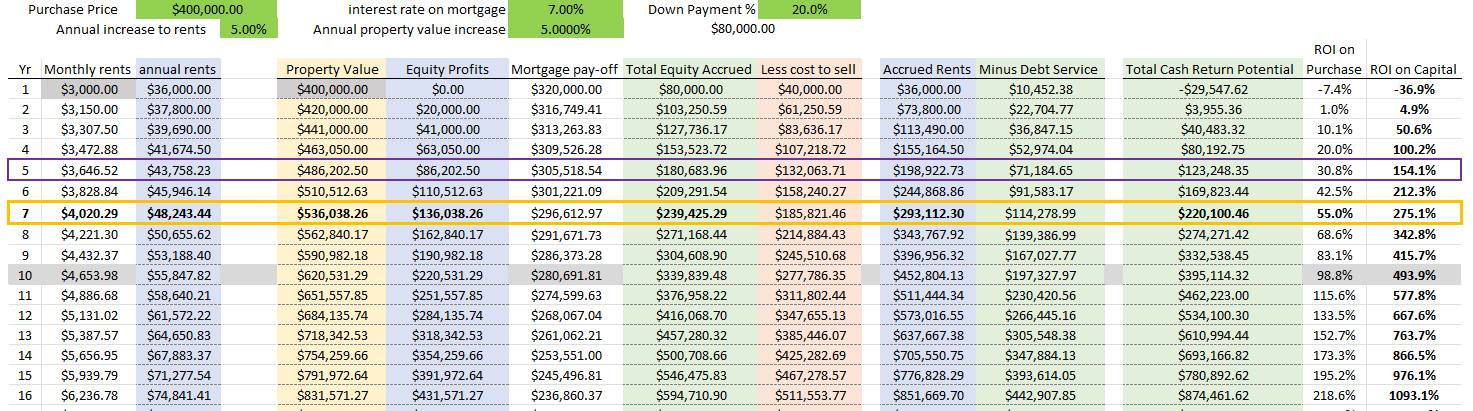
      With S&P compounding at a 12% annual rate your $80k would turn into $248,467.86 over 10 years. 

      Via "poor cash flow day 1" high quality Real Estate assets in well appreciating markets averaging just 5%..... $395,114.32 yr 10...... 

      I don't know about you but averaging 5% annual appreciation is VERY attainable where I am positioned. Last few years have been double digits annually meaning things could sit flat, dead flat, for years, and still hit that 5% annual average. Do you seriously think well positioned properties will appreciate 0% over next 5 years? Of course not, right. 

      Cash-flow keeps the lights on, and appreciation will make you WEALTHY. FACTS...... 

      Well positioned, quality, strategic investment real estate BEATS S&P, beats "cheap cash-flow" properties, beats most every investment vehicle in existence. 

      Once risk adjusted it DOES beat everything.  

      I agree with your sentiment but am unaware of any market that has long term appreciation as high as 7%.  I am using since 2000 which includes the GFC.  Many markets may have over 7% if starting after that.   Using since the year 2000 (source neighborhoodscout), San Fran may have been above 7% before the work from home batted its appreciation.  LA is over 6%.  My market San Diego is near 6%.   No market that I have looked at is over 7% going back to the year 2000 and only a few I have seen is over 6% since the year 2000.

      The 1% or even 2% appreciation lower (I consider markets over 5% since the year 2000 to be high appreciation markets) adds a bit of time to hit cash neutral but on a leveraged purchase the appreciation alone whoops the low inflation total return. At 20% LTV, 5% appreciation is a 25% return on initial equity (I do realize there are transaction costs, but that is true in both markets). On your $300k example, 80% LTV means initial equity of $60k. 5% appreciation is $15k. The appreciation is $1,250/month. if I subtract the -$500 month cash flow in your example, that is $750/month return in year 1 without including equity pay down and tax benefits which are comparable in both markets. Note the appreciation and rent growth are compounding functions meaning year 1 is the worst year. Anyone other than Mike think he can generate $750/month return after expenses on a $300k purchase in the cheap markets on a high leverage purchase? If they do they likely need some lessons in underwriting.

      the math going backwards is clear.   However near term some of those traditional low appreciation markets have experienced appreciation comparable to many of the traditional higher appreciation markets.  @Dave Meyer I believe did a post on this a few months ago.   I am sure it can be found easily.  The time span was too short to indicate much other than the traditional cheap markets have been competive in appreciation recently with traditional high appreciation markets.   If it continues, the line is blurred between high appreciation and low appreciation markets.  Can Detroit be a high appreciation market?  Time will tell. @James Hamling I have seen at least one of your posts indicate, paraphrasing, that the goal is not to purchase the markets that have experienced the high appreciation but the markets that are going to experience the high appreciation. That certainly is the goal, but much easier said than done.  I look at my market dynamics/metrics and it looks likely to continue to have high appreciation but it is not guaranteed.

      Fortunately my primary market has had very good appreciation and rent growth since my purchases. But there is a reason I have not purchased in 3 years in my market (I have put out only a few offers in my market in those 3 years). There are challenges to purchase properties that meet my lofty return expectations. Getting an infinite return that does not bleed cash after a high LTV value extract is near impossible (a unicorn find). I historically was able to find these. I do not invest in RE as the primary for a 20% IRR (possible exception for a vacation home). I would be very happy with 20%/year as LP where the investment is passive. I am spoiled by a different time (2010 to 2022 had a lot of opportunity in RE, the present is more challenging).


      best wishes

    • Investor · Indianapolis, IN · Member since 2014 · 208 posts · 137 votes
      1y
      Quote from @James Hamling:
      Quote from @Dan H.:
      Quote from @Mike D.:
      Quote from @Dan H.:
      Quote from @Mike D.:
      Quote from @Dan H.:
      Quote from @Mike D.:
      Quote from @Dan H.:
      Quote from @Mike D.:
      Quote from @Dan H.:
      Quote from @Mike D.:
      Quote from @Dan H.:
      Quote from @Mike D.:
      Quote from @Dan H.:
      Quote from @Mike D.:
      Quote from @Dan H.:

      Case Shiller used to publish a list with total residential return for this century.  The top of the list was all high appreciation markets.   The bottom of the list was comprised of high initial cash flow properties.   What the list showed was a strong correlation between appreciation and cash flow over a long hold.   The list showed a poor correlation between long term cash flow and initial cash flow.

      I invite you to run your numbers at 80% LTV using that extra down payment to deal with any initial negative cash flow. Use the appreciation and rent growth for this century on each city. Basically the case shiller data without the effort of determining local property tax, maintenance, PM rates, etc..

      In have been investing in my San Diego market for many years. I have purchased with poor timing and great timing.  My worse appreciating property has appreciated $2700/month over its hold ($47k down and closing).  My best appreciating properties have appreciated over $10k/month over their hold.  I suspect that virtually all residential RE in my market will have numbers between my best and worse case.

      Knowing the San Diego appreciation rate (almost 6%/year for this century per neighborhoodscout) how do you think the rent growth has been?

      With time the market with the higher rent growth will always have higher cash flow than the higher initial cash flow market that has lower rent growth.  It is basic math,

      So the high appreciation market has historically produced both better appreciation numbers and better long term cash flow than the low value markets.  This is easy to verify and I believe most experienced investors ecognize this. I recognize past history is not necessarily an indicator of future performance but the metrics on my San Diego market still look promising.

      My view is the low cost markets are best served by local RE investors who know the nuances of the area.

      Best wishes

      Dan and I have had some exchanges in the past about this and I have no doubt he has carefully thought through what he is doing and has some strategies that work well. To be really honest, I don't think this is one. His forceful objections to almost every aspect of what I'm doing have also helped me think through things and grow. So here is a contribution back:

      Okay, running the numbers at 80% LTV sounds interesting. If you do it for Austin, leaving all the other numbers from the initial example the same, you'd have a $2129 monthly payment on a 30 year loan with 7% interest, so -$14,296 negative cashflow. Since you are capturing the full appreciation on the property with a lower down payment, $80k, and since you now have larger principal paydown ($3251 in the first year), your return is now: cashflow -$14,296, principal paydown $3251, appreciation $28,000 = $16,955/$80,000 = 21.2% return. So far it looks good. So far.

      And yes, you could now stick a very large amount of money in reserves to deal with the negative cashflow. Not sure what kind of rent growth you're proposing but let's say 5%. I used a spreadsheet that I had whipped up previously to figure out how much total you're going to need in reserves before the property starts cashflowing and was surprised to find that it still wouldn't be cashflowing after 20 years (!) and over those 20 years it would incur negative cashflow of more than $217k. The rest of the down payment you were going to put away in my example is only $145k, but that money grows at some kind of rate over the years so I suppose it would end up being enough to make up for all the negative cashflow this property would ever incur.

      Even so, several large issues:
      - The opportunity cost on the $145k is major. Since this is your reserve fund, you definitely have to keep it invested in something safe which will probably barely beat inflation. Let's be generous and say you make 5% on it. So, dealing only with the first  year of doing this, you make $16,955 from the house and $7,250 from your reserves, or a total gain of $24,205 on a total investment of $225,000 or 10.8% return. Again, that's making several generous assumptions, and the return continues dropping year over year, which leads to the second problem.
      - By the time your cashflow is inching closer to $0, your return on equity is bad, like below 10%.
      - You are burdening yourself with negative cashflow for years when you could be in a different market with a higher return making cashflow which you can actually use to go to the grocery store and eat.
      - Returns from appreciation are more volatile than cashflow in general and after going through this torture for years it is possible you could see very little payoff.

      So, I don't see why someone would do this. I don't have access to the Case Shiller data you mentioned so I made some other assumptions that might be different. I'd also be interested in hearing if I misinterpreted something about what your idea was.

      I agree with the thesis that high appreciation markets will eventually produce "better" (at least higher) long term cashflow because rent grows faster as well, but it takes a very long time and comes at the cost of low return on equity, to the point that you'd be better off selling out and going into other investments such as a stock/bond portfolio. You also have to consider the opportunity cost in the years when you're waiting for the cashflow to materialize.

      I do not know if you switched numbers from your OP or if your calculation on time span to positive cash flow is off.

      You show a negative $328/month on $2200 rent.

      Without compounding (with compounding it would be better and take less time to achieve positive cash flow) using your rent growth percentage

      1.05 ** years * $2200 - $2200 is the rent

      at 5 years

      1.05 ** 5 * $2200 - $2200 = $607.82 which is likely enough greater $328 to compensate for expenses other than P&i having risen (basically inflation on the non fixed costs).

      >Since this is your reserve fund, you definitely have to keep it invested in something safe which will probably barely beat inflation. Let's be generous and say you make 5% on it. So, dealing only with the first year of doing this, you make $16,955 from the house and $7,250 from your reserves, or a total gain of $24,205 on a total investment of $225,000 or 10.8% return. Again, that's making several generous assumptions, and the return continues dropping year over year, which leads to the second problem.

      There are many ways to manage risk.   I believe high diversification reduces risk.  I think only a very conservative investor would have more than a year of safe, liquid reserves (money market, etc).   So your reserve scenario does not match most investor’s approach.  I do agree that the reserves should not all be in one asset class; that is too risky.   But an investor has a year or so liquid and substantial other investment in other classes besides RE, they have a more robust plan than someone relying solely on cash flow.

      >By the time your cashflow is inching closer to $0, your return on equity is bad, like below 10%.

      what ends up typically occurring is money is extracted before is gets to a 50% LTV to leverage the capital elsewhere reverting the cash flow. I virtually always have used 30 year fixed loans once stabilized for their safety but I have yet to hold a loan 10 years. With the rate increases that started q2 2022, there is a chance that I will finally hold one of these loans over 10 years.

      My worse appreciating property has appreciated $2700/month over its hold.  It never had negative cash flow but even if it did, it could not impact the return significantly.   I purchased for $47k out of pocket including closing costs.  My best appreciating properties have appreciated over $10k/month over their hold.   One of these did have initial negative cash flow at purchase (quite large negative cash flow), but in less than 3 years it had positive cash flow.  The negative cash flow was always inconsequential compared to the value increase.

      I do believe the low cost markets are appropriate for local investors.   Long distance investors should seek higher quality assets.

      Good luck


      Hey Dan, so when you say the cashflow goes positive in the fifth year, something is off there. You must not be using the new P+I for 80% LTV--it's $2129 and there's more than $14k negative cashflow in the first year. So, an extra $608 a month doesn't come close to smoothing that out. Some wires got crossed somewhere.

      It seems that a sophisticated, very wealthy operator could possibly implement your strategy--say they had some stream of cash from something else that they didn't need and could funnel into this, removing the need to keep reserves--but for the average person, even the average millionaire, it would be insane. You suggested keeping reserves, but I suspect that if you yourself use this strategy you are doing something different.

      I guess I should have said my strategy is not for billionaires!

       >Some wires got crossed somewhere.


      possibly.  In the original post you indicated -$328 cash flow under Austin.  Was this not correct?  Was it a subset of the cash flow?   Maybe there was a typo.  It is the number I used.

      In San Diego it is common to see projected rent to selling price ratios of ~0.5%. However, these are not typically what is being purchased by investors or if they are it is because they plan on doing a rehab and significantly raising the rent (a value add). The purchases that have those ratios without the value add and a projected rent increase are virtually all OO purchases. I suspect this is the case in virtually all lower cash flow markets. I have never purchased in my market without at least a projected 0.7% stabilized monthly rent ratio, including the cost of value add in the property cost. Since the rates increase, my underwriting shows 0.7% ratio is cash flow negative at high LTV in my market (while being far superior to the rent ratios that would occur on OO purchases).

      I question if your large negative cash flow is mostly derived using stats that include OO purchases. I know if this was done on my San Diego market, it would depict a far worse cash flow than the already bad cash flow that investors are obtaining. I find it unlikely that Austin investors are regularly purchasing investment properties that project negative $1,167/month cash flow (even though my last purchase my underwriting showed a little worse than this per unit (4 units), but it had value add and positive cash flow was achieved in less than 3 years).

      Do you believe Austin RE investors are buying at a projected negative $1,167/month?  I think it is unlikely.

      I will also point out that if I purchased in my market a property that was negative $1,167, my worse monthly appreciation property is $2700/month.  $2700 - $1167 =$1,533.00 monthly return not including equity paydown and that is my worse monthly appreciating property.  My best is up ~$1m in 3.5 years.  $1m/40 is $25k/month (by the way it is the same property that had the horrendous cash flow at purchase that I mentioned earlier in this post).   Tough to make $25k/month in cash flow with less than 5 units.

      by the way my underwriting does not show those cheap markets to have cash flow anywhere near the projections of those investing there.   In general the investors grossly under estimate maintenance/cap ex, do not depict anything for PM and sometimes grossly under represent vacancy/uncollected rent.  I saw a post recently that showed $86/month maintenance/cap ex and a vacancy rate of one quarter the city’s vacancy rate.   The $86 was 10% of rent and is at least a factor of 3 low for sustaining maintenance/cap ex on that unit.   I asked where he got the number and got an initial reply that he had calculated it via cost and lifetime.  It was clear he used 10%.  I called him on it and did not get a response. I asked how he justified using vacancy of 25% of the city’s vacancy rate and got a reply that he was in the suburbs with lower vacancy.  I believe he could have lower vacancy, but 75% lower seems unlikely.  Certainly it seems to be very aggressive underwriting.  I pointed out he had no entry for uncollected rent so his 5% vacancy was covering both.  This is the quality of the underwriting I see regularly in low rent markets.  This under writing is unlikely to be sustainable over any reasonable length hold.

      There are challenges in RE everywhere and I believe those in low cost markets should start there (but in the upper half of the price range of that market).   I do not believe these markets are likely to produce the returns that OOS investors seek.

      Good luck


      Hey Dan, I found the mistake here--the $328 is the *annual* cashflow for Austin. Everything I've written is with that in mind.

      I understand that basically what you're saying is that an investor in Austin is unlikely to buy a single family home in that price range. I don't know about the logic of other investors--I've seen people on the board buying houses like that--but that would be my logic as well. So if you want to redo both examples using small multifamily, that's fair, but I think you'll find the same principle applies. Comparing apples to apples, the small multifamily property in Memphis is going to have a much higher rent to selling price ratio than the one in Austin, and I don't think the scale of the return of the Austin property to the Memphis one would change much.

      I know that your underwriting shows that investing in cheap markets is very unprofitable--we've discussed that before. On my actual investments, which are small multifamily in the Midwest, I get about $100 a month per unit in maintenance and capex, so a duplex would have about $200 a month. The $86 seems low to me but it's not wildly off. I'm basing this on actual records I keep for my own investments using several years of data. I'm not sure about the way that most people invest because the way most people invest is probably irresponsible, honestly. There are plenty of people who buy junk turnkey properties from lying, cheating providers and lose their shirts.

      My point about the investment that's -$1167 a month is this. It's not suitable for most people. If they have to keep reserves, like I said before, it creates way too much idle cash and the overall return on the reserves + the property itself is low, making the investment unattractive. If they have an income stream say from a company that they want to funnel into that to deal with the negative cashflow, okay, sure, that person is at a level where what I'm saying no longer applies.


       >Memphis is going to have a much higher rent to selling price ratio than the one in Austin, and I don't think the scale of the return of the Austin property to the Memphis one would change much.

      On day 1 yes.  The case Shiller data showed over long holds the cash flow to purchase cost was highest in the highest appreciating markets.  The BP released data that was much shorter in duration (i believe it was an 8 year span) was showing the trend.   For example in the 8 years San Diego went from a poor cash flow at purchase to having a total cash flow somewhere near the middle.   The cash flow in those 8 years was near the middle.  The appreciation was near the top.  A longer time span on that BP data would have shown continuing improvement of the San Diego cash flow.  The math shows the higher rent growth market will have the better cash flow with time.


      >my actual investments, which are small multifamily in the Midwest, I get about $100 a month per unit in maintenance and capex, so a duplex would have about $200 a month.  

      Using actuals does not accurately reflect future cap/ex.  Large cap ex have long lifespans.  How many sewers have you needed to replumb?  Kitchens replaced?  Roofs replaced?  Fences replaced?  Etc.  Even the electrical and hardscape have a lifespan.  I guarantee you did not get this $100/month using lifespan and replacement costs on all items associated with the property (true sustained maintenance/cap ex costs).   $86/month (and your $100/month) is way too low if allocating sustained costs.  I invite you to create a spreadsheet to determine your sustained costs.  In my market we have more costly water heaters (low NOX) and high labor costs.  It is $1600 to replace at reasonable cost (some plumbers charge a lot more) which I suspect t is quite a bit more than your market.  1600/10 (my expected lifespan in years)/12 (months in a year).   The cap ex on the water heater is $13.34/month in my market.  Note including the maintenance it is a little higher as pilot lighting, thermostat coupler replacement, occasionally replace a burner under warranty, an anode replacement, etc.  do this on all items including the supplied appliances and yard and you will see $100 is way too low even if that is based on your current actuals.

      I believe your cash flow projected numbers are very incorrect because I believe you included all the OO purchases in your average purchase price and only the rentals in your rent points. OO in general are larger and more costly by a wide margin than the average rental. If these OO properties were actually rented, it would drive up the average/median rent. So question is how did you determine the average cost of RE purchase? Am. I correct that it includes all the OO? Then recognize the volume of OO versus investor purchases and OO would skew the numbers further. I suspect virtually no Austin RE investor is purchasing projecting a stabilized $1167/month negative. As indicated, I recently purchased a property that at purchase had large negative cash flow. My stabilized cash flow was slightly positive if rents were flat. I just finished stabilization ~6 months ago. My stabalized rent on my underwriting without any rent growth was just over $15k. With rent growth $17.4k and increasing with each tenant renewal.

      I do not believe anyone is using your reserve model (including those without income stream to supplement the negative cash flow) but I will admit some (maybe many) are using a reserve model that may be aggressive.  I keep less than 1% of my networth liquid.   However I am diversified into 3 very Different asset classes and the stock asset class is diversified within stocks.  I have little liquid compared to my RE holdings.   I guarantee that I am better able to survive a GFC type event than a very large percentage of RE investors.  I recognize not everyone can diversify into 3 different investment categories to diversify risk but they are not keeping liquid reserves that cover all negative cash flow until they achieve positive cash flow.  My belief is if they have diversified reserves (not necessarily liquid) to cover no income for a year, they are far better prepared to weather a GFC like event than most RE investments. 

      The historic data is clear that the high appreciation markets have out performed the cheap markets (the case Shiller data clearly showed this, the BP data was on its way to showing this) .  It is why you are getting such push back from experienced investors.   The question is what will occur going forward.   No one knows but I believe in general the high appreciating markets will continue to out perform the cheap markets.


      good luck


      Let me get started with a key point that this discussion has been helping me to formulate: it can be said that high appreciation markets outperform less expensive ones based purely on appreciation and rent growth, but it's a moot point. The key thing this does not consider is use of leverage. A small investor can generate a higher total return in low appreciation, high cashflow markets by using leverage.

      Now I'm going to go off topic. I've had this discussion (about my capex and maintenance numbers) before on the board with others. Again, OFF TOPIC. I like discussing things like this so I will do it but it does not affect my examples either way. Nobody said my capex and expenses were low in the examples, because I used higher numbers that I know are more typical.

      My accounting isn't sloppy. I've had this pushback from several people, so I'm starting to understand that my numbers are unusual. $200 a month (actually I'm at a hair more) is not fake or wrong. I'm confident this can be replicated, at least doing things the way I do it. And yes, just to see if I'd had an exceptional run of years, I have separated out the capex, assumed everything is going to break on the typical schedule, plugged in the prices I pay for those things, and it comes out the same. So what it comes down to is I'm paying less for that stuff than what is typical. I rarely do any maintenance now, but at one time I did all of it so I know how to do stuff. I use people from Taskrabbit, who are extremely affordable, as well as people I know, and I don't let my management company do a single thing. I have systems for checking everything they do and making sure it's up to standards. So, I will come right out and say I get that these numbers are not *typical* but they are *possible*, because I am getting them right now. If you are laid back and a little sloppy then maybe it's double? I don't know. That's all I can say about it. Again, before somebody jumps down my throat, this is *not relevant* to the concept at hand. OFF TOPIC OFF TOPIC OFF TOPIC. Nobody said my examples were wrong because I didn't use my numbers but ones that are more typical. We are not talking about the larger concept. Okay, that's over.

      So again, for sure, the high appreciating markets *will* have the higher cashflow over time, but with lower total return. Then why stay there?

      Honestly, I don't say people can't use appreciation markets to power their purchases of cash flow properties. I'm sure that's worked for many people. But the fact is that, given you can get a higher return on your equity in low appreciation markets, all other things being equal, you'd might as well do everything there. I mean do you want an 11% return or a 23% return? Take the 23% return, don't spend the cashflow and use *that* to buy more cashflow. It may be an unusual way to do it but nobody has shown that it won't work. Why not think outside the box a little? I definitely wanted to hear from experienced investors and that's why I posted this. What I'm generally hearing is a few assumptions need to be tweaked but I think the majority of people have said, if grudgingly, that the concept seems valid. Believe me, my sincere intent is ultimately to learn. This is me forming my own investment approach, and if I can find a way to do it better, or if someone corrects me, I'll change direction. I don't mean just "you are so misguided you are a fool you are an xyz"--I don't care about that if there's nothing to back it up. I care about investing well.

      My theory about where a lot of the pushback is coming from? This isn't how institutions do it. So everybody looks to the level above them thinking they should be doing it that way, without realizing maybe they *shouldn't* be doing it that way. Institutions have swayed markets and set cap rates to their standards, but small investors with leverage can go to markets they don't go to and make money. Ultimately the proof will be in the pudding. I am using this approach--it's been working fine---and I plan to keep using it. I thought about buying some property in Phoenix or Nashville or somewhere and rejected the idea for the exact reasons here. The return on investment/equity is just lower with the amounts you'd have to invest to cashflow, and I don't want to take on negative cashflow. So why go there?

      I think that what you are edging around saying is maybe the biggest possible objection to this approach and the best argument in favor of high appreciation markets. If you do *value add* there, they can take you somewhere. So I will agree, for someone who is reasonable and not just a crowd-follower and actually looking at their numbers, they'll realize they *shouldn't* buy the house in Austin that I used in my example, like you've been saying, and they'll do a value add project in Austin instead. There is absolutely no reason for a passive investor to buy that house. Or, all other things being equal, anything in Austin at all.

      Yeah, so now I see you're saying that you wouldn't actually use reserves in that way. Agree with the approach to reserves.


       > it can be said that high appreciation markets outperform less expensive ones based purely on appreciation and rent growth, but it's a moot point. The key thing this does not consider is use of leverage. A small investor can generate a higher total return in low appreciation, high cashflow markets by using leverage.


      I am 100% missing what you say here. I can get the same LTV in both markets (excluding the real cheap stuff that is hard to finance). I can more easily get equity line of credit on high value assets. My cost to extract (closing costs) is lower as a percentage on high value assets. I cannot think of one way that low value assets are easier to leverage. I cannot think of a few ways high value assets are easier to leverage.

      > I have separated out the capex, assumed everything is going to break on the typical schedule, plugged in the prices I pay for those things, and it comes out the same. So what it comes down to is I'm paying less for that stuff than what is typical. I rarely do any maintenance now, but at one time I did all of it so I know how to do stuff. I use people from Taskrabbit …

      I invite you to post your lifespan and costs on these cap ex items into this thread.  A tad over $200/month is not including all sustained expense.  The most recent I did was interior only (condo).  It was a new market to market to me, I ran my numbers by @Pete Appezzato (with STS/Exp) and incorporated his feed back.  My interior only number was significantly higher than your total cost.  In my market I have dedicated maintenance staff and my small attached unit maintenance/cap ex cost is $300/month.  Detached is higher.  

      >The return on investment/equity is just lower with the amounts you'd have to invest to cashflow, and I don't want to take on negative cashflow. So why go there?

      I think the market is much more challenging than prior to q2 2022.  I agree with you comment at purchase.  Historically your statement valid in high appreciation markets in incorrect as the hold length increases. In general it takes active value add, patience, a sophisticated value add, alternative financing, or a far below value purchase.  I understand high appreciation markets not being ideal for everyone.

      >fact is that, given you can get a higher return on your equity in low appreciation markets, all other things being equal, you'd might as well do everything there.

      Historically the cheap markets has not produced a better return on equity.  Case Shiller showed this.  Unless you have as reputable source that shows otherwise I view it we know what has done better historically.  We do not know what will do better going forward.  I view it similar to growth versus income stocks.   Note if I purchased Amazon circa 2000 it was losing money but its valuation was far above Barnes and noble, many if not all of the large car manufactures.   Why?   Growth potential.  One needs to evaluate ROE, but not primarily against its cash fliw (doing so would be compare to an income stocks but it is more akin to a growth stock) but against its overall projected returns just as you old do for a growth stock. 

      >Ultimately the proof will be in the pudding. I am using this approach--it's been working fine---and I plan to keep using it

      I think you can do fine anywhere.   However you indicated build your net worth twice as fast as an appreciating market.  I will offer you to pick any one of my San Diego area purchases from my profile or either of the two acquisitions I made in Dec 2021 that are not in my profile.  I will provide price, down, current value, current rent.    I will include appreciation per month of hold.   It will give you something to view what I have obtained in my high appreciation market.  I have already indicated my appreciation on hold varies from a low of $2700/month (total out of pocket including closing costs was $47k) to almost $25k/month.  This is what is possible in high appreciation markets.

      >someone who is reasonable and not just a crowd-follower and actually looking at their numbers, they'll realize they *shouldn't* buy the house in Austin that I used in my example, like you've been saying, and they'll do a value add project in Austin instead.

      even though I have requested it, you have not provided how you obtained the value of the investor purchase in Austin or elsewhere. I believe you included all the OO purchases in your property value and that your calculations regarding initial cash flow are very inaccurate. I hope you can see how this would skew the numbers. If I am correct that you used all the OO purchases in property purchase price it would explain how your calculations on cash flow are so absurd. People seldom purchase the highest priced homes as rentals. The properties investors purchase have to make sense as investments. Virtually no investor would purchase your Austin example property, suggesting that is what investors are purchasing to make your case is faulty.

      a lot of successful investors have indicated their experience is your hypothesis has historically been false (also indicated by the Case Shiller data and the BP data was going in that direction). 

      This does not Imply what the future will hold.  It certainly does not imply that you cannot do well being a smart investor in a high initial cash flow market.  I personally think most RE investors are best served by investing in a market close to them which is what you have done.

      I question if at this point you still believe your hypothesis.   I really do not see how someone with an open mind would still be pushing that hypothesis.

      Good luck

      Hey Dan. Yeah, I believe this, lol.

      Anyway, my first paragraph is referring to the return on equity being better in less expensive markets. I know you go into major negative cashflow in order to capture appreciation that is (or at least has been) high in San Diego, and I don't dispute that this can be done profitably, if you can stomach it, though the volatility is very great and it's not for everybody. Part of my premise was that you wouldn't go into negative cashflow. So, assuming you put down enough to cashflow in say San Diego and also in Memphis, the amount is much larger in San Diego, right? Not only is it larger, it's a larger *percentage* of the property's value. Now, assuming modest appreciation, calculate the total return on that down payment, including cashflow, principal accumulation, and appreciation. Unless you go into negative cashflow, and I understand that you personally do do that, the return as a percentage is always greater in the less expensive, higher cap rate markets. It doesn't matter that the appreciation is less. That's basically just me restating my first post.

      Now, we're going off topic again, but I'll go there. I'm just marking this paragraph off again. This does not have to do with my main point and has to do with Dan's questions about my capex numbers. Let's get a rough cost per unit on major capex items for a duplex in the Midwest. A roof lasts say 25 years, right? I expect to spend around $9k for a roof and that covers two units so that's $180/unit/year. A water heater might last 12.5 years and I can get one for $1000. $80/unit/year. Furnaces last maybe 17.5 years and I can get one for $2k. $114/unit/year. Appliances, I do end up replacing them a lot. That probably averages $100/unit/year. Windows? Honestly I have seen windows last 100 years and I rarely replace them. I have never had to do any foundation work. Although flooring, paint, kitchen and bathroom items are technically capex I factor them into turns and I gave those expenses separately. So, adding up all the capex expenses I just gave, we're at $474/unit/year, so just under $1k for a duplex. I don't have time right now to do this in totally granular detail but that will give you a rough idea of where this number comes from. Again, I am a major cost cutter and this cannot be achieved without effort. If you just call some contractor you could easily pay double or more for all this stuff. I'm buying used appliances, I have an affordable HVAC guy, etc. I have the feeling that most people invest in what to me is a very lazy way. With a few phone calls, and also by building relationships over time, these numbers are possible in the Midwest.

      I would like to see the Case Shiller information you are mentioning. I think it must be showing returns assuming that everything was purchased in cash. Of course appreciation rates are higher in low cap rate markets and they've been valued the way they have because institutions purchase them with low or no leverage. Are they really showing return on equity using leverage? I'd be really surprised if they're doing that and showing high appreciation markets come out ahead. The math shows they don't, and anybody can duplicate that math. Why wouldn't it be fair to include cashflow in ROE?

      Yes, sure, I'd like to see the numbers for a San Diego purchase. Is this a passive investment? Because if we're talking value add, that's outside what I'm talking about. I'm sure you can do well if you are actively involved. But that's a different ballgame.

      How did I obtain the value of the investor purchase in Austin? By looking at the MLS in Austin and seeing what a modest single family home costs. I think my projections of revenue are close to reality, however this is a market that I don't invest in so I don't claim it's perfect. It can be confirmed by going on realtor.com, looking up some modest single family homes on the MLS, and then looking up rental listings for the same. I think you will find my example is reasonable.

      Again, no doubt appreciation and rent growth is higher in Sun Belt markets, but if you can't capture that gain without putting down tons and tons of money, your overall return as a percentage is lower. And who doesn't want the higher percentage? All other things being equal.


       >Part of my premise was that you wouldn't go into negative cashflow. So, assuming you put down enough to cashflow in say San Diego and also in Memphis, the amount is much larger in San Diego, right? Not only is it larger, it's a larger *percentage* of the property's value.

      I now understand what you were saying. However, I am unsure even at the lower leverage point that historically the higher appreciation markets still have not out performed the lower appreciation market. Let's for example use San Diego (5.74%) versus Detroit (1.98%) or Cleveland (2.45%) for this century (source neighborhoodscout). If I put double percentage down so 60% LTV versus 80 LTV my gain as a percentage from appreciation has still out produced them and my cash flow due to higher rent growth has out produced them. So thinking the ROE is worse even with less leverage is certainly not universally true.

      However the mathematics of using a lower LTV to increase initial cash flow is poor in higher appreciation markets. This does not stop people from suggesting it and maybe some less experienced investors choosing it without a full understanding of the numbers.

      Your cap ex items is missing a lot of items such as kitchens, bathrooms.   Also my market only has windows close to 100 years if the property is classified historic.   Those old windows need a lot of maintenance and would be cheaper if they had been replaced by vinyl.  Fencing, landscaping.  Sewer.  Electrical.   Knob and tube.   Fused breaker boxes.  Virtually everything on a property has a lifespan.

      All cash purchase would reduce the appreciation benefit. It would hurt the high appreciation markets more than the low appreciation markets.  The case Shiller data used high investor leverage in the calcs but it did not matter as the 3 top cities were all near the top in cash flow since the start of the century (they would have been real high on the list based on their rent growth) and near the top for appreciation.  San Fran was the top city at the last data I saw but its appreciation took a hit when work from home increased (so I do not believe they would be the top today).

      Here is an example of why the appreciation markets have outstanding cash flow if there has been no extraction of value. San Francisco's average rent in year 2000 was $977 (not sure of number of BR). Apartments.com lists current 2 br average apartment as $4218. Note SFH are mush higher.

      $4218 - 977 =$3,241.00  month increase of rent  

      $3241/25 =$129.64 average annual increase.  In reality it started with lower than this average and has been higher than this average recently.

      Clearly a 2 br apartment unit purchased in San Francisco in the year 2000 would have produced crazy cash flow without any extraction of value SFH would be far greater cash flow. You could do this with any of the cities with high appreciation numbers for this century and you would see the same thing It is because there is a tight coupling of long term cash flow and appreciation. There is not a strong coupling of long term cash flow and initial cash flow.


      >Yes, sure, I'd like to see the numbers for a San Diego purchase. Is this a passive investment?

      I have one property that had no upgrade value add (I do not consider residential RE passive but this has been about as passive as it gets, one unit has turned twice, 3 units have original tenants).

      Purchase in Dec 2020 for $640k including bird dog fee ($625k + $15k birddog fee). I used 80% LTV at 2.75% (I wish this was still available), 30 year but including bird dog fee would be a little lower than 80% LTV. Quad in Escondido. Worth ~$1.5m today (look at current quad values in Escondido, over 3700'). PITI $2982. Market rent $8725. Using 40% expense ratio w/o principle, cash flow $3,395. including principle pay down $4,468/month. Gain from appreciation $1.5m - $640k = $860k. $860k/55= $15.6k/month of appreciation. note rents are not high enough to achieve this return via cash flow even if 0% LTV. Note my birddog fee and down together was $148k. I do not remember the closing costs but I did not pay any points to get that loan.

      I am not claiming this was an average purchase. If you look in my profile, I think I referred to its rent ratio as a unicorn find for San Diego. A CA law that I knew about at purchase but was not yet reflected in pricing also allowed this unit to have appreciation far above the average even for San Diego. However, in general I have done BRRRRs. This is my non BRRRR purchase. It was my "passive" RE investment.

      >How did I obtain the value of the investor purchase in Austin?  By looking at the MLS in Austin and seeing what a modest single family home costs. I think my projections of revenue are close to reality, however this is a market that I don't invest in so I don't claim it's perfect. It can be confirmed by going on realtor.com, looking up some modest single family homes on the MLS, and then looking up rental listings for the same. I think you will find my example is reasonable.

      I do not find that method as reasonable. It is heavily factoring in OO purchases (what percentage of SFH do you think are OO purchases versus what percentage are not OO purchase?). I think this method would provide a misleading number in every market, but especially high priced markets. You use a property price that includes OO, but the rent is only of rentals. In general, the OO properties cost a lot more than what RE investors would pay and in general are nicer OO properties would rent for more than the average rent driving up the average rent. it is, however, what I believed you had done and why your negative cash flow estimate was as large as it was and likely worse than any investor would tolerate.

      >no doubt appreciation and rent growth is higher in Sun Belt markets, but if you can't capture that gain without putting down tons and tons of money, your overall return as a percentage is lower.

      If an RE investor chooses to use a lower LTV, it will impact their return. Even with the lower LTV, some high appreciation markets would still out produce some (many?) low appreciation markets as my examples showed. More importantly it is the investor's choice. Maybe they sleep better knowing rents cover all expenses. My last purchase I went max LTV even though using my numbers showed ~$5k/month negative (I had no problem sleeping). This was a value add and I knew that the negative cash flow would not last long. It now (3.5 years later) has decent cash flow (rent $17.6k, P&i ~$6.9k, piti ~$9.5k). It is also up in value almost $1m above purchase and value add costs. This was a value add, so not passive.

      Good luck


      Hey Dan, I went into this math in detail in my first post, but I doubt that 60% LTV is going to be enough to cashflow in San Diego. It certainly would not be enough in most cases today and I doubt it would have been in the past either. I have played around with these numbers quite a bit and believe that what I said in my first post is sound. It gives the example of a high cashflow, low appreciation market vs a low cashflow, high appreciation one and shows how return on equity is greater in the first, when both markets are paid down enough to casfhlow a tiny amount. Yes, the mathematics of using a lower LTV to increase initial cashflow is bad, so if you're going to do it, you have to go all in and deal with insane negative cashflow. Apparently you do this. I understand it can be done, but if you are setting aside enormous amounts of reserves for this you need to consider how much money you're keeping idle. The opportunity cost is extreme. On the other hand, if you are fortunate enough to be in a position where you have a lot of cashflow you don't spend or need for anything, by all means do this.

      I included the items you mentioned--kitchens, bathroom--in turns. A turn is technically pretty much capex, except for cleaning and trash out, but all this does is shift numbers from one column to the other. The ultimate return doesn't change. I think we're kind of quibbling over small stuff now. I don't believe there are any large holes in my numbers.

      Yes, I know high appreciation markets can have great cashflow if you let them sit for years and years because they have high rent growth. But go ahead and calculate the return on equity in those situations. You have so much idle money sitting there that the return as a percentage is probably not beating the stock market. James had an example like this of a class A property that he's getting good ROI on, but not good ROE. Part of what I'm pointing out here is the importance of return on equity. If your return on the equity you currently have in a property at any given point in time is not beating the stock market, that would be a pretty strong indication that you might want to pull that money out and do something else with it. I guarantee by the time you have crossed the line into great cashflow in a high appreciation market that your return on equity is low. I would not be motivated to invest in this way. Owning a property is a big administrative burden at the least. Even if it sits there and cashflows and appreciates, if your money is making 5-10%, why would you want to do that? I know there are many people who do.

      About your Escondido property, you must have gotten an incredibly smoking deal on the purchase price and it wasn't natural market appreciation which as far as I know in Escondido was nowhere near that. The numbers you mentioned would mean 20% market appreciation if that's where the gain came from. However it was achieved, here's the problem, that's looking back into the past. You told me yourself you're currently underwriting with flat appreciation over the next few years, but let's say it's 2% and calculate the return on equity now. The monthly appreciation would be $2,500 and you said cashflow and principal paydown together are $4,468 a month. That's a total of $6,968 a month or $83,616 a year. Given that your equity is around $900k, that's a 9.3% return on equity. Have you calculated that and are you happy with it? Then by all means proceed. But what my post was about was that far greater gain than that can be gotten in high cashflow, low appreciation markets.


       Prior to q2 2022 it was fairly easy to find cash flow positive purchases in San Diego.  They did not have day 1 cash flow comparable to the cheap markets because investment markets are efficient and build in items like expected appreciation, expected rent growth, risks including tenant risks, but they had positive cash flow. I have only purchased one property that projected negative cash flow at purchase.   Its value is up ~$1m in 3.5 years and has modest cash flow.  

      No smart investor handles the negative cash flow by having cash reserves that get them to the cash neutral state.   I keep saying this but you keep acting like this is how investors handle this risk.  It is as absurd as the subject of this post.

      Your calculation for return on equity is not one that anyone uses. IRR, COC, etc projections all use the future projected returns and not solely the initial returns. So your ROE calculation is very flawed and why you have a mistaken belief on which market has historically produced the better ROE. What do you call your ROE calculation that does not use any projection of future returns? An IRR calculation going back in time on pretty much any decent length calculation will show the high appreciation markets have out performed the low appreciation markets. Guess what! this is the same calculation as ROE at that time except is the actual return on the equity from that time (not a projection).

      you replace kitchen on tenant flips?  You replace bathrooms on tenant flips?   You do new electrical on tenant flips?   New roofs on tenant flips?   I offered to look at your spreadsheet of lifespan and costs.   I claim $200/unit is not near enough if allocating for sustained maintenance/cap ex on all items.  Show me a spreadsheet with the costs and lifespan of all items that depict this.   The last one I did was interior only on an away market (so not using my staff) and it was ~$300/month and I incorporated the inputs from an agent in that market.  Low rent markets have a higher expense ratio than higher rent markets.   Your maintenance/cap ex is higher as a function of rent.  

      you keep going back to cash flow as though it is the only source of return.   I have positive cash flow on all my properties and all but one (maybe 2) always projected positive cash flow but it does not matter.   I could have had negative $1k/month of cash flow over the hold and my irr if I exited would be outstanding.   This is because my lowest appreciating property is $2700/month.  If I subtracted $1k/month off it would be $1700/month return on an initial investment of $47k.   Note this is my worse.  I have at least 3 properties with over $10k/month of appreciation over their hold.  Not sure you concentration on cash flow as the source of return.  The reality however is the high appreciation istion markets historically have the higher cash flow because of the tight coupling of appreciation and rent growth.   Look at the San Francisco rents I posted.  $3200/montn of rent growth this century ensures that San Francisco has experience better cash flow than any low appreciation market that you can find.  I challenge you to find one.   And if you thing San Fran is an outlier, look at San Diego, NYC, LA, Boston, etc.   they all had better cash flow for this century than the best low appreciation market you can find assuming no cash extracted.

      >About your Escondido property, you must have gotten an incredibly smoking deal on the purchase price and it wasn't natural market appreciation which as far as I know in Escondido was nowhere near that. The numbers you mentioned would mean 20% market appreciation if that's where the gain came from. However it was achieved, here's the problem, that's looking back into the past. You told me yourself you're currently underwriting with flat appreciation over the next few years, but let's say it's 2% and calculate the return on equity now.  

      I got a good deal, but there was a state law that had already been signed but that was not yet reflected in pricing that also contributed to this properties appreciation.


      >The monthly appreciation would be $2,500 and you said cashflow and principal paydown together are $4,468 a month. That's a total of $6,968 a month or $83,616 a year. Given that your equity is around $900k, that's a 9.3% return on equity

      your calculation on roe is not a standard calculation as roe project the future projections. The roe calculation is correctly done as though you purchased the property today with the existing financing at the current LTV (meaning LTV today) . It includes the expected appreciation and expected rent growth (ideally with conservative numbers). You are correct for the last few years I have been using 0% appreciation for 5 years due to my desire to be conservative and my near term uncertainty. I have been using 5% at year 6 onwards in my market which is 0.75% lower than my market appreciation. I have been doing rent growth also conservatively ay 3% annually even though 5% is close to historical for this century in my market. However, my ROE is calculated at 10 year, 15 years, and 20 year exits. Even with my hopefully conservative underwriting my ROE calculations are far above 10%. I would not choose RE investing if I was only projecting 10% return. That is virtually the same as the lifetime s&p500 which is much more passive. The return from REI must compensate for the work and risks. 10% (or 9.3%) is not nearly sufficient. In general I have achieve infinite ROI on my investment properties (all but 2). I demand my ROE be far higher than the S&P 500. On that Escondido quad it is far over twice as high (I recently ran numbers on this property for ROI and IRR was in the 70% a year if I exit in 10 years. It would be higher per year if I exited today implying the next 10 years are below 70% per year).

      Good luck


      I thought we were getting close to an understanding but there are some major misunderstandings of what I'm saying here.

      I see that you want to use this San Diego example plugging in its increase in value as if it were market appreciation, but that's a false premise. You got a good deal and did something with this property that you haven't fully described to get its value to increase. If you don't want to calculate ROE based on a projection, then you can go back one year and we can assume that your value add was completed by then and you were then benefiting from pure market appreciation. As far as I can see, property values depreciated slightly over the past year in Escondido. There was no appreciation. We'll say somehow your place didn't depreciate, so zero gain from appreciation, I don't know what your cashflow was but I assume it's grown a bit so maybe $3000 average monthly, principal paydown should have averaged $1025 a month over the past year, that is all the gain you had and the equity was $900k. That gives you a return of $48,300 a year or 5.4% ROE. Imagine if you were calculating ROE, then your projection of no appreciation would have led you exactly to this number and you could have chosen to extract your capital sooner. Or were you happy to invest at 5.4% for the past year? If you were, good.

      I'm sure your value add play, whatever it was, was good, but as a passive investment this doesn't seem that good to me and certainly does not rival what's available in other markets. I will make your argument for you more cleanly: you can get good returns in high appreciation markets through value add plays, and they can rival those available to passive investors in high cashflow markets. That's all you have to say, not try to use your value add gain as appreciation. It is very, very appropriate to calculate your return on equity at such time as your value add stuff is done. You could then sell that property and invest it in something else and that is a very important number that can show you when it would be advisable to do that.

      I'll repeat that. If you are done with your value add or whatever you were doing and are now holding a passive investment, it is absolutely appropriate and even crucial to evaluate what its return as a passive investment will be using ROE. If the return sucks, sell it and either recycle your capital into another value add project or put it into a better passive investment. To be direct, I think you held this place too long and should get rid of it now. Of course, you're the one in charge of your own money and I'm sure overall you've done well. It's also not the case that you don't have blind spots, and you're being very direct with me, so I'm doing the same.

      It doesn't bother me in the slightest if other people (that you know) don't do it like that. Dan, do you know that in kindergarten I insisted on holding my pencil in a way different than what they tried to teach and purposely wrote in all caps with many of the letters backward just because I wanted to? I knew exactly how I was expected to do it, read above my grade level and chose to do things that way because I wanted to. This is just the way I do things and I'm not an idiot like some people are trying to make me out to be. This type of thing has been going on a long time and I know people are threatened by people who do things differently and especially those who don't change when everybody makes a big fuss about it but I'm no fool and I'm doing this stuff this way for a good reason. It's very important for some here to think I have no experience at this and either don't have any actual investments or I'm going to go bankrupt tomorrow or a I'm an enormous fool. All that is false.

      Several posts ago, you absolutely suggested using reserves to cover the negative cashflow on a high LTV investment in an expensive market. I think you realized after I laid the numbers out that that doesn't work. But go back and look at your post. I have never exactly been sure what you're proposing doing instead of reserves. You vaguely described diversifying in other ways. You haven't said how exactly, but there is surely an opportunity cost attached to what you are doing and I am interested in finding out what it is and if the return really is that good when those opportunity costs are taken into account. The return is also incredibly volatile and the volatility itself will lower the percent return in addition to simply not putting money in your pocket as reliably as cashflow.

      I don't know why we're still going around and around about my capex numbers. I have enough properties and enough years on record that a kitchen is not going to implode tomorrow in a way I haven't accounted for. That is factored into turns. I gave you a list of major items and showed my numbers for them. If that isn't enough, then sadly that's how it's going to have to stay. I'm confident in my numbers and going deeper into them is going to be very time consuming and serve only to prove to you that they're right. They are right, and I'm sorry, I don't have the time to do it. If you want to think they're wrong, you can think so.

      I do not assume cashflow is the only source of return and the fact that you're saying that at this point makes me think that a lot of what I'm saying is being missed. To repeat, factor in cashflow, appreciation, and principal buildup. Assume you're not going to take on negative cashflow and you're using enough leverage to barely cashflow. Calculate your return on equity (highly advise you start doing so now) in high appreciation and low appreciation markets. The latter will win.

      To repeat, and it's not the first repetition, I know rent growth and appreciation are higher in high appreciation markets. This basic fact is not being disputed by anybody. Investors using leverage can gain higher percentage returns on their money in markets with better cashflow, simply because they can cashflow with less equity and therefore earn a much higher return on equity. It doesn't matter that cashflow and appreciation are better in NY, LA, Boston, etc., etc. Not unless you buy all properties in cash because you're an institution or someone with $100 million.


       >You got a good deal and did something with this property that you haven't fully described to get its value to increase

      I thought I explained it.  I did nothing to the property.  I knew a law had passed that would increase the value of this property.   No effort, no value added by me (the value was added by the state legislature). My first protege recently had land values in its current use at ~$1m.  He knew about a city law that made the property much more valuable with a different usage.  He sold the land with a different use at $1.5m to someone that would use the land for its highest value.   The city just (in the last month) changed the law to prevent what they legally were allowing and encouraging.   He did nothing to improve the property.

      In both cases we believed the value would increase due to laws passed.  It is little different than a new NP is established by congress.   You buy a little cabin just outside the park with the belief that the park will raise the value more than other areas.  You could be wrong and would possibly lose transaction costs at worse case.   If you right and the property outside the park appreciates double the rate it would have without the NP, you made a good investment.  

      I refer to these as sophisticated value adds meaning they are more about knowledge than work involved.  

      You are a little high on my principle paydown possibly because you included birddog fee into the loan but it was not) but a little low on my cash flow (but remember my expense estimate is far more conservative than you use). Oberall you are ~$300 low. Also remember I used 0% appreciation for last year in my ROE calculations before it was flattish in appreciation (my projection was fairly accurate). Not sure of your source showing it went down as most sources I see are slightly up, but flattish is fair. Even with that projection of zero appreciation last year, my ROE shows great (I do not calculate for anything less than 10 years). This is in part because my actual rent increase $395/month last year and because I show 5% appreciation starting in the future until end of time (until selling it). As indicated my lowest IRR was above 70%/year.


      >Several posts ago, you absolutely suggested using reserves to cover the negative cashflow on a high LTV investment in an expensive market. I think you realized after I laid the numbers out that that doesn't work.

      I did not. I did state to run the numbers using 80% LTV and using the money not placed into he property to cover any negative cash flow. 1) I did not state where this money would be held. 2) I certainly did not mean to keep all of it liquid. The numbers do work. I showed you in the last post even if I was $1k/month negative over the hold, my worse appreciating property still would have made $1700/month ($2700 - $1000) not including principle pay down or any tax benefits. My down and closing was $47k on this property. I did not need cash flow for it to have produced a great return. I have had decent cash flow on the property (and would have had good cash flow but equity was extracted twice from this property), but even with negative $1k cash flows month this return would beat many/most low appreciation markets.

      >I have never exactly been sure what you're proposing doing instead of reserves. You vaguely described diversifying in other ways. You haven't said how exactly, but there is surely an opportunity cost attached to what you are doing and I am interested in finding out what it is and if the return really is that good when those opportunity costs are taken into account.

      As long as the reserves are not placed in RE, you have diversified and reduced risks.  there are literally infinite options, but having more than 6 months liquid reserves are very conservative and certainly not my recommendation.   I did real well with mineral rights before I did well in real estate.  Again it was a knowledge play as fracking was starting to be heavily incorporated but people were selling on valuations that did not include the production increases that could result.  I went all in (except for home, job, and 401k, everything I had liquid and could borrow unsecured) but I had much lower amount as my all in back then. I believe their time has passed so this is not a recommendation to diversify into.   Stocks, bonds, anything that is likely over time to beat money market.  Money market is fine for near term reserves (I would not do more than 6 months, but different people have different risk tolerances).

      >Calculate your return on equity (highly advise you start doing so now) in high appreciation and low appreciation markets. The latter will win

      It has not and it does not.  The historical data already shows the high appreciation iatiin markets have produced the far better return.   You act like this data does not exist or you ignore it.  I will admit past performance does not necessarily match future performance 

      We agree to disagreee on your maintenance/cap ex.  I do have a question: are any of your units on the 2nd or more replacement of any large cap ex items such as roof, kitchen remodel, HVAC, etc?. This tells me if you have gone full lifetime on sustained costs. 

      >I do not assume cashflow is the only source of retur

      You only used cash flow in all your ROE calculations.   Your calculation method is not any industry standard that I ever heard of.   Calculation of ROE still calculates into the return the growth (rent and appreciation) until the projected exit.  You even did it when you calculated the ROE from my Escondido quad.  It is not how roe is calculated.  It was interesting the return without any growth it is almost 10%.  That is crazy good.   With growth, obviously that return is a lot better.  


      >Investors using leverage can gain higher percentage returns on their money in markets with better cashflow, simply because they can cashflow with less equity and therefore earn a much higher return on equity.

      historically this has shown to not typically be the case.  The data is there that shows this.  When case Shiller used to publish their residential return for this century it showed the high appreciation markets in general fad the higher cash flow.  And of course they had the higher appreciation.   The BP data on residential return was much shorter in duration (I believe it was only 8 years) also was on its way to showing this as poor at purchase cash flow cities in 8 years had moved near the middle.   By the way, for CA cities the BP data had a large mistake related to property tax that under calculated the cash flow.   

       >It doesn't matter that cashflow and appreciation are better in NY, LA, Boston, etc., etc. Not unless you buy all properties in cash because you're an institution or someone with $100 million.. 

      I do not understand this statement at all.  If you buy all cash the appreciation does not benefit from leverage.  The leveraged investors benefit the most from appreciation and rent growth.   

      Where does it make more sense to purchase all cash, the low appreciation markets or the high appreciation markets?   In the high appreciation markets they want to maximize the benefit from appreciation.  This requires leverage.  In the low appreciation markets, cash flow is the primary source of return.   Cash flow is higher with less leverage.

      By the way this is my last response in this thread.   You keep bringing up items that I have already addressed.  You have demonstrated you do not understand ROE or how to calculate it.   My responses are sufficient to educate someone receptive to the concepts.

      By the way I suggest virtually all REI to invest in a market they are intimate with regardless of if it is a high appreciation or a low appreciation market. This is usually their home market.


      good luck


      I'm exhausted of this circle-jerk and gonna put a nail in this coffin..... 

      Here is the facts of the math of things. What appreciation low, and high looks like, by the #'s. 

      $300k property, appreciation at 2%. And let's keep in fantasy vein and say it's a 1% deal to start, rent's at $3k mnth. 

      Yr 6 your at an aggregate 200% ROI. Of course this is with 0 cap-x/maintenance but hey, it's fantasy land.

      Now, vs appreciation which as Mike wants to compare, a HIGH appreciation market...... 

      Same $300k buy, same interest rate, BUT were gonna drop rents to starting at $2,500 vs $3k and increase appreciation rate to a HIGH rate, 7%. 

      Now yes, I am more then well aware of the countless markets who've had 12 - 24%+ annual appreciation but let's see what just 7% as a "high appreciation" rate does...... 

      Again, keep in mind we nerfd DOWN rents $500mnth (- 17%) in this. 

      Results??????? 

      The high appreciating property is a 320% ROI in yr 6, that is a 1.5X return too the "cash-flow" property.

      Yr 6 gross rents $42k. 

      Yr 6 gross rents of the "cash-flow" property are $39,746........ 

      Yup, MATH, compounding returns, that's how math works....... 

      The appreciation property over-take the "cash-flow" property, as the cash-flow LEADER in yr6. 

      And after yr6 the appreciation property just keeps expanding and exaggerating that lead on producing MORE cash-flow then the "cash-flow" property........ 

      So how is Mike so backwards on his assumptions? Simple, a person with experience of 1-4yrs would feel, FEEL as if their low-appreciating property is winning out, they just haven't realized yet. 

      Now the big X-factor vs the 2 asset types is if and when there is a major inflation event. As those of us IN the industry experienced with the covid-inflation, the well positioned properties caught the biggest impact of that inflation. I had properties that paced 20%+ annual rent increases for 3 years consecutively. It was bonkers. 

      The low grade assets, yes, they had big increases too but nowhere close to 20%, roughly half. Same goes for property values, they didn't catch those same gains. 

      Which is why Mike is buying those properties today at "cheap" prices and feeling, emphasis on FEELING, like he's a genius beating everyone else. 

      Those properties are "cheap" for a reason........ Mike just hasn't figured that part out yet. He will, in time, nobody can beat the realities of time. 

      It's the simple SIMPLE math of compounding returns. The one who compounds at a faster/bigger rate, will beat out the lower EVERY TIME. That's how compounding works. 

      ---- More ? -----

      Ok, let's say vs 2 "cheap" $200k low-appreciating properties, at 1%, vs an "expensive" $400k well appreciating: 

      The "cheap" returns $206k at yr 7.

      The "Expensive" returns $296k at yr 7, starting with rents 75% that of the "cheap"...... 

      That's a $90k difference in just 7yrs, $90k MORE one makes with the LOW cash-flow day 1 via higher appreciation. 

      What's $90k over 7 yrs? That's over $1,071 per month....... 

      Really want you mind blown..... 

      How about an answer on how to 10X your investment capitol, and this is at just 5% appreciation rate (keep in mind where fed rate has been around, nearly 5% right.....) 

      also keep in mind this is starting at a rent of just $3k on a $400k property, that IS cheap, very very cheap in my markets. Stupid crazy cheap to be honest. 

      With S&P compounding at a 12% annual rate your $80k would turn into $248,467.86 over 10 years. 

      Via "poor cash flow day 1" high quality Real Estate assets in well appreciating markets averaging just 5%..... $395,114.32 yr 10...... 

      I don't know about you but averaging 5% annual appreciation is VERY attainable where I am positioned. Last few years have been double digits annually meaning things could sit flat, dead flat, for years, and still hit that 5% annual average. Do you seriously think well positioned properties will appreciate 0% over next 5 years? Of course not, right. 

      Cash-flow keeps the lights on, and appreciation will make you WEALTHY. FACTS...... 

      Well positioned, quality, strategic investment real estate BEATS S&P, beats "cheap cash-flow" properties, beats most every investment vehicle in existence. 

      Once risk adjusted it DOES beat everything. 

      Hey man, before I start this I'm just gonna address your tone again. Do you realize that people who are considering doing business with you might be reading this? I hope they think over things like what you're going to be like on the phone with them when a disagreement comes up. Probably, a lot like these posts. I have not personally attacked you but you seem really agitated and raw and I guess the reasons for that are for you to think about. We can have a respectful disagreement or we can have an exchange of insults and I'm trying to drag it back into the first arena.

      Now, to get into the substance of what you're saying, you are calculating return on investment, which is not the same as return on equity. Your post shows that you do not understand the definition of these and you think I'm talking about the first whereas I'm talking about the second. Instead of just defining these terms, which can be easily Googled, I think a clear, simple example would be helpful. You can invest $1 at 5% interest and after 50 years you will have $11.46 and your return on investment (ROI) will be 1047%. Wow, above a 1000% return! Does that mean this is the best investment in the universe? No. It's intuitively obvious that the huge ROI number is misleading and return on equity (ROE) shows clearly why. To calculate this, you need to find the total gain as a percentage of the amount you have currently in the investment (equity). The return on equity in that situation for the following year will be 5% of $11.46 or $.57. That's return on equity of 5% and it clearly shows why you'd be better off in a different investment even though the return on investment (ROI) is over 1000%. ROI increases over time and as time goes on it becomes less and less meaningful. ROE on the other hand clearly lets you compare the investment you are currently in to other options that may be available. ROE will always drop over time in a real estate investment as it appreciates and equity increases whereas profit doesn't increase proportionately, meaning that if you want the best return on your money you need to either sell out or refi and redeploy funds. I hope that this has been read and understood.

      In your final example, ROE is $80k. Now in the seventh year, assuming $0 cashflow (I think it's probably actually negative and you conveniently leave that out, but we'll assume $0), 5% appreciation on an investment of $536,038 which is $26,802, and principal paydown of $4941, your total return is $31,743 on equity of $239,425 or 13.3%. Just like in the example of the $1 that had more than 1000% ROI after 50 years, of course your investment has some incredible ROI number that gets more incredible the longer times goes on, but it stops meaningfully representing anything pretty quickly.

      Once you get through with the above, you can go back to my initial post and see the ROE for an investment in Memphis. 20-25% is obtainable as a passive investment without much effort in markets like that. Do you think everyone who invests there is an idiot? Because there are plenty of large institutions and wealthy people doing exactly that. Maybe, just maybe, they aren't all fools.

      I'm not here to be an a-hole to you. If you are happy getting 13% in a property that is presumably low effort, I'm not telling you not to do it. What I am saying is that you can't put blinders on and pretend there aren't better returns out there. This should not be an offensive or triggering statement.

      The point of my post was to show that total return, measured as ROE, is always better in low appreciation, high cashflow markets. I am not sure why it seems that what I'm doing is based on feeling when it's based on math. I am a person with feelings, I love feelings, I love art, I love music, but feelings are not really playing a role in what I'm writing  about now. It seems like your feelings are a lot more invested in this than mine. That's why you're being rude and abrasive. It isn't a nice way to conduct yourself and exposes ignorance.
    • Real Estate Broker · Minneapolis, MN · Member since 2011 · 5k+ posts · 6k+ votes
      1y
      Quote from @Dan H.:
      Quote from @James Hamling:
      Quote from @Dan H.:
      Quote from @Mike D.:
      Quote from @Dan H.:
      Quote from @Mike D.:
      Quote from @Dan H.:
      Quote from @Mike D.:
      Quote from @Dan H.:
      Quote from @Mike D.:
      Quote from @Dan H.:
      Quote from @Mike D.:
      Quote from @Dan H.:
      Quote from @Mike D.:
      Quote from @Dan H.:
      Quote from @Mike D.:
      Quote from @Dan H.:

      Case Shiller used to publish a list with total residential return for this century.  The top of the list was all high appreciation markets.   The bottom of the list was comprised of high initial cash flow properties.   What the list showed was a strong correlation between appreciation and cash flow over a long hold.   The list showed a poor correlation between long term cash flow and initial cash flow.

      I invite you to run your numbers at 80% LTV using that extra down payment to deal with any initial negative cash flow. Use the appreciation and rent growth for this century on each city. Basically the case shiller data without the effort of determining local property tax, maintenance, PM rates, etc..

      In have been investing in my San Diego market for many years. I have purchased with poor timing and great timing.  My worse appreciating property has appreciated $2700/month over its hold ($47k down and closing).  My best appreciating properties have appreciated over $10k/month over their hold.  I suspect that virtually all residential RE in my market will have numbers between my best and worse case.

      Knowing the San Diego appreciation rate (almost 6%/year for this century per neighborhoodscout) how do you think the rent growth has been?

      With time the market with the higher rent growth will always have higher cash flow than the higher initial cash flow market that has lower rent growth.  It is basic math,

      So the high appreciation market has historically produced both better appreciation numbers and better long term cash flow than the low value markets.  This is easy to verify and I believe most experienced investors ecognize this. I recognize past history is not necessarily an indicator of future performance but the metrics on my San Diego market still look promising.

      My view is the low cost markets are best served by local RE investors who know the nuances of the area.

      Best wishes

      Dan and I have had some exchanges in the past about this and I have no doubt he has carefully thought through what he is doing and has some strategies that work well. To be really honest, I don't think this is one. His forceful objections to almost every aspect of what I'm doing have also helped me think through things and grow. So here is a contribution back:

      Okay, running the numbers at 80% LTV sounds interesting. If you do it for Austin, leaving all the other numbers from the initial example the same, you'd have a $2129 monthly payment on a 30 year loan with 7% interest, so -$14,296 negative cashflow. Since you are capturing the full appreciation on the property with a lower down payment, $80k, and since you now have larger principal paydown ($3251 in the first year), your return is now: cashflow -$14,296, principal paydown $3251, appreciation $28,000 = $16,955/$80,000 = 21.2% return. So far it looks good. So far.

      And yes, you could now stick a very large amount of money in reserves to deal with the negative cashflow. Not sure what kind of rent growth you're proposing but let's say 5%. I used a spreadsheet that I had whipped up previously to figure out how much total you're going to need in reserves before the property starts cashflowing and was surprised to find that it still wouldn't be cashflowing after 20 years (!) and over those 20 years it would incur negative cashflow of more than $217k. The rest of the down payment you were going to put away in my example is only $145k, but that money grows at some kind of rate over the years so I suppose it would end up being enough to make up for all the negative cashflow this property would ever incur.

      Even so, several large issues:
      - The opportunity cost on the $145k is major. Since this is your reserve fund, you definitely have to keep it invested in something safe which will probably barely beat inflation. Let's be generous and say you make 5% on it. So, dealing only with the first  year of doing this, you make $16,955 from the house and $7,250 from your reserves, or a total gain of $24,205 on a total investment of $225,000 or 10.8% return. Again, that's making several generous assumptions, and the return continues dropping year over year, which leads to the second problem.
      - By the time your cashflow is inching closer to $0, your return on equity is bad, like below 10%.
      - You are burdening yourself with negative cashflow for years when you could be in a different market with a higher return making cashflow which you can actually use to go to the grocery store and eat.
      - Returns from appreciation are more volatile than cashflow in general and after going through this torture for years it is possible you could see very little payoff.

      So, I don't see why someone would do this. I don't have access to the Case Shiller data you mentioned so I made some other assumptions that might be different. I'd also be interested in hearing if I misinterpreted something about what your idea was.

      I agree with the thesis that high appreciation markets will eventually produce "better" (at least higher) long term cashflow because rent grows faster as well, but it takes a very long time and comes at the cost of low return on equity, to the point that you'd be better off selling out and going into other investments such as a stock/bond portfolio. You also have to consider the opportunity cost in the years when you're waiting for the cashflow to materialize.

      I do not know if you switched numbers from your OP or if your calculation on time span to positive cash flow is off.

      You show a negative $328/month on $2200 rent.

      Without compounding (with compounding it would be better and take less time to achieve positive cash flow) using your rent growth percentage

      1.05 ** years * $2200 - $2200 is the rent

      at 5 years

      1.05 ** 5 * $2200 - $2200 = $607.82 which is likely enough greater $328 to compensate for expenses other than P&i having risen (basically inflation on the non fixed costs).

      >Since this is your reserve fund, you definitely have to keep it invested in something safe which will probably barely beat inflation. Let's be generous and say you make 5% on it. So, dealing only with the first year of doing this, you make $16,955 from the house and $7,250 from your reserves, or a total gain of $24,205 on a total investment of $225,000 or 10.8% return. Again, that's making several generous assumptions, and the return continues dropping year over year, which leads to the second problem.

      There are many ways to manage risk.   I believe high diversification reduces risk.  I think only a very conservative investor would have more than a year of safe, liquid reserves (money market, etc).   So your reserve scenario does not match most investor’s approach.  I do agree that the reserves should not all be in one asset class; that is too risky.   But an investor has a year or so liquid and substantial other investment in other classes besides RE, they have a more robust plan than someone relying solely on cash flow.

      >By the time your cashflow is inching closer to $0, your return on equity is bad, like below 10%.

      what ends up typically occurring is money is extracted before is gets to a 50% LTV to leverage the capital elsewhere reverting the cash flow. I virtually always have used 30 year fixed loans once stabilized for their safety but I have yet to hold a loan 10 years. With the rate increases that started q2 2022, there is a chance that I will finally hold one of these loans over 10 years.

      My worse appreciating property has appreciated $2700/month over its hold.  It never had negative cash flow but even if it did, it could not impact the return significantly.   I purchased for $47k out of pocket including closing costs.  My best appreciating properties have appreciated over $10k/month over their hold.   One of these did have initial negative cash flow at purchase (quite large negative cash flow), but in less than 3 years it had positive cash flow.  The negative cash flow was always inconsequential compared to the value increase.

      I do believe the low cost markets are appropriate for local investors.   Long distance investors should seek higher quality assets.

      Good luck


      Hey Dan, so when you say the cashflow goes positive in the fifth year, something is off there. You must not be using the new P+I for 80% LTV--it's $2129 and there's more than $14k negative cashflow in the first year. So, an extra $608 a month doesn't come close to smoothing that out. Some wires got crossed somewhere.

      It seems that a sophisticated, very wealthy operator could possibly implement your strategy--say they had some stream of cash from something else that they didn't need and could funnel into this, removing the need to keep reserves--but for the average person, even the average millionaire, it would be insane. You suggested keeping reserves, but I suspect that if you yourself use this strategy you are doing something different.

      I guess I should have said my strategy is not for billionaires!

       >Some wires got crossed somewhere.


      possibly.  In the original post you indicated -$328 cash flow under Austin.  Was this not correct?  Was it a subset of the cash flow?   Maybe there was a typo.  It is the number I used.

      In San Diego it is common to see projected rent to selling price ratios of ~0.5%. However, these are not typically what is being purchased by investors or if they are it is because they plan on doing a rehab and significantly raising the rent (a value add). The purchases that have those ratios without the value add and a projected rent increase are virtually all OO purchases. I suspect this is the case in virtually all lower cash flow markets. I have never purchased in my market without at least a projected 0.7% stabilized monthly rent ratio, including the cost of value add in the property cost. Since the rates increase, my underwriting shows 0.7% ratio is cash flow negative at high LTV in my market (while being far superior to the rent ratios that would occur on OO purchases).

      I question if your large negative cash flow is mostly derived using stats that include OO purchases. I know if this was done on my San Diego market, it would depict a far worse cash flow than the already bad cash flow that investors are obtaining. I find it unlikely that Austin investors are regularly purchasing investment properties that project negative $1,167/month cash flow (even though my last purchase my underwriting showed a little worse than this per unit (4 units), but it had value add and positive cash flow was achieved in less than 3 years).

      Do you believe Austin RE investors are buying at a projected negative $1,167/month?  I think it is unlikely.

      I will also point out that if I purchased in my market a property that was negative $1,167, my worse monthly appreciation property is $2700/month.  $2700 - $1167 =$1,533.00 monthly return not including equity paydown and that is my worse monthly appreciating property.  My best is up ~$1m in 3.5 years.  $1m/40 is $25k/month (by the way it is the same property that had the horrendous cash flow at purchase that I mentioned earlier in this post).   Tough to make $25k/month in cash flow with less than 5 units.

      by the way my underwriting does not show those cheap markets to have cash flow anywhere near the projections of those investing there.   In general the investors grossly under estimate maintenance/cap ex, do not depict anything for PM and sometimes grossly under represent vacancy/uncollected rent.  I saw a post recently that showed $86/month maintenance/cap ex and a vacancy rate of one quarter the city’s vacancy rate.   The $86 was 10% of rent and is at least a factor of 3 low for sustaining maintenance/cap ex on that unit.   I asked where he got the number and got an initial reply that he had calculated it via cost and lifetime.  It was clear he used 10%.  I called him on it and did not get a response. I asked how he justified using vacancy of 25% of the city’s vacancy rate and got a reply that he was in the suburbs with lower vacancy.  I believe he could have lower vacancy, but 75% lower seems unlikely.  Certainly it seems to be very aggressive underwriting.  I pointed out he had no entry for uncollected rent so his 5% vacancy was covering both.  This is the quality of the underwriting I see regularly in low rent markets.  This under writing is unlikely to be sustainable over any reasonable length hold.

      There are challenges in RE everywhere and I believe those in low cost markets should start there (but in the upper half of the price range of that market).   I do not believe these markets are likely to produce the returns that OOS investors seek.

      Good luck


      Hey Dan, I found the mistake here--the $328 is the *annual* cashflow for Austin. Everything I've written is with that in mind.

      I understand that basically what you're saying is that an investor in Austin is unlikely to buy a single family home in that price range. I don't know about the logic of other investors--I've seen people on the board buying houses like that--but that would be my logic as well. So if you want to redo both examples using small multifamily, that's fair, but I think you'll find the same principle applies. Comparing apples to apples, the small multifamily property in Memphis is going to have a much higher rent to selling price ratio than the one in Austin, and I don't think the scale of the return of the Austin property to the Memphis one would change much.

      I know that your underwriting shows that investing in cheap markets is very unprofitable--we've discussed that before. On my actual investments, which are small multifamily in the Midwest, I get about $100 a month per unit in maintenance and capex, so a duplex would have about $200 a month. The $86 seems low to me but it's not wildly off. I'm basing this on actual records I keep for my own investments using several years of data. I'm not sure about the way that most people invest because the way most people invest is probably irresponsible, honestly. There are plenty of people who buy junk turnkey properties from lying, cheating providers and lose their shirts.

      My point about the investment that's -$1167 a month is this. It's not suitable for most people. If they have to keep reserves, like I said before, it creates way too much idle cash and the overall return on the reserves + the property itself is low, making the investment unattractive. If they have an income stream say from a company that they want to funnel into that to deal with the negative cashflow, okay, sure, that person is at a level where what I'm saying no longer applies.


       >Memphis is going to have a much higher rent to selling price ratio than the one in Austin, and I don't think the scale of the return of the Austin property to the Memphis one would change much.

      On day 1 yes.  The case Shiller data showed over long holds the cash flow to purchase cost was highest in the highest appreciating markets.  The BP released data that was much shorter in duration (i believe it was an 8 year span) was showing the trend.   For example in the 8 years San Diego went from a poor cash flow at purchase to having a total cash flow somewhere near the middle.   The cash flow in those 8 years was near the middle.  The appreciation was near the top.  A longer time span on that BP data would have shown continuing improvement of the San Diego cash flow.  The math shows the higher rent growth market will have the better cash flow with time.


      >my actual investments, which are small multifamily in the Midwest, I get about $100 a month per unit in maintenance and capex, so a duplex would have about $200 a month.  

      Using actuals does not accurately reflect future cap/ex.  Large cap ex have long lifespans.  How many sewers have you needed to replumb?  Kitchens replaced?  Roofs replaced?  Fences replaced?  Etc.  Even the electrical and hardscape have a lifespan.  I guarantee you did not get this $100/month using lifespan and replacement costs on all items associated with the property (true sustained maintenance/cap ex costs).   $86/month (and your $100/month) is way too low if allocating sustained costs.  I invite you to create a spreadsheet to determine your sustained costs.  In my market we have more costly water heaters (low NOX) and high labor costs.  It is $1600 to replace at reasonable cost (some plumbers charge a lot more) which I suspect t is quite a bit more than your market.  1600/10 (my expected lifespan in years)/12 (months in a year).   The cap ex on the water heater is $13.34/month in my market.  Note including the maintenance it is a little higher as pilot lighting, thermostat coupler replacement, occasionally replace a burner under warranty, an anode replacement, etc.  do this on all items including the supplied appliances and yard and you will see $100 is way too low even if that is based on your current actuals.

      I believe your cash flow projected numbers are very incorrect because I believe you included all the OO purchases in your average purchase price and only the rentals in your rent points. OO in general are larger and more costly by a wide margin than the average rental. If these OO properties were actually rented, it would drive up the average/median rent. So question is how did you determine the average cost of RE purchase? Am. I correct that it includes all the OO? Then recognize the volume of OO versus investor purchases and OO would skew the numbers further. I suspect virtually no Austin RE investor is purchasing projecting a stabilized $1167/month negative. As indicated, I recently purchased a property that at purchase had large negative cash flow. My stabilized cash flow was slightly positive if rents were flat. I just finished stabilization ~6 months ago. My stabalized rent on my underwriting without any rent growth was just over $15k. With rent growth $17.4k and increasing with each tenant renewal.

      I do not believe anyone is using your reserve model (including those without income stream to supplement the negative cash flow) but I will admit some (maybe many) are using a reserve model that may be aggressive.  I keep less than 1% of my networth liquid.   However I am diversified into 3 very Different asset classes and the stock asset class is diversified within stocks.  I have little liquid compared to my RE holdings.   I guarantee that I am better able to survive a GFC type event than a very large percentage of RE investors.  I recognize not everyone can diversify into 3 different investment categories to diversify risk but they are not keeping liquid reserves that cover all negative cash flow until they achieve positive cash flow.  My belief is if they have diversified reserves (not necessarily liquid) to cover no income for a year, they are far better prepared to weather a GFC like event than most RE investments. 

      The historic data is clear that the high appreciation markets have out performed the cheap markets (the case Shiller data clearly showed this, the BP data was on its way to showing this) .  It is why you are getting such push back from experienced investors.   The question is what will occur going forward.   No one knows but I believe in general the high appreciating markets will continue to out perform the cheap markets.


      good luck


      Let me get started with a key point that this discussion has been helping me to formulate: it can be said that high appreciation markets outperform less expensive ones based purely on appreciation and rent growth, but it's a moot point. The key thing this does not consider is use of leverage. A small investor can generate a higher total return in low appreciation, high cashflow markets by using leverage.

      Now I'm going to go off topic. I've had this discussion (about my capex and maintenance numbers) before on the board with others. Again, OFF TOPIC. I like discussing things like this so I will do it but it does not affect my examples either way. Nobody said my capex and expenses were low in the examples, because I used higher numbers that I know are more typical.

      My accounting isn't sloppy. I've had this pushback from several people, so I'm starting to understand that my numbers are unusual. $200 a month (actually I'm at a hair more) is not fake or wrong. I'm confident this can be replicated, at least doing things the way I do it. And yes, just to see if I'd had an exceptional run of years, I have separated out the capex, assumed everything is going to break on the typical schedule, plugged in the prices I pay for those things, and it comes out the same. So what it comes down to is I'm paying less for that stuff than what is typical. I rarely do any maintenance now, but at one time I did all of it so I know how to do stuff. I use people from Taskrabbit, who are extremely affordable, as well as people I know, and I don't let my management company do a single thing. I have systems for checking everything they do and making sure it's up to standards. So, I will come right out and say I get that these numbers are not *typical* but they are *possible*, because I am getting them right now. If you are laid back and a little sloppy then maybe it's double? I don't know. That's all I can say about it. Again, before somebody jumps down my throat, this is *not relevant* to the concept at hand. OFF TOPIC OFF TOPIC OFF TOPIC. Nobody said my examples were wrong because I didn't use my numbers but ones that are more typical. We are not talking about the larger concept. Okay, that's over.

      So again, for sure, the high appreciating markets *will* have the higher cashflow over time, but with lower total return. Then why stay there?

      Honestly, I don't say people can't use appreciation markets to power their purchases of cash flow properties. I'm sure that's worked for many people. But the fact is that, given you can get a higher return on your equity in low appreciation markets, all other things being equal, you'd might as well do everything there. I mean do you want an 11% return or a 23% return? Take the 23% return, don't spend the cashflow and use *that* to buy more cashflow. It may be an unusual way to do it but nobody has shown that it won't work. Why not think outside the box a little? I definitely wanted to hear from experienced investors and that's why I posted this. What I'm generally hearing is a few assumptions need to be tweaked but I think the majority of people have said, if grudgingly, that the concept seems valid. Believe me, my sincere intent is ultimately to learn. This is me forming my own investment approach, and if I can find a way to do it better, or if someone corrects me, I'll change direction. I don't mean just "you are so misguided you are a fool you are an xyz"--I don't care about that if there's nothing to back it up. I care about investing well.

      My theory about where a lot of the pushback is coming from? This isn't how institutions do it. So everybody looks to the level above them thinking they should be doing it that way, without realizing maybe they *shouldn't* be doing it that way. Institutions have swayed markets and set cap rates to their standards, but small investors with leverage can go to markets they don't go to and make money. Ultimately the proof will be in the pudding. I am using this approach--it's been working fine---and I plan to keep using it. I thought about buying some property in Phoenix or Nashville or somewhere and rejected the idea for the exact reasons here. The return on investment/equity is just lower with the amounts you'd have to invest to cashflow, and I don't want to take on negative cashflow. So why go there?

      I think that what you are edging around saying is maybe the biggest possible objection to this approach and the best argument in favor of high appreciation markets. If you do *value add* there, they can take you somewhere. So I will agree, for someone who is reasonable and not just a crowd-follower and actually looking at their numbers, they'll realize they *shouldn't* buy the house in Austin that I used in my example, like you've been saying, and they'll do a value add project in Austin instead. There is absolutely no reason for a passive investor to buy that house. Or, all other things being equal, anything in Austin at all.

      Yeah, so now I see you're saying that you wouldn't actually use reserves in that way. Agree with the approach to reserves.


       > it can be said that high appreciation markets outperform less expensive ones based purely on appreciation and rent growth, but it's a moot point. The key thing this does not consider is use of leverage. A small investor can generate a higher total return in low appreciation, high cashflow markets by using leverage.


      I am 100% missing what you say here. I can get the same LTV in both markets (excluding the real cheap stuff that is hard to finance). I can more easily get equity line of credit on high value assets. My cost to extract (closing costs) is lower as a percentage on high value assets. I cannot think of one way that low value assets are easier to leverage. I cannot think of a few ways high value assets are easier to leverage.

      > I have separated out the capex, assumed everything is going to break on the typical schedule, plugged in the prices I pay for those things, and it comes out the same. So what it comes down to is I'm paying less for that stuff than what is typical. I rarely do any maintenance now, but at one time I did all of it so I know how to do stuff. I use people from Taskrabbit …

      I invite you to post your lifespan and costs on these cap ex items into this thread.  A tad over $200/month is not including all sustained expense.  The most recent I did was interior only (condo).  It was a new market to market to me, I ran my numbers by @Pete Appezzato (with STS/Exp) and incorporated his feed back.  My interior only number was significantly higher than your total cost.  In my market I have dedicated maintenance staff and my small attached unit maintenance/cap ex cost is $300/month.  Detached is higher.  

      >The return on investment/equity is just lower with the amounts you'd have to invest to cashflow, and I don't want to take on negative cashflow. So why go there?

      I think the market is much more challenging than prior to q2 2022.  I agree with you comment at purchase.  Historically your statement valid in high appreciation markets in incorrect as the hold length increases. In general it takes active value add, patience, a sophisticated value add, alternative financing, or a far below value purchase.  I understand high appreciation markets not being ideal for everyone.

      >fact is that, given you can get a higher return on your equity in low appreciation markets, all other things being equal, you'd might as well do everything there.

      Historically the cheap markets has not produced a better return on equity.  Case Shiller showed this.  Unless you have as reputable source that shows otherwise I view it we know what has done better historically.  We do not know what will do better going forward.  I view it similar to growth versus income stocks.   Note if I purchased Amazon circa 2000 it was losing money but its valuation was far above Barnes and noble, many if not all of the large car manufactures.   Why?   Growth potential.  One needs to evaluate ROE, but not primarily against its cash fliw (doing so would be compare to an income stocks but it is more akin to a growth stock) but against its overall projected returns just as you old do for a growth stock. 

      >Ultimately the proof will be in the pudding. I am using this approach--it's been working fine---and I plan to keep using it

      I think you can do fine anywhere.   However you indicated build your net worth twice as fast as an appreciating market.  I will offer you to pick any one of my San Diego area purchases from my profile or either of the two acquisitions I made in Dec 2021 that are not in my profile.  I will provide price, down, current value, current rent.    I will include appreciation per month of hold.   It will give you something to view what I have obtained in my high appreciation market.  I have already indicated my appreciation on hold varies from a low of $2700/month (total out of pocket including closing costs was $47k) to almost $25k/month.  This is what is possible in high appreciation markets.

      >someone who is reasonable and not just a crowd-follower and actually looking at their numbers, they'll realize they *shouldn't* buy the house in Austin that I used in my example, like you've been saying, and they'll do a value add project in Austin instead.

      even though I have requested it, you have not provided how you obtained the value of the investor purchase in Austin or elsewhere. I believe you included all the OO purchases in your property value and that your calculations regarding initial cash flow are very inaccurate. I hope you can see how this would skew the numbers. If I am correct that you used all the OO purchases in property purchase price it would explain how your calculations on cash flow are so absurd. People seldom purchase the highest priced homes as rentals. The properties investors purchase have to make sense as investments. Virtually no investor would purchase your Austin example property, suggesting that is what investors are purchasing to make your case is faulty.

      a lot of successful investors have indicated their experience is your hypothesis has historically been false (also indicated by the Case Shiller data and the BP data was going in that direction). 

      This does not Imply what the future will hold.  It certainly does not imply that you cannot do well being a smart investor in a high initial cash flow market.  I personally think most RE investors are best served by investing in a market close to them which is what you have done.

      I question if at this point you still believe your hypothesis.   I really do not see how someone with an open mind would still be pushing that hypothesis.

      Good luck

      Hey Dan. Yeah, I believe this, lol.

      Anyway, my first paragraph is referring to the return on equity being better in less expensive markets. I know you go into major negative cashflow in order to capture appreciation that is (or at least has been) high in San Diego, and I don't dispute that this can be done profitably, if you can stomach it, though the volatility is very great and it's not for everybody. Part of my premise was that you wouldn't go into negative cashflow. So, assuming you put down enough to cashflow in say San Diego and also in Memphis, the amount is much larger in San Diego, right? Not only is it larger, it's a larger *percentage* of the property's value. Now, assuming modest appreciation, calculate the total return on that down payment, including cashflow, principal accumulation, and appreciation. Unless you go into negative cashflow, and I understand that you personally do do that, the return as a percentage is always greater in the less expensive, higher cap rate markets. It doesn't matter that the appreciation is less. That's basically just me restating my first post.

      Now, we're going off topic again, but I'll go there. I'm just marking this paragraph off again. This does not have to do with my main point and has to do with Dan's questions about my capex numbers. Let's get a rough cost per unit on major capex items for a duplex in the Midwest. A roof lasts say 25 years, right? I expect to spend around $9k for a roof and that covers two units so that's $180/unit/year. A water heater might last 12.5 years and I can get one for $1000. $80/unit/year. Furnaces last maybe 17.5 years and I can get one for $2k. $114/unit/year. Appliances, I do end up replacing them a lot. That probably averages $100/unit/year. Windows? Honestly I have seen windows last 100 years and I rarely replace them. I have never had to do any foundation work. Although flooring, paint, kitchen and bathroom items are technically capex I factor them into turns and I gave those expenses separately. So, adding up all the capex expenses I just gave, we're at $474/unit/year, so just under $1k for a duplex. I don't have time right now to do this in totally granular detail but that will give you a rough idea of where this number comes from. Again, I am a major cost cutter and this cannot be achieved without effort. If you just call some contractor you could easily pay double or more for all this stuff. I'm buying used appliances, I have an affordable HVAC guy, etc. I have the feeling that most people invest in what to me is a very lazy way. With a few phone calls, and also by building relationships over time, these numbers are possible in the Midwest.

      I would like to see the Case Shiller information you are mentioning. I think it must be showing returns assuming that everything was purchased in cash. Of course appreciation rates are higher in low cap rate markets and they've been valued the way they have because institutions purchase them with low or no leverage. Are they really showing return on equity using leverage? I'd be really surprised if they're doing that and showing high appreciation markets come out ahead. The math shows they don't, and anybody can duplicate that math. Why wouldn't it be fair to include cashflow in ROE?

      Yes, sure, I'd like to see the numbers for a San Diego purchase. Is this a passive investment? Because if we're talking value add, that's outside what I'm talking about. I'm sure you can do well if you are actively involved. But that's a different ballgame.

      How did I obtain the value of the investor purchase in Austin? By looking at the MLS in Austin and seeing what a modest single family home costs. I think my projections of revenue are close to reality, however this is a market that I don't invest in so I don't claim it's perfect. It can be confirmed by going on realtor.com, looking up some modest single family homes on the MLS, and then looking up rental listings for the same. I think you will find my example is reasonable.

      Again, no doubt appreciation and rent growth is higher in Sun Belt markets, but if you can't capture that gain without putting down tons and tons of money, your overall return as a percentage is lower. And who doesn't want the higher percentage? All other things being equal.


       >Part of my premise was that you wouldn't go into negative cashflow. So, assuming you put down enough to cashflow in say San Diego and also in Memphis, the amount is much larger in San Diego, right? Not only is it larger, it's a larger *percentage* of the property's value.

      I now understand what you were saying. However, I am unsure even at the lower leverage point that historically the higher appreciation markets still have not out performed the lower appreciation market. Let's for example use San Diego (5.74%) versus Detroit (1.98%) or Cleveland (2.45%) for this century (source neighborhoodscout). If I put double percentage down so 60% LTV versus 80 LTV my gain as a percentage from appreciation has still out produced them and my cash flow due to higher rent growth has out produced them. So thinking the ROE is worse even with less leverage is certainly not universally true.

      However the mathematics of using a lower LTV to increase initial cash flow is poor in higher appreciation markets. This does not stop people from suggesting it and maybe some less experienced investors choosing it without a full understanding of the numbers.

      Your cap ex items is missing a lot of items such as kitchens, bathrooms.   Also my market only has windows close to 100 years if the property is classified historic.   Those old windows need a lot of maintenance and would be cheaper if they had been replaced by vinyl.  Fencing, landscaping.  Sewer.  Electrical.   Knob and tube.   Fused breaker boxes.  Virtually everything on a property has a lifespan.

      All cash purchase would reduce the appreciation benefit. It would hurt the high appreciation markets more than the low appreciation markets.  The case Shiller data used high investor leverage in the calcs but it did not matter as the 3 top cities were all near the top in cash flow since the start of the century (they would have been real high on the list based on their rent growth) and near the top for appreciation.  San Fran was the top city at the last data I saw but its appreciation took a hit when work from home increased (so I do not believe they would be the top today).

      Here is an example of why the appreciation markets have outstanding cash flow if there has been no extraction of value. San Francisco's average rent in year 2000 was $977 (not sure of number of BR). Apartments.com lists current 2 br average apartment as $4218. Note SFH are mush higher.

      $4218 - 977 =$3,241.00  month increase of rent  

      $3241/25 =$129.64 average annual increase.  In reality it started with lower than this average and has been higher than this average recently.

      Clearly a 2 br apartment unit purchased in San Francisco in the year 2000 would have produced crazy cash flow without any extraction of value SFH would be far greater cash flow. You could do this with any of the cities with high appreciation numbers for this century and you would see the same thing It is because there is a tight coupling of long term cash flow and appreciation. There is not a strong coupling of long term cash flow and initial cash flow.


      >Yes, sure, I'd like to see the numbers for a San Diego purchase. Is this a passive investment?

      I have one property that had no upgrade value add (I do not consider residential RE passive but this has been about as passive as it gets, one unit has turned twice, 3 units have original tenants).

      Purchase in Dec 2020 for $640k including bird dog fee ($625k + $15k birddog fee). I used 80% LTV at 2.75% (I wish this was still available), 30 year but including bird dog fee would be a little lower than 80% LTV. Quad in Escondido. Worth ~$1.5m today (look at current quad values in Escondido, over 3700'). PITI $2982. Market rent $8725. Using 40% expense ratio w/o principle, cash flow $3,395. including principle pay down $4,468/month. Gain from appreciation $1.5m - $640k = $860k. $860k/55= $15.6k/month of appreciation. note rents are not high enough to achieve this return via cash flow even if 0% LTV. Note my birddog fee and down together was $148k. I do not remember the closing costs but I did not pay any points to get that loan.

      I am not claiming this was an average purchase. If you look in my profile, I think I referred to its rent ratio as a unicorn find for San Diego. A CA law that I knew about at purchase but was not yet reflected in pricing also allowed this unit to have appreciation far above the average even for San Diego. However, in general I have done BRRRRs. This is my non BRRRR purchase. It was my "passive" RE investment.

      >How did I obtain the value of the investor purchase in Austin?  By looking at the MLS in Austin and seeing what a modest single family home costs. I think my projections of revenue are close to reality, however this is a market that I don't invest in so I don't claim it's perfect. It can be confirmed by going on realtor.com, looking up some modest single family homes on the MLS, and then looking up rental listings for the same. I think you will find my example is reasonable.

      I do not find that method as reasonable. It is heavily factoring in OO purchases (what percentage of SFH do you think are OO purchases versus what percentage are not OO purchase?). I think this method would provide a misleading number in every market, but especially high priced markets. You use a property price that includes OO, but the rent is only of rentals. In general, the OO properties cost a lot more than what RE investors would pay and in general are nicer OO properties would rent for more than the average rent driving up the average rent. it is, however, what I believed you had done and why your negative cash flow estimate was as large as it was and likely worse than any investor would tolerate.

      >no doubt appreciation and rent growth is higher in Sun Belt markets, but if you can't capture that gain without putting down tons and tons of money, your overall return as a percentage is lower.

      If an RE investor chooses to use a lower LTV, it will impact their return. Even with the lower LTV, some high appreciation markets would still out produce some (many?) low appreciation markets as my examples showed. More importantly it is the investor's choice. Maybe they sleep better knowing rents cover all expenses. My last purchase I went max LTV even though using my numbers showed ~$5k/month negative (I had no problem sleeping). This was a value add and I knew that the negative cash flow would not last long. It now (3.5 years later) has decent cash flow (rent $17.6k, P&i ~$6.9k, piti ~$9.5k). It is also up in value almost $1m above purchase and value add costs. This was a value add, so not passive.

      Good luck


      Hey Dan, I went into this math in detail in my first post, but I doubt that 60% LTV is going to be enough to cashflow in San Diego. It certainly would not be enough in most cases today and I doubt it would have been in the past either. I have played around with these numbers quite a bit and believe that what I said in my first post is sound. It gives the example of a high cashflow, low appreciation market vs a low cashflow, high appreciation one and shows how return on equity is greater in the first, when both markets are paid down enough to casfhlow a tiny amount. Yes, the mathematics of using a lower LTV to increase initial cashflow is bad, so if you're going to do it, you have to go all in and deal with insane negative cashflow. Apparently you do this. I understand it can be done, but if you are setting aside enormous amounts of reserves for this you need to consider how much money you're keeping idle. The opportunity cost is extreme. On the other hand, if you are fortunate enough to be in a position where you have a lot of cashflow you don't spend or need for anything, by all means do this.

      I included the items you mentioned--kitchens, bathroom--in turns. A turn is technically pretty much capex, except for cleaning and trash out, but all this does is shift numbers from one column to the other. The ultimate return doesn't change. I think we're kind of quibbling over small stuff now. I don't believe there are any large holes in my numbers.

      Yes, I know high appreciation markets can have great cashflow if you let them sit for years and years because they have high rent growth. But go ahead and calculate the return on equity in those situations. You have so much idle money sitting there that the return as a percentage is probably not beating the stock market. James had an example like this of a class A property that he's getting good ROI on, but not good ROE. Part of what I'm pointing out here is the importance of return on equity. If your return on the equity you currently have in a property at any given point in time is not beating the stock market, that would be a pretty strong indication that you might want to pull that money out and do something else with it. I guarantee by the time you have crossed the line into great cashflow in a high appreciation market that your return on equity is low. I would not be motivated to invest in this way. Owning a property is a big administrative burden at the least. Even if it sits there and cashflows and appreciates, if your money is making 5-10%, why would you want to do that? I know there are many people who do.

      About your Escondido property, you must have gotten an incredibly smoking deal on the purchase price and it wasn't natural market appreciation which as far as I know in Escondido was nowhere near that. The numbers you mentioned would mean 20% market appreciation if that's where the gain came from. However it was achieved, here's the problem, that's looking back into the past. You told me yourself you're currently underwriting with flat appreciation over the next few years, but let's say it's 2% and calculate the return on equity now. The monthly appreciation would be $2,500 and you said cashflow and principal paydown together are $4,468 a month. That's a total of $6,968 a month or $83,616 a year. Given that your equity is around $900k, that's a 9.3% return on equity. Have you calculated that and are you happy with it? Then by all means proceed. But what my post was about was that far greater gain than that can be gotten in high cashflow, low appreciation markets.


       Prior to q2 2022 it was fairly easy to find cash flow positive purchases in San Diego.  They did not have day 1 cash flow comparable to the cheap markets because investment markets are efficient and build in items like expected appreciation, expected rent growth, risks including tenant risks, but they had positive cash flow. I have only purchased one property that projected negative cash flow at purchase.   Its value is up ~$1m in 3.5 years and has modest cash flow.  

      No smart investor handles the negative cash flow by having cash reserves that get them to the cash neutral state.   I keep saying this but you keep acting like this is how investors handle this risk.  It is as absurd as the subject of this post.

      Your calculation for return on equity is not one that anyone uses. IRR, COC, etc projections all use the future projected returns and not solely the initial returns. So your ROE calculation is very flawed and why you have a mistaken belief on which market has historically produced the better ROE. What do you call your ROE calculation that does not use any projection of future returns? An IRR calculation going back in time on pretty much any decent length calculation will show the high appreciation markets have out performed the low appreciation markets. Guess what! this is the same calculation as ROE at that time except is the actual return on the equity from that time (not a projection).

      you replace kitchen on tenant flips?  You replace bathrooms on tenant flips?   You do new electrical on tenant flips?   New roofs on tenant flips?   I offered to look at your spreadsheet of lifespan and costs.   I claim $200/unit is not near enough if allocating for sustained maintenance/cap ex on all items.  Show me a spreadsheet with the costs and lifespan of all items that depict this.   The last one I did was interior only on an away market (so not using my staff) and it was ~$300/month and I incorporated the inputs from an agent in that market.  Low rent markets have a higher expense ratio than higher rent markets.   Your maintenance/cap ex is higher as a function of rent.  

      you keep going back to cash flow as though it is the only source of return.   I have positive cash flow on all my properties and all but one (maybe 2) always projected positive cash flow but it does not matter.   I could have had negative $1k/month of cash flow over the hold and my irr if I exited would be outstanding.   This is because my lowest appreciating property is $2700/month.  If I subtracted $1k/month off it would be $1700/month return on an initial investment of $47k.   Note this is my worse.  I have at least 3 properties with over $10k/month of appreciation over their hold.  Not sure you concentration on cash flow as the source of return.  The reality however is the high appreciation istion markets historically have the higher cash flow because of the tight coupling of appreciation and rent growth.   Look at the San Francisco rents I posted.  $3200/montn of rent growth this century ensures that San Francisco has experience better cash flow than any low appreciation market that you can find.  I challenge you to find one.   And if you thing San Fran is an outlier, look at San Diego, NYC, LA, Boston, etc.   they all had better cash flow for this century than the best low appreciation market you can find assuming no cash extracted.

      >About your Escondido property, you must have gotten an incredibly smoking deal on the purchase price and it wasn't natural market appreciation which as far as I know in Escondido was nowhere near that. The numbers you mentioned would mean 20% market appreciation if that's where the gain came from. However it was achieved, here's the problem, that's looking back into the past. You told me yourself you're currently underwriting with flat appreciation over the next few years, but let's say it's 2% and calculate the return on equity now.  

      I got a good deal, but there was a state law that had already been signed but that was not yet reflected in pricing that also contributed to this properties appreciation.


      >The monthly appreciation would be $2,500 and you said cashflow and principal paydown together are $4,468 a month. That's a total of $6,968 a month or $83,616 a year. Given that your equity is around $900k, that's a 9.3% return on equity

      your calculation on roe is not a standard calculation as roe project the future projections. The roe calculation is correctly done as though you purchased the property today with the existing financing at the current LTV (meaning LTV today) . It includes the expected appreciation and expected rent growth (ideally with conservative numbers). You are correct for the last few years I have been using 0% appreciation for 5 years due to my desire to be conservative and my near term uncertainty. I have been using 5% at year 6 onwards in my market which is 0.75% lower than my market appreciation. I have been doing rent growth also conservatively ay 3% annually even though 5% is close to historical for this century in my market. However, my ROE is calculated at 10 year, 15 years, and 20 year exits. Even with my hopefully conservative underwriting my ROE calculations are far above 10%. I would not choose RE investing if I was only projecting 10% return. That is virtually the same as the lifetime s&p500 which is much more passive. The return from REI must compensate for the work and risks. 10% (or 9.3%) is not nearly sufficient. In general I have achieve infinite ROI on my investment properties (all but 2). I demand my ROE be far higher than the S&P 500. On that Escondido quad it is far over twice as high (I recently ran numbers on this property for ROI and IRR was in the 70% a year if I exit in 10 years. It would be higher per year if I exited today implying the next 10 years are below 70% per year).

      Good luck


      I thought we were getting close to an understanding but there are some major misunderstandings of what I'm saying here.

      I see that you want to use this San Diego example plugging in its increase in value as if it were market appreciation, but that's a false premise. You got a good deal and did something with this property that you haven't fully described to get its value to increase. If you don't want to calculate ROE based on a projection, then you can go back one year and we can assume that your value add was completed by then and you were then benefiting from pure market appreciation. As far as I can see, property values depreciated slightly over the past year in Escondido. There was no appreciation. We'll say somehow your place didn't depreciate, so zero gain from appreciation, I don't know what your cashflow was but I assume it's grown a bit so maybe $3000 average monthly, principal paydown should have averaged $1025 a month over the past year, that is all the gain you had and the equity was $900k. That gives you a return of $48,300 a year or 5.4% ROE. Imagine if you were calculating ROE, then your projection of no appreciation would have led you exactly to this number and you could have chosen to extract your capital sooner. Or were you happy to invest at 5.4% for the past year? If you were, good.

      I'm sure your value add play, whatever it was, was good, but as a passive investment this doesn't seem that good to me and certainly does not rival what's available in other markets. I will make your argument for you more cleanly: you can get good returns in high appreciation markets through value add plays, and they can rival those available to passive investors in high cashflow markets. That's all you have to say, not try to use your value add gain as appreciation. It is very, very appropriate to calculate your return on equity at such time as your value add stuff is done. You could then sell that property and invest it in something else and that is a very important number that can show you when it would be advisable to do that.

      I'll repeat that. If you are done with your value add or whatever you were doing and are now holding a passive investment, it is absolutely appropriate and even crucial to evaluate what its return as a passive investment will be using ROE. If the return sucks, sell it and either recycle your capital into another value add project or put it into a better passive investment. To be direct, I think you held this place too long and should get rid of it now. Of course, you're the one in charge of your own money and I'm sure overall you've done well. It's also not the case that you don't have blind spots, and you're being very direct with me, so I'm doing the same.

      It doesn't bother me in the slightest if other people (that you know) don't do it like that. Dan, do you know that in kindergarten I insisted on holding my pencil in a way different than what they tried to teach and purposely wrote in all caps with many of the letters backward just because I wanted to? I knew exactly how I was expected to do it, read above my grade level and chose to do things that way because I wanted to. This is just the way I do things and I'm not an idiot like some people are trying to make me out to be. This type of thing has been going on a long time and I know people are threatened by people who do things differently and especially those who don't change when everybody makes a big fuss about it but I'm no fool and I'm doing this stuff this way for a good reason. It's very important for some here to think I have no experience at this and either don't have any actual investments or I'm going to go bankrupt tomorrow or a I'm an enormous fool. All that is false.

      Several posts ago, you absolutely suggested using reserves to cover the negative cashflow on a high LTV investment in an expensive market. I think you realized after I laid the numbers out that that doesn't work. But go back and look at your post. I have never exactly been sure what you're proposing doing instead of reserves. You vaguely described diversifying in other ways. You haven't said how exactly, but there is surely an opportunity cost attached to what you are doing and I am interested in finding out what it is and if the return really is that good when those opportunity costs are taken into account. The return is also incredibly volatile and the volatility itself will lower the percent return in addition to simply not putting money in your pocket as reliably as cashflow.

      I don't know why we're still going around and around about my capex numbers. I have enough properties and enough years on record that a kitchen is not going to implode tomorrow in a way I haven't accounted for. That is factored into turns. I gave you a list of major items and showed my numbers for them. If that isn't enough, then sadly that's how it's going to have to stay. I'm confident in my numbers and going deeper into them is going to be very time consuming and serve only to prove to you that they're right. They are right, and I'm sorry, I don't have the time to do it. If you want to think they're wrong, you can think so.

      I do not assume cashflow is the only source of return and the fact that you're saying that at this point makes me think that a lot of what I'm saying is being missed. To repeat, factor in cashflow, appreciation, and principal buildup. Assume you're not going to take on negative cashflow and you're using enough leverage to barely cashflow. Calculate your return on equity (highly advise you start doing so now) in high appreciation and low appreciation markets. The latter will win.

      To repeat, and it's not the first repetition, I know rent growth and appreciation are higher in high appreciation markets. This basic fact is not being disputed by anybody. Investors using leverage can gain higher percentage returns on their money in markets with better cashflow, simply because they can cashflow with less equity and therefore earn a much higher return on equity. It doesn't matter that cashflow and appreciation are better in NY, LA, Boston, etc., etc. Not unless you buy all properties in cash because you're an institution or someone with $100 million.


       >You got a good deal and did something with this property that you haven't fully described to get its value to increase

      I thought I explained it.  I did nothing to the property.  I knew a law had passed that would increase the value of this property.   No effort, no value added by me (the value was added by the state legislature). My first protege recently had land values in its current use at ~$1m.  He knew about a city law that made the property much more valuable with a different usage.  He sold the land with a different use at $1.5m to someone that would use the land for its highest value.   The city just (in the last month) changed the law to prevent what they legally were allowing and encouraging.   He did nothing to improve the property.

      In both cases we believed the value would increase due to laws passed.  It is little different than a new NP is established by congress.   You buy a little cabin just outside the park with the belief that the park will raise the value more than other areas.  You could be wrong and would possibly lose transaction costs at worse case.   If you right and the property outside the park appreciates double the rate it would have without the NP, you made a good investment.  

      I refer to these as sophisticated value adds meaning they are more about knowledge than work involved.  

      You are a little high on my principle paydown possibly because you included birddog fee into the loan but it was not) but a little low on my cash flow (but remember my expense estimate is far more conservative than you use). Oberall you are ~$300 low. Also remember I used 0% appreciation for last year in my ROE calculations before it was flattish in appreciation (my projection was fairly accurate). Not sure of your source showing it went down as most sources I see are slightly up, but flattish is fair. Even with that projection of zero appreciation last year, my ROE shows great (I do not calculate for anything less than 10 years). This is in part because my actual rent increase $395/month last year and because I show 5% appreciation starting in the future until end of time (until selling it). As indicated my lowest IRR was above 70%/year.


      >Several posts ago, you absolutely suggested using reserves to cover the negative cashflow on a high LTV investment in an expensive market. I think you realized after I laid the numbers out that that doesn't work.

      I did not. I did state to run the numbers using 80% LTV and using the money not placed into he property to cover any negative cash flow. 1) I did not state where this money would be held. 2) I certainly did not mean to keep all of it liquid. The numbers do work. I showed you in the last post even if I was $1k/month negative over the hold, my worse appreciating property still would have made $1700/month ($2700 - $1000) not including principle pay down or any tax benefits. My down and closing was $47k on this property. I did not need cash flow for it to have produced a great return. I have had decent cash flow on the property (and would have had good cash flow but equity was extracted twice from this property), but even with negative $1k cash flows month this return would beat many/most low appreciation markets.

      >I have never exactly been sure what you're proposing doing instead of reserves. You vaguely described diversifying in other ways. You haven't said how exactly, but there is surely an opportunity cost attached to what you are doing and I am interested in finding out what it is and if the return really is that good when those opportunity costs are taken into account.

      As long as the reserves are not placed in RE, you have diversified and reduced risks.  there are literally infinite options, but having more than 6 months liquid reserves are very conservative and certainly not my recommendation.   I did real well with mineral rights before I did well in real estate.  Again it was a knowledge play as fracking was starting to be heavily incorporated but people were selling on valuations that did not include the production increases that could result.  I went all in (except for home, job, and 401k, everything I had liquid and could borrow unsecured) but I had much lower amount as my all in back then. I believe their time has passed so this is not a recommendation to diversify into.   Stocks, bonds, anything that is likely over time to beat money market.  Money market is fine for near term reserves (I would not do more than 6 months, but different people have different risk tolerances).

      >Calculate your return on equity (highly advise you start doing so now) in high appreciation and low appreciation markets. The latter will win

      It has not and it does not.  The historical data already shows the high appreciation iatiin markets have produced the far better return.   You act like this data does not exist or you ignore it.  I will admit past performance does not necessarily match future performance 

      We agree to disagreee on your maintenance/cap ex.  I do have a question: are any of your units on the 2nd or more replacement of any large cap ex items such as roof, kitchen remodel, HVAC, etc?. This tells me if you have gone full lifetime on sustained costs. 

      >I do not assume cashflow is the only source of retur

      You only used cash flow in all your ROE calculations.   Your calculation method is not any industry standard that I ever heard of.   Calculation of ROE still calculates into the return the growth (rent and appreciation) until the projected exit.  You even did it when you calculated the ROE from my Escondido quad.  It is not how roe is calculated.  It was interesting the return without any growth it is almost 10%.  That is crazy good.   With growth, obviously that return is a lot better.  


      >Investors using leverage can gain higher percentage returns on their money in markets with better cashflow, simply because they can cashflow with less equity and therefore earn a much higher return on equity.

      historically this has shown to not typically be the case.  The data is there that shows this.  When case Shiller used to publish their residential return for this century it showed the high appreciation markets in general fad the higher cash flow.  And of course they had the higher appreciation.   The BP data on residential return was much shorter in duration (I believe it was only 8 years) also was on its way to showing this as poor at purchase cash flow cities in 8 years had moved near the middle.   By the way, for CA cities the BP data had a large mistake related to property tax that under calculated the cash flow.   

       >It doesn't matter that cashflow and appreciation are better in NY, LA, Boston, etc., etc. Not unless you buy all properties in cash because you're an institution or someone with $100 million.. 

      I do not understand this statement at all.  If you buy all cash the appreciation does not benefit from leverage.  The leveraged investors benefit the most from appreciation and rent growth.   

      Where does it make more sense to purchase all cash, the low appreciation markets or the high appreciation markets?   In the high appreciation markets they want to maximize the benefit from appreciation.  This requires leverage.  In the low appreciation markets, cash flow is the primary source of return.   Cash flow is higher with less leverage.

      By the way this is my last response in this thread.   You keep bringing up items that I have already addressed.  You have demonstrated you do not understand ROE or how to calculate it.   My responses are sufficient to educate someone receptive to the concepts.

      By the way I suggest virtually all REI to invest in a market they are intimate with regardless of if it is a high appreciation or a low appreciation market. This is usually their home market.


      good luck


      I'm exhausted of this circle-jerk and gonna put a nail in this coffin..... 

      Here is the facts of the math of things. What appreciation low, and high looks like, by the #'s. 

      $300k property, appreciation at 2%. And let's keep in fantasy vein and say it's a 1% deal to start, rent's at $3k mnth. 

      Yr 6 your at an aggregate 200% ROI. Of course this is with 0 cap-x/maintenance but hey, it's fantasy land.

      Now, vs appreciation which as Mike wants to compare, a HIGH appreciation market...... 

      Same $300k buy, same interest rate, BUT were gonna drop rents to starting at $2,500 vs $3k and increase appreciation rate to a HIGH rate, 7%. 

      Now yes, I am more then well aware of the countless markets who've had 12 - 24%+ annual appreciation but let's see what just 7% as a "high appreciation" rate does...... 

      Again, keep in mind we nerfd DOWN rents $500mnth (- 17%) in this. 

      Results??????? 

      The high appreciating property is a 320% ROI in yr 6, that is a 1.5X return too the "cash-flow" property.

      Yr 6 gross rents $42k. 

      Yr 6 gross rents of the "cash-flow" property are $39,746........ 

      Yup, MATH, compounding returns, that's how math works....... 

      The appreciation property over-take the "cash-flow" property, as the cash-flow LEADER in yr6. 

      And after yr6 the appreciation property just keeps expanding and exaggerating that lead on producing MORE cash-flow then the "cash-flow" property........ 

      So how is Mike so backwards on his assumptions? Simple, a person with experience of 1-4yrs would feel, FEEL as if their low-appreciating property is winning out, they just haven't realized yet. 

      Now the big X-factor vs the 2 asset types is if and when there is a major inflation event. As those of us IN the industry experienced with the covid-inflation, the well positioned properties caught the biggest impact of that inflation. I had properties that paced 20%+ annual rent increases for 3 years consecutively. It was bonkers. 

      The low grade assets, yes, they had big increases too but nowhere close to 20%, roughly half. Same goes for property values, they didn't catch those same gains. 

      Which is why Mike is buying those properties today at "cheap" prices and feeling, emphasis on FEELING, like he's a genius beating everyone else. 

      Those properties are "cheap" for a reason........ Mike just hasn't figured that part out yet. He will, in time, nobody can beat the realities of time. 

      It's the simple SIMPLE math of compounding returns. The one who compounds at a faster/bigger rate, will beat out the lower EVERY TIME. That's how compounding works. 

      ---- More ? -----

      Ok, let's say vs 2 "cheap" $200k low-appreciating properties, at 1%, vs an "expensive" $400k well appreciating: 

      The "cheap" returns $206k at yr 7.

      The "Expensive" returns $296k at yr 7, starting with rents 75% that of the "cheap"...... 

      That's a $90k difference in just 7yrs, $90k MORE one makes with the LOW cash-flow day 1 via higher appreciation. 

      What's $90k over 7 yrs? That's over $1,071 per month....... 

      Really want you mind blown..... 

      How about an answer on how to 10X your investment capitol, and this is at just 5% appreciation rate (keep in mind where fed rate has been around, nearly 5% right.....) 

      also keep in mind this is starting at a rent of just $3k on a $400k property, that IS cheap, very very cheap in my markets. Stupid crazy cheap to be honest. 

      With S&P compounding at a 12% annual rate your $80k would turn into $248,467.86 over 10 years. 

      Via "poor cash flow day 1" high quality Real Estate assets in well appreciating markets averaging just 5%..... $395,114.32 yr 10...... 

      I don't know about you but averaging 5% annual appreciation is VERY attainable where I am positioned. Last few years have been double digits annually meaning things could sit flat, dead flat, for years, and still hit that 5% annual average. Do you seriously think well positioned properties will appreciate 0% over next 5 years? Of course not, right. 

      Cash-flow keeps the lights on, and appreciation will make you WEALTHY. FACTS...... 

      Well positioned, quality, strategic investment real estate BEATS S&P, beats "cheap cash-flow" properties, beats most every investment vehicle in existence. 

      Once risk adjusted it DOES beat everything.  

      I agree with your sentiment but am unaware of any market that has long term appreciation as high as 7%.  I am using since 2000 which includes the GFC.  Many markets may have over 7% if starting after that.   Using since the year 2000 (source neighborhoodscout), San Fran may have been above 7% before the work from home batted its appreciation.  LA is over 6%.  My market San Diego is near 6%.   No market that I have looked at is over 7% going back to the year 2000 and only a few I have seen is over 6% since the year 2000.

      The 1% or even 2% appreciation lower (I consider markets over 5% since the year 2000 to be high appreciation markets) adds a bit of time to hit cash neutral but on a leveraged purchase the appreciation alone whoops the low inflation total return. At 20% LTV, 5% appreciation is a 25% return on initial equity (I do realize there are transaction costs, but that is true in both markets). On your $300k example, 80% LTV means initial equity of $60k. 5% appreciation is $15k. The appreciation is $1,250/month. if I subtract the -$500 month cash flow in your example, that is $750/month return in year 1 without including equity pay down and tax benefits which are comparable in both markets. Note the appreciation and rent growth are compounding functions meaning year 1 is the worst year. Anyone other than Mike think he can generate $750/month return after expenses on a $300k purchase in the cheap markets on a high leverage purchase? If they do they likely need some lessons in underwriting.

      the math going backwards is clear.   However near term some of those traditional low appreciation markets have experienced appreciation comparable to many of the traditional higher appreciation markets.  @Dave Meyer I believe did a post on this a few months ago.   I am sure it can be found easily.  The time span was too short to indicate much other than the traditional cheap markets have been competive in appreciation recently with traditional high appreciation markets.   If it continues, the line is blurred between high appreciation and low appreciation markets.  Can Detroit be a high appreciation market?  Time will tell. @James Hamling I have seen at least one of your posts indicate, paraphrasing, that the goal is not to purchase the markets that have experienced the high appreciation but the markets that are going to experience the high appreciation. That certainly is the goal, but much easier said than done.  I look at my market dynamics/metrics and it looks likely to continue to have high appreciation but it is not guaranteed.

      Fortunately my primary market has had very good appreciation and rent growth since my purchases. But there is a reason I have not purchased in 3 years in my market (I have put out only a few offers in my market in those 3 years). There are challenges to purchase properties that meet my lofty return expectations. Getting an infinite return that does not bleed cash after a high LTV value extract is near impossible (a unicorn find). I historically was able to find these. I do not invest in RE as the primary for a 20% IRR (possible exception for a vacation home). I would be very happy with 20%/year as LP where the investment is passive. I am spoiled by a different time (2010 to 2022 had a lot of opportunity in RE, the present is more challenging).


      best wishes


      I suggest first stripping out any "exceptional" data segments if want to get any chance of accuracy in analysis. For me that means I look pre-GFC, and post GFC - COVID. 

      GFC was a once in 100+ yr thing, so it's gonna skew data. Same with covid. So one has to separate out such things, keep them in their own window of perspectives. 

      Next, keep in mind I said an average appreciation rate. If you get 10%, 2%, 4.5%, 12%, 1%, in the context of investing which means over a duration of time, we don't get hyper fixated on any 1 years results and instead we focus on how 5, 10, 20etc years of things comes out. 

      Much of what I do is a 7yr window. Given this cycle of economy, achieving an averaged 5% appreciation on asset's looks to be a rather non-special bar to achieve. We are in the age of inflation, keep that in mind. Inflation via many many mechanisms. What Bessent has presented for future plans is an inflationary action. What POTUS presents is also inflationary. The demands of national debt presents inflationary resolves. All directions point to inflation. 

      Inflation realized in real estate is appreciation. 

      Diminishing ability to buy/own a home vs rent, increasing tenant pool and tenant demand is an inflationary action. 

      Look, leverage or no leverage is a completely different conversation. What Mike put forward, besides being a complete violation of mathematics, is just bizarre. it's not different, it's saying 1+1= Llama. It's bizarre. 

      The front facing math alone proves appreciation wins. Add in depreciation, 1031, pyramiding, tenant quality, impact on operational expenses, this all just widens the victory gap appreciation holds into a grand canyon. 

      It's actually similar to the all-cash vs with leverage debate. 

      If one understands the math, leverage doesn't just beat out all-cash, it crushes it. But the math is not always readily understood. 

      And those debates also are lead via feelings vs facts. That holding all-cash "feels" safer. 

      Feelings vs facts. 

      There is a reason why when we invest it's a question of what do the #'s say, not how does it feel. 

    • Real Estate Broker · Minneapolis, MN · Member since 2011 · 5k+ posts · 6k+ votes
      1y
      Quote from @James Hamling:
      Quote from @Dan H.:
      Quote from @James Hamling:
      Quote from @Dan H.:
      Quote from @Mike D.:
      Quote from @Dan H.:
      Quote from @Mike D.:
      Quote from @Dan H.:
      Quote from @Mike D.:
      Quote from @Dan H.:
      Quote from @Mike D.:
      Quote from @Dan H.:
      Quote from @Mike D.:
      Quote from @Dan H.:
      Quote from @Mike D.:
      Quote from @Dan H.:
      Quote from @Mike D.:
      Quote from @Dan H.:

      Case Shiller used to publish a list with total residential return for this century.  The top of the list was all high appreciation markets.   The bottom of the list was comprised of high initial cash flow properties.   What the list showed was a strong correlation between appreciation and cash flow over a long hold.   The list showed a poor correlation between long term cash flow and initial cash flow.

      I invite you to run your numbers at 80% LTV using that extra down payment to deal with any initial negative cash flow. Use the appreciation and rent growth for this century on each city. Basically the case shiller data without the effort of determining local property tax, maintenance, PM rates, etc..

      In have been investing in my San Diego market for many years. I have purchased with poor timing and great timing.  My worse appreciating property has appreciated $2700/month over its hold ($47k down and closing).  My best appreciating properties have appreciated over $10k/month over their hold.  I suspect that virtually all residential RE in my market will have numbers between my best and worse case.

      Knowing the San Diego appreciation rate (almost 6%/year for this century per neighborhoodscout) how do you think the rent growth has been?

      With time the market with the higher rent growth will always have higher cash flow than the higher initial cash flow market that has lower rent growth.  It is basic math,

      So the high appreciation market has historically produced both better appreciation numbers and better long term cash flow than the low value markets.  This is easy to verify and I believe most experienced investors ecognize this. I recognize past history is not necessarily an indicator of future performance but the metrics on my San Diego market still look promising.

      My view is the low cost markets are best served by local RE investors who know the nuances of the area.

      Best wishes

      Dan and I have had some exchanges in the past about this and I have no doubt he has carefully thought through what he is doing and has some strategies that work well. To be really honest, I don't think this is one. His forceful objections to almost every aspect of what I'm doing have also helped me think through things and grow. So here is a contribution back:

      Okay, running the numbers at 80% LTV sounds interesting. If you do it for Austin, leaving all the other numbers from the initial example the same, you'd have a $2129 monthly payment on a 30 year loan with 7% interest, so -$14,296 negative cashflow. Since you are capturing the full appreciation on the property with a lower down payment, $80k, and since you now have larger principal paydown ($3251 in the first year), your return is now: cashflow -$14,296, principal paydown $3251, appreciation $28,000 = $16,955/$80,000 = 21.2% return. So far it looks good. So far.

      And yes, you could now stick a very large amount of money in reserves to deal with the negative cashflow. Not sure what kind of rent growth you're proposing but let's say 5%. I used a spreadsheet that I had whipped up previously to figure out how much total you're going to need in reserves before the property starts cashflowing and was surprised to find that it still wouldn't be cashflowing after 20 years (!) and over those 20 years it would incur negative cashflow of more than $217k. The rest of the down payment you were going to put away in my example is only $145k, but that money grows at some kind of rate over the years so I suppose it would end up being enough to make up for all the negative cashflow this property would ever incur.

      Even so, several large issues:
      - The opportunity cost on the $145k is major. Since this is your reserve fund, you definitely have to keep it invested in something safe which will probably barely beat inflation. Let's be generous and say you make 5% on it. So, dealing only with the first  year of doing this, you make $16,955 from the house and $7,250 from your reserves, or a total gain of $24,205 on a total investment of $225,000 or 10.8% return. Again, that's making several generous assumptions, and the return continues dropping year over year, which leads to the second problem.
      - By the time your cashflow is inching closer to $0, your return on equity is bad, like below 10%.
      - You are burdening yourself with negative cashflow for years when you could be in a different market with a higher return making cashflow which you can actually use to go to the grocery store and eat.
      - Returns from appreciation are more volatile than cashflow in general and after going through this torture for years it is possible you could see very little payoff.

      So, I don't see why someone would do this. I don't have access to the Case Shiller data you mentioned so I made some other assumptions that might be different. I'd also be interested in hearing if I misinterpreted something about what your idea was.

      I agree with the thesis that high appreciation markets will eventually produce "better" (at least higher) long term cashflow because rent grows faster as well, but it takes a very long time and comes at the cost of low return on equity, to the point that you'd be better off selling out and going into other investments such as a stock/bond portfolio. You also have to consider the opportunity cost in the years when you're waiting for the cashflow to materialize.

      I do not know if you switched numbers from your OP or if your calculation on time span to positive cash flow is off.

      You show a negative $328/month on $2200 rent.

      Without compounding (with compounding it would be better and take less time to achieve positive cash flow) using your rent growth percentage

      1.05 ** years * $2200 - $2200 is the rent

      at 5 years

      1.05 ** 5 * $2200 - $2200 = $607.82 which is likely enough greater $328 to compensate for expenses other than P&i having risen (basically inflation on the non fixed costs).

      >Since this is your reserve fund, you definitely have to keep it invested in something safe which will probably barely beat inflation. Let's be generous and say you make 5% on it. So, dealing only with the first year of doing this, you make $16,955 from the house and $7,250 from your reserves, or a total gain of $24,205 on a total investment of $225,000 or 10.8% return. Again, that's making several generous assumptions, and the return continues dropping year over year, which leads to the second problem.

      There are many ways to manage risk.   I believe high diversification reduces risk.  I think only a very conservative investor would have more than a year of safe, liquid reserves (money market, etc).   So your reserve scenario does not match most investor’s approach.  I do agree that the reserves should not all be in one asset class; that is too risky.   But an investor has a year or so liquid and substantial other investment in other classes besides RE, they have a more robust plan than someone relying solely on cash flow.

      >By the time your cashflow is inching closer to $0, your return on equity is bad, like below 10%.

      what ends up typically occurring is money is extracted before is gets to a 50% LTV to leverage the capital elsewhere reverting the cash flow. I virtually always have used 30 year fixed loans once stabilized for their safety but I have yet to hold a loan 10 years. With the rate increases that started q2 2022, there is a chance that I will finally hold one of these loans over 10 years.

      My worse appreciating property has appreciated $2700/month over its hold.  It never had negative cash flow but even if it did, it could not impact the return significantly.   I purchased for $47k out of pocket including closing costs.  My best appreciating properties have appreciated over $10k/month over their hold.   One of these did have initial negative cash flow at purchase (quite large negative cash flow), but in less than 3 years it had positive cash flow.  The negative cash flow was always inconsequential compared to the value increase.

      I do believe the low cost markets are appropriate for local investors.   Long distance investors should seek higher quality assets.

      Good luck


      Hey Dan, so when you say the cashflow goes positive in the fifth year, something is off there. You must not be using the new P+I for 80% LTV--it's $2129 and there's more than $14k negative cashflow in the first year. So, an extra $608 a month doesn't come close to smoothing that out. Some wires got crossed somewhere.

      It seems that a sophisticated, very wealthy operator could possibly implement your strategy--say they had some stream of cash from something else that they didn't need and could funnel into this, removing the need to keep reserves--but for the average person, even the average millionaire, it would be insane. You suggested keeping reserves, but I suspect that if you yourself use this strategy you are doing something different.

      I guess I should have said my strategy is not for billionaires!

       >Some wires got crossed somewhere.


      possibly.  In the original post you indicated -$328 cash flow under Austin.  Was this not correct?  Was it a subset of the cash flow?   Maybe there was a typo.  It is the number I used.

      In San Diego it is common to see projected rent to selling price ratios of ~0.5%. However, these are not typically what is being purchased by investors or if they are it is because they plan on doing a rehab and significantly raising the rent (a value add). The purchases that have those ratios without the value add and a projected rent increase are virtually all OO purchases. I suspect this is the case in virtually all lower cash flow markets. I have never purchased in my market without at least a projected 0.7% stabilized monthly rent ratio, including the cost of value add in the property cost. Since the rates increase, my underwriting shows 0.7% ratio is cash flow negative at high LTV in my market (while being far superior to the rent ratios that would occur on OO purchases).

      I question if your large negative cash flow is mostly derived using stats that include OO purchases. I know if this was done on my San Diego market, it would depict a far worse cash flow than the already bad cash flow that investors are obtaining. I find it unlikely that Austin investors are regularly purchasing investment properties that project negative $1,167/month cash flow (even though my last purchase my underwriting showed a little worse than this per unit (4 units), but it had value add and positive cash flow was achieved in less than 3 years).

      Do you believe Austin RE investors are buying at a projected negative $1,167/month?  I think it is unlikely.

      I will also point out that if I purchased in my market a property that was negative $1,167, my worse monthly appreciation property is $2700/month.  $2700 - $1167 =$1,533.00 monthly return not including equity paydown and that is my worse monthly appreciating property.  My best is up ~$1m in 3.5 years.  $1m/40 is $25k/month (by the way it is the same property that had the horrendous cash flow at purchase that I mentioned earlier in this post).   Tough to make $25k/month in cash flow with less than 5 units.

      by the way my underwriting does not show those cheap markets to have cash flow anywhere near the projections of those investing there.   In general the investors grossly under estimate maintenance/cap ex, do not depict anything for PM and sometimes grossly under represent vacancy/uncollected rent.  I saw a post recently that showed $86/month maintenance/cap ex and a vacancy rate of one quarter the city’s vacancy rate.   The $86 was 10% of rent and is at least a factor of 3 low for sustaining maintenance/cap ex on that unit.   I asked where he got the number and got an initial reply that he had calculated it via cost and lifetime.  It was clear he used 10%.  I called him on it and did not get a response. I asked how he justified using vacancy of 25% of the city’s vacancy rate and got a reply that he was in the suburbs with lower vacancy.  I believe he could have lower vacancy, but 75% lower seems unlikely.  Certainly it seems to be very aggressive underwriting.  I pointed out he had no entry for uncollected rent so his 5% vacancy was covering both.  This is the quality of the underwriting I see regularly in low rent markets.  This under writing is unlikely to be sustainable over any reasonable length hold.

      There are challenges in RE everywhere and I believe those in low cost markets should start there (but in the upper half of the price range of that market).   I do not believe these markets are likely to produce the returns that OOS investors seek.

      Good luck


      Hey Dan, I found the mistake here--the $328 is the *annual* cashflow for Austin. Everything I've written is with that in mind.

      I understand that basically what you're saying is that an investor in Austin is unlikely to buy a single family home in that price range. I don't know about the logic of other investors--I've seen people on the board buying houses like that--but that would be my logic as well. So if you want to redo both examples using small multifamily, that's fair, but I think you'll find the same principle applies. Comparing apples to apples, the small multifamily property in Memphis is going to have a much higher rent to selling price ratio than the one in Austin, and I don't think the scale of the return of the Austin property to the Memphis one would change much.

      I know that your underwriting shows that investing in cheap markets is very unprofitable--we've discussed that before. On my actual investments, which are small multifamily in the Midwest, I get about $100 a month per unit in maintenance and capex, so a duplex would have about $200 a month. The $86 seems low to me but it's not wildly off. I'm basing this on actual records I keep for my own investments using several years of data. I'm not sure about the way that most people invest because the way most people invest is probably irresponsible, honestly. There are plenty of people who buy junk turnkey properties from lying, cheating providers and lose their shirts.

      My point about the investment that's -$1167 a month is this. It's not suitable for most people. If they have to keep reserves, like I said before, it creates way too much idle cash and the overall return on the reserves + the property itself is low, making the investment unattractive. If they have an income stream say from a company that they want to funnel into that to deal with the negative cashflow, okay, sure, that person is at a level where what I'm saying no longer applies.


       >Memphis is going to have a much higher rent to selling price ratio than the one in Austin, and I don't think the scale of the return of the Austin property to the Memphis one would change much.

      On day 1 yes.  The case Shiller data showed over long holds the cash flow to purchase cost was highest in the highest appreciating markets.  The BP released data that was much shorter in duration (i believe it was an 8 year span) was showing the trend.   For example in the 8 years San Diego went from a poor cash flow at purchase to having a total cash flow somewhere near the middle.   The cash flow in those 8 years was near the middle.  The appreciation was near the top.  A longer time span on that BP data would have shown continuing improvement of the San Diego cash flow.  The math shows the higher rent growth market will have the better cash flow with time.


      >my actual investments, which are small multifamily in the Midwest, I get about $100 a month per unit in maintenance and capex, so a duplex would have about $200 a month.  

      Using actuals does not accurately reflect future cap/ex.  Large cap ex have long lifespans.  How many sewers have you needed to replumb?  Kitchens replaced?  Roofs replaced?  Fences replaced?  Etc.  Even the electrical and hardscape have a lifespan.  I guarantee you did not get this $100/month using lifespan and replacement costs on all items associated with the property (true sustained maintenance/cap ex costs).   $86/month (and your $100/month) is way too low if allocating sustained costs.  I invite you to create a spreadsheet to determine your sustained costs.  In my market we have more costly water heaters (low NOX) and high labor costs.  It is $1600 to replace at reasonable cost (some plumbers charge a lot more) which I suspect t is quite a bit more than your market.  1600/10 (my expected lifespan in years)/12 (months in a year).   The cap ex on the water heater is $13.34/month in my market.  Note including the maintenance it is a little higher as pilot lighting, thermostat coupler replacement, occasionally replace a burner under warranty, an anode replacement, etc.  do this on all items including the supplied appliances and yard and you will see $100 is way too low even if that is based on your current actuals.

      I believe your cash flow projected numbers are very incorrect because I believe you included all the OO purchases in your average purchase price and only the rentals in your rent points. OO in general are larger and more costly by a wide margin than the average rental. If these OO properties were actually rented, it would drive up the average/median rent. So question is how did you determine the average cost of RE purchase? Am. I correct that it includes all the OO? Then recognize the volume of OO versus investor purchases and OO would skew the numbers further. I suspect virtually no Austin RE investor is purchasing projecting a stabilized $1167/month negative. As indicated, I recently purchased a property that at purchase had large negative cash flow. My stabilized cash flow was slightly positive if rents were flat. I just finished stabilization ~6 months ago. My stabalized rent on my underwriting without any rent growth was just over $15k. With rent growth $17.4k and increasing with each tenant renewal.

      I do not believe anyone is using your reserve model (including those without income stream to supplement the negative cash flow) but I will admit some (maybe many) are using a reserve model that may be aggressive.  I keep less than 1% of my networth liquid.   However I am diversified into 3 very Different asset classes and the stock asset class is diversified within stocks.  I have little liquid compared to my RE holdings.   I guarantee that I am better able to survive a GFC type event than a very large percentage of RE investors.  I recognize not everyone can diversify into 3 different investment categories to diversify risk but they are not keeping liquid reserves that cover all negative cash flow until they achieve positive cash flow.  My belief is if they have diversified reserves (not necessarily liquid) to cover no income for a year, they are far better prepared to weather a GFC like event than most RE investments. 

      The historic data is clear that the high appreciation markets have out performed the cheap markets (the case Shiller data clearly showed this, the BP data was on its way to showing this) .  It is why you are getting such push back from experienced investors.   The question is what will occur going forward.   No one knows but I believe in general the high appreciating markets will continue to out perform the cheap markets.


      good luck


      Let me get started with a key point that this discussion has been helping me to formulate: it can be said that high appreciation markets outperform less expensive ones based purely on appreciation and rent growth, but it's a moot point. The key thing this does not consider is use of leverage. A small investor can generate a higher total return in low appreciation, high cashflow markets by using leverage.

      Now I'm going to go off topic. I've had this discussion (about my capex and maintenance numbers) before on the board with others. Again, OFF TOPIC. I like discussing things like this so I will do it but it does not affect my examples either way. Nobody said my capex and expenses were low in the examples, because I used higher numbers that I know are more typical.

      My accounting isn't sloppy. I've had this pushback from several people, so I'm starting to understand that my numbers are unusual. $200 a month (actually I'm at a hair more) is not fake or wrong. I'm confident this can be replicated, at least doing things the way I do it. And yes, just to see if I'd had an exceptional run of years, I have separated out the capex, assumed everything is going to break on the typical schedule, plugged in the prices I pay for those things, and it comes out the same. So what it comes down to is I'm paying less for that stuff than what is typical. I rarely do any maintenance now, but at one time I did all of it so I know how to do stuff. I use people from Taskrabbit, who are extremely affordable, as well as people I know, and I don't let my management company do a single thing. I have systems for checking everything they do and making sure it's up to standards. So, I will come right out and say I get that these numbers are not *typical* but they are *possible*, because I am getting them right now. If you are laid back and a little sloppy then maybe it's double? I don't know. That's all I can say about it. Again, before somebody jumps down my throat, this is *not relevant* to the concept at hand. OFF TOPIC OFF TOPIC OFF TOPIC. Nobody said my examples were wrong because I didn't use my numbers but ones that are more typical. We are not talking about the larger concept. Okay, that's over.

      So again, for sure, the high appreciating markets *will* have the higher cashflow over time, but with lower total return. Then why stay there?

      Honestly, I don't say people can't use appreciation markets to power their purchases of cash flow properties. I'm sure that's worked for many people. But the fact is that, given you can get a higher return on your equity in low appreciation markets, all other things being equal, you'd might as well do everything there. I mean do you want an 11% return or a 23% return? Take the 23% return, don't spend the cashflow and use *that* to buy more cashflow. It may be an unusual way to do it but nobody has shown that it won't work. Why not think outside the box a little? I definitely wanted to hear from experienced investors and that's why I posted this. What I'm generally hearing is a few assumptions need to be tweaked but I think the majority of people have said, if grudgingly, that the concept seems valid. Believe me, my sincere intent is ultimately to learn. This is me forming my own investment approach, and if I can find a way to do it better, or if someone corrects me, I'll change direction. I don't mean just "you are so misguided you are a fool you are an xyz"--I don't care about that if there's nothing to back it up. I care about investing well.

      My theory about where a lot of the pushback is coming from? This isn't how institutions do it. So everybody looks to the level above them thinking they should be doing it that way, without realizing maybe they *shouldn't* be doing it that way. Institutions have swayed markets and set cap rates to their standards, but small investors with leverage can go to markets they don't go to and make money. Ultimately the proof will be in the pudding. I am using this approach--it's been working fine---and I plan to keep using it. I thought about buying some property in Phoenix or Nashville or somewhere and rejected the idea for the exact reasons here. The return on investment/equity is just lower with the amounts you'd have to invest to cashflow, and I don't want to take on negative cashflow. So why go there?

      I think that what you are edging around saying is maybe the biggest possible objection to this approach and the best argument in favor of high appreciation markets. If you do *value add* there, they can take you somewhere. So I will agree, for someone who is reasonable and not just a crowd-follower and actually looking at their numbers, they'll realize they *shouldn't* buy the house in Austin that I used in my example, like you've been saying, and they'll do a value add project in Austin instead. There is absolutely no reason for a passive investor to buy that house. Or, all other things being equal, anything in Austin at all.

      Yeah, so now I see you're saying that you wouldn't actually use reserves in that way. Agree with the approach to reserves.


       > it can be said that high appreciation markets outperform less expensive ones based purely on appreciation and rent growth, but it's a moot point. The key thing this does not consider is use of leverage. A small investor can generate a higher total return in low appreciation, high cashflow markets by using leverage.


      I am 100% missing what you say here. I can get the same LTV in both markets (excluding the real cheap stuff that is hard to finance). I can more easily get equity line of credit on high value assets. My cost to extract (closing costs) is lower as a percentage on high value assets. I cannot think of one way that low value assets are easier to leverage. I cannot think of a few ways high value assets are easier to leverage.

      > I have separated out the capex, assumed everything is going to break on the typical schedule, plugged in the prices I pay for those things, and it comes out the same. So what it comes down to is I'm paying less for that stuff than what is typical. I rarely do any maintenance now, but at one time I did all of it so I know how to do stuff. I use people from Taskrabbit …

      I invite you to post your lifespan and costs on these cap ex items into this thread.  A tad over $200/month is not including all sustained expense.  The most recent I did was interior only (condo).  It was a new market to market to me, I ran my numbers by @Pete Appezzato (with STS/Exp) and incorporated his feed back.  My interior only number was significantly higher than your total cost.  In my market I have dedicated maintenance staff and my small attached unit maintenance/cap ex cost is $300/month.  Detached is higher.  

      >The return on investment/equity is just lower with the amounts you'd have to invest to cashflow, and I don't want to take on negative cashflow. So why go there?

      I think the market is much more challenging than prior to q2 2022.  I agree with you comment at purchase.  Historically your statement valid in high appreciation markets in incorrect as the hold length increases. In general it takes active value add, patience, a sophisticated value add, alternative financing, or a far below value purchase.  I understand high appreciation markets not being ideal for everyone.

      >fact is that, given you can get a higher return on your equity in low appreciation markets, all other things being equal, you'd might as well do everything there.

      Historically the cheap markets has not produced a better return on equity.  Case Shiller showed this.  Unless you have as reputable source that shows otherwise I view it we know what has done better historically.  We do not know what will do better going forward.  I view it similar to growth versus income stocks.   Note if I purchased Amazon circa 2000 it was losing money but its valuation was far above Barnes and noble, many if not all of the large car manufactures.   Why?   Growth potential.  One needs to evaluate ROE, but not primarily against its cash fliw (doing so would be compare to an income stocks but it is more akin to a growth stock) but against its overall projected returns just as you old do for a growth stock. 

      >Ultimately the proof will be in the pudding. I am using this approach--it's been working fine---and I plan to keep using it

      I think you can do fine anywhere.   However you indicated build your net worth twice as fast as an appreciating market.  I will offer you to pick any one of my San Diego area purchases from my profile or either of the two acquisitions I made in Dec 2021 that are not in my profile.  I will provide price, down, current value, current rent.    I will include appreciation per month of hold.   It will give you something to view what I have obtained in my high appreciation market.  I have already indicated my appreciation on hold varies from a low of $2700/month (total out of pocket including closing costs was $47k) to almost $25k/month.  This is what is possible in high appreciation markets.

      >someone who is reasonable and not just a crowd-follower and actually looking at their numbers, they'll realize they *shouldn't* buy the house in Austin that I used in my example, like you've been saying, and they'll do a value add project in Austin instead.

      even though I have requested it, you have not provided how you obtained the value of the investor purchase in Austin or elsewhere. I believe you included all the OO purchases in your property value and that your calculations regarding initial cash flow are very inaccurate. I hope you can see how this would skew the numbers. If I am correct that you used all the OO purchases in property purchase price it would explain how your calculations on cash flow are so absurd. People seldom purchase the highest priced homes as rentals. The properties investors purchase have to make sense as investments. Virtually no investor would purchase your Austin example property, suggesting that is what investors are purchasing to make your case is faulty.

      a lot of successful investors have indicated their experience is your hypothesis has historically been false (also indicated by the Case Shiller data and the BP data was going in that direction). 

      This does not Imply what the future will hold.  It certainly does not imply that you cannot do well being a smart investor in a high initial cash flow market.  I personally think most RE investors are best served by investing in a market close to them which is what you have done.

      I question if at this point you still believe your hypothesis.   I really do not see how someone with an open mind would still be pushing that hypothesis.

      Good luck

      Hey Dan. Yeah, I believe this, lol.

      Anyway, my first paragraph is referring to the return on equity being better in less expensive markets. I know you go into major negative cashflow in order to capture appreciation that is (or at least has been) high in San Diego, and I don't dispute that this can be done profitably, if you can stomach it, though the volatility is very great and it's not for everybody. Part of my premise was that you wouldn't go into negative cashflow. So, assuming you put down enough to cashflow in say San Diego and also in Memphis, the amount is much larger in San Diego, right? Not only is it larger, it's a larger *percentage* of the property's value. Now, assuming modest appreciation, calculate the total return on that down payment, including cashflow, principal accumulation, and appreciation. Unless you go into negative cashflow, and I understand that you personally do do that, the return as a percentage is always greater in the less expensive, higher cap rate markets. It doesn't matter that the appreciation is less. That's basically just me restating my first post.

      Now, we're going off topic again, but I'll go there. I'm just marking this paragraph off again. This does not have to do with my main point and has to do with Dan's questions about my capex numbers. Let's get a rough cost per unit on major capex items for a duplex in the Midwest. A roof lasts say 25 years, right? I expect to spend around $9k for a roof and that covers two units so that's $180/unit/year. A water heater might last 12.5 years and I can get one for $1000. $80/unit/year. Furnaces last maybe 17.5 years and I can get one for $2k. $114/unit/year. Appliances, I do end up replacing them a lot. That probably averages $100/unit/year. Windows? Honestly I have seen windows last 100 years and I rarely replace them. I have never had to do any foundation work. Although flooring, paint, kitchen and bathroom items are technically capex I factor them into turns and I gave those expenses separately. So, adding up all the capex expenses I just gave, we're at $474/unit/year, so just under $1k for a duplex. I don't have time right now to do this in totally granular detail but that will give you a rough idea of where this number comes from. Again, I am a major cost cutter and this cannot be achieved without effort. If you just call some contractor you could easily pay double or more for all this stuff. I'm buying used appliances, I have an affordable HVAC guy, etc. I have the feeling that most people invest in what to me is a very lazy way. With a few phone calls, and also by building relationships over time, these numbers are possible in the Midwest.

      I would like to see the Case Shiller information you are mentioning. I think it must be showing returns assuming that everything was purchased in cash. Of course appreciation rates are higher in low cap rate markets and they've been valued the way they have because institutions purchase them with low or no leverage. Are they really showing return on equity using leverage? I'd be really surprised if they're doing that and showing high appreciation markets come out ahead. The math shows they don't, and anybody can duplicate that math. Why wouldn't it be fair to include cashflow in ROE?

      Yes, sure, I'd like to see the numbers for a San Diego purchase. Is this a passive investment? Because if we're talking value add, that's outside what I'm talking about. I'm sure you can do well if you are actively involved. But that's a different ballgame.

      How did I obtain the value of the investor purchase in Austin? By looking at the MLS in Austin and seeing what a modest single family home costs. I think my projections of revenue are close to reality, however this is a market that I don't invest in so I don't claim it's perfect. It can be confirmed by going on realtor.com, looking up some modest single family homes on the MLS, and then looking up rental listings for the same. I think you will find my example is reasonable.

      Again, no doubt appreciation and rent growth is higher in Sun Belt markets, but if you can't capture that gain without putting down tons and tons of money, your overall return as a percentage is lower. And who doesn't want the higher percentage? All other things being equal.


       >Part of my premise was that you wouldn't go into negative cashflow. So, assuming you put down enough to cashflow in say San Diego and also in Memphis, the amount is much larger in San Diego, right? Not only is it larger, it's a larger *percentage* of the property's value.

      I now understand what you were saying. However, I am unsure even at the lower leverage point that historically the higher appreciation markets still have not out performed the lower appreciation market. Let's for example use San Diego (5.74%) versus Detroit (1.98%) or Cleveland (2.45%) for this century (source neighborhoodscout). If I put double percentage down so 60% LTV versus 80 LTV my gain as a percentage from appreciation has still out produced them and my cash flow due to higher rent growth has out produced them. So thinking the ROE is worse even with less leverage is certainly not universally true.

      However the mathematics of using a lower LTV to increase initial cash flow is poor in higher appreciation markets. This does not stop people from suggesting it and maybe some less experienced investors choosing it without a full understanding of the numbers.

      Your cap ex items is missing a lot of items such as kitchens, bathrooms.   Also my market only has windows close to 100 years if the property is classified historic.   Those old windows need a lot of maintenance and would be cheaper if they had been replaced by vinyl.  Fencing, landscaping.  Sewer.  Electrical.   Knob and tube.   Fused breaker boxes.  Virtually everything on a property has a lifespan.

      All cash purchase would reduce the appreciation benefit. It would hurt the high appreciation markets more than the low appreciation markets.  The case Shiller data used high investor leverage in the calcs but it did not matter as the 3 top cities were all near the top in cash flow since the start of the century (they would have been real high on the list based on their rent growth) and near the top for appreciation.  San Fran was the top city at the last data I saw but its appreciation took a hit when work from home increased (so I do not believe they would be the top today).

      Here is an example of why the appreciation markets have outstanding cash flow if there has been no extraction of value. San Francisco's average rent in year 2000 was $977 (not sure of number of BR). Apartments.com lists current 2 br average apartment as $4218. Note SFH are mush higher.

      $4218 - 977 =$3,241.00  month increase of rent  

      $3241/25 =$129.64 average annual increase.  In reality it started with lower than this average and has been higher than this average recently.

      Clearly a 2 br apartment unit purchased in San Francisco in the year 2000 would have produced crazy cash flow without any extraction of value SFH would be far greater cash flow. You could do this with any of the cities with high appreciation numbers for this century and you would see the same thing It is because there is a tight coupling of long term cash flow and appreciation. There is not a strong coupling of long term cash flow and initial cash flow.


      >Yes, sure, I'd like to see the numbers for a San Diego purchase. Is this a passive investment?

      I have one property that had no upgrade value add (I do not consider residential RE passive but this has been about as passive as it gets, one unit has turned twice, 3 units have original tenants).

      Purchase in Dec 2020 for $640k including bird dog fee ($625k + $15k birddog fee). I used 80% LTV at 2.75% (I wish this was still available), 30 year but including bird dog fee would be a little lower than 80% LTV. Quad in Escondido. Worth ~$1.5m today (look at current quad values in Escondido, over 3700'). PITI $2982. Market rent $8725. Using 40% expense ratio w/o principle, cash flow $3,395. including principle pay down $4,468/month. Gain from appreciation $1.5m - $640k = $860k. $860k/55= $15.6k/month of appreciation. note rents are not high enough to achieve this return via cash flow even if 0% LTV. Note my birddog fee and down together was $148k. I do not remember the closing costs but I did not pay any points to get that loan.

      I am not claiming this was an average purchase. If you look in my profile, I think I referred to its rent ratio as a unicorn find for San Diego. A CA law that I knew about at purchase but was not yet reflected in pricing also allowed this unit to have appreciation far above the average even for San Diego. However, in general I have done BRRRRs. This is my non BRRRR purchase. It was my "passive" RE investment.

      >How did I obtain the value of the investor purchase in Austin?  By looking at the MLS in Austin and seeing what a modest single family home costs. I think my projections of revenue are close to reality, however this is a market that I don't invest in so I don't claim it's perfect. It can be confirmed by going on realtor.com, looking up some modest single family homes on the MLS, and then looking up rental listings for the same. I think you will find my example is reasonable.

      I do not find that method as reasonable. It is heavily factoring in OO purchases (what percentage of SFH do you think are OO purchases versus what percentage are not OO purchase?). I think this method would provide a misleading number in every market, but especially high priced markets. You use a property price that includes OO, but the rent is only of rentals. In general, the OO properties cost a lot more than what RE investors would pay and in general are nicer OO properties would rent for more than the average rent driving up the average rent. it is, however, what I believed you had done and why your negative cash flow estimate was as large as it was and likely worse than any investor would tolerate.

      >no doubt appreciation and rent growth is higher in Sun Belt markets, but if you can't capture that gain without putting down tons and tons of money, your overall return as a percentage is lower.

      If an RE investor chooses to use a lower LTV, it will impact their return. Even with the lower LTV, some high appreciation markets would still out produce some (many?) low appreciation markets as my examples showed. More importantly it is the investor's choice. Maybe they sleep better knowing rents cover all expenses. My last purchase I went max LTV even though using my numbers showed ~$5k/month negative (I had no problem sleeping). This was a value add and I knew that the negative cash flow would not last long. It now (3.5 years later) has decent cash flow (rent $17.6k, P&i ~$6.9k, piti ~$9.5k). It is also up in value almost $1m above purchase and value add costs. This was a value add, so not passive.

      Good luck


      Hey Dan, I went into this math in detail in my first post, but I doubt that 60% LTV is going to be enough to cashflow in San Diego. It certainly would not be enough in most cases today and I doubt it would have been in the past either. I have played around with these numbers quite a bit and believe that what I said in my first post is sound. It gives the example of a high cashflow, low appreciation market vs a low cashflow, high appreciation one and shows how return on equity is greater in the first, when both markets are paid down enough to casfhlow a tiny amount. Yes, the mathematics of using a lower LTV to increase initial cashflow is bad, so if you're going to do it, you have to go all in and deal with insane negative cashflow. Apparently you do this. I understand it can be done, but if you are setting aside enormous amounts of reserves for this you need to consider how much money you're keeping idle. The opportunity cost is extreme. On the other hand, if you are fortunate enough to be in a position where you have a lot of cashflow you don't spend or need for anything, by all means do this.

      I included the items you mentioned--kitchens, bathroom--in turns. A turn is technically pretty much capex, except for cleaning and trash out, but all this does is shift numbers from one column to the other. The ultimate return doesn't change. I think we're kind of quibbling over small stuff now. I don't believe there are any large holes in my numbers.

      Yes, I know high appreciation markets can have great cashflow if you let them sit for years and years because they have high rent growth. But go ahead and calculate the return on equity in those situations. You have so much idle money sitting there that the return as a percentage is probably not beating the stock market. James had an example like this of a class A property that he's getting good ROI on, but not good ROE. Part of what I'm pointing out here is the importance of return on equity. If your return on the equity you currently have in a property at any given point in time is not beating the stock market, that would be a pretty strong indication that you might want to pull that money out and do something else with it. I guarantee by the time you have crossed the line into great cashflow in a high appreciation market that your return on equity is low. I would not be motivated to invest in this way. Owning a property is a big administrative burden at the least. Even if it sits there and cashflows and appreciates, if your money is making 5-10%, why would you want to do that? I know there are many people who do.

      About your Escondido property, you must have gotten an incredibly smoking deal on the purchase price and it wasn't natural market appreciation which as far as I know in Escondido was nowhere near that. The numbers you mentioned would mean 20% market appreciation if that's where the gain came from. However it was achieved, here's the problem, that's looking back into the past. You told me yourself you're currently underwriting with flat appreciation over the next few years, but let's say it's 2% and calculate the return on equity now. The monthly appreciation would be $2,500 and you said cashflow and principal paydown together are $4,468 a month. That's a total of $6,968 a month or $83,616 a year. Given that your equity is around $900k, that's a 9.3% return on equity. Have you calculated that and are you happy with it? Then by all means proceed. But what my post was about was that far greater gain than that can be gotten in high cashflow, low appreciation markets.


       Prior to q2 2022 it was fairly easy to find cash flow positive purchases in San Diego.  They did not have day 1 cash flow comparable to the cheap markets because investment markets are efficient and build in items like expected appreciation, expected rent growth, risks including tenant risks, but they had positive cash flow. I have only purchased one property that projected negative cash flow at purchase.   Its value is up ~$1m in 3.5 years and has modest cash flow.  

      No smart investor handles the negative cash flow by having cash reserves that get them to the cash neutral state.   I keep saying this but you keep acting like this is how investors handle this risk.  It is as absurd as the subject of this post.

      Your calculation for return on equity is not one that anyone uses. IRR, COC, etc projections all use the future projected returns and not solely the initial returns. So your ROE calculation is very flawed and why you have a mistaken belief on which market has historically produced the better ROE. What do you call your ROE calculation that does not use any projection of future returns? An IRR calculation going back in time on pretty much any decent length calculation will show the high appreciation markets have out performed the low appreciation markets. Guess what! this is the same calculation as ROE at that time except is the actual return on the equity from that time (not a projection).

      you replace kitchen on tenant flips?  You replace bathrooms on tenant flips?   You do new electrical on tenant flips?   New roofs on tenant flips?   I offered to look at your spreadsheet of lifespan and costs.   I claim $200/unit is not near enough if allocating for sustained maintenance/cap ex on all items.  Show me a spreadsheet with the costs and lifespan of all items that depict this.   The last one I did was interior only on an away market (so not using my staff) and it was ~$300/month and I incorporated the inputs from an agent in that market.  Low rent markets have a higher expense ratio than higher rent markets.   Your maintenance/cap ex is higher as a function of rent.  

      you keep going back to cash flow as though it is the only source of return.   I have positive cash flow on all my properties and all but one (maybe 2) always projected positive cash flow but it does not matter.   I could have had negative $1k/month of cash flow over the hold and my irr if I exited would be outstanding.   This is because my lowest appreciating property is $2700/month.  If I subtracted $1k/month off it would be $1700/month return on an initial investment of $47k.   Note this is my worse.  I have at least 3 properties with over $10k/month of appreciation over their hold.  Not sure you concentration on cash flow as the source of return.  The reality however is the high appreciation istion markets historically have the higher cash flow because of the tight coupling of appreciation and rent growth.   Look at the San Francisco rents I posted.  $3200/montn of rent growth this century ensures that San Francisco has experience better cash flow than any low appreciation market that you can find.  I challenge you to find one.   And if you thing San Fran is an outlier, look at San Diego, NYC, LA, Boston, etc.   they all had better cash flow for this century than the best low appreciation market you can find assuming no cash extracted.

      >About your Escondido property, you must have gotten an incredibly smoking deal on the purchase price and it wasn't natural market appreciation which as far as I know in Escondido was nowhere near that. The numbers you mentioned would mean 20% market appreciation if that's where the gain came from. However it was achieved, here's the problem, that's looking back into the past. You told me yourself you're currently underwriting with flat appreciation over the next few years, but let's say it's 2% and calculate the return on equity now.  

      I got a good deal, but there was a state law that had already been signed but that was not yet reflected in pricing that also contributed to this properties appreciation.


      >The monthly appreciation would be $2,500 and you said cashflow and principal paydown together are $4,468 a month. That's a total of $6,968 a month or $83,616 a year. Given that your equity is around $900k, that's a 9.3% return on equity

      your calculation on roe is not a standard calculation as roe project the future projections. The roe calculation is correctly done as though you purchased the property today with the existing financing at the current LTV (meaning LTV today) . It includes the expected appreciation and expected rent growth (ideally with conservative numbers). You are correct for the last few years I have been using 0% appreciation for 5 years due to my desire to be conservative and my near term uncertainty. I have been using 5% at year 6 onwards in my market which is 0.75% lower than my market appreciation. I have been doing rent growth also conservatively ay 3% annually even though 5% is close to historical for this century in my market. However, my ROE is calculated at 10 year, 15 years, and 20 year exits. Even with my hopefully conservative underwriting my ROE calculations are far above 10%. I would not choose RE investing if I was only projecting 10% return. That is virtually the same as the lifetime s&p500 which is much more passive. The return from REI must compensate for the work and risks. 10% (or 9.3%) is not nearly sufficient. In general I have achieve infinite ROI on my investment properties (all but 2). I demand my ROE be far higher than the S&P 500. On that Escondido quad it is far over twice as high (I recently ran numbers on this property for ROI and IRR was in the 70% a year if I exit in 10 years. It would be higher per year if I exited today implying the next 10 years are below 70% per year).

      Good luck


      I thought we were getting close to an understanding but there are some major misunderstandings of what I'm saying here.

      I see that you want to use this San Diego example plugging in its increase in value as if it were market appreciation, but that's a false premise. You got a good deal and did something with this property that you haven't fully described to get its value to increase. If you don't want to calculate ROE based on a projection, then you can go back one year and we can assume that your value add was completed by then and you were then benefiting from pure market appreciation. As far as I can see, property values depreciated slightly over the past year in Escondido. There was no appreciation. We'll say somehow your place didn't depreciate, so zero gain from appreciation, I don't know what your cashflow was but I assume it's grown a bit so maybe $3000 average monthly, principal paydown should have averaged $1025 a month over the past year, that is all the gain you had and the equity was $900k. That gives you a return of $48,300 a year or 5.4% ROE. Imagine if you were calculating ROE, then your projection of no appreciation would have led you exactly to this number and you could have chosen to extract your capital sooner. Or were you happy to invest at 5.4% for the past year? If you were, good.

      I'm sure your value add play, whatever it was, was good, but as a passive investment this doesn't seem that good to me and certainly does not rival what's available in other markets. I will make your argument for you more cleanly: you can get good returns in high appreciation markets through value add plays, and they can rival those available to passive investors in high cashflow markets. That's all you have to say, not try to use your value add gain as appreciation. It is very, very appropriate to calculate your return on equity at such time as your value add stuff is done. You could then sell that property and invest it in something else and that is a very important number that can show you when it would be advisable to do that.

      I'll repeat that. If you are done with your value add or whatever you were doing and are now holding a passive investment, it is absolutely appropriate and even crucial to evaluate what its return as a passive investment will be using ROE. If the return sucks, sell it and either recycle your capital into another value add project or put it into a better passive investment. To be direct, I think you held this place too long and should get rid of it now. Of course, you're the one in charge of your own money and I'm sure overall you've done well. It's also not the case that you don't have blind spots, and you're being very direct with me, so I'm doing the same.

      It doesn't bother me in the slightest if other people (that you know) don't do it like that. Dan, do you know that in kindergarten I insisted on holding my pencil in a way different than what they tried to teach and purposely wrote in all caps with many of the letters backward just because I wanted to? I knew exactly how I was expected to do it, read above my grade level and chose to do things that way because I wanted to. This is just the way I do things and I'm not an idiot like some people are trying to make me out to be. This type of thing has been going on a long time and I know people are threatened by people who do things differently and especially those who don't change when everybody makes a big fuss about it but I'm no fool and I'm doing this stuff this way for a good reason. It's very important for some here to think I have no experience at this and either don't have any actual investments or I'm going to go bankrupt tomorrow or a I'm an enormous fool. All that is false.

      Several posts ago, you absolutely suggested using reserves to cover the negative cashflow on a high LTV investment in an expensive market. I think you realized after I laid the numbers out that that doesn't work. But go back and look at your post. I have never exactly been sure what you're proposing doing instead of reserves. You vaguely described diversifying in other ways. You haven't said how exactly, but there is surely an opportunity cost attached to what you are doing and I am interested in finding out what it is and if the return really is that good when those opportunity costs are taken into account. The return is also incredibly volatile and the volatility itself will lower the percent return in addition to simply not putting money in your pocket as reliably as cashflow.

      I don't know why we're still going around and around about my capex numbers. I have enough properties and enough years on record that a kitchen is not going to implode tomorrow in a way I haven't accounted for. That is factored into turns. I gave you a list of major items and showed my numbers for them. If that isn't enough, then sadly that's how it's going to have to stay. I'm confident in my numbers and going deeper into them is going to be very time consuming and serve only to prove to you that they're right. They are right, and I'm sorry, I don't have the time to do it. If you want to think they're wrong, you can think so.

      I do not assume cashflow is the only source of return and the fact that you're saying that at this point makes me think that a lot of what I'm saying is being missed. To repeat, factor in cashflow, appreciation, and principal buildup. Assume you're not going to take on negative cashflow and you're using enough leverage to barely cashflow. Calculate your return on equity (highly advise you start doing so now) in high appreciation and low appreciation markets. The latter will win.

      To repeat, and it's not the first repetition, I know rent growth and appreciation are higher in high appreciation markets. This basic fact is not being disputed by anybody. Investors using leverage can gain higher percentage returns on their money in markets with better cashflow, simply because they can cashflow with less equity and therefore earn a much higher return on equity. It doesn't matter that cashflow and appreciation are better in NY, LA, Boston, etc., etc. Not unless you buy all properties in cash because you're an institution or someone with $100 million.


       >You got a good deal and did something with this property that you haven't fully described to get its value to increase

      I thought I explained it.  I did nothing to the property.  I knew a law had passed that would increase the value of this property.   No effort, no value added by me (the value was added by the state legislature). My first protege recently had land values in its current use at ~$1m.  He knew about a city law that made the property much more valuable with a different usage.  He sold the land with a different use at $1.5m to someone that would use the land for its highest value.   The city just (in the last month) changed the law to prevent what they legally were allowing and encouraging.   He did nothing to improve the property.

      In both cases we believed the value would increase due to laws passed.  It is little different than a new NP is established by congress.   You buy a little cabin just outside the park with the belief that the park will raise the value more than other areas.  You could be wrong and would possibly lose transaction costs at worse case.   If you right and the property outside the park appreciates double the rate it would have without the NP, you made a good investment.  

      I refer to these as sophisticated value adds meaning they are more about knowledge than work involved.  

      You are a little high on my principle paydown possibly because you included birddog fee into the loan but it was not) but a little low on my cash flow (but remember my expense estimate is far more conservative than you use). Oberall you are ~$300 low. Also remember I used 0% appreciation for last year in my ROE calculations before it was flattish in appreciation (my projection was fairly accurate). Not sure of your source showing it went down as most sources I see are slightly up, but flattish is fair. Even with that projection of zero appreciation last year, my ROE shows great (I do not calculate for anything less than 10 years). This is in part because my actual rent increase $395/month last year and because I show 5% appreciation starting in the future until end of time (until selling it). As indicated my lowest IRR was above 70%/year.


      >Several posts ago, you absolutely suggested using reserves to cover the negative cashflow on a high LTV investment in an expensive market. I think you realized after I laid the numbers out that that doesn't work.

      I did not. I did state to run the numbers using 80% LTV and using the money not placed into he property to cover any negative cash flow. 1) I did not state where this money would be held. 2) I certainly did not mean to keep all of it liquid. The numbers do work. I showed you in the last post even if I was $1k/month negative over the hold, my worse appreciating property still would have made $1700/month ($2700 - $1000) not including principle pay down or any tax benefits. My down and closing was $47k on this property. I did not need cash flow for it to have produced a great return. I have had decent cash flow on the property (and would have had good cash flow but equity was extracted twice from this property), but even with negative $1k cash flows month this return would beat many/most low appreciation markets.

      >I have never exactly been sure what you're proposing doing instead of reserves. You vaguely described diversifying in other ways. You haven't said how exactly, but there is surely an opportunity cost attached to what you are doing and I am interested in finding out what it is and if the return really is that good when those opportunity costs are taken into account.

      As long as the reserves are not placed in RE, you have diversified and reduced risks.  there are literally infinite options, but having more than 6 months liquid reserves are very conservative and certainly not my recommendation.   I did real well with mineral rights before I did well in real estate.  Again it was a knowledge play as fracking was starting to be heavily incorporated but people were selling on valuations that did not include the production increases that could result.  I went all in (except for home, job, and 401k, everything I had liquid and could borrow unsecured) but I had much lower amount as my all in back then. I believe their time has passed so this is not a recommendation to diversify into.   Stocks, bonds, anything that is likely over time to beat money market.  Money market is fine for near term reserves (I would not do more than 6 months, but different people have different risk tolerances).

      >Calculate your return on equity (highly advise you start doing so now) in high appreciation and low appreciation markets. The latter will win

      It has not and it does not.  The historical data already shows the high appreciation iatiin markets have produced the far better return.   You act like this data does not exist or you ignore it.  I will admit past performance does not necessarily match future performance 

      We agree to disagreee on your maintenance/cap ex.  I do have a question: are any of your units on the 2nd or more replacement of any large cap ex items such as roof, kitchen remodel, HVAC, etc?. This tells me if you have gone full lifetime on sustained costs. 

      >I do not assume cashflow is the only source of retur

      You only used cash flow in all your ROE calculations.   Your calculation method is not any industry standard that I ever heard of.   Calculation of ROE still calculates into the return the growth (rent and appreciation) until the projected exit.  You even did it when you calculated the ROE from my Escondido quad.  It is not how roe is calculated.  It was interesting the return without any growth it is almost 10%.  That is crazy good.   With growth, obviously that return is a lot better.  


      >Investors using leverage can gain higher percentage returns on their money in markets with better cashflow, simply because they can cashflow with less equity and therefore earn a much higher return on equity.

      historically this has shown to not typically be the case.  The data is there that shows this.  When case Shiller used to publish their residential return for this century it showed the high appreciation markets in general fad the higher cash flow.  And of course they had the higher appreciation.   The BP data on residential return was much shorter in duration (I believe it was only 8 years) also was on its way to showing this as poor at purchase cash flow cities in 8 years had moved near the middle.   By the way, for CA cities the BP data had a large mistake related to property tax that under calculated the cash flow.   

       >It doesn't matter that cashflow and appreciation are better in NY, LA, Boston, etc., etc. Not unless you buy all properties in cash because you're an institution or someone with $100 million.. 

      I do not understand this statement at all.  If you buy all cash the appreciation does not benefit from leverage.  The leveraged investors benefit the most from appreciation and rent growth.   

      Where does it make more sense to purchase all cash, the low appreciation markets or the high appreciation markets?   In the high appreciation markets they want to maximize the benefit from appreciation.  This requires leverage.  In the low appreciation markets, cash flow is the primary source of return.   Cash flow is higher with less leverage.

      By the way this is my last response in this thread.   You keep bringing up items that I have already addressed.  You have demonstrated you do not understand ROE or how to calculate it.   My responses are sufficient to educate someone receptive to the concepts.

      By the way I suggest virtually all REI to invest in a market they are intimate with regardless of if it is a high appreciation or a low appreciation market. This is usually their home market.


      good luck


      I'm exhausted of this circle-jerk and gonna put a nail in this coffin..... 

      Here is the facts of the math of things. What appreciation low, and high looks like, by the #'s. 

      $300k property, appreciation at 2%. And let's keep in fantasy vein and say it's a 1% deal to start, rent's at $3k mnth. 

      Yr 6 your at an aggregate 200% ROI. Of course this is with 0 cap-x/maintenance but hey, it's fantasy land.

      Now, vs appreciation which as Mike wants to compare, a HIGH appreciation market...... 

      Same $300k buy, same interest rate, BUT were gonna drop rents to starting at $2,500 vs $3k and increase appreciation rate to a HIGH rate, 7%. 

      Now yes, I am more then well aware of the countless markets who've had 12 - 24%+ annual appreciation but let's see what just 7% as a "high appreciation" rate does...... 

      Again, keep in mind we nerfd DOWN rents $500mnth (- 17%) in this. 

      Results??????? 

      The high appreciating property is a 320% ROI in yr 6, that is a 1.5X return too the "cash-flow" property.

      Yr 6 gross rents $42k. 

      Yr 6 gross rents of the "cash-flow" property are $39,746........ 

      Yup, MATH, compounding returns, that's how math works....... 

      The appreciation property over-take the "cash-flow" property, as the cash-flow LEADER in yr6. 

      And after yr6 the appreciation property just keeps expanding and exaggerating that lead on producing MORE cash-flow then the "cash-flow" property........ 

      So how is Mike so backwards on his assumptions? Simple, a person with experience of 1-4yrs would feel, FEEL as if their low-appreciating property is winning out, they just haven't realized yet. 

      Now the big X-factor vs the 2 asset types is if and when there is a major inflation event. As those of us IN the industry experienced with the covid-inflation, the well positioned properties caught the biggest impact of that inflation. I had properties that paced 20%+ annual rent increases for 3 years consecutively. It was bonkers. 

      The low grade assets, yes, they had big increases too but nowhere close to 20%, roughly half. Same goes for property values, they didn't catch those same gains. 

      Which is why Mike is buying those properties today at "cheap" prices and feeling, emphasis on FEELING, like he's a genius beating everyone else. 

      Those properties are "cheap" for a reason........ Mike just hasn't figured that part out yet. He will, in time, nobody can beat the realities of time. 

      It's the simple SIMPLE math of compounding returns. The one who compounds at a faster/bigger rate, will beat out the lower EVERY TIME. That's how compounding works. 

      ---- More ? -----

      Ok, let's say vs 2 "cheap" $200k low-appreciating properties, at 1%, vs an "expensive" $400k well appreciating: 

      The "cheap" returns $206k at yr 7.

      The "Expensive" returns $296k at yr 7, starting with rents 75% that of the "cheap"...... 

      That's a $90k difference in just 7yrs, $90k MORE one makes with the LOW cash-flow day 1 via higher appreciation. 

      What's $90k over 7 yrs? That's over $1,071 per month....... 

      Really want you mind blown..... 

      How about an answer on how to 10X your investment capitol, and this is at just 5% appreciation rate (keep in mind where fed rate has been around, nearly 5% right.....) 

      also keep in mind this is starting at a rent of just $3k on a $400k property, that IS cheap, very very cheap in my markets. Stupid crazy cheap to be honest. 

      With S&P compounding at a 12% annual rate your $80k would turn into $248,467.86 over 10 years. 

      Via "poor cash flow day 1" high quality Real Estate assets in well appreciating markets averaging just 5%..... $395,114.32 yr 10...... 

      I don't know about you but averaging 5% annual appreciation is VERY attainable where I am positioned. Last few years have been double digits annually meaning things could sit flat, dead flat, for years, and still hit that 5% annual average. Do you seriously think well positioned properties will appreciate 0% over next 5 years? Of course not, right. 

      Cash-flow keeps the lights on, and appreciation will make you WEALTHY. FACTS...... 

      Well positioned, quality, strategic investment real estate BEATS S&P, beats "cheap cash-flow" properties, beats most every investment vehicle in existence. 

      Once risk adjusted it DOES beat everything.  

      I agree with your sentiment but am unaware of any market that has long term appreciation as high as 7%.  I am using since 2000 which includes the GFC.  Many markets may have over 7% if starting after that.   Using since the year 2000 (source neighborhoodscout), San Fran may have been above 7% before the work from home batted its appreciation.  LA is over 6%.  My market San Diego is near 6%.   No market that I have looked at is over 7% going back to the year 2000 and only a few I have seen is over 6% since the year 2000.

      The 1% or even 2% appreciation lower (I consider markets over 5% since the year 2000 to be high appreciation markets) adds a bit of time to hit cash neutral but on a leveraged purchase the appreciation alone whoops the low inflation total return. At 20% LTV, 5% appreciation is a 25% return on initial equity (I do realize there are transaction costs, but that is true in both markets). On your $300k example, 80% LTV means initial equity of $60k. 5% appreciation is $15k. The appreciation is $1,250/month. if I subtract the -$500 month cash flow in your example, that is $750/month return in year 1 without including equity pay down and tax benefits which are comparable in both markets. Note the appreciation and rent growth are compounding functions meaning year 1 is the worst year. Anyone other than Mike think he can generate $750/month return after expenses on a $300k purchase in the cheap markets on a high leverage purchase? If they do they likely need some lessons in underwriting.

      the math going backwards is clear.   However near term some of those traditional low appreciation markets have experienced appreciation comparable to many of the traditional higher appreciation markets.  @Dave Meyer I believe did a post on this a few months ago.   I am sure it can be found easily.  The time span was too short to indicate much other than the traditional cheap markets have been competive in appreciation recently with traditional high appreciation markets.   If it continues, the line is blurred between high appreciation and low appreciation markets.  Can Detroit be a high appreciation market?  Time will tell. @James Hamling I have seen at least one of your posts indicate, paraphrasing, that the goal is not to purchase the markets that have experienced the high appreciation but the markets that are going to experience the high appreciation. That certainly is the goal, but much easier said than done.  I look at my market dynamics/metrics and it looks likely to continue to have high appreciation but it is not guaranteed.

      Fortunately my primary market has had very good appreciation and rent growth since my purchases. But there is a reason I have not purchased in 3 years in my market (I have put out only a few offers in my market in those 3 years). There are challenges to purchase properties that meet my lofty return expectations. Getting an infinite return that does not bleed cash after a high LTV value extract is near impossible (a unicorn find). I historically was able to find these. I do not invest in RE as the primary for a 20% IRR (possible exception for a vacation home). I would be very happy with 20%/year as LP where the investment is passive. I am spoiled by a different time (2010 to 2022 had a lot of opportunity in RE, the present is more challenging).


      best wishes


      I suggest first stripping out any "exceptional" data segments if want to get any chance of accuracy in analysis. For me that means I look pre-GFC, and post GFC - COVID. 

      GFC was a once in 100+ yr thing, so it's gonna skew data. Same with covid. So one has to separate out such things, keep them in their own window of perspectives. 

      Next, keep in mind I said an average appreciation rate. If you get 10%, 2%, 4.5%, 12%, 1%, in the context of investing which means over a duration of time, we don't get hyper fixated on any 1 years results and instead we focus on how 5, 10, 20etc years of things comes out. 

      Much of what I do is a 7yr window. Given this cycle of economy, achieving an averaged 5% appreciation on asset's looks to be a rather non-special bar to achieve. We are in the age of inflation, keep that in mind. Inflation via many many mechanisms. What Bessent has presented for future plans is an inflationary action. What POTUS presents is also inflationary. The demands of national debt presents inflationary resolves. All directions point to inflation. 

      Inflation realized in real estate is appreciation. 

      Diminishing ability to buy/own a home vs rent, increasing tenant pool and tenant demand is an inflationary action. 

      Look, leverage or no leverage is a completely different conversation. What Mike put forward, besides being a complete violation of mathematics, is just bizarre. it's not different, it's saying 1+1= Llama. It's bizarre. 

      The front facing math alone proves appreciation wins. Add in depreciation, 1031, pyramiding, tenant quality, impact on operational expenses, this all just widens the victory gap appreciation holds into a grand canyon. 

      It's actually similar to the all-cash vs with leverage debate. 

      If one understands the math, leverage doesn't just beat out all-cash, it crushes it. But the math is not always readily understood. 

      And those debates also are lead via feelings vs facts. That holding all-cash "feels" safer. 

      Feelings vs facts. 

      There is a reason why when we invest it's a question of what do the #'s say, not how does it feel. 


      Interestingly enough Dan, when I stripped out the outlier data and took the longest data segment i could to peg "normalcy" for an average appreciation rate, what I got was: 

      Rents: 3.89%

      Property: 2.9395%

      Yes, this data includes a lot of post GFC data, because one has to, you can't just cut off 10yrs so it is arguably nerf'd down a bit. But I like to consider things conservatively and be surprised positively. 

      So looking forward, a 5% appreciation market is not really anything all that special. It's saying that the inflation cycle will be only 2pts more then "cheap money" past. 

      Post WWII debt deleverage says something very different than 2pts. 

      Now to those who say housing can only go up so far..... I say how do you cap out the price of lumber, wire, nails, Electricians, Plumbers, concrete, excavators, water 7 sewer...... As long as the cost of everything that goes into making housing is not capped, housing itself will not be a capped price. 

      The volume of sales, the % of person who can buy xyz housing, that will change but in an inflationary cycle, the cost of housing will increase. 

      This is why we see housing getting smaller and smaller again.

      Now also remember, every person priced out of ability to buy is an added tenant. Hence the long standing prediction of tenants becoming 60% vs the historical 40%. Or more. 

      Again, inflationary. 

      All signals are inflationary. A deflation would lower US exports, strain US imports, strain domestic economy. Big $ doesn't want that. Big $ and Big Power uniformly agrees inflation is far-far better than deflation. 

      So my bet is on inflation vs deflation. 

    • Real Estate Broker · Minneapolis, MN · Member since 2011 · 5k+ posts · 6k+ votes
      1y
      Quote from @Mike D.:
      Quote from @James Hamling:
      Quote from @Dan H.:
      Quote from @Mike D.:
      Quote from @Dan H.:
      Quote from @Mike D.:
      Quote from @Dan H.:
      Quote from @Mike D.:
      Quote from @Dan H.:
      Quote from @Mike D.:
      Quote from @Dan H.:
      Quote from @Mike D.:
      Quote from @Dan H.:
      Quote from @Mike D.:
      Quote from @Dan H.:
      Quote from @Mike D.:
      Quote from @Dan H.:

      Case Shiller used to publish a list with total residential return for this century.  The top of the list was all high appreciation markets.   The bottom of the list was comprised of high initial cash flow properties.   What the list showed was a strong correlation between appreciation and cash flow over a long hold.   The list showed a poor correlation between long term cash flow and initial cash flow.

      I invite you to run your numbers at 80% LTV using that extra down payment to deal with any initial negative cash flow. Use the appreciation and rent growth for this century on each city. Basically the case shiller data without the effort of determining local property tax, maintenance, PM rates, etc..

      In have been investing in my San Diego market for many years. I have purchased with poor timing and great timing.  My worse appreciating property has appreciated $2700/month over its hold ($47k down and closing).  My best appreciating properties have appreciated over $10k/month over their hold.  I suspect that virtually all residential RE in my market will have numbers between my best and worse case.

      Knowing the San Diego appreciation rate (almost 6%/year for this century per neighborhoodscout) how do you think the rent growth has been?

      With time the market with the higher rent growth will always have higher cash flow than the higher initial cash flow market that has lower rent growth.  It is basic math,

      So the high appreciation market has historically produced both better appreciation numbers and better long term cash flow than the low value markets.  This is easy to verify and I believe most experienced investors ecognize this. I recognize past history is not necessarily an indicator of future performance but the metrics on my San Diego market still look promising.

      My view is the low cost markets are best served by local RE investors who know the nuances of the area.

      Best wishes

      Dan and I have had some exchanges in the past about this and I have no doubt he has carefully thought through what he is doing and has some strategies that work well. To be really honest, I don't think this is one. His forceful objections to almost every aspect of what I'm doing have also helped me think through things and grow. So here is a contribution back:

      Okay, running the numbers at 80% LTV sounds interesting. If you do it for Austin, leaving all the other numbers from the initial example the same, you'd have a $2129 monthly payment on a 30 year loan with 7% interest, so -$14,296 negative cashflow. Since you are capturing the full appreciation on the property with a lower down payment, $80k, and since you now have larger principal paydown ($3251 in the first year), your return is now: cashflow -$14,296, principal paydown $3251, appreciation $28,000 = $16,955/$80,000 = 21.2% return. So far it looks good. So far.

      And yes, you could now stick a very large amount of money in reserves to deal with the negative cashflow. Not sure what kind of rent growth you're proposing but let's say 5%. I used a spreadsheet that I had whipped up previously to figure out how much total you're going to need in reserves before the property starts cashflowing and was surprised to find that it still wouldn't be cashflowing after 20 years (!) and over those 20 years it would incur negative cashflow of more than $217k. The rest of the down payment you were going to put away in my example is only $145k, but that money grows at some kind of rate over the years so I suppose it would end up being enough to make up for all the negative cashflow this property would ever incur.

      Even so, several large issues:
      - The opportunity cost on the $145k is major. Since this is your reserve fund, you definitely have to keep it invested in something safe which will probably barely beat inflation. Let's be generous and say you make 5% on it. So, dealing only with the first  year of doing this, you make $16,955 from the house and $7,250 from your reserves, or a total gain of $24,205 on a total investment of $225,000 or 10.8% return. Again, that's making several generous assumptions, and the return continues dropping year over year, which leads to the second problem.
      - By the time your cashflow is inching closer to $0, your return on equity is bad, like below 10%.
      - You are burdening yourself with negative cashflow for years when you could be in a different market with a higher return making cashflow which you can actually use to go to the grocery store and eat.
      - Returns from appreciation are more volatile than cashflow in general and after going through this torture for years it is possible you could see very little payoff.

      So, I don't see why someone would do this. I don't have access to the Case Shiller data you mentioned so I made some other assumptions that might be different. I'd also be interested in hearing if I misinterpreted something about what your idea was.

      I agree with the thesis that high appreciation markets will eventually produce "better" (at least higher) long term cashflow because rent grows faster as well, but it takes a very long time and comes at the cost of low return on equity, to the point that you'd be better off selling out and going into other investments such as a stock/bond portfolio. You also have to consider the opportunity cost in the years when you're waiting for the cashflow to materialize.

      I do not know if you switched numbers from your OP or if your calculation on time span to positive cash flow is off.

      You show a negative $328/month on $2200 rent.

      Without compounding (with compounding it would be better and take less time to achieve positive cash flow) using your rent growth percentage

      1.05 ** years * $2200 - $2200 is the rent

      at 5 years

      1.05 ** 5 * $2200 - $2200 = $607.82 which is likely enough greater $328 to compensate for expenses other than P&i having risen (basically inflation on the non fixed costs).

      >Since this is your reserve fund, you definitely have to keep it invested in something safe which will probably barely beat inflation. Let's be generous and say you make 5% on it. So, dealing only with the first year of doing this, you make $16,955 from the house and $7,250 from your reserves, or a total gain of $24,205 on a total investment of $225,000 or 10.8% return. Again, that's making several generous assumptions, and the return continues dropping year over year, which leads to the second problem.

      There are many ways to manage risk.   I believe high diversification reduces risk.  I think only a very conservative investor would have more than a year of safe, liquid reserves (money market, etc).   So your reserve scenario does not match most investor’s approach.  I do agree that the reserves should not all be in one asset class; that is too risky.   But an investor has a year or so liquid and substantial other investment in other classes besides RE, they have a more robust plan than someone relying solely on cash flow.

      >By the time your cashflow is inching closer to $0, your return on equity is bad, like below 10%.

      what ends up typically occurring is money is extracted before is gets to a 50% LTV to leverage the capital elsewhere reverting the cash flow. I virtually always have used 30 year fixed loans once stabilized for their safety but I have yet to hold a loan 10 years. With the rate increases that started q2 2022, there is a chance that I will finally hold one of these loans over 10 years.

      My worse appreciating property has appreciated $2700/month over its hold.  It never had negative cash flow but even if it did, it could not impact the return significantly.   I purchased for $47k out of pocket including closing costs.  My best appreciating properties have appreciated over $10k/month over their hold.   One of these did have initial negative cash flow at purchase (quite large negative cash flow), but in less than 3 years it had positive cash flow.  The negative cash flow was always inconsequential compared to the value increase.

      I do believe the low cost markets are appropriate for local investors.   Long distance investors should seek higher quality assets.

      Good luck


      Hey Dan, so when you say the cashflow goes positive in the fifth year, something is off there. You must not be using the new P+I for 80% LTV--it's $2129 and there's more than $14k negative cashflow in the first year. So, an extra $608 a month doesn't come close to smoothing that out. Some wires got crossed somewhere.

      It seems that a sophisticated, very wealthy operator could possibly implement your strategy--say they had some stream of cash from something else that they didn't need and could funnel into this, removing the need to keep reserves--but for the average person, even the average millionaire, it would be insane. You suggested keeping reserves, but I suspect that if you yourself use this strategy you are doing something different.

      I guess I should have said my strategy is not for billionaires!

       >Some wires got crossed somewhere.


      possibly.  In the original post you indicated -$328 cash flow under Austin.  Was this not correct?  Was it a subset of the cash flow?   Maybe there was a typo.  It is the number I used.

      In San Diego it is common to see projected rent to selling price ratios of ~0.5%. However, these are not typically what is being purchased by investors or if they are it is because they plan on doing a rehab and significantly raising the rent (a value add). The purchases that have those ratios without the value add and a projected rent increase are virtually all OO purchases. I suspect this is the case in virtually all lower cash flow markets. I have never purchased in my market without at least a projected 0.7% stabilized monthly rent ratio, including the cost of value add in the property cost. Since the rates increase, my underwriting shows 0.7% ratio is cash flow negative at high LTV in my market (while being far superior to the rent ratios that would occur on OO purchases).

      I question if your large negative cash flow is mostly derived using stats that include OO purchases. I know if this was done on my San Diego market, it would depict a far worse cash flow than the already bad cash flow that investors are obtaining. I find it unlikely that Austin investors are regularly purchasing investment properties that project negative $1,167/month cash flow (even though my last purchase my underwriting showed a little worse than this per unit (4 units), but it had value add and positive cash flow was achieved in less than 3 years).

      Do you believe Austin RE investors are buying at a projected negative $1,167/month?  I think it is unlikely.

      I will also point out that if I purchased in my market a property that was negative $1,167, my worse monthly appreciation property is $2700/month.  $2700 - $1167 =$1,533.00 monthly return not including equity paydown and that is my worse monthly appreciating property.  My best is up ~$1m in 3.5 years.  $1m/40 is $25k/month (by the way it is the same property that had the horrendous cash flow at purchase that I mentioned earlier in this post).   Tough to make $25k/month in cash flow with less than 5 units.

      by the way my underwriting does not show those cheap markets to have cash flow anywhere near the projections of those investing there.   In general the investors grossly under estimate maintenance/cap ex, do not depict anything for PM and sometimes grossly under represent vacancy/uncollected rent.  I saw a post recently that showed $86/month maintenance/cap ex and a vacancy rate of one quarter the city’s vacancy rate.   The $86 was 10% of rent and is at least a factor of 3 low for sustaining maintenance/cap ex on that unit.   I asked where he got the number and got an initial reply that he had calculated it via cost and lifetime.  It was clear he used 10%.  I called him on it and did not get a response. I asked how he justified using vacancy of 25% of the city’s vacancy rate and got a reply that he was in the suburbs with lower vacancy.  I believe he could have lower vacancy, but 75% lower seems unlikely.  Certainly it seems to be very aggressive underwriting.  I pointed out he had no entry for uncollected rent so his 5% vacancy was covering both.  This is the quality of the underwriting I see regularly in low rent markets.  This under writing is unlikely to be sustainable over any reasonable length hold.

      There are challenges in RE everywhere and I believe those in low cost markets should start there (but in the upper half of the price range of that market).   I do not believe these markets are likely to produce the returns that OOS investors seek.

      Good luck


      Hey Dan, I found the mistake here--the $328 is the *annual* cashflow for Austin. Everything I've written is with that in mind.

      I understand that basically what you're saying is that an investor in Austin is unlikely to buy a single family home in that price range. I don't know about the logic of other investors--I've seen people on the board buying houses like that--but that would be my logic as well. So if you want to redo both examples using small multifamily, that's fair, but I think you'll find the same principle applies. Comparing apples to apples, the small multifamily property in Memphis is going to have a much higher rent to selling price ratio than the one in Austin, and I don't think the scale of the return of the Austin property to the Memphis one would change much.

      I know that your underwriting shows that investing in cheap markets is very unprofitable--we've discussed that before. On my actual investments, which are small multifamily in the Midwest, I get about $100 a month per unit in maintenance and capex, so a duplex would have about $200 a month. The $86 seems low to me but it's not wildly off. I'm basing this on actual records I keep for my own investments using several years of data. I'm not sure about the way that most people invest because the way most people invest is probably irresponsible, honestly. There are plenty of people who buy junk turnkey properties from lying, cheating providers and lose their shirts.

      My point about the investment that's -$1167 a month is this. It's not suitable for most people. If they have to keep reserves, like I said before, it creates way too much idle cash and the overall return on the reserves + the property itself is low, making the investment unattractive. If they have an income stream say from a company that they want to funnel into that to deal with the negative cashflow, okay, sure, that person is at a level where what I'm saying no longer applies.


       >Memphis is going to have a much higher rent to selling price ratio than the one in Austin, and I don't think the scale of the return of the Austin property to the Memphis one would change much.

      On day 1 yes.  The case Shiller data showed over long holds the cash flow to purchase cost was highest in the highest appreciating markets.  The BP released data that was much shorter in duration (i believe it was an 8 year span) was showing the trend.   For example in the 8 years San Diego went from a poor cash flow at purchase to having a total cash flow somewhere near the middle.   The cash flow in those 8 years was near the middle.  The appreciation was near the top.  A longer time span on that BP data would have shown continuing improvement of the San Diego cash flow.  The math shows the higher rent growth market will have the better cash flow with time.


      >my actual investments, which are small multifamily in the Midwest, I get about $100 a month per unit in maintenance and capex, so a duplex would have about $200 a month.  

      Using actuals does not accurately reflect future cap/ex.  Large cap ex have long lifespans.  How many sewers have you needed to replumb?  Kitchens replaced?  Roofs replaced?  Fences replaced?  Etc.  Even the electrical and hardscape have a lifespan.  I guarantee you did not get this $100/month using lifespan and replacement costs on all items associated with the property (true sustained maintenance/cap ex costs).   $86/month (and your $100/month) is way too low if allocating sustained costs.  I invite you to create a spreadsheet to determine your sustained costs.  In my market we have more costly water heaters (low NOX) and high labor costs.  It is $1600 to replace at reasonable cost (some plumbers charge a lot more) which I suspect t is quite a bit more than your market.  1600/10 (my expected lifespan in years)/12 (months in a year).   The cap ex on the water heater is $13.34/month in my market.  Note including the maintenance it is a little higher as pilot lighting, thermostat coupler replacement, occasionally replace a burner under warranty, an anode replacement, etc.  do this on all items including the supplied appliances and yard and you will see $100 is way too low even if that is based on your current actuals.

      I believe your cash flow projected numbers are very incorrect because I believe you included all the OO purchases in your average purchase price and only the rentals in your rent points. OO in general are larger and more costly by a wide margin than the average rental. If these OO properties were actually rented, it would drive up the average/median rent. So question is how did you determine the average cost of RE purchase? Am. I correct that it includes all the OO? Then recognize the volume of OO versus investor purchases and OO would skew the numbers further. I suspect virtually no Austin RE investor is purchasing projecting a stabilized $1167/month negative. As indicated, I recently purchased a property that at purchase had large negative cash flow. My stabilized cash flow was slightly positive if rents were flat. I just finished stabilization ~6 months ago. My stabalized rent on my underwriting without any rent growth was just over $15k. With rent growth $17.4k and increasing with each tenant renewal.

      I do not believe anyone is using your reserve model (including those without income stream to supplement the negative cash flow) but I will admit some (maybe many) are using a reserve model that may be aggressive.  I keep less than 1% of my networth liquid.   However I am diversified into 3 very Different asset classes and the stock asset class is diversified within stocks.  I have little liquid compared to my RE holdings.   I guarantee that I am better able to survive a GFC type event than a very large percentage of RE investors.  I recognize not everyone can diversify into 3 different investment categories to diversify risk but they are not keeping liquid reserves that cover all negative cash flow until they achieve positive cash flow.  My belief is if they have diversified reserves (not necessarily liquid) to cover no income for a year, they are far better prepared to weather a GFC like event than most RE investments. 

      The historic data is clear that the high appreciation markets have out performed the cheap markets (the case Shiller data clearly showed this, the BP data was on its way to showing this) .  It is why you are getting such push back from experienced investors.   The question is what will occur going forward.   No one knows but I believe in general the high appreciating markets will continue to out perform the cheap markets.


      good luck


      Let me get started with a key point that this discussion has been helping me to formulate: it can be said that high appreciation markets outperform less expensive ones based purely on appreciation and rent growth, but it's a moot point. The key thing this does not consider is use of leverage. A small investor can generate a higher total return in low appreciation, high cashflow markets by using leverage.

      Now I'm going to go off topic. I've had this discussion (about my capex and maintenance numbers) before on the board with others. Again, OFF TOPIC. I like discussing things like this so I will do it but it does not affect my examples either way. Nobody said my capex and expenses were low in the examples, because I used higher numbers that I know are more typical.

      My accounting isn't sloppy. I've had this pushback from several people, so I'm starting to understand that my numbers are unusual. $200 a month (actually I'm at a hair more) is not fake or wrong. I'm confident this can be replicated, at least doing things the way I do it. And yes, just to see if I'd had an exceptional run of years, I have separated out the capex, assumed everything is going to break on the typical schedule, plugged in the prices I pay for those things, and it comes out the same. So what it comes down to is I'm paying less for that stuff than what is typical. I rarely do any maintenance now, but at one time I did all of it so I know how to do stuff. I use people from Taskrabbit, who are extremely affordable, as well as people I know, and I don't let my management company do a single thing. I have systems for checking everything they do and making sure it's up to standards. So, I will come right out and say I get that these numbers are not *typical* but they are *possible*, because I am getting them right now. If you are laid back and a little sloppy then maybe it's double? I don't know. That's all I can say about it. Again, before somebody jumps down my throat, this is *not relevant* to the concept at hand. OFF TOPIC OFF TOPIC OFF TOPIC. Nobody said my examples were wrong because I didn't use my numbers but ones that are more typical. We are not talking about the larger concept. Okay, that's over.

      So again, for sure, the high appreciating markets *will* have the higher cashflow over time, but with lower total return. Then why stay there?

      Honestly, I don't say people can't use appreciation markets to power their purchases of cash flow properties. I'm sure that's worked for many people. But the fact is that, given you can get a higher return on your equity in low appreciation markets, all other things being equal, you'd might as well do everything there. I mean do you want an 11% return or a 23% return? Take the 23% return, don't spend the cashflow and use *that* to buy more cashflow. It may be an unusual way to do it but nobody has shown that it won't work. Why not think outside the box a little? I definitely wanted to hear from experienced investors and that's why I posted this. What I'm generally hearing is a few assumptions need to be tweaked but I think the majority of people have said, if grudgingly, that the concept seems valid. Believe me, my sincere intent is ultimately to learn. This is me forming my own investment approach, and if I can find a way to do it better, or if someone corrects me, I'll change direction. I don't mean just "you are so misguided you are a fool you are an xyz"--I don't care about that if there's nothing to back it up. I care about investing well.

      My theory about where a lot of the pushback is coming from? This isn't how institutions do it. So everybody looks to the level above them thinking they should be doing it that way, without realizing maybe they *shouldn't* be doing it that way. Institutions have swayed markets and set cap rates to their standards, but small investors with leverage can go to markets they don't go to and make money. Ultimately the proof will be in the pudding. I am using this approach--it's been working fine---and I plan to keep using it. I thought about buying some property in Phoenix or Nashville or somewhere and rejected the idea for the exact reasons here. The return on investment/equity is just lower with the amounts you'd have to invest to cashflow, and I don't want to take on negative cashflow. So why go there?

      I think that what you are edging around saying is maybe the biggest possible objection to this approach and the best argument in favor of high appreciation markets. If you do *value add* there, they can take you somewhere. So I will agree, for someone who is reasonable and not just a crowd-follower and actually looking at their numbers, they'll realize they *shouldn't* buy the house in Austin that I used in my example, like you've been saying, and they'll do a value add project in Austin instead. There is absolutely no reason for a passive investor to buy that house. Or, all other things being equal, anything in Austin at all.

      Yeah, so now I see you're saying that you wouldn't actually use reserves in that way. Agree with the approach to reserves.


       > it can be said that high appreciation markets outperform less expensive ones based purely on appreciation and rent growth, but it's a moot point. The key thing this does not consider is use of leverage. A small investor can generate a higher total return in low appreciation, high cashflow markets by using leverage.


      I am 100% missing what you say here. I can get the same LTV in both markets (excluding the real cheap stuff that is hard to finance). I can more easily get equity line of credit on high value assets. My cost to extract (closing costs) is lower as a percentage on high value assets. I cannot think of one way that low value assets are easier to leverage. I cannot think of a few ways high value assets are easier to leverage.

      > I have separated out the capex, assumed everything is going to break on the typical schedule, plugged in the prices I pay for those things, and it comes out the same. So what it comes down to is I'm paying less for that stuff than what is typical. I rarely do any maintenance now, but at one time I did all of it so I know how to do stuff. I use people from Taskrabbit …

      I invite you to post your lifespan and costs on these cap ex items into this thread.  A tad over $200/month is not including all sustained expense.  The most recent I did was interior only (condo).  It was a new market to market to me, I ran my numbers by @Pete Appezzato (with STS/Exp) and incorporated his feed back.  My interior only number was significantly higher than your total cost.  In my market I have dedicated maintenance staff and my small attached unit maintenance/cap ex cost is $300/month.  Detached is higher.  

      >The return on investment/equity is just lower with the amounts you'd have to invest to cashflow, and I don't want to take on negative cashflow. So why go there?

      I think the market is much more challenging than prior to q2 2022.  I agree with you comment at purchase.  Historically your statement valid in high appreciation markets in incorrect as the hold length increases. In general it takes active value add, patience, a sophisticated value add, alternative financing, or a far below value purchase.  I understand high appreciation markets not being ideal for everyone.

      >fact is that, given you can get a higher return on your equity in low appreciation markets, all other things being equal, you'd might as well do everything there.

      Historically the cheap markets has not produced a better return on equity.  Case Shiller showed this.  Unless you have as reputable source that shows otherwise I view it we know what has done better historically.  We do not know what will do better going forward.  I view it similar to growth versus income stocks.   Note if I purchased Amazon circa 2000 it was losing money but its valuation was far above Barnes and noble, many if not all of the large car manufactures.   Why?   Growth potential.  One needs to evaluate ROE, but not primarily against its cash fliw (doing so would be compare to an income stocks but it is more akin to a growth stock) but against its overall projected returns just as you old do for a growth stock. 

      >Ultimately the proof will be in the pudding. I am using this approach--it's been working fine---and I plan to keep using it

      I think you can do fine anywhere.   However you indicated build your net worth twice as fast as an appreciating market.  I will offer you to pick any one of my San Diego area purchases from my profile or either of the two acquisitions I made in Dec 2021 that are not in my profile.  I will provide price, down, current value, current rent.    I will include appreciation per month of hold.   It will give you something to view what I have obtained in my high appreciation market.  I have already indicated my appreciation on hold varies from a low of $2700/month (total out of pocket including closing costs was $47k) to almost $25k/month.  This is what is possible in high appreciation markets.

      >someone who is reasonable and not just a crowd-follower and actually looking at their numbers, they'll realize they *shouldn't* buy the house in Austin that I used in my example, like you've been saying, and they'll do a value add project in Austin instead.

      even though I have requested it, you have not provided how you obtained the value of the investor purchase in Austin or elsewhere. I believe you included all the OO purchases in your property value and that your calculations regarding initial cash flow are very inaccurate. I hope you can see how this would skew the numbers. If I am correct that you used all the OO purchases in property purchase price it would explain how your calculations on cash flow are so absurd. People seldom purchase the highest priced homes as rentals. The properties investors purchase have to make sense as investments. Virtually no investor would purchase your Austin example property, suggesting that is what investors are purchasing to make your case is faulty.

      a lot of successful investors have indicated their experience is your hypothesis has historically been false (also indicated by the Case Shiller data and the BP data was going in that direction). 

      This does not Imply what the future will hold.  It certainly does not imply that you cannot do well being a smart investor in a high initial cash flow market.  I personally think most RE investors are best served by investing in a market close to them which is what you have done.

      I question if at this point you still believe your hypothesis.   I really do not see how someone with an open mind would still be pushing that hypothesis.

      Good luck

      Hey Dan. Yeah, I believe this, lol.

      Anyway, my first paragraph is referring to the return on equity being better in less expensive markets. I know you go into major negative cashflow in order to capture appreciation that is (or at least has been) high in San Diego, and I don't dispute that this can be done profitably, if you can stomach it, though the volatility is very great and it's not for everybody. Part of my premise was that you wouldn't go into negative cashflow. So, assuming you put down enough to cashflow in say San Diego and also in Memphis, the amount is much larger in San Diego, right? Not only is it larger, it's a larger *percentage* of the property's value. Now, assuming modest appreciation, calculate the total return on that down payment, including cashflow, principal accumulation, and appreciation. Unless you go into negative cashflow, and I understand that you personally do do that, the return as a percentage is always greater in the less expensive, higher cap rate markets. It doesn't matter that the appreciation is less. That's basically just me restating my first post.

      Now, we're going off topic again, but I'll go there. I'm just marking this paragraph off again. This does not have to do with my main point and has to do with Dan's questions about my capex numbers. Let's get a rough cost per unit on major capex items for a duplex in the Midwest. A roof lasts say 25 years, right? I expect to spend around $9k for a roof and that covers two units so that's $180/unit/year. A water heater might last 12.5 years and I can get one for $1000. $80/unit/year. Furnaces last maybe 17.5 years and I can get one for $2k. $114/unit/year. Appliances, I do end up replacing them a lot. That probably averages $100/unit/year. Windows? Honestly I have seen windows last 100 years and I rarely replace them. I have never had to do any foundation work. Although flooring, paint, kitchen and bathroom items are technically capex I factor them into turns and I gave those expenses separately. So, adding up all the capex expenses I just gave, we're at $474/unit/year, so just under $1k for a duplex. I don't have time right now to do this in totally granular detail but that will give you a rough idea of where this number comes from. Again, I am a major cost cutter and this cannot be achieved without effort. If you just call some contractor you could easily pay double or more for all this stuff. I'm buying used appliances, I have an affordable HVAC guy, etc. I have the feeling that most people invest in what to me is a very lazy way. With a few phone calls, and also by building relationships over time, these numbers are possible in the Midwest.

      I would like to see the Case Shiller information you are mentioning. I think it must be showing returns assuming that everything was purchased in cash. Of course appreciation rates are higher in low cap rate markets and they've been valued the way they have because institutions purchase them with low or no leverage. Are they really showing return on equity using leverage? I'd be really surprised if they're doing that and showing high appreciation markets come out ahead. The math shows they don't, and anybody can duplicate that math. Why wouldn't it be fair to include cashflow in ROE?

      Yes, sure, I'd like to see the numbers for a San Diego purchase. Is this a passive investment? Because if we're talking value add, that's outside what I'm talking about. I'm sure you can do well if you are actively involved. But that's a different ballgame.

      How did I obtain the value of the investor purchase in Austin? By looking at the MLS in Austin and seeing what a modest single family home costs. I think my projections of revenue are close to reality, however this is a market that I don't invest in so I don't claim it's perfect. It can be confirmed by going on realtor.com, looking up some modest single family homes on the MLS, and then looking up rental listings for the same. I think you will find my example is reasonable.

      Again, no doubt appreciation and rent growth is higher in Sun Belt markets, but if you can't capture that gain without putting down tons and tons of money, your overall return as a percentage is lower. And who doesn't want the higher percentage? All other things being equal.


       >Part of my premise was that you wouldn't go into negative cashflow. So, assuming you put down enough to cashflow in say San Diego and also in Memphis, the amount is much larger in San Diego, right? Not only is it larger, it's a larger *percentage* of the property's value.

      I now understand what you were saying. However, I am unsure even at the lower leverage point that historically the higher appreciation markets still have not out performed the lower appreciation market. Let's for example use San Diego (5.74%) versus Detroit (1.98%) or Cleveland (2.45%) for this century (source neighborhoodscout). If I put double percentage down so 60% LTV versus 80 LTV my gain as a percentage from appreciation has still out produced them and my cash flow due to higher rent growth has out produced them. So thinking the ROE is worse even with less leverage is certainly not universally true.

      However the mathematics of using a lower LTV to increase initial cash flow is poor in higher appreciation markets. This does not stop people from suggesting it and maybe some less experienced investors choosing it without a full understanding of the numbers.

      Your cap ex items is missing a lot of items such as kitchens, bathrooms.   Also my market only has windows close to 100 years if the property is classified historic.   Those old windows need a lot of maintenance and would be cheaper if they had been replaced by vinyl.  Fencing, landscaping.  Sewer.  Electrical.   Knob and tube.   Fused breaker boxes.  Virtually everything on a property has a lifespan.

      All cash purchase would reduce the appreciation benefit. It would hurt the high appreciation markets more than the low appreciation markets.  The case Shiller data used high investor leverage in the calcs but it did not matter as the 3 top cities were all near the top in cash flow since the start of the century (they would have been real high on the list based on their rent growth) and near the top for appreciation.  San Fran was the top city at the last data I saw but its appreciation took a hit when work from home increased (so I do not believe they would be the top today).

      Here is an example of why the appreciation markets have outstanding cash flow if there has been no extraction of value. San Francisco's average rent in year 2000 was $977 (not sure of number of BR). Apartments.com lists current 2 br average apartment as $4218. Note SFH are mush higher.

      $4218 - 977 =$3,241.00  month increase of rent  

      $3241/25 =$129.64 average annual increase.  In reality it started with lower than this average and has been higher than this average recently.

      Clearly a 2 br apartment unit purchased in San Francisco in the year 2000 would have produced crazy cash flow without any extraction of value SFH would be far greater cash flow. You could do this with any of the cities with high appreciation numbers for this century and you would see the same thing It is because there is a tight coupling of long term cash flow and appreciation. There is not a strong coupling of long term cash flow and initial cash flow.


      >Yes, sure, I'd like to see the numbers for a San Diego purchase. Is this a passive investment?

      I have one property that had no upgrade value add (I do not consider residential RE passive but this has been about as passive as it gets, one unit has turned twice, 3 units have original tenants).

      Purchase in Dec 2020 for $640k including bird dog fee ($625k + $15k birddog fee). I used 80% LTV at 2.75% (I wish this was still available), 30 year but including bird dog fee would be a little lower than 80% LTV. Quad in Escondido. Worth ~$1.5m today (look at current quad values in Escondido, over 3700'). PITI $2982. Market rent $8725. Using 40% expense ratio w/o principle, cash flow $3,395. including principle pay down $4,468/month. Gain from appreciation $1.5m - $640k = $860k. $860k/55= $15.6k/month of appreciation. note rents are not high enough to achieve this return via cash flow even if 0% LTV. Note my birddog fee and down together was $148k. I do not remember the closing costs but I did not pay any points to get that loan.

      I am not claiming this was an average purchase. If you look in my profile, I think I referred to its rent ratio as a unicorn find for San Diego. A CA law that I knew about at purchase but was not yet reflected in pricing also allowed this unit to have appreciation far above the average even for San Diego. However, in general I have done BRRRRs. This is my non BRRRR purchase. It was my "passive" RE investment.

      >How did I obtain the value of the investor purchase in Austin?  By looking at the MLS in Austin and seeing what a modest single family home costs. I think my projections of revenue are close to reality, however this is a market that I don't invest in so I don't claim it's perfect. It can be confirmed by going on realtor.com, looking up some modest single family homes on the MLS, and then looking up rental listings for the same. I think you will find my example is reasonable.

      I do not find that method as reasonable. It is heavily factoring in OO purchases (what percentage of SFH do you think are OO purchases versus what percentage are not OO purchase?). I think this method would provide a misleading number in every market, but especially high priced markets. You use a property price that includes OO, but the rent is only of rentals. In general, the OO properties cost a lot more than what RE investors would pay and in general are nicer OO properties would rent for more than the average rent driving up the average rent. it is, however, what I believed you had done and why your negative cash flow estimate was as large as it was and likely worse than any investor would tolerate.

      >no doubt appreciation and rent growth is higher in Sun Belt markets, but if you can't capture that gain without putting down tons and tons of money, your overall return as a percentage is lower.

      If an RE investor chooses to use a lower LTV, it will impact their return. Even with the lower LTV, some high appreciation markets would still out produce some (many?) low appreciation markets as my examples showed. More importantly it is the investor's choice. Maybe they sleep better knowing rents cover all expenses. My last purchase I went max LTV even though using my numbers showed ~$5k/month negative (I had no problem sleeping). This was a value add and I knew that the negative cash flow would not last long. It now (3.5 years later) has decent cash flow (rent $17.6k, P&i ~$6.9k, piti ~$9.5k). It is also up in value almost $1m above purchase and value add costs. This was a value add, so not passive.

      Good luck


      Hey Dan, I went into this math in detail in my first post, but I doubt that 60% LTV is going to be enough to cashflow in San Diego. It certainly would not be enough in most cases today and I doubt it would have been in the past either. I have played around with these numbers quite a bit and believe that what I said in my first post is sound. It gives the example of a high cashflow, low appreciation market vs a low cashflow, high appreciation one and shows how return on equity is greater in the first, when both markets are paid down enough to casfhlow a tiny amount. Yes, the mathematics of using a lower LTV to increase initial cashflow is bad, so if you're going to do it, you have to go all in and deal with insane negative cashflow. Apparently you do this. I understand it can be done, but if you are setting aside enormous amounts of reserves for this you need to consider how much money you're keeping idle. The opportunity cost is extreme. On the other hand, if you are fortunate enough to be in a position where you have a lot of cashflow you don't spend or need for anything, by all means do this.

      I included the items you mentioned--kitchens, bathroom--in turns. A turn is technically pretty much capex, except for cleaning and trash out, but all this does is shift numbers from one column to the other. The ultimate return doesn't change. I think we're kind of quibbling over small stuff now. I don't believe there are any large holes in my numbers.

      Yes, I know high appreciation markets can have great cashflow if you let them sit for years and years because they have high rent growth. But go ahead and calculate the return on equity in those situations. You have so much idle money sitting there that the return as a percentage is probably not beating the stock market. James had an example like this of a class A property that he's getting good ROI on, but not good ROE. Part of what I'm pointing out here is the importance of return on equity. If your return on the equity you currently have in a property at any given point in time is not beating the stock market, that would be a pretty strong indication that you might want to pull that money out and do something else with it. I guarantee by the time you have crossed the line into great cashflow in a high appreciation market that your return on equity is low. I would not be motivated to invest in this way. Owning a property is a big administrative burden at the least. Even if it sits there and cashflows and appreciates, if your money is making 5-10%, why would you want to do that? I know there are many people who do.

      About your Escondido property, you must have gotten an incredibly smoking deal on the purchase price and it wasn't natural market appreciation which as far as I know in Escondido was nowhere near that. The numbers you mentioned would mean 20% market appreciation if that's where the gain came from. However it was achieved, here's the problem, that's looking back into the past. You told me yourself you're currently underwriting with flat appreciation over the next few years, but let's say it's 2% and calculate the return on equity now. The monthly appreciation would be $2,500 and you said cashflow and principal paydown together are $4,468 a month. That's a total of $6,968 a month or $83,616 a year. Given that your equity is around $900k, that's a 9.3% return on equity. Have you calculated that and are you happy with it? Then by all means proceed. But what my post was about was that far greater gain than that can be gotten in high cashflow, low appreciation markets.


       Prior to q2 2022 it was fairly easy to find cash flow positive purchases in San Diego.  They did not have day 1 cash flow comparable to the cheap markets because investment markets are efficient and build in items like expected appreciation, expected rent growth, risks including tenant risks, but they had positive cash flow. I have only purchased one property that projected negative cash flow at purchase.   Its value is up ~$1m in 3.5 years and has modest cash flow.  

      No smart investor handles the negative cash flow by having cash reserves that get them to the cash neutral state.   I keep saying this but you keep acting like this is how investors handle this risk.  It is as absurd as the subject of this post.

      Your calculation for return on equity is not one that anyone uses. IRR, COC, etc projections all use the future projected returns and not solely the initial returns. So your ROE calculation is very flawed and why you have a mistaken belief on which market has historically produced the better ROE. What do you call your ROE calculation that does not use any projection of future returns? An IRR calculation going back in time on pretty much any decent length calculation will show the high appreciation markets have out performed the low appreciation markets. Guess what! this is the same calculation as ROE at that time except is the actual return on the equity from that time (not a projection).

      you replace kitchen on tenant flips?  You replace bathrooms on tenant flips?   You do new electrical on tenant flips?   New roofs on tenant flips?   I offered to look at your spreadsheet of lifespan and costs.   I claim $200/unit is not near enough if allocating for sustained maintenance/cap ex on all items.  Show me a spreadsheet with the costs and lifespan of all items that depict this.   The last one I did was interior only on an away market (so not using my staff) and it was ~$300/month and I incorporated the inputs from an agent in that market.  Low rent markets have a higher expense ratio than higher rent markets.   Your maintenance/cap ex is higher as a function of rent.  

      you keep going back to cash flow as though it is the only source of return.   I have positive cash flow on all my properties and all but one (maybe 2) always projected positive cash flow but it does not matter.   I could have had negative $1k/month of cash flow over the hold and my irr if I exited would be outstanding.   This is because my lowest appreciating property is $2700/month.  If I subtracted $1k/month off it would be $1700/month return on an initial investment of $47k.   Note this is my worse.  I have at least 3 properties with over $10k/month of appreciation over their hold.  Not sure you concentration on cash flow as the source of return.  The reality however is the high appreciation istion markets historically have the higher cash flow because of the tight coupling of appreciation and rent growth.   Look at the San Francisco rents I posted.  $3200/montn of rent growth this century ensures that San Francisco has experience better cash flow than any low appreciation market that you can find.  I challenge you to find one.   And if you thing San Fran is an outlier, look at San Diego, NYC, LA, Boston, etc.   they all had better cash flow for this century than the best low appreciation market you can find assuming no cash extracted.

      >About your Escondido property, you must have gotten an incredibly smoking deal on the purchase price and it wasn't natural market appreciation which as far as I know in Escondido was nowhere near that. The numbers you mentioned would mean 20% market appreciation if that's where the gain came from. However it was achieved, here's the problem, that's looking back into the past. You told me yourself you're currently underwriting with flat appreciation over the next few years, but let's say it's 2% and calculate the return on equity now.  

      I got a good deal, but there was a state law that had already been signed but that was not yet reflected in pricing that also contributed to this properties appreciation.


      >The monthly appreciation would be $2,500 and you said cashflow and principal paydown together are $4,468 a month. That's a total of $6,968 a month or $83,616 a year. Given that your equity is around $900k, that's a 9.3% return on equity

      your calculation on roe is not a standard calculation as roe project the future projections. The roe calculation is correctly done as though you purchased the property today with the existing financing at the current LTV (meaning LTV today) . It includes the expected appreciation and expected rent growth (ideally with conservative numbers). You are correct for the last few years I have been using 0% appreciation for 5 years due to my desire to be conservative and my near term uncertainty. I have been using 5% at year 6 onwards in my market which is 0.75% lower than my market appreciation. I have been doing rent growth also conservatively ay 3% annually even though 5% is close to historical for this century in my market. However, my ROE is calculated at 10 year, 15 years, and 20 year exits. Even with my hopefully conservative underwriting my ROE calculations are far above 10%. I would not choose RE investing if I was only projecting 10% return. That is virtually the same as the lifetime s&p500 which is much more passive. The return from REI must compensate for the work and risks. 10% (or 9.3%) is not nearly sufficient. In general I have achieve infinite ROI on my investment properties (all but 2). I demand my ROE be far higher than the S&P 500. On that Escondido quad it is far over twice as high (I recently ran numbers on this property for ROI and IRR was in the 70% a year if I exit in 10 years. It would be higher per year if I exited today implying the next 10 years are below 70% per year).

      Good luck


      I thought we were getting close to an understanding but there are some major misunderstandings of what I'm saying here.

      I see that you want to use this San Diego example plugging in its increase in value as if it were market appreciation, but that's a false premise. You got a good deal and did something with this property that you haven't fully described to get its value to increase. If you don't want to calculate ROE based on a projection, then you can go back one year and we can assume that your value add was completed by then and you were then benefiting from pure market appreciation. As far as I can see, property values depreciated slightly over the past year in Escondido. There was no appreciation. We'll say somehow your place didn't depreciate, so zero gain from appreciation, I don't know what your cashflow was but I assume it's grown a bit so maybe $3000 average monthly, principal paydown should have averaged $1025 a month over the past year, that is all the gain you had and the equity was $900k. That gives you a return of $48,300 a year or 5.4% ROE. Imagine if you were calculating ROE, then your projection of no appreciation would have led you exactly to this number and you could have chosen to extract your capital sooner. Or were you happy to invest at 5.4% for the past year? If you were, good.

      I'm sure your value add play, whatever it was, was good, but as a passive investment this doesn't seem that good to me and certainly does not rival what's available in other markets. I will make your argument for you more cleanly: you can get good returns in high appreciation markets through value add plays, and they can rival those available to passive investors in high cashflow markets. That's all you have to say, not try to use your value add gain as appreciation. It is very, very appropriate to calculate your return on equity at such time as your value add stuff is done. You could then sell that property and invest it in something else and that is a very important number that can show you when it would be advisable to do that.

      I'll repeat that. If you are done with your value add or whatever you were doing and are now holding a passive investment, it is absolutely appropriate and even crucial to evaluate what its return as a passive investment will be using ROE. If the return sucks, sell it and either recycle your capital into another value add project or put it into a better passive investment. To be direct, I think you held this place too long and should get rid of it now. Of course, you're the one in charge of your own money and I'm sure overall you've done well. It's also not the case that you don't have blind spots, and you're being very direct with me, so I'm doing the same.

      It doesn't bother me in the slightest if other people (that you know) don't do it like that. Dan, do you know that in kindergarten I insisted on holding my pencil in a way different than what they tried to teach and purposely wrote in all caps with many of the letters backward just because I wanted to? I knew exactly how I was expected to do it, read above my grade level and chose to do things that way because I wanted to. This is just the way I do things and I'm not an idiot like some people are trying to make me out to be. This type of thing has been going on a long time and I know people are threatened by people who do things differently and especially those who don't change when everybody makes a big fuss about it but I'm no fool and I'm doing this stuff this way for a good reason. It's very important for some here to think I have no experience at this and either don't have any actual investments or I'm going to go bankrupt tomorrow or a I'm an enormous fool. All that is false.

      Several posts ago, you absolutely suggested using reserves to cover the negative cashflow on a high LTV investment in an expensive market. I think you realized after I laid the numbers out that that doesn't work. But go back and look at your post. I have never exactly been sure what you're proposing doing instead of reserves. You vaguely described diversifying in other ways. You haven't said how exactly, but there is surely an opportunity cost attached to what you are doing and I am interested in finding out what it is and if the return really is that good when those opportunity costs are taken into account. The return is also incredibly volatile and the volatility itself will lower the percent return in addition to simply not putting money in your pocket as reliably as cashflow.

      I don't know why we're still going around and around about my capex numbers. I have enough properties and enough years on record that a kitchen is not going to implode tomorrow in a way I haven't accounted for. That is factored into turns. I gave you a list of major items and showed my numbers for them. If that isn't enough, then sadly that's how it's going to have to stay. I'm confident in my numbers and going deeper into them is going to be very time consuming and serve only to prove to you that they're right. They are right, and I'm sorry, I don't have the time to do it. If you want to think they're wrong, you can think so.

      I do not assume cashflow is the only source of return and the fact that you're saying that at this point makes me think that a lot of what I'm saying is being missed. To repeat, factor in cashflow, appreciation, and principal buildup. Assume you're not going to take on negative cashflow and you're using enough leverage to barely cashflow. Calculate your return on equity (highly advise you start doing so now) in high appreciation and low appreciation markets. The latter will win.

      To repeat, and it's not the first repetition, I know rent growth and appreciation are higher in high appreciation markets. This basic fact is not being disputed by anybody. Investors using leverage can gain higher percentage returns on their money in markets with better cashflow, simply because they can cashflow with less equity and therefore earn a much higher return on equity. It doesn't matter that cashflow and appreciation are better in NY, LA, Boston, etc., etc. Not unless you buy all properties in cash because you're an institution or someone with $100 million.


       >You got a good deal and did something with this property that you haven't fully described to get its value to increase

      I thought I explained it.  I did nothing to the property.  I knew a law had passed that would increase the value of this property.   No effort, no value added by me (the value was added by the state legislature). My first protege recently had land values in its current use at ~$1m.  He knew about a city law that made the property much more valuable with a different usage.  He sold the land with a different use at $1.5m to someone that would use the land for its highest value.   The city just (in the last month) changed the law to prevent what they legally were allowing and encouraging.   He did nothing to improve the property.

      In both cases we believed the value would increase due to laws passed.  It is little different than a new NP is established by congress.   You buy a little cabin just outside the park with the belief that the park will raise the value more than other areas.  You could be wrong and would possibly lose transaction costs at worse case.   If you right and the property outside the park appreciates double the rate it would have without the NP, you made a good investment.  

      I refer to these as sophisticated value adds meaning they are more about knowledge than work involved.  

      You are a little high on my principle paydown possibly because you included birddog fee into the loan but it was not) but a little low on my cash flow (but remember my expense estimate is far more conservative than you use). Oberall you are ~$300 low. Also remember I used 0% appreciation for last year in my ROE calculations before it was flattish in appreciation (my projection was fairly accurate). Not sure of your source showing it went down as most sources I see are slightly up, but flattish is fair. Even with that projection of zero appreciation last year, my ROE shows great (I do not calculate for anything less than 10 years). This is in part because my actual rent increase $395/month last year and because I show 5% appreciation starting in the future until end of time (until selling it). As indicated my lowest IRR was above 70%/year.


      >Several posts ago, you absolutely suggested using reserves to cover the negative cashflow on a high LTV investment in an expensive market. I think you realized after I laid the numbers out that that doesn't work.

      I did not. I did state to run the numbers using 80% LTV and using the money not placed into he property to cover any negative cash flow. 1) I did not state where this money would be held. 2) I certainly did not mean to keep all of it liquid. The numbers do work. I showed you in the last post even if I was $1k/month negative over the hold, my worse appreciating property still would have made $1700/month ($2700 - $1000) not including principle pay down or any tax benefits. My down and closing was $47k on this property. I did not need cash flow for it to have produced a great return. I have had decent cash flow on the property (and would have had good cash flow but equity was extracted twice from this property), but even with negative $1k cash flows month this return would beat many/most low appreciation markets.

      >I have never exactly been sure what you're proposing doing instead of reserves. You vaguely described diversifying in other ways. You haven't said how exactly, but there is surely an opportunity cost attached to what you are doing and I am interested in finding out what it is and if the return really is that good when those opportunity costs are taken into account.

      As long as the reserves are not placed in RE, you have diversified and reduced risks.  there are literally infinite options, but having more than 6 months liquid reserves are very conservative and certainly not my recommendation.   I did real well with mineral rights before I did well in real estate.  Again it was a knowledge play as fracking was starting to be heavily incorporated but people were selling on valuations that did not include the production increases that could result.  I went all in (except for home, job, and 401k, everything I had liquid and could borrow unsecured) but I had much lower amount as my all in back then. I believe their time has passed so this is not a recommendation to diversify into.   Stocks, bonds, anything that is likely over time to beat money market.  Money market is fine for near term reserves (I would not do more than 6 months, but different people have different risk tolerances).

      >Calculate your return on equity (highly advise you start doing so now) in high appreciation and low appreciation markets. The latter will win

      It has not and it does not.  The historical data already shows the high appreciation iatiin markets have produced the far better return.   You act like this data does not exist or you ignore it.  I will admit past performance does not necessarily match future performance 

      We agree to disagreee on your maintenance/cap ex.  I do have a question: are any of your units on the 2nd or more replacement of any large cap ex items such as roof, kitchen remodel, HVAC, etc?. This tells me if you have gone full lifetime on sustained costs. 

      >I do not assume cashflow is the only source of retur

      You only used cash flow in all your ROE calculations.   Your calculation method is not any industry standard that I ever heard of.   Calculation of ROE still calculates into the return the growth (rent and appreciation) until the projected exit.  You even did it when you calculated the ROE from my Escondido quad.  It is not how roe is calculated.  It was interesting the return without any growth it is almost 10%.  That is crazy good.   With growth, obviously that return is a lot better.  


      >Investors using leverage can gain higher percentage returns on their money in markets with better cashflow, simply because they can cashflow with less equity and therefore earn a much higher return on equity.

      historically this has shown to not typically be the case.  The data is there that shows this.  When case Shiller used to publish their residential return for this century it showed the high appreciation markets in general fad the higher cash flow.  And of course they had the higher appreciation.   The BP data on residential return was much shorter in duration (I believe it was only 8 years) also was on its way to showing this as poor at purchase cash flow cities in 8 years had moved near the middle.   By the way, for CA cities the BP data had a large mistake related to property tax that under calculated the cash flow.   

       >It doesn't matter that cashflow and appreciation are better in NY, LA, Boston, etc., etc. Not unless you buy all properties in cash because you're an institution or someone with $100 million.. 

      I do not understand this statement at all.  If you buy all cash the appreciation does not benefit from leverage.  The leveraged investors benefit the most from appreciation and rent growth.   

      Where does it make more sense to purchase all cash, the low appreciation markets or the high appreciation markets?   In the high appreciation markets they want to maximize the benefit from appreciation.  This requires leverage.  In the low appreciation markets, cash flow is the primary source of return.   Cash flow is higher with less leverage.

      By the way this is my last response in this thread.   You keep bringing up items that I have already addressed.  You have demonstrated you do not understand ROE or how to calculate it.   My responses are sufficient to educate someone receptive to the concepts.

      By the way I suggest virtually all REI to invest in a market they are intimate with regardless of if it is a high appreciation or a low appreciation market. This is usually their home market.


      good luck


      I'm exhausted of this circle-jerk and gonna put a nail in this coffin..... 

      Here is the facts of the math of things. What appreciation low, and high looks like, by the #'s. 

      $300k property, appreciation at 2%. And let's keep in fantasy vein and say it's a 1% deal to start, rent's at $3k mnth. 

      Yr 6 your at an aggregate 200% ROI. Of course this is with 0 cap-x/maintenance but hey, it's fantasy land.

      Now, vs appreciation which as Mike wants to compare, a HIGH appreciation market...... 

      Same $300k buy, same interest rate, BUT were gonna drop rents to starting at $2,500 vs $3k and increase appreciation rate to a HIGH rate, 7%. 

      Now yes, I am more then well aware of the countless markets who've had 12 - 24%+ annual appreciation but let's see what just 7% as a "high appreciation" rate does...... 

      Again, keep in mind we nerfd DOWN rents $500mnth (- 17%) in this. 

      Results??????? 

      The high appreciating property is a 320% ROI in yr 6, that is a 1.5X return too the "cash-flow" property.

      Yr 6 gross rents $42k. 

      Yr 6 gross rents of the "cash-flow" property are $39,746........ 

      Yup, MATH, compounding returns, that's how math works....... 

      The appreciation property over-take the "cash-flow" property, as the cash-flow LEADER in yr6. 

      And after yr6 the appreciation property just keeps expanding and exaggerating that lead on producing MORE cash-flow then the "cash-flow" property........ 

      So how is Mike so backwards on his assumptions? Simple, a person with experience of 1-4yrs would feel, FEEL as if their low-appreciating property is winning out, they just haven't realized yet. 

      Now the big X-factor vs the 2 asset types is if and when there is a major inflation event. As those of us IN the industry experienced with the covid-inflation, the well positioned properties caught the biggest impact of that inflation. I had properties that paced 20%+ annual rent increases for 3 years consecutively. It was bonkers. 

      The low grade assets, yes, they had big increases too but nowhere close to 20%, roughly half. Same goes for property values, they didn't catch those same gains. 

      Which is why Mike is buying those properties today at "cheap" prices and feeling, emphasis on FEELING, like he's a genius beating everyone else. 

      Those properties are "cheap" for a reason........ Mike just hasn't figured that part out yet. He will, in time, nobody can beat the realities of time. 

      It's the simple SIMPLE math of compounding returns. The one who compounds at a faster/bigger rate, will beat out the lower EVERY TIME. That's how compounding works. 

      ---- More ? -----

      Ok, let's say vs 2 "cheap" $200k low-appreciating properties, at 1%, vs an "expensive" $400k well appreciating: 

      The "cheap" returns $206k at yr 7.

      The "Expensive" returns $296k at yr 7, starting with rents 75% that of the "cheap"...... 

      That's a $90k difference in just 7yrs, $90k MORE one makes with the LOW cash-flow day 1 via higher appreciation. 

      What's $90k over 7 yrs? That's over $1,071 per month....... 

      Really want you mind blown..... 

      How about an answer on how to 10X your investment capitol, and this is at just 5% appreciation rate (keep in mind where fed rate has been around, nearly 5% right.....) 

      also keep in mind this is starting at a rent of just $3k on a $400k property, that IS cheap, very very cheap in my markets. Stupid crazy cheap to be honest. 

      With S&P compounding at a 12% annual rate your $80k would turn into $248,467.86 over 10 years. 

      Via "poor cash flow day 1" high quality Real Estate assets in well appreciating markets averaging just 5%..... $395,114.32 yr 10...... 

      I don't know about you but averaging 5% annual appreciation is VERY attainable where I am positioned. Last few years have been double digits annually meaning things could sit flat, dead flat, for years, and still hit that 5% annual average. Do you seriously think well positioned properties will appreciate 0% over next 5 years? Of course not, right. 

      Cash-flow keeps the lights on, and appreciation will make you WEALTHY. FACTS...... 

      Well positioned, quality, strategic investment real estate BEATS S&P, beats "cheap cash-flow" properties, beats most every investment vehicle in existence. 

      Once risk adjusted it DOES beat everything. 

      Hey man, before I start this I'm just gonna address your tone again. Do you realize that people who are considering doing business with you might be reading this? I hope they think over things like what you're going to be like on the phone with them when a disagreement comes up. Probably, a lot like these posts. I have not personally attacked you but you seem really agitated and raw and I guess the reasons for that are for you to think about. We can have a respectful disagreement or we can have an exchange of insults and I'm trying to drag it back into the first arena.

      Now, to get into the substance of what you're saying, you are calculating return on investment, which is not the same as return on equity. Your post shows that you do not understand the definition of these and you think I'm talking about the first whereas I'm talking about the second. Instead of just defining these terms, which can be easily Googled, I think a clear, simple example would be helpful. You can invest $1 at 5% interest and after 50 years you will have $11.46 and your return on investment (ROI) will be 1047%. Wow, above a 1000% return! Does that mean this is the best investment in the universe? No. It's intuitively obvious that the huge ROI number is misleading and return on equity (ROE) shows clearly why. To calculate this, you need to find the total gain as a percentage of the amount you have currently in the investment (equity). The return on equity in that situation for the following year will be 5% of $11.46 or $.57. That's return on equity of 5% and it clearly shows why you'd be better off in a different investment even though the return on investment (ROI) is over 1000%. ROI increases over time and as time goes on it becomes less and less meaningful. ROE on the other hand clearly lets you compare the investment you are currently in to other options that may be available. ROE will always drop over time in a real estate investment as it appreciates and equity increases whereas profit doesn't increase proportionately, meaning that if you want the best return on your money you need to either sell out or refi and redeploy funds. I hope that this has been read and understood.

      In your final example, ROE is $80k. Now in the seventh year, assuming $0 cashflow (I think it's probably actually negative and you conveniently leave that out, but we'll assume $0), 5% appreciation on an investment of $536,038 which is $26,802, and principal paydown of $4941, your total return is $31,743 on equity of $239,425 or 13.3%. Just like in the example of the $1 that had more than 1000% ROI after 50 years, of course your investment has some incredible ROI number that gets more incredible the longer times goes on, but it stops meaningfully representing anything pretty quickly.

      Once you get through with the above, you can go back to my initial post and see the ROE for an investment in Memphis. 20-25% is obtainable as a passive investment without much effort in markets like that. Do you think everyone who invests there is an idiot? Because there are plenty of large institutions and wealthy people doing exactly that. Maybe, just maybe, they aren't all fools.

      I'm not here to be an a-hole to you. If you are happy getting 13% in a property that is presumably low effort, I'm not telling you not to do it. What I am saying is that you can't put blinders on and pretend there aren't better returns out there. This should not be an offensive or triggering statement.

      The point of my post was to show that total return, measured as ROE, is always better in low appreciation, high cashflow markets. I am not sure why it seems that what I'm doing is based on feeling when it's based on math. I am a person with feelings, I love feelings, I love art, I love music, but feelings are not really playing a role in what I'm writing  about now. It seems like your feelings are a lot more invested in this than mine. That's why you're being rude and abrasive. It isn't a nice way to conduct yourself and exposes ignorance.

      I just can't with your nonsensical rant's of how great your own fart's smell. Sorry dude, I am not reading the mile long rant's. 

      Look, twist n spin away all you want. Fact is all that matters is the ROI, Return On Investment.

      If a person spends $____ and will they get back at ____ time. That's it that's all that matters end of day. 

      I couldn't have made it simpler, I provided full financial breakdowns in chart's of the various scenarios. A 4th grader could readily get-it. 

      You keep spinning things in various ways of long winded rant's of but-but-but..... 

      I get it, your obsessed that your right and the world is wrong, that's rather obvious at this point. But unfortunately it just ain't so buddy. 

      I literally posted a chart, and now your with the lies and assume this n assume that, even though it's all right there in the chart and NO it's not the BS math your making up. 

      Your beyond help man. Beyond!

    • Real Estate Broker · Minneapolis, MN · Member since 2011 · 5k+ posts · 6k+ votes
      1y
      Quote from @Dan H.:
      Quote from @James Hamling:
      Quote from @Dan H.:
      Quote from @Mike D.:
      Quote from @Dan H.:
      Quote from @Mike D.:
      Quote from @Dan H.:
      Quote from @Mike D.:
      Quote from @Dan H.:
      Quote from @Mike D.:
      Quote from @Dan H.:
      Quote from @Mike D.:
      Quote from @Dan H.:
      Quote from @Mike D.:
      Quote from @Dan H.:
      Quote from @Mike D.:
      Quote from @Dan H.:

      Case Shiller used to publish a list with total residential return for this century.  The top of the list was all high appreciation markets.   The bottom of the list was comprised of high initial cash flow properties.   What the list showed was a strong correlation between appreciation and cash flow over a long hold.   The list showed a poor correlation between long term cash flow and initial cash flow.

      I invite you to run your numbers at 80% LTV using that extra down payment to deal with any initial negative cash flow. Use the appreciation and rent growth for this century on each city. Basically the case shiller data without the effort of determining local property tax, maintenance, PM rates, etc..

      In have been investing in my San Diego market for many years. I have purchased with poor timing and great timing.  My worse appreciating property has appreciated $2700/month over its hold ($47k down and closing).  My best appreciating properties have appreciated over $10k/month over their hold.  I suspect that virtually all residential RE in my market will have numbers between my best and worse case.

      Knowing the San Diego appreciation rate (almost 6%/year for this century per neighborhoodscout) how do you think the rent growth has been?

      With time the market with the higher rent growth will always have higher cash flow than the higher initial cash flow market that has lower rent growth.  It is basic math,

      So the high appreciation market has historically produced both better appreciation numbers and better long term cash flow than the low value markets.  This is easy to verify and I believe most experienced investors ecognize this. I recognize past history is not necessarily an indicator of future performance but the metrics on my San Diego market still look promising.

      My view is the low cost markets are best served by local RE investors who know the nuances of the area.

      Best wishes

      Dan and I have had some exchanges in the past about this and I have no doubt he has carefully thought through what he is doing and has some strategies that work well. To be really honest, I don't think this is one. His forceful objections to almost every aspect of what I'm doing have also helped me think through things and grow. So here is a contribution back:

      Okay, running the numbers at 80% LTV sounds interesting. If you do it for Austin, leaving all the other numbers from the initial example the same, you'd have a $2129 monthly payment on a 30 year loan with 7% interest, so -$14,296 negative cashflow. Since you are capturing the full appreciation on the property with a lower down payment, $80k, and since you now have larger principal paydown ($3251 in the first year), your return is now: cashflow -$14,296, principal paydown $3251, appreciation $28,000 = $16,955/$80,000 = 21.2% return. So far it looks good. So far.

      And yes, you could now stick a very large amount of money in reserves to deal with the negative cashflow. Not sure what kind of rent growth you're proposing but let's say 5%. I used a spreadsheet that I had whipped up previously to figure out how much total you're going to need in reserves before the property starts cashflowing and was surprised to find that it still wouldn't be cashflowing after 20 years (!) and over those 20 years it would incur negative cashflow of more than $217k. The rest of the down payment you were going to put away in my example is only $145k, but that money grows at some kind of rate over the years so I suppose it would end up being enough to make up for all the negative cashflow this property would ever incur.

      Even so, several large issues:
      - The opportunity cost on the $145k is major. Since this is your reserve fund, you definitely have to keep it invested in something safe which will probably barely beat inflation. Let's be generous and say you make 5% on it. So, dealing only with the first  year of doing this, you make $16,955 from the house and $7,250 from your reserves, or a total gain of $24,205 on a total investment of $225,000 or 10.8% return. Again, that's making several generous assumptions, and the return continues dropping year over year, which leads to the second problem.
      - By the time your cashflow is inching closer to $0, your return on equity is bad, like below 10%.
      - You are burdening yourself with negative cashflow for years when you could be in a different market with a higher return making cashflow which you can actually use to go to the grocery store and eat.
      - Returns from appreciation are more volatile than cashflow in general and after going through this torture for years it is possible you could see very little payoff.

      So, I don't see why someone would do this. I don't have access to the Case Shiller data you mentioned so I made some other assumptions that might be different. I'd also be interested in hearing if I misinterpreted something about what your idea was.

      I agree with the thesis that high appreciation markets will eventually produce "better" (at least higher) long term cashflow because rent grows faster as well, but it takes a very long time and comes at the cost of low return on equity, to the point that you'd be better off selling out and going into other investments such as a stock/bond portfolio. You also have to consider the opportunity cost in the years when you're waiting for the cashflow to materialize.

      I do not know if you switched numbers from your OP or if your calculation on time span to positive cash flow is off.

      You show a negative $328/month on $2200 rent.

      Without compounding (with compounding it would be better and take less time to achieve positive cash flow) using your rent growth percentage

      1.05 ** years * $2200 - $2200 is the rent

      at 5 years

      1.05 ** 5 * $2200 - $2200 = $607.82 which is likely enough greater $328 to compensate for expenses other than P&i having risen (basically inflation on the non fixed costs).

      >Since this is your reserve fund, you definitely have to keep it invested in something safe which will probably barely beat inflation. Let's be generous and say you make 5% on it. So, dealing only with the first year of doing this, you make $16,955 from the house and $7,250 from your reserves, or a total gain of $24,205 on a total investment of $225,000 or 10.8% return. Again, that's making several generous assumptions, and the return continues dropping year over year, which leads to the second problem.

      There are many ways to manage risk.   I believe high diversification reduces risk.  I think only a very conservative investor would have more than a year of safe, liquid reserves (money market, etc).   So your reserve scenario does not match most investor’s approach.  I do agree that the reserves should not all be in one asset class; that is too risky.   But an investor has a year or so liquid and substantial other investment in other classes besides RE, they have a more robust plan than someone relying solely on cash flow.

      >By the time your cashflow is inching closer to $0, your return on equity is bad, like below 10%.

      what ends up typically occurring is money is extracted before is gets to a 50% LTV to leverage the capital elsewhere reverting the cash flow. I virtually always have used 30 year fixed loans once stabilized for their safety but I have yet to hold a loan 10 years. With the rate increases that started q2 2022, there is a chance that I will finally hold one of these loans over 10 years.

      My worse appreciating property has appreciated $2700/month over its hold.  It never had negative cash flow but even if it did, it could not impact the return significantly.   I purchased for $47k out of pocket including closing costs.  My best appreciating properties have appreciated over $10k/month over their hold.   One of these did have initial negative cash flow at purchase (quite large negative cash flow), but in less than 3 years it had positive cash flow.  The negative cash flow was always inconsequential compared to the value increase.

      I do believe the low cost markets are appropriate for local investors.   Long distance investors should seek higher quality assets.

      Good luck


      Hey Dan, so when you say the cashflow goes positive in the fifth year, something is off there. You must not be using the new P+I for 80% LTV--it's $2129 and there's more than $14k negative cashflow in the first year. So, an extra $608 a month doesn't come close to smoothing that out. Some wires got crossed somewhere.

      It seems that a sophisticated, very wealthy operator could possibly implement your strategy--say they had some stream of cash from something else that they didn't need and could funnel into this, removing the need to keep reserves--but for the average person, even the average millionaire, it would be insane. You suggested keeping reserves, but I suspect that if you yourself use this strategy you are doing something different.

      I guess I should have said my strategy is not for billionaires!

       >Some wires got crossed somewhere.


      possibly.  In the original post you indicated -$328 cash flow under Austin.  Was this not correct?  Was it a subset of the cash flow?   Maybe there was a typo.  It is the number I used.

      In San Diego it is common to see projected rent to selling price ratios of ~0.5%. However, these are not typically what is being purchased by investors or if they are it is because they plan on doing a rehab and significantly raising the rent (a value add). The purchases that have those ratios without the value add and a projected rent increase are virtually all OO purchases. I suspect this is the case in virtually all lower cash flow markets. I have never purchased in my market without at least a projected 0.7% stabilized monthly rent ratio, including the cost of value add in the property cost. Since the rates increase, my underwriting shows 0.7% ratio is cash flow negative at high LTV in my market (while being far superior to the rent ratios that would occur on OO purchases).

      I question if your large negative cash flow is mostly derived using stats that include OO purchases. I know if this was done on my San Diego market, it would depict a far worse cash flow than the already bad cash flow that investors are obtaining. I find it unlikely that Austin investors are regularly purchasing investment properties that project negative $1,167/month cash flow (even though my last purchase my underwriting showed a little worse than this per unit (4 units), but it had value add and positive cash flow was achieved in less than 3 years).

      Do you believe Austin RE investors are buying at a projected negative $1,167/month?  I think it is unlikely.

      I will also point out that if I purchased in my market a property that was negative $1,167, my worse monthly appreciation property is $2700/month.  $2700 - $1167 =$1,533.00 monthly return not including equity paydown and that is my worse monthly appreciating property.  My best is up ~$1m in 3.5 years.  $1m/40 is $25k/month (by the way it is the same property that had the horrendous cash flow at purchase that I mentioned earlier in this post).   Tough to make $25k/month in cash flow with less than 5 units.

      by the way my underwriting does not show those cheap markets to have cash flow anywhere near the projections of those investing there.   In general the investors grossly under estimate maintenance/cap ex, do not depict anything for PM and sometimes grossly under represent vacancy/uncollected rent.  I saw a post recently that showed $86/month maintenance/cap ex and a vacancy rate of one quarter the city’s vacancy rate.   The $86 was 10% of rent and is at least a factor of 3 low for sustaining maintenance/cap ex on that unit.   I asked where he got the number and got an initial reply that he had calculated it via cost and lifetime.  It was clear he used 10%.  I called him on it and did not get a response. I asked how he justified using vacancy of 25% of the city’s vacancy rate and got a reply that he was in the suburbs with lower vacancy.  I believe he could have lower vacancy, but 75% lower seems unlikely.  Certainly it seems to be very aggressive underwriting.  I pointed out he had no entry for uncollected rent so his 5% vacancy was covering both.  This is the quality of the underwriting I see regularly in low rent markets.  This under writing is unlikely to be sustainable over any reasonable length hold.

      There are challenges in RE everywhere and I believe those in low cost markets should start there (but in the upper half of the price range of that market).   I do not believe these markets are likely to produce the returns that OOS investors seek.

      Good luck


      Hey Dan, I found the mistake here--the $328 is the *annual* cashflow for Austin. Everything I've written is with that in mind.

      I understand that basically what you're saying is that an investor in Austin is unlikely to buy a single family home in that price range. I don't know about the logic of other investors--I've seen people on the board buying houses like that--but that would be my logic as well. So if you want to redo both examples using small multifamily, that's fair, but I think you'll find the same principle applies. Comparing apples to apples, the small multifamily property in Memphis is going to have a much higher rent to selling price ratio than the one in Austin, and I don't think the scale of the return of the Austin property to the Memphis one would change much.

      I know that your underwriting shows that investing in cheap markets is very unprofitable--we've discussed that before. On my actual investments, which are small multifamily in the Midwest, I get about $100 a month per unit in maintenance and capex, so a duplex would have about $200 a month. The $86 seems low to me but it's not wildly off. I'm basing this on actual records I keep for my own investments using several years of data. I'm not sure about the way that most people invest because the way most people invest is probably irresponsible, honestly. There are plenty of people who buy junk turnkey properties from lying, cheating providers and lose their shirts.

      My point about the investment that's -$1167 a month is this. It's not suitable for most people. If they have to keep reserves, like I said before, it creates way too much idle cash and the overall return on the reserves + the property itself is low, making the investment unattractive. If they have an income stream say from a company that they want to funnel into that to deal with the negative cashflow, okay, sure, that person is at a level where what I'm saying no longer applies.


       >Memphis is going to have a much higher rent to selling price ratio than the one in Austin, and I don't think the scale of the return of the Austin property to the Memphis one would change much.

      On day 1 yes.  The case Shiller data showed over long holds the cash flow to purchase cost was highest in the highest appreciating markets.  The BP released data that was much shorter in duration (i believe it was an 8 year span) was showing the trend.   For example in the 8 years San Diego went from a poor cash flow at purchase to having a total cash flow somewhere near the middle.   The cash flow in those 8 years was near the middle.  The appreciation was near the top.  A longer time span on that BP data would have shown continuing improvement of the San Diego cash flow.  The math shows the higher rent growth market will have the better cash flow with time.


      >my actual investments, which are small multifamily in the Midwest, I get about $100 a month per unit in maintenance and capex, so a duplex would have about $200 a month.  

      Using actuals does not accurately reflect future cap/ex.  Large cap ex have long lifespans.  How many sewers have you needed to replumb?  Kitchens replaced?  Roofs replaced?  Fences replaced?  Etc.  Even the electrical and hardscape have a lifespan.  I guarantee you did not get this $100/month using lifespan and replacement costs on all items associated with the property (true sustained maintenance/cap ex costs).   $86/month (and your $100/month) is way too low if allocating sustained costs.  I invite you to create a spreadsheet to determine your sustained costs.  In my market we have more costly water heaters (low NOX) and high labor costs.  It is $1600 to replace at reasonable cost (some plumbers charge a lot more) which I suspect t is quite a bit more than your market.  1600/10 (my expected lifespan in years)/12 (months in a year).   The cap ex on the water heater is $13.34/month in my market.  Note including the maintenance it is a little higher as pilot lighting, thermostat coupler replacement, occasionally replace a burner under warranty, an anode replacement, etc.  do this on all items including the supplied appliances and yard and you will see $100 is way too low even if that is based on your current actuals.

      I believe your cash flow projected numbers are very incorrect because I believe you included all the OO purchases in your average purchase price and only the rentals in your rent points. OO in general are larger and more costly by a wide margin than the average rental. If these OO properties were actually rented, it would drive up the average/median rent. So question is how did you determine the average cost of RE purchase? Am. I correct that it includes all the OO? Then recognize the volume of OO versus investor purchases and OO would skew the numbers further. I suspect virtually no Austin RE investor is purchasing projecting a stabilized $1167/month negative. As indicated, I recently purchased a property that at purchase had large negative cash flow. My stabilized cash flow was slightly positive if rents were flat. I just finished stabilization ~6 months ago. My stabalized rent on my underwriting without any rent growth was just over $15k. With rent growth $17.4k and increasing with each tenant renewal.

      I do not believe anyone is using your reserve model (including those without income stream to supplement the negative cash flow) but I will admit some (maybe many) are using a reserve model that may be aggressive.  I keep less than 1% of my networth liquid.   However I am diversified into 3 very Different asset classes and the stock asset class is diversified within stocks.  I have little liquid compared to my RE holdings.   I guarantee that I am better able to survive a GFC type event than a very large percentage of RE investors.  I recognize not everyone can diversify into 3 different investment categories to diversify risk but they are not keeping liquid reserves that cover all negative cash flow until they achieve positive cash flow.  My belief is if they have diversified reserves (not necessarily liquid) to cover no income for a year, they are far better prepared to weather a GFC like event than most RE investments. 

      The historic data is clear that the high appreciation markets have out performed the cheap markets (the case Shiller data clearly showed this, the BP data was on its way to showing this) .  It is why you are getting such push back from experienced investors.   The question is what will occur going forward.   No one knows but I believe in general the high appreciating markets will continue to out perform the cheap markets.


      good luck


      Let me get started with a key point that this discussion has been helping me to formulate: it can be said that high appreciation markets outperform less expensive ones based purely on appreciation and rent growth, but it's a moot point. The key thing this does not consider is use of leverage. A small investor can generate a higher total return in low appreciation, high cashflow markets by using leverage.

      Now I'm going to go off topic. I've had this discussion (about my capex and maintenance numbers) before on the board with others. Again, OFF TOPIC. I like discussing things like this so I will do it but it does not affect my examples either way. Nobody said my capex and expenses were low in the examples, because I used higher numbers that I know are more typical.

      My accounting isn't sloppy. I've had this pushback from several people, so I'm starting to understand that my numbers are unusual. $200 a month (actually I'm at a hair more) is not fake or wrong. I'm confident this can be replicated, at least doing things the way I do it. And yes, just to see if I'd had an exceptional run of years, I have separated out the capex, assumed everything is going to break on the typical schedule, plugged in the prices I pay for those things, and it comes out the same. So what it comes down to is I'm paying less for that stuff than what is typical. I rarely do any maintenance now, but at one time I did all of it so I know how to do stuff. I use people from Taskrabbit, who are extremely affordable, as well as people I know, and I don't let my management company do a single thing. I have systems for checking everything they do and making sure it's up to standards. So, I will come right out and say I get that these numbers are not *typical* but they are *possible*, because I am getting them right now. If you are laid back and a little sloppy then maybe it's double? I don't know. That's all I can say about it. Again, before somebody jumps down my throat, this is *not relevant* to the concept at hand. OFF TOPIC OFF TOPIC OFF TOPIC. Nobody said my examples were wrong because I didn't use my numbers but ones that are more typical. We are not talking about the larger concept. Okay, that's over.

      So again, for sure, the high appreciating markets *will* have the higher cashflow over time, but with lower total return. Then why stay there?

      Honestly, I don't say people can't use appreciation markets to power their purchases of cash flow properties. I'm sure that's worked for many people. But the fact is that, given you can get a higher return on your equity in low appreciation markets, all other things being equal, you'd might as well do everything there. I mean do you want an 11% return or a 23% return? Take the 23% return, don't spend the cashflow and use *that* to buy more cashflow. It may be an unusual way to do it but nobody has shown that it won't work. Why not think outside the box a little? I definitely wanted to hear from experienced investors and that's why I posted this. What I'm generally hearing is a few assumptions need to be tweaked but I think the majority of people have said, if grudgingly, that the concept seems valid. Believe me, my sincere intent is ultimately to learn. This is me forming my own investment approach, and if I can find a way to do it better, or if someone corrects me, I'll change direction. I don't mean just "you are so misguided you are a fool you are an xyz"--I don't care about that if there's nothing to back it up. I care about investing well.

      My theory about where a lot of the pushback is coming from? This isn't how institutions do it. So everybody looks to the level above them thinking they should be doing it that way, without realizing maybe they *shouldn't* be doing it that way. Institutions have swayed markets and set cap rates to their standards, but small investors with leverage can go to markets they don't go to and make money. Ultimately the proof will be in the pudding. I am using this approach--it's been working fine---and I plan to keep using it. I thought about buying some property in Phoenix or Nashville or somewhere and rejected the idea for the exact reasons here. The return on investment/equity is just lower with the amounts you'd have to invest to cashflow, and I don't want to take on negative cashflow. So why go there?

      I think that what you are edging around saying is maybe the biggest possible objection to this approach and the best argument in favor of high appreciation markets. If you do *value add* there, they can take you somewhere. So I will agree, for someone who is reasonable and not just a crowd-follower and actually looking at their numbers, they'll realize they *shouldn't* buy the house in Austin that I used in my example, like you've been saying, and they'll do a value add project in Austin instead. There is absolutely no reason for a passive investor to buy that house. Or, all other things being equal, anything in Austin at all.

      Yeah, so now I see you're saying that you wouldn't actually use reserves in that way. Agree with the approach to reserves.


       > it can be said that high appreciation markets outperform less expensive ones based purely on appreciation and rent growth, but it's a moot point. The key thing this does not consider is use of leverage. A small investor can generate a higher total return in low appreciation, high cashflow markets by using leverage.


      I am 100% missing what you say here. I can get the same LTV in both markets (excluding the real cheap stuff that is hard to finance). I can more easily get equity line of credit on high value assets. My cost to extract (closing costs) is lower as a percentage on high value assets. I cannot think of one way that low value assets are easier to leverage. I cannot think of a few ways high value assets are easier to leverage.

      > I have separated out the capex, assumed everything is going to break on the typical schedule, plugged in the prices I pay for those things, and it comes out the same. So what it comes down to is I'm paying less for that stuff than what is typical. I rarely do any maintenance now, but at one time I did all of it so I know how to do stuff. I use people from Taskrabbit …

      I invite you to post your lifespan and costs on these cap ex items into this thread.  A tad over $200/month is not including all sustained expense.  The most recent I did was interior only (condo).  It was a new market to market to me, I ran my numbers by @Pete Appezzato (with STS/Exp) and incorporated his feed back.  My interior only number was significantly higher than your total cost.  In my market I have dedicated maintenance staff and my small attached unit maintenance/cap ex cost is $300/month.  Detached is higher.  

      >The return on investment/equity is just lower with the amounts you'd have to invest to cashflow, and I don't want to take on negative cashflow. So why go there?

      I think the market is much more challenging than prior to q2 2022.  I agree with you comment at purchase.  Historically your statement valid in high appreciation markets in incorrect as the hold length increases. In general it takes active value add, patience, a sophisticated value add, alternative financing, or a far below value purchase.  I understand high appreciation markets not being ideal for everyone.

      >fact is that, given you can get a higher return on your equity in low appreciation markets, all other things being equal, you'd might as well do everything there.

      Historically the cheap markets has not produced a better return on equity.  Case Shiller showed this.  Unless you have as reputable source that shows otherwise I view it we know what has done better historically.  We do not know what will do better going forward.  I view it similar to growth versus income stocks.   Note if I purchased Amazon circa 2000 it was losing money but its valuation was far above Barnes and noble, many if not all of the large car manufactures.   Why?   Growth potential.  One needs to evaluate ROE, but not primarily against its cash fliw (doing so would be compare to an income stocks but it is more akin to a growth stock) but against its overall projected returns just as you old do for a growth stock. 

      >Ultimately the proof will be in the pudding. I am using this approach--it's been working fine---and I plan to keep using it

      I think you can do fine anywhere.   However you indicated build your net worth twice as fast as an appreciating market.  I will offer you to pick any one of my San Diego area purchases from my profile or either of the two acquisitions I made in Dec 2021 that are not in my profile.  I will provide price, down, current value, current rent.    I will include appreciation per month of hold.   It will give you something to view what I have obtained in my high appreciation market.  I have already indicated my appreciation on hold varies from a low of $2700/month (total out of pocket including closing costs was $47k) to almost $25k/month.  This is what is possible in high appreciation markets.

      >someone who is reasonable and not just a crowd-follower and actually looking at their numbers, they'll realize they *shouldn't* buy the house in Austin that I used in my example, like you've been saying, and they'll do a value add project in Austin instead.

      even though I have requested it, you have not provided how you obtained the value of the investor purchase in Austin or elsewhere. I believe you included all the OO purchases in your property value and that your calculations regarding initial cash flow are very inaccurate. I hope you can see how this would skew the numbers. If I am correct that you used all the OO purchases in property purchase price it would explain how your calculations on cash flow are so absurd. People seldom purchase the highest priced homes as rentals. The properties investors purchase have to make sense as investments. Virtually no investor would purchase your Austin example property, suggesting that is what investors are purchasing to make your case is faulty.

      a lot of successful investors have indicated their experience is your hypothesis has historically been false (also indicated by the Case Shiller data and the BP data was going in that direction). 

      This does not Imply what the future will hold.  It certainly does not imply that you cannot do well being a smart investor in a high initial cash flow market.  I personally think most RE investors are best served by investing in a market close to them which is what you have done.

      I question if at this point you still believe your hypothesis.   I really do not see how someone with an open mind would still be pushing that hypothesis.

      Good luck

      Hey Dan. Yeah, I believe this, lol.

      Anyway, my first paragraph is referring to the return on equity being better in less expensive markets. I know you go into major negative cashflow in order to capture appreciation that is (or at least has been) high in San Diego, and I don't dispute that this can be done profitably, if you can stomach it, though the volatility is very great and it's not for everybody. Part of my premise was that you wouldn't go into negative cashflow. So, assuming you put down enough to cashflow in say San Diego and also in Memphis, the amount is much larger in San Diego, right? Not only is it larger, it's a larger *percentage* of the property's value. Now, assuming modest appreciation, calculate the total return on that down payment, including cashflow, principal accumulation, and appreciation. Unless you go into negative cashflow, and I understand that you personally do do that, the return as a percentage is always greater in the less expensive, higher cap rate markets. It doesn't matter that the appreciation is less. That's basically just me restating my first post.

      Now, we're going off topic again, but I'll go there. I'm just marking this paragraph off again. This does not have to do with my main point and has to do with Dan's questions about my capex numbers. Let's get a rough cost per unit on major capex items for a duplex in the Midwest. A roof lasts say 25 years, right? I expect to spend around $9k for a roof and that covers two units so that's $180/unit/year. A water heater might last 12.5 years and I can get one for $1000. $80/unit/year. Furnaces last maybe 17.5 years and I can get one for $2k. $114/unit/year. Appliances, I do end up replacing them a lot. That probably averages $100/unit/year. Windows? Honestly I have seen windows last 100 years and I rarely replace them. I have never had to do any foundation work. Although flooring, paint, kitchen and bathroom items are technically capex I factor them into turns and I gave those expenses separately. So, adding up all the capex expenses I just gave, we're at $474/unit/year, so just under $1k for a duplex. I don't have time right now to do this in totally granular detail but that will give you a rough idea of where this number comes from. Again, I am a major cost cutter and this cannot be achieved without effort. If you just call some contractor you could easily pay double or more for all this stuff. I'm buying used appliances, I have an affordable HVAC guy, etc. I have the feeling that most people invest in what to me is a very lazy way. With a few phone calls, and also by building relationships over time, these numbers are possible in the Midwest.

      I would like to see the Case Shiller information you are mentioning. I think it must be showing returns assuming that everything was purchased in cash. Of course appreciation rates are higher in low cap rate markets and they've been valued the way they have because institutions purchase them with low or no leverage. Are they really showing return on equity using leverage? I'd be really surprised if they're doing that and showing high appreciation markets come out ahead. The math shows they don't, and anybody can duplicate that math. Why wouldn't it be fair to include cashflow in ROE?

      Yes, sure, I'd like to see the numbers for a San Diego purchase. Is this a passive investment? Because if we're talking value add, that's outside what I'm talking about. I'm sure you can do well if you are actively involved. But that's a different ballgame.

      How did I obtain the value of the investor purchase in Austin? By looking at the MLS in Austin and seeing what a modest single family home costs. I think my projections of revenue are close to reality, however this is a market that I don't invest in so I don't claim it's perfect. It can be confirmed by going on realtor.com, looking up some modest single family homes on the MLS, and then looking up rental listings for the same. I think you will find my example is reasonable.

      Again, no doubt appreciation and rent growth is higher in Sun Belt markets, but if you can't capture that gain without putting down tons and tons of money, your overall return as a percentage is lower. And who doesn't want the higher percentage? All other things being equal.


       >Part of my premise was that you wouldn't go into negative cashflow. So, assuming you put down enough to cashflow in say San Diego and also in Memphis, the amount is much larger in San Diego, right? Not only is it larger, it's a larger *percentage* of the property's value.

      I now understand what you were saying. However, I am unsure even at the lower leverage point that historically the higher appreciation markets still have not out performed the lower appreciation market. Let's for example use San Diego (5.74%) versus Detroit (1.98%) or Cleveland (2.45%) for this century (source neighborhoodscout). If I put double percentage down so 60% LTV versus 80 LTV my gain as a percentage from appreciation has still out produced them and my cash flow due to higher rent growth has out produced them. So thinking the ROE is worse even with less leverage is certainly not universally true.

      However the mathematics of using a lower LTV to increase initial cash flow is poor in higher appreciation markets. This does not stop people from suggesting it and maybe some less experienced investors choosing it without a full understanding of the numbers.

      Your cap ex items is missing a lot of items such as kitchens, bathrooms.   Also my market only has windows close to 100 years if the property is classified historic.   Those old windows need a lot of maintenance and would be cheaper if they had been replaced by vinyl.  Fencing, landscaping.  Sewer.  Electrical.   Knob and tube.   Fused breaker boxes.  Virtually everything on a property has a lifespan.

      All cash purchase would reduce the appreciation benefit. It would hurt the high appreciation markets more than the low appreciation markets.  The case Shiller data used high investor leverage in the calcs but it did not matter as the 3 top cities were all near the top in cash flow since the start of the century (they would have been real high on the list based on their rent growth) and near the top for appreciation.  San Fran was the top city at the last data I saw but its appreciation took a hit when work from home increased (so I do not believe they would be the top today).

      Here is an example of why the appreciation markets have outstanding cash flow if there has been no extraction of value. San Francisco's average rent in year 2000 was $977 (not sure of number of BR). Apartments.com lists current 2 br average apartment as $4218. Note SFH are mush higher.

      $4218 - 977 =$3,241.00  month increase of rent  

      $3241/25 =$129.64 average annual increase.  In reality it started with lower than this average and has been higher than this average recently.

      Clearly a 2 br apartment unit purchased in San Francisco in the year 2000 would have produced crazy cash flow without any extraction of value SFH would be far greater cash flow. You could do this with any of the cities with high appreciation numbers for this century and you would see the same thing It is because there is a tight coupling of long term cash flow and appreciation. There is not a strong coupling of long term cash flow and initial cash flow.


      >Yes, sure, I'd like to see the numbers for a San Diego purchase. Is this a passive investment?

      I have one property that had no upgrade value add (I do not consider residential RE passive but this has been about as passive as it gets, one unit has turned twice, 3 units have original tenants).

      Purchase in Dec 2020 for $640k including bird dog fee ($625k + $15k birddog fee). I used 80% LTV at 2.75% (I wish this was still available), 30 year but including bird dog fee would be a little lower than 80% LTV. Quad in Escondido. Worth ~$1.5m today (look at current quad values in Escondido, over 3700'). PITI $2982. Market rent $8725. Using 40% expense ratio w/o principle, cash flow $3,395. including principle pay down $4,468/month. Gain from appreciation $1.5m - $640k = $860k. $860k/55= $15.6k/month of appreciation. note rents are not high enough to achieve this return via cash flow even if 0% LTV. Note my birddog fee and down together was $148k. I do not remember the closing costs but I did not pay any points to get that loan.

      I am not claiming this was an average purchase. If you look in my profile, I think I referred to its rent ratio as a unicorn find for San Diego. A CA law that I knew about at purchase but was not yet reflected in pricing also allowed this unit to have appreciation far above the average even for San Diego. However, in general I have done BRRRRs. This is my non BRRRR purchase. It was my "passive" RE investment.

      >How did I obtain the value of the investor purchase in Austin?  By looking at the MLS in Austin and seeing what a modest single family home costs. I think my projections of revenue are close to reality, however this is a market that I don't invest in so I don't claim it's perfect. It can be confirmed by going on realtor.com, looking up some modest single family homes on the MLS, and then looking up rental listings for the same. I think you will find my example is reasonable.

      I do not find that method as reasonable. It is heavily factoring in OO purchases (what percentage of SFH do you think are OO purchases versus what percentage are not OO purchase?). I think this method would provide a misleading number in every market, but especially high priced markets. You use a property price that includes OO, but the rent is only of rentals. In general, the OO properties cost a lot more than what RE investors would pay and in general are nicer OO properties would rent for more than the average rent driving up the average rent. it is, however, what I believed you had done and why your negative cash flow estimate was as large as it was and likely worse than any investor would tolerate.

      >no doubt appreciation and rent growth is higher in Sun Belt markets, but if you can't capture that gain without putting down tons and tons of money, your overall return as a percentage is lower.

      If an RE investor chooses to use a lower LTV, it will impact their return. Even with the lower LTV, some high appreciation markets would still out produce some (many?) low appreciation markets as my examples showed. More importantly it is the investor's choice. Maybe they sleep better knowing rents cover all expenses. My last purchase I went max LTV even though using my numbers showed ~$5k/month negative (I had no problem sleeping). This was a value add and I knew that the negative cash flow would not last long. It now (3.5 years later) has decent cash flow (rent $17.6k, P&i ~$6.9k, piti ~$9.5k). It is also up in value almost $1m above purchase and value add costs. This was a value add, so not passive.

      Good luck


      Hey Dan, I went into this math in detail in my first post, but I doubt that 60% LTV is going to be enough to cashflow in San Diego. It certainly would not be enough in most cases today and I doubt it would have been in the past either. I have played around with these numbers quite a bit and believe that what I said in my first post is sound. It gives the example of a high cashflow, low appreciation market vs a low cashflow, high appreciation one and shows how return on equity is greater in the first, when both markets are paid down enough to casfhlow a tiny amount. Yes, the mathematics of using a lower LTV to increase initial cashflow is bad, so if you're going to do it, you have to go all in and deal with insane negative cashflow. Apparently you do this. I understand it can be done, but if you are setting aside enormous amounts of reserves for this you need to consider how much money you're keeping idle. The opportunity cost is extreme. On the other hand, if you are fortunate enough to be in a position where you have a lot of cashflow you don't spend or need for anything, by all means do this.

      I included the items you mentioned--kitchens, bathroom--in turns. A turn is technically pretty much capex, except for cleaning and trash out, but all this does is shift numbers from one column to the other. The ultimate return doesn't change. I think we're kind of quibbling over small stuff now. I don't believe there are any large holes in my numbers.

      Yes, I know high appreciation markets can have great cashflow if you let them sit for years and years because they have high rent growth. But go ahead and calculate the return on equity in those situations. You have so much idle money sitting there that the return as a percentage is probably not beating the stock market. James had an example like this of a class A property that he's getting good ROI on, but not good ROE. Part of what I'm pointing out here is the importance of return on equity. If your return on the equity you currently have in a property at any given point in time is not beating the stock market, that would be a pretty strong indication that you might want to pull that money out and do something else with it. I guarantee by the time you have crossed the line into great cashflow in a high appreciation market that your return on equity is low. I would not be motivated to invest in this way. Owning a property is a big administrative burden at the least. Even if it sits there and cashflows and appreciates, if your money is making 5-10%, why would you want to do that? I know there are many people who do.

      About your Escondido property, you must have gotten an incredibly smoking deal on the purchase price and it wasn't natural market appreciation which as far as I know in Escondido was nowhere near that. The numbers you mentioned would mean 20% market appreciation if that's where the gain came from. However it was achieved, here's the problem, that's looking back into the past. You told me yourself you're currently underwriting with flat appreciation over the next few years, but let's say it's 2% and calculate the return on equity now. The monthly appreciation would be $2,500 and you said cashflow and principal paydown together are $4,468 a month. That's a total of $6,968 a month or $83,616 a year. Given that your equity is around $900k, that's a 9.3% return on equity. Have you calculated that and are you happy with it? Then by all means proceed. But what my post was about was that far greater gain than that can be gotten in high cashflow, low appreciation markets.


       Prior to q2 2022 it was fairly easy to find cash flow positive purchases in San Diego.  They did not have day 1 cash flow comparable to the cheap markets because investment markets are efficient and build in items like expected appreciation, expected rent growth, risks including tenant risks, but they had positive cash flow. I have only purchased one property that projected negative cash flow at purchase.   Its value is up ~$1m in 3.5 years and has modest cash flow.  

      No smart investor handles the negative cash flow by having cash reserves that get them to the cash neutral state.   I keep saying this but you keep acting like this is how investors handle this risk.  It is as absurd as the subject of this post.

      Your calculation for return on equity is not one that anyone uses. IRR, COC, etc projections all use the future projected returns and not solely the initial returns. So your ROE calculation is very flawed and why you have a mistaken belief on which market has historically produced the better ROE. What do you call your ROE calculation that does not use any projection of future returns? An IRR calculation going back in time on pretty much any decent length calculation will show the high appreciation markets have out performed the low appreciation markets. Guess what! this is the same calculation as ROE at that time except is the actual return on the equity from that time (not a projection).

      you replace kitchen on tenant flips?  You replace bathrooms on tenant flips?   You do new electrical on tenant flips?   New roofs on tenant flips?   I offered to look at your spreadsheet of lifespan and costs.   I claim $200/unit is not near enough if allocating for sustained maintenance/cap ex on all items.  Show me a spreadsheet with the costs and lifespan of all items that depict this.   The last one I did was interior only on an away market (so not using my staff) and it was ~$300/month and I incorporated the inputs from an agent in that market.  Low rent markets have a higher expense ratio than higher rent markets.   Your maintenance/cap ex is higher as a function of rent.  

      you keep going back to cash flow as though it is the only source of return.   I have positive cash flow on all my properties and all but one (maybe 2) always projected positive cash flow but it does not matter.   I could have had negative $1k/month of cash flow over the hold and my irr if I exited would be outstanding.   This is because my lowest appreciating property is $2700/month.  If I subtracted $1k/month off it would be $1700/month return on an initial investment of $47k.   Note this is my worse.  I have at least 3 properties with over $10k/month of appreciation over their hold.  Not sure you concentration on cash flow as the source of return.  The reality however is the high appreciation istion markets historically have the higher cash flow because of the tight coupling of appreciation and rent growth.   Look at the San Francisco rents I posted.  $3200/montn of rent growth this century ensures that San Francisco has experience better cash flow than any low appreciation market that you can find.  I challenge you to find one.   And if you thing San Fran is an outlier, look at San Diego, NYC, LA, Boston, etc.   they all had better cash flow for this century than the best low appreciation market you can find assuming no cash extracted.

      >About your Escondido property, you must have gotten an incredibly smoking deal on the purchase price and it wasn't natural market appreciation which as far as I know in Escondido was nowhere near that. The numbers you mentioned would mean 20% market appreciation if that's where the gain came from. However it was achieved, here's the problem, that's looking back into the past. You told me yourself you're currently underwriting with flat appreciation over the next few years, but let's say it's 2% and calculate the return on equity now.  

      I got a good deal, but there was a state law that had already been signed but that was not yet reflected in pricing that also contributed to this properties appreciation.


      >The monthly appreciation would be $2,500 and you said cashflow and principal paydown together are $4,468 a month. That's a total of $6,968 a month or $83,616 a year. Given that your equity is around $900k, that's a 9.3% return on equity

      your calculation on roe is not a standard calculation as roe project the future projections. The roe calculation is correctly done as though you purchased the property today with the existing financing at the current LTV (meaning LTV today) . It includes the expected appreciation and expected rent growth (ideally with conservative numbers). You are correct for the last few years I have been using 0% appreciation for 5 years due to my desire to be conservative and my near term uncertainty. I have been using 5% at year 6 onwards in my market which is 0.75% lower than my market appreciation. I have been doing rent growth also conservatively ay 3% annually even though 5% is close to historical for this century in my market. However, my ROE is calculated at 10 year, 15 years, and 20 year exits. Even with my hopefully conservative underwriting my ROE calculations are far above 10%. I would not choose RE investing if I was only projecting 10% return. That is virtually the same as the lifetime s&p500 which is much more passive. The return from REI must compensate for the work and risks. 10% (or 9.3%) is not nearly sufficient. In general I have achieve infinite ROI on my investment properties (all but 2). I demand my ROE be far higher than the S&P 500. On that Escondido quad it is far over twice as high (I recently ran numbers on this property for ROI and IRR was in the 70% a year if I exit in 10 years. It would be higher per year if I exited today implying the next 10 years are below 70% per year).

      Good luck


      I thought we were getting close to an understanding but there are some major misunderstandings of what I'm saying here.

      I see that you want to use this San Diego example plugging in its increase in value as if it were market appreciation, but that's a false premise. You got a good deal and did something with this property that you haven't fully described to get its value to increase. If you don't want to calculate ROE based on a projection, then you can go back one year and we can assume that your value add was completed by then and you were then benefiting from pure market appreciation. As far as I can see, property values depreciated slightly over the past year in Escondido. There was no appreciation. We'll say somehow your place didn't depreciate, so zero gain from appreciation, I don't know what your cashflow was but I assume it's grown a bit so maybe $3000 average monthly, principal paydown should have averaged $1025 a month over the past year, that is all the gain you had and the equity was $900k. That gives you a return of $48,300 a year or 5.4% ROE. Imagine if you were calculating ROE, then your projection of no appreciation would have led you exactly to this number and you could have chosen to extract your capital sooner. Or were you happy to invest at 5.4% for the past year? If you were, good.

      I'm sure your value add play, whatever it was, was good, but as a passive investment this doesn't seem that good to me and certainly does not rival what's available in other markets. I will make your argument for you more cleanly: you can get good returns in high appreciation markets through value add plays, and they can rival those available to passive investors in high cashflow markets. That's all you have to say, not try to use your value add gain as appreciation. It is very, very appropriate to calculate your return on equity at such time as your value add stuff is done. You could then sell that property and invest it in something else and that is a very important number that can show you when it would be advisable to do that.

      I'll repeat that. If you are done with your value add or whatever you were doing and are now holding a passive investment, it is absolutely appropriate and even crucial to evaluate what its return as a passive investment will be using ROE. If the return sucks, sell it and either recycle your capital into another value add project or put it into a better passive investment. To be direct, I think you held this place too long and should get rid of it now. Of course, you're the one in charge of your own money and I'm sure overall you've done well. It's also not the case that you don't have blind spots, and you're being very direct with me, so I'm doing the same.

      It doesn't bother me in the slightest if other people (that you know) don't do it like that. Dan, do you know that in kindergarten I insisted on holding my pencil in a way different than what they tried to teach and purposely wrote in all caps with many of the letters backward just because I wanted to? I knew exactly how I was expected to do it, read above my grade level and chose to do things that way because I wanted to. This is just the way I do things and I'm not an idiot like some people are trying to make me out to be. This type of thing has been going on a long time and I know people are threatened by people who do things differently and especially those who don't change when everybody makes a big fuss about it but I'm no fool and I'm doing this stuff this way for a good reason. It's very important for some here to think I have no experience at this and either don't have any actual investments or I'm going to go bankrupt tomorrow or a I'm an enormous fool. All that is false.

      Several posts ago, you absolutely suggested using reserves to cover the negative cashflow on a high LTV investment in an expensive market. I think you realized after I laid the numbers out that that doesn't work. But go back and look at your post. I have never exactly been sure what you're proposing doing instead of reserves. You vaguely described diversifying in other ways. You haven't said how exactly, but there is surely an opportunity cost attached to what you are doing and I am interested in finding out what it is and if the return really is that good when those opportunity costs are taken into account. The return is also incredibly volatile and the volatility itself will lower the percent return in addition to simply not putting money in your pocket as reliably as cashflow.

      I don't know why we're still going around and around about my capex numbers. I have enough properties and enough years on record that a kitchen is not going to implode tomorrow in a way I haven't accounted for. That is factored into turns. I gave you a list of major items and showed my numbers for them. If that isn't enough, then sadly that's how it's going to have to stay. I'm confident in my numbers and going deeper into them is going to be very time consuming and serve only to prove to you that they're right. They are right, and I'm sorry, I don't have the time to do it. If you want to think they're wrong, you can think so.

      I do not assume cashflow is the only source of return and the fact that you're saying that at this point makes me think that a lot of what I'm saying is being missed. To repeat, factor in cashflow, appreciation, and principal buildup. Assume you're not going to take on negative cashflow and you're using enough leverage to barely cashflow. Calculate your return on equity (highly advise you start doing so now) in high appreciation and low appreciation markets. The latter will win.

      To repeat, and it's not the first repetition, I know rent growth and appreciation are higher in high appreciation markets. This basic fact is not being disputed by anybody. Investors using leverage can gain higher percentage returns on their money in markets with better cashflow, simply because they can cashflow with less equity and therefore earn a much higher return on equity. It doesn't matter that cashflow and appreciation are better in NY, LA, Boston, etc., etc. Not unless you buy all properties in cash because you're an institution or someone with $100 million.


       >You got a good deal and did something with this property that you haven't fully described to get its value to increase

      I thought I explained it.  I did nothing to the property.  I knew a law had passed that would increase the value of this property.   No effort, no value added by me (the value was added by the state legislature). My first protege recently had land values in its current use at ~$1m.  He knew about a city law that made the property much more valuable with a different usage.  He sold the land with a different use at $1.5m to someone that would use the land for its highest value.   The city just (in the last month) changed the law to prevent what they legally were allowing and encouraging.   He did nothing to improve the property.

      In both cases we believed the value would increase due to laws passed.  It is little different than a new NP is established by congress.   You buy a little cabin just outside the park with the belief that the park will raise the value more than other areas.  You could be wrong and would possibly lose transaction costs at worse case.   If you right and the property outside the park appreciates double the rate it would have without the NP, you made a good investment.  

      I refer to these as sophisticated value adds meaning they are more about knowledge than work involved.  

      You are a little high on my principle paydown possibly because you included birddog fee into the loan but it was not) but a little low on my cash flow (but remember my expense estimate is far more conservative than you use). Oberall you are ~$300 low. Also remember I used 0% appreciation for last year in my ROE calculations before it was flattish in appreciation (my projection was fairly accurate). Not sure of your source showing it went down as most sources I see are slightly up, but flattish is fair. Even with that projection of zero appreciation last year, my ROE shows great (I do not calculate for anything less than 10 years). This is in part because my actual rent increase $395/month last year and because I show 5% appreciation starting in the future until end of time (until selling it). As indicated my lowest IRR was above 70%/year.


      >Several posts ago, you absolutely suggested using reserves to cover the negative cashflow on a high LTV investment in an expensive market. I think you realized after I laid the numbers out that that doesn't work.

      I did not. I did state to run the numbers using 80% LTV and using the money not placed into he property to cover any negative cash flow. 1) I did not state where this money would be held. 2) I certainly did not mean to keep all of it liquid. The numbers do work. I showed you in the last post even if I was $1k/month negative over the hold, my worse appreciating property still would have made $1700/month ($2700 - $1000) not including principle pay down or any tax benefits. My down and closing was $47k on this property. I did not need cash flow for it to have produced a great return. I have had decent cash flow on the property (and would have had good cash flow but equity was extracted twice from this property), but even with negative $1k cash flows month this return would beat many/most low appreciation markets.

      >I have never exactly been sure what you're proposing doing instead of reserves. You vaguely described diversifying in other ways. You haven't said how exactly, but there is surely an opportunity cost attached to what you are doing and I am interested in finding out what it is and if the return really is that good when those opportunity costs are taken into account.

      As long as the reserves are not placed in RE, you have diversified and reduced risks.  there are literally infinite options, but having more than 6 months liquid reserves are very conservative and certainly not my recommendation.   I did real well with mineral rights before I did well in real estate.  Again it was a knowledge play as fracking was starting to be heavily incorporated but people were selling on valuations that did not include the production increases that could result.  I went all in (except for home, job, and 401k, everything I had liquid and could borrow unsecured) but I had much lower amount as my all in back then. I believe their time has passed so this is not a recommendation to diversify into.   Stocks, bonds, anything that is likely over time to beat money market.  Money market is fine for near term reserves (I would not do more than 6 months, but different people have different risk tolerances).

      >Calculate your return on equity (highly advise you start doing so now) in high appreciation and low appreciation markets. The latter will win

      It has not and it does not.  The historical data already shows the high appreciation iatiin markets have produced the far better return.   You act like this data does not exist or you ignore it.  I will admit past performance does not necessarily match future performance 

      We agree to disagreee on your maintenance/cap ex.  I do have a question: are any of your units on the 2nd or more replacement of any large cap ex items such as roof, kitchen remodel, HVAC, etc?. This tells me if you have gone full lifetime on sustained costs. 

      >I do not assume cashflow is the only source of retur

      You only used cash flow in all your ROE calculations.   Your calculation method is not any industry standard that I ever heard of.   Calculation of ROE still calculates into the return the growth (rent and appreciation) until the projected exit.  You even did it when you calculated the ROE from my Escondido quad.  It is not how roe is calculated.  It was interesting the return without any growth it is almost 10%.  That is crazy good.   With growth, obviously that return is a lot better.  


      >Investors using leverage can gain higher percentage returns on their money in markets with better cashflow, simply because they can cashflow with less equity and therefore earn a much higher return on equity.

      historically this has shown to not typically be the case.  The data is there that shows this.  When case Shiller used to publish their residential return for this century it showed the high appreciation markets in general fad the higher cash flow.  And of course they had the higher appreciation.   The BP data on residential return was much shorter in duration (I believe it was only 8 years) also was on its way to showing this as poor at purchase cash flow cities in 8 years had moved near the middle.   By the way, for CA cities the BP data had a large mistake related to property tax that under calculated the cash flow.   

       >It doesn't matter that cashflow and appreciation are better in NY, LA, Boston, etc., etc. Not unless you buy all properties in cash because you're an institution or someone with $100 million.. 

      I do not understand this statement at all.  If you buy all cash the appreciation does not benefit from leverage.  The leveraged investors benefit the most from appreciation and rent growth.   

      Where does it make more sense to purchase all cash, the low appreciation markets or the high appreciation markets?   In the high appreciation markets they want to maximize the benefit from appreciation.  This requires leverage.  In the low appreciation markets, cash flow is the primary source of return.   Cash flow is higher with less leverage.

      By the way this is my last response in this thread.   You keep bringing up items that I have already addressed.  You have demonstrated you do not understand ROE or how to calculate it.   My responses are sufficient to educate someone receptive to the concepts.

      By the way I suggest virtually all REI to invest in a market they are intimate with regardless of if it is a high appreciation or a low appreciation market. This is usually their home market.


      good luck


      I'm exhausted of this circle-jerk and gonna put a nail in this coffin..... 

      Here is the facts of the math of things. What appreciation low, and high looks like, by the #'s. 

      $300k property, appreciation at 2%. And let's keep in fantasy vein and say it's a 1% deal to start, rent's at $3k mnth. 

      Yr 6 your at an aggregate 200% ROI. Of course this is with 0 cap-x/maintenance but hey, it's fantasy land.

      Now, vs appreciation which as Mike wants to compare, a HIGH appreciation market...... 

      Same $300k buy, same interest rate, BUT were gonna drop rents to starting at $2,500 vs $3k and increase appreciation rate to a HIGH rate, 7%. 

      Now yes, I am more then well aware of the countless markets who've had 12 - 24%+ annual appreciation but let's see what just 7% as a "high appreciation" rate does...... 

      Again, keep in mind we nerfd DOWN rents $500mnth (- 17%) in this. 

      Results??????? 

      The high appreciating property is a 320% ROI in yr 6, that is a 1.5X return too the "cash-flow" property.

      Yr 6 gross rents $42k. 

      Yr 6 gross rents of the "cash-flow" property are $39,746........ 

      Yup, MATH, compounding returns, that's how math works....... 

      The appreciation property over-take the "cash-flow" property, as the cash-flow LEADER in yr6. 

      And after yr6 the appreciation property just keeps expanding and exaggerating that lead on producing MORE cash-flow then the "cash-flow" property........ 

      So how is Mike so backwards on his assumptions? Simple, a person with experience of 1-4yrs would feel, FEEL as if their low-appreciating property is winning out, they just haven't realized yet. 

      Now the big X-factor vs the 2 asset types is if and when there is a major inflation event. As those of us IN the industry experienced with the covid-inflation, the well positioned properties caught the biggest impact of that inflation. I had properties that paced 20%+ annual rent increases for 3 years consecutively. It was bonkers. 

      The low grade assets, yes, they had big increases too but nowhere close to 20%, roughly half. Same goes for property values, they didn't catch those same gains. 

      Which is why Mike is buying those properties today at "cheap" prices and feeling, emphasis on FEELING, like he's a genius beating everyone else. 

      Those properties are "cheap" for a reason........ Mike just hasn't figured that part out yet. He will, in time, nobody can beat the realities of time. 

      It's the simple SIMPLE math of compounding returns. The one who compounds at a faster/bigger rate, will beat out the lower EVERY TIME. That's how compounding works. 

      ---- More ? -----

      Ok, let's say vs 2 "cheap" $200k low-appreciating properties, at 1%, vs an "expensive" $400k well appreciating: 

      The "cheap" returns $206k at yr 7.

      The "Expensive" returns $296k at yr 7, starting with rents 75% that of the "cheap"...... 

      That's a $90k difference in just 7yrs, $90k MORE one makes with the LOW cash-flow day 1 via higher appreciation. 

      What's $90k over 7 yrs? That's over $1,071 per month....... 

      Really want you mind blown..... 

      How about an answer on how to 10X your investment capitol, and this is at just 5% appreciation rate (keep in mind where fed rate has been around, nearly 5% right.....) 

      also keep in mind this is starting at a rent of just $3k on a $400k property, that IS cheap, very very cheap in my markets. Stupid crazy cheap to be honest. 

      With S&P compounding at a 12% annual rate your $80k would turn into $248,467.86 over 10 years. 

      Via "poor cash flow day 1" high quality Real Estate assets in well appreciating markets averaging just 5%..... $395,114.32 yr 10...... 

      I don't know about you but averaging 5% annual appreciation is VERY attainable where I am positioned. Last few years have been double digits annually meaning things could sit flat, dead flat, for years, and still hit that 5% annual average. Do you seriously think well positioned properties will appreciate 0% over next 5 years? Of course not, right. 

      Cash-flow keeps the lights on, and appreciation will make you WEALTHY. FACTS...... 

      Well positioned, quality, strategic investment real estate BEATS S&P, beats "cheap cash-flow" properties, beats most every investment vehicle in existence. 

      Once risk adjusted it DOES beat everything.  

      I agree with your sentiment but am unaware of any market that has long term appreciation as high as 7%.  I am using since 2000 which includes the GFC.  Many markets may have over 7% if starting after that.   Using since the year 2000 (source neighborhoodscout), San Fran may have been above 7% before the work from home batted its appreciation.  LA is over 6%.  My market San Diego is near 6%.   No market that I have looked at is over 7% going back to the year 2000 and only a few I have seen is over 6% since the year 2000.

      The 1% or even 2% appreciation lower (I consider markets over 5% since the year 2000 to be high appreciation markets) adds a bit of time to hit cash neutral but on a leveraged purchase the appreciation alone whoops the low inflation total return. At 20% LTV, 5% appreciation is a 25% return on initial equity (I do realize there are transaction costs, but that is true in both markets). On your $300k example, 80% LTV means initial equity of $60k. 5% appreciation is $15k. The appreciation is $1,250/month. if I subtract the -$500 month cash flow in your example, that is $750/month return in year 1 without including equity pay down and tax benefits which are comparable in both markets. Note the appreciation and rent growth are compounding functions meaning year 1 is the worst year. Anyone other than Mike think he can generate $750/month return after expenses on a $300k purchase in the cheap markets on a high leverage purchase? If they do they likely need some lessons in underwriting.

      the math going backwards is clear.   However near term some of those traditional low appreciation markets have experienced appreciation comparable to many of the traditional higher appreciation markets.  @Dave Meyer I believe did a post on this a few months ago.   I am sure it can be found easily.  The time span was too short to indicate much other than the traditional cheap markets have been competive in appreciation recently with traditional high appreciation markets.   If it continues, the line is blurred between high appreciation and low appreciation markets.  Can Detroit be a high appreciation market?  Time will tell. @James Hamling I have seen at least one of your posts indicate, paraphrasing, that the goal is not to purchase the markets that have experienced the high appreciation but the markets that are going to experience the high appreciation. That certainly is the goal, but much easier said than done.  I look at my market dynamics/metrics and it looks likely to continue to have high appreciation but it is not guaranteed.

      Fortunately my primary market has had very good appreciation and rent growth since my purchases. But there is a reason I have not purchased in 3 years in my market (I have put out only a few offers in my market in those 3 years). There are challenges to purchase properties that meet my lofty return expectations. Getting an infinite return that does not bleed cash after a high LTV value extract is near impossible (a unicorn find). I historically was able to find these. I do not invest in RE as the primary for a 20% IRR (possible exception for a vacation home). I would be very happy with 20%/year as LP where the investment is passive. I am spoiled by a different time (2010 to 2022 had a lot of opportunity in RE, the present is more challenging).


      best wishes


      Yeah, when looking at a market and asking if it's right for the future, it can feel difficult at best. 

      I start by boiling it down to it's simplest fundamentals. 

      How do people feel about the market/city. Is it the place people want to live. Or is it the place people wanted to live. Current tense or past tense. 

      Next is affordability. What are the various median incomes. How affordable is it to live in the place everyone wants to live vs the area economy. 

      And lastly, is there room to grow, improve, expand, gentrify. 

      When you get a place people want to live, that has room for growth, and the cost to live there has expansion room vs the median incomes and median household incomes of the people in the area, appreciation is a natural outcome. 

      This is why I am a big fan of boots-on market tours. I gotta go there, see the things for myself, wander, talk to random strangers about how it's going, do they like it, love it, what's the temperature of things. 

      Much of the top markets in CA are priced insanely high, but guess what, lots n lots of people love it there, and many make great incomes, so it's all relational. 

      Nashville has a lot of these great components BUT it has 1 very painful thorn in the side, median incomes. Change that, and you unlock the power potential of all else. 

      Miami, boom bust capitol. It's got a bit of a bust going on, but the index for people loving it there, off the charts. 

      Just think of appreciation not as a thing itself but a result. Focus on the ingredients, and the results will take care of themself. 

      I believe this is one of my super-powers, why I can so consistently lead the market actions, boom or bust. I hyper fixate on the ingredients. 

    • Investor · Indianapolis, IN · Member since 2014 · 208 posts · 137 votes
      1y
      Quote from @James Hamling:
      Quote from @Mike D.:
      Quote from @James Hamling:
      Quote from @Dan H.:
      Quote from @Mike D.:
      Quote from @Dan H.:
      Quote from @Mike D.:
      Quote from @Dan H.:
      Quote from @Mike D.:
      Quote from @Dan H.:
      Quote from @Mike D.:
      Quote from @Dan H.:
      Quote from @Mike D.:
      Quote from @Dan H.:
      Quote from @Mike D.:
      Quote from @Dan H.:
      Quote from @Mike D.:
      Quote from @Dan H.:

      Case Shiller used to publish a list with total residential return for this century.  The top of the list was all high appreciation markets.   The bottom of the list was comprised of high initial cash flow properties.   What the list showed was a strong correlation between appreciation and cash flow over a long hold.   The list showed a poor correlation between long term cash flow and initial cash flow.

      I invite you to run your numbers at 80% LTV using that extra down payment to deal with any initial negative cash flow. Use the appreciation and rent growth for this century on each city. Basically the case shiller data without the effort of determining local property tax, maintenance, PM rates, etc..

      In have been investing in my San Diego market for many years. I have purchased with poor timing and great timing.  My worse appreciating property has appreciated $2700/month over its hold ($47k down and closing).  My best appreciating properties have appreciated over $10k/month over their hold.  I suspect that virtually all residential RE in my market will have numbers between my best and worse case.

      Knowing the San Diego appreciation rate (almost 6%/year for this century per neighborhoodscout) how do you think the rent growth has been?

      With time the market with the higher rent growth will always have higher cash flow than the higher initial cash flow market that has lower rent growth.  It is basic math,

      So the high appreciation market has historically produced both better appreciation numbers and better long term cash flow than the low value markets.  This is easy to verify and I believe most experienced investors ecognize this. I recognize past history is not necessarily an indicator of future performance but the metrics on my San Diego market still look promising.

      My view is the low cost markets are best served by local RE investors who know the nuances of the area.

      Best wishes

      Dan and I have had some exchanges in the past about this and I have no doubt he has carefully thought through what he is doing and has some strategies that work well. To be really honest, I don't think this is one. His forceful objections to almost every aspect of what I'm doing have also helped me think through things and grow. So here is a contribution back:

      Okay, running the numbers at 80% LTV sounds interesting. If you do it for Austin, leaving all the other numbers from the initial example the same, you'd have a $2129 monthly payment on a 30 year loan with 7% interest, so -$14,296 negative cashflow. Since you are capturing the full appreciation on the property with a lower down payment, $80k, and since you now have larger principal paydown ($3251 in the first year), your return is now: cashflow -$14,296, principal paydown $3251, appreciation $28,000 = $16,955/$80,000 = 21.2% return. So far it looks good. So far.

      And yes, you could now stick a very large amount of money in reserves to deal with the negative cashflow. Not sure what kind of rent growth you're proposing but let's say 5%. I used a spreadsheet that I had whipped up previously to figure out how much total you're going to need in reserves before the property starts cashflowing and was surprised to find that it still wouldn't be cashflowing after 20 years (!) and over those 20 years it would incur negative cashflow of more than $217k. The rest of the down payment you were going to put away in my example is only $145k, but that money grows at some kind of rate over the years so I suppose it would end up being enough to make up for all the negative cashflow this property would ever incur.

      Even so, several large issues:
      - The opportunity cost on the $145k is major. Since this is your reserve fund, you definitely have to keep it invested in something safe which will probably barely beat inflation. Let's be generous and say you make 5% on it. So, dealing only with the first  year of doing this, you make $16,955 from the house and $7,250 from your reserves, or a total gain of $24,205 on a total investment of $225,000 or 10.8% return. Again, that's making several generous assumptions, and the return continues dropping year over year, which leads to the second problem.
      - By the time your cashflow is inching closer to $0, your return on equity is bad, like below 10%.
      - You are burdening yourself with negative cashflow for years when you could be in a different market with a higher return making cashflow which you can actually use to go to the grocery store and eat.
      - Returns from appreciation are more volatile than cashflow in general and after going through this torture for years it is possible you could see very little payoff.

      So, I don't see why someone would do this. I don't have access to the Case Shiller data you mentioned so I made some other assumptions that might be different. I'd also be interested in hearing if I misinterpreted something about what your idea was.

      I agree with the thesis that high appreciation markets will eventually produce "better" (at least higher) long term cashflow because rent grows faster as well, but it takes a very long time and comes at the cost of low return on equity, to the point that you'd be better off selling out and going into other investments such as a stock/bond portfolio. You also have to consider the opportunity cost in the years when you're waiting for the cashflow to materialize.

      I do not know if you switched numbers from your OP or if your calculation on time span to positive cash flow is off.

      You show a negative $328/month on $2200 rent.

      Without compounding (with compounding it would be better and take less time to achieve positive cash flow) using your rent growth percentage

      1.05 ** years * $2200 - $2200 is the rent

      at 5 years

      1.05 ** 5 * $2200 - $2200 = $607.82 which is likely enough greater $328 to compensate for expenses other than P&i having risen (basically inflation on the non fixed costs).

      >Since this is your reserve fund, you definitely have to keep it invested in something safe which will probably barely beat inflation. Let's be generous and say you make 5% on it. So, dealing only with the first year of doing this, you make $16,955 from the house and $7,250 from your reserves, or a total gain of $24,205 on a total investment of $225,000 or 10.8% return. Again, that's making several generous assumptions, and the return continues dropping year over year, which leads to the second problem.

      There are many ways to manage risk.   I believe high diversification reduces risk.  I think only a very conservative investor would have more than a year of safe, liquid reserves (money market, etc).   So your reserve scenario does not match most investor’s approach.  I do agree that the reserves should not all be in one asset class; that is too risky.   But an investor has a year or so liquid and substantial other investment in other classes besides RE, they have a more robust plan than someone relying solely on cash flow.

      >By the time your cashflow is inching closer to $0, your return on equity is bad, like below 10%.

      what ends up typically occurring is money is extracted before is gets to a 50% LTV to leverage the capital elsewhere reverting the cash flow. I virtually always have used 30 year fixed loans once stabilized for their safety but I have yet to hold a loan 10 years. With the rate increases that started q2 2022, there is a chance that I will finally hold one of these loans over 10 years.

      My worse appreciating property has appreciated $2700/month over its hold.  It never had negative cash flow but even if it did, it could not impact the return significantly.   I purchased for $47k out of pocket including closing costs.  My best appreciating properties have appreciated over $10k/month over their hold.   One of these did have initial negative cash flow at purchase (quite large negative cash flow), but in less than 3 years it had positive cash flow.  The negative cash flow was always inconsequential compared to the value increase.

      I do believe the low cost markets are appropriate for local investors.   Long distance investors should seek higher quality assets.

      Good luck


      Hey Dan, so when you say the cashflow goes positive in the fifth year, something is off there. You must not be using the new P+I for 80% LTV--it's $2129 and there's more than $14k negative cashflow in the first year. So, an extra $608 a month doesn't come close to smoothing that out. Some wires got crossed somewhere.

      It seems that a sophisticated, very wealthy operator could possibly implement your strategy--say they had some stream of cash from something else that they didn't need and could funnel into this, removing the need to keep reserves--but for the average person, even the average millionaire, it would be insane. You suggested keeping reserves, but I suspect that if you yourself use this strategy you are doing something different.

      I guess I should have said my strategy is not for billionaires!

       >Some wires got crossed somewhere.


      possibly.  In the original post you indicated -$328 cash flow under Austin.  Was this not correct?  Was it a subset of the cash flow?   Maybe there was a typo.  It is the number I used.

      In San Diego it is common to see projected rent to selling price ratios of ~0.5%. However, these are not typically what is being purchased by investors or if they are it is because they plan on doing a rehab and significantly raising the rent (a value add). The purchases that have those ratios without the value add and a projected rent increase are virtually all OO purchases. I suspect this is the case in virtually all lower cash flow markets. I have never purchased in my market without at least a projected 0.7% stabilized monthly rent ratio, including the cost of value add in the property cost. Since the rates increase, my underwriting shows 0.7% ratio is cash flow negative at high LTV in my market (while being far superior to the rent ratios that would occur on OO purchases).

      I question if your large negative cash flow is mostly derived using stats that include OO purchases. I know if this was done on my San Diego market, it would depict a far worse cash flow than the already bad cash flow that investors are obtaining. I find it unlikely that Austin investors are regularly purchasing investment properties that project negative $1,167/month cash flow (even though my last purchase my underwriting showed a little worse than this per unit (4 units), but it had value add and positive cash flow was achieved in less than 3 years).

      Do you believe Austin RE investors are buying at a projected negative $1,167/month?  I think it is unlikely.

      I will also point out that if I purchased in my market a property that was negative $1,167, my worse monthly appreciation property is $2700/month.  $2700 - $1167 =$1,533.00 monthly return not including equity paydown and that is my worse monthly appreciating property.  My best is up ~$1m in 3.5 years.  $1m/40 is $25k/month (by the way it is the same property that had the horrendous cash flow at purchase that I mentioned earlier in this post).   Tough to make $25k/month in cash flow with less than 5 units.

      by the way my underwriting does not show those cheap markets to have cash flow anywhere near the projections of those investing there.   In general the investors grossly under estimate maintenance/cap ex, do not depict anything for PM and sometimes grossly under represent vacancy/uncollected rent.  I saw a post recently that showed $86/month maintenance/cap ex and a vacancy rate of one quarter the city’s vacancy rate.   The $86 was 10% of rent and is at least a factor of 3 low for sustaining maintenance/cap ex on that unit.   I asked where he got the number and got an initial reply that he had calculated it via cost and lifetime.  It was clear he used 10%.  I called him on it and did not get a response. I asked how he justified using vacancy of 25% of the city’s vacancy rate and got a reply that he was in the suburbs with lower vacancy.  I believe he could have lower vacancy, but 75% lower seems unlikely.  Certainly it seems to be very aggressive underwriting.  I pointed out he had no entry for uncollected rent so his 5% vacancy was covering both.  This is the quality of the underwriting I see regularly in low rent markets.  This under writing is unlikely to be sustainable over any reasonable length hold.

      There are challenges in RE everywhere and I believe those in low cost markets should start there (but in the upper half of the price range of that market).   I do not believe these markets are likely to produce the returns that OOS investors seek.

      Good luck


      Hey Dan, I found the mistake here--the $328 is the *annual* cashflow for Austin. Everything I've written is with that in mind.

      I understand that basically what you're saying is that an investor in Austin is unlikely to buy a single family home in that price range. I don't know about the logic of other investors--I've seen people on the board buying houses like that--but that would be my logic as well. So if you want to redo both examples using small multifamily, that's fair, but I think you'll find the same principle applies. Comparing apples to apples, the small multifamily property in Memphis is going to have a much higher rent to selling price ratio than the one in Austin, and I don't think the scale of the return of the Austin property to the Memphis one would change much.

      I know that your underwriting shows that investing in cheap markets is very unprofitable--we've discussed that before. On my actual investments, which are small multifamily in the Midwest, I get about $100 a month per unit in maintenance and capex, so a duplex would have about $200 a month. The $86 seems low to me but it's not wildly off. I'm basing this on actual records I keep for my own investments using several years of data. I'm not sure about the way that most people invest because the way most people invest is probably irresponsible, honestly. There are plenty of people who buy junk turnkey properties from lying, cheating providers and lose their shirts.

      My point about the investment that's -$1167 a month is this. It's not suitable for most people. If they have to keep reserves, like I said before, it creates way too much idle cash and the overall return on the reserves + the property itself is low, making the investment unattractive. If they have an income stream say from a company that they want to funnel into that to deal with the negative cashflow, okay, sure, that person is at a level where what I'm saying no longer applies.


       >Memphis is going to have a much higher rent to selling price ratio than the one in Austin, and I don't think the scale of the return of the Austin property to the Memphis one would change much.

      On day 1 yes.  The case Shiller data showed over long holds the cash flow to purchase cost was highest in the highest appreciating markets.  The BP released data that was much shorter in duration (i believe it was an 8 year span) was showing the trend.   For example in the 8 years San Diego went from a poor cash flow at purchase to having a total cash flow somewhere near the middle.   The cash flow in those 8 years was near the middle.  The appreciation was near the top.  A longer time span on that BP data would have shown continuing improvement of the San Diego cash flow.  The math shows the higher rent growth market will have the better cash flow with time.


      >my actual investments, which are small multifamily in the Midwest, I get about $100 a month per unit in maintenance and capex, so a duplex would have about $200 a month.  

      Using actuals does not accurately reflect future cap/ex.  Large cap ex have long lifespans.  How many sewers have you needed to replumb?  Kitchens replaced?  Roofs replaced?  Fences replaced?  Etc.  Even the electrical and hardscape have a lifespan.  I guarantee you did not get this $100/month using lifespan and replacement costs on all items associated with the property (true sustained maintenance/cap ex costs).   $86/month (and your $100/month) is way too low if allocating sustained costs.  I invite you to create a spreadsheet to determine your sustained costs.  In my market we have more costly water heaters (low NOX) and high labor costs.  It is $1600 to replace at reasonable cost (some plumbers charge a lot more) which I suspect t is quite a bit more than your market.  1600/10 (my expected lifespan in years)/12 (months in a year).   The cap ex on the water heater is $13.34/month in my market.  Note including the maintenance it is a little higher as pilot lighting, thermostat coupler replacement, occasionally replace a burner under warranty, an anode replacement, etc.  do this on all items including the supplied appliances and yard and you will see $100 is way too low even if that is based on your current actuals.

      I believe your cash flow projected numbers are very incorrect because I believe you included all the OO purchases in your average purchase price and only the rentals in your rent points. OO in general are larger and more costly by a wide margin than the average rental. If these OO properties were actually rented, it would drive up the average/median rent. So question is how did you determine the average cost of RE purchase? Am. I correct that it includes all the OO? Then recognize the volume of OO versus investor purchases and OO would skew the numbers further. I suspect virtually no Austin RE investor is purchasing projecting a stabilized $1167/month negative. As indicated, I recently purchased a property that at purchase had large negative cash flow. My stabilized cash flow was slightly positive if rents were flat. I just finished stabilization ~6 months ago. My stabalized rent on my underwriting without any rent growth was just over $15k. With rent growth $17.4k and increasing with each tenant renewal.

      I do not believe anyone is using your reserve model (including those without income stream to supplement the negative cash flow) but I will admit some (maybe many) are using a reserve model that may be aggressive.  I keep less than 1% of my networth liquid.   However I am diversified into 3 very Different asset classes and the stock asset class is diversified within stocks.  I have little liquid compared to my RE holdings.   I guarantee that I am better able to survive a GFC type event than a very large percentage of RE investors.  I recognize not everyone can diversify into 3 different investment categories to diversify risk but they are not keeping liquid reserves that cover all negative cash flow until they achieve positive cash flow.  My belief is if they have diversified reserves (not necessarily liquid) to cover no income for a year, they are far better prepared to weather a GFC like event than most RE investments. 

      The historic data is clear that the high appreciation markets have out performed the cheap markets (the case Shiller data clearly showed this, the BP data was on its way to showing this) .  It is why you are getting such push back from experienced investors.   The question is what will occur going forward.   No one knows but I believe in general the high appreciating markets will continue to out perform the cheap markets.


      good luck


      Let me get started with a key point that this discussion has been helping me to formulate: it can be said that high appreciation markets outperform less expensive ones based purely on appreciation and rent growth, but it's a moot point. The key thing this does not consider is use of leverage. A small investor can generate a higher total return in low appreciation, high cashflow markets by using leverage.

      Now I'm going to go off topic. I've had this discussion (about my capex and maintenance numbers) before on the board with others. Again, OFF TOPIC. I like discussing things like this so I will do it but it does not affect my examples either way. Nobody said my capex and expenses were low in the examples, because I used higher numbers that I know are more typical.

      My accounting isn't sloppy. I've had this pushback from several people, so I'm starting to understand that my numbers are unusual. $200 a month (actually I'm at a hair more) is not fake or wrong. I'm confident this can be replicated, at least doing things the way I do it. And yes, just to see if I'd had an exceptional run of years, I have separated out the capex, assumed everything is going to break on the typical schedule, plugged in the prices I pay for those things, and it comes out the same. So what it comes down to is I'm paying less for that stuff than what is typical. I rarely do any maintenance now, but at one time I did all of it so I know how to do stuff. I use people from Taskrabbit, who are extremely affordable, as well as people I know, and I don't let my management company do a single thing. I have systems for checking everything they do and making sure it's up to standards. So, I will come right out and say I get that these numbers are not *typical* but they are *possible*, because I am getting them right now. If you are laid back and a little sloppy then maybe it's double? I don't know. That's all I can say about it. Again, before somebody jumps down my throat, this is *not relevant* to the concept at hand. OFF TOPIC OFF TOPIC OFF TOPIC. Nobody said my examples were wrong because I didn't use my numbers but ones that are more typical. We are not talking about the larger concept. Okay, that's over.

      So again, for sure, the high appreciating markets *will* have the higher cashflow over time, but with lower total return. Then why stay there?

      Honestly, I don't say people can't use appreciation markets to power their purchases of cash flow properties. I'm sure that's worked for many people. But the fact is that, given you can get a higher return on your equity in low appreciation markets, all other things being equal, you'd might as well do everything there. I mean do you want an 11% return or a 23% return? Take the 23% return, don't spend the cashflow and use *that* to buy more cashflow. It may be an unusual way to do it but nobody has shown that it won't work. Why not think outside the box a little? I definitely wanted to hear from experienced investors and that's why I posted this. What I'm generally hearing is a few assumptions need to be tweaked but I think the majority of people have said, if grudgingly, that the concept seems valid. Believe me, my sincere intent is ultimately to learn. This is me forming my own investment approach, and if I can find a way to do it better, or if someone corrects me, I'll change direction. I don't mean just "you are so misguided you are a fool you are an xyz"--I don't care about that if there's nothing to back it up. I care about investing well.

      My theory about where a lot of the pushback is coming from? This isn't how institutions do it. So everybody looks to the level above them thinking they should be doing it that way, without realizing maybe they *shouldn't* be doing it that way. Institutions have swayed markets and set cap rates to their standards, but small investors with leverage can go to markets they don't go to and make money. Ultimately the proof will be in the pudding. I am using this approach--it's been working fine---and I plan to keep using it. I thought about buying some property in Phoenix or Nashville or somewhere and rejected the idea for the exact reasons here. The return on investment/equity is just lower with the amounts you'd have to invest to cashflow, and I don't want to take on negative cashflow. So why go there?

      I think that what you are edging around saying is maybe the biggest possible objection to this approach and the best argument in favor of high appreciation markets. If you do *value add* there, they can take you somewhere. So I will agree, for someone who is reasonable and not just a crowd-follower and actually looking at their numbers, they'll realize they *shouldn't* buy the house in Austin that I used in my example, like you've been saying, and they'll do a value add project in Austin instead. There is absolutely no reason for a passive investor to buy that house. Or, all other things being equal, anything in Austin at all.

      Yeah, so now I see you're saying that you wouldn't actually use reserves in that way. Agree with the approach to reserves.


       > it can be said that high appreciation markets outperform less expensive ones based purely on appreciation and rent growth, but it's a moot point. The key thing this does not consider is use of leverage. A small investor can generate a higher total return in low appreciation, high cashflow markets by using leverage.


      I am 100% missing what you say here. I can get the same LTV in both markets (excluding the real cheap stuff that is hard to finance). I can more easily get equity line of credit on high value assets. My cost to extract (closing costs) is lower as a percentage on high value assets. I cannot think of one way that low value assets are easier to leverage. I cannot think of a few ways high value assets are easier to leverage.

      > I have separated out the capex, assumed everything is going to break on the typical schedule, plugged in the prices I pay for those things, and it comes out the same. So what it comes down to is I'm paying less for that stuff than what is typical. I rarely do any maintenance now, but at one time I did all of it so I know how to do stuff. I use people from Taskrabbit …

      I invite you to post your lifespan and costs on these cap ex items into this thread.  A tad over $200/month is not including all sustained expense.  The most recent I did was interior only (condo).  It was a new market to market to me, I ran my numbers by @Pete Appezzato (with STS/Exp) and incorporated his feed back.  My interior only number was significantly higher than your total cost.  In my market I have dedicated maintenance staff and my small attached unit maintenance/cap ex cost is $300/month.  Detached is higher.  

      >The return on investment/equity is just lower with the amounts you'd have to invest to cashflow, and I don't want to take on negative cashflow. So why go there?

      I think the market is much more challenging than prior to q2 2022.  I agree with you comment at purchase.  Historically your statement valid in high appreciation markets in incorrect as the hold length increases. In general it takes active value add, patience, a sophisticated value add, alternative financing, or a far below value purchase.  I understand high appreciation markets not being ideal for everyone.

      >fact is that, given you can get a higher return on your equity in low appreciation markets, all other things being equal, you'd might as well do everything there.

      Historically the cheap markets has not produced a better return on equity.  Case Shiller showed this.  Unless you have as reputable source that shows otherwise I view it we know what has done better historically.  We do not know what will do better going forward.  I view it similar to growth versus income stocks.   Note if I purchased Amazon circa 2000 it was losing money but its valuation was far above Barnes and noble, many if not all of the large car manufactures.   Why?   Growth potential.  One needs to evaluate ROE, but not primarily against its cash fliw (doing so would be compare to an income stocks but it is more akin to a growth stock) but against its overall projected returns just as you old do for a growth stock. 

      >Ultimately the proof will be in the pudding. I am using this approach--it's been working fine---and I plan to keep using it

      I think you can do fine anywhere.   However you indicated build your net worth twice as fast as an appreciating market.  I will offer you to pick any one of my San Diego area purchases from my profile or either of the two acquisitions I made in Dec 2021 that are not in my profile.  I will provide price, down, current value, current rent.    I will include appreciation per month of hold.   It will give you something to view what I have obtained in my high appreciation market.  I have already indicated my appreciation on hold varies from a low of $2700/month (total out of pocket including closing costs was $47k) to almost $25k/month.  This is what is possible in high appreciation markets.

      >someone who is reasonable and not just a crowd-follower and actually looking at their numbers, they'll realize they *shouldn't* buy the house in Austin that I used in my example, like you've been saying, and they'll do a value add project in Austin instead.

      even though I have requested it, you have not provided how you obtained the value of the investor purchase in Austin or elsewhere. I believe you included all the OO purchases in your property value and that your calculations regarding initial cash flow are very inaccurate. I hope you can see how this would skew the numbers. If I am correct that you used all the OO purchases in property purchase price it would explain how your calculations on cash flow are so absurd. People seldom purchase the highest priced homes as rentals. The properties investors purchase have to make sense as investments. Virtually no investor would purchase your Austin example property, suggesting that is what investors are purchasing to make your case is faulty.

      a lot of successful investors have indicated their experience is your hypothesis has historically been false (also indicated by the Case Shiller data and the BP data was going in that direction). 

      This does not Imply what the future will hold.  It certainly does not imply that you cannot do well being a smart investor in a high initial cash flow market.  I personally think most RE investors are best served by investing in a market close to them which is what you have done.

      I question if at this point you still believe your hypothesis.   I really do not see how someone with an open mind would still be pushing that hypothesis.

      Good luck

      Hey Dan. Yeah, I believe this, lol.

      Anyway, my first paragraph is referring to the return on equity being better in less expensive markets. I know you go into major negative cashflow in order to capture appreciation that is (or at least has been) high in San Diego, and I don't dispute that this can be done profitably, if you can stomach it, though the volatility is very great and it's not for everybody. Part of my premise was that you wouldn't go into negative cashflow. So, assuming you put down enough to cashflow in say San Diego and also in Memphis, the amount is much larger in San Diego, right? Not only is it larger, it's a larger *percentage* of the property's value. Now, assuming modest appreciation, calculate the total return on that down payment, including cashflow, principal accumulation, and appreciation. Unless you go into negative cashflow, and I understand that you personally do do that, the return as a percentage is always greater in the less expensive, higher cap rate markets. It doesn't matter that the appreciation is less. That's basically just me restating my first post.

      Now, we're going off topic again, but I'll go there. I'm just marking this paragraph off again. This does not have to do with my main point and has to do with Dan's questions about my capex numbers. Let's get a rough cost per unit on major capex items for a duplex in the Midwest. A roof lasts say 25 years, right? I expect to spend around $9k for a roof and that covers two units so that's $180/unit/year. A water heater might last 12.5 years and I can get one for $1000. $80/unit/year. Furnaces last maybe 17.5 years and I can get one for $2k. $114/unit/year. Appliances, I do end up replacing them a lot. That probably averages $100/unit/year. Windows? Honestly I have seen windows last 100 years and I rarely replace them. I have never had to do any foundation work. Although flooring, paint, kitchen and bathroom items are technically capex I factor them into turns and I gave those expenses separately. So, adding up all the capex expenses I just gave, we're at $474/unit/year, so just under $1k for a duplex. I don't have time right now to do this in totally granular detail but that will give you a rough idea of where this number comes from. Again, I am a major cost cutter and this cannot be achieved without effort. If you just call some contractor you could easily pay double or more for all this stuff. I'm buying used appliances, I have an affordable HVAC guy, etc. I have the feeling that most people invest in what to me is a very lazy way. With a few phone calls, and also by building relationships over time, these numbers are possible in the Midwest.

      I would like to see the Case Shiller information you are mentioning. I think it must be showing returns assuming that everything was purchased in cash. Of course appreciation rates are higher in low cap rate markets and they've been valued the way they have because institutions purchase them with low or no leverage. Are they really showing return on equity using leverage? I'd be really surprised if they're doing that and showing high appreciation markets come out ahead. The math shows they don't, and anybody can duplicate that math. Why wouldn't it be fair to include cashflow in ROE?

      Yes, sure, I'd like to see the numbers for a San Diego purchase. Is this a passive investment? Because if we're talking value add, that's outside what I'm talking about. I'm sure you can do well if you are actively involved. But that's a different ballgame.

      How did I obtain the value of the investor purchase in Austin? By looking at the MLS in Austin and seeing what a modest single family home costs. I think my projections of revenue are close to reality, however this is a market that I don't invest in so I don't claim it's perfect. It can be confirmed by going on realtor.com, looking up some modest single family homes on the MLS, and then looking up rental listings for the same. I think you will find my example is reasonable.

      Again, no doubt appreciation and rent growth is higher in Sun Belt markets, but if you can't capture that gain without putting down tons and tons of money, your overall return as a percentage is lower. And who doesn't want the higher percentage? All other things being equal.


       >Part of my premise was that you wouldn't go into negative cashflow. So, assuming you put down enough to cashflow in say San Diego and also in Memphis, the amount is much larger in San Diego, right? Not only is it larger, it's a larger *percentage* of the property's value.

      I now understand what you were saying. However, I am unsure even at the lower leverage point that historically the higher appreciation markets still have not out performed the lower appreciation market. Let's for example use San Diego (5.74%) versus Detroit (1.98%) or Cleveland (2.45%) for this century (source neighborhoodscout). If I put double percentage down so 60% LTV versus 80 LTV my gain as a percentage from appreciation has still out produced them and my cash flow due to higher rent growth has out produced them. So thinking the ROE is worse even with less leverage is certainly not universally true.

      However the mathematics of using a lower LTV to increase initial cash flow is poor in higher appreciation markets. This does not stop people from suggesting it and maybe some less experienced investors choosing it without a full understanding of the numbers.

      Your cap ex items is missing a lot of items such as kitchens, bathrooms.   Also my market only has windows close to 100 years if the property is classified historic.   Those old windows need a lot of maintenance and would be cheaper if they had been replaced by vinyl.  Fencing, landscaping.  Sewer.  Electrical.   Knob and tube.   Fused breaker boxes.  Virtually everything on a property has a lifespan.

      All cash purchase would reduce the appreciation benefit. It would hurt the high appreciation markets more than the low appreciation markets.  The case Shiller data used high investor leverage in the calcs but it did not matter as the 3 top cities were all near the top in cash flow since the start of the century (they would have been real high on the list based on their rent growth) and near the top for appreciation.  San Fran was the top city at the last data I saw but its appreciation took a hit when work from home increased (so I do not believe they would be the top today).

      Here is an example of why the appreciation markets have outstanding cash flow if there has been no extraction of value. San Francisco's average rent in year 2000 was $977 (not sure of number of BR). Apartments.com lists current 2 br average apartment as $4218. Note SFH are mush higher.

      $4218 - 977 =$3,241.00  month increase of rent  

      $3241/25 =$129.64 average annual increase.  In reality it started with lower than this average and has been higher than this average recently.

      Clearly a 2 br apartment unit purchased in San Francisco in the year 2000 would have produced crazy cash flow without any extraction of value SFH would be far greater cash flow. You could do this with any of the cities with high appreciation numbers for this century and you would see the same thing It is because there is a tight coupling of long term cash flow and appreciation. There is not a strong coupling of long term cash flow and initial cash flow.


      >Yes, sure, I'd like to see the numbers for a San Diego purchase. Is this a passive investment?

      I have one property that had no upgrade value add (I do not consider residential RE passive but this has been about as passive as it gets, one unit has turned twice, 3 units have original tenants).

      Purchase in Dec 2020 for $640k including bird dog fee ($625k + $15k birddog fee). I used 80% LTV at 2.75% (I wish this was still available), 30 year but including bird dog fee would be a little lower than 80% LTV. Quad in Escondido. Worth ~$1.5m today (look at current quad values in Escondido, over 3700'). PITI $2982. Market rent $8725. Using 40% expense ratio w/o principle, cash flow $3,395. including principle pay down $4,468/month. Gain from appreciation $1.5m - $640k = $860k. $860k/55= $15.6k/month of appreciation. note rents are not high enough to achieve this return via cash flow even if 0% LTV. Note my birddog fee and down together was $148k. I do not remember the closing costs but I did not pay any points to get that loan.

      I am not claiming this was an average purchase. If you look in my profile, I think I referred to its rent ratio as a unicorn find for San Diego. A CA law that I knew about at purchase but was not yet reflected in pricing also allowed this unit to have appreciation far above the average even for San Diego. However, in general I have done BRRRRs. This is my non BRRRR purchase. It was my "passive" RE investment.

      >How did I obtain the value of the investor purchase in Austin?  By looking at the MLS in Austin and seeing what a modest single family home costs. I think my projections of revenue are close to reality, however this is a market that I don't invest in so I don't claim it's perfect. It can be confirmed by going on realtor.com, looking up some modest single family homes on the MLS, and then looking up rental listings for the same. I think you will find my example is reasonable.

      I do not find that method as reasonable. It is heavily factoring in OO purchases (what percentage of SFH do you think are OO purchases versus what percentage are not OO purchase?). I think this method would provide a misleading number in every market, but especially high priced markets. You use a property price that includes OO, but the rent is only of rentals. In general, the OO properties cost a lot more than what RE investors would pay and in general are nicer OO properties would rent for more than the average rent driving up the average rent. it is, however, what I believed you had done and why your negative cash flow estimate was as large as it was and likely worse than any investor would tolerate.

      >no doubt appreciation and rent growth is higher in Sun Belt markets, but if you can't capture that gain without putting down tons and tons of money, your overall return as a percentage is lower.

      If an RE investor chooses to use a lower LTV, it will impact their return. Even with the lower LTV, some high appreciation markets would still out produce some (many?) low appreciation markets as my examples showed. More importantly it is the investor's choice. Maybe they sleep better knowing rents cover all expenses. My last purchase I went max LTV even though using my numbers showed ~$5k/month negative (I had no problem sleeping). This was a value add and I knew that the negative cash flow would not last long. It now (3.5 years later) has decent cash flow (rent $17.6k, P&i ~$6.9k, piti ~$9.5k). It is also up in value almost $1m above purchase and value add costs. This was a value add, so not passive.

      Good luck


      Hey Dan, I went into this math in detail in my first post, but I doubt that 60% LTV is going to be enough to cashflow in San Diego. It certainly would not be enough in most cases today and I doubt it would have been in the past either. I have played around with these numbers quite a bit and believe that what I said in my first post is sound. It gives the example of a high cashflow, low appreciation market vs a low cashflow, high appreciation one and shows how return on equity is greater in the first, when both markets are paid down enough to casfhlow a tiny amount. Yes, the mathematics of using a lower LTV to increase initial cashflow is bad, so if you're going to do it, you have to go all in and deal with insane negative cashflow. Apparently you do this. I understand it can be done, but if you are setting aside enormous amounts of reserves for this you need to consider how much money you're keeping idle. The opportunity cost is extreme. On the other hand, if you are fortunate enough to be in a position where you have a lot of cashflow you don't spend or need for anything, by all means do this.

      I included the items you mentioned--kitchens, bathroom--in turns. A turn is technically pretty much capex, except for cleaning and trash out, but all this does is shift numbers from one column to the other. The ultimate return doesn't change. I think we're kind of quibbling over small stuff now. I don't believe there are any large holes in my numbers.

      Yes, I know high appreciation markets can have great cashflow if you let them sit for years and years because they have high rent growth. But go ahead and calculate the return on equity in those situations. You have so much idle money sitting there that the return as a percentage is probably not beating the stock market. James had an example like this of a class A property that he's getting good ROI on, but not good ROE. Part of what I'm pointing out here is the importance of return on equity. If your return on the equity you currently have in a property at any given point in time is not beating the stock market, that would be a pretty strong indication that you might want to pull that money out and do something else with it. I guarantee by the time you have crossed the line into great cashflow in a high appreciation market that your return on equity is low. I would not be motivated to invest in this way. Owning a property is a big administrative burden at the least. Even if it sits there and cashflows and appreciates, if your money is making 5-10%, why would you want to do that? I know there are many people who do.

      About your Escondido property, you must have gotten an incredibly smoking deal on the purchase price and it wasn't natural market appreciation which as far as I know in Escondido was nowhere near that. The numbers you mentioned would mean 20% market appreciation if that's where the gain came from. However it was achieved, here's the problem, that's looking back into the past. You told me yourself you're currently underwriting with flat appreciation over the next few years, but let's say it's 2% and calculate the return on equity now. The monthly appreciation would be $2,500 and you said cashflow and principal paydown together are $4,468 a month. That's a total of $6,968 a month or $83,616 a year. Given that your equity is around $900k, that's a 9.3% return on equity. Have you calculated that and are you happy with it? Then by all means proceed. But what my post was about was that far greater gain than that can be gotten in high cashflow, low appreciation markets.


       Prior to q2 2022 it was fairly easy to find cash flow positive purchases in San Diego.  They did not have day 1 cash flow comparable to the cheap markets because investment markets are efficient and build in items like expected appreciation, expected rent growth, risks including tenant risks, but they had positive cash flow. I have only purchased one property that projected negative cash flow at purchase.   Its value is up ~$1m in 3.5 years and has modest cash flow.  

      No smart investor handles the negative cash flow by having cash reserves that get them to the cash neutral state.   I keep saying this but you keep acting like this is how investors handle this risk.  It is as absurd as the subject of this post.

      Your calculation for return on equity is not one that anyone uses. IRR, COC, etc projections all use the future projected returns and not solely the initial returns. So your ROE calculation is very flawed and why you have a mistaken belief on which market has historically produced the better ROE. What do you call your ROE calculation that does not use any projection of future returns? An IRR calculation going back in time on pretty much any decent length calculation will show the high appreciation markets have out performed the low appreciation markets. Guess what! this is the same calculation as ROE at that time except is the actual return on the equity from that time (not a projection).

      you replace kitchen on tenant flips?  You replace bathrooms on tenant flips?   You do new electrical on tenant flips?   New roofs on tenant flips?   I offered to look at your spreadsheet of lifespan and costs.   I claim $200/unit is not near enough if allocating for sustained maintenance/cap ex on all items.  Show me a spreadsheet with the costs and lifespan of all items that depict this.   The last one I did was interior only on an away market (so not using my staff) and it was ~$300/month and I incorporated the inputs from an agent in that market.  Low rent markets have a higher expense ratio than higher rent markets.   Your maintenance/cap ex is higher as a function of rent.  

      you keep going back to cash flow as though it is the only source of return.   I have positive cash flow on all my properties and all but one (maybe 2) always projected positive cash flow but it does not matter.   I could have had negative $1k/month of cash flow over the hold and my irr if I exited would be outstanding.   This is because my lowest appreciating property is $2700/month.  If I subtracted $1k/month off it would be $1700/month return on an initial investment of $47k.   Note this is my worse.  I have at least 3 properties with over $10k/month of appreciation over their hold.  Not sure you concentration on cash flow as the source of return.  The reality however is the high appreciation istion markets historically have the higher cash flow because of the tight coupling of appreciation and rent growth.   Look at the San Francisco rents I posted.  $3200/montn of rent growth this century ensures that San Francisco has experience better cash flow than any low appreciation market that you can find.  I challenge you to find one.   And if you thing San Fran is an outlier, look at San Diego, NYC, LA, Boston, etc.   they all had better cash flow for this century than the best low appreciation market you can find assuming no cash extracted.

      >About your Escondido property, you must have gotten an incredibly smoking deal on the purchase price and it wasn't natural market appreciation which as far as I know in Escondido was nowhere near that. The numbers you mentioned would mean 20% market appreciation if that's where the gain came from. However it was achieved, here's the problem, that's looking back into the past. You told me yourself you're currently underwriting with flat appreciation over the next few years, but let's say it's 2% and calculate the return on equity now.  

      I got a good deal, but there was a state law that had already been signed but that was not yet reflected in pricing that also contributed to this properties appreciation.


      >The monthly appreciation would be $2,500 and you said cashflow and principal paydown together are $4,468 a month. That's a total of $6,968 a month or $83,616 a year. Given that your equity is around $900k, that's a 9.3% return on equity

      your calculation on roe is not a standard calculation as roe project the future projections. The roe calculation is correctly done as though you purchased the property today with the existing financing at the current LTV (meaning LTV today) . It includes the expected appreciation and expected rent growth (ideally with conservative numbers). You are correct for the last few years I have been using 0% appreciation for 5 years due to my desire to be conservative and my near term uncertainty. I have been using 5% at year 6 onwards in my market which is 0.75% lower than my market appreciation. I have been doing rent growth also conservatively ay 3% annually even though 5% is close to historical for this century in my market. However, my ROE is calculated at 10 year, 15 years, and 20 year exits. Even with my hopefully conservative underwriting my ROE calculations are far above 10%. I would not choose RE investing if I was only projecting 10% return. That is virtually the same as the lifetime s&p500 which is much more passive. The return from REI must compensate for the work and risks. 10% (or 9.3%) is not nearly sufficient. In general I have achieve infinite ROI on my investment properties (all but 2). I demand my ROE be far higher than the S&P 500. On that Escondido quad it is far over twice as high (I recently ran numbers on this property for ROI and IRR was in the 70% a year if I exit in 10 years. It would be higher per year if I exited today implying the next 10 years are below 70% per year).

      Good luck


      I thought we were getting close to an understanding but there are some major misunderstandings of what I'm saying here.

      I see that you want to use this San Diego example plugging in its increase in value as if it were market appreciation, but that's a false premise. You got a good deal and did something with this property that you haven't fully described to get its value to increase. If you don't want to calculate ROE based on a projection, then you can go back one year and we can assume that your value add was completed by then and you were then benefiting from pure market appreciation. As far as I can see, property values depreciated slightly over the past year in Escondido. There was no appreciation. We'll say somehow your place didn't depreciate, so zero gain from appreciation, I don't know what your cashflow was but I assume it's grown a bit so maybe $3000 average monthly, principal paydown should have averaged $1025 a month over the past year, that is all the gain you had and the equity was $900k. That gives you a return of $48,300 a year or 5.4% ROE. Imagine if you were calculating ROE, then your projection of no appreciation would have led you exactly to this number and you could have chosen to extract your capital sooner. Or were you happy to invest at 5.4% for the past year? If you were, good.

      I'm sure your value add play, whatever it was, was good, but as a passive investment this doesn't seem that good to me and certainly does not rival what's available in other markets. I will make your argument for you more cleanly: you can get good returns in high appreciation markets through value add plays, and they can rival those available to passive investors in high cashflow markets. That's all you have to say, not try to use your value add gain as appreciation. It is very, very appropriate to calculate your return on equity at such time as your value add stuff is done. You could then sell that property and invest it in something else and that is a very important number that can show you when it would be advisable to do that.

      I'll repeat that. If you are done with your value add or whatever you were doing and are now holding a passive investment, it is absolutely appropriate and even crucial to evaluate what its return as a passive investment will be using ROE. If the return sucks, sell it and either recycle your capital into another value add project or put it into a better passive investment. To be direct, I think you held this place too long and should get rid of it now. Of course, you're the one in charge of your own money and I'm sure overall you've done well. It's also not the case that you don't have blind spots, and you're being very direct with me, so I'm doing the same.

      It doesn't bother me in the slightest if other people (that you know) don't do it like that. Dan, do you know that in kindergarten I insisted on holding my pencil in a way different than what they tried to teach and purposely wrote in all caps with many of the letters backward just because I wanted to? I knew exactly how I was expected to do it, read above my grade level and chose to do things that way because I wanted to. This is just the way I do things and I'm not an idiot like some people are trying to make me out to be. This type of thing has been going on a long time and I know people are threatened by people who do things differently and especially those who don't change when everybody makes a big fuss about it but I'm no fool and I'm doing this stuff this way for a good reason. It's very important for some here to think I have no experience at this and either don't have any actual investments or I'm going to go bankrupt tomorrow or a I'm an enormous fool. All that is false.

      Several posts ago, you absolutely suggested using reserves to cover the negative cashflow on a high LTV investment in an expensive market. I think you realized after I laid the numbers out that that doesn't work. But go back and look at your post. I have never exactly been sure what you're proposing doing instead of reserves. You vaguely described diversifying in other ways. You haven't said how exactly, but there is surely an opportunity cost attached to what you are doing and I am interested in finding out what it is and if the return really is that good when those opportunity costs are taken into account. The return is also incredibly volatile and the volatility itself will lower the percent return in addition to simply not putting money in your pocket as reliably as cashflow.

      I don't know why we're still going around and around about my capex numbers. I have enough properties and enough years on record that a kitchen is not going to implode tomorrow in a way I haven't accounted for. That is factored into turns. I gave you a list of major items and showed my numbers for them. If that isn't enough, then sadly that's how it's going to have to stay. I'm confident in my numbers and going deeper into them is going to be very time consuming and serve only to prove to you that they're right. They are right, and I'm sorry, I don't have the time to do it. If you want to think they're wrong, you can think so.

      I do not assume cashflow is the only source of return and the fact that you're saying that at this point makes me think that a lot of what I'm saying is being missed. To repeat, factor in cashflow, appreciation, and principal buildup. Assume you're not going to take on negative cashflow and you're using enough leverage to barely cashflow. Calculate your return on equity (highly advise you start doing so now) in high appreciation and low appreciation markets. The latter will win.

      To repeat, and it's not the first repetition, I know rent growth and appreciation are higher in high appreciation markets. This basic fact is not being disputed by anybody. Investors using leverage can gain higher percentage returns on their money in markets with better cashflow, simply because they can cashflow with less equity and therefore earn a much higher return on equity. It doesn't matter that cashflow and appreciation are better in NY, LA, Boston, etc., etc. Not unless you buy all properties in cash because you're an institution or someone with $100 million.


       >You got a good deal and did something with this property that you haven't fully described to get its value to increase

      I thought I explained it.  I did nothing to the property.  I knew a law had passed that would increase the value of this property.   No effort, no value added by me (the value was added by the state legislature). My first protege recently had land values in its current use at ~$1m.  He knew about a city law that made the property much more valuable with a different usage.  He sold the land with a different use at $1.5m to someone that would use the land for its highest value.   The city just (in the last month) changed the law to prevent what they legally were allowing and encouraging.   He did nothing to improve the property.

      In both cases we believed the value would increase due to laws passed.  It is little different than a new NP is established by congress.   You buy a little cabin just outside the park with the belief that the park will raise the value more than other areas.  You could be wrong and would possibly lose transaction costs at worse case.   If you right and the property outside the park appreciates double the rate it would have without the NP, you made a good investment.  

      I refer to these as sophisticated value adds meaning they are more about knowledge than work involved.  

      You are a little high on my principle paydown possibly because you included birddog fee into the loan but it was not) but a little low on my cash flow (but remember my expense estimate is far more conservative than you use). Oberall you are ~$300 low. Also remember I used 0% appreciation for last year in my ROE calculations before it was flattish in appreciation (my projection was fairly accurate). Not sure of your source showing it went down as most sources I see are slightly up, but flattish is fair. Even with that projection of zero appreciation last year, my ROE shows great (I do not calculate for anything less than 10 years). This is in part because my actual rent increase $395/month last year and because I show 5% appreciation starting in the future until end of time (until selling it). As indicated my lowest IRR was above 70%/year.


      >Several posts ago, you absolutely suggested using reserves to cover the negative cashflow on a high LTV investment in an expensive market. I think you realized after I laid the numbers out that that doesn't work.

      I did not. I did state to run the numbers using 80% LTV and using the money not placed into he property to cover any negative cash flow. 1) I did not state where this money would be held. 2) I certainly did not mean to keep all of it liquid. The numbers do work. I showed you in the last post even if I was $1k/month negative over the hold, my worse appreciating property still would have made $1700/month ($2700 - $1000) not including principle pay down or any tax benefits. My down and closing was $47k on this property. I did not need cash flow for it to have produced a great return. I have had decent cash flow on the property (and would have had good cash flow but equity was extracted twice from this property), but even with negative $1k cash flows month this return would beat many/most low appreciation markets.

      >I have never exactly been sure what you're proposing doing instead of reserves. You vaguely described diversifying in other ways. You haven't said how exactly, but there is surely an opportunity cost attached to what you are doing and I am interested in finding out what it is and if the return really is that good when those opportunity costs are taken into account.

      As long as the reserves are not placed in RE, you have diversified and reduced risks.  there are literally infinite options, but having more than 6 months liquid reserves are very conservative and certainly not my recommendation.   I did real well with mineral rights before I did well in real estate.  Again it was a knowledge play as fracking was starting to be heavily incorporated but people were selling on valuations that did not include the production increases that could result.  I went all in (except for home, job, and 401k, everything I had liquid and could borrow unsecured) but I had much lower amount as my all in back then. I believe their time has passed so this is not a recommendation to diversify into.   Stocks, bonds, anything that is likely over time to beat money market.  Money market is fine for near term reserves (I would not do more than 6 months, but different people have different risk tolerances).

      >Calculate your return on equity (highly advise you start doing so now) in high appreciation and low appreciation markets. The latter will win

      It has not and it does not.  The historical data already shows the high appreciation iatiin markets have produced the far better return.   You act like this data does not exist or you ignore it.  I will admit past performance does not necessarily match future performance 

      We agree to disagreee on your maintenance/cap ex.  I do have a question: are any of your units on the 2nd or more replacement of any large cap ex items such as roof, kitchen remodel, HVAC, etc?. This tells me if you have gone full lifetime on sustained costs. 

      >I do not assume cashflow is the only source of retur

      You only used cash flow in all your ROE calculations.   Your calculation method is not any industry standard that I ever heard of.   Calculation of ROE still calculates into the return the growth (rent and appreciation) until the projected exit.  You even did it when you calculated the ROE from my Escondido quad.  It is not how roe is calculated.  It was interesting the return without any growth it is almost 10%.  That is crazy good.   With growth, obviously that return is a lot better.  


      >Investors using leverage can gain higher percentage returns on their money in markets with better cashflow, simply because they can cashflow with less equity and therefore earn a much higher return on equity.

      historically this has shown to not typically be the case.  The data is there that shows this.  When case Shiller used to publish their residential return for this century it showed the high appreciation markets in general fad the higher cash flow.  And of course they had the higher appreciation.   The BP data on residential return was much shorter in duration (I believe it was only 8 years) also was on its way to showing this as poor at purchase cash flow cities in 8 years had moved near the middle.   By the way, for CA cities the BP data had a large mistake related to property tax that under calculated the cash flow.   

       >It doesn't matter that cashflow and appreciation are better in NY, LA, Boston, etc., etc. Not unless you buy all properties in cash because you're an institution or someone with $100 million.. 

      I do not understand this statement at all.  If you buy all cash the appreciation does not benefit from leverage.  The leveraged investors benefit the most from appreciation and rent growth.   

      Where does it make more sense to purchase all cash, the low appreciation markets or the high appreciation markets?   In the high appreciation markets they want to maximize the benefit from appreciation.  This requires leverage.  In the low appreciation markets, cash flow is the primary source of return.   Cash flow is higher with less leverage.

      By the way this is my last response in this thread.   You keep bringing up items that I have already addressed.  You have demonstrated you do not understand ROE or how to calculate it.   My responses are sufficient to educate someone receptive to the concepts.

      By the way I suggest virtually all REI to invest in a market they are intimate with regardless of if it is a high appreciation or a low appreciation market. This is usually their home market.


      good luck


      I'm exhausted of this circle-jerk and gonna put a nail in this coffin..... 

      Here is the facts of the math of things. What appreciation low, and high looks like, by the #'s. 

      $300k property, appreciation at 2%. And let's keep in fantasy vein and say it's a 1% deal to start, rent's at $3k mnth. 

      Yr 6 your at an aggregate 200% ROI. Of course this is with 0 cap-x/maintenance but hey, it's fantasy land.

      Now, vs appreciation which as Mike wants to compare, a HIGH appreciation market...... 

      Same $300k buy, same interest rate, BUT were gonna drop rents to starting at $2,500 vs $3k and increase appreciation rate to a HIGH rate, 7%. 

      Now yes, I am more then well aware of the countless markets who've had 12 - 24%+ annual appreciation but let's see what just 7% as a "high appreciation" rate does...... 

      Again, keep in mind we nerfd DOWN rents $500mnth (- 17%) in this. 

      Results??????? 

      The high appreciating property is a 320% ROI in yr 6, that is a 1.5X return too the "cash-flow" property.

      Yr 6 gross rents $42k. 

      Yr 6 gross rents of the "cash-flow" property are $39,746........ 

      Yup, MATH, compounding returns, that's how math works....... 

      The appreciation property over-take the "cash-flow" property, as the cash-flow LEADER in yr6. 

      And after yr6 the appreciation property just keeps expanding and exaggerating that lead on producing MORE cash-flow then the "cash-flow" property........ 

      So how is Mike so backwards on his assumptions? Simple, a person with experience of 1-4yrs would feel, FEEL as if their low-appreciating property is winning out, they just haven't realized yet. 

      Now the big X-factor vs the 2 asset types is if and when there is a major inflation event. As those of us IN the industry experienced with the covid-inflation, the well positioned properties caught the biggest impact of that inflation. I had properties that paced 20%+ annual rent increases for 3 years consecutively. It was bonkers. 

      The low grade assets, yes, they had big increases too but nowhere close to 20%, roughly half. Same goes for property values, they didn't catch those same gains. 

      Which is why Mike is buying those properties today at "cheap" prices and feeling, emphasis on FEELING, like he's a genius beating everyone else. 

      Those properties are "cheap" for a reason........ Mike just hasn't figured that part out yet. He will, in time, nobody can beat the realities of time. 

      It's the simple SIMPLE math of compounding returns. The one who compounds at a faster/bigger rate, will beat out the lower EVERY TIME. That's how compounding works. 

      ---- More ? -----

      Ok, let's say vs 2 "cheap" $200k low-appreciating properties, at 1%, vs an "expensive" $400k well appreciating: 

      The "cheap" returns $206k at yr 7.

      The "Expensive" returns $296k at yr 7, starting with rents 75% that of the "cheap"...... 

      That's a $90k difference in just 7yrs, $90k MORE one makes with the LOW cash-flow day 1 via higher appreciation. 

      What's $90k over 7 yrs? That's over $1,071 per month....... 

      Really want you mind blown..... 

      How about an answer on how to 10X your investment capitol, and this is at just 5% appreciation rate (keep in mind where fed rate has been around, nearly 5% right.....) 

      also keep in mind this is starting at a rent of just $3k on a $400k property, that IS cheap, very very cheap in my markets. Stupid crazy cheap to be honest. 

      With S&P compounding at a 12% annual rate your $80k would turn into $248,467.86 over 10 years. 

      Via "poor cash flow day 1" high quality Real Estate assets in well appreciating markets averaging just 5%..... $395,114.32 yr 10...... 

      I don't know about you but averaging 5% annual appreciation is VERY attainable where I am positioned. Last few years have been double digits annually meaning things could sit flat, dead flat, for years, and still hit that 5% annual average. Do you seriously think well positioned properties will appreciate 0% over next 5 years? Of course not, right. 

      Cash-flow keeps the lights on, and appreciation will make you WEALTHY. FACTS...... 

      Well positioned, quality, strategic investment real estate BEATS S&P, beats "cheap cash-flow" properties, beats most every investment vehicle in existence. 

      Once risk adjusted it DOES beat everything. 

      Hey man, before I start this I'm just gonna address your tone again. Do you realize that people who are considering doing business with you might be reading this? I hope they think over things like what you're going to be like on the phone with them when a disagreement comes up. Probably, a lot like these posts. I have not personally attacked you but you seem really agitated and raw and I guess the reasons for that are for you to think about. We can have a respectful disagreement or we can have an exchange of insults and I'm trying to drag it back into the first arena.

      Now, to get into the substance of what you're saying, you are calculating return on investment, which is not the same as return on equity. Your post shows that you do not understand the definition of these and you think I'm talking about the first whereas I'm talking about the second. Instead of just defining these terms, which can be easily Googled, I think a clear, simple example would be helpful. You can invest $1 at 5% interest and after 50 years you will have $11.46 and your return on investment (ROI) will be 1047%. Wow, above a 1000% return! Does that mean this is the best investment in the universe? No. It's intuitively obvious that the huge ROI number is misleading and return on equity (ROE) shows clearly why. To calculate this, you need to find the total gain as a percentage of the amount you have currently in the investment (equity). The return on equity in that situation for the following year will be 5% of $11.46 or $.57. That's return on equity of 5% and it clearly shows why you'd be better off in a different investment even though the return on investment (ROI) is over 1000%. ROI increases over time and as time goes on it becomes less and less meaningful. ROE on the other hand clearly lets you compare the investment you are currently in to other options that may be available. ROE will always drop over time in a real estate investment as it appreciates and equity increases whereas profit doesn't increase proportionately, meaning that if you want the best return on your money you need to either sell out or refi and redeploy funds. I hope that this has been read and understood.

      In your final example, ROE is $80k. Now in the seventh year, assuming $0 cashflow (I think it's probably actually negative and you conveniently leave that out, but we'll assume $0), 5% appreciation on an investment of $536,038 which is $26,802, and principal paydown of $4941, your total return is $31,743 on equity of $239,425 or 13.3%. Just like in the example of the $1 that had more than 1000% ROI after 50 years, of course your investment has some incredible ROI number that gets more incredible the longer times goes on, but it stops meaningfully representing anything pretty quickly.

      Once you get through with the above, you can go back to my initial post and see the ROE for an investment in Memphis. 20-25% is obtainable as a passive investment without much effort in markets like that. Do you think everyone who invests there is an idiot? Because there are plenty of large institutions and wealthy people doing exactly that. Maybe, just maybe, they aren't all fools.

      I'm not here to be an a-hole to you. If you are happy getting 13% in a property that is presumably low effort, I'm not telling you not to do it. What I am saying is that you can't put blinders on and pretend there aren't better returns out there. This should not be an offensive or triggering statement.

      The point of my post was to show that total return, measured as ROE, is always better in low appreciation, high cashflow markets. I am not sure why it seems that what I'm doing is based on feeling when it's based on math. I am a person with feelings, I love feelings, I love art, I love music, but feelings are not really playing a role in what I'm writing  about now. It seems like your feelings are a lot more invested in this than mine. That's why you're being rude and abrasive. It isn't a nice way to conduct yourself and exposes ignorance.

      I just can't with your nonsensical rant's of how great your own fart's smell. Sorry dude, I am not reading the mile long rant's. 

      Look, twist n spin away all you want. Fact is all that matters is the ROI, Return On Investment.

      If a person spends $____ and will they get back at ____ time. That's it that's all that matters end of day. 

      I couldn't have made it simpler, I provided full financial breakdowns in chart's of the various scenarios. A 4th grader could readily get-it. 

      You keep spinning things in various ways of long winded rant's of but-but-but..... 

      I get it, your obsessed that your right and the world is wrong, that's rather obvious at this point. But unfortunately it just ain't so buddy. 

      I literally posted a chart, and now your with the lies and assume this n assume that, even though it's all right there in the chart and NO it's not the BS math your making up. 

      Your beyond help man. Beyond!

      James, if you don't understand ROE this late in the thread, it seems you want to bluster that you know better than everyone without understanding the most basic concept of what I'm writing about.

      Sorry that everything I've said has fallen on deaf ears and best of luck to you.

    • Dan H.Pro Member
      Investor · Poway, CA · Member since 2015 · 7k+ posts · 8k+ votes
      1y
      Quote from @James Hamling:
      Quote from @James Hamling:
      Quote from @Dan H.:
      Quote from @James Hamling:
      Quote from @Dan H.:
      Quote from @Mike D.:
      Quote from @Dan H.:
      Quote from @Mike D.:
      Quote from @Dan H.:
      Quote from @Mike D.:
      Quote from @Dan H.:
      Quote from @Mike D.:
      Quote from @Dan H.:
      Quote from @Mike D.:
      Quote from @Dan H.:
      Quote from @Mike D.:
      Quote from @Dan H.:
      Quote from @Mike D.:
      Quote from @Dan H.:

      Case Shiller used to publish a list with total residential return for this century.  The top of the list was all high appreciation markets.   The bottom of the list was comprised of high initial cash flow properties.   What the list showed was a strong correlation between appreciation and cash flow over a long hold.   The list showed a poor correlation between long term cash flow and initial cash flow.

      I invite you to run your numbers at 80% LTV using that extra down payment to deal with any initial negative cash flow. Use the appreciation and rent growth for this century on each city. Basically the case shiller data without the effort of determining local property tax, maintenance, PM rates, etc..

      In have been investing in my San Diego market for many years. I have purchased with poor timing and great timing.  My worse appreciating property has appreciated $2700/month over its hold ($47k down and closing).  My best appreciating properties have appreciated over $10k/month over their hold.  I suspect that virtually all residential RE in my market will have numbers between my best and worse case.

      Knowing the San Diego appreciation rate (almost 6%/year for this century per neighborhoodscout) how do you think the rent growth has been?

      With time the market with the higher rent growth will always have higher cash flow than the higher initial cash flow market that has lower rent growth.  It is basic math,

      So the high appreciation market has historically produced both better appreciation numbers and better long term cash flow than the low value markets.  This is easy to verify and I believe most experienced investors ecognize this. I recognize past history is not necessarily an indicator of future performance but the metrics on my San Diego market still look promising.

      My view is the low cost markets are best served by local RE investors who know the nuances of the area.

      Best wishes

      Dan and I have had some exchanges in the past about this and I have no doubt he has carefully thought through what he is doing and has some strategies that work well. To be really honest, I don't think this is one. His forceful objections to almost every aspect of what I'm doing have also helped me think through things and grow. So here is a contribution back:

      Okay, running the numbers at 80% LTV sounds interesting. If you do it for Austin, leaving all the other numbers from the initial example the same, you'd have a $2129 monthly payment on a 30 year loan with 7% interest, so -$14,296 negative cashflow. Since you are capturing the full appreciation on the property with a lower down payment, $80k, and since you now have larger principal paydown ($3251 in the first year), your return is now: cashflow -$14,296, principal paydown $3251, appreciation $28,000 = $16,955/$80,000 = 21.2% return. So far it looks good. So far.

      And yes, you could now stick a very large amount of money in reserves to deal with the negative cashflow. Not sure what kind of rent growth you're proposing but let's say 5%. I used a spreadsheet that I had whipped up previously to figure out how much total you're going to need in reserves before the property starts cashflowing and was surprised to find that it still wouldn't be cashflowing after 20 years (!) and over those 20 years it would incur negative cashflow of more than $217k. The rest of the down payment you were going to put away in my example is only $145k, but that money grows at some kind of rate over the years so I suppose it would end up being enough to make up for all the negative cashflow this property would ever incur.

      Even so, several large issues:
      - The opportunity cost on the $145k is major. Since this is your reserve fund, you definitely have to keep it invested in something safe which will probably barely beat inflation. Let's be generous and say you make 5% on it. So, dealing only with the first  year of doing this, you make $16,955 from the house and $7,250 from your reserves, or a total gain of $24,205 on a total investment of $225,000 or 10.8% return. Again, that's making several generous assumptions, and the return continues dropping year over year, which leads to the second problem.
      - By the time your cashflow is inching closer to $0, your return on equity is bad, like below 10%.
      - You are burdening yourself with negative cashflow for years when you could be in a different market with a higher return making cashflow which you can actually use to go to the grocery store and eat.
      - Returns from appreciation are more volatile than cashflow in general and after going through this torture for years it is possible you could see very little payoff.

      So, I don't see why someone would do this. I don't have access to the Case Shiller data you mentioned so I made some other assumptions that might be different. I'd also be interested in hearing if I misinterpreted something about what your idea was.

      I agree with the thesis that high appreciation markets will eventually produce "better" (at least higher) long term cashflow because rent grows faster as well, but it takes a very long time and comes at the cost of low return on equity, to the point that you'd be better off selling out and going into other investments such as a stock/bond portfolio. You also have to consider the opportunity cost in the years when you're waiting for the cashflow to materialize.

      I do not know if you switched numbers from your OP or if your calculation on time span to positive cash flow is off.

      You show a negative $328/month on $2200 rent.

      Without compounding (with compounding it would be better and take less time to achieve positive cash flow) using your rent growth percentage

      1.05 ** years * $2200 - $2200 is the rent

      at 5 years

      1.05 ** 5 * $2200 - $2200 = $607.82 which is likely enough greater $328 to compensate for expenses other than P&i having risen (basically inflation on the non fixed costs).

      >Since this is your reserve fund, you definitely have to keep it invested in something safe which will probably barely beat inflation. Let's be generous and say you make 5% on it. So, dealing only with the first year of doing this, you make $16,955 from the house and $7,250 from your reserves, or a total gain of $24,205 on a total investment of $225,000 or 10.8% return. Again, that's making several generous assumptions, and the return continues dropping year over year, which leads to the second problem.

      There are many ways to manage risk.   I believe high diversification reduces risk.  I think only a very conservative investor would have more than a year of safe, liquid reserves (money market, etc).   So your reserve scenario does not match most investor’s approach.  I do agree that the reserves should not all be in one asset class; that is too risky.   But an investor has a year or so liquid and substantial other investment in other classes besides RE, they have a more robust plan than someone relying solely on cash flow.

      >By the time your cashflow is inching closer to $0, your return on equity is bad, like below 10%.

      what ends up typically occurring is money is extracted before is gets to a 50% LTV to leverage the capital elsewhere reverting the cash flow. I virtually always have used 30 year fixed loans once stabilized for their safety but I have yet to hold a loan 10 years. With the rate increases that started q2 2022, there is a chance that I will finally hold one of these loans over 10 years.

      My worse appreciating property has appreciated $2700/month over its hold.  It never had negative cash flow but even if it did, it could not impact the return significantly.   I purchased for $47k out of pocket including closing costs.  My best appreciating properties have appreciated over $10k/month over their hold.   One of these did have initial negative cash flow at purchase (quite large negative cash flow), but in less than 3 years it had positive cash flow.  The negative cash flow was always inconsequential compared to the value increase.

      I do believe the low cost markets are appropriate for local investors.   Long distance investors should seek higher quality assets.

      Good luck


      Hey Dan, so when you say the cashflow goes positive in the fifth year, something is off there. You must not be using the new P+I for 80% LTV--it's $2129 and there's more than $14k negative cashflow in the first year. So, an extra $608 a month doesn't come close to smoothing that out. Some wires got crossed somewhere.

      It seems that a sophisticated, very wealthy operator could possibly implement your strategy--say they had some stream of cash from something else that they didn't need and could funnel into this, removing the need to keep reserves--but for the average person, even the average millionaire, it would be insane. You suggested keeping reserves, but I suspect that if you yourself use this strategy you are doing something different.

      I guess I should have said my strategy is not for billionaires!

       >Some wires got crossed somewhere.


      possibly.  In the original post you indicated -$328 cash flow under Austin.  Was this not correct?  Was it a subset of the cash flow?   Maybe there was a typo.  It is the number I used.

      In San Diego it is common to see projected rent to selling price ratios of ~0.5%. However, these are not typically what is being purchased by investors or if they are it is because they plan on doing a rehab and significantly raising the rent (a value add). The purchases that have those ratios without the value add and a projected rent increase are virtually all OO purchases. I suspect this is the case in virtually all lower cash flow markets. I have never purchased in my market without at least a projected 0.7% stabilized monthly rent ratio, including the cost of value add in the property cost. Since the rates increase, my underwriting shows 0.7% ratio is cash flow negative at high LTV in my market (while being far superior to the rent ratios that would occur on OO purchases).

      I question if your large negative cash flow is mostly derived using stats that include OO purchases. I know if this was done on my San Diego market, it would depict a far worse cash flow than the already bad cash flow that investors are obtaining. I find it unlikely that Austin investors are regularly purchasing investment properties that project negative $1,167/month cash flow (even though my last purchase my underwriting showed a little worse than this per unit (4 units), but it had value add and positive cash flow was achieved in less than 3 years).

      Do you believe Austin RE investors are buying at a projected negative $1,167/month?  I think it is unlikely.

      I will also point out that if I purchased in my market a property that was negative $1,167, my worse monthly appreciation property is $2700/month.  $2700 - $1167 =$1,533.00 monthly return not including equity paydown and that is my worse monthly appreciating property.  My best is up ~$1m in 3.5 years.  $1m/40 is $25k/month (by the way it is the same property that had the horrendous cash flow at purchase that I mentioned earlier in this post).   Tough to make $25k/month in cash flow with less than 5 units.

      by the way my underwriting does not show those cheap markets to have cash flow anywhere near the projections of those investing there.   In general the investors grossly under estimate maintenance/cap ex, do not depict anything for PM and sometimes grossly under represent vacancy/uncollected rent.  I saw a post recently that showed $86/month maintenance/cap ex and a vacancy rate of one quarter the city’s vacancy rate.   The $86 was 10% of rent and is at least a factor of 3 low for sustaining maintenance/cap ex on that unit.   I asked where he got the number and got an initial reply that he had calculated it via cost and lifetime.  It was clear he used 10%.  I called him on it and did not get a response. I asked how he justified using vacancy of 25% of the city’s vacancy rate and got a reply that he was in the suburbs with lower vacancy.  I believe he could have lower vacancy, but 75% lower seems unlikely.  Certainly it seems to be very aggressive underwriting.  I pointed out he had no entry for uncollected rent so his 5% vacancy was covering both.  This is the quality of the underwriting I see regularly in low rent markets.  This under writing is unlikely to be sustainable over any reasonable length hold.

      There are challenges in RE everywhere and I believe those in low cost markets should start there (but in the upper half of the price range of that market).   I do not believe these markets are likely to produce the returns that OOS investors seek.

      Good luck


      Hey Dan, I found the mistake here--the $328 is the *annual* cashflow for Austin. Everything I've written is with that in mind.

      I understand that basically what you're saying is that an investor in Austin is unlikely to buy a single family home in that price range. I don't know about the logic of other investors--I've seen people on the board buying houses like that--but that would be my logic as well. So if you want to redo both examples using small multifamily, that's fair, but I think you'll find the same principle applies. Comparing apples to apples, the small multifamily property in Memphis is going to have a much higher rent to selling price ratio than the one in Austin, and I don't think the scale of the return of the Austin property to the Memphis one would change much.

      I know that your underwriting shows that investing in cheap markets is very unprofitable--we've discussed that before. On my actual investments, which are small multifamily in the Midwest, I get about $100 a month per unit in maintenance and capex, so a duplex would have about $200 a month. The $86 seems low to me but it's not wildly off. I'm basing this on actual records I keep for my own investments using several years of data. I'm not sure about the way that most people invest because the way most people invest is probably irresponsible, honestly. There are plenty of people who buy junk turnkey properties from lying, cheating providers and lose their shirts.

      My point about the investment that's -$1167 a month is this. It's not suitable for most people. If they have to keep reserves, like I said before, it creates way too much idle cash and the overall return on the reserves + the property itself is low, making the investment unattractive. If they have an income stream say from a company that they want to funnel into that to deal with the negative cashflow, okay, sure, that person is at a level where what I'm saying no longer applies.


       >Memphis is going to have a much higher rent to selling price ratio than the one in Austin, and I don't think the scale of the return of the Austin property to the Memphis one would change much.

      On day 1 yes.  The case Shiller data showed over long holds the cash flow to purchase cost was highest in the highest appreciating markets.  The BP released data that was much shorter in duration (i believe it was an 8 year span) was showing the trend.   For example in the 8 years San Diego went from a poor cash flow at purchase to having a total cash flow somewhere near the middle.   The cash flow in those 8 years was near the middle.  The appreciation was near the top.  A longer time span on that BP data would have shown continuing improvement of the San Diego cash flow.  The math shows the higher rent growth market will have the better cash flow with time.


      >my actual investments, which are small multifamily in the Midwest, I get about $100 a month per unit in maintenance and capex, so a duplex would have about $200 a month.  

      Using actuals does not accurately reflect future cap/ex.  Large cap ex have long lifespans.  How many sewers have you needed to replumb?  Kitchens replaced?  Roofs replaced?  Fences replaced?  Etc.  Even the electrical and hardscape have a lifespan.  I guarantee you did not get this $100/month using lifespan and replacement costs on all items associated with the property (true sustained maintenance/cap ex costs).   $86/month (and your $100/month) is way too low if allocating sustained costs.  I invite you to create a spreadsheet to determine your sustained costs.  In my market we have more costly water heaters (low NOX) and high labor costs.  It is $1600 to replace at reasonable cost (some plumbers charge a lot more) which I suspect t is quite a bit more than your market.  1600/10 (my expected lifespan in years)/12 (months in a year).   The cap ex on the water heater is $13.34/month in my market.  Note including the maintenance it is a little higher as pilot lighting, thermostat coupler replacement, occasionally replace a burner under warranty, an anode replacement, etc.  do this on all items including the supplied appliances and yard and you will see $100 is way too low even if that is based on your current actuals.

      I believe your cash flow projected numbers are very incorrect because I believe you included all the OO purchases in your average purchase price and only the rentals in your rent points. OO in general are larger and more costly by a wide margin than the average rental. If these OO properties were actually rented, it would drive up the average/median rent. So question is how did you determine the average cost of RE purchase? Am. I correct that it includes all the OO? Then recognize the volume of OO versus investor purchases and OO would skew the numbers further. I suspect virtually no Austin RE investor is purchasing projecting a stabilized $1167/month negative. As indicated, I recently purchased a property that at purchase had large negative cash flow. My stabilized cash flow was slightly positive if rents were flat. I just finished stabilization ~6 months ago. My stabalized rent on my underwriting without any rent growth was just over $15k. With rent growth $17.4k and increasing with each tenant renewal.

      I do not believe anyone is using your reserve model (including those without income stream to supplement the negative cash flow) but I will admit some (maybe many) are using a reserve model that may be aggressive.  I keep less than 1% of my networth liquid.   However I am diversified into 3 very Different asset classes and the stock asset class is diversified within stocks.  I have little liquid compared to my RE holdings.   I guarantee that I am better able to survive a GFC type event than a very large percentage of RE investors.  I recognize not everyone can diversify into 3 different investment categories to diversify risk but they are not keeping liquid reserves that cover all negative cash flow until they achieve positive cash flow.  My belief is if they have diversified reserves (not necessarily liquid) to cover no income for a year, they are far better prepared to weather a GFC like event than most RE investments. 

      The historic data is clear that the high appreciation markets have out performed the cheap markets (the case Shiller data clearly showed this, the BP data was on its way to showing this) .  It is why you are getting such push back from experienced investors.   The question is what will occur going forward.   No one knows but I believe in general the high appreciating markets will continue to out perform the cheap markets.


      good luck


      Let me get started with a key point that this discussion has been helping me to formulate: it can be said that high appreciation markets outperform less expensive ones based purely on appreciation and rent growth, but it's a moot point. The key thing this does not consider is use of leverage. A small investor can generate a higher total return in low appreciation, high cashflow markets by using leverage.

      Now I'm going to go off topic. I've had this discussion (about my capex and maintenance numbers) before on the board with others. Again, OFF TOPIC. I like discussing things like this so I will do it but it does not affect my examples either way. Nobody said my capex and expenses were low in the examples, because I used higher numbers that I know are more typical.

      My accounting isn't sloppy. I've had this pushback from several people, so I'm starting to understand that my numbers are unusual. $200 a month (actually I'm at a hair more) is not fake or wrong. I'm confident this can be replicated, at least doing things the way I do it. And yes, just to see if I'd had an exceptional run of years, I have separated out the capex, assumed everything is going to break on the typical schedule, plugged in the prices I pay for those things, and it comes out the same. So what it comes down to is I'm paying less for that stuff than what is typical. I rarely do any maintenance now, but at one time I did all of it so I know how to do stuff. I use people from Taskrabbit, who are extremely affordable, as well as people I know, and I don't let my management company do a single thing. I have systems for checking everything they do and making sure it's up to standards. So, I will come right out and say I get that these numbers are not *typical* but they are *possible*, because I am getting them right now. If you are laid back and a little sloppy then maybe it's double? I don't know. That's all I can say about it. Again, before somebody jumps down my throat, this is *not relevant* to the concept at hand. OFF TOPIC OFF TOPIC OFF TOPIC. Nobody said my examples were wrong because I didn't use my numbers but ones that are more typical. We are not talking about the larger concept. Okay, that's over.

      So again, for sure, the high appreciating markets *will* have the higher cashflow over time, but with lower total return. Then why stay there?

      Honestly, I don't say people can't use appreciation markets to power their purchases of cash flow properties. I'm sure that's worked for many people. But the fact is that, given you can get a higher return on your equity in low appreciation markets, all other things being equal, you'd might as well do everything there. I mean do you want an 11% return or a 23% return? Take the 23% return, don't spend the cashflow and use *that* to buy more cashflow. It may be an unusual way to do it but nobody has shown that it won't work. Why not think outside the box a little? I definitely wanted to hear from experienced investors and that's why I posted this. What I'm generally hearing is a few assumptions need to be tweaked but I think the majority of people have said, if grudgingly, that the concept seems valid. Believe me, my sincere intent is ultimately to learn. This is me forming my own investment approach, and if I can find a way to do it better, or if someone corrects me, I'll change direction. I don't mean just "you are so misguided you are a fool you are an xyz"--I don't care about that if there's nothing to back it up. I care about investing well.

      My theory about where a lot of the pushback is coming from? This isn't how institutions do it. So everybody looks to the level above them thinking they should be doing it that way, without realizing maybe they *shouldn't* be doing it that way. Institutions have swayed markets and set cap rates to their standards, but small investors with leverage can go to markets they don't go to and make money. Ultimately the proof will be in the pudding. I am using this approach--it's been working fine---and I plan to keep using it. I thought about buying some property in Phoenix or Nashville or somewhere and rejected the idea for the exact reasons here. The return on investment/equity is just lower with the amounts you'd have to invest to cashflow, and I don't want to take on negative cashflow. So why go there?

      I think that what you are edging around saying is maybe the biggest possible objection to this approach and the best argument in favor of high appreciation markets. If you do *value add* there, they can take you somewhere. So I will agree, for someone who is reasonable and not just a crowd-follower and actually looking at their numbers, they'll realize they *shouldn't* buy the house in Austin that I used in my example, like you've been saying, and they'll do a value add project in Austin instead. There is absolutely no reason for a passive investor to buy that house. Or, all other things being equal, anything in Austin at all.

      Yeah, so now I see you're saying that you wouldn't actually use reserves in that way. Agree with the approach to reserves.


       > it can be said that high appreciation markets outperform less expensive ones based purely on appreciation and rent growth, but it's a moot point. The key thing this does not consider is use of leverage. A small investor can generate a higher total return in low appreciation, high cashflow markets by using leverage.


      I am 100% missing what you say here. I can get the same LTV in both markets (excluding the real cheap stuff that is hard to finance). I can more easily get equity line of credit on high value assets. My cost to extract (closing costs) is lower as a percentage on high value assets. I cannot think of one way that low value assets are easier to leverage. I cannot think of a few ways high value assets are easier to leverage.

      > I have separated out the capex, assumed everything is going to break on the typical schedule, plugged in the prices I pay for those things, and it comes out the same. So what it comes down to is I'm paying less for that stuff than what is typical. I rarely do any maintenance now, but at one time I did all of it so I know how to do stuff. I use people from Taskrabbit …

      I invite you to post your lifespan and costs on these cap ex items into this thread.  A tad over $200/month is not including all sustained expense.  The most recent I did was interior only (condo).  It was a new market to market to me, I ran my numbers by @Pete Appezzato (with STS/Exp) and incorporated his feed back.  My interior only number was significantly higher than your total cost.  In my market I have dedicated maintenance staff and my small attached unit maintenance/cap ex cost is $300/month.  Detached is higher.  

      >The return on investment/equity is just lower with the amounts you'd have to invest to cashflow, and I don't want to take on negative cashflow. So why go there?

      I think the market is much more challenging than prior to q2 2022.  I agree with you comment at purchase.  Historically your statement valid in high appreciation markets in incorrect as the hold length increases. In general it takes active value add, patience, a sophisticated value add, alternative financing, or a far below value purchase.  I understand high appreciation markets not being ideal for everyone.

      >fact is that, given you can get a higher return on your equity in low appreciation markets, all other things being equal, you'd might as well do everything there.

      Historically the cheap markets has not produced a better return on equity.  Case Shiller showed this.  Unless you have as reputable source that shows otherwise I view it we know what has done better historically.  We do not know what will do better going forward.  I view it similar to growth versus income stocks.   Note if I purchased Amazon circa 2000 it was losing money but its valuation was far above Barnes and noble, many if not all of the large car manufactures.   Why?   Growth potential.  One needs to evaluate ROE, but not primarily against its cash fliw (doing so would be compare to an income stocks but it is more akin to a growth stock) but against its overall projected returns just as you old do for a growth stock. 

      >Ultimately the proof will be in the pudding. I am using this approach--it's been working fine---and I plan to keep using it

      I think you can do fine anywhere.   However you indicated build your net worth twice as fast as an appreciating market.  I will offer you to pick any one of my San Diego area purchases from my profile or either of the two acquisitions I made in Dec 2021 that are not in my profile.  I will provide price, down, current value, current rent.    I will include appreciation per month of hold.   It will give you something to view what I have obtained in my high appreciation market.  I have already indicated my appreciation on hold varies from a low of $2700/month (total out of pocket including closing costs was $47k) to almost $25k/month.  This is what is possible in high appreciation markets.

      >someone who is reasonable and not just a crowd-follower and actually looking at their numbers, they'll realize they *shouldn't* buy the house in Austin that I used in my example, like you've been saying, and they'll do a value add project in Austin instead.

      even though I have requested it, you have not provided how you obtained the value of the investor purchase in Austin or elsewhere. I believe you included all the OO purchases in your property value and that your calculations regarding initial cash flow are very inaccurate. I hope you can see how this would skew the numbers. If I am correct that you used all the OO purchases in property purchase price it would explain how your calculations on cash flow are so absurd. People seldom purchase the highest priced homes as rentals. The properties investors purchase have to make sense as investments. Virtually no investor would purchase your Austin example property, suggesting that is what investors are purchasing to make your case is faulty.

      a lot of successful investors have indicated their experience is your hypothesis has historically been false (also indicated by the Case Shiller data and the BP data was going in that direction). 

      This does not Imply what the future will hold.  It certainly does not imply that you cannot do well being a smart investor in a high initial cash flow market.  I personally think most RE investors are best served by investing in a market close to them which is what you have done.

      I question if at this point you still believe your hypothesis.   I really do not see how someone with an open mind would still be pushing that hypothesis.

      Good luck

      Hey Dan. Yeah, I believe this, lol.

      Anyway, my first paragraph is referring to the return on equity being better in less expensive markets. I know you go into major negative cashflow in order to capture appreciation that is (or at least has been) high in San Diego, and I don't dispute that this can be done profitably, if you can stomach it, though the volatility is very great and it's not for everybody. Part of my premise was that you wouldn't go into negative cashflow. So, assuming you put down enough to cashflow in say San Diego and also in Memphis, the amount is much larger in San Diego, right? Not only is it larger, it's a larger *percentage* of the property's value. Now, assuming modest appreciation, calculate the total return on that down payment, including cashflow, principal accumulation, and appreciation. Unless you go into negative cashflow, and I understand that you personally do do that, the return as a percentage is always greater in the less expensive, higher cap rate markets. It doesn't matter that the appreciation is less. That's basically just me restating my first post.

      Now, we're going off topic again, but I'll go there. I'm just marking this paragraph off again. This does not have to do with my main point and has to do with Dan's questions about my capex numbers. Let's get a rough cost per unit on major capex items for a duplex in the Midwest. A roof lasts say 25 years, right? I expect to spend around $9k for a roof and that covers two units so that's $180/unit/year. A water heater might last 12.5 years and I can get one for $1000. $80/unit/year. Furnaces last maybe 17.5 years and I can get one for $2k. $114/unit/year. Appliances, I do end up replacing them a lot. That probably averages $100/unit/year. Windows? Honestly I have seen windows last 100 years and I rarely replace them. I have never had to do any foundation work. Although flooring, paint, kitchen and bathroom items are technically capex I factor them into turns and I gave those expenses separately. So, adding up all the capex expenses I just gave, we're at $474/unit/year, so just under $1k for a duplex. I don't have time right now to do this in totally granular detail but that will give you a rough idea of where this number comes from. Again, I am a major cost cutter and this cannot be achieved without effort. If you just call some contractor you could easily pay double or more for all this stuff. I'm buying used appliances, I have an affordable HVAC guy, etc. I have the feeling that most people invest in what to me is a very lazy way. With a few phone calls, and also by building relationships over time, these numbers are possible in the Midwest.

      I would like to see the Case Shiller information you are mentioning. I think it must be showing returns assuming that everything was purchased in cash. Of course appreciation rates are higher in low cap rate markets and they've been valued the way they have because institutions purchase them with low or no leverage. Are they really showing return on equity using leverage? I'd be really surprised if they're doing that and showing high appreciation markets come out ahead. The math shows they don't, and anybody can duplicate that math. Why wouldn't it be fair to include cashflow in ROE?

      Yes, sure, I'd like to see the numbers for a San Diego purchase. Is this a passive investment? Because if we're talking value add, that's outside what I'm talking about. I'm sure you can do well if you are actively involved. But that's a different ballgame.

      How did I obtain the value of the investor purchase in Austin? By looking at the MLS in Austin and seeing what a modest single family home costs. I think my projections of revenue are close to reality, however this is a market that I don't invest in so I don't claim it's perfect. It can be confirmed by going on realtor.com, looking up some modest single family homes on the MLS, and then looking up rental listings for the same. I think you will find my example is reasonable.

      Again, no doubt appreciation and rent growth is higher in Sun Belt markets, but if you can't capture that gain without putting down tons and tons of money, your overall return as a percentage is lower. And who doesn't want the higher percentage? All other things being equal.


       >Part of my premise was that you wouldn't go into negative cashflow. So, assuming you put down enough to cashflow in say San Diego and also in Memphis, the amount is much larger in San Diego, right? Not only is it larger, it's a larger *percentage* of the property's value.

      I now understand what you were saying. However, I am unsure even at the lower leverage point that historically the higher appreciation markets still have not out performed the lower appreciation market. Let's for example use San Diego (5.74%) versus Detroit (1.98%) or Cleveland (2.45%) for this century (source neighborhoodscout). If I put double percentage down so 60% LTV versus 80 LTV my gain as a percentage from appreciation has still out produced them and my cash flow due to higher rent growth has out produced them. So thinking the ROE is worse even with less leverage is certainly not universally true.

      However the mathematics of using a lower LTV to increase initial cash flow is poor in higher appreciation markets. This does not stop people from suggesting it and maybe some less experienced investors choosing it without a full understanding of the numbers.

      Your cap ex items is missing a lot of items such as kitchens, bathrooms.   Also my market only has windows close to 100 years if the property is classified historic.   Those old windows need a lot of maintenance and would be cheaper if they had been replaced by vinyl.  Fencing, landscaping.  Sewer.  Electrical.   Knob and tube.   Fused breaker boxes.  Virtually everything on a property has a lifespan.

      All cash purchase would reduce the appreciation benefit. It would hurt the high appreciation markets more than the low appreciation markets.  The case Shiller data used high investor leverage in the calcs but it did not matter as the 3 top cities were all near the top in cash flow since the start of the century (they would have been real high on the list based on their rent growth) and near the top for appreciation.  San Fran was the top city at the last data I saw but its appreciation took a hit when work from home increased (so I do not believe they would be the top today).

      Here is an example of why the appreciation markets have outstanding cash flow if there has been no extraction of value. San Francisco's average rent in year 2000 was $977 (not sure of number of BR). Apartments.com lists current 2 br average apartment as $4218. Note SFH are mush higher.

      $4218 - 977 =$3,241.00  month increase of rent  

      $3241/25 =$129.64 average annual increase.  In reality it started with lower than this average and has been higher than this average recently.

      Clearly a 2 br apartment unit purchased in San Francisco in the year 2000 would have produced crazy cash flow without any extraction of value SFH would be far greater cash flow. You could do this with any of the cities with high appreciation numbers for this century and you would see the same thing It is because there is a tight coupling of long term cash flow and appreciation. There is not a strong coupling of long term cash flow and initial cash flow.


      >Yes, sure, I'd like to see the numbers for a San Diego purchase. Is this a passive investment?

      I have one property that had no upgrade value add (I do not consider residential RE passive but this has been about as passive as it gets, one unit has turned twice, 3 units have original tenants).

      Purchase in Dec 2020 for $640k including bird dog fee ($625k + $15k birddog fee). I used 80% LTV at 2.75% (I wish this was still available), 30 year but including bird dog fee would be a little lower than 80% LTV. Quad in Escondido. Worth ~$1.5m today (look at current quad values in Escondido, over 3700'). PITI $2982. Market rent $8725. Using 40% expense ratio w/o principle, cash flow $3,395. including principle pay down $4,468/month. Gain from appreciation $1.5m - $640k = $860k. $860k/55= $15.6k/month of appreciation. note rents are not high enough to achieve this return via cash flow even if 0% LTV. Note my birddog fee and down together was $148k. I do not remember the closing costs but I did not pay any points to get that loan.

      I am not claiming this was an average purchase. If you look in my profile, I think I referred to its rent ratio as a unicorn find for San Diego. A CA law that I knew about at purchase but was not yet reflected in pricing also allowed this unit to have appreciation far above the average even for San Diego. However, in general I have done BRRRRs. This is my non BRRRR purchase. It was my "passive" RE investment.

      >How did I obtain the value of the investor purchase in Austin?  By looking at the MLS in Austin and seeing what a modest single family home costs. I think my projections of revenue are close to reality, however this is a market that I don't invest in so I don't claim it's perfect. It can be confirmed by going on realtor.com, looking up some modest single family homes on the MLS, and then looking up rental listings for the same. I think you will find my example is reasonable.

      I do not find that method as reasonable. It is heavily factoring in OO purchases (what percentage of SFH do you think are OO purchases versus what percentage are not OO purchase?). I think this method would provide a misleading number in every market, but especially high priced markets. You use a property price that includes OO, but the rent is only of rentals. In general, the OO properties cost a lot more than what RE investors would pay and in general are nicer OO properties would rent for more than the average rent driving up the average rent. it is, however, what I believed you had done and why your negative cash flow estimate was as large as it was and likely worse than any investor would tolerate.

      >no doubt appreciation and rent growth is higher in Sun Belt markets, but if you can't capture that gain without putting down tons and tons of money, your overall return as a percentage is lower.

      If an RE investor chooses to use a lower LTV, it will impact their return. Even with the lower LTV, some high appreciation markets would still out produce some (many?) low appreciation markets as my examples showed. More importantly it is the investor's choice. Maybe they sleep better knowing rents cover all expenses. My last purchase I went max LTV even though using my numbers showed ~$5k/month negative (I had no problem sleeping). This was a value add and I knew that the negative cash flow would not last long. It now (3.5 years later) has decent cash flow (rent $17.6k, P&i ~$6.9k, piti ~$9.5k). It is also up in value almost $1m above purchase and value add costs. This was a value add, so not passive.

      Good luck


      Hey Dan, I went into this math in detail in my first post, but I doubt that 60% LTV is going to be enough to cashflow in San Diego. It certainly would not be enough in most cases today and I doubt it would have been in the past either. I have played around with these numbers quite a bit and believe that what I said in my first post is sound. It gives the example of a high cashflow, low appreciation market vs a low cashflow, high appreciation one and shows how return on equity is greater in the first, when both markets are paid down enough to casfhlow a tiny amount. Yes, the mathematics of using a lower LTV to increase initial cashflow is bad, so if you're going to do it, you have to go all in and deal with insane negative cashflow. Apparently you do this. I understand it can be done, but if you are setting aside enormous amounts of reserves for this you need to consider how much money you're keeping idle. The opportunity cost is extreme. On the other hand, if you are fortunate enough to be in a position where you have a lot of cashflow you don't spend or need for anything, by all means do this.

      I included the items you mentioned--kitchens, bathroom--in turns. A turn is technically pretty much capex, except for cleaning and trash out, but all this does is shift numbers from one column to the other. The ultimate return doesn't change. I think we're kind of quibbling over small stuff now. I don't believe there are any large holes in my numbers.

      Yes, I know high appreciation markets can have great cashflow if you let them sit for years and years because they have high rent growth. But go ahead and calculate the return on equity in those situations. You have so much idle money sitting there that the return as a percentage is probably not beating the stock market. James had an example like this of a class A property that he's getting good ROI on, but not good ROE. Part of what I'm pointing out here is the importance of return on equity. If your return on the equity you currently have in a property at any given point in time is not beating the stock market, that would be a pretty strong indication that you might want to pull that money out and do something else with it. I guarantee by the time you have crossed the line into great cashflow in a high appreciation market that your return on equity is low. I would not be motivated to invest in this way. Owning a property is a big administrative burden at the least. Even if it sits there and cashflows and appreciates, if your money is making 5-10%, why would you want to do that? I know there are many people who do.

      About your Escondido property, you must have gotten an incredibly smoking deal on the purchase price and it wasn't natural market appreciation which as far as I know in Escondido was nowhere near that. The numbers you mentioned would mean 20% market appreciation if that's where the gain came from. However it was achieved, here's the problem, that's looking back into the past. You told me yourself you're currently underwriting with flat appreciation over the next few years, but let's say it's 2% and calculate the return on equity now. The monthly appreciation would be $2,500 and you said cashflow and principal paydown together are $4,468 a month. That's a total of $6,968 a month or $83,616 a year. Given that your equity is around $900k, that's a 9.3% return on equity. Have you calculated that and are you happy with it? Then by all means proceed. But what my post was about was that far greater gain than that can be gotten in high cashflow, low appreciation markets.


       Prior to q2 2022 it was fairly easy to find cash flow positive purchases in San Diego.  They did not have day 1 cash flow comparable to the cheap markets because investment markets are efficient and build in items like expected appreciation, expected rent growth, risks including tenant risks, but they had positive cash flow. I have only purchased one property that projected negative cash flow at purchase.   Its value is up ~$1m in 3.5 years and has modest cash flow.  

      No smart investor handles the negative cash flow by having cash reserves that get them to the cash neutral state.   I keep saying this but you keep acting like this is how investors handle this risk.  It is as absurd as the subject of this post.

      Your calculation for return on equity is not one that anyone uses. IRR, COC, etc projections all use the future projected returns and not solely the initial returns. So your ROE calculation is very flawed and why you have a mistaken belief on which market has historically produced the better ROE. What do you call your ROE calculation that does not use any projection of future returns? An IRR calculation going back in time on pretty much any decent length calculation will show the high appreciation markets have out performed the low appreciation markets. Guess what! this is the same calculation as ROE at that time except is the actual return on the equity from that time (not a projection).

      you replace kitchen on tenant flips?  You replace bathrooms on tenant flips?   You do new electrical on tenant flips?   New roofs on tenant flips?   I offered to look at your spreadsheet of lifespan and costs.   I claim $200/unit is not near enough if allocating for sustained maintenance/cap ex on all items.  Show me a spreadsheet with the costs and lifespan of all items that depict this.   The last one I did was interior only on an away market (so not using my staff) and it was ~$300/month and I incorporated the inputs from an agent in that market.  Low rent markets have a higher expense ratio than higher rent markets.   Your maintenance/cap ex is higher as a function of rent.  

      you keep going back to cash flow as though it is the only source of return.   I have positive cash flow on all my properties and all but one (maybe 2) always projected positive cash flow but it does not matter.   I could have had negative $1k/month of cash flow over the hold and my irr if I exited would be outstanding.   This is because my lowest appreciating property is $2700/month.  If I subtracted $1k/month off it would be $1700/month return on an initial investment of $47k.   Note this is my worse.  I have at least 3 properties with over $10k/month of appreciation over their hold.  Not sure you concentration on cash flow as the source of return.  The reality however is the high appreciation istion markets historically have the higher cash flow because of the tight coupling of appreciation and rent growth.   Look at the San Francisco rents I posted.  $3200/montn of rent growth this century ensures that San Francisco has experience better cash flow than any low appreciation market that you can find.  I challenge you to find one.   And if you thing San Fran is an outlier, look at San Diego, NYC, LA, Boston, etc.   they all had better cash flow for this century than the best low appreciation market you can find assuming no cash extracted.

      >About your Escondido property, you must have gotten an incredibly smoking deal on the purchase price and it wasn't natural market appreciation which as far as I know in Escondido was nowhere near that. The numbers you mentioned would mean 20% market appreciation if that's where the gain came from. However it was achieved, here's the problem, that's looking back into the past. You told me yourself you're currently underwriting with flat appreciation over the next few years, but let's say it's 2% and calculate the return on equity now.  

      I got a good deal, but there was a state law that had already been signed but that was not yet reflected in pricing that also contributed to this properties appreciation.


      >The monthly appreciation would be $2,500 and you said cashflow and principal paydown together are $4,468 a month. That's a total of $6,968 a month or $83,616 a year. Given that your equity is around $900k, that's a 9.3% return on equity

      your calculation on roe is not a standard calculation as roe project the future projections. The roe calculation is correctly done as though you purchased the property today with the existing financing at the current LTV (meaning LTV today) . It includes the expected appreciation and expected rent growth (ideally with conservative numbers). You are correct for the last few years I have been using 0% appreciation for 5 years due to my desire to be conservative and my near term uncertainty. I have been using 5% at year 6 onwards in my market which is 0.75% lower than my market appreciation. I have been doing rent growth also conservatively ay 3% annually even though 5% is close to historical for this century in my market. However, my ROE is calculated at 10 year, 15 years, and 20 year exits. Even with my hopefully conservative underwriting my ROE calculations are far above 10%. I would not choose RE investing if I was only projecting 10% return. That is virtually the same as the lifetime s&p500 which is much more passive. The return from REI must compensate for the work and risks. 10% (or 9.3%) is not nearly sufficient. In general I have achieve infinite ROI on my investment properties (all but 2). I demand my ROE be far higher than the S&P 500. On that Escondido quad it is far over twice as high (I recently ran numbers on this property for ROI and IRR was in the 70% a year if I exit in 10 years. It would be higher per year if I exited today implying the next 10 years are below 70% per year).

      Good luck


      I thought we were getting close to an understanding but there are some major misunderstandings of what I'm saying here.

      I see that you want to use this San Diego example plugging in its increase in value as if it were market appreciation, but that's a false premise. You got a good deal and did something with this property that you haven't fully described to get its value to increase. If you don't want to calculate ROE based on a projection, then you can go back one year and we can assume that your value add was completed by then and you were then benefiting from pure market appreciation. As far as I can see, property values depreciated slightly over the past year in Escondido. There was no appreciation. We'll say somehow your place didn't depreciate, so zero gain from appreciation, I don't know what your cashflow was but I assume it's grown a bit so maybe $3000 average monthly, principal paydown should have averaged $1025 a month over the past year, that is all the gain you had and the equity was $900k. That gives you a return of $48,300 a year or 5.4% ROE. Imagine if you were calculating ROE, then your projection of no appreciation would have led you exactly to this number and you could have chosen to extract your capital sooner. Or were you happy to invest at 5.4% for the past year? If you were, good.

      I'm sure your value add play, whatever it was, was good, but as a passive investment this doesn't seem that good to me and certainly does not rival what's available in other markets. I will make your argument for you more cleanly: you can get good returns in high appreciation markets through value add plays, and they can rival those available to passive investors in high cashflow markets. That's all you have to say, not try to use your value add gain as appreciation. It is very, very appropriate to calculate your return on equity at such time as your value add stuff is done. You could then sell that property and invest it in something else and that is a very important number that can show you when it would be advisable to do that.

      I'll repeat that. If you are done with your value add or whatever you were doing and are now holding a passive investment, it is absolutely appropriate and even crucial to evaluate what its return as a passive investment will be using ROE. If the return sucks, sell it and either recycle your capital into another value add project or put it into a better passive investment. To be direct, I think you held this place too long and should get rid of it now. Of course, you're the one in charge of your own money and I'm sure overall you've done well. It's also not the case that you don't have blind spots, and you're being very direct with me, so I'm doing the same.

      It doesn't bother me in the slightest if other people (that you know) don't do it like that. Dan, do you know that in kindergarten I insisted on holding my pencil in a way different than what they tried to teach and purposely wrote in all caps with many of the letters backward just because I wanted to? I knew exactly how I was expected to do it, read above my grade level and chose to do things that way because I wanted to. This is just the way I do things and I'm not an idiot like some people are trying to make me out to be. This type of thing has been going on a long time and I know people are threatened by people who do things differently and especially those who don't change when everybody makes a big fuss about it but I'm no fool and I'm doing this stuff this way for a good reason. It's very important for some here to think I have no experience at this and either don't have any actual investments or I'm going to go bankrupt tomorrow or a I'm an enormous fool. All that is false.

      Several posts ago, you absolutely suggested using reserves to cover the negative cashflow on a high LTV investment in an expensive market. I think you realized after I laid the numbers out that that doesn't work. But go back and look at your post. I have never exactly been sure what you're proposing doing instead of reserves. You vaguely described diversifying in other ways. You haven't said how exactly, but there is surely an opportunity cost attached to what you are doing and I am interested in finding out what it is and if the return really is that good when those opportunity costs are taken into account. The return is also incredibly volatile and the volatility itself will lower the percent return in addition to simply not putting money in your pocket as reliably as cashflow.

      I don't know why we're still going around and around about my capex numbers. I have enough properties and enough years on record that a kitchen is not going to implode tomorrow in a way I haven't accounted for. That is factored into turns. I gave you a list of major items and showed my numbers for them. If that isn't enough, then sadly that's how it's going to have to stay. I'm confident in my numbers and going deeper into them is going to be very time consuming and serve only to prove to you that they're right. They are right, and I'm sorry, I don't have the time to do it. If you want to think they're wrong, you can think so.

      I do not assume cashflow is the only source of return and the fact that you're saying that at this point makes me think that a lot of what I'm saying is being missed. To repeat, factor in cashflow, appreciation, and principal buildup. Assume you're not going to take on negative cashflow and you're using enough leverage to barely cashflow. Calculate your return on equity (highly advise you start doing so now) in high appreciation and low appreciation markets. The latter will win.

      To repeat, and it's not the first repetition, I know rent growth and appreciation are higher in high appreciation markets. This basic fact is not being disputed by anybody. Investors using leverage can gain higher percentage returns on their money in markets with better cashflow, simply because they can cashflow with less equity and therefore earn a much higher return on equity. It doesn't matter that cashflow and appreciation are better in NY, LA, Boston, etc., etc. Not unless you buy all properties in cash because you're an institution or someone with $100 million.


       >You got a good deal and did something with this property that you haven't fully described to get its value to increase

      I thought I explained it.  I did nothing to the property.  I knew a law had passed that would increase the value of this property.   No effort, no value added by me (the value was added by the state legislature). My first protege recently had land values in its current use at ~$1m.  He knew about a city law that made the property much more valuable with a different usage.  He sold the land with a different use at $1.5m to someone that would use the land for its highest value.   The city just (in the last month) changed the law to prevent what they legally were allowing and encouraging.   He did nothing to improve the property.

      In both cases we believed the value would increase due to laws passed.  It is little different than a new NP is established by congress.   You buy a little cabin just outside the park with the belief that the park will raise the value more than other areas.  You could be wrong and would possibly lose transaction costs at worse case.   If you right and the property outside the park appreciates double the rate it would have without the NP, you made a good investment.  

      I refer to these as sophisticated value adds meaning they are more about knowledge than work involved.  

      You are a little high on my principle paydown possibly because you included birddog fee into the loan but it was not) but a little low on my cash flow (but remember my expense estimate is far more conservative than you use). Oberall you are ~$300 low. Also remember I used 0% appreciation for last year in my ROE calculations before it was flattish in appreciation (my projection was fairly accurate). Not sure of your source showing it went down as most sources I see are slightly up, but flattish is fair. Even with that projection of zero appreciation last year, my ROE shows great (I do not calculate for anything less than 10 years). This is in part because my actual rent increase $395/month last year and because I show 5% appreciation starting in the future until end of time (until selling it). As indicated my lowest IRR was above 70%/year.


      >Several posts ago, you absolutely suggested using reserves to cover the negative cashflow on a high LTV investment in an expensive market. I think you realized after I laid the numbers out that that doesn't work.

      I did not. I did state to run the numbers using 80% LTV and using the money not placed into he property to cover any negative cash flow. 1) I did not state where this money would be held. 2) I certainly did not mean to keep all of it liquid. The numbers do work. I showed you in the last post even if I was $1k/month negative over the hold, my worse appreciating property still would have made $1700/month ($2700 - $1000) not including principle pay down or any tax benefits. My down and closing was $47k on this property. I did not need cash flow for it to have produced a great return. I have had decent cash flow on the property (and would have had good cash flow but equity was extracted twice from this property), but even with negative $1k cash flows month this return would beat many/most low appreciation markets.

      >I have never exactly been sure what you're proposing doing instead of reserves. You vaguely described diversifying in other ways. You haven't said how exactly, but there is surely an opportunity cost attached to what you are doing and I am interested in finding out what it is and if the return really is that good when those opportunity costs are taken into account.

      As long as the reserves are not placed in RE, you have diversified and reduced risks.  there are literally infinite options, but having more than 6 months liquid reserves are very conservative and certainly not my recommendation.   I did real well with mineral rights before I did well in real estate.  Again it was a knowledge play as fracking was starting to be heavily incorporated but people were selling on valuations that did not include the production increases that could result.  I went all in (except for home, job, and 401k, everything I had liquid and could borrow unsecured) but I had much lower amount as my all in back then. I believe their time has passed so this is not a recommendation to diversify into.   Stocks, bonds, anything that is likely over time to beat money market.  Money market is fine for near term reserves (I would not do more than 6 months, but different people have different risk tolerances).

      >Calculate your return on equity (highly advise you start doing so now) in high appreciation and low appreciation markets. The latter will win

      It has not and it does not.  The historical data already shows the high appreciation iatiin markets have produced the far better return.   You act like this data does not exist or you ignore it.  I will admit past performance does not necessarily match future performance 

      We agree to disagreee on your maintenance/cap ex.  I do have a question: are any of your units on the 2nd or more replacement of any large cap ex items such as roof, kitchen remodel, HVAC, etc?. This tells me if you have gone full lifetime on sustained costs. 

      >I do not assume cashflow is the only source of retur

      You only used cash flow in all your ROE calculations.   Your calculation method is not any industry standard that I ever heard of.   Calculation of ROE still calculates into the return the growth (rent and appreciation) until the projected exit.  You even did it when you calculated the ROE from my Escondido quad.  It is not how roe is calculated.  It was interesting the return without any growth it is almost 10%.  That is crazy good.   With growth, obviously that return is a lot better.  


      >Investors using leverage can gain higher percentage returns on their money in markets with better cashflow, simply because they can cashflow with less equity and therefore earn a much higher return on equity.

      historically this has shown to not typically be the case.  The data is there that shows this.  When case Shiller used to publish their residential return for this century it showed the high appreciation markets in general fad the higher cash flow.  And of course they had the higher appreciation.   The BP data on residential return was much shorter in duration (I believe it was only 8 years) also was on its way to showing this as poor at purchase cash flow cities in 8 years had moved near the middle.   By the way, for CA cities the BP data had a large mistake related to property tax that under calculated the cash flow.   

       >It doesn't matter that cashflow and appreciation are better in NY, LA, Boston, etc., etc. Not unless you buy all properties in cash because you're an institution or someone with $100 million.. 

      I do not understand this statement at all.  If you buy all cash the appreciation does not benefit from leverage.  The leveraged investors benefit the most from appreciation and rent growth.   

      Where does it make more sense to purchase all cash, the low appreciation markets or the high appreciation markets?   In the high appreciation markets they want to maximize the benefit from appreciation.  This requires leverage.  In the low appreciation markets, cash flow is the primary source of return.   Cash flow is higher with less leverage.

      By the way this is my last response in this thread.   You keep bringing up items that I have already addressed.  You have demonstrated you do not understand ROE or how to calculate it.   My responses are sufficient to educate someone receptive to the concepts.

      By the way I suggest virtually all REI to invest in a market they are intimate with regardless of if it is a high appreciation or a low appreciation market. This is usually their home market.


      good luck


      I'm exhausted of this circle-jerk and gonna put a nail in this coffin..... 

      Here is the facts of the math of things. What appreciation low, and high looks like, by the #'s. 

      $300k property, appreciation at 2%. And let's keep in fantasy vein and say it's a 1% deal to start, rent's at $3k mnth. 

      Yr 6 your at an aggregate 200% ROI. Of course this is with 0 cap-x/maintenance but hey, it's fantasy land.

      Now, vs appreciation which as Mike wants to compare, a HIGH appreciation market...... 

      Same $300k buy, same interest rate, BUT were gonna drop rents to starting at $2,500 vs $3k and increase appreciation rate to a HIGH rate, 7%. 

      Now yes, I am more then well aware of the countless markets who've had 12 - 24%+ annual appreciation but let's see what just 7% as a "high appreciation" rate does...... 

      Again, keep in mind we nerfd DOWN rents $500mnth (- 17%) in this. 

      Results??????? 

      The high appreciating property is a 320% ROI in yr 6, that is a 1.5X return too the "cash-flow" property.

      Yr 6 gross rents $42k. 

      Yr 6 gross rents of the "cash-flow" property are $39,746........ 

      Yup, MATH, compounding returns, that's how math works....... 

      The appreciation property over-take the "cash-flow" property, as the cash-flow LEADER in yr6. 

      And after yr6 the appreciation property just keeps expanding and exaggerating that lead on producing MORE cash-flow then the "cash-flow" property........ 

      So how is Mike so backwards on his assumptions? Simple, a person with experience of 1-4yrs would feel, FEEL as if their low-appreciating property is winning out, they just haven't realized yet. 

      Now the big X-factor vs the 2 asset types is if and when there is a major inflation event. As those of us IN the industry experienced with the covid-inflation, the well positioned properties caught the biggest impact of that inflation. I had properties that paced 20%+ annual rent increases for 3 years consecutively. It was bonkers. 

      The low grade assets, yes, they had big increases too but nowhere close to 20%, roughly half. Same goes for property values, they didn't catch those same gains. 

      Which is why Mike is buying those properties today at "cheap" prices and feeling, emphasis on FEELING, like he's a genius beating everyone else. 

      Those properties are "cheap" for a reason........ Mike just hasn't figured that part out yet. He will, in time, nobody can beat the realities of time. 

      It's the simple SIMPLE math of compounding returns. The one who compounds at a faster/bigger rate, will beat out the lower EVERY TIME. That's how compounding works. 

      ---- More ? -----

      Ok, let's say vs 2 "cheap" $200k low-appreciating properties, at 1%, vs an "expensive" $400k well appreciating: 

      The "cheap" returns $206k at yr 7.

      The "Expensive" returns $296k at yr 7, starting with rents 75% that of the "cheap"...... 

      That's a $90k difference in just 7yrs, $90k MORE one makes with the LOW cash-flow day 1 via higher appreciation. 

      What's $90k over 7 yrs? That's over $1,071 per month....... 

      Really want you mind blown..... 

      How about an answer on how to 10X your investment capitol, and this is at just 5% appreciation rate (keep in mind where fed rate has been around, nearly 5% right.....) 

      also keep in mind this is starting at a rent of just $3k on a $400k property, that IS cheap, very very cheap in my markets. Stupid crazy cheap to be honest. 

      With S&P compounding at a 12% annual rate your $80k would turn into $248,467.86 over 10 years. 

      Via "poor cash flow day 1" high quality Real Estate assets in well appreciating markets averaging just 5%..... $395,114.32 yr 10...... 

      I don't know about you but averaging 5% annual appreciation is VERY attainable where I am positioned. Last few years have been double digits annually meaning things could sit flat, dead flat, for years, and still hit that 5% annual average. Do you seriously think well positioned properties will appreciate 0% over next 5 years? Of course not, right. 

      Cash-flow keeps the lights on, and appreciation will make you WEALTHY. FACTS...... 

      Well positioned, quality, strategic investment real estate BEATS S&P, beats "cheap cash-flow" properties, beats most every investment vehicle in existence. 

      Once risk adjusted it DOES beat everything.  
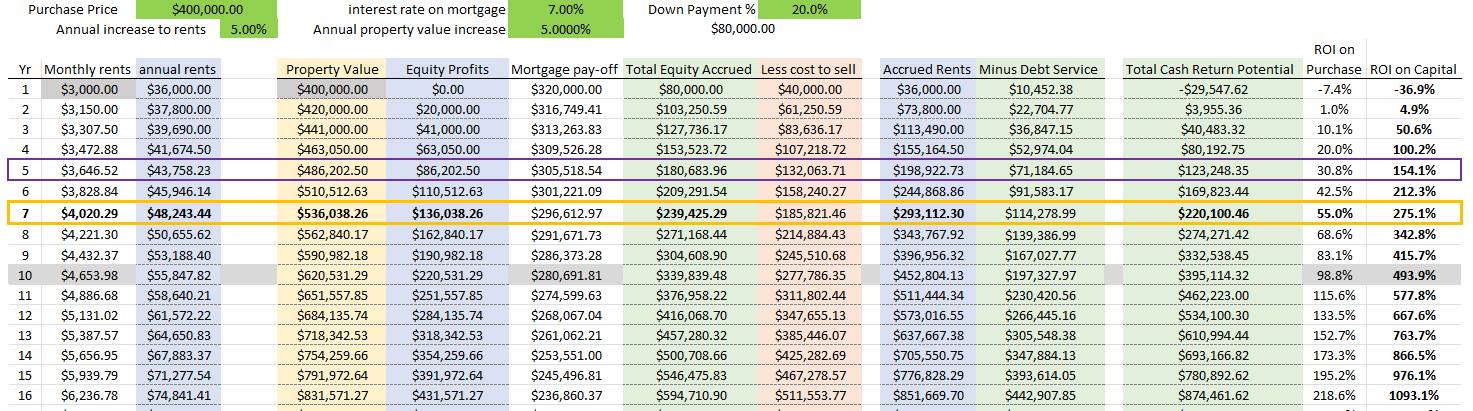
      I agree with your sentiment but am unaware of any market that has long term appreciation as high as 7%.  I am using since 2000 which includes the GFC.  Many markets may have over 7% if starting after that.   Using since the year 2000 (source neighborhoodscout), San Fran may have been above 7% before the work from home batted its appreciation.  LA is over 6%.  My market San Diego is near 6%.   No market that I have looked at is over 7% going back to the year 2000 and only a few I have seen is over 6% since the year 2000.

      The 1% or even 2% appreciation lower (I consider markets over 5% since the year 2000 to be high appreciation markets) adds a bit of time to hit cash neutral but on a leveraged purchase the appreciation alone whoops the low inflation total return. At 20% LTV, 5% appreciation is a 25% return on initial equity (I do realize there are transaction costs, but that is true in both markets). On your $300k example, 80% LTV means initial equity of $60k. 5% appreciation is $15k. The appreciation is $1,250/month. if I subtract the -$500 month cash flow in your example, that is $750/month return in year 1 without including equity pay down and tax benefits which are comparable in both markets. Note the appreciation and rent growth are compounding functions meaning year 1 is the worst year. Anyone other than Mike think he can generate $750/month return after expenses on a $300k purchase in the cheap markets on a high leverage purchase? If they do they likely need some lessons in underwriting.

      the math going backwards is clear.   However near term some of those traditional low appreciation markets have experienced appreciation comparable to many of the traditional higher appreciation markets.  @Dave Meyer I believe did a post on this a few months ago.   I am sure it can be found easily.  The time span was too short to indicate much other than the traditional cheap markets have been competive in appreciation recently with traditional high appreciation markets.   If it continues, the line is blurred between high appreciation and low appreciation markets.  Can Detroit be a high appreciation market?  Time will tell. @James Hamling I have seen at least one of your posts indicate, paraphrasing, that the goal is not to purchase the markets that have experienced the high appreciation but the markets that are going to experience the high appreciation. That certainly is the goal, but much easier said than done.  I look at my market dynamics/metrics and it looks likely to continue to have high appreciation but it is not guaranteed.

      Fortunately my primary market has had very good appreciation and rent growth since my purchases. But there is a reason I have not purchased in 3 years in my market (I have put out only a few offers in my market in those 3 years). There are challenges to purchase properties that meet my lofty return expectations. Getting an infinite return that does not bleed cash after a high LTV value extract is near impossible (a unicorn find). I historically was able to find these. I do not invest in RE as the primary for a 20% IRR (possible exception for a vacation home). I would be very happy with 20%/year as LP where the investment is passive. I am spoiled by a different time (2010 to 2022 had a lot of opportunity in RE, the present is more challenging).


      best wishes


      I suggest first stripping out any "exceptional" data segments if want to get any chance of accuracy in analysis. For me that means I look pre-GFC, and post GFC - COVID. 

      GFC was a once in 100+ yr thing, so it's gonna skew data. Same with covid. So one has to separate out such things, keep them in their own window of perspectives. 

      Next, keep in mind I said an average appreciation rate. If you get 10%, 2%, 4.5%, 12%, 1%, in the context of investing which means over a duration of time, we don't get hyper fixated on any 1 years results and instead we focus on how 5, 10, 20etc years of things comes out. 

      Much of what I do is a 7yr window. Given this cycle of economy, achieving an averaged 5% appreciation on asset's looks to be a rather non-special bar to achieve. We are in the age of inflation, keep that in mind. Inflation via many many mechanisms. What Bessent has presented for future plans is an inflationary action. What POTUS presents is also inflationary. The demands of national debt presents inflationary resolves. All directions point to inflation. 

      Inflation realized in real estate is appreciation. 

      Diminishing ability to buy/own a home vs rent, increasing tenant pool and tenant demand is an inflationary action. 

      Look, leverage or no leverage is a completely different conversation. What Mike put forward, besides being a complete violation of mathematics, is just bizarre. it's not different, it's saying 1+1= Llama. It's bizarre. 

      The front facing math alone proves appreciation wins. Add in depreciation, 1031, pyramiding, tenant quality, impact on operational expenses, this all just widens the victory gap appreciation holds into a grand canyon. 

      It's actually similar to the all-cash vs with leverage debate. 

      If one understands the math, leverage doesn't just beat out all-cash, it crushes it. But the math is not always readily understood. 

      And those debates also are lead via feelings vs facts. That holding all-cash "feels" safer. 

      Feelings vs facts. 

      There is a reason why when we invest it's a question of what do the #'s say, not how does it feel. 


      Interestingly enough Dan, when I stripped out the outlier data and took the longest data segment i could to peg "normalcy" for an average appreciation rate, what I got was: 

      Rents: 3.89%

      Property: 2.9395%

      Yes, this data includes a lot of post GFC data, because one has to, you can't just cut off 10yrs so it is arguably nerf'd down a bit. But I like to consider things conservatively and be surprised positively. 

      So looking forward, a 5% appreciation market is not really anything all that special. It's saying that the inflation cycle will be only 2pts more then "cheap money" past. 

      Post WWII debt deleverage says something very different than 2pts. 

      Now to those who say housing can only go up so far..... I say how do you cap out the price of lumber, wire, nails, Electricians, Plumbers, concrete, excavators, water 7 sewer...... As long as the cost of everything that goes into making housing is not capped, housing itself will not be a capped price. 

      The volume of sales, the % of person who can buy xyz housing, that will change but in an inflationary cycle, the cost of housing will increase. 

      This is why we see housing getting smaller and smaller again.

      Now also remember, every person priced out of ability to buy is an added tenant. Hence the long standing prediction of tenants becoming 60% vs the historical 40%. Or more. 

      Again, inflationary. 

      All signals are inflationary. A deflation would lower US exports, strain US imports, strain domestic economy. Big $ doesn't want that. Big $ and Big Power uniformly agrees inflation is far-far better than deflation. 

      So my bet is on inflation vs deflation. 


       >So looking forward, a 5% appreciation market is not really anything all that special. It's saying that the inflation cycle will be only 2pts more then "cheap money" past

      Looking at it as a 2 pt difference is one way to look at it, but to me the more appropriate way to look at it is 5% is over 67% higher than the average appreciation rate.  Note my market is almost 100% higher than your just less than 3% number.   LA is over 100% higher than your listed national appreciation.

      2 points added to 100 is a lot different (2% increase) than 2 points added to less 3 (over 67% increase).

      Next note those cheap markets are cheap because they are historically below that average appreciation.  Note Detroit appreciation this century is below 2% (lost value in inflation adjusted numbers) so my market is ~3x the appreciation of Detroit.

      I think Mike has some things to learn which will be challenging as he does not seem receptive to the information (or he is stuck trying to defend a subject line that is very wrong (at least historically)).  I can show the math or show by example the issue in his premise, but it is a case you can lead a horse to water ….

      I do find it interesting that your average rent growth is slightly higher than the average property appreciation.  My market is slightly reversed.   The appreciation has been slightly higher the rent growth.

      Best wishes

    • Real Estate Broker · Minneapolis, MN · Member since 2011 · 5k+ posts · 6k+ votes
      1y
      Quote from @Mike D.:
      Quote from @James Hamling:
      Quote from @Mike D.:
      Quote from @James Hamling:
      Quote from @Dan H.:
      Quote from @Mike D.:
      Quote from @Dan H.:
      Quote from @Mike D.:
      Quote from @Dan H.:
      Quote from @Mike D.:
      Quote from @Dan H.:
      Quote from @Mike D.:
      Quote from @Dan H.:
      Quote from @Mike D.:
      Quote from @Dan H.:
      Quote from @Mike D.:
      Quote from @Dan H.:
      Quote from @Mike D.:
      Quote from @Dan H.:

      Case Shiller used to publish a list with total residential return for this century.  The top of the list was all high appreciation markets.   The bottom of the list was comprised of high initial cash flow properties.   What the list showed was a strong correlation between appreciation and cash flow over a long hold.   The list showed a poor correlation between long term cash flow and initial cash flow.

      I invite you to run your numbers at 80% LTV using that extra down payment to deal with any initial negative cash flow. Use the appreciation and rent growth for this century on each city. Basically the case shiller data without the effort of determining local property tax, maintenance, PM rates, etc..

      In have been investing in my San Diego market for many years. I have purchased with poor timing and great timing.  My worse appreciating property has appreciated $2700/month over its hold ($47k down and closing).  My best appreciating properties have appreciated over $10k/month over their hold.  I suspect that virtually all residential RE in my market will have numbers between my best and worse case.

      Knowing the San Diego appreciation rate (almost 6%/year for this century per neighborhoodscout) how do you think the rent growth has been?

      With time the market with the higher rent growth will always have higher cash flow than the higher initial cash flow market that has lower rent growth.  It is basic math,

      So the high appreciation market has historically produced both better appreciation numbers and better long term cash flow than the low value markets.  This is easy to verify and I believe most experienced investors ecognize this. I recognize past history is not necessarily an indicator of future performance but the metrics on my San Diego market still look promising.

      My view is the low cost markets are best served by local RE investors who know the nuances of the area.

      Best wishes

      Dan and I have had some exchanges in the past about this and I have no doubt he has carefully thought through what he is doing and has some strategies that work well. To be really honest, I don't think this is one. His forceful objections to almost every aspect of what I'm doing have also helped me think through things and grow. So here is a contribution back:

      Okay, running the numbers at 80% LTV sounds interesting. If you do it for Austin, leaving all the other numbers from the initial example the same, you'd have a $2129 monthly payment on a 30 year loan with 7% interest, so -$14,296 negative cashflow. Since you are capturing the full appreciation on the property with a lower down payment, $80k, and since you now have larger principal paydown ($3251 in the first year), your return is now: cashflow -$14,296, principal paydown $3251, appreciation $28,000 = $16,955/$80,000 = 21.2% return. So far it looks good. So far.

      And yes, you could now stick a very large amount of money in reserves to deal with the negative cashflow. Not sure what kind of rent growth you're proposing but let's say 5%. I used a spreadsheet that I had whipped up previously to figure out how much total you're going to need in reserves before the property starts cashflowing and was surprised to find that it still wouldn't be cashflowing after 20 years (!) and over those 20 years it would incur negative cashflow of more than $217k. The rest of the down payment you were going to put away in my example is only $145k, but that money grows at some kind of rate over the years so I suppose it would end up being enough to make up for all the negative cashflow this property would ever incur.

      Even so, several large issues:
      - The opportunity cost on the $145k is major. Since this is your reserve fund, you definitely have to keep it invested in something safe which will probably barely beat inflation. Let's be generous and say you make 5% on it. So, dealing only with the first  year of doing this, you make $16,955 from the house and $7,250 from your reserves, or a total gain of $24,205 on a total investment of $225,000 or 10.8% return. Again, that's making several generous assumptions, and the return continues dropping year over year, which leads to the second problem.
      - By the time your cashflow is inching closer to $0, your return on equity is bad, like below 10%.
      - You are burdening yourself with negative cashflow for years when you could be in a different market with a higher return making cashflow which you can actually use to go to the grocery store and eat.
      - Returns from appreciation are more volatile than cashflow in general and after going through this torture for years it is possible you could see very little payoff.

      So, I don't see why someone would do this. I don't have access to the Case Shiller data you mentioned so I made some other assumptions that might be different. I'd also be interested in hearing if I misinterpreted something about what your idea was.

      I agree with the thesis that high appreciation markets will eventually produce "better" (at least higher) long term cashflow because rent grows faster as well, but it takes a very long time and comes at the cost of low return on equity, to the point that you'd be better off selling out and going into other investments such as a stock/bond portfolio. You also have to consider the opportunity cost in the years when you're waiting for the cashflow to materialize.

      I do not know if you switched numbers from your OP or if your calculation on time span to positive cash flow is off.

      You show a negative $328/month on $2200 rent.

      Without compounding (with compounding it would be better and take less time to achieve positive cash flow) using your rent growth percentage

      1.05 ** years * $2200 - $2200 is the rent

      at 5 years

      1.05 ** 5 * $2200 - $2200 = $607.82 which is likely enough greater $328 to compensate for expenses other than P&i having risen (basically inflation on the non fixed costs).

      >Since this is your reserve fund, you definitely have to keep it invested in something safe which will probably barely beat inflation. Let's be generous and say you make 5% on it. So, dealing only with the first year of doing this, you make $16,955 from the house and $7,250 from your reserves, or a total gain of $24,205 on a total investment of $225,000 or 10.8% return. Again, that's making several generous assumptions, and the return continues dropping year over year, which leads to the second problem.

      There are many ways to manage risk.   I believe high diversification reduces risk.  I think only a very conservative investor would have more than a year of safe, liquid reserves (money market, etc).   So your reserve scenario does not match most investor’s approach.  I do agree that the reserves should not all be in one asset class; that is too risky.   But an investor has a year or so liquid and substantial other investment in other classes besides RE, they have a more robust plan than someone relying solely on cash flow.

      >By the time your cashflow is inching closer to $0, your return on equity is bad, like below 10%.

      what ends up typically occurring is money is extracted before is gets to a 50% LTV to leverage the capital elsewhere reverting the cash flow. I virtually always have used 30 year fixed loans once stabilized for their safety but I have yet to hold a loan 10 years. With the rate increases that started q2 2022, there is a chance that I will finally hold one of these loans over 10 years.

      My worse appreciating property has appreciated $2700/month over its hold.  It never had negative cash flow but even if it did, it could not impact the return significantly.   I purchased for $47k out of pocket including closing costs.  My best appreciating properties have appreciated over $10k/month over their hold.   One of these did have initial negative cash flow at purchase (quite large negative cash flow), but in less than 3 years it had positive cash flow.  The negative cash flow was always inconsequential compared to the value increase.

      I do believe the low cost markets are appropriate for local investors.   Long distance investors should seek higher quality assets.

      Good luck


      Hey Dan, so when you say the cashflow goes positive in the fifth year, something is off there. You must not be using the new P+I for 80% LTV--it's $2129 and there's more than $14k negative cashflow in the first year. So, an extra $608 a month doesn't come close to smoothing that out. Some wires got crossed somewhere.

      It seems that a sophisticated, very wealthy operator could possibly implement your strategy--say they had some stream of cash from something else that they didn't need and could funnel into this, removing the need to keep reserves--but for the average person, even the average millionaire, it would be insane. You suggested keeping reserves, but I suspect that if you yourself use this strategy you are doing something different.

      I guess I should have said my strategy is not for billionaires!

       >Some wires got crossed somewhere.


      possibly.  In the original post you indicated -$328 cash flow under Austin.  Was this not correct?  Was it a subset of the cash flow?   Maybe there was a typo.  It is the number I used.

      In San Diego it is common to see projected rent to selling price ratios of ~0.5%. However, these are not typically what is being purchased by investors or if they are it is because they plan on doing a rehab and significantly raising the rent (a value add). The purchases that have those ratios without the value add and a projected rent increase are virtually all OO purchases. I suspect this is the case in virtually all lower cash flow markets. I have never purchased in my market without at least a projected 0.7% stabilized monthly rent ratio, including the cost of value add in the property cost. Since the rates increase, my underwriting shows 0.7% ratio is cash flow negative at high LTV in my market (while being far superior to the rent ratios that would occur on OO purchases).

      I question if your large negative cash flow is mostly derived using stats that include OO purchases. I know if this was done on my San Diego market, it would depict a far worse cash flow than the already bad cash flow that investors are obtaining. I find it unlikely that Austin investors are regularly purchasing investment properties that project negative $1,167/month cash flow (even though my last purchase my underwriting showed a little worse than this per unit (4 units), but it had value add and positive cash flow was achieved in less than 3 years).

      Do you believe Austin RE investors are buying at a projected negative $1,167/month?  I think it is unlikely.

      I will also point out that if I purchased in my market a property that was negative $1,167, my worse monthly appreciation property is $2700/month.  $2700 - $1167 =$1,533.00 monthly return not including equity paydown and that is my worse monthly appreciating property.  My best is up ~$1m in 3.5 years.  $1m/40 is $25k/month (by the way it is the same property that had the horrendous cash flow at purchase that I mentioned earlier in this post).   Tough to make $25k/month in cash flow with less than 5 units.

      by the way my underwriting does not show those cheap markets to have cash flow anywhere near the projections of those investing there.   In general the investors grossly under estimate maintenance/cap ex, do not depict anything for PM and sometimes grossly under represent vacancy/uncollected rent.  I saw a post recently that showed $86/month maintenance/cap ex and a vacancy rate of one quarter the city’s vacancy rate.   The $86 was 10% of rent and is at least a factor of 3 low for sustaining maintenance/cap ex on that unit.   I asked where he got the number and got an initial reply that he had calculated it via cost and lifetime.  It was clear he used 10%.  I called him on it and did not get a response. I asked how he justified using vacancy of 25% of the city’s vacancy rate and got a reply that he was in the suburbs with lower vacancy.  I believe he could have lower vacancy, but 75% lower seems unlikely.  Certainly it seems to be very aggressive underwriting.  I pointed out he had no entry for uncollected rent so his 5% vacancy was covering both.  This is the quality of the underwriting I see regularly in low rent markets.  This under writing is unlikely to be sustainable over any reasonable length hold.

      There are challenges in RE everywhere and I believe those in low cost markets should start there (but in the upper half of the price range of that market).   I do not believe these markets are likely to produce the returns that OOS investors seek.

      Good luck


      Hey Dan, I found the mistake here--the $328 is the *annual* cashflow for Austin. Everything I've written is with that in mind.

      I understand that basically what you're saying is that an investor in Austin is unlikely to buy a single family home in that price range. I don't know about the logic of other investors--I've seen people on the board buying houses like that--but that would be my logic as well. So if you want to redo both examples using small multifamily, that's fair, but I think you'll find the same principle applies. Comparing apples to apples, the small multifamily property in Memphis is going to have a much higher rent to selling price ratio than the one in Austin, and I don't think the scale of the return of the Austin property to the Memphis one would change much.

      I know that your underwriting shows that investing in cheap markets is very unprofitable--we've discussed that before. On my actual investments, which are small multifamily in the Midwest, I get about $100 a month per unit in maintenance and capex, so a duplex would have about $200 a month. The $86 seems low to me but it's not wildly off. I'm basing this on actual records I keep for my own investments using several years of data. I'm not sure about the way that most people invest because the way most people invest is probably irresponsible, honestly. There are plenty of people who buy junk turnkey properties from lying, cheating providers and lose their shirts.

      My point about the investment that's -$1167 a month is this. It's not suitable for most people. If they have to keep reserves, like I said before, it creates way too much idle cash and the overall return on the reserves + the property itself is low, making the investment unattractive. If they have an income stream say from a company that they want to funnel into that to deal with the negative cashflow, okay, sure, that person is at a level where what I'm saying no longer applies.


       >Memphis is going to have a much higher rent to selling price ratio than the one in Austin, and I don't think the scale of the return of the Austin property to the Memphis one would change much.

      On day 1 yes.  The case Shiller data showed over long holds the cash flow to purchase cost was highest in the highest appreciating markets.  The BP released data that was much shorter in duration (i believe it was an 8 year span) was showing the trend.   For example in the 8 years San Diego went from a poor cash flow at purchase to having a total cash flow somewhere near the middle.   The cash flow in those 8 years was near the middle.  The appreciation was near the top.  A longer time span on that BP data would have shown continuing improvement of the San Diego cash flow.  The math shows the higher rent growth market will have the better cash flow with time.


      >my actual investments, which are small multifamily in the Midwest, I get about $100 a month per unit in maintenance and capex, so a duplex would have about $200 a month.  

      Using actuals does not accurately reflect future cap/ex.  Large cap ex have long lifespans.  How many sewers have you needed to replumb?  Kitchens replaced?  Roofs replaced?  Fences replaced?  Etc.  Even the electrical and hardscape have a lifespan.  I guarantee you did not get this $100/month using lifespan and replacement costs on all items associated with the property (true sustained maintenance/cap ex costs).   $86/month (and your $100/month) is way too low if allocating sustained costs.  I invite you to create a spreadsheet to determine your sustained costs.  In my market we have more costly water heaters (low NOX) and high labor costs.  It is $1600 to replace at reasonable cost (some plumbers charge a lot more) which I suspect t is quite a bit more than your market.  1600/10 (my expected lifespan in years)/12 (months in a year).   The cap ex on the water heater is $13.34/month in my market.  Note including the maintenance it is a little higher as pilot lighting, thermostat coupler replacement, occasionally replace a burner under warranty, an anode replacement, etc.  do this on all items including the supplied appliances and yard and you will see $100 is way too low even if that is based on your current actuals.

      I believe your cash flow projected numbers are very incorrect because I believe you included all the OO purchases in your average purchase price and only the rentals in your rent points. OO in general are larger and more costly by a wide margin than the average rental. If these OO properties were actually rented, it would drive up the average/median rent. So question is how did you determine the average cost of RE purchase? Am. I correct that it includes all the OO? Then recognize the volume of OO versus investor purchases and OO would skew the numbers further. I suspect virtually no Austin RE investor is purchasing projecting a stabilized $1167/month negative. As indicated, I recently purchased a property that at purchase had large negative cash flow. My stabilized cash flow was slightly positive if rents were flat. I just finished stabilization ~6 months ago. My stabalized rent on my underwriting without any rent growth was just over $15k. With rent growth $17.4k and increasing with each tenant renewal.

      I do not believe anyone is using your reserve model (including those without income stream to supplement the negative cash flow) but I will admit some (maybe many) are using a reserve model that may be aggressive.  I keep less than 1% of my networth liquid.   However I am diversified into 3 very Different asset classes and the stock asset class is diversified within stocks.  I have little liquid compared to my RE holdings.   I guarantee that I am better able to survive a GFC type event than a very large percentage of RE investors.  I recognize not everyone can diversify into 3 different investment categories to diversify risk but they are not keeping liquid reserves that cover all negative cash flow until they achieve positive cash flow.  My belief is if they have diversified reserves (not necessarily liquid) to cover no income for a year, they are far better prepared to weather a GFC like event than most RE investments. 

      The historic data is clear that the high appreciation markets have out performed the cheap markets (the case Shiller data clearly showed this, the BP data was on its way to showing this) .  It is why you are getting such push back from experienced investors.   The question is what will occur going forward.   No one knows but I believe in general the high appreciating markets will continue to out perform the cheap markets.


      good luck


      Let me get started with a key point that this discussion has been helping me to formulate: it can be said that high appreciation markets outperform less expensive ones based purely on appreciation and rent growth, but it's a moot point. The key thing this does not consider is use of leverage. A small investor can generate a higher total return in low appreciation, high cashflow markets by using leverage.

      Now I'm going to go off topic. I've had this discussion (about my capex and maintenance numbers) before on the board with others. Again, OFF TOPIC. I like discussing things like this so I will do it but it does not affect my examples either way. Nobody said my capex and expenses were low in the examples, because I used higher numbers that I know are more typical.

      My accounting isn't sloppy. I've had this pushback from several people, so I'm starting to understand that my numbers are unusual. $200 a month (actually I'm at a hair more) is not fake or wrong. I'm confident this can be replicated, at least doing things the way I do it. And yes, just to see if I'd had an exceptional run of years, I have separated out the capex, assumed everything is going to break on the typical schedule, plugged in the prices I pay for those things, and it comes out the same. So what it comes down to is I'm paying less for that stuff than what is typical. I rarely do any maintenance now, but at one time I did all of it so I know how to do stuff. I use people from Taskrabbit, who are extremely affordable, as well as people I know, and I don't let my management company do a single thing. I have systems for checking everything they do and making sure it's up to standards. So, I will come right out and say I get that these numbers are not *typical* but they are *possible*, because I am getting them right now. If you are laid back and a little sloppy then maybe it's double? I don't know. That's all I can say about it. Again, before somebody jumps down my throat, this is *not relevant* to the concept at hand. OFF TOPIC OFF TOPIC OFF TOPIC. Nobody said my examples were wrong because I didn't use my numbers but ones that are more typical. We are not talking about the larger concept. Okay, that's over.

      So again, for sure, the high appreciating markets *will* have the higher cashflow over time, but with lower total return. Then why stay there?

      Honestly, I don't say people can't use appreciation markets to power their purchases of cash flow properties. I'm sure that's worked for many people. But the fact is that, given you can get a higher return on your equity in low appreciation markets, all other things being equal, you'd might as well do everything there. I mean do you want an 11% return or a 23% return? Take the 23% return, don't spend the cashflow and use *that* to buy more cashflow. It may be an unusual way to do it but nobody has shown that it won't work. Why not think outside the box a little? I definitely wanted to hear from experienced investors and that's why I posted this. What I'm generally hearing is a few assumptions need to be tweaked but I think the majority of people have said, if grudgingly, that the concept seems valid. Believe me, my sincere intent is ultimately to learn. This is me forming my own investment approach, and if I can find a way to do it better, or if someone corrects me, I'll change direction. I don't mean just "you are so misguided you are a fool you are an xyz"--I don't care about that if there's nothing to back it up. I care about investing well.

      My theory about where a lot of the pushback is coming from? This isn't how institutions do it. So everybody looks to the level above them thinking they should be doing it that way, without realizing maybe they *shouldn't* be doing it that way. Institutions have swayed markets and set cap rates to their standards, but small investors with leverage can go to markets they don't go to and make money. Ultimately the proof will be in the pudding. I am using this approach--it's been working fine---and I plan to keep using it. I thought about buying some property in Phoenix or Nashville or somewhere and rejected the idea for the exact reasons here. The return on investment/equity is just lower with the amounts you'd have to invest to cashflow, and I don't want to take on negative cashflow. So why go there?

      I think that what you are edging around saying is maybe the biggest possible objection to this approach and the best argument in favor of high appreciation markets. If you do *value add* there, they can take you somewhere. So I will agree, for someone who is reasonable and not just a crowd-follower and actually looking at their numbers, they'll realize they *shouldn't* buy the house in Austin that I used in my example, like you've been saying, and they'll do a value add project in Austin instead. There is absolutely no reason for a passive investor to buy that house. Or, all other things being equal, anything in Austin at all.

      Yeah, so now I see you're saying that you wouldn't actually use reserves in that way. Agree with the approach to reserves.


       > it can be said that high appreciation markets outperform less expensive ones based purely on appreciation and rent growth, but it's a moot point. The key thing this does not consider is use of leverage. A small investor can generate a higher total return in low appreciation, high cashflow markets by using leverage.


      I am 100% missing what you say here. I can get the same LTV in both markets (excluding the real cheap stuff that is hard to finance). I can more easily get equity line of credit on high value assets. My cost to extract (closing costs) is lower as a percentage on high value assets. I cannot think of one way that low value assets are easier to leverage. I cannot think of a few ways high value assets are easier to leverage.

      > I have separated out the capex, assumed everything is going to break on the typical schedule, plugged in the prices I pay for those things, and it comes out the same. So what it comes down to is I'm paying less for that stuff than what is typical. I rarely do any maintenance now, but at one time I did all of it so I know how to do stuff. I use people from Taskrabbit …

      I invite you to post your lifespan and costs on these cap ex items into this thread.  A tad over $200/month is not including all sustained expense.  The most recent I did was interior only (condo).  It was a new market to market to me, I ran my numbers by @Pete Appezzato (with STS/Exp) and incorporated his feed back.  My interior only number was significantly higher than your total cost.  In my market I have dedicated maintenance staff and my small attached unit maintenance/cap ex cost is $300/month.  Detached is higher.  

      >The return on investment/equity is just lower with the amounts you'd have to invest to cashflow, and I don't want to take on negative cashflow. So why go there?

      I think the market is much more challenging than prior to q2 2022.  I agree with you comment at purchase.  Historically your statement valid in high appreciation markets in incorrect as the hold length increases. In general it takes active value add, patience, a sophisticated value add, alternative financing, or a far below value purchase.  I understand high appreciation markets not being ideal for everyone.

      >fact is that, given you can get a higher return on your equity in low appreciation markets, all other things being equal, you'd might as well do everything there.

      Historically the cheap markets has not produced a better return on equity.  Case Shiller showed this.  Unless you have as reputable source that shows otherwise I view it we know what has done better historically.  We do not know what will do better going forward.  I view it similar to growth versus income stocks.   Note if I purchased Amazon circa 2000 it was losing money but its valuation was far above Barnes and noble, many if not all of the large car manufactures.   Why?   Growth potential.  One needs to evaluate ROE, but not primarily against its cash fliw (doing so would be compare to an income stocks but it is more akin to a growth stock) but against its overall projected returns just as you old do for a growth stock. 

      >Ultimately the proof will be in the pudding. I am using this approach--it's been working fine---and I plan to keep using it

      I think you can do fine anywhere.   However you indicated build your net worth twice as fast as an appreciating market.  I will offer you to pick any one of my San Diego area purchases from my profile or either of the two acquisitions I made in Dec 2021 that are not in my profile.  I will provide price, down, current value, current rent.    I will include appreciation per month of hold.   It will give you something to view what I have obtained in my high appreciation market.  I have already indicated my appreciation on hold varies from a low of $2700/month (total out of pocket including closing costs was $47k) to almost $25k/month.  This is what is possible in high appreciation markets.

      >someone who is reasonable and not just a crowd-follower and actually looking at their numbers, they'll realize they *shouldn't* buy the house in Austin that I used in my example, like you've been saying, and they'll do a value add project in Austin instead.

      even though I have requested it, you have not provided how you obtained the value of the investor purchase in Austin or elsewhere. I believe you included all the OO purchases in your property value and that your calculations regarding initial cash flow are very inaccurate. I hope you can see how this would skew the numbers. If I am correct that you used all the OO purchases in property purchase price it would explain how your calculations on cash flow are so absurd. People seldom purchase the highest priced homes as rentals. The properties investors purchase have to make sense as investments. Virtually no investor would purchase your Austin example property, suggesting that is what investors are purchasing to make your case is faulty.

      a lot of successful investors have indicated their experience is your hypothesis has historically been false (also indicated by the Case Shiller data and the BP data was going in that direction). 

      This does not Imply what the future will hold.  It certainly does not imply that you cannot do well being a smart investor in a high initial cash flow market.  I personally think most RE investors are best served by investing in a market close to them which is what you have done.

      I question if at this point you still believe your hypothesis.   I really do not see how someone with an open mind would still be pushing that hypothesis.

      Good luck

      Hey Dan. Yeah, I believe this, lol.

      Anyway, my first paragraph is referring to the return on equity being better in less expensive markets. I know you go into major negative cashflow in order to capture appreciation that is (or at least has been) high in San Diego, and I don't dispute that this can be done profitably, if you can stomach it, though the volatility is very great and it's not for everybody. Part of my premise was that you wouldn't go into negative cashflow. So, assuming you put down enough to cashflow in say San Diego and also in Memphis, the amount is much larger in San Diego, right? Not only is it larger, it's a larger *percentage* of the property's value. Now, assuming modest appreciation, calculate the total return on that down payment, including cashflow, principal accumulation, and appreciation. Unless you go into negative cashflow, and I understand that you personally do do that, the return as a percentage is always greater in the less expensive, higher cap rate markets. It doesn't matter that the appreciation is less. That's basically just me restating my first post.

      Now, we're going off topic again, but I'll go there. I'm just marking this paragraph off again. This does not have to do with my main point and has to do with Dan's questions about my capex numbers. Let's get a rough cost per unit on major capex items for a duplex in the Midwest. A roof lasts say 25 years, right? I expect to spend around $9k for a roof and that covers two units so that's $180/unit/year. A water heater might last 12.5 years and I can get one for $1000. $80/unit/year. Furnaces last maybe 17.5 years and I can get one for $2k. $114/unit/year. Appliances, I do end up replacing them a lot. That probably averages $100/unit/year. Windows? Honestly I have seen windows last 100 years and I rarely replace them. I have never had to do any foundation work. Although flooring, paint, kitchen and bathroom items are technically capex I factor them into turns and I gave those expenses separately. So, adding up all the capex expenses I just gave, we're at $474/unit/year, so just under $1k for a duplex. I don't have time right now to do this in totally granular detail but that will give you a rough idea of where this number comes from. Again, I am a major cost cutter and this cannot be achieved without effort. If you just call some contractor you could easily pay double or more for all this stuff. I'm buying used appliances, I have an affordable HVAC guy, etc. I have the feeling that most people invest in what to me is a very lazy way. With a few phone calls, and also by building relationships over time, these numbers are possible in the Midwest.

      I would like to see the Case Shiller information you are mentioning. I think it must be showing returns assuming that everything was purchased in cash. Of course appreciation rates are higher in low cap rate markets and they've been valued the way they have because institutions purchase them with low or no leverage. Are they really showing return on equity using leverage? I'd be really surprised if they're doing that and showing high appreciation markets come out ahead. The math shows they don't, and anybody can duplicate that math. Why wouldn't it be fair to include cashflow in ROE?

      Yes, sure, I'd like to see the numbers for a San Diego purchase. Is this a passive investment? Because if we're talking value add, that's outside what I'm talking about. I'm sure you can do well if you are actively involved. But that's a different ballgame.

      How did I obtain the value of the investor purchase in Austin? By looking at the MLS in Austin and seeing what a modest single family home costs. I think my projections of revenue are close to reality, however this is a market that I don't invest in so I don't claim it's perfect. It can be confirmed by going on realtor.com, looking up some modest single family homes on the MLS, and then looking up rental listings for the same. I think you will find my example is reasonable.

      Again, no doubt appreciation and rent growth is higher in Sun Belt markets, but if you can't capture that gain without putting down tons and tons of money, your overall return as a percentage is lower. And who doesn't want the higher percentage? All other things being equal.


       >Part of my premise was that you wouldn't go into negative cashflow. So, assuming you put down enough to cashflow in say San Diego and also in Memphis, the amount is much larger in San Diego, right? Not only is it larger, it's a larger *percentage* of the property's value.

      I now understand what you were saying. However, I am unsure even at the lower leverage point that historically the higher appreciation markets still have not out performed the lower appreciation market. Let's for example use San Diego (5.74%) versus Detroit (1.98%) or Cleveland (2.45%) for this century (source neighborhoodscout). If I put double percentage down so 60% LTV versus 80 LTV my gain as a percentage from appreciation has still out produced them and my cash flow due to higher rent growth has out produced them. So thinking the ROE is worse even with less leverage is certainly not universally true.

      However the mathematics of using a lower LTV to increase initial cash flow is poor in higher appreciation markets. This does not stop people from suggesting it and maybe some less experienced investors choosing it without a full understanding of the numbers.

      Your cap ex items is missing a lot of items such as kitchens, bathrooms.   Also my market only has windows close to 100 years if the property is classified historic.   Those old windows need a lot of maintenance and would be cheaper if they had been replaced by vinyl.  Fencing, landscaping.  Sewer.  Electrical.   Knob and tube.   Fused breaker boxes.  Virtually everything on a property has a lifespan.

      All cash purchase would reduce the appreciation benefit. It would hurt the high appreciation markets more than the low appreciation markets.  The case Shiller data used high investor leverage in the calcs but it did not matter as the 3 top cities were all near the top in cash flow since the start of the century (they would have been real high on the list based on their rent growth) and near the top for appreciation.  San Fran was the top city at the last data I saw but its appreciation took a hit when work from home increased (so I do not believe they would be the top today).

      Here is an example of why the appreciation markets have outstanding cash flow if there has been no extraction of value. San Francisco's average rent in year 2000 was $977 (not sure of number of BR). Apartments.com lists current 2 br average apartment as $4218. Note SFH are mush higher.

      $4218 - 977 =$3,241.00  month increase of rent  

      $3241/25 =$129.64 average annual increase.  In reality it started with lower than this average and has been higher than this average recently.

      Clearly a 2 br apartment unit purchased in San Francisco in the year 2000 would have produced crazy cash flow without any extraction of value SFH would be far greater cash flow. You could do this with any of the cities with high appreciation numbers for this century and you would see the same thing It is because there is a tight coupling of long term cash flow and appreciation. There is not a strong coupling of long term cash flow and initial cash flow.


      >Yes, sure, I'd like to see the numbers for a San Diego purchase. Is this a passive investment?

      I have one property that had no upgrade value add (I do not consider residential RE passive but this has been about as passive as it gets, one unit has turned twice, 3 units have original tenants).

      Purchase in Dec 2020 for $640k including bird dog fee ($625k + $15k birddog fee). I used 80% LTV at 2.75% (I wish this was still available), 30 year but including bird dog fee would be a little lower than 80% LTV. Quad in Escondido. Worth ~$1.5m today (look at current quad values in Escondido, over 3700'). PITI $2982. Market rent $8725. Using 40% expense ratio w/o principle, cash flow $3,395. including principle pay down $4,468/month. Gain from appreciation $1.5m - $640k = $860k. $860k/55= $15.6k/month of appreciation. note rents are not high enough to achieve this return via cash flow even if 0% LTV. Note my birddog fee and down together was $148k. I do not remember the closing costs but I did not pay any points to get that loan.

      I am not claiming this was an average purchase. If you look in my profile, I think I referred to its rent ratio as a unicorn find for San Diego. A CA law that I knew about at purchase but was not yet reflected in pricing also allowed this unit to have appreciation far above the average even for San Diego. However, in general I have done BRRRRs. This is my non BRRRR purchase. It was my "passive" RE investment.

      >How did I obtain the value of the investor purchase in Austin?  By looking at the MLS in Austin and seeing what a modest single family home costs. I think my projections of revenue are close to reality, however this is a market that I don't invest in so I don't claim it's perfect. It can be confirmed by going on realtor.com, looking up some modest single family homes on the MLS, and then looking up rental listings for the same. I think you will find my example is reasonable.

      I do not find that method as reasonable. It is heavily factoring in OO purchases (what percentage of SFH do you think are OO purchases versus what percentage are not OO purchase?). I think this method would provide a misleading number in every market, but especially high priced markets. You use a property price that includes OO, but the rent is only of rentals. In general, the OO properties cost a lot more than what RE investors would pay and in general are nicer OO properties would rent for more than the average rent driving up the average rent. it is, however, what I believed you had done and why your negative cash flow estimate was as large as it was and likely worse than any investor would tolerate.

      >no doubt appreciation and rent growth is higher in Sun Belt markets, but if you can't capture that gain without putting down tons and tons of money, your overall return as a percentage is lower.

      If an RE investor chooses to use a lower LTV, it will impact their return. Even with the lower LTV, some high appreciation markets would still out produce some (many?) low appreciation markets as my examples showed. More importantly it is the investor's choice. Maybe they sleep better knowing rents cover all expenses. My last purchase I went max LTV even though using my numbers showed ~$5k/month negative (I had no problem sleeping). This was a value add and I knew that the negative cash flow would not last long. It now (3.5 years later) has decent cash flow (rent $17.6k, P&i ~$6.9k, piti ~$9.5k). It is also up in value almost $1m above purchase and value add costs. This was a value add, so not passive.

      Good luck


      Hey Dan, I went into this math in detail in my first post, but I doubt that 60% LTV is going to be enough to cashflow in San Diego. It certainly would not be enough in most cases today and I doubt it would have been in the past either. I have played around with these numbers quite a bit and believe that what I said in my first post is sound. It gives the example of a high cashflow, low appreciation market vs a low cashflow, high appreciation one and shows how return on equity is greater in the first, when both markets are paid down enough to casfhlow a tiny amount. Yes, the mathematics of using a lower LTV to increase initial cashflow is bad, so if you're going to do it, you have to go all in and deal with insane negative cashflow. Apparently you do this. I understand it can be done, but if you are setting aside enormous amounts of reserves for this you need to consider how much money you're keeping idle. The opportunity cost is extreme. On the other hand, if you are fortunate enough to be in a position where you have a lot of cashflow you don't spend or need for anything, by all means do this.

      I included the items you mentioned--kitchens, bathroom--in turns. A turn is technically pretty much capex, except for cleaning and trash out, but all this does is shift numbers from one column to the other. The ultimate return doesn't change. I think we're kind of quibbling over small stuff now. I don't believe there are any large holes in my numbers.

      Yes, I know high appreciation markets can have great cashflow if you let them sit for years and years because they have high rent growth. But go ahead and calculate the return on equity in those situations. You have so much idle money sitting there that the return as a percentage is probably not beating the stock market. James had an example like this of a class A property that he's getting good ROI on, but not good ROE. Part of what I'm pointing out here is the importance of return on equity. If your return on the equity you currently have in a property at any given point in time is not beating the stock market, that would be a pretty strong indication that you might want to pull that money out and do something else with it. I guarantee by the time you have crossed the line into great cashflow in a high appreciation market that your return on equity is low. I would not be motivated to invest in this way. Owning a property is a big administrative burden at the least. Even if it sits there and cashflows and appreciates, if your money is making 5-10%, why would you want to do that? I know there are many people who do.

      About your Escondido property, you must have gotten an incredibly smoking deal on the purchase price and it wasn't natural market appreciation which as far as I know in Escondido was nowhere near that. The numbers you mentioned would mean 20% market appreciation if that's where the gain came from. However it was achieved, here's the problem, that's looking back into the past. You told me yourself you're currently underwriting with flat appreciation over the next few years, but let's say it's 2% and calculate the return on equity now. The monthly appreciation would be $2,500 and you said cashflow and principal paydown together are $4,468 a month. That's a total of $6,968 a month or $83,616 a year. Given that your equity is around $900k, that's a 9.3% return on equity. Have you calculated that and are you happy with it? Then by all means proceed. But what my post was about was that far greater gain than that can be gotten in high cashflow, low appreciation markets.


       Prior to q2 2022 it was fairly easy to find cash flow positive purchases in San Diego.  They did not have day 1 cash flow comparable to the cheap markets because investment markets are efficient and build in items like expected appreciation, expected rent growth, risks including tenant risks, but they had positive cash flow. I have only purchased one property that projected negative cash flow at purchase.   Its value is up ~$1m in 3.5 years and has modest cash flow.  

      No smart investor handles the negative cash flow by having cash reserves that get them to the cash neutral state.   I keep saying this but you keep acting like this is how investors handle this risk.  It is as absurd as the subject of this post.

      Your calculation for return on equity is not one that anyone uses. IRR, COC, etc projections all use the future projected returns and not solely the initial returns. So your ROE calculation is very flawed and why you have a mistaken belief on which market has historically produced the better ROE. What do you call your ROE calculation that does not use any projection of future returns? An IRR calculation going back in time on pretty much any decent length calculation will show the high appreciation markets have out performed the low appreciation markets. Guess what! this is the same calculation as ROE at that time except is the actual return on the equity from that time (not a projection).

      you replace kitchen on tenant flips?  You replace bathrooms on tenant flips?   You do new electrical on tenant flips?   New roofs on tenant flips?   I offered to look at your spreadsheet of lifespan and costs.   I claim $200/unit is not near enough if allocating for sustained maintenance/cap ex on all items.  Show me a spreadsheet with the costs and lifespan of all items that depict this.   The last one I did was interior only on an away market (so not using my staff) and it was ~$300/month and I incorporated the inputs from an agent in that market.  Low rent markets have a higher expense ratio than higher rent markets.   Your maintenance/cap ex is higher as a function of rent.  

      you keep going back to cash flow as though it is the only source of return.   I have positive cash flow on all my properties and all but one (maybe 2) always projected positive cash flow but it does not matter.   I could have had negative $1k/month of cash flow over the hold and my irr if I exited would be outstanding.   This is because my lowest appreciating property is $2700/month.  If I subtracted $1k/month off it would be $1700/month return on an initial investment of $47k.   Note this is my worse.  I have at least 3 properties with over $10k/month of appreciation over their hold.  Not sure you concentration on cash flow as the source of return.  The reality however is the high appreciation istion markets historically have the higher cash flow because of the tight coupling of appreciation and rent growth.   Look at the San Francisco rents I posted.  $3200/montn of rent growth this century ensures that San Francisco has experience better cash flow than any low appreciation market that you can find.  I challenge you to find one.   And if you thing San Fran is an outlier, look at San Diego, NYC, LA, Boston, etc.   they all had better cash flow for this century than the best low appreciation market you can find assuming no cash extracted.

      >About your Escondido property, you must have gotten an incredibly smoking deal on the purchase price and it wasn't natural market appreciation which as far as I know in Escondido was nowhere near that. The numbers you mentioned would mean 20% market appreciation if that's where the gain came from. However it was achieved, here's the problem, that's looking back into the past. You told me yourself you're currently underwriting with flat appreciation over the next few years, but let's say it's 2% and calculate the return on equity now.  

      I got a good deal, but there was a state law that had already been signed but that was not yet reflected in pricing that also contributed to this properties appreciation.


      >The monthly appreciation would be $2,500 and you said cashflow and principal paydown together are $4,468 a month. That's a total of $6,968 a month or $83,616 a year. Given that your equity is around $900k, that's a 9.3% return on equity

      your calculation on roe is not a standard calculation as roe project the future projections. The roe calculation is correctly done as though you purchased the property today with the existing financing at the current LTV (meaning LTV today) . It includes the expected appreciation and expected rent growth (ideally with conservative numbers). You are correct for the last few years I have been using 0% appreciation for 5 years due to my desire to be conservative and my near term uncertainty. I have been using 5% at year 6 onwards in my market which is 0.75% lower than my market appreciation. I have been doing rent growth also conservatively ay 3% annually even though 5% is close to historical for this century in my market. However, my ROE is calculated at 10 year, 15 years, and 20 year exits. Even with my hopefully conservative underwriting my ROE calculations are far above 10%. I would not choose RE investing if I was only projecting 10% return. That is virtually the same as the lifetime s&p500 which is much more passive. The return from REI must compensate for the work and risks. 10% (or 9.3%) is not nearly sufficient. In general I have achieve infinite ROI on my investment properties (all but 2). I demand my ROE be far higher than the S&P 500. On that Escondido quad it is far over twice as high (I recently ran numbers on this property for ROI and IRR was in the 70% a year if I exit in 10 years. It would be higher per year if I exited today implying the next 10 years are below 70% per year).

      Good luck


      I thought we were getting close to an understanding but there are some major misunderstandings of what I'm saying here.

      I see that you want to use this San Diego example plugging in its increase in value as if it were market appreciation, but that's a false premise. You got a good deal and did something with this property that you haven't fully described to get its value to increase. If you don't want to calculate ROE based on a projection, then you can go back one year and we can assume that your value add was completed by then and you were then benefiting from pure market appreciation. As far as I can see, property values depreciated slightly over the past year in Escondido. There was no appreciation. We'll say somehow your place didn't depreciate, so zero gain from appreciation, I don't know what your cashflow was but I assume it's grown a bit so maybe $3000 average monthly, principal paydown should have averaged $1025 a month over the past year, that is all the gain you had and the equity was $900k. That gives you a return of $48,300 a year or 5.4% ROE. Imagine if you were calculating ROE, then your projection of no appreciation would have led you exactly to this number and you could have chosen to extract your capital sooner. Or were you happy to invest at 5.4% for the past year? If you were, good.

      I'm sure your value add play, whatever it was, was good, but as a passive investment this doesn't seem that good to me and certainly does not rival what's available in other markets. I will make your argument for you more cleanly: you can get good returns in high appreciation markets through value add plays, and they can rival those available to passive investors in high cashflow markets. That's all you have to say, not try to use your value add gain as appreciation. It is very, very appropriate to calculate your return on equity at such time as your value add stuff is done. You could then sell that property and invest it in something else and that is a very important number that can show you when it would be advisable to do that.

      I'll repeat that. If you are done with your value add or whatever you were doing and are now holding a passive investment, it is absolutely appropriate and even crucial to evaluate what its return as a passive investment will be using ROE. If the return sucks, sell it and either recycle your capital into another value add project or put it into a better passive investment. To be direct, I think you held this place too long and should get rid of it now. Of course, you're the one in charge of your own money and I'm sure overall you've done well. It's also not the case that you don't have blind spots, and you're being very direct with me, so I'm doing the same.

      It doesn't bother me in the slightest if other people (that you know) don't do it like that. Dan, do you know that in kindergarten I insisted on holding my pencil in a way different than what they tried to teach and purposely wrote in all caps with many of the letters backward just because I wanted to? I knew exactly how I was expected to do it, read above my grade level and chose to do things that way because I wanted to. This is just the way I do things and I'm not an idiot like some people are trying to make me out to be. This type of thing has been going on a long time and I know people are threatened by people who do things differently and especially those who don't change when everybody makes a big fuss about it but I'm no fool and I'm doing this stuff this way for a good reason. It's very important for some here to think I have no experience at this and either don't have any actual investments or I'm going to go bankrupt tomorrow or a I'm an enormous fool. All that is false.

      Several posts ago, you absolutely suggested using reserves to cover the negative cashflow on a high LTV investment in an expensive market. I think you realized after I laid the numbers out that that doesn't work. But go back and look at your post. I have never exactly been sure what you're proposing doing instead of reserves. You vaguely described diversifying in other ways. You haven't said how exactly, but there is surely an opportunity cost attached to what you are doing and I am interested in finding out what it is and if the return really is that good when those opportunity costs are taken into account. The return is also incredibly volatile and the volatility itself will lower the percent return in addition to simply not putting money in your pocket as reliably as cashflow.

      I don't know why we're still going around and around about my capex numbers. I have enough properties and enough years on record that a kitchen is not going to implode tomorrow in a way I haven't accounted for. That is factored into turns. I gave you a list of major items and showed my numbers for them. If that isn't enough, then sadly that's how it's going to have to stay. I'm confident in my numbers and going deeper into them is going to be very time consuming and serve only to prove to you that they're right. They are right, and I'm sorry, I don't have the time to do it. If you want to think they're wrong, you can think so.

      I do not assume cashflow is the only source of return and the fact that you're saying that at this point makes me think that a lot of what I'm saying is being missed. To repeat, factor in cashflow, appreciation, and principal buildup. Assume you're not going to take on negative cashflow and you're using enough leverage to barely cashflow. Calculate your return on equity (highly advise you start doing so now) in high appreciation and low appreciation markets. The latter will win.

      To repeat, and it's not the first repetition, I know rent growth and appreciation are higher in high appreciation markets. This basic fact is not being disputed by anybody. Investors using leverage can gain higher percentage returns on their money in markets with better cashflow, simply because they can cashflow with less equity and therefore earn a much higher return on equity. It doesn't matter that cashflow and appreciation are better in NY, LA, Boston, etc., etc. Not unless you buy all properties in cash because you're an institution or someone with $100 million.


       >You got a good deal and did something with this property that you haven't fully described to get its value to increase

      I thought I explained it.  I did nothing to the property.  I knew a law had passed that would increase the value of this property.   No effort, no value added by me (the value was added by the state legislature). My first protege recently had land values in its current use at ~$1m.  He knew about a city law that made the property much more valuable with a different usage.  He sold the land with a different use at $1.5m to someone that would use the land for its highest value.   The city just (in the last month) changed the law to prevent what they legally were allowing and encouraging.   He did nothing to improve the property.

      In both cases we believed the value would increase due to laws passed.  It is little different than a new NP is established by congress.   You buy a little cabin just outside the park with the belief that the park will raise the value more than other areas.  You could be wrong and would possibly lose transaction costs at worse case.   If you right and the property outside the park appreciates double the rate it would have without the NP, you made a good investment.  

      I refer to these as sophisticated value adds meaning they are more about knowledge than work involved.  

      You are a little high on my principle paydown possibly because you included birddog fee into the loan but it was not) but a little low on my cash flow (but remember my expense estimate is far more conservative than you use). Oberall you are ~$300 low. Also remember I used 0% appreciation for last year in my ROE calculations before it was flattish in appreciation (my projection was fairly accurate). Not sure of your source showing it went down as most sources I see are slightly up, but flattish is fair. Even with that projection of zero appreciation last year, my ROE shows great (I do not calculate for anything less than 10 years). This is in part because my actual rent increase $395/month last year and because I show 5% appreciation starting in the future until end of time (until selling it). As indicated my lowest IRR was above 70%/year.


      >Several posts ago, you absolutely suggested using reserves to cover the negative cashflow on a high LTV investment in an expensive market. I think you realized after I laid the numbers out that that doesn't work.

      I did not. I did state to run the numbers using 80% LTV and using the money not placed into he property to cover any negative cash flow. 1) I did not state where this money would be held. 2) I certainly did not mean to keep all of it liquid. The numbers do work. I showed you in the last post even if I was $1k/month negative over the hold, my worse appreciating property still would have made $1700/month ($2700 - $1000) not including principle pay down or any tax benefits. My down and closing was $47k on this property. I did not need cash flow for it to have produced a great return. I have had decent cash flow on the property (and would have had good cash flow but equity was extracted twice from this property), but even with negative $1k cash flows month this return would beat many/most low appreciation markets.

      >I have never exactly been sure what you're proposing doing instead of reserves. You vaguely described diversifying in other ways. You haven't said how exactly, but there is surely an opportunity cost attached to what you are doing and I am interested in finding out what it is and if the return really is that good when those opportunity costs are taken into account.

      As long as the reserves are not placed in RE, you have diversified and reduced risks.  there are literally infinite options, but having more than 6 months liquid reserves are very conservative and certainly not my recommendation.   I did real well with mineral rights before I did well in real estate.  Again it was a knowledge play as fracking was starting to be heavily incorporated but people were selling on valuations that did not include the production increases that could result.  I went all in (except for home, job, and 401k, everything I had liquid and could borrow unsecured) but I had much lower amount as my all in back then. I believe their time has passed so this is not a recommendation to diversify into.   Stocks, bonds, anything that is likely over time to beat money market.  Money market is fine for near term reserves (I would not do more than 6 months, but different people have different risk tolerances).

      >Calculate your return on equity (highly advise you start doing so now) in high appreciation and low appreciation markets. The latter will win

      It has not and it does not.  The historical data already shows the high appreciation iatiin markets have produced the far better return.   You act like this data does not exist or you ignore it.  I will admit past performance does not necessarily match future performance 

      We agree to disagreee on your maintenance/cap ex.  I do have a question: are any of your units on the 2nd or more replacement of any large cap ex items such as roof, kitchen remodel, HVAC, etc?. This tells me if you have gone full lifetime on sustained costs. 

      >I do not assume cashflow is the only source of retur

      You only used cash flow in all your ROE calculations.   Your calculation method is not any industry standard that I ever heard of.   Calculation of ROE still calculates into the return the growth (rent and appreciation) until the projected exit.  You even did it when you calculated the ROE from my Escondido quad.  It is not how roe is calculated.  It was interesting the return without any growth it is almost 10%.  That is crazy good.   With growth, obviously that return is a lot better.  


      >Investors using leverage can gain higher percentage returns on their money in markets with better cashflow, simply because they can cashflow with less equity and therefore earn a much higher return on equity.

      historically this has shown to not typically be the case.  The data is there that shows this.  When case Shiller used to publish their residential return for this century it showed the high appreciation markets in general fad the higher cash flow.  And of course they had the higher appreciation.   The BP data on residential return was much shorter in duration (I believe it was only 8 years) also was on its way to showing this as poor at purchase cash flow cities in 8 years had moved near the middle.   By the way, for CA cities the BP data had a large mistake related to property tax that under calculated the cash flow.   

       >It doesn't matter that cashflow and appreciation are better in NY, LA, Boston, etc., etc. Not unless you buy all properties in cash because you're an institution or someone with $100 million.. 

      I do not understand this statement at all.  If you buy all cash the appreciation does not benefit from leverage.  The leveraged investors benefit the most from appreciation and rent growth.   

      Where does it make more sense to purchase all cash, the low appreciation markets or the high appreciation markets?   In the high appreciation markets they want to maximize the benefit from appreciation.  This requires leverage.  In the low appreciation markets, cash flow is the primary source of return.   Cash flow is higher with less leverage.

      By the way this is my last response in this thread.   You keep bringing up items that I have already addressed.  You have demonstrated you do not understand ROE or how to calculate it.   My responses are sufficient to educate someone receptive to the concepts.

      By the way I suggest virtually all REI to invest in a market they are intimate with regardless of if it is a high appreciation or a low appreciation market. This is usually their home market.


      good luck


      I'm exhausted of this circle-jerk and gonna put a nail in this coffin..... 

      Here is the facts of the math of things. What appreciation low, and high looks like, by the #'s. 

      $300k property, appreciation at 2%. And let's keep in fantasy vein and say it's a 1% deal to start, rent's at $3k mnth. 

      Yr 6 your at an aggregate 200% ROI. Of course this is with 0 cap-x/maintenance but hey, it's fantasy land.

      Now, vs appreciation which as Mike wants to compare, a HIGH appreciation market...... 

      Same $300k buy, same interest rate, BUT were gonna drop rents to starting at $2,500 vs $3k and increase appreciation rate to a HIGH rate, 7%. 

      Now yes, I am more then well aware of the countless markets who've had 12 - 24%+ annual appreciation but let's see what just 7% as a "high appreciation" rate does...... 

      Again, keep in mind we nerfd DOWN rents $500mnth (- 17%) in this. 

      Results??????? 

      The high appreciating property is a 320% ROI in yr 6, that is a 1.5X return too the "cash-flow" property.

      Yr 6 gross rents $42k. 

      Yr 6 gross rents of the "cash-flow" property are $39,746........ 

      Yup, MATH, compounding returns, that's how math works....... 

      The appreciation property over-take the "cash-flow" property, as the cash-flow LEADER in yr6. 

      And after yr6 the appreciation property just keeps expanding and exaggerating that lead on producing MORE cash-flow then the "cash-flow" property........ 

      So how is Mike so backwards on his assumptions? Simple, a person with experience of 1-4yrs would feel, FEEL as if their low-appreciating property is winning out, they just haven't realized yet. 

      Now the big X-factor vs the 2 asset types is if and when there is a major inflation event. As those of us IN the industry experienced with the covid-inflation, the well positioned properties caught the biggest impact of that inflation. I had properties that paced 20%+ annual rent increases for 3 years consecutively. It was bonkers. 

      The low grade assets, yes, they had big increases too but nowhere close to 20%, roughly half. Same goes for property values, they didn't catch those same gains. 

      Which is why Mike is buying those properties today at "cheap" prices and feeling, emphasis on FEELING, like he's a genius beating everyone else. 

      Those properties are "cheap" for a reason........ Mike just hasn't figured that part out yet. He will, in time, nobody can beat the realities of time. 

      It's the simple SIMPLE math of compounding returns. The one who compounds at a faster/bigger rate, will beat out the lower EVERY TIME. That's how compounding works. 

      ---- More ? -----

      Ok, let's say vs 2 "cheap" $200k low-appreciating properties, at 1%, vs an "expensive" $400k well appreciating: 

      The "cheap" returns $206k at yr 7.

      The "Expensive" returns $296k at yr 7, starting with rents 75% that of the "cheap"...... 

      That's a $90k difference in just 7yrs, $90k MORE one makes with the LOW cash-flow day 1 via higher appreciation. 

      What's $90k over 7 yrs? That's over $1,071 per month....... 

      Really want you mind blown..... 

      How about an answer on how to 10X your investment capitol, and this is at just 5% appreciation rate (keep in mind where fed rate has been around, nearly 5% right.....) 

      also keep in mind this is starting at a rent of just $3k on a $400k property, that IS cheap, very very cheap in my markets. Stupid crazy cheap to be honest. 

      With S&P compounding at a 12% annual rate your $80k would turn into $248,467.86 over 10 years. 

      Via "poor cash flow day 1" high quality Real Estate assets in well appreciating markets averaging just 5%..... $395,114.32 yr 10...... 

      I don't know about you but averaging 5% annual appreciation is VERY attainable where I am positioned. Last few years have been double digits annually meaning things could sit flat, dead flat, for years, and still hit that 5% annual average. Do you seriously think well positioned properties will appreciate 0% over next 5 years? Of course not, right. 

      Cash-flow keeps the lights on, and appreciation will make you WEALTHY. FACTS...... 

      Well positioned, quality, strategic investment real estate BEATS S&P, beats "cheap cash-flow" properties, beats most every investment vehicle in existence. 

      Once risk adjusted it DOES beat everything. 

      Hey man, before I start this I'm just gonna address your tone again. Do you realize that people who are considering doing business with you might be reading this? I hope they think over things like what you're going to be like on the phone with them when a disagreement comes up. Probably, a lot like these posts. I have not personally attacked you but you seem really agitated and raw and I guess the reasons for that are for you to think about. We can have a respectful disagreement or we can have an exchange of insults and I'm trying to drag it back into the first arena.

      Now, to get into the substance of what you're saying, you are calculating return on investment, which is not the same as return on equity. Your post shows that you do not understand the definition of these and you think I'm talking about the first whereas I'm talking about the second. Instead of just defining these terms, which can be easily Googled, I think a clear, simple example would be helpful. You can invest $1 at 5% interest and after 50 years you will have $11.46 and your return on investment (ROI) will be 1047%. Wow, above a 1000% return! Does that mean this is the best investment in the universe? No. It's intuitively obvious that the huge ROI number is misleading and return on equity (ROE) shows clearly why. To calculate this, you need to find the total gain as a percentage of the amount you have currently in the investment (equity). The return on equity in that situation for the following year will be 5% of $11.46 or $.57. That's return on equity of 5% and it clearly shows why you'd be better off in a different investment even though the return on investment (ROI) is over 1000%. ROI increases over time and as time goes on it becomes less and less meaningful. ROE on the other hand clearly lets you compare the investment you are currently in to other options that may be available. ROE will always drop over time in a real estate investment as it appreciates and equity increases whereas profit doesn't increase proportionately, meaning that if you want the best return on your money you need to either sell out or refi and redeploy funds. I hope that this has been read and understood.

      In your final example, ROE is $80k. Now in the seventh year, assuming $0 cashflow (I think it's probably actually negative and you conveniently leave that out, but we'll assume $0), 5% appreciation on an investment of $536,038 which is $26,802, and principal paydown of $4941, your total return is $31,743 on equity of $239,425 or 13.3%. Just like in the example of the $1 that had more than 1000% ROI after 50 years, of course your investment has some incredible ROI number that gets more incredible the longer times goes on, but it stops meaningfully representing anything pretty quickly.

      Once you get through with the above, you can go back to my initial post and see the ROE for an investment in Memphis. 20-25% is obtainable as a passive investment without much effort in markets like that. Do you think everyone who invests there is an idiot? Because there are plenty of large institutions and wealthy people doing exactly that. Maybe, just maybe, they aren't all fools.

      I'm not here to be an a-hole to you. If you are happy getting 13% in a property that is presumably low effort, I'm not telling you not to do it. What I am saying is that you can't put blinders on and pretend there aren't better returns out there. This should not be an offensive or triggering statement.

      The point of my post was to show that total return, measured as ROE, is always better in low appreciation, high cashflow markets. I am not sure why it seems that what I'm doing is based on feeling when it's based on math. I am a person with feelings, I love feelings, I love art, I love music, but feelings are not really playing a role in what I'm writing  about now. It seems like your feelings are a lot more invested in this than mine. That's why you're being rude and abrasive. It isn't a nice way to conduct yourself and exposes ignorance.

      I just can't with your nonsensical rant's of how great your own fart's smell. Sorry dude, I am not reading the mile long rant's. 

      Look, twist n spin away all you want. Fact is all that matters is the ROI, Return On Investment.

      If a person spends $____ and will they get back at ____ time. That's it that's all that matters end of day. 

      I couldn't have made it simpler, I provided full financial breakdowns in chart's of the various scenarios. A 4th grader could readily get-it. 

      You keep spinning things in various ways of long winded rant's of but-but-but..... 

      I get it, your obsessed that your right and the world is wrong, that's rather obvious at this point. But unfortunately it just ain't so buddy. 

      I literally posted a chart, and now your with the lies and assume this n assume that, even though it's all right there in the chart and NO it's not the BS math your making up. 

      Your beyond help man. Beyond!

      James, if you don't understand ROE this late in the thread, it seems you want to bluster that you know better than everyone without understanding the most basic concept of what I'm writing about.

      Sorry that everything I've said has fallen on deaf ears and best of luck to you.

      I don't understand your malfunction as multitudes have told you what your playing at is bizarre, makes no sense, is twisting things etc etc.. 

      Do you, Mike, comprehend what the word "RETURN" means? 

      Ok, how about what "EQUITY" means? 

      Simple English Mike, simple English. 

      So to be to the point, wtf are your yapping about "Return on Equity" when it's literally an oxymoron of a statement? 

      There is no such thing as a "Return on Equity" because you did NOTHING with the equity. The equity did not go anywhere, hence why there can not be a return since it never moved. 

      There is a return on capitol used for down. Because one spends it, and then it "RETURNS" back. 

      There is a Return on Investment, but there is NO SUCH THING as Return on Equity in Investment Real Estate. 

      See Mike, to everyone with ACTUAL knowledge your just tipping your hand to what a do-nothing keyboard hero AND PRETENDER you are. 

      You grabbed ROE, a very real term IN STOCKs, and are very wrongly using it against investment real estate, again, in a bizarre fashion. 
      Return on Equity (ROE) is a financial ratio that indicates how efficiently a company generates profit from the money shareholders have invested.


      In Real Estate, equity is something one holds. Equity is the result of other things. Equity is not investible capitol UNLESS and UNTIL one converts equity into capitol. 

      And once one converts equity into capitol and, invests it, it is then INVESTED CAPITOL and not equity investment with Returns On Equity....... 

      In Investment Real Estate there is such a thing as an Equitable Return, which is a term for non-realized gains contained in an equitable position. Once realized they become gains. And capitol. 

      There ya go Mike, reality. You pressed for it. 

    • Investor · Indianapolis, IN · Member since 2014 · 208 posts · 137 votes
      1y
      Quote from @James Hamling:
      Quote from @Mike D.:
      Quote from @James Hamling:
      Quote from @Mike D.:
      Quote from @James Hamling:
      Quote from @Dan H.:
      Quote from @Mike D.:
      Quote from @Dan H.:
      Quote from @Mike D.:
      Quote from @Dan H.:
      Quote from @Mike D.:
      Quote from @Dan H.:
      Quote from @Mike D.:
      Quote from @Dan H.:
      Quote from @Mike D.:
      Quote from @Dan H.:
      Quote from @Mike D.:
      Quote from @Dan H.:
      Quote from @Mike D.:
      Quote from @Dan H.:

      Case Shiller used to publish a list with total residential return for this century.  The top of the list was all high appreciation markets.   The bottom of the list was comprised of high initial cash flow properties.   What the list showed was a strong correlation between appreciation and cash flow over a long hold.   The list showed a poor correlation between long term cash flow and initial cash flow.

      I invite you to run your numbers at 80% LTV using that extra down payment to deal with any initial negative cash flow. Use the appreciation and rent growth for this century on each city. Basically the case shiller data without the effort of determining local property tax, maintenance, PM rates, etc..

      In have been investing in my San Diego market for many years. I have purchased with poor timing and great timing.  My worse appreciating property has appreciated $2700/month over its hold ($47k down and closing).  My best appreciating properties have appreciated over $10k/month over their hold.  I suspect that virtually all residential RE in my market will have numbers between my best and worse case.

      Knowing the San Diego appreciation rate (almost 6%/year for this century per neighborhoodscout) how do you think the rent growth has been?

      With time the market with the higher rent growth will always have higher cash flow than the higher initial cash flow market that has lower rent growth.  It is basic math,

      So the high appreciation market has historically produced both better appreciation numbers and better long term cash flow than the low value markets.  This is easy to verify and I believe most experienced investors ecognize this. I recognize past history is not necessarily an indicator of future performance but the metrics on my San Diego market still look promising.

      My view is the low cost markets are best served by local RE investors who know the nuances of the area.

      Best wishes

      Dan and I have had some exchanges in the past about this and I have no doubt he has carefully thought through what he is doing and has some strategies that work well. To be really honest, I don't think this is one. His forceful objections to almost every aspect of what I'm doing have also helped me think through things and grow. So here is a contribution back:

      Okay, running the numbers at 80% LTV sounds interesting. If you do it for Austin, leaving all the other numbers from the initial example the same, you'd have a $2129 monthly payment on a 30 year loan with 7% interest, so -$14,296 negative cashflow. Since you are capturing the full appreciation on the property with a lower down payment, $80k, and since you now have larger principal paydown ($3251 in the first year), your return is now: cashflow -$14,296, principal paydown $3251, appreciation $28,000 = $16,955/$80,000 = 21.2% return. So far it looks good. So far.

      And yes, you could now stick a very large amount of money in reserves to deal with the negative cashflow. Not sure what kind of rent growth you're proposing but let's say 5%. I used a spreadsheet that I had whipped up previously to figure out how much total you're going to need in reserves before the property starts cashflowing and was surprised to find that it still wouldn't be cashflowing after 20 years (!) and over those 20 years it would incur negative cashflow of more than $217k. The rest of the down payment you were going to put away in my example is only $145k, but that money grows at some kind of rate over the years so I suppose it would end up being enough to make up for all the negative cashflow this property would ever incur.

      Even so, several large issues:
      - The opportunity cost on the $145k is major. Since this is your reserve fund, you definitely have to keep it invested in something safe which will probably barely beat inflation. Let's be generous and say you make 5% on it. So, dealing only with the first  year of doing this, you make $16,955 from the house and $7,250 from your reserves, or a total gain of $24,205 on a total investment of $225,000 or 10.8% return. Again, that's making several generous assumptions, and the return continues dropping year over year, which leads to the second problem.
      - By the time your cashflow is inching closer to $0, your return on equity is bad, like below 10%.
      - You are burdening yourself with negative cashflow for years when you could be in a different market with a higher return making cashflow which you can actually use to go to the grocery store and eat.
      - Returns from appreciation are more volatile than cashflow in general and after going through this torture for years it is possible you could see very little payoff.

      So, I don't see why someone would do this. I don't have access to the Case Shiller data you mentioned so I made some other assumptions that might be different. I'd also be interested in hearing if I misinterpreted something about what your idea was.

      I agree with the thesis that high appreciation markets will eventually produce "better" (at least higher) long term cashflow because rent grows faster as well, but it takes a very long time and comes at the cost of low return on equity, to the point that you'd be better off selling out and going into other investments such as a stock/bond portfolio. You also have to consider the opportunity cost in the years when you're waiting for the cashflow to materialize.

      I do not know if you switched numbers from your OP or if your calculation on time span to positive cash flow is off.

      You show a negative $328/month on $2200 rent.

      Without compounding (with compounding it would be better and take less time to achieve positive cash flow) using your rent growth percentage

      1.05 ** years * $2200 - $2200 is the rent

      at 5 years

      1.05 ** 5 * $2200 - $2200 = $607.82 which is likely enough greater $328 to compensate for expenses other than P&i having risen (basically inflation on the non fixed costs).

      >Since this is your reserve fund, you definitely have to keep it invested in something safe which will probably barely beat inflation. Let's be generous and say you make 5% on it. So, dealing only with the first year of doing this, you make $16,955 from the house and $7,250 from your reserves, or a total gain of $24,205 on a total investment of $225,000 or 10.8% return. Again, that's making several generous assumptions, and the return continues dropping year over year, which leads to the second problem.

      There are many ways to manage risk.   I believe high diversification reduces risk.  I think only a very conservative investor would have more than a year of safe, liquid reserves (money market, etc).   So your reserve scenario does not match most investor’s approach.  I do agree that the reserves should not all be in one asset class; that is too risky.   But an investor has a year or so liquid and substantial other investment in other classes besides RE, they have a more robust plan than someone relying solely on cash flow.

      >By the time your cashflow is inching closer to $0, your return on equity is bad, like below 10%.

      what ends up typically occurring is money is extracted before is gets to a 50% LTV to leverage the capital elsewhere reverting the cash flow. I virtually always have used 30 year fixed loans once stabilized for their safety but I have yet to hold a loan 10 years. With the rate increases that started q2 2022, there is a chance that I will finally hold one of these loans over 10 years.

      My worse appreciating property has appreciated $2700/month over its hold.  It never had negative cash flow but even if it did, it could not impact the return significantly.   I purchased for $47k out of pocket including closing costs.  My best appreciating properties have appreciated over $10k/month over their hold.   One of these did have initial negative cash flow at purchase (quite large negative cash flow), but in less than 3 years it had positive cash flow.  The negative cash flow was always inconsequential compared to the value increase.

      I do believe the low cost markets are appropriate for local investors.   Long distance investors should seek higher quality assets.

      Good luck


      Hey Dan, so when you say the cashflow goes positive in the fifth year, something is off there. You must not be using the new P+I for 80% LTV--it's $2129 and there's more than $14k negative cashflow in the first year. So, an extra $608 a month doesn't come close to smoothing that out. Some wires got crossed somewhere.

      It seems that a sophisticated, very wealthy operator could possibly implement your strategy--say they had some stream of cash from something else that they didn't need and could funnel into this, removing the need to keep reserves--but for the average person, even the average millionaire, it would be insane. You suggested keeping reserves, but I suspect that if you yourself use this strategy you are doing something different.

      I guess I should have said my strategy is not for billionaires!

       >Some wires got crossed somewhere.


      possibly.  In the original post you indicated -$328 cash flow under Austin.  Was this not correct?  Was it a subset of the cash flow?   Maybe there was a typo.  It is the number I used.

      In San Diego it is common to see projected rent to selling price ratios of ~0.5%. However, these are not typically what is being purchased by investors or if they are it is because they plan on doing a rehab and significantly raising the rent (a value add). The purchases that have those ratios without the value add and a projected rent increase are virtually all OO purchases. I suspect this is the case in virtually all lower cash flow markets. I have never purchased in my market without at least a projected 0.7% stabilized monthly rent ratio, including the cost of value add in the property cost. Since the rates increase, my underwriting shows 0.7% ratio is cash flow negative at high LTV in my market (while being far superior to the rent ratios that would occur on OO purchases).

      I question if your large negative cash flow is mostly derived using stats that include OO purchases. I know if this was done on my San Diego market, it would depict a far worse cash flow than the already bad cash flow that investors are obtaining. I find it unlikely that Austin investors are regularly purchasing investment properties that project negative $1,167/month cash flow (even though my last purchase my underwriting showed a little worse than this per unit (4 units), but it had value add and positive cash flow was achieved in less than 3 years).

      Do you believe Austin RE investors are buying at a projected negative $1,167/month?  I think it is unlikely.

      I will also point out that if I purchased in my market a property that was negative $1,167, my worse monthly appreciation property is $2700/month.  $2700 - $1167 =$1,533.00 monthly return not including equity paydown and that is my worse monthly appreciating property.  My best is up ~$1m in 3.5 years.  $1m/40 is $25k/month (by the way it is the same property that had the horrendous cash flow at purchase that I mentioned earlier in this post).   Tough to make $25k/month in cash flow with less than 5 units.

      by the way my underwriting does not show those cheap markets to have cash flow anywhere near the projections of those investing there.   In general the investors grossly under estimate maintenance/cap ex, do not depict anything for PM and sometimes grossly under represent vacancy/uncollected rent.  I saw a post recently that showed $86/month maintenance/cap ex and a vacancy rate of one quarter the city’s vacancy rate.   The $86 was 10% of rent and is at least a factor of 3 low for sustaining maintenance/cap ex on that unit.   I asked where he got the number and got an initial reply that he had calculated it via cost and lifetime.  It was clear he used 10%.  I called him on it and did not get a response. I asked how he justified using vacancy of 25% of the city’s vacancy rate and got a reply that he was in the suburbs with lower vacancy.  I believe he could have lower vacancy, but 75% lower seems unlikely.  Certainly it seems to be very aggressive underwriting.  I pointed out he had no entry for uncollected rent so his 5% vacancy was covering both.  This is the quality of the underwriting I see regularly in low rent markets.  This under writing is unlikely to be sustainable over any reasonable length hold.

      There are challenges in RE everywhere and I believe those in low cost markets should start there (but in the upper half of the price range of that market).   I do not believe these markets are likely to produce the returns that OOS investors seek.

      Good luck


      Hey Dan, I found the mistake here--the $328 is the *annual* cashflow for Austin. Everything I've written is with that in mind.

      I understand that basically what you're saying is that an investor in Austin is unlikely to buy a single family home in that price range. I don't know about the logic of other investors--I've seen people on the board buying houses like that--but that would be my logic as well. So if you want to redo both examples using small multifamily, that's fair, but I think you'll find the same principle applies. Comparing apples to apples, the small multifamily property in Memphis is going to have a much higher rent to selling price ratio than the one in Austin, and I don't think the scale of the return of the Austin property to the Memphis one would change much.

      I know that your underwriting shows that investing in cheap markets is very unprofitable--we've discussed that before. On my actual investments, which are small multifamily in the Midwest, I get about $100 a month per unit in maintenance and capex, so a duplex would have about $200 a month. The $86 seems low to me but it's not wildly off. I'm basing this on actual records I keep for my own investments using several years of data. I'm not sure about the way that most people invest because the way most people invest is probably irresponsible, honestly. There are plenty of people who buy junk turnkey properties from lying, cheating providers and lose their shirts.

      My point about the investment that's -$1167 a month is this. It's not suitable for most people. If they have to keep reserves, like I said before, it creates way too much idle cash and the overall return on the reserves + the property itself is low, making the investment unattractive. If they have an income stream say from a company that they want to funnel into that to deal with the negative cashflow, okay, sure, that person is at a level where what I'm saying no longer applies.


       >Memphis is going to have a much higher rent to selling price ratio than the one in Austin, and I don't think the scale of the return of the Austin property to the Memphis one would change much.

      On day 1 yes.  The case Shiller data showed over long holds the cash flow to purchase cost was highest in the highest appreciating markets.  The BP released data that was much shorter in duration (i believe it was an 8 year span) was showing the trend.   For example in the 8 years San Diego went from a poor cash flow at purchase to having a total cash flow somewhere near the middle.   The cash flow in those 8 years was near the middle.  The appreciation was near the top.  A longer time span on that BP data would have shown continuing improvement of the San Diego cash flow.  The math shows the higher rent growth market will have the better cash flow with time.


      >my actual investments, which are small multifamily in the Midwest, I get about $100 a month per unit in maintenance and capex, so a duplex would have about $200 a month.  

      Using actuals does not accurately reflect future cap/ex.  Large cap ex have long lifespans.  How many sewers have you needed to replumb?  Kitchens replaced?  Roofs replaced?  Fences replaced?  Etc.  Even the electrical and hardscape have a lifespan.  I guarantee you did not get this $100/month using lifespan and replacement costs on all items associated with the property (true sustained maintenance/cap ex costs).   $86/month (and your $100/month) is way too low if allocating sustained costs.  I invite you to create a spreadsheet to determine your sustained costs.  In my market we have more costly water heaters (low NOX) and high labor costs.  It is $1600 to replace at reasonable cost (some plumbers charge a lot more) which I suspect t is quite a bit more than your market.  1600/10 (my expected lifespan in years)/12 (months in a year).   The cap ex on the water heater is $13.34/month in my market.  Note including the maintenance it is a little higher as pilot lighting, thermostat coupler replacement, occasionally replace a burner under warranty, an anode replacement, etc.  do this on all items including the supplied appliances and yard and you will see $100 is way too low even if that is based on your current actuals.

      I believe your cash flow projected numbers are very incorrect because I believe you included all the OO purchases in your average purchase price and only the rentals in your rent points. OO in general are larger and more costly by a wide margin than the average rental. If these OO properties were actually rented, it would drive up the average/median rent. So question is how did you determine the average cost of RE purchase? Am. I correct that it includes all the OO? Then recognize the volume of OO versus investor purchases and OO would skew the numbers further. I suspect virtually no Austin RE investor is purchasing projecting a stabilized $1167/month negative. As indicated, I recently purchased a property that at purchase had large negative cash flow. My stabilized cash flow was slightly positive if rents were flat. I just finished stabilization ~6 months ago. My stabalized rent on my underwriting without any rent growth was just over $15k. With rent growth $17.4k and increasing with each tenant renewal.

      I do not believe anyone is using your reserve model (including those without income stream to supplement the negative cash flow) but I will admit some (maybe many) are using a reserve model that may be aggressive.  I keep less than 1% of my networth liquid.   However I am diversified into 3 very Different asset classes and the stock asset class is diversified within stocks.  I have little liquid compared to my RE holdings.   I guarantee that I am better able to survive a GFC type event than a very large percentage of RE investors.  I recognize not everyone can diversify into 3 different investment categories to diversify risk but they are not keeping liquid reserves that cover all negative cash flow until they achieve positive cash flow.  My belief is if they have diversified reserves (not necessarily liquid) to cover no income for a year, they are far better prepared to weather a GFC like event than most RE investments. 

      The historic data is clear that the high appreciation markets have out performed the cheap markets (the case Shiller data clearly showed this, the BP data was on its way to showing this) .  It is why you are getting such push back from experienced investors.   The question is what will occur going forward.   No one knows but I believe in general the high appreciating markets will continue to out perform the cheap markets.


      good luck


      Let me get started with a key point that this discussion has been helping me to formulate: it can be said that high appreciation markets outperform less expensive ones based purely on appreciation and rent growth, but it's a moot point. The key thing this does not consider is use of leverage. A small investor can generate a higher total return in low appreciation, high cashflow markets by using leverage.

      Now I'm going to go off topic. I've had this discussion (about my capex and maintenance numbers) before on the board with others. Again, OFF TOPIC. I like discussing things like this so I will do it but it does not affect my examples either way. Nobody said my capex and expenses were low in the examples, because I used higher numbers that I know are more typical.

      My accounting isn't sloppy. I've had this pushback from several people, so I'm starting to understand that my numbers are unusual. $200 a month (actually I'm at a hair more) is not fake or wrong. I'm confident this can be replicated, at least doing things the way I do it. And yes, just to see if I'd had an exceptional run of years, I have separated out the capex, assumed everything is going to break on the typical schedule, plugged in the prices I pay for those things, and it comes out the same. So what it comes down to is I'm paying less for that stuff than what is typical. I rarely do any maintenance now, but at one time I did all of it so I know how to do stuff. I use people from Taskrabbit, who are extremely affordable, as well as people I know, and I don't let my management company do a single thing. I have systems for checking everything they do and making sure it's up to standards. So, I will come right out and say I get that these numbers are not *typical* but they are *possible*, because I am getting them right now. If you are laid back and a little sloppy then maybe it's double? I don't know. That's all I can say about it. Again, before somebody jumps down my throat, this is *not relevant* to the concept at hand. OFF TOPIC OFF TOPIC OFF TOPIC. Nobody said my examples were wrong because I didn't use my numbers but ones that are more typical. We are not talking about the larger concept. Okay, that's over.

      So again, for sure, the high appreciating markets *will* have the higher cashflow over time, but with lower total return. Then why stay there?

      Honestly, I don't say people can't use appreciation markets to power their purchases of cash flow properties. I'm sure that's worked for many people. But the fact is that, given you can get a higher return on your equity in low appreciation markets, all other things being equal, you'd might as well do everything there. I mean do you want an 11% return or a 23% return? Take the 23% return, don't spend the cashflow and use *that* to buy more cashflow. It may be an unusual way to do it but nobody has shown that it won't work. Why not think outside the box a little? I definitely wanted to hear from experienced investors and that's why I posted this. What I'm generally hearing is a few assumptions need to be tweaked but I think the majority of people have said, if grudgingly, that the concept seems valid. Believe me, my sincere intent is ultimately to learn. This is me forming my own investment approach, and if I can find a way to do it better, or if someone corrects me, I'll change direction. I don't mean just "you are so misguided you are a fool you are an xyz"--I don't care about that if there's nothing to back it up. I care about investing well.

      My theory about where a lot of the pushback is coming from? This isn't how institutions do it. So everybody looks to the level above them thinking they should be doing it that way, without realizing maybe they *shouldn't* be doing it that way. Institutions have swayed markets and set cap rates to their standards, but small investors with leverage can go to markets they don't go to and make money. Ultimately the proof will be in the pudding. I am using this approach--it's been working fine---and I plan to keep using it. I thought about buying some property in Phoenix or Nashville or somewhere and rejected the idea for the exact reasons here. The return on investment/equity is just lower with the amounts you'd have to invest to cashflow, and I don't want to take on negative cashflow. So why go there?

      I think that what you are edging around saying is maybe the biggest possible objection to this approach and the best argument in favor of high appreciation markets. If you do *value add* there, they can take you somewhere. So I will agree, for someone who is reasonable and not just a crowd-follower and actually looking at their numbers, they'll realize they *shouldn't* buy the house in Austin that I used in my example, like you've been saying, and they'll do a value add project in Austin instead. There is absolutely no reason for a passive investor to buy that house. Or, all other things being equal, anything in Austin at all.

      Yeah, so now I see you're saying that you wouldn't actually use reserves in that way. Agree with the approach to reserves.


       > it can be said that high appreciation markets outperform less expensive ones based purely on appreciation and rent growth, but it's a moot point. The key thing this does not consider is use of leverage. A small investor can generate a higher total return in low appreciation, high cashflow markets by using leverage.


      I am 100% missing what you say here. I can get the same LTV in both markets (excluding the real cheap stuff that is hard to finance). I can more easily get equity line of credit on high value assets. My cost to extract (closing costs) is lower as a percentage on high value assets. I cannot think of one way that low value assets are easier to leverage. I cannot think of a few ways high value assets are easier to leverage.

      > I have separated out the capex, assumed everything is going to break on the typical schedule, plugged in the prices I pay for those things, and it comes out the same. So what it comes down to is I'm paying less for that stuff than what is typical. I rarely do any maintenance now, but at one time I did all of it so I know how to do stuff. I use people from Taskrabbit …

      I invite you to post your lifespan and costs on these cap ex items into this thread.  A tad over $200/month is not including all sustained expense.  The most recent I did was interior only (condo).  It was a new market to market to me, I ran my numbers by @Pete Appezzato (with STS/Exp) and incorporated his feed back.  My interior only number was significantly higher than your total cost.  In my market I have dedicated maintenance staff and my small attached unit maintenance/cap ex cost is $300/month.  Detached is higher.  

      >The return on investment/equity is just lower with the amounts you'd have to invest to cashflow, and I don't want to take on negative cashflow. So why go there?

      I think the market is much more challenging than prior to q2 2022.  I agree with you comment at purchase.  Historically your statement valid in high appreciation markets in incorrect as the hold length increases. In general it takes active value add, patience, a sophisticated value add, alternative financing, or a far below value purchase.  I understand high appreciation markets not being ideal for everyone.

      >fact is that, given you can get a higher return on your equity in low appreciation markets, all other things being equal, you'd might as well do everything there.

      Historically the cheap markets has not produced a better return on equity.  Case Shiller showed this.  Unless you have as reputable source that shows otherwise I view it we know what has done better historically.  We do not know what will do better going forward.  I view it similar to growth versus income stocks.   Note if I purchased Amazon circa 2000 it was losing money but its valuation was far above Barnes and noble, many if not all of the large car manufactures.   Why?   Growth potential.  One needs to evaluate ROE, but not primarily against its cash fliw (doing so would be compare to an income stocks but it is more akin to a growth stock) but against its overall projected returns just as you old do for a growth stock. 

      >Ultimately the proof will be in the pudding. I am using this approach--it's been working fine---and I plan to keep using it

      I think you can do fine anywhere.   However you indicated build your net worth twice as fast as an appreciating market.  I will offer you to pick any one of my San Diego area purchases from my profile or either of the two acquisitions I made in Dec 2021 that are not in my profile.  I will provide price, down, current value, current rent.    I will include appreciation per month of hold.   It will give you something to view what I have obtained in my high appreciation market.  I have already indicated my appreciation on hold varies from a low of $2700/month (total out of pocket including closing costs was $47k) to almost $25k/month.  This is what is possible in high appreciation markets.

      >someone who is reasonable and not just a crowd-follower and actually looking at their numbers, they'll realize they *shouldn't* buy the house in Austin that I used in my example, like you've been saying, and they'll do a value add project in Austin instead.

      even though I have requested it, you have not provided how you obtained the value of the investor purchase in Austin or elsewhere. I believe you included all the OO purchases in your property value and that your calculations regarding initial cash flow are very inaccurate. I hope you can see how this would skew the numbers. If I am correct that you used all the OO purchases in property purchase price it would explain how your calculations on cash flow are so absurd. People seldom purchase the highest priced homes as rentals. The properties investors purchase have to make sense as investments. Virtually no investor would purchase your Austin example property, suggesting that is what investors are purchasing to make your case is faulty.

      a lot of successful investors have indicated their experience is your hypothesis has historically been false (also indicated by the Case Shiller data and the BP data was going in that direction). 

      This does not Imply what the future will hold.  It certainly does not imply that you cannot do well being a smart investor in a high initial cash flow market.  I personally think most RE investors are best served by investing in a market close to them which is what you have done.

      I question if at this point you still believe your hypothesis.   I really do not see how someone with an open mind would still be pushing that hypothesis.

      Good luck

      Hey Dan. Yeah, I believe this, lol.

      Anyway, my first paragraph is referring to the return on equity being better in less expensive markets. I know you go into major negative cashflow in order to capture appreciation that is (or at least has been) high in San Diego, and I don't dispute that this can be done profitably, if you can stomach it, though the volatility is very great and it's not for everybody. Part of my premise was that you wouldn't go into negative cashflow. So, assuming you put down enough to cashflow in say San Diego and also in Memphis, the amount is much larger in San Diego, right? Not only is it larger, it's a larger *percentage* of the property's value. Now, assuming modest appreciation, calculate the total return on that down payment, including cashflow, principal accumulation, and appreciation. Unless you go into negative cashflow, and I understand that you personally do do that, the return as a percentage is always greater in the less expensive, higher cap rate markets. It doesn't matter that the appreciation is less. That's basically just me restating my first post.

      Now, we're going off topic again, but I'll go there. I'm just marking this paragraph off again. This does not have to do with my main point and has to do with Dan's questions about my capex numbers. Let's get a rough cost per unit on major capex items for a duplex in the Midwest. A roof lasts say 25 years, right? I expect to spend around $9k for a roof and that covers two units so that's $180/unit/year. A water heater might last 12.5 years and I can get one for $1000. $80/unit/year. Furnaces last maybe 17.5 years and I can get one for $2k. $114/unit/year. Appliances, I do end up replacing them a lot. That probably averages $100/unit/year. Windows? Honestly I have seen windows last 100 years and I rarely replace them. I have never had to do any foundation work. Although flooring, paint, kitchen and bathroom items are technically capex I factor them into turns and I gave those expenses separately. So, adding up all the capex expenses I just gave, we're at $474/unit/year, so just under $1k for a duplex. I don't have time right now to do this in totally granular detail but that will give you a rough idea of where this number comes from. Again, I am a major cost cutter and this cannot be achieved without effort. If you just call some contractor you could easily pay double or more for all this stuff. I'm buying used appliances, I have an affordable HVAC guy, etc. I have the feeling that most people invest in what to me is a very lazy way. With a few phone calls, and also by building relationships over time, these numbers are possible in the Midwest.

      I would like to see the Case Shiller information you are mentioning. I think it must be showing returns assuming that everything was purchased in cash. Of course appreciation rates are higher in low cap rate markets and they've been valued the way they have because institutions purchase them with low or no leverage. Are they really showing return on equity using leverage? I'd be really surprised if they're doing that and showing high appreciation markets come out ahead. The math shows they don't, and anybody can duplicate that math. Why wouldn't it be fair to include cashflow in ROE?

      Yes, sure, I'd like to see the numbers for a San Diego purchase. Is this a passive investment? Because if we're talking value add, that's outside what I'm talking about. I'm sure you can do well if you are actively involved. But that's a different ballgame.

      How did I obtain the value of the investor purchase in Austin? By looking at the MLS in Austin and seeing what a modest single family home costs. I think my projections of revenue are close to reality, however this is a market that I don't invest in so I don't claim it's perfect. It can be confirmed by going on realtor.com, looking up some modest single family homes on the MLS, and then looking up rental listings for the same. I think you will find my example is reasonable.

      Again, no doubt appreciation and rent growth is higher in Sun Belt markets, but if you can't capture that gain without putting down tons and tons of money, your overall return as a percentage is lower. And who doesn't want the higher percentage? All other things being equal.


       >Part of my premise was that you wouldn't go into negative cashflow. So, assuming you put down enough to cashflow in say San Diego and also in Memphis, the amount is much larger in San Diego, right? Not only is it larger, it's a larger *percentage* of the property's value.

      I now understand what you were saying. However, I am unsure even at the lower leverage point that historically the higher appreciation markets still have not out performed the lower appreciation market. Let's for example use San Diego (5.74%) versus Detroit (1.98%) or Cleveland (2.45%) for this century (source neighborhoodscout). If I put double percentage down so 60% LTV versus 80 LTV my gain as a percentage from appreciation has still out produced them and my cash flow due to higher rent growth has out produced them. So thinking the ROE is worse even with less leverage is certainly not universally true.

      However the mathematics of using a lower LTV to increase initial cash flow is poor in higher appreciation markets. This does not stop people from suggesting it and maybe some less experienced investors choosing it without a full understanding of the numbers.

      Your cap ex items is missing a lot of items such as kitchens, bathrooms.   Also my market only has windows close to 100 years if the property is classified historic.   Those old windows need a lot of maintenance and would be cheaper if they had been replaced by vinyl.  Fencing, landscaping.  Sewer.  Electrical.   Knob and tube.   Fused breaker boxes.  Virtually everything on a property has a lifespan.

      All cash purchase would reduce the appreciation benefit. It would hurt the high appreciation markets more than the low appreciation markets.  The case Shiller data used high investor leverage in the calcs but it did not matter as the 3 top cities were all near the top in cash flow since the start of the century (they would have been real high on the list based on their rent growth) and near the top for appreciation.  San Fran was the top city at the last data I saw but its appreciation took a hit when work from home increased (so I do not believe they would be the top today).

      Here is an example of why the appreciation markets have outstanding cash flow if there has been no extraction of value. San Francisco's average rent in year 2000 was $977 (not sure of number of BR). Apartments.com lists current 2 br average apartment as $4218. Note SFH are mush higher.

      $4218 - 977 =$3,241.00  month increase of rent  

      $3241/25 =$129.64 average annual increase.  In reality it started with lower than this average and has been higher than this average recently.

      Clearly a 2 br apartment unit purchased in San Francisco in the year 2000 would have produced crazy cash flow without any extraction of value SFH would be far greater cash flow. You could do this with any of the cities with high appreciation numbers for this century and you would see the same thing It is because there is a tight coupling of long term cash flow and appreciation. There is not a strong coupling of long term cash flow and initial cash flow.


      >Yes, sure, I'd like to see the numbers for a San Diego purchase. Is this a passive investment?

      I have one property that had no upgrade value add (I do not consider residential RE passive but this has been about as passive as it gets, one unit has turned twice, 3 units have original tenants).

      Purchase in Dec 2020 for $640k including bird dog fee ($625k + $15k birddog fee). I used 80% LTV at 2.75% (I wish this was still available), 30 year but including bird dog fee would be a little lower than 80% LTV. Quad in Escondido. Worth ~$1.5m today (look at current quad values in Escondido, over 3700'). PITI $2982. Market rent $8725. Using 40% expense ratio w/o principle, cash flow $3,395. including principle pay down $4,468/month. Gain from appreciation $1.5m - $640k = $860k. $860k/55= $15.6k/month of appreciation. note rents are not high enough to achieve this return via cash flow even if 0% LTV. Note my birddog fee and down together was $148k. I do not remember the closing costs but I did not pay any points to get that loan.

      I am not claiming this was an average purchase. If you look in my profile, I think I referred to its rent ratio as a unicorn find for San Diego. A CA law that I knew about at purchase but was not yet reflected in pricing also allowed this unit to have appreciation far above the average even for San Diego. However, in general I have done BRRRRs. This is my non BRRRR purchase. It was my "passive" RE investment.

      >How did I obtain the value of the investor purchase in Austin?  By looking at the MLS in Austin and seeing what a modest single family home costs. I think my projections of revenue are close to reality, however this is a market that I don't invest in so I don't claim it's perfect. It can be confirmed by going on realtor.com, looking up some modest single family homes on the MLS, and then looking up rental listings for the same. I think you will find my example is reasonable.

      I do not find that method as reasonable. It is heavily factoring in OO purchases (what percentage of SFH do you think are OO purchases versus what percentage are not OO purchase?). I think this method would provide a misleading number in every market, but especially high priced markets. You use a property price that includes OO, but the rent is only of rentals. In general, the OO properties cost a lot more than what RE investors would pay and in general are nicer OO properties would rent for more than the average rent driving up the average rent. it is, however, what I believed you had done and why your negative cash flow estimate was as large as it was and likely worse than any investor would tolerate.

      >no doubt appreciation and rent growth is higher in Sun Belt markets, but if you can't capture that gain without putting down tons and tons of money, your overall return as a percentage is lower.

      If an RE investor chooses to use a lower LTV, it will impact their return. Even with the lower LTV, some high appreciation markets would still out produce some (many?) low appreciation markets as my examples showed. More importantly it is the investor's choice. Maybe they sleep better knowing rents cover all expenses. My last purchase I went max LTV even though using my numbers showed ~$5k/month negative (I had no problem sleeping). This was a value add and I knew that the negative cash flow would not last long. It now (3.5 years later) has decent cash flow (rent $17.6k, P&i ~$6.9k, piti ~$9.5k). It is also up in value almost $1m above purchase and value add costs. This was a value add, so not passive.

      Good luck


      Hey Dan, I went into this math in detail in my first post, but I doubt that 60% LTV is going to be enough to cashflow in San Diego. It certainly would not be enough in most cases today and I doubt it would have been in the past either. I have played around with these numbers quite a bit and believe that what I said in my first post is sound. It gives the example of a high cashflow, low appreciation market vs a low cashflow, high appreciation one and shows how return on equity is greater in the first, when both markets are paid down enough to casfhlow a tiny amount. Yes, the mathematics of using a lower LTV to increase initial cashflow is bad, so if you're going to do it, you have to go all in and deal with insane negative cashflow. Apparently you do this. I understand it can be done, but if you are setting aside enormous amounts of reserves for this you need to consider how much money you're keeping idle. The opportunity cost is extreme. On the other hand, if you are fortunate enough to be in a position where you have a lot of cashflow you don't spend or need for anything, by all means do this.

      I included the items you mentioned--kitchens, bathroom--in turns. A turn is technically pretty much capex, except for cleaning and trash out, but all this does is shift numbers from one column to the other. The ultimate return doesn't change. I think we're kind of quibbling over small stuff now. I don't believe there are any large holes in my numbers.

      Yes, I know high appreciation markets can have great cashflow if you let them sit for years and years because they have high rent growth. But go ahead and calculate the return on equity in those situations. You have so much idle money sitting there that the return as a percentage is probably not beating the stock market. James had an example like this of a class A property that he's getting good ROI on, but not good ROE. Part of what I'm pointing out here is the importance of return on equity. If your return on the equity you currently have in a property at any given point in time is not beating the stock market, that would be a pretty strong indication that you might want to pull that money out and do something else with it. I guarantee by the time you have crossed the line into great cashflow in a high appreciation market that your return on equity is low. I would not be motivated to invest in this way. Owning a property is a big administrative burden at the least. Even if it sits there and cashflows and appreciates, if your money is making 5-10%, why would you want to do that? I know there are many people who do.

      About your Escondido property, you must have gotten an incredibly smoking deal on the purchase price and it wasn't natural market appreciation which as far as I know in Escondido was nowhere near that. The numbers you mentioned would mean 20% market appreciation if that's where the gain came from. However it was achieved, here's the problem, that's looking back into the past. You told me yourself you're currently underwriting with flat appreciation over the next few years, but let's say it's 2% and calculate the return on equity now. The monthly appreciation would be $2,500 and you said cashflow and principal paydown together are $4,468 a month. That's a total of $6,968 a month or $83,616 a year. Given that your equity is around $900k, that's a 9.3% return on equity. Have you calculated that and are you happy with it? Then by all means proceed. But what my post was about was that far greater gain than that can be gotten in high cashflow, low appreciation markets.


       Prior to q2 2022 it was fairly easy to find cash flow positive purchases in San Diego.  They did not have day 1 cash flow comparable to the cheap markets because investment markets are efficient and build in items like expected appreciation, expected rent growth, risks including tenant risks, but they had positive cash flow. I have only purchased one property that projected negative cash flow at purchase.   Its value is up ~$1m in 3.5 years and has modest cash flow.  

      No smart investor handles the negative cash flow by having cash reserves that get them to the cash neutral state.   I keep saying this but you keep acting like this is how investors handle this risk.  It is as absurd as the subject of this post.

      Your calculation for return on equity is not one that anyone uses. IRR, COC, etc projections all use the future projected returns and not solely the initial returns. So your ROE calculation is very flawed and why you have a mistaken belief on which market has historically produced the better ROE. What do you call your ROE calculation that does not use any projection of future returns? An IRR calculation going back in time on pretty much any decent length calculation will show the high appreciation markets have out performed the low appreciation markets. Guess what! this is the same calculation as ROE at that time except is the actual return on the equity from that time (not a projection).

      you replace kitchen on tenant flips?  You replace bathrooms on tenant flips?   You do new electrical on tenant flips?   New roofs on tenant flips?   I offered to look at your spreadsheet of lifespan and costs.   I claim $200/unit is not near enough if allocating for sustained maintenance/cap ex on all items.  Show me a spreadsheet with the costs and lifespan of all items that depict this.   The last one I did was interior only on an away market (so not using my staff) and it was ~$300/month and I incorporated the inputs from an agent in that market.  Low rent markets have a higher expense ratio than higher rent markets.   Your maintenance/cap ex is higher as a function of rent.  

      you keep going back to cash flow as though it is the only source of return.   I have positive cash flow on all my properties and all but one (maybe 2) always projected positive cash flow but it does not matter.   I could have had negative $1k/month of cash flow over the hold and my irr if I exited would be outstanding.   This is because my lowest appreciating property is $2700/month.  If I subtracted $1k/month off it would be $1700/month return on an initial investment of $47k.   Note this is my worse.  I have at least 3 properties with over $10k/month of appreciation over their hold.  Not sure you concentration on cash flow as the source of return.  The reality however is the high appreciation istion markets historically have the higher cash flow because of the tight coupling of appreciation and rent growth.   Look at the San Francisco rents I posted.  $3200/montn of rent growth this century ensures that San Francisco has experience better cash flow than any low appreciation market that you can find.  I challenge you to find one.   And if you thing San Fran is an outlier, look at San Diego, NYC, LA, Boston, etc.   they all had better cash flow for this century than the best low appreciation market you can find assuming no cash extracted.

      >About your Escondido property, you must have gotten an incredibly smoking deal on the purchase price and it wasn't natural market appreciation which as far as I know in Escondido was nowhere near that. The numbers you mentioned would mean 20% market appreciation if that's where the gain came from. However it was achieved, here's the problem, that's looking back into the past. You told me yourself you're currently underwriting with flat appreciation over the next few years, but let's say it's 2% and calculate the return on equity now.  

      I got a good deal, but there was a state law that had already been signed but that was not yet reflected in pricing that also contributed to this properties appreciation.


      >The monthly appreciation would be $2,500 and you said cashflow and principal paydown together are $4,468 a month. That's a total of $6,968 a month or $83,616 a year. Given that your equity is around $900k, that's a 9.3% return on equity

      your calculation on roe is not a standard calculation as roe project the future projections. The roe calculation is correctly done as though you purchased the property today with the existing financing at the current LTV (meaning LTV today) . It includes the expected appreciation and expected rent growth (ideally with conservative numbers). You are correct for the last few years I have been using 0% appreciation for 5 years due to my desire to be conservative and my near term uncertainty. I have been using 5% at year 6 onwards in my market which is 0.75% lower than my market appreciation. I have been doing rent growth also conservatively ay 3% annually even though 5% is close to historical for this century in my market. However, my ROE is calculated at 10 year, 15 years, and 20 year exits. Even with my hopefully conservative underwriting my ROE calculations are far above 10%. I would not choose RE investing if I was only projecting 10% return. That is virtually the same as the lifetime s&p500 which is much more passive. The return from REI must compensate for the work and risks. 10% (or 9.3%) is not nearly sufficient. In general I have achieve infinite ROI on my investment properties (all but 2). I demand my ROE be far higher than the S&P 500. On that Escondido quad it is far over twice as high (I recently ran numbers on this property for ROI and IRR was in the 70% a year if I exit in 10 years. It would be higher per year if I exited today implying the next 10 years are below 70% per year).

      Good luck


      I thought we were getting close to an understanding but there are some major misunderstandings of what I'm saying here.

      I see that you want to use this San Diego example plugging in its increase in value as if it were market appreciation, but that's a false premise. You got a good deal and did something with this property that you haven't fully described to get its value to increase. If you don't want to calculate ROE based on a projection, then you can go back one year and we can assume that your value add was completed by then and you were then benefiting from pure market appreciation. As far as I can see, property values depreciated slightly over the past year in Escondido. There was no appreciation. We'll say somehow your place didn't depreciate, so zero gain from appreciation, I don't know what your cashflow was but I assume it's grown a bit so maybe $3000 average monthly, principal paydown should have averaged $1025 a month over the past year, that is all the gain you had and the equity was $900k. That gives you a return of $48,300 a year or 5.4% ROE. Imagine if you were calculating ROE, then your projection of no appreciation would have led you exactly to this number and you could have chosen to extract your capital sooner. Or were you happy to invest at 5.4% for the past year? If you were, good.

      I'm sure your value add play, whatever it was, was good, but as a passive investment this doesn't seem that good to me and certainly does not rival what's available in other markets. I will make your argument for you more cleanly: you can get good returns in high appreciation markets through value add plays, and they can rival those available to passive investors in high cashflow markets. That's all you have to say, not try to use your value add gain as appreciation. It is very, very appropriate to calculate your return on equity at such time as your value add stuff is done. You could then sell that property and invest it in something else and that is a very important number that can show you when it would be advisable to do that.

      I'll repeat that. If you are done with your value add or whatever you were doing and are now holding a passive investment, it is absolutely appropriate and even crucial to evaluate what its return as a passive investment will be using ROE. If the return sucks, sell it and either recycle your capital into another value add project or put it into a better passive investment. To be direct, I think you held this place too long and should get rid of it now. Of course, you're the one in charge of your own money and I'm sure overall you've done well. It's also not the case that you don't have blind spots, and you're being very direct with me, so I'm doing the same.

      It doesn't bother me in the slightest if other people (that you know) don't do it like that. Dan, do you know that in kindergarten I insisted on holding my pencil in a way different than what they tried to teach and purposely wrote in all caps with many of the letters backward just because I wanted to? I knew exactly how I was expected to do it, read above my grade level and chose to do things that way because I wanted to. This is just the way I do things and I'm not an idiot like some people are trying to make me out to be. This type of thing has been going on a long time and I know people are threatened by people who do things differently and especially those who don't change when everybody makes a big fuss about it but I'm no fool and I'm doing this stuff this way for a good reason. It's very important for some here to think I have no experience at this and either don't have any actual investments or I'm going to go bankrupt tomorrow or a I'm an enormous fool. All that is false.

      Several posts ago, you absolutely suggested using reserves to cover the negative cashflow on a high LTV investment in an expensive market. I think you realized after I laid the numbers out that that doesn't work. But go back and look at your post. I have never exactly been sure what you're proposing doing instead of reserves. You vaguely described diversifying in other ways. You haven't said how exactly, but there is surely an opportunity cost attached to what you are doing and I am interested in finding out what it is and if the return really is that good when those opportunity costs are taken into account. The return is also incredibly volatile and the volatility itself will lower the percent return in addition to simply not putting money in your pocket as reliably as cashflow.

      I don't know why we're still going around and around about my capex numbers. I have enough properties and enough years on record that a kitchen is not going to implode tomorrow in a way I haven't accounted for. That is factored into turns. I gave you a list of major items and showed my numbers for them. If that isn't enough, then sadly that's how it's going to have to stay. I'm confident in my numbers and going deeper into them is going to be very time consuming and serve only to prove to you that they're right. They are right, and I'm sorry, I don't have the time to do it. If you want to think they're wrong, you can think so.

      I do not assume cashflow is the only source of return and the fact that you're saying that at this point makes me think that a lot of what I'm saying is being missed. To repeat, factor in cashflow, appreciation, and principal buildup. Assume you're not going to take on negative cashflow and you're using enough leverage to barely cashflow. Calculate your return on equity (highly advise you start doing so now) in high appreciation and low appreciation markets. The latter will win.

      To repeat, and it's not the first repetition, I know rent growth and appreciation are higher in high appreciation markets. This basic fact is not being disputed by anybody. Investors using leverage can gain higher percentage returns on their money in markets with better cashflow, simply because they can cashflow with less equity and therefore earn a much higher return on equity. It doesn't matter that cashflow and appreciation are better in NY, LA, Boston, etc., etc. Not unless you buy all properties in cash because you're an institution or someone with $100 million.


       >You got a good deal and did something with this property that you haven't fully described to get its value to increase

      I thought I explained it.  I did nothing to the property.  I knew a law had passed that would increase the value of this property.   No effort, no value added by me (the value was added by the state legislature). My first protege recently had land values in its current use at ~$1m.  He knew about a city law that made the property much more valuable with a different usage.  He sold the land with a different use at $1.5m to someone that would use the land for its highest value.   The city just (in the last month) changed the law to prevent what they legally were allowing and encouraging.   He did nothing to improve the property.

      In both cases we believed the value would increase due to laws passed.  It is little different than a new NP is established by congress.   You buy a little cabin just outside the park with the belief that the park will raise the value more than other areas.  You could be wrong and would possibly lose transaction costs at worse case.   If you right and the property outside the park appreciates double the rate it would have without the NP, you made a good investment.  

      I refer to these as sophisticated value adds meaning they are more about knowledge than work involved.  

      You are a little high on my principle paydown possibly because you included birddog fee into the loan but it was not) but a little low on my cash flow (but remember my expense estimate is far more conservative than you use). Oberall you are ~$300 low. Also remember I used 0% appreciation for last year in my ROE calculations before it was flattish in appreciation (my projection was fairly accurate). Not sure of your source showing it went down as most sources I see are slightly up, but flattish is fair. Even with that projection of zero appreciation last year, my ROE shows great (I do not calculate for anything less than 10 years). This is in part because my actual rent increase $395/month last year and because I show 5% appreciation starting in the future until end of time (until selling it). As indicated my lowest IRR was above 70%/year.


      >Several posts ago, you absolutely suggested using reserves to cover the negative cashflow on a high LTV investment in an expensive market. I think you realized after I laid the numbers out that that doesn't work.

      I did not. I did state to run the numbers using 80% LTV and using the money not placed into he property to cover any negative cash flow. 1) I did not state where this money would be held. 2) I certainly did not mean to keep all of it liquid. The numbers do work. I showed you in the last post even if I was $1k/month negative over the hold, my worse appreciating property still would have made $1700/month ($2700 - $1000) not including principle pay down or any tax benefits. My down and closing was $47k on this property. I did not need cash flow for it to have produced a great return. I have had decent cash flow on the property (and would have had good cash flow but equity was extracted twice from this property), but even with negative $1k cash flows month this return would beat many/most low appreciation markets.

      >I have never exactly been sure what you're proposing doing instead of reserves. You vaguely described diversifying in other ways. You haven't said how exactly, but there is surely an opportunity cost attached to what you are doing and I am interested in finding out what it is and if the return really is that good when those opportunity costs are taken into account.

      As long as the reserves are not placed in RE, you have diversified and reduced risks.  there are literally infinite options, but having more than 6 months liquid reserves are very conservative and certainly not my recommendation.   I did real well with mineral rights before I did well in real estate.  Again it was a knowledge play as fracking was starting to be heavily incorporated but people were selling on valuations that did not include the production increases that could result.  I went all in (except for home, job, and 401k, everything I had liquid and could borrow unsecured) but I had much lower amount as my all in back then. I believe their time has passed so this is not a recommendation to diversify into.   Stocks, bonds, anything that is likely over time to beat money market.  Money market is fine for near term reserves (I would not do more than 6 months, but different people have different risk tolerances).

      >Calculate your return on equity (highly advise you start doing so now) in high appreciation and low appreciation markets. The latter will win

      It has not and it does not.  The historical data already shows the high appreciation iatiin markets have produced the far better return.   You act like this data does not exist or you ignore it.  I will admit past performance does not necessarily match future performance 

      We agree to disagreee on your maintenance/cap ex.  I do have a question: are any of your units on the 2nd or more replacement of any large cap ex items such as roof, kitchen remodel, HVAC, etc?. This tells me if you have gone full lifetime on sustained costs. 

      >I do not assume cashflow is the only source of retur

      You only used cash flow in all your ROE calculations.   Your calculation method is not any industry standard that I ever heard of.   Calculation of ROE still calculates into the return the growth (rent and appreciation) until the projected exit.  You even did it when you calculated the ROE from my Escondido quad.  It is not how roe is calculated.  It was interesting the return without any growth it is almost 10%.  That is crazy good.   With growth, obviously that return is a lot better.  


      >Investors using leverage can gain higher percentage returns on their money in markets with better cashflow, simply because they can cashflow with less equity and therefore earn a much higher return on equity.

      historically this has shown to not typically be the case.  The data is there that shows this.  When case Shiller used to publish their residential return for this century it showed the high appreciation markets in general fad the higher cash flow.  And of course they had the higher appreciation.   The BP data on residential return was much shorter in duration (I believe it was only 8 years) also was on its way to showing this as poor at purchase cash flow cities in 8 years had moved near the middle.   By the way, for CA cities the BP data had a large mistake related to property tax that under calculated the cash flow.   

       >It doesn't matter that cashflow and appreciation are better in NY, LA, Boston, etc., etc. Not unless you buy all properties in cash because you're an institution or someone with $100 million.. 

      I do not understand this statement at all.  If you buy all cash the appreciation does not benefit from leverage.  The leveraged investors benefit the most from appreciation and rent growth.   

      Where does it make more sense to purchase all cash, the low appreciation markets or the high appreciation markets?   In the high appreciation markets they want to maximize the benefit from appreciation.  This requires leverage.  In the low appreciation markets, cash flow is the primary source of return.   Cash flow is higher with less leverage.

      By the way this is my last response in this thread.   You keep bringing up items that I have already addressed.  You have demonstrated you do not understand ROE or how to calculate it.   My responses are sufficient to educate someone receptive to the concepts.

      By the way I suggest virtually all REI to invest in a market they are intimate with regardless of if it is a high appreciation or a low appreciation market. This is usually their home market.


      good luck


      I'm exhausted of this circle-jerk and gonna put a nail in this coffin..... 

      Here is the facts of the math of things. What appreciation low, and high looks like, by the #'s. 

      $300k property, appreciation at 2%. And let's keep in fantasy vein and say it's a 1% deal to start, rent's at $3k mnth. 

      Yr 6 your at an aggregate 200% ROI. Of course this is with 0 cap-x/maintenance but hey, it's fantasy land.

      Now, vs appreciation which as Mike wants to compare, a HIGH appreciation market...... 

      Same $300k buy, same interest rate, BUT were gonna drop rents to starting at $2,500 vs $3k and increase appreciation rate to a HIGH rate, 7%. 

      Now yes, I am more then well aware of the countless markets who've had 12 - 24%+ annual appreciation but let's see what just 7% as a "high appreciation" rate does...... 

      Again, keep in mind we nerfd DOWN rents $500mnth (- 17%) in this. 

      Results??????? 

      The high appreciating property is a 320% ROI in yr 6, that is a 1.5X return too the "cash-flow" property.

      Yr 6 gross rents $42k. 

      Yr 6 gross rents of the "cash-flow" property are $39,746........ 

      Yup, MATH, compounding returns, that's how math works....... 

      The appreciation property over-take the "cash-flow" property, as the cash-flow LEADER in yr6. 

      And after yr6 the appreciation property just keeps expanding and exaggerating that lead on producing MORE cash-flow then the "cash-flow" property........ 

      So how is Mike so backwards on his assumptions? Simple, a person with experience of 1-4yrs would feel, FEEL as if their low-appreciating property is winning out, they just haven't realized yet. 

      Now the big X-factor vs the 2 asset types is if and when there is a major inflation event. As those of us IN the industry experienced with the covid-inflation, the well positioned properties caught the biggest impact of that inflation. I had properties that paced 20%+ annual rent increases for 3 years consecutively. It was bonkers. 

      The low grade assets, yes, they had big increases too but nowhere close to 20%, roughly half. Same goes for property values, they didn't catch those same gains. 

      Which is why Mike is buying those properties today at "cheap" prices and feeling, emphasis on FEELING, like he's a genius beating everyone else. 

      Those properties are "cheap" for a reason........ Mike just hasn't figured that part out yet. He will, in time, nobody can beat the realities of time. 

      It's the simple SIMPLE math of compounding returns. The one who compounds at a faster/bigger rate, will beat out the lower EVERY TIME. That's how compounding works. 

      ---- More ? -----

      Ok, let's say vs 2 "cheap" $200k low-appreciating properties, at 1%, vs an "expensive" $400k well appreciating: 

      The "cheap" returns $206k at yr 7.

      The "Expensive" returns $296k at yr 7, starting with rents 75% that of the "cheap"...... 

      That's a $90k difference in just 7yrs, $90k MORE one makes with the LOW cash-flow day 1 via higher appreciation. 

      What's $90k over 7 yrs? That's over $1,071 per month....... 

      Really want you mind blown..... 

      How about an answer on how to 10X your investment capitol, and this is at just 5% appreciation rate (keep in mind where fed rate has been around, nearly 5% right.....) 

      also keep in mind this is starting at a rent of just $3k on a $400k property, that IS cheap, very very cheap in my markets. Stupid crazy cheap to be honest. 

      With S&P compounding at a 12% annual rate your $80k would turn into $248,467.86 over 10 years. 

      Via "poor cash flow day 1" high quality Real Estate assets in well appreciating markets averaging just 5%..... $395,114.32 yr 10...... 

      I don't know about you but averaging 5% annual appreciation is VERY attainable where I am positioned. Last few years have been double digits annually meaning things could sit flat, dead flat, for years, and still hit that 5% annual average. Do you seriously think well positioned properties will appreciate 0% over next 5 years? Of course not, right. 

      Cash-flow keeps the lights on, and appreciation will make you WEALTHY. FACTS...... 

      Well positioned, quality, strategic investment real estate BEATS S&P, beats "cheap cash-flow" properties, beats most every investment vehicle in existence. 

      Once risk adjusted it DOES beat everything. 

      Hey man, before I start this I'm just gonna address your tone again. Do you realize that people who are considering doing business with you might be reading this? I hope they think over things like what you're going to be like on the phone with them when a disagreement comes up. Probably, a lot like these posts. I have not personally attacked you but you seem really agitated and raw and I guess the reasons for that are for you to think about. We can have a respectful disagreement or we can have an exchange of insults and I'm trying to drag it back into the first arena.

      Now, to get into the substance of what you're saying, you are calculating return on investment, which is not the same as return on equity. Your post shows that you do not understand the definition of these and you think I'm talking about the first whereas I'm talking about the second. Instead of just defining these terms, which can be easily Googled, I think a clear, simple example would be helpful. You can invest $1 at 5% interest and after 50 years you will have $11.46 and your return on investment (ROI) will be 1047%. Wow, above a 1000% return! Does that mean this is the best investment in the universe? No. It's intuitively obvious that the huge ROI number is misleading and return on equity (ROE) shows clearly why. To calculate this, you need to find the total gain as a percentage of the amount you have currently in the investment (equity). The return on equity in that situation for the following year will be 5% of $11.46 or $.57. That's return on equity of 5% and it clearly shows why you'd be better off in a different investment even though the return on investment (ROI) is over 1000%. ROI increases over time and as time goes on it becomes less and less meaningful. ROE on the other hand clearly lets you compare the investment you are currently in to other options that may be available. ROE will always drop over time in a real estate investment as it appreciates and equity increases whereas profit doesn't increase proportionately, meaning that if you want the best return on your money you need to either sell out or refi and redeploy funds. I hope that this has been read and understood.

      In your final example, ROE is $80k. Now in the seventh year, assuming $0 cashflow (I think it's probably actually negative and you conveniently leave that out, but we'll assume $0), 5% appreciation on an investment of $536,038 which is $26,802, and principal paydown of $4941, your total return is $31,743 on equity of $239,425 or 13.3%. Just like in the example of the $1 that had more than 1000% ROI after 50 years, of course your investment has some incredible ROI number that gets more incredible the longer times goes on, but it stops meaningfully representing anything pretty quickly.

      Once you get through with the above, you can go back to my initial post and see the ROE for an investment in Memphis. 20-25% is obtainable as a passive investment without much effort in markets like that. Do you think everyone who invests there is an idiot? Because there are plenty of large institutions and wealthy people doing exactly that. Maybe, just maybe, they aren't all fools.

      I'm not here to be an a-hole to you. If you are happy getting 13% in a property that is presumably low effort, I'm not telling you not to do it. What I am saying is that you can't put blinders on and pretend there aren't better returns out there. This should not be an offensive or triggering statement.

      The point of my post was to show that total return, measured as ROE, is always better in low appreciation, high cashflow markets. I am not sure why it seems that what I'm doing is based on feeling when it's based on math. I am a person with feelings, I love feelings, I love art, I love music, but feelings are not really playing a role in what I'm writing  about now. It seems like your feelings are a lot more invested in this than mine. That's why you're being rude and abrasive. It isn't a nice way to conduct yourself and exposes ignorance.

      I just can't with your nonsensical rant's of how great your own fart's smell. Sorry dude, I am not reading the mile long rant's. 

      Look, twist n spin away all you want. Fact is all that matters is the ROI, Return On Investment.

      If a person spends $____ and will they get back at ____ time. That's it that's all that matters end of day. 

      I couldn't have made it simpler, I provided full financial breakdowns in chart's of the various scenarios. A 4th grader could readily get-it. 

      You keep spinning things in various ways of long winded rant's of but-but-but..... 

      I get it, your obsessed that your right and the world is wrong, that's rather obvious at this point. But unfortunately it just ain't so buddy. 

      I literally posted a chart, and now your with the lies and assume this n assume that, even though it's all right there in the chart and NO it's not the BS math your making up. 

      Your beyond help man. Beyond!

      James, if you don't understand ROE this late in the thread, it seems you want to bluster that you know better than everyone without understanding the most basic concept of what I'm writing about.

      Sorry that everything I've said has fallen on deaf ears and best of luck to you.


      It don't understand your malfunction as multitudes have told you what your playing at is bizarre, makes no sense, is twisting things etc etc.. 

      Do you, Mike, comprehend what the word "RETURN" means? 

      Ok, how about what "EQUITY" means? 

      Simple English Mike, simple English. 

      So to be to the point, wtf are your yapping about "Return on Equity" when it's literally an oxymoron of a statement? 

      There is no such thing as a "Return on Equity" because you did NOTHING with the equity. The equity did not go anywhere, hence why there can not be a return since it never moved. 

      There is a return on capitol used for down. Because one spends it, and then it "RETURNS" back. 

      There is a Return on Investment, but there is NO SUCH THING as Return on Equity in Investment Real Estate. 

      See Mike, to everyone with ACTUAL knowledge your just tipping your hand to what a do-nothing keyboard hero AND PRETENDER you are. 

      You grabbed ROE, a very real term IN STOCKs, and are very wrongly using it against investment real estate, again, in a bizarre fashion. 
      Return on Equity (ROE) is a financial ratio that indicates how efficiently a company generates profit from the money shareholders have invested.


      In Real Estate, equity is something one holds. Equity is the result of other things. Equity is not investible capitol UNLESS and UNTIL one converts equity into capitol. 

      And once one converts equity into capitol and, invests it, it is then INVESTED CAPITOL and not equity investment with Returns On Equity....... 

      In Investment Real Estate there is such a thing as an Equitable Return, which is a term for non-realized gains contained in an equitable position. Once realized they become gains. And capitol. 

      There ya go Mike, reality. You pressed for it. 


      This will be my final response and it's going to consist mostly of someone else's words. I'm puzzled by how or why I could have made up a basic method of evaluating returns. Not knowing this is like being a mechanic and not knowing what a carburetor is. A strange position to be in and strange to be yelling so loudly about not knowing it.

      "The Return on Equity is another measure that can shed some light on how this income-property investment might play out. Equity, as used here, is not your original investment but rather the difference between the presumed value of the property, less Costs of Sale and the outstanding debt – in other words, the current but unrealized equity you have in the property... you can sometimes detect a general downward trend with ROE, suggesting that your cash flow is not growing as quickly as your equity, perhaps due to amortization of your mortgages. If you see such a signal you may want to consider extracting some or all of that of that equity through a refinance or sale and leveraging the proceeds into additional or larger income property."

      - Frank Gallinelli, Mastering Real Estate Investement

    • Real Estate Broker · Minneapolis, MN · Member since 2011 · 5k+ posts · 6k+ votes
      1y
      Quote from @Dan H.:
      Quote from @James Hamling:
      Quote from @James Hamling:
      Quote from @Dan H.:
      Quote from @James Hamling:
      Quote from @Dan H.:
      Quote from @Mike D.:
      Quote from @Dan H.:
      Quote from @Mike D.:
      Quote from @Dan H.:
      Quote from @Mike D.:
      Quote from @Dan H.:
      Quote from @Mike D.:
      Quote from @Dan H.:
      Quote from @Mike D.:
      Quote from @Dan H.:
      Quote from @Mike D.:
      Quote from @Dan H.:
      Quote from @Mike D.:
      Quote from @Dan H.:

      Case Shiller used to publish a list with total residential return for this century.  The top of the list was all high appreciation markets.   The bottom of the list was comprised of high initial cash flow properties.   What the list showed was a strong correlation between appreciation and cash flow over a long hold.   The list showed a poor correlation between long term cash flow and initial cash flow.

      I invite you to run your numbers at 80% LTV using that extra down payment to deal with any initial negative cash flow. Use the appreciation and rent growth for this century on each city. Basically the case shiller data without the effort of determining local property tax, maintenance, PM rates, etc..

      In have been investing in my San Diego market for many years. I have purchased with poor timing and great timing.  My worse appreciating property has appreciated $2700/month over its hold ($47k down and closing).  My best appreciating properties have appreciated over $10k/month over their hold.  I suspect that virtually all residential RE in my market will have numbers between my best and worse case.

      Knowing the San Diego appreciation rate (almost 6%/year for this century per neighborhoodscout) how do you think the rent growth has been?

      With time the market with the higher rent growth will always have higher cash flow than the higher initial cash flow market that has lower rent growth.  It is basic math,

      So the high appreciation market has historically produced both better appreciation numbers and better long term cash flow than the low value markets.  This is easy to verify and I believe most experienced investors ecognize this. I recognize past history is not necessarily an indicator of future performance but the metrics on my San Diego market still look promising.

      My view is the low cost markets are best served by local RE investors who know the nuances of the area.

      Best wishes

      Dan and I have had some exchanges in the past about this and I have no doubt he has carefully thought through what he is doing and has some strategies that work well. To be really honest, I don't think this is one. His forceful objections to almost every aspect of what I'm doing have also helped me think through things and grow. So here is a contribution back:

      Okay, running the numbers at 80% LTV sounds interesting. If you do it for Austin, leaving all the other numbers from the initial example the same, you'd have a $2129 monthly payment on a 30 year loan with 7% interest, so -$14,296 negative cashflow. Since you are capturing the full appreciation on the property with a lower down payment, $80k, and since you now have larger principal paydown ($3251 in the first year), your return is now: cashflow -$14,296, principal paydown $3251, appreciation $28,000 = $16,955/$80,000 = 21.2% return. So far it looks good. So far.

      And yes, you could now stick a very large amount of money in reserves to deal with the negative cashflow. Not sure what kind of rent growth you're proposing but let's say 5%. I used a spreadsheet that I had whipped up previously to figure out how much total you're going to need in reserves before the property starts cashflowing and was surprised to find that it still wouldn't be cashflowing after 20 years (!) and over those 20 years it would incur negative cashflow of more than $217k. The rest of the down payment you were going to put away in my example is only $145k, but that money grows at some kind of rate over the years so I suppose it would end up being enough to make up for all the negative cashflow this property would ever incur.

      Even so, several large issues:
      - The opportunity cost on the $145k is major. Since this is your reserve fund, you definitely have to keep it invested in something safe which will probably barely beat inflation. Let's be generous and say you make 5% on it. So, dealing only with the first  year of doing this, you make $16,955 from the house and $7,250 from your reserves, or a total gain of $24,205 on a total investment of $225,000 or 10.8% return. Again, that's making several generous assumptions, and the return continues dropping year over year, which leads to the second problem.
      - By the time your cashflow is inching closer to $0, your return on equity is bad, like below 10%.
      - You are burdening yourself with negative cashflow for years when you could be in a different market with a higher return making cashflow which you can actually use to go to the grocery store and eat.
      - Returns from appreciation are more volatile than cashflow in general and after going through this torture for years it is possible you could see very little payoff.

      So, I don't see why someone would do this. I don't have access to the Case Shiller data you mentioned so I made some other assumptions that might be different. I'd also be interested in hearing if I misinterpreted something about what your idea was.

      I agree with the thesis that high appreciation markets will eventually produce "better" (at least higher) long term cashflow because rent grows faster as well, but it takes a very long time and comes at the cost of low return on equity, to the point that you'd be better off selling out and going into other investments such as a stock/bond portfolio. You also have to consider the opportunity cost in the years when you're waiting for the cashflow to materialize.

      I do not know if you switched numbers from your OP or if your calculation on time span to positive cash flow is off.

      You show a negative $328/month on $2200 rent.

      Without compounding (with compounding it would be better and take less time to achieve positive cash flow) using your rent growth percentage

      1.05 ** years * $2200 - $2200 is the rent

      at 5 years

      1.05 ** 5 * $2200 - $2200 = $607.82 which is likely enough greater $328 to compensate for expenses other than P&i having risen (basically inflation on the non fixed costs).

      >Since this is your reserve fund, you definitely have to keep it invested in something safe which will probably barely beat inflation. Let's be generous and say you make 5% on it. So, dealing only with the first year of doing this, you make $16,955 from the house and $7,250 from your reserves, or a total gain of $24,205 on a total investment of $225,000 or 10.8% return. Again, that's making several generous assumptions, and the return continues dropping year over year, which leads to the second problem.

      There are many ways to manage risk.   I believe high diversification reduces risk.  I think only a very conservative investor would have more than a year of safe, liquid reserves (money market, etc).   So your reserve scenario does not match most investor’s approach.  I do agree that the reserves should not all be in one asset class; that is too risky.   But an investor has a year or so liquid and substantial other investment in other classes besides RE, they have a more robust plan than someone relying solely on cash flow.

      >By the time your cashflow is inching closer to $0, your return on equity is bad, like below 10%.

      what ends up typically occurring is money is extracted before is gets to a 50% LTV to leverage the capital elsewhere reverting the cash flow. I virtually always have used 30 year fixed loans once stabilized for their safety but I have yet to hold a loan 10 years. With the rate increases that started q2 2022, there is a chance that I will finally hold one of these loans over 10 years.

      My worse appreciating property has appreciated $2700/month over its hold.  It never had negative cash flow but even if it did, it could not impact the return significantly.   I purchased for $47k out of pocket including closing costs.  My best appreciating properties have appreciated over $10k/month over their hold.   One of these did have initial negative cash flow at purchase (quite large negative cash flow), but in less than 3 years it had positive cash flow.  The negative cash flow was always inconsequential compared to the value increase.

      I do believe the low cost markets are appropriate for local investors.   Long distance investors should seek higher quality assets.

      Good luck


      Hey Dan, so when you say the cashflow goes positive in the fifth year, something is off there. You must not be using the new P+I for 80% LTV--it's $2129 and there's more than $14k negative cashflow in the first year. So, an extra $608 a month doesn't come close to smoothing that out. Some wires got crossed somewhere.

      It seems that a sophisticated, very wealthy operator could possibly implement your strategy--say they had some stream of cash from something else that they didn't need and could funnel into this, removing the need to keep reserves--but for the average person, even the average millionaire, it would be insane. You suggested keeping reserves, but I suspect that if you yourself use this strategy you are doing something different.

      I guess I should have said my strategy is not for billionaires!

       >Some wires got crossed somewhere.


      possibly.  In the original post you indicated -$328 cash flow under Austin.  Was this not correct?  Was it a subset of the cash flow?   Maybe there was a typo.  It is the number I used.

      In San Diego it is common to see projected rent to selling price ratios of ~0.5%. However, these are not typically what is being purchased by investors or if they are it is because they plan on doing a rehab and significantly raising the rent (a value add). The purchases that have those ratios without the value add and a projected rent increase are virtually all OO purchases. I suspect this is the case in virtually all lower cash flow markets. I have never purchased in my market without at least a projected 0.7% stabilized monthly rent ratio, including the cost of value add in the property cost. Since the rates increase, my underwriting shows 0.7% ratio is cash flow negative at high LTV in my market (while being far superior to the rent ratios that would occur on OO purchases).

      I question if your large negative cash flow is mostly derived using stats that include OO purchases. I know if this was done on my San Diego market, it would depict a far worse cash flow than the already bad cash flow that investors are obtaining. I find it unlikely that Austin investors are regularly purchasing investment properties that project negative $1,167/month cash flow (even though my last purchase my underwriting showed a little worse than this per unit (4 units), but it had value add and positive cash flow was achieved in less than 3 years).

      Do you believe Austin RE investors are buying at a projected negative $1,167/month?  I think it is unlikely.

      I will also point out that if I purchased in my market a property that was negative $1,167, my worse monthly appreciation property is $2700/month.  $2700 - $1167 =$1,533.00 monthly return not including equity paydown and that is my worse monthly appreciating property.  My best is up ~$1m in 3.5 years.  $1m/40 is $25k/month (by the way it is the same property that had the horrendous cash flow at purchase that I mentioned earlier in this post).   Tough to make $25k/month in cash flow with less than 5 units.

      by the way my underwriting does not show those cheap markets to have cash flow anywhere near the projections of those investing there.   In general the investors grossly under estimate maintenance/cap ex, do not depict anything for PM and sometimes grossly under represent vacancy/uncollected rent.  I saw a post recently that showed $86/month maintenance/cap ex and a vacancy rate of one quarter the city’s vacancy rate.   The $86 was 10% of rent and is at least a factor of 3 low for sustaining maintenance/cap ex on that unit.   I asked where he got the number and got an initial reply that he had calculated it via cost and lifetime.  It was clear he used 10%.  I called him on it and did not get a response. I asked how he justified using vacancy of 25% of the city’s vacancy rate and got a reply that he was in the suburbs with lower vacancy.  I believe he could have lower vacancy, but 75% lower seems unlikely.  Certainly it seems to be very aggressive underwriting.  I pointed out he had no entry for uncollected rent so his 5% vacancy was covering both.  This is the quality of the underwriting I see regularly in low rent markets.  This under writing is unlikely to be sustainable over any reasonable length hold.

      There are challenges in RE everywhere and I believe those in low cost markets should start there (but in the upper half of the price range of that market).   I do not believe these markets are likely to produce the returns that OOS investors seek.

      Good luck


      Hey Dan, I found the mistake here--the $328 is the *annual* cashflow for Austin. Everything I've written is with that in mind.

      I understand that basically what you're saying is that an investor in Austin is unlikely to buy a single family home in that price range. I don't know about the logic of other investors--I've seen people on the board buying houses like that--but that would be my logic as well. So if you want to redo both examples using small multifamily, that's fair, but I think you'll find the same principle applies. Comparing apples to apples, the small multifamily property in Memphis is going to have a much higher rent to selling price ratio than the one in Austin, and I don't think the scale of the return of the Austin property to the Memphis one would change much.

      I know that your underwriting shows that investing in cheap markets is very unprofitable--we've discussed that before. On my actual investments, which are small multifamily in the Midwest, I get about $100 a month per unit in maintenance and capex, so a duplex would have about $200 a month. The $86 seems low to me but it's not wildly off. I'm basing this on actual records I keep for my own investments using several years of data. I'm not sure about the way that most people invest because the way most people invest is probably irresponsible, honestly. There are plenty of people who buy junk turnkey properties from lying, cheating providers and lose their shirts.

      My point about the investment that's -$1167 a month is this. It's not suitable for most people. If they have to keep reserves, like I said before, it creates way too much idle cash and the overall return on the reserves + the property itself is low, making the investment unattractive. If they have an income stream say from a company that they want to funnel into that to deal with the negative cashflow, okay, sure, that person is at a level where what I'm saying no longer applies.


       >Memphis is going to have a much higher rent to selling price ratio than the one in Austin, and I don't think the scale of the return of the Austin property to the Memphis one would change much.

      On day 1 yes.  The case Shiller data showed over long holds the cash flow to purchase cost was highest in the highest appreciating markets.  The BP released data that was much shorter in duration (i believe it was an 8 year span) was showing the trend.   For example in the 8 years San Diego went from a poor cash flow at purchase to having a total cash flow somewhere near the middle.   The cash flow in those 8 years was near the middle.  The appreciation was near the top.  A longer time span on that BP data would have shown continuing improvement of the San Diego cash flow.  The math shows the higher rent growth market will have the better cash flow with time.


      >my actual investments, which are small multifamily in the Midwest, I get about $100 a month per unit in maintenance and capex, so a duplex would have about $200 a month.  

      Using actuals does not accurately reflect future cap/ex.  Large cap ex have long lifespans.  How many sewers have you needed to replumb?  Kitchens replaced?  Roofs replaced?  Fences replaced?  Etc.  Even the electrical and hardscape have a lifespan.  I guarantee you did not get this $100/month using lifespan and replacement costs on all items associated with the property (true sustained maintenance/cap ex costs).   $86/month (and your $100/month) is way too low if allocating sustained costs.  I invite you to create a spreadsheet to determine your sustained costs.  In my market we have more costly water heaters (low NOX) and high labor costs.  It is $1600 to replace at reasonable cost (some plumbers charge a lot more) which I suspect t is quite a bit more than your market.  1600/10 (my expected lifespan in years)/12 (months in a year).   The cap ex on the water heater is $13.34/month in my market.  Note including the maintenance it is a little higher as pilot lighting, thermostat coupler replacement, occasionally replace a burner under warranty, an anode replacement, etc.  do this on all items including the supplied appliances and yard and you will see $100 is way too low even if that is based on your current actuals.

      I believe your cash flow projected numbers are very incorrect because I believe you included all the OO purchases in your average purchase price and only the rentals in your rent points. OO in general are larger and more costly by a wide margin than the average rental. If these OO properties were actually rented, it would drive up the average/median rent. So question is how did you determine the average cost of RE purchase? Am. I correct that it includes all the OO? Then recognize the volume of OO versus investor purchases and OO would skew the numbers further. I suspect virtually no Austin RE investor is purchasing projecting a stabilized $1167/month negative. As indicated, I recently purchased a property that at purchase had large negative cash flow. My stabilized cash flow was slightly positive if rents were flat. I just finished stabilization ~6 months ago. My stabalized rent on my underwriting without any rent growth was just over $15k. With rent growth $17.4k and increasing with each tenant renewal.

      I do not believe anyone is using your reserve model (including those without income stream to supplement the negative cash flow) but I will admit some (maybe many) are using a reserve model that may be aggressive.  I keep less than 1% of my networth liquid.   However I am diversified into 3 very Different asset classes and the stock asset class is diversified within stocks.  I have little liquid compared to my RE holdings.   I guarantee that I am better able to survive a GFC type event than a very large percentage of RE investors.  I recognize not everyone can diversify into 3 different investment categories to diversify risk but they are not keeping liquid reserves that cover all negative cash flow until they achieve positive cash flow.  My belief is if they have diversified reserves (not necessarily liquid) to cover no income for a year, they are far better prepared to weather a GFC like event than most RE investments. 

      The historic data is clear that the high appreciation markets have out performed the cheap markets (the case Shiller data clearly showed this, the BP data was on its way to showing this) .  It is why you are getting such push back from experienced investors.   The question is what will occur going forward.   No one knows but I believe in general the high appreciating markets will continue to out perform the cheap markets.


      good luck


      Let me get started with a key point that this discussion has been helping me to formulate: it can be said that high appreciation markets outperform less expensive ones based purely on appreciation and rent growth, but it's a moot point. The key thing this does not consider is use of leverage. A small investor can generate a higher total return in low appreciation, high cashflow markets by using leverage.

      Now I'm going to go off topic. I've had this discussion (about my capex and maintenance numbers) before on the board with others. Again, OFF TOPIC. I like discussing things like this so I will do it but it does not affect my examples either way. Nobody said my capex and expenses were low in the examples, because I used higher numbers that I know are more typical.

      My accounting isn't sloppy. I've had this pushback from several people, so I'm starting to understand that my numbers are unusual. $200 a month (actually I'm at a hair more) is not fake or wrong. I'm confident this can be replicated, at least doing things the way I do it. And yes, just to see if I'd had an exceptional run of years, I have separated out the capex, assumed everything is going to break on the typical schedule, plugged in the prices I pay for those things, and it comes out the same. So what it comes down to is I'm paying less for that stuff than what is typical. I rarely do any maintenance now, but at one time I did all of it so I know how to do stuff. I use people from Taskrabbit, who are extremely affordable, as well as people I know, and I don't let my management company do a single thing. I have systems for checking everything they do and making sure it's up to standards. So, I will come right out and say I get that these numbers are not *typical* but they are *possible*, because I am getting them right now. If you are laid back and a little sloppy then maybe it's double? I don't know. That's all I can say about it. Again, before somebody jumps down my throat, this is *not relevant* to the concept at hand. OFF TOPIC OFF TOPIC OFF TOPIC. Nobody said my examples were wrong because I didn't use my numbers but ones that are more typical. We are not talking about the larger concept. Okay, that's over.

      So again, for sure, the high appreciating markets *will* have the higher cashflow over time, but with lower total return. Then why stay there?

      Honestly, I don't say people can't use appreciation markets to power their purchases of cash flow properties. I'm sure that's worked for many people. But the fact is that, given you can get a higher return on your equity in low appreciation markets, all other things being equal, you'd might as well do everything there. I mean do you want an 11% return or a 23% return? Take the 23% return, don't spend the cashflow and use *that* to buy more cashflow. It may be an unusual way to do it but nobody has shown that it won't work. Why not think outside the box a little? I definitely wanted to hear from experienced investors and that's why I posted this. What I'm generally hearing is a few assumptions need to be tweaked but I think the majority of people have said, if grudgingly, that the concept seems valid. Believe me, my sincere intent is ultimately to learn. This is me forming my own investment approach, and if I can find a way to do it better, or if someone corrects me, I'll change direction. I don't mean just "you are so misguided you are a fool you are an xyz"--I don't care about that if there's nothing to back it up. I care about investing well.

      My theory about where a lot of the pushback is coming from? This isn't how institutions do it. So everybody looks to the level above them thinking they should be doing it that way, without realizing maybe they *shouldn't* be doing it that way. Institutions have swayed markets and set cap rates to their standards, but small investors with leverage can go to markets they don't go to and make money. Ultimately the proof will be in the pudding. I am using this approach--it's been working fine---and I plan to keep using it. I thought about buying some property in Phoenix or Nashville or somewhere and rejected the idea for the exact reasons here. The return on investment/equity is just lower with the amounts you'd have to invest to cashflow, and I don't want to take on negative cashflow. So why go there?

      I think that what you are edging around saying is maybe the biggest possible objection to this approach and the best argument in favor of high appreciation markets. If you do *value add* there, they can take you somewhere. So I will agree, for someone who is reasonable and not just a crowd-follower and actually looking at their numbers, they'll realize they *shouldn't* buy the house in Austin that I used in my example, like you've been saying, and they'll do a value add project in Austin instead. There is absolutely no reason for a passive investor to buy that house. Or, all other things being equal, anything in Austin at all.

      Yeah, so now I see you're saying that you wouldn't actually use reserves in that way. Agree with the approach to reserves.


       > it can be said that high appreciation markets outperform less expensive ones based purely on appreciation and rent growth, but it's a moot point. The key thing this does not consider is use of leverage. A small investor can generate a higher total return in low appreciation, high cashflow markets by using leverage.


      I am 100% missing what you say here. I can get the same LTV in both markets (excluding the real cheap stuff that is hard to finance). I can more easily get equity line of credit on high value assets. My cost to extract (closing costs) is lower as a percentage on high value assets. I cannot think of one way that low value assets are easier to leverage. I cannot think of a few ways high value assets are easier to leverage.

      > I have separated out the capex, assumed everything is going to break on the typical schedule, plugged in the prices I pay for those things, and it comes out the same. So what it comes down to is I'm paying less for that stuff than what is typical. I rarely do any maintenance now, but at one time I did all of it so I know how to do stuff. I use people from Taskrabbit …

      I invite you to post your lifespan and costs on these cap ex items into this thread.  A tad over $200/month is not including all sustained expense.  The most recent I did was interior only (condo).  It was a new market to market to me, I ran my numbers by @Pete Appezzato (with STS/Exp) and incorporated his feed back.  My interior only number was significantly higher than your total cost.  In my market I have dedicated maintenance staff and my small attached unit maintenance/cap ex cost is $300/month.  Detached is higher.  

      >The return on investment/equity is just lower with the amounts you'd have to invest to cashflow, and I don't want to take on negative cashflow. So why go there?

      I think the market is much more challenging than prior to q2 2022.  I agree with you comment at purchase.  Historically your statement valid in high appreciation markets in incorrect as the hold length increases. In general it takes active value add, patience, a sophisticated value add, alternative financing, or a far below value purchase.  I understand high appreciation markets not being ideal for everyone.

      >fact is that, given you can get a higher return on your equity in low appreciation markets, all other things being equal, you'd might as well do everything there.

      Historically the cheap markets has not produced a better return on equity.  Case Shiller showed this.  Unless you have as reputable source that shows otherwise I view it we know what has done better historically.  We do not know what will do better going forward.  I view it similar to growth versus income stocks.   Note if I purchased Amazon circa 2000 it was losing money but its valuation was far above Barnes and noble, many if not all of the large car manufactures.   Why?   Growth potential.  One needs to evaluate ROE, but not primarily against its cash fliw (doing so would be compare to an income stocks but it is more akin to a growth stock) but against its overall projected returns just as you old do for a growth stock. 

      >Ultimately the proof will be in the pudding. I am using this approach--it's been working fine---and I plan to keep using it

      I think you can do fine anywhere.   However you indicated build your net worth twice as fast as an appreciating market.  I will offer you to pick any one of my San Diego area purchases from my profile or either of the two acquisitions I made in Dec 2021 that are not in my profile.  I will provide price, down, current value, current rent.    I will include appreciation per month of hold.   It will give you something to view what I have obtained in my high appreciation market.  I have already indicated my appreciation on hold varies from a low of $2700/month (total out of pocket including closing costs was $47k) to almost $25k/month.  This is what is possible in high appreciation markets.

      >someone who is reasonable and not just a crowd-follower and actually looking at their numbers, they'll realize they *shouldn't* buy the house in Austin that I used in my example, like you've been saying, and they'll do a value add project in Austin instead.

      even though I have requested it, you have not provided how you obtained the value of the investor purchase in Austin or elsewhere. I believe you included all the OO purchases in your property value and that your calculations regarding initial cash flow are very inaccurate. I hope you can see how this would skew the numbers. If I am correct that you used all the OO purchases in property purchase price it would explain how your calculations on cash flow are so absurd. People seldom purchase the highest priced homes as rentals. The properties investors purchase have to make sense as investments. Virtually no investor would purchase your Austin example property, suggesting that is what investors are purchasing to make your case is faulty.

      a lot of successful investors have indicated their experience is your hypothesis has historically been false (also indicated by the Case Shiller data and the BP data was going in that direction). 

      This does not Imply what the future will hold.  It certainly does not imply that you cannot do well being a smart investor in a high initial cash flow market.  I personally think most RE investors are best served by investing in a market close to them which is what you have done.

      I question if at this point you still believe your hypothesis.   I really do not see how someone with an open mind would still be pushing that hypothesis.

      Good luck

      Hey Dan. Yeah, I believe this, lol.

      Anyway, my first paragraph is referring to the return on equity being better in less expensive markets. I know you go into major negative cashflow in order to capture appreciation that is (or at least has been) high in San Diego, and I don't dispute that this can be done profitably, if you can stomach it, though the volatility is very great and it's not for everybody. Part of my premise was that you wouldn't go into negative cashflow. So, assuming you put down enough to cashflow in say San Diego and also in Memphis, the amount is much larger in San Diego, right? Not only is it larger, it's a larger *percentage* of the property's value. Now, assuming modest appreciation, calculate the total return on that down payment, including cashflow, principal accumulation, and appreciation. Unless you go into negative cashflow, and I understand that you personally do do that, the return as a percentage is always greater in the less expensive, higher cap rate markets. It doesn't matter that the appreciation is less. That's basically just me restating my first post.

      Now, we're going off topic again, but I'll go there. I'm just marking this paragraph off again. This does not have to do with my main point and has to do with Dan's questions about my capex numbers. Let's get a rough cost per unit on major capex items for a duplex in the Midwest. A roof lasts say 25 years, right? I expect to spend around $9k for a roof and that covers two units so that's $180/unit/year. A water heater might last 12.5 years and I can get one for $1000. $80/unit/year. Furnaces last maybe 17.5 years and I can get one for $2k. $114/unit/year. Appliances, I do end up replacing them a lot. That probably averages $100/unit/year. Windows? Honestly I have seen windows last 100 years and I rarely replace them. I have never had to do any foundation work. Although flooring, paint, kitchen and bathroom items are technically capex I factor them into turns and I gave those expenses separately. So, adding up all the capex expenses I just gave, we're at $474/unit/year, so just under $1k for a duplex. I don't have time right now to do this in totally granular detail but that will give you a rough idea of where this number comes from. Again, I am a major cost cutter and this cannot be achieved without effort. If you just call some contractor you could easily pay double or more for all this stuff. I'm buying used appliances, I have an affordable HVAC guy, etc. I have the feeling that most people invest in what to me is a very lazy way. With a few phone calls, and also by building relationships over time, these numbers are possible in the Midwest.

      I would like to see the Case Shiller information you are mentioning. I think it must be showing returns assuming that everything was purchased in cash. Of course appreciation rates are higher in low cap rate markets and they've been valued the way they have because institutions purchase them with low or no leverage. Are they really showing return on equity using leverage? I'd be really surprised if they're doing that and showing high appreciation markets come out ahead. The math shows they don't, and anybody can duplicate that math. Why wouldn't it be fair to include cashflow in ROE?

      Yes, sure, I'd like to see the numbers for a San Diego purchase. Is this a passive investment? Because if we're talking value add, that's outside what I'm talking about. I'm sure you can do well if you are actively involved. But that's a different ballgame.

      How did I obtain the value of the investor purchase in Austin? By looking at the MLS in Austin and seeing what a modest single family home costs. I think my projections of revenue are close to reality, however this is a market that I don't invest in so I don't claim it's perfect. It can be confirmed by going on realtor.com, looking up some modest single family homes on the MLS, and then looking up rental listings for the same. I think you will find my example is reasonable.

      Again, no doubt appreciation and rent growth is higher in Sun Belt markets, but if you can't capture that gain without putting down tons and tons of money, your overall return as a percentage is lower. And who doesn't want the higher percentage? All other things being equal.


       >Part of my premise was that you wouldn't go into negative cashflow. So, assuming you put down enough to cashflow in say San Diego and also in Memphis, the amount is much larger in San Diego, right? Not only is it larger, it's a larger *percentage* of the property's value.

      I now understand what you were saying. However, I am unsure even at the lower leverage point that historically the higher appreciation markets still have not out performed the lower appreciation market. Let's for example use San Diego (5.74%) versus Detroit (1.98%) or Cleveland (2.45%) for this century (source neighborhoodscout). If I put double percentage down so 60% LTV versus 80 LTV my gain as a percentage from appreciation has still out produced them and my cash flow due to higher rent growth has out produced them. So thinking the ROE is worse even with less leverage is certainly not universally true.

      However the mathematics of using a lower LTV to increase initial cash flow is poor in higher appreciation markets. This does not stop people from suggesting it and maybe some less experienced investors choosing it without a full understanding of the numbers.

      Your cap ex items is missing a lot of items such as kitchens, bathrooms.   Also my market only has windows close to 100 years if the property is classified historic.   Those old windows need a lot of maintenance and would be cheaper if they had been replaced by vinyl.  Fencing, landscaping.  Sewer.  Electrical.   Knob and tube.   Fused breaker boxes.  Virtually everything on a property has a lifespan.

      All cash purchase would reduce the appreciation benefit. It would hurt the high appreciation markets more than the low appreciation markets.  The case Shiller data used high investor leverage in the calcs but it did not matter as the 3 top cities were all near the top in cash flow since the start of the century (they would have been real high on the list based on their rent growth) and near the top for appreciation.  San Fran was the top city at the last data I saw but its appreciation took a hit when work from home increased (so I do not believe they would be the top today).

      Here is an example of why the appreciation markets have outstanding cash flow if there has been no extraction of value. San Francisco's average rent in year 2000 was $977 (not sure of number of BR). Apartments.com lists current 2 br average apartment as $4218. Note SFH are mush higher.

      $4218 - 977 =$3,241.00  month increase of rent  

      $3241/25 =$129.64 average annual increase.  In reality it started with lower than this average and has been higher than this average recently.

      Clearly a 2 br apartment unit purchased in San Francisco in the year 2000 would have produced crazy cash flow without any extraction of value SFH would be far greater cash flow. You could do this with any of the cities with high appreciation numbers for this century and you would see the same thing It is because there is a tight coupling of long term cash flow and appreciation. There is not a strong coupling of long term cash flow and initial cash flow.


      >Yes, sure, I'd like to see the numbers for a San Diego purchase. Is this a passive investment?

      I have one property that had no upgrade value add (I do not consider residential RE passive but this has been about as passive as it gets, one unit has turned twice, 3 units have original tenants).

      Purchase in Dec 2020 for $640k including bird dog fee ($625k + $15k birddog fee). I used 80% LTV at 2.75% (I wish this was still available), 30 year but including bird dog fee would be a little lower than 80% LTV. Quad in Escondido. Worth ~$1.5m today (look at current quad values in Escondido, over 3700'). PITI $2982. Market rent $8725. Using 40% expense ratio w/o principle, cash flow $3,395. including principle pay down $4,468/month. Gain from appreciation $1.5m - $640k = $860k. $860k/55= $15.6k/month of appreciation. note rents are not high enough to achieve this return via cash flow even if 0% LTV. Note my birddog fee and down together was $148k. I do not remember the closing costs but I did not pay any points to get that loan.

      I am not claiming this was an average purchase. If you look in my profile, I think I referred to its rent ratio as a unicorn find for San Diego. A CA law that I knew about at purchase but was not yet reflected in pricing also allowed this unit to have appreciation far above the average even for San Diego. However, in general I have done BRRRRs. This is my non BRRRR purchase. It was my "passive" RE investment.

      >How did I obtain the value of the investor purchase in Austin?  By looking at the MLS in Austin and seeing what a modest single family home costs. I think my projections of revenue are close to reality, however this is a market that I don't invest in so I don't claim it's perfect. It can be confirmed by going on realtor.com, looking up some modest single family homes on the MLS, and then looking up rental listings for the same. I think you will find my example is reasonable.

      I do not find that method as reasonable. It is heavily factoring in OO purchases (what percentage of SFH do you think are OO purchases versus what percentage are not OO purchase?). I think this method would provide a misleading number in every market, but especially high priced markets. You use a property price that includes OO, but the rent is only of rentals. In general, the OO properties cost a lot more than what RE investors would pay and in general are nicer OO properties would rent for more than the average rent driving up the average rent. it is, however, what I believed you had done and why your negative cash flow estimate was as large as it was and likely worse than any investor would tolerate.

      >no doubt appreciation and rent growth is higher in Sun Belt markets, but if you can't capture that gain without putting down tons and tons of money, your overall return as a percentage is lower.

      If an RE investor chooses to use a lower LTV, it will impact their return. Even with the lower LTV, some high appreciation markets would still out produce some (many?) low appreciation markets as my examples showed. More importantly it is the investor's choice. Maybe they sleep better knowing rents cover all expenses. My last purchase I went max LTV even though using my numbers showed ~$5k/month negative (I had no problem sleeping). This was a value add and I knew that the negative cash flow would not last long. It now (3.5 years later) has decent cash flow (rent $17.6k, P&i ~$6.9k, piti ~$9.5k). It is also up in value almost $1m above purchase and value add costs. This was a value add, so not passive.

      Good luck


      Hey Dan, I went into this math in detail in my first post, but I doubt that 60% LTV is going to be enough to cashflow in San Diego. It certainly would not be enough in most cases today and I doubt it would have been in the past either. I have played around with these numbers quite a bit and believe that what I said in my first post is sound. It gives the example of a high cashflow, low appreciation market vs a low cashflow, high appreciation one and shows how return on equity is greater in the first, when both markets are paid down enough to casfhlow a tiny amount. Yes, the mathematics of using a lower LTV to increase initial cashflow is bad, so if you're going to do it, you have to go all in and deal with insane negative cashflow. Apparently you do this. I understand it can be done, but if you are setting aside enormous amounts of reserves for this you need to consider how much money you're keeping idle. The opportunity cost is extreme. On the other hand, if you are fortunate enough to be in a position where you have a lot of cashflow you don't spend or need for anything, by all means do this.

      I included the items you mentioned--kitchens, bathroom--in turns. A turn is technically pretty much capex, except for cleaning and trash out, but all this does is shift numbers from one column to the other. The ultimate return doesn't change. I think we're kind of quibbling over small stuff now. I don't believe there are any large holes in my numbers.

      Yes, I know high appreciation markets can have great cashflow if you let them sit for years and years because they have high rent growth. But go ahead and calculate the return on equity in those situations. You have so much idle money sitting there that the return as a percentage is probably not beating the stock market. James had an example like this of a class A property that he's getting good ROI on, but not good ROE. Part of what I'm pointing out here is the importance of return on equity. If your return on the equity you currently have in a property at any given point in time is not beating the stock market, that would be a pretty strong indication that you might want to pull that money out and do something else with it. I guarantee by the time you have crossed the line into great cashflow in a high appreciation market that your return on equity is low. I would not be motivated to invest in this way. Owning a property is a big administrative burden at the least. Even if it sits there and cashflows and appreciates, if your money is making 5-10%, why would you want to do that? I know there are many people who do.

      About your Escondido property, you must have gotten an incredibly smoking deal on the purchase price and it wasn't natural market appreciation which as far as I know in Escondido was nowhere near that. The numbers you mentioned would mean 20% market appreciation if that's where the gain came from. However it was achieved, here's the problem, that's looking back into the past. You told me yourself you're currently underwriting with flat appreciation over the next few years, but let's say it's 2% and calculate the return on equity now. The monthly appreciation would be $2,500 and you said cashflow and principal paydown together are $4,468 a month. That's a total of $6,968 a month or $83,616 a year. Given that your equity is around $900k, that's a 9.3% return on equity. Have you calculated that and are you happy with it? Then by all means proceed. But what my post was about was that far greater gain than that can be gotten in high cashflow, low appreciation markets.


       Prior to q2 2022 it was fairly easy to find cash flow positive purchases in San Diego.  They did not have day 1 cash flow comparable to the cheap markets because investment markets are efficient and build in items like expected appreciation, expected rent growth, risks including tenant risks, but they had positive cash flow. I have only purchased one property that projected negative cash flow at purchase.   Its value is up ~$1m in 3.5 years and has modest cash flow.  

      No smart investor handles the negative cash flow by having cash reserves that get them to the cash neutral state.   I keep saying this but you keep acting like this is how investors handle this risk.  It is as absurd as the subject of this post.

      Your calculation for return on equity is not one that anyone uses. IRR, COC, etc projections all use the future projected returns and not solely the initial returns. So your ROE calculation is very flawed and why you have a mistaken belief on which market has historically produced the better ROE. What do you call your ROE calculation that does not use any projection of future returns? An IRR calculation going back in time on pretty much any decent length calculation will show the high appreciation markets have out performed the low appreciation markets. Guess what! this is the same calculation as ROE at that time except is the actual return on the equity from that time (not a projection).

      you replace kitchen on tenant flips?  You replace bathrooms on tenant flips?   You do new electrical on tenant flips?   New roofs on tenant flips?   I offered to look at your spreadsheet of lifespan and costs.   I claim $200/unit is not near enough if allocating for sustained maintenance/cap ex on all items.  Show me a spreadsheet with the costs and lifespan of all items that depict this.   The last one I did was interior only on an away market (so not using my staff) and it was ~$300/month and I incorporated the inputs from an agent in that market.  Low rent markets have a higher expense ratio than higher rent markets.   Your maintenance/cap ex is higher as a function of rent.  

      you keep going back to cash flow as though it is the only source of return.   I have positive cash flow on all my properties and all but one (maybe 2) always projected positive cash flow but it does not matter.   I could have had negative $1k/month of cash flow over the hold and my irr if I exited would be outstanding.   This is because my lowest appreciating property is $2700/month.  If I subtracted $1k/month off it would be $1700/month return on an initial investment of $47k.   Note this is my worse.  I have at least 3 properties with over $10k/month of appreciation over their hold.  Not sure you concentration on cash flow as the source of return.  The reality however is the high appreciation istion markets historically have the higher cash flow because of the tight coupling of appreciation and rent growth.   Look at the San Francisco rents I posted.  $3200/montn of rent growth this century ensures that San Francisco has experience better cash flow than any low appreciation market that you can find.  I challenge you to find one.   And if you thing San Fran is an outlier, look at San Diego, NYC, LA, Boston, etc.   they all had better cash flow for this century than the best low appreciation market you can find assuming no cash extracted.

      >About your Escondido property, you must have gotten an incredibly smoking deal on the purchase price and it wasn't natural market appreciation which as far as I know in Escondido was nowhere near that. The numbers you mentioned would mean 20% market appreciation if that's where the gain came from. However it was achieved, here's the problem, that's looking back into the past. You told me yourself you're currently underwriting with flat appreciation over the next few years, but let's say it's 2% and calculate the return on equity now.  

      I got a good deal, but there was a state law that had already been signed but that was not yet reflected in pricing that also contributed to this properties appreciation.


      >The monthly appreciation would be $2,500 and you said cashflow and principal paydown together are $4,468 a month. That's a total of $6,968 a month or $83,616 a year. Given that your equity is around $900k, that's a 9.3% return on equity

      your calculation on roe is not a standard calculation as roe project the future projections. The roe calculation is correctly done as though you purchased the property today with the existing financing at the current LTV (meaning LTV today) . It includes the expected appreciation and expected rent growth (ideally with conservative numbers). You are correct for the last few years I have been using 0% appreciation for 5 years due to my desire to be conservative and my near term uncertainty. I have been using 5% at year 6 onwards in my market which is 0.75% lower than my market appreciation. I have been doing rent growth also conservatively ay 3% annually even though 5% is close to historical for this century in my market. However, my ROE is calculated at 10 year, 15 years, and 20 year exits. Even with my hopefully conservative underwriting my ROE calculations are far above 10%. I would not choose RE investing if I was only projecting 10% return. That is virtually the same as the lifetime s&p500 which is much more passive. The return from REI must compensate for the work and risks. 10% (or 9.3%) is not nearly sufficient. In general I have achieve infinite ROI on my investment properties (all but 2). I demand my ROE be far higher than the S&P 500. On that Escondido quad it is far over twice as high (I recently ran numbers on this property for ROI and IRR was in the 70% a year if I exit in 10 years. It would be higher per year if I exited today implying the next 10 years are below 70% per year).

      Good luck


      I thought we were getting close to an understanding but there are some major misunderstandings of what I'm saying here.

      I see that you want to use this San Diego example plugging in its increase in value as if it were market appreciation, but that's a false premise. You got a good deal and did something with this property that you haven't fully described to get its value to increase. If you don't want to calculate ROE based on a projection, then you can go back one year and we can assume that your value add was completed by then and you were then benefiting from pure market appreciation. As far as I can see, property values depreciated slightly over the past year in Escondido. There was no appreciation. We'll say somehow your place didn't depreciate, so zero gain from appreciation, I don't know what your cashflow was but I assume it's grown a bit so maybe $3000 average monthly, principal paydown should have averaged $1025 a month over the past year, that is all the gain you had and the equity was $900k. That gives you a return of $48,300 a year or 5.4% ROE. Imagine if you were calculating ROE, then your projection of no appreciation would have led you exactly to this number and you could have chosen to extract your capital sooner. Or were you happy to invest at 5.4% for the past year? If you were, good.

      I'm sure your value add play, whatever it was, was good, but as a passive investment this doesn't seem that good to me and certainly does not rival what's available in other markets. I will make your argument for you more cleanly: you can get good returns in high appreciation markets through value add plays, and they can rival those available to passive investors in high cashflow markets. That's all you have to say, not try to use your value add gain as appreciation. It is very, very appropriate to calculate your return on equity at such time as your value add stuff is done. You could then sell that property and invest it in something else and that is a very important number that can show you when it would be advisable to do that.

      I'll repeat that. If you are done with your value add or whatever you were doing and are now holding a passive investment, it is absolutely appropriate and even crucial to evaluate what its return as a passive investment will be using ROE. If the return sucks, sell it and either recycle your capital into another value add project or put it into a better passive investment. To be direct, I think you held this place too long and should get rid of it now. Of course, you're the one in charge of your own money and I'm sure overall you've done well. It's also not the case that you don't have blind spots, and you're being very direct with me, so I'm doing the same.

      It doesn't bother me in the slightest if other people (that you know) don't do it like that. Dan, do you know that in kindergarten I insisted on holding my pencil in a way different than what they tried to teach and purposely wrote in all caps with many of the letters backward just because I wanted to? I knew exactly how I was expected to do it, read above my grade level and chose to do things that way because I wanted to. This is just the way I do things and I'm not an idiot like some people are trying to make me out to be. This type of thing has been going on a long time and I know people are threatened by people who do things differently and especially those who don't change when everybody makes a big fuss about it but I'm no fool and I'm doing this stuff this way for a good reason. It's very important for some here to think I have no experience at this and either don't have any actual investments or I'm going to go bankrupt tomorrow or a I'm an enormous fool. All that is false.

      Several posts ago, you absolutely suggested using reserves to cover the negative cashflow on a high LTV investment in an expensive market. I think you realized after I laid the numbers out that that doesn't work. But go back and look at your post. I have never exactly been sure what you're proposing doing instead of reserves. You vaguely described diversifying in other ways. You haven't said how exactly, but there is surely an opportunity cost attached to what you are doing and I am interested in finding out what it is and if the return really is that good when those opportunity costs are taken into account. The return is also incredibly volatile and the volatility itself will lower the percent return in addition to simply not putting money in your pocket as reliably as cashflow.

      I don't know why we're still going around and around about my capex numbers. I have enough properties and enough years on record that a kitchen is not going to implode tomorrow in a way I haven't accounted for. That is factored into turns. I gave you a list of major items and showed my numbers for them. If that isn't enough, then sadly that's how it's going to have to stay. I'm confident in my numbers and going deeper into them is going to be very time consuming and serve only to prove to you that they're right. They are right, and I'm sorry, I don't have the time to do it. If you want to think they're wrong, you can think so.

      I do not assume cashflow is the only source of return and the fact that you're saying that at this point makes me think that a lot of what I'm saying is being missed. To repeat, factor in cashflow, appreciation, and principal buildup. Assume you're not going to take on negative cashflow and you're using enough leverage to barely cashflow. Calculate your return on equity (highly advise you start doing so now) in high appreciation and low appreciation markets. The latter will win.

      To repeat, and it's not the first repetition, I know rent growth and appreciation are higher in high appreciation markets. This basic fact is not being disputed by anybody. Investors using leverage can gain higher percentage returns on their money in markets with better cashflow, simply because they can cashflow with less equity and therefore earn a much higher return on equity. It doesn't matter that cashflow and appreciation are better in NY, LA, Boston, etc., etc. Not unless you buy all properties in cash because you're an institution or someone with $100 million.


       >You got a good deal and did something with this property that you haven't fully described to get its value to increase

      I thought I explained it.  I did nothing to the property.  I knew a law had passed that would increase the value of this property.   No effort, no value added by me (the value was added by the state legislature). My first protege recently had land values in its current use at ~$1m.  He knew about a city law that made the property much more valuable with a different usage.  He sold the land with a different use at $1.5m to someone that would use the land for its highest value.   The city just (in the last month) changed the law to prevent what they legally were allowing and encouraging.   He did nothing to improve the property.

      In both cases we believed the value would increase due to laws passed.  It is little different than a new NP is established by congress.   You buy a little cabin just outside the park with the belief that the park will raise the value more than other areas.  You could be wrong and would possibly lose transaction costs at worse case.   If you right and the property outside the park appreciates double the rate it would have without the NP, you made a good investment.  

      I refer to these as sophisticated value adds meaning they are more about knowledge than work involved.  

      You are a little high on my principle paydown possibly because you included birddog fee into the loan but it was not) but a little low on my cash flow (but remember my expense estimate is far more conservative than you use). Oberall you are ~$300 low. Also remember I used 0% appreciation for last year in my ROE calculations before it was flattish in appreciation (my projection was fairly accurate). Not sure of your source showing it went down as most sources I see are slightly up, but flattish is fair. Even with that projection of zero appreciation last year, my ROE shows great (I do not calculate for anything less than 10 years). This is in part because my actual rent increase $395/month last year and because I show 5% appreciation starting in the future until end of time (until selling it). As indicated my lowest IRR was above 70%/year.


      >Several posts ago, you absolutely suggested using reserves to cover the negative cashflow on a high LTV investment in an expensive market. I think you realized after I laid the numbers out that that doesn't work.

      I did not. I did state to run the numbers using 80% LTV and using the money not placed into he property to cover any negative cash flow. 1) I did not state where this money would be held. 2) I certainly did not mean to keep all of it liquid. The numbers do work. I showed you in the last post even if I was $1k/month negative over the hold, my worse appreciating property still would have made $1700/month ($2700 - $1000) not including principle pay down or any tax benefits. My down and closing was $47k on this property. I did not need cash flow for it to have produced a great return. I have had decent cash flow on the property (and would have had good cash flow but equity was extracted twice from this property), but even with negative $1k cash flows month this return would beat many/most low appreciation markets.

      >I have never exactly been sure what you're proposing doing instead of reserves. You vaguely described diversifying in other ways. You haven't said how exactly, but there is surely an opportunity cost attached to what you are doing and I am interested in finding out what it is and if the return really is that good when those opportunity costs are taken into account.

      As long as the reserves are not placed in RE, you have diversified and reduced risks.  there are literally infinite options, but having more than 6 months liquid reserves are very conservative and certainly not my recommendation.   I did real well with mineral rights before I did well in real estate.  Again it was a knowledge play as fracking was starting to be heavily incorporated but people were selling on valuations that did not include the production increases that could result.  I went all in (except for home, job, and 401k, everything I had liquid and could borrow unsecured) but I had much lower amount as my all in back then. I believe their time has passed so this is not a recommendation to diversify into.   Stocks, bonds, anything that is likely over time to beat money market.  Money market is fine for near term reserves (I would not do more than 6 months, but different people have different risk tolerances).

      >Calculate your return on equity (highly advise you start doing so now) in high appreciation and low appreciation markets. The latter will win

      It has not and it does not.  The historical data already shows the high appreciation iatiin markets have produced the far better return.   You act like this data does not exist or you ignore it.  I will admit past performance does not necessarily match future performance 

      We agree to disagreee on your maintenance/cap ex.  I do have a question: are any of your units on the 2nd or more replacement of any large cap ex items such as roof, kitchen remodel, HVAC, etc?. This tells me if you have gone full lifetime on sustained costs. 

      >I do not assume cashflow is the only source of retur

      You only used cash flow in all your ROE calculations.   Your calculation method is not any industry standard that I ever heard of.   Calculation of ROE still calculates into the return the growth (rent and appreciation) until the projected exit.  You even did it when you calculated the ROE from my Escondido quad.  It is not how roe is calculated.  It was interesting the return without any growth it is almost 10%.  That is crazy good.   With growth, obviously that return is a lot better.  


      >Investors using leverage can gain higher percentage returns on their money in markets with better cashflow, simply because they can cashflow with less equity and therefore earn a much higher return on equity.

      historically this has shown to not typically be the case.  The data is there that shows this.  When case Shiller used to publish their residential return for this century it showed the high appreciation markets in general fad the higher cash flow.  And of course they had the higher appreciation.   The BP data on residential return was much shorter in duration (I believe it was only 8 years) also was on its way to showing this as poor at purchase cash flow cities in 8 years had moved near the middle.   By the way, for CA cities the BP data had a large mistake related to property tax that under calculated the cash flow.   

       >It doesn't matter that cashflow and appreciation are better in NY, LA, Boston, etc., etc. Not unless you buy all properties in cash because you're an institution or someone with $100 million.. 

      I do not understand this statement at all.  If you buy all cash the appreciation does not benefit from leverage.  The leveraged investors benefit the most from appreciation and rent growth.   

      Where does it make more sense to purchase all cash, the low appreciation markets or the high appreciation markets?   In the high appreciation markets they want to maximize the benefit from appreciation.  This requires leverage.  In the low appreciation markets, cash flow is the primary source of return.   Cash flow is higher with less leverage.

      By the way this is my last response in this thread.   You keep bringing up items that I have already addressed.  You have demonstrated you do not understand ROE or how to calculate it.   My responses are sufficient to educate someone receptive to the concepts.

      By the way I suggest virtually all REI to invest in a market they are intimate with regardless of if it is a high appreciation or a low appreciation market. This is usually their home market.


      good luck


      I'm exhausted of this circle-jerk and gonna put a nail in this coffin..... 

      Here is the facts of the math of things. What appreciation low, and high looks like, by the #'s. 

      $300k property, appreciation at 2%. And let's keep in fantasy vein and say it's a 1% deal to start, rent's at $3k mnth. 

      Yr 6 your at an aggregate 200% ROI. Of course this is with 0 cap-x/maintenance but hey, it's fantasy land.

      Now, vs appreciation which as Mike wants to compare, a HIGH appreciation market...... 

      Same $300k buy, same interest rate, BUT were gonna drop rents to starting at $2,500 vs $3k and increase appreciation rate to a HIGH rate, 7%. 

      Now yes, I am more then well aware of the countless markets who've had 12 - 24%+ annual appreciation but let's see what just 7% as a "high appreciation" rate does...... 

      Again, keep in mind we nerfd DOWN rents $500mnth (- 17%) in this. 

      Results??????? 

      The high appreciating property is a 320% ROI in yr 6, that is a 1.5X return too the "cash-flow" property.

      Yr 6 gross rents $42k. 

      Yr 6 gross rents of the "cash-flow" property are $39,746........ 

      Yup, MATH, compounding returns, that's how math works....... 

      The appreciation property over-take the "cash-flow" property, as the cash-flow LEADER in yr6. 

      And after yr6 the appreciation property just keeps expanding and exaggerating that lead on producing MORE cash-flow then the "cash-flow" property........ 

      So how is Mike so backwards on his assumptions? Simple, a person with experience of 1-4yrs would feel, FEEL as if their low-appreciating property is winning out, they just haven't realized yet. 

      Now the big X-factor vs the 2 asset types is if and when there is a major inflation event. As those of us IN the industry experienced with the covid-inflation, the well positioned properties caught the biggest impact of that inflation. I had properties that paced 20%+ annual rent increases for 3 years consecutively. It was bonkers. 

      The low grade assets, yes, they had big increases too but nowhere close to 20%, roughly half. Same goes for property values, they didn't catch those same gains. 

      Which is why Mike is buying those properties today at "cheap" prices and feeling, emphasis on FEELING, like he's a genius beating everyone else. 

      Those properties are "cheap" for a reason........ Mike just hasn't figured that part out yet. He will, in time, nobody can beat the realities of time. 

      It's the simple SIMPLE math of compounding returns. The one who compounds at a faster/bigger rate, will beat out the lower EVERY TIME. That's how compounding works. 

      ---- More ? -----

      Ok, let's say vs 2 "cheap" $200k low-appreciating properties, at 1%, vs an "expensive" $400k well appreciating: 

      The "cheap" returns $206k at yr 7.

      The "Expensive" returns $296k at yr 7, starting with rents 75% that of the "cheap"...... 

      That's a $90k difference in just 7yrs, $90k MORE one makes with the LOW cash-flow day 1 via higher appreciation. 

      What's $90k over 7 yrs? That's over $1,071 per month....... 

      Really want you mind blown..... 

      How about an answer on how to 10X your investment capitol, and this is at just 5% appreciation rate (keep in mind where fed rate has been around, nearly 5% right.....) 

      also keep in mind this is starting at a rent of just $3k on a $400k property, that IS cheap, very very cheap in my markets. Stupid crazy cheap to be honest. 

      With S&P compounding at a 12% annual rate your $80k would turn into $248,467.86 over 10 years. 

      Via "poor cash flow day 1" high quality Real Estate assets in well appreciating markets averaging just 5%..... $395,114.32 yr 10...... 

      I don't know about you but averaging 5% annual appreciation is VERY attainable where I am positioned. Last few years have been double digits annually meaning things could sit flat, dead flat, for years, and still hit that 5% annual average. Do you seriously think well positioned properties will appreciate 0% over next 5 years? Of course not, right. 

      Cash-flow keeps the lights on, and appreciation will make you WEALTHY. FACTS...... 

      Well positioned, quality, strategic investment real estate BEATS S&P, beats "cheap cash-flow" properties, beats most every investment vehicle in existence. 

      Once risk adjusted it DOES beat everything.  

      I agree with your sentiment but am unaware of any market that has long term appreciation as high as 7%.  I am using since 2000 which includes the GFC.  Many markets may have over 7% if starting after that.   Using since the year 2000 (source neighborhoodscout), San Fran may have been above 7% before the work from home batted its appreciation.  LA is over 6%.  My market San Diego is near 6%.   No market that I have looked at is over 7% going back to the year 2000 and only a few I have seen is over 6% since the year 2000.

      The 1% or even 2% appreciation lower (I consider markets over 5% since the year 2000 to be high appreciation markets) adds a bit of time to hit cash neutral but on a leveraged purchase the appreciation alone whoops the low inflation total return. At 20% LTV, 5% appreciation is a 25% return on initial equity (I do realize there are transaction costs, but that is true in both markets). On your $300k example, 80% LTV means initial equity of $60k. 5% appreciation is $15k. The appreciation is $1,250/month. if I subtract the -$500 month cash flow in your example, that is $750/month return in year 1 without including equity pay down and tax benefits which are comparable in both markets. Note the appreciation and rent growth are compounding functions meaning year 1 is the worst year. Anyone other than Mike think he can generate $750/month return after expenses on a $300k purchase in the cheap markets on a high leverage purchase? If they do they likely need some lessons in underwriting.

      the math going backwards is clear.   However near term some of those traditional low appreciation markets have experienced appreciation comparable to many of the traditional higher appreciation markets.  @Dave Meyer I believe did a post on this a few months ago.   I am sure it can be found easily.  The time span was too short to indicate much other than the traditional cheap markets have been competive in appreciation recently with traditional high appreciation markets.   If it continues, the line is blurred between high appreciation and low appreciation markets.  Can Detroit be a high appreciation market?  Time will tell. @James Hamling I have seen at least one of your posts indicate, paraphrasing, that the goal is not to purchase the markets that have experienced the high appreciation but the markets that are going to experience the high appreciation. That certainly is the goal, but much easier said than done.  I look at my market dynamics/metrics and it looks likely to continue to have high appreciation but it is not guaranteed.

      Fortunately my primary market has had very good appreciation and rent growth since my purchases. But there is a reason I have not purchased in 3 years in my market (I have put out only a few offers in my market in those 3 years). There are challenges to purchase properties that meet my lofty return expectations. Getting an infinite return that does not bleed cash after a high LTV value extract is near impossible (a unicorn find). I historically was able to find these. I do not invest in RE as the primary for a 20% IRR (possible exception for a vacation home). I would be very happy with 20%/year as LP where the investment is passive. I am spoiled by a different time (2010 to 2022 had a lot of opportunity in RE, the present is more challenging).


      best wishes


      I suggest first stripping out any "exceptional" data segments if want to get any chance of accuracy in analysis. For me that means I look pre-GFC, and post GFC - COVID. 

      GFC was a once in 100+ yr thing, so it's gonna skew data. Same with covid. So one has to separate out such things, keep them in their own window of perspectives. 

      Next, keep in mind I said an average appreciation rate. If you get 10%, 2%, 4.5%, 12%, 1%, in the context of investing which means over a duration of time, we don't get hyper fixated on any 1 years results and instead we focus on how 5, 10, 20etc years of things comes out. 

      Much of what I do is a 7yr window. Given this cycle of economy, achieving an averaged 5% appreciation on asset's looks to be a rather non-special bar to achieve. We are in the age of inflation, keep that in mind. Inflation via many many mechanisms. What Bessent has presented for future plans is an inflationary action. What POTUS presents is also inflationary. The demands of national debt presents inflationary resolves. All directions point to inflation. 

      Inflation realized in real estate is appreciation. 

      Diminishing ability to buy/own a home vs rent, increasing tenant pool and tenant demand is an inflationary action. 

      Look, leverage or no leverage is a completely different conversation. What Mike put forward, besides being a complete violation of mathematics, is just bizarre. it's not different, it's saying 1+1= Llama. It's bizarre. 

      The front facing math alone proves appreciation wins. Add in depreciation, 1031, pyramiding, tenant quality, impact on operational expenses, this all just widens the victory gap appreciation holds into a grand canyon. 

      It's actually similar to the all-cash vs with leverage debate. 

      If one understands the math, leverage doesn't just beat out all-cash, it crushes it. But the math is not always readily understood. 

      And those debates also are lead via feelings vs facts. That holding all-cash "feels" safer. 

      Feelings vs facts. 

      There is a reason why when we invest it's a question of what do the #'s say, not how does it feel. 


      Interestingly enough Dan, when I stripped out the outlier data and took the longest data segment i could to peg "normalcy" for an average appreciation rate, what I got was: 

      Rents: 3.89%

      Property: 2.9395%

      Yes, this data includes a lot of post GFC data, because one has to, you can't just cut off 10yrs so it is arguably nerf'd down a bit. But I like to consider things conservatively and be surprised positively. 

      So looking forward, a 5% appreciation market is not really anything all that special. It's saying that the inflation cycle will be only 2pts more then "cheap money" past. 

      Post WWII debt deleverage says something very different than 2pts. 

      Now to those who say housing can only go up so far..... I say how do you cap out the price of lumber, wire, nails, Electricians, Plumbers, concrete, excavators, water 7 sewer...... As long as the cost of everything that goes into making housing is not capped, housing itself will not be a capped price. 

      The volume of sales, the % of person who can buy xyz housing, that will change but in an inflationary cycle, the cost of housing will increase. 

      This is why we see housing getting smaller and smaller again.

      Now also remember, every person priced out of ability to buy is an added tenant. Hence the long standing prediction of tenants becoming 60% vs the historical 40%. Or more. 

      Again, inflationary. 

      All signals are inflationary. A deflation would lower US exports, strain US imports, strain domestic economy. Big $ doesn't want that. Big $ and Big Power uniformly agrees inflation is far-far better than deflation. 

      So my bet is on inflation vs deflation. 


       >So looking forward, a 5% appreciation market is not really anything all that special. It's saying that the inflation cycle will be only 2pts more then "cheap money" past

      Looking at it as a 2 pt difference is one way to look at it, but to me the more appropriate way to look at it is 5% is over 67% higher than the average appreciation rate.  Note my market is almost 100% higher than your just less than 3% number.   LA is over 100% higher than your listed national appreciation.

      2 points added to 100 is a lot different (2% increase) than 2 points added to less 3 (over 67% increase).

      Next note those cheap markets are cheap because they are historically below that average appreciation.  Note Detroit appreciation this century is below 2% (lost value in inflation adjusted numbers) so my market is ~3x the appreciation of Detroit.

      I think Mike has some things to learn which will be challenging as he does not seem receptive to the information (or he is stuck trying to defend a subject line that is very wrong (at least historically)).  I can show the math or show by example the issue in his premise, but it is a case you can lead a horse to water ….

      I do find it interesting that your average rent growth is slightly higher than the average property appreciation.  My market is slightly reversed.   The appreciation has been slightly higher the rent growth.

      Best wishes


      If someone is sitting on, for argument sake let's say 10% appreciation rate right now, no, heck no they should not expect 12%, right. 

      And as I have shared and discussed in other places the most prevalent factor is the "Python Economy" so how it plays out will vary market to market, right. 

      Take a San Diego. Let's say hyper-inflation kicks in and it's 45% inflation rate quarterly. There is only so much juice to be squeezed, right. Can't get blood out of a rock no matter how hard you squeeze. 

      So certainly there is factors to what a markets upward "cap" is on inflation aka appreciation. 

      But in a world where were talking about 2% vs 7%...... 

      Yes, I see a lot more basis for 7% as a general rule than 2%. 

      I do struggle to wrap my head around such prices increasing, really at all, more or less at such a clip. But I felt the same in 80's about a 14% rate on a mortgage. Or about a standard regular home in S.CA being accepted around $1m vs national median, and all that has come to pass. 

      As one moves upward in price strata, things adjust, right. 5% on $1m is a lot more then 5% on $250k, 100% agreed. 

      And these are the exceptions; luxury segment and the rare % of markets where price is so significantly elevated vs national average. 

      I bet you CA still paces nose-bleed prices vs rest of national average, I doubt much will change on that line. Same for the NY's, Seattle etc., which is really a function of supply/demand isn't it. 

      So it's more a metric of basis, then modified by S/D for the area, and financial capacity for S/D function. 

      Good luck demanding $1m for a "median" home anywhere in Ohio, regardless of demand, the financial capacity simply does not exist in such #'s in CA. But in various CA towns, and NY towns etc it sure does. 

      This is how we get "Billionaires Row". Those properties are not worth what they trade at, by a long shot. It's all supply/demand. 

      Georgetown is the same. Not all that opulent brown-stones going 7 figures, if not 8. Why? Supply/Demand. Perceptual value. 

      As inflation adjusts the perceptual value of money, well that adjustment carries over. 

    • Andreas MuellerBusiness Member
      Real Estate Agent · Nashville, TN · Member since 2019 · 377 posts · 181 votes
      1y
      Quote from @Mike D.:
      Quote from @Dan H.:
      Quote from @Mike D.:
      Quote from @Dan H.:
      Quote from @Mike D.:
      Quote from @Dan H.:
      Quote from @Mike D.:
      Quote from @Dan H.:

      Case Shiller used to publish a list with total residential return for this century.  The top of the list was all high appreciation markets.   The bottom of the list was comprised of high initial cash flow properties.   What the list showed was a strong correlation between appreciation and cash flow over a long hold.   The list showed a poor correlation between long term cash flow and initial cash flow.

      I invite you to run your numbers at 80% LTV using that extra down payment to deal with any initial negative cash flow. Use the appreciation and rent growth for this century on each city. Basically the case shiller data without the effort of determining local property tax, maintenance, PM rates, etc..

      In have been investing in my San Diego market for many years. I have purchased with poor timing and great timing.  My worse appreciating property has appreciated $2700/month over its hold ($47k down and closing).  My best appreciating properties have appreciated over $10k/month over their hold.  I suspect that virtually all residential RE in my market will have numbers between my best and worse case.

      Knowing the San Diego appreciation rate (almost 6%/year for this century per neighborhoodscout) how do you think the rent growth has been?

      With time the market with the higher rent growth will always have higher cash flow than the higher initial cash flow market that has lower rent growth.  It is basic math,

      So the high appreciation market has historically produced both better appreciation numbers and better long term cash flow than the low value markets.  This is easy to verify and I believe most experienced investors ecognize this. I recognize past history is not necessarily an indicator of future performance but the metrics on my San Diego market still look promising.

      My view is the low cost markets are best served by local RE investors who know the nuances of the area.

      Best wishes

      Dan and I have had some exchanges in the past about this and I have no doubt he has carefully thought through what he is doing and has some strategies that work well. To be really honest, I don't think this is one. His forceful objections to almost every aspect of what I'm doing have also helped me think through things and grow. So here is a contribution back:

      Okay, running the numbers at 80% LTV sounds interesting. If you do it for Austin, leaving all the other numbers from the initial example the same, you'd have a $2129 monthly payment on a 30 year loan with 7% interest, so -$14,296 negative cashflow. Since you are capturing the full appreciation on the property with a lower down payment, $80k, and since you now have larger principal paydown ($3251 in the first year), your return is now: cashflow -$14,296, principal paydown $3251, appreciation $28,000 = $16,955/$80,000 = 21.2% return. So far it looks good. So far.

      And yes, you could now stick a very large amount of money in reserves to deal with the negative cashflow. Not sure what kind of rent growth you're proposing but let's say 5%. I used a spreadsheet that I had whipped up previously to figure out how much total you're going to need in reserves before the property starts cashflowing and was surprised to find that it still wouldn't be cashflowing after 20 years (!) and over those 20 years it would incur negative cashflow of more than $217k. The rest of the down payment you were going to put away in my example is only $145k, but that money grows at some kind of rate over the years so I suppose it would end up being enough to make up for all the negative cashflow this property would ever incur.

      Even so, several large issues:
      - The opportunity cost on the $145k is major. Since this is your reserve fund, you definitely have to keep it invested in something safe which will probably barely beat inflation. Let's be generous and say you make 5% on it. So, dealing only with the first  year of doing this, you make $16,955 from the house and $7,250 from your reserves, or a total gain of $24,205 on a total investment of $225,000 or 10.8% return. Again, that's making several generous assumptions, and the return continues dropping year over year, which leads to the second problem.
      - By the time your cashflow is inching closer to $0, your return on equity is bad, like below 10%.
      - You are burdening yourself with negative cashflow for years when you could be in a different market with a higher return making cashflow which you can actually use to go to the grocery store and eat.
      - Returns from appreciation are more volatile than cashflow in general and after going through this torture for years it is possible you could see very little payoff.

      So, I don't see why someone would do this. I don't have access to the Case Shiller data you mentioned so I made some other assumptions that might be different. I'd also be interested in hearing if I misinterpreted something about what your idea was.

      I agree with the thesis that high appreciation markets will eventually produce "better" (at least higher) long term cashflow because rent grows faster as well, but it takes a very long time and comes at the cost of low return on equity, to the point that you'd be better off selling out and going into other investments such as a stock/bond portfolio. You also have to consider the opportunity cost in the years when you're waiting for the cashflow to materialize.

      I do not know if you switched numbers from your OP or if your calculation on time span to positive cash flow is off.

      You show a negative $328/month on $2200 rent.

      Without compounding (with compounding it would be better and take less time to achieve positive cash flow) using your rent growth percentage

      1.05 ** years * $2200 - $2200 is the rent

      at 5 years

      1.05 ** 5 * $2200 - $2200 = $607.82 which is likely enough greater $328 to compensate for expenses other than P&i having risen (basically inflation on the non fixed costs).

      >Since this is your reserve fund, you definitely have to keep it invested in something safe which will probably barely beat inflation. Let's be generous and say you make 5% on it. So, dealing only with the first year of doing this, you make $16,955 from the house and $7,250 from your reserves, or a total gain of $24,205 on a total investment of $225,000 or 10.8% return. Again, that's making several generous assumptions, and the return continues dropping year over year, which leads to the second problem.

      There are many ways to manage risk.   I believe high diversification reduces risk.  I think only a very conservative investor would have more than a year of safe, liquid reserves (money market, etc).   So your reserve scenario does not match most investor’s approach.  I do agree that the reserves should not all be in one asset class; that is too risky.   But an investor has a year or so liquid and substantial other investment in other classes besides RE, they have a more robust plan than someone relying solely on cash flow.

      >By the time your cashflow is inching closer to $0, your return on equity is bad, like below 10%.

      what ends up typically occurring is money is extracted before is gets to a 50% LTV to leverage the capital elsewhere reverting the cash flow. I virtually always have used 30 year fixed loans once stabilized for their safety but I have yet to hold a loan 10 years. With the rate increases that started q2 2022, there is a chance that I will finally hold one of these loans over 10 years.

      My worse appreciating property has appreciated $2700/month over its hold.  It never had negative cash flow but even if it did, it could not impact the return significantly.   I purchased for $47k out of pocket including closing costs.  My best appreciating properties have appreciated over $10k/month over their hold.   One of these did have initial negative cash flow at purchase (quite large negative cash flow), but in less than 3 years it had positive cash flow.  The negative cash flow was always inconsequential compared to the value increase.

      I do believe the low cost markets are appropriate for local investors.   Long distance investors should seek higher quality assets.

      Good luck


      Hey Dan, so when you say the cashflow goes positive in the fifth year, something is off there. You must not be using the new P+I for 80% LTV--it's $2129 and there's more than $14k negative cashflow in the first year. So, an extra $608 a month doesn't come close to smoothing that out. Some wires got crossed somewhere.

      It seems that a sophisticated, very wealthy operator could possibly implement your strategy--say they had some stream of cash from something else that they didn't need and could funnel into this, removing the need to keep reserves--but for the average person, even the average millionaire, it would be insane. You suggested keeping reserves, but I suspect that if you yourself use this strategy you are doing something different.

      I guess I should have said my strategy is not for billionaires!

       >Some wires got crossed somewhere.


      possibly.  In the original post you indicated -$328 cash flow under Austin.  Was this not correct?  Was it a subset of the cash flow?   Maybe there was a typo.  It is the number I used.

      In San Diego it is common to see projected rent to selling price ratios of ~0.5%. However, these are not typically what is being purchased by investors or if they are it is because they plan on doing a rehab and significantly raising the rent (a value add). The purchases that have those ratios without the value add and a projected rent increase are virtually all OO purchases. I suspect this is the case in virtually all lower cash flow markets. I have never purchased in my market without at least a projected 0.7% stabilized monthly rent ratio, including the cost of value add in the property cost. Since the rates increase, my underwriting shows 0.7% ratio is cash flow negative at high LTV in my market (while being far superior to the rent ratios that would occur on OO purchases).

      I question if your large negative cash flow is mostly derived using stats that include OO purchases. I know if this was done on my San Diego market, it would depict a far worse cash flow than the already bad cash flow that investors are obtaining. I find it unlikely that Austin investors are regularly purchasing investment properties that project negative $1,167/month cash flow (even though my last purchase my underwriting showed a little worse than this per unit (4 units), but it had value add and positive cash flow was achieved in less than 3 years).

      Do you believe Austin RE investors are buying at a projected negative $1,167/month?  I think it is unlikely.

      I will also point out that if I purchased in my market a property that was negative $1,167, my worse monthly appreciation property is $2700/month.  $2700 - $1167 =$1,533.00 monthly return not including equity paydown and that is my worse monthly appreciating property.  My best is up ~$1m in 3.5 years.  $1m/40 is $25k/month (by the way it is the same property that had the horrendous cash flow at purchase that I mentioned earlier in this post).   Tough to make $25k/month in cash flow with less than 5 units.

      by the way my underwriting does not show those cheap markets to have cash flow anywhere near the projections of those investing there.   In general the investors grossly under estimate maintenance/cap ex, do not depict anything for PM and sometimes grossly under represent vacancy/uncollected rent.  I saw a post recently that showed $86/month maintenance/cap ex and a vacancy rate of one quarter the city’s vacancy rate.   The $86 was 10% of rent and is at least a factor of 3 low for sustaining maintenance/cap ex on that unit.   I asked where he got the number and got an initial reply that he had calculated it via cost and lifetime.  It was clear he used 10%.  I called him on it and did not get a response. I asked how he justified using vacancy of 25% of the city’s vacancy rate and got a reply that he was in the suburbs with lower vacancy.  I believe he could have lower vacancy, but 75% lower seems unlikely.  Certainly it seems to be very aggressive underwriting.  I pointed out he had no entry for uncollected rent so his 5% vacancy was covering both.  This is the quality of the underwriting I see regularly in low rent markets.  This under writing is unlikely to be sustainable over any reasonable length hold.

      There are challenges in RE everywhere and I believe those in low cost markets should start there (but in the upper half of the price range of that market).   I do not believe these markets are likely to produce the returns that OOS investors seek.

      Good luck


      Hey Dan, I found the mistake here--the $328 is the *annual* cashflow for Austin. Everything I've written is with that in mind.

      I understand that basically what you're saying is that an investor in Austin is unlikely to buy a single family home in that price range. I don't know about the logic of other investors--I've seen people on the board buying houses like that--but that would be my logic as well. So if you want to redo both examples using small multifamily, that's fair, but I think you'll find the same principle applies. Comparing apples to apples, the small multifamily property in Memphis is going to have a much higher rent to selling price ratio than the one in Austin, and I don't think the scale of the return of the Austin property to the Memphis one would change much.

      I know that your underwriting shows that investing in cheap markets is very unprofitable--we've discussed that before. On my actual investments, which are small multifamily in the Midwest, I get about $100 a month per unit in maintenance and capex, so a duplex would have about $200 a month. The $86 seems low to me but it's not wildly off. I'm basing this on actual records I keep for my own investments using several years of data. I'm not sure about the way that most people invest because the way most people invest is probably irresponsible, honestly. There are plenty of people who buy junk turnkey properties from lying, cheating providers and lose their shirts.

      My point about the investment that's -$1167 a month is this. It's not suitable for most people. If they have to keep reserves, like I said before, it creates way too much idle cash and the overall return on the reserves + the property itself is low, making the investment unattractive. If they have an income stream say from a company that they want to funnel into that to deal with the negative cashflow, okay, sure, that person is at a level where what I'm saying no longer applies.


       >Memphis is going to have a much higher rent to selling price ratio than the one in Austin, and I don't think the scale of the return of the Austin property to the Memphis one would change much.

      On day 1 yes.  The case Shiller data showed over long holds the cash flow to purchase cost was highest in the highest appreciating markets.  The BP released data that was much shorter in duration (i believe it was an 8 year span) was showing the trend.   For example in the 8 years San Diego went from a poor cash flow at purchase to having a total cash flow somewhere near the middle.   The cash flow in those 8 years was near the middle.  The appreciation was near the top.  A longer time span on that BP data would have shown continuing improvement of the San Diego cash flow.  The math shows the higher rent growth market will have the better cash flow with time.


      >my actual investments, which are small multifamily in the Midwest, I get about $100 a month per unit in maintenance and capex, so a duplex would have about $200 a month.  

      Using actuals does not accurately reflect future cap/ex.  Large cap ex have long lifespans.  How many sewers have you needed to replumb?  Kitchens replaced?  Roofs replaced?  Fences replaced?  Etc.  Even the electrical and hardscape have a lifespan.  I guarantee you did not get this $100/month using lifespan and replacement costs on all items associated with the property (true sustained maintenance/cap ex costs).   $86/month (and your $100/month) is way too low if allocating sustained costs.  I invite you to create a spreadsheet to determine your sustained costs.  In my market we have more costly water heaters (low NOX) and high labor costs.  It is $1600 to replace at reasonable cost (some plumbers charge a lot more) which I suspect t is quite a bit more than your market.  1600/10 (my expected lifespan in years)/12 (months in a year).   The cap ex on the water heater is $13.34/month in my market.  Note including the maintenance it is a little higher as pilot lighting, thermostat coupler replacement, occasionally replace a burner under warranty, an anode replacement, etc.  do this on all items including the supplied appliances and yard and you will see $100 is way too low even if that is based on your current actuals.

      I believe your cash flow projected numbers are very incorrect because I believe you included all the OO purchases in your average purchase price and only the rentals in your rent points. OO in general are larger and more costly by a wide margin than the average rental. If these OO properties were actually rented, it would drive up the average/median rent. So question is how did you determine the average cost of RE purchase? Am. I correct that it includes all the OO? Then recognize the volume of OO versus investor purchases and OO would skew the numbers further. I suspect virtually no Austin RE investor is purchasing projecting a stabilized $1167/month negative. As indicated, I recently purchased a property that at purchase had large negative cash flow. My stabilized cash flow was slightly positive if rents were flat. I just finished stabilization ~6 months ago. My stabalized rent on my underwriting without any rent growth was just over $15k. With rent growth $17.4k and increasing with each tenant renewal.

      I do not believe anyone is using your reserve model (including those without income stream to supplement the negative cash flow) but I will admit some (maybe many) are using a reserve model that may be aggressive.  I keep less than 1% of my networth liquid.   However I am diversified into 3 very Different asset classes and the stock asset class is diversified within stocks.  I have little liquid compared to my RE holdings.   I guarantee that I am better able to survive a GFC type event than a very large percentage of RE investors.  I recognize not everyone can diversify into 3 different investment categories to diversify risk but they are not keeping liquid reserves that cover all negative cash flow until they achieve positive cash flow.  My belief is if they have diversified reserves (not necessarily liquid) to cover no income for a year, they are far better prepared to weather a GFC like event than most RE investments. 

      The historic data is clear that the high appreciation markets have out performed the cheap markets (the case Shiller data clearly showed this, the BP data was on its way to showing this) .  It is why you are getting such push back from experienced investors.   The question is what will occur going forward.   No one knows but I believe in general the high appreciating markets will continue to out perform the cheap markets.


      good luck


      Let me get started with a key point that this discussion has been helping me to formulate: it can be said that high appreciation markets outperform less expensive ones based purely on appreciation and rent growth, but it's a moot point. The key thing this does not consider is use of leverage. A small investor can generate a higher total return in low appreciation, high cashflow markets by using leverage.

      Now I'm going to go off topic. I've had this discussion (about my capex and maintenance numbers) before on the board with others. Again, OFF TOPIC. I like discussing things like this so I will do it but it does not affect my examples either way. Nobody said my capex and expenses were low in the examples, because I used higher numbers that I know are more typical.

      My accounting isn't sloppy. I've had this pushback from several people, so I'm starting to understand that my numbers are unusual. $200 a month (actually I'm at a hair more) is not fake or wrong. I'm confident this can be replicated, at least doing things the way I do it. And yes, just to see if I'd had an exceptional run of years, I have separated out the capex, assumed everything is going to break on the typical schedule, plugged in the prices I pay for those things, and it comes out the same. So what it comes down to is I'm paying less for that stuff than what is typical. I rarely do any maintenance now, but at one time I did all of it so I know how to do stuff. I use people from Taskrabbit, who are extremely affordable, as well as people I know, and I don't let my management company do a single thing. I have systems for checking everything they do and making sure it's up to standards. So, I will come right out and say I get that these numbers are not *typical* but they are *possible*, because I am getting them right now. If you are laid back and a little sloppy then maybe it's double? I don't know. That's all I can say about it. Again, before somebody jumps down my throat, this is *not relevant* to the concept at hand. OFF TOPIC OFF TOPIC OFF TOPIC. Nobody said my examples were wrong because I didn't use my numbers but ones that are more typical. We are not talking about the larger concept. Okay, that's over.

      So again, for sure, the high appreciating markets *will* have the higher cashflow over time, but with lower total return. Then why stay there?

      Honestly, I don't say people can't use appreciation markets to power their purchases of cash flow properties. I'm sure that's worked for many people. But the fact is that, given you can get a higher return on your equity in low appreciation markets, all other things being equal, you'd might as well do everything there. I mean do you want an 11% return or a 23% return? Take the 23% return, don't spend the cashflow and use *that* to buy more cashflow. It may be an unusual way to do it but nobody has shown that it won't work. Why not think outside the box a little? I definitely wanted to hear from experienced investors and that's why I posted this. What I'm generally hearing is a few assumptions need to be tweaked but I think the majority of people have said, if grudgingly, that the concept seems valid. Believe me, my sincere intent is ultimately to learn. This is me forming my own investment approach, and if I can find a way to do it better, or if someone corrects me, I'll change direction. I don't mean just "you are so misguided you are a fool you are an xyz"--I don't care about that if there's nothing to back it up. I care about investing well.

      My theory about where a lot of the pushback is coming from? This isn't how institutions do it. So everybody looks to the level above them thinking they should be doing it that way, without realizing maybe they *shouldn't* be doing it that way. Institutions have swayed markets and set cap rates to their standards, but small investors with leverage can go to markets they don't go to and make money. Ultimately the proof will be in the pudding. I am using this approach--it's been working fine---and I plan to keep using it. I thought about buying some property in Phoenix or Nashville or somewhere and rejected the idea for the exact reasons here. The return on investment/equity is just lower with the amounts you'd have to invest to cashflow, and I don't want to take on negative cashflow. So why go there?

      I think that what you are edging around saying is maybe the biggest possible objection to this approach and the best argument in favor of high appreciation markets. If you do *value add* there, they can take you somewhere. So I will agree, for someone who is reasonable and not just a crowd-follower and actually looking at their numbers, they'll realize they *shouldn't* buy the house in Austin that I used in my example, like you've been saying, and they'll do a value add project in Austin instead. There is absolutely no reason for a passive investor to buy that house. Or, all other things being equal, anything in Austin at all.

      Yeah, so now I see you're saying that you wouldn't actually use reserves in that way. Agree with the approach to reserves.


      You can make great money in any market. It's all about the deal. And isn't that the goal anyway?

      Growth/natural appreciation is the cherry, but you want the whole cake, the banana, the icing and the whipped cream. 

      THE Investor Agent and Management: For Investors by Investors
  • V.G JasonPro Member
    Investor · Member since 2022 · 3k+ posts · 3k+ votes
    1y

    Rental appreciation, quality of tenants, and however you want to measure IV in high appreciating markets will always reign superior to "cash flow" cities. And if you're investing, you should be searching a large upside as RE is quite deliberate and absolutely not passive.

    If you really wanted to be the ultimate RE investor focused on nothing but alpha and irrespective of drawdowns you focus on strictly high appreciation markets with housing scarcity and confiding with 1-1.25 DSCR, and are at median price points in better areas that are distressed so you can value add. That'd be California, Hawaii, parts of Florida, and parts of New York. You'd almost always remove yourself from any "cash flow" city cause the capital is better served fixing up a house in San Diego, or of the sort.

    Of course, that barrier to entry is rather high and most of us are a bit more pragmatic and don't have institutional money to weather the storm of tenant risk, capex, etc., those cities possess.

    If you're a light REI, it's a large percent of your net worth. I think it's pretty indisputable a concentration focus on what you know where you know is best. Even if it's Detroit, you're better off with 2 very good houses than 8. But outside of that then betting 1-2 houses in Nashville will likely reign superior than 4-5 houses in Memphis. Capex, tenant, etc., risk all needs to be included.

  • Chris SeveneyBusiness Member
    Moderator
    Investor · VA · Member since 2015 · 21k+ posts · 19k+ votes
    1y

    I worked for a company that bought real estate in washington dc since the 40's. They recently sold a piece of property they bought in 1986 for $2M for $42M. I have friends that live on streets where they bought their homes for 800k a little more than a decade ago and the homes are now $2.2 - $3M

    California is another example of appreciation markets. Looking at this from 30,000 feet, there are a lot more millionaire real estate owners in Boston, DC, NY, California, Miami etc. than there are in cleveland, memphis, detroit etc.

    7e investments53 Reviews
    • Jay HinrichsBusiness Member
      Real Estate Consultant · Summerlin, NV · Member since 2014 · 45k+ posts · 66k+ votes
      1y
      Quote from @Chris Seveney:

      I worked for a company that bought real estate in washington dc since the 40's. They recently sold a piece of property they bought in 1986 for $2M for $42M. I have friends that live on streets where they bought their homes for 800k a little more than a decade ago and the homes are now $2.2 - $3M

      California is another example of appreciation markets. Looking at this from 30,000 feet, there are a lot more millionaire real estate owners in Boston, DC, NY, California, Miami etc. than there are in cleveland, memphis, detroit etc.


      I bought a chunk of land in Northern CA NON build able but positioned in path of progress in 97 for 27k Sold it in 1 month before covid for 2.2 million.. Never cash flowed a day it was actually a big anchor around our neck paying 400.00 a year in property tax's and having to mow it every 3 years or so for 500.00... total negative cash flow until it was NOT.. :)
  • Real Estate Broker · Austin, TX · Member since 2012 · 1k+ posts · 1k+ votes
    1y

    @Mike D. In Indianapolis where you are from, it seems, the median house price is 251k. Median house  price in Jarrell, Texas is 280k which is a suburb of Austin. I would rather invest in Jarrell than Indianapolis because its in high demand and in Williamson County and I know it very well. Williamson County is one of the fastest growing counties in the US. Fastest growing means more demand. More demand than supply means greater appreciation of rents and prices. If one keeps their tenants happy then one can do quite well.

    That 9.9% rate of return number that you came up with is pretty good. When one factors in the 1031 exchange then it looks even better than the historical rate of return of the stock market. Tax free cash out refi is even better. 

    I have never been to Indianapolis but from pics that I have seen online, it looks nice and certainly not garbage. Herb Simon has done very well from there and is a great example of real estate billionaires are everywhere. 

  • Real Estate Broker · Minneapolis, MN · Member since 2011 · 5k+ posts · 6k+ votes
    1y

    @Mike D. in most ways your thesis is wildly wrong, BUT your inadvertently hitting on a truth. The issue is your not even aware of it. 

    No, class C/D is not some super-performer vs Class A/B. I say this as a person very VERY experienced in BOTH. 

    They are different. 

    C/D is the opposite of passive. It's VERY active. Problems and issues are the norm. Those who are very good at operations, can do good in this segment. Although the #1 most common issue is novices getting cash-flow blinders on and forgetting there is a reason for that cash-flow, it's because the operational impact is far FAR more then that of other classes. So the net get's significantly nerf'd down. 

    The fundamental truth Mike is inadvertently stumbling upon is the "Gold-Rush" premise. 

    Those who chase yester-markets $. 

    When people see, for example an Austin market. If you are seeing this huge appreciation that has already happened, odd's are your too late and now your entering at a market high. 

    It's the simple investing basis, buy low, sell high. 

    But human psychology is that where you see this profit-party going on, and it draws people, they feel safety and security that it's a "good market" because look at all that appreciation (ie prices way up). 

    The person looking to low appreciating markets may, emphasis on MAY, just by luck of the draw have stumbled upon a market pre-appreciating event. This is no different than randomly buying low priced stocks that have laid flat as others rose, if you buy enough some will pop but it's an act of random investing, not investing with purpose. 

    Cash-flow makes money, appreciation makes WEALTH. 

    There is a very simple basis obvious truth. Nobody is going to just give away paychecks. Well, that's what one is expecting when your buying cash-flow, think about it, why would they just sell that pay-check? 

    Generally because they know more then you. For example, they know it's a ticking maintenance-bomb. The buyer has cash-flow blinders on and ignores the upcoming massive expenses that will devour all that cash-flow and then some. 

    And then there is the slum-lords who don't care because they believe duck-tape and denial can prevent having to fix anything. 

    Chasing other persons returns, chasing a market that has already popped, has good chances that your buying at a high. And what comes next, as in Austin and so many TX cities is consolidation. 

    Mike clearly does not understand this depth of things and has decided his own confirmation bias, but is very incorrect. 

    Mike keys in on this word PASSIVE. 

    The only way you get remotely close to anything resembling passive in investment real estate is via high quality inventory, in high quality markets, with high quality tenants, AAA investing. That is simply just a fundamental truth. 

    A class properties, in an A class market, garnering A class tenants. 

    And those do not come with big cash-flow day1. They grow into cash-cows if done right, they have immense appreciation in both market value and rents for a duration of time. Why? Because there top quality, best location, the place people want to live, value living, strive to earn there way into living. Schools people pursue for there kids. 

    Look, we use all these metrics and what not but the metrics are just a quantification of the psychology and economy. So if you focus on comprehending the psychology and economy, you'll nail it and understand it. 

    When people value something, they care for it. There stands a fear of loss. 

    This is why in A class, when done right, we have long tenancy, less vacancy, lower maintenance and more predictable cap-x. As well as higher rates of appreciation in BOTH rents and asset value. 

    Does not not sound like the very definition of a real estate INVESTMENT? 

    • Investor · Indianapolis, IN · Member since 2014 · 208 posts · 137 votes
      1y
      Quote from @James Hamling:

      @Mike D. in most ways your thesis is wildly wrong, BUT your inadvertently hitting on a truth. The issue is your not even aware of it. 

      No, class C/D is not some super-performer vs Class A/B. I say this as a person very VERY experienced in BOTH. 

      They are different. 

      C/D is the opposite of passive. It's VERY active. Problems and issues are the norm. Those who are very good at operations, can do good in this segment. Although the #1 most common issue is novices getting cash-flow blinders on and forgetting there is a reason for that cash-flow, it's because the operational impact is far FAR more then that of other classes. So the net get's significantly nerf'd down. 

      The fundamental truth Mike is inadvertently stumbling upon is the "Gold-Rush" premise. 

      Those who chase yester-markets $. 

      When people see, for example an Austin market. If you are seeing this huge appreciation that has already happened, odd's are your too late and now your entering at a market high. 

      It's the simple investing basis, buy low, sell high. 

      But human psychology is that where you see this profit-party going on, and it draws people, they feel safety and security that it's a "good market" because look at all that appreciation (ie prices way up). 

      The person looking to low appreciating markets may, emphasis on MAY, just by luck of the draw have stumbled upon a market pre-appreciating event. This is no different than randomly buying low priced stocks that have laid flat as others rose, if you buy enough some will pop but it's an act of random investing, not investing with purpose. 

      Cash-flow makes money, appreciation makes WEALTH. 

      There is a very simple basis obvious truth. Nobody is going to just give away paychecks. Well, that's what one is expecting when your buying cash-flow, think about it, why would they just sell that pay-check? 

      Generally because they know more then you. For example, they know it's a ticking maintenance-bomb. The buyer has cash-flow blinders on and ignores the upcoming massive expenses that will devour all that cash-flow and then some. 

      And then there is the slum-lords who don't care because they believe duck-tape and denial can prevent having to fix anything. 

      Chasing other persons returns, chasing a market that has already popped, has good chances that your buying at a high. And what comes next, as in Austin and so many TX cities is consolidation. 

      Mike clearly does not understand this depth of things and has decided his own confirmation bias, but is very incorrect. 

      Mike keys in on this word PASSIVE. 

      The only way you get remotely close to anything resembling passive in investment real estate is via high quality inventory, in high quality markets, with high quality tenants, AAA investing. That is simply just a fundamental truth. 

      A class properties, in an A class market, garnering A class tenants. 

      And those do not come with big cash-flow day1. They grow into cash-cows if done right, they have immense appreciation in both market value and rents for a duration of time. Why? Because there top quality, best location, the place people want to live, value living, strive to earn there way into living. Schools people pursue for there kids. 

      Look, we use all these metrics and what not but the metrics are just a quantification of the psychology and economy. So if you focus on comprehending the psychology and economy, you'll nail it and understand it. 

      When people value something, they care for it. There stands a fear of loss. 

      This is why in A class, when done right, we have long tenancy, less vacancy, lower maintenance and more predictable cap-x. As well as higher rates of appreciation in BOTH rents and asset value. 

      Does not not sound like the very definition of a real estate INVESTMENT? 

      Thank you for your feedback as always, James. Observation: I don't see a single number in your post.

      You say "Cashflow makes money, appreciation makes wealth." That's something that's frequently repeated. Why do you believe it? Have you compared cashflow and appreciation markets? I've spent the past couple weeks doing it on spreadsheets, and have come to a conclusion that is somewhat contrarian. Therefore, the purpose of my post is to question conventional wisdom. Some people will respond warmly to you because you're confirming what they already think. A given, since a lot of people do. But why do you, yourself, believe this? Can you let us know, using hard figures?

      Can you show an example of how specifically I become more wealthy by investing in appreciating properties with low cashflow? I want to see the numbers on such a property. Create a hypothetical one, show me how much I have to put down, what rate my money grows at, and where I end up. Tear my numbers apart, show how your plan is better. I'll engage you on this level. I will engage in a battle of numbers, but not words, which in the end are irrelevant.

      To address your point about passive investments, we've had this discussion elsewhere, but not even A properties are really passive. Many sophisticated and wealthy investors choose to continue investing in C and B properties because there simply isn't that much money in A. You are a property manager and I'm sure you have a reason for steering your clients away from C class properties, which as you correctly point out are more work than the higher grades. So, you need to take a look, on a paper, with numbers, at the returns these classes offer, accurately understand how much work they are, and then decide what you want to invest in. Myself, I'll pass on A, but understand that others' motivations are different.

      To correct a misconception in your post, I am not telling people to go to markets where appreciation has occurred in the past. I am telling people not to chase high appreciation at all. Don't pan for the "gold" of appreciation, dump it in the river and go home. Maybe that's too abstract: just settle in a market that grows faster than inflation, with decent fundamentals, and has great cashflow and you will come out ahead. I have shown in numbers why this grows wealth faster than markets with high appreciation. Even the others who quibbled with my numbers recognized that the premise was basically correct. If you believe otherwise, I'd love to hear not just what you believe, but why. With math, numbers, appreciation rates, LTVs, rent growth percentages.

    • Real Estate Broker · Minneapolis, MN · Member since 2011 · 5k+ posts · 6k+ votes
      1y
      Quote from @Mike D.:
      Quote from @James Hamling:

      @Mike D. in most ways your thesis is wildly wrong, BUT your inadvertently hitting on a truth. The issue is your not even aware of it. 

      No, class C/D is not some super-performer vs Class A/B. I say this as a person very VERY experienced in BOTH. 

      They are different. 

      C/D is the opposite of passive. It's VERY active. Problems and issues are the norm. Those who are very good at operations, can do good in this segment. Although the #1 most common issue is novices getting cash-flow blinders on and forgetting there is a reason for that cash-flow, it's because the operational impact is far FAR more then that of other classes. So the net get's significantly nerf'd down. 

      The fundamental truth Mike is inadvertently stumbling upon is the "Gold-Rush" premise. 

      Those who chase yester-markets $. 

      When people see, for example an Austin market. If you are seeing this huge appreciation that has already happened, odd's are your too late and now your entering at a market high. 

      It's the simple investing basis, buy low, sell high. 

      But human psychology is that where you see this profit-party going on, and it draws people, they feel safety and security that it's a "good market" because look at all that appreciation (ie prices way up). 

      The person looking to low appreciating markets may, emphasis on MAY, just by luck of the draw have stumbled upon a market pre-appreciating event. This is no different than randomly buying low priced stocks that have laid flat as others rose, if you buy enough some will pop but it's an act of random investing, not investing with purpose. 

      Cash-flow makes money, appreciation makes WEALTH. 

      There is a very simple basis obvious truth. Nobody is going to just give away paychecks. Well, that's what one is expecting when your buying cash-flow, think about it, why would they just sell that pay-check? 

      Generally because they know more then you. For example, they know it's a ticking maintenance-bomb. The buyer has cash-flow blinders on and ignores the upcoming massive expenses that will devour all that cash-flow and then some. 

      And then there is the slum-lords who don't care because they believe duck-tape and denial can prevent having to fix anything. 

      Chasing other persons returns, chasing a market that has already popped, has good chances that your buying at a high. And what comes next, as in Austin and so many TX cities is consolidation. 

      Mike clearly does not understand this depth of things and has decided his own confirmation bias, but is very incorrect. 

      Mike keys in on this word PASSIVE. 

      The only way you get remotely close to anything resembling passive in investment real estate is via high quality inventory, in high quality markets, with high quality tenants, AAA investing. That is simply just a fundamental truth. 

      A class properties, in an A class market, garnering A class tenants. 

      And those do not come with big cash-flow day1. They grow into cash-cows if done right, they have immense appreciation in both market value and rents for a duration of time. Why? Because there top quality, best location, the place people want to live, value living, strive to earn there way into living. Schools people pursue for there kids. 

      Look, we use all these metrics and what not but the metrics are just a quantification of the psychology and economy. So if you focus on comprehending the psychology and economy, you'll nail it and understand it. 

      When people value something, they care for it. There stands a fear of loss. 

      This is why in A class, when done right, we have long tenancy, less vacancy, lower maintenance and more predictable cap-x. As well as higher rates of appreciation in BOTH rents and asset value. 

      Does not not sound like the very definition of a real estate INVESTMENT? 

      Thank you for your feedback as always, James. Observation: I don't see a single number in your post.

      You say "Cashflow makes money, appreciation makes wealth." That's something that's frequently repeated. Why do you believe it? Have you compared cashflow and appreciation markets? I've spent the past couple weeks doing it on spreadsheets, and have come to a conclusion that is somewhat contrarian. Therefore, the purpose of my post is to question conventional wisdom. Some people will respond warmly to you because you're confirming what they already think. A given, since a lot of people do. But why do you, yourself, believe this? Can you let us know, using hard figures?

      Can you show an example of how specifically I become more wealthy by investing in appreciating properties with low cashflow? I want to see the numbers on such a property. Create a hypothetical one, show me how much I have to put down, what rate my money grows at, and where I end up. Tear my numbers apart, show how your plan is better. I'll engage you on this level. I will engage in a battle of numbers, but not words, which in the end are irrelevant.

      To address your point about passive investments, we've had this discussion elsewhere, but not even A properties are really passive. Many sophisticated and wealthy investors choose to continue investing in C and B properties because there simply isn't that much money in A. You are a property manager and I'm sure you have a reason for steering your clients away from C class properties, which as you correctly point out are more work than the higher grades. So, you need to take a look, on a paper, with numbers, at the returns these classes offer, accurately understand how much work they are, and then decide what you want to invest in. Myself, I'll pass on A, but understand that others' motivations are different.

      To correct a misconception in your post, I am not telling people to go to markets where appreciation has occurred in the past. I am telling people not to chase high appreciation at all. Don't pan for the "gold" of appreciation, dump it in the river and go home. Maybe that's too abstract: just settle in a market that grows faster than inflation, with decent fundamentals, and has great cashflow and you will come out ahead. I have shown in numbers why this grows wealth faster than markets with high appreciation. Even the others who quibbled with my numbers recognized that the premise was basically correct. If you believe otherwise, I'd love to hear not just what you believe, but why. With math, numbers, appreciation rates, LTVs, rent growth percentages.

      Your clearly not here to learn. Your not worthy of my wisdom...... 

      Your continued ranting of assumptions and guesswork as facts because your shizamed them up in your head and therefor it's "your truth" is clear evidence of this. 

      As I mentioned before, look me up, stop guessing, your such an expert at guessing wrong it's just annoying at this point. Put in an ounce of effort. 

  • Rental Property Investor · Member since 2018 · 826 posts · 810 votes
    1y

    I thought this was simply a troll post, but OP put a lot of thought into it, so I respect the critical thinking.  Just some key logic gaps as others have pointed out. 

    I also invest in multiple markets between south, midwest and west and my direct experience over 30 yrs is exactly opposite what you imply. 

    OP is missing a key understanding what cap rate implies, and this doesn't apply to just real estate. Mergers and acquisitions of large corporations are based on EBITDA multiples or EV, and it has nothing to do with Midwest vs high COLA locations. It's all about reliability of FUTURE cash flows.  

    I hope you take the constructive  here and do more exploring. I'm sure your views will change as you gain different perspectives. 

    • Investor · Indianapolis, IN · Member since 2014 · 208 posts · 137 votes
      1y
      Quote from @Allan C.:

      I thought this was simply a troll post, but OP put a lot of thought into it, so I respect the critical thinking.  Just some key logic gaps as others have pointed out. 

      I also invest in multiple markets between south, midwest and west and my direct experience over 30 yrs is exactly opposite what you imply. 

      OP is missing a key understanding what cap rate implies, and this doesn't apply to just real estate. Mergers and acquisitions of large corporations are based on EBITDA multiples or EV, and it has nothing to do with Midwest vs high COLA locations. It's all about reliability of FUTURE cash flows.  

      I hope you take the constructive  here and do more exploring. I'm sure your views will change as you gain different perspectives. 

      Thanks for that. I started out years ago thinking forget about appreciation because my purpose was financial freedom which I believed cashflow would accomplish better. Over the years I've tried myself to poke holes in that belief, but haven't succeeded. I still think so. And yeah, I'll cop to stating my conclusion in a provocative way. Part of my posting this was wanting to draw arguments that could possibly talk me into something else.

      I think what you're stating here is the logic of institutional investors and it may well be that that logic filters down to individuals and that's why people get it into their heads that they should invest in high-appreciation markets. Just because future returns are expected to be better by the standards of institutions in low cap rate markets doesn't mean individual investors using leverage don't get better returns in high cap rate markets--or no?

    • Rental Property Investor · Member since 2018 · 826 posts · 810 votes
      1y

      markets are generally efficient, so returns are a function of several factors: risk, effort and barriers to entry. High cap in REI means higher risk or higher effort - it doesn't mean anything else, otherwise every investor will crowd the space. You may have found something that works for you, but that doesn't apply to general mass.

      Low historic cap doesn't mean future REI returns will be better in historically high appreciating market. Similar to a high P/E ratio doesn't mean a company's stock price will keep outperforming.

      I don't have the data to back up my belief, but I expect there to be a multiple more 8 & 9 figure net worth people who achieved success through appreciation than cash flow. 

    • Investor · Indianapolis, IN · Member since 2014 · 208 posts · 137 votes
      1y
      Quote from @Allan C.:

      markets are generally efficient, so returns are a function of several factors: risk, effort and barriers to entry. High cap in REI means higher risk or higher effort - it doesn't mean anything else, otherwise every investor will crowd the space. You may have found something that works for you, but that doesn't apply to general mass.

      Low historic cap doesn't mean future REI returns will be better in historically high appreciating market. Similar to a high P/E ratio doesn't mean a company's stock price will keep outperforming.

      I don't have the data to back up my belief, but I expect there to be a multiple more 8 & 9 figure net worth people who achieved success through appreciation than cash flow. 


      Hey Allan, so here is something to think about. High cap for sure means higher effort and risk *for institutions* that don't use leverage. To an extent you can piggyback off their logic and follow what they do, but if you're using leverage you could do it more profitably in high cap rate markets that frankly aren't as valuable for institutions but can be very valuable for you. Should a mom and pop restaurant owner do everything like McDonald's? Should the corner store act like Walmart? The corner store might do well by stocking items that it isn't profitable for Walmart to deal with--same idea. So if you are Walmart, don't do what I said! You can add that asterisk. If you have $100m, go to the low cap rate markets because the other institutions have probably valued them correctly for your purposes.

    • Jay HinrichsBusiness Member
      Real Estate Consultant · Summerlin, NV · Member since 2014 · 45k+ posts · 66k+ votes
      1y
      Quote from @Mike D.:
      Quote from @Allan C.:

      I thought this was simply a troll post, but OP put a lot of thought into it, so I respect the critical thinking.  Just some key logic gaps as others have pointed out. 

      I also invest in multiple markets between south, midwest and west and my direct experience over 30 yrs is exactly opposite what you imply. 

      OP is missing a key understanding what cap rate implies, and this doesn't apply to just real estate. Mergers and acquisitions of large corporations are based on EBITDA multiples or EV, and it has nothing to do with Midwest vs high COLA locations. It's all about reliability of FUTURE cash flows.  

      I hope you take the constructive  here and do more exploring. I'm sure your views will change as you gain different perspectives. 

      Thanks for that. I started out years ago thinking forget about appreciation because my purpose was financial freedom which I believed cashflow would accomplish better. Over the years I've tried myself to poke holes in that belief, but haven't succeeded. I still think so. And yeah, I'll cop to stating my conclusion in a provocative way. Part of my posting this was wanting to draw arguments that could possibly talk me into something else.

      I think what you're stating here is the logic of institutional investors and it may well be that that logic filters down to individuals and that's why people get it into their heads that they should invest in high-appreciation markets. Just because future returns are expected to be better by the standards of institutions in low cap rate markets doesn't mean individual investors using leverage don't get better returns in high cap rate markets--or no?


      I big part of this is reality.. reality of where you live and work.. You play the game in your sandbox and if your lucky enough to grow up and live and understand and invest in a high appreciation market then your experience is going to be far different than someone in the mid west whose sandbox is totally different .. the reasons to even buy real estate are totally different.. and the criteria to buy said Real  Estate is totally different.. In low appreciting marekts there is NO reason on earth to buy rentals if they dont cash flow and cash flow well. Its a waste of money time and effort better off in CDs or mutual funds.

      But in high appreciation ( historically) the motivation is far different cash flow while nice is not the goal and or NEEDED the name of the game is simply ownership get into ownership and let the rising tide raise all boats.

      Also folks in the mid west or cheaper markets have these illusions about CA being high priced there are plenty of markets that are priced basically the same as Indy.. Everyone wants to compare Indy to Cupertino or Palo Alto.. I grew up in Cupertino and owned homes in Palo Alto so I have real world experience.  Just fyi the price of a home mid 70s in Cupertino was pretty much the same as Indy and probably cheaper than Detroit.. Now the home my parents raised us in that thye paid 26k for is worth about 3 MILLION  same house in Indy probably worth 300 to 350k  So what is better ? Or the house I bought in Palo Alto in 85 for 179k ( large sum) sold in 91 for 500k but today WAAAY north of 3 million  :)  So you see for us who grew up in those markets we just had to get in the game.
  • Austin, TX · Member since 2019 · 5k+ posts · 5k+ votes
    1y

    I like to look for diamonds in the rough.

  • Don KonipolBusiness Member
    Investor · The Woodlands TX / Avon, CT · Member since 2009 · 6k+ posts · 10k+ votes
    1y

    Hindsight is 20/20.  We really don’t know whether any particular real estate market will appreciate, let alone at what rate.  We take “prior performance” and ASSUME that the future will be linear.  It all seems so obvious IN RETROSPECT.

    In 1973 I attended a real estate seminar that predicted a certain metropolitan area was the best for future investing because huge money was being spent - both public and private on rebuilding its downtown, on public facilities, and on its industrial base.  The same seminar (sponsored by the Urban Land Institute) predicted the continual demise of a different city because that city was bankrupt, its infrastructure was crumbling, and its industrial base was leaving.

    Here’s what happened in the next 50 years.  The city that the ULI thought was the poster child for profitable investing lost more than HALF its population. Residential property lost so much value that houses were being torn down and property reverting to farmland. That city considered  the “best” for real estate investment was Detroit.

    The city with no future, where landlords were burning down there buildings to not have to pay property taxes, and considered the worse for investing?  Well, in1973 Saul Steinberg, future billionaire, purchased a 24,000 square foot co op apartment for $240,000.  That same apartment sold in 2019 for $100 million.  The city to “avoid” investing in was of course New York.  

    The investing analysis being discussed here assumes that we know with a degree of certainty what the rate of price appreciation (and that there will be price appreciation at all) will be in the future.  We don’t, not by a long shot.  Neither of course to we know what the future holds for rents, expenses, etc.  BUT we aren’t even making an attempt to project future values using any analysis - we’re merely expecting the future to be the same as the past.  

    To me THIS is the major weakness in the “theory” being proposed.  

    Private Mortgage Financing Partners, LLC
    • Investor · Indianapolis, IN · Member since 2014 · 208 posts · 137 votes
      1y
      Quote from @Don Konipol:

      Hindsight is 20/20.  We really don’t know whether any particular real estate market will appreciate, let alone at what rate.  We take “prior performance” and ASSUME that the future will be linear.  It all seems so obvious IN RETROSPECT.

      In 1973 I attended a real estate seminar that predicted a certain metropolitan area was the best for future investing because huge money was being spent - both public and private on rebuilding its downtown, on public facilities, and on its industrial base.  The same seminar (sponsored by the Urban Land Institute) predicted the continual demise of a different city because that city was bankrupt, its infrastructure was crumbling, and its industrial base was leaving.

      Here’s what happened in the next 50 years.  The city that the ULI thought was the poster child for profitable investing lost more than HALF its population. Residential property lost so much value that houses were being torn down and property reverting to farmland. That city considered  the “best” for real estate investment was Detroit.

      The city with no future, where landlords were burning down there buildings to not have to pay property taxes, and considered the worse for investing?  Well, in1973 Saul Steinberg, future billionaire, purchased a 24,000 square foot co op apartment for $240,000.  That same apartment sold in 2019 for $100 million.  The city to “avoid” investing in was of course New York.  

      The investing analysis being discussed here assumes that we know with a degree of certainty what the rate of price appreciation (and that there will be price appreciation at all) will be in the future.  We don’t, not by a long shot.  Neither of course to we know what the future holds for rents, expenses, etc.  BUT we aren’t even making an attempt to project future values using any analysis - we’re merely expecting the future to be the same as the past.  

      To me THIS is the major weakness in the “theory” being proposed.  


      Thank you for the serious critique. It seems like this is a good argument *against* investing for appreciation at all, since even sophisticated analysts don't know where it's going to happen, right? That seems like some solid reasoning and you won't get any argument here. Most people investing for appreciation don't actually understand the economic fundamentals that create it (I would fully admit my own grasp on it is basic), and there probably is no real point in trying to understand either, if not even experts can succeed at it. Seems like a good lesson to learn!

      In my example I was purposely generous to Austin because I think it would have been fairer to show the appreciation between Austin and Memphis flattening out, but it would have drawn too much arguing from people and would have been too much of a distraction.

  • V.G JasonPro Member
    Investor · Member since 2022 · 3k+ posts · 3k+ votes
    1y

    I think you're focusing on today's numbers too much. The appreciation markets paid off and better when bought right. That dust has settled. 

    And that's still fundamentally the view. We need to go where the puck is going, not where it's been. 

    Go buy a median house in Austin versus Indianapolis in 2015 and let's view how it's moved up the curve. Rough data shows Austin went $222k to $523k, peaking at $575k and Indianapolis went from $122k to $260k. Absolute value is the angle here cause obviously lower value then the delta on percentages is skewed, but still should be taken into account.

    Take it a step deeper, go check out it out from 2000. Austin was $133k, Indianapolis was $98k with rough data. Those 15 years were vastly different.

    If you're talking today, as an actual Austin buyer, buy deep or alternative investment. Rather not take funds to Indianapolis, rather go to equities or almost anything. Real estate is hard as is, you really need to buy quality.

    The choices aren't binary. I'll take buying deep + distressed in high quality cities than buying marginal cash flow in rough cities. If I can't find the former, my cash has other options.

    • Real Estate Broker · Minneapolis, MN · Member since 2011 · 5k+ posts · 6k+ votes
      1y
      Quote from @V.G Jason:

      I think you're focusing on today's numbers too much. The appreciation markets paid off and better when bought right. That dust has settled. 

      And that's still fundamentally the view. We need to go where the puck is going, not where it's been. 

      Go buy a median house in Austin versus Indianapolis in 2015 and let's view how it's moved up the curve. Rough data shows Austin went $222k to $523k, peaking at $575k and Indianapolis went from $122k to $260k. Absolute value is the angle here cause obviously lower value then the delta on percentages is skewed, but still should be taken into account.

      Take it a step deeper, go check out it out from 2000. Austin was $133k, Indianapolis was $98k with rough data. Those 15 years were vastly different.

      If you're talking today, as an actual Austin buyer, buy deep or alternative investment. Rather not take funds to Indianapolis, rather go to equities or almost anything. Real estate is hard as is, you really need to buy quality.

      The choices aren't binary. I'll take buying deep + distressed in high quality cities than buying marginal cash flow in rough cities. If I can't find the former, my cash has other options.

      "Go buy a median house in Austin versus Indianapolis in 2015 and let's view how it's moved up the curve. Rough data shows Austin went $222k to $523k, peaking at $575k and Indianapolis went from $122k to $260k."

      That, right there, how in the world can anyone take these facts and keep arguing cash-flow is the key not appreciation????? It's arrogant ignorance at it's finest. 

      And the whole argument only stands on the fallacy of pretending one knows the current "ATH" of prices is and will remain the ATH, that it's only down or flat for eternity from there..... And it rarely is, very rarely. 

      California is a great example. Back when median home price reached $500k, people were making the same ASSUMPTION. The price is "so high" look out, oh-no, yada-yada. 
      What happened, it doubled, tripled etc.. 

      Now, is it difficult to peg a future appreciation, darn right it is. I imagine this is why the novices are so attracted to the cash-flow BS. 
      But impossible it is NOT. 
      Proof? 
      Every developer does exactly that as a profession. It's the entire basis of development. 
      Self-storage does a very similar thing. 
      Both use very detailed and professional means of analysis to project out with degrees of accuracy.
      It's called a feasibility study. 

      Yes, black-swans can happen that change everything, that's a cost of doing business. 
      Those risks of Black-swans exist for everyone, in every market, no exceptions. 

    • Investor · Indianapolis, IN · Member since 2014 · 208 posts · 137 votes
      1y
      Quote from @James Hamling:
      Quote from @V.G Jason:

      I think you're focusing on today's numbers too much. The appreciation markets paid off and better when bought right. That dust has settled. 

      And that's still fundamentally the view. We need to go where the puck is going, not where it's been. 

      Go buy a median house in Austin versus Indianapolis in 2015 and let's view how it's moved up the curve. Rough data shows Austin went $222k to $523k, peaking at $575k and Indianapolis went from $122k to $260k. Absolute value is the angle here cause obviously lower value then the delta on percentages is skewed, but still should be taken into account.

      Take it a step deeper, go check out it out from 2000. Austin was $133k, Indianapolis was $98k with rough data. Those 15 years were vastly different.

      If you're talking today, as an actual Austin buyer, buy deep or alternative investment. Rather not take funds to Indianapolis, rather go to equities or almost anything. Real estate is hard as is, you really need to buy quality.

      The choices aren't binary. I'll take buying deep + distressed in high quality cities than buying marginal cash flow in rough cities. If I can't find the former, my cash has other options.

      "Go buy a median house in Austin versus Indianapolis in 2015 and let's view how it's moved up the curve. Rough data shows Austin went $222k to $523k, peaking at $575k and Indianapolis went from $122k to $260k."

      That, right there, how in the world can anyone take these facts and keep arguing cash-flow is the key not appreciation????? It's arrogant ignorance at it's finest. 

      And the whole argument only stands on the fallacy of pretending one knows the current "ATH" of prices is and will remain the ATH, that it's only down or flat for eternity from there..... And it rarely is, very rarely. 

      California is a great example. Back when median home price reached $500k, people were making the same ASSUMPTION. The price is "so high" look out, oh-no, yada-yada. 
      What happened, it doubled, tripled etc.. 

      Now, is it difficult to peg a future appreciation, darn right it is. I imagine this is why the novices are so attracted to the cash-flow BS. 
      But impossible it is NOT. 
      Proof? 
      Every developer does exactly that as a profession. It's the entire basis of development. 
      Self-storage does a very similar thing. 
      Both use very detailed and professional means of analysis to project out with degrees of accuracy.
      It's called a feasibility study. 

      Yes, black-swans can happen that change everything, that's a cost of doing business. 
      Those risks of Black-swans exist for everyone, in every market, no exceptions. 

      I'm afraid my point is being missed.

      How much money did you have to put down to buy the median house in Austin versus the median house in Indianapolis, and what was your return on investment? Indianapolis has somewhat lower cashflow and somewhat higher appreciation than Memphis but my original example comes very close to applying as is.

      If you are willing to take on major negative cashflow, you can put down a minimum amount on the house in Austin and achieve the same gain you could in Indianapolis, but otherwise, you can't.

      Have you read and understood this?

    • Real Estate Broker · Minneapolis, MN · Member since 2011 · 5k+ posts · 6k+ votes
      1y
      Quote from @Mike D.:
      Quote from @James Hamling:
      Quote from @V.G Jason:

      I think you're focusing on today's numbers too much. The appreciation markets paid off and better when bought right. That dust has settled. 

      And that's still fundamentally the view. We need to go where the puck is going, not where it's been. 

      Go buy a median house in Austin versus Indianapolis in 2015 and let's view how it's moved up the curve. Rough data shows Austin went $222k to $523k, peaking at $575k and Indianapolis went from $122k to $260k. Absolute value is the angle here cause obviously lower value then the delta on percentages is skewed, but still should be taken into account.

      Take it a step deeper, go check out it out from 2000. Austin was $133k, Indianapolis was $98k with rough data. Those 15 years were vastly different.

      If you're talking today, as an actual Austin buyer, buy deep or alternative investment. Rather not take funds to Indianapolis, rather go to equities or almost anything. Real estate is hard as is, you really need to buy quality.

      The choices aren't binary. I'll take buying deep + distressed in high quality cities than buying marginal cash flow in rough cities. If I can't find the former, my cash has other options.

      "Go buy a median house in Austin versus Indianapolis in 2015 and let's view how it's moved up the curve. Rough data shows Austin went $222k to $523k, peaking at $575k and Indianapolis went from $122k to $260k."

      That, right there, how in the world can anyone take these facts and keep arguing cash-flow is the key not appreciation????? It's arrogant ignorance at it's finest. 

      And the whole argument only stands on the fallacy of pretending one knows the current "ATH" of prices is and will remain the ATH, that it's only down or flat for eternity from there..... And it rarely is, very rarely. 

      California is a great example. Back when median home price reached $500k, people were making the same ASSUMPTION. The price is "so high" look out, oh-no, yada-yada. 
      What happened, it doubled, tripled etc.. 

      Now, is it difficult to peg a future appreciation, darn right it is. I imagine this is why the novices are so attracted to the cash-flow BS. 
      But impossible it is NOT. 
      Proof? 
      Every developer does exactly that as a profession. It's the entire basis of development. 
      Self-storage does a very similar thing. 
      Both use very detailed and professional means of analysis to project out with degrees of accuracy.
      It's called a feasibility study. 

      Yes, black-swans can happen that change everything, that's a cost of doing business. 
      Those risks of Black-swans exist for everyone, in every market, no exceptions. 

      I'm afraid my point is being missed.

      How much money did you have to put down to buy the median house in Austin versus the median house in Indianapolis, and what was your return on investment? Indianapolis has somewhat lower cashflow and somewhat higher appreciation than Memphis but my original example comes very close to applying as is.

      If you are willing to take on major negative cashflow, you can put down a minimum amount on the house in Austin and achieve the same gain you could in Indianapolis, but otherwise, you can't.

      Have you read and understood this?


      Look, I will try to make this as simple to grasp as humanly possible, call this the "crayola" explanation. 

      The above is what I made and use on our build-4-rent ventures. 

      This is a real-world case. Purchased just over 3yrs ago. It's a AAA. A class property, A class market, for A class tenants. The investment type you are saying is such a pizz-poor performer vs your C/D class "cash-flow" ones. 

      This was our exact final analysis at buy decision. 

      I cite this one because I can tell you how it's going after just over 3 yrs. The results. 

      As things turned out, through negotiations and some strategy which I won't dive into here, we got in at 5.15% rate. That changed the #'s a lot right off the bat. Why did I factor 7.5? Because that was our DSCR and one should always do analysis using conservative factors.

      Just passing 3yrs into it: 

      We have had a grand total from closing day of 5mnths vacancy in total. 

      Appreciation has out-paced forecast as we are now pushing against $385k on market value and rent's landed a bit higher than expected, pacing median $2,750 since yr2. 

      Cap-x has been $0. 

      Maintenance has been $350. 

      Turns has been $2,250 thus far. 

      Again, this is NOT theory, this is actual real world actual factual property in operation last 3yrs, Dayton MN. Feel free to look up the market. It's an upper end 2lvl townhome, 3bd 3ba with dedicated office. Not luxury but near luxury. As said, AAA strategy. 

      Median home price in immediate neighborhood is mid 500's - mid 600's. 

      Tenant demographics thus far have all been divorcing home owners, our exact targeted demographic. 

      We have received 2 early lease termination fee's so that adjusts our incurred expenses on vacancy durations. 

      Do your thing Mike, review the spreadsheet, try riddling me how your cheap "cash-flow" C/D would out perform this....... 

      We are in excess of 45% ROI already, and are now just crossing the threshold of parabolic increase of returns. Projected to roughly double that ROI in next yr. And we will, no doubt.

      Because what you fail to grasp is the power of compounding returns. And we are receiving these compounding returns 2 ways. Both in asset value and rent revenues. 

      The lion's share of our expenses are fixed. 

      When we now list this property for rent 7:10 prospective tenants ask if we'd consider selling it. That is A-class unique. 

      At this rate it is probable we will liquidate around yr5. Our upward limits are yr7 and/or 200% ROI, whichever comes first.

      Why 200% ROI vs letting it ride...... well for one cap-x. Second is pyramiding. Generally the ideal "perfect" exit is 240% ROI to best empower pyramiding but we start the process once cross 200%. Setting strategy, exact timing, prepping things etc..

      Now if you know math, the moment we pyramid, we are then stepping into a realm of infinite returns. When we turn 1 into 2, the 1 was a lateral move, the 2nd is in math, free, because the capitol came from returns, not our pocket. 

      Do that a second time turning 2 into 4, you have 3 earning "for free" and 1 lateral move. Do it once more and vhwallah, 1 lateral move property and 7 "free" properties. 

      If it's 7yrs each time, it's now 21 years investing. And your invested capitol is under $100k yet your sitting on well over $1m. And I am talking very conservative here, right. 

      That comes out to a 62% annual return, if you want to consider it in terms of "what-if" on say purchasing a dividend stock/etf. 

      Or, vs your low appreciating "cash-flow" C/D properties. 

      I am pretty sure nobody is hair brained enough to try and say they can get 62% annual returning "cash-flow" properties. 

      Nobody can. 

      But MATH can, via the compounding returns of appreciating assets, done strategically. 

      Now, we havn't even touched on tax's, a very important part of "cash-flow" you've left out because cash-flow is tax'd, not deferable. But equitable gains Uncle Sam has kindly offered to let us keep on making $ with the tax for as long as we feel fit, over n over n over again. 

      As I said before Mike your wrong in a whole laundry list of ways. 

      But your stuck in this "paper-trades" analysis paralysis arguing from your limited knowledge saying "but but but, my theory says". Uh-huh, and a 10yr old can argue forever on how they think flying a 737 works vs what actual 737 pilots share. 

      You gotta step back from your theory and just listen for a bit, stop focusing on arguing and just try to listen for a moment. 

      If it's an ego thing let me help remove that here and now; your not fooling any of us, we can tell your have 0 or next to 0 experience. And here we are politely trying to help correct and steer your right. 

    • Investor · Indianapolis, IN · Member since 2014 · 208 posts · 137 votes
      1y
      Quote from @James Hamling:
      Quote from @Mike D.:
      Quote from @James Hamling:
      Quote from @V.G Jason:

      I think you're focusing on today's numbers too much. The appreciation markets paid off and better when bought right. That dust has settled. 

      And that's still fundamentally the view. We need to go where the puck is going, not where it's been. 

      Go buy a median house in Austin versus Indianapolis in 2015 and let's view how it's moved up the curve. Rough data shows Austin went $222k to $523k, peaking at $575k and Indianapolis went from $122k to $260k. Absolute value is the angle here cause obviously lower value then the delta on percentages is skewed, but still should be taken into account.

      Take it a step deeper, go check out it out from 2000. Austin was $133k, Indianapolis was $98k with rough data. Those 15 years were vastly different.

      If you're talking today, as an actual Austin buyer, buy deep or alternative investment. Rather not take funds to Indianapolis, rather go to equities or almost anything. Real estate is hard as is, you really need to buy quality.

      The choices aren't binary. I'll take buying deep + distressed in high quality cities than buying marginal cash flow in rough cities. If I can't find the former, my cash has other options.

      "Go buy a median house in Austin versus Indianapolis in 2015 and let's view how it's moved up the curve. Rough data shows Austin went $222k to $523k, peaking at $575k and Indianapolis went from $122k to $260k."

      That, right there, how in the world can anyone take these facts and keep arguing cash-flow is the key not appreciation????? It's arrogant ignorance at it's finest. 

      And the whole argument only stands on the fallacy of pretending one knows the current "ATH" of prices is and will remain the ATH, that it's only down or flat for eternity from there..... And it rarely is, very rarely. 

      California is a great example. Back when median home price reached $500k, people were making the same ASSUMPTION. The price is "so high" look out, oh-no, yada-yada. 
      What happened, it doubled, tripled etc.. 

      Now, is it difficult to peg a future appreciation, darn right it is. I imagine this is why the novices are so attracted to the cash-flow BS. 
      But impossible it is NOT. 
      Proof? 
      Every developer does exactly that as a profession. It's the entire basis of development. 
      Self-storage does a very similar thing. 
      Both use very detailed and professional means of analysis to project out with degrees of accuracy.
      It's called a feasibility study. 

      Yes, black-swans can happen that change everything, that's a cost of doing business. 
      Those risks of Black-swans exist for everyone, in every market, no exceptions. 

      I'm afraid my point is being missed.

      How much money did you have to put down to buy the median house in Austin versus the median house in Indianapolis, and what was your return on investment? Indianapolis has somewhat lower cashflow and somewhat higher appreciation than Memphis but my original example comes very close to applying as is.

      If you are willing to take on major negative cashflow, you can put down a minimum amount on the house in Austin and achieve the same gain you could in Indianapolis, but otherwise, you can't.

      Have you read and understood this?


      Look, I will try to make this as simple to grasp as humanly possible, call this the "crayola" explanation. 

      The above is what I made and use on our build-4-rent ventures. 

      This is a real-world case. Purchased just over 3yrs ago. It's a AAA. A class property, A class market, for A class tenants. The investment type you are saying is such a pizz-poor performer vs your C/D class "cash-flow" ones. 

      This was our exact final analysis at buy decision. 

      I cite this one because I can tell you how it's going after just over 3 yrs. The results. 

      As things turned out, through negotiations and some strategy which I won't dive into here, we got in at 5.15% rate. That changed the #'s a lot right off the bat. Why did I factor 7.5? Because that was our DSCR and one should always do analysis using conservative factors.

      Just passing 3yrs into it: 

      We have had a grand total from closing day of 5mnths vacancy in total. 

      Appreciation has out-paced forecast as we are now pushing against $385k on market value and rent's landed a bit higher than expected, pacing median $2,750 since yr2. 

      Cap-x has been $0. 

      Maintenance has been $350. 

      Turns has been $2,250 thus far. 

      Again, this is NOT theory, this is actual real world actual factual property in operation last 3yrs, Dayton MN. Feel free to look up the market. It's an upper end 2lvl townhome, 3bd 3ba with dedicated office. Not luxury but near luxury. As said, AAA strategy. 

      Median home price in immediate neighborhood is mid 500's - mid 600's. 

      Tenant demographics thus far have all been divorcing home owners, our exact targeted demographic. 

      We have received 2 early lease termination fee's so that adjusts our incurred expenses on vacancy durations. 

      Do your thing Mike, review the spreadsheet, try riddling me how your cheap "cash-flow" C/D would out perform this....... 

      We are in excess of 45% ROI already, and are now just crossing the threshold of parabolic increase of returns. Projected to roughly double that ROI in next yr. And we will, no doubt.

      Because what you fail to grasp is the power of compounding returns. And we are receiving these compounding returns 2 ways. Both in asset value and rent revenues. 

      The lion's share of our expenses are fixed. 

      When we now list this property for rent 7:10 prospective tenants ask if we'd consider selling it. That is A-class unique. 

      At this rate it is probable we will liquidate around yr5. Our upward limits are yr7 and/or 200% ROI, whichever comes first.

      Why 200% ROI vs letting it ride...... well for one cap-x. Second is pyramiding. Generally the ideal "perfect" exit is 240% ROI to best empower pyramiding but we start the process once cross 200%. Setting strategy, exact timing, prepping things etc..

      Now if you know math, the moment we pyramid, we are then stepping into a realm of infinite returns. When we turn 1 into 2, the 1 was a lateral move, the 2nd is in math, free, because the capitol came from returns, not our pocket. 

      Do that a second time turning 2 into 4, you have 3 earning "for free" and 1 lateral move. Do it once more and vhwallah, 1 lateral move property and 7 "free" properties. 

      If it's 7yrs each time, it's now 21 years investing. And your invested capitol is under $100k yet your sitting on well over $1m. And I am talking very conservative here, right. 

      That comes out to a 62% annual return, if you want to consider it in terms of "what-if" on say purchasing a dividend stock/etf. 

      Or, vs your low appreciating "cash-flow" C/D properties. 

      I am pretty sure nobody is hair brained enough to try and say they can get 62% annual returning "cash-flow" properties. 

      Nobody can. 

      But MATH can, via the compounding returns of appreciating assets, done strategically. 

      Now, we havn't even touched on tax's, a very important part of "cash-flow" you've left out because cash-flow is tax'd, not deferable. But equitable gains Uncle Sam has kindly offered to let us keep on making $ with the tax for as long as we feel fit, over n over n over again. 

      As I said before Mike your wrong in a whole laundry list of ways. 

      But your stuck in this "paper-trades" analysis paralysis arguing from your limited knowledge saying "but but but, my theory says". Uh-huh, and a 10yr old can argue forever on how they think flying a 737 works vs what actual 737 pilots share. 

      You gotta step back from your theory and just listen for a bit, stop focusing on arguing and just try to listen for a moment. 

      If it's an ego thing let me help remove that here and now; your not fooling any of us, we can tell your have 0 or next to 0 experience. And here we are politely trying to help correct and steer your right. 

      Man, James. I'm not here to brag and say "I own x number of properties," but it's a non-zero, multiple number. As I started gaining more success with this I started thinking about how I was going to treat people. Does anyone want to become the rich guy who is an a-hole? Hence, the more success I gain, the nicer I am to people. Can you show respect back to someone who has been in the business for going on 15 years? Thanks!

      Alright then, I see that at the start of year seven you have equity of $153,847. Given that the property is appreciating at 2.9% and it's worth $410,498, you will have $11,904 of appreciation throughout the year, and your principal paydown is $4,122. I assume there may be negative cashflow on this, that's a critical piece of information you haven't given, but let's assume there's zero. Then your total gain is $16,026 on your equity of $153,847 or a return of 10.4%. You have tracked your return on investment in the chart and it makes the return look much better, but, honest question, why wouldn't you sell out and go into stocks and bonds?

    • Real Estate Broker · Minneapolis, MN · Member since 2011 · 5k+ posts · 6k+ votes
      1y
      Quote from @Mike D.:
      Quote from @James Hamling:
      Quote from @Mike D.:
      Quote from @James Hamling:
      Quote from @V.G Jason:

      I think you're focusing on today's numbers too much. The appreciation markets paid off and better when bought right. That dust has settled. 

      And that's still fundamentally the view. We need to go where the puck is going, not where it's been. 

      Go buy a median house in Austin versus Indianapolis in 2015 and let's view how it's moved up the curve. Rough data shows Austin went $222k to $523k, peaking at $575k and Indianapolis went from $122k to $260k. Absolute value is the angle here cause obviously lower value then the delta on percentages is skewed, but still should be taken into account.

      Take it a step deeper, go check out it out from 2000. Austin was $133k, Indianapolis was $98k with rough data. Those 15 years were vastly different.

      If you're talking today, as an actual Austin buyer, buy deep or alternative investment. Rather not take funds to Indianapolis, rather go to equities or almost anything. Real estate is hard as is, you really need to buy quality.

      The choices aren't binary. I'll take buying deep + distressed in high quality cities than buying marginal cash flow in rough cities. If I can't find the former, my cash has other options.

      "Go buy a median house in Austin versus Indianapolis in 2015 and let's view how it's moved up the curve. Rough data shows Austin went $222k to $523k, peaking at $575k and Indianapolis went from $122k to $260k."

      That, right there, how in the world can anyone take these facts and keep arguing cash-flow is the key not appreciation????? It's arrogant ignorance at it's finest. 

      And the whole argument only stands on the fallacy of pretending one knows the current "ATH" of prices is and will remain the ATH, that it's only down or flat for eternity from there..... And it rarely is, very rarely. 

      California is a great example. Back when median home price reached $500k, people were making the same ASSUMPTION. The price is "so high" look out, oh-no, yada-yada. 
      What happened, it doubled, tripled etc.. 

      Now, is it difficult to peg a future appreciation, darn right it is. I imagine this is why the novices are so attracted to the cash-flow BS. 
      But impossible it is NOT. 
      Proof? 
      Every developer does exactly that as a profession. It's the entire basis of development. 
      Self-storage does a very similar thing. 
      Both use very detailed and professional means of analysis to project out with degrees of accuracy.
      It's called a feasibility study. 

      Yes, black-swans can happen that change everything, that's a cost of doing business. 
      Those risks of Black-swans exist for everyone, in every market, no exceptions. 

      I'm afraid my point is being missed.

      How much money did you have to put down to buy the median house in Austin versus the median house in Indianapolis, and what was your return on investment? Indianapolis has somewhat lower cashflow and somewhat higher appreciation than Memphis but my original example comes very close to applying as is.

      If you are willing to take on major negative cashflow, you can put down a minimum amount on the house in Austin and achieve the same gain you could in Indianapolis, but otherwise, you can't.

      Have you read and understood this?


      Look, I will try to make this as simple to grasp as humanly possible, call this the "crayola" explanation. 

      The above is what I made and use on our build-4-rent ventures. 

      This is a real-world case. Purchased just over 3yrs ago. It's a AAA. A class property, A class market, for A class tenants. The investment type you are saying is such a pizz-poor performer vs your C/D class "cash-flow" ones. 

      This was our exact final analysis at buy decision. 

      I cite this one because I can tell you how it's going after just over 3 yrs. The results. 

      As things turned out, through negotiations and some strategy which I won't dive into here, we got in at 5.15% rate. That changed the #'s a lot right off the bat. Why did I factor 7.5? Because that was our DSCR and one should always do analysis using conservative factors.

      Just passing 3yrs into it: 

      We have had a grand total from closing day of 5mnths vacancy in total. 

      Appreciation has out-paced forecast as we are now pushing against $385k on market value and rent's landed a bit higher than expected, pacing median $2,750 since yr2. 

      Cap-x has been $0. 

      Maintenance has been $350. 

      Turns has been $2,250 thus far. 

      Again, this is NOT theory, this is actual real world actual factual property in operation last 3yrs, Dayton MN. Feel free to look up the market. It's an upper end 2lvl townhome, 3bd 3ba with dedicated office. Not luxury but near luxury. As said, AAA strategy. 

      Median home price in immediate neighborhood is mid 500's - mid 600's. 

      Tenant demographics thus far have all been divorcing home owners, our exact targeted demographic. 

      We have received 2 early lease termination fee's so that adjusts our incurred expenses on vacancy durations. 

      Do your thing Mike, review the spreadsheet, try riddling me how your cheap "cash-flow" C/D would out perform this....... 

      We are in excess of 45% ROI already, and are now just crossing the threshold of parabolic increase of returns. Projected to roughly double that ROI in next yr. And we will, no doubt.

      Because what you fail to grasp is the power of compounding returns. And we are receiving these compounding returns 2 ways. Both in asset value and rent revenues. 

      The lion's share of our expenses are fixed. 

      When we now list this property for rent 7:10 prospective tenants ask if we'd consider selling it. That is A-class unique. 

      At this rate it is probable we will liquidate around yr5. Our upward limits are yr7 and/or 200% ROI, whichever comes first.

      Why 200% ROI vs letting it ride...... well for one cap-x. Second is pyramiding. Generally the ideal "perfect" exit is 240% ROI to best empower pyramiding but we start the process once cross 200%. Setting strategy, exact timing, prepping things etc..

      Now if you know math, the moment we pyramid, we are then stepping into a realm of infinite returns. When we turn 1 into 2, the 1 was a lateral move, the 2nd is in math, free, because the capitol came from returns, not our pocket. 

      Do that a second time turning 2 into 4, you have 3 earning "for free" and 1 lateral move. Do it once more and vhwallah, 1 lateral move property and 7 "free" properties. 

      If it's 7yrs each time, it's now 21 years investing. And your invested capitol is under $100k yet your sitting on well over $1m. And I am talking very conservative here, right. 

      That comes out to a 62% annual return, if you want to consider it in terms of "what-if" on say purchasing a dividend stock/etf. 

      Or, vs your low appreciating "cash-flow" C/D properties. 

      I am pretty sure nobody is hair brained enough to try and say they can get 62% annual returning "cash-flow" properties. 

      Nobody can. 

      But MATH can, via the compounding returns of appreciating assets, done strategically. 

      Now, we havn't even touched on tax's, a very important part of "cash-flow" you've left out because cash-flow is tax'd, not deferable. But equitable gains Uncle Sam has kindly offered to let us keep on making $ with the tax for as long as we feel fit, over n over n over again. 

      As I said before Mike your wrong in a whole laundry list of ways. 

      But your stuck in this "paper-trades" analysis paralysis arguing from your limited knowledge saying "but but but, my theory says". Uh-huh, and a 10yr old can argue forever on how they think flying a 737 works vs what actual 737 pilots share. 

      You gotta step back from your theory and just listen for a bit, stop focusing on arguing and just try to listen for a moment. 

      If it's an ego thing let me help remove that here and now; your not fooling any of us, we can tell your have 0 or next to 0 experience. And here we are politely trying to help correct and steer your right. 

      Man, James. I'm not here to brag and say "I own x number of properties," but it's a non-zero, multiple number. As I started gaining more success with this I started thinking about how I was going to treat people. Does anyone want to become the rich guy who is an a-hole? Hence, the more success I gain, the nicer I am to people. Can you show respect back to someone who has been in the business for going on 15 years? Thanks!

      Alright then, I see that at the start of year seven you have equity of $153,847. Given that the property is appreciating at 2.9% and it's worth $410,498, you will have $11,904 of appreciation throughout the year, and your principal paydown is $4,122. I assume there may be negative cashflow on this, that's a critical piece of information you haven't given, but let's assume there's zero. Then your total gain is $16,026 on your equity of $153,847 or a return of 10.4%. You have tracked your return on investment in the chart and it makes the return look much better, but, honest question, why wouldn't you sell out and go into stocks and bonds?


      There is something seriously wrong with you man....... 

    • Investor · Indianapolis, IN · Member since 2014 · 208 posts · 137 votes
      1y
      Quote from @James Hamling:
      Quote from @Mike D.:
      Quote from @James Hamling:
      Quote from @Mike D.:
      Quote from @James Hamling:
      Quote from @V.G Jason:

      I think you're focusing on today's numbers too much. The appreciation markets paid off and better when bought right. That dust has settled. 

      And that's still fundamentally the view. We need to go where the puck is going, not where it's been. 

      Go buy a median house in Austin versus Indianapolis in 2015 and let's view how it's moved up the curve. Rough data shows Austin went $222k to $523k, peaking at $575k and Indianapolis went from $122k to $260k. Absolute value is the angle here cause obviously lower value then the delta on percentages is skewed, but still should be taken into account.

      Take it a step deeper, go check out it out from 2000. Austin was $133k, Indianapolis was $98k with rough data. Those 15 years were vastly different.

      If you're talking today, as an actual Austin buyer, buy deep or alternative investment. Rather not take funds to Indianapolis, rather go to equities or almost anything. Real estate is hard as is, you really need to buy quality.

      The choices aren't binary. I'll take buying deep + distressed in high quality cities than buying marginal cash flow in rough cities. If I can't find the former, my cash has other options.

      "Go buy a median house in Austin versus Indianapolis in 2015 and let's view how it's moved up the curve. Rough data shows Austin went $222k to $523k, peaking at $575k and Indianapolis went from $122k to $260k."

      That, right there, how in the world can anyone take these facts and keep arguing cash-flow is the key not appreciation????? It's arrogant ignorance at it's finest. 

      And the whole argument only stands on the fallacy of pretending one knows the current "ATH" of prices is and will remain the ATH, that it's only down or flat for eternity from there..... And it rarely is, very rarely. 

      California is a great example. Back when median home price reached $500k, people were making the same ASSUMPTION. The price is "so high" look out, oh-no, yada-yada. 
      What happened, it doubled, tripled etc.. 

      Now, is it difficult to peg a future appreciation, darn right it is. I imagine this is why the novices are so attracted to the cash-flow BS. 
      But impossible it is NOT. 
      Proof? 
      Every developer does exactly that as a profession. It's the entire basis of development. 
      Self-storage does a very similar thing. 
      Both use very detailed and professional means of analysis to project out with degrees of accuracy.
      It's called a feasibility study. 

      Yes, black-swans can happen that change everything, that's a cost of doing business. 
      Those risks of Black-swans exist for everyone, in every market, no exceptions. 

      I'm afraid my point is being missed.

      How much money did you have to put down to buy the median house in Austin versus the median house in Indianapolis, and what was your return on investment? Indianapolis has somewhat lower cashflow and somewhat higher appreciation than Memphis but my original example comes very close to applying as is.

      If you are willing to take on major negative cashflow, you can put down a minimum amount on the house in Austin and achieve the same gain you could in Indianapolis, but otherwise, you can't.

      Have you read and understood this?


      Look, I will try to make this as simple to grasp as humanly possible, call this the "crayola" explanation. 

      The above is what I made and use on our build-4-rent ventures. 

      This is a real-world case. Purchased just over 3yrs ago. It's a AAA. A class property, A class market, for A class tenants. The investment type you are saying is such a pizz-poor performer vs your C/D class "cash-flow" ones. 

      This was our exact final analysis at buy decision. 

      I cite this one because I can tell you how it's going after just over 3 yrs. The results. 

      As things turned out, through negotiations and some strategy which I won't dive into here, we got in at 5.15% rate. That changed the #'s a lot right off the bat. Why did I factor 7.5? Because that was our DSCR and one should always do analysis using conservative factors.

      Just passing 3yrs into it: 

      We have had a grand total from closing day of 5mnths vacancy in total. 

      Appreciation has out-paced forecast as we are now pushing against $385k on market value and rent's landed a bit higher than expected, pacing median $2,750 since yr2. 

      Cap-x has been $0. 

      Maintenance has been $350. 

      Turns has been $2,250 thus far. 

      Again, this is NOT theory, this is actual real world actual factual property in operation last 3yrs, Dayton MN. Feel free to look up the market. It's an upper end 2lvl townhome, 3bd 3ba with dedicated office. Not luxury but near luxury. As said, AAA strategy. 

      Median home price in immediate neighborhood is mid 500's - mid 600's. 

      Tenant demographics thus far have all been divorcing home owners, our exact targeted demographic. 

      We have received 2 early lease termination fee's so that adjusts our incurred expenses on vacancy durations. 

      Do your thing Mike, review the spreadsheet, try riddling me how your cheap "cash-flow" C/D would out perform this....... 

      We are in excess of 45% ROI already, and are now just crossing the threshold of parabolic increase of returns. Projected to roughly double that ROI in next yr. And we will, no doubt.

      Because what you fail to grasp is the power of compounding returns. And we are receiving these compounding returns 2 ways. Both in asset value and rent revenues. 

      The lion's share of our expenses are fixed. 

      When we now list this property for rent 7:10 prospective tenants ask if we'd consider selling it. That is A-class unique. 

      At this rate it is probable we will liquidate around yr5. Our upward limits are yr7 and/or 200% ROI, whichever comes first.

      Why 200% ROI vs letting it ride...... well for one cap-x. Second is pyramiding. Generally the ideal "perfect" exit is 240% ROI to best empower pyramiding but we start the process once cross 200%. Setting strategy, exact timing, prepping things etc..

      Now if you know math, the moment we pyramid, we are then stepping into a realm of infinite returns. When we turn 1 into 2, the 1 was a lateral move, the 2nd is in math, free, because the capitol came from returns, not our pocket. 

      Do that a second time turning 2 into 4, you have 3 earning "for free" and 1 lateral move. Do it once more and vhwallah, 1 lateral move property and 7 "free" properties. 

      If it's 7yrs each time, it's now 21 years investing. And your invested capitol is under $100k yet your sitting on well over $1m. And I am talking very conservative here, right. 

      That comes out to a 62% annual return, if you want to consider it in terms of "what-if" on say purchasing a dividend stock/etf. 

      Or, vs your low appreciating "cash-flow" C/D properties. 

      I am pretty sure nobody is hair brained enough to try and say they can get 62% annual returning "cash-flow" properties. 

      Nobody can. 

      But MATH can, via the compounding returns of appreciating assets, done strategically. 

      Now, we havn't even touched on tax's, a very important part of "cash-flow" you've left out because cash-flow is tax'd, not deferable. But equitable gains Uncle Sam has kindly offered to let us keep on making $ with the tax for as long as we feel fit, over n over n over again. 

      As I said before Mike your wrong in a whole laundry list of ways. 

      But your stuck in this "paper-trades" analysis paralysis arguing from your limited knowledge saying "but but but, my theory says". Uh-huh, and a 10yr old can argue forever on how they think flying a 737 works vs what actual 737 pilots share. 

      You gotta step back from your theory and just listen for a bit, stop focusing on arguing and just try to listen for a moment. 

      If it's an ego thing let me help remove that here and now; your not fooling any of us, we can tell your have 0 or next to 0 experience. And here we are politely trying to help correct and steer your right. 

      Man, James. I'm not here to brag and say "I own x number of properties," but it's a non-zero, multiple number. As I started gaining more success with this I started thinking about how I was going to treat people. Does anyone want to become the rich guy who is an a-hole? Hence, the more success I gain, the nicer I am to people. Can you show respect back to someone who has been in the business for going on 15 years? Thanks!

      Alright then, I see that at the start of year seven you have equity of $153,847. Given that the property is appreciating at 2.9% and it's worth $410,498, you will have $11,904 of appreciation throughout the year, and your principal paydown is $4,122. I assume there may be negative cashflow on this, that's a critical piece of information you haven't given, but let's assume there's zero. Then your total gain is $16,026 on your equity of $153,847 or a return of 10.4%. You have tracked your return on investment in the chart and it makes the return look much better, but, honest question, why wouldn't you sell out and go into stocks and bonds?


      There is something seriously wrong with you man....... 


      Whatever it is, it must be wrong with Gary Keller (an investor worth around $200m), too. I hope these words will help where mine have not.

      "You want to know both your ROI (return on investment) and your ROE (return on equity). The difference is that ROI shows what you are earning on the money you initially invested, while ROE shows what you are earning annually on all the capital you have. In essence, your equity is your capital. You could take it out and invest it somewhere else... as you increase your equity position in the investment, your rate of return on that equity decreases even though you continue to get appreciation, debt paydown, and cash flow. This phenomenon is what causes Millionaire Real Estate Investors to tap into their accrued equity, pull it out, and reinvest it for greater returns."

      That's from The Millionaire Real Estate Investor. You can also see an interesting chart on page 292 of the book where "wealthy money" is defined as a return of above 13%. It's a great book.

    • Member since 2024 · 65 posts · 62 votes
      1y

      @James Hamling thanks for all your responses- I've certainly learned a thing or two from you. I can tell you're passionate, but please don't be rude to the OP (or anyone for that matter). There's more than one way to invest in R/E. 

  • Real Estate Agent · Nashville, TN · Member since 2015 · 2k+ posts · 2k+ votes
    1y

    I don't know....I've enjoyed both, although the past year has been much harder to find deals. I've invested in Nashville for 10+ years and started out with cashflow and later with appreciation. Now both are hard to find! 

    Either way, the vast majority of my net worth earnings have come from appreciation and not cash flow. Even on the properties that cash flow they have been small in comparison to the appreciation.  

    • Jay HinrichsBusiness Member
      Real Estate Consultant · Summerlin, NV · Member since 2014 · 45k+ posts · 66k+ votes
      1y
      Quote from @Luka Milicevic:

      I don't know....I've enjoyed both, although the past year has been much harder to find deals. I've invested in Nashville for 10+ years and started out with cashflow and later with appreciation. Now both are hard to find! 

      Either way, the vast majority of my net worth earnings have come from appreciation and not cash flow. Even on the properties that cash flow they have been small in comparison to the appreciation.  


      Nashville is happening unlike almost any other city not on the coast in mid south.. great move to get in the game there.
  • Ned CareyPro Member
    Moderator
    Investor · Baltimore, MD · Member since 2008 · 17k+ posts · 13k+ votes
    1y

    @Don Konipol hit it on the head     "Hindsight is 20/20."

    Many issues are being left out here. How experienced is the investor? Is the investor living in the market or investing from out of state? Where is the market being discussed in their market cycle? How long a time frame are we using for the discussion?  is the investor managing the property him or herself?

    Any ONE of the above factors can change the result more than the generalization of cash flow or appreciating market. 

    • Real Estate Broker · Minneapolis, MN · Member since 2011 · 5k+ posts · 6k+ votes
      1y
      Quote from @Ned Carey:

      @Don Konipol hit it on the head     "Hindsight is 20/20."

      Many issues are being left out here. How experienced is the investor? Is the investor living in the market or investing from out of state? Where is the market being discussed in their market cycle? How long a time frame are we using for the discussion?  is the investor managing the property him or herself?

      Any ONE of the above factors can change the result more than the generalization of cash flow or appreciating market. 


      Ya-know, the funniest thing is if you invest into an appreciating market/asset, cash-flow is what you will get when multiplied by time. 

      So is that then later considered a "cash-flow" market/play? Or an appreciating market/play? 

      Because if you bought in Austin pre-2020, your holding cash-cows are you not? 

      Appreciation generates cash-flow, grows cash-flow. 

      But cash-flow does not necessarily create appreciation, or grow appreciation. 

      Soooooo it seems a simple obvious intelligent direction to me. I will take appreciation every time over cash-flow because with appreciation I will always get the cash-flow as well. 

      As for the ridiculous notion of having to wait decades to get there, well that's just nonsense. Don't be so dumb as to pay $400k for a place getting $1,250 rents. That falls under the "Duh" category.  

      I don't know a single market in US priced that high/tight. 

      The tightest I have seen was a 3.25 cap. 

    • Investor · Indianapolis, IN · Member since 2015 · 270 posts · 217 votes
      1y
      Quote from @James Hamling:
      Quote from @Ned Carey:

      @Don Konipol hit it on the head     "Hindsight is 20/20."

      Many issues are being left out here. How experienced is the investor? Is the investor living in the market or investing from out of state? Where is the market being discussed in their market cycle? How long a time frame are we using for the discussion?  is the investor managing the property him or herself?

      Any ONE of the above factors can change the result more than the generalization of cash flow or appreciating market. 


      Ya-know, the funniest thing is if you invest into an appreciating market/asset, cash-flow is what you will get when multiplied by time. 

      So is that then later considered a "cash-flow" market/play? Or an appreciating market/play? 

      Because if you bought in Austin pre-2020, your holding cash-cows are you not? 

      Appreciation generates cash-flow, grows cash-flow. 

      But cash-flow does not necessarily create appreciation, or grow appreciation. 

      Soooooo it seems a simple obvious intelligent direction to me. I will take appreciation every time over cash-flow because with appreciation I will always get the cash-flow as well. 

      As for the ridiculous notion of having to wait decades to get there, well that's just nonsense. Don't be so dumb as to pay $400k for a place getting $1,250 rents. That falls under the "Duh" category.  

      I don't know a single market in US priced that high/tight. 

      The tightest I have seen was a 3.25 cap. 


      Just buy things before they go up in price bro!

      Somebody get this guy a nobel prize.

    • Investor · Indianapolis, IN · Member since 2014 · 208 posts · 137 votes
      1y
      Quote from @Ned Carey:

      @Don Konipol hit it on the head     "Hindsight is 20/20."

      Many issues are being left out here. How experienced is the investor? Is the investor living in the market or investing from out of state? Where is the market being discussed in their market cycle? How long a time frame are we using for the discussion?  is the investor managing the property him or herself?

      Any ONE of the above factors can change the result more than the generalization of cash flow or appreciating market. 

      Oh, I definitely agree with all that. However, all other things being equal, markets that you can get a little cashflow on while taking advantage of appreciation with low down payments will always beat out the high appreciation markets with low to no cashflow. Perhaps you could tip the high appreciation market in your favor by having all the factors you mentioned aligned.

      A lot to ask, though. If you're not sure you do have all those factors working for you, why not tip the scales in your favor from the beginning?

    • Don KonipolBusiness Member
      Investor · The Woodlands TX / Avon, CT · Member since 2009 · 6k+ posts · 10k+ votes
      1y
      Quote from @Ned Carey:

      @Don Konipol hit it on the head     "Hindsight is 20/20."

      Many issues are being left out here. How experienced is the investor? Is the investor living in the market or investing from out of state? Where is the market being discussed in their market cycle? How long a time frame are we using for the discussion?  is the investor managing the property him or herself?

      Any ONE of the above factors can change the result more than the generalization of cash flow or appreciating market. 

      Sustainable success as a real estate investor is not the result of being able to guess/forecast/devine/luck out which, when, how much, etc. a real estate market will appreciate.  Sustainable success is a result of being an expert in a market niche, following sound principles of finance, being willing to take risks when the risk reward ratio is favorable, having backup funds to get by periods of negative cash flow, continually expanding your knowledge, experience and education, and saving/investing by spending less than you earn.  

      The wanna be investors that aren’t ready yet - who need more focus, direction, education, experience - come on these forums and one day are interested in tax liens, the next day they’re  all set to “wholesale”, the next week they believe investing in notes is the golden ticket.  Once they get to the investment stage, they want to know WHERE to invest - where’s the most appreciation, where’s the best cash flow.  The best place to invest is the place you know best, the place where you’re an expert.  Ned, you’re the “expert” in tax liens in Baltimore.  You didn’t read a report two years ago that said Los Angeles was a better place to invest, pack up the family and move to LA and close down your MD operation. Because you would be giving up your competitive advantage by shifting operations to an area where you’re not the expert.  
      The point is that asking should I invest in Austin or Memphis is the wrong question.  

      Private Mortgage Financing Partners, LLC
  • Investor · Indianapolis, IN · Member since 2015 · 270 posts · 217 votes
    1y

    All markets are "appreciation markets" now and cash flow sucks even here. The crap I used to buy has gone up a couple hundred percent.

    The whole cash flow vs appreciation market thing is not real in the first place. You can demonstrate the absurdity of the idea with some very basic math.

    "Don't gamble; take all your savings and buy some good stock house and hold it till it goes up, then sell it. If it don't go up, don't buy it." - Will Rogers

  • Chris ClothierBusiness Member
    Rental Property Investor · memphis, TN · Member since 2009 · 2k+ posts · 3k+ votes
    1y

    @Mike D. - interesting title to get some attention, and nice job of creating a sticky topic.  By the sound of it, you fervently believe what you are saying as well, but I'm not sure you will find empirical data that shows this.  I've been buying and selling in what are considered cash flow markets across the Mid-South for 28 years, and hold a sizable portfolio in these markets.  The return has been borderline insane due to the timing of the purchases and the ability to leverage the equity out into other properties.  

    On the one hand, I want to agree with you because it would be beneficial to my business.  

    Unfortunately, on the other hand, the truth hits hard.  There are sellers in Memphis who will share your post with potential out-of-state investors who have never been to Memphis and will not visit before making a purchase. They are going to pay $150,000 for an absolute junk property that sold for $30,000 ten years ago, has no chance of renting for $1,000 on a stable basis, much less the $1,500 mentioned in your post. Before anyone knows it, the passive cash flow dream disappears into recriminations, accusations, and poor-me posts on BP.

    There are numerous variables to this discussion, and it can be argued on paper and in online forums to no end.  I do not personally know any passive investors who have invested in both markets and consider secondary and tertiary markets as the primary drivers of their net worth.  Most can build sizeable portfolios in smaller markets like the ones you mentioned because their appreciation bets in primary markets pay off.  

    For me, my net worth since I started investing has been driven by appreciation.  Small market properties have appreciated, enabling me to utilize equity to build a larger portfolio, which has contributed to the increase in my net worth.  At the same time, properties I bought during this period, specifically for appreciation, have easily tripled the contribution to my net worth.

    I speak with so many investors who get caught up (my words) in a paper cash flow.  They fail to consider having a proper capital stack in the first place.  They call appreciation the cherry on top of the cash flow sundae, which I blame a lot on internet sites like this one that push cash flow and cause investors to miss out on the single best reason to buy RE in the first place.  Time.

    If you hold a property over time, 10, 15, 20 years, allowing a resident to pay off your leverage, supply/demand economics influence the value of your property. Suppose you focus on median-priced homes in an area. In that case, based on my nearly 30 years of experience, there is no question that appreciation will have a disproportionate effect on your net worth compared to the NOI.

    However, there are always nuances to consider, such as location, the timing of a property's purchase, sale, or refinancing, and even the use of refinanced equity. Numerous factors must be considered, and even then, it ultimately comes down to an investor's needs and desires, as well as their definition of a successful investment. However, for me, the NOI on a property does not compare to making a smart bet on investment in appreciation.

    • Investor · Indianapolis, IN · Member since 2014 · 208 posts · 137 votes
      1y
      Quote from @Chris Clothier:

      @Mike D. - interesting title to get some attention, and nice job of creating a sticky topic.  By the sound of it, you fervently believe what you are saying as well, but I'm not sure you will find empirical data that shows this.  I've been buying and selling in what are considered cash flow markets across the Mid-South for 28 years, and hold a sizable portfolio in these markets.  The return has been borderline insane due to the timing of the purchases and the ability to leverage the equity out into other properties.  

      On the one hand, I want to agree with you because it would be beneficial to my business.  

      Unfortunately, on the other hand, the truth hits hard.  There are sellers in Memphis who will share your post with potential out-of-state investors who have never been to Memphis and will not visit before making a purchase. They are going to pay $150,000 for an absolute junk property that sold for $30,000 ten years ago, has no chance of renting for $1,000 on a stable basis, much less the $1,500 mentioned in your post. Before anyone knows it, the passive cash flow dream disappears into recriminations, accusations, and poor-me posts on BP.

      There are numerous variables to this discussion, and it can be argued on paper and in online forums to no end.  I do not personally know any passive investors who have invested in both markets and consider secondary and tertiary markets as the primary drivers of their net worth.  Most can build sizeable portfolios in smaller markets like the ones you mentioned because their appreciation bets in primary markets pay off.  

      For me, my net worth since I started investing has been driven by appreciation.  Small market properties have appreciated, enabling me to utilize equity to build a larger portfolio, which has contributed to the increase in my net worth.  At the same time, properties I bought during this period, specifically for appreciation, have easily tripled the contribution to my net worth.

      I speak with so many investors who get caught up (my words) in a paper cash flow.  They fail to consider having a proper capital stack in the first place.  They call appreciation the cherry on top of the cash flow sundae, which I blame a lot on internet sites like this one that push cash flow and cause investors to miss out on the single best reason to buy RE in the first place.  Time.

      If you hold a property over time, 10, 15, 20 years, allowing a resident to pay off your leverage, supply/demand economics influence the value of your property. Suppose you focus on median-priced homes in an area. In that case, based on my nearly 30 years of experience, there is no question that appreciation will have a disproportionate effect on your net worth compared to the NOI.

      However, there are always nuances to consider, such as location, the timing of a property's purchase, sale, or refinancing, and even the use of refinanced equity. Numerous factors must be considered, and even then, it ultimately comes down to an investor's needs and desires, as well as their definition of a successful investment. However, for me, the NOI on a property does not compare to making a smart bet on investment in appreciation.


      Thank you! I feel like you get it and appreciate the critiques! In particular I would be very bothered if unscrupulous turnkey providers use this post for their purposes, but what can you do? Man, what a world, people twist everything. I know those exact kind of situations occur and they suck.

  • Don KonipolBusiness Member
    Investor · The Woodlands TX / Avon, CT · Member since 2009 · 6k+ posts · 10k+ votes
    1y

    In the long run all markets tend to appreciate in value……..Irving Fisher

    In the long run we’re all dead anyway…….John Maynard Keynes 

    Private Mortgage Financing Partners, LLC
  • Flipper/Rehabber · CA · Member since 2023 · 1k+ posts · 1k+ votes
    1y

    These threads are freaking hilarious, reminds me of the "cap rate wars" that used to be on this forum

    • Ned CareyPro Member
      Moderator
      Investor · Baltimore, MD · Member since 2008 · 17k+ posts · 13k+ votes
      1y
      Quote from @Alan F.:

      These threads are freaking hilarious, reminds me of the "cap rate wars" that used to be on this forum


       Funny I was thinking about the guy that was prominent in those threads today.  I was thinking his twisted logic might be used as an example here. 

    • Flipper/Rehabber · CA · Member since 2023 · 1k+ posts · 1k+ votes
      1y
      Quote from @Ned Carey:
      Quote from @Alan F.:

      These threads are freaking hilarious, reminds me of the "cap rate wars" that used to be on this forum


       Funny I was thinking about the guy that was prominent in those threads today.  I was thinking his twisted logic might be used as an example here. 


       The click bait title "grow your net worth TWICE as fast " sure seems like someone has not gone through many real estate cycles. 

    • Real Estate Broker · Minneapolis, MN · Member since 2011 · 5k+ posts · 6k+ votes
      1y
      Quote from @Alan F.:
      Quote from @Ned Carey:
      Quote from @Alan F.:

      These threads are freaking hilarious, reminds me of the "cap rate wars" that used to be on this forum


       Funny I was thinking about the guy that was prominent in those threads today.  I was thinking his twisted logic might be used as an example here. 


       The click bait title "grow your net worth TWICE as fast " sure seems like someone has not gone through many real estate cycles. 


      "grow your net worth TWICE as fast "....

      Get a 2nd job and double your annual investment capitol, DONE. 
      Lol. 
  • Member since 2021 · 39 posts · 29 votes
    1y

    I like this thread, it’s thought provoking. Here’s my crazy opinion… 

    They are both pretty good! I think an ideal small portfolio may be a little diversified and included say… 4-5 houses on the cheaper end with initial cash flow, 1-2 short term rentals, and 1-2 higher end properties that take a few years to cash flow but higher appreciation. I don’t think it necessarily has to be a one against another. 

Join the conversationCreate a free account to reply, vote on answers and follow this thread.

