How are you creating paper losses?

How are you creating paper losses?

Rental Property Investor 路 Somewhere over the Rainbow 路 Member since 2021 路 1k+ posts 路 1k+ votes

I am starting to realize that tax losses are maybe the most important part of investing in real estate. There's cashflow, sure, but you will likely not retire from your 9-5 on cashflow (you'd have to majorly scale). But we can essentially create cashflow by creating paper losses. This is primarily aimed at W2 workers, especially higher income earners. 

Cashflow can be harder to come by these days whether that's high sales prices, interest rates etc. So how can we create more cashflow? Through losses. Now there are the normal expenses from a rental property - maintenance, management fees, repairs, loan interest, insurance etc. We have those across the board. But the BIGGEST of these is depreciation. 

From what I can tell there are 2 ways to use depreciation. If you're investing in LTRs you (or your spouse) would need to qualify as a REP. This would essentially disqualify W2 workers. Point being that being a REP will allow you to deduct from your W2. 

Secondly is investing in an STR. The STR is considered an active business as long as you "materially participate" by meeting 1 of 11 rules (the easiest probably spending 100 hours AND more than any other person).

Now we've decided to invest in an STR so we can take those active losses. What's next? Cost segregation study. So let's say we buy an STR for 750,000. the key here is ideally getting something with a higher building/land ratio. Let's say for example it's 75/25 here. So we have the building valued at ~560k. From here we can generally cost seg 20-30% of the buildings value - let's use 25% for the example - 560k * .25 = 140k. So we can deduct 140k from our W2.

Let's say we had a taxable income of 250k this past year - we would pay ~52k in taxes. Now let's apply our STR cost seg study so we'd reduce our taxable income from 250 - 140 = 110k. And looking at the tax calculator we come up with ~15k. So we've saved 37k in taxes annually or $3083/month. That is an extra 37k in your pocket. Another way of looking at it is 37k/250k = 15%. You've just gotten a 15% raise.

If we don't do a cost seg - 560k/27.5 = 20363/year or $1700/month. Still significant. 

So if your STR breaks even, you're still coming ahead 3k/month or 1.7k/month. Not only that, but it's a great vehicle to pass wealth down as well.

Is there something I'm missing here or does this make sense to do every couple years. Buy STR, cost seg, save a little down payment, buy STR, cost seg and repeat. Anything I seem to be missing here (it's been a late night!)?

4Reply
489 views

Most Popular Reply

Chris SeveneyBusiness Member
Moderator
Investor 路 VA 路 Member since 2015 路 21k+ posts 路 19k+ votes
9mo

Have to respectfully disagree that tax losses are the most important part of real estate. You realize that you are deferring taxes not eliminating them. depreciation gets paid back when you sell the property. Yes there are 1031's and other options you can follow but for the average investor most never do a 1031 as its complex. 

Also regarding STR, that is like operating a business and most fail at it. The most important aspect of real estate is the old adage "location, location, location"

7e investments53 Reviews
See this reply in the discussion

28 Replies

Jump to latestLatest
  • Chris SeveneyBusiness Member
    Moderator
    Investor 路 VA 路 Member since 2015 路 21k+ posts 路 19k+ votes
    9mo

    Have to respectfully disagree that tax losses are the most important part of real estate. You realize that you are deferring taxes not eliminating them. depreciation gets paid back when you sell the property. Yes there are 1031's and other options you can follow but for the average investor most never do a 1031 as its complex. 

    Also regarding STR, that is like operating a business and most fail at it. The most important aspect of real estate is the old adage "location, location, location"

    7e investments53 Reviews
    • Rental Property Investor 路 Somewhere over the Rainbow 路 Member since 2021 路 1k+ posts 路 1k+ votes
      9mo
      Quote from @Chris Seveney:

      Have to respectfully disagree that tax losses are the most important part of real estate. You realize that you are deferring taxes not eliminating them. depreciation gets paid back when you sell the property. Yes there are 1031's and other options you can follow but for the average investor most never do a 1031 as its complex. 

      Also regarding STR, that is like operating a business and most fail at it. The most important aspect of real estate is the old adage "location, location, location"


      I guess I needed the post to be a little controversial to get some responses - I'd agree tax losses are not the MOST important but I think they are one of the biggest benefits you can get from real estate. I think they are just more powerful than I initially realized. 

      At the core we need a great investment - enough cashflow to sustain the business, a great location and systems to operate efficiently. Of course. 

      Let's use the 750k home example real quick. Let's say we put 30% down - so 225k. We're saving 37k in taxes in the first year from that investment. So 37/225 = 16%. So a 16% return in year one. Cashflow won't beat that I could almost guarantee it. How else are you going to get a 16% return in year one? Not only that but I have the 37k TODAY, which means I can reinvest it again sooner. 

      As far as deferring vs eliminating taxes - The main idea here is to purchase a good investment with a long time horizon. So if you defer taxes long enough, yes you DO eliminate them. I'd argue that an infinite deferral = elimination. Or take it a step farther and pass away so your heirs get the stepped up cost basis - again taxes "eliminated". A 1031 exchange's complexity is subjective - sure complex to a 5 year old but thousands are completed every year so it's far from impossible. The timelines seem to be the toughest constraint, but there are a few ways around this as well. 

      I think an STR operates more like a business compared to LTRs, but it still seems to be way less of the day to day from being say a contractor. We are looking for the biggest deductions we can get, while running as passive of an "active" business as we can get. Can you think of something that fits the bill better than an STR for high earner W2 employees? I'm not sure if there is a better vehicle for tax deductions and passing on wealth

    • Lender 路 Charleston, SC 路 Member since 2019 路 1k+ posts 路 1k+ votes
      9mo
      Quote from @Chris Seveney:

      Have to respectfully disagree that tax losses are the most important part of real estate. You realize that you are deferring taxes not eliminating them. depreciation gets paid back when you sell the property. Yes there are 1031's and other options you can follow but for the average investor most never do a 1031 as its complex. 

      Also regarding STR, that is like operating a business and most fail at it. The most important aspect of real estate is the old adage "location, location, location"


       lol right? This place is turning into a clown show

    • Rental Property Investor 路 Member since 2018 路 826 posts 路 810 votes
      9mo

      @Chris Seveney I'll respectfully disagree with your sentiment that deferred taxes is not highly valuable. It's a highly powerful tool, especially in a hyper-inflationary environment. 

      every 5 years you defer taxes you can essentially double your savings (15% cagr). If I defer 5 years I still walk away with 100% of my savings after paying the deferred taxes. If I defer 10 yrs I'll walk with 3x.... 7x after 15 yr deferral, etc.  

      Even 7% cagr is doubling after 10 yrs

    • Rental Property Investor 路 Somewhere over the Rainbow 路 Member since 2021 路 1k+ posts 路 1k+ votes
      9mo
      Quote from @Patrick Roberts:
      Quote from @Chris Seveney:

      Have to respectfully disagree that tax losses are the most important part of real estate. You realize that you are deferring taxes not eliminating them. depreciation gets paid back when you sell the property. Yes there are 1031's and other options you can follow but for the average investor most never do a 1031 as its complex. 

      Also regarding STR, that is like operating a business and most fail at it. The most important aspect of real estate is the old adage "location, location, location"


       lol right? This place is turning into a clown show


       Explain. Are you the clown? You have less votes than posts - what do you think that says about the quality of your posts? 

    • Lender 路 Charleston, SC 路 Member since 2019 路 1k+ posts 路 1k+ votes
      9mo
      Quote from @Jeremy Horton:
      Quote from @Patrick Roberts:
      Quote from @Chris Seveney:

      Have to respectfully disagree that tax losses are the most important part of real estate. You realize that you are deferring taxes not eliminating them. depreciation gets paid back when you sell the property. Yes there are 1031's and other options you can follow but for the average investor most never do a 1031 as its complex. 

      Also regarding STR, that is like operating a business and most fail at it. The most important aspect of real estate is the old adage "location, location, location"


       lol right? This place is turning into a clown show


       Explain. Are you the clown? You have less votes than posts - what do you think that says about the quality of your posts? 


       It says nothing. Or maybe it says that I call people out for dumb and ridiculous ideas, or that I say things they dont want to hear. Things like saying that people should invest tens of thousands of dollars in illiquid, actively managed assets like STRs just because they will have losses that can reduce taxes. If all you want to do is reduce taxes, there are far simpler, easier, less-risky ways. Talk about missing the forest for the trees. 

      What does it say about you that you think some made-up gamified metrics on a social media forum actually have value or merit?

    • Rental Property Investor 路 Somewhere over the Rainbow 路 Member since 2021 路 1k+ posts 路 1k+ votes
      9mo
      Quote from @Patrick Roberts:
      Quote from @Jeremy Horton:
      Quote from @Patrick Roberts:
      Quote from @Chris Seveney:

      Have to respectfully disagree that tax losses are the most important part of real estate. You realize that you are deferring taxes not eliminating them. depreciation gets paid back when you sell the property. Yes there are 1031's and other options you can follow but for the average investor most never do a 1031 as its complex. 

      Also regarding STR, that is like operating a business and most fail at it. The most important aspect of real estate is the old adage "location, location, location"


       lol right? This place is turning into a clown show


       Explain. Are you the clown? You have less votes than posts - what do you think that says about the quality of your posts? 


       It says nothing. Or maybe it says that I call people out for dumb and ridiculous ideas, or that I say things they dont want to hear. Things like saying that people should invest tens of thousands of dollars in illiquid, actively managed assets like STRs just because they will have losses that can reduce taxes. If all you want to do is reduce taxes, there are far simpler, easier, less-risky ways. Talk about missing the forest for the trees. 

      What does it say about you that you think some made-up gamified metrics on a social media forum actually have value or merit?


       Ok, so you are the clown. Thanks for letting us know. 

    • Investor 路 Milwaukee - Mequon, WI 路 Member since 2010 路 5k+ posts 路 7k+ votes
      9mo
      Quote from @Patrick Roberts:
      Quote from @Jeremy Horton:
      Quote from @Patrick Roberts:
      Quote from @Chris Seveney:

      Have to respectfully disagree that tax losses are the most important part of real estate. You realize that you are deferring taxes not eliminating them. depreciation gets paid back when you sell the property. Yes there are 1031's and other options you can follow but for the average investor most never do a 1031 as its complex. 

      Also regarding STR, that is like operating a business and most fail at it. The most important aspect of real estate is the old adage "location, location, location"


       lol right? This place is turning into a clown show


       Explain. Are you the clown? You have less votes than posts - what do you think that says about the quality of your posts? 


       It says nothing. Or maybe it says that I call people out for dumb and ridiculous ideas, or that I say things they dont want to hear. Things like saying that people should invest tens of thousands of dollars in illiquid, actively managed assets like STRs just because they will have losses that can reduce taxes. If all you want to do is reduce taxes, there are far simpler, easier, less-risky ways. Talk about missing the forest for the trees. 

      What does it say about you that you think some made-up gamified metrics on a social media forum actually have value or merit?


       Language. Please save your clown-comments for social media.

  • Rental Property Investor 路 Member since 2025 路 85 posts 路 35 votes
    9mo

    Yes, especially after OBBB, which allows 100% accelerated depreciation in year one, the tax advantage aspect become the important part of a successful RE investment. Yes, there are hurdles - a material participation, an average length of stay no longer than 7 days etc, but overall it's very powerful.I agree, the exit strategy needs to be planned. However, 1031 is not the only option.

  • JD MartinBusiness Member
    Moderator
    Rock Star Extraordinaire 路 Northeast, TN 路 Member since 2015 路 10k+ posts 路 16k+ votes
    9mo

    Tax optimization is huge, a major advantage of real estate, but I think it works in conjunction with cash flow and appreciation as in a 3 legged stool.

    If you have a spouse that can meet the real estate professional requirements while the other brings in a healthy W2 income you can really supercharge things. Having both LTRs and STR, my opinion is that the former is better for cash flow and depreciation deferral and the latter for tax expense deferrals. But that's just a generality and how it works for me - my long terms provide better stable cash flow, my short term more tax deductions.

    The best way to create paper losses is 100% expensable improvements, in my opinion. Things that create long term value that you can expense rather than capitalize.

    Skyline Properties
    View Page
  • Dan H.Pro Member
    Investor 路 Poway, CA 路 Member since 2015 路 7k+ posts 路 8k+ votes
    9mo
    Quote from @Jeremy Horton:

    I am starting to realize that tax losses are maybe the most important part of investing in real estate. There's cashflow, sure, but you will likely not retire from your 9-5 on cashflow (you'd have to majorly scale). But we can essentially create cashflow by creating paper losses. This is primarily aimed at W2 workers, especially higher income earners. 

    Cashflow can be harder to come by these days whether that's high sales prices, interest rates etc. So how can we create more cashflow? Through losses. Now there are the normal expenses from a rental property - maintenance, management fees, repairs, loan interest, insurance etc. We have those across the board. But the BIGGEST of these is depreciation. 

    From what I can tell there are 2 ways to use depreciation. If you're investing in LTRs you (or your spouse) would need to qualify as a REP. This would essentially disqualify W2 workers. Point being that being a REP will allow you to deduct from your W2. 

    Secondly is investing in an STR. The STR is considered an active business as long as you "materially participate" by meeting 1 of 11 rules (the easiest probably spending 100 hours AND more than any other person).

    Now we've decided to invest in an STR so we can take those active losses. What's next? Cost segregation study. So let's say we buy an STR for 750,000. the key here is ideally getting something with a higher building/land ratio. Let's say for example it's 75/25 here. So we have the building valued at ~560k. From here we can generally cost seg 20-30% of the buildings value - let's use 25% for the example - 560k * .25 = 140k. So we can deduct 140k from our W2.

    Let's say we had a taxable income of 250k this past year - we would pay ~52k in taxes. Now let's apply our STR cost seg study so we'd reduce our taxable income from 250 - 140 = 110k. And looking at the tax calculator we come up with ~15k. So we've saved 37k in taxes annually or $3083/month. That is an extra 37k in your pocket. Another way of looking at it is 37k/250k = 15%. You've just gotten a 15% raise.

    If we don't do a cost seg - 560k/27.5 = 20363/year or $1700/month. Still significant. 

    So if your STR breaks even, you're still coming ahead 3k/month or 1.7k/month. Not only that, but it's a great vehicle to pass wealth down as well.

    Is there something I'm missing here or does this make sense to do every couple years. Buy STR, cost seg, save a little down payment, buy STR, cost seg and repeat. Anything I seem to be missing here (it's been a late night!)?
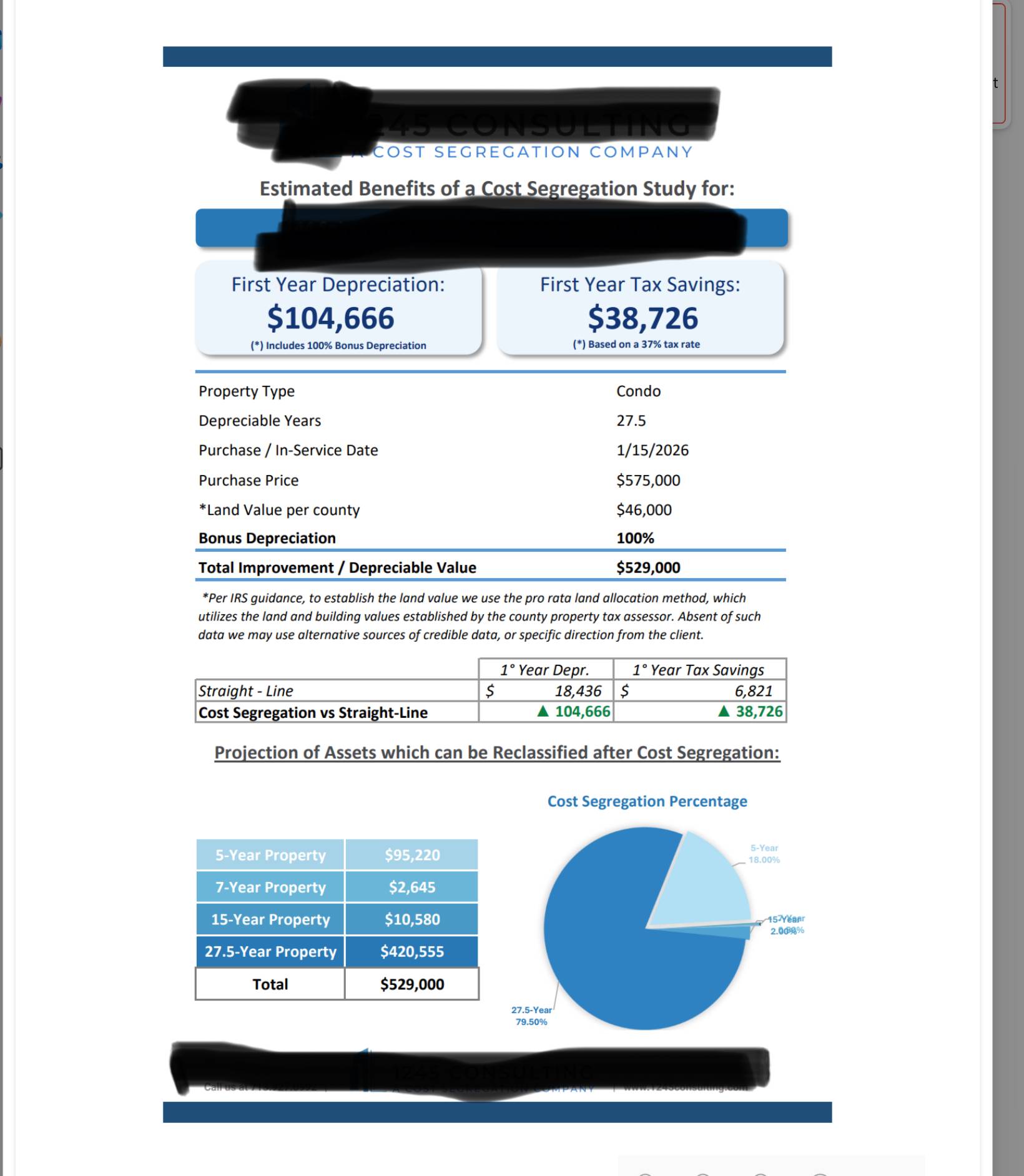
     One thing that is not obvious in your post is the need to purchase annually which is not easy because the year 2 to 5 deprecation will s a fraction of the year 1 accelerated depreciation.   Then because you are front loading the depreciation, at some point the depreciation is less on the property then if you did not accelerate the depreciation.

    I am including a preliminary cost seg savings breakdown (less than 1 month old).  Ignore the year 1 savings as it is BS to make it look better than reality.  But the depreciation amount should be fairly accurate.

    You can look at the year 1 depreciation as cash flow but I choose to think of it as a reducer to the money invested. The property with that preliminary cost set in effect has the year 1 tax savings increase the LTV to 85% (using my estimate of tax brackets). The increased LTV improves all return numbers n the underwriting. 5% appreciation amounts to 33% return from appreciation. Equity paydown as percentage increases. Cash flow as percentage increases.

    Good luck

    • Rental Property Investor 路 Somewhere over the Rainbow 路 Member since 2021 路 1k+ posts 路 1k+ votes
      9mo
      Quote from @Dan H.:
      Quote from @Jeremy Horton:

      I am starting to realize that tax losses are maybe the most important part of investing in real estate. There's cashflow, sure, but you will likely not retire from your 9-5 on cashflow (you'd have to majorly scale). But we can essentially create cashflow by creating paper losses. This is primarily aimed at W2 workers, especially higher income earners. 

      Cashflow can be harder to come by these days whether that's high sales prices, interest rates etc. So how can we create more cashflow? Through losses. Now there are the normal expenses from a rental property - maintenance, management fees, repairs, loan interest, insurance etc. We have those across the board. But the BIGGEST of these is depreciation. 

      From what I can tell there are 2 ways to use depreciation. If you're investing in LTRs you (or your spouse) would need to qualify as a REP. This would essentially disqualify W2 workers. Point being that being a REP will allow you to deduct from your W2. 

      Secondly is investing in an STR. The STR is considered an active business as long as you "materially participate" by meeting 1 of 11 rules (the easiest probably spending 100 hours AND more than any other person).

      Now we've decided to invest in an STR so we can take those active losses. What's next? Cost segregation study. So let's say we buy an STR for 750,000. the key here is ideally getting something with a higher building/land ratio. Let's say for example it's 75/25 here. So we have the building valued at ~560k. From here we can generally cost seg 20-30% of the buildings value - let's use 25% for the example - 560k * .25 = 140k. So we can deduct 140k from our W2.

      Let's say we had a taxable income of 250k this past year - we would pay ~52k in taxes. Now let's apply our STR cost seg study so we'd reduce our taxable income from 250 - 140 = 110k. And looking at the tax calculator we come up with ~15k. So we've saved 37k in taxes annually or $3083/month. That is an extra 37k in your pocket. Another way of looking at it is 37k/250k = 15%. You've just gotten a 15% raise.

      If we don't do a cost seg - 560k/27.5 = 20363/year or $1700/month. Still significant. 

      So if your STR breaks even, you're still coming ahead 3k/month or 1.7k/month. Not only that, but it's a great vehicle to pass wealth down as well.

      Is there something I'm missing here or does this make sense to do every couple years. Buy STR, cost seg, save a little down payment, buy STR, cost seg and repeat. Anything I seem to be missing here (it's been a late night!)?

       One thing that is not obvious in your post is the need to purchase annually which is not easy because the year 2 to 5 deprecation will s a fraction of the year 1 accelerated depreciation.   Then because you are front loading the depreciation, at some point the depreciation is less on the property then if you did not accelerate the depreciation.

      I am including a preliminary cost seg savings breakdown (less than 1 month old).  Ignore the year 1 savings as it is BS to make it look better than reality.  But the depreciation amount should be fairly accurate.

      You can look at the year 1 depreciation as cash flow but I choose to think of it as a reducer to the money invested. The property with that preliminary cost set in effect has the year 1 tax savings increase the LTV to 85% (using my estimate of tax brackets). The increased LTV improves all return numbers n the underwriting. 5% appreciation amounts to 33% return from appreciation. Equity paydown as percentage increases. Cash flow as percentage increases.

      Good luck


      One thing that is not obvious in your post is the need to purchase annually which is not easy because the year 2 to 5 deprecation will s a fraction of the year 1 accelerated depreciation. Then because you are front loading the depreciation, at some point the depreciation is less on the property then if you did not accelerate the depreciation.

      I'm glad you brought this up - it is one thing I had considered but hadn't fully worked out the details. I think it would be tough to purchase annually - may be a lot easier to do every 2-5 years (realistically). I do see that in order to keep up the depreciation losses you would need to buy annually - basically by front loading the depreciation you'd cancel out depreciation in the coming years. One thing I wanted to look at was the breakover point - looks to be around 5-6 years in your example. So if you bought another property before the breakover point, you should be able to stay ahead (if I'm thinking about this right). 

      The upfront savings I feel like provide a lot of opportunity. I mean that is an extra 38k in your pocket - not insignificant.

      If your example - what did you recommend to the client? 
    • Dan H.Pro Member
      Investor 路 Poway, CA 路 Member since 2015 路 7k+ posts 路 8k+ votes
      9mo
      Quote from @Jeremy Horton:
      Quote from @Dan H.:
      Quote from @Jeremy Horton:

      I am starting to realize that tax losses are maybe the most important part of investing in real estate. There's cashflow, sure, but you will likely not retire from your 9-5 on cashflow (you'd have to majorly scale). But we can essentially create cashflow by creating paper losses. This is primarily aimed at W2 workers, especially higher income earners. 

      Cashflow can be harder to come by these days whether that's high sales prices, interest rates etc. So how can we create more cashflow? Through losses. Now there are the normal expenses from a rental property - maintenance, management fees, repairs, loan interest, insurance etc. We have those across the board. But the BIGGEST of these is depreciation. 

      From what I can tell there are 2 ways to use depreciation. If you're investing in LTRs you (or your spouse) would need to qualify as a REP. This would essentially disqualify W2 workers. Point being that being a REP will allow you to deduct from your W2. 

      Secondly is investing in an STR. The STR is considered an active business as long as you "materially participate" by meeting 1 of 11 rules (the easiest probably spending 100 hours AND more than any other person).

      Now we've decided to invest in an STR so we can take those active losses. What's next? Cost segregation study. So let's say we buy an STR for 750,000. the key here is ideally getting something with a higher building/land ratio. Let's say for example it's 75/25 here. So we have the building valued at ~560k. From here we can generally cost seg 20-30% of the buildings value - let's use 25% for the example - 560k * .25 = 140k. So we can deduct 140k from our W2.

      Let's say we had a taxable income of 250k this past year - we would pay ~52k in taxes. Now let's apply our STR cost seg study so we'd reduce our taxable income from 250 - 140 = 110k. And looking at the tax calculator we come up with ~15k. So we've saved 37k in taxes annually or $3083/month. That is an extra 37k in your pocket. Another way of looking at it is 37k/250k = 15%. You've just gotten a 15% raise.

      If we don't do a cost seg - 560k/27.5 = 20363/year or $1700/month. Still significant. 

      So if your STR breaks even, you're still coming ahead 3k/month or 1.7k/month. Not only that, but it's a great vehicle to pass wealth down as well.

      Is there something I'm missing here or does this make sense to do every couple years. Buy STR, cost seg, save a little down payment, buy STR, cost seg and repeat. Anything I seem to be missing here (it's been a late night!)?

       One thing that is not obvious in your post is the need to purchase annually which is not easy because the year 2 to 5 deprecation will s a fraction of the year 1 accelerated depreciation.   Then because you are front loading the depreciation, at some point the depreciation is less on the property then if you did not accelerate the depreciation.

      I am including a preliminary cost seg savings breakdown (less than 1 month old).  Ignore the year 1 savings as it is BS to make it look better than reality.  But the depreciation amount should be fairly accurate.

      You can look at the year 1 depreciation as cash flow but I choose to think of it as a reducer to the money invested. The property with that preliminary cost set in effect has the year 1 tax savings increase the LTV to 85% (using my estimate of tax brackets). The increased LTV improves all return numbers n the underwriting. 5% appreciation amounts to 33% return from appreciation. Equity paydown as percentage increases. Cash flow as percentage increases.

      Good luck


      One thing that is not obvious in your post is the need to purchase annually which is not easy because the year 2 to 5 deprecation will s a fraction of the year 1 accelerated depreciation. Then because you are front loading the depreciation, at some point the depreciation is less on the property then if you did not accelerate the depreciation.

      I'm glad you brought this up - it is one thing I had considered but hadn't fully worked out the details. I think it would be tough to purchase annually - may be a lot easier to do every 2-5 years (realistically). I do see that in order to keep up the depreciation losses you would need to buy annually - basically by front loading the depreciation you'd cancel out depreciation in the coming years. One thing I wanted to look at was the breakover point - looks to be around 5-6 years in your example. So if you bought another property before the breakover point, you should be able to stay ahead (if I'm thinking about this right). 

      The upfront savings I feel like provide a lot of opportunity. I mean that is an extra 38k in your pocket - not insignificant.

      If your example - what did you recommend to the client? 

       You are correct you do not have to purchase annually to stay ahead of the standard depreciation.   I have not done the math to calculate it, but I suspect it is slightly longer than every 5 years. 

      I indicated ignore the $38k. It is not accurate even if you hit a 37% bracket because the first $600k (filing single, double for filing joint married) is at a lower than 37% rate. No one is at the 37% tax level yet this cost seg uses that as the projection as if once you hit the 37% tax bracket all your income is taxed at 37%. It is a deceiving number (BS) to make the cost seg look better than reality. I forecast ~$24k tax saving (married joint filing) for my projected tax savings on that purchase. Then subtract out the cost of the cost seg. A long ways from $38k. It approached adding 5% to the LTV (it likely is closer to 4% - I did the math almost a month ago and in my head I think it is close to 5%, but it is not that close to 5%).

      I warn against using the 37% number.   It is BS in all cases and for most people none of their income will be taxed at 37% (in 2026, I will not hit the 37% bracket so none of my income will be taxed at 37%).  That year 1 savings has to be calculated based on your taxable income and how you are going to file (single, joint married, etc).  Most people will be like me and not that close to the $38k savings depicted.

      Good luck

    • Rental Property Investor 路 Somewhere over the Rainbow 路 Member since 2021 路 1k+ posts 路 1k+ votes
      9mo
      Quote from @Dan H.:
      Quote from @Jeremy Horton:
      Quote from @Dan H.:
      Quote from @Jeremy Horton:

      I am starting to realize that tax losses are maybe the most important part of investing in real estate. There's cashflow, sure, but you will likely not retire from your 9-5 on cashflow (you'd have to majorly scale). But we can essentially create cashflow by creating paper losses. This is primarily aimed at W2 workers, especially higher income earners. 

      Cashflow can be harder to come by these days whether that's high sales prices, interest rates etc. So how can we create more cashflow? Through losses. Now there are the normal expenses from a rental property - maintenance, management fees, repairs, loan interest, insurance etc. We have those across the board. But the BIGGEST of these is depreciation. 

      From what I can tell there are 2 ways to use depreciation. If you're investing in LTRs you (or your spouse) would need to qualify as a REP. This would essentially disqualify W2 workers. Point being that being a REP will allow you to deduct from your W2. 

      Secondly is investing in an STR. The STR is considered an active business as long as you "materially participate" by meeting 1 of 11 rules (the easiest probably spending 100 hours AND more than any other person).

      Now we've decided to invest in an STR so we can take those active losses. What's next? Cost segregation study. So let's say we buy an STR for 750,000. the key here is ideally getting something with a higher building/land ratio. Let's say for example it's 75/25 here. So we have the building valued at ~560k. From here we can generally cost seg 20-30% of the buildings value - let's use 25% for the example - 560k * .25 = 140k. So we can deduct 140k from our W2.

      Let's say we had a taxable income of 250k this past year - we would pay ~52k in taxes. Now let's apply our STR cost seg study so we'd reduce our taxable income from 250 - 140 = 110k. And looking at the tax calculator we come up with ~15k. So we've saved 37k in taxes annually or $3083/month. That is an extra 37k in your pocket. Another way of looking at it is 37k/250k = 15%. You've just gotten a 15% raise.

      If we don't do a cost seg - 560k/27.5 = 20363/year or $1700/month. Still significant. 

      So if your STR breaks even, you're still coming ahead 3k/month or 1.7k/month. Not only that, but it's a great vehicle to pass wealth down as well.

      Is there something I'm missing here or does this make sense to do every couple years. Buy STR, cost seg, save a little down payment, buy STR, cost seg and repeat. Anything I seem to be missing here (it's been a late night!)?

       One thing that is not obvious in your post is the need to purchase annually which is not easy because the year 2 to 5 deprecation will s a fraction of the year 1 accelerated depreciation.   Then because you are front loading the depreciation, at some point the depreciation is less on the property then if you did not accelerate the depreciation.

      I am including a preliminary cost seg savings breakdown (less than 1 month old).  Ignore the year 1 savings as it is BS to make it look better than reality.  But the depreciation amount should be fairly accurate.

      You can look at the year 1 depreciation as cash flow but I choose to think of it as a reducer to the money invested. The property with that preliminary cost set in effect has the year 1 tax savings increase the LTV to 85% (using my estimate of tax brackets). The increased LTV improves all return numbers n the underwriting. 5% appreciation amounts to 33% return from appreciation. Equity paydown as percentage increases. Cash flow as percentage increases.

      Good luck


      One thing that is not obvious in your post is the need to purchase annually which is not easy because the year 2 to 5 deprecation will s a fraction of the year 1 accelerated depreciation. Then because you are front loading the depreciation, at some point the depreciation is less on the property then if you did not accelerate the depreciation.

      I'm glad you brought this up - it is one thing I had considered but hadn't fully worked out the details. I think it would be tough to purchase annually - may be a lot easier to do every 2-5 years (realistically). I do see that in order to keep up the depreciation losses you would need to buy annually - basically by front loading the depreciation you'd cancel out depreciation in the coming years. One thing I wanted to look at was the breakover point - looks to be around 5-6 years in your example. So if you bought another property before the breakover point, you should be able to stay ahead (if I'm thinking about this right). 

      The upfront savings I feel like provide a lot of opportunity. I mean that is an extra 38k in your pocket - not insignificant.

      If your example - what did you recommend to the client? 

       You are correct you do not have to purchase annually to stay ahead of the standard depreciation.   I have not done the math to calculate it, but I suspect it is slightly longer than every 5 years. 

      I indicated ignore the $38k. It is not accurate even if you hit a 37% bracket because the first $600k (filing single, double for filing joint married) is at a lower than 37% rate. No one is at the 37% tax level yet this cost seg uses that as the projection as if once you hit the 37% tax bracket all your income is taxed at 37%. It is a deceiving number (BS) to make the cost seg look better than reality. I forecast ~$24k tax saving (married joint filing) for my projected tax savings on that purchase. Then subtract out the cost of the cost seg. A long ways from $38k. It approached adding 5% to the LTV (it likely is closer to 4% - I did the math almost a month ago and in my head I think it is close to 5%, but it is not that close to 5%).

      So once again I warn against using the 37% number.   It is BS in all cases and for most people none of their income will be taxed at 37% (in 2026, I will not hit the 37% bracket so none of my income will be taxed at 37%).  That year 1 savings has to be calculated based on your taxable income and how you are going to file (single, joint married, etc).  Most people will be like me and not that close to the $38k savings depicted.

      Good luck

      Gotcha - I understand 

      Let me run this hypothetical scenario so see if I'm getting this straight

      So W2 employee 
      - 250k salary 
      - Buys a 650k STR (total cost basis)
      - 75% building value (650*.75 = 487.5k) - 487.5k Depreciation basis 
      - 25% land value (650 * .75 = 162.5)

      So if we do the straight line method we have: 
      487.5 / 27.5 = 17727. 27 annual depreciation 

      If we do a cost seg study where 25% of the building value is depreciation year one:
      487.5k * .25 = 121875 first year depreciation 

      So the taxable income in each method: 
      Straight line method = 250k - 17727 = 232273 (taxable income) 

      Cost Seg = 250k - 121875 = 128125 (taxable income) 

      Now we'll look at the income tax for each scenario: 
      Straight line method: 46350 (19.96% effective tax rate)
      Cost Seg: 19817 (15.47% effective tax rate) 

      So the difference: 46350 - 19817 = 26533 in tax savings 

      I tried to run this conservatively but still accurate. So the individual factors affecting it are income (higher income would result in greater tax savings), cost of STR (higher total cost basis results in greater tax savings) - then the breakdown of the building vs land value (higher proportion of building/land results in greater tax savings)

      All my LTR rental income falls in the 35% bracket since I am a single member LLC - from what I understand the income "passes through" and is essentially added to my W2. Then the depreciation is passive, so it has to be passed on (I essentially don't want to lock in passive losses). I didn't add in the STR income to the W2 on the above example - but I'm assuming that would be 30-40k or so. 


    • Dan H.Pro Member
      Investor 路 Poway, CA 路 Member since 2015 路 7k+ posts 路 8k+ votes
      9mo
      Quote from @Jeremy Horton:
      Quote from @Dan H.:
      Quote from @Jeremy Horton:
      Quote from @Dan H.:
      Quote from @Jeremy Horton:

      I am starting to realize that tax losses are maybe the most important part of investing in real estate. There's cashflow, sure, but you will likely not retire from your 9-5 on cashflow (you'd have to majorly scale). But we can essentially create cashflow by creating paper losses. This is primarily aimed at W2 workers, especially higher income earners. 

      Cashflow can be harder to come by these days whether that's high sales prices, interest rates etc. So how can we create more cashflow? Through losses. Now there are the normal expenses from a rental property - maintenance, management fees, repairs, loan interest, insurance etc. We have those across the board. But the BIGGEST of these is depreciation. 

      From what I can tell there are 2 ways to use depreciation. If you're investing in LTRs you (or your spouse) would need to qualify as a REP. This would essentially disqualify W2 workers. Point being that being a REP will allow you to deduct from your W2. 

      Secondly is investing in an STR. The STR is considered an active business as long as you "materially participate" by meeting 1 of 11 rules (the easiest probably spending 100 hours AND more than any other person).

      Now we've decided to invest in an STR so we can take those active losses. What's next? Cost segregation study. So let's say we buy an STR for 750,000. the key here is ideally getting something with a higher building/land ratio. Let's say for example it's 75/25 here. So we have the building valued at ~560k. From here we can generally cost seg 20-30% of the buildings value - let's use 25% for the example - 560k * .25 = 140k. So we can deduct 140k from our W2.

      Let's say we had a taxable income of 250k this past year - we would pay ~52k in taxes. Now let's apply our STR cost seg study so we'd reduce our taxable income from 250 - 140 = 110k. And looking at the tax calculator we come up with ~15k. So we've saved 37k in taxes annually or $3083/month. That is an extra 37k in your pocket. Another way of looking at it is 37k/250k = 15%. You've just gotten a 15% raise.

      If we don't do a cost seg - 560k/27.5 = 20363/year or $1700/month. Still significant. 

      So if your STR breaks even, you're still coming ahead 3k/month or 1.7k/month. Not only that, but it's a great vehicle to pass wealth down as well.

      Is there something I'm missing here or does this make sense to do every couple years. Buy STR, cost seg, save a little down payment, buy STR, cost seg and repeat. Anything I seem to be missing here (it's been a late night!)?

       One thing that is not obvious in your post is the need to purchase annually which is not easy because the year 2 to 5 deprecation will s a fraction of the year 1 accelerated depreciation.   Then because you are front loading the depreciation, at some point the depreciation is less on the property then if you did not accelerate the depreciation.

      I am including a preliminary cost seg savings breakdown (less than 1 month old).  Ignore the year 1 savings as it is BS to make it look better than reality.  But the depreciation amount should be fairly accurate.

      You can look at the year 1 depreciation as cash flow but I choose to think of it as a reducer to the money invested. The property with that preliminary cost set in effect has the year 1 tax savings increase the LTV to 85% (using my estimate of tax brackets). The increased LTV improves all return numbers n the underwriting. 5% appreciation amounts to 33% return from appreciation. Equity paydown as percentage increases. Cash flow as percentage increases.

      Good luck


      One thing that is not obvious in your post is the need to purchase annually which is not easy because the year 2 to 5 deprecation will s a fraction of the year 1 accelerated depreciation. Then because you are front loading the depreciation, at some point the depreciation is less on the property then if you did not accelerate the depreciation.

      I'm glad you brought this up - it is one thing I had considered but hadn't fully worked out the details. I think it would be tough to purchase annually - may be a lot easier to do every 2-5 years (realistically). I do see that in order to keep up the depreciation losses you would need to buy annually - basically by front loading the depreciation you'd cancel out depreciation in the coming years. One thing I wanted to look at was the breakover point - looks to be around 5-6 years in your example. So if you bought another property before the breakover point, you should be able to stay ahead (if I'm thinking about this right). 

      The upfront savings I feel like provide a lot of opportunity. I mean that is an extra 38k in your pocket - not insignificant.

      If your example - what did you recommend to the client? 

       You are correct you do not have to purchase annually to stay ahead of the standard depreciation.   I have not done the math to calculate it, but I suspect it is slightly longer than every 5 years. 

      I indicated ignore the $38k. It is not accurate even if you hit a 37% bracket because the first $600k (filing single, double for filing joint married) is at a lower than 37% rate. No one is at the 37% tax level yet this cost seg uses that as the projection as if once you hit the 37% tax bracket all your income is taxed at 37%. It is a deceiving number (BS) to make the cost seg look better than reality. I forecast ~$24k tax saving (married joint filing) for my projected tax savings on that purchase. Then subtract out the cost of the cost seg. A long ways from $38k. It approached adding 5% to the LTV (it likely is closer to 4% - I did the math almost a month ago and in my head I think it is close to 5%, but it is not that close to 5%).

      So once again I warn against using the 37% number.   It is BS in all cases and for most people none of their income will be taxed at 37% (in 2026, I will not hit the 37% bracket so none of my income will be taxed at 37%).  That year 1 savings has to be calculated based on your taxable income and how you are going to file (single, joint married, etc).  Most people will be like me and not that close to the $38k savings depicted.

      Good luck

      Gotcha - I understand 

      Let me run this hypothetical scenario so see if I'm getting this straight

      So W2 employee 
      - 250k salary 
      - Buys a 650k STR (total cost basis)
      - 75% building value (650*.75 = 487.5k) - 487.5k Depreciation basis 
      - 25% land value (650 * .75 = 162.5)

      So if we do the straight line method we have: 
      487.5 / 27.5 = 17727. 27 annual depreciation 

      If we do a cost seg study where 25% of the building value is depreciation year one:
      487.5k * .25 = 121875 first year depreciation 

      So the taxable income in each method: 
      Straight line method = 250k - 17727 = 232273 (taxable income) 

      Cost Seg = 250k - 121875 = 128125 (taxable income) 

      Now we'll look at the income tax for each scenario: 
      Straight line method: 46350 (19.96% effective tax rate)
      Cost Seg: 19817 (15.47% effective tax rate) 

      So the difference: 46350 - 19817 = 26533 in tax savings 

      I tried to run this conservatively but still accurate. So the individual factors affecting it are income (higher income would result in greater tax savings), cost of STR (higher total cost basis results in greater tax savings) - then the breakdown of the building vs land value (higher proportion of building/land results in greater tax savings)

      All my LTR rental income falls in the 35% bracket since I am a single member LLC - from what I understand the income "passes through" and is essentially added to my W2. Then the depreciation is passive, so it has to be passed on (I essentially don't want to lock in passive losses). I didn't add in the STR income to the W2 on the above example - but I'm assuming that would be 30-40k or so. 


       I think you have a good handle on this and suspect you know both items that I will point out but will point them out for those who have not put the effort in that you have and want as complete answer as possible.

      To the tax percentage and building value percentage is also the cost depreciation result.  Note in your example you used 25% which may be possible, but the preliminary cost seg that I included resulted in year 1 write off below 20% of the purchase price.  This will vary by property; if all properties were close to the same we could just put structure value into a spreadsheet that would spit out the depreciation result.

      When calculating the savings in year 1 there is the tax savings but to calculate the real savings you need to extract the cost of the cost segregation.   On big values, the cost of the study is not as relevant as it is in my example.   My last 2 cost segs had purchase price of $1.5m and $2.5m.  The cost of the cost seg on that price is less significant than on my $575k example that I included in earlier post.

      Good luck

    • Rental Property Investor 路 Somewhere over the Rainbow 路 Member since 2021 路 1k+ posts 路 1k+ votes
      9mo
      Quote from @Dan H.:
      Quote from @Jeremy Horton:
      Quote from @Dan H.:
      Quote from @Jeremy Horton:
      Quote from @Dan H.:
      Quote from @Jeremy Horton:

      I am starting to realize that tax losses are maybe the most important part of investing in real estate. There's cashflow, sure, but you will likely not retire from your 9-5 on cashflow (you'd have to majorly scale). But we can essentially create cashflow by creating paper losses. This is primarily aimed at W2 workers, especially higher income earners. 

      Cashflow can be harder to come by these days whether that's high sales prices, interest rates etc. So how can we create more cashflow? Through losses. Now there are the normal expenses from a rental property - maintenance, management fees, repairs, loan interest, insurance etc. We have those across the board. But the BIGGEST of these is depreciation. 

      From what I can tell there are 2 ways to use depreciation. If you're investing in LTRs you (or your spouse) would need to qualify as a REP. This would essentially disqualify W2 workers. Point being that being a REP will allow you to deduct from your W2. 

      Secondly is investing in an STR. The STR is considered an active business as long as you "materially participate" by meeting 1 of 11 rules (the easiest probably spending 100 hours AND more than any other person).

      Now we've decided to invest in an STR so we can take those active losses. What's next? Cost segregation study. So let's say we buy an STR for 750,000. the key here is ideally getting something with a higher building/land ratio. Let's say for example it's 75/25 here. So we have the building valued at ~560k. From here we can generally cost seg 20-30% of the buildings value - let's use 25% for the example - 560k * .25 = 140k. So we can deduct 140k from our W2.

      Let's say we had a taxable income of 250k this past year - we would pay ~52k in taxes. Now let's apply our STR cost seg study so we'd reduce our taxable income from 250 - 140 = 110k. And looking at the tax calculator we come up with ~15k. So we've saved 37k in taxes annually or $3083/month. That is an extra 37k in your pocket. Another way of looking at it is 37k/250k = 15%. You've just gotten a 15% raise.

      If we don't do a cost seg - 560k/27.5 = 20363/year or $1700/month. Still significant. 

      So if your STR breaks even, you're still coming ahead 3k/month or 1.7k/month. Not only that, but it's a great vehicle to pass wealth down as well.

      Is there something I'm missing here or does this make sense to do every couple years. Buy STR, cost seg, save a little down payment, buy STR, cost seg and repeat. Anything I seem to be missing here (it's been a late night!)?

       One thing that is not obvious in your post is the need to purchase annually which is not easy because the year 2 to 5 deprecation will s a fraction of the year 1 accelerated depreciation.   Then because you are front loading the depreciation, at some point the depreciation is less on the property then if you did not accelerate the depreciation.

      I am including a preliminary cost seg savings breakdown (less than 1 month old).  Ignore the year 1 savings as it is BS to make it look better than reality.  But the depreciation amount should be fairly accurate.

      You can look at the year 1 depreciation as cash flow but I choose to think of it as a reducer to the money invested. The property with that preliminary cost set in effect has the year 1 tax savings increase the LTV to 85% (using my estimate of tax brackets). The increased LTV improves all return numbers n the underwriting. 5% appreciation amounts to 33% return from appreciation. Equity paydown as percentage increases. Cash flow as percentage increases.

      Good luck


      One thing that is not obvious in your post is the need to purchase annually which is not easy because the year 2 to 5 deprecation will s a fraction of the year 1 accelerated depreciation. Then because you are front loading the depreciation, at some point the depreciation is less on the property then if you did not accelerate the depreciation.

      I'm glad you brought this up - it is one thing I had considered but hadn't fully worked out the details. I think it would be tough to purchase annually - may be a lot easier to do every 2-5 years (realistically). I do see that in order to keep up the depreciation losses you would need to buy annually - basically by front loading the depreciation you'd cancel out depreciation in the coming years. One thing I wanted to look at was the breakover point - looks to be around 5-6 years in your example. So if you bought another property before the breakover point, you should be able to stay ahead (if I'm thinking about this right). 

      The upfront savings I feel like provide a lot of opportunity. I mean that is an extra 38k in your pocket - not insignificant.

      If your example - what did you recommend to the client? 

       You are correct you do not have to purchase annually to stay ahead of the standard depreciation.   I have not done the math to calculate it, but I suspect it is slightly longer than every 5 years. 

      I indicated ignore the $38k. It is not accurate even if you hit a 37% bracket because the first $600k (filing single, double for filing joint married) is at a lower than 37% rate. No one is at the 37% tax level yet this cost seg uses that as the projection as if once you hit the 37% tax bracket all your income is taxed at 37%. It is a deceiving number (BS) to make the cost seg look better than reality. I forecast ~$24k tax saving (married joint filing) for my projected tax savings on that purchase. Then subtract out the cost of the cost seg. A long ways from $38k. It approached adding 5% to the LTV (it likely is closer to 4% - I did the math almost a month ago and in my head I think it is close to 5%, but it is not that close to 5%).

      So once again I warn against using the 37% number.   It is BS in all cases and for most people none of their income will be taxed at 37% (in 2026, I will not hit the 37% bracket so none of my income will be taxed at 37%).  That year 1 savings has to be calculated based on your taxable income and how you are going to file (single, joint married, etc).  Most people will be like me and not that close to the $38k savings depicted.

      Good luck

      Gotcha - I understand 

      Let me run this hypothetical scenario so see if I'm getting this straight

      So W2 employee 
      - 250k salary 
      - Buys a 650k STR (total cost basis)
      - 75% building value (650*.75 = 487.5k) - 487.5k Depreciation basis 
      - 25% land value (650 * .75 = 162.5)

      So if we do the straight line method we have: 
      487.5 / 27.5 = 17727. 27 annual depreciation 

      If we do a cost seg study where 25% of the building value is depreciation year one:
      487.5k * .25 = 121875 first year depreciation 

      So the taxable income in each method: 
      Straight line method = 250k - 17727 = 232273 (taxable income) 

      Cost Seg = 250k - 121875 = 128125 (taxable income) 

      Now we'll look at the income tax for each scenario: 
      Straight line method: 46350 (19.96% effective tax rate)
      Cost Seg: 19817 (15.47% effective tax rate) 

      So the difference: 46350 - 19817 = 26533 in tax savings 

      I tried to run this conservatively but still accurate. So the individual factors affecting it are income (higher income would result in greater tax savings), cost of STR (higher total cost basis results in greater tax savings) - then the breakdown of the building vs land value (higher proportion of building/land results in greater tax savings)

      All my LTR rental income falls in the 35% bracket since I am a single member LLC - from what I understand the income "passes through" and is essentially added to my W2. Then the depreciation is passive, so it has to be passed on (I essentially don't want to lock in passive losses). I didn't add in the STR income to the W2 on the above example - but I'm assuming that would be 30-40k or so. 


       I think you have a good handle on this and suspect you know both items that I will point out but will point them out for those who have not put the effort in that you have and want as complete answer as possible.

      To the tax percentage and building value percentage is also the cost depreciation result.  Note in your example you used 25% which may be possible, but the preliminary cost seg that I included resulted in year 1 write off below 20% of the purchase price.  This will vary by property; if all properties were close to the same we could just put structure value into a spreadsheet that would spit out the depreciation result.

      When calculating the savings in year 1 there is the tax savings but to calculate the real savings you need to extract the cost of the cost segregation.   On big values, the cost of the study is not as relevant as it is in my example.   My last 2 cost segs had purchase price of $1.5m and $2.5m.  The cost of the cost seg on that price is less significant than on my $575k example that I included in earlier post.

      Good luck


      Gotcha. I notice the cost of the seg study itself keeps coming up? Is there a rule of thumb you like to use to estimate it? 1-2% of the building cost or something?  

    • Dan H.Pro Member
      Investor 路 Poway, CA 路 Member since 2015 路 7k+ posts 路 8k+ votes
      9mo
      Quote from @Jeremy Horton:
      Quote from @Dan H.:
      Quote from @Jeremy Horton:
      Quote from @Dan H.:
      Quote from @Jeremy Horton:
      Quote from @Dan H.:
      Quote from @Jeremy Horton:

      I am starting to realize that tax losses are maybe the most important part of investing in real estate. There's cashflow, sure, but you will likely not retire from your 9-5 on cashflow (you'd have to majorly scale). But we can essentially create cashflow by creating paper losses. This is primarily aimed at W2 workers, especially higher income earners. 

      Cashflow can be harder to come by these days whether that's high sales prices, interest rates etc. So how can we create more cashflow? Through losses. Now there are the normal expenses from a rental property - maintenance, management fees, repairs, loan interest, insurance etc. We have those across the board. But the BIGGEST of these is depreciation. 

      From what I can tell there are 2 ways to use depreciation. If you're investing in LTRs you (or your spouse) would need to qualify as a REP. This would essentially disqualify W2 workers. Point being that being a REP will allow you to deduct from your W2. 

      Secondly is investing in an STR. The STR is considered an active business as long as you "materially participate" by meeting 1 of 11 rules (the easiest probably spending 100 hours AND more than any other person).

      Now we've decided to invest in an STR so we can take those active losses. What's next? Cost segregation study. So let's say we buy an STR for 750,000. the key here is ideally getting something with a higher building/land ratio. Let's say for example it's 75/25 here. So we have the building valued at ~560k. From here we can generally cost seg 20-30% of the buildings value - let's use 25% for the example - 560k * .25 = 140k. So we can deduct 140k from our W2.

      Let's say we had a taxable income of 250k this past year - we would pay ~52k in taxes. Now let's apply our STR cost seg study so we'd reduce our taxable income from 250 - 140 = 110k. And looking at the tax calculator we come up with ~15k. So we've saved 37k in taxes annually or $3083/month. That is an extra 37k in your pocket. Another way of looking at it is 37k/250k = 15%. You've just gotten a 15% raise.

      If we don't do a cost seg - 560k/27.5 = 20363/year or $1700/month. Still significant. 

      So if your STR breaks even, you're still coming ahead 3k/month or 1.7k/month. Not only that, but it's a great vehicle to pass wealth down as well.

      Is there something I'm missing here or does this make sense to do every couple years. Buy STR, cost seg, save a little down payment, buy STR, cost seg and repeat. Anything I seem to be missing here (it's been a late night!)?

       One thing that is not obvious in your post is the need to purchase annually which is not easy because the year 2 to 5 deprecation will s a fraction of the year 1 accelerated depreciation.   Then because you are front loading the depreciation, at some point the depreciation is less on the property then if you did not accelerate the depreciation.

      I am including a preliminary cost seg savings breakdown (less than 1 month old).  Ignore the year 1 savings as it is BS to make it look better than reality.  But the depreciation amount should be fairly accurate.

      You can look at the year 1 depreciation as cash flow but I choose to think of it as a reducer to the money invested. The property with that preliminary cost set in effect has the year 1 tax savings increase the LTV to 85% (using my estimate of tax brackets). The increased LTV improves all return numbers n the underwriting. 5% appreciation amounts to 33% return from appreciation. Equity paydown as percentage increases. Cash flow as percentage increases.

      Good luck


      One thing that is not obvious in your post is the need to purchase annually which is not easy because the year 2 to 5 deprecation will s a fraction of the year 1 accelerated depreciation. Then because you are front loading the depreciation, at some point the depreciation is less on the property then if you did not accelerate the depreciation.

      I'm glad you brought this up - it is one thing I had considered but hadn't fully worked out the details. I think it would be tough to purchase annually - may be a lot easier to do every 2-5 years (realistically). I do see that in order to keep up the depreciation losses you would need to buy annually - basically by front loading the depreciation you'd cancel out depreciation in the coming years. One thing I wanted to look at was the breakover point - looks to be around 5-6 years in your example. So if you bought another property before the breakover point, you should be able to stay ahead (if I'm thinking about this right). 

      The upfront savings I feel like provide a lot of opportunity. I mean that is an extra 38k in your pocket - not insignificant.

      If your example - what did you recommend to the client? 

       You are correct you do not have to purchase annually to stay ahead of the standard depreciation.   I have not done the math to calculate it, but I suspect it is slightly longer than every 5 years. 

      I indicated ignore the $38k. It is not accurate even if you hit a 37% bracket because the first $600k (filing single, double for filing joint married) is at a lower than 37% rate. No one is at the 37% tax level yet this cost seg uses that as the projection as if once you hit the 37% tax bracket all your income is taxed at 37%. It is a deceiving number (BS) to make the cost seg look better than reality. I forecast ~$24k tax saving (married joint filing) for my projected tax savings on that purchase. Then subtract out the cost of the cost seg. A long ways from $38k. It approached adding 5% to the LTV (it likely is closer to 4% - I did the math almost a month ago and in my head I think it is close to 5%, but it is not that close to 5%).

      So once again I warn against using the 37% number.   It is BS in all cases and for most people none of their income will be taxed at 37% (in 2026, I will not hit the 37% bracket so none of my income will be taxed at 37%).  That year 1 savings has to be calculated based on your taxable income and how you are going to file (single, joint married, etc).  Most people will be like me and not that close to the $38k savings depicted.

      Good luck

      Gotcha - I understand 

      Let me run this hypothetical scenario so see if I'm getting this straight

      So W2 employee 
      - 250k salary 
      - Buys a 650k STR (total cost basis)
      - 75% building value (650*.75 = 487.5k) - 487.5k Depreciation basis 
      - 25% land value (650 * .75 = 162.5)

      So if we do the straight line method we have: 
      487.5 / 27.5 = 17727. 27 annual depreciation 

      If we do a cost seg study where 25% of the building value is depreciation year one:
      487.5k * .25 = 121875 first year depreciation 

      So the taxable income in each method: 
      Straight line method = 250k - 17727 = 232273 (taxable income) 

      Cost Seg = 250k - 121875 = 128125 (taxable income) 

      Now we'll look at the income tax for each scenario: 
      Straight line method: 46350 (19.96% effective tax rate)
      Cost Seg: 19817 (15.47% effective tax rate) 

      So the difference: 46350 - 19817 = 26533 in tax savings 

      I tried to run this conservatively but still accurate. So the individual factors affecting it are income (higher income would result in greater tax savings), cost of STR (higher total cost basis results in greater tax savings) - then the breakdown of the building vs land value (higher proportion of building/land results in greater tax savings)

      All my LTR rental income falls in the 35% bracket since I am a single member LLC - from what I understand the income "passes through" and is essentially added to my W2. Then the depreciation is passive, so it has to be passed on (I essentially don't want to lock in passive losses). I didn't add in the STR income to the W2 on the above example - but I'm assuming that would be 30-40k or so. 


       I think you have a good handle on this and suspect you know both items that I will point out but will point them out for those who have not put the effort in that you have and want as complete answer as possible.

      To the tax percentage and building value percentage is also the cost depreciation result.  Note in your example you used 25% which may be possible, but the preliminary cost seg that I included resulted in year 1 write off below 20% of the purchase price.  This will vary by property; if all properties were close to the same we could just put structure value into a spreadsheet that would spit out the depreciation result.

      When calculating the savings in year 1 there is the tax savings but to calculate the real savings you need to extract the cost of the cost segregation.   On big values, the cost of the study is not as relevant as it is in my example.   My last 2 cost segs had purchase price of $1.5m and $2.5m.  The cost of the cost seg on that price is less significant than on my $575k example that I included in earlier post.

      Good luck


      Gotcha. I notice the cost of the seg study itself keeps coming up? Is there a rule of thumb you like to use to estimate it? 1-2% of the building cost or something?  


      I have seen a wide range of cost segregation prices.   Some of this is the method used and if they will defend the cost segregation if you get audited.

      i have not used DIYCostSeg.com but @krishna Iyer recently indicated they are as low as $500.   The one I use has charged me just over 3x that but these were over $1m purchases.  I did not request a quote for the $575k example I included but I expect it to be far higher than $500 that Krishna indicated.

      i look at an audit as 1) not very likely 2) if i use a repatriable cost segregation company then i do not believe i will have penalties.  Let鈥檚 say the irs determines the cost seg was off 10% and I am paying 25% total income taxes, the error amount seems fairly small (2.5% of the initial depreciation amount).  Granted I would not be thrilled, but it is far from catastrophic.   

      note I have never been audited and therefore do not know first hand the pain and inconvenience.   I do what my experts tell me is allowed to help reduce the odds of audit but also so that if I get audited I do not expect crazy adverse findings.  Any findings should be honest mistakes and not very significant (an audit of me is unlikely to justify the effort and cost of the audit).

      good luck
    • JD MartinBusiness Member
      Moderator
      Rock Star Extraordinaire 路 Northeast, TN 路 Member since 2015 路 10k+ posts 路 16k+ votes
      9mo
      Quote from @Dan H.:
      Quote from @Jeremy Horton:
      Quote from @Dan H.:
      Quote from @Jeremy Horton:
      Quote from @Dan H.:
      Quote from @Jeremy Horton:
      Quote from @Dan H.:
      Quote from @Jeremy Horton:

      I am starting to realize that tax losses are maybe the most important part of investing in real estate. There's cashflow, sure, but you will likely not retire from your 9-5 on cashflow (you'd have to majorly scale). But we can essentially create cashflow by creating paper losses. This is primarily aimed at W2 workers, especially higher income earners. 

      Cashflow can be harder to come by these days whether that's high sales prices, interest rates etc. So how can we create more cashflow? Through losses. Now there are the normal expenses from a rental property - maintenance, management fees, repairs, loan interest, insurance etc. We have those across the board. But the BIGGEST of these is depreciation. 

      From what I can tell there are 2 ways to use depreciation. If you're investing in LTRs you (or your spouse) would need to qualify as a REP. This would essentially disqualify W2 workers. Point being that being a REP will allow you to deduct from your W2. 

      Secondly is investing in an STR. The STR is considered an active business as long as you "materially participate" by meeting 1 of 11 rules (the easiest probably spending 100 hours AND more than any other person).

      Now we've decided to invest in an STR so we can take those active losses. What's next? Cost segregation study. So let's say we buy an STR for 750,000. the key here is ideally getting something with a higher building/land ratio. Let's say for example it's 75/25 here. So we have the building valued at ~560k. From here we can generally cost seg 20-30% of the buildings value - let's use 25% for the example - 560k * .25 = 140k. So we can deduct 140k from our W2.

      Let's say we had a taxable income of 250k this past year - we would pay ~52k in taxes. Now let's apply our STR cost seg study so we'd reduce our taxable income from 250 - 140 = 110k. And looking at the tax calculator we come up with ~15k. So we've saved 37k in taxes annually or $3083/month. That is an extra 37k in your pocket. Another way of looking at it is 37k/250k = 15%. You've just gotten a 15% raise.

      If we don't do a cost seg - 560k/27.5 = 20363/year or $1700/month. Still significant. 

      So if your STR breaks even, you're still coming ahead 3k/month or 1.7k/month. Not only that, but it's a great vehicle to pass wealth down as well.

      Is there something I'm missing here or does this make sense to do every couple years. Buy STR, cost seg, save a little down payment, buy STR, cost seg and repeat. Anything I seem to be missing here (it's been a late night!)?

       One thing that is not obvious in your post is the need to purchase annually which is not easy because the year 2 to 5 deprecation will s a fraction of the year 1 accelerated depreciation.   Then because you are front loading the depreciation, at some point the depreciation is less on the property then if you did not accelerate the depreciation.

      I am including a preliminary cost seg savings breakdown (less than 1 month old).  Ignore the year 1 savings as it is BS to make it look better than reality.  But the depreciation amount should be fairly accurate.

      You can look at the year 1 depreciation as cash flow but I choose to think of it as a reducer to the money invested. The property with that preliminary cost set in effect has the year 1 tax savings increase the LTV to 85% (using my estimate of tax brackets). The increased LTV improves all return numbers n the underwriting. 5% appreciation amounts to 33% return from appreciation. Equity paydown as percentage increases. Cash flow as percentage increases.

      Good luck


      One thing that is not obvious in your post is the need to purchase annually which is not easy because the year 2 to 5 deprecation will s a fraction of the year 1 accelerated depreciation. Then because you are front loading the depreciation, at some point the depreciation is less on the property then if you did not accelerate the depreciation.

      I'm glad you brought this up - it is one thing I had considered but hadn't fully worked out the details. I think it would be tough to purchase annually - may be a lot easier to do every 2-5 years (realistically). I do see that in order to keep up the depreciation losses you would need to buy annually - basically by front loading the depreciation you'd cancel out depreciation in the coming years. One thing I wanted to look at was the breakover point - looks to be around 5-6 years in your example. So if you bought another property before the breakover point, you should be able to stay ahead (if I'm thinking about this right). 

      The upfront savings I feel like provide a lot of opportunity. I mean that is an extra 38k in your pocket - not insignificant.

      If your example - what did you recommend to the client? 

       You are correct you do not have to purchase annually to stay ahead of the standard depreciation.   I have not done the math to calculate it, but I suspect it is slightly longer than every 5 years. 

      I indicated ignore the $38k. It is not accurate even if you hit a 37% bracket because the first $600k (filing single, double for filing joint married) is at a lower than 37% rate. No one is at the 37% tax level yet this cost seg uses that as the projection as if once you hit the 37% tax bracket all your income is taxed at 37%. It is a deceiving number (BS) to make the cost seg look better than reality. I forecast ~$24k tax saving (married joint filing) for my projected tax savings on that purchase. Then subtract out the cost of the cost seg. A long ways from $38k. It approached adding 5% to the LTV (it likely is closer to 4% - I did the math almost a month ago and in my head I think it is close to 5%, but it is not that close to 5%).

      So once again I warn against using the 37% number.   It is BS in all cases and for most people none of their income will be taxed at 37% (in 2026, I will not hit the 37% bracket so none of my income will be taxed at 37%).  That year 1 savings has to be calculated based on your taxable income and how you are going to file (single, joint married, etc).  Most people will be like me and not that close to the $38k savings depicted.

      Good luck

      Gotcha - I understand 

      Let me run this hypothetical scenario so see if I'm getting this straight

      So W2 employee 
      - 250k salary 
      - Buys a 650k STR (total cost basis)
      - 75% building value (650*.75 = 487.5k) - 487.5k Depreciation basis 
      - 25% land value (650 * .75 = 162.5)

      So if we do the straight line method we have: 
      487.5 / 27.5 = 17727. 27 annual depreciation 

      If we do a cost seg study where 25% of the building value is depreciation year one:
      487.5k * .25 = 121875 first year depreciation 

      So the taxable income in each method: 
      Straight line method = 250k - 17727 = 232273 (taxable income) 

      Cost Seg = 250k - 121875 = 128125 (taxable income) 

      Now we'll look at the income tax for each scenario: 
      Straight line method: 46350 (19.96% effective tax rate)
      Cost Seg: 19817 (15.47% effective tax rate) 

      So the difference: 46350 - 19817 = 26533 in tax savings 

      I tried to run this conservatively but still accurate. So the individual factors affecting it are income (higher income would result in greater tax savings), cost of STR (higher total cost basis results in greater tax savings) - then the breakdown of the building vs land value (higher proportion of building/land results in greater tax savings)

      All my LTR rental income falls in the 35% bracket since I am a single member LLC - from what I understand the income "passes through" and is essentially added to my W2. Then the depreciation is passive, so it has to be passed on (I essentially don't want to lock in passive losses). I didn't add in the STR income to the W2 on the above example - but I'm assuming that would be 30-40k or so. 


       I think you have a good handle on this and suspect you know both items that I will point out but will point them out for those who have not put the effort in that you have and want as complete answer as possible.

      To the tax percentage and building value percentage is also the cost depreciation result.  Note in your example you used 25% which may be possible, but the preliminary cost seg that I included resulted in year 1 write off below 20% of the purchase price.  This will vary by property; if all properties were close to the same we could just put structure value into a spreadsheet that would spit out the depreciation result.

      When calculating the savings in year 1 there is the tax savings but to calculate the real savings you need to extract the cost of the cost segregation.   On big values, the cost of the study is not as relevant as it is in my example.   My last 2 cost segs had purchase price of $1.5m and $2.5m.  The cost of the cost seg on that price is less significant than on my $575k example that I included in earlier post.

      Good luck


      Gotcha. I notice the cost of the seg study itself keeps coming up? Is there a rule of thumb you like to use to estimate it? 1-2% of the building cost or something?  


      I have seen a wide range of cost segregation prices.   Some of this is the method used and if they will defend the cost segregation if you get audited.

      i have not used DIYCostSeg.com but @krishna Iyer recently indicated they are as low as $500.   The one I use has charged me just over 3x that but these were over $1m purchases.  I did not request a quote for the $575k example I included but I expect it to be far higher than $500 that Krishna indicated.

      i look at an audit as 1) not very likely 2) if i use a repatriable cost segregation company then i do not believe i will have penalties.  Let鈥檚 say the irs determines the cost seg was off 10% and I am paying 25% total income taxes, the error amount seems fairly small (2.5% of the initial depreciation amount).  Granted I would not be thrilled, but it is far from catastrophic.   

      note I have never been audited and therefore do not know first hand the pain and inconvenience.   I do what my experts tell me is allowed to help reduce the odds of audit but also so that if I get audited I do not expect crazy adverse findings.  Any findings should be honest mistakes and not very significant (an audit of me is unlikely to justify the effort and cost of the audit).

      good luck

       I have used one of the lower cost cost segregation companies, I think it was somewhere around $1200 or similar which also included future audit legal representation if necessary. You always have to remember that you're going to end up with some recapture if you sell, so the cost seg really has to reduce your tax burden enough to make sense. I did it on a $500k purchase but the cost seg reduced my taxes that year by almost $40k, so to say it was worthwhile is an understatement. But that year was a particularly high income year for me, and I had no other significant purchases, rehabs or other costs to reduce my tax bill that year.

      I don't know if anyone else does this, but I always try to run a trial tax return around the end of November so that I have a good handle on anything I might want to do or not do by year's end to keep my taxes as low as possible legally. Even the cost segregation I waited until the beginning of December that year to complete to be sure I needed it, as it was great that year but reduces my depreciation on that property beyond it going forward. 

      Skyline Properties
      View Page
    • Dan H.Pro Member
      Investor 路 Poway, CA 路 Member since 2015 路 7k+ posts 路 8k+ votes
      9mo
      Quote from @JD Martin:
      Quote from @Dan H.:
      Quote from @Jeremy Horton:
      Quote from @Dan H.:
      Quote from @Jeremy Horton:
      Quote from @Dan H.:
      Quote from @Jeremy Horton:
      Quote from @Dan H.:
      Quote from @Jeremy Horton:

      I am starting to realize that tax losses are maybe the most important part of investing in real estate. There's cashflow, sure, but you will likely not retire from your 9-5 on cashflow (you'd have to majorly scale). But we can essentially create cashflow by creating paper losses. This is primarily aimed at W2 workers, especially higher income earners. 

      Cashflow can be harder to come by these days whether that's high sales prices, interest rates etc. So how can we create more cashflow? Through losses. Now there are the normal expenses from a rental property - maintenance, management fees, repairs, loan interest, insurance etc. We have those across the board. But the BIGGEST of these is depreciation. 

      From what I can tell there are 2 ways to use depreciation. If you're investing in LTRs you (or your spouse) would need to qualify as a REP. This would essentially disqualify W2 workers. Point being that being a REP will allow you to deduct from your W2. 

      Secondly is investing in an STR. The STR is considered an active business as long as you "materially participate" by meeting 1 of 11 rules (the easiest probably spending 100 hours AND more than any other person).

      Now we've decided to invest in an STR so we can take those active losses. What's next? Cost segregation study. So let's say we buy an STR for 750,000. the key here is ideally getting something with a higher building/land ratio. Let's say for example it's 75/25 here. So we have the building valued at ~560k. From here we can generally cost seg 20-30% of the buildings value - let's use 25% for the example - 560k * .25 = 140k. So we can deduct 140k from our W2.

      Let's say we had a taxable income of 250k this past year - we would pay ~52k in taxes. Now let's apply our STR cost seg study so we'd reduce our taxable income from 250 - 140 = 110k. And looking at the tax calculator we come up with ~15k. So we've saved 37k in taxes annually or $3083/month. That is an extra 37k in your pocket. Another way of looking at it is 37k/250k = 15%. You've just gotten a 15% raise.

      If we don't do a cost seg - 560k/27.5 = 20363/year or $1700/month. Still significant. 

      So if your STR breaks even, you're still coming ahead 3k/month or 1.7k/month. Not only that, but it's a great vehicle to pass wealth down as well.

      Is there something I'm missing here or does this make sense to do every couple years. Buy STR, cost seg, save a little down payment, buy STR, cost seg and repeat. Anything I seem to be missing here (it's been a late night!)?

       One thing that is not obvious in your post is the need to purchase annually which is not easy because the year 2 to 5 deprecation will s a fraction of the year 1 accelerated depreciation.   Then because you are front loading the depreciation, at some point the depreciation is less on the property then if you did not accelerate the depreciation.

      I am including a preliminary cost seg savings breakdown (less than 1 month old).  Ignore the year 1 savings as it is BS to make it look better than reality.  But the depreciation amount should be fairly accurate.

      You can look at the year 1 depreciation as cash flow but I choose to think of it as a reducer to the money invested. The property with that preliminary cost set in effect has the year 1 tax savings increase the LTV to 85% (using my estimate of tax brackets). The increased LTV improves all return numbers n the underwriting. 5% appreciation amounts to 33% return from appreciation. Equity paydown as percentage increases. Cash flow as percentage increases.

      Good luck


      One thing that is not obvious in your post is the need to purchase annually which is not easy because the year 2 to 5 deprecation will s a fraction of the year 1 accelerated depreciation. Then because you are front loading the depreciation, at some point the depreciation is less on the property then if you did not accelerate the depreciation.

      I'm glad you brought this up - it is one thing I had considered but hadn't fully worked out the details. I think it would be tough to purchase annually - may be a lot easier to do every 2-5 years (realistically). I do see that in order to keep up the depreciation losses you would need to buy annually - basically by front loading the depreciation you'd cancel out depreciation in the coming years. One thing I wanted to look at was the breakover point - looks to be around 5-6 years in your example. So if you bought another property before the breakover point, you should be able to stay ahead (if I'm thinking about this right). 

      The upfront savings I feel like provide a lot of opportunity. I mean that is an extra 38k in your pocket - not insignificant.

      If your example - what did you recommend to the client? 

       You are correct you do not have to purchase annually to stay ahead of the standard depreciation.   I have not done the math to calculate it, but I suspect it is slightly longer than every 5 years. 

      I indicated ignore the $38k. It is not accurate even if you hit a 37% bracket because the first $600k (filing single, double for filing joint married) is at a lower than 37% rate. No one is at the 37% tax level yet this cost seg uses that as the projection as if once you hit the 37% tax bracket all your income is taxed at 37%. It is a deceiving number (BS) to make the cost seg look better than reality. I forecast ~$24k tax saving (married joint filing) for my projected tax savings on that purchase. Then subtract out the cost of the cost seg. A long ways from $38k. It approached adding 5% to the LTV (it likely is closer to 4% - I did the math almost a month ago and in my head I think it is close to 5%, but it is not that close to 5%).

      So once again I warn against using the 37% number.   It is BS in all cases and for most people none of their income will be taxed at 37% (in 2026, I will not hit the 37% bracket so none of my income will be taxed at 37%).  That year 1 savings has to be calculated based on your taxable income and how you are going to file (single, joint married, etc).  Most people will be like me and not that close to the $38k savings depicted.

      Good luck

      Gotcha - I understand 

      Let me run this hypothetical scenario so see if I'm getting this straight

      So W2 employee 
      - 250k salary 
      - Buys a 650k STR (total cost basis)
      - 75% building value (650*.75 = 487.5k) - 487.5k Depreciation basis 
      - 25% land value (650 * .75 = 162.5)

      So if we do the straight line method we have: 
      487.5 / 27.5 = 17727. 27 annual depreciation 

      If we do a cost seg study where 25% of the building value is depreciation year one:
      487.5k * .25 = 121875 first year depreciation 

      So the taxable income in each method: 
      Straight line method = 250k - 17727 = 232273 (taxable income) 

      Cost Seg = 250k - 121875 = 128125 (taxable income) 

      Now we'll look at the income tax for each scenario: 
      Straight line method: 46350 (19.96% effective tax rate)
      Cost Seg: 19817 (15.47% effective tax rate) 

      So the difference: 46350 - 19817 = 26533 in tax savings 

      I tried to run this conservatively but still accurate. So the individual factors affecting it are income (higher income would result in greater tax savings), cost of STR (higher total cost basis results in greater tax savings) - then the breakdown of the building vs land value (higher proportion of building/land results in greater tax savings)

      All my LTR rental income falls in the 35% bracket since I am a single member LLC - from what I understand the income "passes through" and is essentially added to my W2. Then the depreciation is passive, so it has to be passed on (I essentially don't want to lock in passive losses). I didn't add in the STR income to the W2 on the above example - but I'm assuming that would be 30-40k or so. 


       I think you have a good handle on this and suspect you know both items that I will point out but will point them out for those who have not put the effort in that you have and want as complete answer as possible.

      To the tax percentage and building value percentage is also the cost depreciation result.  Note in your example you used 25% which may be possible, but the preliminary cost seg that I included resulted in year 1 write off below 20% of the purchase price.  This will vary by property; if all properties were close to the same we could just put structure value into a spreadsheet that would spit out the depreciation result.

      When calculating the savings in year 1 there is the tax savings but to calculate the real savings you need to extract the cost of the cost segregation.   On big values, the cost of the study is not as relevant as it is in my example.   My last 2 cost segs had purchase price of $1.5m and $2.5m.  The cost of the cost seg on that price is less significant than on my $575k example that I included in earlier post.

      Good luck


      Gotcha. I notice the cost of the seg study itself keeps coming up? Is there a rule of thumb you like to use to estimate it? 1-2% of the building cost or something?  


      I have seen a wide range of cost segregation prices.   Some of this is the method used and if they will defend the cost segregation if you get audited.

      i have not used DIYCostSeg.com but @krishna Iyer recently indicated they are as low as $500.   The one I use has charged me just over 3x that but these were over $1m purchases.  I did not request a quote for the $575k example I included but I expect it to be far higher than $500 that Krishna indicated.

      i look at an audit as 1) not very likely 2) if i use a repatriable cost segregation company then i do not believe i will have penalties.  Let鈥檚 say the irs determines the cost seg was off 10% and I am paying 25% total income taxes, the error amount seems fairly small (2.5% of the initial depreciation amount).  Granted I would not be thrilled, but it is far from catastrophic.   

      note I have never been audited and therefore do not know first hand the pain and inconvenience.   I do what my experts tell me is allowed to help reduce the odds of audit but also so that if I get audited I do not expect crazy adverse findings.  Any findings should be honest mistakes and not very significant (an audit of me is unlikely to justify the effort and cost of the audit).

      good luck

       I have used one of the lower cost cost segregation companies, I think it was somewhere around $1200 or similar which also included future audit legal representation if necessary. You always have to remember that you're going to end up with some recapture if you sell, so the cost seg really has to reduce your tax burden enough to make sense. I did it on a $500k purchase but the cost seg reduced my taxes that year by almost $40k, so to say it was worthwhile is an understatement. But that year was a particularly high income year for me, and I had no other significant purchases, rehabs or other costs to reduce my tax bill that year.

      I don't know if anyone else does this, but I always try to run a trial tax return around the end of November so that I have a good handle on anything I might want to do or not do by year's end to keep my taxes as low as possible legally. Even the cost segregation I waited until the beginning of December that year to complete to be sure I needed it, as it was great that year but reduces my depreciation on that property beyond it going forward. 


       >I don't know if anyone else does this, but I always try to run a trial tax return around the end of November so that I have a good handle on anything I might want to do or not do by year's end to keep my taxes as low as possible legally

      I do this every year.  Not just to determine need for write offs but to determine if f I should increase my income this tax year or future tax years.   In 2024 I chose to significantly increase my income due to the amount of write offs I had and my pathetic income before the increase of income. My income before the increase was below poverty level so I increased my income $300k   Needless to say it was no longer below the poverty level 馃榾.

      It certainly is not for everyone, but those who can exert a lot of control on write off and/or income can benefit significantly.  

  • V.G JasonPro Member
    Investor 路 Member since 2022 路 3k+ posts 路 3k+ votes
    9mo

    The most important part of investing (in real estate) is eliminating your cost basis & managing liability & risk.

    The latter is different in real estate than it is equities or other assets. You're going to need to manage liability via location, entity protection, insurance, property management, etc., 

    Taxes are an excellent tool. And as Allan has stated it's powerful CAGR added. In RE specifically with long time horizons as a necessity, it's even more powerful.

    A good idea is if you keep this all personally (under your name) learning to grow a future tax beneficial structure like a CRUT in the interim time and let the tax realization happen on a year you actualize the CRUT.


    For this specific post, a $250k salary should not be buying a $650k STR. They'll likely need 33% downpayment, furnishings and reserves. That's north $300k, almost double what they earn net. They can do this every 3-4 years. They're better targeting $400k, perhaps $350k STRs that are value adds to be capital efficient and taking any excess investable cash and chasing yield via another investment, letting it season & compound then re-investing that in a similar project. Essentially, getting another STR from compound interest every 4-7 years.

    • Rental Property Investor 路 Somewhere over the Rainbow 路 Member since 2021 路 1k+ posts 路 1k+ votes
      9mo
      Quote from @V.G Jason:

      The most important part of investing (in real estate) is eliminating your cost basis & managing liability & risk.

      The latter is different in real estate than it is equities or other assets. You're going to need to manage liability via location, entity protection, insurance, property management, etc., 

      Taxes are an excellent tool. And as Allan has stated it's powerful CAGR added. In RE specifically with long time horizons as a necessity, it's even more powerful.

      A good idea is if you keep this all personally (under your name) learning to grow a future tax beneficial structure like a CRUT in the interim time and let the tax realization happen on a year you actualize the CRUT.


      For this specific post, a $250k salary should not be buying a $650k STR. They'll likely need 33% downpayment, furnishings and reserves. That's north $300k, almost double what they earn net. They can do this every 3-4 years. They're better targeting $400k, perhaps $350k STRs that are value adds to be capital efficient and taking any excess investable cash and chasing yield via another investment, letting it season & compound then re-investing that in a similar project. Essentially, getting another STR from compound interest every 4-7 years.


      Ah the CRUT stuff is above my pay grade - I'll have to do some research here, I'm not familiar with that

      The second point I think I'm mostly on board with. The numbers I used were mostly hypothetical - the interesting thing is (even using the 250k salary example) the RE income adds significantly to the W2. This income is taxed exclusively at 35% - that's the problem I'm running into now. Where would you say the breakover point is for investing in a 650k STR?

      So you're saying it would be better to target cheaper STRs since you would have more capital leftover to invest in say the stock market? Then use the stock market gains to buy a new STR every 4-7 years? I feel like it's always better to value add - but the value add isn't exclusive to smaller STRs - this can be done with any price properties.

    • V.G JasonPro Member
      Investor 路 Member since 2022 路 3k+ posts 路 3k+ votes
      9mo
      Quote from @Jeremy Horton:
      Quote from @V.G Jason:

      The most important part of investing (in real estate) is eliminating your cost basis & managing liability & risk.

      The latter is different in real estate than it is equities or other assets. You're going to need to manage liability via location, entity protection, insurance, property management, etc., 

      Taxes are an excellent tool. And as Allan has stated it's powerful CAGR added. In RE specifically with long time horizons as a necessity, it's even more powerful.

      A good idea is if you keep this all personally (under your name) learning to grow a future tax beneficial structure like a CRUT in the interim time and let the tax realization happen on a year you actualize the CRUT.


      For this specific post, a $250k salary should not be buying a $650k STR. They'll likely need 33% downpayment, furnishings and reserves. That's north $300k, almost double what they earn net. They can do this every 3-4 years. They're better targeting $400k, perhaps $350k STRs that are value adds to be capital efficient and taking any excess investable cash and chasing yield via another investment, letting it season & compound then re-investing that in a similar project. Essentially, getting another STR from compound interest every 4-7 years.


      Ah the CRUT stuff is above my pay grade - I'll have to do some research here, I'm not familiar with that

      The second point I think I'm mostly on board with. The numbers I used were mostly hypothetical - the interesting thing is (even using the 250k salary example) the RE income adds significantly to the W2. This income is taxed exclusively at 35% - that's the problem I'm running into now. Where would you say the breakover point is for investing in a 650k STR?

      So you're saying it would be better to target cheaper STRs since you would have more capital leftover to invest in say the stock market? Then use the stock market gains to buy a new STR every 4-7 years? I feel like it's always better to value add - but the value add isn't exclusive to smaller STRs - this can be done with any price properties.


      I am against diversification, but pro liquidity. Having all your investments within a $650k STR at income level is a bit tomfoolery. The cheaper STR costs less to get in, therefore more capital liquid.

      The carry cost of a $650k STR is higher than a $350k one if you're mortgaged at 70-75%, capex could be similar, opex definitely correlated and linearly higher.

      Value add is a necessity, in any property. You are going to price yourself out of the note if you do it on a $650k STR with a $250k income, you're basically going to be forced to sell it. Which could work out for you, for sure, but the goal is to keep the hard assets.

      For a $650k STR, you need to have 60% down at minimum, otherwise you'll suffer the seasonality. For that to work, your annual income has to be around $1 million pre-tax assuming you don't have any other debt, and you can then buy one every 2-3 years.

      This will not be in agreement with most but I work from a position of strength, not stretch. And I'll take use my portfolio building knowledge in a similar fashion for RE. For most of the board here, they'll say a $650k works with an income of $200k. 

    • Rental Property Investor 路 Somewhere over the Rainbow 路 Member since 2021 路 1k+ posts 路 1k+ votes
      9mo
      Quote from @V.G Jason:
      Quote from @Jeremy Horton:
      Quote from @V.G Jason:

      The most important part of investing (in real estate) is eliminating your cost basis & managing liability & risk.

      The latter is different in real estate than it is equities or other assets. You're going to need to manage liability via location, entity protection, insurance, property management, etc., 

      Taxes are an excellent tool. And as Allan has stated it's powerful CAGR added. In RE specifically with long time horizons as a necessity, it's even more powerful.

      A good idea is if you keep this all personally (under your name) learning to grow a future tax beneficial structure like a CRUT in the interim time and let the tax realization happen on a year you actualize the CRUT.


      For this specific post, a $250k salary should not be buying a $650k STR. They'll likely need 33% downpayment, furnishings and reserves. That's north $300k, almost double what they earn net. They can do this every 3-4 years. They're better targeting $400k, perhaps $350k STRs that are value adds to be capital efficient and taking any excess investable cash and chasing yield via another investment, letting it season & compound then re-investing that in a similar project. Essentially, getting another STR from compound interest every 4-7 years.


      Ah the CRUT stuff is above my pay grade - I'll have to do some research here, I'm not familiar with that

      The second point I think I'm mostly on board with. The numbers I used were mostly hypothetical - the interesting thing is (even using the 250k salary example) the RE income adds significantly to the W2. This income is taxed exclusively at 35% - that's the problem I'm running into now. Where would you say the breakover point is for investing in a 650k STR?

      So you're saying it would be better to target cheaper STRs since you would have more capital leftover to invest in say the stock market? Then use the stock market gains to buy a new STR every 4-7 years? I feel like it's always better to value add - but the value add isn't exclusive to smaller STRs - this can be done with any price properties.


      I am against diversification, but pro liquidity. Having all your investments within a $650k STR at income level is a bit tomfoolery. The cheaper STR costs less to get in, therefore more capital liquid.

      The carry cost of a $650k STR is higher than a $350k one if you're mortgaged at 70-75%, capex could be similar, opex definitely correlated and linearly higher.

      Value add is a necessity, in any property. You are going to price yourself out of the note if you do it on a $650k STR with a $250k income, you're basically going to be forced to sell it. Which could work out for you, for sure, but the goal is to keep the hard assets.

      For a $650k STR, you need to have 60% down at minimum, otherwise you'll suffer the seasonality. For that to work, your annual income has to be around $1 million pre-tax assuming you don't have any other debt, and you can then buy one every 2-3 years.

      This will not be in agreement with most but I work from a position of strength, not stretch. And I'll take use my portfolio building knowledge in a similar fashion for RE. For most of the board here, they'll say a $650k works with an income of $200k. 

      Ok so your position is to essentially buy the cheapest value add property available to maximize liquidity. I mean we could all buy value add crack houses and have lots of liquidity. But I'd guarantee at an equal cost basis that 15 crack houses will cost more to maintain that one STR. One roof as opposed to 15. One HVAC as opposed to 15 etc. Cap Ex seems to be much cheaper on the STR. Opex I'd imagine would be higher on the STR due to utilities, management ratio, marketing etc. 

      0.5% of US households bring in 1mm/year. So I guess these are the only people who should be buying 650k STRs? Gee, I wonder who can buy the 750k ones? Or the 1mm ones? So it seems to there is an avenue for this to work consistently and successfully making <1mm/year. Not trying to be rude, I just think there is a "how" that can be answered here without putting 60% down and making 1mm/year. Not only that, we see hundreds/thousands of people do it every year. 

      Value add makes sense but maybe not in the traditional buy/rehab/refi/sell sense. With STRs for me personally, I just want to buy at a discount. I think there are some people in trouble these days that may be open to selling lower. I don't know this for sure, I'll have to see when I get to that point 

      I was thinking 30-40% down would get you in a pretty good spot. 60% seems excessive. I mean the idea is to have positive cashflow, I'd say at 25% down. Anything over that should be extra. Maybe I'm being unrealistic here, it's been awhile since I looked at expenses. If seasonality is a problem, maybe the suggestion would be investing in an area that is accessible and draws tourism year-round? Or maybe the daily rates during the summer make up for the slow winter? 

      We seem to be getting a little in the weeds over the hypothetic numbers I gave. I'm not advocating having all your investments in a 650k STR - in my personal position I'd be selling several LTRs and rolling that equity over into a single STR since it is an active business. I'm essentially swapping debt here - the four LTRs I have I would sell for about $700k and I have probably 40% equity in them. So a slightly lower priced STR should accommodate for the selling costs and essentially swap the debt with better tax benefits. I would not plan to use any of my stock investments (>1mm). I do respect your opinion on here, but it's not quite adding up for me. That's partly why I am trying to figure what I'm missing
    • V.G JasonPro Member
      Investor 路 Member since 2022 路 3k+ posts 路 3k+ votes
      9mo
      Quote from @Jeremy Horton:
      Quote from @V.G Jason:
      Quote from @Jeremy Horton:
      Quote from @V.G Jason:

      The most important part of investing (in real estate) is eliminating your cost basis & managing liability & risk.

      The latter is different in real estate than it is equities or other assets. You're going to need to manage liability via location, entity protection, insurance, property management, etc., 

      Taxes are an excellent tool. And as Allan has stated it's powerful CAGR added. In RE specifically with long time horizons as a necessity, it's even more powerful.

      A good idea is if you keep this all personally (under your name) learning to grow a future tax beneficial structure like a CRUT in the interim time and let the tax realization happen on a year you actualize the CRUT.


      For this specific post, a $250k salary should not be buying a $650k STR. They'll likely need 33% downpayment, furnishings and reserves. That's north $300k, almost double what they earn net. They can do this every 3-4 years. They're better targeting $400k, perhaps $350k STRs that are value adds to be capital efficient and taking any excess investable cash and chasing yield via another investment, letting it season & compound then re-investing that in a similar project. Essentially, getting another STR from compound interest every 4-7 years.


      Ah the CRUT stuff is above my pay grade - I'll have to do some research here, I'm not familiar with that

      The second point I think I'm mostly on board with. The numbers I used were mostly hypothetical - the interesting thing is (even using the 250k salary example) the RE income adds significantly to the W2. This income is taxed exclusively at 35% - that's the problem I'm running into now. Where would you say the breakover point is for investing in a 650k STR?

      So you're saying it would be better to target cheaper STRs since you would have more capital leftover to invest in say the stock market? Then use the stock market gains to buy a new STR every 4-7 years? I feel like it's always better to value add - but the value add isn't exclusive to smaller STRs - this can be done with any price properties.


      I am against diversification, but pro liquidity. Having all your investments within a $650k STR at income level is a bit tomfoolery. The cheaper STR costs less to get in, therefore more capital liquid.

      The carry cost of a $650k STR is higher than a $350k one if you're mortgaged at 70-75%, capex could be similar, opex definitely correlated and linearly higher.

      Value add is a necessity, in any property. You are going to price yourself out of the note if you do it on a $650k STR with a $250k income, you're basically going to be forced to sell it. Which could work out for you, for sure, but the goal is to keep the hard assets.

      For a $650k STR, you need to have 60% down at minimum, otherwise you'll suffer the seasonality. For that to work, your annual income has to be around $1 million pre-tax assuming you don't have any other debt, and you can then buy one every 2-3 years.

      This will not be in agreement with most but I work from a position of strength, not stretch. And I'll take use my portfolio building knowledge in a similar fashion for RE. For most of the board here, they'll say a $650k works with an income of $200k. 

      Ok so your position is to essentially buy the cheapest value add property available to maximize liquidity. I mean we could all buy value add crack houses and have lots of liquidity. But I'd guarantee at an equal cost basis that 15 crack houses will cost more to maintain that one STR. One roof as opposed to 15. One HVAC as opposed to 15 etc. Cap Ex seems to be much cheaper on the STR. Opex I'd imagine would be higher on the STR due to utilities, management ratio, marketing etc. 

      0.5% of US households bring in 1mm/year. So I guess these are the only people who should be buying 650k STRs? Gee, I wonder who can buy the 750k ones? Or the 1mm ones? So it seems to there is an avenue for this to work consistently and successfully making <1mm/year. Not trying to be rude, I just think there is a "how" that can be answered here without putting 60% down and making 1mm/year. Not only that, we see hundreds/thousands of people do it every year. 

      Value add makes sense but maybe not in the traditional buy/rehab/refi/sell sense. With STRs for me personally, I just want to buy at a discount. I think there are some people in trouble these days that may be open to selling lower. I don't know this for sure, I'll have to see when I get to that point 

      I was thinking 30-40% down would get you in a pretty good spot. 60% seems excessive. I mean the idea is to have positive cashflow, I'd say at 25% down. Anything over that should be extra. Maybe I'm being unrealistic here, it's been awhile since I looked at expenses. If seasonality is a problem, maybe the suggestion would be investing in an area that is accessible and draws tourism year-round? Or maybe the daily rates during the summer make up for the slow winter? 

      We seem to be getting a little in the weeds over the hypothetic numbers I gave. I'm not advocating having all your investments in a 650k STR - in my personal position I'd be selling several LTRs and rolling that equity over into a single STR since it is an active business. I'm essentially swapping debt here - the four LTRs I have I would sell for about $700k and I have probably 40% equity in them. So a slightly lower priced STR should accommodate for the selling costs and essentially swap the debt with better tax benefits. I would not plan to use any of my stock investments (>1mm). I do respect your opinion on here, but it's not quite adding up for me. That's partly why I am trying to figure what I'm missing

      300-400k isn't crack houses. You're talking about consolidating a portfolio.  That's completely different than the original variables provided.

      And yes some people buy $650k STRs with high leverage, moderate income. There's tons more people with negative net worths, car payments higher than their food budget, and credit card debt that exceeds their retirement savings. 

      If you can't tell, lots of people aren't smart. If you need to rationalize their spending for what works in the STR math, go for it.

      In your case specifically, if wouldn't apply. It appears your consolidating your 4 crackhouse priced assets into one property, a better one I assume and then actively manage it to get a better tax status on it. That's a solid plan.

    • Rental Property Investor 路 Somewhere over the Rainbow 路 Member since 2021 路 1k+ posts 路 1k+ votes
      9mo
      Quote from @V.G Jason:
      Quote from @Jeremy Horton:
      Quote from @V.G Jason:
      Quote from @Jeremy Horton:
      Quote from @V.G Jason:

      The most important part of investing (in real estate) is eliminating your cost basis & managing liability & risk.

      The latter is different in real estate than it is equities or other assets. You're going to need to manage liability via location, entity protection, insurance, property management, etc., 

      Taxes are an excellent tool. And as Allan has stated it's powerful CAGR added. In RE specifically with long time horizons as a necessity, it's even more powerful.

      A good idea is if you keep this all personally (under your name) learning to grow a future tax beneficial structure like a CRUT in the interim time and let the tax realization happen on a year you actualize the CRUT.


      For this specific post, a $250k salary should not be buying a $650k STR. They'll likely need 33% downpayment, furnishings and reserves. That's north $300k, almost double what they earn net. They can do this every 3-4 years. They're better targeting $400k, perhaps $350k STRs that are value adds to be capital efficient and taking any excess investable cash and chasing yield via another investment, letting it season & compound then re-investing that in a similar project. Essentially, getting another STR from compound interest every 4-7 years.


      Ah the CRUT stuff is above my pay grade - I'll have to do some research here, I'm not familiar with that

      The second point I think I'm mostly on board with. The numbers I used were mostly hypothetical - the interesting thing is (even using the 250k salary example) the RE income adds significantly to the W2. This income is taxed exclusively at 35% - that's the problem I'm running into now. Where would you say the breakover point is for investing in a 650k STR?

      So you're saying it would be better to target cheaper STRs since you would have more capital leftover to invest in say the stock market? Then use the stock market gains to buy a new STR every 4-7 years? I feel like it's always better to value add - but the value add isn't exclusive to smaller STRs - this can be done with any price properties.


      I am against diversification, but pro liquidity. Having all your investments within a $650k STR at income level is a bit tomfoolery. The cheaper STR costs less to get in, therefore more capital liquid.

      The carry cost of a $650k STR is higher than a $350k one if you're mortgaged at 70-75%, capex could be similar, opex definitely correlated and linearly higher.

      Value add is a necessity, in any property. You are going to price yourself out of the note if you do it on a $650k STR with a $250k income, you're basically going to be forced to sell it. Which could work out for you, for sure, but the goal is to keep the hard assets.

      For a $650k STR, you need to have 60% down at minimum, otherwise you'll suffer the seasonality. For that to work, your annual income has to be around $1 million pre-tax assuming you don't have any other debt, and you can then buy one every 2-3 years.

      This will not be in agreement with most but I work from a position of strength, not stretch. And I'll take use my portfolio building knowledge in a similar fashion for RE. For most of the board here, they'll say a $650k works with an income of $200k. 

      Ok so your position is to essentially buy the cheapest value add property available to maximize liquidity. I mean we could all buy value add crack houses and have lots of liquidity. But I'd guarantee at an equal cost basis that 15 crack houses will cost more to maintain that one STR. One roof as opposed to 15. One HVAC as opposed to 15 etc. Cap Ex seems to be much cheaper on the STR. Opex I'd imagine would be higher on the STR due to utilities, management ratio, marketing etc. 

      0.5% of US households bring in 1mm/year. So I guess these are the only people who should be buying 650k STRs? Gee, I wonder who can buy the 750k ones? Or the 1mm ones? So it seems to there is an avenue for this to work consistently and successfully making <1mm/year. Not trying to be rude, I just think there is a "how" that can be answered here without putting 60% down and making 1mm/year. Not only that, we see hundreds/thousands of people do it every year. 

      Value add makes sense but maybe not in the traditional buy/rehab/refi/sell sense. With STRs for me personally, I just want to buy at a discount. I think there are some people in trouble these days that may be open to selling lower. I don't know this for sure, I'll have to see when I get to that point 

      I was thinking 30-40% down would get you in a pretty good spot. 60% seems excessive. I mean the idea is to have positive cashflow, I'd say at 25% down. Anything over that should be extra. Maybe I'm being unrealistic here, it's been awhile since I looked at expenses. If seasonality is a problem, maybe the suggestion would be investing in an area that is accessible and draws tourism year-round? Or maybe the daily rates during the summer make up for the slow winter? 

      We seem to be getting a little in the weeds over the hypothetic numbers I gave. I'm not advocating having all your investments in a 650k STR - in my personal position I'd be selling several LTRs and rolling that equity over into a single STR since it is an active business. I'm essentially swapping debt here - the four LTRs I have I would sell for about $700k and I have probably 40% equity in them. So a slightly lower priced STR should accommodate for the selling costs and essentially swap the debt with better tax benefits. I would not plan to use any of my stock investments (>1mm). I do respect your opinion on here, but it's not quite adding up for me. That's partly why I am trying to figure what I'm missing

      300-400k isn't crack houses. You're talking about consolidating a portfolio.  That's completely different than the original variables provided.

      And yes some people buy $650k STRs with high leverage, moderate income. There's tons more people with negative net worths, car payments higher than their food budget, and credit card debt that exceeds their retirement savings. 

      If you can't tell, lots of people aren't smart. If you need to rationalize their spending for what works in the STR math, go for it.

      In your case specifically, if wouldn't apply. It appears your consolidating your 4 crackhouse priced assets into one property, a better one I assume and then actively manage it to get a better tax status on it. That's a solid plan.


      I need to look at the STR market a little closer - I've generally only looked in mainstream vacation areas and the cost to entry is ~350-400k. Nothing necessarily wrong with that - they can probably do better % wise than larger more expensive properties assuming the location/amenities and all that is good.

      I do realize there's not a lot of smart people lol. The average is pretty low. I think we actually all need to pivot into daycares, apparently you can have an IQ of 65, start a day care with no kids and make millions. 

      I have a plan to meet with a good CPA I found here on BP actually coming up. Maybe it will be a good chance to go over my entire financial situation. I'll definitely update after that. Thanks for your help, if nothing else I at least need to take a look at maintaining liquidity and having a realistic plan to scale based on my salary. 

  • Aaron ZimmermanBusiness Member
    Accountant 路 Chicago, IL 路 Member since 2018 路 2k+ posts 路 1k+ votes
    9mo

    @Jeremy Horton First, tax benefits are not the most important piece. I'd argue that cash flow or appreciation would be . Cash flow allows you to service the debt on the property and keep it, appreciation will ideally be strong in the long term and that's where a lot of wealth is generated.


    First, the STR loophole rental has a few requirements. (1) material participation - there are 7 tests but you have outlined the most common one. (2) need to rent out the property for 7 days or less; (3) can't use the property too much for personal use otherwise the benefits are negated.

    With the STR loophole and doing the cost seg, you're bringing tax benefits forward. If you're taking that extra $140k of depreciation in year 1, your gain upon sale will be higher. For instance, let's say you bought the property for $700k and now after 3 years, you've taken $200k, your adjusted basis is $500k. Let's say you want out of the property and it's worth $750k, you have $250k of gain: $200k that will be subject to recapture and $50k at long term capital gains rates. I'm not saying not to do this but there are considerations every investor should be aware.

    • Rental Property Investor 路 Somewhere over the Rainbow 路 Member since 2021 路 1k+ posts 路 1k+ votes
      9mo
      Quote from @Aaron Zimmerman:

      @Jeremy Horton First, tax benefits are not the most important piece. I'd argue that cash flow or appreciation would be . Cash flow allows you to service the debt on the property and keep it, appreciation will ideally be strong in the long term and that's where a lot of wealth is generated.


      First, the STR loophole rental has a few requirements. (1) material participation - there are 7 tests but you have outlined the most common one. (2) need to rent out the property for 7 days or less; (3) can't use the property too much for personal use otherwise the benefits are negated.

      With the STR loophole and doing the cost seg, you're bringing tax benefits forward. If you're taking that extra $140k of depreciation in year 1, your gain upon sale will be higher. For instance, let's say you bought the property for $700k and now after 3 years, you've taken $200k, your adjusted basis is $500k. Let's say you want out of the property and it's worth $750k, you have $250k of gain: $200k that will be subject to recapture and $50k at long term capital gains rates. I'm not saying not to do this but there are considerations every investor should be aware.


       Right - the material participation seems to be pretty straight forward. As far as the recapture, I do not consider this as I would 1031 exchange or hold long enough to where the appreciation essentially dwarfs the recapture. 

      I'm not saying tax deductions are THE most important - but it's definitely one of the most important pieces. We all know about cashflow and appreciation - of course you need cashflow to get a return and sustain the business. Of course you want appreciation over time. Of course you need to buy in a good location. These are points that every one would agree on so there's not much discussion to be had there.  

      But for tax deduction -  year one, in the example in this thread netted 37k (iirc). I doubt you net 37k cashflow in year 1. I also doubt you net 37k appreciation in year one. So in year one, I'd say it is the most important. Now if you can do this every few years, you're in really good shape.

    • Aaron ZimmermanBusiness Member
      Accountant 路 Chicago, IL 路 Member since 2018 路 2k+ posts 路 1k+ votes
      9mo

      @Jeremy Horton agreed. If you do a couple short term rentals and have good success in the business plus the tax benefits, you'll be in good shape 

Join the conversationCreate a free account to reply, vote on answers and follow this thread.