Would You Buy a Property That Loses Money Every Month?

Would You Buy a Property That Loses Money Every Month?

Dallas · Member since 2026 · 14 posts · 7 votes

Here's a question I've been thinking about:

Would you knowingly purchase an investment property that generates negative monthly cash flow if you believed it had strong potential for long-term appreciation?

Some investors prioritize cash flow because they want their properties paying for themselves and generating income from day one. Others are willing to sacrifice short-term cash flow if they believe the location, future development, or market growth could deliver substantial appreciation.

But there's an obvious risk: appreciation isn't guaranteed, and covering a property's monthly shortfall can become expensive over time.

I'm curious where other investors draw the line.

- Would you ever accept negative cash flow on an investment property?

- How much monthly loss would be too much?

- Would your answer change if the property were in a rapidly developing neighborhood?

- Is it smarter to prioritize cash flow over appreciation, especially when starting out?

If you had to choose just one for your next investment, which would it be: immediate cash flow or long term appreciation? And why?

I'd love to hear both sides, especially from investors who've experienced the consequences of either strategy.

2Reply
625 views

Most Popular Reply

Chris ColtonPro Member
Investor · San Antonio, TX · Member since 2026 · 47 posts · 28 votes
1d

For me it is cash flow first. I would not buy a place that loses money every month and hope appreciation covers it later. Appreciation may or may not come, but the monthly bill is certain. Starting out I think a property needs to pay for itself after the regular costs are counted. If it cannot do that I would keep looking.

See this reply in the discussion

25 Replies

Jump to latestLatest
  • Chris ColtonPro Member
    Investor · San Antonio, TX · Member since 2026 · 47 posts · 28 votes
    1d

    For me it is cash flow first. I would not buy a place that loses money every month and hope appreciation covers it later. Appreciation may or may not come, but the monthly bill is certain. Starting out I think a property needs to pay for itself after the regular costs are counted. If it cannot do that I would keep looking.

    • Dallas · Member since 2026 · 14 posts · 7 votes
      1d

      @Chris Colton That's a sensible approach, especially for someone building a portfolio from the ground up. I agree that appreciation is never guaranteed, whereas the monthly expenses are very real. Cash flow also gives investors more breathing room to handle unexpected repairs, vacancies, and market changes.

      Here's a question, would you make an exception for a property that runs slightly negative initially but has a clear path to positive cash flow within a year or two, perhaps through renovations or improved management?

  • Real Estate Consultant · Ann Arbor, MI · Member since 2022 · 474 posts · 261 votes
    1d

    Hi Michele from Dallas-

    Great question! You asked if it is ever a good idea to buy a property with negative cash flow if you believed it had the potential to appreciate greatly.

    For most investors, it is not wise to buy a property that does not cash flow hoping it will appreciate. There are still places you can buy cash flowing properties like the Midwest that also appreciate.

    Appreciation is always hoped to stay on pace or ahead of inflation, but cash flow will help you weather a slowdown in the real estate market and keep you in business.

    Also, some markets that appreciate quickly see reversals more than areas that have cash flow and steady appreciation and are less cyclical.

    To your success!

    • Dallas · Member since 2026 · 14 posts · 7 votes
      1d

      @Jeff Roth Well said. I particularly agree with your point about market cycles. Strong appreciation can be attractive, but it doesn't necessarily protect an investor when the market slows or reverses. Cash flow provides a cushion and gives investors more staying power.

      I also think the balance between the two is important. A property that generates consistent cash flow while appreciating steadily can be a much stronger long-term investment than one relying heavily on market growth.

  • MD/DC · Member since 2024 · 1k+ posts · 1k+ votes
    1d

    Not on purpose.

  • Real Estate Agent · Portland, ME · Member since 2021 · 14 posts · 4 votes
    1d

    Michele, I'm with Chris on the starting-out part. A monthly shortfall is a certain cost, while the appreciation is a forecast, and the gap tends to feel bigger the longer you carry it.

    One thing I'd add from my own portfolio is that the answer can depend on how a property is used, not just where it is. I have a single-family home that I rent out in the winter and run as a short-term rental in the summer, and I'm getting a unit in my triplex ready for short-term rental as well. So before I'd call a property a money-loser, I'd check whether a different use, season, or tenant type changes the monthly number, where local rules allow it.

    If I did consider one that ran negative, I'd want a specific reason the gap closes, such as a documented rent increase, rather than general optimism about the neighborhood. How long would you be willing to carry the gap before deciding to sell?

    • Dallas · Member since 2026 · 14 posts · 7 votes
      1d

      @Levi Rawlings That's an interesting perspective. I agree that a property's performance shouldn't always be judged by one rental strategy alone. Exploring different tenant types or seasonal demand can sometimes change the numbers significantly, provided local regulations and operating costs make it viable.

      As for how long I'd carry a monthly shortfall, I don't think there's a universal timeline. I'd want a clearly defined plan, a realistic estimate of when the property should become profitable, and enough reserves to sustain it. If the expected improvement doesn't materialize within that timeframe, I'd seriously reconsider holding it.

      I like your point about needin a specific reason for the gap to close rather than simply betting on appreciation. How do you evaluate whether seasonal STR income is reliable enough to justify the additional management and operating costs?

    • Real Estate Agent · Portland, ME · Member since 2021 · 14 posts · 4 votes
      9h

      Michele, thanks for the thoughtful reply. The way I'd test whether seasonal STR income is reliable is to look at it in two parts. First, what are the slowest months actually paying versus a standard lease for the same property, since the average hides the gap. Second, what does the extra management and turnover cost, in cleaning, supplies, utilities, platform fees, and your own time. If a combination of the season's net income minus the impact to you personally for your involvement in the STR is more favorable to you than a regular tenant after those costs, I'd go for the STR. You can always pivot to another strategy (i.e. furnished long term rental) later after peak season if you don't want to hold it through the slow season. Here in Maine, it's not uncommon for a STR to be converted to a longer-term winter rental until tourist season begins again.

  • Joe VilleneuvePro Member
    Plymouth, MI · Member since 2013 · 13k+ posts · 19k+ votes
    1d

    No.

  • Developer · Member since 2024 · 61 posts · 22 votes
    1d

    I'd split "negative cash flow" into two very different situations before answering.

    1. Negative because you put the minimum down. If the property would cash flow with 25% down but you bought it with 5%, you're really choosing leverage, not a bad property. You can fix it later with a paydown or refinance.

    2. Negative because rent can't cover taxes, insurance and upkeep at any reasonable loan. That one doesn't get better on its own, and every tax or insurance increase makes the gap wider.

    If I ever considered the first kind, I'd want three things in writing before buying:

    - The real monthly shortfall after vacancy, repairs, CapEx and management, not just PITI vs rent. A "$100 a month" loss often turns into $350 once those are counted.

    - How many years I can carry it out of W-2 income, multiplied out. $350 a month for 7 years is about $29,000 that the appreciation has to beat before I'm even back to zero.

    - An exit trigger, like "if rent hasn't closed the gap in 3 years, I sell or refinance."

    On your last question: starting out, I'd pick cash flow. Appreciation is the bonus you get for being able to hold, and cash flow is what lets you hold.

  • Sheldon DavidBusiness Member
    Technology · Member since 2026 · 12 posts · 2 votes
    1d

    I’d distinguish a temporary shortfall with a funded improvement plan from an ongoing shortfall that depends on appreciation.

    For example, renovating a vacant unit has a defined budget and a result you can investigate through rent comps. Waiting for the market to rise has a much less predictable timeline.

    Before considering either, I’d calculate the annual cash contribution required, upcoming replacements, and how long I could comfortably carry the property if rents and values stayed flat. I’d include those future contributions in the return calculation, too.

    Property IQ
    View Page
  • Ryan BrownPro Member
    Real Estate Agent · Louisville, KY · Member since 2022 · 85 posts · 30 votes
    1d

    I’ll offer a counterpoint: not every investor needs a property to pay them today. Someone in a very strong financial position may be comfortable covering a monthly shortfall in exchange for long-term appreciation, principal paydown, or future income growth. Their ability to hold through a downturn is very different from someone who needs the rent to cover every bill.

    Taxes can also change the equation. For an investor who can actually use the deductions, depreciation-generated paper losses may make a lower-cash-flow property more valuable to their overall financial picture than another deal with stronger monthly cash flow. That depends on their tax situation, though—rental losses aren’t automatically deductible against salary or other income.

    I’d separate paper losses from actual cash losses. You can have positive cash flow and still show a tax loss, so losing money every month isn’t necessary to get those benefits.

    I wouldn’t buy a bad deal just for a write-off. But I also wouldn’t automatically call a property a bad investment because it doesn’t cash flow today. The question is whether the expected long-term, after-tax return justifies the carrying cost—and whether the investor can comfortably afford to wait.

  • Realtor · Columbus, Franklin County · Member since 2026 · 67 posts · 16 votes
    1d

    My personal rule is that it has to cash flow at the price I'm paying, with real reserves in the numbers and a DSCR of at least 1.25x. Appreciation is the bonus, not the plan. If someone does choose negative cash flow, I'd make them put a number on it: monthly shortfall times expected hold months is the cash you're effectively adding to the down payment. Then ask whether a realistic appreciation rate actually beats putting that same cash into a property that pays you. The trap is that the shortfall rarely stays fixed, because taxes, insurance, and capex rise while you wait. If someone wants appreciation potential, I'd rather find it in a value-add deal: buy a dated property that cash flows modestly as-is, then force the equity with a rehab and rents at market.

  • Realtor · Alpine, AZ · Member since 2026 · 2 posts · 0 votes
    1d

    I would not purchase a home that I knew I was going to lose money on each month hoping that it will increase in value one day.

    If it was negative and you had a good reason why it would only be negative for a certain amount of time, I would consider it. But if it's depending on the property increasing in value, then I would keep searching.

    I don't believe there is an amount of dollars you would want to be losing per month. If I was sinking money into my investment and not seeing anything that could bring it up to a positive number, I would keep looking. If the area is growing fast, it could help you, but again there's no guarantee.

    Cash flow would be nice to have when you're just starting out. It can help you build a cushion for repairs or periods when the property is vacant. Some properties may also have things like wells or septic systems that could affect your numbers.

    I would go with cash flow and treat appreciation as the upside.

  • Mechanicsburg, PA · Member since 2013 · 3k+ posts · 2k+ votes
    1d

    @Michele Balady I've bought hundreds of vacant lots, farm land, woodland, all or most were negative cashflow. We rented some land to farmers and got crop rents, not a lot of money mostly paid the tax bill. We timbered some property, sold some trees. The first piece of vacant land I bought was about 3 acres of woods. When I went out to look at the land I made a point of talking to the neighboring farmer. He told me he was having his property timbered, which he did a selective cut every ten years. He mentioned that there seems to be some timber quality trees on my property and my land had not been timbered in a long time. He gave me the number of his logger and I called and made an appointment for him to assess my timber. He came and gave me a price for the trees that was more than the price I paid for the land. I kept that land for a long time, never got any rent and sold it for about 25 times what I paid for it so the no rent was not a problem.

  • Member since 2017 · 76 posts · 35 votes
    22h

    Michele, one more way the monthly number can change before you call a property a money-loser: price it by the room instead of the whole house. I rent my houses by the bedroom, and the math only works if you're honest on both sides.

    Add each bedroom at what a room actually rents for within a few miles. Look at room listings, not whole-house comps. Rooms in my houses run $600 to $775.

    Then subtract what you take on that a whole-house tenant would have paid: the utilities and wifi you now carry (I cover the first $100 a month and split the rest by the days each person lived there), a cleaner for the shared kitchen and bathrooms ($50 to $60 a visit for my houses), furniture for the common areas, and more move-outs a year, because a room changes hands more often than a house does.

    Before you count on any of it, check your city's limit on unrelated people living together. Some cap it at three or four.

    If that number closes the gap, the problem was the use, not the property. If it doesn't, I'm with the rest of the thread: keep looking.

  • G. Brian DavisPro Member
    Investor · Hatboro, PA · Member since 2016 · 3k+ posts · 890 votes
    22h

    I’d be pretty cautious about buying something that loses money every month just because I’m betting on appreciation. If I were going to accept negative cash flow, I’d want to know exactly what I’m getting in return for taking that risk; strong fundamentals, a clear path to increasing income, or a very compelling basis. I’d also want to know how long I can comfortably carry the shortfall if the appreciation takes longer than expected. For me, cash flow doesn’t have to be huge on day one, but I want the property moving in the right direction without having to depend on the market bailing me out. Appreciation is great, but I’d rather have it be the bonus than the thing that makes the deal work.

  • Denise SuppleeBusiness Member
    Realtor · Willow Grove, PA · Member since 2017 · 1k+ posts · 662 votes
    21h

    I wouldn't automatically rule out a deal because it doesn't cash flow from day one, but I would want a very good reason for the shortfall. There's a big difference between a property that's temporarily negative because of a clear business plan and one that needs appreciation to bail out the numbers. The second one makes me nervous. I also don't think you have to choose between cash flow and appreciation. I'd rather find an investment where the numbers make sense today and there is still room for appreciation over time. If I have to put money into it every month just hoping the property goes up, that's not a deal I'm comfortable with.

    Spark Rental Co-Investing Club584 Reviews
  • Divin KanyamaBusiness Member
    Accountant · Seattle, WA · Member since 2025 · 640 posts · 268 votes
    18h

    @Michele Balady If I had to choose, I’d prioritize cash flow for the next investment, especially starting out. I’d want appreciation to improve the outcome, not be necessary to rescue it. I could consider a temporary shortfall tied to a specific plan, such as a renovation, but I’d be much less comfortable accepting an open-ended loss based mainly on a neighborhood’s potential.

    I wouldn’t set a universal monthly-loss limit. I’d set a total funding budget and a deadline, then test whether I could cover the shortfall, vacancies, and repairs without touching household emergency funds or assuming a refinance. A developing neighborhood might make me investigate further, but it wouldn’t change that boundary. I understand the appeal of accepting less income for greater upside; personally, I’d rather pass on some potential appreciation than buy a property I couldn’t comfortably hold if growth took much longer than expected.

  • Delray Beach, FL · Member since 2024 · 41 posts · 22 votes
    18h

    Hi Michele, the answer is always "it depends" on your situation, goals and wallet!

    For me, cash flow comes first. I invest mostly in older multifamily properties in Cincinnati, and while appreciation is definitely a plus, I don't want to rely on something I can't really control.

    Would I accept negative cash flow? Maybe, but only temporarily and if there's a clear plan to turn it positive, like increasing rents after renovations or reducing expenses. I wouldn't buy a property losing $300–500 every month just hoping the neighborhood will appreciate in 5–10 years.

    Especially when you're starting out, I think cash flow is important because unexpected expenses WILL happen, and the last thing you want is to keep putting money into a property every month on top of repairs and maintenance.

    Ideally you want both, but if I had to choose, I'd take a property generating decent cash flow in a stable neighborhood over one losing money in a hot market.

    Appreciation would be the bonus, not the strategy.

  • Dan H.Pro Member
    Investor · Poway, CA · Member since 2015 · 7k+ posts · 8k+ votes
    18h

    I am often the contrarian and this is another example.

    I am about total return and do not give a $hit about the cash flow. I did feel different when I was starting out.

    Not only do I have this view but I have acted as such. I purchased the most negative cash flow non commercial property that I ever heard of. I purchased a property for $2.35m that had fully occupied rent of $6600. Has anyone heard of a more negative cash flow non commercial property?

    Because I had another project/property that I prioritized over this one it took me 3 years to stabilize this property. In 3 years the value was up over $1m above my purchase and rehab costs. For 2026 I expect wants to exceed $20k/month. It has modest cash flow for its equity of about $5k/month. I recovered my full investment in 3 years (my goal is to recover investment in less than 4 years, but this is the most expensive).

    This initially huge cash flow negative property has been a home run. I knew its potential. I actually was hoping for slightly better valuation at this point, but underwrote more conservative than I was hoping for.

    Virtually all of the return on this property is tax deferred and with current rules I never expect to pay taxes on the bulk of my profit on this property.

    If I can recover my full investment in less than 4 years, I will consider purchasing the property regardless of the cash flow.

    I have good cash flow across my RE portfolio. I have no w2 job and live a fine life. However, I do not have a single property that has produced better returns from cash flow than appreciation and it is not even close. My worse return from appreciation is ~$2700/month. I have 3 properties with over $10k/month of appreciation. Needless to say none of my properties had that level of cash flow over the hold.

    There are investors that cannot support large negative cash flow. However, if you can handle the negative cash flow, you should be evaluating properties based on ROI.

    Best wishes

  • Investor · Milwaukee - Mequon, WI · Member since 2010 · 5k+ posts · 7k+ votes
    10h

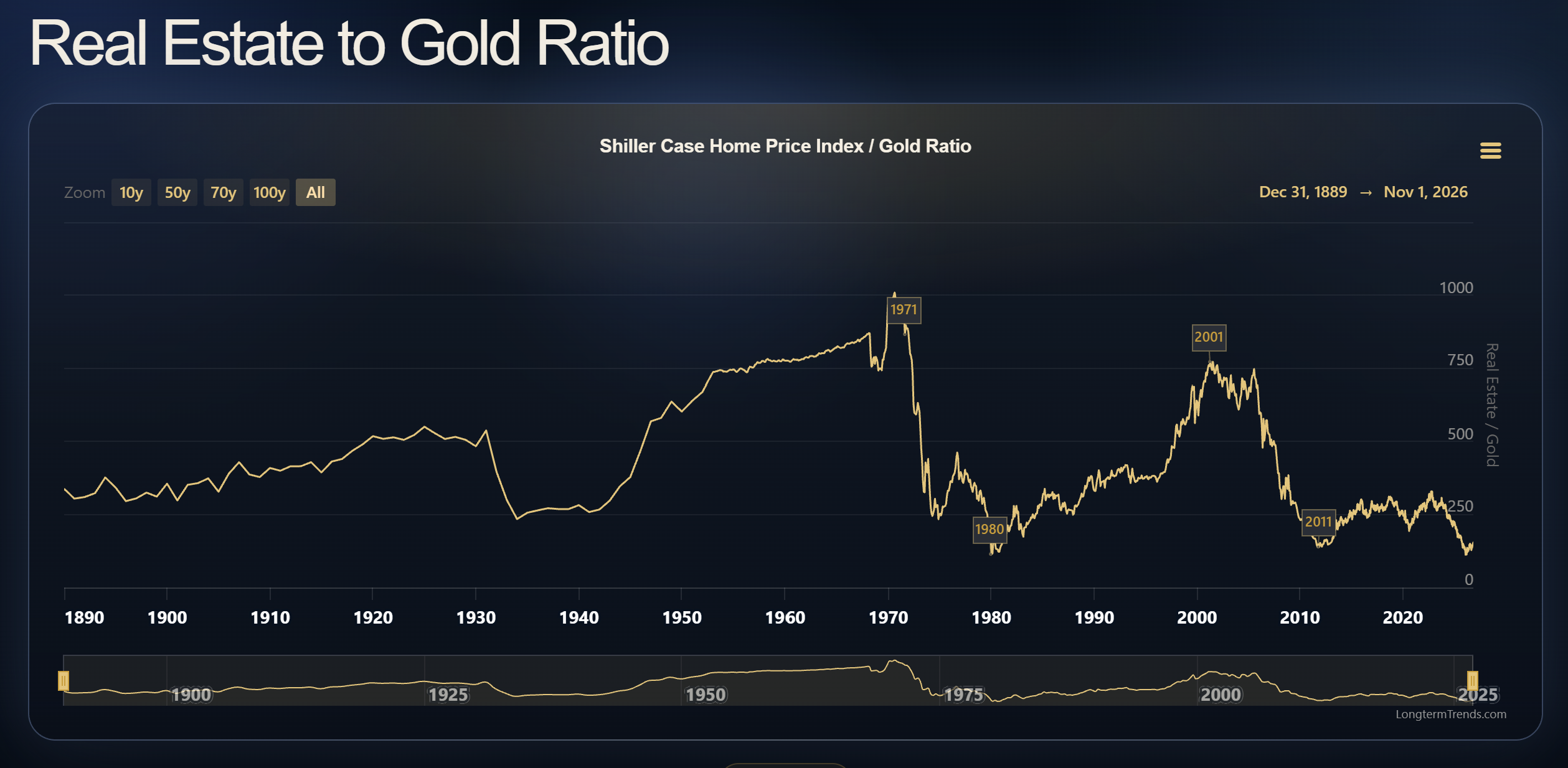
    Cash flow is a really poor metric to gauge a RE investment, especially year-one cash flow! If $200/mo make or break someone financially, they have no business investing in RE. @Dan H. is absolutely right: you have to look at a project wholistically.

    RE returns are risk inverse: better quality investments usually produce a lower return. Cash flow tends to be best in the hood.

    "Appreciation may or may not come" is also a rookie statement,however, sometimes true, especially in low income neighborhoods and "cash flow" markets. RE moves like a glacier and the direction is usually pretty clear to a seasoned investor.

    There is no 10 year period in US history when RE prices did not go up. It is baked into our financial system, if nothing else, inflation is forcing prices up. You could buy a new construction home in 1960 for 15k pretty much anywhere in the country. But 15k was also a lot of money back then.

    I'll leave this here for debate: Real Estate To Gold Ratio.

  • Simon W.Business Member
    Real Estate Consultant · Lehigh Valley PA & New York City · Member since 2013 · 1k+ posts · 689 votes
    8h

    The thing I'd separate is the cash loss and the tax loss, because they're not the same number. If a rental loses $200 a month, that's $2,400 a year of real cash out of your pocket. But on a $200,000 purchase with roughly $180,000 allocated to the building, depreciation is about $6,500 a year, so on paper the property can look like a bigger loss than it is.

    That paper loss usually doesn't offset your W-2 income unless you qualify under the passive loss rules. More often it gets suspended and carries forward until you have passive income or sell. So I wouldn't count the tax benefit as cash you'll see this year.

    I'd only hold a negative cash flow deal if there's a clear plan, like a rent bump or a refi, and I'd track the monthly shortfall on its own line so you can see if it's actually shrinking.

    Accounting Properties LLC
    View Page
    CFO LLC
    View Page
  • Ryan SpathBusiness Member
    Real Estate Agent · Boise, ID · Member since 2017 · 592 posts · 381 votes
    4h

    Im finishing up "the psychology of money" and it has a lesson that may apply to this scenerio. In Chapter 16: "You & Me" the general theme is, People make different financial decisions because they have different experiences, goals, time horizons, and risk tolerances. We're not all playing the same financial game. Housel explains that advice that makes perfect sense for one person might be completely wrong for another—not because either person is foolish, but because their circumstances are different. If Im a high earning w2 employee and the bonus depreciation I can use in year 1 maybe i can stomach the monthly loss. If im building a portfolio and need the cash flow to survive, I may not consider this.

    Personally for me at my current situation, I would not take any negative cash flow due to my current goals. However in the past, after my first property I did take negative cash flow to the tune of ~100 a month for the first year, next year was break even and eventually 1031 exchanged this into 2 properties, and later scrapped equity from one of those and purchased another property.......

Join the conversationCreate a free account to reply, vote on answers and follow this thread.