When Will The RE Market Crash?

When Will The RE Market Crash?

Flipper/Rehabber · Leominster, MA · Member since 2020 · 667 posts · 384 votes

The history of markets tells us that we will always have a crash.  


This graph shows total consumer debt in the US since 2003

Housing crashes come from over indebtedness, this graph shows that US consumers have more debt today than they did during the housing crisis in 2008

Total US consumer debt in 2008 $13T

Total US consumer debt in 2019 $13.9T

Total debt per US consumer according to US Census Bureau data: $41.77, this exceeds the record established in 2008 of $41.68 (this is total consumer debt divided by the entire population)


So, are we in for a crash?? UNLIKELY

There are two key financial indicators that tell us that US consumers are in better shape today than they were in 2008 (even taking the pandemic into account):

  1. Median household income 2019: $68,703
  2. Median household income 2008: $57,010

Consumers make more money; the median household income is up 20% from 2008, while total debt is only up 6.9%.

The second indicator is the consumer debt delinquency rate

2005: 4%                                   2016: 4%

2006: 4.25%                              2017: 4.125%

2007: 6%                                   2018: 4.25%

2008: 8%                                   2019: 4.125%

Delinquency rates for 2020 are not yet available, but there is no evidence that delinquencies have spiked anywhere close to 2008 levels. 

Anecdotally it seems unlikely that there will be a real estate market crash at any point in the next 3 to 5 years. The federal reserve has dropped interest rates to 3% or less, which is being reflected in current mortgage rates (a recent Buyer of ours put less than 5% down and obtained a 30 year mortgage with a 2.37 interest rate). The federal reserve is now committed to a low interest rate environment for the foreseeable future, IF they were to raise interest rates back to 4% ALL homebuyers and many consumers that refinanced their properties would be under water as purchasing power would decrease and there would be a subsequent impact on sale prices (historically there is an inverse relationship between interest rates and property prices; drop interest rates, property prices go up and the reverse applies).

What do you think?  Many pundits disagree with me and believe that market is long overdue for a correction.  Reply and let me know what you think. 
20Reply
471 views

Most Popular Reply

Joe VilleneuvePro Member
Plymouth, MI · Member since 2013 · 13k+ posts · 19k+ votes
5y

All those "pundits" that agree with you have agreed with you for the last 20-25 years.  Trouble is, they all went to the the University of Chicken Little.  What's really going to be funny, is when the market does crash, they will all claim the saw it coming,...the year before.  What they will conveniently forget, is they also predicted it coming the next year...for the previous 2 and a half decades.

Point?

Setup your RE so you can adjust the the crash.

See this reply in the discussion

127 Replies

Jump to latestLatest
  • New to Real Estate · Bristol, VA · Member since 2020 · 14 posts · 3 votes
    5y

    @Moises R Cosme I think saying companies are finding out that remote work is unproductive is a pretty broad statement. The best companies will continue to be innovative and perform. The impact will be felt and is already being felt in commercial real estate just look at Pinterest. They paid $90 million to cancel a lease in SF due to concerns with COVID. The better question is probably how long and how big will the impact be to commercial.

  • Los Angeles, CA · Member since 2018 · 86 posts · 86 votes
    5y
    Originally posted by @Moises R Cosme:

    @Matthew M. Real interest rate = nominal rate minus rate of inflation. Then subtract expected income tax rate. What are bond investors earning at the end of the day?

    The notion that inflation is zero is false; the cost of education is twice what it was 10 years ago, the cost of milk, cheese, cars etc.

    Would we ever accept a 0 net return on investments we make?

    What I am saying is that there is global demand for treasuries because even though our rates are historically low, they are equally historically low everywhere else in the world and the treasury market is the biggest market in the world.  It is 37% of the entire US Bond market at about $23 trillion dollars.  For reference, about 29% of of treasury debt outstanding is held by foreign investors (Japan and China are the largest holders).  Treasury demand is driven by: 

    1) institutional investors that buy for tax reasons, regulatory capital reasons, or for safety; not returns.

    2) Fed policy which can buy at any price to combat deflationary and recession pressure which in turn, hopefully yields a bit of inflation. At the moment all the liquidity pumped into the economy, $3Trillion or so pumped by the fed alone, is helping elevate asset prices and stave off a recession/depression.    

    The "investors" that buy Treasuries to make returns usually do so with huge leverage and although the "yields" are low they are usually basis trading or curve trading which you can do at any yield level. 

    I guess the point I am trying to make is that the Treasury Market has to be looked at against the global backdrop to come to a conclusion, it's not as simple as rates = low ergo demand = low.  Mom and pop retail investors don't even make a dent in this market.

  • Rental Property Investor · Knoxville, TN · Member since 2020 · 51 posts · 40 votes
    5y

    @Moises R Cosme

    1. Federal reserve holdings are at all time highs.

    2. Banks are on corporate welfare

    3. RE prices are at all time highs

    4. Foreclosures on the rise

    5. Without 1.8 trillion cares act and the 4+ trillion Fed reserve spending we would be experiencing a REAL RECESSION.

    Link for fed reserve holdings. https://fred.stlouisfed.org/series/TREAST

  • Flipper/Rehabber · Leominster, MA · Member since 2020 · 667 posts · 384 votes
    5y

    @Max Katelouzos remote work will not work long term. Performance and learning go hand in hand, new employees need the ability to learn from longer term employees; this is not a feature that is easily available or accessible in practical form with remote work. As an example, when I started my sales career most of the actionable information I obtained was from sitting around high performers and being in and around their environments while they worked. I listened to how they said things, how they organized their day etc.

  • Flipper/Rehabber · Leominster, MA · Member since 2020 · 667 posts · 384 votes
    5y

    @Matthew M. Excellent!!! The demand for Japanese treasuries seems to prove your point. Ok, then the question shifts to the overall Fiat currency system. Your well argued point makes the case that the motivation for investment in treasuries are something other than economic gain; what is everyone doing? Why are treasuries allowed to buy their own sovereign debt to lose money (in real terms)?

    I did not expect your response, but overall it is obvious to me that there is a problem. Our treasury pays its mortgage by taking another mortgage and calls that economic growth even when it knows it will need to take another mortgage just to make the payments on the existing debt. Does this make any sense? What is the consequence of this behavior? What is the likely impact on the largest sector of the US economy?

  • Flipper/Rehabber · Leominster, MA · Member since 2020 · 667 posts · 384 votes
    5y

    @Ian Walsh that's not fun... what do you think will happen? Does it make sense to you that you are originating loans at 2.37% to borrowers that are putting down 5%, with less than 6 months' of reserves?

  • Flipper/Rehabber · Leominster, MA · Member since 2020 · 667 posts · 384 votes
    5y

    @Jeffery Callis what is your conclusion? What do you think all of these things will lead to?

  • Flipper/Rehabber · Leominster, MA · Member since 2020 · 667 posts · 384 votes
    5y

    @Victor S. Inflation is real, what did the average new car cost in 2010? What does the average new car cost in 2020? Ask yourself the same about milk and cheese. Your girl's observation about the rise in food prices is not perceived and does not exist in a vacuum. Real incomes for most workers is shrinking, while costs for essential items is rising. The low cost of oil is subsidizing everything else; what would happen if gas went to $4/gallon?

  • Flipper/Rehabber · Leominster, MA · Member since 2020 · 667 posts · 384 votes
    5y

    @Javier Rosales with respect, you are wrong. What was the price of a new car in 2000? 2010? Compare that to 2020. What was the cost of a gallon of milk in 2000? 2010? Compare that to 2020. There is no shortage of milk & there is certainly no shortage of cheese.

  • Shawnee Mission, KS · Member since 2016 · 719 posts · 313 votes
    5y

    The market is HOT some parts of the country are worse than others.

    What it will take is an engine to push it over, confidence in the current systems of borrowing /buying property will get pressed.

    If /when it happens some parts will suffer more than others like a allude to earlier.

    Could be constant release of bad news that erodes confidence and folks spook causing a shift  a run to the exit.

    Consumer confidence is an economic indicator that measures the degree of optimism that consumers feel about the overall state of the economy and their personal financial situation.

  • Rental Property Investor · Knoxville, TN · Member since 2020 · 51 posts · 40 votes
    5y

    @Moises R Cosme

    1. Imo we are going to see a crash.💥

    2.Housing market is being propped up by the paycheck protection program which for banks was corporate welfare. So they are spending 75% of the PPP money on buying property. As long they spend it on “business needs” it doesn’t matter. Which is why we are still seeing a rise in value. Some would call in manipulating the market.

  • Investor · Milwaukee - Mequon, WI · Member since 2010 · 5k+ posts · 7k+ votes
    5y

    Some pretty wild theories here.. one main difference between the financial markets and the housing market is that nobody needs stocks to sleep in.

    RE markets are driven by supply and demand. Nobody has ever told me I want to buy a house because of inflation, they got a PPP or because of low rates - people buy houses because they "need" to, usually life events.

    Demand is driven by 83 million millenials thinking about buying a house. And supply is restricted by old people getting older and not selling their homes. Plus we have not built much in the last decade after 2008.

    Real estate is still comparativley cheap, at least here in Milwaukee, even though prices have gone up, it is easier to buy a house now than in the ten years leading up to 2008.

    I believe we may see a different direction in some of the hyper expensive costal markets that are selling over $1,000 per SF, but for the midwest with often under $150 per SF there is still a lot of room to grow.

    Cost of labor and lumber (material in general) keep driving cost of new construction, which has always been the benchmark for existing home prices. 

  • Real Estate Consultant · Washington, DC · Member since 2016 · 39 posts · 17 votes
    5y

    @Moises R Cosme I don’t see rates bouncing back that high especially under this administrations. There’s going to be some flexibility to get loans for the next few years. I could be wrong, but considering the fluctuation on demand due to this pandemic and many departing major hubs due to the option of telework. There’s going to be some adjustments.

  • Real Estate Consultant · Washington, DC · Member since 2016 · 39 posts · 17 votes
    5y

    @Moises R Cosme but many companies will downsize since remote working is increasing. Like stated, I see more people migrating to smaller cities instead of congested ones and also, rents won’t depreciate at the rate that those reside in major cities would like. So, why not move where rents are a little cheaper? Especially, if I no longer have to be close to the job if I don’t have to get there everyday.

  • Rental Property Investor · Knoxville, TN · Member since 2020 · 51 posts · 40 votes
    5y

    @Marcus Auerbach

    Are you claiming that big banks for not buying property with PPP money?

    Why wouldn’t they hedge the RE market when they are receiving billions in paycheck protection program money?

  • Investor · Milwaukee - Mequon, WI · Member since 2010 · 5k+ posts · 7k+ votes
    5y
    Originally posted by @Jeffery Callis:

    @Marcus Auerbach

    Are you claiming that big banks for not buying property with PPP money?

    Why wouldn’t they hedge the RE market when they are receiving billions in paycheck protection program money?

    Frankly, even though I study the topic extensively every month (just for  my own sake as an investor) I don't know what every bank is doing. But I can tell you that banks don't like to own real estate, they are not set up for that. They have plenty other ways to hedge and on the financial markets. The topic is vast and I have made a video about what I expect for 2021, you can find it on my YouTube channel.

  • Flipper/Rehabber · Leominster, MA · Member since 2020 · 667 posts · 384 votes
    5y

    @Marcus Auerbach great points!!! How much debt does the average millenial carry? How much are they making? How are they able to service their debt loads?

    Lending works when people are not overly indebted; general trends are drifting toward over indebtedness. Demand only works if the people looking to buy can get financing. The majority of homebuyers finance their purchase, that financing is not disconnected from their broader financial picture and that broader picture is dependent on externalities like interest rates.

  • Flipper/Rehabber · Leominster, MA · Member since 2020 · 667 posts · 384 votes
    5y

    @Marcus Auerbach banks do not like holding residential real estate, it is a nightmare for them. You are spot on!!!

  • Investor · Milwaukee - Mequon, WI · Member since 2010 · 5k+ posts · 7k+ votes
    5y

    @Moises R Cosme there is a dig difference between a change in interest rate and unavailability in lending. We have seen that early this year for a few weeks with Covid when banks just locked down. If lending seizes, our economy seizes. But rates are different.

    People find out how much their interest rate is after they have decided to buy their first house. Half of them believe they need 20% down and are surprised when they find out they don't, just as an exhibit of how little they know at that point.

    Millennials have money to buy, they have saved up longer than any generation before them and many are burdened by college debt (which is a concept I don't understand - who thought that "for profit" education is good for a society, normally you want the best education for the most people, so you can fund the retirement of the older folks through the younger work force - sorry I digress).

    If you can afford to pay rent, you generally can afford to make a house payment, typically it is even cheaper.

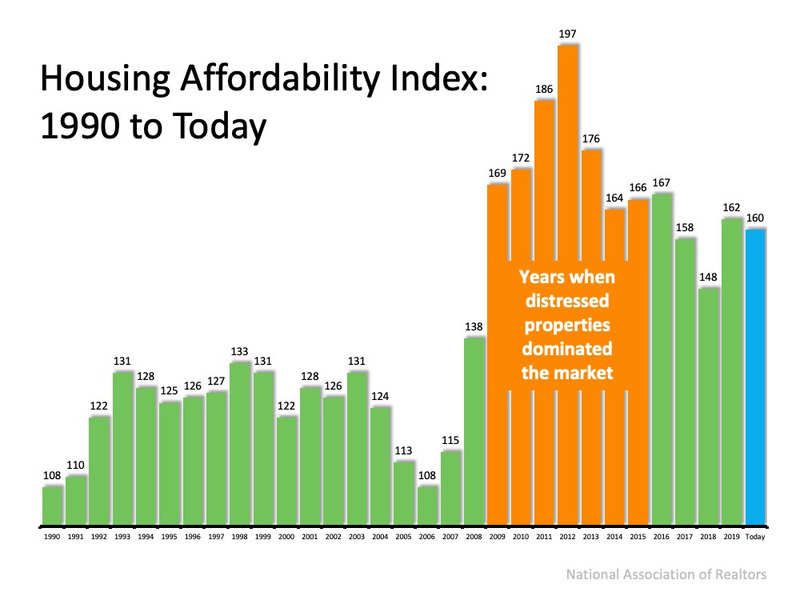
    Note that buying a home is still cheaper than it was in the years 1990-2008!

    (higher index = higher affordability)

  • Flipper/Rehabber · Leominster, MA · Member since 2020 · 667 posts · 384 votes
    5y

    @Marcus Auerbach what data went into that graph? What does 'home affordability' mean in the context of that graph?

  • Member since 2020 · 201 posts · 118 votes
    5y
    Originally posted by @Moises R Cosme:

    The history of markets tells us that we will always have a crash.  


    This graph shows total consumer debt in the US since 2003

    Housing crashes come from over indebtedness, this graph shows that US consumers have more debt today than they did during the housing crisis in 2008

    Total US consumer debt in 2008 $13T

    Total US consumer debt in 2019 $13.9T

    Total debt per US consumer according to US Census Bureau data: $41.77, this exceeds the record established in 2008 of $41.68 (this is total consumer debt divided by the entire population)


    So, are we in for a crash?? UNLIKELY

    There are two key financial indicators that tell us that US consumers are in better shape today than they were in 2008 (even taking the pandemic into account):

    1. Median household income 2019: $68,703
    2. Median household income 2008: $57,010

    Consumers make more money; the median household income is up 20% from 2008, while total debt is only up 6.9%.

    The second indicator is the consumer debt delinquency rate

    2005: 4%                                   2016: 4%

    2006: 4.25%                              2017: 4.125%

    2007: 6%                                   2018: 4.25%

    2008: 8%                                   2019: 4.125%

    Delinquency rates for 2020 are not yet available, but there is no evidence that delinquencies have spiked anywhere close to 2008 levels. 

    Anecdotally it seems unlikely that there will be a real estate market crash at any point in the next 3 to 5 years. The federal reserve has dropped interest rates to 3% or less, which is being reflected in current mortgage rates (a recent Buyer of ours put less than 5% down and obtained a 30 year mortgage with a 2.37 interest rate). The federal reserve is now committed to a low interest rate environment for the foreseeable future, IF they were to raise interest rates back to 4% ALL homebuyers and many consumers that refinanced their properties would be under water as purchasing power would decrease and there would be a subsequent impact on sale prices (historically there is an inverse relationship between interest rates and property prices; drop interest rates, property prices go up and the reverse applies).

    What do you think?  Many pundits disagree with me and believe that market is long overdue for a correction.  Reply and let me know what you think. 

    I think there is usually a delayed reaction in the real estate market to economic shocks. So we had a stock market shock in March and then stocks climbed again on "stimulus packages". The real economy works at a different rythm and the pain unfolds more slowly. I think that's what will happen with real estate. There will be more foreclosures, vacant properties, etc but it will take longer to become apparent.

  • Flipper/Rehabber · Leominster, MA · Member since 2020 · 667 posts · 384 votes
    5y

    @Taylor Wrice-Brooks if that's the case there is no real macro change since rents will pull back in one market and increase in others. We have seen this in our markets, property value & rents have risen dramatically in small cities in our area and pulled back a bit in the big metros.

    I agree, it does not seem that interest rates will increase in the very near term (12 - 18 mos), but that only creates a larger problem down the road since you have more buyers paying the higher prices with monthly payments based on the lower interest rate. All of those buyers would have negative equity if interest rates flex up and prices pull back as a result. The more buyers you have in that situation, the bigger the problem when those properties turn over.

    Obviously, this is all opinion - all of us just need to transact given the set of circumstances that exist in our markets at the time.

  • Investor · Milwaukee - Mequon, WI · Member since 2010 · 5k+ posts · 7k+ votes
    5y
    Originally posted by @Moises R Cosme:

    @Marcus Auerbach what data went into that graph? What does 'home affordability' mean in the context of that graph?

    The index is claculated by the NAR, you can look it up. It's calculated based on home prices, income and interest rates.

  • Flipper/Rehabber · Leominster, MA · Member since 2020 · 667 posts · 384 votes
    5y

    @Marcus Auerbach thanks for citing the graph.

  • Russell BrazilBusiness Member
    Moderator
    Real Estate Agent · Washington, D.C. · Member since 2012 · 17k+ posts · 30k+ votes
    5y

    December 24th, 2026

Join the conversationCreate a free account to reply, vote on answers and follow this thread.