Does Velocity Banking work????
Member since 2019 · 187 posts · 74 votes
Hey everyone ive been hearing about and researching VELOCITY BANKING alot lately. Seems too good to be true. Any of you experts have experience in this field and can confirm or deny? Thanks everyone!
Nick
Paying off a low interest mortgage instead of acquiring profitable assets is counter intuitive to creating wealth. It's a distraction, it's just creating a fancy name "Velocity Banking" and treating it like a magic wand without testing the financial math behind the whole philosophy. It's a gimmick
@NIcholas Hamel
No. Nothing about VB will make any significant difference. Now paying your mortgage off faster will dramatically decrease total interest paid. But this was invented to sound cool. Dave Ramsey has been preaching early payoff for 30 years and his students average paying off their mortgages in 7 years.
Actually, it's DOES make a significant difference, unless you find the difference between $186,511.57 and $51,378.21 - $135,133.36, difference in interest paid between full term ($200K at 5% for 30 years) and accelerated payoff - "insignificant".
... and yes, that WOULD even buy "drinks for the house" ... many times over! ... though, I can certainly think of more productive use of the money.
how much interest did you pay for using the heloc in that scenario?
nobody said this method doesn't work. it does, but there is no "velocity" associated with it vs just adding more to your principal payments.
Interest on the HELOC - if that's what you're using as a "velocity account" - would be around $700 a year, less than the interest portion of the first mortgage payment during the first year of the loan. A (HE)LOC is a revolving account and incurs simple interest, probably based on the average daily balance during the payment period. See your loan documents for specifics - this is a generic example.
There is *PLENTY* of "velocity" to it. Instead of bashing what you don't understand, you should first learn about it, then come back so we can have a more intelligent discourse.
Simply adding more to your principal portion will achieve a similar goal, without the side-benefits of helping your credit profile or making cash instantly available (from a HELOC or other LOC) should a sudden need arise.
I understand it perfectly fine (even without having to go to that 2-day class). Tell me where that extra cash (i.e., velocity) is coming from to then payoff the heloc as soon as you can? Again, nobody is arguing you can't use a heloc to do this. People on the other side are arguing that there is no visible benefit vs just adding cash to your principal every month, if mortgage paydown was your goal. You can still do this and have a heloc available for when/if you need it. If this heloc method helps someone to be more diligent and focused, more power to them, but to claim that this is some sort of a revolutionary method that will magically get rid of your mortgage in several years is somewhat disingenuous.
here is an actual calculator anyone can use to see for themselves several different scenarios of making additional principal pmts vs using a heloc:
https://www.biggerpockets.com/files/user/DanWeed/file/loc-vs-mortgage
@NIcholas Hamel
No. Nothing about VB will make any significant difference. Now paying your mortgage off faster will dramatically decrease total interest paid. But this was invented to sound cool. Dave Ramsey has been preaching early payoff for 30 years and his students average paying off their mortgages in 7 years.
Actually, it's DOES make a significant difference, unless you find the difference between $186,511.57 and $51,378.21 - $135,133.36, difference in interest paid between full term ($200K at 5% for 30 years) and accelerated payoff - "insignificant".
... and yes, that WOULD even buy "drinks for the house" ... many times over! ... though, I can certainly think of more productive use of the money.
how much interest did you pay for using the heloc in that scenario?
nobody said this method doesn't work. it does, but there is no "velocity" associated with it vs just adding more to your principal payments.
Interest on the HELOC - if that's what you're using as a "velocity account" - would be around $700 a year, less than the interest portion of the first mortgage payment during the first year of the loan. A (HE)LOC is a revolving account and incurs simple interest, probably based on the average daily balance during the payment period. See your loan documents for specifics - this is a generic example.
There is *PLENTY* of "velocity" to it. Instead of bashing what you don't understand, you should first learn about it, then come back so we can have a more intelligent discourse.
Simply adding more to your principal portion will achieve a similar goal, without the side-benefits of helping your credit profile or making cash instantly available (from a HELOC or other LOC) should a sudden need arise.
I understand it perfectly fine (even without having to go to that 2-day class). Tell me where that extra cash (i.e., velocity) is coming from to then payoff the heloc as soon as you can? Again, nobody is arguing you can't use a heloc to do this. People on the other side are arguing that there is no visible benefit vs just adding cash to your principal every month, if mortgage paydown was your goal. You can still do this and have a heloc available for when/if you need it. If this heloc method helps someone to be more diligent and focused, more power to them, but to claim that this is some sort of a revolutionary method that will magically get rid of your mortgage in several years is somewhat disingenuous.
here is an actual calculator anyone can use to see for themselves several different scenarios of making additional principal pmts vs using a heloc:
https://www.biggerpockets.com/files/user/DanWeed/file/loc-vs-mortgage
"I understand it perfectly fine (even without having to go to that 2-day class). Tell me where that extra cash (i.e., velocity) is coming from to then payoff the heloc as soon as you can?"
If you "understand it perfectly fine (even without having to go to that 2-day class)", then you already know the answer. If you don't know the answer, then you don't "understand it perfectly fine (even without having to go to that 2-day class)".
The rest of that is still the same uninformed rhetoric. No need to address it again - I've been doing that for some four years now.
Any financial calculator will do, really, though I found Excel especially useful, myself.
Again, if you "understand it perfectly fine (even without having to go to that 2-day class)", then you know a HELOC is not the only choice for a velocity account (you DO know what a velocity account is, right? After all you "understand it perfectly fine (even without having to go to that 2-day class".)
Just to be safe, let me repeat what I've been saying in forum posts for at least four years now: velocity banking *IS* *NOT* about "transferring mortgage debt to a HELOC". Dunno who started that.
@David Dachtera
When you responded to my post you quoted it so I assume you read it. I said obviously paying your mortgage faster reduces interest, which no one is debating, but this fact has nothing to do with VB.
What calculator are using where practicing VB and paying your 200k 5% mortgage off in 5 years saves you 135k vs just paying extra directly on your mortgage and totally paying off in 5 years. Or 7 years or whatever number you used in your 135k saving example. That’s just not true. Where did you get those numbers?
Also, Helocs are about 6% interest rate and primary mortgages are about 3.5% interest rate. Curious to see the math.
It is ABSOLUTELY true! ... and I can send you the spreadsheet (accelerated amortization table) to prove it. It's already here on BP, actually, I just can't find the link on short notice. BP isn't organized that way. The second worksheet in the book shows the HELOC (if that's what you're using as a velocity account).
If you know how to use the HP 10B financial calculator - or the 10Bii cell phone app which emulates it - you can run the numbers for yourself. Use a $200K loan at 5% (fixed) amortized over 30 years, then run it again applying a $15K "chunk" every 12 payments starting with number 13. Determine the number and the amount of the final payment, the total of payments, and the total of interest paid both unaccelerated and accelerated.
@David Dachtera
Thanks for the response David. I understand the principal is the principal and theres no way around this but the same doesnt go for the interest is wat im seeing here with this strategy.
There is no way to get around the interest either. If your loan is 4% interest and you transfer that balance to a HELOC that is 4% interest, you are paying the same interest. It can all be mathematically proven, so there is really nothing to debate.
Velocity Banking *IS* *NOT* about transferring any balances anywhere.
"... so there is really nothing to debate".
For the benefit of those following this thread ...
Here are some file links I found from earlier discussions (this debate has been "raging" for years) ...
Basic acceleration example: https://www.biggerpockets.com/...
The basic example is an earlier version of the spreadsheet and may lack features of the following file ...
Acceleration example showing the results: https://www.biggerpockets.com/...
These show how this all works. They illustrate the principal and interest portions of each payment along with the results of acceleration.
Neither one has any hidden cells or "magic" formulas - it's all readily visible.
Hope this helps ...
@David Dachtera
When you responded to my post you quoted it so I assume you read it. I said obviously paying your mortgage faster reduces interest, which no one is debating, but this fact has nothing to do with VB.
What calculator are using where practicing VB and paying your 200k 5% mortgage off in 5 years saves you 135k vs just paying extra directly on your mortgage and totally paying off in 5 years. Or 7 years or whatever number you used in your 135k saving example. That’s just not true. Where did you get those numbers?
Also, Helocs are about 6% interest rate and primary mortgages are about 3.5% interest rate. Curious to see the math.
It is ABSOLUTELY true! ... and I can send you the spreadsheet (accelerated amortization table) to prove it. It's already here on BP, actually, I just can't find the link on short notice. BP isn't organized that way. The second worksheet in the book shows the HELOC (if that's what you're using as a velocity account).
If you know how to use the HP 10B financial calculator - or the 10Bii cell phone app which emulates it - you can run the numbers for yourself. Use a $200K loan at 5% (fixed) amortized over 30 years, then run it again applying a $15K "chunk" every 12 payments starting with number 13. Determine the number and the amount of the final payment, the total of payments, and the total of interest paid both unaccelerated and accelerated.
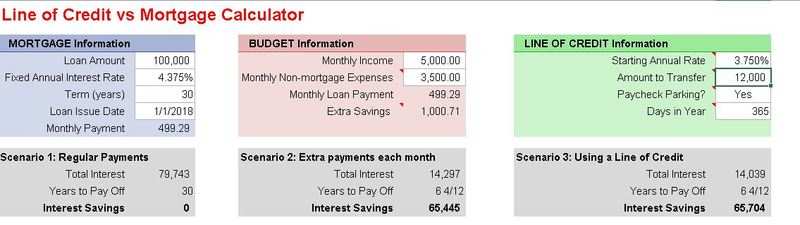
How about instead of verbal back-and-forth, we do some spreadsheet sparring? Here's a visual (from the spreadsheet i've posted above) for everyone to see. I was generous and used a very low heloc rate (what my bank is currently showing on my loc) and a higher mortgage rate (what i was able to get in 2016).
For the benefit of those following this thread ...
Here are some file links I found from earlier discussions (this debate has been "raging" for years) ...
Basic acceleration example: https://www.biggerpockets.com/...
The basic example is an earlier version of the spreadsheet and may lack features of the following file ...
Acceleration example showing the results: https://www.biggerpockets.com/...
These show how this all works. They illustrate the principal and interest portions of each payment along with the results of acceleration.
Neither one has any hidden cells or "magic" formulas - it's all readily visible.
Hope this helps ...
what's missing is a third example that shows additional principal payments on that mortgage of roughly $1200-1300/mo. If you have that money to pay your heloc every month (on top of your regular mortgage payments), i assume we can use that as additional principal. can you provide those calcs as well?
I too looked at this and saw some advantages, just depends on what your up to in your investing. I'm not doing this due to I need my cash.
There are some interest saving advantages by not holding cash in your savings or checking when you have debt which helps escalate the principal pay down.
The heloc allows you to have access cash when needed.
With this said you can use 100% of your savings and 100% of your income to put towards principal.
So with this strategy you are paying down your principle faster than a typical family for 2 reasons. Your paying extra our of your income directly to principal and you are not paying interest on loans due to your savings is covering a chunk of loan principal.
Only thing is that the heloc can be called due at any time.
I found a spread sheet and I ran the calculations both ways.
1st using 100% of heloc on primary principal of mortgage.
2nd using only 10% of heloc on primary principal of mortgage.
Both of the above came out with a similar outcome. Because you are just moving debt.
The big advantages came from, not paying interest on loans due to dead cash in savings and using 100% of your income towards principal.
For the benefit of those following this thread ...
Here are some file links I found from earlier discussions (this debate has been "raging" for years) ...
Basic acceleration example: https://www.biggerpockets.com/...
The basic example is an earlier version of the spreadsheet and may lack features of the following file ...
Acceleration example showing the results: https://www.biggerpockets.com/...
These show how this all works. They illustrate the principal and interest portions of each payment along with the results of acceleration.
Neither one has any hidden cells or "magic" formulas - it's all readily visible.
Hope this helps ...
what's missing is a third example that shows additional principal payments on that mortgage of roughly $1200-1300/mo. If you have that money to pay your heloc every month (on top of your regular mortgage payments), i assume we can use that as additional principal. can you provide those calcs as well?
There's nothing "missing", but you can make that (third example) yourself.
Starting from the first file, (Excel tutorial here... )
1. Zero the value in cell D1 of the HELOC worksheet.
2. On the "1st Mtg" worksheet, increase the "Monthly P&I" (D4) by the desired amount.
3. The spreadsheet will show you where the loan pays off and the totals of payments and interest at that point in the life of the loan.
REMEMBER:
"Velocity" or additional principal - either one will work.
It's up to YOU to decide which best suits your needs. There is no "one size fits all".
Using a line of credit such as a personal line, a HELOC, etc. has certain advantages. Consult your tax professional for specifics in your personal case.
I too looked at this and saw some advantages, just depends on what your up to in your investing. I'm not doing this due to I need my cash.
There are some interest saving advantages by not holding cash in your savings or checking when you have debt which helps escalate the principal pay down.
The heloc allows you to have access cash when needed.
With this said you can use 100% of your savings and 100% of your income to put towards principal.
So with this strategy you are paying down your principle faster than a typical family for 2 reasons. Your paying extra our of your income directly to principal and you are not paying interest on loans due to your savings is covering a chunk of loan principal.
Only thing is that the heloc can be called due at any time.
I found a spread sheet and I ran the calculations both ways.
1st using 100% of heloc on primary principal of mortgage.
2nd using only 10% of heloc on primary principal of mortgage.
Both of the above came out with a similar outcome. Because you are just moving debt.
The big advantages came from, not paying interest on loans due to dead cash in savings and using 100% of your income towards principal.
Again, no one is talking about "moving debt". Make sure you understand that. If not, feel free to ask questions.
That said, of course, it *IS* possible to get a 1st Lien HELOC. Some lenders still do that. This can have some advantages. However, make sure it appears as a real estate loan on your credit report. Some lenders slip up on that - notably, BMO Harris. If it's not coded properly, it will count against your revolving credit utilization which could be a serious issue on your credit profile.
... and even a 1st Lien HELOC can be accelerated!
@Wayne Brooks
The point is to convert the initial payments of an amortized loan to simple interest via a heloc, loc, credit card etc... you skip all of the front loaded interest by doing so and focus on paying down your heloc. It works because the interest on a heloc is calculated using the avg daily balance. So every payment you make during the month lowers the avg daily balance and the amount that you are paying interest on at the end of the month. You still pay interest, but the amount you pay over the life of the loan is significantly less.
@Logan Krutsch I understand the mechanics very well. An amortized mtg loan IS a simple interest loan....interest for that period is the outstanding balance at the underlying rate....each month.
There is much confusion/misunderstanding about an amortized loan being “front loaded”. If you had the same balance and interest rate on a heloc and made the same exact payment to the heloc as the amortized payment....the interest/principal portions each month would be Exactly the same as they are Both simple interest loans.
The simple key with each loan is to pay More than the required principal payment each month....nothing more, nothing less
If you paid the same amount extra directly to the mtg each month, as you do in paying back the heloc, you’d save the Exact same amount over the life of the loan (except for small savings the first month assuming you pay extra toward your mtg at the end of the first month).
@Logan Krutsch I understand the mechanics very well. An amortized mtg loan IS a simple interest loan....interest for that period is the outstanding balance at the underlying rate....each month.
There is much confusion/misunderstanding about an amortized loan being “front loaded”. If you had the same balance and interest rate on a heloc and made the same exact payment to the heloc as the amortized payment....the interest/principal portions each month would be Exactly the same as they are Both simple interest loans.
The simple key with each loan is to pay More than the required principal payment each month....nothing more, nothing less
If you paid the same amount extra directly to the mtg each month, as you do in paying back the heloc, you’d save the Exact same amount over the life of the loan (except for small savings the first month assuming you pay extra toward your mtg at the end of the first month).
Exactly!! ^^^^ The reason that mortgages appear "front end loaded" with interest is because any loan is "front end loaded with principal". Or simply put, interest owed is greatest early in the loan, because you owe more money and pay more interest. There is no such thing as "amortized interest". Unfortunately, ignorant or dishonest Youtube personalities have created the concept that you "skip payments" when you pay a chunk towards your mortgage. You do not skip all the interest. Your interest paid goes down by the amount proportional to the chunk you pay. For example if you owe $100,000 at 4%, that is equal to $4000 per year or $333 per month. If you paid down $10,000 worth of principal, you would avoid $400 annually or $33 per month. Your outstanding balance of $90,000 would still rack up $300 ($333-33) per month. I am oversimplifying the math, but it generally illustrates the point. This is where the Youtube trickery occurs. They tell people that you skip the entire $333 worth of interest. The other part people don't understand is that when you make the "chunk payment" using a HELOC, you are transferring your mortgage balance to a HELOC and accruing interest at the same rate if the interest rate is the same. In other words, a HELOC on $10,000 at 4% is $400 annually, or $33 per month. The point is, as Wayne clearly stated, whether you pay extra principal through the HELOC or directly to the mortgage really makes no difference.
The only value of a HELOC may be if the interest rate was lower or if the HELOC makes it easier for a person to make extra payments. Some argue that you use a HELOC as a negative bank account. In other words instead of having cash in your checking account, you pay all your bills with a line of credit. The idea is instead of having dead cash in a bank account, your money is always at work. There could be some minor interest savings doing this, but running your finances with no cash is risky.
@Wayne Brooks
The point is to convert the initial payments of an amortized loan to simple interest via a heloc, loc, credit card etc... you skip all of the front loaded interest by doing so and focus on paying down your heloc. It works because the interest on a heloc is calculated using the avg daily balance. So every payment you make during the month lowers the avg daily balance and the amount that you are paying interest on at the end of the month. You still pay interest, but the amount you pay over the life of the loan is significantly less.
You have to understand that whether interest is recalculated monthly or daily makes very little difference. Let's say you paid $1000 on your HELOC and the HELOC is 4%. That translates to $40 a year worth of interest or $3.33 per month or $0.11 per day. So even if your HELOC can avoid some daily interest, in my example the most you could avoid is $3.33 on a $1000 payment. Even if you made a thousand dollar payment every month and timed it just right, that $40 a year you can save. The POINT is that daily interest savings would never be enough to pay off a loan one month early, let alone years early.
A mortgage is simple interest. It get's recalculated monthly as you pay down extra principal. The only difference with a fixed term mortgage versus HELOC is that a HELOC generally is a variable payment. Most HELOC only require interest payments and you decide how much principal you pay. So if you pay the minimum on a HELOC, the balance may not even go down. All that an amortization table does, is calculates exactly how much interest and principal to pay in even payments to pay off by the end of the term (30, 20, 15 year or whatever). If you pay extra principal, it doesn't change your payments, but it does increase the amount of money going to principal and does result in the loan being paid off early.
@David Dachtera
Thanks for the response David. I understand the principal is the principal and theres no way around this but the same doesnt go for the interest is wat im seeing here with this strategy.
There is no way to get around the interest either. If your loan is 4% interest and you transfer that balance to a HELOC that is 4% interest, you are paying the same interest. It can all be mathematically proven, so there is really nothing to debate.
Velocity Banking *IS* *NOT* about transferring any balances anywhere.
"... so there is really nothing to debate".
Are you saying when you pay a "chunk" off your mortgage using your HELOC, that amount of debt is not transferred to the HELOC?
The point is the only way to pay a mortgage off faster is using extra principal payments. Whether those payments float through a HELOC or are directly paid to the mortgage makes little difference.
This topic is dangerous because people on Youtube or those selling "2 day seminars" are taking advantage of common people that don't understand interest calculations. Either these Youtubers are ignorant themselves or they are intentionally scamming people.
My PNC HELOC has a debit card. Is that what everyone is asking?
looks like these threads come about at least once every year. go grab a six pack and get down to reading:
https://www.biggerpockets.com/forums/61/topics/546767-heloc-payoff-strategy?page=1
p.s.
Originally posted by @NIcholas Hamel:
@Wayne Brooks
If there are no savings how are people paying off their mortgage in 5-10 years?
how can you save anything paying a higher interest than your mortgage?
No doubt - this thing is like a bad penny that just keeps showing up, covered in old bubble gum.

@David Dachtera
Thanks for the response David. I understand the principal is the principal and theres no way around this but the same doesnt go for the interest is wat im seeing here with this strategy.
There is no way to get around the interest either. If your loan is 4% interest and you transfer that balance to a HELOC that is 4% interest, you are paying the same interest. It can all be mathematically proven, so there is really nothing to debate.
Velocity Banking *IS* *NOT* about transferring any balances anywhere.
"... so there is really nothing to debate".
Are you saying when you pay a "chunk" off your mortgage using your HELOC, that amount of debt is not transferred to the HELOC?
The point is the only way to pay a mortgage off faster is using extra principal payments. Whether those payments float through a HELOC or are directly paid to the mortgage makes little difference.
This topic is dangerous because people on Youtube or those selling "2 day seminars" are taking advantage of common people that don't understand interest calculations. Either these Youtubers are ignorant themselves or they are intentionally scamming people.
That's EXACTLY what I'm saying. The available balance from the (HE)LOC - or other available funding - is applied to the principal of the 1st lien / home loan. There is no "transfer".
Yes - "The point is the only way to pay a mortgage off faster is using extra principal payments." No one has said - or will say - otherwise. ... and no, with respect to the 1st lien / home loan, where the money comes from makes no fundamental difference. Again, no one has said - or will say - otherwise.
No one is "selling a 2-day seminar". The case to which I refer is one class out of 62, available on-line and on-demand. The velocity banking class is two 8-hour days of material, mostly on how to restructure your finances to make the best use of your take-home pay and understand where you are paying interest as well as how to reduce those expenses and benefit from the process.
... but, if you need to be right, then so be it: It's all a lot of hooey ... just don't tell the people reducing / eliminating their mortgages and other debt using this method.
To answer the original post. As an expert who has used this method successfully, it works when done correctly. There is no magic to it. Plain and simple you are leveraging the banks money to pay down the banks money @ a cost. You will save 10s of thousands of dollars in my experience. I seem to always get the question about the HELOC payment. The HELOC payment is satisfied when you deposit your pay into the HELOC. I have gone down this rabbit hole a few times and a few of us just have to agree to disagree. Bottom line is the method works when done properly.
It doesn't work, any more than just paying extra on a mortgage. I won't relitigate this thing but there are threads, here in BP, with spreadsheets demonstrating this is a lot of hoo-ha. There are several smart guys that put this exact BS to work in a spreadsheet, just like the magicians claim, and demonstrated the difference between the two, anywhere on the timeline, was a couple of dollars difference at best and not always in the favor of the magic.
So for any of you interested in this hocus-pocus, just do a search. You will find the spreadsheets and see the proof for yourself.
@NIcholas Hamel
Ive studied it some. Ive not found a bank where you can use it as conveniently to use as a debit card instead of a credit card.
My holdup is that any cash in any account is lost traction.
Im sure it or snowball by balance or snowball by interest rate all work if you stick too it.
Truthfully any extra principle helps.
This is true Blake except for the All In One or AIO loan which is a 1st position line of credit that combines a sweep checking accounting, an interest only line of credit, and features of a ARM or adjustable rate mortgage which cap the rate on the line and keep it relatively safer than typical HELOC's which max at 18% capped interest generally.
The AIO loan provides you a debit card which you can make purchases to your line directly and the sweep feature also moves over any idle cash at 12am each night over to reduce principal balance prior to calculating your interest for that day.
Prior to this product I would have to manually transfer funds to keep all the funds working 24/7 and there would be gaps in between since ACH payment transfers take 3-5 days to confirm in between banks and lines.
@JD Martin
Actually JD, so you say take your money from your checking account and pay down the principal and I say pull money from a HELOC to pay down my principal. It appears we are accomplishing the same goal, aren't we?
You put you receivables in your checking account. I put my receivables in my HELOC. We still have accomplished the same goal.
I put my left shoe on first, then my right shoe. You may put your right shoe on first and then your left shoe. In the end, we both have our shoes on. I don't bash the way you put on your shoes because you don't differently than me.
What is called velocity banking, today, absolutely works.
It doesn't work, any more than just paying extra on a mortgage. I won't relitigate this thing but there are threads, here in BP, with spreadsheets demonstrating this is a lot of hoo-ha. There are several smart guys that put this exact BS to work in a spreadsheet, just like the magicians claim, and demonstrated the difference between the two, anywhere on the timeline, was a couple of dollars difference at best and not always in the favor of the magic.
So for any of you interested in this hocus-pocus, just do a search. You will find the spreadsheets and see the proof for yourself.
Yes - see the spreadsheets, but be careful which ones you trust.
The ones who say it doesn't work will produce evidence appearing to prove their point. It is usually wrong and incomplete because they don't understand what Velocity Banking is or how to do it.
The ones who say Velocity Banking does work produce evidence showing how and why it works. See my links earlier in this thread for two examples .
Hoo-ha? Hocus-pocus? Well, if you need to be right, then so be it - it's both of those. Just don't tell the people who are reducing and eliminating their debts using this method (thus proving that it does work, how it works and why it works). They are busy reducing their debts and the interest they pay, and don't have time for nonsense from skeptics.
This may violate one of BP's rules, so mods (@Joe Splitrock and or @JD Martin) please take it down if it does.
If all this back and forth about simple vs amortized interest, daily vs monthly compounding, HELOCs and mortgage, dueling excel spreadsheets is making anyone's head spin and you can't figure if the Velocity strategy is "good" or not I may have another way to decide. The cow weight guess test.
For those that have never done this, it is when you get a group of people (15-40) and show them a a cow and ask everyone to give their best guess at its weight. Then you give them an option of picking either their guess, the guess of someone else, or the group's average guess as being closest to the right answer. If the option they pick is closest to the actual weight, they get a prize. Now here is the surprise, picking the group average has like an 85%+ chance of winning the bet. That is an insane edge. Also, the winning percentage and the closeness of the groups guess to the actual answer increase with group size, to a point.
What does that tell us? That it is crazy hard to tell what specific individual has an informational edge, but overall the group has a way of arriving at approximately the right answer most of the time. This is Adam Smith's invisible hand at work and what makes our markets mostly efficient most of the time.
How does this apply to the Velocity of Banking debate? Well, BP has its very own built in cow weight guessing test; the posts and votes. The posts are their "guess" and the votes are a proxy for how "good" there guess is. Over hundreds and thousands of posts across hundreds of different topics, thousands of other people have given a vote to a good post. Granted some of those are funny memes or jokes at Clayton Morris' expense, but for the most part the vast majority of votes are given for quality posts that help people and display a level of expertise by the poster.
Here comes the borderline part of the post:
If I had no idea which side of this velocity banking debate was right and no hope/desire of figuring it out on my own, I'd look at the Post to Vote ratio for the people on each side and go with the camp who had the higher.
In this case, the "Velocity of Banking isn't all that and a bag of chips" camp wins, hands down.
@Victor S.
Thank you sir. Very much. My head was starting to hurt.
It’s like “if you use VB you have to make all these extra payments on your heloc and it goes so quick! VS just make minimum payments. See VB banking works!” Completing ignoring the tens of thousands of additional actually dollars from your wallet to your heloc over this 5 years.
This is like Gatorade saying “drinking Gatorade and five years of hard training beats drinking water and sitting on the couch every time!”
I just thought of “super duper light speed banking banking house hack system” just now. As soon as you buy your house sell everything else you own and write a check and pay off the mortgage of the first day. Boom! No mortgage payments ever! I need a book deal.