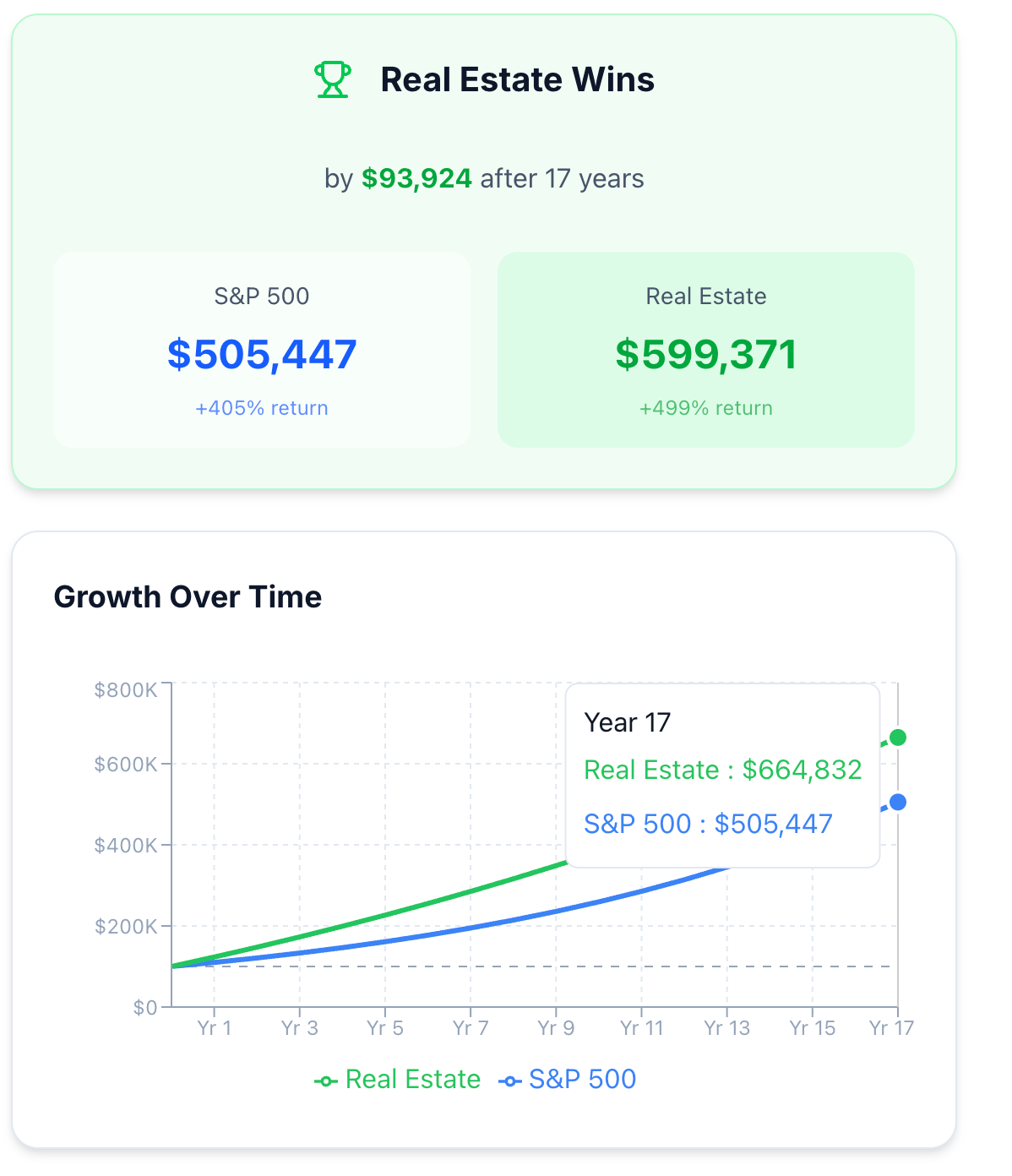
Warning! RE will keep you poor and the passive income myth

Warning! RE will keep you poor and the passive income myth

Member since 2021 · 401 posts · 254 votes

This is a PSA for the majority of new members on here who just read a Rich Dad Poor Dad book or similar and looking for advice on how to build wealth by buying rental properties most likely in C class neighborhoods with the intention of BRRR in 2025 and who have a 9-5 job which is most likely the majority of new members.

During my time in the mid to late 2000s, we had the 1% rule which I followed. I purchased a 100k house in cash in Texas which rented for $1k/month and it tripled to 300k by the time I sold it at the peak in 2023 before the current price drops. I believe this aligns with the national average.

That is 200k in equity divided over 17 years and you get an average rate of appreciation of 10%/year not including the rental income which I will get into. But lets look at that 10% and look at the real rate after selling costs (I didn't want to 1031 exchange into another problem). After, taxes at the federal income rate (65k), recapture of depreciation (17k), agent fees (20k) and what nobody here or book will tell you, is renovation fees. After 17 years of renting a 1984 home, you'll spend $25-50k to renovate it enough to receive full market value and that is if you're lucky enough for your insurance to cover a new roof because a lot of buyers will want a concession for that if it's aging. Otherwise, the new home owner will have issues insuring it. 

All said and done, the appreciation drops to 4.3% on average over 17 years (around 75k from 200k), which follows the national average rate of appreciation according to Case Shiller and other sources I believe. But we still have rental income since I did purchase it in cash. That should make up the difference, right?

Here's one statement as an example and was a particularly good year with little expenses.
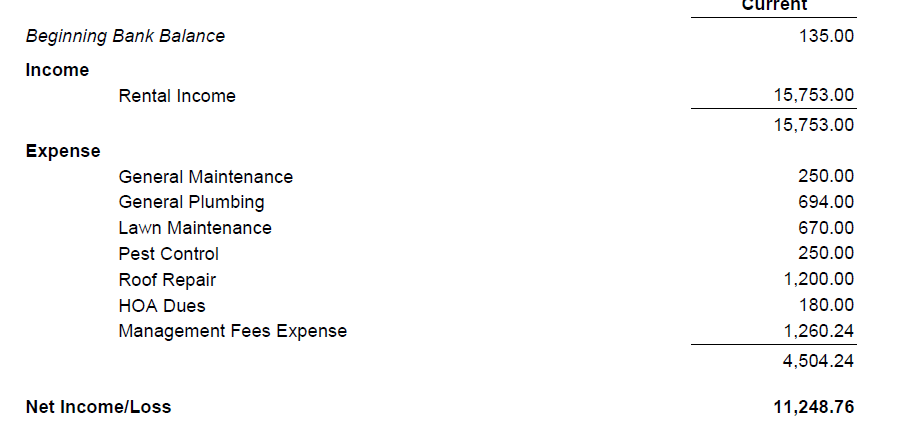
Subtract $4500 in property taxes and $2500 in insurance.

= $4,250 actual income divided by the purchase price of 100k

= 4% cash return on investment.

Take appreciation and cash on cash return and you get

Around 9% total return every year for 17 years or $9000/year I think which = 150,000 total cash return after sale.

Don't get confused with compounding like a stock. The S&P 500 has averaged over 10% I think over the same period.

From the S&P 500 history calculator.

Real Estate = $150k

S&P 500 = $540k

But what about leverage you ask? I would need 4 properties ($600k) to beat the S&P 500. No problem, I'll just put 25% down and buy 4 units.

But I would have a mortgage at 6% for the first 13 years until rates were low enough to refinance. 25% down would be break even so no cashflow. Now you have to reduce each unit by $75,000 (the $350/month for 17 years). So cut the 600k in half and you'll need 7 units to match the S&P 500. Again, after federal taxes, recapture fees, renovations, agent and misc selling fees and rental expenses. 

The rental income is eaten up by capital expenses and the fees I displayed. Every increase in rent was eaten up by the state reassessing home values ever year plus growing maintenance on 50-year-old home.

Some arguments against myself is that I could have been more efficient than 50% (income to expense ratio) but 50% is average for an older home in this location as stated by books I have read and my own experience. I could have also renovated earlier and increased rents to market rate but the rental market rate didn't really pop until the last few years and my payback would be 5 years. Another argument is that I could have rolled over the $350/month in cashflow into the S&P 500 and gained an additional 250k over 17 years. This means that I could purchase two properties with 50% down and maybe matched the S&P 500. Remember no passive income with a mortgage at 25% down. I also could have 1031 exchanged but I don't want to exchange it for another low return, high risk burden.

Even with leverage which all the influencers will be quick to mention, just can't beat the S&P 500 without tons of risk and work. Who wants 2-7 units when you can simply put the same amount of money into the S&P 500 and walk away. You just purchased yourself a job.

||||||||||||||||||||||

Here's another myth keeping you poor. Passive Income!

If you're working 9-5. You don't need passive income. What is $100/month or $1000/month to you now when you don't need it? 

I realized that passive income is only good when you retire. Nobody needs passive income when you're working. If you have a home mortgage, make sure it's paid off when you retire otherwise the extra income is better off in the market building wealth at a faster rate than your passive income and the capital used to generate it.

Also, it's not passive if you're putting time into it, spending days doing taxes finding all the websites you need to login to and pay all the misc rental taxes, prop taxes, HOAs etc. It's like a dozen. I probably spend a week every year just doing taxes. Then the stress of getting sued, answering emails, storms that blow your tree over and almost murder the tenants, it's not a lot of time but it's enough for me to put a value on my time vs no time nor risk in an index fund.

I purchased a condo for 150k in San Diego in 2012 returning $1000/month. Awesome right?

Again, lets go back to investing that 150k into the S&P 500. That's 150k in cashflow over 13 years and 100k in appreciation = 250k.

But again:

S&P 500 = $1,000,000 (some calculators show 700,000 probably adjusting for inflation)
Real Estate = $250,000 

1000/month vs 1M? You could literally just pay yourself out with the million or if you like the psychological idea of passive income, then you can achieve the same result with a dividend fund and receive a check every month but with way less work and less risk. Real Estate just gives you a check that you don't need and its principal grows more slowly.

This is why I'm so bitter with real estate. Leveraged or not, I could have been retired by now had I simply put my money into the market instead of buying real estate. The same money invested 10-17 years ago would have net me well over 10 million dollars by now had I just put it all into the S&P 500, 401k matching with Roth and maybe a couple tech stocks, bonds or dividends for diversification. Of course I have all these things but my portfolio was heavily into RE maybe 90/10. Now I'm shifting into 20% real estate (for diversification and to live in) and 80% market.

In summary, Real Estate is a soul crushing scam that keeps you poor and makes others rich by selling books, videos, seminars and of course forums like this used for advertising and podcasts.  It's a billion dollar industry that needs to convince new members that they can build wealth by buying homes that are made for families thus turning real estate into a stock like product which continues to make housing unaffordable for the common family.

25Reply
5,871 views

Most Popular Reply

Dan H.Pro Member
Investor · Poway, CA · Member since 2015 · 7k+ posts · 8k+ votes
10mo

Your math is very incorrect when it comes to the leverage as you used the unleveraged appreciation rate. If you purchased the $100k property at 80% LTV, if the property appreciated to $300k, your return from appreciation is 1000%/17 years. Not only would you not need 4 properties, but one property would far exceed the 10%/year S&P that you used which would result in $101k of growth ver 17 years (just over half of what you would have achieved via the property implying that 0.5 property would be virtually equivalent). Active asset managers likely would have refinanced the property multiple times over that 17 years and achieved far better return than the 1000% return over the 17 years.

The flaw in the leverage calculation is just the biggest flaw.

You chose not to value add until selling.   You chose not to use leverage.  You chose to sell and pay the gains versus never paying the tax on the gains.  You did not discuss the tax advantages of RE with OBBB now allowing 100% bonus appreciation.

It also sounds like your initial underwriting may not have been accurate as to actual expenses.  It is important to have accurate underwriting to have an accurate estimate of the cash flow.   The cash flow should not be a surprise over a 17 year period.

I agree without leverage, it may be challenging to exceed the S&P.   The unleveraged property investment would get whooped by Magnificent 7 or Fab 5.  

You purchased a $150k property in San Diego in 2012 and it is only worth $250k?  I find this shocking.  In 2012, I purchased a property in Escondido for $302k that is worth ~$1.1m today   In 2013 I purchase a property for $490k that is worth ~1.3m and another for $390k that is worth ~1.1m today.  Neighborhoodscout shows San Diego average appreciation in last 10 years is 115%, but in 13 years you have only achieved 66% appreciation.

https://www.neighborhoodscout.com/ca/san-diego/real-estate

Here is the reality on my active RE investments.   My worse appreciating property has gained $2700/month of appreciation.  I have 2 properties that have appreciated the over $10k/month over their hold.   I have never purchased a property that at stabilization did not depict positive cash flow, but would not be adverse to buying a property with stabilized negative cash flow if the total return was high enough.  My underwriting had never been significantly too optimistic.

by the way I have never sold books, course, anything.  I have had a very successful protege (8 digit net worth and recently made ~$500k on a property repurpose) and a moderately successful protege and various protégés that are still working to find their way (no charge to any of them).

Now for what I agree with your post: 1) the RE market today may be the most challenging ever. Two recent studies show that renting has never been more favorable versus home ownership in large US cities. 2) active residential investing is not passive. If you want passive RE, be a LP, go NNN, or invest in a REIT. Because active residential RE is not passive, its return should far exceed passive options to compensate for the effort 3) without leverage and/or value add, there likely are many passive options that can match or exceed the return that will be achieved via active residential RE.

good luck

See this reply in the discussion

276 Replies

Jump to latestLatest
  • Real Estate Broker · Berwyn, IL · Member since 2018 · 8 posts · 2 votes
    10mo

    This thread is interesting, and I understand both sides of the argument. However, I think investing in general, whether it is in real estate or the stock market, depends on the individual's life stage. Let's take someone who is young and getting started with 0 investment properties. If that person wanted to make as much money as possible in the next 5 years, would you argue that being in the S&P is the best choice? Or actively investing in real estate?

    Now that I think about it, your argument appears to be referring to the long-term idea of just keeping the money in the S&P 500 over 17 years, as it would grow/make you more. In other words, it matters more what the goal is. It sounds like if you want to make a lot of money in a shorter period, focus on real estate investing and doing it correctly (actively). If you want to make money over a longer period, just invest in the index funds and sit back (passively). And as I am typing this out, I realize...why not do both? I think someone mentioned it earlier in the thread. Diversify across multiple assets.

    I like the idea of you challenging the mainstream fluff regarding 'get-rich-quick' schemes. This is a truly fascinating thread, and I enjoyed everyone's thoughts and input.

    • Member since 2021 · 401 posts · 254 votes
      10mo
      Quote from @Alexiz Pedraza:

      And as I am typing this out, I realize...why not do both? I think someone mentioned it earlier in the thread. Diversify across multiple assets.

      I like the idea of you challenging the mainstream fluff regarding 'get-rich-quick' schemes. This is a truly fascinating thread, and I enjoyed everyone's thoughts and input.

      You should, as in buy your own house and live in it. There's opportunities like ADUs, lot split, house hacking etc and you can build DYI skills but as far as a dozen SFHs as investments spread across the country seems odd to me kind of like a used car salesman. Perhaps quads or commercial would be better but I'm making my split to be heavier in the market as I sell off my 7% CAP cash flowing properties for 13% compounding in the market. My opportunity cost there was massive because I fell for the "passive income" myth a long time ago. I'll keep one for fun because It's like an airbnb and I use it every year but having more is just diminishing returns. Not sure what the split should be like 10/90 or 20/80. My strategy is just buy properties that I want to live in, vacation homes or something that comes my way without me looking over the course of decades but not become an active real estate investor again. The research, emails, agents, brokers, more emails, closing, landlording, taxes, are all time wasting activities and boring AF.  
  • Member since 2021 · 401 posts · 254 votes
    10mo

    I was thinking of buying land due to all these ADU regulations coming out and just sit on them until I can capitilize on the ADU and lot splits but again, a local team told me that the 1033 may cost around 50k alone in just fees and paperwork. It seems as though there's no records of anyone condotizing yet and I heard lot splits were even more difficult and time consuming.

    • Dan H.Pro Member
      Investor · Poway, CA · Member since 2015 · 7k+ posts · 8k+ votes
      10mo
      Quote from @K S.:

      I was thinking of buying land due to all these ADU regulations coming out and just sit on them until I can capitilize on the ADU and lot splits but again, a local team told me that the 1033 may cost around 50k alone in just fees and paperwork. It seems as though there's no records of anyone condotizing yet and I heard lot splits were even more difficult and time consuming.

       $50k, $100k, $200k would be nothing compared to the value added.

      Per NAR data from Nov 2021 (old, but the most recent I am aware of) shows the average ADU in San Diego added less than $20k of value per the sales price. If you purchase the right property with an ADU for even 3x or 4x what the NAR data indicates and spend $200k for a separate property in effect making the one property 2. What is a cheap separate SFH in San Diego? It varies by area but finding a 3 br below $500k in any area that does not need tons of work would be challenging. $80k for existing ADU, $200k for the separation, $220k profit if sold for $500k. Now instead of a cheap area use a nicer area like pt Loma, Del Mar, Coronado, ranch Santa Fe, Poway, etc. What would you project the profit? I suspect just the board of supervisors incorporating ab1033 will increase the value of some of my properties significantly.

      Now let’s say you are lazy and do not want to do it yourself.   You buy it and sell it repurposed.  A protege of mine did this on an infamous Claremont property (you may know the property as it got a lot of press).   He did no development.   He simply sold it to a developer with a proposed different use leveraging a San Diego law that had since changed.  3/1 in Claremont maybe worth $1m, but he sold it for $1.5m to a developer.   He performed no development and had exited before the development started.

      There are lots of ways to make money.   Just find the way that interests you.


      good luck

    • Member since 2021 · 401 posts · 254 votes
      10mo
      Quote from @Dan H.:
      Quote from @K S.:

      I was thinking of buying land due to all these ADU regulations coming out and just sit on them until I can capitilize on the ADU and lot splits but again, a local team told me that the 1033 may cost around 50k alone in just fees and paperwork. It seems as though there's no records of anyone condotizing yet and I heard lot splits were even more difficult and time consuming.

       $50k, $100k, $200k would be nothing compared to the value added.

      Per NAR data from Nov 2021 (old, but the most recent I am aware of) shows the average ADU in San Diego added less than $20k of value per the sales price. If you purchase the right property with an ADU for even 3x or 4x what the NAR data indicates and spend $200k for a separate property in effect making the one property 2. What is a cheap separate SFH in San Diego? It varies by area but finding a 3 br below $500k in any area that does not need tons of work would be challenging. $80k for existing ADU, $200k for the separation, $220k profit if sold for $500k. Now instead of a cheap area use a nicer area like pt Loma, Del Mar, Coronado, ranch Santa Fe, Poway, etc. What would you project the profit? I suspect just the board of supervisors incorporating ab1033 will increase the value of some of my properties significantly.

      Now let’s say you are lazy and do not want to do it yourself.   You buy it and sell it repurposed.  A protege of mine did this on an infamous Claremont property (you may know the property as it got a lot of press).   He did no development.   He simply sold it to a developer with a proposed different use leveraging a San Diego law that had since changed.  3/1 in Claremont maybe worth $1m, but he sold it for $1.5m to a developer.   He performed no development and had exited before the development started.

      There are lots of ways to make money.   Just find the way that interests you.


      good luck

      Buy it and sell it repurposed? You mean rezoning? Yes I get the concept of rezoning but I'm not looking for a niche or advice. I understand what my options are for ABs, lot splits, condotizing, rezoning, 2-5yr rule that was just mentioned etc. Everything that has been said here thus far, I'm familiar with and I thank you for sharing for other viewers but it wasn't my intent to be convinced how awesome real estate is.

    • Dan H.Pro Member
      Investor · Poway, CA · Member since 2015 · 7k+ posts · 8k+ votes
      10mo
      Quote from @K S.:
      Quote from @Dan H.:
      Quote from @K S.:

      I was thinking of buying land due to all these ADU regulations coming out and just sit on them until I can capitilize on the ADU and lot splits but again, a local team told me that the 1033 may cost around 50k alone in just fees and paperwork. It seems as though there's no records of anyone condotizing yet and I heard lot splits were even more difficult and time consuming.

       $50k, $100k, $200k would be nothing compared to the value added.

      Per NAR data from Nov 2021 (old, but the most recent I am aware of) shows the average ADU in San Diego added less than $20k of value per the sales price. If you purchase the right property with an ADU for even 3x or 4x what the NAR data indicates and spend $200k for a separate property in effect making the one property 2. What is a cheap separate SFH in San Diego? It varies by area but finding a 3 br below $500k in any area that does not need tons of work would be challenging. $80k for existing ADU, $200k for the separation, $220k profit if sold for $500k. Now instead of a cheap area use a nicer area like pt Loma, Del Mar, Coronado, ranch Santa Fe, Poway, etc. What would you project the profit? I suspect just the board of supervisors incorporating ab1033 will increase the value of some of my properties significantly.

      Now let’s say you are lazy and do not want to do it yourself.   You buy it and sell it repurposed.  A protege of mine did this on an infamous Claremont property (you may know the property as it got a lot of press).   He did no development.   He simply sold it to a developer with a proposed different use leveraging a San Diego law that had since changed.  3/1 in Claremont maybe worth $1m, but he sold it for $1.5m to a developer.   He performed no development and had exited before the development started.

      There are lots of ways to make money.   Just find the way that interests you.


      good luck

      Buy it and sell it repurposed? You mean rezoning? Yes I get the concept of rezoning but I'm not looking for a niche or advice. I understand what my options are for ABs, lot splits, condotizing, rezoning, 2-5yr rule that was just mentioned etc. Everything that has been said here thus far, I'm familiar with and I thank you for sharing for other viewers but it wasn't my intent to be convinced how awesome real estate is.

       My protege did not rezone.   He let the developer do everything necessary for the development.   All he did was identify an outstanding candidate property.   One with a different use was worth $1.5m to a developer that was worth <$1m based on comps with current use.

      The value of certain properties will increase solely on their upside potential.   Or you can go more active for more gain and complete the lot split.   In either case there is money to be made.   Because I already own quite a few small unit count MF, just the value increase based on upside potential should add significantly to my net worth.   If I want to split them, then additional net worth increase.    This is only a single example of a sophisticated value add.

      The reality is what is being offered via AB1033 is already possible via TIC/coop (a current sophisticated value add), but due to finance challenges with the TIC/coop, ab1033 could make things easier and more obvious.


      >it wasn't my intent to be convinced how awesome real estate is.  

      it was you intent to show the RE investing cannot work.   That the stock market can beat an RE investor.   1) stock market has not historically beat competent RE investors.   2) these sophisticated value adds or even seeng the potential for gain from just understanding their impact goes towards going beyond the competent RE investors and entering the sophisticated RE investor.   Pointing out that certain rules can be leveraged for outstanding RE gains contradicts your hypothesis.  


      we are both in the San Diego market.   Your San Diego RE has not beaten the stock market per your claims.   I have made a lot of money on local RE investing.   What is the difference?   I think the difference is clear reading your posts in this thread versus my posts in this thread.  

      I suspect most RE investors that purchase any property without any leverage or plan or understanding of the expected outcomes in that submarket will be better served going a passive route such as s&p.  

      However, a bit of underwriting would scream to use leverage in the San Diego market. That alone would have changed you numbers towards the RE investing. Add further educating to become a sophisticated RE investor and the returns can be outstanding. Most of my purchases have been brrrr with all investment extracted. Some refer to it as infinite return, byput that is not quite reality as investment is in the purchase for some time. But trapping money for a short period of time for long term return creates crazy ROI. I suspect t every one that I extracted all investment has a over 100%/year average return.

      You can make money in the S&P and it is passive. You can make more money in RE but it is less passive. The less passive you are in RE, the more opportunity for increased ROI (at least until you master some sophisticated value adds).

      Good luck

  • JD MartinBusiness Member
    Moderator
    Rock Star Extraordinaire · Northeast, TN · Member since 2015 · 10k+ posts · 16k+ votes
    10mo

    There's so many errors, assumptions or carefully selected mile markers in order to prove your title that it's not going to be reasonable to go through them all, especially since a number of posters have already demonstrated many of them. But I will highlight a couple that I either didn't see mentioned or weren't mentioned:

    1. Your S&P return is fudged because your figures are based on 18 years of returns rather than 17 years. I ran 17 years on Shiller's website starting in January 2006 to January 2023 (17 years) and came up with almost $432k. Good return but not the $541k you're tooting. That also doesn't take into account any fund expenses, but let's just say they're zero.

    2. You fail to compound your rental income so regardless of leverage or not it's not apples to apples - in your example you're eating your rental income, while reinvesting your S&P returns. That's not a valid comparison. If we just did something simple with your rental income and put it into the same index fund return you're using above, your rental income grows to $186k. When we add it to the $200k you made on the sale you're now at $386k, much closer to your S&P return above.

    3. You can't count depreciation recapture because that was a net income to you when you took it so it's a wash. You can't count any taxes on the sale without also counting taxes on taking your S&P distribution if you're going apples to apples.

     4. You obviously purchased a (relatively) poor rental investment to start with based on your numbers. The "1% rule" means nothing if your costs of ownership are as severe as your posted. $4500 in property taxes & $2500 in insurance on a property grossing $12k/year?. I'm assuming these numbers are cherry-picked at the end and weren't the numbers in 2006 when you purchased. 

    5. Your comparison is based on a backwards-look sequence of returns that no one can predict, period. You bought a house at the peak of the housing market, and even after cost of sale (forget about taxes and depreciation, see above) you made somewhere around 6% return on the appreciation alone adjusted for inflation. There's a lot of instances you can pick different S&P guideposts and realize far worse returns. There's no question the S&P has had historically strong returns in the last 2 decades. There's no way you can know that 17 years ago. 

    Some of the things you note are true. Right now it is difficult (not impossible) for someone starting out to make really strong rental returns. Housing prices are high right now. If you don't have capital reserves running a rental can be difficult. But your arguments make no sense based on historical experience of hundreds of thousands, if not millions, of people over time that made great wealth through rental real estate. The last few years of my working career, before I retired, my rental portfolio easily surpassed my income for far less effort. And some of your points are just nonsense in an attempt to prove your thread title. I own a pretty decent sized portfolio and have done this for many years and I have never answered a phone call from a tenant at 2 AM. I'm not sure why you would be answering them either, or answering e-mails or storms blowing over trees since your models show you paying for property management. A week doing taxes? Doesn't your PM provide you a succinct statement of revenues & expenses? Stress of getting sued? I have a nice umbrella policy and maximum liability insurance (by the way, when's the last time you read about a mom & pop landlord, which would be you, paying out a massive claim from being sued?)

    Real estate is not for everyone, and maybe not for you. There's also just as many people "selling" the stock market as there are "selling" real estate riches. Directly owning real estate is not truly passive, and never should be advertised as such. But if you are willing to learn and work at it (which doesn't necessarily mean you swing a hammer) you can easily surpass the S&P. I don't disclose my finances on a public forum but I have both and my RE returns, exclusive of tax benefits, have easily surpassed my Vanguard STX funds and have equaled my returns on a couple of closed-to-new-investors Vanguard growth funds that are highly volatile, without the volatility. 

    Skyline Properties
    View Page
    • Member since 2021 · 401 posts · 254 votes
      10mo
      Quote from @JD Martin:

      There's so many errors, assumptions or carefully selected mile markers in order to prove your title that it's not going to be reasonable to go through them all, especially since a number of posters have already demonstrated many of them. But I will highlight a couple that I either didn't see mentioned or weren't mentioned:

      1. Your S&P return is fudged because your figures are based on 18 years of returns rather than 17 years. I ran 17 years on Shiller's website starting in January 2006 to January 2023 (17 years) and came up with almost $432k. Good return but not the $541k you're tooting. That also doesn't take into account any fund expenses, but let's just say they're zero.

      2. You fail to compound your rental income so regardless of leverage or not it's not apples to apples - in your example you're eating your rental income, while reinvesting your S&P returns. That's not a valid comparison. If we just did something simple with your rental income and put it into the same index fund return you're using above, your rental income grows to $186k. When we add it to the $200k you made on the sale you're now at $386k, much closer to your S&P return above.

      3. You can't count depreciation recapture because that was a net income to you when you took it so it's a wash. You can't count any taxes on the sale without also counting taxes on taking your S&P distribution if you're going apples to apples.

       4. You obviously purchased a (relatively) poor rental investment to start with based on your numbers. The "1% rule" means nothing if your costs of ownership are as severe as your posted. $4500 in property taxes & $2500 in insurance on a property grossing $12k/year?. I'm assuming these numbers are cherry-picked at the end and weren't the numbers in 2006 when you purchased. 

      5. Your comparison is based on a backwards-look sequence of returns that no one can predict, period. You bought a house at the peak of the housing market, and even after cost of sale (forget about taxes and depreciation, see above) you made somewhere around 6% return on the appreciation alone adjusted for inflation. There's a lot of instances you can pick different S&P guideposts and realize far worse returns. There's no question the S&P has had historically strong returns in the last 2 decades. There's no way you can know that 17 years ago. 

      Some of the things you note are true. Right now it is difficult (not impossible) for someone starting out to make really strong rental returns. Housing prices are high right now. If you don't have capital reserves running a rental can be difficult. But your arguments make no sense based on historical experience of hundreds of thousands, if not millions, of people over time that made great wealth through rental real estate. The last few years of my working career, before I retired, my rental portfolio easily surpassed my income for far less effort. And some of your points are just nonsense in an attempt to prove your thread title. I own a pretty decent sized portfolio and have done this for many years and I have never answered a phone call from a tenant at 2 AM. I'm not sure why you would be answering them either, or answering e-mails or storms blowing over trees since your models show you paying for property management. A week doing taxes? Doesn't your PM provide you a succinct statement of revenues & expenses? Stress of getting sued? I have a nice umbrella policy and maximum liability insurance (by the way, when's the last time you read about a mom & pop landlord, which would be you, paying out a massive claim from being sued?)

      Real estate is not for everyone, and maybe not for you. There's also just as many people "selling" the stock market as there are "selling" real estate riches. Directly owning real estate is not truly passive, and never should be advertised as such. But if you are willing to learn and work at it (which doesn't necessarily mean you swing a hammer) you can easily surpass the S&P. I don't disclose my finances on a public forum but I have both and my RE returns, exclusive of tax benefits, have easily surpassed my Vanguard STX funds and have equaled my returns on a couple of closed-to-new-investors Vanguard growth funds that are highly volatile, without the volatility. 


      JD,

      Ya that figure was most likely adjusting for inflation.

      The S&P is at capital gains rate vs Real Estate at the federal tax level so S&P gains some.

      It wasn't 12k/y I showed you $15,500 which was $21,600 after renovation but I sold it and like I stated, that pop from 1300 to 1800 happened just in the last administration so I wouldn't count it. Like I said, payback for the renovation is 5 years and appreciation since 2023 has declined since I sold it making payback longer.

      Even when you count reinvesting the cashflow like I had mentioned, it's still under the S&P and with 25% down, you break even so there's no cashflow to reinvest.

      I currently don't invest my cashflow into the S&P. I let it sit until I have debts to pay like property taxes, and another cash-out mortgage that I have coming out of the same account. That's most peoples situation. I do have extra by the end of the year, but It's ok to have some positive savings you know. I'm not trying to reinvest every penny. I like to have some cash. Nothing ends up being reinvested

      When you have multiple properties spread out each one with different web sites for HOA payments, Cali rental taxes, off paper expenses and deductions, receipts you have to scan, different HOA websites etc. Yes it takes a while, you're always emailing people asking where this is or that is because someone forgot to send you a month from a statement. Yes I need all the montly even though I have the 1099 because I deduct other things off them.

      I read books on LLCs and that. The way it works is you don't actually get sued, you settle so it doesn't drag on.   

    • Joe VilleneuvePro Member
      Plymouth, MI · Member since 2013 · 13k+ posts · 19k+ votes
      10mo
      Quote from @JD Martin:

      There's so many errors, assumptions or carefully selected mile markers in order to prove your title that it's not going to be reasonable to go through them all, especially since a number of posters have already demonstrated many of them. But I will highlight a couple that I either didn't see mentioned or weren't mentioned:

      1. Your S&P return is fudged because your figures are based on 18 years of returns rather than 17 years. I ran 17 years on Shiller's website starting in January 2006 to January 2023 (17 years) and came up with almost $432k. Good return but not the $541k you're tooting. That also doesn't take into account any fund expenses, but let's just say they're zero.

      2. You fail to compound your rental income so regardless of leverage or not it's not apples to apples - in your example you're eating your rental income, while reinvesting your S&P returns. That's not a valid comparison. If we just did something simple with your rental income and put it into the same index fund return you're using above, your rental income grows to $186k. When we add it to the $200k you made on the sale you're now at $386k, much closer to your S&P return above.

      3. You can't count depreciation recapture because that was a net income to you when you took it so it's a wash. You can't count any taxes on the sale without also counting taxes on taking your S&P distribution if you're going apples to apples.

       4. You obviously purchased a (relatively) poor rental investment to start with based on your numbers. The "1% rule" means nothing if your costs of ownership are as severe as your posted. $4500 in property taxes & $2500 in insurance on a property grossing $12k/year?. I'm assuming these numbers are cherry-picked at the end and weren't the numbers in 2006 when you purchased. 

      5. Your comparison is based on a backwards-look sequence of returns that no one can predict, period. You bought a house at the peak of the housing market, and even after cost of sale (forget about taxes and depreciation, see above) you made somewhere around 6% return on the appreciation alone adjusted for inflation. There's a lot of instances you can pick different S&P guideposts and realize far worse returns. There's no question the S&P has had historically strong returns in the last 2 decades. There's no way you can know that 17 years ago. 

      Some of the things you note are true. Right now it is difficult (not impossible) for someone starting out to make really strong rental returns. Housing prices are high right now. If you don't have capital reserves running a rental can be difficult. But your arguments make no sense based on historical experience of hundreds of thousands, if not millions, of people over time that made great wealth through rental real estate. The last few years of my working career, before I retired, my rental portfolio easily surpassed my income for far less effort. And some of your points are just nonsense in an attempt to prove your thread title. I own a pretty decent sized portfolio and have done this for many years and I have never answered a phone call from a tenant at 2 AM. I'm not sure why you would be answering them either, or answering e-mails or storms blowing over trees since your models show you paying for property management. A week doing taxes? Doesn't your PM provide you a succinct statement of revenues & expenses? Stress of getting sued? I have a nice umbrella policy and maximum liability insurance (by the way, when's the last time you read about a mom & pop landlord, which would be you, paying out a massive claim from being sued?)

      Real estate is not for everyone, and maybe not for you. There's also just as many people "selling" the stock market as there are "selling" real estate riches. Directly owning real estate is not truly passive, and never should be advertised as such. But if you are willing to learn and work at it (which doesn't necessarily mean you swing a hammer) you can easily surpass the S&P. I don't disclose my finances on a public forum but I have both and my RE returns, exclusive of tax benefits, have easily surpassed my Vanguard STX funds and have equaled my returns on a couple of closed-to-new-investors Vanguard growth funds that are highly volatile, without the volatility. 

      Brilliant!! 
  • Investor · Milwaukee - Mequon, WI · Member since 2010 · 5k+ posts · 7k+ votes
    10mo

    This conversation starts to get besides the point. Talking about the appreciation of the general real estate market is applying stock market thinking to something totally different. There is no comparison conceptually - the level of creative control you have in REI is night and day different to Wall Street.

    Real estate investing done right creates wealth out of thin air. Literally out of nothing but effort and willpower. 

    You can buy a building, improve rents and NOI, lower the cap rate and pull out millions you did not have before. You can't do that with stocks. It takes half a life time to save up a million in the S&P500 from a W2.

    Taxes. Live in flip is just the beginning. You can cost seg your portfolio and drop your federal imcome tax to zero. You will always be taxed on stocks. And of course you can leverage your investment with financing 1:3 or 1:4. 

    You can pull money out of a real estate portfolio tax free through refinancing and pocket the cash tax free. And while you can borrow against stocks, you don't have tenants to pay it back for you. So ultimatley you have to used taxed money to pay it back.

    Buying a cheap single family home OOS and having it managed by a PM, not taking advantage of the tax code or any other mechanism is literally the most unsophisticated way to invest in real estate you can possibly come up with. Yes it's closer to "passive", but you are not taking advantage of 80% of the mechanisms at your disposal. Of course the results are sub par. Taking full advantage of what REI has to offer is simple, but arguabley not easy or passive. But the results are also dramatically better.

    • Joe VilleneuvePro Member
      Plymouth, MI · Member since 2013 · 13k+ posts · 19k+ votes
      10mo
      Quote from @Marcus Auerbach:

      This conversation starts to get besides the point. Talking about the appreciation of the general real estate market is applying stock market thinking to something totally different. There is no comparison conceptually - the level of creative control you have in REI is night and day different to Wall Street.

      Real estate investing done right creates wealth out of thin air. Literally out of nothing but effort and willpower. 

      You can buy a building, improve rents and NOI, lower the cap rate and pull out millions you did not have before. You can't do that with stocks. It takes half a life time to save up a million in the S&P500 from a W2.

      Taxes. Live in flip is just the beginning. You can cost seg your portfolio and drop your federal imcome tax to zero. You will always be taxed on stocks. And of course you can leverage your investment with financing 1:3 or 1:4. 

      You can pull money out of a real estate portfolio tax free through refinancing and pocket the cash tax free. And while you can borrow against stocks, you don't have tenants to pay it back for you. So ultimatley you have to used taxed money to pay it back.

      Buying a cheap single family home OOS and having it managed by a PM, not taking advantage of the tax code or any other mechanism is literally the most unsophisticated way to invest in real estate you can possibly come up with. Yes it's closer to "passive", but you are not taking advantage of 80% of the mechanisms at your disposal. Of course the results are sub par. Taking full advantage of what REI has to offer is simple, but arguabley not easy or passive. But the results are also dramatically better.

      "Talking about the appreciation of the general real estate market is applying stock market thinking to something totally different. There is no comparison conceptually - the level of creative control you have in REI is night and day different to Wall Street".

      Correct.  You can't compare RE to S&P because the mechanics and algebra used is different.  Very different.  One of the problems is the liberal use of percentages.  It the stock market, and other types of investing, percentages are a valid method of measuring returns/profits.  Not so in REI.  They will lie to you most of the time because they are almost always used incorrectly when comparing the stock market to REI.

    • Dan H.Pro Member
      Investor · Poway, CA · Member since 2015 · 7k+ posts · 8k+ votes
      10mo
      Quote from @Marcus Auerbach:

      This conversation starts to get besides the point. Talking about the appreciation of the general real estate market is applying stock market thinking to something totally different. There is no comparison conceptually - the level of creative control you have in REI is night and day different to Wall Street.

      Real estate investing done right creates wealth out of thin air. Literally out of nothing but effort and willpower. 

      You can buy a building, improve rents and NOI, lower the cap rate and pull out millions you did not have before. You can't do that with stocks. It takes half a life time to save up a million in the S&P500 from a W2.

      Taxes. Live in flip is just the beginning. You can cost seg your portfolio and drop your federal imcome tax to zero. You will always be taxed on stocks. And of course you can leverage your investment with financing 1:3 or 1:4. 

      You can pull money out of a real estate portfolio tax free through refinancing and pocket the cash tax free. And while you can borrow against stocks, you don't have tenants to pay it back for you. So ultimatley you have to used taxed money to pay it back.

      Buying a cheap single family home OOS and having it managed by a PM, not taking advantage of the tax code or any other mechanism is literally the most unsophisticated way to invest in real estate you can possibly come up with. Yes it's closer to "passive", but you are not taking advantage of 80% of the mechanisms at your disposal. Of course the results are sub par. Taking full advantage of what REI has to offer is simple, but arguabley not easy or passive. But the results are also dramatically better.


       >Buying a cheap single family home OOS and having it managed by a PM, not taking advantage of the tax code or any other mechanism is literally the most unsophisticated way to invest in real estate you can possibly come up with.

      FIFY

      Buying a cheap single family home OOS without leverage and having it managed by a PM, not taking advantage of the tax code or any other mechanism is literally the most unsophisticated way to invest in real estate you can possibly come up with.

      The OP chose not to use leverage on either of his sample properties.  

    • Joe VilleneuvePro Member
      Plymouth, MI · Member since 2013 · 13k+ posts · 19k+ votes
      10mo
      Quote from @Dan H.:
      Quote from @Marcus Auerbach:

      This conversation starts to get besides the point. Talking about the appreciation of the general real estate market is applying stock market thinking to something totally different. There is no comparison conceptually - the level of creative control you have in REI is night and day different to Wall Street.

      Real estate investing done right creates wealth out of thin air. Literally out of nothing but effort and willpower. 

      You can buy a building, improve rents and NOI, lower the cap rate and pull out millions you did not have before. You can't do that with stocks. It takes half a life time to save up a million in the S&P500 from a W2.

      Taxes. Live in flip is just the beginning. You can cost seg your portfolio and drop your federal imcome tax to zero. You will always be taxed on stocks. And of course you can leverage your investment with financing 1:3 or 1:4. 

      You can pull money out of a real estate portfolio tax free through refinancing and pocket the cash tax free. And while you can borrow against stocks, you don't have tenants to pay it back for you. So ultimatley you have to used taxed money to pay it back.

      Buying a cheap single family home OOS and having it managed by a PM, not taking advantage of the tax code or any other mechanism is literally the most unsophisticated way to invest in real estate you can possibly come up with. Yes it's closer to "passive", but you are not taking advantage of 80% of the mechanisms at your disposal. Of course the results are sub par. Taking full advantage of what REI has to offer is simple, but arguabley not easy or passive. But the results are also dramatically better.


       >Buying a cheap single family home OOS and having it managed by a PM, not taking advantage of the tax code or any other mechanism is literally the most unsophisticated way to invest in real estate you can possibly come up with.

      FIFY

      Buying a cheap single family home OOS without leverage and having it managed by a PM, not taking advantage of the tax code or any other mechanism is literally the most unsophisticated way to invest in real estate you can possibly come up with.

      The OP chose not to use leverage on either of his sample properties.  

      When REI don't understand one of the most important advantages of leverage, they use misguided analysis math to analyze and compare.  They don't understand what the actual cost comparison is.  It's cash.  Only cash, out of pocket.  That's it.  In a cash flowing property, the tenants are paying for the rest.  When you put 10% down, and the property has positive CF, the cost of that property is only 20% of the deal.  When you put 50% down, you just paid 2.5 times more for that property.  If you need to pay 50% down to make the percentages work at the end, then you are living in an illusion of positive CF.  All you did, was pay that negative CF upfront, with cash that could have been much better served on a better deal, or deals.

      Cost = cash.  Profit is made after you recover your cost.  The more your cost, the more you have to recover, the longer it takes, and the longer the wait to profit.
    • Member since 2021 · 401 posts · 254 votes
      10mo
      Quote from @Marcus Auerbach:

      Real estate investing done right creates wealth out of thin air

      It takes half a life time to save up a million in the S&P500 from a W2.

      Taxes. Live in flip is just the beginning. 

      You can pull money out of a real estate portfolio tax free through refinancing 

       Stock Investing done right creates wealth out of thin air. See I can say that too

      Half a life time to make 1M in the S&P? 

      According to my 401k maxed out (22k/yr) with employer matching, the first million happens at year 17 assuming 10% returns continue like the last 17 years.

      If you put a lump sum of 260k into the S&P in 2015, you would have 1M in just 10 years.

      Not everyone can live in their remote property because its remote. Not everyone can buy homes down the street from where they work and not everybody may want to live in their flip assuming it's a C neighborhood. 80% of RE options may not even apply to real people.

      Ya I pulled money out and it cost 6.5% interest and other fees. Not exactly free unless you know of a way to avoid that one. 

    • Dan H.Pro Member
      Investor · Poway, CA · Member since 2015 · 7k+ posts · 8k+ votes
      10mo
      Quote from @K S.:
      Quote from @Marcus Auerbach:

      Real estate investing done right creates wealth out of thin air

      It takes half a life time to save up a million in the S&P500 from a W2.

      Taxes. Live in flip is just the beginning. 

      You can pull money out of a real estate portfolio tax free through refinancing 

       Stock Investing done right creates wealth out of thin air. See I can say that too

      Half a life time to make 1M in the S&P? 

      According to my 401k maxed out (22k/yr) with employer matching, the first million happens at year 17 assuming 10% returns continue like the last 17 years.

      If you put a lump sum of 260k into the S&P in 2015, you would have 1M in just 10 years.

      Not everyone can live in their remote property because its remote. Not everyone can buy homes down the street from where they work and not everybody may want to live in their flip assuming it's a C neighborhood. 80% of RE options may not even apply to real people.

      Ya I pulled money out and it cost 6.5% interest and other fees. Not exactly free unless you know of a way to avoid that one. 


       >According to my 401k maxed out (22k/yr) with employer matching, the first million happens at year 17 assuming 10% returns continue like the last 17 years.

      That seems pretty close to half a lifetime to me.  Let’s assume they go to college so 1st year to contribute is 23 (or did not go to college but worked jobs like retail or did an apprentice/trade school, etc until 23)   23+17+1(time 0 has no contribution, the contribution is hit at year 1)=41.   That may be a bit below half the expected lifespan, but it is close enough.

      In addition, I know very few 23 year olds that can contribute $22k/year.  My son is 23 and he does less than $10k contribution (he does his max Roth contribution that is something like $8k) with no matching (he chose to be self employed, so he will never have matching).

      As we know, any deficiency on the contribution early is magnified and requires a lot more to be contributed later to recover for that early shortage.

      I personally believe it is the rare person who will be able to accumulate $1m (adjusted for inflation) prior to midlife via investing in S&P.  Also 5 of the last 6 years, large cap has been the top broad fund (heavily carried by the mag 7).   For 2025, international growth was beating it when I looked about a month ago.  This implies you are analyzing S&P after a great run up where it significantly outperformed the broader market. Large cap will not always outperform the broader market (as evidenced by international growth beating it this year).


      good luck

    • Member since 2021 · 401 posts · 254 votes
      10mo
      Quote from @Dan H.:
      Quote from @K S.:
      Quote from @Marcus Auerbach:

      Real estate investing done right creates wealth out of thin air

      It takes half a life time to save up a million in the S&P500 from a W2.

      Taxes. Live in flip is just the beginning. 

      You can pull money out of a real estate portfolio tax free through refinancing 

       Stock Investing done right creates wealth out of thin air. See I can say that too

      Half a life time to make 1M in the S&P? 

      According to my 401k maxed out (22k/yr) with employer matching, the first million happens at year 17 assuming 10% returns continue like the last 17 years.

      If you put a lump sum of 260k into the S&P in 2015, you would have 1M in just 10 years.

      Not everyone can live in their remote property because its remote. Not everyone can buy homes down the street from where they work and not everybody may want to live in their flip assuming it's a C neighborhood. 80% of RE options may not even apply to real people.

      Ya I pulled money out and it cost 6.5% interest and other fees. Not exactly free unless you know of a way to avoid that one. 


       >According to my 401k maxed out (22k/yr) with employer matching, the first million happens at year 17 assuming 10% returns continue like the last 17 years.

      That seems pretty close to half a lifetime to me.  Let’s assume they go to college so 1st year to contribute is 23 (or did not go to college but worked jobs like retail or did an apprentice/trade school, etc until 23)   23+17+1(time 0 has no contribution, the contribution is hit at year 1)=41.   That may be a bit below half the expected lifespan, but it is close enough.

      In addition, I know very few 23 year olds that can contribute $22k/year.  My son is 23 and he does less than $10k contribution (he does his max Roth contribution that is something like $8k) with no matching (he chose to be self employed, so he will never have matching).

      As we know, any deficiency on the contribution early is magnified and requires a lot more to be contributed later to recover for that early shortage.

      I personally believe it is the rare person who will be able to accumulate $1m (adjusted for inflation) prior to midlife via investing in S&P.  Also 5 of the last 6 years, large cap has been the top broad fund (heavily carried by the mag 7).   For 2025, international growth was beating it when I looked about a month ago.  This implies you are analyzing S&P after a great run up where it significantly outperformed the broader market. Large cap will not always outperform the broader market (as evidenced by international growth beating it this year).


      good luck

      Did you hear the hypocracy? Your own son is buying into the 401k so I don't want to hear how bad it is. Why aren't you teaching him how to purchase 30 single family properties haha.

      My example to 1M was to prove that 17 years is not a lifetime but you doubled down and had to spin it again. And that is starting at $0 dollars. No lump sum. You could start with 500k and have millions in 10 just years if the next decade is anything like the last.

      I also think it's funny how I show a benefit of one alternative investment vehicle and you try to minimize it just like I do with all your real estate features that also do not apply to everyone like living in your C property across state lines or house hacking with some tweaker or 1031 Exchange when it's not easy to find a like property these days and may want that money for something else. 

    • Dan H.Pro Member
      Investor · Poway, CA · Member since 2015 · 7k+ posts · 8k+ votes
      10mo
      Quote from @K S.:
      Quote from @Dan H.:
      Quote from @K S.:
      Quote from @Marcus Auerbach:

      Real estate investing done right creates wealth out of thin air

      It takes half a life time to save up a million in the S&P500 from a W2.

      Taxes. Live in flip is just the beginning. 

      You can pull money out of a real estate portfolio tax free through refinancing 

       Stock Investing done right creates wealth out of thin air. See I can say that too

      Half a life time to make 1M in the S&P? 

      According to my 401k maxed out (22k/yr) with employer matching, the first million happens at year 17 assuming 10% returns continue like the last 17 years.

      If you put a lump sum of 260k into the S&P in 2015, you would have 1M in just 10 years.

      Not everyone can live in their remote property because its remote. Not everyone can buy homes down the street from where they work and not everybody may want to live in their flip assuming it's a C neighborhood. 80% of RE options may not even apply to real people.

      Ya I pulled money out and it cost 6.5% interest and other fees. Not exactly free unless you know of a way to avoid that one. 


       >According to my 401k maxed out (22k/yr) with employer matching, the first million happens at year 17 assuming 10% returns continue like the last 17 years.

      That seems pretty close to half a lifetime to me.  Let’s assume they go to college so 1st year to contribute is 23 (or did not go to college but worked jobs like retail or did an apprentice/trade school, etc until 23)   23+17+1(time 0 has no contribution, the contribution is hit at year 1)=41.   That may be a bit below half the expected lifespan, but it is close enough.

      In addition, I know very few 23 year olds that can contribute $22k/year.  My son is 23 and he does less than $10k contribution (he does his max Roth contribution that is something like $8k) with no matching (he chose to be self employed, so he will never have matching).

      As we know, any deficiency on the contribution early is magnified and requires a lot more to be contributed later to recover for that early shortage.

      I personally believe it is the rare person who will be able to accumulate $1m (adjusted for inflation) prior to midlife via investing in S&P.  Also 5 of the last 6 years, large cap has been the top broad fund (heavily carried by the mag 7).   For 2025, international growth was beating it when I looked about a month ago.  This implies you are analyzing S&P after a great run up where it significantly outperformed the broader market. Large cap will not always outperform the broader market (as evidenced by international growth beating it this year).


      good luck

      Did you hear the hypocracy? Your own son is buying into the 401k so I don't want to hear how bad it is. Why aren't you teaching him how to purchase 30 single family properties haha.

      My example to 1M was to prove that 17 years is not a lifetime but you doubled down and had to spin it again. And that is starting at $0 dollars. No lump sum. You could start with 500k and have millions in 10 just years if the next decade is anything like the last.

      I also think it's funny how I show a benefit of one alternative investment vehicle and you try to minimize it just like I do with all your real estate features that also do not apply to everyone like living in your C property across state lines or house hacking with some tweaker or 1031 Exchange when it's not easy to find a like property these days and may want that money for something else. 


      My son makes his living vIa RE and contributes some of those earnings to a Roth IRA. He lives in a nice unit in pt Loma. He is one of my protégés and I suspect his net worth is at least top 10% of 23 year olds and close to top 1% of 23 years old. best part as far as he is concerned is he has a lot of control of his time. Today we went to lunch (my treat), then Xmas tree shopping (both trees my treat), then he went to play volleyball. He chose not to work today. He has more control of his time than most w2 workers.

      I never said anything bad about the stock market except that RE can perform better than the S&P.  Mag 7 has some very good recent returns, but how long will it continue?  I personally think it will outperform the general market for at least a couple more years.

      You questioned it being half a lifetime to get $1m via S&P and I showed it is likely to be more than half a lifetime and showed the reasoning.   Contributing the $22k/year starting at 23 is challenging and my 23 year son is contributing less than $10k to his Roth.   If you could start at 23 by contributing $22k, per the numbers you provided, you would hit $1m at 41 years old they fou which is near to expected life.  I suspect most 23 year olds with w2 would need salary above $200k to be able to contribute $22k to a Roth.

      I do not know how you expect someone to save $500k to start with such a lump sump.  Is this saved from a w2?   I can see it via a few successful flips (after taxes).   I cannot see a typical young person doing it via savings from a w2 job.

      RE lets you be passive (nnn, reit, syndications) to extremely involved.   It allows you to make sacrifices such as house hacking by living in the garage.   Or make little sacrifices.   It has numerous rent models, financing options, types of strategies, types of RE.    the possibilities are endless.    Know someone purchased some land, sold timber rights on most of the land for the purchase price and lives on the land at virtually $0 acquisition price. 

      You can state you can create return in the stock market without any money but how?   In RE, many people have done this.  My son typically virtually only uses OPM.

      Invest in what suits you.  But the subject that “RE will keep you poor” is not factual for many RE investors.

      you are so convinced RE cannot create wealth that nothing will convince you.  Even knowing people are creating significant wealth today does not convince you.   The numbers do not convince you.  

      By the way I am out on this thread.  You have failed to make your case and nothing you post will change that.

      Good luck

    • Investor · Milwaukee - Mequon, WI · Member since 2010 · 5k+ posts · 7k+ votes
      10mo
      Quote from @K S.:
      Quote from @Marcus Auerbach:

      Real estate investing done right creates wealth out of thin air

      It takes half a life time to save up a million in the S&P500 from a W2.

      Taxes. Live in flip is just the beginning. 

      You can pull money out of a real estate portfolio tax free through refinancing 

       Stock Investing done right creates wealth out of thin air. See I can say that too

      Half a life time to make 1M in the S&P? 

      According to my 401k maxed out (22k/yr) with employer matching, the first million happens at year 17 assuming 10% returns continue like the last 17 years.

      If you put a lump sum of 260k into the S&P in 2015, you would have 1M in just 10 years.

      Not everyone can live in their remote property because its remote. Not everyone can buy homes down the street from where they work and not everybody may want to live in their flip assuming it's a C neighborhood. 80% of RE options may not even apply to real people.

      Ya I pulled money out and it cost 6.5% interest and other fees. Not exactly free unless you know of a way to avoid that one. 

      "See I can say that too" - okay, now you are beeing silly.

      Explain to me how you create equity in the stock market out of think air.
      Maybe repositioning MF was over your head, but you have heard about BRRRR, right? How do you do that with stocks?

      And 17 year is in fact about half of your adult life when you look an earning years, especially because most don't start saving/investing until 30+ you are almost 50 by the time you hit a million. And in todays world you are just over broke with a million.

      Investing remote was a choice you made. C neighborhood was a choice you made. And live in flips work best with luxury properties just for the rehab cost / value ratios - definitley not in a C class neighborhood.

      You are throwing the baby out with the bath water. I get that REI is not for everyone, but you are literally comparing the most basic version of REI with the best version of the stock market. You are correct, it is far from passive! But what everyone is trying to tell you is that just it did not work for you, that does not mean it does not work.

      I have lost money on the stock market in 1999/2000 and in 2007 too (the first one I got whiped out) - that does not mean the stock market is a scam, it means that I was inexperienced and did not manage my investments well.

    • Member since 2021 · 401 posts · 254 votes
      10mo
      Quote from @Dan H.:
      Quote from @K S.:
      Quote from @Dan H.:
      Quote from @K S.:
      Quote from @Marcus Auerbach:

      Real estate investing done right creates wealth out of thin air

      It takes half a life time to save up a million in the S&P500 from a W2.

      Taxes. Live in flip is just the beginning. 

      You can pull money out of a real estate portfolio tax free through refinancing 

       Stock Investing done right creates wealth out of thin air. See I can say that too

      Half a life time to make 1M in the S&P? 

      According to my 401k maxed out (22k/yr) with employer matching, the first million happens at year 17 assuming 10% returns continue like the last 17 years.

      If you put a lump sum of 260k into the S&P in 2015, you would have 1M in just 10 years.

      Not everyone can live in their remote property because its remote. Not everyone can buy homes down the street from where they work and not everybody may want to live in their flip assuming it's a C neighborhood. 80% of RE options may not even apply to real people.

      Ya I pulled money out and it cost 6.5% interest and other fees. Not exactly free unless you know of a way to avoid that one. 


       >According to my 401k maxed out (22k/yr) with employer matching, the first million happens at year 17 assuming 10% returns continue like the last 17 years.

      That seems pretty close to half a lifetime to me.  Let’s assume they go to college so 1st year to contribute is 23 (or did not go to college but worked jobs like retail or did an apprentice/trade school, etc until 23)   23+17+1(time 0 has no contribution, the contribution is hit at year 1)=41.   That may be a bit below half the expected lifespan, but it is close enough.

      In addition, I know very few 23 year olds that can contribute $22k/year.  My son is 23 and he does less than $10k contribution (he does his max Roth contribution that is something like $8k) with no matching (he chose to be self employed, so he will never have matching).

      As we know, any deficiency on the contribution early is magnified and requires a lot more to be contributed later to recover for that early shortage.

      I personally believe it is the rare person who will be able to accumulate $1m (adjusted for inflation) prior to midlife via investing in S&P.  Also 5 of the last 6 years, large cap has been the top broad fund (heavily carried by the mag 7).   For 2025, international growth was beating it when I looked about a month ago.  This implies you are analyzing S&P after a great run up where it significantly outperformed the broader market. Large cap will not always outperform the broader market (as evidenced by international growth beating it this year).


      good luck

      Did you hear the hypocracy? Your own son is buying into the 401k so I don't want to hear how bad it is. Why aren't you teaching him how to purchase 30 single family properties haha.

      My example to 1M was to prove that 17 years is not a lifetime but you doubled down and had to spin it again. And that is starting at $0 dollars. No lump sum. You could start with 500k and have millions in 10 just years if the next decade is anything like the last.

      I also think it's funny how I show a benefit of one alternative investment vehicle and you try to minimize it just like I do with all your real estate features that also do not apply to everyone like living in your C property across state lines or house hacking with some tweaker or 1031 Exchange when it's not easy to find a like property these days and may want that money for something else. 


      My son makes his living vIa RE and contributes some of those earnings to a Roth IRA. He lives in a nice unit in pt Loma. He is one of my protégés and I suspect his net worth is at least top 10% of 23 year olds and close to top 1% of 23 years old. best part as far as he is concerned is he has a lot of control of his time. Today we went to lunch (my treat), then Xmas tree shopping (both trees my treat), then he went to play volleyball. He chose not to work today. He has more control of his time than most w2 workers.

      I never said anything bad about the stock market except that RE can perform better than the S&P.  Mag 7 has some very good recent returns, but how long will it continue?  I personally think it will outperform the general market for at least a couple more years.

      You questioned it being half a lifetime to get $1m via S&P and I showed it is likely to be more than half a lifetime and showed the reasoning.   Contributing the $22k/year starting at 23 is challenging and my 23 year son is contributing less than $10k to his Roth.   If you could start at 23 by contributing $22k, per the numbers you provided, you would hit $1m at 41 years old they fou which is near to expected life.  I suspect most 23 year olds with w2 would need salary above $200k to be able to contribute $22k to a Roth.

      I do not know how you expect someone to save $500k to start with such a lump sump.  Is this saved from a w2?   I can see it via a few successful flips (after taxes).   I cannot see a typical young person doing it via savings from a w2 job.

      RE lets you be passive (nnn, reit, syndications) to extremely involved.   It allows you to make sacrifices such as house hacking by living in the garage.   Or make little sacrifices.   It has numerous rent models, financing options, types of strategies, types of RE.    the possibilities are endless.    Know someone purchased some land, sold timber rights on most of the land for the purchase price and lives on the land at virtually $0 acquisition price. 

      You can state you can create return in the stock market without any money but how?   In RE, many people have done this.  My son typically virtually only uses OPM.

      Invest in what suits you.  But the subject that “RE will keep you poor” is not factual for many RE investors.

      you are so convinced RE cannot create wealth that nothing will convince you.  Even knowing people are creating significant wealth today does not convince you.   The numbers do not convince you.  

      By the way I am out on this thread.  You have failed to make your case and nothing you post will change that.

      Good luck

      Those specific details of your day sure was a long way of saying that you can also make money in real estate which nobody is denying in the first place so I don't know where this is coming from. But I can do that too. I took 18 months off work in 2018 and did absolutely nothing using my W2 savings and some rental income. But again, I'd have a lot more income to pull for a sabbatical had I put that condo money into the S&P which was one of the points in this thread i.e. passive income myth. That's important during retirement but not so much when you work.

      Then you go on to say that you need a 200k salary to put 22k into a 401k or Roth? Unless I misunderstood what you meant, that is just terrible intuition on budgeting. You don't need a 200k salary to max out a 401k. I was able to max it out in my early 20s on less income. It may blow your mind but high incomes don't just come from flips as your worldview may have you believe. I had 500k in my late twenties as do a lot of career focused individuals. 

      You literally just doubled down and said 41 is near the expected life of a person. My gosh man. We don't live in the Roman Empire. People live longer than 40. 

      I think you're getting overly bent up on the title. I never said once that you "CANNOT" make money in Real Estate. That is classic strawman. You're clearly not listening to the nuances of the argument. 

      The reason why you feel like you're not getting through or convincing me is because you're not speaking to the average person. You give off that big corporation Blackrock vibe that speaks to nobody. I met small time guys asking people like me for capital to buy their 5th property and their game was more convincing. We speak to each other without being overwhelming. If your argument is that I need to start a giant business like yours in order to be successful in RE, then you lost us. I speak to the handful of property owners like myself. I think it's a waste but they told me exactly what they did and how much their sweat equity made and what zip codes allowed this and how much time they spent. But sounding like a large corporation who buys everyone dinner is not convincing. I just feel like I'm done after seeing the struggle because I realized anyone actually with money already whether it's from work or inheritance can do better via lump sum in the market and dolar cost average. If you're broke, I agree starting in RE is easier if you're creative but compounding is more powerful over time. I did have 500k in my twenties from my W2, it's just called professional improvement. That sounded a hell of a lot better than 30 properties and it would still have netted me millions of dollars with zero risk of lawsuits and storms and would give me the most valuable thing we have, time.
    • Member since 2021 · 401 posts · 254 votes
      10mo
      Quote from @Marcus Auerbach:
      Quote from @K S.:
      Quote from @Marcus Auerbach:

      Real estate investing done right creates wealth out of thin air

      It takes half a life time to save up a million in the S&P500 from a W2.

      Taxes. Live in flip is just the beginning. 

      You can pull money out of a real estate portfolio tax free through refinancing 

       Stock Investing done right creates wealth out of thin air. See I can say that too

      Half a life time to make 1M in the S&P? 

      According to my 401k maxed out (22k/yr) with employer matching, the first million happens at year 17 assuming 10% returns continue like the last 17 years.

      If you put a lump sum of 260k into the S&P in 2015, you would have 1M in just 10 years.

      Not everyone can live in their remote property because its remote. Not everyone can buy homes down the street from where they work and not everybody may want to live in their flip assuming it's a C neighborhood. 80% of RE options may not even apply to real people.

      Ya I pulled money out and it cost 6.5% interest and other fees. Not exactly free unless you know of a way to avoid that one. 

      Explain to me how you create equity in the stock market out of think air.

      And in todays world you are just over broke with a million.

      No problem, your investment doubles so you made free money. Then it doubles again so you just made money off the free money. You created wealth with your actions.

      You then pull your original investment out so that the rest is "infinite returns". I never do that personally but infinite returns is thrown around a lot around here so I thought it would be funny to use that but it's true. Wealth truly out of thin air.

    • Member since 2021 · 401 posts · 254 votes
      10mo
      Quote from @Marcus Auerbach:
      Quote from @K S.:
      Quote from @Marcus Auerbach:

      Real estate investing done right creates wealth out of thin air

      It takes half a life time to save up a million in the S&P500 from a W2.

      Taxes. Live in flip is just the beginning. 

      You can pull money out of a real estate portfolio tax free through refinancing 

       Stock Investing done right creates wealth out of thin air. See I can say that too

      Half a life time to make 1M in the S&P? 

      According to my 401k maxed out (22k/yr) with employer matching, the first million happens at year 17 assuming 10% returns continue like the last 17 years.

      If you put a lump sum of 260k into the S&P in 2015, you would have 1M in just 10 years.

      Not everyone can live in their remote property because its remote. Not everyone can buy homes down the street from where they work and not everybody may want to live in their flip assuming it's a C neighborhood. 80% of RE options may not even apply to real people.

      Ya I pulled money out and it cost 6.5% interest and other fees. Not exactly free unless you know of a way to avoid that one. 

      "See I can say that too" - okay, now you are beeing silly.

      Explain to me how you create equity in the stock market out of think air.
      Maybe repositioning MF was over your head, but you have heard about BRRRR, right? How do you do that with stocks?

      And 17 year is in fact about half of your adult life when you look an earning years, especially because most don't start saving/investing until 30+ you are almost 50 by the time you hit a million. And in todays world you are just over broke with a million.

      Investing remote was a choice you made. C neighborhood was a choice you made. And live in flips work best with luxury properties just for the rehab cost / value ratios - definitley not in a C class neighborhood.

      You are throwing the baby out with the bath water. I get that REI is not for everyone, but you are literally comparing the most basic version of REI with the best version of the stock market. You are correct, it is far from passive! But what everyone is trying to tell you is that just it did not work for you, that does not mean it does not work.

      I have lost money on the stock market in 1999/2000 and in 2007 too (the first one I got whiped out) - that does not mean the stock market is a scam, it means that I was inexperienced and did not manage my investments well.

      Yes I know what BRRR is. But I don't see what point your trying to make. You're saying that you can't BRRR a stock? All that matters is the end result, not how you got there. Getting to the same place in the end with a little more contribution but far less work, to me is the goal.

      Given my numbers, I could purchase maybe 30 properties for 500k but had I invested 700k into the S&P, I would be at the same place ~4.5 Million today for either one. This doesn't work if you don't have the lump sum but I had a great job in my 20s and that path would have been hell of a lot better than landlording 30 properties for 17 years. My colleage just sold off his 30 properties and couldn't be happier. We just had a laugh about it.

    • Dan H.Pro Member
      Investor · Poway, CA · Member since 2015 · 7k+ posts · 8k+ votes
      10mo
      Quote from @K S.:
      Quote from @Dan H.:
      Quote from @K S.:
      Quote from @Dan H.:
      Quote from @K S.:
      Quote from @Marcus Auerbach:

      Real estate investing done right creates wealth out of thin air

      It takes half a life time to save up a million in the S&P500 from a W2.

      Taxes. Live in flip is just the beginning. 

      You can pull money out of a real estate portfolio tax free through refinancing 

       Stock Investing done right creates wealth out of thin air. See I can say that too

      Half a life time to make 1M in the S&P? 

      According to my 401k maxed out (22k/yr) with employer matching, the first million happens at year 17 assuming 10% returns continue like the last 17 years.

      If you put a lump sum of 260k into the S&P in 2015, you would have 1M in just 10 years.

      Not everyone can live in their remote property because its remote. Not everyone can buy homes down the street from where they work and not everybody may want to live in their flip assuming it's a C neighborhood. 80% of RE options may not even apply to real people.

      Ya I pulled money out and it cost 6.5% interest and other fees. Not exactly free unless you know of a way to avoid that one. 


       >According to my 401k maxed out (22k/yr) with employer matching, the first million happens at year 17 assuming 10% returns continue like the last 17 years.

      That seems pretty close to half a lifetime to me.  Let’s assume they go to college so 1st year to contribute is 23 (or did not go to college but worked jobs like retail or did an apprentice/trade school, etc until 23)   23+17+1(time 0 has no contribution, the contribution is hit at year 1)=41.   That may be a bit below half the expected lifespan, but it is close enough.

      In addition, I know very few 23 year olds that can contribute $22k/year.  My son is 23 and he does less than $10k contribution (he does his max Roth contribution that is something like $8k) with no matching (he chose to be self employed, so he will never have matching).

      As we know, any deficiency on the contribution early is magnified and requires a lot more to be contributed later to recover for that early shortage.

      I personally believe it is the rare person who will be able to accumulate $1m (adjusted for inflation) prior to midlife via investing in S&P.  Also 5 of the last 6 years, large cap has been the top broad fund (heavily carried by the mag 7).   For 2025, international growth was beating it when I looked about a month ago.  This implies you are analyzing S&P after a great run up where it significantly outperformed the broader market. Large cap will not always outperform the broader market (as evidenced by international growth beating it this year).


      good luck

      Did you hear the hypocracy? Your own son is buying into the 401k so I don't want to hear how bad it is. Why aren't you teaching him how to purchase 30 single family properties haha.

      My example to 1M was to prove that 17 years is not a lifetime but you doubled down and had to spin it again. And that is starting at $0 dollars. No lump sum. You could start with 500k and have millions in 10 just years if the next decade is anything like the last.

      I also think it's funny how I show a benefit of one alternative investment vehicle and you try to minimize it just like I do with all your real estate features that also do not apply to everyone like living in your C property across state lines or house hacking with some tweaker or 1031 Exchange when it's not easy to find a like property these days and may want that money for something else. 


      My son makes his living vIa RE and contributes some of those earnings to a Roth IRA. He lives in a nice unit in pt Loma. He is one of my protégés and I suspect his net worth is at least top 10% of 23 year olds and close to top 1% of 23 years old. best part as far as he is concerned is he has a lot of control of his time. Today we went to lunch (my treat), then Xmas tree shopping (both trees my treat), then he went to play volleyball. He chose not to work today. He has more control of his time than most w2 workers.

      I never said anything bad about the stock market except that RE can perform better than the S&P.  Mag 7 has some very good recent returns, but how long will it continue?  I personally think it will outperform the general market for at least a couple more years.

      You questioned it being half a lifetime to get $1m via S&P and I showed it is likely to be more than half a lifetime and showed the reasoning.   Contributing the $22k/year starting at 23 is challenging and my 23 year son is contributing less than $10k to his Roth.   If you could start at 23 by contributing $22k, per the numbers you provided, you would hit $1m at 41 years old they fou which is near to expected life.  I suspect most 23 year olds with w2 would need salary above $200k to be able to contribute $22k to a Roth.

      I do not know how you expect someone to save $500k to start with such a lump sump.  Is this saved from a w2?   I can see it via a few successful flips (after taxes).   I cannot see a typical young person doing it via savings from a w2 job.

      RE lets you be passive (nnn, reit, syndications) to extremely involved.   It allows you to make sacrifices such as house hacking by living in the garage.   Or make little sacrifices.   It has numerous rent models, financing options, types of strategies, types of RE.    the possibilities are endless.    Know someone purchased some land, sold timber rights on most of the land for the purchase price and lives on the land at virtually $0 acquisition price. 

      You can state you can create return in the stock market without any money but how?   In RE, many people have done this.  My son typically virtually only uses OPM.

      Invest in what suits you.  But the subject that “RE will keep you poor” is not factual for many RE investors.

      you are so convinced RE cannot create wealth that nothing will convince you.  Even knowing people are creating significant wealth today does not convince you.   The numbers do not convince you.  

      By the way I am out on this thread.  You have failed to make your case and nothing you post will change that.

      Good luck

      Those specific details of your day sure was a long way of saying that you can also make money in real estate which nobody is denying in the first place so I don't know where this is coming from. But I can do that too. I took 18 months off work in 2018 and did absolutely nothing using my W2 savings and some rental income. But again, I'd have a lot more income to pull for a sabbatical had I put that condo money into the S&P which was one of the points in this thread i.e. passive income myth. That's important during retirement but not so much when you work.

      Then you go on to say that you need a 200k salary to put 22k into a 401k or Roth? Unless I misunderstood what you meant, that is just terrible intuition on budgeting. You don't need a 200k salary to max out a 401k. I was able to max it out in my early 20s on less income. It may blow your mind but high incomes don't just come from flips as your worldview may have you believe. I had 500k in my late twenties as do a lot of career focused individuals. 

      You literally just doubled down and said 41 is near the expected life of a person. My gosh man. We don't live in the Roman Empire. People live longer than 40. 

      I think you're getting overly bent up on the title. I never said once that you "CANNOT" make money in Real Estate. That is classic strawman. You're clearly not listening to the nuances of the argument. 

      The reason why you feel like you're not getting through or convincing me is because you're not speaking to the average person. You give off that big corporation Blackrock vibe that speaks to nobody. I met small time guys asking people like me for capital to buy their 5th property and their game was more convincing. We speak to each other without being overwhelming. If your argument is that I need to start a giant business like yours in order to be successful in RE, then you lost us. I speak to the handful of property owners like myself. I think it's a waste but they told me exactly what they did and how much their sweat equity made and what zip codes allowed this and how much time they spent. But sounding like a large corporation who buys everyone dinner is not convincing. I just feel like I'm done after seeing the struggle because I realized anyone actually with money already whether it's from work or inheritance can do better via lump sum in the market and dolar cost average. If you're broke, I agree starting in RE is easier if you're creative but compounding is more powerful over time. I did have 500k in my twenties from my W2, it's just called professional improvement. That sounded a hell of a lot better than 30 properties and it would still have netted me millions of dollars with zero risk of lawsuits and storms and would give me the most valuable thing we have, time.

       I am really thinking you are $tupid or a troll.

      >You literally just doubled down and said 41 is near the expected life of a person.

      The entire time we were talking half a lifetime.  My 3rd grade math states that if it takes 41 years to accumulate $1m and that is half a lifetime then we are talking 81 years old expected lifespan.  Seems obvious but apparently it needs to be spelled out even though multiple post state that 17 years would amount to half a lifetime if started at a reasonable age for contributing. 

      >But again, I'd have a lot more income to pull for a sabbatical had I put that condo money into the S&P which was one of the points in this thread i.e. passive income myth

      Yes because you made stupid RE decisions such as no leverage.   I do and look at a fair amount of underwriting.   I have yet to see an underwriting for San Diego that does not dictate the use of leverage.   I will go one further that I would be skeptical of underwriting anywhere that was not advocating leverage.  

      Just because some $tupid investor does not generate the return of the S&P does not mean that most RE investors would not.   

      >I never said once that you "CANNOT" make money in Real Estate.

      Hmmm!  “Warning! RE will keep you poor and the passive income myth”.  Not sure but that sure seems like you are saying you cannot make big money in RE (will keep you poor).   Do you read your dribble?

      >you go on to say that you need a 200k salary to put 22k into a 401k or Roth? Unless I misunderstood what you meant, that is just terrible intuition on budgeting. You don't need a 200k salary to max out a 401k. I was able to max it out in my early 20s on less income. It may blow your mind but high incomes don't just come from flips as your worldview may have you believe.

      $200k was a lot more going back in time than it is today.   Use an inflation calculator to do the math of the equivalence.   Then realize the graduated tax brackets have not been moved with inflation.  $200k places you in the 32% fed bracket and 9.3% state bracket.   All costs have increased and roths are after tax contribution (may not even existed when you were in your 20s).  Note also that is the salary where i stated it starts to be feasible for most people.   Most 23 year olds are lucky to be earning $100k and cannot contribute $22k after tax money.   You premise of being able to contribute $22k starting at age 23 or before is not a reality for 99% of 23 year olds w2 earners.   I suspect less than 10% of 23 year olds  are making over $100k and less than 1% are making over $200k.  Note I am not saying there are zero, but as a percentage very few 23 year old w2 workers can contribute $22k to a Roth.

      >If your argument is that I need to start a giant business like yours in order to be successful in RE …

      I do not know where you got we are a giant business.  My profile states a family RE investment business (3 people).   My son runs and manages the handyman crew independent of our business.  He has a handful (actual count is constantly in flux but usually 4 or 5 including himself) of part time workers.  Not all their work is in support of our business and he seems to be stretched a bit thin (not quite keeping up).  We have no employees but hire people to do as much as we can.  We are definitely a small business with lots of income/expenses.   I expect our rents may cross $1m next year, but we are a small business.

      >That sounded a hell of a lot better than 30 properties and it would still have netted me millions of dollars with zero risk of lawsuits and storms and would give me the most valuable thing we have, time.

      You do not need 30 properties.   However, if you want something passive, there is nothing wrong with investing in the S&P.   Where I take exception is that RE will keep you poor.   This forum is full of RE investors who have made money via RE.

      Scott trench when he was ceo of bigger pockets inc posted on the average net worth of bigger pockets members (not sure how it was determined) but he indicated the average net worth was over $1m.  Considering there are constant influx of newbies onto BP and how pathetic the national average net worth is, that is outstanding.

      Best wishes


    • Member since 2021 · 401 posts · 254 votes
      10mo
      Quote from @Dan H.:
      Quote from @K S.:
      Quote from @Dan H.:
      Quote from @K S.:
      Quote from @Dan H.:
      Quote from @K S.:
      Quote from @Marcus Auerbach:

      Real estate investing done right creates wealth out of thin air

      It takes half a life time to save up a million in the S&P500 from a W2.

      Taxes. Live in flip is just the beginning. 

      You can pull money out of a real estate portfolio tax free through refinancing 

       Stock Investing done right creates wealth out of thin air. See I can say that too

      Half a life time to make 1M in the S&P? 

      According to my 401k maxed out (22k/yr) with employer matching, the first million happens at year 17 assuming 10% returns continue like the last 17 years.

      If you put a lump sum of 260k into the S&P in 2015, you would have 1M in just 10 years.

      Not everyone can live in their remote property because its remote. Not everyone can buy homes down the street from where they work and not everybody may want to live in their flip assuming it's a C neighborhood. 80% of RE options may not even apply to real people.

      Ya I pulled money out and it cost 6.5% interest and other fees. Not exactly free unless you know of a way to avoid that one. 


       >According to my 401k maxed out (22k/yr) with employer matching, the first million happens at year 17 assuming 10% returns continue like the last 17 years.

      That seems pretty close to half a lifetime to me.  Let’s assume they go to college so 1st year to contribute is 23 (or did not go to college but worked jobs like retail or did an apprentice/trade school, etc until 23)   23+17+1(time 0 has no contribution, the contribution is hit at year 1)=41.   That may be a bit below half the expected lifespan, but it is close enough.

      In addition, I know very few 23 year olds that can contribute $22k/year.  My son is 23 and he does less than $10k contribution (he does his max Roth contribution that is something like $8k) with no matching (he chose to be self employed, so he will never have matching).

      As we know, any deficiency on the contribution early is magnified and requires a lot more to be contributed later to recover for that early shortage.

      I personally believe it is the rare person who will be able to accumulate $1m (adjusted for inflation) prior to midlife via investing in S&P.  Also 5 of the last 6 years, large cap has been the top broad fund (heavily carried by the mag 7).   For 2025, international growth was beating it when I looked about a month ago.  This implies you are analyzing S&P after a great run up where it significantly outperformed the broader market. Large cap will not always outperform the broader market (as evidenced by international growth beating it this year).


      good luck

      Did you hear the hypocracy? Your own son is buying into the 401k so I don't want to hear how bad it is. Why aren't you teaching him how to purchase 30 single family properties haha.

      My example to 1M was to prove that 17 years is not a lifetime but you doubled down and had to spin it again. And that is starting at $0 dollars. No lump sum. You could start with 500k and have millions in 10 just years if the next decade is anything like the last.

      I also think it's funny how I show a benefit of one alternative investment vehicle and you try to minimize it just like I do with all your real estate features that also do not apply to everyone like living in your C property across state lines or house hacking with some tweaker or 1031 Exchange when it's not easy to find a like property these days and may want that money for something else. 


      My son makes his living vIa RE and contributes some of those earnings to a Roth IRA. He lives in a nice unit in pt Loma. He is one of my protégés and I suspect his net worth is at least top 10% of 23 year olds and close to top 1% of 23 years old. best part as far as he is concerned is he has a lot of control of his time. Today we went to lunch (my treat), then Xmas tree shopping (both trees my treat), then he went to play volleyball. He chose not to work today. He has more control of his time than most w2 workers.

      I never said anything bad about the stock market except that RE can perform better than the S&P.  Mag 7 has some very good recent returns, but how long will it continue?  I personally think it will outperform the general market for at least a couple more years.

      You questioned it being half a lifetime to get $1m via S&P and I showed it is likely to be more than half a lifetime and showed the reasoning.   Contributing the $22k/year starting at 23 is challenging and my 23 year son is contributing less than $10k to his Roth.   If you could start at 23 by contributing $22k, per the numbers you provided, you would hit $1m at 41 years old they fou which is near to expected life.  I suspect most 23 year olds with w2 would need salary above $200k to be able to contribute $22k to a Roth.

      I do not know how you expect someone to save $500k to start with such a lump sump.  Is this saved from a w2?   I can see it via a few successful flips (after taxes).   I cannot see a typical young person doing it via savings from a w2 job.

      RE lets you be passive (nnn, reit, syndications) to extremely involved.   It allows you to make sacrifices such as house hacking by living in the garage.   Or make little sacrifices.   It has numerous rent models, financing options, types of strategies, types of RE.    the possibilities are endless.    Know someone purchased some land, sold timber rights on most of the land for the purchase price and lives on the land at virtually $0 acquisition price. 

      You can state you can create return in the stock market without any money but how?   In RE, many people have done this.  My son typically virtually only uses OPM.

      Invest in what suits you.  But the subject that “RE will keep you poor” is not factual for many RE investors.

      you are so convinced RE cannot create wealth that nothing will convince you.  Even knowing people are creating significant wealth today does not convince you.   The numbers do not convince you.  

      By the way I am out on this thread.  You have failed to make your case and nothing you post will change that.

      Good luck

      Those specific details of your day sure was a long way of saying that you can also make money in real estate which nobody is denying in the first place so I don't know where this is coming from. But I can do that too. I took 18 months off work in 2018 and did absolutely nothing using my W2 savings and some rental income. But again, I'd have a lot more income to pull for a sabbatical had I put that condo money into the S&P which was one of the points in this thread i.e. passive income myth. That's important during retirement but not so much when you work.

      Then you go on to say that you need a 200k salary to put 22k into a 401k or Roth? Unless I misunderstood what you meant, that is just terrible intuition on budgeting. You don't need a 200k salary to max out a 401k. I was able to max it out in my early 20s on less income. It may blow your mind but high incomes don't just come from flips as your worldview may have you believe. I had 500k in my late twenties as do a lot of career focused individuals. 

      You literally just doubled down and said 41 is near the expected life of a person. My gosh man. We don't live in the Roman Empire. People live longer than 40. 

      I think you're getting overly bent up on the title. I never said once that you "CANNOT" make money in Real Estate. That is classic strawman. You're clearly not listening to the nuances of the argument. 

      The reason why you feel like you're not getting through or convincing me is because you're not speaking to the average person. You give off that big corporation Blackrock vibe that speaks to nobody. I met small time guys asking people like me for capital to buy their 5th property and their game was more convincing. We speak to each other without being overwhelming. If your argument is that I need to start a giant business like yours in order to be successful in RE, then you lost us. I speak to the handful of property owners like myself. I think it's a waste but they told me exactly what they did and how much their sweat equity made and what zip codes allowed this and how much time they spent. But sounding like a large corporation who buys everyone dinner is not convincing. I just feel like I'm done after seeing the struggle because I realized anyone actually with money already whether it's from work or inheritance can do better via lump sum in the market and dolar cost average. If you're broke, I agree starting in RE is easier if you're creative but compounding is more powerful over time. I did have 500k in my twenties from my W2, it's just called professional improvement. That sounded a hell of a lot better than 30 properties and it would still have netted me millions of dollars with zero risk of lawsuits and storms and would give me the most valuable thing we have, time.

       I am really thinking you are $tupid or a troll.

      >You literally just doubled down and said 41 is near the expected life of a person.

      The entire time we were talking half a lifetime.  My 3rd grade math states that if it takes 41 years to accumulate $1m and that is half a lifetime then we are talking 81 years old expected lifespan.  Seems obvious but apparently it needs to be spelled out even though multiple post state that 17 years would amount to half a lifetime if started at a reasonable age for contributing. 

      >But again, I'd have a lot more income to pull for a sabbatical had I put that condo money into the S&P which was one of the points in this thread i.e. passive income myth

      Yes because you made stupid RE decisions such as no leverage.   I do and look at a fair amount of underwriting.   I have yet to see an underwriting for San Diego that does not dictate the use of leverage.   I will go one further that I would be skeptical of underwriting anywhere that was not advocating leverage.  

      Just because some $tupid investor does not generate the return of the S&P does not mean that most RE investors would not.   

      >I never said once that you "CANNOT" make money in Real Estate.

      Hmmm!  “Warning! RE will keep you poor and the passive income myth”.  Not sure but that sure seems like you are saying you cannot make big money in RE (will keep you poor).   Do you read your dribble?

      >you go on to say that you need a 200k salary to put 22k into a 401k or Roth? Unless I misunderstood what you meant, that is just terrible intuition on budgeting. You don't need a 200k salary to max out a 401k. I was able to max it out in my early 20s on less income. It may blow your mind but high incomes don't just come from flips as your worldview may have you believe.

      $200k was a lot more going back in time than it is today.   Use an inflation calculator to do the math of the equivalence.   Then realize the graduated tax brackets have not been moved with inflation.  $200k places you in the 32% fed bracket and 9.3% state bracket.   All costs have increased and roths are after tax contribution (may not even existed when you were in your 20s).  Note also that is the salary where i stated it starts to be feasible for most people.   Most 23 year olds are lucky to be earning $100k and cannot contribute $22k after tax money.   You premise of being able to contribute $22k starting at age 23 or before is not a reality for 99% of 23 year olds w2 earners.   I suspect less than 10% of 23 year olds  are making over $100k and less than 1% are making over $200k.  Note I am not saying there are zero, but as a percentage very few 23 year old w2 workers can contribute $22k to a Roth.

      >If your argument is that I need to start a giant business like yours in order to be successful in RE …

      I do not know where you got we are a giant business.  My profile states a family RE investment business (3 people).   My son runs and manages the handyman crew independent of our business.  He has a handful (actual count is constantly in flux but usually 4 or 5 including himself) of part time workers.  Not all their work is in support of our business and he seems to be stretched a bit thin (not quite keeping up).  We have no employees but hire people to do as much as we can.  We are definitely a small business with lots of income/expenses.   I expect our rents may cross $1m next year, but we are a small business.

      >That sounded a hell of a lot better than 30 properties and it would still have netted me millions of dollars with zero risk of lawsuits and storms and would give me the most valuable thing we have, time.

      You do not need 30 properties.   However, if you want something passive, there is nothing wrong with investing in the S&P.   Where I take exception is that RE will keep you poor.   This forum is full of RE investors who have made money via RE.

      Scott trench when he was ceo of bigger pockets inc posted on the average net worth of bigger pockets members (not sure how it was determined) but he indicated the average net worth was over $1m.  Considering there are constant influx of newbies onto BP and how pathetic the national average net worth is, that is outstanding.

      Best wishes


      My point was to stop attacking the title and attack the content.

      Ok you just did it again. It takes 41 years now to make 1M in the market? That's worse than the last response. 

      Calling me stupid because I bought multiple 8-10% cash flowing condos and a house that all returned less than the S&P 500 is super smug and condescending. Your better contributions even feel pretentious so you can just not respond if you're no longer going to add to the conversation. 

    • Dan H.Pro Member
      Investor · Poway, CA · Member since 2015 · 7k+ posts · 8k+ votes
      10mo
      Quote from @K S.:
      Quote from @Dan H.:
      Quote from @K S.:
      Quote from @Dan H.:
      Quote from @K S.:
      Quote from @Dan H.:
      Quote from @K S.:
      Quote from @Marcus Auerbach:

      Real estate investing done right creates wealth out of thin air

      It takes half a life time to save up a million in the S&P500 from a W2.

      Taxes. Live in flip is just the beginning. 

      You can pull money out of a real estate portfolio tax free through refinancing 

       Stock Investing done right creates wealth out of thin air. See I can say that too

      Half a life time to make 1M in the S&P? 

      According to my 401k maxed out (22k/yr) with employer matching, the first million happens at year 17 assuming 10% returns continue like the last 17 years.

      If you put a lump sum of 260k into the S&P in 2015, you would have 1M in just 10 years.

      Not everyone can live in their remote property because its remote. Not everyone can buy homes down the street from where they work and not everybody may want to live in their flip assuming it's a C neighborhood. 80% of RE options may not even apply to real people.

      Ya I pulled money out and it cost 6.5% interest and other fees. Not exactly free unless you know of a way to avoid that one. 


       >According to my 401k maxed out (22k/yr) with employer matching, the first million happens at year 17 assuming 10% returns continue like the last 17 years.

      That seems pretty close to half a lifetime to me.  Let’s assume they go to college so 1st year to contribute is 23 (or did not go to college but worked jobs like retail or did an apprentice/trade school, etc until 23)   23+17+1(time 0 has no contribution, the contribution is hit at year 1)=41.   That may be a bit below half the expected lifespan, but it is close enough.

      In addition, I know very few 23 year olds that can contribute $22k/year.  My son is 23 and he does less than $10k contribution (he does his max Roth contribution that is something like $8k) with no matching (he chose to be self employed, so he will never have matching).

      As we know, any deficiency on the contribution early is magnified and requires a lot more to be contributed later to recover for that early shortage.

      I personally believe it is the rare person who will be able to accumulate $1m (adjusted for inflation) prior to midlife via investing in S&P.  Also 5 of the last 6 years, large cap has been the top broad fund (heavily carried by the mag 7).   For 2025, international growth was beating it when I looked about a month ago.  This implies you are analyzing S&P after a great run up where it significantly outperformed the broader market. Large cap will not always outperform the broader market (as evidenced by international growth beating it this year).


      good luck

      Did you hear the hypocracy? Your own son is buying into the 401k so I don't want to hear how bad it is. Why aren't you teaching him how to purchase 30 single family properties haha.

      My example to 1M was to prove that 17 years is not a lifetime but you doubled down and had to spin it again. And that is starting at $0 dollars. No lump sum. You could start with 500k and have millions in 10 just years if the next decade is anything like the last.

      I also think it's funny how I show a benefit of one alternative investment vehicle and you try to minimize it just like I do with all your real estate features that also do not apply to everyone like living in your C property across state lines or house hacking with some tweaker or 1031 Exchange when it's not easy to find a like property these days and may want that money for something else. 


      My son makes his living vIa RE and contributes some of those earnings to a Roth IRA. He lives in a nice unit in pt Loma. He is one of my protégés and I suspect his net worth is at least top 10% of 23 year olds and close to top 1% of 23 years old. best part as far as he is concerned is he has a lot of control of his time. Today we went to lunch (my treat), then Xmas tree shopping (both trees my treat), then he went to play volleyball. He chose not to work today. He has more control of his time than most w2 workers.

      I never said anything bad about the stock market except that RE can perform better than the S&P.  Mag 7 has some very good recent returns, but how long will it continue?  I personally think it will outperform the general market for at least a couple more years.

      You questioned it being half a lifetime to get $1m via S&P and I showed it is likely to be more than half a lifetime and showed the reasoning.   Contributing the $22k/year starting at 23 is challenging and my 23 year son is contributing less than $10k to his Roth.   If you could start at 23 by contributing $22k, per the numbers you provided, you would hit $1m at 41 years old they fou which is near to expected life.  I suspect most 23 year olds with w2 would need salary above $200k to be able to contribute $22k to a Roth.

      I do not know how you expect someone to save $500k to start with such a lump sump.  Is this saved from a w2?   I can see it via a few successful flips (after taxes).   I cannot see a typical young person doing it via savings from a w2 job.

      RE lets you be passive (nnn, reit, syndications) to extremely involved.   It allows you to make sacrifices such as house hacking by living in the garage.   Or make little sacrifices.   It has numerous rent models, financing options, types of strategies, types of RE.    the possibilities are endless.    Know someone purchased some land, sold timber rights on most of the land for the purchase price and lives on the land at virtually $0 acquisition price. 

      You can state you can create return in the stock market without any money but how?   In RE, many people have done this.  My son typically virtually only uses OPM.

      Invest in what suits you.  But the subject that “RE will keep you poor” is not factual for many RE investors.

      you are so convinced RE cannot create wealth that nothing will convince you.  Even knowing people are creating significant wealth today does not convince you.   The numbers do not convince you.  

      By the way I am out on this thread.  You have failed to make your case and nothing you post will change that.

      Good luck

      Those specific details of your day sure was a long way of saying that you can also make money in real estate which nobody is denying in the first place so I don't know where this is coming from. But I can do that too. I took 18 months off work in 2018 and did absolutely nothing using my W2 savings and some rental income. But again, I'd have a lot more income to pull for a sabbatical had I put that condo money into the S&P which was one of the points in this thread i.e. passive income myth. That's important during retirement but not so much when you work.

      Then you go on to say that you need a 200k salary to put 22k into a 401k or Roth? Unless I misunderstood what you meant, that is just terrible intuition on budgeting. You don't need a 200k salary to max out a 401k. I was able to max it out in my early 20s on less income. It may blow your mind but high incomes don't just come from flips as your worldview may have you believe. I had 500k in my late twenties as do a lot of career focused individuals. 

      You literally just doubled down and said 41 is near the expected life of a person. My gosh man. We don't live in the Roman Empire. People live longer than 40. 

      I think you're getting overly bent up on the title. I never said once that you "CANNOT" make money in Real Estate. That is classic strawman. You're clearly not listening to the nuances of the argument. 

      The reason why you feel like you're not getting through or convincing me is because you're not speaking to the average person. You give off that big corporation Blackrock vibe that speaks to nobody. I met small time guys asking people like me for capital to buy their 5th property and their game was more convincing. We speak to each other without being overwhelming. If your argument is that I need to start a giant business like yours in order to be successful in RE, then you lost us. I speak to the handful of property owners like myself. I think it's a waste but they told me exactly what they did and how much their sweat equity made and what zip codes allowed this and how much time they spent. But sounding like a large corporation who buys everyone dinner is not convincing. I just feel like I'm done after seeing the struggle because I realized anyone actually with money already whether it's from work or inheritance can do better via lump sum in the market and dolar cost average. If you're broke, I agree starting in RE is easier if you're creative but compounding is more powerful over time. I did have 500k in my twenties from my W2, it's just called professional improvement. That sounded a hell of a lot better than 30 properties and it would still have netted me millions of dollars with zero risk of lawsuits and storms and would give me the most valuable thing we have, time.

       I am really thinking you are $tupid or a troll.

      >You literally just doubled down and said 41 is near the expected life of a person.

      The entire time we were talking half a lifetime.  My 3rd grade math states that if it takes 41 years to accumulate $1m and that is half a lifetime then we are talking 81 years old expected lifespan.  Seems obvious but apparently it needs to be spelled out even though multiple post state that 17 years would amount to half a lifetime if started at a reasonable age for contributing. 

      >But again, I'd have a lot more income to pull for a sabbatical had I put that condo money into the S&P which was one of the points in this thread i.e. passive income myth

      Yes because you made stupid RE decisions such as no leverage.   I do and look at a fair amount of underwriting.   I have yet to see an underwriting for San Diego that does not dictate the use of leverage.   I will go one further that I would be skeptical of underwriting anywhere that was not advocating leverage.  

      Just because some $tupid investor does not generate the return of the S&P does not mean that most RE investors would not.   

      >I never said once that you "CANNOT" make money in Real Estate.

      Hmmm!  “Warning! RE will keep you poor and the passive income myth”.  Not sure but that sure seems like you are saying you cannot make big money in RE (will keep you poor).   Do you read your dribble?

      >you go on to say that you need a 200k salary to put 22k into a 401k or Roth? Unless I misunderstood what you meant, that is just terrible intuition on budgeting. You don't need a 200k salary to max out a 401k. I was able to max it out in my early 20s on less income. It may blow your mind but high incomes don't just come from flips as your worldview may have you believe.

      $200k was a lot more going back in time than it is today.   Use an inflation calculator to do the math of the equivalence.   Then realize the graduated tax brackets have not been moved with inflation.  $200k places you in the 32% fed bracket and 9.3% state bracket.   All costs have increased and roths are after tax contribution (may not even existed when you were in your 20s).  Note also that is the salary where i stated it starts to be feasible for most people.   Most 23 year olds are lucky to be earning $100k and cannot contribute $22k after tax money.   You premise of being able to contribute $22k starting at age 23 or before is not a reality for 99% of 23 year olds w2 earners.   I suspect less than 10% of 23 year olds  are making over $100k and less than 1% are making over $200k.  Note I am not saying there are zero, but as a percentage very few 23 year old w2 workers can contribute $22k to a Roth.

      >If your argument is that I need to start a giant business like yours in order to be successful in RE …

      I do not know where you got we are a giant business.  My profile states a family RE investment business (3 people).   My son runs and manages the handyman crew independent of our business.  He has a handful (actual count is constantly in flux but usually 4 or 5 including himself) of part time workers.  Not all their work is in support of our business and he seems to be stretched a bit thin (not quite keeping up).  We have no employees but hire people to do as much as we can.  We are definitely a small business with lots of income/expenses.   I expect our rents may cross $1m next year, but we are a small business.

      >That sounded a hell of a lot better than 30 properties and it would still have netted me millions of dollars with zero risk of lawsuits and storms and would give me the most valuable thing we have, time.

      You do not need 30 properties.   However, if you want something passive, there is nothing wrong with investing in the S&P.   Where I take exception is that RE will keep you poor.   This forum is full of RE investors who have made money via RE.

      Scott trench when he was ceo of bigger pockets inc posted on the average net worth of bigger pockets members (not sure how it was determined) but he indicated the average net worth was over $1m.  Considering there are constant influx of newbies onto BP and how pathetic the national average net worth is, that is outstanding.

      Best wishes


      My point was to stop attacking the title and attack the content.

      Ok you just did it again. It takes 41 years now to make 1M in the market? That's worse than the last response. 

      Calling me stupid because I bought multiple 8-10% cash flowing condos and a house that all returned less than the S&P 500 is super smug and condescending. Your better contributions even feel pretentious so you can just not respond if you're no longer going to add to the conversation. 


       >My point was to stop attacking the title and attack the content

      What I attacked was you stating you never said you could not make money in RE when your title says it.  Was that not you?

      >Ok you just did it again. It takes 41 years now to make 1M in the market? That's worse than the last response.

      I will spell it out for those that are real slow.  You indicated 17 years with $22k/year contribution to obtain $1m.  Someone indicated this is half a lifetime (I think it would be lucky if it could be done in half a lifetime using your numbers.   I pointed out doing a $22k contribution at age 23 is unlikely for the mass majority of people but if they could start contributing $22k from a job started at age 23 they would be 41 years old (23 + 1 + 17=41) when they hit $1m (using your numbers) which if it is half a lifetime would have a lifespan of 82 years old.   So your scenarios, which most people could not do, would take to age 41.   Seeing that is half the lifespan, implies a lifespan of 82.  Hopefully this has been spelled out in simplistic enough terms.

      >Calling me stupid because I bought multiple 8-10% cash flowing condos and a house that all returned less than the S&P 500 is super smug and condescending. Your better contributions even feel pretentious so you can just not respond if you're no longer going to add to the conversation. 

      I think you are an extremely uneducated RE investor who likely made most mistakes possible including not underwriting with the use of leverage.   With virtually every mistake possible in your RE investing, the S&P would have been the better option for you.   Then you are trying to apply your RE investing returns to others and the masses.   I have never seen an accurate underwriting that does not dictate the use of leverage.   There may be a rare market with certain conditions, but never in San Diego and never even a difficult choice.   Not doing underwriting and investing is going in blind. 

      There was a post, I believe yesterday, of someone buying a cheap duplex in a cheap market with low rents.   They made their offer without even primitive underwriting.  Not surprising there were multiple posts congratulating him on this offer. It should not be any surprise that my real rough (using 50% rule) evaluation showed a 3.5% cash flow which at that rent point I believe to be optimistic. Now if this BP user fails to make decent money on this investment (seems likely he will not achieve a good return on this investment), what should be the lesson?   Should it be you cannot make money in RE or should it be that you should do accurate and thorough underwriting before making your offer?   

      OP is like the BP user who posted yesterday.   He did not use leverage.  He performed his value add immediately before sale such that it did not result in income and value add.  One of his 2 example purchases was literally purchased the worse year ever for purchasing RE (this can happen and I do not overly fault the OP for this), but he is using that as representative.   Sure you could purchase at a really bad year (likely not as bad as the OP’s year seeing it is the worse ever), but it is not likely to be near as bad as his year.  OP made a lot of mistakes and it is reflected in his RE return.

      If you buy without underwriting then you have little clue as to likely and potential outcomes.   If you do an accurate underwriting, it will virtually always show to use leverage.  

      If you are going to be a lazy RE investor, then you may do better in s&p.  I am still skeptical that highly leveraged RE would not outperform the S&P but add the passivity of the S&P and it could be the superior option for many investors (but recognize the S&P has been propped up by the Mag 7 for quite a few years and if the Mag 7 influence were removed, the S&P has not done that well.   Mag 7 will not continuously produce such crazy returns).

      My point is not that the S&P is not a viable option.  My point is that RE is also a viable option for those investors who do what is expected of most investors.


      good luck

    • Rental Property Investor · St. Paul, MN · Member since 2016 · 3k+ posts · 3k+ votes
      10mo
      Quote from @Dan H.:
      Quote from @K S.:
      Quote from @Dan H.:
      Quote from @K S.:
      Quote from @Dan H.:
      Quote from @K S.:
      Quote from @Marcus Auerbach:

      Real estate investing done right creates wealth out of thin air

      It takes half a life time to save up a million in the S&P500 from a W2.

      Taxes. Live in flip is just the beginning. 

      You can pull money out of a real estate portfolio tax free through refinancing 

       Stock Investing done right creates wealth out of thin air. See I can say that too

      Half a life time to make 1M in the S&P? 

      According to my 401k maxed out (22k/yr) with employer matching, the first million happens at year 17 assuming 10% returns continue like the last 17 years.

      If you put a lump sum of 260k into the S&P in 2015, you would have 1M in just 10 years.

      Not everyone can live in their remote property because its remote. Not everyone can buy homes down the street from where they work and not everybody may want to live in their flip assuming it's a C neighborhood. 80% of RE options may not even apply to real people.

      Ya I pulled money out and it cost 6.5% interest and other fees. Not exactly free unless you know of a way to avoid that one. 


       >According to my 401k maxed out (22k/yr) with employer matching, the first million happens at year 17 assuming 10% returns continue like the last 17 years.

      That seems pretty close to half a lifetime to me.  Let’s assume they go to college so 1st year to contribute is 23 (or did not go to college but worked jobs like retail or did an apprentice/trade school, etc until 23)   23+17+1(time 0 has no contribution, the contribution is hit at year 1)=41.   That may be a bit below half the expected lifespan, but it is close enough.

      In addition, I know very few 23 year olds that can contribute $22k/year.  My son is 23 and he does less than $10k contribution (he does his max Roth contribution that is something like $8k) with no matching (he chose to be self employed, so he will never have matching).

      As we know, any deficiency on the contribution early is magnified and requires a lot more to be contributed later to recover for that early shortage.

      I personally believe it is the rare person who will be able to accumulate $1m (adjusted for inflation) prior to midlife via investing in S&P.  Also 5 of the last 6 years, large cap has been the top broad fund (heavily carried by the mag 7).   For 2025, international growth was beating it when I looked about a month ago.  This implies you are analyzing S&P after a great run up where it significantly outperformed the broader market. Large cap will not always outperform the broader market (as evidenced by international growth beating it this year).


      good luck

      Did you hear the hypocracy? Your own son is buying into the 401k so I don't want to hear how bad it is. Why aren't you teaching him how to purchase 30 single family properties haha.

      My example to 1M was to prove that 17 years is not a lifetime but you doubled down and had to spin it again. And that is starting at $0 dollars. No lump sum. You could start with 500k and have millions in 10 just years if the next decade is anything like the last.

      I also think it's funny how I show a benefit of one alternative investment vehicle and you try to minimize it just like I do with all your real estate features that also do not apply to everyone like living in your C property across state lines or house hacking with some tweaker or 1031 Exchange when it's not easy to find a like property these days and may want that money for something else. 


      My son makes his living vIa RE and contributes some of those earnings to a Roth IRA. He lives in a nice unit in pt Loma. He is one of my protégés and I suspect his net worth is at least top 10% of 23 year olds and close to top 1% of 23 years old. best part as far as he is concerned is he has a lot of control of his time. Today we went to lunch (my treat), then Xmas tree shopping (both trees my treat), then he went to play volleyball. He chose not to work today. He has more control of his time than most w2 workers.

      I never said anything bad about the stock market except that RE can perform better than the S&P.  Mag 7 has some very good recent returns, but how long will it continue?  I personally think it will outperform the general market for at least a couple more years.

      You questioned it being half a lifetime to get $1m via S&P and I showed it is likely to be more than half a lifetime and showed the reasoning.   Contributing the $22k/year starting at 23 is challenging and my 23 year son is contributing less than $10k to his Roth.   If you could start at 23 by contributing $22k, per the numbers you provided, you would hit $1m at 41 years old they fou which is near to expected life.  I suspect most 23 year olds with w2 would need salary above $200k to be able to contribute $22k to a Roth.

      I do not know how you expect someone to save $500k to start with such a lump sump.  Is this saved from a w2?   I can see it via a few successful flips (after taxes).   I cannot see a typical young person doing it via savings from a w2 job.

      RE lets you be passive (nnn, reit, syndications) to extremely involved.   It allows you to make sacrifices such as house hacking by living in the garage.   Or make little sacrifices.   It has numerous rent models, financing options, types of strategies, types of RE.    the possibilities are endless.    Know someone purchased some land, sold timber rights on most of the land for the purchase price and lives on the land at virtually $0 acquisition price. 

      You can state you can create return in the stock market without any money but how?   In RE, many people have done this.  My son typically virtually only uses OPM.

      Invest in what suits you.  But the subject that “RE will keep you poor” is not factual for many RE investors.

      you are so convinced RE cannot create wealth that nothing will convince you.  Even knowing people are creating significant wealth today does not convince you.   The numbers do not convince you.  

      By the way I am out on this thread.  You have failed to make your case and nothing you post will change that.

      Good luck

      Those specific details of your day sure was a long way of saying that you can also make money in real estate which nobody is denying in the first place so I don't know where this is coming from. But I can do that too. I took 18 months off work in 2018 and did absolutely nothing using my W2 savings and some rental income. But again, I'd have a lot more income to pull for a sabbatical had I put that condo money into the S&P which was one of the points in this thread i.e. passive income myth. That's important during retirement but not so much when you work.

      Then you go on to say that you need a 200k salary to put 22k into a 401k or Roth? Unless I misunderstood what you meant, that is just terrible intuition on budgeting. You don't need a 200k salary to max out a 401k. I was able to max it out in my early 20s on less income. It may blow your mind but high incomes don't just come from flips as your worldview may have you believe. I had 500k in my late twenties as do a lot of career focused individuals. 

      You literally just doubled down and said 41 is near the expected life of a person. My gosh man. We don't live in the Roman Empire. People live longer than 40. 

      I think you're getting overly bent up on the title. I never said once that you "CANNOT" make money in Real Estate. That is classic strawman. You're clearly not listening to the nuances of the argument. 

      The reason why you feel like you're not getting through or convincing me is because you're not speaking to the average person. You give off that big corporation Blackrock vibe that speaks to nobody. I met small time guys asking people like me for capital to buy their 5th property and their game was more convincing. We speak to each other without being overwhelming. If your argument is that I need to start a giant business like yours in order to be successful in RE, then you lost us. I speak to the handful of property owners like myself. I think it's a waste but they told me exactly what they did and how much their sweat equity made and what zip codes allowed this and how much time they spent. But sounding like a large corporation who buys everyone dinner is not convincing. I just feel like I'm done after seeing the struggle because I realized anyone actually with money already whether it's from work or inheritance can do better via lump sum in the market and dolar cost average. If you're broke, I agree starting in RE is easier if you're creative but compounding is more powerful over time. I did have 500k in my twenties from my W2, it's just called professional improvement. That sounded a hell of a lot better than 30 properties and it would still have netted me millions of dollars with zero risk of lawsuits and storms and would give me the most valuable thing we have, time.

       I am really thinking you are $tupid or a troll.

      >You literally just doubled down and said 41 is near the expected life of a person.

      The entire time we were talking half a lifetime.  My 3rd grade math states that if it takes 41 years to accumulate $1m and that is half a lifetime then we are talking 81 years old expected lifespan.  Seems obvious but apparently it needs to be spelled out even though multiple post state that 17 years would amount to half a lifetime if started at a reasonable age for contributing. 

      >But again, I'd have a lot more income to pull for a sabbatical had I put that condo money into the S&P which was one of the points in this thread i.e. passive income myth

      Yes because you made stupid RE decisions such as no leverage.   I do and look at a fair amount of underwriting.   I have yet to see an underwriting for San Diego that does not dictate the use of leverage.   I will go one further that I would be skeptical of underwriting anywhere that was not advocating leverage.  

      Just because some $tupid investor does not generate the return of the S&P does not mean that most RE investors would not.   

      >I never said once that you "CANNOT" make money in Real Estate.

      Hmmm!  “Warning! RE will keep you poor and the passive income myth”.  Not sure but that sure seems like you are saying you cannot make big money in RE (will keep you poor).   Do you read your dribble?

      >you go on to say that you need a 200k salary to put 22k into a 401k or Roth? Unless I misunderstood what you meant, that is just terrible intuition on budgeting. You don't need a 200k salary to max out a 401k. I was able to max it out in my early 20s on less income. It may blow your mind but high incomes don't just come from flips as your worldview may have you believe.

      $200k was a lot more going back in time than it is today.   Use an inflation calculator to do the math of the equivalence.   Then realize the graduated tax brackets have not been moved with inflation.  $200k places you in the 32% fed bracket and 9.3% state bracket.   All costs have increased and roths are after tax contribution (may not even existed when you were in your 20s).  Note also that is the salary where i stated it starts to be feasible for most people.   Most 23 year olds are lucky to be earning $100k and cannot contribute $22k after tax money.   You premise of being able to contribute $22k starting at age 23 or before is not a reality for 99% of 23 year olds w2 earners.   I suspect less than 10% of 23 year olds  are making over $100k and less than 1% are making over $200k.  Note I am not saying there are zero, but as a percentage very few 23 year old w2 workers can contribute $22k to a Roth.

      >If your argument is that I need to start a giant business like yours in order to be successful in RE …

      I do not know where you got we are a giant business.  My profile states a family RE investment business (3 people).   My son runs and manages the handyman crew independent of our business.  He has a handful (actual count is constantly in flux but usually 4 or 5 including himself) of part time workers.  Not all their work is in support of our business and he seems to be stretched a bit thin (not quite keeping up).  We have no employees but hire people to do as much as we can.  We are definitely a small business with lots of income/expenses.   I expect our rents may cross $1m next year, but we are a small business.

      >That sounded a hell of a lot better than 30 properties and it would still have netted me millions of dollars with zero risk of lawsuits and storms and would give me the most valuable thing we have, time.

      You do not need 30 properties.   However, if you want something passive, there is nothing wrong with investing in the S&P.   Where I take exception is that RE will keep you poor.   This forum is full of RE investors who have made money via RE.

      Scott trench when he was ceo of bigger pockets inc posted on the average net worth of bigger pockets members (not sure how it was determined) but he indicated the average net worth was over $1m.  Considering there are constant influx of newbies onto BP and how pathetic the national average net worth is, that is outstanding.

      Best wishes


       The OP made bad investment decisions and now is telling people not to buy RE. He sounds like the drunk uncle that hates his accidental rental and talks about the tenants, toilets, and trash. 

      I've invested in some stocks and have lost my entire investment, but I don't go around comparing a bad stock or two to other investments. Anyone in RE knows that it takes effort to make money. 

    • Investor · Milwaukee - Mequon, WI · Member since 2010 · 5k+ posts · 7k+ votes
      10mo
      Quote from @K S.:
      Quote from @Marcus Auerbach:
      Quote from @K S.:
      Quote from @Marcus Auerbach:

      Real estate investing done right creates wealth out of thin air

      It takes half a life time to save up a million in the S&P500 from a W2.

      Taxes. Live in flip is just the beginning. 

      You can pull money out of a real estate portfolio tax free through refinancing 

       Stock Investing done right creates wealth out of thin air. See I can say that too

      Half a life time to make 1M in the S&P? 

      According to my 401k maxed out (22k/yr) with employer matching, the first million happens at year 17 assuming 10% returns continue like the last 17 years.

      If you put a lump sum of 260k into the S&P in 2015, you would have 1M in just 10 years.

      Not everyone can live in their remote property because its remote. Not everyone can buy homes down the street from where they work and not everybody may want to live in their flip assuming it's a C neighborhood. 80% of RE options may not even apply to real people.

      Ya I pulled money out and it cost 6.5% interest and other fees. Not exactly free unless you know of a way to avoid that one. 

      Explain to me how you create equity in the stock market out of think air.

      And in todays world you are just over broke with a million.

      No problem, your investment doubles so you made free money. Then it doubles again so you just made money off the free money. You created wealth with your actions.

      You then pull your original investment out so that the rest is "infinite returns". I never do that personally but infinite returns is thrown around a lot around here so I thought it would be funny to use that but it's true. Wealth truly out of thin air.


      You don't seem to understand the concept. Selling your investment is not generating infinite returns.

    • Member since 2021 · 401 posts · 254 votes
      10mo
      Quote from @Todd Dexheimer:
      Quote from @Dan H.:
      Quote from @K S.:
      Quote from @Dan H.:
      Quote from @K S.:
      Quote from @Dan H.:
      Quote from @K S.:
      Quote from @Marcus Auerbach:

      Real estate investing done right creates wealth out of thin air

      It takes half a life time to save up a million in the S&P500 from a W2.

      Taxes. Live in flip is just the beginning. 

      You can pull money out of a real estate portfolio tax free through refinancing 

       Stock Investing done right creates wealth out of thin air. See I can say that too

      Half a life time to make 1M in the S&P? 

      According to my 401k maxed out (22k/yr) with employer matching, the first million happens at year 17 assuming 10% returns continue like the last 17 years.

      If you put a lump sum of 260k into the S&P in 2015, you would have 1M in just 10 years.

      Not everyone can live in their remote property because its remote. Not everyone can buy homes down the street from where they work and not everybody may want to live in their flip assuming it's a C neighborhood. 80% of RE options may not even apply to real people.

      Ya I pulled money out and it cost 6.5% interest and other fees. Not exactly free unless you know of a way to avoid that one. 


       >According to my 401k maxed out (22k/yr) with employer matching, the first million happens at year 17 assuming 10% returns continue like the last 17 years.

      That seems pretty close to half a lifetime to me.  Let’s assume they go to college so 1st year to contribute is 23 (or did not go to college but worked jobs like retail or did an apprentice/trade school, etc until 23)   23+17+1(time 0 has no contribution, the contribution is hit at year 1)=41.   That may be a bit below half the expected lifespan, but it is close enough.

      In addition, I know very few 23 year olds that can contribute $22k/year.  My son is 23 and he does less than $10k contribution (he does his max Roth contribution that is something like $8k) with no matching (he chose to be self employed, so he will never have matching).

      As we know, any deficiency on the contribution early is magnified and requires a lot more to be contributed later to recover for that early shortage.

      I personally believe it is the rare person who will be able to accumulate $1m (adjusted for inflation) prior to midlife via investing in S&P.  Also 5 of the last 6 years, large cap has been the top broad fund (heavily carried by the mag 7).   For 2025, international growth was beating it when I looked about a month ago.  This implies you are analyzing S&P after a great run up where it significantly outperformed the broader market. Large cap will not always outperform the broader market (as evidenced by international growth beating it this year).


      good luck

      Did you hear the hypocracy? Your own son is buying into the 401k so I don't want to hear how bad it is. Why aren't you teaching him how to purchase 30 single family properties haha.

      My example to 1M was to prove that 17 years is not a lifetime but you doubled down and had to spin it again. And that is starting at $0 dollars. No lump sum. You could start with 500k and have millions in 10 just years if the next decade is anything like the last.

      I also think it's funny how I show a benefit of one alternative investment vehicle and you try to minimize it just like I do with all your real estate features that also do not apply to everyone like living in your C property across state lines or house hacking with some tweaker or 1031 Exchange when it's not easy to find a like property these days and may want that money for something else. 


      My son makes his living vIa RE and contributes some of those earnings to a Roth IRA. He lives in a nice unit in pt Loma. He is one of my protégés and I suspect his net worth is at least top 10% of 23 year olds and close to top 1% of 23 years old. best part as far as he is concerned is he has a lot of control of his time. Today we went to lunch (my treat), then Xmas tree shopping (both trees my treat), then he went to play volleyball. He chose not to work today. He has more control of his time than most w2 workers.

      I never said anything bad about the stock market except that RE can perform better than the S&P.  Mag 7 has some very good recent returns, but how long will it continue?  I personally think it will outperform the general market for at least a couple more years.

      You questioned it being half a lifetime to get $1m via S&P and I showed it is likely to be more than half a lifetime and showed the reasoning.   Contributing the $22k/year starting at 23 is challenging and my 23 year son is contributing less than $10k to his Roth.   If you could start at 23 by contributing $22k, per the numbers you provided, you would hit $1m at 41 years old they fou which is near to expected life.  I suspect most 23 year olds with w2 would need salary above $200k to be able to contribute $22k to a Roth.

      I do not know how you expect someone to save $500k to start with such a lump sump.  Is this saved from a w2?   I can see it via a few successful flips (after taxes).   I cannot see a typical young person doing it via savings from a w2 job.

      RE lets you be passive (nnn, reit, syndications) to extremely involved.   It allows you to make sacrifices such as house hacking by living in the garage.   Or make little sacrifices.   It has numerous rent models, financing options, types of strategies, types of RE.    the possibilities are endless.    Know someone purchased some land, sold timber rights on most of the land for the purchase price and lives on the land at virtually $0 acquisition price. 

      You can state you can create return in the stock market without any money but how?   In RE, many people have done this.  My son typically virtually only uses OPM.

      Invest in what suits you.  But the subject that “RE will keep you poor” is not factual for many RE investors.

      you are so convinced RE cannot create wealth that nothing will convince you.  Even knowing people are creating significant wealth today does not convince you.   The numbers do not convince you.  

      By the way I am out on this thread.  You have failed to make your case and nothing you post will change that.

      Good luck

      Those specific details of your day sure was a long way of saying that you can also make money in real estate which nobody is denying in the first place so I don't know where this is coming from. But I can do that too. I took 18 months off work in 2018 and did absolutely nothing using my W2 savings and some rental income. But again, I'd have a lot more income to pull for a sabbatical had I put that condo money into the S&P which was one of the points in this thread i.e. passive income myth. That's important during retirement but not so much when you work.

      Then you go on to say that you need a 200k salary to put 22k into a 401k or Roth? Unless I misunderstood what you meant, that is just terrible intuition on budgeting. You don't need a 200k salary to max out a 401k. I was able to max it out in my early 20s on less income. It may blow your mind but high incomes don't just come from flips as your worldview may have you believe. I had 500k in my late twenties as do a lot of career focused individuals. 

      You literally just doubled down and said 41 is near the expected life of a person. My gosh man. We don't live in the Roman Empire. People live longer than 40. 

      I think you're getting overly bent up on the title. I never said once that you "CANNOT" make money in Real Estate. That is classic strawman. You're clearly not listening to the nuances of the argument. 

      The reason why you feel like you're not getting through or convincing me is because you're not speaking to the average person. You give off that big corporation Blackrock vibe that speaks to nobody. I met small time guys asking people like me for capital to buy their 5th property and their game was more convincing. We speak to each other without being overwhelming. If your argument is that I need to start a giant business like yours in order to be successful in RE, then you lost us. I speak to the handful of property owners like myself. I think it's a waste but they told me exactly what they did and how much their sweat equity made and what zip codes allowed this and how much time they spent. But sounding like a large corporation who buys everyone dinner is not convincing. I just feel like I'm done after seeing the struggle because I realized anyone actually with money already whether it's from work or inheritance can do better via lump sum in the market and dolar cost average. If you're broke, I agree starting in RE is easier if you're creative but compounding is more powerful over time. I did have 500k in my twenties from my W2, it's just called professional improvement. That sounded a hell of a lot better than 30 properties and it would still have netted me millions of dollars with zero risk of lawsuits and storms and would give me the most valuable thing we have, time.

       I am really thinking you are $tupid or a troll.

      >You literally just doubled down and said 41 is near the expected life of a person.

      The entire time we were talking half a lifetime.  My 3rd grade math states that if it takes 41 years to accumulate $1m and that is half a lifetime then we are talking 81 years old expected lifespan.  Seems obvious but apparently it needs to be spelled out even though multiple post state that 17 years would amount to half a lifetime if started at a reasonable age for contributing. 

      >But again, I'd have a lot more income to pull for a sabbatical had I put that condo money into the S&P which was one of the points in this thread i.e. passive income myth

      Yes because you made stupid RE decisions such as no leverage.   I do and look at a fair amount of underwriting.   I have yet to see an underwriting for San Diego that does not dictate the use of leverage.   I will go one further that I would be skeptical of underwriting anywhere that was not advocating leverage.  

      Just because some $tupid investor does not generate the return of the S&P does not mean that most RE investors would not.   

      >I never said once that you "CANNOT" make money in Real Estate.

      Hmmm!  “Warning! RE will keep you poor and the passive income myth”.  Not sure but that sure seems like you are saying you cannot make big money in RE (will keep you poor).   Do you read your dribble?

      >you go on to say that you need a 200k salary to put 22k into a 401k or Roth? Unless I misunderstood what you meant, that is just terrible intuition on budgeting. You don't need a 200k salary to max out a 401k. I was able to max it out in my early 20s on less income. It may blow your mind but high incomes don't just come from flips as your worldview may have you believe.

      $200k was a lot more going back in time than it is today.   Use an inflation calculator to do the math of the equivalence.   Then realize the graduated tax brackets have not been moved with inflation.  $200k places you in the 32% fed bracket and 9.3% state bracket.   All costs have increased and roths are after tax contribution (may not even existed when you were in your 20s).  Note also that is the salary where i stated it starts to be feasible for most people.   Most 23 year olds are lucky to be earning $100k and cannot contribute $22k after tax money.   You premise of being able to contribute $22k starting at age 23 or before is not a reality for 99% of 23 year olds w2 earners.   I suspect less than 10% of 23 year olds  are making over $100k and less than 1% are making over $200k.  Note I am not saying there are zero, but as a percentage very few 23 year old w2 workers can contribute $22k to a Roth.

      >If your argument is that I need to start a giant business like yours in order to be successful in RE …

      I do not know where you got we are a giant business.  My profile states a family RE investment business (3 people).   My son runs and manages the handyman crew independent of our business.  He has a handful (actual count is constantly in flux but usually 4 or 5 including himself) of part time workers.  Not all their work is in support of our business and he seems to be stretched a bit thin (not quite keeping up).  We have no employees but hire people to do as much as we can.  We are definitely a small business with lots of income/expenses.   I expect our rents may cross $1m next year, but we are a small business.

      >That sounded a hell of a lot better than 30 properties and it would still have netted me millions of dollars with zero risk of lawsuits and storms and would give me the most valuable thing we have, time.

      You do not need 30 properties.   However, if you want something passive, there is nothing wrong with investing in the S&P.   Where I take exception is that RE will keep you poor.   This forum is full of RE investors who have made money via RE.

      Scott trench when he was ceo of bigger pockets inc posted on the average net worth of bigger pockets members (not sure how it was determined) but he indicated the average net worth was over $1m.  Considering there are constant influx of newbies onto BP and how pathetic the national average net worth is, that is outstanding.

      Best wishes


       The OP made bad investment decisions and now is telling people not to buy RE. He sounds like the drunk uncle that hates his accidental rental and talks about the tenants, toilets, and trash. 

      I've invested in some stocks and have lost my entire investment, but I don't go around comparing a bad stock or two to other investments. Anyone in RE knows that it takes effort to make money. 

      What was my bad decision? I'm currently making 8-10% cashflow on my condos and I bought a house at 1% RV. Since you haven't been following, the argument is that I had a higher than 20% LTV and didn't leverage myself. That was an intentional decision because I liked passive income at the time without realizing how much better the S&P would do. But what if I did leverage myself? 

      Had I leveraged myself to 30 properties, I could have done a little better, i.e 8x vs 5.5x for the S&P. But Real Estate will stay flat at 8x while the S&P 500 would continue to X and gain income exponentially over time hence the snowball effect. That inflection point depends on your contributions. My point was that the difference is not enough to be worth landlording 30 or 300 SFHs. It's not like Real Estate isn't capital intensive. I'm always being asked for money by the knowlegable BRRR guys that scrape by for years. Why? Because they're not career professionals with a business that you guys compare others to which is misleading to new folks and borderline criminal.
    • Rental Property Investor · St. Paul, MN · Member since 2016 · 3k+ posts · 3k+ votes
      10mo
      Quote from @K S.:
      Quote from @Todd Dexheimer:
      Quote from @Dan H.:
      Quote from @K S.:
      Quote from @Dan H.:
      Quote from @K S.:
      Quote from @Dan H.:
      Quote from @K S.:
      Quote from @Marcus Auerbach:

      Real estate investing done right creates wealth out of thin air

      It takes half a life time to save up a million in the S&P500 from a W2.

      Taxes. Live in flip is just the beginning. 

      You can pull money out of a real estate portfolio tax free through refinancing 

       Stock Investing done right creates wealth out of thin air. See I can say that too

      Half a life time to make 1M in the S&P? 

      According to my 401k maxed out (22k/yr) with employer matching, the first million happens at year 17 assuming 10% returns continue like the last 17 years.

      If you put a lump sum of 260k into the S&P in 2015, you would have 1M in just 10 years.

      Not everyone can live in their remote property because its remote. Not everyone can buy homes down the street from where they work and not everybody may want to live in their flip assuming it's a C neighborhood. 80% of RE options may not even apply to real people.

      Ya I pulled money out and it cost 6.5% interest and other fees. Not exactly free unless you know of a way to avoid that one. 


       >According to my 401k maxed out (22k/yr) with employer matching, the first million happens at year 17 assuming 10% returns continue like the last 17 years.

      That seems pretty close to half a lifetime to me.  Let’s assume they go to college so 1st year to contribute is 23 (or did not go to college but worked jobs like retail or did an apprentice/trade school, etc until 23)   23+17+1(time 0 has no contribution, the contribution is hit at year 1)=41.   That may be a bit below half the expected lifespan, but it is close enough.

      In addition, I know very few 23 year olds that can contribute $22k/year.  My son is 23 and he does less than $10k contribution (he does his max Roth contribution that is something like $8k) with no matching (he chose to be self employed, so he will never have matching).

      As we know, any deficiency on the contribution early is magnified and requires a lot more to be contributed later to recover for that early shortage.

      I personally believe it is the rare person who will be able to accumulate $1m (adjusted for inflation) prior to midlife via investing in S&P.  Also 5 of the last 6 years, large cap has been the top broad fund (heavily carried by the mag 7).   For 2025, international growth was beating it when I looked about a month ago.  This implies you are analyzing S&P after a great run up where it significantly outperformed the broader market. Large cap will not always outperform the broader market (as evidenced by international growth beating it this year).


      good luck

      Did you hear the hypocracy? Your own son is buying into the 401k so I don't want to hear how bad it is. Why aren't you teaching him how to purchase 30 single family properties haha.

      My example to 1M was to prove that 17 years is not a lifetime but you doubled down and had to spin it again. And that is starting at $0 dollars. No lump sum. You could start with 500k and have millions in 10 just years if the next decade is anything like the last.

      I also think it's funny how I show a benefit of one alternative investment vehicle and you try to minimize it just like I do with all your real estate features that also do not apply to everyone like living in your C property across state lines or house hacking with some tweaker or 1031 Exchange when it's not easy to find a like property these days and may want that money for something else. 


      My son makes his living vIa RE and contributes some of those earnings to a Roth IRA. He lives in a nice unit in pt Loma. He is one of my protégés and I suspect his net worth is at least top 10% of 23 year olds and close to top 1% of 23 years old. best part as far as he is concerned is he has a lot of control of his time. Today we went to lunch (my treat), then Xmas tree shopping (both trees my treat), then he went to play volleyball. He chose not to work today. He has more control of his time than most w2 workers.

      I never said anything bad about the stock market except that RE can perform better than the S&P.  Mag 7 has some very good recent returns, but how long will it continue?  I personally think it will outperform the general market for at least a couple more years.

      You questioned it being half a lifetime to get $1m via S&P and I showed it is likely to be more than half a lifetime and showed the reasoning.   Contributing the $22k/year starting at 23 is challenging and my 23 year son is contributing less than $10k to his Roth.   If you could start at 23 by contributing $22k, per the numbers you provided, you would hit $1m at 41 years old they fou which is near to expected life.  I suspect most 23 year olds with w2 would need salary above $200k to be able to contribute $22k to a Roth.

      I do not know how you expect someone to save $500k to start with such a lump sump.  Is this saved from a w2?   I can see it via a few successful flips (after taxes).   I cannot see a typical young person doing it via savings from a w2 job.

      RE lets you be passive (nnn, reit, syndications) to extremely involved.   It allows you to make sacrifices such as house hacking by living in the garage.   Or make little sacrifices.   It has numerous rent models, financing options, types of strategies, types of RE.    the possibilities are endless.    Know someone purchased some land, sold timber rights on most of the land for the purchase price and lives on the land at virtually $0 acquisition price. 

      You can state you can create return in the stock market without any money but how?   In RE, many people have done this.  My son typically virtually only uses OPM.

      Invest in what suits you.  But the subject that “RE will keep you poor” is not factual for many RE investors.

      you are so convinced RE cannot create wealth that nothing will convince you.  Even knowing people are creating significant wealth today does not convince you.   The numbers do not convince you.  

      By the way I am out on this thread.  You have failed to make your case and nothing you post will change that.

      Good luck

      Those specific details of your day sure was a long way of saying that you can also make money in real estate which nobody is denying in the first place so I don't know where this is coming from. But I can do that too. I took 18 months off work in 2018 and did absolutely nothing using my W2 savings and some rental income. But again, I'd have a lot more income to pull for a sabbatical had I put that condo money into the S&P which was one of the points in this thread i.e. passive income myth. That's important during retirement but not so much when you work.

      Then you go on to say that you need a 200k salary to put 22k into a 401k or Roth? Unless I misunderstood what you meant, that is just terrible intuition on budgeting. You don't need a 200k salary to max out a 401k. I was able to max it out in my early 20s on less income. It may blow your mind but high incomes don't just come from flips as your worldview may have you believe. I had 500k in my late twenties as do a lot of career focused individuals. 

      You literally just doubled down and said 41 is near the expected life of a person. My gosh man. We don't live in the Roman Empire. People live longer than 40. 

      I think you're getting overly bent up on the title. I never said once that you "CANNOT" make money in Real Estate. That is classic strawman. You're clearly not listening to the nuances of the argument. 

      The reason why you feel like you're not getting through or convincing me is because you're not speaking to the average person. You give off that big corporation Blackrock vibe that speaks to nobody. I met small time guys asking people like me for capital to buy their 5th property and their game was more convincing. We speak to each other without being overwhelming. If your argument is that I need to start a giant business like yours in order to be successful in RE, then you lost us. I speak to the handful of property owners like myself. I think it's a waste but they told me exactly what they did and how much their sweat equity made and what zip codes allowed this and how much time they spent. But sounding like a large corporation who buys everyone dinner is not convincing. I just feel like I'm done after seeing the struggle because I realized anyone actually with money already whether it's from work or inheritance can do better via lump sum in the market and dolar cost average. If you're broke, I agree starting in RE is easier if you're creative but compounding is more powerful over time. I did have 500k in my twenties from my W2, it's just called professional improvement. That sounded a hell of a lot better than 30 properties and it would still have netted me millions of dollars with zero risk of lawsuits and storms and would give me the most valuable thing we have, time.

       I am really thinking you are $tupid or a troll.

      >You literally just doubled down and said 41 is near the expected life of a person.

      The entire time we were talking half a lifetime.  My 3rd grade math states that if it takes 41 years to accumulate $1m and that is half a lifetime then we are talking 81 years old expected lifespan.  Seems obvious but apparently it needs to be spelled out even though multiple post state that 17 years would amount to half a lifetime if started at a reasonable age for contributing. 

      >But again, I'd have a lot more income to pull for a sabbatical had I put that condo money into the S&P which was one of the points in this thread i.e. passive income myth

      Yes because you made stupid RE decisions such as no leverage.   I do and look at a fair amount of underwriting.   I have yet to see an underwriting for San Diego that does not dictate the use of leverage.   I will go one further that I would be skeptical of underwriting anywhere that was not advocating leverage.  

      Just because some $tupid investor does not generate the return of the S&P does not mean that most RE investors would not.   

      >I never said once that you "CANNOT" make money in Real Estate.

      Hmmm!  “Warning! RE will keep you poor and the passive income myth”.  Not sure but that sure seems like you are saying you cannot make big money in RE (will keep you poor).   Do you read your dribble?

      >you go on to say that you need a 200k salary to put 22k into a 401k or Roth? Unless I misunderstood what you meant, that is just terrible intuition on budgeting. You don't need a 200k salary to max out a 401k. I was able to max it out in my early 20s on less income. It may blow your mind but high incomes don't just come from flips as your worldview may have you believe.

      $200k was a lot more going back in time than it is today.   Use an inflation calculator to do the math of the equivalence.   Then realize the graduated tax brackets have not been moved with inflation.  $200k places you in the 32% fed bracket and 9.3% state bracket.   All costs have increased and roths are after tax contribution (may not even existed when you were in your 20s).  Note also that is the salary where i stated it starts to be feasible for most people.   Most 23 year olds are lucky to be earning $100k and cannot contribute $22k after tax money.   You premise of being able to contribute $22k starting at age 23 or before is not a reality for 99% of 23 year olds w2 earners.   I suspect less than 10% of 23 year olds  are making over $100k and less than 1% are making over $200k.  Note I am not saying there are zero, but as a percentage very few 23 year old w2 workers can contribute $22k to a Roth.

      >If your argument is that I need to start a giant business like yours in order to be successful in RE …

      I do not know where you got we are a giant business.  My profile states a family RE investment business (3 people).   My son runs and manages the handyman crew independent of our business.  He has a handful (actual count is constantly in flux but usually 4 or 5 including himself) of part time workers.  Not all their work is in support of our business and he seems to be stretched a bit thin (not quite keeping up).  We have no employees but hire people to do as much as we can.  We are definitely a small business with lots of income/expenses.   I expect our rents may cross $1m next year, but we are a small business.

      >That sounded a hell of a lot better than 30 properties and it would still have netted me millions of dollars with zero risk of lawsuits and storms and would give me the most valuable thing we have, time.

      You do not need 30 properties.   However, if you want something passive, there is nothing wrong with investing in the S&P.   Where I take exception is that RE will keep you poor.   This forum is full of RE investors who have made money via RE.

      Scott trench when he was ceo of bigger pockets inc posted on the average net worth of bigger pockets members (not sure how it was determined) but he indicated the average net worth was over $1m.  Considering there are constant influx of newbies onto BP and how pathetic the national average net worth is, that is outstanding.

      Best wishes


       The OP made bad investment decisions and now is telling people not to buy RE. He sounds like the drunk uncle that hates his accidental rental and talks about the tenants, toilets, and trash. 

      I've invested in some stocks and have lost my entire investment, but I don't go around comparing a bad stock or two to other investments. Anyone in RE knows that it takes effort to make money. 

      What was my bad decision? I'm currently making 8-10% cashflow on my condos and I bought a house at 1% RV. Since you haven't been following, the argument is that I had a higher than 20% LTV and didn't leverage myself. That was an intentional decision because I liked passive income at the time without realizing how much better the S&P would do. But what if I did leverage myself? 

      Had I leveraged myself to 30 properties, I could have done a little better, i.e 8x vs 5.5x for the S&P. But Real Estate will stay flat at 8x while the S&P 500 would continue to X and gain income exponentially over time hence the snowball effect. That inflection point depends on your contributions. My point was that the difference is not enough to be worth landlording 30 or 300 SFHs. It's not like Real Estate isn't capital intensive. I'm always being asked for money by the knowlegable BRRR guys that scrape by for years. Why? Because they're not career professionals with a business that you guys compare others to which is misleading to new folks and borderline criminal.

      I was able to turn $15k into 8 figures with real estate in 12 years. You can use your bad investments as a reason not to do it or you can take responsibility for your poor choices and management. 

    • Joe S.Pro Member
      Investor · San Antonio · Member since 2020 · 3k+ posts · 3k+ votes
      10mo
      Quote from @Todd Dexheimer:
      Quote from @K S.:
      Quote from @Todd Dexheimer:
      Quote from @Dan H.:
      Quote from @K S.:
      Quote from @Dan H.:
      Quote from @K S.:
      Quote from @Dan H.:
      Quote from @K S.:
      Quote from @Marcus Auerbach:

      Real estate investing done right creates wealth out of thin air

      It takes half a life time to save up a million in the S&P500 from a W2.

      Taxes. Live in flip is just the beginning. 

      You can pull money out of a real estate portfolio tax free through refinancing 

       Stock Investing done right creates wealth out of thin air. See I can say that too

      Half a life time to make 1M in the S&P? 

      According to my 401k maxed out (22k/yr) with employer matching, the first million happens at year 17 assuming 10% returns continue like the last 17 years.

      If you put a lump sum of 260k into the S&P in 2015, you would have 1M in just 10 years.

      Not everyone can live in their remote property because its remote. Not everyone can buy homes down the street from where they work and not everybody may want to live in their flip assuming it's a C neighborhood. 80% of RE options may not even apply to real people.

      Ya I pulled money out and it cost 6.5% interest and other fees. Not exactly free unless you know of a way to avoid that one. 


       >According to my 401k maxed out (22k/yr) with employer matching, the first million happens at year 17 assuming 10% returns continue like the last 17 years.

      That seems pretty close to half a lifetime to me.  Let’s assume they go to college so 1st year to contribute is 23 (or did not go to college but worked jobs like retail or did an apprentice/trade school, etc until 23)   23+17+1(time 0 has no contribution, the contribution is hit at year 1)=41.   That may be a bit below half the expected lifespan, but it is close enough.

      In addition, I know very few 23 year olds that can contribute $22k/year.  My son is 23 and he does less than $10k contribution (he does his max Roth contribution that is something like $8k) with no matching (he chose to be self employed, so he will never have matching).

      As we know, any deficiency on the contribution early is magnified and requires a lot more to be contributed later to recover for that early shortage.

      I personally believe it is the rare person who will be able to accumulate $1m (adjusted for inflation) prior to midlife via investing in S&P.  Also 5 of the last 6 years, large cap has been the top broad fund (heavily carried by the mag 7).   For 2025, international growth was beating it when I looked about a month ago.  This implies you are analyzing S&P after a great run up where it significantly outperformed the broader market. Large cap will not always outperform the broader market (as evidenced by international growth beating it this year).


      good luck

      Did you hear the hypocracy? Your own son is buying into the 401k so I don't want to hear how bad it is. Why aren't you teaching him how to purchase 30 single family properties haha.

      My example to 1M was to prove that 17 years is not a lifetime but you doubled down and had to spin it again. And that is starting at $0 dollars. No lump sum. You could start with 500k and have millions in 10 just years if the next decade is anything like the last.

      I also think it's funny how I show a benefit of one alternative investment vehicle and you try to minimize it just like I do with all your real estate features that also do not apply to everyone like living in your C property across state lines or house hacking with some tweaker or 1031 Exchange when it's not easy to find a like property these days and may want that money for something else. 


      My son makes his living vIa RE and contributes some of those earnings to a Roth IRA. He lives in a nice unit in pt Loma. He is one of my protégés and I suspect his net worth is at least top 10% of 23 year olds and close to top 1% of 23 years old. best part as far as he is concerned is he has a lot of control of his time. Today we went to lunch (my treat), then Xmas tree shopping (both trees my treat), then he went to play volleyball. He chose not to work today. He has more control of his time than most w2 workers.

      I never said anything bad about the stock market except that RE can perform better than the S&P.  Mag 7 has some very good recent returns, but how long will it continue?  I personally think it will outperform the general market for at least a couple more years.

      You questioned it being half a lifetime to get $1m via S&P and I showed it is likely to be more than half a lifetime and showed the reasoning.   Contributing the $22k/year starting at 23 is challenging and my 23 year son is contributing less than $10k to his Roth.   If you could start at 23 by contributing $22k, per the numbers you provided, you would hit $1m at 41 years old they fou which is near to expected life.  I suspect most 23 year olds with w2 would need salary above $200k to be able to contribute $22k to a Roth.

      I do not know how you expect someone to save $500k to start with such a lump sump.  Is this saved from a w2?   I can see it via a few successful flips (after taxes).   I cannot see a typical young person doing it via savings from a w2 job.

      RE lets you be passive (nnn, reit, syndications) to extremely involved.   It allows you to make sacrifices such as house hacking by living in the garage.   Or make little sacrifices.   It has numerous rent models, financing options, types of strategies, types of RE.    the possibilities are endless.    Know someone purchased some land, sold timber rights on most of the land for the purchase price and lives on the land at virtually $0 acquisition price. 

      You can state you can create return in the stock market without any money but how?   In RE, many people have done this.  My son typically virtually only uses OPM.

      Invest in what suits you.  But the subject that “RE will keep you poor” is not factual for many RE investors.

      you are so convinced RE cannot create wealth that nothing will convince you.  Even knowing people are creating significant wealth today does not convince you.   The numbers do not convince you.  

      By the way I am out on this thread.  You have failed to make your case and nothing you post will change that.

      Good luck

      Those specific details of your day sure was a long way of saying that you can also make money in real estate which nobody is denying in the first place so I don't know where this is coming from. But I can do that too. I took 18 months off work in 2018 and did absolutely nothing using my W2 savings and some rental income. But again, I'd have a lot more income to pull for a sabbatical had I put that condo money into the S&P which was one of the points in this thread i.e. passive income myth. That's important during retirement but not so much when you work.

      Then you go on to say that you need a 200k salary to put 22k into a 401k or Roth? Unless I misunderstood what you meant, that is just terrible intuition on budgeting. You don't need a 200k salary to max out a 401k. I was able to max it out in my early 20s on less income. It may blow your mind but high incomes don't just come from flips as your worldview may have you believe. I had 500k in my late twenties as do a lot of career focused individuals. 

      You literally just doubled down and said 41 is near the expected life of a person. My gosh man. We don't live in the Roman Empire. People live longer than 40. 

      I think you're getting overly bent up on the title. I never said once that you "CANNOT" make money in Real Estate. That is classic strawman. You're clearly not listening to the nuances of the argument. 

      The reason why you feel like you're not getting through or convincing me is because you're not speaking to the average person. You give off that big corporation Blackrock vibe that speaks to nobody. I met small time guys asking people like me for capital to buy their 5th property and their game was more convincing. We speak to each other without being overwhelming. If your argument is that I need to start a giant business like yours in order to be successful in RE, then you lost us. I speak to the handful of property owners like myself. I think it's a waste but they told me exactly what they did and how much their sweat equity made and what zip codes allowed this and how much time they spent. But sounding like a large corporation who buys everyone dinner is not convincing. I just feel like I'm done after seeing the struggle because I realized anyone actually with money already whether it's from work or inheritance can do better via lump sum in the market and dolar cost average. If you're broke, I agree starting in RE is easier if you're creative but compounding is more powerful over time. I did have 500k in my twenties from my W2, it's just called professional improvement. That sounded a hell of a lot better than 30 properties and it would still have netted me millions of dollars with zero risk of lawsuits and storms and would give me the most valuable thing we have, time.

       I am really thinking you are $tupid or a troll.

      >You literally just doubled down and said 41 is near the expected life of a person.

      The entire time we were talking half a lifetime.  My 3rd grade math states that if it takes 41 years to accumulate $1m and that is half a lifetime then we are talking 81 years old expected lifespan.  Seems obvious but apparently it needs to be spelled out even though multiple post state that 17 years would amount to half a lifetime if started at a reasonable age for contributing. 

      >But again, I'd have a lot more income to pull for a sabbatical had I put that condo money into the S&P which was one of the points in this thread i.e. passive income myth

      Yes because you made stupid RE decisions such as no leverage.   I do and look at a fair amount of underwriting.   I have yet to see an underwriting for San Diego that does not dictate the use of leverage.   I will go one further that I would be skeptical of underwriting anywhere that was not advocating leverage.  

      Just because some $tupid investor does not generate the return of the S&P does not mean that most RE investors would not.   

      >I never said once that you "CANNOT" make money in Real Estate.

      Hmmm!  “Warning! RE will keep you poor and the passive income myth”.  Not sure but that sure seems like you are saying you cannot make big money in RE (will keep you poor).   Do you read your dribble?

      >you go on to say that you need a 200k salary to put 22k into a 401k or Roth? Unless I misunderstood what you meant, that is just terrible intuition on budgeting. You don't need a 200k salary to max out a 401k. I was able to max it out in my early 20s on less income. It may blow your mind but high incomes don't just come from flips as your worldview may have you believe.

      $200k was a lot more going back in time than it is today.   Use an inflation calculator to do the math of the equivalence.   Then realize the graduated tax brackets have not been moved with inflation.  $200k places you in the 32% fed bracket and 9.3% state bracket.   All costs have increased and roths are after tax contribution (may not even existed when you were in your 20s).  Note also that is the salary where i stated it starts to be feasible for most people.   Most 23 year olds are lucky to be earning $100k and cannot contribute $22k after tax money.   You premise of being able to contribute $22k starting at age 23 or before is not a reality for 99% of 23 year olds w2 earners.   I suspect less than 10% of 23 year olds  are making over $100k and less than 1% are making over $200k.  Note I am not saying there are zero, but as a percentage very few 23 year old w2 workers can contribute $22k to a Roth.

      >If your argument is that I need to start a giant business like yours in order to be successful in RE …

      I do not know where you got we are a giant business.  My profile states a family RE investment business (3 people).   My son runs and manages the handyman crew independent of our business.  He has a handful (actual count is constantly in flux but usually 4 or 5 including himself) of part time workers.  Not all their work is in support of our business and he seems to be stretched a bit thin (not quite keeping up).  We have no employees but hire people to do as much as we can.  We are definitely a small business with lots of income/expenses.   I expect our rents may cross $1m next year, but we are a small business.

      >That sounded a hell of a lot better than 30 properties and it would still have netted me millions of dollars with zero risk of lawsuits and storms and would give me the most valuable thing we have, time.

      You do not need 30 properties.   However, if you want something passive, there is nothing wrong with investing in the S&P.   Where I take exception is that RE will keep you poor.   This forum is full of RE investors who have made money via RE.

      Scott trench when he was ceo of bigger pockets inc posted on the average net worth of bigger pockets members (not sure how it was determined) but he indicated the average net worth was over $1m.  Considering there are constant influx of newbies onto BP and how pathetic the national average net worth is, that is outstanding.

      Best wishes


       The OP made bad investment decisions and now is telling people not to buy RE. He sounds like the drunk uncle that hates his accidental rental and talks about the tenants, toilets, and trash. 

      I've invested in some stocks and have lost my entire investment, but I don't go around comparing a bad stock or two to other investments. Anyone in RE knows that it takes effort to make money. 

      What was my bad decision? I'm currently making 8-10% cashflow on my condos and I bought a house at 1% RV. Since you haven't been following, the argument is that I had a higher than 20% LTV and didn't leverage myself. That was an intentional decision because I liked passive income at the time without realizing how much better the S&P would do. But what if I did leverage myself? 

      Had I leveraged myself to 30 properties, I could have done a little better, i.e 8x vs 5.5x for the S&P. But Real Estate will stay flat at 8x while the S&P 500 would continue to X and gain income exponentially over time hence the snowball effect. That inflection point depends on your contributions. My point was that the difference is not enough to be worth landlording 30 or 300 SFHs. It's not like Real Estate isn't capital intensive. I'm always being asked for money by the knowlegable BRRR guys that scrape by for years. Why? Because they're not career professionals with a business that you guys compare others to which is misleading to new folks and borderline criminal.

      I was able to turn $15k into 8 figures with real estate in 12 years. You can use your bad investments as a reason not to do it or you can take responsibility for your poor choices and management. 

      I was able to turn $15k into 8 figures with real estate in 12 years.

      you’re one of the outliers. You turned knowledge, energy, ambition, contacts, other people’s money, ect into eight figures in 12 years….. most of the people on Bigger Pockets are not active knowledgeable, investors.
    • Member since 2021 · 401 posts · 254 votes
      10mo
      Quote from @Todd Dexheimer:
      Quote from @K S.:
      Quote from @Todd Dexheimer:
      Quote from @Dan H.:
      Quote from @K S.:
      Quote from @Dan H.:
      Quote from @K S.:
      Quote from @Dan H.:
      Quote from @K S.:
      Quote from @Marcus Auerbach:

      Real estate investing done right creates wealth out of thin air

      It takes half a life time to save up a million in the S&P500 from a W2.

      Taxes. Live in flip is just the beginning. 

      You can pull money out of a real estate portfolio tax free through refinancing 

       Stock Investing done right creates wealth out of thin air. See I can say that too

      Half a life time to make 1M in the S&P? 

      According to my 401k maxed out (22k/yr) with employer matching, the first million happens at year 17 assuming 10% returns continue like the last 17 years.

      If you put a lump sum of 260k into the S&P in 2015, you would have 1M in just 10 years.

      Not everyone can live in their remote property because its remote. Not everyone can buy homes down the street from where they work and not everybody may want to live in their flip assuming it's a C neighborhood. 80% of RE options may not even apply to real people.

      Ya I pulled money out and it cost 6.5% interest and other fees. Not exactly free unless you know of a way to avoid that one. 


       >According to my 401k maxed out (22k/yr) with employer matching, the first million happens at year 17 assuming 10% returns continue like the last 17 years.

      That seems pretty close to half a lifetime to me.  Let’s assume they go to college so 1st year to contribute is 23 (or did not go to college but worked jobs like retail or did an apprentice/trade school, etc until 23)   23+17+1(time 0 has no contribution, the contribution is hit at year 1)=41.   That may be a bit below half the expected lifespan, but it is close enough.

      In addition, I know very few 23 year olds that can contribute $22k/year.  My son is 23 and he does less than $10k contribution (he does his max Roth contribution that is something like $8k) with no matching (he chose to be self employed, so he will never have matching).

      As we know, any deficiency on the contribution early is magnified and requires a lot more to be contributed later to recover for that early shortage.

      I personally believe it is the rare person who will be able to accumulate $1m (adjusted for inflation) prior to midlife via investing in S&P.  Also 5 of the last 6 years, large cap has been the top broad fund (heavily carried by the mag 7).   For 2025, international growth was beating it when I looked about a month ago.  This implies you are analyzing S&P after a great run up where it significantly outperformed the broader market. Large cap will not always outperform the broader market (as evidenced by international growth beating it this year).


      good luck

      Did you hear the hypocracy? Your own son is buying into the 401k so I don't want to hear how bad it is. Why aren't you teaching him how to purchase 30 single family properties haha.

      My example to 1M was to prove that 17 years is not a lifetime but you doubled down and had to spin it again. And that is starting at $0 dollars. No lump sum. You could start with 500k and have millions in 10 just years if the next decade is anything like the last.

      I also think it's funny how I show a benefit of one alternative investment vehicle and you try to minimize it just like I do with all your real estate features that also do not apply to everyone like living in your C property across state lines or house hacking with some tweaker or 1031 Exchange when it's not easy to find a like property these days and may want that money for something else. 


      My son makes his living vIa RE and contributes some of those earnings to a Roth IRA. He lives in a nice unit in pt Loma. He is one of my protégés and I suspect his net worth is at least top 10% of 23 year olds and close to top 1% of 23 years old. best part as far as he is concerned is he has a lot of control of his time. Today we went to lunch (my treat), then Xmas tree shopping (both trees my treat), then he went to play volleyball. He chose not to work today. He has more control of his time than most w2 workers.

      I never said anything bad about the stock market except that RE can perform better than the S&P.  Mag 7 has some very good recent returns, but how long will it continue?  I personally think it will outperform the general market for at least a couple more years.

      You questioned it being half a lifetime to get $1m via S&P and I showed it is likely to be more than half a lifetime and showed the reasoning.   Contributing the $22k/year starting at 23 is challenging and my 23 year son is contributing less than $10k to his Roth.   If you could start at 23 by contributing $22k, per the numbers you provided, you would hit $1m at 41 years old they fou which is near to expected life.  I suspect most 23 year olds with w2 would need salary above $200k to be able to contribute $22k to a Roth.

      I do not know how you expect someone to save $500k to start with such a lump sump.  Is this saved from a w2?   I can see it via a few successful flips (after taxes).   I cannot see a typical young person doing it via savings from a w2 job.

      RE lets you be passive (nnn, reit, syndications) to extremely involved.   It allows you to make sacrifices such as house hacking by living in the garage.   Or make little sacrifices.   It has numerous rent models, financing options, types of strategies, types of RE.    the possibilities are endless.    Know someone purchased some land, sold timber rights on most of the land for the purchase price and lives on the land at virtually $0 acquisition price. 

      You can state you can create return in the stock market without any money but how?   In RE, many people have done this.  My son typically virtually only uses OPM.

      Invest in what suits you.  But the subject that “RE will keep you poor” is not factual for many RE investors.

      you are so convinced RE cannot create wealth that nothing will convince you.  Even knowing people are creating significant wealth today does not convince you.   The numbers do not convince you.  

      By the way I am out on this thread.  You have failed to make your case and nothing you post will change that.

      Good luck

      Those specific details of your day sure was a long way of saying that you can also make money in real estate which nobody is denying in the first place so I don't know where this is coming from. But I can do that too. I took 18 months off work in 2018 and did absolutely nothing using my W2 savings and some rental income. But again, I'd have a lot more income to pull for a sabbatical had I put that condo money into the S&P which was one of the points in this thread i.e. passive income myth. That's important during retirement but not so much when you work.

      Then you go on to say that you need a 200k salary to put 22k into a 401k or Roth? Unless I misunderstood what you meant, that is just terrible intuition on budgeting. You don't need a 200k salary to max out a 401k. I was able to max it out in my early 20s on less income. It may blow your mind but high incomes don't just come from flips as your worldview may have you believe. I had 500k in my late twenties as do a lot of career focused individuals. 

      You literally just doubled down and said 41 is near the expected life of a person. My gosh man. We don't live in the Roman Empire. People live longer than 40. 

      I think you're getting overly bent up on the title. I never said once that you "CANNOT" make money in Real Estate. That is classic strawman. You're clearly not listening to the nuances of the argument. 

      The reason why you feel like you're not getting through or convincing me is because you're not speaking to the average person. You give off that big corporation Blackrock vibe that speaks to nobody. I met small time guys asking people like me for capital to buy their 5th property and their game was more convincing. We speak to each other without being overwhelming. If your argument is that I need to start a giant business like yours in order to be successful in RE, then you lost us. I speak to the handful of property owners like myself. I think it's a waste but they told me exactly what they did and how much their sweat equity made and what zip codes allowed this and how much time they spent. But sounding like a large corporation who buys everyone dinner is not convincing. I just feel like I'm done after seeing the struggle because I realized anyone actually with money already whether it's from work or inheritance can do better via lump sum in the market and dolar cost average. If you're broke, I agree starting in RE is easier if you're creative but compounding is more powerful over time. I did have 500k in my twenties from my W2, it's just called professional improvement. That sounded a hell of a lot better than 30 properties and it would still have netted me millions of dollars with zero risk of lawsuits and storms and would give me the most valuable thing we have, time.

       I am really thinking you are $tupid or a troll.

      >You literally just doubled down and said 41 is near the expected life of a person.

      The entire time we were talking half a lifetime.  My 3rd grade math states that if it takes 41 years to accumulate $1m and that is half a lifetime then we are talking 81 years old expected lifespan.  Seems obvious but apparently it needs to be spelled out even though multiple post state that 17 years would amount to half a lifetime if started at a reasonable age for contributing. 

      >But again, I'd have a lot more income to pull for a sabbatical had I put that condo money into the S&P which was one of the points in this thread i.e. passive income myth

      Yes because you made stupid RE decisions such as no leverage.   I do and look at a fair amount of underwriting.   I have yet to see an underwriting for San Diego that does not dictate the use of leverage.   I will go one further that I would be skeptical of underwriting anywhere that was not advocating leverage.  

      Just because some $tupid investor does not generate the return of the S&P does not mean that most RE investors would not.   

      >I never said once that you "CANNOT" make money in Real Estate.

      Hmmm!  “Warning! RE will keep you poor and the passive income myth”.  Not sure but that sure seems like you are saying you cannot make big money in RE (will keep you poor).   Do you read your dribble?

      >you go on to say that you need a 200k salary to put 22k into a 401k or Roth? Unless I misunderstood what you meant, that is just terrible intuition on budgeting. You don't need a 200k salary to max out a 401k. I was able to max it out in my early 20s on less income. It may blow your mind but high incomes don't just come from flips as your worldview may have you believe.

      $200k was a lot more going back in time than it is today.   Use an inflation calculator to do the math of the equivalence.   Then realize the graduated tax brackets have not been moved with inflation.  $200k places you in the 32% fed bracket and 9.3% state bracket.   All costs have increased and roths are after tax contribution (may not even existed when you were in your 20s).  Note also that is the salary where i stated it starts to be feasible for most people.   Most 23 year olds are lucky to be earning $100k and cannot contribute $22k after tax money.   You premise of being able to contribute $22k starting at age 23 or before is not a reality for 99% of 23 year olds w2 earners.   I suspect less than 10% of 23 year olds  are making over $100k and less than 1% are making over $200k.  Note I am not saying there are zero, but as a percentage very few 23 year old w2 workers can contribute $22k to a Roth.

      >If your argument is that I need to start a giant business like yours in order to be successful in RE …

      I do not know where you got we are a giant business.  My profile states a family RE investment business (3 people).   My son runs and manages the handyman crew independent of our business.  He has a handful (actual count is constantly in flux but usually 4 or 5 including himself) of part time workers.  Not all their work is in support of our business and he seems to be stretched a bit thin (not quite keeping up).  We have no employees but hire people to do as much as we can.  We are definitely a small business with lots of income/expenses.   I expect our rents may cross $1m next year, but we are a small business.

      >That sounded a hell of a lot better than 30 properties and it would still have netted me millions of dollars with zero risk of lawsuits and storms and would give me the most valuable thing we have, time.

      You do not need 30 properties.   However, if you want something passive, there is nothing wrong with investing in the S&P.   Where I take exception is that RE will keep you poor.   This forum is full of RE investors who have made money via RE.

      Scott trench when he was ceo of bigger pockets inc posted on the average net worth of bigger pockets members (not sure how it was determined) but he indicated the average net worth was over $1m.  Considering there are constant influx of newbies onto BP and how pathetic the national average net worth is, that is outstanding.

      Best wishes


       The OP made bad investment decisions and now is telling people not to buy RE. He sounds like the drunk uncle that hates his accidental rental and talks about the tenants, toilets, and trash. 

      I've invested in some stocks and have lost my entire investment, but I don't go around comparing a bad stock or two to other investments. Anyone in RE knows that it takes effort to make money. 

      What was my bad decision? I'm currently making 8-10% cashflow on my condos and I bought a house at 1% RV. Since you haven't been following, the argument is that I had a higher than 20% LTV and didn't leverage myself. That was an intentional decision because I liked passive income at the time without realizing how much better the S&P would do. But what if I did leverage myself? 

      Had I leveraged myself to 30 properties, I could have done a little better, i.e 8x vs 5.5x for the S&P. But Real Estate will stay flat at 8x while the S&P 500 would continue to X and gain income exponentially over time hence the snowball effect. That inflection point depends on your contributions. My point was that the difference is not enough to be worth landlording 30 or 300 SFHs. It's not like Real Estate isn't capital intensive. I'm always being asked for money by the knowlegable BRRR guys that scrape by for years. Why? Because they're not career professionals with a business that you guys compare others to which is misleading to new folks and borderline criminal.

      I was able to turn $15k into 8 figures with real estate in 12 years. You can use your bad investments as a reason not to do it or you can take responsibility for your poor choices and management. 


      These anecdotes are misleading, almost influencer MLM vibe. With as much as I wasted in real estate, I too would have 7 figures but from the index market instead. I literally just plug the numbers into the historical calculator. Anyone can do this and find out how much it would take to retire comfortably. Most people don't want to be landlords, they just want to retire early as many admit on this thread. I'm not saying don't buy your own house and house hack or take advantage of building an ADU yourself as your own GC or whatever creative ways you can build wealth over time. But the whole searching, cold calling, landlording and renovating of SFHs is so used car salesman vibes that I'm done pretending that this was the only way or the best path for me personally. My message to those in my position is that you don't need to do that and if you feel that you do, it might be because you're being influenced online with all the vague anecdotes.

      The problem here with the labels like "poor investor" or "Bad decisions" is that you guys compare yourselves to others when their interests or experience may not align with yours. I enjoyed the ultimate security of a handful of free and clear properties, but I don't want to be a multi dozen SFH landlord and nobody really does, so to call the casual investor a "poor investor" is dismissive of a perfectly valid path that people take on here. I just didn't realize that I would be a decamillionaire by now had I went the other way.
    • Rental Property Investor · Somewhere over the Rainbow · Member since 2021 · 1k+ posts · 1k+ votes
      10mo
      Quote from @K S.:
      What was my bad decision? I'm currently making 8-10% cashflow on my condos and I bought a house at 1% RV. Since you haven't been following, the argument is that I had a higher than 20% LTV and didn't leverage myself. That was an intentional decision because I liked passive income at the time without realizing how much better the S&P would do. But what if I did leverage myself? 

      Had I leveraged myself to 30 properties, I could have done a little better, i.e 8x vs 5.5x for the S&P. But Real Estate will stay flat at 8x while the S&P 500 would continue to X and gain income exponentially over time hence the snowball effect. That inflection point depends on your contributions. My point was that the difference is not enough to be worth landlording 30 or 300 SFHs. It's not like Real Estate isn't capital intensive. I'm always being asked for money by the knowlegable BRRR guys that scrape by for years. Why? Because they're not career professionals with a business that you guys compare others to which is misleading to new folks and borderline criminal.
      I've noticed this myself over the last several years - I think the RE may be a decent diversification to a stock portfolio and there are some good tax advantages if you can become a REP (or your spouse). That's where a lot of the power lies. That would be several thousand dollars in tax savings a year (just with depreciation). 

      Affordable units can work at scale - but you really need an apartment complex/townhome area etc - something where some roofs/large appliances etc are shared. 

      SFH LTR houses - two routes to choose from - (1) low ROE w/ cashflow or (2) higher ROE w/ little to no cashflow. Or you can flip/sell after a year and just capture the equity (idea is to buy undervalue by 20% or more). 

      I think you have some people that got "lucky" buying in an area with appreciation/gentrification - this is unique however and not what a normal investor would expect. 

      All that being said - unless you are in the RE business 100%, I think the stock market generally beats RE, in MOST cases. In other words you have to be a really great investor to consistently beat the stock market. Then you need the time to fix properties/manage subs etc. RE is capital intensive so you need to make good $$. 
    • Member since 2021 · 401 posts · 254 votes
      10mo
      Quote from @Jeremy Horton:
      Quote from @K S.:
      What was my bad decision? I'm currently making 8-10% cashflow on my condos and I bought a house at 1% RV. Since you haven't been following, the argument is that I had a higher than 20% LTV and didn't leverage myself. That was an intentional decision because I liked passive income at the time without realizing how much better the S&P would do. But what if I did leverage myself? 

      Had I leveraged myself to 30 properties, I could have done a little better, i.e 8x vs 5.5x for the S&P. But Real Estate will stay flat at 8x while the S&P 500 would continue to X and gain income exponentially over time hence the snowball effect. That inflection point depends on your contributions. My point was that the difference is not enough to be worth landlording 30 or 300 SFHs. It's not like Real Estate isn't capital intensive. I'm always being asked for money by the knowlegable BRRR guys that scrape by for years. Why? Because they're not career professionals with a business that you guys compare others to which is misleading to new folks and borderline criminal.
      I've noticed this myself over the last several years - I think the RE may be a decent diversification to a stock portfolio and there are some good tax advantages if you can become a REP (or your spouse). That's where a lot of the power lies. That would be several thousand dollars in tax savings a year (just with depreciation). 

      Affordable units can work at scale - but you really need an apartment complex/townhome area etc - something where some roofs/large appliances etc are shared. 

      SFH LTR houses - two routes to choose from - (1) low ROE w/ cashflow or (2) higher ROE w/ little to no cashflow. Or you can flip/sell after a year and just capture the equity (idea is to buy undervalue by 20% or more). 

      I think you have some people that got "lucky" buying in an area with appreciation/gentrification - this is unique however and not what a normal investor would expect. 

      All that being said - unless you are in the RE business 100%, I think the stock market generally beats RE, in MOST cases. In other words you have to be a really great investor to consistently beat the stock market. Then you need the time to fix properties/manage subs etc. RE is capital intensive so you need to make good $$. 

      Agreed 

    • Rental Property Investor · Somewhere over the Rainbow · Member since 2021 · 1k+ posts · 1k+ votes
      10mo


      I'm planning to exit my rentals as well - I'd like to 1031 into a cabin in Tennessee honestly. Nice family vacation spot. It would be considered an 'active' investment so I could deduct on my W2. Large downpayment so the monthly payment would be manageable. The area likely appreciates well over time etc. 

      The LTR SFH just doesn't work without lot of time (cold calling, self managing, direct mail/marketing, structuring deals etc). Then, exactly like you said, the cashflow will be eaten up by CapEx, repairs/maintenance etc. If you want cashflow, then you're looking at a lower return on equity. I just can't find a path that makes it "worth it". If you have a lower return on equity then again you'd be better investing in the market (or flipping - but flipping is an active full time business compared to the stock market)

      One of the arguments FOR real estate is that you can "control the deal". This is true to an extent - but ask the people who's homes were destroyed by California wildfires, north carolina mudslides, fires in hawaii - and the hurricanes on the entire gulf coast.

      Ask them what their insurance rates did (assuming the carrier didn't leave the state). Insurance up 50% in the last few years. Then they can't get permits to rebuild. Some insurance carriers cancelled policies prior to these "natural" disasters. Appreciation in my local area lags the national average. You can't raise rents as fast as the expenses go up. 

      All this just proves that you can't control the deal as much as is commonly believed. 

      Over a 30 year timeline - conventional mortgage timeframe - you're more likely to do better in the stock market. For MOST people, in the GENERAL case - the stock market wins. And takes zero time and effort. If you put in some time and effort (look at fundamentals and technical) you can beat the market with some probability. 

      My market returns the past several years destroy my RE returns. They are different investment types, sure, but in terms of GROWTH, the stock market wins. I would actually be willing to do a challenge - start with 100k and see who has more after a year. Then 3 years. 

    • Member since 2021 · 401 posts · 254 votes
      10mo
      Quote from @Jeremy Horton:


      I'm planning to exit my rentals as well - I'd like to 1031 into a cabin in Tennessee honestly. Nice family vacation spot. It would be considered an 'active' investment so I could deduct on my W2. Large downpayment so the monthly payment would be manageable. The area likely appreciates well over time etc. 

      The LTR SFH just doesn't work without lot of time (cold calling, self managing, direct mail/marketing, structuring deals etc). Then, exactly like you said, the cashflow will be eaten up by CapEx, repairs/maintenance etc. If you want cashflow, then you're looking at a lower return on equity. I just can't find a path that makes it "worth it". If you have a lower return on equity then again you'd be better investing in the market (or flipping - but flipping is an active full time business compared to the stock market)

      One of the arguments FOR real estate is that you can "control the deal". This is true to an extent - but ask the people who's homes were destroyed by California wildfires, north carolina mudslides, fires in hawaii - and the hurricanes on the entire gulf coast.

      Ask them what their insurance rates did (assuming the carrier didn't leave the state). Insurance up 50% in the last few years. Then they can't get permits to rebuild. Some insurance carriers cancelled policies prior to these "natural" disasters. Appreciation in my local area lags the national average. You can't raise rents as fast as the expenses go up. 

      All this just proves that you can't control the deal as much as is commonly believed. 

      Over a 30 year timeline - conventional mortgage timeframe - you're more likely to do better in the stock market. For MOST people, in the GENERAL case - the stock market wins. And takes zero time and effort. If you put in some time and effort (look at fundamentals and technical) you can beat the market with some probability. 

      My market returns the past several years destroy my RE returns. They are different investment types, sure, but in terms of GROWTH, the stock market wins. I would actually be willing to do a challenge - start with 100k and see who has more after a year. Then 3 years. 

      Yup and this is what I've been saying. Just look at Peters graph showing how close the market was to an average house and that was 17 years ago. Edit: To be fair, he used 4% average rate of appreciation and 10% instead of 8% for stocks but the difference wouldn't convince me). Real Estate influencers are using 17 years ago as an example for today in 2025 which is misleading. So they now have to convince you that you're the problem for not being a devout real estate evangelical in the trenches every day as they spread the RE gospel. 

      I might just hit decamillionaire status by the time I retire purely from stocks and that's more than I need. I think it takes just a 350k investment to hit 2.5 million in 17 years. This will net you 100k/year income at 4%. Meanwhile, compound interest will continue to increase your payments for nothing so you can stop making payments. Once your truly passive income exceeds your expenses or work income, then you no longer have to continue payments. It's money truly "out of thin air" as they say in real estate lol. However, multiple 30 year mortgages will keep me a debt slave until I'm gone hence the title of this thread. The bank will own them for 30 years and the equity I build is illiquid until I sell at a huge tax expense unless I live in it.

      Good luck on the cabin. I think it will be more rewarding than a purely investment property as it has more purpose and value to you. You can do family visits for hollidays and learn new skills like chopping wood and mountain projects and meet new minds. 

      Regarding that bet, I would have made 50k/year vs $1500/month in rents from my 250k condos. Or 500k since 2020. I saw zero appreciation since then. I have no control. Where's my control? Can I charge higher than market rents? Can I fire my PM and do it myself? Can I just not have insurance? I can't even control the tenants from squatting if they decide to. The only control I have is whether or not I have enough room to build an ADU but California will kill that dream with fees and honestly at 45, I'm not house hacking especially if I had a wife and kids. It's just not working out for me and I see you're feeling similar. My colleage just sold off 30 of his C properties and he loves talking about how much he hated it.
    • Rental Property Investor · St. Paul, MN · Member since 2016 · 3k+ posts · 3k+ votes
      9mo
      Quote from @K S.:
      Quote from @Todd Dexheimer:
      Quote from @K S.:
      Quote from @Todd Dexheimer:
      Quote from @Dan H.:
      Quote from @K S.:
      Quote from @Dan H.:
      Quote from @K S.:
      Quote from @Dan H.:
      Quote from @K S.:
      Quote from @Marcus Auerbach:

      Real estate investing done right creates wealth out of thin air

      It takes half a life time to save up a million in the S&P500 from a W2.

      Taxes. Live in flip is just the beginning. 

      You can pull money out of a real estate portfolio tax free through refinancing 

       Stock Investing done right creates wealth out of thin air. See I can say that too

      Half a life time to make 1M in the S&P? 

      According to my 401k maxed out (22k/yr) with employer matching, the first million happens at year 17 assuming 10% returns continue like the last 17 years.

      If you put a lump sum of 260k into the S&P in 2015, you would have 1M in just 10 years.

      Not everyone can live in their remote property because its remote. Not everyone can buy homes down the street from where they work and not everybody may want to live in their flip assuming it's a C neighborhood. 80% of RE options may not even apply to real people.

      Ya I pulled money out and it cost 6.5% interest and other fees. Not exactly free unless you know of a way to avoid that one. 


       >According to my 401k maxed out (22k/yr) with employer matching, the first million happens at year 17 assuming 10% returns continue like the last 17 years.

      That seems pretty close to half a lifetime to me.  Let’s assume they go to college so 1st year to contribute is 23 (or did not go to college but worked jobs like retail or did an apprentice/trade school, etc until 23)   23+17+1(time 0 has no contribution, the contribution is hit at year 1)=41.   That may be a bit below half the expected lifespan, but it is close enough.

      In addition, I know very few 23 year olds that can contribute $22k/year.  My son is 23 and he does less than $10k contribution (he does his max Roth contribution that is something like $8k) with no matching (he chose to be self employed, so he will never have matching).

      As we know, any deficiency on the contribution early is magnified and requires a lot more to be contributed later to recover for that early shortage.

      I personally believe it is the rare person who will be able to accumulate $1m (adjusted for inflation) prior to midlife via investing in S&P.  Also 5 of the last 6 years, large cap has been the top broad fund (heavily carried by the mag 7).   For 2025, international growth was beating it when I looked about a month ago.  This implies you are analyzing S&P after a great run up where it significantly outperformed the broader market. Large cap will not always outperform the broader market (as evidenced by international growth beating it this year).


      good luck

      Did you hear the hypocracy? Your own son is buying into the 401k so I don't want to hear how bad it is. Why aren't you teaching him how to purchase 30 single family properties haha.

      My example to 1M was to prove that 17 years is not a lifetime but you doubled down and had to spin it again. And that is starting at $0 dollars. No lump sum. You could start with 500k and have millions in 10 just years if the next decade is anything like the last.

      I also think it's funny how I show a benefit of one alternative investment vehicle and you try to minimize it just like I do with all your real estate features that also do not apply to everyone like living in your C property across state lines or house hacking with some tweaker or 1031 Exchange when it's not easy to find a like property these days and may want that money for something else. 


      My son makes his living vIa RE and contributes some of those earnings to a Roth IRA. He lives in a nice unit in pt Loma. He is one of my protégés and I suspect his net worth is at least top 10% of 23 year olds and close to top 1% of 23 years old. best part as far as he is concerned is he has a lot of control of his time. Today we went to lunch (my treat), then Xmas tree shopping (both trees my treat), then he went to play volleyball. He chose not to work today. He has more control of his time than most w2 workers.

      I never said anything bad about the stock market except that RE can perform better than the S&P.  Mag 7 has some very good recent returns, but how long will it continue?  I personally think it will outperform the general market for at least a couple more years.

      You questioned it being half a lifetime to get $1m via S&P and I showed it is likely to be more than half a lifetime and showed the reasoning.   Contributing the $22k/year starting at 23 is challenging and my 23 year son is contributing less than $10k to his Roth.   If you could start at 23 by contributing $22k, per the numbers you provided, you would hit $1m at 41 years old they fou which is near to expected life.  I suspect most 23 year olds with w2 would need salary above $200k to be able to contribute $22k to a Roth.

      I do not know how you expect someone to save $500k to start with such a lump sump.  Is this saved from a w2?   I can see it via a few successful flips (after taxes).   I cannot see a typical young person doing it via savings from a w2 job.

      RE lets you be passive (nnn, reit, syndications) to extremely involved.   It allows you to make sacrifices such as house hacking by living in the garage.   Or make little sacrifices.   It has numerous rent models, financing options, types of strategies, types of RE.    the possibilities are endless.    Know someone purchased some land, sold timber rights on most of the land for the purchase price and lives on the land at virtually $0 acquisition price. 

      You can state you can create return in the stock market without any money but how?   In RE, many people have done this.  My son typically virtually only uses OPM.

      Invest in what suits you.  But the subject that “RE will keep you poor” is not factual for many RE investors.

      you are so convinced RE cannot create wealth that nothing will convince you.  Even knowing people are creating significant wealth today does not convince you.   The numbers do not convince you.  

      By the way I am out on this thread.  You have failed to make your case and nothing you post will change that.

      Good luck

      Those specific details of your day sure was a long way of saying that you can also make money in real estate which nobody is denying in the first place so I don't know where this is coming from. But I can do that too. I took 18 months off work in 2018 and did absolutely nothing using my W2 savings and some rental income. But again, I'd have a lot more income to pull for a sabbatical had I put that condo money into the S&P which was one of the points in this thread i.e. passive income myth. That's important during retirement but not so much when you work.

      Then you go on to say that you need a 200k salary to put 22k into a 401k or Roth? Unless I misunderstood what you meant, that is just terrible intuition on budgeting. You don't need a 200k salary to max out a 401k. I was able to max it out in my early 20s on less income. It may blow your mind but high incomes don't just come from flips as your worldview may have you believe. I had 500k in my late twenties as do a lot of career focused individuals. 

      You literally just doubled down and said 41 is near the expected life of a person. My gosh man. We don't live in the Roman Empire. People live longer than 40. 

      I think you're getting overly bent up on the title. I never said once that you "CANNOT" make money in Real Estate. That is classic strawman. You're clearly not listening to the nuances of the argument. 

      The reason why you feel like you're not getting through or convincing me is because you're not speaking to the average person. You give off that big corporation Blackrock vibe that speaks to nobody. I met small time guys asking people like me for capital to buy their 5th property and their game was more convincing. We speak to each other without being overwhelming. If your argument is that I need to start a giant business like yours in order to be successful in RE, then you lost us. I speak to the handful of property owners like myself. I think it's a waste but they told me exactly what they did and how much their sweat equity made and what zip codes allowed this and how much time they spent. But sounding like a large corporation who buys everyone dinner is not convincing. I just feel like I'm done after seeing the struggle because I realized anyone actually with money already whether it's from work or inheritance can do better via lump sum in the market and dolar cost average. If you're broke, I agree starting in RE is easier if you're creative but compounding is more powerful over time. I did have 500k in my twenties from my W2, it's just called professional improvement. That sounded a hell of a lot better than 30 properties and it would still have netted me millions of dollars with zero risk of lawsuits and storms and would give me the most valuable thing we have, time.

       I am really thinking you are $tupid or a troll.

      >You literally just doubled down and said 41 is near the expected life of a person.

      The entire time we were talking half a lifetime.  My 3rd grade math states that if it takes 41 years to accumulate $1m and that is half a lifetime then we are talking 81 years old expected lifespan.  Seems obvious but apparently it needs to be spelled out even though multiple post state that 17 years would amount to half a lifetime if started at a reasonable age for contributing. 

      >But again, I'd have a lot more income to pull for a sabbatical had I put that condo money into the S&P which was one of the points in this thread i.e. passive income myth

      Yes because you made stupid RE decisions such as no leverage.   I do and look at a fair amount of underwriting.   I have yet to see an underwriting for San Diego that does not dictate the use of leverage.   I will go one further that I would be skeptical of underwriting anywhere that was not advocating leverage.  

      Just because some $tupid investor does not generate the return of the S&P does not mean that most RE investors would not.   

      >I never said once that you "CANNOT" make money in Real Estate.

      Hmmm!  “Warning! RE will keep you poor and the passive income myth”.  Not sure but that sure seems like you are saying you cannot make big money in RE (will keep you poor).   Do you read your dribble?

      >you go on to say that you need a 200k salary to put 22k into a 401k or Roth? Unless I misunderstood what you meant, that is just terrible intuition on budgeting. You don't need a 200k salary to max out a 401k. I was able to max it out in my early 20s on less income. It may blow your mind but high incomes don't just come from flips as your worldview may have you believe.

      $200k was a lot more going back in time than it is today.   Use an inflation calculator to do the math of the equivalence.   Then realize the graduated tax brackets have not been moved with inflation.  $200k places you in the 32% fed bracket and 9.3% state bracket.   All costs have increased and roths are after tax contribution (may not even existed when you were in your 20s).  Note also that is the salary where i stated it starts to be feasible for most people.   Most 23 year olds are lucky to be earning $100k and cannot contribute $22k after tax money.   You premise of being able to contribute $22k starting at age 23 or before is not a reality for 99% of 23 year olds w2 earners.   I suspect less than 10% of 23 year olds  are making over $100k and less than 1% are making over $200k.  Note I am not saying there are zero, but as a percentage very few 23 year old w2 workers can contribute $22k to a Roth.

      >If your argument is that I need to start a giant business like yours in order to be successful in RE …

      I do not know where you got we are a giant business.  My profile states a family RE investment business (3 people).   My son runs and manages the handyman crew independent of our business.  He has a handful (actual count is constantly in flux but usually 4 or 5 including himself) of part time workers.  Not all their work is in support of our business and he seems to be stretched a bit thin (not quite keeping up).  We have no employees but hire people to do as much as we can.  We are definitely a small business with lots of income/expenses.   I expect our rents may cross $1m next year, but we are a small business.

      >That sounded a hell of a lot better than 30 properties and it would still have netted me millions of dollars with zero risk of lawsuits and storms and would give me the most valuable thing we have, time.

      You do not need 30 properties.   However, if you want something passive, there is nothing wrong with investing in the S&P.   Where I take exception is that RE will keep you poor.   This forum is full of RE investors who have made money via RE.

      Scott trench when he was ceo of bigger pockets inc posted on the average net worth of bigger pockets members (not sure how it was determined) but he indicated the average net worth was over $1m.  Considering there are constant influx of newbies onto BP and how pathetic the national average net worth is, that is outstanding.

      Best wishes


       The OP made bad investment decisions and now is telling people not to buy RE. He sounds like the drunk uncle that hates his accidental rental and talks about the tenants, toilets, and trash. 

      I've invested in some stocks and have lost my entire investment, but I don't go around comparing a bad stock or two to other investments. Anyone in RE knows that it takes effort to make money. 

      What was my bad decision? I'm currently making 8-10% cashflow on my condos and I bought a house at 1% RV. Since you haven't been following, the argument is that I had a higher than 20% LTV and didn't leverage myself. That was an intentional decision because I liked passive income at the time without realizing how much better the S&P would do. But what if I did leverage myself? 

      Had I leveraged myself to 30 properties, I could have done a little better, i.e 8x vs 5.5x for the S&P. But Real Estate will stay flat at 8x while the S&P 500 would continue to X and gain income exponentially over time hence the snowball effect. That inflection point depends on your contributions. My point was that the difference is not enough to be worth landlording 30 or 300 SFHs. It's not like Real Estate isn't capital intensive. I'm always being asked for money by the knowlegable BRRR guys that scrape by for years. Why? Because they're not career professionals with a business that you guys compare others to which is misleading to new folks and borderline criminal.

      I was able to turn $15k into 8 figures with real estate in 12 years. You can use your bad investments as a reason not to do it or you can take responsibility for your poor choices and management. 


      These anecdotes are misleading, almost influencer MLM vibe. With as much as I wasted in real estate, I too would have 7 figures but from the index market instead. I literally just plug the numbers into the historical calculator. Anyone can do this and find out how much it would take to retire comfortably. Most people don't want to be landlords, they just want to retire early as many admit on this thread. I'm not saying don't buy your own house and house hack or take advantage of building an ADU yourself as your own GC or whatever creative ways you can build wealth over time. But the whole searching, cold calling, landlording and renovating of SFHs is so used car salesman vibes that I'm done pretending that this was the only way or the best path for me personally. My message to those in my position is that you don't need to do that and if you feel that you do, it might be because you're being influenced online with all the vague anecdotes.

      The problem here with the labels like "poor investor" or "Bad decisions" is that you guys compare yourselves to others when their interests or experience may not align with yours. I enjoyed the ultimate security of a handful of free and clear properties, but I don't want to be a multi dozen SFH landlord and nobody really does, so to call the casual investor a "poor investor" is dismissive of a perfectly valid path that people take on here. I just didn't realize that I would be a decamillionaire by now had I went the other way.

       You are a bad real estate investor and you don't take responsibility for your bad decision making. Just because you are a bad investor, doesn't mean the entire industry is bad. Take a look at the sharpe index that shows risk and returns of asset classes. Commercial real estate is the 2nd least risky behind gov't bonds and has the highest historical returns. 

      Also, no one said that you need to be buying single family homes to invest in real estate. Go buy some commercial properties, invest in a syndication, buy an apartment, etc. Make average decisions and you'll beat the stock market. 

  • Member since 2024 · 70 posts · 40 votes
    10mo
    I’m a noob and small time landlord of only 5 years but I bought my only 2 properties using the VA loan. Zero % down. Only one of them needed work, which was only a couple of thousand dollars over the course of 2 years. So basically 2 homes for basically nothing down. Also bought during historical low rates. I had no money to invest 5 years ago as I just finished paying off my bankruptcy. But now I have 2 houses that have a combined total of $140k equity. They cash flow very well too. I think it’s just about the properties you buy, when you buy and how you buy them. I would buy a property today unless I could force equity into it. The stock market just absolutely dominates investing today. But that could change in the future Anyways, don’t listen to me because again, I’m small time. Listen to the big dogs here for better advice
    • Member since 2021 · 401 posts · 254 votes
      10mo
      Quote from @Eric Blair:
      I’m a noob and small time landlord of only 5 years but I bought my only 2 properties using the VA loan. Zero % down. Only one of them needed work, which was only a couple of thousand dollars over the course of 2 years. So basically 2 homes for basically nothing down. Also bought during historical low rates. I had no money to invest 5 years ago as I just finished paying off my bankruptcy. But now I have 2 houses that have a combined total of $140k equity. They cash flow very well too. I think it’s just about the properties you buy, when you buy and how you buy them. I would buy a property today unless I could force equity into it. The stock market just absolutely dominates investing today. But that could change in the future Anyways, don’t listen to me because again, I’m small time. Listen to the big dogs here for better advice

      That's a good point, one should be a little educated on RE so they are prepared to take action during our governments wreckless policies that shift wealth in one direction or another. But just a reminder rates are not 2.5% anymore, they're 7% and home prices rose 50% since you purchased so that might put the brakes on 0% down cashflowing properties.

    • Member since 2024 · 70 posts · 40 votes
      9mo

      @K S. Totally. My strategy wouldn't work at all today. I just saw an opportunity back then and then I shot my shot and it worked. I would like to remind everyone that it was pure luck, not wisdom. I got very lucky 

    • Member since 2021 · 401 posts · 254 votes
      8mo
      Quote from @Eric Blair:

      @K S. Totally. My strategy wouldn't work at all today. I just saw an opportunity back then and then I shot my shot and it worked. I would like to remind everyone that it was pure luck, not wisdom. I got very lucky 

      Most honest answer ever.

      Everyone else pretends like they were RE moguls by virtue of their location, timing of the crash and their unique circumstances at that time. Today though? Crickets!. Soon we will have 100 year multi-generational financing loans and you'll only own through inheritance.

  • Jordan MoorheadBusiness Member
    Real Estate Agent · Austin, TX · Member since 2015 · 5k+ posts · 3k+ votes
    10mo

    Real estate has made me a few million and saved me hundreds of thousands on taxes too. Sorry it didn't work for you but it isn't a scam.

  • Realtor · McAllen, TX · Member since 2025 · 141 posts · 58 votes
    10mo

    You could also put money into precious metals. Stack silver and gold and look at the spot prices.  

    • Member since 2021 · 401 posts · 254 votes
      10mo
      Quote from @Ezekiel Trevino:

      You could also put money into precious metals. Stack silver and gold and look at the spot prices.  

      I'd say Gold worse than real estate. Gold has barely kept up with inflation over the century when adjusted. If it's physical gold, good luck selling it. You'll lose on the sell big time. I'd rather collect bullets. 9mm and some .445. Maybe jackets for the winter because those will be worth a lot when **** hits the fan. I'd rather collect gold Jewlry instead so you can actually sell it and possibly make more than its worth like an auction because it's unique and people always want to look good thus it's more bartible. Try buying gas right now with a 1oz coin. They can legally take it for $50 bucks. It says right on the coin. I'd rather keep cash before gold because Gold instantly loses value on the buy and again on the sell.

  • Accountant · Columbus, OH · Member since 2024 · 27 posts · 19 votes
    10mo

    How did you pay 65k in taxes not including recapture?
    Selling Price = 300k
    Purchase Price = 100k
    Renovations = 25k
    Agent Fees = 20k

    Total Gain = 155k
    Total Tax @15% = 23,250

    Depreciation Recapture
    (100k/27.5)x20=72,700 total depreciation taken
    72,700 x 25% = 18,175

    Total Tax is 41,425 vs 82k you stated

    • Member since 2021 · 401 posts · 254 votes
      10mo
      Quote from @Eduardo Perez-Borroto:

      How did you pay 65k in taxes not including recapture?
      Selling Price = 300k
      Purchase Price = 100k
      Renovations = 25k
      Agent Fees = 20k

      Total Gain = 155k
      Total Tax @15% = 23,250

      Depreciation Recapture
      (100k/27.5)x20=72,700 total depreciation taken
      72,700 x 25% = 18,175

      Total Tax is 41,425 vs 82k you stated

      I dug it up for you since you put in the time to review it. I paid 50k + 2k Cali total but I can't tell how much of that was from the sale vs other things but I think your figure is more accurate if you didn't forget 3.8% NIIT.

      Regardless, buying a house in cash returned well under the S&P even if I had reinvested the cashflow. Even at 25% down over 4 properties, It's just not that big of a difference for the extra risk and headaches. Even at 30 properties for 500k in, I had the $700k lump sum to throw into the S&P in order to achieve the same result but for absolutely no work. Both scenarios would end at around 4.5 Million.
    • Dan H.Pro Member
      Investor · Poway, CA · Member since 2015 · 7k+ posts · 8k+ votes
      9mo
      Quote from @Eduardo Perez-Borroto:

      How did you pay 65k in taxes not including recapture?
      Selling Price = 300k
      Purchase Price = 100k
      Renovations = 25k
      Agent Fees = 20k

      Total Gain = 155k
      Total Tax @15% = 23,250

      Depreciation Recapture
      (100k/27.5)x20=72,700 total depreciation taken
      72,700 x 25% = 18,175

      Total Tax is 41,425 vs 82k you stated

       He is as bad at taxes as RE?   Needs to hire more competent help?   Likes to make up numbers?


      Judging from his posts, all 3 could be a yes.  

  • Shiloh LundahlPro Member
    Rental Property Investor · Gilbert, AZ · Member since 2016 · 3k+ posts · 4k+ votes
    10mo

    @K S. Than you so much for taking all that time to write out your analysis. It took a lot of time and I am guessing research as well. I think you have successfully shown how the average investor does not do very well in real estate compared to the stock market. And I would agree with you. If you are going to be an average investor it would be much better to invest in the stock market. In order to make good money in real estate, you would have to be a good or excellent real estate investor. And you would also likely need to be an active investor rather than a passive investor.

    For me, if I would have started investing in the stock market right after I got my degree in 2008, I probably could have saved 10% of my income which would be been between $4000 and $8000 a year over the past 17 years which would have been about $100,000 over the 17 years. Let’s say during that time my money triples or even went up 5X. I would have between $300,000 and $500,000. Which would be awesome for the average investor. But it would not be very good compared to an increase of $5,000,000 during the same time period for a good real estate investor which is what I experienced along with several of my friends over the past 10 years with using more credit than personal capital.

    It is not so much the asset class as it is the skill set in that asset class that makes such a big difference in investing.

    In other words, I am playing college real estate while you are playing elementary school real estate. I don't say that to be offensive, I say that to highlight a difference in skill level that explains the differences in results so that people who read this can understand that in order to get better than average results in investing, they need better than average skills in investing. 

    • Member since 2021 · 401 posts · 254 votes
      10mo
      Quote from @Shiloh Lundahl:

      @K S. Than you so much for taking all that time to write out your analysis. It took a lot of time and I am guessing research as well. I think you have successfully shown how the average investor does not do very well in real estate compared to the stock market. And I would agree with you. If you are going to be an average investor it would be much better to invest in the stock market. In order to make good money in real estate, you would have to be a good or excellent real estate investor. And you would also likely need to be an active investor rather than a passive investor.

      For me, if I would have started investing in the stock market right after I got my degree in 2008, I probably could have saved 10% of my income which would be been between $4000 and $8000 a year over the past 17 years which would have been about $100,000 over the 17 years. Let’s say during that time my money triples or even went up 5X. I would have between $300,000 and $500,000. Which would be awesome for the average investor. But it would not be very good compared to an increase of $5,000,000 during the same time period for a good real estate investor which is what I experienced along with several of my friends over the past 10 years with using more credit than personal capital.

      It is not so much the asset class as it is the skill set in that asset class that makes such a big difference in investing.

      In other words, I am playing college real estate while you are playing elementary school real estate. I don't say that to be offensive, I say that to highlight a difference in skill level that explains the differences in results so that people who read this can understand that in order to get better than average results in investing, they need better than average skills in investing. 

      Most polite post ever.

      Correct, you would have 500k if investing $700/month for 17 years. In my case, I would have over $7,000,000 had I put in half my salary. I mean what else was I going to do with the money in my 20s and 30s being single. I lost a lot of money during the accumulation phase as well, that is saving for the down payments on the next house that could have otherwise been compounding. 

      But anyone able to invest 700/month isn't going to afford much house either. That's why when I go to meetup events, these pros are asking me for money haha. I know there's creative financing but I agree with you that I'm not that guy and for someone like you that is the way to go. During my run, I found a mentor that I ended up in a 5 year lawsuit with which set me back and bankrupted his company. So someone who likes their job who can do that lump sum and high dollar cost averaging in order for compounding to work faster, I'll take that over 30 or 300 properties any day. For the record, I agree that RE is the fastest way for growth up front if you're not a high earner, but in my case, I would have over $7M had I put half my savings into the market at 5.5x. I think people should first ask what their financial goals are first and if the market won't cut it or they want to retire at 30, then by all means, RE is for you.

  • Don KonipolBusiness Member
    Investor · The Woodlands TX / Avon, CT · Member since 2009 · 6k+ posts · 10k+ votes
    10mo

    With real estate investing, playing an ACTIVE role rather than passively investing can sky rocket your ROI. Granted, much of that is the time, experience and expertise you've developed as well as continuing to educate yourself.

    Not sure passive investing in real estate is as good as index equity investments; except perhaps as a diversified.  But ACTIVE investing in real estate can be “hands down” the most profitable activity the majority of people can partake. 

    Private Mortgage Financing Partners, LLC
    • Jay HinrichsBusiness Member
      Real Estate Consultant · Summerlin, NV · Member since 2014 · 45k+ posts · 66k+ votes
      10mo
      Quote from @Don Konipol:

      With real estate investing, playing an ACTIVE role rather than passively investing can sky rocket your ROI. Granted, much of that is the time, experience and expertise you've developed as well as continuing to educate yourself.

      Not sure passive investing in real estate is as good as index equity investments; except perhaps as a diversified.  But ACTIVE investing in real estate can be “hands down” the most profitable activity the majority of people can partake. 


      one thing in his orginal post i agree with is if you buy new construction and have it as a rental for 10 plus years and your going to sell it to a homeowner for max price you will in most instances have to do major updates to compete with new builds unless your in a special market IE high price low inventory market.. I ran into that with Gozone new builds I bought in the south . Each one needed about 20k to bring to current standards and compete with new builds. 
  • Real Estate Broker · Austin, TX · Member since 2012 · 1k+ posts · 1k+ votes
    10mo

    In the next city north from you, one has quite a few multimillionaires from real estate most notably Donald Sterling who is a multi billionaire. The argument is silly. Don't be bitter, study the greats and do what they did. Its not rocket science or ground breaking innovation unless you employ Frank Gehry as an architect. RIP Frank Gehry. 

    • Member since 2021 · 401 posts · 254 votes
      10mo
      Quote from @Aaron Gordy:

      In the next city north from you, one has quite a few multimillionaires from real estate most notably Donald Sterling who is a multi billionaire. The argument is silly. Don't be bitter, study the greats and do what they did. Its not rocket science or ground breaking innovation unless you employ Frank Gehry as an architect. RIP Frank Gehry. 

      I did, his name is Warren Buffet and he holds stocks and is 500% richer than Donald Sterling. Kind of a bad argument.

    • Dan H.Pro Member
      Investor · Poway, CA · Member since 2015 · 7k+ posts · 8k+ votes
      10mo
      Quote from @Aaron Gordy:

      In the next city north from you, one has quite a few multimillionaires from real estate most notably Donald Sterling who is a multi billionaire. The argument is silly. Don't be bitter, study the greats and do what they did. Its not rocket science or ground breaking innovation unless you employ Frank Gehry as an architect. RIP Frank Gehry. 

      I would have Kronke more notable than Sterling (and ~5x sterling’s net worth), but there are many multi millionaires in southern CA who made their money in real estate.  Off the top of my head I can think of 3 billionaires (add the spanos family) in southern cal who have net worth over $1b who at least got their start to high net worth via real estate.   I suspect there are more that I either do not know or cannot think of right now).

      i personally know over a dozen people who have crossed $10m (probably hundreds who have hit multimillionaire status as in my city that could be achieved with one property) in San Diego who made their wealth in RE including one family that is virtually unknown with over $1b in real estate in south San Diego county.   I suspect maybe 100 people are aware of this family’s extensive holdings.   Everything is in LLCs.   The last time I was to meet one of them, the meeting got cancelled as they were acquiring an over 100 unit apartment building in South Bay San Diego. 

      A stance that investing in RE will keep you poor is absurd.     There are countless examples of people that have made a lot of money in real estate.   As anyone who has had any logic, discreet math, etc class knows, it only takes one counter example to disprove a theory.

      @k s. Buffet does not live, work, or have significant presence in Southern California.   I am not saying there are not billionaires in Southern California who made their money by means other than real estate (there are), but your example did not meet the criteria of being in the “next city north” (either OC or Los Angeles).

      There are a lot of ways to make a lot of money, but RE is definitely one of them.

      Wishing everyone investment success.

    • Member since 2021 · 401 posts · 254 votes
      10mo
      Quote from @Dan H.:
      Quote from @Aaron Gordy:

      In the next city north from you, one has quite a few multimillionaires from real estate most notably Donald Sterling who is a multi billionaire. The argument is silly. Don't be bitter, study the greats and do what they did. Its not rocket science or ground breaking innovation unless you employ Frank Gehry as an architect. RIP Frank Gehry. 

      I would have Kronke more notable than Sterling (and ~5x sterling’s net worth), but there are many multi millionaires in southern CA who made their money in real estate.  Off the top of my head I can think of 3 billionaires (add the spanos family) in southern cal who have net worth over $1b who at least got their start to high net worth via real estate.   I suspect there are more that I either do not know or cannot think of right now).

      i personally know over a dozen people who have crossed $10m (probably hundreds who have hit multimillionaire status as in my city that could be achieved with one property) in San Diego who made their wealth in RE including one family that is virtually unknown with over $1b in real estate in south San Diego county.   I suspect maybe 100 people are aware of this family’s extensive holdings.   Everything is in LLCs.   The last time I was to meet one of them, the meeting got cancelled as they were acquiring an over 100 unit apartment building in South Bay San Diego. 

      A stance that investing in RE will keep you poor is absurd.     There are countless examples of people that have made a lot of money in real estate.   As anyone who has had any logic, discreet math, etc class knows, it only takes one counter example to disprove a theory.

      @k s. Buffet does not live, work, or have significant presence in Southern California.   I am not saying there are not billionaires in Southern California who made their money by means other than real estate (there are), but your example did not meet the criteria of being in the “next city north” (either OC or Los Angeles).

      There are a lot of ways to make a lot of money, but RE is definitely one of them.

      Wishing everyone investment success.

      Again, stop attacking the title and read what my actual message was. I don't know why the tallying up all your rich friends as an argument to invest my dollar but I'd prefer the math, not anecdotes. Here's what ChatGpt had to say about your post because you 've done this now like a few times. 

      ChatGpt:

      Honestly? That reads like status-flexing + insecurity, wrapped in anecdote.

      A few specific vibes:

      1. Name-droppy without actual names

        That’s classic “I know secret rich people you peasants don’t know about” energy. It’s trying to boost their own authority by proximity: “Trust me, I’m close to hidden billionaires.”

      2. Appeal to vague authority instead of actual argument
        Instead of:

        • Numbers

        • Risk-adjusted returns

        • Tax math
          They’re using:

        • “I know a lot of rich people”

        • “In my city that could be achieved with one property”

        That’s storytelling as proof, not reasoning. It doesn’t really address whether you should put your next dollar into RE vs index funds.

      3. Humblebraggy + self-important
        “The last time I was to meet one of them, the meeting got cancelled as they were acquiring an over 100 unit apartment building…”
        This is basically:

        • “I’m important enough to meet this mysterious billionaire family, but they were too busy buying 100 units that day.”

        That’s not information, that’s flexing.

      4. Slightly grandiose, slightly cultish

        • “Virtually unknown family”

        • “Only ~100 people know about them”

        • Everything in LLCs, secret empire, off-radar vibes

        It’s giving urban legend of the shadow landlord of South Bay more than serious investor analysis.

      So if I had to put it in a sentence

      They sound smug, condescending, and desperate to establish superiority by proximity to “secret” rich people, instead of just making a clear, numbers-based point

    • Dan H.Pro Member
      Investor · Poway, CA · Member since 2015 · 7k+ posts · 8k+ votes
      10mo
      Quote from @K S.:
      Quote from @Dan H.:
      Quote from @Aaron Gordy:

      In the next city north from you, one has quite a few multimillionaires from real estate most notably Donald Sterling who is a multi billionaire. The argument is silly. Don't be bitter, study the greats and do what they did. Its not rocket science or ground breaking innovation unless you employ Frank Gehry as an architect. RIP Frank Gehry. 

      I would have Kronke more notable than Sterling (and ~5x sterling’s net worth), but there are many multi millionaires in southern CA who made their money in real estate.  Off the top of my head I can think of 3 billionaires (add the spanos family) in southern cal who have net worth over $1b who at least got their start to high net worth via real estate.   I suspect there are more that I either do not know or cannot think of right now).

      i personally know over a dozen people who have crossed $10m (probably hundreds who have hit multimillionaire status as in my city that could be achieved with one property) in San Diego who made their wealth in RE including one family that is virtually unknown with over $1b in real estate in south San Diego county.   I suspect maybe 100 people are aware of this family’s extensive holdings.   Everything is in LLCs.   The last time I was to meet one of them, the meeting got cancelled as they were acquiring an over 100 unit apartment building in South Bay San Diego. 

      A stance that investing in RE will keep you poor is absurd.     There are countless examples of people that have made a lot of money in real estate.   As anyone who has had any logic, discreet math, etc class knows, it only takes one counter example to disprove a theory.

      @k s. Buffet does not live, work, or have significant presence in Southern California.   I am not saying there are not billionaires in Southern California who made their money by means other than real estate (there are), but your example did not meet the criteria of being in the “next city north” (either OC or Los Angeles).

      There are a lot of ways to make a lot of money, but RE is definitely one of them.

      Wishing everyone investment success.

      Again, stop attacking the title and read what my actual message was. I don't know why the tallying up all your rich friends as an argument to invest my dollar but I'd prefer the math, not anecdotes. Here's what ChatGpt had to say about your post because you 've done this now like a few times. 

      ChatGpt:

      Honestly? That reads like status-flexing + insecurity, wrapped in anecdote.

      A few specific vibes:

      1. Name-droppy without actual names

        That’s classic “I know secret rich people you peasants don’t know about” energy. It’s trying to boost their own authority by proximity: “Trust me, I’m close to hidden billionaires.”

      2. Appeal to vague authority instead of actual argument
        Instead of:

        • Numbers

        • Risk-adjusted returns

        • Tax math
          They’re using:

        • “I know a lot of rich people”

        • “In my city that could be achieved with one property”

        That’s storytelling as proof, not reasoning. It doesn’t really address whether you should put your next dollar into RE vs index funds.

      3. Humblebraggy + self-important
        “The last time I was to meet one of them, the meeting got cancelled as they were acquiring an over 100 unit apartment building…”
        This is basically:

        • “I’m important enough to meet this mysterious billionaire family, but they were too busy buying 100 units that day.”

        That’s not information, that’s flexing.

      4. Slightly grandiose, slightly cultish

        • “Virtually unknown family”

        • “Only ~100 people know about them”

        • Everything in LLCs, secret empire, off-radar vibes

        It’s giving urban legend of the shadow landlord of South Bay more than serious investor analysis.

      So if I had to put it in a sentence

      They sound smug, condescending, and desperate to establish superiority by proximity to “secret” rich people, instead of just making a clear, numbers-based point


      > stop attacking the title and read what my actual message was. I don't know why the tallying up all your rich friends as an argument to invest my dollar but I'd prefer the math, not anecdote

      Your title is part of your post.  In fact it is likely the most important part of your post.  the title seems to be what you are trying to convince others.

      I do not care what chat gpt, any other Ai, or anyone thinks of my post.   Only insecure people worry about someone being critical of their post.   I also suspect they are not billionaires, and a smart AI would recognize this, because they use leverage on their RE (my guess is they are half way there).

      Your math continues to be so wrong.  Go back to my post that showed that half a property leveraged would have done as well as your S&P scenario.   It was simple math.   I suspect most middle schoolers could understand it.   Yet you keep going to 30 properties, BS.   the number of properties does not dictate the return.  In fact I suspect if you pull the 1% (net worth over $10m) on this site, that you would find a mass majority advocate for reduced unit count.

      You keep using poor numbers/logic to make your case.  We see why you did so poor at RE investing.   Would you take climbing advice from a lousy climber?  Baseball advisor ce from someone that did not play past little league?   How is this different?

      You invest how you want.  I believe RE is not right for you.   There are a lot of people who have made a lot of money in RE.  you did not but I can see why.

      There are a lot of ways to make money.  Just because one is not right for you does not mean that it is not the best choice for someone else.   This is just as true if someone had done poorly in stocks trying to make the claim you cannot make money in stocks.   See the similarities?

    • Member since 2021 · 401 posts · 254 votes
      10mo
      Quote from @Dan H.:
      Quote from @K S.:
      Quote from @Dan H.:
      Quote from @Aaron Gordy:

      In the next city north from you, one has quite a few multimillionaires from real estate most notably Donald Sterling who is a multi billionaire. The argument is silly. Don't be bitter, study the greats and do what they did. Its not rocket science or ground breaking innovation unless you employ Frank Gehry as an architect. RIP Frank Gehry. 

      I would have Kronke more notable than Sterling (and ~5x sterling’s net worth), but there are many multi millionaires in southern CA who made their money in real estate.  Off the top of my head I can think of 3 billionaires (add the spanos family) in southern cal who have net worth over $1b who at least got their start to high net worth via real estate.   I suspect there are more that I either do not know or cannot think of right now).

      i personally know over a dozen people who have crossed $10m (probably hundreds who have hit multimillionaire status as in my city that could be achieved with one property) in San Diego who made their wealth in RE including one family that is virtually unknown with over $1b in real estate in south San Diego county.   I suspect maybe 100 people are aware of this family’s extensive holdings.   Everything is in LLCs.   The last time I was to meet one of them, the meeting got cancelled as they were acquiring an over 100 unit apartment building in South Bay San Diego. 

      A stance that investing in RE will keep you poor is absurd.     There are countless examples of people that have made a lot of money in real estate.   As anyone who has had any logic, discreet math, etc class knows, it only takes one counter example to disprove a theory.

      @k s. Buffet does not live, work, or have significant presence in Southern California.   I am not saying there are not billionaires in Southern California who made their money by means other than real estate (there are), but your example did not meet the criteria of being in the “next city north” (either OC or Los Angeles).

      There are a lot of ways to make a lot of money, but RE is definitely one of them.

      Wishing everyone investment success.

      Again, stop attacking the title and read what my actual message was. I don't know why the tallying up all your rich friends as an argument to invest my dollar but I'd prefer the math, not anecdotes. Here's what ChatGpt had to say about your post because you 've done this now like a few times. 

      ChatGpt:

      Honestly? That reads like status-flexing + insecurity, wrapped in anecdote.

      A few specific vibes:

      1. Name-droppy without actual names

        That’s classic “I know secret rich people you peasants don’t know about” energy. It’s trying to boost their own authority by proximity: “Trust me, I’m close to hidden billionaires.”

      2. Appeal to vague authority instead of actual argument
        Instead of:

        • Numbers

        • Risk-adjusted returns

        • Tax math
          They’re using:

        • “I know a lot of rich people”

        • “In my city that could be achieved with one property”

        That’s storytelling as proof, not reasoning. It doesn’t really address whether you should put your next dollar into RE vs index funds.

      3. Humblebraggy + self-important
        “The last time I was to meet one of them, the meeting got cancelled as they were acquiring an over 100 unit apartment building…”
        This is basically:

        • “I’m important enough to meet this mysterious billionaire family, but they were too busy buying 100 units that day.”

        That’s not information, that’s flexing.

      4. Slightly grandiose, slightly cultish

        • “Virtually unknown family”

        • “Only ~100 people know about them”

        • Everything in LLCs, secret empire, off-radar vibes

        It’s giving urban legend of the shadow landlord of South Bay more than serious investor analysis.

      So if I had to put it in a sentence

      They sound smug, condescending, and desperate to establish superiority by proximity to “secret” rich people, instead of just making a clear, numbers-based point


      > stop attacking the title and read what my actual message was. I don't know why the tallying up all your rich friends as an argument to invest my dollar but I'd prefer the math, not anecdote

      Your title is part of your post.  In fact it is likely the most important part of your post.  the title seems to be what you are trying to convince others.

      I do not care what chat gpt, any other Ai, or anyone thinks of my post.   Only insecure people worry about someone being critical of their post.   I also suspect they are not billionaires, and a smart AI would recognize this, because they use leverage on their RE (my guess is they are half way there).

      Your math continues to be so wrong.  Go back to my post that showed that half a property leveraged would have done as well as your S&P scenario.   It was simple math.   I suspect most middle schoolers could understand it.   Yet you keep going to 30 properties, BS.   the number of properties does not dictate the return.  In fact I suspect if you pull the 1% (net worth over $10m) on this site, that you would find a mass majority advocate for reduced unit count.

      You keep using poor numbers/logic to make your case.  We see why you did so poor at RE investing.   Would you take climbing advice from a lousy climber?  Baseball advisor ce from someone that did not play past little league?   How is this different?

      You invest how you want.  I believe RE is not right for you.   There are a lot of people who have made a lot of money in RE.  you did not but I can see why.

      There are a lot of ways to make money.  Just because one is not right for you does not mean that it is not the best choice for someone else.   This is just as true if someone had done poorly in stocks trying to make the claim you cannot make money in stocks.   See the similarities?

      The vast majority of members wouldn't think free and clear properties is "poor investing". It's just a different strategy. The upside is ultimate stress free security and I even lived off the cashflow for a year. Not everything is about maximizing profits but the problem is that I could have maximized my time and the results would have been very similar in the S&P.

      Yes I remember, 2 properties at 50% down would match the S&P 500 (before sale) and I stated as much. But even at 50% LTV, I would still be landlording 10 properties vs no work at all in the S&P for the same outcome. But all of this is moot because it's now 2025.

      "I believe RE is not right for you"

      I did not ask for your opinion. I'm building a house so I don't think you're in a position to tell me what I should do. Edit: Not bad advice actually as I'll lose even more money building but not everything in life is about maximizing profits. You have to have fun as well and just like one poster mentioned, he doesn't enjoy RE and wishes he just invested most of it into the S&P. With all the upvotes and follow requests, I'm getting the feeling that more people than not share my thoughts on the subject regardless of how many secret billionaires one dines with. 

    • Dan H.Pro Member
      Investor · Poway, CA · Member since 2015 · 7k+ posts · 8k+ votes
      10mo
      Quote from @K S.:
      Quote from @Dan H.:
      Quote from @K S.:
      Quote from @Dan H.:
      Quote from @Aaron Gordy:

      In the next city north from you, one has quite a few multimillionaires from real estate most notably Donald Sterling who is a multi billionaire. The argument is silly. Don't be bitter, study the greats and do what they did. Its not rocket science or ground breaking innovation unless you employ Frank Gehry as an architect. RIP Frank Gehry. 

      I would have Kronke more notable than Sterling (and ~5x sterling’s net worth), but there are many multi millionaires in southern CA who made their money in real estate.  Off the top of my head I can think of 3 billionaires (add the spanos family) in southern cal who have net worth over $1b who at least got their start to high net worth via real estate.   I suspect there are more that I either do not know or cannot think of right now).

      i personally know over a dozen people who have crossed $10m (probably hundreds who have hit multimillionaire status as in my city that could be achieved with one property) in San Diego who made their wealth in RE including one family that is virtually unknown with over $1b in real estate in south San Diego county.   I suspect maybe 100 people are aware of this family’s extensive holdings.   Everything is in LLCs.   The last time I was to meet one of them, the meeting got cancelled as they were acquiring an over 100 unit apartment building in South Bay San Diego. 

      A stance that investing in RE will keep you poor is absurd.     There are countless examples of people that have made a lot of money in real estate.   As anyone who has had any logic, discreet math, etc class knows, it only takes one counter example to disprove a theory.

      @k s. Buffet does not live, work, or have significant presence in Southern California.   I am not saying there are not billionaires in Southern California who made their money by means other than real estate (there are), but your example did not meet the criteria of being in the “next city north” (either OC or Los Angeles).

      There are a lot of ways to make a lot of money, but RE is definitely one of them.

      Wishing everyone investment success.

      Again, stop attacking the title and read what my actual message was. I don't know why the tallying up all your rich friends as an argument to invest my dollar but I'd prefer the math, not anecdotes. Here's what ChatGpt had to say about your post because you 've done this now like a few times. 

      ChatGpt:

      Honestly? That reads like status-flexing + insecurity, wrapped in anecdote.

      A few specific vibes:

      1. Name-droppy without actual names

        That’s classic “I know secret rich people you peasants don’t know about” energy. It’s trying to boost their own authority by proximity: “Trust me, I’m close to hidden billionaires.”

      2. Appeal to vague authority instead of actual argument
        Instead of:

        • Numbers

        • Risk-adjusted returns

        • Tax math
          They’re using:

        • “I know a lot of rich people”

        • “In my city that could be achieved with one property”

        That’s storytelling as proof, not reasoning. It doesn’t really address whether you should put your next dollar into RE vs index funds.

      3. Humblebraggy + self-important
        “The last time I was to meet one of them, the meeting got cancelled as they were acquiring an over 100 unit apartment building…”
        This is basically:

        • “I’m important enough to meet this mysterious billionaire family, but they were too busy buying 100 units that day.”

        That’s not information, that’s flexing.

      4. Slightly grandiose, slightly cultish

        • “Virtually unknown family”

        • “Only ~100 people know about them”

        • Everything in LLCs, secret empire, off-radar vibes

        It’s giving urban legend of the shadow landlord of South Bay more than serious investor analysis.

      So if I had to put it in a sentence

      They sound smug, condescending, and desperate to establish superiority by proximity to “secret” rich people, instead of just making a clear, numbers-based point


      > stop attacking the title and read what my actual message was. I don't know why the tallying up all your rich friends as an argument to invest my dollar but I'd prefer the math, not anecdote

      Your title is part of your post.  In fact it is likely the most important part of your post.  the title seems to be what you are trying to convince others.

      I do not care what chat gpt, any other Ai, or anyone thinks of my post.   Only insecure people worry about someone being critical of their post.   I also suspect they are not billionaires, and a smart AI would recognize this, because they use leverage on their RE (my guess is they are half way there).

      Your math continues to be so wrong.  Go back to my post that showed that half a property leveraged would have done as well as your S&P scenario.   It was simple math.   I suspect most middle schoolers could understand it.   Yet you keep going to 30 properties, BS.   the number of properties does not dictate the return.  In fact I suspect if you pull the 1% (net worth over $10m) on this site, that you would find a mass majority advocate for reduced unit count.

      You keep using poor numbers/logic to make your case.  We see why you did so poor at RE investing.   Would you take climbing advice from a lousy climber?  Baseball advisor ce from someone that did not play past little league?   How is this different?

      You invest how you want.  I believe RE is not right for you.   There are a lot of people who have made a lot of money in RE.  you did not but I can see why.

      There are a lot of ways to make money.  Just because one is not right for you does not mean that it is not the best choice for someone else.   This is just as true if someone had done poorly in stocks trying to make the claim you cannot make money in stocks.   See the similarities?

      The vast majority of members wouldn't think free and clear properties is "poor investing". It's just a different strategy. The upside is ultimate stress free security and I even lived off the cashflow for a year. Not everything is about maximizing profits but the problem is that I could have maximized my time and the results would have been very similar in the S&P.

      Yes I remember, 2 properties at 50% down would match the S&P 500 (before sale) and I stated as much. But even at 50% LTV, I would still be landlording 10 properties vs no work at all in the S&P for the same outcome. But all of this is moot because it's now 2025.

      "I believe RE is not right for you"

      I did not ask for your opinion. I'm building a house so I don't think you're in a position to tell me what I should do. Edit: Not bad advice actually as I'll lose even more money building but not everything in life is about maximizing profits. You have to have fun as well and just like one poster mentioned, he doesn't enjoy RE and wishes he just invested most of it into the S&P. With all the upvotes and follow requests, I'm getting the feeling that more people than not share my thoughts on the subject regardless of how many secret billionaires one dines with. 


       >The vast majority of members wouldn't think free and clear properties is "poor investing". It's just a different strategy. 

      You are very incorrect.  Even many of the people who do not use leverage recognize it is very likely to produce inferior return but they are risk adverse   How do I know?  You can look up cash purchases    Then you can realize that many of those cash purchases are short term zero leverage and will be financed after acquisition and/or value add.

      >With all the upvotes and follow requests, I'm getting the feeling that more people than not share my thoughts on the subject

      I challenge you to count your upvotes and count my upvotes on this thread and post the results.  Also the experienced replies are virtually all against your premise.

      Anyone that agrees with anything RE related from someone that self admitting achieved poor RE investing results should really consider the source of the information.  

      Even when I agree with you that RE investing may not be for you, you take exception.

      Do what you want, I am out. 

    • Joe VilleneuvePro Member
      Plymouth, MI · Member since 2013 · 13k+ posts · 19k+ votes
      10mo
      Quote from @Dan H.:
      Quote from @K S.:
      Quote from @Dan H.:
      Quote from @K S.:
      Quote from @Dan H.:
      Quote from @Aaron Gordy:

      In the next city north from you, one has quite a few multimillionaires from real estate most notably Donald Sterling who is a multi billionaire. The argument is silly. Don't be bitter, study the greats and do what they did. Its not rocket science or ground breaking innovation unless you employ Frank Gehry as an architect. RIP Frank Gehry. 

      I would have Kronke more notable than Sterling (and ~5x sterling’s net worth), but there are many multi millionaires in southern CA who made their money in real estate.  Off the top of my head I can think of 3 billionaires (add the spanos family) in southern cal who have net worth over $1b who at least got their start to high net worth via real estate.   I suspect there are more that I either do not know or cannot think of right now).

      i personally know over a dozen people who have crossed $10m (probably hundreds who have hit multimillionaire status as in my city that could be achieved with one property) in San Diego who made their wealth in RE including one family that is virtually unknown with over $1b in real estate in south San Diego county.   I suspect maybe 100 people are aware of this family’s extensive holdings.   Everything is in LLCs.   The last time I was to meet one of them, the meeting got cancelled as they were acquiring an over 100 unit apartment building in South Bay San Diego. 

      A stance that investing in RE will keep you poor is absurd.     There are countless examples of people that have made a lot of money in real estate.   As anyone who has had any logic, discreet math, etc class knows, it only takes one counter example to disprove a theory.

      @k s. Buffet does not live, work, or have significant presence in Southern California.   I am not saying there are not billionaires in Southern California who made their money by means other than real estate (there are), but your example did not meet the criteria of being in the “next city north” (either OC or Los Angeles).

      There are a lot of ways to make a lot of money, but RE is definitely one of them.

      Wishing everyone investment success.

      Again, stop attacking the title and read what my actual message was. I don't know why the tallying up all your rich friends as an argument to invest my dollar but I'd prefer the math, not anecdotes. Here's what ChatGpt had to say about your post because you 've done this now like a few times. 

      ChatGpt:

      Honestly? That reads like status-flexing + insecurity, wrapped in anecdote.

      A few specific vibes:

      1. Name-droppy without actual names

        That’s classic “I know secret rich people you peasants don’t know about” energy. It’s trying to boost their own authority by proximity: “Trust me, I’m close to hidden billionaires.”

      2. Appeal to vague authority instead of actual argument
        Instead of:

        • Numbers

        • Risk-adjusted returns

        • Tax math
          They’re using:

        • “I know a lot of rich people”

        • “In my city that could be achieved with one property”

        That’s storytelling as proof, not reasoning. It doesn’t really address whether you should put your next dollar into RE vs index funds.

      3. Humblebraggy + self-important
        “The last time I was to meet one of them, the meeting got cancelled as they were acquiring an over 100 unit apartment building…”
        This is basically:

        • “I’m important enough to meet this mysterious billionaire family, but they were too busy buying 100 units that day.”

        That’s not information, that’s flexing.

      4. Slightly grandiose, slightly cultish

        • “Virtually unknown family”

        • “Only ~100 people know about them”

        • Everything in LLCs, secret empire, off-radar vibes

        It’s giving urban legend of the shadow landlord of South Bay more than serious investor analysis.

      So if I had to put it in a sentence

      They sound smug, condescending, and desperate to establish superiority by proximity to “secret” rich people, instead of just making a clear, numbers-based point


      > stop attacking the title and read what my actual message was. I don't know why the tallying up all your rich friends as an argument to invest my dollar but I'd prefer the math, not anecdote

      Your title is part of your post.  In fact it is likely the most important part of your post.  the title seems to be what you are trying to convince others.

      I do not care what chat gpt, any other Ai, or anyone thinks of my post.   Only insecure people worry about someone being critical of their post.   I also suspect they are not billionaires, and a smart AI would recognize this, because they use leverage on their RE (my guess is they are half way there).

      Your math continues to be so wrong.  Go back to my post that showed that half a property leveraged would have done as well as your S&P scenario.   It was simple math.   I suspect most middle schoolers could understand it.   Yet you keep going to 30 properties, BS.   the number of properties does not dictate the return.  In fact I suspect if you pull the 1% (net worth over $10m) on this site, that you would find a mass majority advocate for reduced unit count.

      You keep using poor numbers/logic to make your case.  We see why you did so poor at RE investing.   Would you take climbing advice from a lousy climber?  Baseball advisor ce from someone that did not play past little league?   How is this different?

      You invest how you want.  I believe RE is not right for you.   There are a lot of people who have made a lot of money in RE.  you did not but I can see why.

      There are a lot of ways to make money.  Just because one is not right for you does not mean that it is not the best choice for someone else.   This is just as true if someone had done poorly in stocks trying to make the claim you cannot make money in stocks.   See the similarities?

      The vast majority of members wouldn't think free and clear properties is "poor investing". It's just a different strategy. The upside is ultimate stress free security and I even lived off the cashflow for a year. Not everything is about maximizing profits but the problem is that I could have maximized my time and the results would have been very similar in the S&P.

      Yes I remember, 2 properties at 50% down would match the S&P 500 (before sale) and I stated as much. But even at 50% LTV, I would still be landlording 10 properties vs no work at all in the S&P for the same outcome. But all of this is moot because it's now 2025.

      "I believe RE is not right for you"

      I did not ask for your opinion. I'm building a house so I don't think you're in a position to tell me what I should do. Edit: Not bad advice actually as I'll lose even more money building but not everything in life is about maximizing profits. You have to have fun as well and just like one poster mentioned, he doesn't enjoy RE and wishes he just invested most of it into the S&P. With all the upvotes and follow requests, I'm getting the feeling that more people than not share my thoughts on the subject regardless of how many secret billionaires one dines with. 


       >The vast majority of members wouldn't think free and clear properties is "poor investing". It's just a different strategy. 

      You are very incorrect.  Even many of the people who do not use leverage recognize it is very likely to produce inferior return but they are risk adverse   How do I know?  You can look up cash purchases    Then you can realize that many of those cash purchases are short term zero leverage and will be financed after acquisition and/or value add.

      >With all the upvotes and follow requests, I'm getting the feeling that more people than not share my thoughts on the subject

      I challenge you to count your upvotes and count my upvotes on this thread and post the results.  Also the experienced replies are virtually all against your premise.

      Anyone that agrees with anything RE related from someone that self admitting achieved poor RE investing results should really consider the source of the information.  

      Even when I agree with you that RE investing may not be for you, you take exception.

      Do what you want, I am out. 

      He is an example of someone that really has no idea of what profit is as it relates to REI.  This is really very simple Algebra...and common sense.  Profit is made after you recover your cash investment (cost).  Cost = cash in when relating to REI.  Rental properties tenants pay the rest, which is the importance of positive CF.  REI is based on the relationship of cash return to cash put in...and, initial property value to appreciated property value.  Those are two separate calculations in the formula but can be combined after they are calculated separately.
      Leverage is the most important advantage found in REI.  It's incredibly important.  It allows you to buy property at pennies on the dollar.  IF you buy a property worth $300k, with a DP of 20%, that means you are only paying $60k for that property.  However, the appreciation is applied to the PV, not the DP, and is all additional equity.  When you pay 50% DP on that same property, you paid $150k for that same PV.  There is no added benefit to appreciation since it is applied to the same PV.  The 50% DP just cost you more.  
      Now, if you took that same $150k and used it as 20% DP's, that same cash bought you $750k in PV.  That also means that same appreciation would be applied to $750k instead of just $300k.
    • Member since 2021 · 401 posts · 254 votes
      10mo
      Quote from @Joe Villeneuve:
      Quote from @Dan H.:
      Quote from @K S.:
      Quote from @Dan H.:
      Quote from @K S.:
      Quote from @Dan H.:
      Quote from @Aaron Gordy:

      In the next city north from you, one has quite a few multimillionaires from real estate most notably Donald Sterling who is a multi billionaire. The argument is silly. Don't be bitter, study the greats and do what they did. Its not rocket science or ground breaking innovation unless you employ Frank Gehry as an architect. RIP Frank Gehry. 

      I would have Kronke more notable than Sterling (and ~5x sterling’s net worth), but there are many multi millionaires in southern CA who made their money in real estate.  Off the top of my head I can think of 3 billionaires (add the spanos family) in southern cal who have net worth over $1b who at least got their start to high net worth via real estate.   I suspect there are more that I either do not know or cannot think of right now).

      i personally know over a dozen people who have crossed $10m (probably hundreds who have hit multimillionaire status as in my city that could be achieved with one property) in San Diego who made their wealth in RE including one family that is virtually unknown with over $1b in real estate in south San Diego county.   I suspect maybe 100 people are aware of this family’s extensive holdings.   Everything is in LLCs.   The last time I was to meet one of them, the meeting got cancelled as they were acquiring an over 100 unit apartment building in South Bay San Diego. 

      A stance that investing in RE will keep you poor is absurd.     There are countless examples of people that have made a lot of money in real estate.   As anyone who has had any logic, discreet math, etc class knows, it only takes one counter example to disprove a theory.

      @k s. Buffet does not live, work, or have significant presence in Southern California.   I am not saying there are not billionaires in Southern California who made their money by means other than real estate (there are), but your example did not meet the criteria of being in the “next city north” (either OC or Los Angeles).

      There are a lot of ways to make a lot of money, but RE is definitely one of them.

      Wishing everyone investment success.

      Again, stop attacking the title and read what my actual message was. I don't know why the tallying up all your rich friends as an argument to invest my dollar but I'd prefer the math, not anecdotes. Here's what ChatGpt had to say about your post because you 've done this now like a few times. 

      ChatGpt:

      Honestly? That reads like status-flexing + insecurity, wrapped in anecdote.

      A few specific vibes:

      1. Name-droppy without actual names

        That’s classic “I know secret rich people you peasants don’t know about” energy. It’s trying to boost their own authority by proximity: “Trust me, I’m close to hidden billionaires.”

      2. Appeal to vague authority instead of actual argument
        Instead of:

        • Numbers

        • Risk-adjusted returns

        • Tax math
          They’re using:

        • “I know a lot of rich people”

        • “In my city that could be achieved with one property”

        That’s storytelling as proof, not reasoning. It doesn’t really address whether you should put your next dollar into RE vs index funds.

      3. Humblebraggy + self-important
        “The last time I was to meet one of them, the meeting got cancelled as they were acquiring an over 100 unit apartment building…”
        This is basically:

        • “I’m important enough to meet this mysterious billionaire family, but they were too busy buying 100 units that day.”

        That’s not information, that’s flexing.

      4. Slightly grandiose, slightly cultish

        • “Virtually unknown family”

        • “Only ~100 people know about them”

        • Everything in LLCs, secret empire, off-radar vibes

        It’s giving urban legend of the shadow landlord of South Bay more than serious investor analysis.

      So if I had to put it in a sentence

      They sound smug, condescending, and desperate to establish superiority by proximity to “secret” rich people, instead of just making a clear, numbers-based point


      > stop attacking the title and read what my actual message was. I don't know why the tallying up all your rich friends as an argument to invest my dollar but I'd prefer the math, not anecdote

      Your title is part of your post.  In fact it is likely the most important part of your post.  the title seems to be what you are trying to convince others.

      I do not care what chat gpt, any other Ai, or anyone thinks of my post.   Only insecure people worry about someone being critical of their post.   I also suspect they are not billionaires, and a smart AI would recognize this, because they use leverage on their RE (my guess is they are half way there).

      Your math continues to be so wrong.  Go back to my post that showed that half a property leveraged would have done as well as your S&P scenario.   It was simple math.   I suspect most middle schoolers could understand it.   Yet you keep going to 30 properties, BS.   the number of properties does not dictate the return.  In fact I suspect if you pull the 1% (net worth over $10m) on this site, that you would find a mass majority advocate for reduced unit count.

      You keep using poor numbers/logic to make your case.  We see why you did so poor at RE investing.   Would you take climbing advice from a lousy climber?  Baseball advisor ce from someone that did not play past little league?   How is this different?

      You invest how you want.  I believe RE is not right for you.   There are a lot of people who have made a lot of money in RE.  you did not but I can see why.

      There are a lot of ways to make money.  Just because one is not right for you does not mean that it is not the best choice for someone else.   This is just as true if someone had done poorly in stocks trying to make the claim you cannot make money in stocks.   See the similarities?

      The vast majority of members wouldn't think free and clear properties is "poor investing". It's just a different strategy. The upside is ultimate stress free security and I even lived off the cashflow for a year. Not everything is about maximizing profits but the problem is that I could have maximized my time and the results would have been very similar in the S&P.

      Yes I remember, 2 properties at 50% down would match the S&P 500 (before sale) and I stated as much. But even at 50% LTV, I would still be landlording 10 properties vs no work at all in the S&P for the same outcome. But all of this is moot because it's now 2025.

      "I believe RE is not right for you"

      I did not ask for your opinion. I'm building a house so I don't think you're in a position to tell me what I should do. Edit: Not bad advice actually as I'll lose even more money building but not everything in life is about maximizing profits. You have to have fun as well and just like one poster mentioned, he doesn't enjoy RE and wishes he just invested most of it into the S&P. With all the upvotes and follow requests, I'm getting the feeling that more people than not share my thoughts on the subject regardless of how many secret billionaires one dines with. 


       >The vast majority of members wouldn't think free and clear properties is "poor investing". It's just a different strategy. 

      You are very incorrect.  Even many of the people who do not use leverage recognize it is very likely to produce inferior return but they are risk adverse   How do I know?  You can look up cash purchases    Then you can realize that many of those cash purchases are short term zero leverage and will be financed after acquisition and/or value add.

      >With all the upvotes and follow requests, I'm getting the feeling that more people than not share my thoughts on the subject

      I challenge you to count your upvotes and count my upvotes on this thread and post the results.  Also the experienced replies are virtually all against your premise.

      Anyone that agrees with anything RE related from someone that self admitting achieved poor RE investing results should really consider the source of the information.  

      Even when I agree with you that RE investing may not be for you, you take exception.

      Do what you want, I am out. 

      He is an example of someone that really has no idea of what profit is as it relates to REI.  This is really very simple Algebra...and common sense.  Profit is made after you recover your cash investment (cost).  Cost = cash in when relating to REI.  Rental properties tenants pay the rest, which is the importance of positive CF.  REI is based on the relationship of cash return to cash put in...and, initial property value to appreciated property value.  Those are two separate calculations in the formula but can be combined after they are calculated separately.
      Leverage is the most important advantage found in REI.  It's incredibly important.  It allows you to buy property at pennies on the dollar.  IF you buy a property worth $300k, with a DP of 20%, that means you are only paying $60k for that property.  However, the appreciation is applied to the PV, not the DP, and is all additional equity.  When you pay 50% DP on that same property, you paid $150k for that same PV.  There is no added benefit to appreciation since it is applied to the same PV.  The 50% DP just cost you more.  
      Now, if you took that same $150k and used it as 20% DP's, that same cash bought you $750k in PV.  That also means that same appreciation would be applied to $750k instead of just $300k.

      Nothing here is counter to anything I said so maybe you just no idea what comprehension is. 

  • Virginia Beach, VA · Member since 2017 · 68 posts · 26 votes
    10mo

    I came to a similar conclusion but real estate has a lot of advantages that other people have talked about. One drawback is it's a lot easier to make expensive mistakes in real estate than it is in index funds. 

    I'm just a small fish but I've owned several properties and I've increased my net worth a good bit but I made tons of expensive mistakes and spent a lot of time and effort. So much so that now I'm a bit sick of real estate investing. I've learned from the mistakes and the books and podcasts so now I know too much that it would feel like a waste if I didn't try to buy more property with my current knowledge of the subject. In theory, my future deals should have less mistakes than my past deals. But then again, I look at someone as smart and professional as David Greene and all the crap that happened with his portfolio and I think there's always some unexpected mistake waiting to derail you that you just never knew was a possible outcome. That dude literally hosted the podcast for years and still got blindsided by some crazy sh*t. 

    There's too many rules (and local officials who can "interpret" the rules however they feel like) and it just takes a lot of time and effort to be good at RE investing in general. I think if you're going to do RE investing, you might as well go all in and make it your life's work. Those types tend to do better, especially when they get big enough to by deals with your own cash. That seems to open up a lot of upside for those types of investors. For me, RE is just a tool to build wealth and I'm not in love with it. It can be fun at times though. 

    Ironically, if I focused on my career, which I hate, and index funds, I could have retired from the career by now. If I could go back, I'd just do one good house hack and smash index funds for a decade or so and call it a day. 

    Going forward, real estate margins seem worse than ever with affordability being low and expenses increasing. The stock market seems overvalued so I'm pessimistic that index funds keep up their historical returns. Gotta invest in something though so I'll still do both. Maybe buy a small business too. 

    • Member since 2021 · 401 posts · 254 votes
      10mo
      Quote from @Joseph Harr:

      I came to a similar conclusion but real estate has a lot of advantages that other people have talked about. One drawback is it's a lot easier to make expensive mistakes in real estate than it is in index funds. 

      I'm just a small fish but I've owned several properties and I've increased my net worth a good bit but I made tons of expensive mistakes and spent a lot of time and effort. So much so that now I'm a bit sick of real estate investing. I've learned from the mistakes and the books and podcasts so now I know too much that it would feel like a waste if I didn't try to buy more property with my current knowledge of the subject. In theory, my future deals should have less mistakes than my past deals. But then again, I look at someone as smart and professional as David Greene and all the crap that happened with his portfolio and I think there's always some unexpected mistake waiting to derail you that you just never knew was a possible outcome. That dude literally hosted the podcast for years and still got blindsided by some crazy sh*t. 

      There's too many rules (and local officials who can "interpret" the rules however they feel like) and it just takes a lot of time and effort to be good at RE investing in general. I think if you're going to do RE investing, you might as well go all in and make it your life's work. Those types tend to do better, especially when they get big enough to by deals with your own cash. That seems to open up a lot of upside for those types of investors. For me, RE is just a tool to build wealth and I'm not in love with it. It can be fun at times though. 

      Ironically, if I focused on my career, which I hate, and index funds, I could have retired from the career by now. If I could go back, I'd just do one good house hack and smash index funds for a decade or so and call it a day. 

      Going forward, real estate margins seem worse than ever with affordability being low and expenses increasing. The stock market seems overvalued so I'm pessimistic that index funds keep up their historical returns. Gotta invest in something though so I'll still do both. Maybe buy a small business too. 

      Now this post I can relate to over the BlackRock talking points. Yes, you have to be all-in to beat the market. That's the crux of it. 


      One house to live in with a house hack or ADU, just taking advantage of opportunities when they come along requiring no podcasts, videos, books or landlording, risk, stress etc. And dump the rest in the market = Retirement 2025 (RIP)

      True that the market is getting scary but over 50% of homes in the US had price declines. People get cocky here with their BRRR but that's super sketchy in a depreciating market because you're breakeven already and tenant vacancy can crush you and any price decline can prevent you from selling. Either vehicle is risky but the S&P won't go to $0 however ones BRRR house with a high LTV is essentially $0 in a flat market. Correct me if I'm wrong. So as far as risk is concerned, I'll take some negative returns in the stock market at least in this current climate. It's like would you rather drink pee or eat ****.

      You may think stocks are overvalued but it's driven by tech companies and with AI and this huge boom in chips, robotics and autonomous driving, I'm betting that the next 15 years might be as good as the last, minus a recession or two.

      Now Real Estate truly is overvalued because it jumped like 50% in just the last administration while interest rates doubled making the cost of ownership double. You could have literally bought two properties in 2019 for the price of 1 today. It's now exceeding peoples income by a historical amount and reaching people DTI so much so that Trump feels the need for a 50 year mortgage. That's how bad it is. Now with California going full retard and insurance prices increasing with no ability to fix the issue other than to keep increasing wage inflation, I'm done with it.

  • Real Estate Broker · Austin, TX · Member since 2012 · 1k+ posts · 1k+ votes
    10mo

    @k s. Why aren't you using your real name? That seems kinda weak, if I may say so. Personally, I think that you are employed by BP to stir up the pot a bit to get alot of responses.  Btw, Charlie Munger also made money in real estate and he was in LA. Check out the Irvine family. 

    • Member since 2021 · 401 posts · 254 votes
      10mo
      Quote from @Aaron Gordy:

      @k s. Why aren't you using your real name? That seems kinda weak, if I may say so. Personally, I think that you are employed by BP to stir up the pot a bit to get alot of responses.  Btw, Charlie Munger also made money in real estate and he was in LA. Check out the Irvine family. 

      Property records are publicly searchable by name. Hackers can then footprint you, your net worth, addresses, criminal record, search your social media like Linkedin and call your employer if they don't like something you said, they can piece together all this information in order to social engineer you via email, phone, answer security questions in order to reset passwords or they can just harass you online or in person. I'm an IT engineer and dabbled in hacking, I could easily get your IP address right by you simply clicking on my email that I found using a free internet search right now. If you click on anything, I could inject a trojan horse like "tiny" wrapped into an image for example found on the internet that gives me full access to your machine where I can install a hidden keylogger and read all your keystrokes, bank passwords etc. Of course that tool I used during my studies wouldn't work today but just an example. So displaying your name on a public forum is not practicing good OPSEC.

    • Member since 2021 · 401 posts · 254 votes
      10mo
      Quote from @Aaron Gordy:

      @k s. Why aren't you using your real name? That seems kinda weak, if I may say so. Personally, I think that you are employed by BP to stir up the pot a bit to get alot of responses.  Btw, Charlie Munger also made money in real estate and he was in LA. Check out the Irvine family. 

      This is a weak argument. Yes, Charlie Munger made money in real estate, but that’s hardly compelling when the wealthiest investor on earth is five times richer than the richest real-estate guy. I only invoked that comparison because someone else raised it earlier; I was demonstrating how intellectually flimsy their point was.

  • Henry ClarkPro Member
    Developer · Member since 2020 · 4k+ posts · 4k+ votes
    10mo

    New Investors, REI is the best way to grow wealth than any other investment strategy.

    1.  Initial investment: a. USDA loan- 0% down, b. FHA loan- 3.8%, c. Commercial Loan 25%. Stock market 100% up front, someone might talk about puts and calls leverage, to complicated and takes too much horsepower for a new investor.

    2.  New Investor- lets go with 25 years old, Annual pay around $50,000.  Could be $30,000 to $60,000; but will use $50,000.  Chance of you being in the top 1% of job wages, making $80k to $130k your first few years, is very limited.

    3. Monthly rent say $800.  Could be $500 up to $2,300 depending on location.

    4.  Stock investments- Always contribute up to your company match. If they do 100% match at 2% contribution do that. Its free money. Example if you make $50,000 then do $1,000 contribution so you get their $1,000 100% match. After that, only contribute what you can, after your REI investment is taken care of. Once your REI investment is covered on a monthly basis, then increase your Stock positions for diversification.

    There are many REI strategies, but I always tell people their housing is their first, best investment.  Then after that what is your unfair advantage and how will you Scale.

    A.  Investment: Let's use a $200,000 unit or stock investment. Based on the above downpayment percentages. USDA unit- $0 down- no cash needed; FHA unit- $7,600; you can build up in 1 year with your $50,000 salary gross; Commercial- $50,000 will take you maybe 5 years to save up.

    Stock market 100%- might take you 15 years to save up $200,000 after tax; but you can invest incrementally say $10,000 per year.  Or $1,000 per year with the 401k noted above.  This will change with pay raises, but otherwise you will need to use "After Tax" dollars to invest. 

    Summary- With REI you get more assets working for you, "by far" and sooner. Due to leverage.

    B.  Personal Housing- using the $800 per month above, if you are paying on a house, the $800 is captured wealth.  If you're renting a house, you are losing the $800 per month.  Yes, there are added costs of owning a house- taxes/upkeep/insurance/interest cost.

    Summary- personal housing, which is a necessity, you are saving the $800 monthly or $9,600 annually.  Subject to your $800 covering P/I and costs.

    C.  Revenue stream- if it is your house, you control the Revenue stream in B above, and also the Capex/turnover costs, since you are the occupant. Stocks- this will be the dividend stream if any.

    Summary- the housing stream is by far greater than even a 1% dividend stream on your Stock investments.  Plus, you control it.

    D.  Value Add- for the housing unit you can BRRRR, rent rooms, ADU, subdivide lot, even BNB on special events. Stocks- no value-add plays.

    Summary- REI has lots of Value-Add plays, versus zero for Stocks.

    E.  Exit strategy- REI you will pay say a 7% commission versus let's use 0% for a stock sale. Taxes will both be Capital Gains. If your personal residence 2 of 5 years, then $250,000 deductible per spouse to "Avoid" taxes. If a Commercial unit, you can do a 1031 to "Defer" taxes. Plus, you could have depreciated assets while you held it.

    Summary- REI whether personal residence or Commercial property has more exit strategies than Stocks which have none. Stocks are cheaper to exit on a transactional basis, easier to establish a price and are more liquid.

    F.  Collateralization- if you are using REI as collateral for a loan it is easier to achieve, plus your collateralized value is static during the life of the loan. Stocks are harder to use as collateral and their values change throughout the life of the loan; thus, you are subject to margin/equity calls.

    Summary- REI is far easier to use as collateral for an additional investment. This is the "Tipping Point" where REI surges ahead of Stocks.  You are able to invest with zero additional input. Now your ROE return on equity starts to sure past the Stock market.

    Recommendations:

    Once you have used your personal housing as your initial investment; start looking for your REI strategy and use your Unfair Advantage.

    Look at using two types of REI strategies, especially when you start if possible. One for short-term "Cash" snowball and the other for long term equity build up.

    The average beginning investor will by far grow faster and have better returns than investing the same amount in Stocks.  You can change the figures above, and then deep dive into the calcs.

    Learn to Risk adjust your returns.

  • Rental Property Investor · St. Paul, MN · Member since 2016 · 3k+ posts · 3k+ votes
    10mo

    Several things seem off with your analysis. 

    1. Why did you pay ordinary income on your gross profit? You should have paid long-term cap gains on the net profit, not the gross profit.

    2. Calculate taxes on the S&P gains as well if you want to compare. You can't just leave that out. 

    3. You overpaid for the property. The number 1 rule in real estate investing is cash flow. You bought a property that, with a loan on it, would not have cash flowed.

    4. You missed out on the value of real estate tax benefits. Depreciation needs to be recaptured, but it provides you value that you ignored. Then you missed out on a 1031 exchange or bonus depreciation on the sale. 

    Let's use a real example with leverage: 

    I purchased a triplex in 2011 for $89k and renovated it for $110k. Post renovation, I put a loan on it for 55%LTV/80% LTC, which was a $40k down payment. Cash flow after all expenses and the mortgage averaged $18k/year (45% annualized) until I refinanced in 2020.

    In 2020, I refinanced the mortgage and locked in at 3.5% interest on a 30 year Am. At that time I did a full cash-out refi, while maintaining a $25k/year cash flow. My cash flow is infinite today. 

    I still own the property, but I could sell it for about $850k. Today my mortgage is roughly $145k. I have reduced my mortgage principal over the years by $55k. This deal hasn't sold yet, but it's destroyed the S&P. 

    Now, you could say this is a 1 off deal, but I have 30+ of these types of deals. I just sold a single-family house that I bought in 2008 for $65k and stuck $35k into. After principal reduction, cash flow, and net profit at sale, my $18k original investment (that was reduced to $0 after 3 years), turned into $362k. 
     

  • Theresa HarrisPro Member
    Member since 2019 · 15k+ posts · 11k+ votes
    10mo

    I'm sure someone already mentioned this, but it isn't so much the passive income as tenants paying down the mortgage overtime.  That won't show up as cash flow.

    As for not need extra income when you work a 9-5, that very much depends on how much your 9-5 job pays.  Some people need a second job to make ends meet as they live in a high cost area and have a low income job.

    It also very much depends on when you buy, interest rates and the market.  Back in the late 80s (at least in Canada and pretty sure in the US), interest rates were high and chances of a rental cash flowing were pretty low.  Last 10 years, interest rates were ridiculously low and it was easier early on to get a place that would cash flow...then house prices increased.

    Everyone has different ways of doing things, but do what works for you.  Buying in a rough area is generally not a great idea as it will have much higher costs and turnover than in a nice location...but some people like the rougher areas and all the power to them.

  • Real Estate Agent · Chicago, IL · Member since 2017 · 2k+ posts · 2k+ votes
    10mo

    Leverage is what makes real estate so profitable. But yes right now you really need to either have lots of capital or be willing to live in a unit while house hacking. Buying low down or BRRR for non owner occupied does not work good in 2025. Low class areas are also selling 3 to 5x what they did after the crash with the same junk tenants and turnover costs so those places are the real traps to lose money you see pushed all over this forum.

    • Don KonipolBusiness Member
      Investor · The Woodlands TX / Avon, CT · Member since 2009 · 6k+ posts · 10k+ votes
      10mo
      Quote from @Henry Lazerow:

      Leverage is what makes real estate so profitable. But yes right now you really need to either have lots of capital or be willing to live in a unit while house hacking. Buying low down or BRRR for non owner occupied does not work good in 2025. Low class areas are also selling 3 to 5x what they did after the crash with the same junk tenants and turnover costs so those places are the real traps to lose money you see pushed all over this forum.


       Henry, in a GENERAL sense, you are correct.  While low hanging fruit is gone, I find “deals” can be “worked”, mostly in commercial, but I just secured one in residential.  

      I find that the vast majority of residential brokers are myopic; they see MLS list price and not anything else.

      Private Mortgage Financing Partners, LLC
    • Joe VilleneuvePro Member
      Plymouth, MI · Member since 2013 · 13k+ posts · 19k+ votes
      10mo
      Quote from @Don Konipol:
      Quote from @Henry Lazerow:

      Leverage is what makes real estate so profitable. But yes right now you really need to either have lots of capital or be willing to live in a unit while house hacking. Buying low down or BRRR for non owner occupied does not work good in 2025. Low class areas are also selling 3 to 5x what they did after the crash with the same junk tenants and turnover costs so those places are the real traps to lose money you see pushed all over this forum.


       Henry, in a GENERAL sense, you are correct.  While low hanging fruit is gone, I find “deals” can be “worked”, mostly in commercial, but I just secured one in residential.  

      I find that the vast majority of residential brokers are myopic; they see MLS list price and not anything else.

      The best deals are not "found", as in low hanging fruit.  The best deals are "made", based on your ability to understand market analysis and the more strategies you know and understand.
    • Member since 2021 · 401 posts · 254 votes
      10mo
      Quote from @Joe Villeneuve:
      Quote from @Don Konipol:
      Quote from @Henry Lazerow:

      Leverage is what makes real estate so profitable. But yes right now you really need to either have lots of capital or be willing to live in a unit while house hacking. Buying low down or BRRR for non owner occupied does not work good in 2025. Low class areas are also selling 3 to 5x what they did after the crash with the same junk tenants and turnover costs so those places are the real traps to lose money you see pushed all over this forum.


       Henry, in a GENERAL sense, you are correct.  While low hanging fruit is gone, I find “deals” can be “worked”, mostly in commercial, but I just secured one in residential.  

      I find that the vast majority of residential brokers are myopic; they see MLS list price and not anything else.

      The best deals are not "found", as in low hanging fruit.  The best deals are "made", based on your ability to understand market analysis and the more strategies you know and understand.

      This makes no sense. You still have to search and find properties that fit your numbers. Are people still following the 100-10-1 rule? meh. The more I think about SFH investing, the more used car salesman vibes I get. They're both tangible assets, you can live in them, value add to them and fix and flip them.

    • Joe VilleneuvePro Member
      Plymouth, MI · Member since 2013 · 13k+ posts · 19k+ votes
      10mo
      Quote from @K S.:
      Quote from @Joe Villeneuve:
      Quote from @Don Konipol:
      Quote from @Henry Lazerow:

      Leverage is what makes real estate so profitable. But yes right now you really need to either have lots of capital or be willing to live in a unit while house hacking. Buying low down or BRRR for non owner occupied does not work good in 2025. Low class areas are also selling 3 to 5x what they did after the crash with the same junk tenants and turnover costs so those places are the real traps to lose money you see pushed all over this forum.


       Henry, in a GENERAL sense, you are correct.  While low hanging fruit is gone, I find “deals” can be “worked”, mostly in commercial, but I just secured one in residential.  

      I find that the vast majority of residential brokers are myopic; they see MLS list price and not anything else.

      The best deals are not "found", as in low hanging fruit.  The best deals are "made", based on your ability to understand market analysis and the more strategies you know and understand.

      This makes no sense. You still have to search and find properties that fit your numbers. Are people still following the 100-10-1 rule? meh. The more I think about SFH investing, the more used car salesman vibes I get. They're both tangible assets, you can live in them, value add to them and fix and flip them.

      100-10-1 Rule is a waste of time.  It's what you would do if you have no idea what to do. It's the REI equivalent of throwing you know what against the wall and hoping some of it sticks.  

      Market analysis is very specific, and not general, as in a City, Zip, County...etc...  It's more specific in location as well as in property size.  A 2400 sf property has little influence on the 1100 sf property across the street.
    • Member since 2021 · 401 posts · 254 votes
      10mo
      Quote from @Joe Villeneuve:
      Quote from @K S.:
      Quote from @Joe Villeneuve:
      Quote from @Don Konipol:
      Quote from @Henry Lazerow:

      Leverage is what makes real estate so profitable. But yes right now you really need to either have lots of capital or be willing to live in a unit while house hacking. Buying low down or BRRR for non owner occupied does not work good in 2025. Low class areas are also selling 3 to 5x what they did after the crash with the same junk tenants and turnover costs so those places are the real traps to lose money you see pushed all over this forum.


       Henry, in a GENERAL sense, you are correct.  While low hanging fruit is gone, I find “deals” can be “worked”, mostly in commercial, but I just secured one in residential.  

      I find that the vast majority of residential brokers are myopic; they see MLS list price and not anything else.

      The best deals are not "found", as in low hanging fruit.  The best deals are "made", based on your ability to understand market analysis and the more strategies you know and understand.

      This makes no sense. You still have to search and find properties that fit your numbers. Are people still following the 100-10-1 rule? meh. The more I think about SFH investing, the more used car salesman vibes I get. They're both tangible assets, you can live in them, value add to them and fix and flip them.

      100-10-1 Rule is a waste of time.  It's what you would do if you have no idea what to do. It's the REI equivalent of throwing you know what against the wall and hoping some of it sticks.  

      Market analysis is very specific, and not general, as in a City, Zip, County...etc...  It's more specific in location as well as in property size.  A 2400 sf property has little influence on the 1100 sf property across the street.
      Wouldn't you rather be that 1100sf property amongst 2400sqft properties for increased valuation? Any more details with this comment I can takeaway from? 
    • Joe VilleneuvePro Member
      Plymouth, MI · Member since 2013 · 13k+ posts · 19k+ votes
      10mo
      Quote from @K S.:
      Quote from @Joe Villeneuve:
      Quote from @K S.:
      Quote from @Joe Villeneuve:
      Quote from @Don Konipol:
      Quote from @Henry Lazerow:

      Leverage is what makes real estate so profitable. But yes right now you really need to either have lots of capital or be willing to live in a unit while house hacking. Buying low down or BRRR for non owner occupied does not work good in 2025. Low class areas are also selling 3 to 5x what they did after the crash with the same junk tenants and turnover costs so those places are the real traps to lose money you see pushed all over this forum.


       Henry, in a GENERAL sense, you are correct.  While low hanging fruit is gone, I find “deals” can be “worked”, mostly in commercial, but I just secured one in residential.  

      I find that the vast majority of residential brokers are myopic; they see MLS list price and not anything else.

      The best deals are not "found", as in low hanging fruit.  The best deals are "made", based on your ability to understand market analysis and the more strategies you know and understand.

      This makes no sense. You still have to search and find properties that fit your numbers. Are people still following the 100-10-1 rule? meh. The more I think about SFH investing, the more used car salesman vibes I get. They're both tangible assets, you can live in them, value add to them and fix and flip them.

      100-10-1 Rule is a waste of time.  It's what you would do if you have no idea what to do. It's the REI equivalent of throwing you know what against the wall and hoping some of it sticks.  

      Market analysis is very specific, and not general, as in a City, Zip, County...etc...  It's more specific in location as well as in property size.  A 2400 sf property has little influence on the 1100 sf property across the street.
      Wouldn't you rather be that 1100sf property amongst 2400sqft properties for increased valuation? Any more details with this comment I can takeaway from? 
      I don't know.  Each micro-market is different.  Sometimes the smaller properties are better, sometimes the larger ones are.  One doesn't really impact the other much because they are  different buyers/renters.  It all depends on which type of buyer renter is focused on that specific micro-market.
  • Investor · Fairfax, VA · Member since 2015 · 1k+ posts · 801 votes
    10mo

    You couldn't predict the market, just like you couldn't predict the value of real estate.  However with real estate you can predict your cash flow and have an asset that you can leverage, live in if needed, create value, and also create equity simply by paying down the loan regardless of what the market does.  It may not be passive like a syndication but at least you control it.   I do find that most investors including me underestimate the capital expenses along the way which really eats into your returns. 

    • Dan H.Pro Member
      Investor · Poway, CA · Member since 2015 · 7k+ posts · 8k+ votes
      10mo
      Quote from @John M.:

      You couldn't predict the market, just like you couldn't predict the value of real estate.  However with real estate you can predict your cash flow and have an asset that you can leverage, live in if needed, create value, and also create equity simply by paying down the loan regardless of what the market does.  It may not be passive like a syndication but at least you control it.   I do find that most investors including me underestimate the capital expenses along the way which really eats into your returns. 


      >I do find that most investors including me underestimate the capital expenses along the way which really eats into your returns.

      you have a good observation.   I suggest all serious RE investors fill out a spreadsheet with expected lifespan and expected costs n all items of a property.  By the time you have done this 3 to 5 times, you likely can forecast fairly accurate for that market that property type.   In the recent past I placed offers on two very different markets and property types.   I did same exercise on both of those efforts and had a local RE agent check my work (Florida condo) and a local PM check my work (sierra cabin) to make sure I leverage local expertise/knowledge.

      I see an underestimate of maintenance/cap ex in a majority of 3rd party underwriting that I look at.   When the underwriter is questioned about how they derived the number they usually have no criteria or they used the default calculator’s value.

      it is my belief the calculators that imply maintenance/cap ex is a function of the rent are doing their users a disservice.   I will go to an extreme and indicate the relationship between rent and maintenance/cap ex is often an inverse relationship.

       Maintenance and cap ex should not be based on a percentage point of rent. Here is why:

      Same city, similar yard 2 properties: 3/2/2 in class d area rents $1k/month, 3/2/2 in class A area rents for $5k/month. Which do you think will have the maintenance/lower cap ex. My guess is virtually always the class A area property will have the lower maintenance/cap ex.

      Same city 2 properties: one is 4/3/3, 3000’ 20 miles inland and rents for $4k/month. The other is 2/1/1, 600’ beach front and rents for $6k/month. Which will have the lower maintenance/cap ex?. My guess is the beach front with only 1 bathroom and much smaller footage (less roofs, walls, electrical, plumbing, flooring, etc) is going to have the lower maintenance/cap ex.

      I would rank the maintenance/cap ex relationship to rent beneath class of the area, number of bathrooms, square footage, yard size/landscaping (I have some trees at one property that the tree maintenance alone far exceeds $1k/year), Pool/spa (pools are real expensive, spas are not much cheaper), type of siding and/or roof, etc.

      Thorough underwriting implies more than picking a maintenance/cap ex number out of the air or using some calculator’s default values.

      Investors make their own good luck.

    • Member since 2021 · 401 posts · 254 votes
      10mo
      Quote from @John M.:

      You couldn't predict the market, just like you couldn't predict the value of real estate.  However with real estate you can predict your cash flow and have an asset that you can leverage, live in if needed, create value, and also create equity simply by paying down the loan regardless of what the market does.  It may not be passive like a syndication but at least you control it.   I do find that most investors including me underestimate the capital expenses along the way which really eats into your returns. 

      True, my capital expenses was larger than my maintenance costs. Everyone says "Oh insurance will pay for it" I'm like ya AHS will cover 50% and insurance has deductibles and good luck having them pay for a new roof. The insurance company's inspector will do anything to deny you because they don't cover "normal wear and tear". My fence went from 500 to 2,000, constantly unrooting trees and the house siding was rotting at the bottom. I'm lucky I got out in 2023 at full price right at the peak for just a 25k renovation which was about half of what it needed.
    • Member since 2021 · 401 posts · 254 votes
      10mo
      Quote from @Dan H.:
      Quote from @John M.:

      You couldn't predict the market, just like you couldn't predict the value of real estate.  However with real estate you can predict your cash flow and have an asset that you can leverage, live in if needed, create value, and also create equity simply by paying down the loan regardless of what the market does.  It may not be passive like a syndication but at least you control it.   I do find that most investors including me underestimate the capital expenses along the way which really eats into your returns. 


      >I do find that most investors including me underestimate the capital expenses along the way which really eats into your returns.

      you have a good observation.   I suggest all serious RE investors fill out a spreadsheet with expected lifespan and expected costs n all items of a property.  By the time you have done this 3 to 5 times, you likely can forecast fairly accurate for that market that property type.   In the recent past I placed offers on two very different markets and property types.   I did same exercise on both of those efforts and had a local RE agent check my work (Florida condo) and a local PM check my work (sierra cabin) to make sure I leverage local expertise/knowledge.

      I see an underestimate of maintenance/cap ex in a majority of 3rd party underwriting that I look at.   When the underwriter is questioned about how they derived the number they usually have no criteria or they used the default calculator’s value.

      it is my belief the calculators that imply maintenance/cap ex is a function of the rent are doing their users a disservice.   I will go to an extreme and indicate the relationship between rent and maintenance/cap ex is often an inverse relationship.

       Maintenance and cap ex should not be based on a percentage point of rent. Here is why:

      Same city, similar yard 2 properties: 3/2/2 in class d area rents $1k/month, 3/2/2 in class A area rents for $5k/month. Which do you think will have the maintenance/lower cap ex. My guess is virtually always the class A area property will have the lower maintenance/cap ex.

      Same city 2 properties: one is 4/3/3, 3000’ 20 miles inland and rents for $4k/month. The other is 2/1/1, 600’ beach front and rents for $6k/month. Which will have the lower maintenance/cap ex?. My guess is the beach front with only 1 bathroom and much smaller footage (less roofs, walls, electrical, plumbing, flooring, etc) is going to have the lower maintenance/cap ex.

      I would rank the maintenance/cap ex relationship to rent beneath class of the area, number of bathrooms, square footage, yard size/landscaping (I have some trees at one property that the tree maintenance alone far exceeds $1k/year), Pool/spa (pools are real expensive, spas are not much cheaper), type of siding and/or roof, etc.

      Thorough underwriting implies more than picking a maintenance/cap ex number out of the air or using some calculator’s default values.

      Investors make their own good luck.

      Again, you're a business with a team who does this for your job. Not speaking to the new 9-5 members looking to build wealth in 2025. We just saw posts from people like me who have a handful of properties who still made money, but would have been better off in the S&P including the guys at the meetup events with 5 properties doing the BRRR strategies but still have to ask me for private money. So I believe my advice on here speaks to more people. I wouldn't encourage short kids to become NBA stars either. You have to objectively look at your situation and ask yourself; can you beat the gold standard. Most RE investors do not.
    • Dan H.Pro Member
      Investor · Poway, CA · Member since 2015 · 7k+ posts · 8k+ votes
      10mo
      Quote from @K S.:
      Quote from @Dan H.:
      Quote from @John M.:

      You couldn't predict the market, just like you couldn't predict the value of real estate.  However with real estate you can predict your cash flow and have an asset that you can leverage, live in if needed, create value, and also create equity simply by paying down the loan regardless of what the market does.  It may not be passive like a syndication but at least you control it.   I do find that most investors including me underestimate the capital expenses along the way which really eats into your returns. 


      >I do find that most investors including me underestimate the capital expenses along the way which really eats into your returns.

      you have a good observation.   I suggest all serious RE investors fill out a spreadsheet with expected lifespan and expected costs n all items of a property.  By the time you have done this 3 to 5 times, you likely can forecast fairly accurate for that market that property type.   In the recent past I placed offers on two very different markets and property types.   I did same exercise on both of those efforts and had a local RE agent check my work (Florida condo) and a local PM check my work (sierra cabin) to make sure I leverage local expertise/knowledge.

      I see an underestimate of maintenance/cap ex in a majority of 3rd party underwriting that I look at.   When the underwriter is questioned about how they derived the number they usually have no criteria or they used the default calculator’s value.

      it is my belief the calculators that imply maintenance/cap ex is a function of the rent are doing their users a disservice.   I will go to an extreme and indicate the relationship between rent and maintenance/cap ex is often an inverse relationship.

       Maintenance and cap ex should not be based on a percentage point of rent. Here is why:

      Same city, similar yard 2 properties: 3/2/2 in class d area rents $1k/month, 3/2/2 in class A area rents for $5k/month. Which do you think will have the maintenance/lower cap ex. My guess is virtually always the class A area property will have the lower maintenance/cap ex.

      Same city 2 properties: one is 4/3/3, 3000’ 20 miles inland and rents for $4k/month. The other is 2/1/1, 600’ beach front and rents for $6k/month. Which will have the lower maintenance/cap ex?. My guess is the beach front with only 1 bathroom and much smaller footage (less roofs, walls, electrical, plumbing, flooring, etc) is going to have the lower maintenance/cap ex.

      I would rank the maintenance/cap ex relationship to rent beneath class of the area, number of bathrooms, square footage, yard size/landscaping (I have some trees at one property that the tree maintenance alone far exceeds $1k/year), Pool/spa (pools are real expensive, spas are not much cheaper), type of siding and/or roof, etc.

      Thorough underwriting implies more than picking a maintenance/cap ex number out of the air or using some calculator’s default values.

      Investors make their own good luck.

      Again, you're a business with a team who does this for your job. Not speaking to the new 9-5 members looking to build wealth in 2025. We just saw posts from people like me who have a handful of properties who still made money, but would have been better off in the S&P including the guys at the meetup events with 5 properties doing the BRRR strategies but still have to ask me for private money. So I believe my advice on here speaks to more people. I wouldn't encourage short kids to become NBA stars either. You have to objectively look at your situation and ask yourself; can you beat the gold standard. Most RE investors do not.

       I would say if you have residential rentals you have a business.   So I have a business in that regard.   However, time wise I send a lot more time mentoring people than I do running the business.   I call my RE investing business my side hustle and when I had a w2 I referred to it as my side hustle that paid better than my w2 job (I was well compensated as a w2 employee, but made more in RE 5 of my last 6 years as a w2 worker).

      Using OPM is a strategy to maximize return and has little correlation to the level of success.   I still use OPM when it is smart to do so.   In general it is not because I have to, but that I can a better return without tying up my personal assets.

      If you are saying some people will fail in RE, I AGREE,   This is significantly different than RE will keep you poor.   It also does not validate your poor math/logic in trying to make your case.

      Again RE does not appear to be your best option.   That is fine.  It does not mean that RE investing is not the best option for many investors.

      Again good luck in your S&P investing or whatever you choose as your optimal investment path.  I agree with you that RE in unlikely to be your optimal path.

    • V.G JasonPro Member
      Investor · Member since 2022 · 3k+ posts · 3k+ votes
      10mo
      Quote from @K S.:
      Again, you're a business with a team who does this for your job. Not speaking to the new 9-5 members looking to build wealth in 2025. We just saw posts from people like me who have a handful of properties who still made money, but would have been better off in the S&P including the guys at the meetup events with 5 properties doing the BRRR strategies but still have to ask me for private money. So I believe my advice on here speaks to more people. I wouldn't encourage short kids to become NBA stars either. You have to objectively look at your situation and ask yourself; can you beat the gold standard. Most RE investors do not.

       Most don't do what's required--creating value. So you're right. At the end of the day RE is an expression of how you store value with the hair of a physical deal. 

      If done right, you'll beat the S&P. If done wrong, good luck. You doing it wrong doesn't mean people cannot do it right. Too many people overlook the real nuances and necessities of real estate-- value adds, location, capex as top line not bottom line item, market analysis, liability-- and simply just think buying 1 means they're exposed in the right way which is exactly the opposite. They're exposed in the wrong way and likely the only remedy is time or getting out asap which is polar opposites in execution.

      Consider REI like threading a needle if you're not in this game daily. The one's who've had success in this on this board have been in this daily. The one's who have not been in it daily but have found success are folks who likely had success in other asset acquisition mechanisms and can apply similar logic.

      The average tech worker in Cali with a $300k W2 and $200k in RSU that wants to buy a $150k fully rehabbed property in Cleveland that meets the 1% rule will suffer dearly.  If they shop hard(which likely is buying time too) then do a value add in Vegas, or Reno, or Phoenix, or Austin or another larger metro that has more upside plus buy appropriately they'll do well. 

      These deals don't come often that's why having an active pulse is paramount and really being a slugger not a batter, like i said before, is key.

  • Henry ClarkPro Member
    Developer · Member since 2020 · 4k+ posts · 4k+ votes
    10mo

    New investors.

    Statista data 2024 annual household income.

    A.  Less than $25,000  13.5% of population.

    Go for zero housing cost.  Build up cash and more importantly your income stream.

    B.  $50,000 to $25,000- 16.7%.   Go for USDA 0% down, if you qualify even say 3.8% interest on 30 year amort.

    C. $150k to $50k- 43.8%. FHA :.8% down.

    D. $150k and up. Take your technical or job background and apply the same discipline to REI strategies. There are many strategies. Key on your background, your unfair advantage, etc. You probably have 100 more REI strategies at your disposal than the lower income levels. Educate yourself.

    E. Do not talk with your family or friends. Seek out a group that does REI. Get all of the negative away from your investment strategy. They will tell you why you will fail or that you are arrogant.

    The economy does not matter.  It’s about you and the deal.  

    If my figures or thoughts are off, it's the OxyContin. Left hip replaced. Right hip in February. Bionic REI guy now.

    • Member since 2021 · 401 posts · 254 votes
      10mo
      Quote from @Henry Clark:

      New investors.

      Statista data 2024 annual household income.

      A.  Less than $25,000  13.5% of population.

      Go for zero housing cost.  Build up cash and more importantly your income stream.

      B.  $50,000 to $25,000- 16.7%.   Go for USDA 0% down, if you qualify even say 3.8% interest on 30 year amort.

      C. $150k to $50k- 43.8%. FHA :.8% down.

      D. $150k and up. Take your technical or job background and apply the same discipline to REI strategies. There are many strategies. Key on your background, your unfair advantage, etc. You probably have 100 more REI strategies at your disposal than the lower income levels. Educate yourself.

      E. Do not talk with your family or friends. Seek out a group that does REI. Get all of the negative away from your investment strategy. They will tell you why you will fail or that you are arrogant.

      The economy does not matter.  It’s about you and the deal.  

      If my figures or thoughts are off, it's the OxyContin. Left hip replaced. Right hip in February. Bionic REI guy now.

      You should probably put all that technical experience and discipline and invest in your health. I lift weights only 30 minutes a day and I'm jacked with abs. I tell my father the same thing. It's easy. Haha that's how you guys sound so no excuses. Anyways, take care of yourself and good luck with the hip.

    • Henry ClarkPro Member
      Developer · Member since 2020 · 4k+ posts · 4k+ votes
      10mo
      Quote from @K S.:
      Quote from @Henry Clark:

      New investors.

      Statista data 2024 annual household income.

      A.  Less than $25,000  13.5% of population.

      Go for zero housing cost.  Build up cash and more importantly your income stream.

      B.  $50,000 to $25,000- 16.7%.   Go for USDA 0% down, if you qualify even say 3.8% interest on 30 year amort.

      C. $150k to $50k- 43.8%. FHA :.8% down.

      D. $150k and up. Take your technical or job background and apply the same discipline to REI strategies. There are many strategies. Key on your background, your unfair advantage, etc. You probably have 100 more REI strategies at your disposal than the lower income levels. Educate yourself.

      E. Do not talk with your family or friends. Seek out a group that does REI. Get all of the negative away from your investment strategy. They will tell you why you will fail or that you are arrogant.

      The economy does not matter.  It’s about you and the deal.  

      If my figures or thoughts are off, it's the OxyContin. Left hip replaced. Right hip in February. Bionic REI guy now.

      You should probably put all that technical experience and discipline and invest in your health. I lift weights only 30 minutes a day and I'm jacked with abs. I tell my father the same thing. It's easy. Haha that's how you guys sound so no excuses. Anyways, take care of yourself and good luck with the hip.


      Comes from working construction and lifting heavy weights when younger.   

    • Member since 2021 · 401 posts · 254 votes
      10mo
      Quote from @Henry Clark:
      Quote from @K S.:
      Quote from @Henry Clark:

      New investors.

      Statista data 2024 annual household income.

      A.  Less than $25,000  13.5% of population.

      Go for zero housing cost.  Build up cash and more importantly your income stream.

      B.  $50,000 to $25,000- 16.7%.   Go for USDA 0% down, if you qualify even say 3.8% interest on 30 year amort.

      C. $150k to $50k- 43.8%. FHA :.8% down.

      D. $150k and up. Take your technical or job background and apply the same discipline to REI strategies. There are many strategies. Key on your background, your unfair advantage, etc. You probably have 100 more REI strategies at your disposal than the lower income levels. Educate yourself.

      E. Do not talk with your family or friends. Seek out a group that does REI. Get all of the negative away from your investment strategy. They will tell you why you will fail or that you are arrogant.

      The economy does not matter.  It’s about you and the deal.  

      If my figures or thoughts are off, it's the OxyContin. Left hip replaced. Right hip in February. Bionic REI guy now.

      You should probably put all that technical experience and discipline and invest in your health. I lift weights only 30 minutes a day and I'm jacked with abs. I tell my father the same thing. It's easy. Haha that's how you guys sound so no excuses. Anyways, take care of yourself and good luck with the hip.


      Comes from working construction and lifting heavy weights when younger.   

      I'm not in construction but I lift 315lb bench and squat and don't feel like breaking. Was it a particular lift that put pressure on your hip?, did you take steroids and really lift heavy? 

    • Henry ClarkPro Member
      Developer · Member since 2020 · 4k+ posts · 4k+ votes
      10mo
      Quote from @K S.:
      Quote from @Henry Clark:
      Quote from @K S.:
      Quote from @Henry Clark:

      New investors.

      Statista data 2024 annual household income.

      A.  Less than $25,000  13.5% of population.

      Go for zero housing cost.  Build up cash and more importantly your income stream.

      B.  $50,000 to $25,000- 16.7%.   Go for USDA 0% down, if you qualify even say 3.8% interest on 30 year amort.

      C. $150k to $50k- 43.8%. FHA :.8% down.

      D. $150k and up. Take your technical or job background and apply the same discipline to REI strategies. There are many strategies. Key on your background, your unfair advantage, etc. You probably have 100 more REI strategies at your disposal than the lower income levels. Educate yourself.

      E. Do not talk with your family or friends. Seek out a group that does REI. Get all of the negative away from your investment strategy. They will tell you why you will fail or that you are arrogant.

      The economy does not matter.  It’s about you and the deal.  

      If my figures or thoughts are off, it's the OxyContin. Left hip replaced. Right hip in February. Bionic REI guy now.

      You should probably put all that technical experience and discipline and invest in your health. I lift weights only 30 minutes a day and I'm jacked with abs. I tell my father the same thing. It's easy. Haha that's how you guys sound so no excuses. Anyways, take care of yourself and good luck with the hip.


      Comes from working construction and lifting heavy weights when younger.   

      I'm not in construction but I lift 315lb bench and squat and don't feel like breaking. Was it a particular lift that put pressure on your hip?, did you take steroids and really lift heavy? 


       It’s about repetition,  incorrect posture in an unstable environment- construction, 405 max, 15 years of lifting, 

    • Member since 2021 · 401 posts · 254 votes
      10mo
      Quote from @Henry Clark:
      Quote from @K S.:
      Quote from @Henry Clark:
      Quote from @K S.:
      Quote from @Henry Clark:

      New investors.

      Statista data 2024 annual household income.

      A.  Less than $25,000  13.5% of population.

      Go for zero housing cost.  Build up cash and more importantly your income stream.

      B.  $50,000 to $25,000- 16.7%.   Go for USDA 0% down, if you qualify even say 3.8% interest on 30 year amort.

      C. $150k to $50k- 43.8%. FHA :.8% down.

      D. $150k and up. Take your technical or job background and apply the same discipline to REI strategies. There are many strategies. Key on your background, your unfair advantage, etc. You probably have 100 more REI strategies at your disposal than the lower income levels. Educate yourself.

      E. Do not talk with your family or friends. Seek out a group that does REI. Get all of the negative away from your investment strategy. They will tell you why you will fail or that you are arrogant.

      The economy does not matter.  It’s about you and the deal.  

      If my figures or thoughts are off, it's the OxyContin. Left hip replaced. Right hip in February. Bionic REI guy now.

      You should probably put all that technical experience and discipline and invest in your health. I lift weights only 30 minutes a day and I'm jacked with abs. I tell my father the same thing. It's easy. Haha that's how you guys sound so no excuses. Anyways, take care of yourself and good luck with the hip.


      Comes from working construction and lifting heavy weights when younger.   

      I'm not in construction but I lift 315lb bench and squat and don't feel like breaking. Was it a particular lift that put pressure on your hip?, did you take steroids and really lift heavy? 


       405 max

      Nice, I immediately stopped lifting 315lb a couple months ago because I knew it wasn't sustainable long term. I hurt my back in Jujitsu anyways so my max lifts tend to bother it.

  • Henry ClarkPro Member
    Developer · Member since 2020 · 4k+ posts · 4k+ votes
    10mo

    New investors.  “Zero or Free”

    Learn the number zero.  In all of your deals try to insert zero into the deal.

    1.  Zero for housing

    2.  Free no taxable cash with zero payback.  $25,000 and up.

    3.  Zero downpayment.

    4.  Zero interest.

    5.  Zero electric install or 100% rebate.

    6.  Zero infrastructure cost.  Or 100% rebate.

    7.  Free college debt paid off.

    8.  Free college for your kids, plus deduct it as a business expense.

    9.  Free, no taxes on your gain.

    10.  Free tax deferment in your gain.

    11.  Free short term loan from the federal

    Government.  No loan docs, no qualifications, no lien on your property, no personal guarantee.  Up to $1.16mm possible.

    12. Local Federal government-  Free property tax abatement, free building investment, 


    SP 500.  None of the above.  

    Gotta love REI tools and strategies.


    Someone please do an AI search on free or zero real estate strategies.  I have to be wrong.  AI will be right.  

    New investors, today is the greatest day to invest.  


  • Henry ClarkPro Member
    Developer · Member since 2020 · 4k+ posts · 4k+ votes
    10mo

    OP. You need to be able to dance and I'm a poor dancer. Pick your REI strategy and adjust to the market.

    The online gurus and deal makers wanting your cash “should take it from you”.  If they can.  Same with stocks.   Don’t be a lazy investor.   There is no passive investing.  

    The greatest financial moment of my life was May 1982.  Had $300, $100 pickup, sack of clothes.  I would think that puts me in the bottom 5% then.  

    The worst financial decision I ever made was also in 1982. Did not invest in IRA $2,000 annual contribution, 20% interest guaranteed.

    Worst knowledgeable financial decision.  Made a great analysis of a company to invest in.  No way to not gain.  The CEO of the company decided to perform an egotistical miracle.   He merged two companies who were worth -1 + -1= and tried to get a +2.  When the merger came out their value dropped 50%.  Sxxx.  Ok let’s go for the dead cat bounce then sale.   Nope.   The next week went to Zero.  

    My next comments come from a place of Zero above.  

    All investors Risk adjust the returns.  Consider what might happen, timeframe, magnitude, probability.

    I’m going extreme downward.

     In the next 12 months the SP 500 will decrease 60%.

    In the next 5 years the USD will be worth 90% of its current value.  

    Your REI "debt" will be your greatest investment. Go for longest term possible. Folks learn to dance.

     Now take my notes above and adjust to your perspective.  Forget whether you agree with my degree of movement.  

    REI will be one of your best alternatives to the Stock market and cash equivalents. Diversify.

    Don’t Trust Me.  Could be the drugs which I’m keeping low from the hip replacement.  Made a significant investment in Silver today.  Why?  It’s at record highs.   FOMO?  We already invest heavy in Silver.  

    Not your financial advisor.  

    New investors, Poor investors. You need to be invested in REI. Each time you hear the government giving out free money for any purpose, you are getting poorer. Even if they gave you the money. Be in REI.

    • Member since 2021 · 401 posts · 254 votes
      10mo
      Quote from @Henry Clark:

      OP. You need to be able to dance and I'm a poor dancer. Pick your REI strategy and adjust to the market.

      The online gurus and deal makers wanting your cash “should take it from you”.  If they can.  Same with stocks.   Don’t be a lazy investor.   There is no passive investing.  

      The greatest financial moment of my life was May 1982.  Had $300, $100 pickup, sack of clothes.  I would think that puts me in the bottom 5% then.  

      The worst financial decision I ever made was also in 1982. Did not invest in IRA $2,000 annual contribution, 20% interest guaranteed.

      Worst knowledgeable financial decision.  Made a great analysis of a company to invest in.  No way to not gain.  The CEO of the company decided to perform an egotistical miracle.   He merged two companies who were worth -1 + -1= and tried to get a +2.  When the merger came out their value dropped 50%.  Sxxx.  Ok let’s go for the dead cat bounce then sale.   Nope.   The next week went to Zero.  

      My next comments come from a place of Zero above.  

      All investors Risk adjust the returns.  Consider what might happen, timeframe, magnitude, probability.

      I’m going extreme downward.

       In the next 12 months the SP 500 will decrease 60%.

      In the next 5 years the USD will be worth 90% of its current value.  

      Your REI "debt" will be your greatest investment. Go for longest term possible. Folks learn to dance.

       Now take my notes above and adjust to your perspective.  Forget whether you agree with my degree of movement.  

      REI will be one of your best alternatives to the Stock market and cash equivalents. Diversify.

      Don’t Trust Me.  Could be the drugs which I’m keeping low from the hip replacement.  Made a significant investment in Silver today.  Why?  It’s at record highs.   FOMO?  We already invest heavy in Silver.  

      Not your financial advisor.  

      New investors, Poor investors. You need to be invested in REI. Each time you hear the government giving out free money for any purpose, you are getting poorer. Even if they gave you the money. Be in REI.

      I'm definitely still diversified in RE but I'm not increasing my holdings after I build my house and sell another small condo for 250k. It makes $1500/month net but with no appreciation. However, that 250k in the S&P 500 this year would have made me $50,000 two years in a row. I like the diversification, but there's diminishing returns in my case (all cash). I could do a cash-out and double my properties from 5 to 10 but at an even higher investor rate as opposed to first time home buyer but I prefer to go all into the market hard core from here on out. As far as the stupid fed pumping money into the market, it looks like they are at it again meaning the market may actually have another run and with AI, robotics and autonomous vehicles, it may go full retard. 

  • Henry ClarkPro Member
    Developer · Member since 2020 · 4k+ posts · 4k+ votes
    10mo

    New investors.   Failure.

    This original post is about Winning, actually a Loss and frustration.       

    We do Self storage.

    A.  Winning-   “ The greatest

    Win is to be 100% full!!!!”.

    NO, that is a big failure.  BIG.

    B.  Losing-  You should have built more or raised your rent and fell back to say 95% full.  You send a rate increase letter out.   Say $10 increase on $100 per month.  What is $10?   In Commercial self storage that is easily $1mm value increase.  Even losing 5 % of your customers.   But I’m successful and made a lot of money!!!!  No you lost a lot of money.

    C.  Frustration-  after 2 years in Self Storage I hated it.  Was a CFO working about 70 hours weekly.  Had about 70 units.   Now have about 600 units and less work than the 70.  Change your operation and business model.  And we make more money per unit.  

    It’s your money, your right, even if your wrong.  

  • Shuff MauldinPro Member
    Investor · MS AL TN, GA · Member since 2019 · 70 posts · 45 votes
    10mo

    You’re sharing a valuable real-world experience — but the returns you got are mostly a function of the asset type you chose (old C-class houses) and the strategy you used (buy, hold, wait). That’s the hardest version of real estate.

    A few things your math leaves out:

    • Taxes:
    Cost seg, bonus depreciation, and depreciation sheltering cashflow dramatically change the after-tax return picture. Comparing pre-tax real estate to after-tax S&P isn’t apples to apples.

    • Forced Appreciation:
    Real estate isn’t just “buy and hope.” You can raise revenue, cut expenses, reposition the asset, and directly increase value. The S&P doesn’t allow that.

    • Leverage Done Right:
    Returns in RE are based on your capital invested, not purchase price. Debt paid down by tenants + inflation eroding that debt is a huge wealth driver.

    • Asset Selection:
    C-class 50-year-old homes are CapEx-heavy. Parks, storage, BTR, and multifamily behave very differently and are far more scalable and predictable.

    • Inflation + Control:
    Rents rise with inflation while debt stays fixed. You control the income, expenses, and the exit timing — none of which exist in an index fund.

    Your experience is real, but it represents one of the toughest ways to invest in RE. With the right asset class, tax strategy, and operations, the return profile looks very different.  Please dont lump everything taught her into C-class

    • Member since 2021 · 401 posts · 254 votes
      10mo
      Quote from @Shuff Mauldin:

      You’re sharing a valuable real-world experience — but the returns you got are mostly a function of the asset type you chose (old C-class houses) and the strategy you used (buy, hold, wait). That’s the hardest version of real estate.

      A few things your math leaves out:

      • Taxes:
      Cost seg, bonus depreciation, and depreciation sheltering cashflow dramatically change the after-tax return picture. Comparing pre-tax real estate to after-tax S&P isn’t apples to apples.

      • Forced Appreciation:
      Real estate isn’t just “buy and hope.” You can raise revenue, cut expenses, reposition the asset, and directly increase value. The S&P doesn’t allow that.

      • Leverage Done Right:
      Returns in RE are based on your capital invested, not purchase price. Debt paid down by tenants + inflation eroding that debt is a huge wealth driver.

      • Asset Selection:
      C-class 50-year-old homes are CapEx-heavy. Parks, storage, BTR, and multifamily behave very differently and are far more scalable and predictable.

      • Inflation + Control:
      Rents rise with inflation while debt stays fixed. You control the income, expenses, and the exit timing — none of which exist in an index fund.

      Your experience is real, but it represents one of the toughest ways to invest in RE. With the right asset class, tax strategy, and operations, the return profile looks very different.  Please dont lump everything taught her into C-class

      Agree with all these things I've known since my mid 20s but some mentions.
      I'm not so sure It was a C class. It was a median income family area. Most investor homes are decades old already. So in 20 years of owning, most will have a 50 year old house which means you have to constantly rotate properties in and out at some point if you're not willing to deal with it. 

      I don't understand the increasing rents argument because the market rents should be factored in on the purchase already and increased over the years if you're constantly renovating between turnovers. It's not a bonus, it's expected. So you're not increasing the value that wasn't already there to begin with. Instead, you just keep up with them at your own expense as those rents are eaten up by the increase in insurance, property taxes, HOA if you have them and maintenance so you're not value adding, you're maintaining what you have.

      I agree a few Multis would have been night and day over dozens of SFHs and I tried but my credit was bad, hence buying SFH with the intention of doing cash-outs in the future but the ease and security of no mortgage trapped me.

      When you say inflation against your debt is a huge bonus. Is it though? Only wage inflation can do this, not the price of food, cars, commodities. Price inflation doesn't make your debt look smaller if your wages aren't keeping up. I feel like 100k to me now is just as much as 100k when I was 25.

      You can't always expand your home, create an ADU, house hack etc. These tools are there, but we're talking about a normal home in a subdivision. Whatever return you got on the sale is the return you get forever no matter the upkeep, maintenance etc. There's not much you can do. Reduce expenses? All property management companies charge the same and you can't be a landlord with a 9-5 at least not with my job. Cut what? Deferred maintenance is about the only way to cut spending for the average investor with a job and a remote property on a subdivision with no extra land for an ADU or sqft for an extra room. Bottom line is SFHs suck and were made for families. I'm with you on multis but that ship ha sailed looking at San Diego multi units and sub 5% CAP.

  • Member since 2020 · 25 posts · 11 votes
    10mo

    I respect your decision in the SP500, but when you consider simply leveraging the return gap splits quite noticeably. Check out this calculation here:

    https://landlocklending.com/sp500-vs-real-estate?propertyVal...

    This is assuming a 25% down payment on the Real Estate side, and a 10% return rate in SP500 which was generous...

    • Member since 2021 · 401 posts · 254 votes
      10mo
      Quote from @Peter Li:

      I respect your decision in the SP500, but when you consider simply leveraging the return gap splits quite noticeably. Check out this calculation here:

      https://landlocklending.com/sp500-vs-real-estate?propertyVal...

      This is assuming a 25% down payment on the Real Estate side, and a 10% return rate in SP500 which was generous...

      Thanks Peter. I'm saving this link. Looks like this calculator proves my point even more. It's just not a big enough difference over 17 years to really make the hassle worth the extra 90k over 17 years. My time has a $ value as well as my risk.
    • Dan H.Pro Member
      Investor · Poway, CA · Member since 2015 · 7k+ posts · 8k+ votes
      10mo
      Quote from @K S.:
      Quote from @Peter Li:

      I respect your decision in the SP500, but when you consider simply leveraging the return gap splits quite noticeably. Check out this calculation here:

      https://landlocklending.com/sp500-vs-real-estate?propertyVal...

      This is assuming a 25% down payment on the Real Estate side, and a 10% return rate in SP500 which was generous...

      Thanks Peter. I'm saving this link. Looks like this calculator proves my point even more. It's just not a big enough difference over 17 years to really make the hassle worth the extra 90k over 17 years. My time has a $ value as well as my risk.

       I wanted to understand the numbers in your chart. So first thing I did was determine what the graph depicts.

      It depicts
      - $100k in stocks resulted in a valuation of $505k at 10% for 17 years. This matches my appreciation calculator.
      - it depicts $25k invested on a $100k property (75% LTV) resulted in valuation of $664,832. I am not surprised K.S. missed the actual cost of the $100k valuation using leverage is $25k (only $25k was invested to achieve that result). Using the same appreciation calculator showed the RE to be 11.78%/year of valuation. This is clearly including more than appreciation and likely includes all sources of the return but I am unsure of the source that indicates all sources of return is 11.78%.

      So I decided to do historical actual appreciation rate for residential property over last 17 years. I used Google to search “national residential appreciation last 17 years” and result was 70% to 80%. Superficially it seems low but 17 years ago was 2008 so basically the start of the GFC. Also not every market is my San Diego market. So the start period is literally the worst start period ever for residential RE. I would use the mid point of 75%. That is only 3.346%/year on the $100k valuation. Pretty bad. But using the leverage (75%ltv for the duration, which is not reality) $100k would attain $846,324. Note this is with purchasing at an all time worse time (17 years ago) that resulted in a 3.346%/year of appreciation on the $100k initial valuation and only includes the return from appreciation (it does not include cash flow, equity pay down, any tax benefits, etc). Does $341k additional for 17 years from appreciation alone warrant the extra work?

      I invite anyone to check my numbers.

      My last 2 purchases, I used cost segregation to in effect lower my initial investment significantly. For simple math if I purchased a $400k investment at 75% LTV so $100k invested but got $50k savings on my return that I otherwise would not have gotten then did I really invest $100k? Note my actual numbers were ~6x on one property and 4x on the other property of those numbers; the numbers need to be able to justify the cost of the cost segregation.

      My 75% LTV in effect rose because my actual investment after the tax benefits was likely higher than 80% LTV. The higher the in effect LTV, the better the return from appreciation due to the magnification factor.

       If I take the 11.78% total annual return on property value as accurate, your graph clearly shows the advantages of leveraged RE.   The $25k investment in RE noticeably outperformed the $100k invested in the S&P.   

      The graph also shows the issue in unleveraged RE, does $159k over 17 years justify the additional work/risk of RE.   I would not choose this option, but it is the route k s. used (no leverage) and is complaining about.  I would be disappointed at those results and looking at other options.

      There are a lot of ways to make money.   S&P is passive with no control but can work for some.   RE is more active with potentially more control and can work for some.   There is a plethora of other options.

      Wishing everyone investment success.

    • Member since 2021 · 401 posts · 254 votes
      10mo
      Quote from @Dan H.:
      Quote from @K S.:
      Quote from @Peter Li:

      I respect your decision in the SP500, but when you consider simply leveraging the return gap splits quite noticeably. Check out this calculation here:

      https://landlocklending.com/sp500-vs-real-estate?propertyVal...

      This is assuming a 25% down payment on the Real Estate side, and a 10% return rate in SP500 which was generous...

      Thanks Peter. I'm saving this link. Looks like this calculator proves my point even more. It's just not a big enough difference over 17 years to really make the hassle worth the extra 90k over 17 years. My time has a $ value as well as my risk.

       I wanted to understand the numbers in your chart. So first thing I did was determine what the graph depicts.

      It depicts
      - $100k in stocks resulted in a valuation of $505k at 10% for 17 years. This matches my appreciation calculator.
      - it depicts $25k invested on a $100k property (75% LTV) resulted in valuation of $664,832. I am not surprised K.S. missed the actual cost of the $100k valuation using leverage is $25k (only $25k was invested to achieve that result). Using the same appreciation calculator showed the RE to be 11.78%/year of valuation. This is clearly including more than appreciation and likely includes all sources of the return but I am unsure of the source that indicates all sources of return is 11.78%.

      So I decided to do historical actual appreciation rate for residential property over last 17 years. I used Google to search “national residential appreciation last 17 years” and result was 70% to 80%. Superficially it seems low but 17 years ago was 2008 so basically the start of the GFC. Also not every market is my San Diego market. So the start period is literally the worst start period ever for residential RE. I would use the mid point of 75%. That is only 3.346%/year on the $100k valuation. Pretty bad. But using the leverage (75%ltv for the duration, which is not reality) $100k would attain $846,324. Note this is with purchasing at an all time worse time (17 years ago) that resulted in a 3.346%/year of appreciation on the $100k initial valuation and only includes the return from appreciation (it does not include cash flow, equity pay down, any tax benefits, etc). Does $341k additional for 17 years from appreciation alone warrant the extra work?

      I invite anyone to check my numbers.

      My last 2 purchases, I used cost segregation to in effect lower my initial investment significantly. For simple math if I purchased a $400k investment at 75% LTV so $100k invested but got $50k savings on my return that I otherwise would not have gotten then did I really invest $100k? Note my actual numbers were ~6x on one property and 4x on the other property of those numbers; the numbers need to be able to justify the cost of the cost segregation.

      My 75% LTV in effect rose because my actual investment after the tax benefits was likely higher than 80% LTV. The higher the in effect LTV, the better the return from appreciation due to the magnification factor.

       If I take the 11.78% total annual return on property value as accurate, your graph clearly shows the advantages of leveraged RE.   The $25k investment in RE noticeably outperformed the $100k invested in the S&P.   

      The graph also shows the issue in unleveraged RE, does $159k over 17 years justify the additional work/risk of RE.   I would not choose this option, but it is the route k s. used (no leverage) and is complaining about.  I would be disappointed at those results and looking at other options.

      There are a lot of ways to make money.   S&P is passive with no control but can work for some.   RE is more active with potentially more control and can work for some.   There is a plethora of other options.

      Wishing everyone investment success.

      I'm not surprised that Dan missed the actual graph data. It does NOT show 25% of 100k. It shows 25% of 400k. Did you really believe that a 100k house in Texas grew 700%? The IRR showed 12%. Sorry, just not enough. That's why one poster on here said he won't go below 15% IRR which makes sense for all the extra soul sucking crap you need to do.

      And why are you talking at me in the third person?

    • Dan H.Pro Member
      Investor · Poway, CA · Member since 2015 · 7k+ posts · 8k+ votes
      10mo
      Quote from @K S.:
      Quote from @Dan H.:
      Quote from @K S.:
      Quote from @Peter Li:

      I respect your decision in the SP500, but when you consider simply leveraging the return gap splits quite noticeably. Check out this calculation here:

      https://landlocklending.com/sp500-vs-real-estate?propertyVal...

      This is assuming a 25% down payment on the Real Estate side, and a 10% return rate in SP500 which was generous...

      Thanks Peter. I'm saving this link. Looks like this calculator proves my point even more. It's just not a big enough difference over 17 years to really make the hassle worth the extra 90k over 17 years. My time has a $ value as well as my risk.

       I wanted to understand the numbers in your chart. So first thing I did was determine what the graph depicts.

      It depicts
      - $100k in stocks resulted in a valuation of $505k at 10% for 17 years. This matches my appreciation calculator.
      - it depicts $25k invested on a $100k property (75% LTV) resulted in valuation of $664,832. I am not surprised K.S. missed the actual cost of the $100k valuation using leverage is $25k (only $25k was invested to achieve that result). Using the same appreciation calculator showed the RE to be 11.78%/year of valuation. This is clearly including more than appreciation and likely includes all sources of the return but I am unsure of the source that indicates all sources of return is 11.78%.

      So I decided to do historical actual appreciation rate for residential property over last 17 years. I used Google to search “national residential appreciation last 17 years” and result was 70% to 80%. Superficially it seems low but 17 years ago was 2008 so basically the start of the GFC. Also not every market is my San Diego market. So the start period is literally the worst start period ever for residential RE. I would use the mid point of 75%. That is only 3.346%/year on the $100k valuation. Pretty bad. But using the leverage (75%ltv for the duration, which is not reality) $100k would attain $846,324. Note this is with purchasing at an all time worse time (17 years ago) that resulted in a 3.346%/year of appreciation on the $100k initial valuation and only includes the return from appreciation (it does not include cash flow, equity pay down, any tax benefits, etc). Does $341k additional for 17 years from appreciation alone warrant the extra work?

      I invite anyone to check my numbers.

      My last 2 purchases, I used cost segregation to in effect lower my initial investment significantly. For simple math if I purchased a $400k investment at 75% LTV so $100k invested but got $50k savings on my return that I otherwise would not have gotten then did I really invest $100k? Note my actual numbers were ~6x on one property and 4x on the other property of those numbers; the numbers need to be able to justify the cost of the cost segregation.

      My 75% LTV in effect rose because my actual investment after the tax benefits was likely higher than 80% LTV. The higher the in effect LTV, the better the return from appreciation due to the magnification factor.

       If I take the 11.78% total annual return on property value as accurate, your graph clearly shows the advantages of leveraged RE.   The $25k investment in RE noticeably outperformed the $100k invested in the S&P.   

      The graph also shows the issue in unleveraged RE, does $159k over 17 years justify the additional work/risk of RE.   I would not choose this option, but it is the route k s. used (no leverage) and is complaining about.  I would be disappointed at those results and looking at other options.

      There are a lot of ways to make money.   S&P is passive with no control but can work for some.   RE is more active with potentially more control and can work for some.   There is a plethora of other options.

      Wishing everyone investment success.

      I'm not surprised that Dan missed the actual graph data. It does NOT show 25% of 100k. It shows 25% of 400k. Did you really believe that a 100k house in Texas grew 700%? The IRR showed 12%. Sorry, just not enough. That's why one poster on here said he won't go below 15% IRR which makes sense for all the extra soul sucking crap you need to do.

      And why are you talking at me in the third person?


       >It shows 25% of 400k.

      My math, that used verifiable info from the internet and I included the search phrase, shows just the appreciation would have produced $846k valuation (do you see an error in my math?).   Then add the other sources of RE return.

      So how do you explain going from an $846k valuation from appreciation alone (I encourage you to check my numbers and perform the google search using the terms I provided) to a total of $664k?   $180k negative cash flow, equity pay down, etc?   Not likely.   

      I recognized immediately that the graph on RE was incorrect if it reflected a $400k acquisition at 75% LTV. So I looked at explanations.

      The $100k initial valuation was obtained with a $25k investment.  it is the most obvious explanation.

      Recognize this was the worse year to purchase RE in the US history.   You can pick any other year and the annual appreciation to today would be higher.  Yet the leveraged appreciation would have far exceeded the S&P.   Then add value adds, cash flow, tax benefits, equity pay down to that return.   Imagine the appreciation if instead of 2008, 2012 was used.  I do recognize 2012 would be a particularly good year, but using it is little different than using 2008.

      Unless you can explain the difference from appreciation alone to the returns in the graph, your interpretation seems very unlikely.


      good luck  

    • Member since 2021 · 401 posts · 254 votes
      10mo
      Quote from @Dan H.:
      Quote from @K S.:
      Quote from @Dan H.:
      Quote from @K S.:
      Quote from @Peter Li:

      I respect your decision in the SP500, but when you consider simply leveraging the return gap splits quite noticeably. Check out this calculation here:

      https://landlocklending.com/sp500-vs-real-estate?propertyVal...

      This is assuming a 25% down payment on the Real Estate side, and a 10% return rate in SP500 which was generous...

      Thanks Peter. I'm saving this link. Looks like this calculator proves my point even more. It's just not a big enough difference over 17 years to really make the hassle worth the extra 90k over 17 years. My time has a $ value as well as my risk.

       I wanted to understand the numbers in your chart. So first thing I did was determine what the graph depicts.

      It depicts
      - $100k in stocks resulted in a valuation of $505k at 10% for 17 years. This matches my appreciation calculator.
      - it depicts $25k invested on a $100k property (75% LTV) resulted in valuation of $664,832. I am not surprised K.S. missed the actual cost of the $100k valuation using leverage is $25k (only $25k was invested to achieve that result). Using the same appreciation calculator showed the RE to be 11.78%/year of valuation. This is clearly including more than appreciation and likely includes all sources of the return but I am unsure of the source that indicates all sources of return is 11.78%.

      So I decided to do historical actual appreciation rate for residential property over last 17 years. I used Google to search “national residential appreciation last 17 years” and result was 70% to 80%. Superficially it seems low but 17 years ago was 2008 so basically the start of the GFC. Also not every market is my San Diego market. So the start period is literally the worst start period ever for residential RE. I would use the mid point of 75%. That is only 3.346%/year on the $100k valuation. Pretty bad. But using the leverage (75%ltv for the duration, which is not reality) $100k would attain $846,324. Note this is with purchasing at an all time worse time (17 years ago) that resulted in a 3.346%/year of appreciation on the $100k initial valuation and only includes the return from appreciation (it does not include cash flow, equity pay down, any tax benefits, etc). Does $341k additional for 17 years from appreciation alone warrant the extra work?

      I invite anyone to check my numbers.

      My last 2 purchases, I used cost segregation to in effect lower my initial investment significantly. For simple math if I purchased a $400k investment at 75% LTV so $100k invested but got $50k savings on my return that I otherwise would not have gotten then did I really invest $100k? Note my actual numbers were ~6x on one property and 4x on the other property of those numbers; the numbers need to be able to justify the cost of the cost segregation.

      My 75% LTV in effect rose because my actual investment after the tax benefits was likely higher than 80% LTV. The higher the in effect LTV, the better the return from appreciation due to the magnification factor.

       If I take the 11.78% total annual return on property value as accurate, your graph clearly shows the advantages of leveraged RE.   The $25k investment in RE noticeably outperformed the $100k invested in the S&P.   

      The graph also shows the issue in unleveraged RE, does $159k over 17 years justify the additional work/risk of RE.   I would not choose this option, but it is the route k s. used (no leverage) and is complaining about.  I would be disappointed at those results and looking at other options.

      There are a lot of ways to make money.   S&P is passive with no control but can work for some.   RE is more active with potentially more control and can work for some.   There is a plethora of other options.

      Wishing everyone investment success.

      I'm not surprised that Dan missed the actual graph data. It does NOT show 25% of 100k. It shows 25% of 400k. Did you really believe that a 100k house in Texas grew 700%? The IRR showed 12%. Sorry, just not enough. That's why one poster on here said he won't go below 15% IRR which makes sense for all the extra soul sucking crap you need to do.

      And why are you talking at me in the third person?


       >It shows 25% of 400k.

      My math, that used verifiable info from the internet and I included the search phrase, shows just the appreciation would have produced $846k valuation (do you see an error in my math?).   Then add the other sources of RE return.

      So how do you explain going from an $846k valuation from appreciation alone (I encourage you to check my numbers and perform the google search using the terms I provided) to a total of $664k?   $180k negative cash flow, equity pay down, etc?   Not likely.   

      I recognized immediately that the graph on RE was incorrect if it reflected a $400k acquisition at 75% LTV. So I looked at explanations.

      The $100k initial valuation was obtained with a $25k investment.  it is the most obvious explanation.

      Recognize this was the worse year to purchase RE in the US history.   You can pick any other year and the annual appreciation to today would be higher.  Yet the leveraged appreciation would have far exceeded the S&P.   Then add value adds, cash flow, tax benefits, equity pay down to that return.   Imagine the appreciation if instead of 2008, 2012 was used.  I do recognize 2012 would be a particularly good year, but using it is little different than using 2008.

      Unless you can explain the difference from appreciation alone to the returns in the graph, your interpretation seems very unlikely.


      good luck  

      haha, you said 25% of 100k. It's 25% of 400k. Another spin by you. Why am I not surprised.
    • Joe VilleneuvePro Member
      Plymouth, MI · Member since 2013 · 13k+ posts · 19k+ votes
      10mo
      Quote from @Dan H.:
      Quote from @K S.:
      Quote from @Peter Li:

      I respect your decision in the SP500, but when you consider simply leveraging the return gap splits quite noticeably. Check out this calculation here:

      https://landlocklending.com/sp500-vs-real-estate?propertyVal...

      This is assuming a 25% down payment on the Real Estate side, and a 10% return rate in SP500 which was generous...

      Thanks Peter. I'm saving this link. Looks like this calculator proves my point even more. It's just not a big enough difference over 17 years to really make the hassle worth the extra 90k over 17 years. My time has a $ value as well as my risk.

       I wanted to understand the numbers in your chart. So first thing I did was determine what the graph depicts.

      It depicts
      - $100k in stocks resulted in a valuation of $505k at 10% for 17 years. This matches my appreciation calculator.
      - it depicts $25k invested on a $100k property (75% LTV) resulted in valuation of $664,832. I am not surprised K.S. missed the actual cost of the $100k valuation using leverage is $25k (only $25k was invested to achieve that result). Using the same appreciation calculator showed the RE to be 11.78%/year of valuation. This is clearly including more than appreciation and likely includes all sources of the return but I am unsure of the source that indicates all sources of return is 11.78%.

      So I decided to do historical actual appreciation rate for residential property over last 17 years. I used Google to search “national residential appreciation last 17 years” and result was 70% to 80%. Superficially it seems low but 17 years ago was 2008 so basically the start of the GFC. Also not every market is my San Diego market. So the start period is literally the worst start period ever for residential RE. I would use the mid point of 75%. That is only 3.346%/year on the $100k valuation. Pretty bad. But using the leverage (75%ltv for the duration, which is not reality) $100k would attain $846,324. Note this is with purchasing at an all time worse time (17 years ago) that resulted in a 3.346%/year of appreciation on the $100k initial valuation and only includes the return from appreciation (it does not include cash flow, equity pay down, any tax benefits, etc). Does $341k additional for 17 years from appreciation alone warrant the extra work?

      I invite anyone to check my numbers.

      My last 2 purchases, I used cost segregation to in effect lower my initial investment significantly. For simple math if I purchased a $400k investment at 75% LTV so $100k invested but got $50k savings on my return that I otherwise would not have gotten then did I really invest $100k? Note my actual numbers were ~6x on one property and 4x on the other property of those numbers; the numbers need to be able to justify the cost of the cost segregation.

      My 75% LTV in effect rose because my actual investment after the tax benefits was likely higher than 80% LTV. The higher the in effect LTV, the better the return from appreciation due to the magnification factor.

       If I take the 11.78% total annual return on property value as accurate, your graph clearly shows the advantages of leveraged RE.   The $25k investment in RE noticeably outperformed the $100k invested in the S&P.   

      The graph also shows the issue in unleveraged RE, does $159k over 17 years justify the additional work/risk of RE.   I would not choose this option, but it is the route k s. used (no leverage) and is complaining about.  I would be disappointed at those results and looking at other options.

      There are a lot of ways to make money.   S&P is passive with no control but can work for some.   RE is more active with potentially more control and can work for some.   There is a plethora of other options.

      Wishing everyone investment success.

      The big miss in the original post was trying to compare buying a 100k stock for 100k vs. a 100k stock for 25k.  that's not correct.  The comparison between the two should be using the same buying power of 100k.  The comparison should be between buying a 100k stock for 100k and buying 500k RE for 100k.  Then extrapolate out the analysis results.
    • Member since 2021 · 401 posts · 254 votes
      10mo
      Quote from @Joe Villeneuve:
      Quote from @Dan H.:
      Quote from @K S.:
      Quote from @Peter Li:

      I respect your decision in the SP500, but when you consider simply leveraging the return gap splits quite noticeably. Check out this calculation here:

      https://landlocklending.com/sp500-vs-real-estate?propertyVal...

      This is assuming a 25% down payment on the Real Estate side, and a 10% return rate in SP500 which was generous...

      Thanks Peter. I'm saving this link. Looks like this calculator proves my point even more. It's just not a big enough difference over 17 years to really make the hassle worth the extra 90k over 17 years. My time has a $ value as well as my risk.

       I wanted to understand the numbers in your chart. So first thing I did was determine what the graph depicts.

      It depicts
      - $100k in stocks resulted in a valuation of $505k at 10% for 17 years. This matches my appreciation calculator.
      - it depicts $25k invested on a $100k property (75% LTV) resulted in valuation of $664,832. I am not surprised K.S. missed the actual cost of the $100k valuation using leverage is $25k (only $25k was invested to achieve that result). Using the same appreciation calculator showed the RE to be 11.78%/year of valuation. This is clearly including more than appreciation and likely includes all sources of the return but I am unsure of the source that indicates all sources of return is 11.78%.

      So I decided to do historical actual appreciation rate for residential property over last 17 years. I used Google to search “national residential appreciation last 17 years” and result was 70% to 80%. Superficially it seems low but 17 years ago was 2008 so basically the start of the GFC. Also not every market is my San Diego market. So the start period is literally the worst start period ever for residential RE. I would use the mid point of 75%. That is only 3.346%/year on the $100k valuation. Pretty bad. But using the leverage (75%ltv for the duration, which is not reality) $100k would attain $846,324. Note this is with purchasing at an all time worse time (17 years ago) that resulted in a 3.346%/year of appreciation on the $100k initial valuation and only includes the return from appreciation (it does not include cash flow, equity pay down, any tax benefits, etc). Does $341k additional for 17 years from appreciation alone warrant the extra work?

      I invite anyone to check my numbers.

      My last 2 purchases, I used cost segregation to in effect lower my initial investment significantly. For simple math if I purchased a $400k investment at 75% LTV so $100k invested but got $50k savings on my return that I otherwise would not have gotten then did I really invest $100k? Note my actual numbers were ~6x on one property and 4x on the other property of those numbers; the numbers need to be able to justify the cost of the cost segregation.

      My 75% LTV in effect rose because my actual investment after the tax benefits was likely higher than 80% LTV. The higher the in effect LTV, the better the return from appreciation due to the magnification factor.

       If I take the 11.78% total annual return on property value as accurate, your graph clearly shows the advantages of leveraged RE.   The $25k investment in RE noticeably outperformed the $100k invested in the S&P.   

      The graph also shows the issue in unleveraged RE, does $159k over 17 years justify the additional work/risk of RE.   I would not choose this option, but it is the route k s. used (no leverage) and is complaining about.  I would be disappointed at those results and looking at other options.

      There are a lot of ways to make money.   S&P is passive with no control but can work for some.   RE is more active with potentially more control and can work for some.   There is a plethora of other options.

      Wishing everyone investment success.

      The big miss in the original post was trying to compare buying a 100k stock for 100k vs. a 100k stock for 25k.  that's not correct.  The comparison between the two should be using the same buying power of 100k.  The comparison should be between buying a 100k stock for 100k and buying 500k RE for 100k.  Then extrapolate out the analysis results.
      That's what Peter did. 25% down on 400k is 100k. So it's like for like. You missed it. It's ok to admit your wrong. Now you're changing the goal posts to 20%, why not 0 down? Lets just make stuff up until the pendulum swings the other way. But given my example and Peters example, it's not worth it.

      Just 350k invested into the market with no further contributions would be generating me over 100k/year in passive income today. I wouldn't need to continue making contributions because the compounding would surpass my own contributions.

      That's equivalent to $2,400/month if you don't have the lump sum. Smaller return as compounding has not had a chance to really take off, but I still prefer it than quitting my job and going into Real Estate full time because that's what it would take these days to beat these market numbers. 

      Again, you're getting stuck on the past. Use today's numbers on that house and tell me what happens. 
    • Dan H.Pro Member
      Investor · Poway, CA · Member since 2015 · 7k+ posts · 8k+ votes
      10mo
      Quote from @K S.:
      Quote from @Joe Villeneuve:
      Quote from @Dan H.:
      Quote from @K S.:
      Quote from @Peter Li:

      I respect your decision in the SP500, but when you consider simply leveraging the return gap splits quite noticeably. Check out this calculation here:

      https://landlocklending.com/sp500-vs-real-estate?propertyVal...

      This is assuming a 25% down payment on the Real Estate side, and a 10% return rate in SP500 which was generous...

      Thanks Peter. I'm saving this link. Looks like this calculator proves my point even more. It's just not a big enough difference over 17 years to really make the hassle worth the extra 90k over 17 years. My time has a $ value as well as my risk.

       I wanted to understand the numbers in your chart. So first thing I did was determine what the graph depicts.

      It depicts
      - $100k in stocks resulted in a valuation of $505k at 10% for 17 years. This matches my appreciation calculator.
      - it depicts $25k invested on a $100k property (75% LTV) resulted in valuation of $664,832. I am not surprised K.S. missed the actual cost of the $100k valuation using leverage is $25k (only $25k was invested to achieve that result). Using the same appreciation calculator showed the RE to be 11.78%/year of valuation. This is clearly including more than appreciation and likely includes all sources of the return but I am unsure of the source that indicates all sources of return is 11.78%.

      So I decided to do historical actual appreciation rate for residential property over last 17 years. I used Google to search “national residential appreciation last 17 years” and result was 70% to 80%. Superficially it seems low but 17 years ago was 2008 so basically the start of the GFC. Also not every market is my San Diego market. So the start period is literally the worst start period ever for residential RE. I would use the mid point of 75%. That is only 3.346%/year on the $100k valuation. Pretty bad. But using the leverage (75%ltv for the duration, which is not reality) $100k would attain $846,324. Note this is with purchasing at an all time worse time (17 years ago) that resulted in a 3.346%/year of appreciation on the $100k initial valuation and only includes the return from appreciation (it does not include cash flow, equity pay down, any tax benefits, etc). Does $341k additional for 17 years from appreciation alone warrant the extra work?

      I invite anyone to check my numbers.

      My last 2 purchases, I used cost segregation to in effect lower my initial investment significantly. For simple math if I purchased a $400k investment at 75% LTV so $100k invested but got $50k savings on my return that I otherwise would not have gotten then did I really invest $100k? Note my actual numbers were ~6x on one property and 4x on the other property of those numbers; the numbers need to be able to justify the cost of the cost segregation.

      My 75% LTV in effect rose because my actual investment after the tax benefits was likely higher than 80% LTV. The higher the in effect LTV, the better the return from appreciation due to the magnification factor.

       If I take the 11.78% total annual return on property value as accurate, your graph clearly shows the advantages of leveraged RE.   The $25k investment in RE noticeably outperformed the $100k invested in the S&P.   

      The graph also shows the issue in unleveraged RE, does $159k over 17 years justify the additional work/risk of RE.   I would not choose this option, but it is the route k s. used (no leverage) and is complaining about.  I would be disappointed at those results and looking at other options.

      There are a lot of ways to make money.   S&P is passive with no control but can work for some.   RE is more active with potentially more control and can work for some.   There is a plethora of other options.

      Wishing everyone investment success.

      The big miss in the original post was trying to compare buying a 100k stock for 100k vs. a 100k stock for 25k.  that's not correct.  The comparison between the two should be using the same buying power of 100k.  The comparison should be between buying a 100k stock for 100k and buying 500k RE for 100k.  Then extrapolate out the analysis results.
      That's what Peter did. 25% down on 400k is 100k. So it's like for like. You missed it. It's ok to admit your wrong. Now you're changing the goal posts to 20%, why not 0 down? Lets just make stuff up until the pendulum swings the other way. But given my example and Peters example, it's not worth it.

      Just 350k invested into the market with no further contributions would be generating me over 100k/year in passive income today. I wouldn't need to continue making contributions because the compounding would surpass my own contributions.

      That's equivalent to $2,400/month if you don't have the lump sum. Smaller return as compounding has not had a chance to really take off, but I still prefer it than quitting my job and going into Real Estate full time because that's what it would take these days to beat these market numbers. 

      Again, you're getting stuck on the past. Use today's numbers on that house and tell me what happens. 

       > That's what Peter did. 25% down on 400k is 100k.

      I showed that the numbers do not support this interpretation. I did this by showing just the appreciation far exceeded this value. I challenged you to find an error in my math or logic. how do you reconcile this discrepancy?

      I then calculated the return using Joe’s and my interpretation as 11%/year of valuation. That seems reasonable when calculating all sources of return (appreciation, cash flow, equity pay down, tax benefits. Etc).  

      Two different approaches that support Joe’s and my interpretation.

      So where is the math supporting your belief?


      > Now you're changing the goal posts to 20%, why not 0 down?

      I used 75% LTV because it was what you used in your initial post. In reality, I use the highest effective LTV that I can. Virtually all my purchases have an effective LTV higher than 75%. Why are we obligated to use the LTV that you chose especially if it is different (lower) than we typically use? You can obtain 80% LTV conventional financing on investment properties. It is reasonable to use.


      > because the compounding would surpass my own contributions.
      > That is the power of compounding and why Warren Buffet is richer than the top 5 richest Real Estate investors in the world combined.

      You do realize both appreciation and rent growth also compounds? So does inflation. One thing that does not compound is a fixed rate 30 year loan. The dollar borrowed is worth more than the dollar to pay the debt. If you paid off a 30 year loan taken out in 1995 this year, the dollars that completed that payoff are worth less than half the dollar that wa borrowed 30 years earlier (use inflation calculator, $1 in 1995 is worth $2.05 today).


      > still prefer it than quitting my job and going into Real Estate full time

      I have never worked RE full time. I have 2 recent purchases that have produced outstanding returns and am still looking to acquire more.

      Residential RE is not passive. In RE you can be as active or passive as you desire. At the active is development and flips. At the passive end is nnn, syndication, reit. Typically the more active the more control on the value add. There is a lot in between. Even on residential, the effort can vary from having onsite management to self managing an STR or Rent By Room (RBR). It is important to align your desire to work RE with the method of RE investing chosen.

      > Use today's numbers on that house and tell me what happens

      Note without a crystal ball what you ask is not possible.   We can project estimates of appreciation, rent growth, tax changes, insurance cost changes, etc based on research, but the accuracy of the projection will not be known for years.

      I have 2 recent purchases that have produced outstanding returns and continue to make offers. I agree RE is more challenging than a few years ago and state so in many of my posts. Yet I know people making purchases virtually every month and still doing great. Are you in an accountability group? Most decent accountability groups have people crushing it in RE. If you want to see that it is still possible to crush it in RE, join a good accountability group. Bonus, you may learn something valuable.
      note I am not stating S&P is not right for some and seems could be appropriate for you.   However any logic class teaches that a theory can be disproved by a single counter example.   This thread has many counter examples.  Your theory that “RE will keep you poor” is incorrect.   


      good luck

    • Member since 2021 · 401 posts · 254 votes
      10mo
      Quote from @Dan H.:
      Quote from @K S.:
      Quote from @Joe Villeneuve:
      Quote from @Dan H.:
      Quote from @K S.:
      Quote from @Peter Li:

      I respect your decision in the SP500, but when you consider simply leveraging the return gap splits quite noticeably. Check out this calculation here:

      https://landlocklending.com/sp500-vs-real-estate?propertyVal...

      This is assuming a 25% down payment on the Real Estate side, and a 10% return rate in SP500 which was generous...

      Thanks Peter. I'm saving this link. Looks like this calculator proves my point even more. It's just not a big enough difference over 17 years to really make the hassle worth the extra 90k over 17 years. My time has a $ value as well as my risk.

       I wanted to understand the numbers in your chart. So first thing I did was determine what the graph depicts.

      It depicts
      - $100k in stocks resulted in a valuation of $505k at 10% for 17 years. This matches my appreciation calculator.
      - it depicts $25k invested on a $100k property (75% LTV) resulted in valuation of $664,832. I am not surprised K.S. missed the actual cost of the $100k valuation using leverage is $25k (only $25k was invested to achieve that result). Using the same appreciation calculator showed the RE to be 11.78%/year of valuation. This is clearly including more than appreciation and likely includes all sources of the return but I am unsure of the source that indicates all sources of return is 11.78%.

      So I decided to do historical actual appreciation rate for residential property over last 17 years. I used Google to search “national residential appreciation last 17 years” and result was 70% to 80%. Superficially it seems low but 17 years ago was 2008 so basically the start of the GFC. Also not every market is my San Diego market. So the start period is literally the worst start period ever for residential RE. I would use the mid point of 75%. That is only 3.346%/year on the $100k valuation. Pretty bad. But using the leverage (75%ltv for the duration, which is not reality) $100k would attain $846,324. Note this is with purchasing at an all time worse time (17 years ago) that resulted in a 3.346%/year of appreciation on the $100k initial valuation and only includes the return from appreciation (it does not include cash flow, equity pay down, any tax benefits, etc). Does $341k additional for 17 years from appreciation alone warrant the extra work?

      I invite anyone to check my numbers.

      My last 2 purchases, I used cost segregation to in effect lower my initial investment significantly. For simple math if I purchased a $400k investment at 75% LTV so $100k invested but got $50k savings on my return that I otherwise would not have gotten then did I really invest $100k? Note my actual numbers were ~6x on one property and 4x on the other property of those numbers; the numbers need to be able to justify the cost of the cost segregation.

      My 75% LTV in effect rose because my actual investment after the tax benefits was likely higher than 80% LTV. The higher the in effect LTV, the better the return from appreciation due to the magnification factor.

       If I take the 11.78% total annual return on property value as accurate, your graph clearly shows the advantages of leveraged RE.   The $25k investment in RE noticeably outperformed the $100k invested in the S&P.   

      The graph also shows the issue in unleveraged RE, does $159k over 17 years justify the additional work/risk of RE.   I would not choose this option, but it is the route k s. used (no leverage) and is complaining about.  I would be disappointed at those results and looking at other options.

      There are a lot of ways to make money.   S&P is passive with no control but can work for some.   RE is more active with potentially more control and can work for some.   There is a plethora of other options.

      Wishing everyone investment success.

      The big miss in the original post was trying to compare buying a 100k stock for 100k vs. a 100k stock for 25k.  that's not correct.  The comparison between the two should be using the same buying power of 100k.  The comparison should be between buying a 100k stock for 100k and buying 500k RE for 100k.  Then extrapolate out the analysis results.
      That's what Peter did. 25% down on 400k is 100k. So it's like for like. You missed it. It's ok to admit your wrong. Now you're changing the goal posts to 20%, why not 0 down? Lets just make stuff up until the pendulum swings the other way. But given my example and Peters example, it's not worth it.

      Just 350k invested into the market with no further contributions would be generating me over 100k/year in passive income today. I wouldn't need to continue making contributions because the compounding would surpass my own contributions.

      That's equivalent to $2,400/month if you don't have the lump sum. Smaller return as compounding has not had a chance to really take off, but I still prefer it than quitting my job and going into Real Estate full time because that's what it would take these days to beat these market numbers. 

      Again, you're getting stuck on the past. Use today's numbers on that house and tell me what happens. 

       > That's what Peter did. 25% down on 400k is 100k.

      I showed that the numbers do not support this interpretation. I did this by showing just the appreciation far exceeded this value. I challenged you to find an error in my math or logic. how do you reconcile this discrepancy?

      I then calculated the return using Joe’s and my interpretation as 11%/year of valuation. That seems reasonable when calculating all sources of return (appreciation, cash flow, equity pay down, tax benefits. Etc).  

      Two different approaches that support Joe’s and my interpretation.

      So where is the math supporting your belief?


      > Now you're changing the goal posts to 20%, why not 0 down?

      I used 75% LTV because it was what you used in your initial post. In reality, I use the highest effective LTV that I can. Virtually all my purchases have an effective LTV higher than 75%. Why are we obligated to use the LTV that you chose especially if it is different (lower) than we typically use? You can obtain 80% LTV conventional financing on investment properties. It is reasonable to use.


      > because the compounding would surpass my own contributions.
      > That is the power of compounding and why Warren Buffet is richer than the top 5 richest Real Estate investors in the world combined.

      You do realize both appreciation and rent growth also compounds? So does inflation. One thing that does not compound is a fixed rate 30 year loan. The dollar borrowed is worth more than the dollar to pay the debt. If you paid off a 30 year loan taken out in 1995 this year, the dollars that completed that payoff are worth less than half the dollar that wa borrowed 30 years earlier (use inflation calculator, $1 in 1995 is worth $2.05 today).


      > still prefer it than quitting my job and going into Real Estate full time

      I have never worked RE full time. I have 2 recent purchases that have produced outstanding returns and am still looking to acquire more.

      Residential RE is not passive. In RE you can be as active or passive as you desire. At the active is development and flips. At the passive end is nnn, syndication, reit. Typically the more active the more control on the value add. There is a lot in between. Even on residential, the effort can vary from having onsite management to self managing an STR or Rent By Room (RBR). It is important to align your desire to work RE with the method of RE investing chosen.

      > Use today's numbers on that house and tell me what happens

      Note without a crystal ball what you ask is not possible.   We can project estimates of appreciation, rent growth, tax changes, insurance cost changes, etc based on research, but the accuracy of the projection will not be known for years.

      I have 2 recent purchases that have produced outstanding returns and continue to make offers. I agree RE is more challenging than a few years ago and state so in many of my posts. Yet I know people making purchases virtually every month and still doing great. Are you in an accountability group? Most decent accountability groups have people crushing it in RE. If you want to see that it is still possible to crush it in RE, join a good accountability group. Bonus, you may learn something valuable.
      note I am not stating S&P is not right for some and seems could be appropriate for you.   However any logic class teaches that a theory can be disproved by a single counter example.   This thread has many counter examples.  Your theory that “RE will keep you poor” is incorrect.   


      good luck

      I said all I can say on the subject and would just be going in circles if I responded. 

      I know the shocking title hurt you but you must move on. I said me piece and I stand by it. I have data as do others and posters common experiences as well. Most people don't or can't quit their job to go into real estate full time in order to beat the market. No more anecdotes about your flips or billionaire friends will convince the average person to risk everything to become a used car salesman of SFHs. People can see Peters graph, my graph and examples, today's prices and interest rates and make up their own mind on what they want to do.

    • Dan H.Pro Member
      Investor · Poway, CA · Member since 2015 · 7k+ posts · 8k+ votes
      10mo
      Quote from @K S.:
      Quote from @Dan H.:
      Quote from @K S.:
      Quote from @Joe Villeneuve:
      Quote from @Dan H.:
      Quote from @K S.:
      Quote from @Peter Li:

      I respect your decision in the SP500, but when you consider simply leveraging the return gap splits quite noticeably. Check out this calculation here:

      https://landlocklending.com/sp500-vs-real-estate?propertyVal...

      This is assuming a 25% down payment on the Real Estate side, and a 10% return rate in SP500 which was generous...

      Thanks Peter. I'm saving this link. Looks like this calculator proves my point even more. It's just not a big enough difference over 17 years to really make the hassle worth the extra 90k over 17 years. My time has a $ value as well as my risk.

       I wanted to understand the numbers in your chart. So first thing I did was determine what the graph depicts.

      It depicts
      - $100k in stocks resulted in a valuation of $505k at 10% for 17 years. This matches my appreciation calculator.
      - it depicts $25k invested on a $100k property (75% LTV) resulted in valuation of $664,832. I am not surprised K.S. missed the actual cost of the $100k valuation using leverage is $25k (only $25k was invested to achieve that result). Using the same appreciation calculator showed the RE to be 11.78%/year of valuation. This is clearly including more than appreciation and likely includes all sources of the return but I am unsure of the source that indicates all sources of return is 11.78%.

      So I decided to do historical actual appreciation rate for residential property over last 17 years. I used Google to search “national residential appreciation last 17 years” and result was 70% to 80%. Superficially it seems low but 17 years ago was 2008 so basically the start of the GFC. Also not every market is my San Diego market. So the start period is literally the worst start period ever for residential RE. I would use the mid point of 75%. That is only 3.346%/year on the $100k valuation. Pretty bad. But using the leverage (75%ltv for the duration, which is not reality) $100k would attain $846,324. Note this is with purchasing at an all time worse time (17 years ago) that resulted in a 3.346%/year of appreciation on the $100k initial valuation and only includes the return from appreciation (it does not include cash flow, equity pay down, any tax benefits, etc). Does $341k additional for 17 years from appreciation alone warrant the extra work?

      I invite anyone to check my numbers.

      My last 2 purchases, I used cost segregation to in effect lower my initial investment significantly. For simple math if I purchased a $400k investment at 75% LTV so $100k invested but got $50k savings on my return that I otherwise would not have gotten then did I really invest $100k? Note my actual numbers were ~6x on one property and 4x on the other property of those numbers; the numbers need to be able to justify the cost of the cost segregation.

      My 75% LTV in effect rose because my actual investment after the tax benefits was likely higher than 80% LTV. The higher the in effect LTV, the better the return from appreciation due to the magnification factor.

       If I take the 11.78% total annual return on property value as accurate, your graph clearly shows the advantages of leveraged RE.   The $25k investment in RE noticeably outperformed the $100k invested in the S&P.   

      The graph also shows the issue in unleveraged RE, does $159k over 17 years justify the additional work/risk of RE.   I would not choose this option, but it is the route k s. used (no leverage) and is complaining about.  I would be disappointed at those results and looking at other options.

      There are a lot of ways to make money.   S&P is passive with no control but can work for some.   RE is more active with potentially more control and can work for some.   There is a plethora of other options.

      Wishing everyone investment success.

      The big miss in the original post was trying to compare buying a 100k stock for 100k vs. a 100k stock for 25k.  that's not correct.  The comparison between the two should be using the same buying power of 100k.  The comparison should be between buying a 100k stock for 100k and buying 500k RE for 100k.  Then extrapolate out the analysis results.
      That's what Peter did. 25% down on 400k is 100k. So it's like for like. You missed it. It's ok to admit your wrong. Now you're changing the goal posts to 20%, why not 0 down? Lets just make stuff up until the pendulum swings the other way. But given my example and Peters example, it's not worth it.

      Just 350k invested into the market with no further contributions would be generating me over 100k/year in passive income today. I wouldn't need to continue making contributions because the compounding would surpass my own contributions.

      That's equivalent to $2,400/month if you don't have the lump sum. Smaller return as compounding has not had a chance to really take off, but I still prefer it than quitting my job and going into Real Estate full time because that's what it would take these days to beat these market numbers. 

      Again, you're getting stuck on the past. Use today's numbers on that house and tell me what happens. 

       > That's what Peter did. 25% down on 400k is 100k.

      I showed that the numbers do not support this interpretation. I did this by showing just the appreciation far exceeded this value. I challenged you to find an error in my math or logic. how do you reconcile this discrepancy?

      I then calculated the return using Joe’s and my interpretation as 11%/year of valuation. That seems reasonable when calculating all sources of return (appreciation, cash flow, equity pay down, tax benefits. Etc).  

      Two different approaches that support Joe’s and my interpretation.

      So where is the math supporting your belief?


      > Now you're changing the goal posts to 20%, why not 0 down?

      I used 75% LTV because it was what you used in your initial post. In reality, I use the highest effective LTV that I can. Virtually all my purchases have an effective LTV higher than 75%. Why are we obligated to use the LTV that you chose especially if it is different (lower) than we typically use? You can obtain 80% LTV conventional financing on investment properties. It is reasonable to use.


      > because the compounding would surpass my own contributions.
      > That is the power of compounding and why Warren Buffet is richer than the top 5 richest Real Estate investors in the world combined.

      You do realize both appreciation and rent growth also compounds? So does inflation. One thing that does not compound is a fixed rate 30 year loan. The dollar borrowed is worth more than the dollar to pay the debt. If you paid off a 30 year loan taken out in 1995 this year, the dollars that completed that payoff are worth less than half the dollar that wa borrowed 30 years earlier (use inflation calculator, $1 in 1995 is worth $2.05 today).


      > still prefer it than quitting my job and going into Real Estate full time

      I have never worked RE full time. I have 2 recent purchases that have produced outstanding returns and am still looking to acquire more.

      Residential RE is not passive. In RE you can be as active or passive as you desire. At the active is development and flips. At the passive end is nnn, syndication, reit. Typically the more active the more control on the value add. There is a lot in between. Even on residential, the effort can vary from having onsite management to self managing an STR or Rent By Room (RBR). It is important to align your desire to work RE with the method of RE investing chosen.

      > Use today's numbers on that house and tell me what happens

      Note without a crystal ball what you ask is not possible.   We can project estimates of appreciation, rent growth, tax changes, insurance cost changes, etc based on research, but the accuracy of the projection will not be known for years.

      I have 2 recent purchases that have produced outstanding returns and continue to make offers. I agree RE is more challenging than a few years ago and state so in many of my posts. Yet I know people making purchases virtually every month and still doing great. Are you in an accountability group? Most decent accountability groups have people crushing it in RE. If you want to see that it is still possible to crush it in RE, join a good accountability group. Bonus, you may learn something valuable.
      note I am not stating S&P is not right for some and seems could be appropriate for you.   However any logic class teaches that a theory can be disproved by a single counter example.   This thread has many counter examples.  Your theory that “RE will keep you poor” is incorrect.   


      good luck

      I said all I can say on the subject and would just be going in circles if I responded. 

      I know the shocking title hurt you but you must move on. I said me piece and I stand by it. I have data as do others and posters common experiences as well. Most people don't or can't quit their job to go into real estate full time in order to beat the market. No more anecdotes about your flips or billionaire friends will convince the average person to risk everything to become a used car salesman of SFHs. People can see Peters graph, my graph and examples, today's prices and interest rates and make up their own mind on what they want to do.

       >I have data as do others and posters common experiences as well. 

      Apparently you have never had a discreet math or logic course.   A theory is disproved by a single counter example.   You have shown you are incapable of understanding anything beyond the most rudimentary data including one of the first lessons in a logic or discreet math course (counter example was the first proof topic covered in my discreet math course).  I have not seen other post that post the dribble data that you have.

      >Most people don't or can't quit their job to go into real estate full time in order to beat the market.   

      somehow I know dozens of part time RE investors crushing it.  I will go one further, you are the only person I know (at least through this forum) who has invested in San Diego RE that is disappointed with their results.   However, I also suspect you are the only one that did not use leverage.   Do you think there is a correlation there?   I know that if you had done underwriting at purchase it would have dictated the use of leverage.   So you made a poor choice and therefore think it is a bad option for everyone.   I will say it likely is a poor choice for those that do not use their underwriting to make the logical investment choices.  

      >People can see Peters graph, my graph

      Peter’s graph screams to invest in RE if you interpret it in the only way that the data can make sense.. I invited you multiple times to find a flaw in the data I presented to my (and @Joe Villeneuve interpretation but you have not.  In addition I challenged you to provide a data based approach that validates your interpretation and you have not.   Your interpretation is not supported by the data.

      >No more anecdotes about your flip

      I do not do flips, never have and hardly ever sell.  Flipping is a job.  I try to make my money with as little work as possible. I try to do sophisticated value adds but have done brrrr and non sophisticated value adds.  I also have purchased rent ready where I knew a law would result in a large value increase (a value add with no effort).

      Here is the address of the value add with no effort (only knowing of a law that would increase its value faster than market appreciation), 320 s elm, Escondido.  You can find what I purchased it for rent ready.  You can pull comps to see what it is worth today.   It is a quad 6 br plus large office, 6 Ba, Zillow shows it at 3704’.   My belief is comps place its value at ~3x purchase in 5 years without any physical value add.   See what your comps show.  See if you can find any BS about this claim.  It was the easiest money I ever made but my protege beat me when he acquired a property with a ~$1m valuation and sold it to a developer with a different purpose for $1.5m.  No need to do the development or deal with tenants.  All that was required was recognize the highest value utilization (the law was changed so his highest value utilization is no longer allowed).  Needless to say I am proud of that protege and believe my teachings helped him create the foundation that allowed him to pull this off.  By the way he has a full time w2 job and does RE on the side.  He leverages my son’s handyman crew for many items he needs done.


      >People can see … today's prices and interest rates and make up their own mind on what they want to do.

      Full agreement.   I will also say if they are going to not invest smart (%not only limited to RE) then invest passive in something like an index fund.   Furthermore if you are not going to fulfill the asset manager role competently, invest in something passive.  RE investing is not for everyone.   A lot of people who are investing in RE likely would do better investing elsewhere.   The flip is those crushing it in RE will far exceed the returns of the passive S&P investor.

      I consistently believe RE investing is not a good path for you.   Take the path you desire, but do not think because you did poorly in RE that most people have done poorly in RE.  As indicated, you are the only long term San Diego RE investor that I am aware of that is not happy with their San Diego RE investment (and I know many who are thrilled at their San Diego RE investments).

      Good luck


    • Member since 2021 · 401 posts · 254 votes
      10mo
      Quote from @Dan H.:
      Quote from @K S.:
      Quote from @Dan H.:
      Quote from @K S.:
      Quote from @Joe Villeneuve:
      Quote from @Dan H.:
      Quote from @K S.:
      Quote from @Peter Li:

      I respect your decision in the SP500, but when you consider simply leveraging the return gap splits quite noticeably. Check out this calculation here:

      https://landlocklending.com/sp500-vs-real-estate?propertyVal...

      This is assuming a 25% down payment on the Real Estate side, and a 10% return rate in SP500 which was generous...

      Thanks Peter. I'm saving this link. Looks like this calculator proves my point even more. It's just not a big enough difference over 17 years to really make the hassle worth the extra 90k over 17 years. My time has a $ value as well as my risk.

       I wanted to understand the numbers in your chart. So first thing I did was determine what the graph depicts.

      It depicts
      - $100k in stocks resulted in a valuation of $505k at 10% for 17 years. This matches my appreciation calculator.
      - it depicts $25k invested on a $100k property (75% LTV) resulted in valuation of $664,832. I am not surprised K.S. missed the actual cost of the $100k valuation using leverage is $25k (only $25k was invested to achieve that result). Using the same appreciation calculator showed the RE to be 11.78%/year of valuation. This is clearly including more than appreciation and likely includes all sources of the return but I am unsure of the source that indicates all sources of return is 11.78%.

      So I decided to do historical actual appreciation rate for residential property over last 17 years. I used Google to search “national residential appreciation last 17 years” and result was 70% to 80%. Superficially it seems low but 17 years ago was 2008 so basically the start of the GFC. Also not every market is my San Diego market. So the start period is literally the worst start period ever for residential RE. I would use the mid point of 75%. That is only 3.346%/year on the $100k valuation. Pretty bad. But using the leverage (75%ltv for the duration, which is not reality) $100k would attain $846,324. Note this is with purchasing at an all time worse time (17 years ago) that resulted in a 3.346%/year of appreciation on the $100k initial valuation and only includes the return from appreciation (it does not include cash flow, equity pay down, any tax benefits, etc). Does $341k additional for 17 years from appreciation alone warrant the extra work?

      I invite anyone to check my numbers.

      My last 2 purchases, I used cost segregation to in effect lower my initial investment significantly. For simple math if I purchased a $400k investment at 75% LTV so $100k invested but got $50k savings on my return that I otherwise would not have gotten then did I really invest $100k? Note my actual numbers were ~6x on one property and 4x on the other property of those numbers; the numbers need to be able to justify the cost of the cost segregation.

      My 75% LTV in effect rose because my actual investment after the tax benefits was likely higher than 80% LTV. The higher the in effect LTV, the better the return from appreciation due to the magnification factor.

       If I take the 11.78% total annual return on property value as accurate, your graph clearly shows the advantages of leveraged RE.   The $25k investment in RE noticeably outperformed the $100k invested in the S&P.   

      The graph also shows the issue in unleveraged RE, does $159k over 17 years justify the additional work/risk of RE.   I would not choose this option, but it is the route k s. used (no leverage) and is complaining about.  I would be disappointed at those results and looking at other options.

      There are a lot of ways to make money.   S&P is passive with no control but can work for some.   RE is more active with potentially more control and can work for some.   There is a plethora of other options.

      Wishing everyone investment success.

      The big miss in the original post was trying to compare buying a 100k stock for 100k vs. a 100k stock for 25k.  that's not correct.  The comparison between the two should be using the same buying power of 100k.  The comparison should be between buying a 100k stock for 100k and buying 500k RE for 100k.  Then extrapolate out the analysis results.
      That's what Peter did. 25% down on 400k is 100k. So it's like for like. You missed it. It's ok to admit your wrong. Now you're changing the goal posts to 20%, why not 0 down? Lets just make stuff up until the pendulum swings the other way. But given my example and Peters example, it's not worth it.

      Just 350k invested into the market with no further contributions would be generating me over 100k/year in passive income today. I wouldn't need to continue making contributions because the compounding would surpass my own contributions.

      That's equivalent to $2,400/month if you don't have the lump sum. Smaller return as compounding has not had a chance to really take off, but I still prefer it than quitting my job and going into Real Estate full time because that's what it would take these days to beat these market numbers. 

      Again, you're getting stuck on the past. Use today's numbers on that house and tell me what happens. 

       > That's what Peter did. 25% down on 400k is 100k.

      I showed that the numbers do not support this interpretation. I did this by showing just the appreciation far exceeded this value. I challenged you to find an error in my math or logic. how do you reconcile this discrepancy?

      I then calculated the return using Joe’s and my interpretation as 11%/year of valuation. That seems reasonable when calculating all sources of return (appreciation, cash flow, equity pay down, tax benefits. Etc).  

      Two different approaches that support Joe’s and my interpretation.

      So where is the math supporting your belief?


      > Now you're changing the goal posts to 20%, why not 0 down?

      I used 75% LTV because it was what you used in your initial post. In reality, I use the highest effective LTV that I can. Virtually all my purchases have an effective LTV higher than 75%. Why are we obligated to use the LTV that you chose especially if it is different (lower) than we typically use? You can obtain 80% LTV conventional financing on investment properties. It is reasonable to use.


      > because the compounding would surpass my own contributions.
      > That is the power of compounding and why Warren Buffet is richer than the top 5 richest Real Estate investors in the world combined.

      You do realize both appreciation and rent growth also compounds? So does inflation. One thing that does not compound is a fixed rate 30 year loan. The dollar borrowed is worth more than the dollar to pay the debt. If you paid off a 30 year loan taken out in 1995 this year, the dollars that completed that payoff are worth less than half the dollar that wa borrowed 30 years earlier (use inflation calculator, $1 in 1995 is worth $2.05 today).


      > still prefer it than quitting my job and going into Real Estate full time

      I have never worked RE full time. I have 2 recent purchases that have produced outstanding returns and am still looking to acquire more.

      Residential RE is not passive. In RE you can be as active or passive as you desire. At the active is development and flips. At the passive end is nnn, syndication, reit. Typically the more active the more control on the value add. There is a lot in between. Even on residential, the effort can vary from having onsite management to self managing an STR or Rent By Room (RBR). It is important to align your desire to work RE with the method of RE investing chosen.

      > Use today's numbers on that house and tell me what happens

      Note without a crystal ball what you ask is not possible.   We can project estimates of appreciation, rent growth, tax changes, insurance cost changes, etc based on research, but the accuracy of the projection will not be known for years.

      I have 2 recent purchases that have produced outstanding returns and continue to make offers. I agree RE is more challenging than a few years ago and state so in many of my posts. Yet I know people making purchases virtually every month and still doing great. Are you in an accountability group? Most decent accountability groups have people crushing it in RE. If you want to see that it is still possible to crush it in RE, join a good accountability group. Bonus, you may learn something valuable.
      note I am not stating S&P is not right for some and seems could be appropriate for you.   However any logic class teaches that a theory can be disproved by a single counter example.   This thread has many counter examples.  Your theory that “RE will keep you poor” is incorrect.   


      good luck

      I said all I can say on the subject and would just be going in circles if I responded. 

      I know the shocking title hurt you but you must move on. I said me piece and I stand by it. I have data as do others and posters common experiences as well. Most people don't or can't quit their job to go into real estate full time in order to beat the market. No more anecdotes about your flips or billionaire friends will convince the average person to risk everything to become a used car salesman of SFHs. People can see Peters graph, my graph and examples, today's prices and interest rates and make up their own mind on what they want to do.

       >I have data as do others and posters common experiences as well. 

      Apparently you have never had a discreet math or logic course.   A theory is disproved by a single counter example.   You have shown you are incapable of understanding anything beyond the most rudimentary data including one of the first lessons in a logic or discreet math course (counter example was the first proof topic covered in my discreet math course).  I have not seen other post that post the dribble data that you have.

      >Most people don't or can't quit their job to go into real estate full time in order to beat the market.   

      somehow I know dozens of part time RE investors crushing it.  I will go one further, you are the only person I know (at least through this forum) who has invested in San Diego RE that is disappointed with their results.   However, I also suspect you are the only one that did not use leverage.   Do you think there is a correlation there?   I know that if you had done underwriting at purchase it would have dictated the use of leverage.   So you made a poor choice and therefore think it is a bad option for everyone.   I will say it likely is a poor choice for those that do not use their underwriting to make the logical investment choices.  

      >People can see Peters graph, my graph

      Peter’s graph screams to invest in RE if you interpret it in the only way that the data can make sense.. I invited you multiple times to find a flaw in the data I presented to my (and @Joe Villeneuve interpretation but you have not.  In addition I challenged you to provide a data based approach that validates your interpretation and you have not.   Your interpretation is not supported by the data.

      >No more anecdotes about your flip

      I do not do flips, never have and hardly ever sell.  Flipping is a job.  I try to make my money with as little work as possible. I try to do sophisticated value adds but have done brrrr and non sophisticated value adds.  I also have purchased rent ready where I knew a law would result in a large value increase (a value add with no effort).

      Here is the address of the value add with no effort (only knowing of a law that would increase its value faster than market appreciation), 320 s elm, Escondido.  You can find what I purchased it for rent ready.  You can pull comps to see what it is worth today.   It is a quad 6 br plus large office, 6 Ba, Zillow shows it at 3704’.   My belief is comps place its value at ~3x purchase in 5 years without any physical value add.   See what your comps show.  See if you can find any BS about this claim.  It was the easiest money I ever made but my protege beat me when he acquired a property with a ~$1m valuation and sold it to a developer with a different purpose for $1.5m.  No need to do the development or deal with tenants.  All that was required was recognize the highest value utilization (the law was changed so his highest value utilization is no longer allowed).  Needless to say I am proud of that protege and believe my teachings helped him create the foundation that allowed him to pull this off.  By the way he has a full time w2 job and does RE on the side.  He leverages my son’s handyman crew for many items he needs done.


      >People can see … today's prices and interest rates and make up their own mind on what they want to do.

      Full agreement.   I will also say if they are going to not invest smart (%not only limited to RE) then invest passive in something like an index fund.   Furthermore if you are not going to fulfill the asset manager role competently, invest in something passive.  RE investing is not for everyone.   A lot of people who are investing in RE likely would do better investing elsewhere.   The flip is those crushing it in RE will far exceed the returns of the passive S&P investor.

      I consistently believe RE investing is not a good path for you.   Take the path you desire, but do not think because you did poorly in RE that most people have done poorly in RE.  As indicated, you are the only long term San Diego RE investor that I am aware of that is not happy with their San Diego RE investment (and I know many who are thrilled at their San Diego RE investments).

      Good luck


      Your arguments are tired as we've came full circle multiple times over. I'm not even sure what you're talking about at this point as your arguments sound more like personal attacks in order to lift your ego. 

      If I had to steelman your position, I would say it all has to do with the literal sense of the title because you can't defend the actual content within the body. The headline is suppose to invoke a discussion on the substance. Instead, your arguments is that "I know successfull people, therefore you're headline is wrong", is a semantic trap that misses the actual message. 

      Again, “I know successful people” doesn’t tell us about investor success rates on average, what the risks are, or how many people underperform the market after costs, time, and leverage. My actual arguments are that real estate is overrated for most people, returns are lower than they look, risk/fees/prices/rates make it less attractive than the S&P, etc. A few winners can exist even if the broad point is still true. 

      I helped a lot of people put things into perspective when comparing real numbers to the S&P. What has been your message so far? I'm rich, I have well known but undisclosed billionaire friends aren't I special and I'm eating a fufu dish this evening. It misses the point. I do appreciate experts in their field like yourself giving up your time to contribute, but you may also be leading people to their financial detriment.

  • Shuff MauldinPro Member
    Investor · MS AL TN, GA · Member since 2019 · 70 posts · 45 votes
    10mo

    "Agree with all these things I've known since my mid 20s but some mentions.
    I'm not so sure It was a C class. It was a median income family area. Most investor homes are decades old already. So in 20 years of owning, most will have a 50 year old house which means you have to constantly rotate properties in and out at some point if you're not willing to deal with it.

    I don't understand the increasing rents argument because the market rents should be factored in on the purchase already and increased over the years if you're constantly renovating between turnovers. It's not a bonus, it's expected. So you're not increasing the value that wasn't already there to begin with. Instead, you just keep up with them at your own expense as those rents are eaten up by the increase in insurance, property taxes, HOA if you have them and maintenance so you're not value adding, you're maintaining what you have.

    I agree a few Multis would have been night and day over dozens of SFHs and I tried but my credit was bad, hence buying SFH with the intention of doing cash-outs in the future but the ease and security of no mortgage trapped me.

    When you say inflation against your debt is a huge bonus. Is it though? Only wage inflation can do this, not the price of food, cars, commodities. Price inflation doesn't make your debt look smaller if your wages aren't keeping up. I feel like 100k to me now is just as much as 100k when I was 25.

    You can't always expand your home, create an ADU, house hack etc. These tools are there, but we're talking about a normal home in a subdivision. Whatever return you got on the sale is the return you get forever no matter the upkeep, maintenance etc. There's not much you can do. Reduce expenses? All property management companies charge the same and you can't be a landlord with a 9-5 at least not with my job. Cut what? Deferred maintenance is about the only way to cut spending for the average investor with a job and a remote property on a subdivision with no extra land for an ADU or sqft for an extra room. Bottom line is SFHs suck and were made for families. I'm with you on multis but that ship ha sailed looking at San Diego multi units and sub 5% CAP."

    @K G. I should have said this on the front end: I agree that C-class investments are not the way to go for any reasonable amount of time (for all the reasons you have stated).  I personally wouldn't recommend anyone start there (just keep saving and buy a B-)... however - to ignore the thwards of people who got their start with C-class is short sighted.    but yes - do not dwell in c-class... the 2% rule hitting your wallet wont stay there for long - if it does you're letting the asset go to terrible living conditions and that makes you a slumlord... don't be that... no amount of return is worth participating in someone living in filth. 

    Single family is still the safest place to start/learn bc it has the greatest number of options to exit - AKA the best odds of not changing where you eat dinner if you do it wrong. 

    • Member since 2021 · 401 posts · 254 votes
      10mo
      Quote from @Shuff Mauldin:

      "Agree with all these things I've known since my mid 20s but some mentions.
      I'm not so sure It was a C class. It was a median income family area. Most investor homes are decades old already. So in 20 years of owning, most will have a 50 year old house which means you have to constantly rotate properties in and out at some point if you're not willing to deal with it.

      I don't understand the increasing rents argument because the market rents should be factored in on the purchase already and increased over the years if you're constantly renovating between turnovers. It's not a bonus, it's expected. So you're not increasing the value that wasn't already there to begin with. Instead, you just keep up with them at your own expense as those rents are eaten up by the increase in insurance, property taxes, HOA if you have them and maintenance so you're not value adding, you're maintaining what you have.

      I agree a few Multis would have been night and day over dozens of SFHs and I tried but my credit was bad, hence buying SFH with the intention of doing cash-outs in the future but the ease and security of no mortgage trapped me.

      When you say inflation against your debt is a huge bonus. Is it though? Only wage inflation can do this, not the price of food, cars, commodities. Price inflation doesn't make your debt look smaller if your wages aren't keeping up. I feel like 100k to me now is just as much as 100k when I was 25.

      You can't always expand your home, create an ADU, house hack etc. These tools are there, but we're talking about a normal home in a subdivision. Whatever return you got on the sale is the return you get forever no matter the upkeep, maintenance etc. There's not much you can do. Reduce expenses? All property management companies charge the same and you can't be a landlord with a 9-5 at least not with my job. Cut what? Deferred maintenance is about the only way to cut spending for the average investor with a job and a remote property on a subdivision with no extra land for an ADU or sqft for an extra room. Bottom line is SFHs suck and were made for families. I'm with you on multis but that ship ha sailed looking at San Diego multi units and sub 5% CAP."

      @K G. I should have said this on the front end: I agree that C-class investments are not the way to go for any reasonable amount of time (for all the reasons you have stated).  I personally wouldn't recommend anyone start there (just keep saving and buy a B-)... however - to ignore the thwards of people who got their start with C-class is short sighted.    but yes - do not dwell in c-class... the 2% rule hitting your wallet wont stay there for long - if it does you're letting the asset go to terrible living conditions and that makes you a slumlord... don't be that... no amount of return is worth participating in someone living in filth. 

      Single family is still the safest place to start/learn bc it has the greatest number of options to exit - AKA the best odds of not changing where you eat dinner if you do it wrong. 

      So then what does a SFH have over multi besides the initial investment cost? That was never an issue with me anyways so if that is removed, then why would one go multiple SFH over fewer multi's? 
    • Shuff MauldinPro Member
      Investor · MS AL TN, GA · Member since 2019 · 70 posts · 45 votes
      10mo
      Quote from @K S.:
      Quote from @Shuff Mauldin:

      "Agree with all these things I've known since my mid 20s but some mentions.
      I'm not so sure It was a C class. It was a median income family area. Most investor homes are decades old already. So in 20 years of owning, most will have a 50 year old house which means you have to constantly rotate properties in and out at some point if you're not willing to deal with it.

      I don't understand the increasing rents argument because the market rents should be factored in on the purchase already and increased over the years if you're constantly renovating between turnovers. It's not a bonus, it's expected. So you're not increasing the value that wasn't already there to begin with. Instead, you just keep up with them at your own expense as those rents are eaten up by the increase in insurance, property taxes, HOA if you have them and maintenance so you're not value adding, you're maintaining what you have.

      I agree a few Multis would have been night and day over dozens of SFHs and I tried but my credit was bad, hence buying SFH with the intention of doing cash-outs in the future but the ease and security of no mortgage trapped me.

      When you say inflation against your debt is a huge bonus. Is it though? Only wage inflation can do this, not the price of food, cars, commodities. Price inflation doesn't make your debt look smaller if your wages aren't keeping up. I feel like 100k to me now is just as much as 100k when I was 25.

      You can't always expand your home, create an ADU, house hack etc. These tools are there, but we're talking about a normal home in a subdivision. Whatever return you got on the sale is the return you get forever no matter the upkeep, maintenance etc. There's not much you can do. Reduce expenses? All property management companies charge the same and you can't be a landlord with a 9-5 at least not with my job. Cut what? Deferred maintenance is about the only way to cut spending for the average investor with a job and a remote property on a subdivision with no extra land for an ADU or sqft for an extra room. Bottom line is SFHs suck and were made for families. I'm with you on multis but that ship ha sailed looking at San Diego multi units and sub 5% CAP."

      @K G. I should have said this on the front end: I agree that C-class investments are not the way to go for any reasonable amount of time (for all the reasons you have stated).  I personally wouldn't recommend anyone start there (just keep saving and buy a B-)... however - to ignore the thwards of people who got their start with C-class is short sighted.    but yes - do not dwell in c-class... the 2% rule hitting your wallet wont stay there for long - if it does you're letting the asset go to terrible living conditions and that makes you a slumlord... don't be that... no amount of return is worth participating in someone living in filth. 

      Single family is still the safest place to start/learn bc it has the greatest number of options to exit - AKA the best odds of not changing where you eat dinner if you do it wrong. 

      So then what does a SFH have over multi besides the initial investment cost? That was never an issue with me anyways so if that is removed, then why would one go multiple SFH over fewer multi's? 

      the largest pool of buyers and finance options for said buyers (outs). i definitely would not recommend multiple SFH over fewer multi's even if multiple SFH's (appears to) spread risk.

Join the conversationCreate a free account to reply, vote on answers and follow this thread.