Warning! RE will keep you poor and the passive income myth

Warning! RE will keep you poor and the passive income myth

Member since 2021 · 401 posts · 254 votes

This is a PSA for the majority of new members on here who just read a Rich Dad Poor Dad book or similar and looking for advice on how to build wealth by buying rental properties most likely in C class neighborhoods with the intention of BRRR in 2025 and who have a 9-5 job which is most likely the majority of new members.

During my time in the mid to late 2000s, we had the 1% rule which I followed. I purchased a 100k house in cash in Texas which rented for $1k/month and it tripled to 300k by the time I sold it at the peak in 2023 before the current price drops. I believe this aligns with the national average.

That is 200k in equity divided over 17 years and you get an average rate of appreciation of 10%/year not including the rental income which I will get into. But lets look at that 10% and look at the real rate after selling costs (I didn't want to 1031 exchange into another problem). After, taxes at the federal income rate (65k), recapture of depreciation (17k), agent fees (20k) and what nobody here or book will tell you, is renovation fees. After 17 years of renting a 1984 home, you'll spend $25-50k to renovate it enough to receive full market value and that is if you're lucky enough for your insurance to cover a new roof because a lot of buyers will want a concession for that if it's aging. Otherwise, the new home owner will have issues insuring it. 

All said and done, the appreciation drops to 4.3% on average over 17 years (around 75k from 200k), which follows the national average rate of appreciation according to Case Shiller and other sources I believe. But we still have rental income since I did purchase it in cash. That should make up the difference, right?

Here's one statement as an example and was a particularly good year with little expenses.
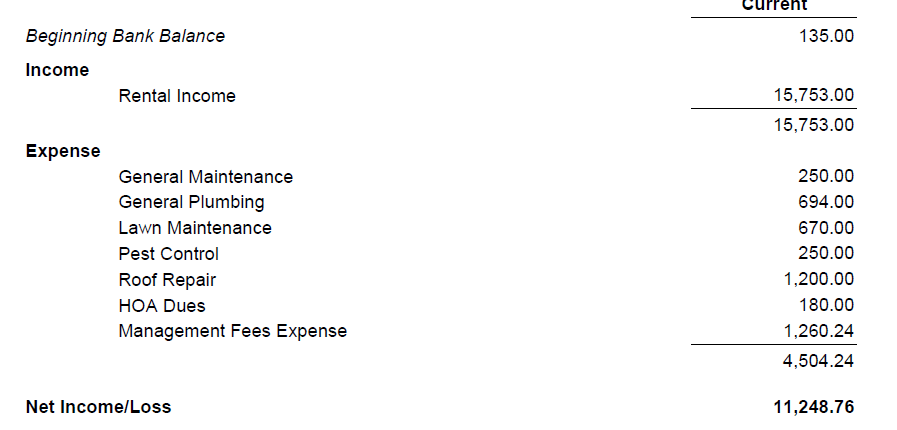
Subtract $4500 in property taxes and $2500 in insurance.

= $4,250 actual income divided by the purchase price of 100k

= 4% cash return on investment.

Take appreciation and cash on cash return and you get

Around 9% total return every year for 17 years or $9000/year I think which = 150,000 total cash return after sale.

Don't get confused with compounding like a stock. The S&P 500 has averaged over 10% I think over the same period.

From the S&P 500 history calculator.

Real Estate = $150k

S&P 500 = $540k

But what about leverage you ask? I would need 4 properties ($600k) to beat the S&P 500. No problem, I'll just put 25% down and buy 4 units.

But I would have a mortgage at 6% for the first 13 years until rates were low enough to refinance. 25% down would be break even so no cashflow. Now you have to reduce each unit by $75,000 (the $350/month for 17 years). So cut the 600k in half and you'll need 7 units to match the S&P 500. Again, after federal taxes, recapture fees, renovations, agent and misc selling fees and rental expenses. 

The rental income is eaten up by capital expenses and the fees I displayed. Every increase in rent was eaten up by the state reassessing home values ever year plus growing maintenance on 50-year-old home.

Some arguments against myself is that I could have been more efficient than 50% (income to expense ratio) but 50% is average for an older home in this location as stated by books I have read and my own experience. I could have also renovated earlier and increased rents to market rate but the rental market rate didn't really pop until the last few years and my payback would be 5 years. Another argument is that I could have rolled over the $350/month in cashflow into the S&P 500 and gained an additional 250k over 17 years. This means that I could purchase two properties with 50% down and maybe matched the S&P 500. Remember no passive income with a mortgage at 25% down. I also could have 1031 exchanged but I don't want to exchange it for another low return, high risk burden.

Even with leverage which all the influencers will be quick to mention, just can't beat the S&P 500 without tons of risk and work. Who wants 2-7 units when you can simply put the same amount of money into the S&P 500 and walk away. You just purchased yourself a job.

||||||||||||||||||||||

Here's another myth keeping you poor. Passive Income!

If you're working 9-5. You don't need passive income. What is $100/month or $1000/month to you now when you don't need it? 

I realized that passive income is only good when you retire. Nobody needs passive income when you're working. If you have a home mortgage, make sure it's paid off when you retire otherwise the extra income is better off in the market building wealth at a faster rate than your passive income and the capital used to generate it.

Also, it's not passive if you're putting time into it, spending days doing taxes finding all the websites you need to login to and pay all the misc rental taxes, prop taxes, HOAs etc. It's like a dozen. I probably spend a week every year just doing taxes. Then the stress of getting sued, answering emails, storms that blow your tree over and almost murder the tenants, it's not a lot of time but it's enough for me to put a value on my time vs no time nor risk in an index fund.

I purchased a condo for 150k in San Diego in 2012 returning $1000/month. Awesome right?

Again, lets go back to investing that 150k into the S&P 500. That's 150k in cashflow over 13 years and 100k in appreciation = 250k.

But again:

S&P 500 = $1,000,000 (some calculators show 700,000 probably adjusting for inflation)
Real Estate = $250,000 

1000/month vs 1M? You could literally just pay yourself out with the million or if you like the psychological idea of passive income, then you can achieve the same result with a dividend fund and receive a check every month but with way less work and less risk. Real Estate just gives you a check that you don't need and its principal grows more slowly.

This is why I'm so bitter with real estate. Leveraged or not, I could have been retired by now had I simply put my money into the market instead of buying real estate. The same money invested 10-17 years ago would have net me well over 10 million dollars by now had I just put it all into the S&P 500, 401k matching with Roth and maybe a couple tech stocks, bonds or dividends for diversification. Of course I have all these things but my portfolio was heavily into RE maybe 90/10. Now I'm shifting into 20% real estate (for diversification and to live in) and 80% market.

In summary, Real Estate is a soul crushing scam that keeps you poor and makes others rich by selling books, videos, seminars and of course forums like this used for advertising and podcasts.  It's a billion dollar industry that needs to convince new members that they can build wealth by buying homes that are made for families thus turning real estate into a stock like product which continues to make housing unaffordable for the common family.

25Reply
6,076 views

Most Popular Reply

Dan H.Pro Member
Investor · Poway, CA · Member since 2015 · 7k+ posts · 8k+ votes
10mo

Your math is very incorrect when it comes to the leverage as you used the unleveraged appreciation rate. If you purchased the $100k property at 80% LTV, if the property appreciated to $300k, your return from appreciation is 1000%/17 years. Not only would you not need 4 properties, but one property would far exceed the 10%/year S&P that you used which would result in $101k of growth ver 17 years (just over half of what you would have achieved via the property implying that 0.5 property would be virtually equivalent). Active asset managers likely would have refinanced the property multiple times over that 17 years and achieved far better return than the 1000% return over the 17 years.

The flaw in the leverage calculation is just the biggest flaw.

You chose not to value add until selling.   You chose not to use leverage.  You chose to sell and pay the gains versus never paying the tax on the gains.  You did not discuss the tax advantages of RE with OBBB now allowing 100% bonus appreciation.

It also sounds like your initial underwriting may not have been accurate as to actual expenses.  It is important to have accurate underwriting to have an accurate estimate of the cash flow.   The cash flow should not be a surprise over a 17 year period.

I agree without leverage, it may be challenging to exceed the S&P.   The unleveraged property investment would get whooped by Magnificent 7 or Fab 5.  

You purchased a $150k property in San Diego in 2012 and it is only worth $250k?  I find this shocking.  In 2012, I purchased a property in Escondido for $302k that is worth ~$1.1m today   In 2013 I purchase a property for $490k that is worth ~1.3m and another for $390k that is worth ~1.1m today.  Neighborhoodscout shows San Diego average appreciation in last 10 years is 115%, but in 13 years you have only achieved 66% appreciation.

https://www.neighborhoodscout.com/ca/san-diego/real-estate

Here is the reality on my active RE investments.   My worse appreciating property has gained $2700/month of appreciation.  I have 2 properties that have appreciated the over $10k/month over their hold.   I have never purchased a property that at stabilization did not depict positive cash flow, but would not be adverse to buying a property with stabilized negative cash flow if the total return was high enough.  My underwriting had never been significantly too optimistic.

by the way I have never sold books, course, anything.  I have had a very successful protege (8 digit net worth and recently made ~$500k on a property repurpose) and a moderately successful protege and various protégés that are still working to find their way (no charge to any of them).

Now for what I agree with your post: 1) the RE market today may be the most challenging ever. Two recent studies show that renting has never been more favorable versus home ownership in large US cities. 2) active residential investing is not passive. If you want passive RE, be a LP, go NNN, or invest in a REIT. Because active residential RE is not passive, its return should far exceed passive options to compensate for the effort 3) without leverage and/or value add, there likely are many passive options that can match or exceed the return that will be achieved via active residential RE.

good luck

See this reply in the discussion

276 Replies

Jump to latestLatest
  • Don KonipolBusiness Member
    Investor · The Woodlands TX / Avon, CT · Member since 2009 · 6k+ posts · 10k+ votes
    10mo

    There are people who became billionaires in real estate

    There are people who became billionaires in stock market investing 


    The big difference is that (obviously my opinion) investing in real estate is more satisfying, more stimulating and more fun.  But hey, I’m a real estate guy, so I’m biased. 

    Private Mortgage Financing Partners, LLC
  • Don KonipolBusiness Member
    Investor · The Woodlands TX / Avon, CT · Member since 2009 · 6k+ posts · 10k+ votes
    10mo

    Why would anyone believe that the greatest bull market in stocks over the PAST 17 years will be necessarily repeated over the NEXT 17 years?  It might, or we might see a repeat of say 1966 - 1979 in which the market REAL (inflation adjusted) pricing DECLINED.  

    RISK. -   I know a lot of people who lost lots of money investing in securities - but I know NOBODY that purchased a house 30, 40, or 50 years ago and didn’t make a bundle. 

    Private Mortgage Financing Partners, LLC
    • Henry ClarkPro Member
      Developer · Member since 2020 · 4k+ posts · 4k+ votes
      10mo
      Quote from @Don Konipol:

      Why would anyone believe that the greatest bull market in stocks over the PAST 17 years will be necessarily repeated over the NEXT 17 years?  It might, or we might see a repeat of say 1966 - 1979 in which the market REAL (inflation adjusted) pricing DECLINED.  

      RISK. -   I know a lot of people who lost lots of money investing in securities - but I know NOBODY that purchased a house 30, 40, or 50 years ago and didn’t make a bundle. 


      Not only agree but my crystal ball says the SP 500 won’t do 5% annually over the next 3 years.  Which will be great for us to move more assets into stocks then.  

       Took the checks to the bank.  120% return over 1 1/2 year.  Returns will be that good for all of the lots.  But will be spread out over more years.   Won’t be that good over the entire project.  18 lots will probably take around 7 years to sale the last one.    3rd lot to close on the 22nd.  Went to market around June.  

      Point is, there are a lot of REI strategies out there. If one doesn't work try another one.
      I don’t think most of the people on this post do the same REI strategy.  

    • Member since 2021 · 401 posts · 254 votes
      10mo
      Quote from @Don Konipol:

      Why would anyone believe that the greatest bull market in stocks over the PAST 17 years will be necessarily repeated over the NEXT 17 years?  It might, or we might see a repeat of say 1966 - 1979 in which the market REAL (inflation adjusted) pricing DECLINED.  

      RISK. -   I know a lot of people who lost lots of money investing in securities - but I know NOBODY that purchased a house 30, 40, or 50 years ago and didn’t make a bundle. 


      You can't invest based on what-ifs but history can teach us more than anecdotes.

      100,000 in the S&P for 50 years = $40,000,000.
      100,000 SFH for 50 years = 1.8 Million.

      Not only that, but the house probably had to be rebuilt or at least renovated multiple times.

      That is the power of compounding and why Warren Buffet is richer than the top 5 richest Real Estate investors in the world combined. 
  • Property Manager · Southfield Mi · Member since 2018 · 192 posts · 177 votes
    10mo

    This argument reminds me of a saying attributed to Albert Einstein

    “If you can't explain it to a six year old, you don't understand it yourself.”

    So here is the E=MC2 of this discussion

    If you want to be completely passive as an investor you will likely have greater success with the S&P than with real estate, however if you want your own activity and intelligence to play a role in your outcomes (with adequate time and the accumulation of knowledge) Real estate will likely rise above the passive investment of the S&P 500 and Wall St in General.  

    • Member since 2021 · 401 posts · 254 votes
      10mo
      Quote from @Leroy K. Williams:

      This argument reminds me of a saying attributed to Albert Einstein

      “If you can't explain it to a six year old, you don't understand it yourself.”

      So here is the E=MC2 of this discussion

      If you want to be completely passive as an investor you will likely have greater success with the S&P than with real estate, however if you want your own activity and intelligence to play a role in your outcomes (with adequate time and the accumulation of knowledge) Real estate will likely rise above the passive investment of the S&P 500 and Wall St in General.  

      I'm pretty sure most Einstein quotes were things he never said and just made up. 
    • Chris SeveneyBusiness Member
      Moderator
      Investor · VA · Member since 2015 · 21k+ posts · 19k+ votes
      10mo
      Quote from @Leroy K. Williams:

      This argument reminds me of a saying attributed to Albert Einstein

      “If you can't explain it to a six year old, you don't understand it yourself.”

      So here is the E=MC2 of this discussion

      If you want to be completely passive as an investor you will likely have greater success with the S&P than with real estate, however if you want your own activity and intelligence to play a role in your outcomes (with adequate time and the accumulation of knowledge) Real estate will likely rise above the passive investment of the S&P 500 and Wall St in General.  


       200 posts in this one chat and this one says it all. This is all people need to read.

      7e investments53 Reviews
    • Member since 2021 · 401 posts · 254 votes
      10mo
      Quote from @Chris Seveney:
      Quote from @Leroy K. Williams:

      This argument reminds me of a saying attributed to Albert Einstein

      “If you can't explain it to a six year old, you don't understand it yourself.”

      So here is the E=MC2 of this discussion

      If you want to be completely passive as an investor you will likely have greater success with the S&P than with real estate, however if you want your own activity and intelligence to play a role in your outcomes (with adequate time and the accumulation of knowledge) Real estate will likely rise above the passive investment of the S&P 500 and Wall St in General.  


       200 posts in this one chat and this one says it all. This is all people need to read.

      Actually, It's been said over and over again but got lost before circling back again.
      That with hard work, dedication and a can-do attitude, real estate is "likely" to rise above the S&P. But just replace Real Estate with <insert here> and it's still a true statement because it's just fortune cookie BS. Therefore, something that says everything, says nothing. 
       

  • Investor · Pittsburgh, PA · Member since 2023 · 109 posts · 58 votes
    10mo

    Sounds like someone who just did it wrong...

  • Henry ClarkPro Member
    Developer · Member since 2020 · 4k+ posts · 4k+ votes
    10mo

    New Investors:

    We dont do SFH as an REI strategy because we can beat it. We do stocks for diversification.

    With that said,  over 50 years it is no comparison.

    Iteration 1:
    Housing 1975 $35,000; 2025 $410,000. FRED economic data median sales price.  1171%
    Leverage-  say 25%  $8,750.  4,686%.  

    SP 500 1975 $68; SP500 $6,827.  1,000 % increase.   No leverage.  Minimal dividend impact overall.

    Iteration 2:

    Housing- would have had at least 4 iterations.  Plus renters would have paid principal down.  Your return becomes Infinite once you hit the tipping point.  Key difference in the above discussions is not appropriately including leverage and then second iteration infinite return leverage.  

    SP500 no iterations.  No renters to pay principal off.  

    What the above does not include is the principal investors unfair advantage.  They would have included value add.  

    If the above was in a high appreciation area like California versus Memphis or Cincinnati; numbers would be even higher.  

    All new investors should start with their own housing. You have unfair advantages over experienced investors. After that you would move up to MFH or another REI strategy. As far as the SP 500 I don't expect it to have a 5% annual return over the next 3 years.

    Remember it’s your money, your always right, even if your wrong.

    Not taking anything away from Buffet.  He used his unfair advantage.  Free money and the Baby Boomer cycle.  From that base he made great investment decisions.  

    • Member since 2021 · 401 posts · 254 votes
      10mo
      Quote from @Henry Clark:

      New Investors:

      We dont do SFH as an REI strategy because we can beat it. We do stocks for diversification.

      With that said,  over 50 years it is no comparison.

      Iteration 1:
      Housing 1975 $35,000; 2025 $410,000. FRED economic data median sales price.  1171%
      Leverage-  say 25%  $8,750.  4,686%.  

      SP 500 1975 $68; SP500 $6,827.  1,000 % increase.   No leverage.  Minimal dividend impact overall.

      Iteration 2:

      Housing- would have had at least 4 iterations.  Plus renters would have paid principal down.  Your return becomes Infinite once you hit the tipping point.  Key difference in the above discussions is not appropriately including leverage and then second iteration infinite return leverage.  

      SP500 no iterations.  No renters to pay principal off.  

      What the above does not include is the principal investors unfair advantage.  They would have included value add.  

      If the above was in a high appreciation area like California versus Memphis or Cincinnati; numbers would be even higher.  

      All new investors should start with their own housing. You have unfair advantages over experienced investors. After that you would move up to MFH or another REI strategy. As far as the SP 500 I don't expect it to have a 5% annual return over the next 3 years.

      Remember it’s your money, your always right, even if your wrong.

      Not taking anything away from Buffet.  He used his unfair advantage.  Free money and the Baby Boomer cycle.  From that base he made great investment decisions.  

      Buying a house to live in and move up to Multis is fair. But what I've seen is more elderly retirees who become debt slaved slumlords until they die. Now you guys work in Real Estate for a living which creates two different arguments and causes us to talk over each other.

      On one hand you're talking about your success as a full-time real estate professional and the other is the casual buyer with a handfull of properties who is the 99% on this forum. If the majority of people using this method can't wipe out their multiple 30-year mortgages at retirement, then I think the S&P would have done much more work for them as I have proven. I get that some people want to die with debt but most elderly folks can't manage all the stress, paperwork/taxes, landlording and risk of being taken advantage of as you age. So it's best to wipe off debt as you age and simplify your life. Most elderly can't even drive to your property and certainly not going to renovate anything either. 

      Random sources suggest that half or more of 4 plex owners are over 65 and have a mortgage or HELOC which tells me that they are debt slaves and not independently wealthy. My experience has shown 4-unit owners have deferred maintenance which tells me that they're scraping by. It's more hassle than it's worth into retirement. Every tenant has experienced property owners refusing to fix things they're contractually obligated to fix proving they trapped themselves into debt slavery and have to defer maintenance.

      Again, 350k into the market 20 years ago with no further contributions is 100k/year today. The monthly amount to get to that figure if you don't have a lump sum is about what you would pay for in rent. Bonus is that you no longer need to make contributions as you're at the inflection point where your income surpasses your contributions and your yearly income still continues to grow faster than you can spend it.  And this works for everybody exactly the same. No luck required, no managing your fund, no landlording.

    • Member since 2021 · 401 posts · 254 votes
      10mo
      Quote from @Henry Clark:

      As far as the SP 500 I don’t expect it to have a 5% annual return over the next 3 years.  

      It's always had ups and downs but the average is what matters over time so your speculative prediction should not be used as investment advice. Not a day goes by when people aren't predicting the collapse or a recession. Someday, someone will be correct, but they've been wrong for a decade. You should be invested despite a coming recession. Just keep dollar cost averaging and you'll come out further ahead at the other end.  

      Also, with the AI tech boom, we could see the biggest boom in history in the next decade but who knows, which is why you should just be dollar cost averaging so you can weather any storm. But I see more downside in Real Estate with more unaffordability, inflation for things like labor costs and insurance if you can get insurance in California. The only way prices continue to rise is with wage inflation, 50 year mortgages, then 100 year mortgages and so on but the RV continues to drop at the same time further keeping people as debt slaves indefinitely.
    • Member since 2021 · 401 posts · 254 votes
      10mo
      Quote from @Henry Clark:

      I don’t expect it to have a 5% annual return over the next 3 years.  

      You mentioned this before but it doesn't mean anything to someone who dollar cost averages. Markets are always up and down but in the end, it's the average over the long run that matters.

      Besides, I see more downside to real estate with the prices, rates, inflation, labor, insurance reaching peoples DTI so much so that Trump wants 50 year mortgages which means 100 year mortgages which means only generational wealth will be possible in the future. And Blackrock. That is your only hope of succeeding if you buy today.

      There may be a recession but overall, AI may prop up the market and boom with autonomous vehicles, space datacenters, robots and even government investments. We can't even imagine new industries that may come about just like nobody predicted what would become of the internet 25 years ago.

  • Henry ClarkPro Member
    Developer · Member since 2020 · 4k+ posts · 4k+ votes
    10mo

    New Investors. Left off the tax and asset swapping advantage of REI over SP500.

    Again max out your stock investments and IRA contributions with company matching and Roth limits. For diversification purposes.

    Always keep thinking Unfair Advantage in your investments. The Federal Government made the following for REI. You can depreciate your asset to avoid taxes, 1031 exchange, year 1 writeoff, 2/5 years primary residency $250,000 tax avoidance, Death step up basis, loan programs 0% or 3.8% down, VA, REI expense writeoff, 1099 your kids and pay for their car or college, bankruptcy waiver on your home, military Free money,

    Stocks have none of the above.

    Asset addition or swapping. To swap or add REI you can use some of the above to do tax free. Stocks you cannot, you have to sell and pay taxes. Stocks you could take a loan out against a controlled account, but any major dip you get called at the low end of the market. REI you don't get "called" as long as your making the payments.

    With the above said if I gave you 50 year history or a crystal ball.  I would rather pick the houses back in 1975 versus the stocks back in 1975.  Most of the SP500 upswing is for companies that don’t exist.   Which means you would have had to sell to buy new stocks, taking the tax hit.  

    SP500 is easy and faster to sale. REI is harder and takes longer to sale. Investors will tend less to sale at the bottom with REI.

    Now is the best time to learn REI while it is a tough market. That way you're ready in easier times.

    • Member since 2021 · 401 posts · 254 votes
      10mo
      Quote from @Henry Clark:

      New Investors. Left off the tax and asset swapping advantage of REI over SP500.

      Again max out your stock investments and IRA contributions with company matching and Roth limits. For diversification purposes.

      Always keep thinking Unfair Advantage in your investments. The Federal Government made the following for REI. You can depreciate your asset to avoid taxes, 1031 exchange, year 1 writeoff, 2/5 years primary residency $250,000 tax avoidance, Death step up basis, loan programs 0% or 3.8% down, VA, REI expense writeoff, 1099 your kids and pay for their car or college, bankruptcy waiver on your home, military Free money,

      Stocks have none of the above.

      Asset addition or swapping. To swap or add REI you can use some of the above to do tax free. Stocks you cannot, you have to sell and pay taxes. Stocks you could take a loan out against a controlled account, but any major dip you get called at the low end of the market. REI you don't get "called" as long as your making the payments.

      With the above said if I gave you 50 year history or a crystal ball.  I would rather pick the houses back in 1975 versus the stocks back in 1975.  Most of the SP500 upswing is for companies that don’t exist.   Which means you would have had to sell to buy new stocks, taking the tax hit.  

      SP500 is easy and faster to sale. REI is harder and takes longer to sale. Investors will tend less to sale at the bottom with REI.

      Now is the best time to learn REI while it is a tough market. That way you're ready in easier times.

      Incorrect, you don't have to buy and sell new stocks in the S&P. It's an auto managed index fund. Nobody has made an argument comparing a single stock vs a single house if that's your argument but that would be a strawman. I would agree. But it's not my argument. 

      Regarding your 50 year house vs market. The numbers below show the market crushing a SFH bought in 1975. Even leveraged with 4 of these wouldn't touch the effects that compounding has in the market.

      100,000 in the S&P for 50 years = $40,000,000.
      100,000 SFH for 50 years = 1.8 Million.

      Stocks also have some tax advantages and other interesting tricks like harvesting, less capital gains tax or no tax at retirement at all, shifting funds from stocks to dividends or bonds without a taxable sale event and possibly gold as well but not sure if that has happened yet. But none of these make one better over the other because we can predict the end results of both of these investments with historical calculators despite how many "features" they have. 

    • Jay HinrichsBusiness Member
      Real Estate Consultant · Summerlin, NV · Member since 2014 · 45k+ posts · 66k+ votes
      10mo
      Quote from @Henry Clark:

      New Investors. Left off the tax and asset swapping advantage of REI over SP500.

      Again max out your stock investments and IRA contributions with company matching and Roth limits. For diversification purposes.

      Always keep thinking Unfair Advantage in your investments. The Federal Government made the following for REI. You can depreciate your asset to avoid taxes, 1031 exchange, year 1 writeoff, 2/5 years primary residency $250,000 tax avoidance, Death step up basis, loan programs 0% or 3.8% down, VA, REI expense writeoff, 1099 your kids and pay for their car or college, bankruptcy waiver on your home, military Free money,

      Stocks have none of the above.

      Asset addition or swapping. To swap or add REI you can use some of the above to do tax free. Stocks you cannot, you have to sell and pay taxes. Stocks you could take a loan out against a controlled account, but any major dip you get called at the low end of the market. REI you don't get "called" as long as your making the payments.

      With the above said if I gave you 50 year history or a crystal ball.  I would rather pick the houses back in 1975 versus the stocks back in 1975.  Most of the SP500 upswing is for companies that don’t exist.   Which means you would have had to sell to buy new stocks, taking the tax hit.  

      SP500 is easy and faster to sale. REI is harder and takes longer to sale. Investors will tend less to sale at the bottom with REI.

      Now is the best time to learn REI while it is a tough market. That way you're ready in easier times.


      Henry great point myself personally I have used the 500k tax free 4 times now on the west coast and got the full 500k benefit each time thats 2 mil tax free for just living in my house. 
    • Henry ClarkPro Member
      Developer · Member since 2020 · 4k+ posts · 4k+ votes
      10mo
      Quote from @K S.:
      Quote from @Henry Clark:

      New Investors. Left off the tax and asset swapping advantage of REI over SP500.

      Again max out your stock investments and IRA contributions with company matching and Roth limits. For diversification purposes.

      Always keep thinking Unfair Advantage in your investments. The Federal Government made the following for REI. You can depreciate your asset to avoid taxes, 1031 exchange, year 1 writeoff, 2/5 years primary residency $250,000 tax avoidance, Death step up basis, loan programs 0% or 3.8% down, VA, REI expense writeoff, 1099 your kids and pay for their car or college, bankruptcy waiver on your home, military Free money,

      Stocks have none of the above.

      Asset addition or swapping. To swap or add REI you can use some of the above to do tax free. Stocks you cannot, you have to sell and pay taxes. Stocks you could take a loan out against a controlled account, but any major dip you get called at the low end of the market. REI you don't get "called" as long as your making the payments.

      With the above said if I gave you 50 year history or a crystal ball.  I would rather pick the houses back in 1975 versus the stocks back in 1975.  Most of the SP500 upswing is for companies that don’t exist.   Which means you would have had to sell to buy new stocks, taking the tax hit.  

      SP500 is easy and faster to sale. REI is harder and takes longer to sale. Investors will tend less to sale at the bottom with REI.

      Now is the best time to learn REI while it is a tough market. That way you're ready in easier times.

      Incorrect, you don't have to buy and sell new stocks in the S&P. It's an auto managed index fund. Nobody has made an argument comparing a single stock vs a single house if that's your argument but that would be a strawman. I would agree. But it's not my argument. 

      Regarding your 50 year house vs market. The numbers below show the market crushing a SFH bought in 1975. Even leveraged with 4 of these wouldn't touch the effects that compounding has in the market.

      100,000 in the S&P for 50 years = $40,000,000.
      100,000 SFH for 50 years = 1.8 Million.

      Stocks also have some tax advantages and other interesting tricks like harvesting, less capital gains tax or no tax at retirement at all, shifting funds from stocks to dividends or bonds without a taxable sale event and possibly gold as well but not sure if that has happened yet. But none of these make one better over the other because we can predict the end results of both of these investments with historical calculators despite how many "features" they have. 


       Look at my analysis above.  I’m using public numbers.

      Stocks are not even close to REI, even before you get into the tax benefits of REI. Or the multiple iterations and Infinite Return of REI. If I did the extra 4 iterations of REI over 50 years it would be 40 or 50 to one over the stock market. With Tax benefits of REI, it would be even higher.

      If your personal main issue is REI is not worth the aggravation, then I can do another post. Those you can buy your way out or they are easy to address. I would have given up doing Self Storage long ago if I kept my original tenant model. Now this one phone handles 4 locations or around 600 customers. We sold 4 locations. Then we had about 1,300 customers. We changed our tenant model. That was while I was a CFO working 60 70 hours a week.

    • Member since 2021 · 401 posts · 254 votes
      10mo
      Quote from @Henry Clark:
      Quote from @K S.:
      Quote from @Henry Clark:

      New Investors. Left off the tax and asset swapping advantage of REI over SP500.

      Again max out your stock investments and IRA contributions with company matching and Roth limits. For diversification purposes.

      Always keep thinking Unfair Advantage in your investments. The Federal Government made the following for REI. You can depreciate your asset to avoid taxes, 1031 exchange, year 1 writeoff, 2/5 years primary residency $250,000 tax avoidance, Death step up basis, loan programs 0% or 3.8% down, VA, REI expense writeoff, 1099 your kids and pay for their car or college, bankruptcy waiver on your home, military Free money,

      Stocks have none of the above.

      Asset addition or swapping. To swap or add REI you can use some of the above to do tax free. Stocks you cannot, you have to sell and pay taxes. Stocks you could take a loan out against a controlled account, but any major dip you get called at the low end of the market. REI you don't get "called" as long as your making the payments.

      With the above said if I gave you 50 year history or a crystal ball.  I would rather pick the houses back in 1975 versus the stocks back in 1975.  Most of the SP500 upswing is for companies that don’t exist.   Which means you would have had to sell to buy new stocks, taking the tax hit.  

      SP500 is easy and faster to sale. REI is harder and takes longer to sale. Investors will tend less to sale at the bottom with REI.

      Now is the best time to learn REI while it is a tough market. That way you're ready in easier times.

      Incorrect, you don't have to buy and sell new stocks in the S&P. It's an auto managed index fund. Nobody has made an argument comparing a single stock vs a single house if that's your argument but that would be a strawman. I would agree. But it's not my argument. 

      Regarding your 50 year house vs market. The numbers below show the market crushing a SFH bought in 1975. Even leveraged with 4 of these wouldn't touch the effects that compounding has in the market.

      100,000 in the S&P for 50 years = $40,000,000.
      100,000 SFH for 50 years = 1.8 Million.

      Stocks also have some tax advantages and other interesting tricks like harvesting, less capital gains tax or no tax at retirement at all, shifting funds from stocks to dividends or bonds without a taxable sale event and possibly gold as well but not sure if that has happened yet. But none of these make one better over the other because we can predict the end results of both of these investments with historical calculators despite how many "features" they have. 


       Look at my analysis above.  I’m using public numbers.

      Stocks are not even close to REI, even before you get into the tax benefits of REI. Or the multiple iterations and Infinite Return of REI. If I did the extra 4 iterations of REI over 50 years it would be 40 or 50 to one over the stock market. With Tax benefits of REI, it would be even higher.

      If your personal main issue is REI is not worth the aggravation, then I can do another post. Those you can buy your way out or they are easy to address. I would have given up doing Self Storage long ago if I kept my original tenant model. Now this one phone handles 4 locations or around 600 customers. We sold 4 locations. Then we had about 1,300 customers. We changed our tenant model. That was while I was a CFO working 60 70 hours a week.

      Well no that's not my message but again, we're running in circles. One can read all the previous posts to see each others argument. I'll leave it at that.

      I don't agree with the SFH vs Market 50 years ago. Here's the S&P Historical Calculator.

      A SFH will be worth 1.8M
      Market = 40,000,000 

      That's the power of compounding. This does NOT include all the renovations during that period, maintenance CAPx and possibly a complete teardown. You can leverage yourself with 25 properties and maybe come close? That's 1 property every two years. Not even enough equity build up but even if I grant you this, I really don't want to landlord 25 SFH properties for 50 years to achieve the same result for free. That's my point in this particular situation.

    • Dan H.Pro Member
      Investor · Poway, CA · Member since 2015 · 7k+ posts · 8k+ votes
      10mo
      Quote from @K S.:
      Quote from @Henry Clark:
      Quote from @K S.:
      Quote from @Henry Clark:

      New Investors. Left off the tax and asset swapping advantage of REI over SP500.

      Again max out your stock investments and IRA contributions with company matching and Roth limits. For diversification purposes.

      Always keep thinking Unfair Advantage in your investments. The Federal Government made the following for REI. You can depreciate your asset to avoid taxes, 1031 exchange, year 1 writeoff, 2/5 years primary residency $250,000 tax avoidance, Death step up basis, loan programs 0% or 3.8% down, VA, REI expense writeoff, 1099 your kids and pay for their car or college, bankruptcy waiver on your home, military Free money,

      Stocks have none of the above.

      Asset addition or swapping. To swap or add REI you can use some of the above to do tax free. Stocks you cannot, you have to sell and pay taxes. Stocks you could take a loan out against a controlled account, but any major dip you get called at the low end of the market. REI you don't get "called" as long as your making the payments.

      With the above said if I gave you 50 year history or a crystal ball.  I would rather pick the houses back in 1975 versus the stocks back in 1975.  Most of the SP500 upswing is for companies that don’t exist.   Which means you would have had to sell to buy new stocks, taking the tax hit.  

      SP500 is easy and faster to sale. REI is harder and takes longer to sale. Investors will tend less to sale at the bottom with REI.

      Now is the best time to learn REI while it is a tough market. That way you're ready in easier times.

      Incorrect, you don't have to buy and sell new stocks in the S&P. It's an auto managed index fund. Nobody has made an argument comparing a single stock vs a single house if that's your argument but that would be a strawman. I would agree. But it's not my argument. 

      Regarding your 50 year house vs market. The numbers below show the market crushing a SFH bought in 1975. Even leveraged with 4 of these wouldn't touch the effects that compounding has in the market.

      100,000 in the S&P for 50 years = $40,000,000.
      100,000 SFH for 50 years = 1.8 Million.

      Stocks also have some tax advantages and other interesting tricks like harvesting, less capital gains tax or no tax at retirement at all, shifting funds from stocks to dividends or bonds without a taxable sale event and possibly gold as well but not sure if that has happened yet. But none of these make one better over the other because we can predict the end results of both of these investments with historical calculators despite how many "features" they have. 


       Look at my analysis above.  I’m using public numbers.

      Stocks are not even close to REI, even before you get into the tax benefits of REI. Or the multiple iterations and Infinite Return of REI. If I did the extra 4 iterations of REI over 50 years it would be 40 or 50 to one over the stock market. With Tax benefits of REI, it would be even higher.

      If your personal main issue is REI is not worth the aggravation, then I can do another post. Those you can buy your way out or they are easy to address. I would have given up doing Self Storage long ago if I kept my original tenant model. Now this one phone handles 4 locations or around 600 customers. We sold 4 locations. Then we had about 1,300 customers. We changed our tenant model. That was while I was a CFO working 60 70 hours a week.

      Well no that's not my message but again, we're running in circles. One can read all the previous posts to see each others argument. I'll leave it at that.

      I don't agree with the SFH vs Market 50 years ago. Here's the S&P Historical Calculator.

      A SFH will be worth 1.8M
      Market = 40,000,000 

      That's the power of compounding. This does NOT include all the renovations during that period, maintenance CAPx and possibly a complete teardown. You can leverage yourself with 25 properties and maybe come close? That's 1 property every two years. Not even enough equity build up but even if I grant you this, I really don't want to landlord 25 SFH properties for 50 years to achieve the same result for free. That's my point in this particular situation.


       You keep referring to the power of compounding. But everything in RE except the biggest expense for most (the fixed rate loan) has compounding.

      I do not know where you found either number but it appears incorrect like much of your dribble.

      I invite you to check this:

      I entered “what would 100k invested in 1975 in s&p be worth today” into Google search.  The result is $13m, not bad but a long way from $40m.  I then entered the $100k, 50 years, $13m into the appreciation calculator and got 10.225% which seems plausible.   

      The math on the other value assuming leverage is more complex, but assuming the 25% leverage you have used previously, I entered $400k initial and $1.4m exit with 50 year span and was provided a 2.6%/year.   Needless to say no one is RE investing for a 2.6% return.   This number is as bogus as the S&P number provided.   I will go further, I suspect experienced RE investors do not give a glance to a residential RE investment that does not project at least 20%/year return.   To be blunt, I would only consider an RE purchase close to 20% if I was going to personally use it, I expect projections far better than 20%/year.

      I do admit calculating historical returns on RE is challenging. It starts with the heavy influence of OO purchases. If an area average sold price is $1m and the average SFH rent is $5k (both ballpark accurate for my market), does that imply the average investor has a 0.5% ratio? Not even close. The OO purchases in general are not the lower cost units that become rentals. They drive the average sale cost up. Similarly because the bulk of rentals is the lower cost units, the average rental price is lower than if all units were rented. Finding the RE investor rent to value ratio is more challenging. I personally believe it is around 0.7% in my market which admittedly is my estimate (hard to verify - I do not expect anyone to verify this as it is my estimate being active in the market for a couple decades).

      Then calculating cash flow is challenging with the various definitions of cash flow and varied expense forecasts.   The compounding of rent while only a subset of expenses (assuming a fixed rate loan) is inflation impacted makes this particularly challenging over a long hold.

      Then add the tax benefits. My last two purchases I did cost segregation to in effect raise my LTV. Note if I purchase at 75% LTV but get 10% of purchase to write off year 1, my effective LTV is 85%. Note Obbb restored 100% accelerated depreciation. 1031, 2 of 5, standard depreciation, rebase value at death, etc. the value of these advantages depends on your ability to use them, but they have value for all investors.

      What I can say with confidence is your SFH gain at 50 years is far too low if leverage is used and maintained.

      Now I have been transparent in the methods I used to derive this conclusion.   Anyone and everyone can check my numbers (other than investor rent to value ratio in San Diego which was approximated based on my market knowledge) seeing I posted exactly how I derived them.   I invite scrutiny.

      Note even though $13m is a lot less than $40m, it is substantial and passive.   It is a valid option if you want something passive.   I should point out S&P has been carried by the fab 5 (going back a little further) and then mag 7 (recently).   Throw them out and S&P has not done nearly as well.   The mag 7 growth is unlikely to go indefinitely and if their growth declines to the rest of the S&P, the S&P will not continue to lead the market.  My recent (a couple months ago) show large cap was not the leading investment class for 2025 (it had led most recent years)   International growth was leading for 2025.   Does this indicate S&P is currently over valued?  Hard to be sure, but not hard to believe the recent growth cannot continue indefinitely.

      Good luck

    • Member since 2021 · 401 posts · 254 votes
      10mo
      Quote from @Dan H.:
      Quote from @K S.:
      Quote from @Henry Clark:
      Quote from @K S.:
      Quote from @Henry Clark:

      New Investors. Left off the tax and asset swapping advantage of REI over SP500.

      Again max out your stock investments and IRA contributions with company matching and Roth limits. For diversification purposes.

      Always keep thinking Unfair Advantage in your investments. The Federal Government made the following for REI. You can depreciate your asset to avoid taxes, 1031 exchange, year 1 writeoff, 2/5 years primary residency $250,000 tax avoidance, Death step up basis, loan programs 0% or 3.8% down, VA, REI expense writeoff, 1099 your kids and pay for their car or college, bankruptcy waiver on your home, military Free money,

      Stocks have none of the above.

      Asset addition or swapping. To swap or add REI you can use some of the above to do tax free. Stocks you cannot, you have to sell and pay taxes. Stocks you could take a loan out against a controlled account, but any major dip you get called at the low end of the market. REI you don't get "called" as long as your making the payments.

      With the above said if I gave you 50 year history or a crystal ball.  I would rather pick the houses back in 1975 versus the stocks back in 1975.  Most of the SP500 upswing is for companies that don’t exist.   Which means you would have had to sell to buy new stocks, taking the tax hit.  

      SP500 is easy and faster to sale. REI is harder and takes longer to sale. Investors will tend less to sale at the bottom with REI.

      Now is the best time to learn REI while it is a tough market. That way you're ready in easier times.

      Incorrect, you don't have to buy and sell new stocks in the S&P. It's an auto managed index fund. Nobody has made an argument comparing a single stock vs a single house if that's your argument but that would be a strawman. I would agree. But it's not my argument. 

      Regarding your 50 year house vs market. The numbers below show the market crushing a SFH bought in 1975. Even leveraged with 4 of these wouldn't touch the effects that compounding has in the market.

      100,000 in the S&P for 50 years = $40,000,000.
      100,000 SFH for 50 years = 1.8 Million.

      Stocks also have some tax advantages and other interesting tricks like harvesting, less capital gains tax or no tax at retirement at all, shifting funds from stocks to dividends or bonds without a taxable sale event and possibly gold as well but not sure if that has happened yet. But none of these make one better over the other because we can predict the end results of both of these investments with historical calculators despite how many "features" they have. 


       Look at my analysis above.  I’m using public numbers.

      Stocks are not even close to REI, even before you get into the tax benefits of REI. Or the multiple iterations and Infinite Return of REI. If I did the extra 4 iterations of REI over 50 years it would be 40 or 50 to one over the stock market. With Tax benefits of REI, it would be even higher.

      If your personal main issue is REI is not worth the aggravation, then I can do another post. Those you can buy your way out or they are easy to address. I would have given up doing Self Storage long ago if I kept my original tenant model. Now this one phone handles 4 locations or around 600 customers. We sold 4 locations. Then we had about 1,300 customers. We changed our tenant model. That was while I was a CFO working 60 70 hours a week.

      Well no that's not my message but again, we're running in circles. One can read all the previous posts to see each others argument. I'll leave it at that.

      I don't agree with the SFH vs Market 50 years ago. Here's the S&P Historical Calculator.

      A SFH will be worth 1.8M
      Market = 40,000,000 

      That's the power of compounding. This does NOT include all the renovations during that period, maintenance CAPx and possibly a complete teardown. You can leverage yourself with 25 properties and maybe come close? That's 1 property every two years. Not even enough equity build up but even if I grant you this, I really don't want to landlord 25 SFH properties for 50 years to achieve the same result for free. That's my point in this particular situation.


       You keep referring to the power of compounding. But everything in RE except the biggest expense for most (the fixed rate loan) has compounding.

      I do not know where you found either number but it appears incorrect like much of your dribble.

      I invite you to check this:

      I entered “what would 100k invested in 1975 in s&p be worth today” into Google search.  The result is $13m, not bad but a long way from $40m.  I then entered the $100k, 50 years, $13m into the appreciation calculator and got 10.225% which seems plausible.   

      The math on the other value assuming leverage is more complex, but assuming the 25% leverage you have used previously, I entered $400k initial and $1.4m exit with 50 year span and was provided a 2.6%/year.   Needless to say no one is RE investing for a 2.6% return.   This number is as bogus as the S&P number provided.   I will go further, I suspect experienced RE investors do not give a glance to a residential RE investment that does not project at least 20%/year return.   To be blunt, I would only consider an RE purchase close to 20% if I was going to personally use it, I expect projections far better than 20%/year.

      I do admit calculating historical returns on RE is challenging. It starts with the heavy influence of OO purchases. If an area average sold price is $1m and the average SFH rent is $5k (both ballpark accurate for my market), does that imply the average investor has a 0.5% ratio? Not even close. The OO purchases in general are not the lower cost units that become rentals. They drive the average sale cost up. Similarly because the bulk of rentals is the lower cost units, the average rental price is lower than if all units were rented. Finding the RE investor rent to value ratio is more challenging. I personally believe it is around 0.7% in my market which admittedly is my estimate (hard to verify - I do not expect anyone to verify this as it is my estimate being active in the market for a couple decades).

      Then calculating cash flow is challenging with the various definitions of cash flow and varied expense forecasts.   The compounding of rent while only a subset of expenses (assuming a fixed rate loan) is inflation impacted makes this particularly challenging over a long hold.

      Then add the tax benefits. My last two purchases I did cost segregation to in effect raise my LTV. Note if I purchase at 75% LTV but get 10% of purchase to write off year 1, my effective LTV is 85%. Note Obbb restored 100% accelerated depreciation. 1031, 2 of 5, standard depreciation, rebase value at death, etc. the value of these advantages depends on your ability to use them, but they have value for all investors.

      What I can say with confidence is your SFH gain at 50 years is far too low if leverage is used and maintained.

      Now I have been transparent in the methods I used to derive this conclusion.   Anyone and everyone can check my numbers (other than investor rent to value ratio in San Diego which was approximated based on my market knowledge) seeing I posted exactly how I derived them.   I invite scrutiny.

      Note even though $13m is a lot less than $40m, it is substantial and passive.   It is a valid option if you want something passive.   I should point out S&P has been carried by the fab 5 (going back a little further) and then mag 7 (recently).   Throw them out and S&P has not done nearly as well.   The mag 7 growth is unlikely to go indefinitely and if their growth declines to the rest of the S&P, the S&P will not continue to lead the market.  My recent (a couple months ago) show large cap was not the leading investment class for 2025 (it had led most recent years)   International growth was leading for 2025.   Does this indicate S&P is currently over valued?  Hard to be sure, but not hard to believe the recent growth cannot continue indefinitely.

      Good luck

      I can't read your posts anymore but I caught your first paragraph. For one, I don't think you used a historical calculator or you included inflation into the figure or both. As far as the continuing personal attacks, I told the moderator to block you further from the thread. 
    • Dan H.Pro Member
      Investor · Poway, CA · Member since 2015 · 7k+ posts · 8k+ votes
      10mo
      Quote from @K S.:
      Quote from @Dan H.:
      Quote from @K S.:
      Quote from @Henry Clark:
      Quote from @K S.:
      Quote from @Henry Clark:

      New Investors. Left off the tax and asset swapping advantage of REI over SP500.

      Again max out your stock investments and IRA contributions with company matching and Roth limits. For diversification purposes.

      Always keep thinking Unfair Advantage in your investments. The Federal Government made the following for REI. You can depreciate your asset to avoid taxes, 1031 exchange, year 1 writeoff, 2/5 years primary residency $250,000 tax avoidance, Death step up basis, loan programs 0% or 3.8% down, VA, REI expense writeoff, 1099 your kids and pay for their car or college, bankruptcy waiver on your home, military Free money,

      Stocks have none of the above.

      Asset addition or swapping. To swap or add REI you can use some of the above to do tax free. Stocks you cannot, you have to sell and pay taxes. Stocks you could take a loan out against a controlled account, but any major dip you get called at the low end of the market. REI you don't get "called" as long as your making the payments.

      With the above said if I gave you 50 year history or a crystal ball.  I would rather pick the houses back in 1975 versus the stocks back in 1975.  Most of the SP500 upswing is for companies that don’t exist.   Which means you would have had to sell to buy new stocks, taking the tax hit.  

      SP500 is easy and faster to sale. REI is harder and takes longer to sale. Investors will tend less to sale at the bottom with REI.

      Now is the best time to learn REI while it is a tough market. That way you're ready in easier times.

      Incorrect, you don't have to buy and sell new stocks in the S&P. It's an auto managed index fund. Nobody has made an argument comparing a single stock vs a single house if that's your argument but that would be a strawman. I would agree. But it's not my argument. 

      Regarding your 50 year house vs market. The numbers below show the market crushing a SFH bought in 1975. Even leveraged with 4 of these wouldn't touch the effects that compounding has in the market.

      100,000 in the S&P for 50 years = $40,000,000.
      100,000 SFH for 50 years = 1.8 Million.

      Stocks also have some tax advantages and other interesting tricks like harvesting, less capital gains tax or no tax at retirement at all, shifting funds from stocks to dividends or bonds without a taxable sale event and possibly gold as well but not sure if that has happened yet. But none of these make one better over the other because we can predict the end results of both of these investments with historical calculators despite how many "features" they have. 


       Look at my analysis above.  I’m using public numbers.

      Stocks are not even close to REI, even before you get into the tax benefits of REI. Or the multiple iterations and Infinite Return of REI. If I did the extra 4 iterations of REI over 50 years it would be 40 or 50 to one over the stock market. With Tax benefits of REI, it would be even higher.

      If your personal main issue is REI is not worth the aggravation, then I can do another post. Those you can buy your way out or they are easy to address. I would have given up doing Self Storage long ago if I kept my original tenant model. Now this one phone handles 4 locations or around 600 customers. We sold 4 locations. Then we had about 1,300 customers. We changed our tenant model. That was while I was a CFO working 60 70 hours a week.

      Well no that's not my message but again, we're running in circles. One can read all the previous posts to see each others argument. I'll leave it at that.

      I don't agree with the SFH vs Market 50 years ago. Here's the S&P Historical Calculator.

      A SFH will be worth 1.8M
      Market = 40,000,000 

      That's the power of compounding. This does NOT include all the renovations during that period, maintenance CAPx and possibly a complete teardown. You can leverage yourself with 25 properties and maybe come close? That's 1 property every two years. Not even enough equity build up but even if I grant you this, I really don't want to landlord 25 SFH properties for 50 years to achieve the same result for free. That's my point in this particular situation.


       You keep referring to the power of compounding. But everything in RE except the biggest expense for most (the fixed rate loan) has compounding.

      I do not know where you found either number but it appears incorrect like much of your dribble.

      I invite you to check this:

      I entered “what would 100k invested in 1975 in s&p be worth today” into Google search.  The result is $13m, not bad but a long way from $40m.  I then entered the $100k, 50 years, $13m into the appreciation calculator and got 10.225% which seems plausible.   

      The math on the other value assuming leverage is more complex, but assuming the 25% leverage you have used previously, I entered $400k initial and $1.4m exit with 50 year span and was provided a 2.6%/year.   Needless to say no one is RE investing for a 2.6% return.   This number is as bogus as the S&P number provided.   I will go further, I suspect experienced RE investors do not give a glance to a residential RE investment that does not project at least 20%/year return.   To be blunt, I would only consider an RE purchase close to 20% if I was going to personally use it, I expect projections far better than 20%/year.

      I do admit calculating historical returns on RE is challenging. It starts with the heavy influence of OO purchases. If an area average sold price is $1m and the average SFH rent is $5k (both ballpark accurate for my market), does that imply the average investor has a 0.5% ratio? Not even close. The OO purchases in general are not the lower cost units that become rentals. They drive the average sale cost up. Similarly because the bulk of rentals is the lower cost units, the average rental price is lower than if all units were rented. Finding the RE investor rent to value ratio is more challenging. I personally believe it is around 0.7% in my market which admittedly is my estimate (hard to verify - I do not expect anyone to verify this as it is my estimate being active in the market for a couple decades).

      Then calculating cash flow is challenging with the various definitions of cash flow and varied expense forecasts.   The compounding of rent while only a subset of expenses (assuming a fixed rate loan) is inflation impacted makes this particularly challenging over a long hold.

      Then add the tax benefits. My last two purchases I did cost segregation to in effect raise my LTV. Note if I purchase at 75% LTV but get 10% of purchase to write off year 1, my effective LTV is 85%. Note Obbb restored 100% accelerated depreciation. 1031, 2 of 5, standard depreciation, rebase value at death, etc. the value of these advantages depends on your ability to use them, but they have value for all investors.

      What I can say with confidence is your SFH gain at 50 years is far too low if leverage is used and maintained.

      Now I have been transparent in the methods I used to derive this conclusion.   Anyone and everyone can check my numbers (other than investor rent to value ratio in San Diego which was approximated based on my market knowledge) seeing I posted exactly how I derived them.   I invite scrutiny.

      Note even though $13m is a lot less than $40m, it is substantial and passive.   It is a valid option if you want something passive.   I should point out S&P has been carried by the fab 5 (going back a little further) and then mag 7 (recently).   Throw them out and S&P has not done nearly as well.   The mag 7 growth is unlikely to go indefinitely and if their growth declines to the rest of the S&P, the S&P will not continue to lead the market.  My recent (a couple months ago) show large cap was not the leading investment class for 2025 (it had led most recent years)   International growth was leading for 2025.   Does this indicate S&P is currently over valued?  Hard to be sure, but not hard to believe the recent growth cannot continue indefinitely.

      Good luck

      I can't read your posts anymore but I caught your first paragraph. For one, I don't think you used a historical calculator or you included inflation into the figure or both. As far as the continuing personal attacks, I told the moderator to block you further from the thread. 

       I used a perfectly good calculator and a perfectly good search engine (Google) that both how your numbers (that you never indicated the source) to be bogus just like your logic that because you failed in RE (unleveraged which makes your case different than virtually all RE investors) that no one can succeed in RE (RE will make you poor). It takes less than a minute to show your s&p data for past 50 years is bogus dribble.

      >continuing personal attacks, I told the moderator to block you further from the thread.

      Cannot handle criticism.  You think me calling your posts dribble and pointing out the flaw in your numbers and the method you chose to invest in RE constitutes personal attacks?

      I personally think that your thread should be shutdown unless you start posting the source of that garbage data.   Posting your source would make it easy to compare my sources to your sources.  Note I have tried to post verifiable data/logic.  I state exactly how I derive my conclusion for anyone to verify.  I hope some readers do this so they can see your data for the dribble that it is.  

      Invest in the s&p if you desire.  Do not post on a forum bogus data to make a case that logically Is not true.   Your failure does not mean all others will fail.  In fact you would not have failed nearly as badly if you had simply used leverage (I have shown this mathematically in this thread).

      Good luck

    • Joe VilleneuvePro Member
      Plymouth, MI · Member since 2013 · 13k+ posts · 19k+ votes
      10mo
      Quote from @Dan H.:
      Quote from @K S.:
      Quote from @Dan H.:
      Quote from @K S.:
      Quote from @Henry Clark:
      Quote from @K S.:
      Quote from @Henry Clark:

      New Investors. Left off the tax and asset swapping advantage of REI over SP500.

      Again max out your stock investments and IRA contributions with company matching and Roth limits. For diversification purposes.

      Always keep thinking Unfair Advantage in your investments. The Federal Government made the following for REI. You can depreciate your asset to avoid taxes, 1031 exchange, year 1 writeoff, 2/5 years primary residency $250,000 tax avoidance, Death step up basis, loan programs 0% or 3.8% down, VA, REI expense writeoff, 1099 your kids and pay for their car or college, bankruptcy waiver on your home, military Free money,

      Stocks have none of the above.

      Asset addition or swapping. To swap or add REI you can use some of the above to do tax free. Stocks you cannot, you have to sell and pay taxes. Stocks you could take a loan out against a controlled account, but any major dip you get called at the low end of the market. REI you don't get "called" as long as your making the payments.

      With the above said if I gave you 50 year history or a crystal ball.  I would rather pick the houses back in 1975 versus the stocks back in 1975.  Most of the SP500 upswing is for companies that don’t exist.   Which means you would have had to sell to buy new stocks, taking the tax hit.  

      SP500 is easy and faster to sale. REI is harder and takes longer to sale. Investors will tend less to sale at the bottom with REI.

      Now is the best time to learn REI while it is a tough market. That way you're ready in easier times.

      Incorrect, you don't have to buy and sell new stocks in the S&P. It's an auto managed index fund. Nobody has made an argument comparing a single stock vs a single house if that's your argument but that would be a strawman. I would agree. But it's not my argument. 

      Regarding your 50 year house vs market. The numbers below show the market crushing a SFH bought in 1975. Even leveraged with 4 of these wouldn't touch the effects that compounding has in the market.

      100,000 in the S&P for 50 years = $40,000,000.
      100,000 SFH for 50 years = 1.8 Million.

      Stocks also have some tax advantages and other interesting tricks like harvesting, less capital gains tax or no tax at retirement at all, shifting funds from stocks to dividends or bonds without a taxable sale event and possibly gold as well but not sure if that has happened yet. But none of these make one better over the other because we can predict the end results of both of these investments with historical calculators despite how many "features" they have. 


       Look at my analysis above.  I’m using public numbers.

      Stocks are not even close to REI, even before you get into the tax benefits of REI. Or the multiple iterations and Infinite Return of REI. If I did the extra 4 iterations of REI over 50 years it would be 40 or 50 to one over the stock market. With Tax benefits of REI, it would be even higher.

      If your personal main issue is REI is not worth the aggravation, then I can do another post. Those you can buy your way out or they are easy to address. I would have given up doing Self Storage long ago if I kept my original tenant model. Now this one phone handles 4 locations or around 600 customers. We sold 4 locations. Then we had about 1,300 customers. We changed our tenant model. That was while I was a CFO working 60 70 hours a week.

      Well no that's not my message but again, we're running in circles. One can read all the previous posts to see each others argument. I'll leave it at that.

      I don't agree with the SFH vs Market 50 years ago. Here's the S&P Historical Calculator.

      A SFH will be worth 1.8M
      Market = 40,000,000 

      That's the power of compounding. This does NOT include all the renovations during that period, maintenance CAPx and possibly a complete teardown. You can leverage yourself with 25 properties and maybe come close? That's 1 property every two years. Not even enough equity build up but even if I grant you this, I really don't want to landlord 25 SFH properties for 50 years to achieve the same result for free. That's my point in this particular situation.


       You keep referring to the power of compounding. But everything in RE except the biggest expense for most (the fixed rate loan) has compounding.

      I do not know where you found either number but it appears incorrect like much of your dribble.

      I invite you to check this:

      I entered “what would 100k invested in 1975 in s&p be worth today” into Google search.  The result is $13m, not bad but a long way from $40m.  I then entered the $100k, 50 years, $13m into the appreciation calculator and got 10.225% which seems plausible.   

      The math on the other value assuming leverage is more complex, but assuming the 25% leverage you have used previously, I entered $400k initial and $1.4m exit with 50 year span and was provided a 2.6%/year.   Needless to say no one is RE investing for a 2.6% return.   This number is as bogus as the S&P number provided.   I will go further, I suspect experienced RE investors do not give a glance to a residential RE investment that does not project at least 20%/year return.   To be blunt, I would only consider an RE purchase close to 20% if I was going to personally use it, I expect projections far better than 20%/year.

      I do admit calculating historical returns on RE is challenging. It starts with the heavy influence of OO purchases. If an area average sold price is $1m and the average SFH rent is $5k (both ballpark accurate for my market), does that imply the average investor has a 0.5% ratio? Not even close. The OO purchases in general are not the lower cost units that become rentals. They drive the average sale cost up. Similarly because the bulk of rentals is the lower cost units, the average rental price is lower than if all units were rented. Finding the RE investor rent to value ratio is more challenging. I personally believe it is around 0.7% in my market which admittedly is my estimate (hard to verify - I do not expect anyone to verify this as it is my estimate being active in the market for a couple decades).

      Then calculating cash flow is challenging with the various definitions of cash flow and varied expense forecasts.   The compounding of rent while only a subset of expenses (assuming a fixed rate loan) is inflation impacted makes this particularly challenging over a long hold.

      Then add the tax benefits. My last two purchases I did cost segregation to in effect raise my LTV. Note if I purchase at 75% LTV but get 10% of purchase to write off year 1, my effective LTV is 85%. Note Obbb restored 100% accelerated depreciation. 1031, 2 of 5, standard depreciation, rebase value at death, etc. the value of these advantages depends on your ability to use them, but they have value for all investors.

      What I can say with confidence is your SFH gain at 50 years is far too low if leverage is used and maintained.

      Now I have been transparent in the methods I used to derive this conclusion.   Anyone and everyone can check my numbers (other than investor rent to value ratio in San Diego which was approximated based on my market knowledge) seeing I posted exactly how I derived them.   I invite scrutiny.

      Note even though $13m is a lot less than $40m, it is substantial and passive.   It is a valid option if you want something passive.   I should point out S&P has been carried by the fab 5 (going back a little further) and then mag 7 (recently).   Throw them out and S&P has not done nearly as well.   The mag 7 growth is unlikely to go indefinitely and if their growth declines to the rest of the S&P, the S&P will not continue to lead the market.  My recent (a couple months ago) show large cap was not the leading investment class for 2025 (it had led most recent years)   International growth was leading for 2025.   Does this indicate S&P is currently over valued?  Hard to be sure, but not hard to believe the recent growth cannot continue indefinitely.

      Good luck

      I can't read your posts anymore but I caught your first paragraph. For one, I don't think you used a historical calculator or you included inflation into the figure or both. As far as the continuing personal attacks, I told the moderator to block you further from the thread. 

       I used a perfectly good calculator and a perfectly good search engine (Google) that both how your numbers (that you never indicated the source) to be bogus just like your logic that because you failed in RE (unleveraged which makes your case different than virtually all RE investors) that no one can succeed in RE (RE will make you poor). It takes less than a minute to show your s&p data for past 50 years is bogus dribble.

      >continuing personal attacks, I told the moderator to block you further from the thread.

      Cannot handle criticism.  You think me calling your posts dribble and pointing out the flaw in your numbers and the method you chose to invest in RE constitutes personal attacks?

      I personally think that your thread should be shutdown unless you start posting the source of that garbage data.   Posting your source would make it easy to compare my sources to your sources.  Note I have tried to post verifiable data/logic.  I state exactly how I derive my conclusion for anyone to verify.  I hope some readers do this so they can see your data for the dribble that it is.  

      Invest in the s&p if you desire.  Do not post on a forum bogus data to make a case that logically Is not true.   Your failure does not mean all others will fail.  In fact you would not have failed nearly as badly if you had simply used leverage (I have shown this mathematically in this thread).

      Good luck

      "Invest in the s&p if you desire. Do not post on a forum bogus data to make a case that logically Is not true. Your failure does not mean all others will fail. In fact you would not have failed nearly as badly if you had simply used leverage (I have shown this mathematically in this thread)."

      This pretty much says it all.  There isn't an investment option in this world that takes advantage exponential returns like the use of leveraging in REI.  Right from the start, with a 20% DP, you are buying a property that's worth 5 times what you are paying for it.  The compounding effect starts from a number 5 times higher than what you pay for it.  That's like running a 10 mile race, and getting an 8 mile head start.  I think even the rabbit would win that race. 

    • Member since 2021 · 401 posts · 254 votes
      10mo
      Quote from @Dan H.:
      Quote from @K S.:
      Quote from @Dan H.:
      Quote from @K S.:
      Quote from @Henry Clark:
      Quote from @K S.:
      Quote from @Henry Clark:

      New Investors. Left off the tax and asset swapping advantage of REI over SP500.

      Again max out your stock investments and IRA contributions with company matching and Roth limits. For diversification purposes.

      Always keep thinking Unfair Advantage in your investments. The Federal Government made the following for REI. You can depreciate your asset to avoid taxes, 1031 exchange, year 1 writeoff, 2/5 years primary residency $250,000 tax avoidance, Death step up basis, loan programs 0% or 3.8% down, VA, REI expense writeoff, 1099 your kids and pay for their car or college, bankruptcy waiver on your home, military Free money,

      Stocks have none of the above.

      Asset addition or swapping. To swap or add REI you can use some of the above to do tax free. Stocks you cannot, you have to sell and pay taxes. Stocks you could take a loan out against a controlled account, but any major dip you get called at the low end of the market. REI you don't get "called" as long as your making the payments.

      With the above said if I gave you 50 year history or a crystal ball.  I would rather pick the houses back in 1975 versus the stocks back in 1975.  Most of the SP500 upswing is for companies that don’t exist.   Which means you would have had to sell to buy new stocks, taking the tax hit.  

      SP500 is easy and faster to sale. REI is harder and takes longer to sale. Investors will tend less to sale at the bottom with REI.

      Now is the best time to learn REI while it is a tough market. That way you're ready in easier times.

      Incorrect, you don't have to buy and sell new stocks in the S&P. It's an auto managed index fund. Nobody has made an argument comparing a single stock vs a single house if that's your argument but that would be a strawman. I would agree. But it's not my argument. 

      Regarding your 50 year house vs market. The numbers below show the market crushing a SFH bought in 1975. Even leveraged with 4 of these wouldn't touch the effects that compounding has in the market.

      100,000 in the S&P for 50 years = $40,000,000.
      100,000 SFH for 50 years = 1.8 Million.

      Stocks also have some tax advantages and other interesting tricks like harvesting, less capital gains tax or no tax at retirement at all, shifting funds from stocks to dividends or bonds without a taxable sale event and possibly gold as well but not sure if that has happened yet. But none of these make one better over the other because we can predict the end results of both of these investments with historical calculators despite how many "features" they have. 


       Look at my analysis above.  I’m using public numbers.

      Stocks are not even close to REI, even before you get into the tax benefits of REI. Or the multiple iterations and Infinite Return of REI. If I did the extra 4 iterations of REI over 50 years it would be 40 or 50 to one over the stock market. With Tax benefits of REI, it would be even higher.

      If your personal main issue is REI is not worth the aggravation, then I can do another post. Those you can buy your way out or they are easy to address. I would have given up doing Self Storage long ago if I kept my original tenant model. Now this one phone handles 4 locations or around 600 customers. We sold 4 locations. Then we had about 1,300 customers. We changed our tenant model. That was while I was a CFO working 60 70 hours a week.

      Well no that's not my message but again, we're running in circles. One can read all the previous posts to see each others argument. I'll leave it at that.

      I don't agree with the SFH vs Market 50 years ago. Here's the S&P Historical Calculator.

      A SFH will be worth 1.8M
      Market = 40,000,000 

      That's the power of compounding. This does NOT include all the renovations during that period, maintenance CAPx and possibly a complete teardown. You can leverage yourself with 25 properties and maybe come close? That's 1 property every two years. Not even enough equity build up but even if I grant you this, I really don't want to landlord 25 SFH properties for 50 years to achieve the same result for free. That's my point in this particular situation.


       You keep referring to the power of compounding. But everything in RE except the biggest expense for most (the fixed rate loan) has compounding.

      I do not know where you found either number but it appears incorrect like much of your dribble.

      I invite you to check this:

      I entered “what would 100k invested in 1975 in s&p be worth today” into Google search.  The result is $13m, not bad but a long way from $40m.  I then entered the $100k, 50 years, $13m into the appreciation calculator and got 10.225% which seems plausible.   

      The math on the other value assuming leverage is more complex, but assuming the 25% leverage you have used previously, I entered $400k initial and $1.4m exit with 50 year span and was provided a 2.6%/year.   Needless to say no one is RE investing for a 2.6% return.   This number is as bogus as the S&P number provided.   I will go further, I suspect experienced RE investors do not give a glance to a residential RE investment that does not project at least 20%/year return.   To be blunt, I would only consider an RE purchase close to 20% if I was going to personally use it, I expect projections far better than 20%/year.

      I do admit calculating historical returns on RE is challenging. It starts with the heavy influence of OO purchases. If an area average sold price is $1m and the average SFH rent is $5k (both ballpark accurate for my market), does that imply the average investor has a 0.5% ratio? Not even close. The OO purchases in general are not the lower cost units that become rentals. They drive the average sale cost up. Similarly because the bulk of rentals is the lower cost units, the average rental price is lower than if all units were rented. Finding the RE investor rent to value ratio is more challenging. I personally believe it is around 0.7% in my market which admittedly is my estimate (hard to verify - I do not expect anyone to verify this as it is my estimate being active in the market for a couple decades).

      Then calculating cash flow is challenging with the various definitions of cash flow and varied expense forecasts.   The compounding of rent while only a subset of expenses (assuming a fixed rate loan) is inflation impacted makes this particularly challenging over a long hold.

      Then add the tax benefits. My last two purchases I did cost segregation to in effect raise my LTV. Note if I purchase at 75% LTV but get 10% of purchase to write off year 1, my effective LTV is 85%. Note Obbb restored 100% accelerated depreciation. 1031, 2 of 5, standard depreciation, rebase value at death, etc. the value of these advantages depends on your ability to use them, but they have value for all investors.

      What I can say with confidence is your SFH gain at 50 years is far too low if leverage is used and maintained.

      Now I have been transparent in the methods I used to derive this conclusion.   Anyone and everyone can check my numbers (other than investor rent to value ratio in San Diego which was approximated based on my market knowledge) seeing I posted exactly how I derived them.   I invite scrutiny.

      Note even though $13m is a lot less than $40m, it is substantial and passive.   It is a valid option if you want something passive.   I should point out S&P has been carried by the fab 5 (going back a little further) and then mag 7 (recently).   Throw them out and S&P has not done nearly as well.   The mag 7 growth is unlikely to go indefinitely and if their growth declines to the rest of the S&P, the S&P will not continue to lead the market.  My recent (a couple months ago) show large cap was not the leading investment class for 2025 (it had led most recent years)   International growth was leading for 2025.   Does this indicate S&P is currently over valued?  Hard to be sure, but not hard to believe the recent growth cannot continue indefinitely.

      Good luck

      I can't read your posts anymore but I caught your first paragraph. For one, I don't think you used a historical calculator or you included inflation into the figure or both. As far as the continuing personal attacks, I told the moderator to block you further from the thread. 

       I used a perfectly good calculator and a perfectly good search engine (Google) that both how your numbers (that you never indicated the source) to be bogus just like your logic that because you failed in RE (unleveraged which makes your case different than virtually all RE investors) that no one can succeed in RE (RE will make you poor). It takes less than a minute to show your s&p data for past 50 years is bogus dribble.

      >continuing personal attacks, I told the moderator to block you further from the thread.

      Cannot handle criticism.  You think me calling your posts dribble and pointing out the flaw in your numbers and the method you chose to invest in RE constitutes personal attacks?

      I personally think that your thread should be shutdown unless you start posting the source of that garbage data.   Posting your source would make it easy to compare my sources to your sources.  Note I have tried to post verifiable data/logic.  I state exactly how I derive my conclusion for anyone to verify.  I hope some readers do this so they can see your data for the dribble that it is.  

      Invest in the s&p if you desire.  Do not post on a forum bogus data to make a case that logically Is not true.   Your failure does not mean all others will fail.  In fact you would not have failed nearly as badly if you had simply used leverage (I have shown this mathematically in this thread).

      Good luck

      Now you're gaslighting because you know the reporting was not due to critique, but your insistent trolling to provoke a reaction like a validation-starved troll. You've called me idiot and failed investor multiple times not for constructive criticism but to project your own insecurities onto others while begging for ego strokes with your constant flexing in order to mask your own failures in life as evidenced by all your billionaire friend stories. We all know those billionaires aren't your "real friends" anyways, you're just seeking validation and it's sad. I'll answer any questions that don't come from you and will report every post hereafter.

    • Chris SeveneyBusiness Member
      Moderator
      Investor · VA · Member since 2015 · 21k+ posts · 19k+ votes
      10mo
      Quote from @Dan H.:
      Quote from @K S.:
      Quote from @Dan H.:
      Quote from @K S.:
      Quote from @Henry Clark:
      Quote from @K S.:
      Quote from @Henry Clark:

      New Investors. Left off the tax and asset swapping advantage of REI over SP500.

      Again max out your stock investments and IRA contributions with company matching and Roth limits. For diversification purposes.

      Always keep thinking Unfair Advantage in your investments. The Federal Government made the following for REI. You can depreciate your asset to avoid taxes, 1031 exchange, year 1 writeoff, 2/5 years primary residency $250,000 tax avoidance, Death step up basis, loan programs 0% or 3.8% down, VA, REI expense writeoff, 1099 your kids and pay for their car or college, bankruptcy waiver on your home, military Free money,

      Stocks have none of the above.

      Asset addition or swapping. To swap or add REI you can use some of the above to do tax free. Stocks you cannot, you have to sell and pay taxes. Stocks you could take a loan out against a controlled account, but any major dip you get called at the low end of the market. REI you don't get "called" as long as your making the payments.

      With the above said if I gave you 50 year history or a crystal ball.  I would rather pick the houses back in 1975 versus the stocks back in 1975.  Most of the SP500 upswing is for companies that don’t exist.   Which means you would have had to sell to buy new stocks, taking the tax hit.  

      SP500 is easy and faster to sale. REI is harder and takes longer to sale. Investors will tend less to sale at the bottom with REI.

      Now is the best time to learn REI while it is a tough market. That way you're ready in easier times.

      Incorrect, you don't have to buy and sell new stocks in the S&P. It's an auto managed index fund. Nobody has made an argument comparing a single stock vs a single house if that's your argument but that would be a strawman. I would agree. But it's not my argument. 

      Regarding your 50 year house vs market. The numbers below show the market crushing a SFH bought in 1975. Even leveraged with 4 of these wouldn't touch the effects that compounding has in the market.

      100,000 in the S&P for 50 years = $40,000,000.
      100,000 SFH for 50 years = 1.8 Million.

      Stocks also have some tax advantages and other interesting tricks like harvesting, less capital gains tax or no tax at retirement at all, shifting funds from stocks to dividends or bonds without a taxable sale event and possibly gold as well but not sure if that has happened yet. But none of these make one better over the other because we can predict the end results of both of these investments with historical calculators despite how many "features" they have. 


       Look at my analysis above.  I’m using public numbers.

      Stocks are not even close to REI, even before you get into the tax benefits of REI. Or the multiple iterations and Infinite Return of REI. If I did the extra 4 iterations of REI over 50 years it would be 40 or 50 to one over the stock market. With Tax benefits of REI, it would be even higher.

      If your personal main issue is REI is not worth the aggravation, then I can do another post. Those you can buy your way out or they are easy to address. I would have given up doing Self Storage long ago if I kept my original tenant model. Now this one phone handles 4 locations or around 600 customers. We sold 4 locations. Then we had about 1,300 customers. We changed our tenant model. That was while I was a CFO working 60 70 hours a week.

      Well no that's not my message but again, we're running in circles. One can read all the previous posts to see each others argument. I'll leave it at that.

      I don't agree with the SFH vs Market 50 years ago. Here's the S&P Historical Calculator.

      A SFH will be worth 1.8M
      Market = 40,000,000 

      That's the power of compounding. This does NOT include all the renovations during that period, maintenance CAPx and possibly a complete teardown. You can leverage yourself with 25 properties and maybe come close? That's 1 property every two years. Not even enough equity build up but even if I grant you this, I really don't want to landlord 25 SFH properties for 50 years to achieve the same result for free. That's my point in this particular situation.


       You keep referring to the power of compounding. But everything in RE except the biggest expense for most (the fixed rate loan) has compounding.

      I do not know where you found either number but it appears incorrect like much of your dribble.

      I invite you to check this:

      I entered “what would 100k invested in 1975 in s&p be worth today” into Google search.  The result is $13m, not bad but a long way from $40m.  I then entered the $100k, 50 years, $13m into the appreciation calculator and got 10.225% which seems plausible.   

      The math on the other value assuming leverage is more complex, but assuming the 25% leverage you have used previously, I entered $400k initial and $1.4m exit with 50 year span and was provided a 2.6%/year.   Needless to say no one is RE investing for a 2.6% return.   This number is as bogus as the S&P number provided.   I will go further, I suspect experienced RE investors do not give a glance to a residential RE investment that does not project at least 20%/year return.   To be blunt, I would only consider an RE purchase close to 20% if I was going to personally use it, I expect projections far better than 20%/year.

      I do admit calculating historical returns on RE is challenging. It starts with the heavy influence of OO purchases. If an area average sold price is $1m and the average SFH rent is $5k (both ballpark accurate for my market), does that imply the average investor has a 0.5% ratio? Not even close. The OO purchases in general are not the lower cost units that become rentals. They drive the average sale cost up. Similarly because the bulk of rentals is the lower cost units, the average rental price is lower than if all units were rented. Finding the RE investor rent to value ratio is more challenging. I personally believe it is around 0.7% in my market which admittedly is my estimate (hard to verify - I do not expect anyone to verify this as it is my estimate being active in the market for a couple decades).

      Then calculating cash flow is challenging with the various definitions of cash flow and varied expense forecasts.   The compounding of rent while only a subset of expenses (assuming a fixed rate loan) is inflation impacted makes this particularly challenging over a long hold.

      Then add the tax benefits. My last two purchases I did cost segregation to in effect raise my LTV. Note if I purchase at 75% LTV but get 10% of purchase to write off year 1, my effective LTV is 85%. Note Obbb restored 100% accelerated depreciation. 1031, 2 of 5, standard depreciation, rebase value at death, etc. the value of these advantages depends on your ability to use them, but they have value for all investors.

      What I can say with confidence is your SFH gain at 50 years is far too low if leverage is used and maintained.

      Now I have been transparent in the methods I used to derive this conclusion.   Anyone and everyone can check my numbers (other than investor rent to value ratio in San Diego which was approximated based on my market knowledge) seeing I posted exactly how I derived them.   I invite scrutiny.

      Note even though $13m is a lot less than $40m, it is substantial and passive.   It is a valid option if you want something passive.   I should point out S&P has been carried by the fab 5 (going back a little further) and then mag 7 (recently).   Throw them out and S&P has not done nearly as well.   The mag 7 growth is unlikely to go indefinitely and if their growth declines to the rest of the S&P, the S&P will not continue to lead the market.  My recent (a couple months ago) show large cap was not the leading investment class for 2025 (it had led most recent years)   International growth was leading for 2025.   Does this indicate S&P is currently over valued?  Hard to be sure, but not hard to believe the recent growth cannot continue indefinitely.

      Good luck

      I can't read your posts anymore but I caught your first paragraph. For one, I don't think you used a historical calculator or you included inflation into the figure or both. As far as the continuing personal attacks, I told the moderator to block you further from the thread. 

       I used a perfectly good calculator and a perfectly good search engine (Google) that both how your numbers (that you never indicated the source) to be bogus just like your logic that because you failed in RE (unleveraged which makes your case different than virtually all RE investors) that no one can succeed in RE (RE will make you poor). It takes less than a minute to show your s&p data for past 50 years is bogus dribble.

      >continuing personal attacks, I told the moderator to block you further from the thread.

      Cannot handle criticism.  You think me calling your posts dribble and pointing out the flaw in your numbers and the method you chose to invest in RE constitutes personal attacks?

      I personally think that your thread should be shutdown unless you start posting the source of that garbage data.   Posting your source would make it easy to compare my sources to your sources.  Note I have tried to post verifiable data/logic.  I state exactly how I derive my conclusion for anyone to verify.  I hope some readers do this so they can see your data for the dribble that it is.  

      Invest in the s&p if you desire.  Do not post on a forum bogus data to make a case that logically Is not true.   Your failure does not mean all others will fail.  In fact you would not have failed nearly as badly if you had simply used leverage (I have shown this mathematically in this thread).

      Good luck


       I just stopped reading the posts. Sometimes easier to just walk away. 

      7e investments53 Reviews
    • Member since 2021 · 401 posts · 254 votes
      10mo
      Quote from @Joe Villeneuve:
      "Invest in the s&p if you desire. Do not post on a forum bogus data to make a case that logically Is not true. Your failure does not mean all others will fail. In fact you would not have failed nearly as badly if you had simply used leverage (I have shown this mathematically in this thread)."

      This pretty much says it all.  There isn't an investment option in this world that takes advantage exponential returns like the use of leveraging in REI.  Right from the start, with a 20% DP, you are buying a property that's worth 5 times what you are paying for it.  The compounding effect starts from a number 5 times higher than what you pay for it.  That's like running a 10 mile race, and getting an 8 mile head start.  I think even the rabbit would win that race. 

      Here's Peters graph again that I retooled to fit my actual numbers using "Leverage".

      Graphs show the power of compounding start to overtake real estate in a big way.

      50% efficiency

      35% efficiency: (not my case)


      Gif is a 10 20 and 30 year example of the above values using these values in the link but they are

      1% RV, 25% down, breakeven cashflow

      S&P 500 vs Real Estate Calculator | Compare Investment Returns | Landlock Lending

      Look at the power of compound interest overtaking real estate without lifting a finger.

      This alone busts a lot of myths on here. What this shows is that beating the S&P takes a lot more than just finding a property at 1% RV with 25% down. Tiny changes in your efficiency and appreciation make a big difference. But this was 20 years ago, today is different and this point is lost on people. but have you seen California? Even Don doesn't know what to do. The boat is fun but his kid still would have doubled his 170k had he put it in the market in 2020 and just slept on the ship and ate for free. Also creative.

      This is why I decided to sell and put all that equity into the market since I'm at that inflection point where it will start to snowball and surpass anything my real estate is doing now with or without leverage.

    • Member since 2021 · 401 posts · 254 votes
      10mo
      Quote from @Chris Seveney:
      Quote from @Dan H.:
      Quote from @K S.:
      Quote from @Dan H.:
      Quote from @K S.:
      Quote from @Henry Clark:
      Quote from @K S.:
      Quote from @Henry Clark:

      New Investors. Left off the tax and asset swapping advantage of REI over SP500.

      Again max out your stock investments and IRA contributions with company matching and Roth limits. For diversification purposes.

      Always keep thinking Unfair Advantage in your investments. The Federal Government made the following for REI. You can depreciate your asset to avoid taxes, 1031 exchange, year 1 writeoff, 2/5 years primary residency $250,000 tax avoidance, Death step up basis, loan programs 0% or 3.8% down, VA, REI expense writeoff, 1099 your kids and pay for their car or college, bankruptcy waiver on your home, military Free money,

      Stocks have none of the above.

      Asset addition or swapping. To swap or add REI you can use some of the above to do tax free. Stocks you cannot, you have to sell and pay taxes. Stocks you could take a loan out against a controlled account, but any major dip you get called at the low end of the market. REI you don't get "called" as long as your making the payments.

      With the above said if I gave you 50 year history or a crystal ball.  I would rather pick the houses back in 1975 versus the stocks back in 1975.  Most of the SP500 upswing is for companies that don’t exist.   Which means you would have had to sell to buy new stocks, taking the tax hit.  

      SP500 is easy and faster to sale. REI is harder and takes longer to sale. Investors will tend less to sale at the bottom with REI.

      Now is the best time to learn REI while it is a tough market. That way you're ready in easier times.

      Incorrect, you don't have to buy and sell new stocks in the S&P. It's an auto managed index fund. Nobody has made an argument comparing a single stock vs a single house if that's your argument but that would be a strawman. I would agree. But it's not my argument. 

      Regarding your 50 year house vs market. The numbers below show the market crushing a SFH bought in 1975. Even leveraged with 4 of these wouldn't touch the effects that compounding has in the market.

      100,000 in the S&P for 50 years = $40,000,000.
      100,000 SFH for 50 years = 1.8 Million.

      Stocks also have some tax advantages and other interesting tricks like harvesting, less capital gains tax or no tax at retirement at all, shifting funds from stocks to dividends or bonds without a taxable sale event and possibly gold as well but not sure if that has happened yet. But none of these make one better over the other because we can predict the end results of both of these investments with historical calculators despite how many "features" they have. 


       Look at my analysis above.  I’m using public numbers.

      Stocks are not even close to REI, even before you get into the tax benefits of REI. Or the multiple iterations and Infinite Return of REI. If I did the extra 4 iterations of REI over 50 years it would be 40 or 50 to one over the stock market. With Tax benefits of REI, it would be even higher.

      If your personal main issue is REI is not worth the aggravation, then I can do another post. Those you can buy your way out or they are easy to address. I would have given up doing Self Storage long ago if I kept my original tenant model. Now this one phone handles 4 locations or around 600 customers. We sold 4 locations. Then we had about 1,300 customers. We changed our tenant model. That was while I was a CFO working 60 70 hours a week.

      Well no that's not my message but again, we're running in circles. One can read all the previous posts to see each others argument. I'll leave it at that.

      I don't agree with the SFH vs Market 50 years ago. Here's the S&P Historical Calculator.

      A SFH will be worth 1.8M
      Market = 40,000,000 

      That's the power of compounding. This does NOT include all the renovations during that period, maintenance CAPx and possibly a complete teardown. You can leverage yourself with 25 properties and maybe come close? That's 1 property every two years. Not even enough equity build up but even if I grant you this, I really don't want to landlord 25 SFH properties for 50 years to achieve the same result for free. That's my point in this particular situation.


       You keep referring to the power of compounding. But everything in RE except the biggest expense for most (the fixed rate loan) has compounding.

      I do not know where you found either number but it appears incorrect like much of your dribble.

      I invite you to check this:

      I entered “what would 100k invested in 1975 in s&p be worth today” into Google search.  The result is $13m, not bad but a long way from $40m.  I then entered the $100k, 50 years, $13m into the appreciation calculator and got 10.225% which seems plausible.   

      The math on the other value assuming leverage is more complex, but assuming the 25% leverage you have used previously, I entered $400k initial and $1.4m exit with 50 year span and was provided a 2.6%/year.   Needless to say no one is RE investing for a 2.6% return.   This number is as bogus as the S&P number provided.   I will go further, I suspect experienced RE investors do not give a glance to a residential RE investment that does not project at least 20%/year return.   To be blunt, I would only consider an RE purchase close to 20% if I was going to personally use it, I expect projections far better than 20%/year.

      I do admit calculating historical returns on RE is challenging. It starts with the heavy influence of OO purchases. If an area average sold price is $1m and the average SFH rent is $5k (both ballpark accurate for my market), does that imply the average investor has a 0.5% ratio? Not even close. The OO purchases in general are not the lower cost units that become rentals. They drive the average sale cost up. Similarly because the bulk of rentals is the lower cost units, the average rental price is lower than if all units were rented. Finding the RE investor rent to value ratio is more challenging. I personally believe it is around 0.7% in my market which admittedly is my estimate (hard to verify - I do not expect anyone to verify this as it is my estimate being active in the market for a couple decades).

      Then calculating cash flow is challenging with the various definitions of cash flow and varied expense forecasts.   The compounding of rent while only a subset of expenses (assuming a fixed rate loan) is inflation impacted makes this particularly challenging over a long hold.

      Then add the tax benefits. My last two purchases I did cost segregation to in effect raise my LTV. Note if I purchase at 75% LTV but get 10% of purchase to write off year 1, my effective LTV is 85%. Note Obbb restored 100% accelerated depreciation. 1031, 2 of 5, standard depreciation, rebase value at death, etc. the value of these advantages depends on your ability to use them, but they have value for all investors.

      What I can say with confidence is your SFH gain at 50 years is far too low if leverage is used and maintained.

      Now I have been transparent in the methods I used to derive this conclusion.   Anyone and everyone can check my numbers (other than investor rent to value ratio in San Diego which was approximated based on my market knowledge) seeing I posted exactly how I derived them.   I invite scrutiny.

      Note even though $13m is a lot less than $40m, it is substantial and passive.   It is a valid option if you want something passive.   I should point out S&P has been carried by the fab 5 (going back a little further) and then mag 7 (recently).   Throw them out and S&P has not done nearly as well.   The mag 7 growth is unlikely to go indefinitely and if their growth declines to the rest of the S&P, the S&P will not continue to lead the market.  My recent (a couple months ago) show large cap was not the leading investment class for 2025 (it had led most recent years)   International growth was leading for 2025.   Does this indicate S&P is currently over valued?  Hard to be sure, but not hard to believe the recent growth cannot continue indefinitely.

      Good luck

      I can't read your posts anymore but I caught your first paragraph. For one, I don't think you used a historical calculator or you included inflation into the figure or both. As far as the continuing personal attacks, I told the moderator to block you further from the thread. 

       I used a perfectly good calculator and a perfectly good search engine (Google) that both how your numbers (that you never indicated the source) to be bogus just like your logic that because you failed in RE (unleveraged which makes your case different than virtually all RE investors) that no one can succeed in RE (RE will make you poor). It takes less than a minute to show your s&p data for past 50 years is bogus dribble.

      >continuing personal attacks, I told the moderator to block you further from the thread.

      Cannot handle criticism.  You think me calling your posts dribble and pointing out the flaw in your numbers and the method you chose to invest in RE constitutes personal attacks?

      I personally think that your thread should be shutdown unless you start posting the source of that garbage data.   Posting your source would make it easy to compare my sources to your sources.  Note I have tried to post verifiable data/logic.  I state exactly how I derive my conclusion for anyone to verify.  I hope some readers do this so they can see your data for the dribble that it is.  

      Invest in the s&p if you desire.  Do not post on a forum bogus data to make a case that logically Is not true.   Your failure does not mean all others will fail.  In fact you would not have failed nearly as badly if you had simply used leverage (I have shown this mathematically in this thread).

      Good luck


       I just stopped reading the posts. Sometimes easier to just walk away. 

      Well you've said nothing so far so not really a loss. 

      But I can be convinced that my numbers in my last post are inaccurate if only you or Dan can post more stories of your rich friends and caviar dishes. 

    • Joe VilleneuvePro Member
      Plymouth, MI · Member since 2013 · 13k+ posts · 19k+ votes
      10mo
      Quote from @K S.:
      Quote from @Joe Villeneuve:
      "Invest in the s&p if you desire. Do not post on a forum bogus data to make a case that logically Is not true. Your failure does not mean all others will fail. In fact you would not have failed nearly as badly if you had simply used leverage (I have shown this mathematically in this thread)."

      This pretty much says it all.  There isn't an investment option in this world that takes advantage exponential returns like the use of leveraging in REI.  Right from the start, with a 20% DP, you are buying a property that's worth 5 times what you are paying for it.  The compounding effect starts from a number 5 times higher than what you pay for it.  That's like running a 10 mile race, and getting an 8 mile head start.  I think even the rabbit would win that race. 

      Here's Peters graph again that I retooled to fit my actual numbers using "Leverage".

      Graphs show the power of compounding start to overtake real estate in a big way.

      50% efficiency

      35% efficiency: (not my case)


      Gif is a 10 20 and 30 year example of the above values using these values in the link but they are

      1% RV, 25% down, breakeven cashflow

      S&P 500 vs Real Estate Calculator | Compare Investment Returns | Landlock Lending

      Look at the power of compound interest overtaking real estate without lifting a finger.

      This alone busts a lot of myths on here. What this shows is that beating the S&P takes a lot more than just finding a property at 1% RV with 25% down. Tiny changes in your efficiency and appreciation make a big difference. But this was 20 years ago, today is different and this point is lost on people. but have you seen California? Even Don doesn't know what to do. The boat is fun but his kid still would have doubled his 170k had he put it in the market in 2020 and just slept on the ship and ate for free. Also creative.

      This is why I decided to sell and put all that equity into the market since I'm at that inflection point where it will start to snowball and surpass anything my real estate is doing now with or without leverage.

      Pretty graphs, based on percentages of ...what?  Nowhere does it show you are starting out 5 times ahead with value when you put 20% down on RE.  That's your starting point.  If you start with 100k in both cases, the 20% DP means you're buying $500k of property, so your value gains should start there.
    • Member since 2021 · 401 posts · 254 votes
      10mo
      Quote from @Joe Villeneuve:
      Quote from @K S.:
      Quote from @Joe Villeneuve:
      "Invest in the s&p if you desire. Do not post on a forum bogus data to make a case that logically Is not true. Your failure does not mean all others will fail. In fact you would not have failed nearly as badly if you had simply used leverage (I have shown this mathematically in this thread)."

      This pretty much says it all.  There isn't an investment option in this world that takes advantage exponential returns like the use of leveraging in REI.  Right from the start, with a 20% DP, you are buying a property that's worth 5 times what you are paying for it.  The compounding effect starts from a number 5 times higher than what you pay for it.  That's like running a 10 mile race, and getting an 8 mile head start.  I think even the rabbit would win that race. 

      Here's Peters graph again that I retooled to fit my actual numbers using "Leverage".

      Graphs show the power of compounding start to overtake real estate in a big way.

      50% efficiency

      35% efficiency: (not my case)


      Gif is a 10 20 and 30 year example of the above values using these values in the link but they are

      1% RV, 25% down, breakeven cashflow

      S&P 500 vs Real Estate Calculator | Compare Investment Returns | Landlock Lending

      Look at the power of compound interest overtaking real estate without lifting a finger.

      This alone busts a lot of myths on here. What this shows is that beating the S&P takes a lot more than just finding a property at 1% RV with 25% down. Tiny changes in your efficiency and appreciation make a big difference. But this was 20 years ago, today is different and this point is lost on people. but have you seen California? Even Don doesn't know what to do. The boat is fun but his kid still would have doubled his 170k had he put it in the market in 2020 and just slept on the ship and ate for free. Also creative.

      This is why I decided to sell and put all that equity into the market since I'm at that inflection point where it will start to snowball and surpass anything my real estate is doing now with or without leverage.

      Pretty graphs, based on percentages of ...what?  Nowhere does it show you are starting out 5 times ahead with value when you put 20% down on RE.  That's your starting point.  If you start with 100k in both cases, the 20% DP means you're buying $500k of property, so your value gains should start there.
      I provided a link with the values. And I used 25% because that's what I did initially which I recall was breakeven at the time. I would not put down less than breakeven because that would be a monthly debt that I couldn't sustain for long if I lost my job. 
    • Joe VilleneuvePro Member
      Plymouth, MI · Member since 2013 · 13k+ posts · 19k+ votes
      10mo
      Quote from @K S.:
      Quote from @Joe Villeneuve:
      Quote from @K S.:
      Quote from @Joe Villeneuve:
      "Invest in the s&p if you desire. Do not post on a forum bogus data to make a case that logically Is not true. Your failure does not mean all others will fail. In fact you would not have failed nearly as badly if you had simply used leverage (I have shown this mathematically in this thread)."

      This pretty much says it all.  There isn't an investment option in this world that takes advantage exponential returns like the use of leveraging in REI.  Right from the start, with a 20% DP, you are buying a property that's worth 5 times what you are paying for it.  The compounding effect starts from a number 5 times higher than what you pay for it.  That's like running a 10 mile race, and getting an 8 mile head start.  I think even the rabbit would win that race. 

      Here's Peters graph again that I retooled to fit my actual numbers using "Leverage".

      Graphs show the power of compounding start to overtake real estate in a big way.

      50% efficiency

      35% efficiency: (not my case)


      Gif is a 10 20 and 30 year example of the above values using these values in the link but they are

      1% RV, 25% down, breakeven cashflow

      S&P 500 vs Real Estate Calculator | Compare Investment Returns | Landlock Lending

      Look at the power of compound interest overtaking real estate without lifting a finger.

      This alone busts a lot of myths on here. What this shows is that beating the S&P takes a lot more than just finding a property at 1% RV with 25% down. Tiny changes in your efficiency and appreciation make a big difference. But this was 20 years ago, today is different and this point is lost on people. but have you seen California? Even Don doesn't know what to do. The boat is fun but his kid still would have doubled his 170k had he put it in the market in 2020 and just slept on the ship and ate for free. Also creative.

      This is why I decided to sell and put all that equity into the market since I'm at that inflection point where it will start to snowball and surpass anything my real estate is doing now with or without leverage.

      Pretty graphs, based on percentages of ...what?  Nowhere does it show you are starting out 5 times ahead with value when you put 20% down on RE.  That's your starting point.  If you start with 100k in both cases, the 20% DP means you're buying $500k of property, so your value gains should start there.
      I provided a link with the values. And I used 25% because that's what I did initially which I recall was breakeven at the time. I would not put down less than breakeven because that would be a monthly debt that I couldn't sustain for long if I lost my job. 
      OK.  First, you should never put down more of a DP to fix negative CF.  All you're doing is paying that NCF upfront and increasing the cost of the property to you.  If you need to do that to produce PCF, then don't buy the property.

      Wait.  That's actually where the disconnect lies.  You can't compare a bad property with the S&P returns because you shouldn't be buying that property in the first place.  Of course, the S&P will outperform, or at least break even.  Why would you buy that property in the first place.  Try comparing an actual good deal instead.  If you can't find one, then find a different market to invest in.  If you can't find a better market to invest in, then don't buy anything yet.
    • Real Estate Broker · Minneapolis, MN · Member since 2011 · 5k+ posts · 6k+ votes
      10mo
      Quote from @Joe Villeneuve:
      Quote from @K S.:
      Quote from @Joe Villeneuve:
      Quote from @K S.:
      Quote from @Joe Villeneuve:
      "Invest in the s&p if you desire. Do not post on a forum bogus data to make a case that logically Is not true. Your failure does not mean all others will fail. In fact you would not have failed nearly as badly if you had simply used leverage (I have shown this mathematically in this thread)."

      This pretty much says it all.  There isn't an investment option in this world that takes advantage exponential returns like the use of leveraging in REI.  Right from the start, with a 20% DP, you are buying a property that's worth 5 times what you are paying for it.  The compounding effect starts from a number 5 times higher than what you pay for it.  That's like running a 10 mile race, and getting an 8 mile head start.  I think even the rabbit would win that race. 

      Here's Peters graph again that I retooled to fit my actual numbers using "Leverage".

      Graphs show the power of compounding start to overtake real estate in a big way.

      50% efficiency

      35% efficiency: (not my case)


      Gif is a 10 20 and 30 year example of the above values using these values in the link but they are

      1% RV, 25% down, breakeven cashflow

      S&P 500 vs Real Estate Calculator | Compare Investment Returns | Landlock Lending

      Look at the power of compound interest overtaking real estate without lifting a finger.

      This alone busts a lot of myths on here. What this shows is that beating the S&P takes a lot more than just finding a property at 1% RV with 25% down. Tiny changes in your efficiency and appreciation make a big difference. But this was 20 years ago, today is different and this point is lost on people. but have you seen California? Even Don doesn't know what to do. The boat is fun but his kid still would have doubled his 170k had he put it in the market in 2020 and just slept on the ship and ate for free. Also creative.

      This is why I decided to sell and put all that equity into the market since I'm at that inflection point where it will start to snowball and surpass anything my real estate is doing now with or without leverage.

      Pretty graphs, based on percentages of ...what?  Nowhere does it show you are starting out 5 times ahead with value when you put 20% down on RE.  That's your starting point.  If you start with 100k in both cases, the 20% DP means you're buying $500k of property, so your value gains should start there.
      I provided a link with the values. And I used 25% because that's what I did initially which I recall was breakeven at the time. I would not put down less than breakeven because that would be a monthly debt that I couldn't sustain for long if I lost my job. 
      OK.  First, you should never put down more of a DP to fix negative CF.  All you're doing is paying that NCF upfront and increasing the cost of the property to you.  If you need to do that to produce PCF, then don't buy the property.

      Wait.  That's actually where the disconnect lies.  You can't compare a bad property with the S&P returns because you shouldn't be buying that property in the first place.  Of course, the S&P will outperform, or at least break even.  Why would you buy that property in the first place.  Try comparing an actual good deal instead.  If you can't find one, then find a different market to invest in.  If you can't find a better market to invest in, then don't buy anything yet.

      K S. keeps using "cooked books" accounting to create the results the pre-selected to show. 

      Here is the reality using very conservative fact-based math: 

      By year 7, 175.8% Return on Invested Capitol. 

      Nobody nowhere is ballzy enough to claim any etf or stock market anything can achieve even half that in 7yrs. 

      And as you will see, this is NOT via some great under-market priced property. No it's via some homerun BRRRR. It's via an investment property that started year one -39% performance.

      All via 2.9% annual appreciation. Is that some wildly high unattainable #? It's the pre-covid inflation 15yr average. And annual rent appreciation of 3.89%. Again, is this a wildly high #? Less then 4% annual...... 

      And here is the funny part, this UNDER reports returns because it does not factor in Tax Advantages at all. 

      It's all just math. 

      Because with investment real estate you: (a) get to multiply the earning power of your investment capitol (b) enjoy DOUBLE compounding as you enjoy the compounding appreciation of the asset AND the compounding appreciation of the rents during your hold. 

      With real estate you get compounding value AND compounding "dividend payment" growth. 

      Yes, Investment Real Estate gains take time to compound on each other. But as that freight train get's going, it never takes the pedal off the metal until it hit's infinity, literally, infinte returns. 

      What is infinite returns? 

      Say your investment capitol, the actual $ out of pocket was $20k. And say over 10 years, you have now received $20k plus inflation back into your pocket via net cash-flow (what some call profit but it's not profit until you have recouped your outlay). 

      Now you are effectively into this property for $0.00 invested. 

      If you could go out, buy a property for $0.00, and it pays you $100 per month net profit, what % return rate would that $100 be?????? INFINITE. 

      THAT is infinite returns. 

      And no, you can never get that with S&P, ever. 

      But you will, with 100% certainty, get infinite returns with real estate with enough time. At any price, on any property, all that changes is the time factor to get there. 

      So when you boil Investment Real Estate down to it's absolute base root it's simply a math game, in which the most important factor is TIME. 

      People muddle details, like buying a bad property, mismanaging it, hiring wrong, operating poorly etc., with the math must not work. 

      No, math is math, it's never wrong. Never. 1+1 will always and forever = 2. 

      What's wrong is the comprehension. The failure to operate correctly. The failure to see the true problems and wrong turns. 

      Give me any property, in any market, in any condition, and I can turn a profit with it..... eventually. The game is doing it in a manner where our profits are realized and, ideally go infinite, in OUR desired time span. 

      If you want 175% returns on capitol in 7yrs, DONE. Seriously, that's easy. No, not simple, but it is easy. I could probably do 20-50 a month. No joke. Read the math, I gave everyone the chart right here. 

      Will you get "rich" on it? Well, depends on you deployment level, your scale. 

      As a certified trader, there is a saying on wall street: "What's the quickest way to make a million dollars on wall street? Start with 2 million....". 

      Just because S&P made what it did in past years, is NO GUARENTEE it will do that at TODAYS buy-in price. It very well could go down for 10yrs and take another 10 to claw back to par. Tons of stocks have. 

      Real Estate will NOT be in the negative for 10 years. 200+ yrs of USA data to prove. Rents will NOT lay flat or negative for 10yrs. Again, entire history of data to prove. 

      The stock market, has caused people years, decades to get back to PAR from buy-in's pre drop: covid crash, GFC, SNL, Dot-Com, etc etc etc....... 

      Wall Street is in no way shape or form "safe" or "certain" returns. It will go up, it will go down. If you DCA religiously you will, over a long enough time scale, reap the averaged rate of return of 9% if done right, so says the math. 

      Don't DCA religiously every month, for years, decades on end. Don't do it into the right fund, NO, odd's are firmly against those returns.

      Investment Real Estate is the simplest and most reliable of all investment bar-none. 

    • Joe VilleneuvePro Member
      Plymouth, MI · Member since 2013 · 13k+ posts · 19k+ votes
      10mo
      Quote from @James Hamling:
      Quote from @Joe Villeneuve:
      Quote from @K S.:
      Quote from @Joe Villeneuve:
      Quote from @K S.:
      Quote from @Joe Villeneuve:
      "Invest in the s&p if you desire. Do not post on a forum bogus data to make a case that logically Is not true. Your failure does not mean all others will fail. In fact you would not have failed nearly as badly if you had simply used leverage (I have shown this mathematically in this thread)."

      This pretty much says it all.  There isn't an investment option in this world that takes advantage exponential returns like the use of leveraging in REI.  Right from the start, with a 20% DP, you are buying a property that's worth 5 times what you are paying for it.  The compounding effect starts from a number 5 times higher than what you pay for it.  That's like running a 10 mile race, and getting an 8 mile head start.  I think even the rabbit would win that race. 

      Here's Peters graph again that I retooled to fit my actual numbers using "Leverage".

      Graphs show the power of compounding start to overtake real estate in a big way.

      50% efficiency

      35% efficiency: (not my case)


      Gif is a 10 20 and 30 year example of the above values using these values in the link but they are

      1% RV, 25% down, breakeven cashflow

      S&P 500 vs Real Estate Calculator | Compare Investment Returns | Landlock Lending

      Look at the power of compound interest overtaking real estate without lifting a finger.

      This alone busts a lot of myths on here. What this shows is that beating the S&P takes a lot more than just finding a property at 1% RV with 25% down. Tiny changes in your efficiency and appreciation make a big difference. But this was 20 years ago, today is different and this point is lost on people. but have you seen California? Even Don doesn't know what to do. The boat is fun but his kid still would have doubled his 170k had he put it in the market in 2020 and just slept on the ship and ate for free. Also creative.

      This is why I decided to sell and put all that equity into the market since I'm at that inflection point where it will start to snowball and surpass anything my real estate is doing now with or without leverage.

      Pretty graphs, based on percentages of ...what?  Nowhere does it show you are starting out 5 times ahead with value when you put 20% down on RE.  That's your starting point.  If you start with 100k in both cases, the 20% DP means you're buying $500k of property, so your value gains should start there.
      I provided a link with the values. And I used 25% because that's what I did initially which I recall was breakeven at the time. I would not put down less than breakeven because that would be a monthly debt that I couldn't sustain for long if I lost my job. 
      OK.  First, you should never put down more of a DP to fix negative CF.  All you're doing is paying that NCF upfront and increasing the cost of the property to you.  If you need to do that to produce PCF, then don't buy the property.

      Wait.  That's actually where the disconnect lies.  You can't compare a bad property with the S&P returns because you shouldn't be buying that property in the first place.  Of course, the S&P will outperform, or at least break even.  Why would you buy that property in the first place.  Try comparing an actual good deal instead.  If you can't find one, then find a different market to invest in.  If you can't find a better market to invest in, then don't buy anything yet.

      K S. keeps using "cooked books" accounting to create the results the pre-selected to show. 

      Here is the reality using very conservative fact-based math: 

      By year 7, 175.8% Return on Invested Capitol. 

      Nobody nowhere is ballzy enough to claim any etf or stock market anything can achieve even half that in 7yrs. 

      And as you will see, this is NOT via some great under-market priced property. No it's via some homerun BRRRR. It's via an investment property that started year one -39% performance.

      All via 2.9% annual appreciation. Is that some wildly high unattainable #? It's the pre-covid inflation 15yr average. And annual rent appreciation of 3.89%. Again, is this a wildly high #? Less then 4% annual...... 

      And here is the funny part, this UNDER reports returns because it does not factor in Tax Advantages at all. 

      It's all just math. 

      Because with investment real estate you: (a) get to multiply the earning power of your investment capitol (b) enjoy DOUBLE compounding as you enjoy the compounding appreciation of the asset AND the compounding appreciation of the rents during your hold. 

      With real estate you get compounding value AND compounding "dividend payment" growth. 

      Yes, Investment Real Estate gains take time to compound on each other. But as that freight train get's going, it never takes the pedal off the metal until it hit's infinity, literally, infinte returns. 

      What is infinite returns? 

      Say your investment capitol, the actual $ out of pocket was $20k. And say over 10 years, you have now received $20k plus inflation back into your pocket via net cash-flow (what some call profit but it's not profit until you have recouped your outlay). 

      Now you are effectively into this property for $0.00 invested. 

      If you could go out, buy a property for $0.00, and it pays you $100 per month net profit, what % return rate would that $100 be?????? INFINITE. 

      THAT is infinite returns. 

      And no, you can never get that with S&P, ever. 

      But you will, with 100% certainty, get infinite returns with real estate with enough time. At any price, on any property, all that changes is the time factor to get there. 

      So when you boil Investment Real Estate down to it's absolute base root it's simply a math game, in which the most important factor is TIME. 

      People muddle details, like buying a bad property, mismanaging it, hiring wrong, operating poorly etc., with the math must not work. 

      No, math is math, it's never wrong. Never. 1+1 will always and forever = 2. 

      What's wrong is the comprehension. The failure to operate correctly. The failure to see the true problems and wrong turns. 

      Give me any property, in any market, in any condition, and I can turn a profit with it..... eventually. The game is doing it in a manner where our profits are realized and, ideally go infinite, in OUR desired time span. 

      If you want 175% returns on capitol in 7yrs, DONE. Seriously, that's easy. No, not simple, but it is easy. I could probably do 20-50 a month. No joke. Read the math, I gave everyone the chart right here. 

      Will you get "rich" on it? Well, depends on you deployment level, your scale. 

      As a certified trader, there is a saying on wall street: "What's the quickest way to make a million dollars on wall street? Start with 2 million....". 

      Just because S&P made what it did in past years, is NO GUARENTEE it will do that at TODAYS buy-in price. It very well could go down for 10yrs and take another 10 to claw back to par. Tons of stocks have. 

      Real Estate will NOT be in the negative for 10 years. 200+ yrs of USA data to prove. Rents will NOT lay flat or negative for 10yrs. Again, entire history of data to prove. 

      The stock market, has caused people years, decades to get back to PAR from buy-in's pre drop: covid crash, GFC, SNL, Dot-Com, etc etc etc....... 

      Wall Street is in no way shape or form "safe" or "certain" returns. It will go up, it will go down. If you DCA religiously you will, over a long enough time scale, reap the averaged rate of return of 9% if done right, so says the math. 

      Don't DCA religiously every month, for years, decades on end. Don't do it into the right fund, NO, odd's are firmly against those returns.

      Investment Real Estate is the simplest and most reliable of all investment bar-none. 

      Investing is about $$$$, not %%%%.  Percentages will lie to you when you are comparing apples to oranges (S&P to REI) because the mechanics and control options are vastly different.  It comes down to actual dollars.  I have given examples of how this is true multiple times here.  It's always frustrating when percentages are always brought up when doing this comparison.  You simple can't use them.

      Leverage is the number 1 reason, and how it established the starting point at far different distances.

      Take $100k in cash and buy into the S&P and what do you get?  $100k in S&P.
      Take that same $100k and buy RE and what do you get?  $500k in RE.  This is the starting point.  Now apply 5% appreciation/returns to both and you're at $105k for the S&P, and $525k for RE.  Keep applying the same percentages to both and the REI gets further away each time.
      OK.  Apply a different percentage to each, like 5% for the S&P and only 3% for the REI, and see how long it takes the S&P to "catch up".  Yes, catch up, since the REI has a $400k head start.
    • Member since 2021 · 401 posts · 254 votes
      10mo
      Quote from @Joe Villeneuve:
      Quote from @K S.:
      Quote from @Joe Villeneuve:
      Quote from @K S.:
      Quote from @Joe Villeneuve:
      "Invest in the s&p if you desire. Do not post on a forum bogus data to make a case that logically Is not true. Your failure does not mean all others will fail. In fact you would not have failed nearly as badly if you had simply used leverage (I have shown this mathematically in this thread)."

      This pretty much says it all.  There isn't an investment option in this world that takes advantage exponential returns like the use of leveraging in REI.  Right from the start, with a 20% DP, you are buying a property that's worth 5 times what you are paying for it.  The compounding effect starts from a number 5 times higher than what you pay for it.  That's like running a 10 mile race, and getting an 8 mile head start.  I think even the rabbit would win that race. 

      Here's Peters graph again that I retooled to fit my actual numbers using "Leverage".

      Graphs show the power of compounding start to overtake real estate in a big way.

      50% efficiency

      35% efficiency: (not my case)


      Gif is a 10 20 and 30 year example of the above values using these values in the link but they are

      1% RV, 25% down, breakeven cashflow

      S&P 500 vs Real Estate Calculator | Compare Investment Returns | Landlock Lending

      Look at the power of compound interest overtaking real estate without lifting a finger.

      This alone busts a lot of myths on here. What this shows is that beating the S&P takes a lot more than just finding a property at 1% RV with 25% down. Tiny changes in your efficiency and appreciation make a big difference. But this was 20 years ago, today is different and this point is lost on people. but have you seen California? Even Don doesn't know what to do. The boat is fun but his kid still would have doubled his 170k had he put it in the market in 2020 and just slept on the ship and ate for free. Also creative.

      This is why I decided to sell and put all that equity into the market since I'm at that inflection point where it will start to snowball and surpass anything my real estate is doing now with or without leverage.

      Pretty graphs, based on percentages of ...what?  Nowhere does it show you are starting out 5 times ahead with value when you put 20% down on RE.  That's your starting point.  If you start with 100k in both cases, the 20% DP means you're buying $500k of property, so your value gains should start there.
      I provided a link with the values. And I used 25% because that's what I did initially which I recall was breakeven at the time. I would not put down less than breakeven because that would be a monthly debt that I couldn't sustain for long if I lost my job. 
      OK.  First, you should never put down more of a DP to fix negative CF.  All you're doing is paying that NCF upfront and increasing the cost of the property to you.  If you need to do that to produce PCF, then don't buy the property.

      Wait.  That's actually where the disconnect lies.  You can't compare a bad property with the S&P returns because you shouldn't be buying that property in the first place.  Of course, the S&P will outperform, or at least break even.  Why would you buy that property in the first place.  Try comparing an actual good deal instead.  If you can't find one, then find a different market to invest in.  If you can't find a better market to invest in, then don't buy anything yet.
      I don't feel like 20% vs 25% was that big of a difference or enough to sway me not to regret just putting it into the market. Searching, analyzing and just finding the right agent and printing every page, wet sigs and digitally sending everything remotely via email and notaries, plus working with lenders was just bananas. Buying cash was so easy, faster close, less paperwork and I could pull cash out later. Cash allows for more negotiating power as well but meh. 
    • Real Estate Broker · Minneapolis, MN · Member since 2011 · 5k+ posts · 6k+ votes
      10mo
      Quote from @Joe Villeneuve:
      Quote from @James Hamling:
      Quote from @Joe Villeneuve:
      Quote from @K S.:
      Quote from @Joe Villeneuve:
      Quote from @K S.:
      Quote from @Joe Villeneuve:
      "Invest in the s&p if you desire. Do not post on a forum bogus data to make a case that logically Is not true. Your failure does not mean all others will fail. In fact you would not have failed nearly as badly if you had simply used leverage (I have shown this mathematically in this thread)."

      This pretty much says it all.  There isn't an investment option in this world that takes advantage exponential returns like the use of leveraging in REI.  Right from the start, with a 20% DP, you are buying a property that's worth 5 times what you are paying for it.  The compounding effect starts from a number 5 times higher than what you pay for it.  That's like running a 10 mile race, and getting an 8 mile head start.  I think even the rabbit would win that race. 

      Here's Peters graph again that I retooled to fit my actual numbers using "Leverage".

      Graphs show the power of compounding start to overtake real estate in a big way.

      50% efficiency

      35% efficiency: (not my case)


      Gif is a 10 20 and 30 year example of the above values using these values in the link but they are

      1% RV, 25% down, breakeven cashflow

      S&P 500 vs Real Estate Calculator | Compare Investment Returns | Landlock Lending

      Look at the power of compound interest overtaking real estate without lifting a finger.

      This alone busts a lot of myths on here. What this shows is that beating the S&P takes a lot more than just finding a property at 1% RV with 25% down. Tiny changes in your efficiency and appreciation make a big difference. But this was 20 years ago, today is different and this point is lost on people. but have you seen California? Even Don doesn't know what to do. The boat is fun but his kid still would have doubled his 170k had he put it in the market in 2020 and just slept on the ship and ate for free. Also creative.

      This is why I decided to sell and put all that equity into the market since I'm at that inflection point where it will start to snowball and surpass anything my real estate is doing now with or without leverage.

      Pretty graphs, based on percentages of ...what?  Nowhere does it show you are starting out 5 times ahead with value when you put 20% down on RE.  That's your starting point.  If you start with 100k in both cases, the 20% DP means you're buying $500k of property, so your value gains should start there.
      I provided a link with the values. And I used 25% because that's what I did initially which I recall was breakeven at the time. I would not put down less than breakeven because that would be a monthly debt that I couldn't sustain for long if I lost my job. 
      OK.  First, you should never put down more of a DP to fix negative CF.  All you're doing is paying that NCF upfront and increasing the cost of the property to you.  If you need to do that to produce PCF, then don't buy the property.

      Wait.  That's actually where the disconnect lies.  You can't compare a bad property with the S&P returns because you shouldn't be buying that property in the first place.  Of course, the S&P will outperform, or at least break even.  Why would you buy that property in the first place.  Try comparing an actual good deal instead.  If you can't find one, then find a different market to invest in.  If you can't find a better market to invest in, then don't buy anything yet.

      K S. keeps using "cooked books" accounting to create the results the pre-selected to show. 

      Here is the reality using very conservative fact-based math: 

      By year 7, 175.8% Return on Invested Capitol. 

      Nobody nowhere is ballzy enough to claim any etf or stock market anything can achieve even half that in 7yrs. 

      And as you will see, this is NOT via some great under-market priced property. No it's via some homerun BRRRR. It's via an investment property that started year one -39% performance.

      All via 2.9% annual appreciation. Is that some wildly high unattainable #? It's the pre-covid inflation 15yr average. And annual rent appreciation of 3.89%. Again, is this a wildly high #? Less then 4% annual...... 

      And here is the funny part, this UNDER reports returns because it does not factor in Tax Advantages at all. 

      It's all just math. 

      Because with investment real estate you: (a) get to multiply the earning power of your investment capitol (b) enjoy DOUBLE compounding as you enjoy the compounding appreciation of the asset AND the compounding appreciation of the rents during your hold. 

      With real estate you get compounding value AND compounding "dividend payment" growth. 

      Yes, Investment Real Estate gains take time to compound on each other. But as that freight train get's going, it never takes the pedal off the metal until it hit's infinity, literally, infinte returns. 

      What is infinite returns? 

      Say your investment capitol, the actual $ out of pocket was $20k. And say over 10 years, you have now received $20k plus inflation back into your pocket via net cash-flow (what some call profit but it's not profit until you have recouped your outlay). 

      Now you are effectively into this property for $0.00 invested. 

      If you could go out, buy a property for $0.00, and it pays you $100 per month net profit, what % return rate would that $100 be?????? INFINITE. 

      THAT is infinite returns. 

      And no, you can never get that with S&P, ever. 

      But you will, with 100% certainty, get infinite returns with real estate with enough time. At any price, on any property, all that changes is the time factor to get there. 

      So when you boil Investment Real Estate down to it's absolute base root it's simply a math game, in which the most important factor is TIME. 

      People muddle details, like buying a bad property, mismanaging it, hiring wrong, operating poorly etc., with the math must not work. 

      No, math is math, it's never wrong. Never. 1+1 will always and forever = 2. 

      What's wrong is the comprehension. The failure to operate correctly. The failure to see the true problems and wrong turns. 

      Give me any property, in any market, in any condition, and I can turn a profit with it..... eventually. The game is doing it in a manner where our profits are realized and, ideally go infinite, in OUR desired time span. 

      If you want 175% returns on capitol in 7yrs, DONE. Seriously, that's easy. No, not simple, but it is easy. I could probably do 20-50 a month. No joke. Read the math, I gave everyone the chart right here. 

      Will you get "rich" on it? Well, depends on you deployment level, your scale. 

      As a certified trader, there is a saying on wall street: "What's the quickest way to make a million dollars on wall street? Start with 2 million....". 

      Just because S&P made what it did in past years, is NO GUARENTEE it will do that at TODAYS buy-in price. It very well could go down for 10yrs and take another 10 to claw back to par. Tons of stocks have. 

      Real Estate will NOT be in the negative for 10 years. 200+ yrs of USA data to prove. Rents will NOT lay flat or negative for 10yrs. Again, entire history of data to prove. 

      The stock market, has caused people years, decades to get back to PAR from buy-in's pre drop: covid crash, GFC, SNL, Dot-Com, etc etc etc....... 

      Wall Street is in no way shape or form "safe" or "certain" returns. It will go up, it will go down. If you DCA religiously you will, over a long enough time scale, reap the averaged rate of return of 9% if done right, so says the math. 

      Don't DCA religiously every month, for years, decades on end. Don't do it into the right fund, NO, odd's are firmly against those returns.

      Investment Real Estate is the simplest and most reliable of all investment bar-none. 

      Investing is about $$$$, not %%%%.  Percentages will lie to you when you are comparing apples to oranges (S&P to REI) because the mechanics and control options are vastly different.  It comes down to actual dollars.  I have given examples of how this is true multiple times here.  It's always frustrating when percentages are always brought up when doing this comparison.  You simple can't use them.

      Leverage is the number 1 reason, and how it established the starting point at far different distances.

      Take $100k in cash and buy into the S&P and what do you get?  $100k in S&P.
      Take that same $100k and buy RE and what do you get?  $500k in RE.  This is the starting point.  Now apply 5% appreciation/returns to both and you're at $105k for the S&P, and $525k for RE.  Keep applying the same percentages to both and the REI gets further away each time.
      OK.  Apply a different percentage to each, like 5% for the S&P and only 3% for the REI, and see how long it takes the S&P to "catch up".  Yes, catch up, since the REI has a $400k head start.

      A simple real world example, I took one of my properties. 

      Oct 1999 sold $120k. 

      20% down would be $24k. 

      Today value $345k. 

      Just so happens to work out to nearly 10X, on appreciation alone. Zero consideration of rent's ever, tax this n that, just appreciation alone ~10X the money. 

      In the S&P, from that same exact date, $24k would be $197,659.44 

      Add on $80k paydown, and as little as $4k per year net from rents on average(current rents are $2,700mnth), and real estate doubled+ the S&P returns.

      Now with S&P, I get to start taking distributions and guess what, I don't get that $197k do I? Nope, gotta pay the tax man. 

      Real Estate, I say I don't feel like paying taxes on it, the kids can do that once I kick the bucket. So I refi, and put $200k in my pocket less finance fee. 

      It's simply no comparison between the 2. 

    • Joe VilleneuvePro Member
      Plymouth, MI · Member since 2013 · 13k+ posts · 19k+ votes
      10mo
      Quote from @K S.:
      Quote from @Joe Villeneuve:
      Quote from @K S.:
      Quote from @Joe Villeneuve:
      Quote from @K S.:
      Quote from @Joe Villeneuve:
      "Invest in the s&p if you desire. Do not post on a forum bogus data to make a case that logically Is not true. Your failure does not mean all others will fail. In fact you would not have failed nearly as badly if you had simply used leverage (I have shown this mathematically in this thread)."

      This pretty much says it all.  There isn't an investment option in this world that takes advantage exponential returns like the use of leveraging in REI.  Right from the start, with a 20% DP, you are buying a property that's worth 5 times what you are paying for it.  The compounding effect starts from a number 5 times higher than what you pay for it.  That's like running a 10 mile race, and getting an 8 mile head start.  I think even the rabbit would win that race. 

      Here's Peters graph again that I retooled to fit my actual numbers using "Leverage".

      Graphs show the power of compounding start to overtake real estate in a big way.

      50% efficiency

      35% efficiency: (not my case)


      Gif is a 10 20 and 30 year example of the above values using these values in the link but they are

      1% RV, 25% down, breakeven cashflow

      S&P 500 vs Real Estate Calculator | Compare Investment Returns | Landlock Lending

      Look at the power of compound interest overtaking real estate without lifting a finger.

      This alone busts a lot of myths on here. What this shows is that beating the S&P takes a lot more than just finding a property at 1% RV with 25% down. Tiny changes in your efficiency and appreciation make a big difference. But this was 20 years ago, today is different and this point is lost on people. but have you seen California? Even Don doesn't know what to do. The boat is fun but his kid still would have doubled his 170k had he put it in the market in 2020 and just slept on the ship and ate for free. Also creative.

      This is why I decided to sell and put all that equity into the market since I'm at that inflection point where it will start to snowball and surpass anything my real estate is doing now with or without leverage.

      Pretty graphs, based on percentages of ...what?  Nowhere does it show you are starting out 5 times ahead with value when you put 20% down on RE.  That's your starting point.  If you start with 100k in both cases, the 20% DP means you're buying $500k of property, so your value gains should start there.
      I provided a link with the values. And I used 25% because that's what I did initially which I recall was breakeven at the time. I would not put down less than breakeven because that would be a monthly debt that I couldn't sustain for long if I lost my job. 
      OK.  First, you should never put down more of a DP to fix negative CF.  All you're doing is paying that NCF upfront and increasing the cost of the property to you.  If you need to do that to produce PCF, then don't buy the property.

      Wait.  That's actually where the disconnect lies.  You can't compare a bad property with the S&P returns because you shouldn't be buying that property in the first place.  Of course, the S&P will outperform, or at least break even.  Why would you buy that property in the first place.  Try comparing an actual good deal instead.  If you can't find one, then find a different market to invest in.  If you can't find a better market to invest in, then don't buy anything yet.
      I don't feel like 20% vs 25% was that big of a difference or enough to sway me not to regret just putting it into the market. Searching, analyzing and just finding the right agent and printing every page, wet sigs and digitally sending everything remotely via email and notaries, plus working with lenders was just bananas. Buying cash was so easy, faster close, less paperwork and I could pull cash out later. Cash allows for more negotiating power as well but meh. 
      So using all cash to buy, then paying for that same cash later is OK with you?
    • Member since 2021 · 401 posts · 254 votes
      10mo
      Quote from @James Hamling:
      Quote from @Joe Villeneuve:
      Quote from @James Hamling:
      Quote from @Joe Villeneuve:
      Quote from @K S.:
      Quote from @Joe Villeneuve:
      Quote from @K S.:
      Quote from @Joe Villeneuve:
      "Invest in the s&p if you desire. Do not post on a forum bogus data to make a case that logically Is not true. Your failure does not mean all others will fail. In fact you would not have failed nearly as badly if you had simply used leverage (I have shown this mathematically in this thread)."

      This pretty much says it all.  There isn't an investment option in this world that takes advantage exponential returns like the use of leveraging in REI.  Right from the start, with a 20% DP, you are buying a property that's worth 5 times what you are paying for it.  The compounding effect starts from a number 5 times higher than what you pay for it.  That's like running a 10 mile race, and getting an 8 mile head start.  I think even the rabbit would win that race. 

      Here's Peters graph again that I retooled to fit my actual numbers using "Leverage".

      Graphs show the power of compounding start to overtake real estate in a big way.

      50% efficiency

      35% efficiency: (not my case)


      Gif is a 10 20 and 30 year example of the above values using these values in the link but they are

      1% RV, 25% down, breakeven cashflow

      S&P 500 vs Real Estate Calculator | Compare Investment Returns | Landlock Lending

      Look at the power of compound interest overtaking real estate without lifting a finger.

      This alone busts a lot of myths on here. What this shows is that beating the S&P takes a lot more than just finding a property at 1% RV with 25% down. Tiny changes in your efficiency and appreciation make a big difference. But this was 20 years ago, today is different and this point is lost on people. but have you seen California? Even Don doesn't know what to do. The boat is fun but his kid still would have doubled his 170k had he put it in the market in 2020 and just slept on the ship and ate for free. Also creative.

      This is why I decided to sell and put all that equity into the market since I'm at that inflection point where it will start to snowball and surpass anything my real estate is doing now with or without leverage.

      Pretty graphs, based on percentages of ...what?  Nowhere does it show you are starting out 5 times ahead with value when you put 20% down on RE.  That's your starting point.  If you start with 100k in both cases, the 20% DP means you're buying $500k of property, so your value gains should start there.
      I provided a link with the values. And I used 25% because that's what I did initially which I recall was breakeven at the time. I would not put down less than breakeven because that would be a monthly debt that I couldn't sustain for long if I lost my job. 
      OK.  First, you should never put down more of a DP to fix negative CF.  All you're doing is paying that NCF upfront and increasing the cost of the property to you.  If you need to do that to produce PCF, then don't buy the property.

      Wait.  That's actually where the disconnect lies.  You can't compare a bad property with the S&P returns because you shouldn't be buying that property in the first place.  Of course, the S&P will outperform, or at least break even.  Why would you buy that property in the first place.  Try comparing an actual good deal instead.  If you can't find one, then find a different market to invest in.  If you can't find a better market to invest in, then don't buy anything yet.

      K S. keeps using "cooked books" accounting to create the results the pre-selected to show. 

      Here is the reality using very conservative fact-based math: 

      By year 7, 175.8% Return on Invested Capitol. 

      Nobody nowhere is ballzy enough to claim any etf or stock market anything can achieve even half that in 7yrs. 

      And as you will see, this is NOT via some great under-market priced property. No it's via some homerun BRRRR. It's via an investment property that started year one -39% performance.

      All via 2.9% annual appreciation. Is that some wildly high unattainable #? It's the pre-covid inflation 15yr average. And annual rent appreciation of 3.89%. Again, is this a wildly high #? Less then 4% annual...... 

      And here is the funny part, this UNDER reports returns because it does not factor in Tax Advantages at all. 

      It's all just math. 

      Because with investment real estate you: (a) get to multiply the earning power of your investment capitol (b) enjoy DOUBLE compounding as you enjoy the compounding appreciation of the asset AND the compounding appreciation of the rents during your hold. 

      With real estate you get compounding value AND compounding "dividend payment" growth. 

      Yes, Investment Real Estate gains take time to compound on each other. But as that freight train get's going, it never takes the pedal off the metal until it hit's infinity, literally, infinte returns. 

      What is infinite returns? 

      Say your investment capitol, the actual $ out of pocket was $20k. And say over 10 years, you have now received $20k plus inflation back into your pocket via net cash-flow (what some call profit but it's not profit until you have recouped your outlay). 

      Now you are effectively into this property for $0.00 invested. 

      If you could go out, buy a property for $0.00, and it pays you $100 per month net profit, what % return rate would that $100 be?????? INFINITE. 

      THAT is infinite returns. 

      And no, you can never get that with S&P, ever. 

      But you will, with 100% certainty, get infinite returns with real estate with enough time. At any price, on any property, all that changes is the time factor to get there. 

      So when you boil Investment Real Estate down to it's absolute base root it's simply a math game, in which the most important factor is TIME. 

      People muddle details, like buying a bad property, mismanaging it, hiring wrong, operating poorly etc., with the math must not work. 

      No, math is math, it's never wrong. Never. 1+1 will always and forever = 2. 

      What's wrong is the comprehension. The failure to operate correctly. The failure to see the true problems and wrong turns. 

      Give me any property, in any market, in any condition, and I can turn a profit with it..... eventually. The game is doing it in a manner where our profits are realized and, ideally go infinite, in OUR desired time span. 

      If you want 175% returns on capitol in 7yrs, DONE. Seriously, that's easy. No, not simple, but it is easy. I could probably do 20-50 a month. No joke. Read the math, I gave everyone the chart right here. 

      Will you get "rich" on it? Well, depends on you deployment level, your scale. 

      As a certified trader, there is a saying on wall street: "What's the quickest way to make a million dollars on wall street? Start with 2 million....". 

      Just because S&P made what it did in past years, is NO GUARENTEE it will do that at TODAYS buy-in price. It very well could go down for 10yrs and take another 10 to claw back to par. Tons of stocks have. 

      Real Estate will NOT be in the negative for 10 years. 200+ yrs of USA data to prove. Rents will NOT lay flat or negative for 10yrs. Again, entire history of data to prove. 

      The stock market, has caused people years, decades to get back to PAR from buy-in's pre drop: covid crash, GFC, SNL, Dot-Com, etc etc etc....... 

      Wall Street is in no way shape or form "safe" or "certain" returns. It will go up, it will go down. If you DCA religiously you will, over a long enough time scale, reap the averaged rate of return of 9% if done right, so says the math. 

      Don't DCA religiously every month, for years, decades on end. Don't do it into the right fund, NO, odd's are firmly against those returns.

      Investment Real Estate is the simplest and most reliable of all investment bar-none. 

      Investing is about $$$$, not %%%%.  Percentages will lie to you when you are comparing apples to oranges (S&P to REI) because the mechanics and control options are vastly different.  It comes down to actual dollars.  I have given examples of how this is true multiple times here.  It's always frustrating when percentages are always brought up when doing this comparison.  You simple can't use them.

      Leverage is the number 1 reason, and how it established the starting point at far different distances.

      Take $100k in cash and buy into the S&P and what do you get?  $100k in S&P.
      Take that same $100k and buy RE and what do you get?  $500k in RE.  This is the starting point.  Now apply 5% appreciation/returns to both and you're at $105k for the S&P, and $525k for RE.  Keep applying the same percentages to both and the REI gets further away each time.
      OK.  Apply a different percentage to each, like 5% for the S&P and only 3% for the REI, and see how long it takes the S&P to "catch up".  Yes, catch up, since the REI has a $400k head start.

      A simple real world example, I took one of my properties. 

      Oct 1999 sold $120k. 

      20% down would be $24k. 

      Today value $345k. 

      Just so happens to work out to nearly 10X, on appreciation alone. Zero consideration of rent's ever, tax this n that, just appreciation alone ~10X the money. 

      In the S&P, from that same exact date, $24k would be $197,659.44

      My house numbers closely match yours yet I get critiqued about my deal all the time. 

      Thanks for the example, but this looks underwhelming to me. You're saying that Real Estate wins by 100k over 27 years assuming a perfect record over that time frame without factoring in risk + cost of time + renovations? Pass!. But again, if I only had 24k, that's what I would do but I would live in it. And I'll have to remind everyone once again that this was in 1999. Prices more than tripled yet wages are flat. I don't even know why we're still using examples from history when you guys should be showing the members examples form today in the year 2025 if you're trying to convince them to get started in real estate and totally crush my argument. Not one person has done so. So far we have a respectable guy trying to buy a boat in California because houses are too expensive lol and others who have a time machine apparently and going back to 1999.

      Lets take 500k invested for 20 of these properties using your example and lets include 1% RV, amortization, average rate of appreciation etc, link below. The result is 5,500,00 vs 7,900,000 over 30 years.

      BTW, the difference is an extra 120k invested into the S&P and your end result will be the same. I'll gladly pay that 120k penalty for 30 years of freedom, time and my life back.  

      Even without the penalty, I feel perfectly happy with 5,500,000 for doing nothing vs 8,000,000 landlording 20 properties for 30 years which can be a full time job if you want those numbers because you know a property management company is going to skim 10% off the top of that plus half of first months rent. Then assume renovations in that time and the fact that you won't manage 20 properties with 100% efficiency and see these actual numbers over 30 years. Would you even get your 27.5/yr depreciation after 27 years or do you have to start 1031 exchanging all your properties? It's evident to me that you'll come close to matching that S&P 500 number in 30 years once you factor all this in.  

      Before someone mentions it, I did not include refinancing. If someone else wants to make the BRRR case fine, please do.

      It would take an additional 120k lump sum investment to make up for the difference you see here over 30 years. RE does not include property management fees, selling costs, renovations, risk and time. 

      S&P 500 vs Real Estate Calculator | Compare Investment Returns | Landlock Lending

    • Real Estate Broker · Minneapolis, MN · Member since 2011 · 5k+ posts · 6k+ votes
      10mo
      Quote from @K S.:
      Quote from @James Hamling:
      Quote from @Joe Villeneuve:
      Quote from @James Hamling:
      Quote from @Joe Villeneuve:
      Quote from @K S.:
      Quote from @Joe Villeneuve:
      Quote from @K S.:
      Quote from @Joe Villeneuve:
      "Invest in the s&p if you desire. Do not post on a forum bogus data to make a case that logically Is not true. Your failure does not mean all others will fail. In fact you would not have failed nearly as badly if you had simply used leverage (I have shown this mathematically in this thread)."

      This pretty much says it all.  There isn't an investment option in this world that takes advantage exponential returns like the use of leveraging in REI.  Right from the start, with a 20% DP, you are buying a property that's worth 5 times what you are paying for it.  The compounding effect starts from a number 5 times higher than what you pay for it.  That's like running a 10 mile race, and getting an 8 mile head start.  I think even the rabbit would win that race. 

      Here's Peters graph again that I retooled to fit my actual numbers using "Leverage".

      Graphs show the power of compounding start to overtake real estate in a big way.

      50% efficiency

      35% efficiency: (not my case)


      Gif is a 10 20 and 30 year example of the above values using these values in the link but they are

      1% RV, 25% down, breakeven cashflow

      S&P 500 vs Real Estate Calculator | Compare Investment Returns | Landlock Lending

      Look at the power of compound interest overtaking real estate without lifting a finger.

      This alone busts a lot of myths on here. What this shows is that beating the S&P takes a lot more than just finding a property at 1% RV with 25% down. Tiny changes in your efficiency and appreciation make a big difference. But this was 20 years ago, today is different and this point is lost on people. but have you seen California? Even Don doesn't know what to do. The boat is fun but his kid still would have doubled his 170k had he put it in the market in 2020 and just slept on the ship and ate for free. Also creative.

      This is why I decided to sell and put all that equity into the market since I'm at that inflection point where it will start to snowball and surpass anything my real estate is doing now with or without leverage.

      Pretty graphs, based on percentages of ...what?  Nowhere does it show you are starting out 5 times ahead with value when you put 20% down on RE.  That's your starting point.  If you start with 100k in both cases, the 20% DP means you're buying $500k of property, so your value gains should start there.
      I provided a link with the values. And I used 25% because that's what I did initially which I recall was breakeven at the time. I would not put down less than breakeven because that would be a monthly debt that I couldn't sustain for long if I lost my job. 
      OK.  First, you should never put down more of a DP to fix negative CF.  All you're doing is paying that NCF upfront and increasing the cost of the property to you.  If you need to do that to produce PCF, then don't buy the property.

      Wait.  That's actually where the disconnect lies.  You can't compare a bad property with the S&P returns because you shouldn't be buying that property in the first place.  Of course, the S&P will outperform, or at least break even.  Why would you buy that property in the first place.  Try comparing an actual good deal instead.  If you can't find one, then find a different market to invest in.  If you can't find a better market to invest in, then don't buy anything yet.

      K S. keeps using "cooked books" accounting to create the results the pre-selected to show. 

      Here is the reality using very conservative fact-based math: 

      By year 7, 175.8% Return on Invested Capitol. 

      Nobody nowhere is ballzy enough to claim any etf or stock market anything can achieve even half that in 7yrs. 

      And as you will see, this is NOT via some great under-market priced property. No it's via some homerun BRRRR. It's via an investment property that started year one -39% performance.

      All via 2.9% annual appreciation. Is that some wildly high unattainable #? It's the pre-covid inflation 15yr average. And annual rent appreciation of 3.89%. Again, is this a wildly high #? Less then 4% annual...... 

      And here is the funny part, this UNDER reports returns because it does not factor in Tax Advantages at all. 

      It's all just math. 

      Because with investment real estate you: (a) get to multiply the earning power of your investment capitol (b) enjoy DOUBLE compounding as you enjoy the compounding appreciation of the asset AND the compounding appreciation of the rents during your hold. 

      With real estate you get compounding value AND compounding "dividend payment" growth. 

      Yes, Investment Real Estate gains take time to compound on each other. But as that freight train get's going, it never takes the pedal off the metal until it hit's infinity, literally, infinte returns. 

      What is infinite returns? 

      Say your investment capitol, the actual $ out of pocket was $20k. And say over 10 years, you have now received $20k plus inflation back into your pocket via net cash-flow (what some call profit but it's not profit until you have recouped your outlay). 

      Now you are effectively into this property for $0.00 invested. 

      If you could go out, buy a property for $0.00, and it pays you $100 per month net profit, what % return rate would that $100 be?????? INFINITE. 

      THAT is infinite returns. 

      And no, you can never get that with S&P, ever. 

      But you will, with 100% certainty, get infinite returns with real estate with enough time. At any price, on any property, all that changes is the time factor to get there. 

      So when you boil Investment Real Estate down to it's absolute base root it's simply a math game, in which the most important factor is TIME. 

      People muddle details, like buying a bad property, mismanaging it, hiring wrong, operating poorly etc., with the math must not work. 

      No, math is math, it's never wrong. Never. 1+1 will always and forever = 2. 

      What's wrong is the comprehension. The failure to operate correctly. The failure to see the true problems and wrong turns. 

      Give me any property, in any market, in any condition, and I can turn a profit with it..... eventually. The game is doing it in a manner where our profits are realized and, ideally go infinite, in OUR desired time span. 

      If you want 175% returns on capitol in 7yrs, DONE. Seriously, that's easy. No, not simple, but it is easy. I could probably do 20-50 a month. No joke. Read the math, I gave everyone the chart right here. 

      Will you get "rich" on it? Well, depends on you deployment level, your scale. 

      As a certified trader, there is a saying on wall street: "What's the quickest way to make a million dollars on wall street? Start with 2 million....". 

      Just because S&P made what it did in past years, is NO GUARENTEE it will do that at TODAYS buy-in price. It very well could go down for 10yrs and take another 10 to claw back to par. Tons of stocks have. 

      Real Estate will NOT be in the negative for 10 years. 200+ yrs of USA data to prove. Rents will NOT lay flat or negative for 10yrs. Again, entire history of data to prove. 

      The stock market, has caused people years, decades to get back to PAR from buy-in's pre drop: covid crash, GFC, SNL, Dot-Com, etc etc etc....... 

      Wall Street is in no way shape or form "safe" or "certain" returns. It will go up, it will go down. If you DCA religiously you will, over a long enough time scale, reap the averaged rate of return of 9% if done right, so says the math. 

      Don't DCA religiously every month, for years, decades on end. Don't do it into the right fund, NO, odd's are firmly against those returns.

      Investment Real Estate is the simplest and most reliable of all investment bar-none. 

      Investing is about $$$$, not %%%%.  Percentages will lie to you when you are comparing apples to oranges (S&P to REI) because the mechanics and control options are vastly different.  It comes down to actual dollars.  I have given examples of how this is true multiple times here.  It's always frustrating when percentages are always brought up when doing this comparison.  You simple can't use them.

      Leverage is the number 1 reason, and how it established the starting point at far different distances.

      Take $100k in cash and buy into the S&P and what do you get?  $100k in S&P.
      Take that same $100k and buy RE and what do you get?  $500k in RE.  This is the starting point.  Now apply 5% appreciation/returns to both and you're at $105k for the S&P, and $525k for RE.  Keep applying the same percentages to both and the REI gets further away each time.
      OK.  Apply a different percentage to each, like 5% for the S&P and only 3% for the REI, and see how long it takes the S&P to "catch up".  Yes, catch up, since the REI has a $400k head start.

      A simple real world example, I took one of my properties. 

      Oct 1999 sold $120k. 

      20% down would be $24k. 

      Today value $345k. 

      Just so happens to work out to nearly 10X, on appreciation alone. Zero consideration of rent's ever, tax this n that, just appreciation alone ~10X the money. 

      In the S&P, from that same exact date, $24k would be $197,659.44

      My house numbers closely match yours yet I get critiqued about my deal all the time. 

      Thanks for the example, but this looks underwhelming to me. You're saying that Real Estate wins by 100k over 27 years assuming a perfect record over that time frame without factoring in risk + cost of time + renovations? Pass!. But again, if I only had 24k, that's what I would do but I would live in it. And I'll have to remind everyone once again that this was in 1999. Prices more than tripled yet wages are flat. I don't even know why we're still using examples from history when you guys should be showing the members examples form today in the year 2025 if you're trying to convince them to get started in real estate and totally crush my argument. Not one person has done so. So far we have a respectable guy trying to buy a boat in California because houses are too expensive lol and others who have a time machine apparently and going back to 1999.

      Lets take 500k invested for 20 of these properties using your example and lets include 1% RV, amortization, average rate of appreciation etc, link below. The result is 5,500,00 vs 7,900,000 over 30 years.

      BTW, the difference is an extra 120k invested into the S&P and your end result will be the same. I'll gladly pay that 120k penalty for 30 years of freedom, time and my life back.  

      Even without the penalty, I feel perfectly happy with 5,500,000 for doing nothing vs 8,000,000 landlording 20 properties for 30 years which can be a full time job if you want those numbers because you know a property management company is going to skim 10% off the top of that plus half of first months rent. Then assume renovations in that time and the fact that you won't manage 20 properties with 100% efficiency and see these actual numbers over 30 years. Would you even get your 27.5/yr depreciation after 27 years or do you have to start 1031 exchanging all your properties? It's evident to me that you'll come close to matching that S&P 500 number in 30 years once you factor all this in.  

      Before someone mentions it, I did not include refinancing. If someone else wants to make the BRRR case fine, please do.

      It would take an additional 120k lump sum investment to make up for the difference you see here over 30 years. RE does not include property management fees, selling costs, renovations, risk and time. 

      S&P 500 vs Real Estate Calculator | Compare Investment Returns | Landlock Lending


      Why are you even here, on BP? 

      Other then Trolling. 

      I see 0 substance to anything your doing other than Trolling. 

      You have a clear chosen anti REI stance. Consistently distort and misrepresent.

      I don't get it. 

    • Member since 2021 · 401 posts · 254 votes
      10mo
      Quote from @James Hamling:
      Quote from @K S.:
      Quote from @James Hamling:
      Quote from @Joe Villeneuve:
      Quote from @James Hamling:
      Quote from @Joe Villeneuve:
      Quote from @K S.:
      Quote from @Joe Villeneuve:
      Quote from @K S.:
      Quote from @Joe Villeneuve:
      "Invest in the s&p if you desire. Do not post on a forum bogus data to make a case that logically Is not true. Your failure does not mean all others will fail. In fact you would not have failed nearly as badly if you had simply used leverage (I have shown this mathematically in this thread)."

      This pretty much says it all.  There isn't an investment option in this world that takes advantage exponential returns like the use of leveraging in REI.  Right from the start, with a 20% DP, you are buying a property that's worth 5 times what you are paying for it.  The compounding effect starts from a number 5 times higher than what you pay for it.  That's like running a 10 mile race, and getting an 8 mile head start.  I think even the rabbit would win that race. 

      Here's Peters graph again that I retooled to fit my actual numbers using "Leverage".

      Graphs show the power of compounding start to overtake real estate in a big way.

      50% efficiency

      35% efficiency: (not my case)


      Gif is a 10 20 and 30 year example of the above values using these values in the link but they are

      1% RV, 25% down, breakeven cashflow

      S&P 500 vs Real Estate Calculator | Compare Investment Returns | Landlock Lending

      Look at the power of compound interest overtaking real estate without lifting a finger.

      This alone busts a lot of myths on here. What this shows is that beating the S&P takes a lot more than just finding a property at 1% RV with 25% down. Tiny changes in your efficiency and appreciation make a big difference. But this was 20 years ago, today is different and this point is lost on people. but have you seen California? Even Don doesn't know what to do. The boat is fun but his kid still would have doubled his 170k had he put it in the market in 2020 and just slept on the ship and ate for free. Also creative.

      This is why I decided to sell and put all that equity into the market since I'm at that inflection point where it will start to snowball and surpass anything my real estate is doing now with or without leverage.

      Pretty graphs, based on percentages of ...what?  Nowhere does it show you are starting out 5 times ahead with value when you put 20% down on RE.  That's your starting point.  If you start with 100k in both cases, the 20% DP means you're buying $500k of property, so your value gains should start there.
      I provided a link with the values. And I used 25% because that's what I did initially which I recall was breakeven at the time. I would not put down less than breakeven because that would be a monthly debt that I couldn't sustain for long if I lost my job. 
      OK.  First, you should never put down more of a DP to fix negative CF.  All you're doing is paying that NCF upfront and increasing the cost of the property to you.  If you need to do that to produce PCF, then don't buy the property.

      Wait.  That's actually where the disconnect lies.  You can't compare a bad property with the S&P returns because you shouldn't be buying that property in the first place.  Of course, the S&P will outperform, or at least break even.  Why would you buy that property in the first place.  Try comparing an actual good deal instead.  If you can't find one, then find a different market to invest in.  If you can't find a better market to invest in, then don't buy anything yet.

      K S. keeps using "cooked books" accounting to create the results the pre-selected to show. 

      Here is the reality using very conservative fact-based math: 

      By year 7, 175.8% Return on Invested Capitol. 

      Nobody nowhere is ballzy enough to claim any etf or stock market anything can achieve even half that in 7yrs. 

      And as you will see, this is NOT via some great under-market priced property. No it's via some homerun BRRRR. It's via an investment property that started year one -39% performance.

      All via 2.9% annual appreciation. Is that some wildly high unattainable #? It's the pre-covid inflation 15yr average. And annual rent appreciation of 3.89%. Again, is this a wildly high #? Less then 4% annual...... 

      And here is the funny part, this UNDER reports returns because it does not factor in Tax Advantages at all. 

      It's all just math. 

      Because with investment real estate you: (a) get to multiply the earning power of your investment capitol (b) enjoy DOUBLE compounding as you enjoy the compounding appreciation of the asset AND the compounding appreciation of the rents during your hold. 

      With real estate you get compounding value AND compounding "dividend payment" growth. 

      Yes, Investment Real Estate gains take time to compound on each other. But as that freight train get's going, it never takes the pedal off the metal until it hit's infinity, literally, infinte returns. 

      What is infinite returns? 

      Say your investment capitol, the actual $ out of pocket was $20k. And say over 10 years, you have now received $20k plus inflation back into your pocket via net cash-flow (what some call profit but it's not profit until you have recouped your outlay). 

      Now you are effectively into this property for $0.00 invested. 

      If you could go out, buy a property for $0.00, and it pays you $100 per month net profit, what % return rate would that $100 be?????? INFINITE. 

      THAT is infinite returns. 

      And no, you can never get that with S&P, ever. 

      But you will, with 100% certainty, get infinite returns with real estate with enough time. At any price, on any property, all that changes is the time factor to get there. 

      So when you boil Investment Real Estate down to it's absolute base root it's simply a math game, in which the most important factor is TIME. 

      People muddle details, like buying a bad property, mismanaging it, hiring wrong, operating poorly etc., with the math must not work. 

      No, math is math, it's never wrong. Never. 1+1 will always and forever = 2. 

      What's wrong is the comprehension. The failure to operate correctly. The failure to see the true problems and wrong turns. 

      Give me any property, in any market, in any condition, and I can turn a profit with it..... eventually. The game is doing it in a manner where our profits are realized and, ideally go infinite, in OUR desired time span. 

      If you want 175% returns on capitol in 7yrs, DONE. Seriously, that's easy. No, not simple, but it is easy. I could probably do 20-50 a month. No joke. Read the math, I gave everyone the chart right here. 

      Will you get "rich" on it? Well, depends on you deployment level, your scale. 

      As a certified trader, there is a saying on wall street: "What's the quickest way to make a million dollars on wall street? Start with 2 million....". 

      Just because S&P made what it did in past years, is NO GUARENTEE it will do that at TODAYS buy-in price. It very well could go down for 10yrs and take another 10 to claw back to par. Tons of stocks have. 

      Real Estate will NOT be in the negative for 10 years. 200+ yrs of USA data to prove. Rents will NOT lay flat or negative for 10yrs. Again, entire history of data to prove. 

      The stock market, has caused people years, decades to get back to PAR from buy-in's pre drop: covid crash, GFC, SNL, Dot-Com, etc etc etc....... 

      Wall Street is in no way shape or form "safe" or "certain" returns. It will go up, it will go down. If you DCA religiously you will, over a long enough time scale, reap the averaged rate of return of 9% if done right, so says the math. 

      Don't DCA religiously every month, for years, decades on end. Don't do it into the right fund, NO, odd's are firmly against those returns.

      Investment Real Estate is the simplest and most reliable of all investment bar-none. 

      Investing is about $$$$, not %%%%.  Percentages will lie to you when you are comparing apples to oranges (S&P to REI) because the mechanics and control options are vastly different.  It comes down to actual dollars.  I have given examples of how this is true multiple times here.  It's always frustrating when percentages are always brought up when doing this comparison.  You simple can't use them.

      Leverage is the number 1 reason, and how it established the starting point at far different distances.

      Take $100k in cash and buy into the S&P and what do you get?  $100k in S&P.
      Take that same $100k and buy RE and what do you get?  $500k in RE.  This is the starting point.  Now apply 5% appreciation/returns to both and you're at $105k for the S&P, and $525k for RE.  Keep applying the same percentages to both and the REI gets further away each time.
      OK.  Apply a different percentage to each, like 5% for the S&P and only 3% for the REI, and see how long it takes the S&P to "catch up".  Yes, catch up, since the REI has a $400k head start.

      A simple real world example, I took one of my properties. 

      Oct 1999 sold $120k. 

      20% down would be $24k. 

      Today value $345k. 

      Just so happens to work out to nearly 10X, on appreciation alone. Zero consideration of rent's ever, tax this n that, just appreciation alone ~10X the money. 

      In the S&P, from that same exact date, $24k would be $197,659.44

      My house numbers closely match yours yet I get critiqued about my deal all the time. 

      Thanks for the example, but this looks underwhelming to me. You're saying that Real Estate wins by 100k over 27 years assuming a perfect record over that time frame without factoring in risk + cost of time + renovations? Pass!. But again, if I only had 24k, that's what I would do but I would live in it. And I'll have to remind everyone once again that this was in 1999. Prices more than tripled yet wages are flat. I don't even know why we're still using examples from history when you guys should be showing the members examples form today in the year 2025 if you're trying to convince them to get started in real estate and totally crush my argument. Not one person has done so. So far we have a respectable guy trying to buy a boat in California because houses are too expensive lol and others who have a time machine apparently and going back to 1999.

      Lets take 500k invested for 20 of these properties using your example and lets include 1% RV, amortization, average rate of appreciation etc, link below. The result is 5,500,00 vs 7,900,000 over 30 years.

      BTW, the difference is an extra 120k invested into the S&P and your end result will be the same. I'll gladly pay that 120k penalty for 30 years of freedom, time and my life back.  

      Even without the penalty, I feel perfectly happy with 5,500,000 for doing nothing vs 8,000,000 landlording 20 properties for 30 years which can be a full time job if you want those numbers because you know a property management company is going to skim 10% off the top of that plus half of first months rent. Then assume renovations in that time and the fact that you won't manage 20 properties with 100% efficiency and see these actual numbers over 30 years. Would you even get your 27.5/yr depreciation after 27 years or do you have to start 1031 exchanging all your properties? It's evident to me that you'll come close to matching that S&P 500 number in 30 years once you factor all this in.  

      Before someone mentions it, I did not include refinancing. If someone else wants to make the BRRR case fine, please do.

      It would take an additional 120k lump sum investment to make up for the difference you see here over 30 years. RE does not include property management fees, selling costs, renovations, risk and time. 

      S&P 500 vs Real Estate Calculator | Compare Investment Returns | Landlock Lending


      Why are you even here, on BP? 

      Other then Trolling. 

      I see 0 substance to anything your doing other than Trolling. 

      You have a clear chosen anti REI stance. Consistently distort and misrepresent.

      I don't get it. 

      You're in my thread. If provided a distorted or misrepresented view of your 120k property from 1999, then tell me where I'm wrong in its comparison against the S&P. I literally gave you the data using YOUR numbers. It's your example. If anyone distorted the big picture, it was you. You always use the trolling technique when you have no argument. And if you were paying attention, I'm not anti real estate. I'm building a cabin. I'm just comparing examples like yours to the S&P. If you're offended or can't rebuttal the post, then leave and create your own thread. 

    • Real Estate Broker · Minneapolis, MN · Member since 2011 · 5k+ posts · 6k+ votes
      10mo
      Quote from @K S.:
      Quote from @James Hamling:
      Quote from @K S.:
      Quote from @James Hamling:
      Quote from @Joe Villeneuve:
      Quote from @James Hamling:
      Quote from @Joe Villeneuve:
      Quote from @K S.:
      Quote from @Joe Villeneuve:
      Quote from @K S.:
      Quote from @Joe Villeneuve:
      "Invest in the s&p if you desire. Do not post on a forum bogus data to make a case that logically Is not true. Your failure does not mean all others will fail. In fact you would not have failed nearly as badly if you had simply used leverage (I have shown this mathematically in this thread)."

      This pretty much says it all.  There isn't an investment option in this world that takes advantage exponential returns like the use of leveraging in REI.  Right from the start, with a 20% DP, you are buying a property that's worth 5 times what you are paying for it.  The compounding effect starts from a number 5 times higher than what you pay for it.  That's like running a 10 mile race, and getting an 8 mile head start.  I think even the rabbit would win that race. 

      Here's Peters graph again that I retooled to fit my actual numbers using "Leverage".

      Graphs show the power of compounding start to overtake real estate in a big way.

      50% efficiency

      35% efficiency: (not my case)


      Gif is a 10 20 and 30 year example of the above values using these values in the link but they are

      1% RV, 25% down, breakeven cashflow

      S&P 500 vs Real Estate Calculator | Compare Investment Returns | Landlock Lending

      Look at the power of compound interest overtaking real estate without lifting a finger.

      This alone busts a lot of myths on here. What this shows is that beating the S&P takes a lot more than just finding a property at 1% RV with 25% down. Tiny changes in your efficiency and appreciation make a big difference. But this was 20 years ago, today is different and this point is lost on people. but have you seen California? Even Don doesn't know what to do. The boat is fun but his kid still would have doubled his 170k had he put it in the market in 2020 and just slept on the ship and ate for free. Also creative.

      This is why I decided to sell and put all that equity into the market since I'm at that inflection point where it will start to snowball and surpass anything my real estate is doing now with or without leverage.

      Pretty graphs, based on percentages of ...what?  Nowhere does it show you are starting out 5 times ahead with value when you put 20% down on RE.  That's your starting point.  If you start with 100k in both cases, the 20% DP means you're buying $500k of property, so your value gains should start there.
      I provided a link with the values. And I used 25% because that's what I did initially which I recall was breakeven at the time. I would not put down less than breakeven because that would be a monthly debt that I couldn't sustain for long if I lost my job. 
      OK.  First, you should never put down more of a DP to fix negative CF.  All you're doing is paying that NCF upfront and increasing the cost of the property to you.  If you need to do that to produce PCF, then don't buy the property.

      Wait.  That's actually where the disconnect lies.  You can't compare a bad property with the S&P returns because you shouldn't be buying that property in the first place.  Of course, the S&P will outperform, or at least break even.  Why would you buy that property in the first place.  Try comparing an actual good deal instead.  If you can't find one, then find a different market to invest in.  If you can't find a better market to invest in, then don't buy anything yet.

      K S. keeps using "cooked books" accounting to create the results the pre-selected to show. 

      Here is the reality using very conservative fact-based math: 

      By year 7, 175.8% Return on Invested Capitol. 

      Nobody nowhere is ballzy enough to claim any etf or stock market anything can achieve even half that in 7yrs. 

      And as you will see, this is NOT via some great under-market priced property. No it's via some homerun BRRRR. It's via an investment property that started year one -39% performance.

      All via 2.9% annual appreciation. Is that some wildly high unattainable #? It's the pre-covid inflation 15yr average. And annual rent appreciation of 3.89%. Again, is this a wildly high #? Less then 4% annual...... 

      And here is the funny part, this UNDER reports returns because it does not factor in Tax Advantages at all. 

      It's all just math. 

      Because with investment real estate you: (a) get to multiply the earning power of your investment capitol (b) enjoy DOUBLE compounding as you enjoy the compounding appreciation of the asset AND the compounding appreciation of the rents during your hold. 

      With real estate you get compounding value AND compounding "dividend payment" growth. 

      Yes, Investment Real Estate gains take time to compound on each other. But as that freight train get's going, it never takes the pedal off the metal until it hit's infinity, literally, infinte returns. 

      What is infinite returns? 

      Say your investment capitol, the actual $ out of pocket was $20k. And say over 10 years, you have now received $20k plus inflation back into your pocket via net cash-flow (what some call profit but it's not profit until you have recouped your outlay). 

      Now you are effectively into this property for $0.00 invested. 

      If you could go out, buy a property for $0.00, and it pays you $100 per month net profit, what % return rate would that $100 be?????? INFINITE. 

      THAT is infinite returns. 

      And no, you can never get that with S&P, ever. 

      But you will, with 100% certainty, get infinite returns with real estate with enough time. At any price, on any property, all that changes is the time factor to get there. 

      So when you boil Investment Real Estate down to it's absolute base root it's simply a math game, in which the most important factor is TIME. 

      People muddle details, like buying a bad property, mismanaging it, hiring wrong, operating poorly etc., with the math must not work. 

      No, math is math, it's never wrong. Never. 1+1 will always and forever = 2. 

      What's wrong is the comprehension. The failure to operate correctly. The failure to see the true problems and wrong turns. 

      Give me any property, in any market, in any condition, and I can turn a profit with it..... eventually. The game is doing it in a manner where our profits are realized and, ideally go infinite, in OUR desired time span. 

      If you want 175% returns on capitol in 7yrs, DONE. Seriously, that's easy. No, not simple, but it is easy. I could probably do 20-50 a month. No joke. Read the math, I gave everyone the chart right here. 

      Will you get "rich" on it? Well, depends on you deployment level, your scale. 

      As a certified trader, there is a saying on wall street: "What's the quickest way to make a million dollars on wall street? Start with 2 million....". 

      Just because S&P made what it did in past years, is NO GUARENTEE it will do that at TODAYS buy-in price. It very well could go down for 10yrs and take another 10 to claw back to par. Tons of stocks have. 

      Real Estate will NOT be in the negative for 10 years. 200+ yrs of USA data to prove. Rents will NOT lay flat or negative for 10yrs. Again, entire history of data to prove. 

      The stock market, has caused people years, decades to get back to PAR from buy-in's pre drop: covid crash, GFC, SNL, Dot-Com, etc etc etc....... 

      Wall Street is in no way shape or form "safe" or "certain" returns. It will go up, it will go down. If you DCA religiously you will, over a long enough time scale, reap the averaged rate of return of 9% if done right, so says the math. 

      Don't DCA religiously every month, for years, decades on end. Don't do it into the right fund, NO, odd's are firmly against those returns.

      Investment Real Estate is the simplest and most reliable of all investment bar-none. 

      Investing is about $$$$, not %%%%.  Percentages will lie to you when you are comparing apples to oranges (S&P to REI) because the mechanics and control options are vastly different.  It comes down to actual dollars.  I have given examples of how this is true multiple times here.  It's always frustrating when percentages are always brought up when doing this comparison.  You simple can't use them.

      Leverage is the number 1 reason, and how it established the starting point at far different distances.

      Take $100k in cash and buy into the S&P and what do you get?  $100k in S&P.
      Take that same $100k and buy RE and what do you get?  $500k in RE.  This is the starting point.  Now apply 5% appreciation/returns to both and you're at $105k for the S&P, and $525k for RE.  Keep applying the same percentages to both and the REI gets further away each time.
      OK.  Apply a different percentage to each, like 5% for the S&P and only 3% for the REI, and see how long it takes the S&P to "catch up".  Yes, catch up, since the REI has a $400k head start.

      A simple real world example, I took one of my properties. 

      Oct 1999 sold $120k. 

      20% down would be $24k. 

      Today value $345k. 

      Just so happens to work out to nearly 10X, on appreciation alone. Zero consideration of rent's ever, tax this n that, just appreciation alone ~10X the money. 

      In the S&P, from that same exact date, $24k would be $197,659.44

      My house numbers closely match yours yet I get critiqued about my deal all the time. 

      Thanks for the example, but this looks underwhelming to me. You're saying that Real Estate wins by 100k over 27 years assuming a perfect record over that time frame without factoring in risk + cost of time + renovations? Pass!. But again, if I only had 24k, that's what I would do but I would live in it. And I'll have to remind everyone once again that this was in 1999. Prices more than tripled yet wages are flat. I don't even know why we're still using examples from history when you guys should be showing the members examples form today in the year 2025 if you're trying to convince them to get started in real estate and totally crush my argument. Not one person has done so. So far we have a respectable guy trying to buy a boat in California because houses are too expensive lol and others who have a time machine apparently and going back to 1999.

      Lets take 500k invested for 20 of these properties using your example and lets include 1% RV, amortization, average rate of appreciation etc, link below. The result is 5,500,00 vs 7,900,000 over 30 years.

      BTW, the difference is an extra 120k invested into the S&P and your end result will be the same. I'll gladly pay that 120k penalty for 30 years of freedom, time and my life back.  

      Even without the penalty, I feel perfectly happy with 5,500,000 for doing nothing vs 8,000,000 landlording 20 properties for 30 years which can be a full time job if you want those numbers because you know a property management company is going to skim 10% off the top of that plus half of first months rent. Then assume renovations in that time and the fact that you won't manage 20 properties with 100% efficiency and see these actual numbers over 30 years. Would you even get your 27.5/yr depreciation after 27 years or do you have to start 1031 exchanging all your properties? It's evident to me that you'll come close to matching that S&P 500 number in 30 years once you factor all this in.  

      Before someone mentions it, I did not include refinancing. If someone else wants to make the BRRR case fine, please do.

      It would take an additional 120k lump sum investment to make up for the difference you see here over 30 years. RE does not include property management fees, selling costs, renovations, risk and time. 

      S&P 500 vs Real Estate Calculator | Compare Investment Returns | Landlock Lending


      Why are you even here, on BP? 

      Other then Trolling. 

      I see 0 substance to anything your doing other than Trolling. 

      You have a clear chosen anti REI stance. Consistently distort and misrepresent.

      I don't get it. 

      You're in my thread. If provided a distorted or misrepresented view of your 120k property from 1999, then tell me where I'm wrong in its comparison against the S&P. I literally gave you the data using YOUR numbers. It's your example. If anyone distorted the big picture, it was you. You always use the trolling technique when you have no argument. And if you were paying attention, I'm not anti real estate. I'm building a cabin. I'm just comparing examples like yours to the S&P. If you're offended or can't rebuttal the post, then leave and create your own thread. 


      Lol. 

      Refuses to answer the absolute simplest of question. 

      Summary of response "Nah-ah, YOU DID!!!!" lol. 

      You've convinced me KS., your real name is Karen. I'm envious, you got your own emoji: 

    • Member since 2021 · 401 posts · 254 votes
      10mo
      Quote from @James Hamling:
      Quote from @K S.:
      Quote from @James Hamling:
      Quote from @K S.:
      Quote from @James Hamling:
      Quote from @Joe Villeneuve:
      Quote from @James Hamling:
      Quote from @Joe Villeneuve:
      Quote from @K S.:
      Quote from @Joe Villeneuve:
      Quote from @K S.:
      Quote from @Joe Villeneuve:
      "Invest in the s&p if you desire. Do not post on a forum bogus data to make a case that logically Is not true. Your failure does not mean all others will fail. In fact you would not have failed nearly as badly if you had simply used leverage (I have shown this mathematically in this thread)."

      This pretty much says it all.  There isn't an investment option in this world that takes advantage exponential returns like the use of leveraging in REI.  Right from the start, with a 20% DP, you are buying a property that's worth 5 times what you are paying for it.  The compounding effect starts from a number 5 times higher than what you pay for it.  That's like running a 10 mile race, and getting an 8 mile head start.  I think even the rabbit would win that race. 

      Here's Peters graph again that I retooled to fit my actual numbers using "Leverage".

      Graphs show the power of compounding start to overtake real estate in a big way.

      50% efficiency

      35% efficiency: (not my case)


      Gif is a 10 20 and 30 year example of the above values using these values in the link but they are

      1% RV, 25% down, breakeven cashflow

      S&P 500 vs Real Estate Calculator | Compare Investment Returns | Landlock Lending

      Look at the power of compound interest overtaking real estate without lifting a finger.

      This alone busts a lot of myths on here. What this shows is that beating the S&P takes a lot more than just finding a property at 1% RV with 25% down. Tiny changes in your efficiency and appreciation make a big difference. But this was 20 years ago, today is different and this point is lost on people. but have you seen California? Even Don doesn't know what to do. The boat is fun but his kid still would have doubled his 170k had he put it in the market in 2020 and just slept on the ship and ate for free. Also creative.

      This is why I decided to sell and put all that equity into the market since I'm at that inflection point where it will start to snowball and surpass anything my real estate is doing now with or without leverage.

      Pretty graphs, based on percentages of ...what?  Nowhere does it show you are starting out 5 times ahead with value when you put 20% down on RE.  That's your starting point.  If you start with 100k in both cases, the 20% DP means you're buying $500k of property, so your value gains should start there.
      I provided a link with the values. And I used 25% because that's what I did initially which I recall was breakeven at the time. I would not put down less than breakeven because that would be a monthly debt that I couldn't sustain for long if I lost my job. 
      OK.  First, you should never put down more of a DP to fix negative CF.  All you're doing is paying that NCF upfront and increasing the cost of the property to you.  If you need to do that to produce PCF, then don't buy the property.

      Wait.  That's actually where the disconnect lies.  You can't compare a bad property with the S&P returns because you shouldn't be buying that property in the first place.  Of course, the S&P will outperform, or at least break even.  Why would you buy that property in the first place.  Try comparing an actual good deal instead.  If you can't find one, then find a different market to invest in.  If you can't find a better market to invest in, then don't buy anything yet.

      K S. keeps using "cooked books" accounting to create the results the pre-selected to show. 

      Here is the reality using very conservative fact-based math: 

      By year 7, 175.8% Return on Invested Capitol. 

      Nobody nowhere is ballzy enough to claim any etf or stock market anything can achieve even half that in 7yrs. 

      And as you will see, this is NOT via some great under-market priced property. No it's via some homerun BRRRR. It's via an investment property that started year one -39% performance.

      All via 2.9% annual appreciation. Is that some wildly high unattainable #? It's the pre-covid inflation 15yr average. And annual rent appreciation of 3.89%. Again, is this a wildly high #? Less then 4% annual...... 

      And here is the funny part, this UNDER reports returns because it does not factor in Tax Advantages at all. 

      It's all just math. 

      Because with investment real estate you: (a) get to multiply the earning power of your investment capitol (b) enjoy DOUBLE compounding as you enjoy the compounding appreciation of the asset AND the compounding appreciation of the rents during your hold. 

      With real estate you get compounding value AND compounding "dividend payment" growth. 

      Yes, Investment Real Estate gains take time to compound on each other. But as that freight train get's going, it never takes the pedal off the metal until it hit's infinity, literally, infinte returns. 

      What is infinite returns? 

      Say your investment capitol, the actual $ out of pocket was $20k. And say over 10 years, you have now received $20k plus inflation back into your pocket via net cash-flow (what some call profit but it's not profit until you have recouped your outlay). 

      Now you are effectively into this property for $0.00 invested. 

      If you could go out, buy a property for $0.00, and it pays you $100 per month net profit, what % return rate would that $100 be?????? INFINITE. 

      THAT is infinite returns. 

      And no, you can never get that with S&P, ever. 

      But you will, with 100% certainty, get infinite returns with real estate with enough time. At any price, on any property, all that changes is the time factor to get there. 

      So when you boil Investment Real Estate down to it's absolute base root it's simply a math game, in which the most important factor is TIME. 

      People muddle details, like buying a bad property, mismanaging it, hiring wrong, operating poorly etc., with the math must not work. 

      No, math is math, it's never wrong. Never. 1+1 will always and forever = 2. 

      What's wrong is the comprehension. The failure to operate correctly. The failure to see the true problems and wrong turns. 

      Give me any property, in any market, in any condition, and I can turn a profit with it..... eventually. The game is doing it in a manner where our profits are realized and, ideally go infinite, in OUR desired time span. 

      If you want 175% returns on capitol in 7yrs, DONE. Seriously, that's easy. No, not simple, but it is easy. I could probably do 20-50 a month. No joke. Read the math, I gave everyone the chart right here. 

      Will you get "rich" on it? Well, depends on you deployment level, your scale. 

      As a certified trader, there is a saying on wall street: "What's the quickest way to make a million dollars on wall street? Start with 2 million....". 

      Just because S&P made what it did in past years, is NO GUARENTEE it will do that at TODAYS buy-in price. It very well could go down for 10yrs and take another 10 to claw back to par. Tons of stocks have. 

      Real Estate will NOT be in the negative for 10 years. 200+ yrs of USA data to prove. Rents will NOT lay flat or negative for 10yrs. Again, entire history of data to prove. 

      The stock market, has caused people years, decades to get back to PAR from buy-in's pre drop: covid crash, GFC, SNL, Dot-Com, etc etc etc....... 

      Wall Street is in no way shape or form "safe" or "certain" returns. It will go up, it will go down. If you DCA religiously you will, over a long enough time scale, reap the averaged rate of return of 9% if done right, so says the math. 

      Don't DCA religiously every month, for years, decades on end. Don't do it into the right fund, NO, odd's are firmly against those returns.

      Investment Real Estate is the simplest and most reliable of all investment bar-none. 

      Investing is about $$$$, not %%%%.  Percentages will lie to you when you are comparing apples to oranges (S&P to REI) because the mechanics and control options are vastly different.  It comes down to actual dollars.  I have given examples of how this is true multiple times here.  It's always frustrating when percentages are always brought up when doing this comparison.  You simple can't use them.

      Leverage is the number 1 reason, and how it established the starting point at far different distances.

      Take $100k in cash and buy into the S&P and what do you get?  $100k in S&P.
      Take that same $100k and buy RE and what do you get?  $500k in RE.  This is the starting point.  Now apply 5% appreciation/returns to both and you're at $105k for the S&P, and $525k for RE.  Keep applying the same percentages to both and the REI gets further away each time.
      OK.  Apply a different percentage to each, like 5% for the S&P and only 3% for the REI, and see how long it takes the S&P to "catch up".  Yes, catch up, since the REI has a $400k head start.

      A simple real world example, I took one of my properties. 

      Oct 1999 sold $120k. 

      20% down would be $24k. 

      Today value $345k. 

      Just so happens to work out to nearly 10X, on appreciation alone. Zero consideration of rent's ever, tax this n that, just appreciation alone ~10X the money. 

      In the S&P, from that same exact date, $24k would be $197,659.44

      My house numbers closely match yours yet I get critiqued about my deal all the time. 

      Thanks for the example, but this looks underwhelming to me. You're saying that Real Estate wins by 100k over 27 years assuming a perfect record over that time frame without factoring in risk + cost of time + renovations? Pass!. But again, if I only had 24k, that's what I would do but I would live in it. And I'll have to remind everyone once again that this was in 1999. Prices more than tripled yet wages are flat. I don't even know why we're still using examples from history when you guys should be showing the members examples form today in the year 2025 if you're trying to convince them to get started in real estate and totally crush my argument. Not one person has done so. So far we have a respectable guy trying to buy a boat in California because houses are too expensive lol and others who have a time machine apparently and going back to 1999.

      Lets take 500k invested for 20 of these properties using your example and lets include 1% RV, amortization, average rate of appreciation etc, link below. The result is 5,500,00 vs 7,900,000 over 30 years.

      BTW, the difference is an extra 120k invested into the S&P and your end result will be the same. I'll gladly pay that 120k penalty for 30 years of freedom, time and my life back.  

      Even without the penalty, I feel perfectly happy with 5,500,000 for doing nothing vs 8,000,000 landlording 20 properties for 30 years which can be a full time job if you want those numbers because you know a property management company is going to skim 10% off the top of that plus half of first months rent. Then assume renovations in that time and the fact that you won't manage 20 properties with 100% efficiency and see these actual numbers over 30 years. Would you even get your 27.5/yr depreciation after 27 years or do you have to start 1031 exchanging all your properties? It's evident to me that you'll come close to matching that S&P 500 number in 30 years once you factor all this in.  

      Before someone mentions it, I did not include refinancing. If someone else wants to make the BRRR case fine, please do.

      It would take an additional 120k lump sum investment to make up for the difference you see here over 30 years. RE does not include property management fees, selling costs, renovations, risk and time. 

      S&P 500 vs Real Estate Calculator | Compare Investment Returns | Landlock Lending


      Why are you even here, on BP? 

      Other then Trolling. 

      I see 0 substance to anything your doing other than Trolling. 

      You have a clear chosen anti REI stance. Consistently distort and misrepresent.

      I don't get it. 

      You're in my thread. If provided a distorted or misrepresented view of your 120k property from 1999, then tell me where I'm wrong in its comparison against the S&P. I literally gave you the data using YOUR numbers. It's your example. If anyone distorted the big picture, it was you. You always use the trolling technique when you have no argument. And if you were paying attention, I'm not anti real estate. I'm building a cabin. I'm just comparing examples like yours to the S&P. If you're offended or can't rebuttal the post, then leave and create your own thread. 


      Lol. 

      Refuses to answer the absolute simplest of question. 

      Summary of response "Nah-ah, YOU DID!!!!" lol. 

      You've convinced me KS., your real name is Karen. I'm envious, you got your own emoji: 

      It's evident that I really hurt you by slandering your subpar 1999 purchase. A little passive aggressive? 

      I simply asked you to engage more into the argument and instead you recast my argument as "finger-pointing" in order to make yourself look above it? Classic strawman so you can reframe the situation as something its not so you don't have to engage in the comparison.

      Classic projection. This attitude your projecting onto me is exactly what you're accused of in real life. You're so transparent that I can see right through your feeble mind. I figured you out. You never had any friends growing up, made money and later bought your circle of yes-friends mostly beneath you for a power rush. They fake-laugh at your stupid jokes which confirms to you that your funny and clever because you're never challenged. However, your children and wife still hate you and use the same childish behavior against you that you use here and thus you project that onto everyone else because you can't face the mirror. Pathetic!

    • Real Estate Broker · Minneapolis, MN · Member since 2011 · 5k+ posts · 6k+ votes
      10mo
      Quote from @K S.:
      Quote from @James Hamling:
      Quote from @K S.:
      Quote from @James Hamling:
      Quote from @K S.:
      Quote from @James Hamling:
      Quote from @Joe Villeneuve:
      Quote from @James Hamling:
      Quote from @Joe Villeneuve:
      Quote from @K S.:
      Quote from @Joe Villeneuve:
      Quote from @K S.:
      Quote from @Joe Villeneuve:
      "Invest in the s&p if you desire. Do not post on a forum bogus data to make a case that logically Is not true. Your failure does not mean all others will fail. In fact you would not have failed nearly as badly if you had simply used leverage (I have shown this mathematically in this thread)."

      This pretty much says it all.  There isn't an investment option in this world that takes advantage exponential returns like the use of leveraging in REI.  Right from the start, with a 20% DP, you are buying a property that's worth 5 times what you are paying for it.  The compounding effect starts from a number 5 times higher than what you pay for it.  That's like running a 10 mile race, and getting an 8 mile head start.  I think even the rabbit would win that race. 

      Here's Peters graph again that I retooled to fit my actual numbers using "Leverage".

      Graphs show the power of compounding start to overtake real estate in a big way.

      50% efficiency

      35% efficiency: (not my case)


      Gif is a 10 20 and 30 year example of the above values using these values in the link but they are

      1% RV, 25% down, breakeven cashflow

      S&P 500 vs Real Estate Calculator | Compare Investment Returns | Landlock Lending

      Look at the power of compound interest overtaking real estate without lifting a finger.

      This alone busts a lot of myths on here. What this shows is that beating the S&P takes a lot more than just finding a property at 1% RV with 25% down. Tiny changes in your efficiency and appreciation make a big difference. But this was 20 years ago, today is different and this point is lost on people. but have you seen California? Even Don doesn't know what to do. The boat is fun but his kid still would have doubled his 170k had he put it in the market in 2020 and just slept on the ship and ate for free. Also creative.

      This is why I decided to sell and put all that equity into the market since I'm at that inflection point where it will start to snowball and surpass anything my real estate is doing now with or without leverage.

      Pretty graphs, based on percentages of ...what?  Nowhere does it show you are starting out 5 times ahead with value when you put 20% down on RE.  That's your starting point.  If you start with 100k in both cases, the 20% DP means you're buying $500k of property, so your value gains should start there.
      I provided a link with the values. And I used 25% because that's what I did initially which I recall was breakeven at the time. I would not put down less than breakeven because that would be a monthly debt that I couldn't sustain for long if I lost my job. 
      OK.  First, you should never put down more of a DP to fix negative CF.  All you're doing is paying that NCF upfront and increasing the cost of the property to you.  If you need to do that to produce PCF, then don't buy the property.

      Wait.  That's actually where the disconnect lies.  You can't compare a bad property with the S&P returns because you shouldn't be buying that property in the first place.  Of course, the S&P will outperform, or at least break even.  Why would you buy that property in the first place.  Try comparing an actual good deal instead.  If you can't find one, then find a different market to invest in.  If you can't find a better market to invest in, then don't buy anything yet.

      K S. keeps using "cooked books" accounting to create the results the pre-selected to show. 

      Here is the reality using very conservative fact-based math: 

      By year 7, 175.8% Return on Invested Capitol. 

      Nobody nowhere is ballzy enough to claim any etf or stock market anything can achieve even half that in 7yrs. 

      And as you will see, this is NOT via some great under-market priced property. No it's via some homerun BRRRR. It's via an investment property that started year one -39% performance.

      All via 2.9% annual appreciation. Is that some wildly high unattainable #? It's the pre-covid inflation 15yr average. And annual rent appreciation of 3.89%. Again, is this a wildly high #? Less then 4% annual...... 

      And here is the funny part, this UNDER reports returns because it does not factor in Tax Advantages at all. 

      It's all just math. 

      Because with investment real estate you: (a) get to multiply the earning power of your investment capitol (b) enjoy DOUBLE compounding as you enjoy the compounding appreciation of the asset AND the compounding appreciation of the rents during your hold. 

      With real estate you get compounding value AND compounding "dividend payment" growth. 

      Yes, Investment Real Estate gains take time to compound on each other. But as that freight train get's going, it never takes the pedal off the metal until it hit's infinity, literally, infinte returns. 

      What is infinite returns? 

      Say your investment capitol, the actual $ out of pocket was $20k. And say over 10 years, you have now received $20k plus inflation back into your pocket via net cash-flow (what some call profit but it's not profit until you have recouped your outlay). 

      Now you are effectively into this property for $0.00 invested. 

      If you could go out, buy a property for $0.00, and it pays you $100 per month net profit, what % return rate would that $100 be?????? INFINITE. 

      THAT is infinite returns. 

      And no, you can never get that with S&P, ever. 

      But you will, with 100% certainty, get infinite returns with real estate with enough time. At any price, on any property, all that changes is the time factor to get there. 

      So when you boil Investment Real Estate down to it's absolute base root it's simply a math game, in which the most important factor is TIME. 

      People muddle details, like buying a bad property, mismanaging it, hiring wrong, operating poorly etc., with the math must not work. 

      No, math is math, it's never wrong. Never. 1+1 will always and forever = 2. 

      What's wrong is the comprehension. The failure to operate correctly. The failure to see the true problems and wrong turns. 

      Give me any property, in any market, in any condition, and I can turn a profit with it..... eventually. The game is doing it in a manner where our profits are realized and, ideally go infinite, in OUR desired time span. 

      If you want 175% returns on capitol in 7yrs, DONE. Seriously, that's easy. No, not simple, but it is easy. I could probably do 20-50 a month. No joke. Read the math, I gave everyone the chart right here. 

      Will you get "rich" on it? Well, depends on you deployment level, your scale. 

      As a certified trader, there is a saying on wall street: "What's the quickest way to make a million dollars on wall street? Start with 2 million....". 

      Just because S&P made what it did in past years, is NO GUARENTEE it will do that at TODAYS buy-in price. It very well could go down for 10yrs and take another 10 to claw back to par. Tons of stocks have. 

      Real Estate will NOT be in the negative for 10 years. 200+ yrs of USA data to prove. Rents will NOT lay flat or negative for 10yrs. Again, entire history of data to prove. 

      The stock market, has caused people years, decades to get back to PAR from buy-in's pre drop: covid crash, GFC, SNL, Dot-Com, etc etc etc....... 

      Wall Street is in no way shape or form "safe" or "certain" returns. It will go up, it will go down. If you DCA religiously you will, over a long enough time scale, reap the averaged rate of return of 9% if done right, so says the math. 

      Don't DCA religiously every month, for years, decades on end. Don't do it into the right fund, NO, odd's are firmly against those returns.

      Investment Real Estate is the simplest and most reliable of all investment bar-none. 

      Investing is about $$$$, not %%%%.  Percentages will lie to you when you are comparing apples to oranges (S&P to REI) because the mechanics and control options are vastly different.  It comes down to actual dollars.  I have given examples of how this is true multiple times here.  It's always frustrating when percentages are always brought up when doing this comparison.  You simple can't use them.

      Leverage is the number 1 reason, and how it established the starting point at far different distances.

      Take $100k in cash and buy into the S&P and what do you get?  $100k in S&P.
      Take that same $100k and buy RE and what do you get?  $500k in RE.  This is the starting point.  Now apply 5% appreciation/returns to both and you're at $105k for the S&P, and $525k for RE.  Keep applying the same percentages to both and the REI gets further away each time.
      OK.  Apply a different percentage to each, like 5% for the S&P and only 3% for the REI, and see how long it takes the S&P to "catch up".  Yes, catch up, since the REI has a $400k head start.

      A simple real world example, I took one of my properties. 

      Oct 1999 sold $120k. 

      20% down would be $24k. 

      Today value $345k. 

      Just so happens to work out to nearly 10X, on appreciation alone. Zero consideration of rent's ever, tax this n that, just appreciation alone ~10X the money. 

      In the S&P, from that same exact date, $24k would be $197,659.44

      My house numbers closely match yours yet I get critiqued about my deal all the time. 

      Thanks for the example, but this looks underwhelming to me. You're saying that Real Estate wins by 100k over 27 years assuming a perfect record over that time frame without factoring in risk + cost of time + renovations? Pass!. But again, if I only had 24k, that's what I would do but I would live in it. And I'll have to remind everyone once again that this was in 1999. Prices more than tripled yet wages are flat. I don't even know why we're still using examples from history when you guys should be showing the members examples form today in the year 2025 if you're trying to convince them to get started in real estate and totally crush my argument. Not one person has done so. So far we have a respectable guy trying to buy a boat in California because houses are too expensive lol and others who have a time machine apparently and going back to 1999.

      Lets take 500k invested for 20 of these properties using your example and lets include 1% RV, amortization, average rate of appreciation etc, link below. The result is 5,500,00 vs 7,900,000 over 30 years.

      BTW, the difference is an extra 120k invested into the S&P and your end result will be the same. I'll gladly pay that 120k penalty for 30 years of freedom, time and my life back.  

      Even without the penalty, I feel perfectly happy with 5,500,000 for doing nothing vs 8,000,000 landlording 20 properties for 30 years which can be a full time job if you want those numbers because you know a property management company is going to skim 10% off the top of that plus half of first months rent. Then assume renovations in that time and the fact that you won't manage 20 properties with 100% efficiency and see these actual numbers over 30 years. Would you even get your 27.5/yr depreciation after 27 years or do you have to start 1031 exchanging all your properties? It's evident to me that you'll come close to matching that S&P 500 number in 30 years once you factor all this in.  

      Before someone mentions it, I did not include refinancing. If someone else wants to make the BRRR case fine, please do.

      It would take an additional 120k lump sum investment to make up for the difference you see here over 30 years. RE does not include property management fees, selling costs, renovations, risk and time. 

      S&P 500 vs Real Estate Calculator | Compare Investment Returns | Landlock Lending


      Why are you even here, on BP? 

      Other then Trolling. 

      I see 0 substance to anything your doing other than Trolling. 

      You have a clear chosen anti REI stance. Consistently distort and misrepresent.

      I don't get it. 

      You're in my thread. If provided a distorted or misrepresented view of your 120k property from 1999, then tell me where I'm wrong in its comparison against the S&P. I literally gave you the data using YOUR numbers. It's your example. If anyone distorted the big picture, it was you. You always use the trolling technique when you have no argument. And if you were paying attention, I'm not anti real estate. I'm building a cabin. I'm just comparing examples like yours to the S&P. If you're offended or can't rebuttal the post, then leave and create your own thread. 


      Lol. 

      Refuses to answer the absolute simplest of question. 

      Summary of response "Nah-ah, YOU DID!!!!" lol. 

      You've convinced me KS., your real name is Karen. I'm envious, you got your own emoji: 

      It's evident that I really hurt you by slandering your subpar 1999 purchase. A little passive aggressive? 

      I simply asked you to engage more into the argument and instead you recast my argument as "finger-pointing" in order to make yourself look above it? Classic strawman so you can reframe the situation as something its not so you don't have to engage in the comparison.

      Classic projection. This attitude your projecting onto me is exactly what you're accused of in real life. You're so transparent that I can see right through your feeble mind. I figured you out. You never had any friends growing up, made money and later bought your circle of yes-friends mostly beneath you for a power rush. They fake-laugh at your stupid jokes which confirms to you that your funny and clever because you're never challenged. However, your children and wife still hate you and use the same childish behavior against you that you use here and thus you project that onto everyone else because you can't face the mirror. Pathetic!

      Oh-dang karen, apparently that struck a cord....


      Did you want to talk to my manager?

  • Henry ClarkPro Member
    Developer · Member since 2020 · 4k+ posts · 4k+ votes
    10mo

    New Investors

    I do believe in dollar cost averaging in the stock market, but not now.  I do believe in market or Life cycle timing and Risk management.  

    You control your age whether say 60 or 25.  If you’re 60 and we take a 50% hit you will either pull retirement funds on a down market, or keep working.   You won’t recover for 10 years.  If your 25 and can see a down market coming I would hold in cash and buy in the down cycle.  Manage your Risk.


    Why is my crystal ball better than someone else’s, do I have more control over my greed?

    Just had hip replacement.  About every three hour they did blood pressure check.  Basically 125/70.  Let’s say the following in progression occurred.  160/90; 200/100; 250/120; 280/130; 300/140. etc.  

    Currently the SP500 is in the 300/140 range.  Based on P/E ratio.  Even worse it is based on the Mag 7 which are in the same industry.  This was a fun ride up, but now it is a question of personal greed and risk management.  We have positioned to enter more into the stock market later.   Will we miss the uptick going say 350/150?  Possibly , but not worth it risk adjusted.  

    Also product life cycles have gotten faster.  Especially when it comes to computing.  Versus say a 20 year life cycle these new Mag7 products will become

    Commoditized in say 10’years.  But the PE ratios assume 30 to 120 years for the Mag 7.

  • Henry ClarkPro Member
    Developer · Member since 2020 · 4k+ posts · 4k+ votes
    10mo

    OP totally agree with most BP investors are in the 99% range.  Say one unit up to 4 units and will never scale past that.  And they may not need to, based on their wealth expectations.  

    That is why I try to address "New Investors" in my posts above. They have more unfair advantages than larger investors. Thus they should be investing in REI.

    My son just transferred to San Diego. I spent a month trying to figure out an REI strategy we could do there. He didn't want to do, since he isn't interested in Wealth building yet. That is a tough market to crack. Mostly $1mm and up. Or $1,200 per month HOA fees. He is spending $2,300 on a 1/1 in a new complex. But as a New or Small investor I found a $350,000 solution and his military Base Housing Allowance of $2,300 monthly becomes tax free REI investment. That would be about $45,000 gain over 2 years after expenses and tax free.

    There are many ways for New Investors to make money in REI.

    • Member since 2021 · 401 posts · 254 votes
      10mo
      Quote from @Henry Clark:

      OP totally agree with most BP investors are in the 99% range.  Say one unit up to 4 units and will never scale past that.  And they may not need to, based on their wealth expectations.  

      That is why I try to address "New Investors" in my posts above. They have more unfair advantages than larger investors. Thus they should be investing in REI.

      My son just transferred to San Diego. I spent a month trying to figure out an REI strategy we could do there. He didn't want to do, since he isn't interested in Wealth building yet. That is a tough market to crack. Mostly $1mm and up. Or $1,200 per month HOA fees. He is spending $2,300 on a 1/1 in a new complex. But as a New or Small investor I found a $350,000 solution and his military Base Housing Allowance of $2,300 monthly becomes tax free REI investment. That would be about $45,000 gain over 2 years after expenses and tax free.

      There are many ways for New Investors to make money in REI.

      Agree he should buy something in order to pocket that housing allowance. Maybe a small condo to start?

      I'm not sure what you mean by smaller investors have an unfair advantage over larger investors. 

      I sold my condo in downtown San Diego for 500k. I was renting it out for $2300. The new owners monthly would be over 5000/month. I sold it because HOA skyrocketed to $1500/month. There's a disconnect between rent and home price in SD. It's definetely better to rent. My example is extreme but he should be able to find a less expensive condo further out, maybe hillcrest, maybe golden hill I think it's called all close to the Navy base. The buyer relisted that unit on the market for $400k and is still sitting there today. Even at that price, it still doesn't get you under $2300/month due to the HOA. But that's downtown, San Diego in general has more options of course. Chula Vista (near the base) was the discount city for a while, not sure anymore. East county is cheaper than north county but the only nice place there is Santee and maybe Lakeside but that's out there. That's where I lived when I was in the Navy. Father lives in El Cajon but his 2bd townhome went from 170k to 600k. Any less than that and it will be undesirable. Maybe a small studio in North Park or some trendy hip area in San Diego city.

  • Member since 2021 · 401 posts · 254 votes
    10mo

    Henry,

    Being a pro, how would you personally find a deal up here say for your kid. I've been to a couple auctions, toured wholesalers' properties with a flipper (who went bankrupt), and been to the meetup events just recently where only 1 person showed up showing the sad state of affairs San Diego is in and spoke to a guy who had 5 properties not in San Diego but "out of state" and asked me for 300k. That is the situation today. 

    • Henry ClarkPro Member
      Developer · Member since 2020 · 4k+ posts · 4k+ votes
      10mo
      Quote from @K S.:

      Henry,

      Being a pro, how would you personally find a deal up here say for your kid. I've been to a couple auctions, toured wholesalers' properties with a flipper (who went bankrupt), and been to the meetup events just recently where only 1 person showed up showing the sad state of affairs San Diego is in and spoke to a guy who had 5 properties not in San Diego but "out of state" and asked me for 300k. That is the situation today. 


       I like hard problems.  He is 25, single in the Navy, E5 up for E6 next year so he can do off base housing.  I would buy a used 40 to 50 foot yacht for $350,000 and pay dock fees.  Already discussed with a yacht Broker.  They had several for sale and already docked.  Just 2 miles from the Base.  I’m a little more adventurous than him.  He wanted a standard apartment.  

    • Jay HinrichsBusiness Member
      Real Estate Consultant · Summerlin, NV · Member since 2014 · 45k+ posts · 66k+ votes
      10mo
      Quote from @Henry Clark:
      Quote from @K S.:

      Henry,

      Being a pro, how would you personally find a deal up here say for your kid. I've been to a couple auctions, toured wholesalers' properties with a flipper (who went bankrupt), and been to the meetup events just recently where only 1 person showed up showing the sad state of affairs San Diego is in and spoke to a guy who had 5 properties not in San Diego but "out of state" and asked me for 300k. That is the situation today. 


       I like hard problems.  He is 25, single in the Navy, E5 up for E6 next year so he can do off base housing.  I would buy a used 40 to 50 foot yacht for $350,000 and pay dock fees.  Already discussed with a yacht Broker.  They had several for sale and already docked.  Just 2 miles from the Base.  I’m a little more adventurous than him.  He wanted a standard apartment.  


      this was a common play in high priced west coast markets.. 
    • Dan H.Pro Member
      Investor · Poway, CA · Member since 2015 · 7k+ posts · 8k+ votes
      10mo
      Quote from @Henry Clark:
      Quote from @K S.:

      Henry,

      Being a pro, how would you personally find a deal up here say for your kid. I've been to a couple auctions, toured wholesalers' properties with a flipper (who went bankrupt), and been to the meetup events just recently where only 1 person showed up showing the sad state of affairs San Diego is in and spoke to a guy who had 5 properties not in San Diego but "out of state" and asked me for 300k. That is the situation today. 


       I like hard problems.  He is 25, single in the Navy, E5 up for E6 next year so he can do off base housing.  I would buy a used 40 to 50 foot yacht for $350,000 and pay dock fees.  Already discussed with a yacht Broker.  They had several for sale and already docked.  Just 2 miles from the Base.  I’m a little more adventurous than him.  He wanted a standard apartment.  


       Not sure of your definition of yacht (at that price point I suspect you are near what I used to own), but as someone that owned a 32’ boat with twin diesels, flying bridge, galley, restroom, bed area, boats are expensive to maintain and especially so if they sit in the water (my 32’ required wide load permit to tow so never was towed in my ownership).   Diesels are superior to gas if used enough, but have higher costs if used irregularly.   I have 2 smaller trailerable boats now, much cheaper to maintain but still not cheap to maintain.

      My belief is the slip fees, maintenance, and cap ex would make this more costly than a TIC/coop condo in San Diego. Because I believe you can manage the finance challenges involved, I suggest looking at this route. It also aligns closer to what your son wants.

      By the way I would have loved to live on a yacht when I was young.   The problem is by the time you can afford a 32’ boat/yacht most are not that young and do not want to be living in something smaller than most studios (even if the marina has bathing and cooking facilities).

      Good luck

    • Henry ClarkPro Member
      Developer · Member since 2020 · 4k+ posts · 4k+ votes
      10mo
      Quote from @Dan H.:
      Quote from @Henry Clark:
      Quote from @K S.:

      Henry,

      Being a pro, how would you personally find a deal up here say for your kid. I've been to a couple auctions, toured wholesalers' properties with a flipper (who went bankrupt), and been to the meetup events just recently where only 1 person showed up showing the sad state of affairs San Diego is in and spoke to a guy who had 5 properties not in San Diego but "out of state" and asked me for 300k. That is the situation today. 


       I like hard problems.  He is 25, single in the Navy, E5 up for E6 next year so he can do off base housing.  I would buy a used 40 to 50 foot yacht for $350,000 and pay dock fees.  Already discussed with a yacht Broker.  They had several for sale and already docked.  Just 2 miles from the Base.  I’m a little more adventurous than him.  He wanted a standard apartment.  


       Not sure of your definition of yacht (at that price point I suspect you are near what I used to own), but as someone that owned a 32’ boat with twin diesels, flying bridge, galley, restroom, bed area, boats are expensive to maintain and especially so if they sit in the water (my 32’ required wide load permit to tow so never was towed in my ownership).   Diesels are superior to gas if used enough, but have higher costs if used irregularly.   I have 2 smaller trailerable boats now, much cheaper to maintain but still not cheap to maintain.

      My belief is the slip fees, maintenance, and cap ex would make this more costly than a TIC/coop condo in San Diego. Because I believe you can manage the finance challenges involved, I suggest looking at this route. It also aligns closer to what your son wants.

      By the way I would have loved to live on a yacht when I was young.   The problem is by the time you can afford a 32’ boat/yacht most are not that young and do not want to be living in something smaller than most studios (even if the marina has bathing and cooking facilities).

      Good luck


       He has $170,000 so can afford it.  We brought him along with our Self storage and Country Subdivision deals.  Most of these yachts are about 15 years old.  Not a lot of hours on the diesels which is good and bad as you mentioned.  The big kicker is the tax free BAH military dollars, total might be near $2,400 per month.  So he can pay for the slip fee, sewer pump outs, maintenance, sale for a “Loss” and still make money.  On the water.  2 miles away from work in SD traffic.  

  • Member since 2025 · 28 posts · 22 votes
    10mo

    The S and P just added Carvana, tells you all you have to know about the stock market. Scams and delusion. Investing in a company(Carvana) that hasn't made a profit in 10 years? or I can invest in myself. Ill take real estate for the win. Not easy by any means but if your lazy then you don't deserve success. Investing your money in the stock market without knowledge is no different than REI. You do stupid ****, you lose money. Very simple.

    • Real Estate Broker · Minneapolis, MN · Member since 2011 · 5k+ posts · 6k+ votes
      10mo
      Quote from @Kevin Jo:

      The S and P just added Carvana, tells you all you have to know about the stock market. Scams and delusion. Investing in a company(Carvana) that hasn't made a profit in 10 years? or I can invest in myself. Ill take real estate for the win. Not easy by any means but if your lazy then you don't deserve success. Investing your money in the stock market without knowledge is no different than REI. You do stupid ****, you lose money. Very simple.


      "Investing in a company(Carvana) that hasn't made a profit in 10 years? or I can invest in myself. Ill take real estate for the win."


      So true.... 

  • Member since 2021 · 401 posts · 254 votes
    10mo

    To be fair, I agree that once you start refinancing and leveraging yourself, then Real Estate market wins obviously. I'm not denying that.

    I'm showing that with the same initial investment of 100k down on a 400k property (25%) vs 100k down in the index market, both are too close to justify becoming a landlord unless you keep pulling equity to leverage yourself and then Real Estates dominates in exchange for higher risk and work.

    I'd just have to argue that I made enough at my 9-5 to overcome the need to leverage by putting additional contributions into the market over the last 20 years to meet my financial goals without the risk of leverage and all the work involved in becoming a landlord and I think more people on here should realize what they are up against in this market.

    If you're a low-income earner, then making money in Real Estate is easier than stocks because you can borrow money or get a 0% down mortgage. I get that. But for high earners that just wants passive income, Real Estate feels like buying yourself a job. Both can retire in the end, but one has to create wealth and the other watches it be created out of thin air.

    • Real Estate Broker · Minneapolis, MN · Member since 2011 · 5k+ posts · 6k+ votes
      10mo
      Quote from @K S.:

      To be fair, I agree that once you start refinancing and leveraging yourself, then Real Estate market wins obviously. I'm not denying that.

      I'm showing that with the same initial investment of 100k down on a 400k property (25%) vs 100k down in the index market, both are too close to justify becoming a landlord unless you keep pulling equity to leverage yourself and then Real Estates dominates in exchange for higher risk and work.

      I'd just have to argue that I made enough at my 9-5 to overcome the need to leverage by putting additional contributions into the market over the last 20 years to meet my financial goals without the risk of leverage and all the work involved in becoming a landlord and I think more people on here should realize what they are up against in this market.

      If you're a low-income earner, then making money in Real Estate is easier than stocks because you can borrow money or get a 0% down mortgage. I get that. But for high earners that just wants passive income, Real Estate feels like buying yourself a job. Both can retire in the end, but one has to create wealth and the other watches it be created out of thin air.


      Not true at all. 

      Investment Real Estate is even MORE, not less, powerful for high income earners. 

      Let's take your 20yr mark. (see chart below) With Investment Real Estate that's a 1,055.2% return on investment capitol WITHOUT touching equity. If one had drawn equity (tax free) and used that to invest additionally, that would GREATLY skew the returns UPWARD. 

      And for the high income earner, they also have sizable tax impacts. Do you know how to lower your tax's via stocks? It's nothing like with Real Estate. 

      Real Estate is the simplest way to mitigate tax exposure downward. 

      And via Real Estate a person can elect to literally NEVER pay taxes on their gains for their entire lifetime. Maybe the heirs will, maybe they will keep the can-kicking Olympics going. And via refi's one can gain access and use to the $. 

      Now if your Elon or similar you can do similar via taking loans on your stocks but most have no idea how this is done or where to start. Real Estate, again, simple. Get down to 40% LTV, refi too 65% and enjoy the cash in your pocket tax free.

  • Member since 2025 · 28 posts · 22 votes
    10mo

    KS has some valid points to make on starting off. If you have $50k to invest and you and your spouse work then investing that money in todays RE market to net 0 is not too smart. Like most people putting down 20% you cannot even recoup your down payment in 10 years on most houses today by renting, especially SFH. Starting off today and knowing nothing about REI is going to lead to big mistakes and investing in the market with some help of a financial counselor is probably wiser. You really have to work hard at finding REI deals, or have knowledge of repairs to pick up garbage properties. Lots of variables in RE. You can get lucky in RE just like you can get lucky in the market but 90% of people don't "luck" into success in either. I have become successful due to real estate but its not without peaks and valleys. I would not have changed my investment strategy to the market if I started all over again but that is just my preference. I don't know jack about the stock market and don't care to learn. I do know alot about building houses and every trade that goes into one so I prefer to stay in my lane.

    • Real Estate Broker · Minneapolis, MN · Member since 2011 · 5k+ posts · 6k+ votes
      10mo
      Quote from @Kevin Jo:

      KS has some valid points to make on starting off. If you have $50k to invest and you and your spouse work then investing that money in todays RE market to net 0 is not too smart. Like most people putting down 20% you cannot even recoup your down payment in 10 years on most houses today by renting, especially SFH. Starting off today and knowing nothing about REI is going to lead to big mistakes and investing in the market with some help of a financial counselor is probably wiser. You really have to work hard at finding REI deals, or have knowledge of repairs to pick up garbage properties. Lots of variables in RE. You can get lucky in RE just like you can get lucky in the market but 90% of people don't "luck" into success in either. I have become successful due to real estate but its not without peaks and valleys. I would not have changed my investment strategy to the market if I started all over again but that is just my preference. I don't know jack about the stock market and don't care to learn. I do know alot about building houses and every trade that goes into one so I prefer to stay in my lane.


      If you havn't recouped 100% of your DP in 10 years with investment real estate, you did something colossally wrong at the buy. 

      No, it does not take some secret "deal" treasure map. 

      It does take Strategy, being Tactical in ones actions, not following impulses of feelings over facts. Cheap often = expensive. 

      The simplest of strategies is a build-4-rent. There is viable local and asset's all over the country. Yr1-3 is the lean times, often pacing around net 0. But when your in the path of progress, progress happens. 

      The "simple" answer is the polar opposite to looking for "cheap" properties. The answer is looking for QUALITY properties. 

      Look, when someone buys a stock, do you come back 2 hours later and yell "where my profits?!". Well, that's exactly what person are doing buying real estate as an investment seeking profits right out the gate on cash-flow. If it's QUALITY it's almost certain to NOT cash-flow day1, because QUALITY has low volatility. It takes time. 

      Tesla stock did not 2X overnight. Stocks that have such big swings to profit, also have big drops, and decay over time. 

      Quality does the opposite. It reliably, consistently, pegs up, up, up over time. 

      And when buy a Quality stock, how do you "tap" your gains? You gotta sell don't you. So why the confusion for so many that the BEST way to "tap" gains with real estate as an investment is ALSO with component of selling. 

      But with real estate Uncle Sam says "Oh, so you want to keep investing and making $, ok, I'll give you a pass, no taxes due, pay those when ready to close-out things". Essentially allowing us to make $ with our tax payment. 

    • Henry ClarkPro Member
      Developer · Member since 2020 · 4k+ posts · 4k+ votes
      10mo
      Quote from @Kevin Jo:

      KS has some valid points to make on starting off. If you have $50k to invest and you and your spouse work then investing that money in today's RE market to net 0 is not too smart. Like most people putting down 20% you cannot even recoup your down payment in 10 years on most houses today by renting, especially SFH. Starting off today and knowing nothing about REI is going to lead to big mistakes and investing in the market with some help of a financial counselor is probably wiser. You really have to work hard at finding REI deals, or have knowledge of repairs to pick up garbage properties. Lots of variables in RE. You can get lucky in RE just like you can get lucky in the market but 90% of people don't "luck" into success in either. I have become successful due to real estate but it'snot without peaks and valleys. I would not have changed my investment strategy to the market if I started all over again but that is just my preference. I don't know jack about the stock market and don't care to learn. I do know alot about building houses and every trade that goes into one so I prefer to stay in my lane.

      Couple of points.
      1.  10,000 hour rule.  It doesn’t matter what you do it takes 10,000 hours to become an expert.  Along that way is Failure.

      2.  Pure math.  REI beats Stocks by a factor of 30 or 40 times.  Not 2 or 3 times.  Even before factoring in Tax advantage and REI valueadd.

      3.  Stock market is the second best investment for an individual all time. 

      4.  REI takes more effort to sell, less liquid, etc than Stock.  Plus you live in your first investment.  This means less chance of selling in the downswing than stock.

      5.  With all that said the underlying issue for the OP which he has not expanded on is the difficulties of managing units.  

      6.  OP what market?  What class ABC? What issues?  You have 3mm on BP who can solve any issue you have met.  We do Self Storage but I’m sure I can resolve 80% of any issues you have had in residential.  The other 2,999,999 BP can solve the other 20% of issues.

      New Investors: Underlying point, why be on BP if you don’t use it.  

      So what are the issues?  


    • Joe VilleneuvePro Member
      Plymouth, MI · Member since 2013 · 13k+ posts · 19k+ votes
      10mo
      Quote from @James Hamling:
      Quote from @Kevin Jo:

      KS has some valid points to make on starting off. If you have $50k to invest and you and your spouse work then investing that money in todays RE market to net 0 is not too smart. Like most people putting down 20% you cannot even recoup your down payment in 10 years on most houses today by renting, especially SFH. Starting off today and knowing nothing about REI is going to lead to big mistakes and investing in the market with some help of a financial counselor is probably wiser. You really have to work hard at finding REI deals, or have knowledge of repairs to pick up garbage properties. Lots of variables in RE. You can get lucky in RE just like you can get lucky in the market but 90% of people don't "luck" into success in either. I have become successful due to real estate but its not without peaks and valleys. I would not have changed my investment strategy to the market if I started all over again but that is just my preference. I don't know jack about the stock market and don't care to learn. I do know alot about building houses and every trade that goes into one so I prefer to stay in my lane.


      If you havn't recouped 100% of your DP in 10 years with investment real estate, you did something colossally wrong at the buy. 

      No, it does not take some secret "deal" treasure map. 

      It does take Strategy, being Tactical in ones actions, not following impulses of feelings over facts. Cheap often = expensive. 

      The simplest of strategies is a build-4-rent. There is viable local and asset's all over the country. Yr1-3 is the lean times, often pacing around net 0. But when your in the path of progress, progress happens. 

      The "simple" answer is the polar opposite to looking for "cheap" properties. The answer is looking for QUALITY properties. 

      Look, when someone buys a stock, do you come back 2 hours later and yell "where my profits?!". Well, that's exactly what person are doing buying real estate as an investment seeking profits right out the gate on cash-flow. If it's QUALITY it's almost certain to NOT cash-flow day1, because QUALITY has low volatility. It takes time. 

      Tesla stock did not 2X overnight. Stocks that have such big swings to profit, also have big drops, and decay over time. 

      Quality does the opposite. It reliably, consistently, pegs up, up, up over time. 

      And when buy a Quality stock, how do you "tap" your gains? You gotta sell don't you. So why the confusion for so many that the BEST way to "tap" gains with real estate as an investment is ALSO with component of selling. 

      But with real estate Uncle Sam says "Oh, so you want to keep investing and making $, ok, I'll give you a pass, no taxes due, pay those when ready to close-out things". Essentially allowing us to make $ with our tax payment. 

      Yes.  I think too many REI don't understand that deals are not found, they are made.  There are two parts to every deal:
      1 - The cost to the REI.  This is the cash they put in, usually the DP, but can also include any added cash put in such as rehab costs. etc...
      2 - How the rest is paid for by someone, or something else.  These are the terms.
    • Member since 2025 · 28 posts · 22 votes
      10mo
      Quote from @James Hamling:
      Quote from @Kevin Jo:

      KS has some valid points to make on starting off. If you have $50k to invest and you and your spouse work then investing that money in todays RE market to net 0 is not too smart. Like most people putting down 20% you cannot even recoup your down payment in 10 years on most houses today by renting, especially SFH. Starting off today and knowing nothing about REI is going to lead to big mistakes and investing in the market with some help of a financial counselor is probably wiser. You really have to work hard at finding REI deals, or have knowledge of repairs to pick up garbage properties. Lots of variables in RE. You can get lucky in RE just like you can get lucky in the market but 90% of people don't "luck" into success in either. I have become successful due to real estate but its not without peaks and valleys. I would not have changed my investment strategy to the market if I started all over again but that is just my preference. I don't know jack about the stock market and don't care to learn. I do know alot about building houses and every trade that goes into one so I prefer to stay in my lane.


      If you havn't recouped 100% of your DP in 10 years with investment real estate, you did something colossally wrong at the buy. 

      No, it does not take some secret "deal" treasure map. 

      It does take Strategy, being Tactical in ones actions, not following impulses of feelings over facts. Cheap often = expensive. 

      The simplest of strategies is a build-4-rent. There is viable local and asset's all over the country. Yr1-3 is the lean times, often pacing around net 0. But when your in the path of progress, progress happens. 

      The "simple" answer is the polar opposite to looking for "cheap" properties. The answer is looking for QUALITY properties. 

      Look, when someone buys a stock, do you come back 2 hours later and yell "where my profits?!". Well, that's exactly what person are doing buying real estate as an investment seeking profits right out the gate on cash-flow. If it's QUALITY it's almost certain to NOT cash-flow day1, because QUALITY has low volatility. It takes time. 

      Tesla stock did not 2X overnight. Stocks that have such big swings to profit, also have big drops, and decay over time. 

      Quality does the opposite. It reliably, consistently, pegs up, up, up over time. 

      And when buy a Quality stock, how do you "tap" your gains? You gotta sell don't you. So why the confusion for so many that the BEST way to "tap" gains with real estate as an investment is ALSO with component of selling. 

      But with real estate Uncle Sam says "Oh, so you want to keep investing and making $, ok, I'll give you a pass, no taxes due, pay those when ready to close-out things". Essentially allowing us to make $ with our tax payment. 


       If I don't make money from renting day one I don't buy. Net 0 is for beginners. Quality is way overblown, there are so many ways to make money in RE including buying crap properties. If you don't know what your doing then you go buy the nicest and best and let it sit at net 0. I make decisions on cashflow not what kind of quality am I getting. If you can't make money renting on day one go put your money in the stock market because you are not ready for RE.

    • Real Estate Broker · Minneapolis, MN · Member since 2011 · 5k+ posts · 6k+ votes
      10mo
      Quote from @Kevin Jo:
      Quote from @James Hamling:
      Quote from @Kevin Jo:

      KS has some valid points to make on starting off. If you have $50k to invest and you and your spouse work then investing that money in todays RE market to net 0 is not too smart. Like most people putting down 20% you cannot even recoup your down payment in 10 years on most houses today by renting, especially SFH. Starting off today and knowing nothing about REI is going to lead to big mistakes and investing in the market with some help of a financial counselor is probably wiser. You really have to work hard at finding REI deals, or have knowledge of repairs to pick up garbage properties. Lots of variables in RE. You can get lucky in RE just like you can get lucky in the market but 90% of people don't "luck" into success in either. I have become successful due to real estate but its not without peaks and valleys. I would not have changed my investment strategy to the market if I started all over again but that is just my preference. I don't know jack about the stock market and don't care to learn. I do know alot about building houses and every trade that goes into one so I prefer to stay in my lane.


      If you havn't recouped 100% of your DP in 10 years with investment real estate, you did something colossally wrong at the buy. 

      No, it does not take some secret "deal" treasure map. 

      It does take Strategy, being Tactical in ones actions, not following impulses of feelings over facts. Cheap often = expensive. 

      The simplest of strategies is a build-4-rent. There is viable local and asset's all over the country. Yr1-3 is the lean times, often pacing around net 0. But when your in the path of progress, progress happens. 

      The "simple" answer is the polar opposite to looking for "cheap" properties. The answer is looking for QUALITY properties. 

      Look, when someone buys a stock, do you come back 2 hours later and yell "where my profits?!". Well, that's exactly what person are doing buying real estate as an investment seeking profits right out the gate on cash-flow. If it's QUALITY it's almost certain to NOT cash-flow day1, because QUALITY has low volatility. It takes time. 

      Tesla stock did not 2X overnight. Stocks that have such big swings to profit, also have big drops, and decay over time. 

      Quality does the opposite. It reliably, consistently, pegs up, up, up over time. 

      And when buy a Quality stock, how do you "tap" your gains? You gotta sell don't you. So why the confusion for so many that the BEST way to "tap" gains with real estate as an investment is ALSO with component of selling. 

      But with real estate Uncle Sam says "Oh, so you want to keep investing and making $, ok, I'll give you a pass, no taxes due, pay those when ready to close-out things". Essentially allowing us to make $ with our tax payment. 


       If I don't make money from renting day one I don't buy. Net 0 is for beginners. Quality is way overblown, there are so many ways to make money in RE including buying crap properties. If you don't know what your doing then you go buy the nicest and best and let it sit at net 0. I make decisions on cashflow not what kind of quality am I getting. If you can't make money renting on day one go put your money in the stock market because you are not ready for RE.


      I assure I have done a lot more sec8 investment properties than you have, by a strong multiplication factor. 

      I have exactly 0 today, and all but exclusively hold class A. 

      Calss A is not a net 0 forever, no idea why anyone would think that. Rent appreciation notches it up n up over time. 

      Less cash-flow from start on A class vs D, oh heck yeah. But it doesn't stay that way for long until class A has the bigger cash-flow and D class the lessor. 

      Why? APPRECIATION + time. 

      That low end D class, call it sec8, the rents only go up what is allowed. The lower strata of renters on market rate rentals, there incomes do not go up much over time. 

      A class properties, that garner A class tenants, who have upper class incomes, yeah there incomes have gone way up in recent years. My most recent tenants placed have household income near $400kyr. 

      The lack of experience seems to be on your side my friend because your with a wrong assumption that why people rent in A class is the same as in C/D class. I assure it's a very different world, with very different motives. 

      About 90% of my tenancy is from divorce, relocation and sold a home and now waiting for a build of new home to finish. Many of these custom new builds take about 24-32mnths to complete. 

      What does it take to make $2k+ monthly CASH FLOW, net, on a leveraged C/D class property? All but impossible, right. Well, on my A class, all it takes is TIME. I have one right now that clears that, $2k net per month, standard rental. Why? Because it's an $800k home FMV. As the #'s get bigger it's easier and easier to clear sizable cash-flow, you just gotta be a bit patient to get there.

      C/D class never will appreciate enough to get there. Not to mention the headaches and issues in C/D "cash-flow" properties that are soooo much more. Maintenance is way more. Reno at turns is way more. 

      Heck, I had a turn a few months back that the exiting tenant literally left it BETTER then how she had gotten it. She had pro cleaners come through, painters, carpet cleaning, the full 9. Place was spotless. How often does that happen in C/D class? All but never. 

      These are just different modes of investing, different strategies. 

      AAA builds more wealth, but has a time factor required to it. 

      Sec8, C/D class should have more cash-flow right out the gate but it's way more active, way more risk exposure, at sacrifice of appreciation. 

      No 1 is better then the other. It's like arguing LTR vs STR, there just different. What's best is which best fit's the operator at that point in the journey, and best helps them get to their next stage in things.

      And I'm at the point that some paper losses to write off are valuable in themself. There is plenty of new investors who also could really use such write-off's, and don't need a net cash-flow day 1. Different strokes for different folks. 

    • Dan H.Pro Member
      Investor · Poway, CA · Member since 2015 · 7k+ posts · 8k+ votes
      10mo
      Quote from @Kevin Jo:
      Quote from @James Hamling:
      Quote from @Kevin Jo:

      KS has some valid points to make on starting off. If you have $50k to invest and you and your spouse work then investing that money in todays RE market to net 0 is not too smart. Like most people putting down 20% you cannot even recoup your down payment in 10 years on most houses today by renting, especially SFH. Starting off today and knowing nothing about REI is going to lead to big mistakes and investing in the market with some help of a financial counselor is probably wiser. You really have to work hard at finding REI deals, or have knowledge of repairs to pick up garbage properties. Lots of variables in RE. You can get lucky in RE just like you can get lucky in the market but 90% of people don't "luck" into success in either. I have become successful due to real estate but its not without peaks and valleys. I would not have changed my investment strategy to the market if I started all over again but that is just my preference. I don't know jack about the stock market and don't care to learn. I do know alot about building houses and every trade that goes into one so I prefer to stay in my lane.


      If you havn't recouped 100% of your DP in 10 years with investment real estate, you did something colossally wrong at the buy. 

      No, it does not take some secret "deal" treasure map. 

      It does take Strategy, being Tactical in ones actions, not following impulses of feelings over facts. Cheap often = expensive. 

      The simplest of strategies is a build-4-rent. There is viable local and asset's all over the country. Yr1-3 is the lean times, often pacing around net 0. But when your in the path of progress, progress happens. 

      The "simple" answer is the polar opposite to looking for "cheap" properties. The answer is looking for QUALITY properties. 

      Look, when someone buys a stock, do you come back 2 hours later and yell "where my profits?!". Well, that's exactly what person are doing buying real estate as an investment seeking profits right out the gate on cash-flow. If it's QUALITY it's almost certain to NOT cash-flow day1, because QUALITY has low volatility. It takes time. 

      Tesla stock did not 2X overnight. Stocks that have such big swings to profit, also have big drops, and decay over time. 

      Quality does the opposite. It reliably, consistently, pegs up, up, up over time. 

      And when buy a Quality stock, how do you "tap" your gains? You gotta sell don't you. So why the confusion for so many that the BEST way to "tap" gains with real estate as an investment is ALSO with component of selling. 

      But with real estate Uncle Sam says "Oh, so you want to keep investing and making $, ok, I'll give you a pass, no taxes due, pay those when ready to close-out things". Essentially allowing us to make $ with our tax payment. 


       If I don't make money from renting day one I don't buy. Net 0 is for beginners. Quality is way overblown, there are so many ways to make money in RE including buying crap properties. If you don't know what your doing then you go buy the nicest and best and let it sit at net 0. I make decisions on cashflow not what kind of quality am I getting. If you can't make money renting on day one go put your money in the stock market because you are not ready for RE.


      If an investor requires cash flow to pay the bills then initial cash flow is critical.

      if you do not need the cash flow, then total return dictates the quality of the investment.  Value add creates an initial return amplifier.

      There is poor correlation between initial cash flow and actual long term cash flow. The reason for this is that RE market prices are based on numerous criteria. Some of the big ones are expected appreciation, expected rent growth, and risks.

      In most markets, the market with the highest rent to price ratio is the lowest class areas. This is because of the risks and effort to have rentals in that market.

      Similarly, the markets with the best initial cash flow typically have poor historical appreciation and rent growth. The properties with poor initial cash flow often have good/great historical appreciation and are in higher class areas. Rent growth has a strong relationship to appreciation.

      The higher rent growth market will always surpass a market with better initial cash flow but lower rent growth given enough time.

      On a long term hold, the rent growth is much more important than the initial cash flow.

      If I invested $100k in the year 2000 using the same leverage and no extraction of value in both San Diego and Cleveland, which investments do you think would have the better cash flow over the hold? Which do you think would have appreciated more? If the answer is not obvious, remember the relationship between appreciation and rent growth so the answer is the same for both questions.

      Cash flow is taxed annually. Appreciation gets taxed at property sale and there are legal means to avoid paying the taxes upon selling. RE investors often are in high tax brackets and those that are not strive to get into high tax brackets. My goal is to obtain return while minimizing taxes. If I have to pay taxes of 40% on cash flow but nothing on the appreciation (even extracted appreciation), then the cash flow only provides 60% value compared to the value achieved from appreciation. Appreciation accomplishes paying less taxes much better than cash flow.

      Some people act as though cash flow is guaranteed. At the Great Recession (GR), there were many markets that suffered increased vacancy and reduction in rents. Detroit, Las Vegas, much of Arizona, etc had actual cash flow reduced due to the GR. In contrast there are many cities that have not had a single 10 year period since the numbers were tracked without appreciation (my market is one such market). Appreciation may not be guaranteed, but it has yet to not happen for a 10 year span in my market.

      At my current investment situation, cash flow is unnecessary. One of my more recent purchases (Dec 2021) had a monthly rent ratio of ~0.25% (horrendous - very large negative cash flow). I used accelerated depreciation to raise my effective LTV. Today it is worth ~$1m more than my purchase and value add costs and the rent is over 3x what it was at purchase. At 40% expense ratio, my cash flow and equity pay down is $3,829/month with an artificially high effective LTV. Because of the low effective acquisition costs, this purchase has produced outstanding ROI.

      I do not want to disparage high initial cash flow as some investors need initial cash flow. However, typically better ROI can be achieved by evaluating all sources of return. Typically, when all sources of return are evaluated, initial cash flow is not a primary criteria and can be an indicator of lower anticipated rent growth, lower anticipated appreciation, and higher risks.

      Good luck

    • Henry ClarkPro Member
      Developer · Member since 2020 · 4k+ posts · 4k+ votes
      10mo
      Quote from @Dan H.:
      Quote from @Kevin Jo:
      Quote from @James Hamling:
      Quote from @Kevin Jo:

      KS has some valid points to make on starting off. If you have $50k to invest and you and your spouse work then investing that money in todays RE market to net 0 is not too smart. Like most people putting down 20% you cannot even recoup your down payment in 10 years on most houses today by renting, especially SFH. Starting off today and knowing nothing about REI is going to lead to big mistakes and investing in the market with some help of a financial counselor is probably wiser. You really have to work hard at finding REI deals, or have knowledge of repairs to pick up garbage properties. Lots of variables in RE. You can get lucky in RE just like you can get lucky in the market but 90% of people don't "luck" into success in either. I have become successful due to real estate but its not without peaks and valleys. I would not have changed my investment strategy to the market if I started all over again but that is just my preference. I don't know jack about the stock market and don't care to learn. I do know alot about building houses and every trade that goes into one so I prefer to stay in my lane.


      If you havn't recouped 100% of your DP in 10 years with investment real estate, you did something colossally wrong at the buy. 

      No, it does not take some secret "deal" treasure map. 

      It does take Strategy, being Tactical in ones actions, not following impulses of feelings over facts. Cheap often = expensive. 

      The simplest of strategies is a build-4-rent. There is viable local and asset's all over the country. Yr1-3 is the lean times, often pacing around net 0. But when your in the path of progress, progress happens. 

      The "simple" answer is the polar opposite to looking for "cheap" properties. The answer is looking for QUALITY properties. 

      Look, when someone buys a stock, do you come back 2 hours later and yell "where my profits?!". Well, that's exactly what person are doing buying real estate as an investment seeking profits right out the gate on cash-flow. If it's QUALITY it's almost certain to NOT cash-flow day1, because QUALITY has low volatility. It takes time. 

      Tesla stock did not 2X overnight. Stocks that have such big swings to profit, also have big drops, and decay over time. 

      Quality does the opposite. It reliably, consistently, pegs up, up, up over time. 

      And when buy a Quality stock, how do you "tap" your gains? You gotta sell don't you. So why the confusion for so many that the BEST way to "tap" gains with real estate as an investment is ALSO with component of selling. 

      But with real estate Uncle Sam says "Oh, so you want to keep investing and making $, ok, I'll give you a pass, no taxes due, pay those when ready to close-out things". Essentially allowing us to make $ with our tax payment. 


       If I don't make money from renting day one I don't buy. Net 0 is for beginners. Quality is way overblown, there are so many ways to make money in RE including buying crap properties. If you don't know what your doing then you go buy the nicest and best and let it sit at net 0. I make decisions on cashflow not what kind of quality am I getting. If you can't make money renting on day one go put your money in the stock market because you are not ready for RE.


      If an investor requires cash flow to pay the bills then initial cash flow is critical.

      if you do not need the cash flow, then total return dictates the quality of the investment.  Value add creates an initial return amplifier.

      There is poor correlation between initial cash flow and actual long term cash flow. The reason for this is that RE market prices are based on numerous criteria. Some of the big ones are expected appreciation, expected rent growth, and risks.

      In most markets, the market with the highest rent to price ratio is the lowest class areas. This is because of the risks and effort to have rentals in that market.

      Similarly, the markets with the best initial cash flow typically have poor historical appreciation and rent growth. The properties with poor initial cash flow often have good/great historical appreciation and are in higher class areas. Rent growth has a strong relationship to appreciation.

      The higher rent growth market will always surpass a market with better initial cash flow but lower rent growth given enough time.

      On a long term hold, the rent growth is much more important than the initial cash flow.

      If I invested $100k in the year 2000 using the same leverage and no extraction of value in both San Diego and Cleveland, which investments do you think would have the better cash flow over the hold? Which do you think would have appreciated more? If the answer is not obvious, remember the relationship between appreciation and rent growth so the answer is the same for both questions.

      Cash flow is taxed annually. Appreciation gets taxed at property sale and there are legal means to avoid paying the taxes upon selling. RE investors often are in high tax brackets and those that are not strive to get into high tax brackets. My goal is to obtain return while minimizing taxes. If I have to pay taxes of 40% on cash flow but nothing on the appreciation (even extracted appreciation), then the cash flow only provides 60% value compared to the value achieved from appreciation. Appreciation accomplishes paying less taxes much better than cash flow.

      Some people act as though cash flow is guaranteed. At the Great Recession (GR), there were many markets that suffered increased vacancy and reduction in rents. Detroit, Las Vegas, much of Arizona, etc had actual cash flow reduced due to the GR. In contrast there are many cities that have not had a single 10 year period since the numbers were tracked without appreciation (my market is one such market). Appreciation may not be guaranteed, but it has yet to not happen for a 10 year span in my market.

      At my current investment situation, cash flow is unnecessary. One of my more recent purchases (Dec 2021) had a monthly rent ratio of ~0.25% (horrendous - very large negative cash flow). I used accelerated depreciation to raise my effective LTV. Today it is worth ~$1m more than my purchase and value add costs and the rent is over 3x what it was at purchase. At 40% expense ratio, my cash flow and equity pay down is $3,829/month with an artificially high effective LTV. Because of the low effective acquisition costs, this purchase has produced outstanding ROI.

      I do not want to disparage high initial cash flow as some investors need initial cash flow. However, typically better ROI can be achieved by evaluating all sources of return. Typically, when all sources of return are evaluated, initial cash flow is not a primary criteria and can be an indicator of lower anticipated rent growth, lower anticipated appreciation, and higher risks.

      Good luck

      Dan  H  you might also add the capex contrast between those two types of property.  A versus C.  

  • Henry ClarkPro Member
    Developer · Member since 2020 · 4k+ posts · 4k+ votes
    10mo

    This post reminds me of a drive in NoWhere Nebraska about 2 PM in the afternoon.  My wife is from out there and was coming back from one of their pastures.  

    Gravel road.  No town for 30 miles.  
    Came up on an old pickup truck like out of a movie.   Old, dented, wore out.  

    It was weaving back and forth across the road on both sides.  About 25 miles per hour.  We still had an hour to get back to the farm.  Honked several times but no response.  

    Do I pass?  How fast?  Pull up alongside and assist?  I decided to pick up speed and pass about 45.   When they went right, I went left.

    Quick glance it was a drunk old lady hugging the steering wheel.  Honked my horn as I went by.  Decided if she had lived this long and not killed someone, she would make it home or into a ditch.  
    If I tried to stop her we would get into a wreck.

    I’m just one opinion.  Killing time while my hip heals. 


  • Investor · Akron, OH · Member since 2016 · 2k+ posts · 4k+ votes
    10mo

    Real Estate is making me rich.

  • Rental Property Investor · St. Paul, MN · Member since 2016 · 3k+ posts · 3k+ votes
    10mo

    S&P would be worth $4,111,317 today, not $5.5mm. 

    This is also an example of a below-average deal. If you want excellent returns, then you need to create value. 


    Also, wages have grown from $27,426 in 1999 to $69,847 in 2025


    You manipulate everything that you type to try to push it to your favor. You must be selling financial services, trying to convince real estate investors to stop putting their money into RE and invest in their 401k. so you can gain more clients. 

  • Nicholas L.Pro Member
    Flipper/Rehabber · Pittsburgh · Member since 2018 · 6k+ posts · 5k+ votes
    10mo

    @Todd Dexheimer

    @James Hamling

    @Dan H.

    i benefit a ton from James and Dan being on BP and value their content - i'm always glad when they jump into forum threads.  i'll speak in defense of @K S. for a second though.  i haven't recreated the math to see who is right on percentages, but i think some of the points are valid - that, in general, the less value add you're doing, the lower the returns are going to be.  i think that's accurate.   

    We have some Lebron Jameses of RE on here saying that it's very possible to play like Lebron James.  and it is.  but there aren't that many Lebron Jameses.

    OK everyone carry on

    • Real Estate Broker · Minneapolis, MN · Member since 2011 · 5k+ posts · 6k+ votes
      10mo
      Quote from @Nicholas L.:

      @Todd Dexheimer

      @James Hamling

      @Dan H.

      i benefit a ton from James and Dan being on BP and value their content - i'm always glad when they jump into forum threads.  i'll speak in defense of @K S. for a second though.  i haven't recreated the math to see who is right on percentages, but i think some of the points are valid - that, in general, the less value add you're doing, the lower the returns are going to be.  i think that's accurate.   

      We have some Lebron Jameses of RE on here saying that it's very possible to play like Lebron James.  and it is.  but there aren't that many Lebron Jameses.

      OK everyone carry on


      Don't think of value-add in terms of changing the investment performance, because in general it doesn't. Value-add changes the math of your invested capitol. 

      Now, being into say a $100k FMV property that does $1kmnth in gross revenue, being into it for $1k vs $10k produces very different ROI results.

      What I am trying to point out is the asset itself, how that performs, appreciates, leases, monetizes, that doesn't change. So a poor performing property in a flat or declining market will not shazam into good appreciating LT investment because it's a value-add. 

      And sadly enough, YES, I do see people schlepping exactly those kind of "deals" and selling it as "good" because it has a value-add facet. 

      Understanding all that, value-add doesn't change the performance as much as it's a "Time-Hack". Value-add slingshot's you ahead years, giving you the equity accrual faster than waiting the, call it 3yrs, for that to build up and appreciation to do it's thing. 

      Time is the elephant in the room. 

      There isn't that many "Lebrons" in REI because most are not patient enough to just start. They want instant mega-money, so they look, look, search, wait, wait, wait, and burn years after year looking for "perfect". Years wasted that would have been building up.

      The tortoise and the hair. 

      Back in the day when asked MJ how he became so great he said he spent more time, more shots, missing and failing then anyone else. MJ was a tortoise. But people focus on the last mile of things alone and invent some false narrative he was some lucky hair. 

      The world is full of over-night successes' 10, 15, 20 years in the making....... 

    • Dan H.Pro Member
      Investor · Poway, CA · Member since 2015 · 7k+ posts · 8k+ votes
      10mo
      Quote from @Nicholas L.:

      @Todd Dexheimer

      @James Hamling

      @Dan H.

      i benefit a ton from James and Dan being on BP and value their content - i'm always glad when they jump into forum threads.  i'll speak in defense of @K S. for a second though.  i haven't recreated the math to see who is right on percentages, but i think some of the points are valid - that, in general, the less value add you're doing, the lower the returns are going to be.  i think that's accurate.   

      We have some Lebron Jameses of RE on here saying that it's very possible to play like Lebron James.  and it is.  but there aren't that many Lebron Jameses.

      OK everyone carry on


       I agree there are some quite successful RE investors posting in this thread (but you are being very generous comparing me to LeBron (Jordan is my GOAT, but LeBrom would be my #2)). However the fact that there are these very successful RE investors, proves that RE will not make you poor. Scot trench, when he was ceo, had a post on the average or median (do not remember which) wealth of BP users and indicated it was over $1m (I do not have the exact number or the how he came to his conclusion). Considering the horrendous net worth of average Americans, this also indicates RE will not keep you poor. There are also always an influx of new BP users the majority with modest net worths.

      There is no doubt that a value add is a return accelerator. If you can add significant value via a value add to obtain 10s of thousands or hundreds of thousands of near term equity gain, this can help get past the initial period where returns are typically the thinnest.

      If this is combined with an equity extract, you have reduced the amount of money that was used to control a high value asset. In the ideal BRRRR, you acquire an asset trapping $0 in the property creating astronomical returns (some refer to this as infinite return). Even if you trap 5% of the initial purchase price, you achieve an initial 20x amplifier to the appreciation rate.

      However, value adds historically have not been required to surpass the returns of the S&P. Leveraged RE has historically out produced the return from the S&P. I showed using KS' own property (which frankly was a horrendous purchase even if it used leverage) that at 80% LTV the appreciation over his hold would have produced a 10x return from the appreciation alone versus the 5.5x return he calculated for the S&P. Note this nearly double the return was via a not good purchase and did not include cash flow, equity pay down, or tax benefits. The math is simple in my post. I invite you and anyone else to look at it and see if there is a math or logic error.

      https://www.biggerpockets.com/forums/52/topics/1270799-warni...

      I also do not disagree with everything KS said. RE is typically more effort than S&P. RE is not for everyone. If you are going to simply purchase a high rent to value property with no underwriting or leverage (what the OP did), you may be better served by investing in something like the S&P.

      I also agree that RE seems more challenging now than in the past. I seem to post this on nearly half my posts. However, we really do not know how a property purchased today will perform or how the S&P purchased today will perform. Any projection is only a projection

      I will add something that I did not see KS mention, buy and hold RE investment (especially without a value add) is not a short term investment.   The selling costs usually dictate near a 5 year hold to have any chance of a return and I would not rely on a 5 year hold producing a decent return.   I suspect virtually all good acquisitions would produce a good return with a 10 year hold.   So the more passive RE investment strategies (no value add) are long term strategies.   S&p with lower exit options, can work in the shorter term but there is increased risk on relying on any behavior of the S&P in the near term.

      I strongly disagree that RE investing will keep you poor. I especially disagree that because some poor RE investors did poorly (surprise that a poor RE investor would do poorly) that implies anything about the return of other RE investors.

      Everyone needs to evaluate the best investment option for their personal situation. I know that RE investing allows me to live the life that I desire and if I want to change virtually anything in my life, I have the means to do so.

      Best wishes to everyone

    • Real Estate Broker · Minneapolis, MN · Member since 2011 · 5k+ posts · 6k+ votes
      10mo
      Quote from @Dan H.:
      Quote from @Nicholas L.:

      @Todd Dexheimer

      @James Hamling

      @Dan H.

      i benefit a ton from James and Dan being on BP and value their content - i'm always glad when they jump into forum threads.  i'll speak in defense of @K S. for a second though.  i haven't recreated the math to see who is right on percentages, but i think some of the points are valid - that, in general, the less value add you're doing, the lower the returns are going to be.  i think that's accurate.   

      We have some Lebron Jameses of RE on here saying that it's very possible to play like Lebron James.  and it is.  but there aren't that many Lebron Jameses.

      OK everyone carry on


       I agree there are some quite successful RE investors posting in this thread (but you are being very generous comparing me to LeBron (Jordan is my GOAT, but LeBrom would be my #2)). However the fact that there are these very successful RE investors, proves that RE will not make you poor. Scot trench, when he was ceo, had a post on the average or median (do not remember which) wealth of BP users and indicated it was over $1m (I do not have the exact number or the how he came to his conclusion). Considering the horrendous net worth of average Americans, this also indicates RE will not keep you poor. There are also always an influx of new BP users the majority with modest net worths.

      There is no doubt that a value add is a return accelerator. If you can add significant value via a value add to obtain 10s of thousands or hundreds of thousands of near term equity gain, this can help get past the initial period where returns are typically the thinnest.

      If this is combined with an equity extract, you have reduced the amount of money that was used to control a high value asset. In the ideal BRRRR, you acquire an asset trapping $0 in the property creating astronomical returns (some refer to this as infinite return). Even if you trap 5% of the initial purchase price, you achieve an initial 20x amplifier to the appreciation rate.

      However, value adds historically have not been required to surpass the returns of the S&P. Leveraged RE has historically out produced the return from the S&P. I showed using KS' own property (which frankly was a horrendous purchase even if it used leverage) that at 80% LTV the appreciation over his hold would have produced a 10x return from the appreciation alone versus the 5.5x return he calculated for the S&P. Note this nearly double the return was via a not good purchase and did not include cash flow, equity pay down, or tax benefits. The math is simple in my post. I invite you and anyone else to look at it and see if there is a math or logic error.

      https://www.biggerpockets.com/forums/52/topics/1270799-warni...

      I also do not disagree with everything KS said. RE is typically more effort than S&P. RE is not for everyone. If you are going to simply purchase a high rent to value property with no underwriting or leverage (what the OP did), you may be better served by investing in something like the S&P.

      I also agree that RE seems more challenging now than in the past. I seem to post this on nearly half my posts. However, we really do not know how a property purchased today will perform or how the S&P purchased today will perform. Any projection is only a projection

      I will add something that I did not see KS mention, buy and hold RE investment (especially without a value add) is not a short term investment.   The selling costs usually dictate near a 5 year hold to have any chance of a return and I would not rely on a 5 year hold producing a decent return.   I suspect virtually all good acquisitions would produce a good return with a 10 year hold.   So the more passive RE investment strategies (no value add) are long term strategies.   S&p with lower exit options, can work in the shorter term but there is increased risk on relying on any behavior of the S&P in the near term.

      I strongly disagree that RE investing will keep you poor. I especially disagree that because some poor RE investors did poorly (surprise that a poor RE investor would do poorly) that implies anything about the return of other RE investors.

      Everyone needs to evaluate the best investment option for their personal situation. I know that RE investing allows me to live the life that I desire and if I want to change virtually anything in my life, I have the means to do so.

      Best wishes to everyone


      My target metrics are a 7yr hold. 

      For a minimum 125% ROI.

      7yrs seems to be the sweet-spot. Long enough to allow things to accrue and compound. Short enough that there is feasibility of some level of forecasting. 

      But most importantly, CAPEX. 7yrs is a good solid timeframe that allows exit before significant capex comes to start thieving returns.

      1031, rinse & repeat. 

      Now I say minimum 125% ROI, because that's exactly what it is, the minimum. If analysis does not show a conservative viable path, it's a no-go.

      The ideal at 7yr is ~$175% ROI. 200%+ is absolute gold as that fully empower pyramiding with little to no additional capitol contributions, keeping any additional capitol contributions for adding an additional "seed" property.

      I consider anything longer then 7yrs a "forever" hold, because reality is that's what it could be as we can't forecast with any degree of accuracy past 7yrs. So gotta assume it could be a forever hold. 

      I only consider this for "special" properties. Example; water-front. 

      For any kind of standard property, 7yrs and out, gotta be, CAPEX kills returns. CAPEX can be like quick-sand drawing a person in deeper and deeper.

      But those forever properties, IDK, I enter with plans I will be at some time replacing EVERYTHING. So I entered with the schedule of when for what. 

    • Rental Property Investor · St. Paul, MN · Member since 2016 · 3k+ posts · 3k+ votes
      10mo
      Quote from @Nicholas L.:

      @Todd Dexheimer

      @James Hamling

      @Dan H.

      i benefit a ton from James and Dan being on BP and value their content - i'm always glad when they jump into forum threads.  i'll speak in defense of @K S. for a second though.  i haven't recreated the math to see who is right on percentages, but i think some of the points are valid - that, in general, the less value add you're doing, the lower the returns are going to be.  i think that's accurate.   

      We have some Lebron Jameses of RE on here saying that it's very possible to play like Lebron James.  and it is.  but there aren't that many Lebron Jameses.

      OK everyone carry on

      I’m a hockey guy, so if you could please address me as Connor McDavid or Wayne Gretzky that would be appreciated.

      Here is where the OP has it correct. If you are going to play the real estate game and be unsophisticated, you will get unsophisticated results. This guy tried to play the real estate game as a passive investor, by purchasing assets that need to be managed actively. He also did not make good investment decisions. He blindly followed the one percent rule without really understanding anything more about real estate. He also bought the properties for cash, which takes away from one of the best tools that real estate has to offer in leverage.

      If you’re going to compare stocks to real estate, then you need to compare investing in a syndication or REIT, otherwise you’re comparing apples to oranges


  • Joe VilleneuvePro Member
    Plymouth, MI · Member since 2013 · 13k+ posts · 19k+ votes
    10mo

    This topic has always hit my funny bone. The reason is because you can't compare the S&P to REI using the same formulas and end numbers (in percentages). S&P is about percentages, done correctly, REI is not. Trying to compare the cost of either one is not the same since with REI, the cost is (should be) much less for the same value,...or better, a much greater value (starting point) using the same cost.

    • Real Estate Broker · Minneapolis, MN · Member since 2011 · 5k+ posts · 6k+ votes
      10mo
      Quote from @Joe Villeneuve:

      This topic has always hit my funny bone. The reason is because you can't compare the S&P to REI using the same formulas and end numbers (in percentages). S&P is about percentages, done correctly, REI is not. Trying to compare the cost of either one is not the same since with REI, the cost is (should be) much less for the same value,...or better, a much greater value (starting point) using the same cost.


       Well, let's be fair Joe, a person could use leverage in stock market same as real estate. 

      A person can use margin account, and options trading to get to that 4X multiple. 

      Nobody, neither me nor you Joe ever mention this leverage investing potential in stock market because the failure rate is something like 97.8%. 

      Most, go ahead anyone look it up, the vast majority of average everyday people who do options trading or trade on margin, LOOSE not make $. 

      The vast majority who pick individual stocks also loose $. 

      The short-short summary of the NYSE is; 99 ways to loose $, 3 ways to make some"..... 

    • Dan H.Pro Member
      Investor · Poway, CA · Member since 2015 · 7k+ posts · 8k+ votes
      10mo
      Quote from @James Hamling:
      Quote from @Joe Villeneuve:

      This topic has always hit my funny bone. The reason is because you can't compare the S&P to REI using the same formulas and end numbers (in percentages). S&P is about percentages, done correctly, REI is not. Trying to compare the cost of either one is not the same since with REI, the cost is (should be) much less for the same value,...or better, a much greater value (starting point) using the same cost.


       Well, let's be fair Joe, a person could use leverage in stock market same as real estate. 

      A person can use margin account, and options trading to get to that 4X multiple. 

      Nobody, neither me nor you Joe ever mention this leverage investing potential in stock market because the failure rate is something like 97.8%. 

      Most, go ahead anyone look it up, the vast majority of average everyday people who do options trading or trade on margin, LOOSE not make $. 

      The vast majority who pick individual stocks also loose $. 

      The short-short summary of the NYSE is; 99 ways to loose $, 3 ways to make some"..... 

      Not quite the same, The last short I did was of AOL many years ago.   AOL was late joining the internet and there were tons of offerings for internet access at 25% of the price of aol.  Seemed obvious it was over valued.   So I shorted it.

      AOL kept sending out free cds with installation of AOL and even though they weee 4x the cost of less expensive options that provided virtually the same access to the internet as AOL, their user base kept growing and the stock value kept increasing.   If i had the assets i have today, I may have kept holding but it was going to cost a very large percentage of my savings to exit and I could have been forced to exit shortly (I was not forced to exit, but it was likely going to happen soon).

      We all know I ended up being correct.  AOL when it finally did start falling was an epic fall.   I did not have the assets that would have allowed me to hold it until it fell (it was not an option for me).   Over the years there have been numerous stocks, such as Groupon at its height, that I was very confident were over valued but I never did another short after AOL.  

      It was an expensive lesson but I learned a lot: 1) stock behavior is not always rationale or may take time to be rationale 2) you do not only need to predict the decline in stock price (I did that great), but you also have to time it well (I somehow did this poorly) 3) any investment where the downside is much greater than the upside needs to be a virtual certainty (I lost multipliers of my best case upside).

      Margin may be a bit less risky than a short, but it has a lot of similarity.  

      I have my stock investments so that I can borrow against them (versus selling), but I would not do this to purchase more stocks. I can get as low as fed fun + 2.25% (current total 6% to 6.25% with virtually no costs - this is far lower than HML). If I was buying to brrrr, flip or sophisticated value add, I could use this loan against my assets option, perform the value add, extract my investment, and pay off the asset backed loan. Basically where I knew I was increasing value in the short term and borrowing against the stock holdings only for a fairly short timespan.

      Good luck

    • Joe VilleneuvePro Member
      Plymouth, MI · Member since 2013 · 13k+ posts · 19k+ votes
      10mo
      Quote from @James Hamling:
      Quote from @Joe Villeneuve:

      This topic has always hit my funny bone. The reason is because you can't compare the S&P to REI using the same formulas and end numbers (in percentages). S&P is about percentages, done correctly, REI is not. Trying to compare the cost of either one is not the same since with REI, the cost is (should be) much less for the same value,...or better, a much greater value (starting point) using the same cost.


       Well, let's be fair Joe, a person could use leverage in stock market same as real estate. 

      A person can use margin account, and options trading to get to that 4X multiple. 

      Nobody, neither me nor you Joe ever mention this leverage investing potential in stock market because the failure rate is something like 97.8%. 

      Most, go ahead anyone look it up, the vast majority of average everyday people who do options trading or trade on margin, LOOSE not make $. 

      The vast majority who pick individual stocks also loose $. 

      The short-short summary of the NYSE is; 99 ways to loose $, 3 ways to make some"..... 

      Not the same kind of leverage, which is why it's never mentioned.  Yes. you can trade options, but that's more of a short term, and immediate cover whole.  REI leverage is for the long term.  
  • Investor · Costa Mesa, CA · Member since 2016 · 1k+ posts · 1k+ votes
    10mo

    Reminds me of the saying- "Person who says that it cannot be done should not interrupt person doing it."

  • Member since 2025 · 7 posts · 4 votes
    10mo

    @K S. You make some great points in your post. I've encountered this very situation on many occasions during my investing career.

    The key questions I revert to are;

    1) Can I outperform the current net yield by relinquishing the asset, and deploying the cash elsewhere? When you have ideas...build out a thesis around each one and run the financials.

    2) Which of those ideas give me a higher net % return, lower time output and reduced friction?

    3) What's the initial time burn to implement this?

    • V.G JasonPro Member
      Investor · Member since 2022 · 3k+ posts · 3k+ votes
      10mo
      Quote from @Andrew May:

      @K S. You make some great points in your post. I've encountered this very situation on many occasions during my investing career.

      The key questions I revert to are;

      1) Can I outperform the current net yield by relinquishing the asset, and deploying the cash elsewhere? When you have ideas...build out a thesis around each one and run the financials.

      2) Which of those ideas give me a higher net % return, lower time output and reduced friction?

      3) What's the initial time burn to implement this?

      Those questions are really the backbone of any investment, it's not specific to just RE.

      RE is different in it's nature due to physical & utility

      All investments have:
      High return on capital?
      Sustainable advantages?
      Growth prospects?
      Who is managing this?

      RE adds leverage, different risks(good and bad), and incredible extrinsic value if done right.

      Every investment done right will do the following and without elaborating on how:
      Work to eliminate cost basis
      Add investment capital to add new investment
      Have extrinsic properties that outperform equal benchmarks
      Shield from tail risks and liabilities

      You can't just dollar cost average into "cash-flow" properties and call it a day. Go back to point 4--who's managing this-- it'll validate the entire thesis. KS isn't capable, ODC isn't capable, others are and others aren't.


  • Bo SmithPro Member
    Hinton, WV · Member since 2026 · 1k+ posts · 375 votes
    8mo

    This hits hard. Most people think they'll buy a rental and magically have passive income next month. Reality check: year 1-3 you're basically working for free between repairs, vacancy, and learning curves. The real money comes from forced appreciation through value-add deals, not just collecting rent. Are you focusing more on cash flow or appreciation plays right now?

    • Member since 2021 · 401 posts · 254 votes
      8mo
      Quote from @Bo Smith:

      This hits hard. Most people think they'll buy a rental and magically have passive income next month. Reality check: year 1-3 you're basically working for free between repairs, vacancy, and learning curves. The real money comes from forced appreciation through value-add deals, not just collecting rent. Are you focusing more on cash flow or appreciation plays right now?

      I literally just hired a property manager for my first out of state property and spent no time with vacancies, learning or repairing. Best 8% spent ever. Again, me and the majority of people here have a 9-5 and don't live near their rentals. So it's a little tired hearing advice from people who fit the niche knowing that the rest aren't going to do their own repairs or value add in their B or C neighborhoods when the cost/sqft is less than the cost to construct extensions nor do they don't have enough land for ADUs. But yeah agreed, "value add", if you can.
    • Joe S.Pro Member
      Investor · San Antonio · Member since 2020 · 3k+ posts · 3k+ votes
      8mo
      Quote from @Bo Smith:

      This hits hard. Most people think they'll buy a rental and magically have passive income next month. Reality check: year 1-3 you're basically working for free between repairs, vacancy, and learning curves. The real money comes from forced appreciation through value-add deals, not just collecting rent. Are you focusing more on cash flow or appreciation plays right now?

      Reality check: year 1-3 you're basically working for free between repairs, vacancy, and learning curves.

      If that was the worst of it that would be OK I suppose.  Many people are not working for free. They are paying big bucks to work.

        
  • Member since 2019 · 60 posts · 31 votes
    8mo

    In the last 25 years, the stock market has had at least three major drawdowns of 30-50%. If one did not live through these with real money invested, it is hard to compare the pain of stock market investing vs the pain of real estate investing. Both are real and both require a special kind of individual to survive the hardships and be successful.

  • Bo SmithPro Member
    Hinton, WV · Member since 2026 · 1k+ posts · 375 votes
    8mo

    The 1% rule was golden back then, but you're right - today's math is brutal. I've seen too many newbies chase cash flow in rough areas and end up with nightmare tenants, deferred maintenance, and vacancy cycles that kill returns. One thing that saved me: before any BRRRR deal, I run a 10-year hold scenario with 15% vacancy and $3k/year in random repairs. If it still works, maybe it's worth it. Are you seeing better opportunities outside traditional rental strategies now?

    • Member since 2021 · 401 posts · 254 votes
      8mo
      Quote from @Bo Smith:

      The 1% rule was golden back then, but you're right - today's math is brutal. I've seen too many newbies chase cash flow in rough areas and end up with nightmare tenants, deferred maintenance, and vacancy cycles that kill returns. One thing that saved me: before any BRRRR deal, I run a 10-year hold scenario with 15% vacancy and $3k/year in random repairs. If it still works, maybe it's worth it. Are you seeing better opportunities outside traditional rental strategies now?

      Better opportunities outside of traditional rental strategies? Yes, 

      I 1031 exchanged half my condo proceeds for land in Cali because of all these new ADU bills like condotization (you can sell the individual ADUs) but again, the cost benefit analysis is all just conjecture after all said and done and again, more successful if you're a career professional with a team. I'll be lucky to break even because I don't have those connections. Although this is the opportunity that is out there, I almost never hear anybody here talk about actually building something, they're always just talking about landlording but designing and building something that someone actually wants to live in is way more rewarding especially when you design something that you want to live in or will live in as a vacation home or more. So starting with land may be the next "opportunity" whether you build on it or not but that's what people always say so who knows but I find it way more rewarding then slapping plastic LVP on some crap hole and renting it out.

      But for me, the real opportunity is the market. I mean the S&P jumped 15-30% year over year for years yet the condo I sold in 2023 lost $150k and the HOAs doubled. I would also call tech stock index funds an "opportunity" if you can foresee where CPU, robotics and AI are going. Both my 401k and TSLA have beaten my condos. So I'm excited to get out of RE and start dumping into the market. 

      I took the rest of the 1031 exchange money and purchased another small Hard Rock condo in cash for the ~8% return as I wait for California prices to come down a bit. The hard rock is truly a hands free investment vehicle that operates like a hotel so you can actually use it for free and get better CAP rates without the hassle of tenants or answering emails. Maybe not an opportunity but a good 1031 park that you can actually use. I save 8-17k/year in savings when I visit. Even the $65 valet parking is free. Free drinks at the bar as well. It was a good exchange imo.

    • Member since 2021 · 401 posts · 254 votes
      8mo
      Quote from @Bo Smith:

      Are you seeing better opportunities outside traditional rental strategies now?

      To update my answer regarding opportunities, I just found out that 2026 DSCR loans have dropped their interest rates near that of a conventional mortgage meaning I can now pull cash out of an investment property for much less than previously and allows me to fund a new build without a 10% construction loan or HELOC. That was good timing because I was going to just sell the condo because the cost to sell the condo would be cheaper than a construction loan at 10% including the second close. Nice!

  • Huong T NguyenPro Member
    Member since 2019 · 93 posts · 35 votes
    8mo

    I actually agree with OP that stock market could give you far better return especially if you want to go hands-off in your investment. This is from my experience, and not some theorizing on paper. I still invest in RE, for risk diversification, though. I cannot imagine myself putting 100% of what I have in the stock market, should something happen.

    A little context here: I bought my properties when the rates were low and they cash flow very well. They do not appreciate much because they are located in small towns, but definitely not C or D neighborhood, and I do have decent tenants, no Section 8. lots of my tenants are retirees. On the contrary, I did lose a substantial amount of money in the stock market in late 2017-early 2018 through "trading", only to make it back plus a handsome profit by investing in good tech stocks. 

    I had a full-time job during all those years, so no time to do BRRR or hunt deals or being active in other ways.

  • Investor · Lehigh Valley, PA · Member since 2016 · 35 posts · 7 votes
    8mo

    I'm a bit late to the party here. It occurs to me that the OP and others working a 9 to 5 are limited to turnkey type investments off the MLS and the guidance of so called gurus. Those of use who are more or less full time have far more options and are free to actively manage them. I would be very hard pressed to invest in real estate if I were tied to a full time job and would probably not do so unless I could get a good PM. Getting a good PM requires investing a scale however so it's DIY until you get to that point for most and that's the rub. If I had a 9 to 5, I'd scale quickly looking only at MFH four units and above. That's more cash flow and enough meat on the bone for a PM.

    • Member since 2021 · 401 posts · 254 votes
      8mo
      Quote from @Greg L.:

      I'm a bit late to the party here. It occurs to me that the OP and others working a 9 to 5 are limited to turnkey type investments off the MLS and the guidance of so called gurus. Those of use who are more or less full time have far more options and are free to actively manage them. I would be very hard pressed to invest in real estate if I were tied to a full time job and would probably not do so unless I could get a good PM. Getting a good PM requires investing a scale however so it's DIY until you get to that point for most and that's the rub. If I had a 9 to 5, I'd scale quickly looking only at MFH four units and above. That's more cash flow and enough meat on the bone for a PM.

      .

  • Real Estate Agent · Chicago, IL · Member since 2017 · 2k+ posts · 2k+ votes
    8mo

    The whole point of real estate investing is leverage. If you buy C or working class cash of course you will have a lower total return than the stock market. If you buy A or B class at 25 down you should get a total return of roughly 3x the stock market. All my savvy clients cash out refi every few years when the equity picks up enough, this is true from my 30 year old clients to my 60 year old clients. Self managing is also important and as long as you buy class A or B in major metros can be done remotely with leasing agent and handyman. PM will never prioritize you until have dozens of units and no one takes as good of care of your property then you. Anything that hits 1% probably is low class or some dying area aka why it’s cheap and will underperform over any decent hold period.

    My first property was a 5% down 4 unit house hack at $420k with rents only $2500. Sounds horrible right? I raised rents after $80k of updates and 7 years later it’s worth $900k so gave me roughly 400% return on my invested capital in 7 years, I also refi it twice now to reinvest the equity. Try that in the stock market! 

    • Member since 2021 · 401 posts · 254 votes
      8mo
      Quote from @Henry Lazerow:

      The whole point of real estate investing is leverage. If you buy C class cash no duh you will have a lower return than stock market. If you buy A or B class at 25 down you should get a total return of roughly 3x the stock market. All my savvy clients cash out refi every few years when the equity picks up enough, this is true from my 30 year old clients to my 60 year old clients. Self managing is also important and as long as you buy class A or B can be done remotely. Anything that hits 1% probably is low class and will underperform over any decent hold period. 

      How can you cover the mortgage with just 25% down in an A or B property with less than 1% rent to value?. I mean I literally bought my 100k house with 23% down at 1% and I barely broke even if that, and that was a middle class neighborhood in 2010.

      That same house is now 325k and rents are $1800 (after renovation). That is .5% today. Anyone putting down 25% is underwater and prices are dropping. 

Join the conversationCreate a free account to reply, vote on answers and follow this thread.