Hello everyone my name is Junior, I live in the los angeles area working in the medical field. Living in Los Angeles makes real estate investing unreachable with how high homes are here, so I will be looking out state to start my journey. I am interested in multi family homes from duplex to quadplex. As a complete newbie I'm here to network and learn the process about out of state investing.
Hey Junior and welcome to the community! You're definitely not alone - a ton of investors living in high-cost areas like L.A. are building wealth through out-of-state investing. It’s a smart move, especially with your interest in multifamily properties. I lived in LA for 4 years and sold RE there, so I know the pain!
Starting with duplexes to quadplexes is a solid strategy - more doors under one roof means better cash flow and efficiency, especially when managed well. Since you're in the medical field and likely balancing a demanding schedule, here's what I’d recommend as a starting point:
1. Target Landlord-Friendly, Affordable Markets
Markets in the Midwest and Southeast, like Alabama, Missouri, Indiana, and parts of Florida or the Carolinas, are ideal for investors starting out. You can find solid duplexes and quads in the $150K–$350K range with strong rent-to-price ratios and local property management available.
2. Turnkey or Light Rehab Multifamily
Since you're new and investing from a distance, turnkey, already rehabbed or new build multifamily properties and tenant-ready, can help you avoid the growing pains of managing renovations remotely. You can always branch into light rehabs later once you've built your team and confidence.
3. Network & Learn the Process
You’re doing the right thing by joining investor communities and learning from others who’ve done this. Ask questions about:
Building your out-of-state team (agent, PM, contractor)
Understanding financing options for 2–4 units
What to look for in market selection (population trends, job growth, etc.)
You're in a great position to start building passive income outside of California, and once you do one deal, the process becomes much more familiar.
Feel free to reach out if you want examples of out-of-state multifamily deals or a walkthrough of the numbers - happy to help however I can.
Best of luck,
Melissa
Welcome to Bigger Pockets Junior!
Bigger Pockets is a great place to learn and connect with fellow investors.
If you’re looking to invest long distance, I definitely recommend building your core-4 team. This team consists of an Investor Focused Agent, Lender, Contractor, and PM.
Read this article on the "core 4". It explains the team that you should develop to have a strong foundation under you while investing remotely.
https://www.biggerpockets.com/blog/core-four-real-estate-team
Welcome to Bigger Pockets Junior!
Bigger Pockets is a great place to learn and connect with fellow investors.
If you’re looking to invest long distance, I definitely recommend building your core-4 team. This team consists of an Investor Focused Agent, Lender, Contractor, and PM.
Read this article on the "core 4". It explains the team that you should develop to have a strong foundation under you while investing remotely.
https://www.biggerpockets.com/blog/core-four-real-estate-team
Thank you, that is something I'm looking to find here as I meet people.
This platform offers an excellent opportunity for networking and building connections.
What are your overall financial goals? Are you interested in exploring the Kansas City market?
This platform offers an excellent opportunity for networking and building connections.
What are your overall financial goals? Are you interested in exploring the Kansas City market?
Hey Mackaylee, financial goal is to buy and hold cash flowing multi family homes, I would be interested in the Kansas City market.
I have to disagree, Los Angeles can be starting point. That's what I did. I house hacked twice and now invest out of state. But I never would have been able to get started had I not started locally.
The main reason is because you can use the appreciation as a vehicle to fund future properties. Keep in mind a 3% increase on a $1M property is far better than 3% appreciation on a $100K one. Of course no guarantees on appreciation but you get the idea. What is guaranteed though is loan buy down. Larger loan buy down, larger equity position.
This also includes that if you have $50K, you could buy a $1M duplex and use part of the income to qualify. You couldn't buy a $1M asset out of state with only $50K if you were buying strictly as an investment property.
With all of that said, you need to decide what your goals are in the short term and long term. You are going to get a lot of Realtors on here saying their market is the best place to invest. Maybe it is, maybe it isn't, but you need to do the research yourself. This is coming from someone who not only has a house hack here in LA, but also owns rentals in three other states.
I have to disagree, Los Angeles can be starting point. That's what I did. I house hacked twice and now invest out of state. But I never would have been able to get started had I not started locally.
The main reason is because you can use the appreciation as a vehicle to fund future properties. Keep in mind a 3% increase on a $1M property is far better than 3% appreciation on a $100K one. Of course no guarantees on appreciation but you get the idea. What is guaranteed though is loan buy down. Larger loan buy down, larger equity position.
This also includes that if you have $50K, you could buy a $1M duplex and use part of the income to qualify. You couldn't buy a $1M asset out of state with only $50K if you were buying strictly as an investment property.
With all of that said, you need to decide what your goals are in the short term and long term. You are going to get a lot of Realtors on here saying their market is the best place to invest. Maybe it is, maybe it isn't, but you need to do the research yourself. This is coming from someone who not only has a house hack here in LA, but also owns rentals in three other states.
Hey Rick, you're right but buying a million dollar property wirh current interest rates, even with house hacking my share of the mortgage payment would make me house poor. I prefer something I can comfortably pay for if it was to be ever be vacant.
Hey Junior,
Welcome! Investing out of state is a smart move. For multi-family properties (duplex to quadplex), focus on markets with lower prices, good cash flow, and steady growth. Start by researching areas with strong job markets and low vacancy rates. Make sure the properties you're looking at offer solid cash flow. Since you're out of state, hire a reliable property manager to handle everything locally. Also, learn about financing options like FHA loans for smaller multi-families and connect with local experts for advice. Networking is key, so stay active in real estate groups.
Recommend you first figure out the property Class you want to invest in, THEN figure out the corresponding location/neighborhoods to invest in.
Why is Property Class so important for investors to understand and apply in their investing strategies?
Because the Property Class dictates the Class of the tenant pool that the property will attract.
The Tenant Class greatly impacts rental income stability and property maintenance/damage by tenants.
Both Property Class and Tenant Class affect what type of contractors, handymen and property management companies will work on a property.
If you buy & renovate a property in Class D area to Class A standards, what Tenant Class will rent it?
Or, if you put several Class D tenants in a Class A four-plex, what do you think will happen to the property?
So, if you fail to apply the correct assumptions to a property, your expectations won’t be met and it may even be a financial disaster.
We use the following to rank Property Classes, in order of importance:
Key metrics for each Property Class:
Class A Properties:
Tenant Pool: Majority of FICO scores 680+, no convictions/evictions in last 7 years.
Tenant Default: 0-5% probability of eviction or early lease termination.
Section 8: Class A rents are too high and won’t be approved.
Vacancies: 5-10%, depending on market conditions.
Cashflow vs Appreciation: Typically, 3-5 years for positive cashflow, but you get highest relative rent & value appreciation.
Class B Properties:
Tenant Pool: Majority of FICO scores 620-680, some blemishes, no convictions/evictions in last 5 years.
Tenant Default: 5-10% probability of eviction or early lease termination.
Vacancies: 10-15%, depending on market conditions.
Cashflow vs Appreciation: Typically, 1-3 years for positive cashflow, balanced amounts of relative rent & value appreciation.
Section 8: Class B rents are usually too high for the Section 8 program.
Class C Properties:
Tenant Pool: Majority of FICO scores 560-620, many blemishes, but should have no convictions/evictions in last 3 years. Verifying recent 2-years of rental history very important! Same for 2-years of job/income stability.
Tenant Default: 10-20% probability of eviction or early lease termination.
Section 8: Class C rents usually meet program requirements, proper screening still recommended.
Vacancies: 10-20%, depending on market conditions and tenant screening.
Cashflow vs Appreciation: Should cashflow immediately, at the lower end of relative rent & value appreciation.
Class D Properties:
Tenant Pool: Majority of FICO scores under 560, little to no good tradelines, lots of collections & chargeoffs, but should have no convictions/evictions in last 12 months. Verifying last 2-years of rental history and income/employment extremely important to find the “best of the worst”.
Tenant Default: 20-30% probability of eviction or early lease termination.
Section 8: Class D rents meet program requirements, often challenges to pass Section 8 inspection.
Vacancies: 20%+, depending on market conditions and tenant screening.
Cashflow vs Appreciation: Typically, all cashflow with little, maybe even negative, relative rent & value appreciation.
Where did we get our FICO credit score information from?
Check out this chart:
|
FICO Score |
Pct of Population |
Default Probability |
|
800 or more |
13.00% |
1.00% |
|
750-799 |
27.00% |
1.00% |
|
700-749 |
18.00% |
4.40% |
|
650-699 |
15.00% |
8.90% |
|
600-649 |
12.00% |
15.80% |
|
550-599 |
8.00% |
22.50% |
|
500-549 |
5.00% |
28.40% |
|
Less than 499 |
2.00% |
41.00% |
Make sure you understand the Class of properties you are looking at and the corresponding results to expect.
Metro Detroit has 132 cities, the City of Detroit 183 Neighborhoods, which we’re analyzing and classifying. Check out the map on our website where we’ve made this all easy to follow.
We can also share numerous examples of properties & portfolios we’ve assisted investors with!
DM us if you’d like to discuss this logical approach in greater detail!
Hello everyone my name is Junior, I live in the los angeles area working in the medical field. Living in Los Angeles makes real estate investing unreachable with how high homes are here, so I will be looking out state to start my journey. I am interested in multi family homes from duplex to quadplex. As a complete newbie I'm here to network and learn the process about out of state investing.
Hey Junior, welcome to the BP forums! A ton of folks from high-priced markets like LA are doing exactly what you're thinking—buying out of state to make their money go further and actually cash flow. If you're looking for a place to start, I’d definitely recommend checking out Columbus, Ohio. I moved here from Portland, Oregon back in 2020 to start investing and now own 10+ rentals, so I’ve seen firsthand how doable it is. Columbus has super strong fundamentals—population and job growth, huge companies like Intel, Amazon, Google, Facebook, Honda, Microsoft, and more pouring money into development here—and you can still find duplexes to quads in the $120K–$250K range that hit the 1% rule and cash flow out of the gate. Plus, it’s very landlord-friendly and relatively easy to build a solid team here to manage remotely. Happy to connect and answer any questions you have!
Hello everyone my name is Junior, I live in the los angeles area working in the medical field. Living in Los Angeles makes real estate investing unreachable with how high homes are here, so I will be looking out state to start my journey. I am interested in multi family homes from duplex to quadplex. As a complete newbie I'm here to network and learn the process about out of state investing.
Welcome to the site!
Hey Junior! I’d recommend focusing on markets with strong growth indicators. Things like new developments, job opportunities, and infrastructure projects. Those factors can really drive long-term value and rental demand. Excited to see where your journey takes you!
Hello everyone my name is Junior, I live in the los angeles area working in the medical field. Living in Los Angeles makes real estate investing unreachable with how high homes are here, so I will be looking out state to start my journey. I am interested in multi family homes from duplex to quadplex. As a complete newbie I'm here to network and learn the process about out of state investing.
Welcome to BP, YOu're going to love it here with all the info that it provides and all the talented people that bring you knowledge.
Hey Junior and welcome to the community! You're definitely not alone - a ton of investors living in high-cost areas like L.A. are building wealth through out-of-state investing. It’s a smart move, especially with your interest in multifamily properties. I lived in LA for 4 years and sold RE there, so I know the pain!
Starting with duplexes to quadplexes is a solid strategy - more doors under one roof means better cash flow and efficiency, especially when managed well. Since you're in the medical field and likely balancing a demanding schedule, here's what I’d recommend as a starting point:
1. Target Landlord-Friendly, Affordable Markets
Markets in the Midwest and Southeast, like Alabama, Missouri, Indiana, and parts of Florida or the Carolinas, are ideal for investors starting out. You can find solid duplexes and quads in the $150K–$350K range with strong rent-to-price ratios and local property management available.
2. Turnkey or Light Rehab Multifamily
Since you're new and investing from a distance, turnkey, already rehabbed or new build multifamily properties and tenant-ready, can help you avoid the growing pains of managing renovations remotely. You can always branch into light rehabs later once you've built your team and confidence.
3. Network & Learn the Process
You’re doing the right thing by joining investor communities and learning from others who’ve done this. Ask questions about:
Building your out-of-state team (agent, PM, contractor)
Understanding financing options for 2–4 units
What to look for in market selection (population trends, job growth, etc.)
You're in a great position to start building passive income outside of California, and once you do one deal, the process becomes much more familiar.
Feel free to reach out if you want examples of out-of-state multifamily deals or a walkthrough of the numbers - happy to help however I can.
Best of luck,
Melissa
Hey Junior and welcome to the community! You're definitely not alone - a ton of investors living in high-cost areas like L.A. are building wealth through out-of-state investing. It’s a smart move, especially with your interest in multifamily properties. I lived in LA for 4 years and sold RE there, so I know the pain!
Starting with duplexes to quadplexes is a solid strategy - more doors under one roof means better cash flow and efficiency, especially when managed well. Since you're in the medical field and likely balancing a demanding schedule, here's what I’d recommend as a starting point:
1. Target Landlord-Friendly, Affordable Markets
Markets in the Midwest and Southeast, like Alabama, Missouri, Indiana, and parts of Florida or the Carolinas, are ideal for investors starting out. You can find solid duplexes and quads in the $150K–$350K range with strong rent-to-price ratios and local property management available.
2. Turnkey or Light Rehab Multifamily
Since you're new and investing from a distance, turnkey, already rehabbed or new build multifamily properties and tenant-ready, can help you avoid the growing pains of managing renovations remotely. You can always branch into light rehabs later once you've built your team and confidence.
3. Network & Learn the Process
You’re doing the right thing by joining investor communities and learning from others who’ve done this. Ask questions about:
Building your out-of-state team (agent, PM, contractor)
Understanding financing options for 2–4 units
What to look for in market selection (population trends, job growth, etc.)
You're in a great position to start building passive income outside of California, and once you do one deal, the process becomes much more familiar.
Feel free to reach out if you want examples of out-of-state multifamily deals or a walkthrough of the numbers - happy to help however I can.
Best of luck,
Melissa
Hi Melissa, I appreciate you taking your time to respond to my post, I will definitely keep you in mind when I have questions. Thank you.
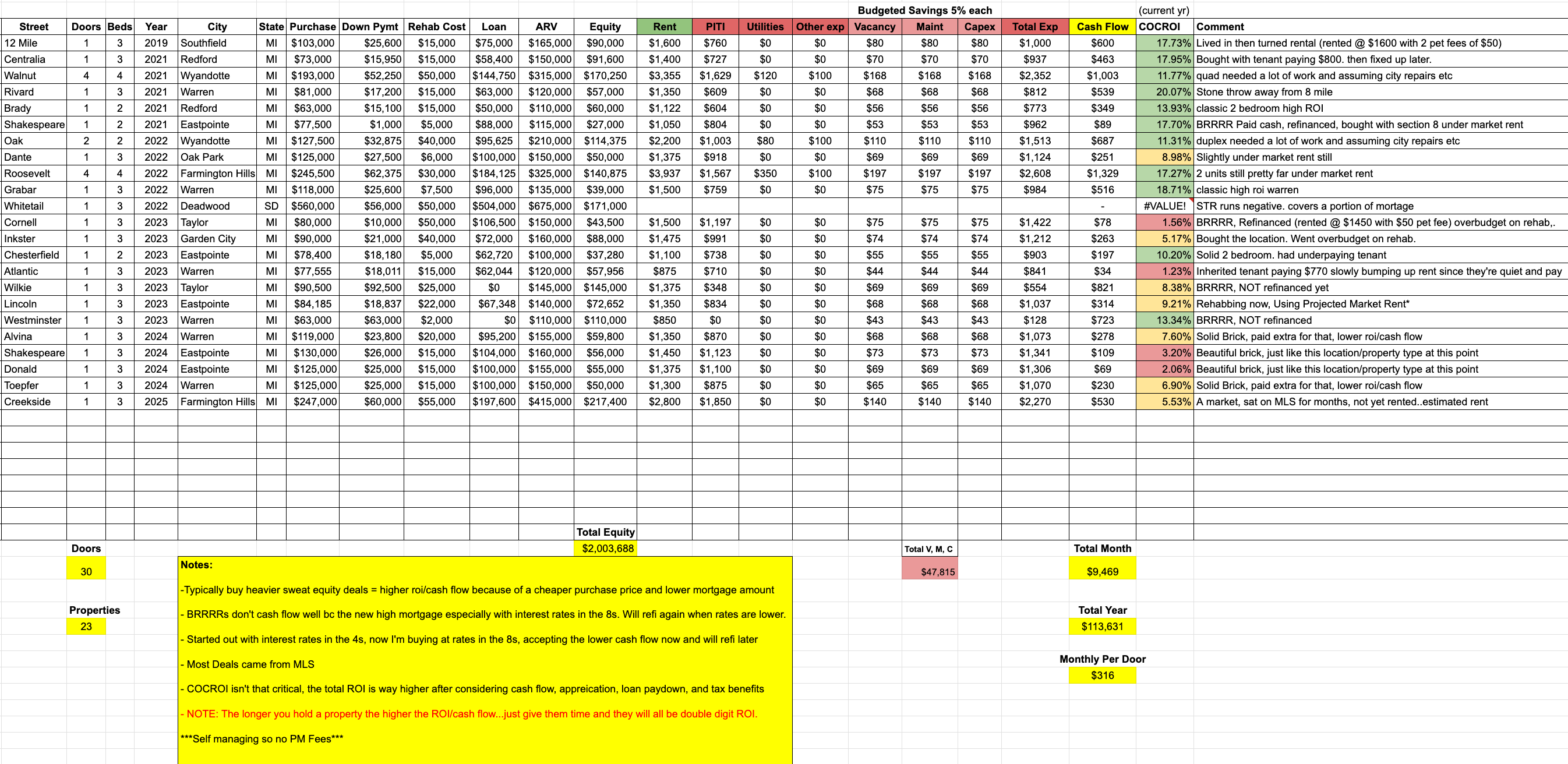
Metro Detroit has what 99% of Real Estate Investors want. Couple hundred bucks a door monthly cash flow, solid ROI, and yes plenty appreciation. (#1 appreciating city 2023)
I personally make well over $100k/yr cash flow from my portfolio here. All of which, I’ve purchased within the last 5 years.
There are 2 types of people who dog on Detroit..
1. People who don't actually own property in Detroit
2. People who did it wrong and weren't able to execute.
If you do it right, it’s arguably the best market to invest.
Purchase: $80k-$130k
Rent: $1100-$1500 (no rent control in MI)
1% rule: .9%-1.4% rule deals
Coc ROI: 4-12%
Total ROI: 20-40%
Cash flow: $50-$250/door (after all expenses and budgeting for maint, capex, vacancy)
Appreciation: 3-10%+ (has been double digit for a decade)
Location: C+, B-
These numbers are based on the "sweet spot" in Metro Detroit. These are largely in the suburbs and some markets within the city. You can find higher ROI (on paper) here and probably in other cities…but the probability of actually collecting rent significantly decreases. Where these numbers are found, there is a very high rate of rent actually being paid.
We have over a dozen Fortune 500 companies just in Metro Detroit with huge Healthcare, Auto, and mortgage industry National footprints. Ford, Rocket mortgage, Beaumont hospitals and more. All complimented with Amazon fulfillment centers, google, and more tech manufacturing jobs.
The bad reputation of “Detroit” comes from OOS investors wanting sub $40,000, D class properties in poor condition, because they pencil out to 2-3% deals on paper. We don’t buy those.
We have found what works and repeat it as much as funds allow.
Detroit has one the highest rent to price ratios in the country…and we focus on the best balance of price/location within the area.
Here is a picture of my portfolio if you/anyone is curious.