Hello Everyone,
I am in living in Conroe, TX with my wife. We both just turned 30 this year and I am looking to get us started with real estate investing for financial freedom in the future, and some more cash flow so she can slow down from working once we start having kids.
Any tips on where to get started would be greatly appreciated - originally looked into house hacking but we aren't sure we want to down size from a house into a duplex as we enjoy our privacy.
Thank you for anyone who replies,
Darryl
Welcome @Darryl Stewart!
The first question you need to answer - which most new investors never even think to ask - is whether you want to invest actively or passively.
The both have pros and cons. Active investing is a side business, which some people want and others don't. It gives you control over managing your investments, but it comes with a huge amount of work. You have to hassle with lenders, contractors, inspectors, tenants, property managers, accountants, etc.
Passive investing is completely hands-off once you wire in the money, and you don't control the management of the property. You can get virtually identical tax benefits. This umbrella category includes some JV partnerships, real estate syndications, equity funds, and private notes.
I started my career as an active investor, got sick of all the headaches, and today only invest passively. I invest as a member of the co-investing club, where we meet every month to all vet investments together. Any member can go in on that month's investment with $5K or more.
There's no right answer, but you do need to consider the question and come up with your own answer.
@Darryl Stewart, welcome to BP! I highly suggest looking out of state as the numbers in Houston area might not be the best in terms of Cashflow. Midwest states like Ohio you could get close to the 1% rule. I'm talking good areas with $100k single family homes where it can rent for close to $1000/month!
Welcome, Darryl.
Welcome @Darryl Stewart!
The first question you need to answer - which most new investors never even think to ask - is whether you want to invest actively or passively.
The both have pros and cons. Active investing is a side business, which some people want and others don't. It gives you control over managing your investments, but it comes with a huge amount of work. You have to hassle with lenders, contractors, inspectors, tenants, property managers, accountants, etc.
Passive investing is completely hands-off once you wire in the money, and you don't control the management of the property. You can get virtually identical tax benefits. This umbrella category includes some JV partnerships, real estate syndications, equity funds, and private notes.
I started my career as an active investor, got sick of all the headaches, and today only invest passively. I invest as a member of the co-investing club, where we meet every month to all vet investments together. Any member can go in on that month's investment with $5K or more.
There's no right answer, but you do need to consider the question and come up with your own answer.
Welcome @Darryl Stewart!
The first question you need to answer - which most new investors never even think to ask - is whether you want to invest actively or passively.
The both have pros and cons. Active investing is a side business, which some people want and others don't. It gives you control over managing your investments, but it comes with a huge amount of work. You have to hassle with lenders, contractors, inspectors, tenants, property managers, accountants, etc.
Passive investing is completely hands-off once you wire in the money, and you don't control the management of the property. You can get virtually identical tax benefits. This umbrella category includes some JV partnerships, real estate syndications, equity funds, and private notes.
I started my career as an active investor, got sick of all the headaches, and today only invest passively. I invest as a member of the co-investing club, where we meet every month to all vet investments together. Any member can go in on that month's investment with $5K or more.
There's no right answer, but you do need to consider the question and come up with your own answer.
Thank you for this information, I believe passive is probably what I'm looking for even though being active could i assume help me know more about the process. I will definitely look more into this.
Welcome @Darryl Stewart!
The first question you need to answer - which most new investors never even think to ask - is whether you want to invest actively or passively.
The both have pros and cons. Active investing is a side business, which some people want and others don't. It gives you control over managing your investments, but it comes with a huge amount of work. You have to hassle with lenders, contractors, inspectors, tenants, property managers, accountants, etc.
Passive investing is completely hands-off once you wire in the money, and you don't control the management of the property. You can get virtually identical tax benefits. This umbrella category includes some JV partnerships, real estate syndications, equity funds, and private notes.
I started my career as an active investor, got sick of all the headaches, and today only invest passively. I invest as a member of the co-investing club, where we meet every month to all vet investments together. Any member can go in on that month's investment with $5K or more.
There's no right answer, but you do need to consider the question and come up with your own answer.
Thank you for this information, I believe passive is probably what I'm looking for even though being active could i assume help me know more about the process. I will definitely look more into this.
Sounds great Darryl! I'll shoot you a connection request, reach out any time with questions.
Hello Everyone,
I am in living in Conroe, TX with my wife. We both just turned 30 this year and I am looking to get us started with real estate investing for financial freedom in the future, and some more cash flow so she can slow down from working once we start having kids.
Any tips on where to get started would be greatly appreciated - originally looked into house hacking but we aren't sure we want to down size from a house into a duplex as we enjoy our privacy.
Thank you for anyone who replies,
Darryl
First you set your goals "why do you want to be an investor", what do you want to get out of it
Then you decide if you want to do Flips, single family homes, rentals, MTR, STR, storage, Multis, commercial, and so on.
Then you decide where you want to invest. It can be different than where you want to live.
Then you look at the type of cash or financing you want to use, borrow from banks, borrow from hard money lender, use creative financing, use your 401(k), relatives, etc
Then you ask lots of questions
Sometimes it takes someone with some experience to help you sort that all out.
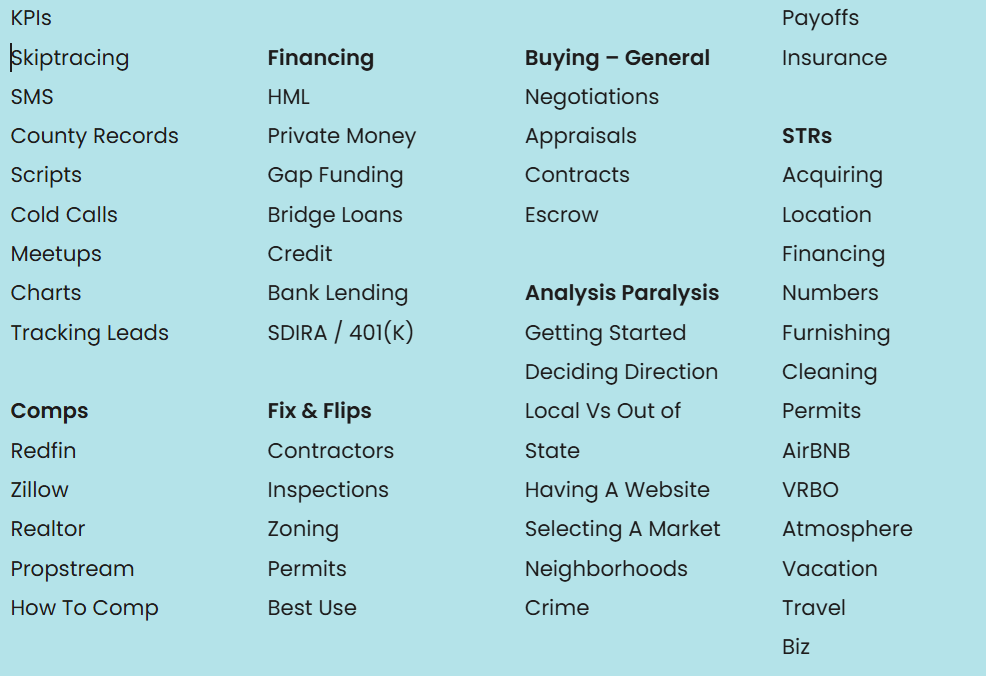
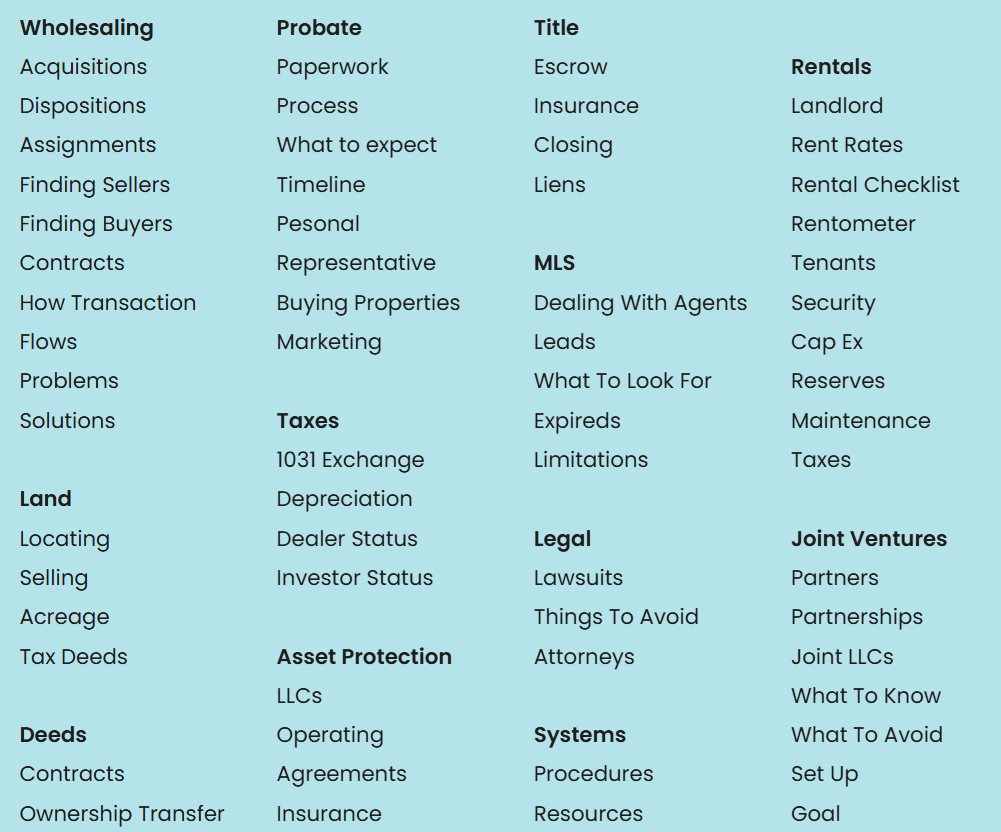
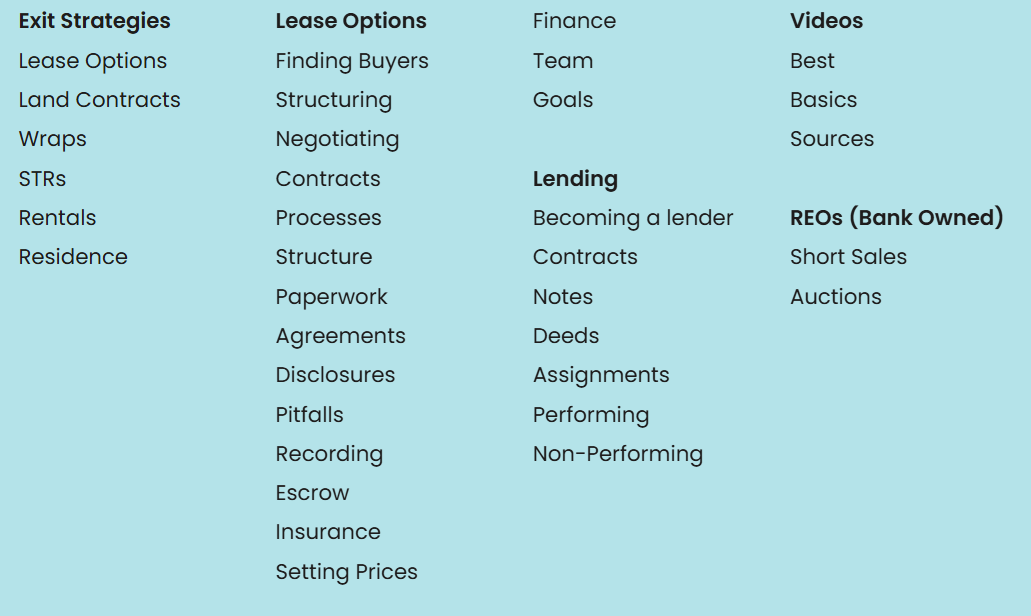
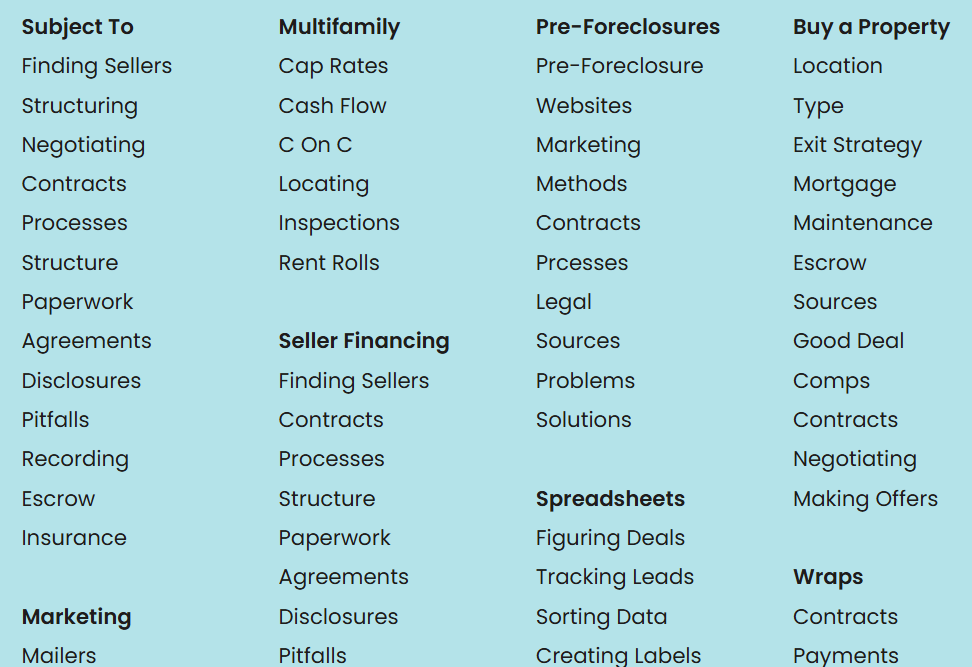
Here are some thoughts from what we teach, but it will give you something to think about
Click on Images to enlarge
Welcome!
I say this often: Be a sponge! Read books, watch videos, attend local meetups, comment in the forums, and ultimately...take action!
Welcome!
I say this often: Be a sponge! Read books, watch videos, attend local meetups, comment in the forums, and ultimately...take action!
Any books you recommend? I have a hard time choosing since the market changes all the time. I think I want to look into multi-family units and eventually get into house flips. I have just started listening to the bigger pockets podcast for some ideas as well.
Welcome!
I say this often: Be a sponge! Read books, watch videos, attend local meetups, comment in the forums, and ultimately...take action!
Any books you recommend? I have a hard time choosing since the market changes all the time. I think I want to look into multi-family units and eventually get into house flips. I have just started listening to the bigger pockets podcast for some ideas as well.
All my recommended books are shared here.
Multifamily and flips are very different business models, especially if you're considering 10+ unit MF.
MF = active business (unless your on the LP side)
SF rental = passive(ish) long-term wealth
Flips / wholesale = active income
@Darryl Stewart turn your single family into a rental and house hack a duplex. Best way to get started with less down.
Hey Darryl — welcome to the community! Sounds like you’ve got a clear “why,” which is the best place to start. If you enjoy your space but still want to get started, you might look into rent-by-the-room models or even buying a small single-family rental as your first deal. Happy to connect!
Welcome Darryl! I would recommend buying a single-family house for you and your wife to live in.
Hello Everyone,
I am in living in Conroe, TX with my wife. We both just turned 30 this year and I am looking to get us started with real estate investing for financial freedom in the future, and some more cash flow so she can slow down from working once we start having kids.
Any tips on where to get started would be greatly appreciated - originally looked into house hacking but we aren't sure we want to down size from a house into a duplex as we enjoy our privacy.
Thank you for anyone who replies,
Darryl
Hey Darryl, welcome to BiggerPockets! That’s an awesome goal and mindset to have at 30—you’re in a perfect spot to start building long-term wealth through real estate. If you’re not too keen on house hacking, you could look into buying your first rental property in a more affordable, landlord-friendly market that still has great cash flow potential. I moved from Portland, Oregon to Columbus, Ohio back in 2020 to invest and now own 10+ rentals here, and I’ve seen a lot of people start their journey the same way. Columbus is one of those markets that still has solid deals in the $120K–180K range that hit the 1% rule and positive cash flow, with strong job growth, population growth, and tons of major companies expanding here like Intel, Amazon, Google, and Honda. It’s a great market for first-time investors who want steady returns and appreciation upside. Happy to connect and answer any questions you have!
If you're not willing to downsize, could you consider doing a short term rental of your primary residence if there's a separate exit?
some other ideas would be a live in flip. You basically do work as you're living in the property and sell for a profit. You can exclude up to $500k gain if married and $250k gain if single.
If you're not willing to downsize, could you consider doing a short term rental of your primary residence if there's a separate exit?
some other ideas would be a live in flip. You basically do work as you're living in the property and sell for a profit. You can exclude up to $500k gain if married and $250k gain if single.
Hello Aaron,
We are coming up on year 2 at our first house, so renting this home out might be what I am thinking. A live in flip is a possibility..So i may need to do some more research on how to flip/remodel a home for that.
If you're not willing to downsize, could you consider doing a short term rental of your primary residence if there's a separate exit?
some other ideas would be a live in flip. You basically do work as you're living in the property and sell for a profit. You can exclude up to $500k gain if married and $250k gain if single.
Hello Aaron,
We are coming up on year 2 at our first house, so renting this home out might be what I am thinking. A live in flip is a possibility..So i may need to do some more research on how to flip/remodel a home for that.
Just a thought, I don't know the value of your house, but if you were to sell it, you'd likely have to come to closing with money to pay off the fees.
It typically costs about 8% to sell a house, with real estate agent fees, repairs, closing costs, etc so it costs about $24,000 to sell a $300,000 house.
Because of the way mortgages work, after two years you may have paid off $8,000 so generally speaking, you'd have to bring $16,000 to closing if you sold after2 years. That's going the wrong direction.
If you're not willing to downsize, could you consider doing a short term rental of your primary residence if there's a separate exit?
some other ideas would be a live in flip. You basically do work as you're living in the property and sell for a profit. You can exclude up to $500k gain if married and $250k gain if single.
Hello Aaron,
We are coming up on year 2 at our first house, so renting this home out might be what I am thinking. A live in flip is a possibility..So i may need to do some more research on how to flip/remodel a home for that.
Just a thought, I don't know the value of your house, but if you were to sell it, you'd likely have to come to closing with money to pay off the fees.
It typically costs about 8% to sell a house, with real estate agent fees, repairs, closing costs, etc so it costs about $24,000 to sell a $300,000 house.
Because of the way mortgages work, after two years you may have paid off $8,000 so generally speaking, you'd have to bring $16,000 to closing if you sold after2 years. That's going the wrong direction.
We would rent out the house we are in now if we choose to leave.
If you're not willing to downsize, could you consider doing a short term rental of your primary residence if there's a separate exit?
some other ideas would be a live in flip. You basically do work as you're living in the property and sell for a profit. You can exclude up to $500k gain if married and $250k gain if single.
Hello Aaron,
We are coming up on year 2 at our first house, so renting this home out might be what I am thinking. A live in flip is a possibility..So i may need to do some more research on how to flip/remodel a home for that.
Just a thought, I don't know the value of your house, but if you were to sell it, you'd likely have to come to closing with money to pay off the fees.
It typically costs about 8% to sell a house, with real estate agent fees, repairs, closing costs, etc so it costs about $24,000 to sell a $300,000 house.
Because of the way mortgages work, after two years you may have paid off $8,000 so generally speaking, you'd have to bring $16,000 to closing if you sold after2 years. That's going the wrong direction.
We would rent out the house we are in now if we choose to leave.
If you're not willing to downsize, could you consider doing a short term rental of your primary residence if there's a separate exit?
some other ideas would be a live in flip. You basically do work as you're living in the property and sell for a profit. You can exclude up to $500k gain if married and $250k gain if single.
Hello Aaron,
We are coming up on year 2 at our first house, so renting this home out might be what I am thinking. A live in flip is a possibility..So i may need to do some more research on how to flip/remodel a home for that.
Just a thought, I don't know the value of your house, but if you were to sell it, you'd likely have to come to closing with money to pay off the fees.
It typically costs about 8% to sell a house, with real estate agent fees, repairs, closing costs, etc so it costs about $24,000 to sell a $300,000 house.
Because of the way mortgages work, after two years you may have paid off $8,000 so generally speaking, you'd have to bring $16,000 to closing if you sold after2 years. That's going the wrong direction.
We would rent out the house we are in now if we choose to leave.
Okay thank you for that information.
Welcome, Darryl, sounds like you’re thinking about this the right way early on.
From a tax side, even your first property can open a lot of doors. You don’t have to start with a house hack if you value your privacy. Another great way to get started is with small multifamily or turnkey rental properties that let you generate cash flow without having to live in one unit. Depending on your market, you could also explore single-family rentals or even short-term rental strategies if you’re open to actively managing a property.
The key is starting small, learning the ropes, and thinking about the tax benefits, depreciation, mortgage interest, and expenses, and how they interplay with your current income to help you offset, save, and scale.
Keep good records from day one, and think about setting up an LLC once you buy to keep things clean and separate. Real estate's one of the best ways to lower taxes while building long-term income, so starting now will pay off big later. Good luck and happy to connect!