How to stop noise from upstairs unit.

How to stop noise from upstairs unit.

Sherwood, OR · Member since 2017 · 8 posts · 0 votes

I own a duplex that we have turned into a triplex. We live in the basement unit.  We built this unit from scratch, it was a large finished empty basement.  We insulated the ceiling to help with noise but it hasn't done much at all.  We are in the process of updating the upstairs unit. My husband has gutted it.  I'm planning on floating vinyl plank throughout the entire unit, with the exception of tile in the bathroom.  What underlayment should I use to reduce noise. Right now with an empty unit and no flooring I can hear every step and the sound of talking.  I've researched but I can't find much good info. Please help. thanks - Jessica

0Reply
62 views

Most Popular Reply

Severna Park, MD · Member since 2013 · 7k+ posts · 7k+ votes
9y

Or just turn up the TV a little more .............My idea doesnt cost as much 

See this reply in the discussion

18 Replies

Jump to latestLatest
  • JD MartinBusiness Member
    Moderator
    Rock Star Extraordinaire · Northeast, TN · Member since 2015 · 10k+ posts · 16k+ votes
    9y

    Use an open-cell spray foam. When I had my own basement done with it, the insulation is so good that I can't hear the furnace come on anymore, and it wasn't very loud to begin with. I have to go outside and listen for the gas exhaust fan. 

    Noise that is not transmitted through vibration is just sound waves traveling through empty air. Block the movement of the air and you'll block the movement of the sound. 

    Aside from that, use a floating floor upstairs with an underlayment beneath it. It will absorb a lot of the vibration noise from walking/banging on the floor. 

    Skyline Properties
    View Page
  • Sherwood, OR · Member since 2017 · 8 posts · 0 votes
    9y

    the ceiling is already insulated, looking back I wish I would have done a spray foam.  It will cost too much to redo now.  Do you have an underlayment you recommend?

  • JD MartinBusiness Member
    Moderator
    Rock Star Extraordinaire · Northeast, TN · Member since 2015 · 10k+ posts · 16k+ votes
    9y

    Not really. The thicker the better without making the floor feel like you're walking on a mattress. 

    Skyline Properties
    View Page
  • Sherwood, OR · Member since 2017 · 8 posts · 0 votes
    9y

    ok thank you, I'm thinking of using an acoustic caulk around all the edges and any other gaps we see

  • Sherwood, OR · Member since 2017 · 8 posts · 0 votes
    9y

    listening to my hubby vacuum through the ceiling I really wish we would have used spray foam

  • Logan, UT · Member since 2016 · 35 posts · 13 votes
    9y

    The biggest thing I would suggest is to check that the sub flooring is secured to the floor joists. It's not fun in the wee-hours of the morning to wake up to creaking as someone is walking through their unit. My wife and I are in the process of securing the sub floor to the joists in our home so as to not wake up the baby when we lay him down for a nap.

  • Sherwood, OR · Member since 2017 · 8 posts · 0 votes
    9y

    he's working on that today, we have lots of squeaks

  • Architect · Papillion, NE · Member since 2015 · 1k+ posts · 840 votes
    9y

    @Jessica Shinneman

    Sound travels thru vibration.  The higher the STC rating the better.  The higher the NRC number the better.  Here are a few links to check out.

    Similar topic:

    https://www.biggerpockets.com/forums/84/topics/417166-soundproofing-apartment-recommendations---help-needed

    Product resource:  Look at page 67 (figure 156) or so with floor assemblies.

    https://www.nationalgypsum.com/file/THESOUNDBOOK.pdf

    Product resource:

    http://www.kineticshometheater.com/isolation.html

    http://www.kineticsnoise.com/

    As for the foam @JD Martin mention, know the different between "open-cell" vs "closed-cell" foams.  Both are good products when used correctly.  Not sure exactly he used it the foam but I know he knows his stuff.

    http://www.spf.basf.com/homeowners_products.php

  • San Diego, CA · Member since 2017 · 11 posts · 7 votes
    9y

    Hi Jessica,

    Is the insulation just between the joists? Or does it overlap continuously over it? If you have it just between joists, the sound will transfer through the joists into the downstairs unit.

  • Sherwood, OR · Member since 2017 · 8 posts · 0 votes
    9y

    it's just in between the joists, I can't afford to make it better now.  The sound wasn't that bad so I thought it would be fine but it got worse with time.  I need to stop the noise upstairs somehow that's why I'm hoping there is an underlayment that can help me

  • San Diego, CA · Member since 2017 · 11 posts · 7 votes
    9y

    I used to work on Hotels and what we would do between rooms for the most sound proof wall assembly was have two layers of gypsum (mostly for fire protection) on each side and then stager 2" metal studs (4" thick wall total) with insulation wrapped between. The idea was breaking the solid elements between walls to limit acoustical transfer. I'm thinking for your ceiling if you don't mind losing some height, figure out of way to attach a loose foam material to the existing ceiling and put another layer of gypsum bd on top. Here's link with some graphics

    http://www.diynetwork.com/how-to/rooms-and-spaces/walls-and-ceilings/soundproofing-a-ceiling

  • Investor · Los Altos, CA · Member since 2014 · 942 posts · 1k+ votes
    9y

    @Jessica Shinneman try using a product called DynaPad.  It is made by a company called Dynamat.  They originally made material used for sound deadening cars for aftermarket audio enthusiast.  It is a sound deadening adhesive sheet that would be stuck to the interior of door skins, flooring etc. DynaPad is basically the same concept but for the home.  I have used Dynamat on cars, but I have never used it on a home.  But if it works in a "giant tin box" it should work in your home.  If you do use it, please report back to us on the effectiveness.

  • Member since 2016 · 13k+ posts · 12k+ votes
    9y

    Nothing you do to the upstairs apartment will diminish the sound effectively. The only way to do it is with the proper treatment of the basement ceiling area. Better insulation and a double layer of 5/8 drywall.

    At this point in time your only real option is another layer of 5/8 drywall on the ceiling. If you do this make sure you use the metal strips (resilient channel) designed to float the ceiling otherwise it will not accomplish anything. Sound is transferred through solid surface contact so the drywall must be separated from the floor joists or the existing dry wall in your case.

  • Severna Park, MD · Member since 2013 · 7k+ posts · 7k+ votes
    9y

    Or just turn up the TV a little more .............My idea doesnt cost as much 

  • Rental Property Investor · Chappaqua, NY · Member since 2015 · 1k+ posts · 947 votes
    9y
    Jessica Shinneman I've used homasote board over the top of existing wood floor then 3/4 plywood followed by 3/4 oak. Some sound will always get through but it help a lot. The sound goes through the screws/nails into the joists then down to you. How about carpet? That and sound machines at night will help alleviate it. Just keep in mind your suffering now to be more secure in the future! Do you have recessed lighting in your apt? If the sound is bad recessed lighting will make it worse.
  • Sherwood, OR · Member since 2017 · 8 posts · 0 votes
    9y

    I don't want to do carpet bc it really grosses me out.  I think I'll try an extra layer of plywood, acoustic calking and then a layer of recycled tire underlayment with vinyl plank on top.  We do have 2 recessed lights but luckly its below a closet.  

    I guess my question is which underlayment is the best on the market

  • Investor · New Britain, CT · Member since 2019 · 2 posts · 0 votes
    5y

    @Jessica Shinneman what option did you end up going with and did it work?

  • Mike ReynoldsPro Member
    construction · Nacogdoches, TX · Member since 2011 · 2k+ posts · 1k+ votes
    4y


    Resilient Channel: If You Use It, Don't Screw It Up! - BKL
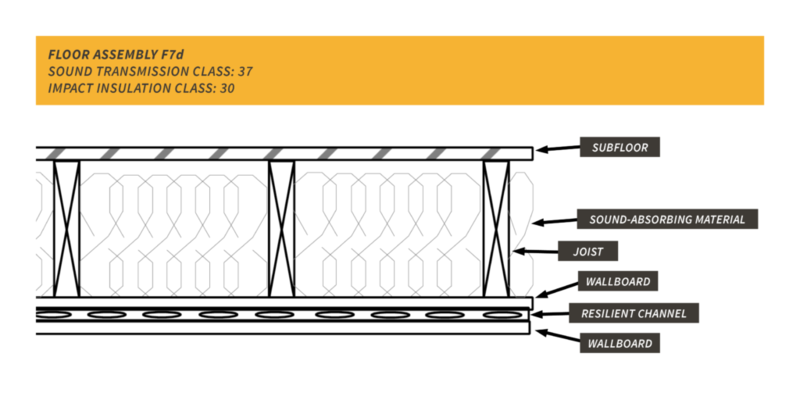
    Note that if you only need one layer of drywall then install your channel on your joist and then your one layer of drywall. If you need 2 layers for a fire wall then use the diagram above. 

    Closed cell foam will not work at all for sound. The key is to get air space and closed cell foam doesn't cut it for that. Open cell foam will work but only marginally (just a bit) worse than rock wool or fiberglass. Rock wool is the best DIY insulation for sound. Look at the lumber yard for sound insulation. 

    For good measure you can install sound barrier rubber or vinyl. It is heavy and hard to install so make sure your joist will handle the extra load. I mean it is heavy. 1 to 3 pounds per sq foot so you have to figure that into your live load calcs. 

Join the conversationCreate a free account to reply, vote on answers and follow this thread.