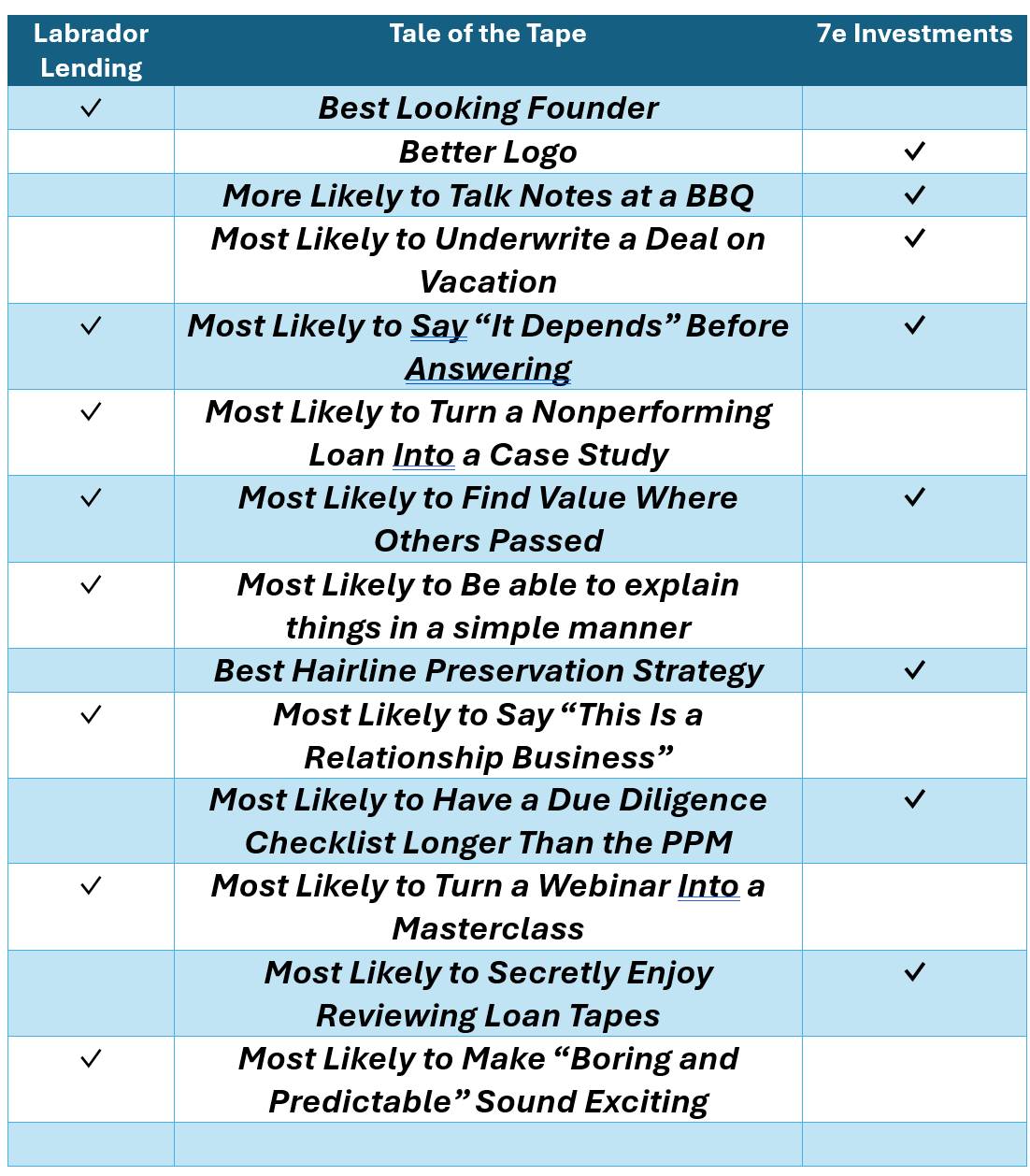
I'm beginning due diligence on a next mortgage note fund investment. I'm familiar with the asset class, and many of the funds seem really similar. I'm hoping that both Chris Seveny and Jamie Bateman will weigh in on the question -- guys, to avoid self-promotion (and I gather that you're also invested in the other company), it would be great for each to give your understanding of how the other's funds are similar and different to yours.
Jamie, what makes 7e Investments' current offerings unique to other mortgage note funds out there? What common ground do they share?
Chris, same question re: Labrador Lending.
Anybody who's invested in both funds, your experiences and understanding would be great too.
Thanks!

I know Jamie personally so I wanted to add some fun to this post. Also full disclosure I have not read his entire PPM offering, so I cannot compare and contrast every little detail. The main difference between the two are his is for accredited investors only and mine is open to non-accredited and accredited.

I know Jamie personally so I wanted to add some fun to this post. Also full disclosure I have not read his entire PPM offering, so I cannot compare and contrast every little detail. The main difference between the two are his is for accredited investors only and mine is open to non-accredited and accredited.
Hahaha! This is great, @Chris Seveney! You are also more likely to spend your weekends reading fund and SEC docs. And I play way more pickleball.
@Anna Watkins I am invested in both funds. There are a lot of similarities and some key differences. Chris has a much bigger team and a much bigger fund. I believe his minimum is lower but his commitment period is considerably longer. Ours is 12 months. Neither of us has ever missed a monthly distribution, as far as I am aware. Chris has Reg A and Reg D components to his fund and goes through an annual audit. I think he has over 1,000 investors in his fund; we have A LOT less than that. Happy to hop on a call to share more. I would recommend them both.
we have a lot fewer* than that (The editor in me couldn't let that slide.)
Hahaha! This is great, @Chris Seveney! You are also more likely to spend your weekends reading fund and SEC docs. And I play way more pickleball.
@Anna Watkins I am invested in both funds. There are a lot of similarities and some key differences. Chris has a much bigger team and a much bigger fund. I believe his minimum is lower but his commitment period is considerably longer. Ours is 12 months. Neither of us has ever missed a monthly distribution, as far as I am aware. Chris has Reg A and Reg D components to his fund and goes through an annual audit. I think he has over 1,000 investors in his fund; we have A LOT less than that. Happy to hop on a call to share more. I would recommend them both.
I forgot I was going to add you were a better pickleball player.
Jay hit nail on the head with any investment - diversify and invest in as many offerings you can - then you can see what you like and do not like about them and if one does one thing you can ask the other questions etc.
one thing i do want to correct is the commitment period which I believe both funds have similar periods now but on shorter periods jamies fund appears to have higher gross returns.
good replys guys.. I know Chris personally have not met Jamie . but it boils down to what collateral they are creating or buying.. I suspect that Jamie's 12 months he would be doing more short term HML type loans ( dont know personally just a wag) or if he is buying NPN he has a exit plan for those that does not include a full work out as NPN can certainly take more than a year to do a work out on. ..
Where my Experience with Chris is he will look at many types of collateral situations and buy NPN and make new loan origination's.
Try them both and let us know how you do. :)
Actually we buy a lot of longer-term debt. Our average note size is likely much smaller than Chris's, so we can sell off a small loan or two if need be for an investor redemption. We buy mostly 1st lien notes collaterlized by owner-occupied properties. Some 2nds, some land notes, some HMLs, some origination as well.
When I was in college my roommate taught me how to play guitar...badly. He told me a joke: "Q: How many guitar players does it take to screw in a light bulb? A: All of them. One to actually do it and the rest to say 'I'm better than that guy'." Let the friendly banter begin.
Thanks for submitting your compare & contrast lit homework promptly. :-)
And more seriously, I appreciate the input, it's super helpful. And I got a checklist too! I dunno', a fund sponsor who plays pickleball IS pretty important . .
Thanks for submitting your compare & contrast lit homework promptly. :-)
And more seriously, I appreciate the input, it's super helpful. And I got a checklist too! I dunno', a fund sponsor who plays pickleball IS pretty important . .
In all seriousness, my recommendation before investing in any offering is getting on the phone with them and asking questions. Questions such as:
1. What could happen that could cause my investmet to be lost? How to you try and mitigate against that?
2. What keeps the sponsor awake at night
3. Describe how you source your opportunities?
4. What is your communication like to investors? If I have questions is there someone I can call?
5. What happens if the sponsor drops dead tomorrow?
6. How long have the sponsor been doing this, and what else are they doing?
There are many others, but those are some of the ones to start with.
All the questions I asked Lauren before investing in 7e, but some more I'm going to add to the list. Thanks, Chris -- ;-)
I’m just happy to see a REAL question instead of some generic AI post meant to gain attention for the OP!
I too run a private mortgage fund (about $75 million in loans) but we work differently - every note investment is a separate series of the main LLC, and each investor gets to pick and choose which series, or note they wish to invest in. Some invest in all, some pick and choose. The minimum investment in any one note (series) is $50,000, so to be properly diversified a minimum capital of $500,000 is probably needed.
We have more money waiting on the sideline than we have deals the last two years, so we haven’t been accepting any new investors. That may change in the future as we have now added an underwriter/originator who had been our operations/workout specialist the last year and a half.
The first thing to look at is TRUST in the sponsor. If as an investor you have ANY reservations, don’t invest. Reg D (which we utilize) is a safe harbor for an EXEMPTION from securities registration, not another way to register. As a result there is little or no governmental oversight until after the fact. Thefact that a sponsor chose the somewhat more expensive Reg D route rather than relying on either the general exemption for private placements or an intrastate offering is a good sign, but nowhere near sufficient by itself to confidently invest.
Second, an investor should be sure that the risk factors inherent in the investment align with their own. Also that the risk adjusted return is superior to alternative investments.
Finally, the investor should confirm that the fund is invested in notes that align with their own stated parameters, and that the sponsor hasn’t gone “off the rails” chasing lower quality when supply became constrained. Additionally, compensation schemes should be checked so that the sponsors compensation aligns as much as possible with the investors best interests.
don hits nail on the head regarding trust in the sponsor. Also get to know the sponsor and speak to them. I see people passing on deals or investing in deals because they relied on someone they thought was smarter than them. Get to understand them and what they are doing and does it make sense?
I will go off on a slight tangent also as I recently saw someone who gets paid to analyze deals do just that for someone, but they made so many assumptions that were completely invalid on the offering (I know because I invested in it and did a deep dive to understand the metrics and this person shared their comments with me).
It appears this persons playbook is they apply the same factors / analysis the same across the board (which is really scary because they are probably giving bad advice and are not a registered investment advisor).
As I always say, trust your gut and do not succumb to the herd mentality.
I can't weigh in on either from an investor standpoint, but I've met @Chris Seveney, and he's a stand-up guy. Someone that I would do business with and invest with.
Do your DD on both and determine which one best hits your investing goals.