Will Population Decline Affect Housing?
Devin JamesPro Member
Developer · Orlando, FL · Member since 2018 · 502 posts · 306 votesThere’s been a lot of talk about declining birth rates in the U.S., how will this impact housing demand in the long run?
I brought it up to a friend this morning, saying I was concerned about what a smaller population could mean for the market.
He made a great point: immigration will offset that decline.
Fewer people being born, but potentially more people moving in.
Has anyone else thought about this when looking ahead at the housing market?
The mainstream narrative/masses are almost always wrong.
Anyone recall peak scares? lol
Here's what's going to happen in the coming years, and it will happen sooner than most people expect.
AI is going to unleash insane progress in biotech and drug discovery. We are going to see gene therapies and new drugs come to market at the fastest pace in history.
We are going to solve problems that we only dreamed of solving.
All this will result in grossly extended health spans and lifespans. As a result, population shrinkage worries will work themselves out as more and more people live longer, healthier lives, are able to have children later in life, etc.
.
Your comment: "AI is going to unleash insane progress in biotech and drug discovery. We are going to see gene therapies and new drugs come to market at the fastest pace in history."
The reason there is a chase for the new drugs (ie profit $$) is because you can't patent natural cures.
Most problems we encounter in the medical field are self inflicted by what we eat and drink. GMOs are not the solution.
Actually, people are going to realize that drugs are not the answer. A clean food and clean water source are. Shots (injections, pills, compounds) have terrible unintended consequences. But, it will be too late for some.
Those who recognize that we are more than DNA and body parts will take themselves more seriously.
Putting air into a basketball that has a hole in it will keep the ball inflated only as long as the air going in is faster than the air coming out. AI can not make the air go in fast enough for the human body.
Of the 20 pills my mother was taking, 10 were to counteract the negative effects of the others. Pretty clever, make products with a side effect so you can also sell the solution to the side effect.
There’s been a lot of talk about declining birth rates in the U.S., how will this impact housing demand in the long run?
I brought it up to a friend this morning, saying I was concerned about what a smaller population could mean for the market.
He made a great point: immigration will offset that decline.
Fewer people being born, but potentially more people moving in.
Has anyone else thought about this when looking ahead at the housing market?
The mainstream narrative/masses are almost always wrong.
Anyone recall peak scares? lol
Here's what's going to happen in the coming years, and it will happen sooner than most people expect.
AI is going to unleash insane progress in biotech and drug discovery. We are going to see gene therapies and new drugs come to market at the fastest pace in history.
We are going to solve problems that we only dreamed of solving.
All this will result in grossly extended health spans and lifespans. As a result, population shrinkage worries will work themselves out as more and more people live longer, healthier lives, are able to have children later in life, etc.
The mainstream narrative/masses are almost always wrong.
Anyone recall peak scares? lol
Here's what's going to happen in the coming years, and it will happen sooner than most people expect.
AI is going to unleash insane progress in biotech and drug discovery. We are going to see gene therapies and new drugs come to market at the fastest pace in history.
We are going to solve problems that we only dreamed of solving.
All this will result in grossly extended health spans and lifespans. As a result, population shrinkage worries will work themselves out as more and more people live longer, healthier lives, are able to have children later in life, etc.
I think this is less about "new drugs" and more about the food/water supply personally. I believe you can add more healthy years to your life from eating healthy whole foods and drinking water while minimizing vitamin/mineral deficiencies. The idea isn't putting a on a band-aid - it's preventing getting cut in the first place.
Look at the obesity rates and life expectancy...I guess being obese makes you live longer...oh wait...obesity rates have gone up and so has life expectancy - I guess the two are related...
The pharmaceutical industry is FIRST and FOREMOST a BUSINESS. These are for profit businesses - with MASSIVE profit, and MASSIVE influence. Why would they want to put an end to that? Take a look at the covid shot - would you consider this a new and exciting drug? Did it help 99% of people it was given to? Was it essentially mandated by the federal government that everyone get it (regardless of your personal risk level - which if you aren't old and fat or have a pre-existing condition is almost nil)? I'll pass on the new and exciting drugs and go with natural foods/water/mineral supplements.
Let me get on ozempic...wait, if I ate healthy, if crops weren't sprayed with folic acid/pesticides, if the water supply wasn't laced with flouride and heavy metals maybe they wouldn't get so fat and cancerous in the first place?
Prevention > Band-Aids every time
And personally I'd blame the liberals for the change in birthrates - hard to reproduce with every other person thinks they're gay/lesbian or trans. Look at the number of people (young people especially) who think they are trans these days? I think you would find that liberals reproduce (thank God) at a much lower rate than conservatives - nut to butt just doesn't work
The mainstream narrative/masses are almost always wrong.
Anyone recall peak scares? lol
Here's what's going to happen in the coming years, and it will happen sooner than most people expect.
AI is going to unleash insane progress in biotech and drug discovery. We are going to see gene therapies and new drugs come to market at the fastest pace in history.
We are going to solve problems that we only dreamed of solving.
All this will result in grossly extended health spans and lifespans. As a result, population shrinkage worries will work themselves out as more and more people live longer, healthier lives, are able to have children later in life, etc.
.
Your comment: "AI is going to unleash insane progress in biotech and drug discovery. We are going to see gene therapies and new drugs come to market at the fastest pace in history."
The reason there is a chase for the new drugs (ie profit $$) is because you can't patent natural cures.
Most problems we encounter in the medical field are self inflicted by what we eat and drink. GMOs are not the solution.
Actually, people are going to realize that drugs are not the answer. A clean food and clean water source are. Shots (injections, pills, compounds) have terrible unintended consequences. But, it will be too late for some.
Those who recognize that we are more than DNA and body parts will take themselves more seriously.
Putting air into a basketball that has a hole in it will keep the ball inflated only as long as the air going in is faster than the air coming out. AI can not make the air go in fast enough for the human body.
Of the 20 pills my mother was taking, 10 were to counteract the negative effects of the others. Pretty clever, make products with a side effect so you can also sell the solution to the side effect.
China, Japan & Italy have this problem right now.
China is trying to ignore/hide it because their short-sighted 1 child/family policy caused it. They've now ended that policy and are now offering incentives to have more children.
In Italy & Japan you can buy houses cheap in abandoned villages. Japan has the fastest aging population in the world, with one of the lowest birthrates. They're the world's "canary in a coal mine".
Climate change will be racing with population declines to determine which will have a bigger effect sooner!
Low water supplies & fires out west, increasing hurricanes in the southeast and shorter winters in the north may drive population growth back to the Midwest.

China, Japan & Italy have this problem right now.
China is trying to ignore/hide it because their short-sighted 1 child/family policy caused it. They've now ended that policy and are now offering incentives to have more children.
In Italy & Japan you can buy houses cheap in abandoned villages. Japan has the fastest aging population in the world, with one of the lowest birthrates. They're the world's "canary in a coal mine".
Climate change will be racing with population declines to determine which will have a bigger effect sooner!
Low water supplies & fires out west, increasing hurricanes in the southeast and shorter winters in the north may drive population growth back to the Midwest.
Birth rates have been declining for a long time in many countries. Immigration could offset the declining birth rate, but for housing how people live will also affect demand. ie How many single people opt to live on their own? and the economy-how many can afford to live on their own?
The mainstream narrative/masses are almost always wrong.
Anyone recall peak scares? lol
Here's what's going to happen in the coming years, and it will happen sooner than most people expect.
AI is going to unleash insane progress in biotech and drug discovery. We are going to see gene therapies and new drugs come to market at the fastest pace in history.
We are going to solve problems that we only dreamed of solving.
All this will result in grossly extended health spans and lifespans. As a result, population shrinkage worries will work themselves out as more and more people live longer, healthier lives, are able to have children later in life, etc.
.
Your comment: "AI is going to unleash insane progress in biotech and drug discovery. We are going to see gene therapies and new drugs come to market at the fastest pace in history."
The reason there is a chase for the new drugs (ie profit $$) is because you can't patent natural cures.
Most problems we encounter in the medical field are self inflicted by what we eat and drink. GMOs are not the solution.
Actually, people are going to realize that drugs are not the answer. A clean food and clean water source are. Shots (injections, pills, compounds) have terrible unintended consequences. But, it will be too late for some.
Those who recognize that we are more than DNA and body parts will take themselves more seriously.
Putting air into a basketball that has a hole in it will keep the ball inflated only as long as the air going in is faster than the air coming out. AI can not make the air go in fast enough for the human body.
Of the 20 pills my mother was taking, 10 were to counteract the negative effects of the others. Pretty clever, make products with a side effect so you can also sell the solution to the side effect.
You're thinking too small. And I don't mean that in a demeaning way.
You cannot naturally cure cancer. Just go ask Steve Jobs.
And that is just one example. I am talking about solving degenerative disease and either grossly extending lifespans via slowing the aging process or completely eliminating aging altogether.
Yes, it sounds crazy. But these things are happening.
There’s been a lot of talk about declining birth rates in the U.S., how will this impact housing demand in the long run?
I brought it up to a friend this morning, saying I was concerned about what a smaller population could mean for the market.
He made a great point: immigration will offset that decline.
Fewer people being born, but potentially more people moving in.
Has anyone else thought about this when looking ahead at the housing market?
The irony of this post is off the charts.
Detroit is actually doing very well today. People are just stuck in their lagging narratives to realize it.
Ask me how I know.
Its interesting which countries have low birth rates and which countries do not.
There’s been a lot of talk about declining birth rates in the U.S., how will this impact housing demand in the long run?
I brought it up to a friend this morning, saying I was concerned about what a smaller population could mean for the market.
He made a great point: immigration will offset that decline.
Fewer people being born, but potentially more people moving in.
Has anyone else thought about this when looking ahead at the housing market?
The irony of this post is off the charts.
Detroit is actually doing very well today. People are just stuck in their lagging narratives to realize it.
Ask me how I know.
There’s been a lot of talk about declining birth rates in the U.S., how will this impact housing demand in the long run?
I brought it up to a friend this morning, saying I was concerned about what a smaller population could mean for the market.
He made a great point: immigration will offset that decline.
Fewer people being born, but potentially more people moving in.
Has anyone else thought about this when looking ahead at the housing market?
The irony of this post is off the charts.
Detroit is actually doing very well today. People are just stuck in their lagging narratives to realize it.
Ask me how I know.
There’s been a lot of talk about declining birth rates in the U.S., how will this impact housing demand in the long run?
I brought it up to a friend this morning, saying I was concerned about what a smaller population could mean for the market.
He made a great point: immigration will offset that decline.
Fewer people being born, but potentially more people moving in.
Has anyone else thought about this when looking ahead at the housing market?
The irony of this post is off the charts.
Detroit is actually doing very well today. People are just stuck in their lagging narratives to realize it.
Ask me how I know.
There’s been a lot of talk about declining birth rates in the U.S., how will this impact housing demand in the long run?
I brought it up to a friend this morning, saying I was concerned about what a smaller population could mean for the market.
He made a great point: immigration will offset that decline.
Fewer people being born, but potentially more people moving in.
Has anyone else thought about this when looking ahead at the housing market?
The irony of this post is off the charts.
Detroit is actually doing very well today. People are just stuck in their lagging narratives to realize it.
Ask me how I know.
Your talking about Devil's Night?
There’s been a lot of talk about declining birth rates in the U.S., how will this impact housing demand in the long run?
I brought it up to a friend this morning, saying I was concerned about what a smaller population could mean for the market.
He made a great point: immigration will offset that decline.
Fewer people being born, but potentially more people moving in.
Has anyone else thought about this when looking ahead at the housing market?
The irony of this post is off the charts.
Detroit is actually doing very well today. People are just stuck in their lagging narratives to realize it.
Ask me how I know.
Your talking about Devil's Night?
There’s been a lot of talk about declining birth rates in the U.S., how will this impact housing demand in the long run?
I brought it up to a friend this morning, saying I was concerned about what a smaller population could mean for the market.
He made a great point: immigration will offset that decline.
Fewer people being born, but potentially more people moving in.
Has anyone else thought about this when looking ahead at the housing market?
The irony of this post is off the charts.
Detroit is actually doing very well today. People are just stuck in their lagging narratives to realize it.
Ask me how I know.
Your talking about Devil's Night?
There’s been a lot of talk about declining birth rates in the U.S., how will this impact housing demand in the long run?
I brought it up to a friend this morning, saying I was concerned about what a smaller population could mean for the market.
He made a great point: immigration will offset that decline.
Fewer people being born, but potentially more people moving in.
Has anyone else thought about this when looking ahead at the housing market?
The irony of this post is off the charts.
Detroit is actually doing very well today. People are just stuck in their lagging narratives to realize it.
Ask me how I know.
Your talking about Devil's Night?
Hundreds of homes - Arson.
The mainstream narrative/masses are almost always wrong.
Anyone recall peak scares? lol
Here's what's going to happen in the coming years, and it will happen sooner than most people expect.
AI is going to unleash insane progress in biotech and drug discovery. We are going to see gene therapies and new drugs come to market at the fastest pace in history.
We are going to solve problems that we only dreamed of solving.
All this will result in grossly extended health spans and lifespans. As a result, population shrinkage worries will work themselves out as more and more people live longer, healthier lives, are able to have children later in life, etc.
.
Your comment: "AI is going to unleash insane progress in biotech and drug discovery. We are going to see gene therapies and new drugs come to market at the fastest pace in history."
The reason there is a chase for the new drugs (ie profit $$) is because you can't patent natural cures.
Most problems we encounter in the medical field are self inflicted by what we eat and drink. GMOs are not the solution.
Actually, people are going to realize that drugs are not the answer. A clean food and clean water source are. Shots (injections, pills, compounds) have terrible unintended consequences. But, it will be too late for some.
Those who recognize that we are more than DNA and body parts will take themselves more seriously.
Putting air into a basketball that has a hole in it will keep the ball inflated only as long as the air going in is faster than the air coming out. AI can not make the air go in fast enough for the human body.
Of the 20 pills my mother was taking, 10 were to counteract the negative effects of the others. Pretty clever, make products with a side effect so you can also sell the solution to the side effect.
You're thinking too small. And I don't mean that in a demeaning way.
You cannot naturally cure cancer. Just go ask Steve Jobs.
And that is just one example. I am talking about solving degenerative disease and either grossly extending lifespans via slowing the aging process or completely eliminating aging altogether.
Yes, it sounds crazy. But these things are happening.
Your comment "You cannot naturally cure cancer. Just go ask Steve Jobs."
You can't naturally be a Formula 1 driver. Just go ask Shaquille O'Neal.
Simply because one person can't doesn't mean others can't.
I would list natural and inexpensive methods of "curing cancer" that of course don't make money for the doctor and pharmaceutical companies, so they are not utilized. Information will start to come out over the next little while for those who have an interest.
Search Dr. Wallach - selenium and its relationship to cancer
or
Ana Maria Mihalcea, M.D., Ph.D.
or
Dr. William Makis nuclear medicine
or
Dr. Bryan Ardis, D.C.
or
Dr. Richard Bartlett, MD
or
Ivermectin, “a potential anticancer drug derived from an antiparasitic drug”
Some believe that the root cause of many cancers is the food we eat and the drinks we drink and the chemicals we inject into our bodies "in the name of science". Maybe we should slow down and analyze the effects of the Covid shot for instance like at the HHS https://vaers.hhs.gov/

There are plenty more. These are all solutions that don't require expensive treatment, therefore they are useless to adding to the profit of the hospitals.
*************************
I've looked at the current state of AI and it is not impressive. Perhaps, some day in the future it will be, but not yet. You are on an interesting track, we just aren't to a reliable & useful level with it.
There’s been a lot of talk about declining birth rates in the U.S., how will this impact housing demand in the long run?
I brought it up to a friend this morning, saying I was concerned about what a smaller population could mean for the market.
He made a great point: immigration will offset that decline.
Fewer people being born, but potentially more people moving in.
Has anyone else thought about this when looking ahead at the housing market?
The irony of this post is off the charts.
Detroit is actually doing very well today. People are just stuck in their lagging narratives to realize it.
Ask me how I know.
Ken, you're very wrong about a lot in such a short post. I recently lived in the Detroit suburbs for 5 years. I own 12-doors in the city of Detroit.
I know exactly how well things are going there. I'm sure you have a great read on your local market but I'd recommend refraining from pretending to be an expert on a market you clearly know little about.
Good luck!
Only in respect to micro markets.
As a whole, the U.S. will not have population concerns. It's just a matter of time until they orchestrate an updated immigration plan. It's time.
There’s been a lot of talk about declining birth rates in the U.S., how will this impact housing demand in the long run?
I brought it up to a friend this morning, saying I was concerned about what a smaller population could mean for the market.
He made a great point: immigration will offset that decline.
Fewer people being born, but potentially more people moving in.
Has anyone else thought about this when looking ahead at the housing market?
The irony of this post is off the charts.
Detroit is actually doing very well today. People are just stuck in their lagging narratives to realize it.
Ask me how I know.
Ken, you're very wrong about a lot in such a short post. I recently lived in the Detroit suburbs for 5 years. I own 12-doors in the city of Detroit.
I know exactly how well things are going there. I'm sure you have a great read on your local market but I'd recommend refraining from pretending to be an expert on a market you clearly know little about.
Good luck!
.
Again, how many vacant properties are in Detroit?.
Using AI ;-) the answer is "
"Detroit has approximately 102,330 vacant housing units, which is 28% of the city's total housing stock."
That doesn't seem to be a very prosperous city to me.
I wish you well anyway. It's been fun.
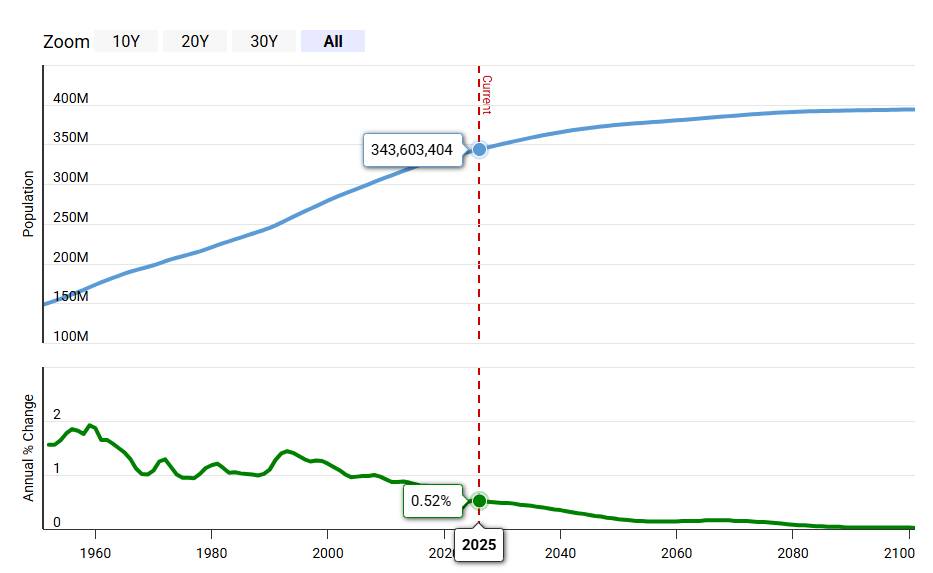
Well this looks like it could become a problem around yr 2100 so it will be my G.Grandkids who would be the ones sorting this out....
The mainstream narrative/masses are almost always wrong.
Anyone recall peak scares? lol
Here's what's going to happen in the coming years, and it will happen sooner than most people expect.
AI is going to unleash insane progress in biotech and drug discovery. We are going to see gene therapies and new drugs come to market at the fastest pace in history.
We are going to solve problems that we only dreamed of solving.
All this will result in grossly extended health spans and lifespans. As a result, population shrinkage worries will work themselves out as more and more people live longer, healthier lives, are able to have children later in life, etc.
.
Your comment: "AI is going to unleash insane progress in biotech and drug discovery. We are going to see gene therapies and new drugs come to market at the fastest pace in history."
The reason there is a chase for the new drugs (ie profit $$) is because you can't patent natural cures.
Most problems we encounter in the medical field are self inflicted by what we eat and drink. GMOs are not the solution.
Actually, people are going to realize that drugs are not the answer. A clean food and clean water source are. Shots (injections, pills, compounds) have terrible unintended consequences. But, it will be too late for some.
Those who recognize that we are more than DNA and body parts will take themselves more seriously.
Putting air into a basketball that has a hole in it will keep the ball inflated only as long as the air going in is faster than the air coming out. AI can not make the air go in fast enough for the human body.
Of the 20 pills my mother was taking, 10 were to counteract the negative effects of the others. Pretty clever, make products with a side effect so you can also sell the solution to the side effect.
You're thinking too small. And I don't mean that in a demeaning way.
You cannot naturally cure cancer. Just go ask Steve Jobs.
And that is just one example. I am talking about solving degenerative disease and either grossly extending lifespans via slowing the aging process or completely eliminating aging altogether.
Yes, it sounds crazy. But these things are happening.
Your comment "You cannot naturally cure cancer. Just go ask Steve Jobs."
You can't naturally be a Formula 1 driver. Just go ask Shaquille O'Neal.
Simply because one person can't doesn't mean others can't.
I would list natural and inexpensive methods of "curing cancer" that of course don't make money for the doctor and pharmaceutical companies, so they are not utilized. Information will start to come out over the next little while for those who have an interest.
Search Dr. Wallach - selenium and its relationship to cancer
or
Ana Maria Mihalcea, M.D., Ph.D.
or
Dr. William Makis nuclear medicine
or
Dr. Bryan Ardis, D.C.
or
Dr. Richard Bartlett, MD
or
Ivermectin, “a potential anticancer drug derived from an antiparasitic drug”
Some believe that the root cause of many cancers is the food we eat and the drinks we drink and the chemicals we inject into our bodies "in the name of science". Maybe we should slow down and analyze the effects of the Covid shot for instance like at the HHS https://vaers.hhs.gov/
There are plenty more. These are all solutions that don't require expensive treatment, therefore they are useless to adding to the profit of the hospitals.
*************************
I've looked at the current state of AI and it is not impressive. Perhaps, some day in the future it will be, but not yet. You are on an interesting track, we just aren't to a reliable & useful level with it.
"You can't naturally be a Formula 1 driver. Just go ask Shaquille O'Neal."

There’s been a lot of talk about declining birth rates in the U.S., how will this impact housing demand in the long run?
I brought it up to a friend this morning, saying I was concerned about what a smaller population could mean for the market.
He made a great point: immigration will offset that decline.
Fewer people being born, but potentially more people moving in.
Has anyone else thought about this when looking ahead at the housing market?
This is on my mind a lot as well. This is also why real estate isn't built up too much at once and comes and goes in waves. RE is a very a depreciable asset. It requires a lot of updates and maintenance. Those people who think they will automatically get $800,000 for an aging house were right in 2020 but not today. Those houses very often just sit and rot, get destroyed and turn into empty lots. The supply and demand move in tandem with a lag. Scarcity is built into the whole system. As 30% of the population goes into the next phase, there will be opportunities to buy and markets to run from for sure.
Demographics is destiny.
Florence, AL is turning around its aging problem through new transplants while Huntsville, AL is trying to stem the new development because there's too much housing and jobs here and not enough infrastructure when it comes to schools, healthcare, etc. Like others pointed out, this will not be a collective downfall across all areas of the US. There will be a pull and tug and various areas.
The mainstream narrative/masses are almost always wrong.
Anyone recall peak scares? lol
Here's what's going to happen in the coming years, and it will happen sooner than most people expect.
AI is going to unleash insane progress in biotech and drug discovery. We are going to see gene therapies and new drugs come to market at the fastest pace in history.
We are going to solve problems that we only dreamed of solving.
All this will result in grossly extended health spans and lifespans. As a result, population shrinkage worries will work themselves out as more and more people live longer, healthier lives, are able to have children later in life, etc.
.
Your comment: "AI is going to unleash insane progress in biotech and drug discovery. We are going to see gene therapies and new drugs come to market at the fastest pace in history."
The reason there is a chase for the new drugs (ie profit $$) is because you can't patent natural cures.
Most problems we encounter in the medical field are self inflicted by what we eat and drink. GMOs are not the solution.
Actually, people are going to realize that drugs are not the answer. A clean food and clean water source are. Shots (injections, pills, compounds) have terrible unintended consequences. But, it will be too late for some.
Those who recognize that we are more than DNA and body parts will take themselves more seriously.
Putting air into a basketball that has a hole in it will keep the ball inflated only as long as the air going in is faster than the air coming out. AI can not make the air go in fast enough for the human body.
Of the 20 pills my mother was taking, 10 were to counteract the negative effects of the others. Pretty clever, make products with a side effect so you can also sell the solution to the side effect.
You're thinking too small. And I don't mean that in a demeaning way.
You cannot naturally cure cancer. Just go ask Steve Jobs.
And that is just one example. I am talking about solving degenerative disease and either grossly extending lifespans via slowing the aging process or completely eliminating aging altogether.
Yes, it sounds crazy. But these things are happening.
Your comment "You cannot naturally cure cancer. Just go ask Steve Jobs."
You can't naturally be a Formula 1 driver. Just go ask Shaquille O'Neal.
Simply because one person can't doesn't mean others can't.
I would list natural and inexpensive methods of "curing cancer" that of course don't make money for the doctor and pharmaceutical companies, so they are not utilized. Information will start to come out over the next little while for those who have an interest.
Search Dr. Wallach - selenium and its relationship to cancer
or
Ana Maria Mihalcea, M.D., Ph.D.
or
Dr. William Makis nuclear medicine
or
Dr. Bryan Ardis, D.C.
or
Dr. Richard Bartlett, MD
or
Ivermectin, “a potential anticancer drug derived from an antiparasitic drug”
Some believe that the root cause of many cancers is the food we eat and the drinks we drink and the chemicals we inject into our bodies "in the name of science". Maybe we should slow down and analyze the effects of the Covid shot for instance like at the HHS https://vaers.hhs.gov/
There are plenty more. These are all solutions that don't require expensive treatment, therefore they are useless to adding to the profit of the hospitals.
*************************
I've looked at the current state of AI and it is not impressive. Perhaps, some day in the future it will be, but not yet. You are on an interesting track, we just aren't to a reliable & useful level with it.
"You can't naturally be a Formula 1 driver. Just go ask Shaquille O'Neal."
SUPPLY
"About 2.6 million Baby Boomers die each year, but that number is expected to increase to nearly 4 million by 2037." And a total of about 3.3 million Americans in total die each year. Likely most are over 40 and more likely to be homeowners than younger people percentage wise. Boomers are largest demographic co-hort in US history. Also a buddy of mine lives in a mythical city called Austin, where he swears while sober, said he saw guys 3-D printing houses, well foundation/walls etc. I have not looked into this but, if process ramps up, could cut construction costs, time to market and massively increase supply, too.
DEMAND
America is decreasing it's previously Laissez-faire approach to immigration.
So population decline either with Celestial deportation or with a more southerly route may not be good long term for housing market?
SUPPLY
"About 2.6 million Baby Boomers die each year, but that number is expected to increase to nearly 4 million by 2037." And a total of about 3.3 million Americans in total die each year. Likely most are over 40 and more likely to be homeowners than younger people percentage wise. Boomers are largest demographic co-hort in US history. Also a buddy of mine lives in a mythical city called Austin, where he swears while sober, said he saw guys 3-D printing houses, well foundation/walls etc. I have not looked into this but, if process ramps up, could cut construction costs, time to market and massively increase supply, too.
DEMAND
America is decreasing it's previously Laissez-faire approach to immigration.
So population decline either with Celestial deportation or with a more southerly route may not be good long term for housing market?
The mainstream narrative/masses are almost always wrong.
Anyone recall peak scares? lol
Here's what's going to happen in the coming years, and it will happen sooner than most people expect.
AI is going to unleash insane progress in biotech and drug discovery. We are going to see gene therapies and new drugs come to market at the fastest pace in history.
We are going to solve problems that we only dreamed of solving.
All this will result in grossly extended health spans and lifespans. As a result, population shrinkage worries will work themselves out as more and more people live longer, healthier lives, are able to have children later in life, etc.
.
Your comment: "AI is going to unleash insane progress in biotech and drug discovery. We are going to see gene therapies and new drugs come to market at the fastest pace in history."
The reason there is a chase for the new drugs (ie profit $$) is because you can't patent natural cures.
Most problems we encounter in the medical field are self inflicted by what we eat and drink. GMOs are not the solution.
Actually, people are going to realize that drugs are not the answer. A clean food and clean water source are. Shots (injections, pills, compounds) have terrible unintended consequences. But, it will be too late for some.
Those who recognize that we are more than DNA and body parts will take themselves more seriously.
Putting air into a basketball that has a hole in it will keep the ball inflated only as long as the air going in is faster than the air coming out. AI can not make the air go in fast enough for the human body.
Of the 20 pills my mother was taking, 10 were to counteract the negative effects of the others. Pretty clever, make products with a side effect so you can also sell the solution to the side effect.
You're thinking too small. And I don't mean that in a demeaning way.
You cannot naturally cure cancer. Just go ask Steve Jobs.
And that is just one example. I am talking about solving degenerative disease and either grossly extending lifespans via slowing the aging process or completely eliminating aging altogether.
Yes, it sounds crazy. But these things are happening.
Your comment "You cannot naturally cure cancer. Just go ask Steve Jobs."
You can't naturally be a Formula 1 driver. Just go ask Shaquille O'Neal.
Simply because one person can't doesn't mean others can't.
I would list natural and inexpensive methods of "curing cancer" that of course don't make money for the doctor and pharmaceutical companies, so they are not utilized. Information will start to come out over the next little while for those who have an interest.
Search Dr. Wallach - selenium and its relationship to cancer
or
Ana Maria Mihalcea, M.D., Ph.D.
or
Dr. William Makis nuclear medicine
or
Dr. Bryan Ardis, D.C.
or
Dr. Richard Bartlett, MD
or
Ivermectin, “a potential anticancer drug derived from an antiparasitic drug”
Some believe that the root cause of many cancers is the food we eat and the drinks we drink and the chemicals we inject into our bodies "in the name of science". Maybe we should slow down and analyze the effects of the Covid shot for instance like at the HHS https://vaers.hhs.gov/
There are plenty more. These are all solutions that don't require expensive treatment, therefore they are useless to adding to the profit of the hospitals.
*************************
I've looked at the current state of AI and it is not impressive. Perhaps, some day in the future it will be, but not yet. You are on an interesting track, we just aren't to a reliable & useful level with it.
"You can't naturally be a Formula 1 driver. Just go ask Shaquille O'Neal."
I'd love to meet him, he really does seem like just a great person.
I love what he did with Papa Johns.
Shaq doesn't get half the credit he deserves for his business savvy. The guy is rather brilliant. And charitable at same time. A rare combination.
SUPPLY
"About 2.6 million Baby Boomers die each year, but that number is expected to increase to nearly 4 million by 2037." And a total of about 3.3 million Americans in total die each year. Likely most are over 40 and more likely to be homeowners than younger people percentage wise. Boomers are largest demographic co-hort in US history. Also a buddy of mine lives in a mythical city called Austin, where he swears while sober, said he saw guys 3-D printing houses, well foundation/walls etc. I have not looked into this but, if process ramps up, could cut construction costs, time to market and massively increase supply, too.
DEMAND
America is decreasing it's previously Laissez-faire approach to immigration.
So population decline either with Celestial deportation or with a more southerly route may not be good long term for housing market?
3-D printing for homes has LOOOOng been around and being fiddled with. Literally decades now. Have you seen any huge impact from 3-D home printing yet? No. It's an interesting idea that still hasn't landed any significant changes.
SW is about the only place we can do it so that's where all the R&D is located by the daisy-chain of those trying to evolve the tech to something of viability.
For now it's still a novelty more than anything.
The recent leaps in pre-fab builds is the spear head of things. BOXABL is a standout leader in this segment. That is where your most likely to see any significant disruptions come from for any radical shift in how housing is built.
SUPPLY
"About 2.6 million Baby Boomers die each year, but that number is expected to increase to nearly 4 million by 2037." And a total of about 3.3 million Americans in total die each year. Likely most are over 40 and more likely to be homeowners than younger people percentage wise. Boomers are largest demographic co-hort in US history. Also a buddy of mine lives in a mythical city called Austin, where he swears while sober, said he saw guys 3-D printing houses, well foundation/walls etc. I have not looked into this but, if process ramps up, could cut construction costs, time to market and massively increase supply, too.
DEMAND
America is decreasing it's previously Laissez-faire approach to immigration.
So population decline either with Celestial deportation or with a more southerly route may not be good long term for housing market?
3-D printing for homes has LOOOOng been around and being fiddled with. Literally decades now. Have you seen any huge impact from 3-D home printing yet? No. It's an interesting idea that still hasn't landed any significant changes.
SW is about the only place we can do it so that's where all the R&D is located by the daisy-chain of those trying to evolve the tech to something of viability.
For now it's still a novelty more than anything.
The recent leaps in pre-fab builds is the spear head of things. BOXABL is a standout leader in this segment. That is where your most likely to see any significant disruptions come from for any radical shift in how housing is built.
SUPPLY
"About 2.6 million Baby Boomers die each year, but that number is expected to increase to nearly 4 million by 2037." And a total of about 3.3 million Americans in total die each year. Likely most are over 40 and more likely to be homeowners than younger people percentage wise. Boomers are largest demographic co-hort in US history. Also a buddy of mine lives in a mythical city called Austin, where he swears while sober, said he saw guys 3-D printing houses, well foundation/walls etc. I have not looked into this but, if process ramps up, could cut construction costs, time to market and massively increase supply, too.
DEMAND
America is decreasing it's previously Laissez-faire approach to immigration.
So population decline either with Celestial deportation or with a more southerly route may not be good long term for housing market?
3-D printing for homes has LOOOOng been around and being fiddled with. Literally decades now. Have you seen any huge impact from 3-D home printing yet? No. It's an interesting idea that still hasn't landed any significant changes.
SW is about the only place we can do it so that's where all the R&D is located by the daisy-chain of those trying to evolve the tech to something of viability.
For now it's still a novelty more than anything.
The recent leaps in pre-fab builds is the spear head of things. BOXABL is a standout leader in this segment. That is where your most likely to see any significant disruptions come from for any radical shift in how housing is built.
I also followed Boxabl and 3D printing for housing, but settled on SIP panels and modular as more effective solutions at this time.
SUPPLY
"About 2.6 million Baby Boomers die each year, but that number is expected to increase to nearly 4 million by 2037." And a total of about 3.3 million Americans in total die each year. Likely most are over 40 and more likely to be homeowners than younger people percentage wise. Boomers are largest demographic co-hort in US history. Also a buddy of mine lives in a mythical city called Austin, where he swears while sober, said he saw guys 3-D printing houses, well foundation/walls etc. I have not looked into this but, if process ramps up, could cut construction costs, time to market and massively increase supply, too.
DEMAND
America is decreasing it's previously Laissez-faire approach to immigration.
So population decline either with Celestial deportation or with a more southerly route may not be good long term for housing market?
3-D printing for homes has LOOOOng been around and being fiddled with. Literally decades now. Have you seen any huge impact from 3-D home printing yet? No. It's an interesting idea that still hasn't landed any significant changes.
SW is about the only place we can do it so that's where all the R&D is located by the daisy-chain of those trying to evolve the tech to something of viability.
For now it's still a novelty more than anything.
The recent leaps in pre-fab builds is the spear head of things. BOXABL is a standout leader in this segment. That is where your most likely to see any significant disruptions come from for any radical shift in how housing is built.
They are following (smartly in my opinion) the standard manu. engineering path of iterations and evolutions.
The majority of current market available units, yes, are more ADU or "tiny home" style units.
The "master plan" and actions in process are to completely change the industry via site connected units, like leggos.
They do have some of these out now for market purchase where it is multi unit's that can be inter connected.
And stacked unit's are in process, just about to launch or just now launched publicly. Not sure as of this exact minute in time, it's that close/new.
Following standard manu. engineering principles they go through a process of: concept, prototype, test, gen I, test, Gen II, test etc etc until they have a ready for market fully tested and proven unit.
The goal is getting to 3-4 level stackable's.
I started in the pre-manufactured components segment back in 90's, it's come a loooong ways since then.
A major issue we always had was connecting factory too field. How what we were doing in factory with panelization actually translated into true time, labor and QC savings in field. And for long it was nominal.
boxabl and similar ones, I think there achieving it.
I have seen some pretty awesome builds come from them that were delivered to site, and completely setup, completed, ready for occupancy within 24-72hrs.
That's just mind blowing.
But yes, site does take prep that takes days or weeks site dependent for roadway, pad prep, utilities etc.. Nothing new there, right.
Any of us who've been in the development segment for any time, we know how massive a disruptor this could be if they get it to scale as standard units.
Scaling up a factory output is real and viable. We can scale job sites only so much, it's not realistic to try scale a job site where we can pump out a completed unit each day. A factory can absolutely do that, even 2, 5, 10+.
Stick built is antiquated, it is, it's just been a matter of not readily having a better option at scale. Companies like boxabl are solving that.
Once they get to the point in manufacturing to scale production, that's when we start seeing cost of units start dropping like a stone. Just like flat panel tv's and really any manufactured product. Scale of production = reduction in expense = cost savings for consumer.
OP. The US can double its population in one year if it wanted to.
The mainstream narrative/masses are almost always wrong.
Anyone recall peak scares? lol
Here's what's going to happen in the coming years, and it will happen sooner than most people expect.
AI is going to unleash insane progress in biotech and drug discovery. We are going to see gene therapies and new drugs come to market at the fastest pace in history.
We are going to solve problems that we only dreamed of solving.
All this will result in grossly extended health spans and lifespans. As a result, population shrinkage worries will work themselves out as more and more people live longer, healthier lives, are able to have children later in life, etc.
I have yet to see real AI. So far all of them on the market are actually machine learning taught by humans. For example you know that please select all squares with buses on websites. That’s us teaching “AI” for years. They are only as smart as the smartest people teaching these “AI”.
Hello @Devin James,
The US will likely not face population decline in the next decades due to immigration and longer life spans, even if birth rates decline.
However, national averages have limited relevance to individual cities. Cleveland, Ohio, offers a stark example of population decline. From its peak of over 914,000 residents in 1950, the city's population fell to 750,000 by 1970 and plummeted to about 372,000 by 2020—a 50% decrease since 1970. This dramatic decline stemmed not from birth rates but from issues with city government, crime, and cost of living.
During the same period, the population of the Las Vegas metro area has grown dramatically since 1970. In 1970, the population was approximately 273,000. By 2020, it had surged to over 2.3 million, representing an increase of more than 740% over the same period. This also had little to do with national birth rates.
As investors, we should focus on city-level performance, not national averages. Focus on cities with both significant, sustained population growth and consistent appreciation of existing properties. These two factors serve as strong indicators of a city's long-term economic outlook.

Hello @Devin James,
The US will likely not face population decline in the next decades due to immigration and longer life spans, even if birth rates decline.
However, national averages have limited relevance to individual cities. Cleveland, Ohio, offers a stark example of population decline. From its peak of over 914,000 residents in 1950, the city's population fell to 750,000 by 1970 and plummeted to about 372,000 by 2020—a 50% decrease since 1970. This dramatic decline stemmed not from birth rates but from issues with city government, crime, and cost of living.
During the same period, the population of the Las Vegas metro area has grown dramatically since 1970. In 1970, the population was approximately 273,000. By 2020, it had surged to over 2.3 million, representing an increase of more than 740% over the same period. This also had little to do with national birth rates.
As investors, we should focus on city-level performance, not national averages. Focus on cities with both significant, sustained population growth and consistent appreciation of existing properties. These two factors serve as strong indicators of a city's long-term economic outlook.
This is great insight.
Similar to focusing on different markets. One market can be booming, another can be on the decline.
Hello @Devin James,
The US will likely not face population decline in the next decades due to immigration and longer life spans, even if birth rates decline.
However, national averages have limited relevance to individual cities. Cleveland, Ohio, offers a stark example of population decline. From its peak of over 914,000 residents in 1950, the city's population fell to 750,000 by 1970 and plummeted to about 372,000 by 2020—a 50% decrease since 1970. This dramatic decline stemmed not from birth rates but from issues with city government, crime, and cost of living.
During the same period, the population of the Las Vegas metro area has grown dramatically since 1970. In 1970, the population was approximately 273,000. By 2020, it had surged to over 2.3 million, representing an increase of more than 740% over the same period. This also had little to do with national birth rates.
As investors, we should focus on city-level performance, not national averages. Focus on cities with both significant, sustained population growth and consistent appreciation of existing properties. These two factors serve as strong indicators of a city's long-term economic outlook.
There’s been a lot of talk about declining birth rates in the U.S., how will this impact housing demand in the long run?
I brought it up to a friend this morning, saying I was concerned about what a smaller population could mean for the market.
He made a great point: immigration will offset that decline.
Fewer people being born, but potentially more people moving in.
Has anyone else thought about this when looking ahead at the housing market?
Population is declining but people are also living a lot longer. We will also continue to have positive immigration in this country which will make up some of the difference as well.
I do not think this is anything any of us here on BP are going to have to worry about in our lifetime, sure maybe in 100 years it could be positive or negative, but impacts of this would take multiple decades/century to actually have an impact and technology will play a greater impact on us than population.

The first effects on the US economy may be economic, as some countries around the world begin collapsing. The US will probably be able to delay major effects longer than most countries by bringing in immigrants. But eventually the world (in 70 years or so) and US populations will begin declining. The large problems won't be simply due to population decline, but rapid population decline.
Obviously decreased housing demand will affect real estate values. I'll be teaching my children that while we're making money on real estate right now, at some point future generations will need to get out of real estate. Maybe they'll need to get into nursing home and mortuary businesses.
