Hi all , my strategy is basically finding areas that are dense in population in a good neighborhood and have a demand for rentals and have cash flow. However I am unable to correctly identify ‘ research this and I am having analysis paralysis.
would you say to just find high cashflowing areas or should I just find an agent and trust his word. Like how can I ensure I am not just buying in some crappy area vs a good area with demand. I will be investing out of state so if I were to want to choose any state what would my first steps be ?
any help would be appreciated to hopefully get my first rental by September
hello. i'm just going to be very direct. here are a few thoughts.
1. i don't think not buying means you have analysis paralysis. the market is tough right now. buying a bad deal is just going to set you back financially. "analysis paralysis" is a term created by people selling things to get you to buy so they can make money off your purchase. you need to look out for you.
2. i would not buy a property thousands of miles away because an agent or an Internet person said so. this is a recipe for disaster. see these threads.
Issues with Mold
Sell at a loss or rent at a loss
Experience of OOS investing in Cleveland after 1.5 years.
$12,000 Turnover!! Is this normal for less than 3 year tenant.
Baltimore - a path to never-ending pain
3. how do you know if an area is good? you go there in person and see if it's good. if you can't do this, don't buy there. see above threads.
4. you're not going to cash flow any amount whatsoever, period, in the first few years of owning a rental property, or potentially even longer. none. $0. not any. i cannot emphasize this enough. it costs money just to buy - those costs are called closing costs. then it costs money to get ready to rent - maybe you need to do some sprucing up like painting. then it costs money to lease up - you might have to pay an entire months rent to an agent or PM. then something is going to break immediately. might be a doorknob, or the dishwasher, or the furnace. costs, costs, costs.
hope this helps
i wish you good luck
Hi Chaim,
For out-of-state investing, don’t just rely on an agent, trust data first. Start by picking landlord-friendly markets with population and job growth. Use tools like Rentometer, Zillow, and city-data.com to verify rent demand and neighborhood quality. Focus on specific ZIP codes, not just cities, and aim for solid rent-to-price ratios (ideally 0.8–1%+).
Once you’ve narrowed it down, then bring in an investor-friendly agent to help you execute. That way, you're leading with strategy, not guesswork.
hello. i'm just going to be very direct. here are a few thoughts.
1. i don't think not buying means you have analysis paralysis. the market is tough right now. buying a bad deal is just going to set you back financially. "analysis paralysis" is a term created by people selling things to get you to buy so they can make money off your purchase. you need to look out for you.
2. i would not buy a property thousands of miles away because an agent or an Internet person said so. this is a recipe for disaster. see these threads.
Issues with Mold
Sell at a loss or rent at a loss
Experience of OOS investing in Cleveland after 1.5 years.
$12,000 Turnover!! Is this normal for less than 3 year tenant.
Baltimore - a path to never-ending pain
3. how do you know if an area is good? you go there in person and see if it's good. if you can't do this, don't buy there. see above threads.
4. you're not going to cash flow any amount whatsoever, period, in the first few years of owning a rental property, or potentially even longer. none. $0. not any. i cannot emphasize this enough. it costs money just to buy - those costs are called closing costs. then it costs money to get ready to rent - maybe you need to do some sprucing up like painting. then it costs money to lease up - you might have to pay an entire months rent to an agent or PM. then something is going to break immediately. might be a doorknob, or the dishwasher, or the furnace. costs, costs, costs.
hope this helps
i wish you good luck
hello. i'm just going to be very direct. here are a few thoughts.
1. i don't think not buying means you have analysis paralysis. the market is tough right now. buying a bad deal is just going to set you back financially. "analysis paralysis" is a term created by people selling things to get you to buy so they can make money off your purchase. you need to look out for you.
2. i would not buy a property thousands of miles away because an agent or an Internet person said so. this is a recipe for disaster. see these threads.
Issues with Mold
Sell at a loss or rent at a loss
Experience of OOS investing in Cleveland after 1.5 years.
$12,000 Turnover!! Is this normal for less than 3 year tenant.
Baltimore - a path to never-ending pain
3. how do you know if an area is good? you go there in person and see if it's good. if you can't do this, don't buy there. see above threads.
4. you're not going to cash flow any amount whatsoever, period, in the first few years of owning a rental property, or potentially even longer. none. $0. not any. i cannot emphasize this enough. it costs money just to buy - those costs are called closing costs. then it costs money to get ready to rent - maybe you need to do some sprucing up like painting. then it costs money to lease up - you might have to pay an entire months rent to an agent or PM. then something is going to break immediately. might be a doorknob, or the dishwasher, or the furnace. costs, costs, costs.
hope this helps
i wish you good luck
This.
@Nicholas L. I understand your point of view however, anywhere close to me would be to expensive. My only option would be nj if I can find the correct market which might be too expensive so to atleast start out it would need to be out of state
@Chaim Mal try to find a location you can at least drive to and get a feel for it. If you're in the tristate area you should have a couple of options?
@Nicholas L., why are you ruining everyone's get rich quick ideas? :)
@Chaim Mal choose a place you know like the back of your hand. I am assuming you are talking SFR or duplex, versus a 200 unit apartment complex. As such, while there is nothing wrong with Drago's comments, you are more likely to lose money investing in an area you don't know, even if it is landlord friendly, with strong population growth and job growth, then you are buying in a rural town in that you know inside out.
From there, I would pick a place that you already travel to regularly. If you travel for business to a certain market, you might as well tag on your rental to that trip. A flight will cost you $500-1000, and you will likely want to visit your property once or twice per year. If you buy a place that is only cash flowing $100-200/mo, well that flight will eat up half your profit alone.
Lastly, cash flow and nice area are generally not synonymous. I know this is very subjective. But houses in the best neighborhoods of any city are expensive. So, if you want cash flow, you are either putting a lot of money down (which means your return on investment is lower) or you are buying in a cruddy area and hoping for the best.
Good advice from @Nicholas L.
I'd add that you don't want to only trust the agent's word, they need to show you data that will justify the purchase for your goals (why you want to invest in real estate). This is more than comparative sales in the area. For our clients produce reports with rental data in the hyper-local area, condition, calculations for cash flow, cash on cash, and knowledge from other investor clients and local development.
They will also have multiple trusted tradesmen in the area that you can verify.
Consider where you would want to live. Many people find that investing where they would want to live has long term benefits.
Why not invest in your state or city, wherever you know the market?
@Bradley Buxton the reason can't invest in my market is because I am in ny and the prices here does line up with my financials.
Hey @Chaim Mal!
Totally get where you’re coming from, especially when you’re trying to pick the “perfect” out-of-state market. The truth is, you don’t need to know everything to take your first step. You just need a clear strategy and the right team around you. Cash flow is important, but it’s just one piece. You want areas with rental demand, stable or growing populations, landlord-friendly laws, and properties priced in a range where the 1% rule still exists, or close to it.
Markets like Memphis check a lot of those boxes: strong rental demand, homes under $150K, and investor-friendly teams who already work with out-of-state buyers. Your first steps? Pick one market, dig into submarkets (using Rentometer, Trulia crime maps, and BP forums), and start building relationships with investor-focused agents and property managers. Not just anyone. A good agent won't mind showing you comps, rent data, and breaking down which neighborhoods have staying power vs. higher risk. Once you have a market and a team, everything gets clearer! And you’re no longer making guesses alone. You got this! September is a real possibility if you lock in on one market now and stay focused. Let me know if you want to explore how others are doing it in places like Memphis!
Great question and you're definitely not alone! Analysis paralysis is one of the most common hurdles for new investors, especially when looking to invest out of state. You’re already thinking the right way: dense population, good neighborhoods, rental demand, and cash flow. Now it’s just about turning that into an action plan.
Here’s how to move from stuck to taking action---
Step 1: Choose Your Market Intentionally
Don’t rely solely on an agent’s word - your best protection is knowing how to spot a solid market yourself. Look for areas with:
Population growth
Job growth + economic diversity
Landlord-friendly laws
Median home prices that support cash flow (often under $250K)
Great starter markets include:
Indianapolis, IN
Birmingham, AL
Columbus, GA
Ocala or Citrus Springs, FL
Cleveland, OH
Step 2: Use Data to Validate Neighborhoods
Once you’ve chosen a market, go neighborhood by neighborhood using:
Rentometer.com – to verify rent demand
City-Data.com – for income levels, crime trends, owner vs renter mix
Local property managers – they’ll tell you what tenants want and where to avoid
Step 3: Find the Right Agent or Team
You definitely want a good investor-friendly agent, but don’t just take their word - instead, interview them like a business partner:
How many investor clients do you work with?
What areas are best for rentals and why?
Would you invest here?
Also ask to be introduced to a local PM - they’ll give you an honest take on rental demand, tenant quality, and what’s rentable.
You don’t need to find the “perfect” market to win - you need to take action in a good one with the right fundamentals. The goal is to buy a decent, cash-flowing property in a market you understand well enough to trust your decisions.
Happy to chat more about specific markets or help run your first deal analysis - you're closer than you think!
Best of luck,
Melissa
Great question and you're definitely not alone! Analysis paralysis is one of the most common hurdles for new investors, especially when looking to invest out of state. You’re already thinking the right way: dense population, good neighborhoods, rental demand, and cash flow. Now it’s just about turning that into an action plan.
Here’s how to move from stuck to taking action---
Step 1: Choose Your Market Intentionally
Don’t rely solely on an agent’s word - your best protection is knowing how to spot a solid market yourself. Look for areas with:
Population growth
Job growth + economic diversity
Landlord-friendly laws
Median home prices that support cash flow (often under $250K)
Great starter markets include:
Indianapolis, IN
Birmingham, AL
Columbus, GA
Ocala or Citrus Springs, FL
Cleveland, OH
Step 2: Use Data to Validate Neighborhoods
Once you’ve chosen a market, go neighborhood by neighborhood using:
Rentometer.com – to verify rent demand
City-Data.com – for income levels, crime trends, owner vs renter mix
Local property managers – they’ll tell you what tenants want and where to avoid
Step 3: Find the Right Agent or Team
You definitely want a good investor-friendly agent, but don’t just take their word - instead, interview them like a business partner:
How many investor clients do you work with?
What areas are best for rentals and why?
Would you invest here?
Also ask to be introduced to a local PM - they’ll give you an honest take on rental demand, tenant quality, and what’s rentable.
You don’t need to find the “perfect” market to win - you need to take action in a good one with the right fundamentals. The goal is to buy a decent, cash-flowing property in a market you understand well enough to trust your decisions.
Happy to chat more about specific markets or help run your first deal analysis - you're closer than you think!
Best of luck,
Melissa
@Melissa Justice to gather my team for out of state would you suggest to just google pms and agents in the area or have them be referred ? Thanks for the insight
While you can Google agents and property managers, referrals are almost always the better route, especially when you're investing out of state. A referred agent or PM typically comes with a track record that someone in the investor community can vouch for. That saves you a ton of trial and error.
Ask in forums like this one (BiggerPockets) - lots of investors are happy to share their contacts, especially if they’ve had a good experience.@Melissa Justice to gather my team for out of state would you suggest to just google pms and agents in the area or have them be referred ? Thanks for the insight
While you can Google agents and property managers, referrals are almost always the better route, especially when you're investing out of state. A referred agent or PM typically comes with a track record that someone in the investor community can vouch for. That saves you a ton of trial and error.
Ask in forums like this one (BiggerPockets) - lots of investors are happy to share their contacts, especially if they’ve had a good experience.Having talked with thousands of investors and investor wannabes. Call it analysis paralysis, call it decision constipation.
Most people are not paralyzed with analysis; they are afraid to pull the trigger.
Hire an investor-agent in your market of choice and leverage their experience. Period.
Hi all , my strategy is basically finding areas that are dense in population in a good neighborhood and have a demand for rentals and have cash flow. However I am unable to correctly identify ‘ research this and I am having analysis paralysis.
would you say to just find high cashflowing areas or should I just find an agent and trust his word. Like how can I ensure I am not just buying in some crappy area vs a good area with demand. I will be investing out of state so if I were to want to choose any state what would my first steps be ?
any help would be appreciated to hopefully get my first rental by September
Most agents that work with investors will be able to guide you on which neighborhoods are not great for out of state investors that are new to the market. I have a map and recommend that investors stay away from D and F neighborhoods until they have a strong contracting and property management team that is ready to take on that challenge
First, conduct thorough research on potential markets. Consider factors like economic growth, job opportunities, population trends, and property values.
Once you've narrowed down your options, connect with local real estate agents and property managers who can provide valuable insights and assist with property searches. It's also wise to familiarize yourself with state-specific regulations and tax implications that may affect your investment.
I'd be happy to connect and share insight on the Kansas City market!
All you should care about as far as state is are they landlord friendly or not.
After that, it is going to matter more about the specific city. As a small landlord, you don't really need to care about the big numbers. If you had a 100 unit building, sure you should care about the average income trends. But as a small landlord, all you care about is the average rent for similar properties and the general appreciation in that area.
Something I like to point out to most beginners is that there are two types of investors generally focusing on cashflow. Beginners that don't know any better and retirees that are at the end of their investing careers.
The reason for this is that beginners think cashflow is the best way to improve their life. They tend to think that an extra $500 is going to be the big difference that takes them from here to investing bigger and better.
In reality, cashflow is definitely great to have and you want at least some to ensure you are covering expenses, but appreciation is where you really change your financial situation. If you have a choice between a $300,000 property that cash flows $1000 a month but appreciates 1% or one that breaks even that appreciates 10%, which is better? The cashflow house made you $12,000 cashflow and $3,000 in appreciation. The appreciation house made you $30,000. And when you eventually cash out refinance that money, it is tax free. Also, cashflow is harder to find in today's market, but appreciation is relatively easy to find or force with a BRRRR.
That all to say, it isn't bad to go for cashflow if you are doing it for the right reasons. Just make sure you know why you are doing it and not just because you think more cashflow = better investment.
Also, if you decide you want to look into the Milwaukee market, reach out. I would be happy to talk you through it. I am an agent and investor here, so I know the market well.
You can try to get a feel if a realtor is really “investor friendly”. You could ask them how many closings they’ve had in the last year, or couple years, if they invest themselves, etc.
Red flags would be someone too desperate. It’s a delicate balance between has enough business to be competent but yet also communicative; vs super communicative because they have no business or experience. So keep that in mind with expectations of how fast someone is responding. Realtors juggle a lot to have a consistent flow of business and keeping everyone happy.
Similar to if you want the best doctor or attorney...good chance they might be a little busy at times. However, no excuse for hours and/or days without responses.
Anyways, here is some info we put together on the suburbs of Detroit that seems to help when OOS investors are trying to decide on which market to invest in:
Metro Detroit has what 99% of Real Estate Investors want. Couple hundred bucks a door monthly cash flow, solid ROI, and yes plenty appreciation. (#1 appreciating city 2023)
I personally make well over $100k/yr cash flow from my portfolio here. All of which, I’ve purchased within the last 5 years.
There are 2 types of people who dog on Detroit..
1. People who don't actually own property in Detroit
2. People who did it wrong and weren't able to execute.
If you do it right, it’s arguably the best market to invest.
Purchase: $80k-$130k
Rent: $1100-$1500 (no rent control in MI)
1% rule: .9%-1.4% rule deals
Coc ROI: 4-12%
Total ROI: 20-40%
Cash flow: $50-$250/door (after all expenses and budgeting for maint, capex, vacancy)
Appreciation: 3-10%+ (has been double digit for a decade)
Location: C+, B-
These numbers are based on the "sweet spot" in Metro Detroit. These are largely in the suburbs and some markets within the city. You can find higher ROI (on paper) here and probably in other cities…but the probability of actually collecting rent significantly decreases. Where these numbers are found, there is a very high rate of rent actually being paid.
We have over a dozen Fortune 500 companies just in Metro Detroit with huge Healthcare, Auto, and mortgage industry National footprints. Ford, Rocket mortgage, Beaumont hospitals and more. All complimented with Amazon fulfillment centers, google, and more tech manufacturing jobs.
The bad reputation of “Detroit” comes from OOS investors wanting sub $40,000, D class properties in poor condition, because they pencil out to 2-3% deals on paper. We don’t buy those.
We have found what works and repeat it as much as funds allow.
Detroit has one the highest rent to price ratios in the country…and we focus on the best balance of price/location within the area.
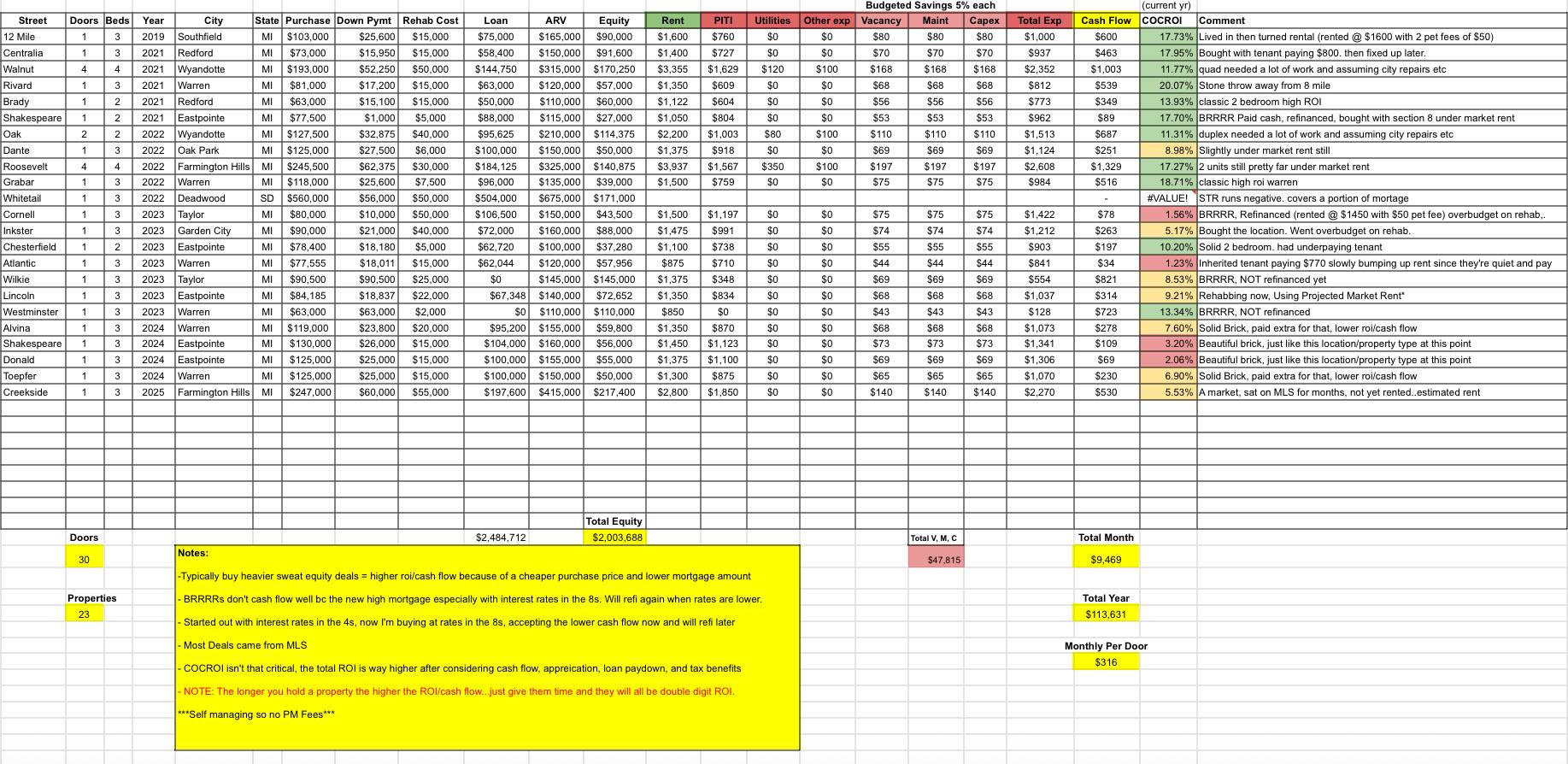
Here is a picture of my portfolio if you/anyone is curious.

@Joe Hammel right, but the problem is your locations are in b- c+ I feel that would be too low for me. Would you say that in your location class it still not as bad as I am perceiving ? Because I am going to be stretching thin and one bad move and it's over
Hi all , my strategy is basically finding areas that are dense in population in a good neighborhood and have a demand for rentals and have cash flow. However I am unable to correctly identify ‘ research this and I am having analysis paralysis.
would you say to just find high cashflowing areas or should I just find an agent and trust his word. Like how can I ensure I am not just buying in some crappy area vs a good area with demand. I will be investing out of state so if I were to want to choose any state what would my first steps be ?
any help would be appreciated to hopefully get my first rental by September
Hey Chaim — totally get where you're coming from! That analysis paralysis is real, especially when you're looking out of state and trying to make sure you don’t end up in a low-demand or high-turnover area. What you’re describing — focusing on population density, demand for rentals, and cash flow — is a solid strategy. But rather than relying solely on an agent’s word (even good ones can have blind spots), I’d recommend building your own baseline understanding of a market first so you can ask the right questions and gut-check what you're being told.
Here’s how I started when I moved from Portland to invest in Columbus, Ohio — now I own 10+ rentals here. First, I looked for markets with strong job growth, population growth, and where you can still find properties that hit the 1% rule (aka $150K property renting for $1,500/mo). Columbus checked all those boxes — big employers like Intel, Google, Amazon, and tons of university and healthcare jobs. It’s also landlord-friendly and still affordable compared to most major metros. Once I narrowed in on Columbus, I studied crime maps, school ratings, rent-to-income ratios, and local zoning maps to get familiar with neighborhoods — that helped me know if a “deal” was really in a good spot or not.
As far as steps go: pick 1–2 metro areas and go deep. Look at rental listings, property prices, crime stats, and demographic trends. Once you feel confident in a market, then start interviewing agents and PMs — and the good ones will know exactly which zip codes to target (and avoid). You’re doing the right thing asking these questions now — investing out of state can absolutely work if you take the time upfront to really understand the market. Happy to connect and answer any questions you have!
@Jimmy Lieu how do you analyze job growth ? What stats can one look at and know that it's in the positive ?
Hi Chaim, I’d recommend focusing on high-cash-flow areas with strong rental demand, but do your own research to avoid relying solely on an agent. Connect with local property managers, review market trends, and look for areas with job growth to ensure a solid, long-term investment.
@Chaim Mal Totally get the analysis paralysis! I’d start by narrowing down cities with strong job growth & landlord-friendly laws, then dig into zip codes with proven rent demand.
@Chaim Mal be careful with agents - more than 95% of them have no clue how to deal with investors.
Many claim to be "investor-friendly", but actually they are just, "commission-friendly" and don't care what they sell you:(
Don't believe us?
Try asking them how many rentals they have or ask them to analyze a property for you.
Most will offer zero guidance and state that's 100% on you.
Regarding where to invest, real estate can be looked at like your 401k investments. Do you want high-risk & high-returns or low-risk & low-returns?
Recommend you first figure out the property Class you want to invest in, THEN figure out the corresponding location/neighborhoods to invest in.
Why is Property Class so important for investors to understand and apply in their investing strategies?
Because the Property Class dictates the Class of the tenant pool that the property will attract.
The Tenant Class greatly impacts rental income stability and property maintenance/damage by tenants.
Both Property Class and Tenant Class affect what type of contractors, handymen and property management companies will work on a property.
If you buy & renovate a property in Class D area to Class A standards, what Tenant Class will rent it?
Or, if you put several Class D tenants in a Class A four-plex, what do you think will happen to the property?
So, if you fail to apply the correct assumptions to a property, your expectations won’t be met and it may even be a financial disaster.
We use the following to rank Property Classes, in order of importance:
Key metrics for each Property Class:
Class A Properties:
Tenant Pool: Majority of FICO scores 680+, no convictions/evictions in last 7 years.
Tenant Default: 0-5% probability of eviction or early lease termination.
Section 8: Class A rents are too high and won’t be approved.
Vacancies: 5-10%, depending on market conditions.
Cashflow vs Appreciation: Typically, 3-5 years for positive cashflow, but you get highest relative rent & value appreciation.
Class B Properties:
Tenant Pool: Majority of FICO scores 620-680, some blemishes, no convictions/evictions in last 5 years.
Tenant Default: 5-10% probability of eviction or early lease termination.
Vacancies: 10-15%, depending on market conditions.
Cashflow vs Appreciation: Typically, 1-3 years for positive cashflow, balanced amounts of relative rent & value appreciation.
Section 8: Class B rents are usually too high for the Section 8 program.
Class C Properties:
Tenant Pool: Majority of FICO scores 560-620, many blemishes, but should have no convictions/evictions in last 3 years. Verifying recent 2-years of rental history very important! Same for 2-years of job/income stability.
Tenant Default: 10-20% probability of eviction or early lease termination.
Section 8: Class C rents usually meet program requirements, proper screening still recommended.
Vacancies: 10-20%, depending on market conditions and tenant screening.
Cashflow vs Appreciation: Should cashflow immediately, at the lower end of relative rent & value appreciation.
Class D Properties:
Tenant Pool: Majority of FICO scores under 560, little to no good tradelines, lots of collections & chargeoffs, but should have no convictions/evictions in last 12 months. Verifying last 2-years of rental history and income/employment extremely important to find the “best of the worst”.
Tenant Default: 20-30% probability of eviction or early lease termination.
Section 8: Class D rents meet program requirements, often challenges to pass Section 8 inspection.
Vacancies: 20%+, depending on market conditions and tenant screening.
Cashflow vs Appreciation: Typically, all cashflow with little, maybe even negative, relative rent & value appreciation.
Where did we get our FICO credit score information from?
Check out this chart:
|
FICO Score |
Pct of Population |
Default Probability |
|
800 or more |
13.00% |
1.00% |
|
750-799 |
27.00% |
1.00% |
|
700-749 |
18.00% |
4.40% |
|
650-699 |
15.00% |
8.90% |
|
600-649 |
12.00% |
15.80% |
|
550-599 |
8.00% |
22.50% |
|
500-549 |
5.00% |
28.40% |
|
Less than 499 |
2.00% |
41.00% |
Make sure you understand the Class of properties you are looking at and the corresponding results to expect.
Metro Detroit has 132 cities, the City of Detroit 183 Neighborhoods, which we’re analyzing and classifying. Check out the map on our website where we’ve made this all easy to follow.
We can also share numerous examples of properties & portfolios we’ve assisted investors with!
DM us if you’d like to discuss this logical approach in greater detail!
@Chaim Mal Congrats on taking the leap! I’d vet agents w/ investor experience & lean on data (rents, pop. growth, crime). You got this - good luck landing that first one!
I agree with Nicholas' and Daniela's comments. From her comment it sounds like you're on the East Coast near NJ/NY area.
I talk to a lot of California investors and it's a huge gamble to buy out of state especially a market you don't know well. Many of us have lost money on "cash flow on paper" properties, specifically Class C.
If I were you I would try to stay local or at least a 2 to 3 hour drive (if that's do-able for you). Good luck.
@Becca F. I don't plan on buying c class at the moment. If I were to stay local, how would you suggest to look at let's say nj (you are right about me being in ny ) how can I evaluate which part might be best ?
I don't know anything about the NY or NJ market. The only thing I've heard is that upstate NY properties would cost less than NYC area.
Your post mentioned "high cash flowing areas". I agree with Nicholas' comments about not cash flowing the first few years. This is especially true now in 2025 market vs. 2012-2018
Here are some general strategies that California investors I know are using (which may or may not work where you're looking and you'll need to factor in NY/NJ local rental laws)
- To lessen negative cash flow (not eliminate it): mid-term or short term rentals. This depends on the market. STRs are oversaturated in many cities. This is more labor intensive than a traditional long term rental and you need to furnish it and pay for utilities and WiFi/internet.
- Rent by the room (called co-living by some): will usually get more rent than renting to an individual/couple/family but tenant dynamics (roommate situations) could be challenging
- Buy a property with an ADU (accessory dwelling unit). This seems to be more popular on the West Coast. Or add that onto your primary residence property and rent it out or live in the ADU yourself and rent out the main house. Construction costs could be high.
- Buying new build. The builder will often offer a lower interest rate. Research who's a good vs. average vs. terrible builder in your area.
I'd recommend that you attend local meetups. You can talk to NY investors who buy in-state and out of state. You'll get different perspectives from those of us that don't even live in NY/NJ and are commenting on your post. Some of them may even let you walk their projects. Good luck.
Hi all , my strategy is basically finding areas that are dense in population in a good neighborhood and have a demand for rentals and have cash flow. However I am unable to correctly identify ‘ research this and I am having analysis paralysis.
would you say to just find high cashflowing areas or should I just find an agent and trust his word. Like how can I ensure I am not just buying in some crappy area vs a good area with demand. I will be investing out of state so if I were to want to choose any state what would my first steps be ?
any help would be appreciated to hopefully get my first rental by September
First do some research on what the areas are that you want to target and then find a local agent to work with who can guide you through everything. Happy to help!
you go there. i'm not being flippant - pick a couple areas and spend a weekend in each in person. set up meetings with local folks during your trips - PMs, agents, other investors.