What numbers do you consider essential before buying a rental property?

What numbers do you consider essential before buying a rental property?

Charles WalkerBusiness Member
Real Estate Consultant · Member since 2025 · 46 posts · 2 votes

One of the easiest mistakes in rental analysis is stopping at "monthly rent" instead of following the numbers through operating performance, financing, and investor return.

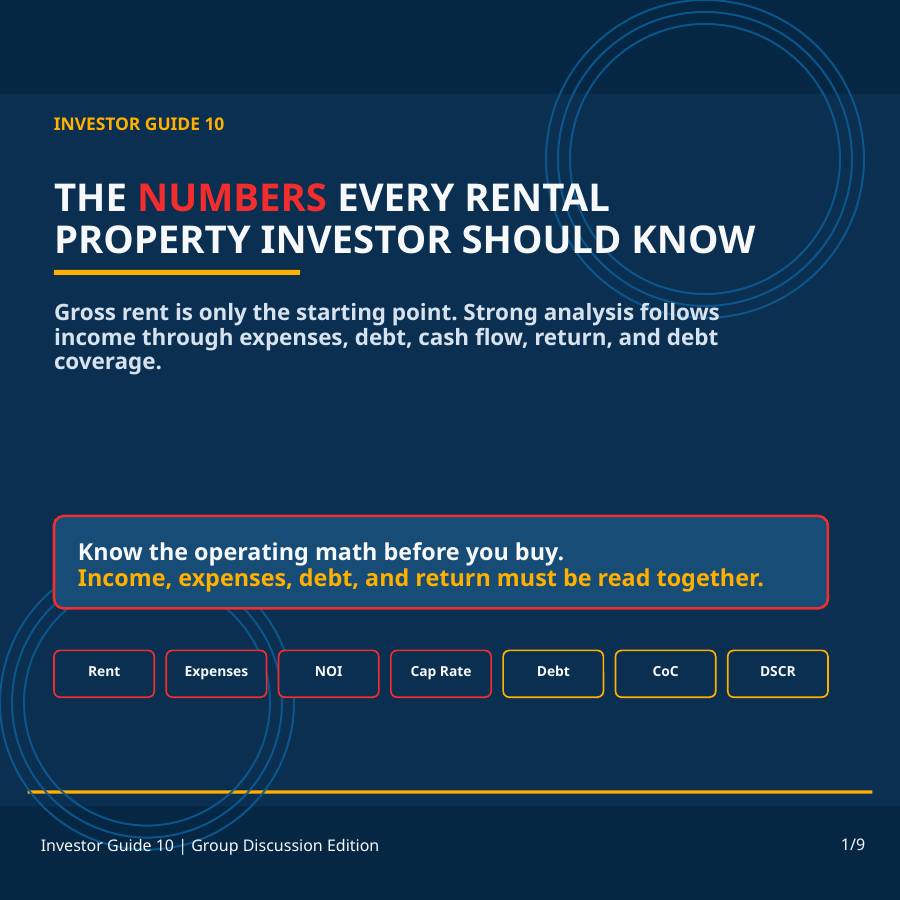
A basic framework I like is: gross rent -> operating expenses -> NOI -> cap rate -> debt service -> cash flow -> cash-on-cash return -> DSCR.

For example, assume $2,400/month in rent ($28,800/year) and $8,800/year in operating expenses. That produces $20,000 of NOI. On a $250,000 property value, the cap rate is 8.0% before financing.

If debt service is $1,350/month, the property produces about $317/month in pre-tax cash flow. If the investor has $50,000 of cash invested, the illustrative cash-on-cash return is about 7.6%.

DSCR adds another perspective by comparing property income with debt service. Using NOI divided by annual debt service, the example is about 1.23, although calculation methods and minimum requirements vary by lender and program.

No one metric tells the whole story. Which number do you rely on most when screening rental properties - and which metric do you think newer investors misunderstand most often?
0Reply
652 views

18 Replies

Jump to latestLatest
  • Diana KhanPro Member
    Attorney · 10451 Mill Run Cir #755 Owings Mills, MD 21117 · Member since 2024 · 688 posts · 247 votes
    4d
    Quote from @Charles Walker:

    One of the easiest mistakes in rental analysis is stopping at "monthly rent" instead of following the numbers through operating performance, financing, and investor return.

    A basic framework I like is: gross rent -> operating expenses -> NOI -> cap rate -> debt service -> cash flow -> cash-on-cash return -> DSCR.

    For example, assume $2,400/month in rent ($28,800/year) and $8,800/year in operating expenses. That produces $20,000 of NOI. On a $250,000 property value, the cap rate is 8.0% before financing.

    If debt service is $1,350/month, the property produces about $317/month in pre-tax cash flow. If the investor has $50,000 of cash invested, the illustrative cash-on-cash return is about 7.6%.

    DSCR adds another perspective by comparing property income with debt service. Using NOI divided by annual debt service, the example is about 1.23, although calculation methods and minimum requirements vary by lender and program.

    No one metric tells the whole story. Which number do you rely on most when screening rental properties - and which metric do you think newer investors misunderstand most often?

    @Charles Walker, I'd pay close attention to cash flow after all the expenses are considered. I think newer investors sometimes focus too much on the monthly rent without looking at what they'll actually keep. I'd also want to review the existing leases, any unpaid rent, and other property issues that could affect those numbers.

    I'm a real estate attorney and investor based in Maryland, and I work with clients on rental properties, contracts, and real estate transactions. I've seen how important it is to understand both the numbers and the legal details before buying. A property might look good on paper, but the documents can tell you a lot more about what you're taking on.

    I appreciate you breaking this down, @Charles Walker! It's a helpful reminder that there's more to evaluating a rental property than just looking at the rent. Happy to stay connected!

  • Staten Island, NY · Member since 2013 · 131 posts · 66 votes
    4d

    Good breakdown, Charles. The number I lean on most is cash flow after an honest expense check, because everything else in that chain depends on the expense line being right.

    In your example the $8,800 a year in operating expenses is doing a lot of work. On a real deal I'd want the actual tax bill, an insurance quote, and the seller's real numbers, then add vacancy, repairs, capex, and a management fee even if I plan to self manage. A small miss there moves the NOI, and the cap rate and cash on cash move with it.

    I think cap rate is the one newer investors misunderstand most. It ignores financing, so two buyers can see the same 8.0% and end up with very different cash flow.

  • Matthew MorrowBusiness Member
    Investor · PA - NY - NJ · Member since 2019 · 924 posts · 329 votes
    3d

    @Charles Walker that's a clean framework. The one I'd put in front of all of it is purchase price, because if you overpay there isn't much the rest of the chain can do to fix it. I'd also be honest with vacancy. One month empty can take a big bite out of a year's cash flow on a single unit, so I don't like seeing a vacancy line that's wishful. Same with capex on older houses. Every property is different, but that's how I'd approach it.

    CORE Team | Realty ONE Group Supreme548 Reviews
  • Member since 2026 · 252 posts · 35 votes
    3d

    Charles, one number I'd get early is what insurance will really cost, because carriers can get picky about the age of the roof, electrical and plumbing, and that alone can change a deal. I'd call for a real quote before falling in love with the spreadsheet.

    Randy, Bunklow

    • Charles WalkerBusiness Member
      OP
      Real Estate Consultant · Member since 2025 · 46 posts · 2 votes
      2d

      Randy, that’s a practical addition. I’d want to know both the premium and what the carrier requires to insure the property. A roof replacement or electrical upgrade could change the rehab budget as well as the ongoing expenses.

      I’d also check the deductible and coverage terms. A lower premium with a large deductible can leave an investor needing more cash reserves than the spreadsheet suggests.

  • Investor · Washington, US · Member since 2021 · 136 posts · 40 votes
    3d

    I'd stress-test that 1.23 DSCR with lower rent and higher expenses. If a modest change wipes out the cushion above 1.0, I'd want more breathing room before buying.

    • Charles WalkerBusiness Member
      OP
      Real Estate Consultant · Member since 2025 · 46 posts · 2 votes
      2d

      Alex, that's a useful distinction. A 1.23 DSCR is a snapshot based on the assumptions used. The next question is how well those assumptions hold up.

      I’d run lower rent, additional vacancy, and higher taxes, insurance, and maintenance through the numbers. I’d also account for repair and replacement reserves when evaluating the actual cash left over.

      Meeting a lender’s requirement is one checkpoint. Having enough breathing room to handle a difficult year is another. What stress-test assumptions do you typically use?

  • James JonesPro Member
    Investor · Collierville, TN 38017 · Member since 2017 · 951 posts · 648 votes
    2d

    Charles, I run five numbers before I buy anything, and one decides it. Purchase price under $100K. Expected ARV between $180K and $265K after rehab. Rent — for a 3-bedroom, $1,395 to $1,950 on Section 8. The refi: will a DSCR loan at 70 to 80% LTV on a 30-year amortization pull my capital back out? And the decider is the 1% rule — monthly rent divided by all-in price. Buy at $100K, rent at $1,395, and I'm at 1.39% before I even negotiate. If that one number fails, the other four don't matter. I've bought 236 properties in nine Memphis ZIP codes running that same screen.

    • Charles WalkerBusiness Member
      OP
      Real Estate Consultant · Member since 2025 · 46 posts · 2 votes
      2d

      ames, that’s a clearly defined buy box, and applying it across 236 properties gives you a substantial track record.

      One clarification for readers: you mentioned rent divided by the all-in price, but the $1,395 ÷ $100,000 example uses purchase price alone. If rehab and closing costs bring the total to $140,000, that same rent puts you just under 1%.

      That distinction also matters when evaluating the refinance: how much capital comes back depends on the completed value, loan proceeds, and total dollars invested.

      Do you apply your 1% screen to purchase price initially, then require it to hold against the full project cost before closing?

    • James JonesPro Member
      Investor · Collierville, TN 38017 · Member since 2017 · 951 posts · 648 votes
      1d

      Charles, fair catch — the screen itself runs on purchase price. That is the buy box: under $100K against rent of $1,395 to $1,950 for a 3-bedroom, so a deal starts at 1.39% or better before rehab enters the picture. The all-in test comes right behind it, just under a different name. Rehab has to land the house at an ARV of $180K to $265K, and the DSCR refi at 70 to 80% LTV on a 30-year has to pull my capital back out and still cash flow. If the total project cost breaks that refi math, I walk before closing. The 1% screen gets a deal in the door; the ARV and the refi decide whether it stays.

    • Charles WalkerBusiness Member
      OP
      Real Estate Consultant · Member since 2025 · 46 posts · 2 votes
      15h

      James, that clarifies the distinction. You use rent against purchase price for the initial screen, then test total project cost against the refinance proceeds and the cash flow remaining afterward.

      That is useful context for newer investors: passing the 1% screen earns a closer look. It does not establish that the rehab budget, valuation, or resulting debt payment will work.

      Thanks for explaining how those checks fit together in your process.

  • Realtor · Memphis, Shelby County · Member since 2026 · 235 posts · 79 votes
    2d

    Great framework, Charles — and from the agent side of the table, the number I'd add as the silent deal-killer is verified rent. I've watched more underwriting fall apart on an optimistic rent number than on anything else. A comp sheet is a starting point, not a verdict: look at what similar homes actually leased for, not just what's listed, and how long they sat. Then stress-test the expense side the way Randy and Alex suggest — real insurance and tax quotes in hand before you lock the deal, not after. Cap rate tells you how the market prices the income, cash flow tells you whether you can hold through a bad month, and DSCR tells you whether a lender wants to be your partner. If all three agree, you have something worth writing.

    • Charles WalkerBusiness Member
      OP
      Real Estate Consultant · Member since 2025 · 46 posts · 2 votes
      2d

      Verified rent deserves a place near the top of that list. An asking rent shows what an owner hopes to collect; comparable signed leases provide stronger evidence of what tenants will pay. Time on market helps put that number in context.

      I’d add one check on expenses: confirm whether the purchase could trigger a property tax reassessment, and get an insurance quote that reflects the intended rental use.

      Cap rate, cash flow, and DSCR all depend on those underlying inputs. Three favorable calculations can still give false confidence if they share the same optimistic rent assumption.

  • Charles WalkerBusiness Member
    OP
    Real Estate Consultant · Member since 2025 · 46 posts · 2 votes
    2d

    Mathew, purchase price sets the starting point, and I’d work backward from realistic rent and expenses to determine what I can afford to pay.

    Your vacancy point is especially relevant for a single rental: one empty month means losing 8.3% of the year’s potential rent, while many expenses continue.

    For older houses, I’d also separate routine maintenance from major replacements. A property can show positive monthly cash flow and still leave the owner short when the roof or HVAC needs replacing. Those costs belong in the buying decision.

  • Matthew MorrowBusiness Member
    Investor · PA - NY - NJ · Member since 2019 · 924 posts · 329 votes
    1d

    @Charles Walker the roof and HVAC point is the one I learned the hard way. I go in assuming the last owner didn't take care of the big items the way I would, and that there's something behind the walls I haven't found yet. If the numbers only work when nothing major breaks for five years, I've probably paid too much.

    CORE Team | Realty ONE Group Supreme548 Reviews
    • Charles WalkerBusiness Member
      OP
      Real Estate Consultant · Member since 2025 · 46 posts · 2 votes
      15h

      Matthew, that five-year test is a useful way to challenge the projected return. A property can show positive monthly cash flow while leaving very little room for a roof, HVAC replacement, or an unexpected repair.

      I would separate money needed for known replacements from reserves for surprises. If the roof is already near the end of its useful life, that belongs in the acquisition calculations rather than being treated as an unexpected expense later.

      That also makes the purchase-price decision clearer: what can I pay and still have enough cash to own this property responsibly?

  • Real Estate Broker · Atlanta, GA · Member since 2026 · 2 posts · 0 votes
    21h

    What I would want to know is my real net monthly cash flow after all expected costs.

    Take what comparable properties have actually rented for, not what they're listed at, and come up with a realistic rent. Then work through taxes, insurance, repairs, vacancy and the other expenses to find out what you're actually left with each month.


    I feel like when you're learning, DSCR can be misunderstood. You're able to meet a lender's standard for that number, but that doesn't always equal a good rental. It could still leave you with very little cash flow after your actual expenses and debt payment.


    Which again is why I like to look at the actual net cash flow and whether there's enough room left after all the expenses.

  • Charles WalkerBusiness Member
    OP
    Real Estate Consultant · Member since 2025 · 46 posts · 2 votes
    15h

    Zac, the distinction between meeting a lender's DSCR requirement and having a rental worth owning is important. The investor still has to account for expenses and future replacements that may fall outside the lender's calculation.

    Using actual leased comparables also gives the analysis a firmer starting point. An optimistic rent assumption can make every number that follows look better than it should.

    I would pair that net monthly cash flow with the cash invested to produce it. That helps show whether the remaining margin adequately compensates the investor for the capital committed and the risks involved.

Join the conversationCreate a free account to reply, vote on answers and follow this thread.