Hi there!
My wife and I are considering moving to either Denver or Austin to start our house hacking journey. We are open to STR, MTR, and LTR, and are looking for either a single family, multifamily, or home with an ADU. We'd like to rinse and repeat 3-5 times. I'm looking for opinions on which market is better currently to enter from a house hacking standpoint.
See the agents BiggerPockets members work with in Denver, CO.
See agentsSarah, congrats on starting the house hacking journey with your wife!
Since you want to repeat it 3 to 5 times, I'd work backward from that goal and map out the financing for the whole run, not just house number one. Owner-occupied loans expect you to actually move in and live there for a while, often about a year, so that sets the pace between purchases. Some loan types also limit how many you can hold at once, so it's worth choosing which one you use first on purpose.
Since you'd be relocating, lenders will also look at your income and job situation in the new city, so lining that up before the move makes the first purchase smoother. For the STR and ADU options, check each city's short-term rental rules before running numbers in either market.
I'm a mortgage broker and enjoy helping investors plan this kind of thing, so I'm happy to be a resource. No pressure at all!
Are you both keeping your current jobs through the move, and are you leaning toward a 2 to 4 unit or a single family with an ADU?
@Sarah Stimson, I'd let the strategy pick the city, not the other way around. Denver and Austin both work for house hacking, but they reward different plays, and the rules on short stays can decide it for you. I've lived in multiple states, and have house hacked and done coliving, so I'd be open to comparing notes on choosing where to land. Are you two moving for work either way? Which strategy feels like the best fit for you right now?
Austin is a great market to invest in presently. The vacancy rate is decreasing rapidly. Its a long term strategy though and not a short term.
@Sarah Stimson I'm biased but I'd pick Austin! You can still find househacks here, we're doing it all the time. My wife and I househacked our way into living for free in Round Rock (North of Austin). What my team is seeing work is a duplex or a home with an ADU, with an MTR on the other unit. Austin's STR rules are strict, so I'd underwrite LTR/MTR first and treat STR as a bonus. Reach out if you want to chat, and come to our monthly meetup when you're in town!
We're in Denver, and do biz in TX as well. I own multiple STRs right outside Denver. My first house was house hacking before it was a thing.
Since you want to do this 3 to 5 times, I'd let the financing plan and the STR rules narrow the choice before the market does. Denver only allows short-term rentals in your primary residence, so an STR play there means renting the other side of a duplex, a basement unit, or an ADU on the lot you live on, with a city STR license. There are small pockets in the Denver metro (outside Denver city limits) where STR non owner could work. Once you move out, that unit can't stay short-term. Austin's rules have been changing for a few years, so pull the current ordinance before you count any STR income there.
On the loan side, the repeat plan is where people get stuck. FHA generally lets you hold one FHA loan at a time, so it's great for house one and then you usually need a different program. Conventional now allows 5% down on an owner-occupied 2 to 4 unit, which works well for the second and third purchases. Both expect you to move in within 60 days and stay about a year. If you look at 3 or 4 units on FHA, the self-sufficiency test (75% of market rent from all units has to cover the full payment) knocks out a lot of listings in both cities, so run that first. You'll also want to stage the financing to match the plan knowing that FHA and Conventional treat departing residence rental income differently. The order you use these programs may matter more than which city you pick.
Which one are you leaning toward?
Generally speaking, you can make it work in any market. It just comes down to the strategy.
With that said, you really need to look into the business plan and how that competes with the new construction market. For example, in Austin, there is a lot of new builds to compete against. So you might have a 2-4 unit property but that apartment complex down the street might have all the amenities. The only way you can compete is on price. You have to factor that in.
One extra underwriting detail: for a 2–4 unit owner-occupied purchase, ask whether the lender will use rent from the other units to help qualify and whether they rely on signed leases or appraiser-supported market rents. The usable rent is often adjusted for vacancy/expenses, and projected STR/MTR income may be treated differently from a long-term lease. FHA also has a separate self-sufficiency test for 3–4 units. Model your first purchase on documented long-term rents, then ask how that income is treated when you move and apply again; that can change which market and sequence works best. If you'd like to compare the financing scenarios, call me; my contact info is in my signature.
– Ryan
@Sarah Stimson I can't speak on Austin, but I'm very biased towards Denver of course, my wife and I have house hacked over 10 times in Denver metro area and we achieved financial freedom after 7 house hacks, so it is possible, and 3-5 house hacks is a great goal if you are flexible!
Regarding Denver, it is a great buyer's market, especially right now, for buyers utilizing the house hack strategy because of softness of the market and the opportunity to get in on a small multifamily like a 2-4 unit property for 5% down and getting massive seller credits, inspection repairs, etc done because sellers don't have a lot of buyers, so negotiations have swung to buyers.
There are lots of ways to house hack: small multis (2-4 units), house with ADU, house with mother-in-law, single families with walkout basements, two houses on one lot, etc.
The hard part isn't really finding the deal. The hard part is after closing and understanding how to operate the business with whatever strategy you employ, whether it be STR, MTR, LTR, rent by room, or a combination of two strategies. That part is my favorite due to maximizing the operations to achieve the highest return relative to risk.
Hi there!
My wife and I are considering moving to either Denver or Austin to start our house hacking journey. We are open to STR, MTR, and LTR, and are looking for either a single family, multifamily, or home with an ADU. We'd like to rinse and repeat 3-5 times. I'm looking for opinions on which market is better currently to enter from a house hacking standpoint.
Hey Sarah, both markets are worth comparing, but I’d look closely at the purchase price and rental numbers before committing. If you're open to other options, the Midwest is worth considering too. There are still opportunities to house hack duplexes and small multifamily properties with better entry prices and cash flow potential. You can even invest out of state with the right local team in place, which could make scaling to 3–5 properties more manageable.
Hey Sarah!
Both markets can work, and Joe's point about mapping out the financing for all 3 to 5 is a big one. One thing I'd add since you're relocating: figure out the job side before you pick the house. For owner occupied financing, your income needs to continue in the new city, so if either of you is changing jobs or going remote, get that documented first, since a brand new job or an offer letter can change what you qualify for. Most of the time when we see couples moving like this, it's just a matter of lining up the work situation first, and then the house hack falls into place. Feel free to reach out, happy to go through those options with you if you'd like!
@Sarah Stimson, interesting choice! Denver and Austin seem to be in pretty different spots right now.
Both markets peaked in June 2022, but Austin is down about 26% since then, while Denver is only down around 9% (see chart).
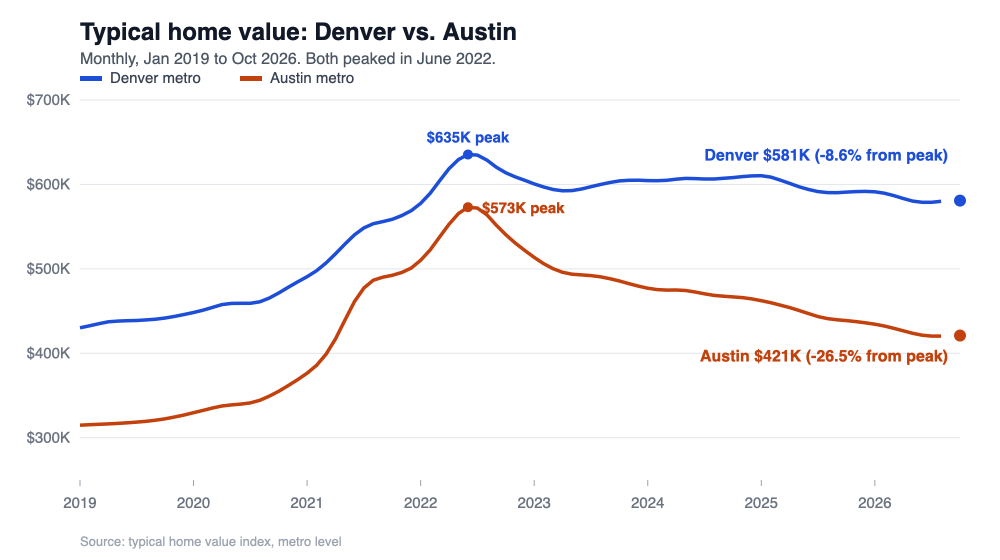
Denver still seems to be adjusting, with listings up 9% and pending sales down 18% over the past year. Austin has already seen a much bigger correction.
For house hacking, Austin might have a slight edge as well. Typical monthly rent is about 0.45% of home value there, compared to 0.36% in Denver.
Since you're planning to buy 3-5 properties, I'd also think about where each market might be a few years from now, not just where prices are today.
Congrats on the plan, @Sarah Stimson! I can't say one market is better right now since prices and rents shift quickly, and both cities are expensive for house hacking. I'd compare short-term rental and ADU rules first, then the full monthly cost, including property taxes, insurance and utilities, on a few real listings in each city.
Remember that most owner-occupant loans expect about a year of living in each property, so 3 to 5 houses is a multi-year plan. I'd pick the city where the rules fit your strategy and where you'd be happy living
House hacking in a single family seems a bit out there to me once you are past college age. But maybe we are spoiled here with the number of duplexes we have. No city in the US has more duplexes than Milwaukee. Many are 100 years old, but they were actually deigned by German immigrants to be two family homes with the ability to rent out the upper for extra income. Often the upper had actually 2 entrance doors, so you could even have 2 tenants upstairs - with the limitation of course that one of them had only a bedroom and nothing else.
We have a lot of people house hacking here, but I have actually never seen someone do that with a single family home. I am sure you can find a MF in Austin or Denver.

Sarah, one Austin-specific thing worth adding to your comparison: the HOME code changes the city passed in 2023-2024 now allow up to three units on most single-family lots, plus smaller minimum lot sizes, so a regular house with room for an ADU or a second structure can turn into a house hack that would have been hard to permit a few years ago. Check the zoning and any deed restrictions on each address, because HOAs and older subdivision covenants can still block it. The other number to put front and center is property tax. Texas has no state income tax, but tax rates in Austin and the suburbs often run around 2% of value, and once you move out and the unit is a rental you lose the homestead exemption, so underwrite each property at full non-homestead taxes from day one. On the repeat plan, pick your first loan with the second one in mind: owner-occupied loans generally expect you to live there about a year, and FHA usually allows only one at a time, so many people use FHA or a low-down conventional on the first and keep enough reserves to move to the next without selling. Full disclosure, I'm a lender, but happy to keep comparing notes here.
Sarah, if renting by the room is one of the plays you're weighing, the rule that can decide it is each city's limit on unrelated adults living in one home, and the two cities are not the same.
Denver changed its zoning in 2021 to allow up to five unrelated adults in a household, whatever the size of the house. That makes a five bedroom room rental workable in most of the city, which is unusual for a big city.
Austin also limits unrelated occupants, and the number has changed over the years and depends on the zone, so read the current rule for the exact lot before you count bedrooms.
Why it matters for doing this 3 to 5 times: in a room rental the bedroom count is the business. A house that can legally hold five unrelated people earns very differently from one capped at three or four, and that gap repeats with every house you add.
Two things that pay off from the first house: one lease per person, so one roommate leaving never puts the whole house on the hook, and a written utility split before anyone moves in.
Both Denver and Austin could work for house hacking, but I'd focus on finding a property that makes financial sense after you move out. Since you're planning to repeat this 3–5 times, consider how much cash you'll need upfront, whether rental income can help you qualify for future purchases, and how each property performs as a long-term rental. I'd also compare local STR regulations before relying on short-term rental income. Have you established a budget, and are you leaning toward multifamily or a single-family home with an ADU?
Welcome, Sarah. Since you and your wife are free to pick the city, I'd add one more market to the comparison before you commit: Columbus, Ohio. For a rinse-and-repeat plan, entry price matters most, because you'll be putting owner-occupied money down three to five times. Small multifamily in Columbus starts around $200K, and a lot of the deals I see there hit the 1% rule and cash flow after every expense, with $20K-$30K of built-in equity on most. That leaves room to keep a unit or two as a rental each time you move up, instead of stretching on every purchase. Landlord-friendly rules and evictions that wrap in about 30 days when uncontested help once you're running several properties.
Denver and Austin each have their own strengths, so run the same numbers on all three: purchase price, down payment, rent per unit, and what the STR or MTR rules allow. Happy to connect, and to introduce you to investor-friendly lenders and property managers here if Columbus makes your shortlist.
Sarah, for a plan to repeat 3–5 times, I would choose the property and rental strategy before choosing the city.
In Denver, I would underwrite the first purchase as a long-term or mid-term rental and treat short-term-rental income as optional, because Denver requires an STR license and generally limits it to the host's primary residence. An ADU or 2–4-unit option can still be strong, but the zoning, legal unit status, utilities, parking, and realistic rent for each space need to be verified before comparing returns.
I would compare Denver and Austin using the same four numbers: total cash needed, monthly housing cost after conservative rent, the owner-occupancy timeline needed for the next purchase, and the fallback resale or rental plan if one strategy changes.
Are you both keeping your current jobs through the move, and would you rather share part of a single-family home or have fully separate units? I’m a Denver-area Realtor, and this is an AI-assisted reply I reviewed.
Denver investors — we are the labor.
Not a sales company. Not a middleman. We are the crew that actually does the work.
I have a remodel crew available in Denver RIGHT NOW — ready to start tomorrow.
We do:
Full remodels / flips — kitchens, baths, flooring, paint, drywall
Basement finishes
Roofing + exterior — hail, insurance work, repairs, full replacements
Insurance work — we document with photos, meet the adjuster, and do the work
How we work with investors:
You send me the address + scope / inspector report
I walk it + send you a real labor scope with timeline — not a sales estimate
We start. We show up. We finish.
We have a crew ready for TOMORROW in Denver.
Not 3 weeks out. Tomorrow.
We cover: Denver, Commerce City, Aurora, Lakewood, Arvada, Westminster, Thornton, Northglenn, Brighton, Centennial, Littleton, Englewood.
If you have a flip, a rental turn, or a hail / insurance job sitting because your contractor ghosted you, post:
City + neighborhood
What needs to be done (kitchen/bath/roof/full flip?)
Timeline — when do you need it done?
I'll tell you if we can take it and what the timeline looks like. DM me — I have crew slots for tomorrow in Denver.
Update — I have a remodel crew open in Denver for tomorrow. If you have a flip or rental turn that needs to start this week, DM me the address + scope. I can walk it tomorrow.
Sarah, I work the Austin metro, so I'll stay on the Austin half of your question.
Three things decide a house hack here more than the city choice does.
Inventory. True side-by-side duplexes are a thin slice of what lists in the metro. If you limit the search to duplexes inside Austin city limits, you will wait a long time. I see more of them in Williamson and Bell counties, so Round Rock, Georgetown and Temple are worth having on the map. Widen to a house with a permitted second unit and the list gets a lot longer.
Property tax by address, not by city. Two duplexes a mile apart can sit in different city, school and MUD or PID districts. Pull the exact rate from the Travis, Williamson or Hays appraisal district before you write an offer, and underwrite the half you rent at full non-homestead tax from day one.
The ADU question is a permitting question, not a city question. Austin's HOME changes opened up more units per lot, but deed restrictions and HOA covenants can still stop you, and the suburbs and unincorporated county have their own rules. Verify it on the specific lot.
If the plan is to repeat this 3 to 5 times, I'd pick the market where you can reliably find the next one, not just the first one.
Are you set on a true duplex, or would a house with a legal second unit work for the first one?