2027 Loan Limits Are Up. Do 2-4 Units Still Cash Flow?

2027 Loan Limits Are Up. Do 2-4 Units Still Cash Flow?

Masoud ArouniPro Member
Investor · Pleasanton, CA · Member since 2026 · 141 posts · 58 votes

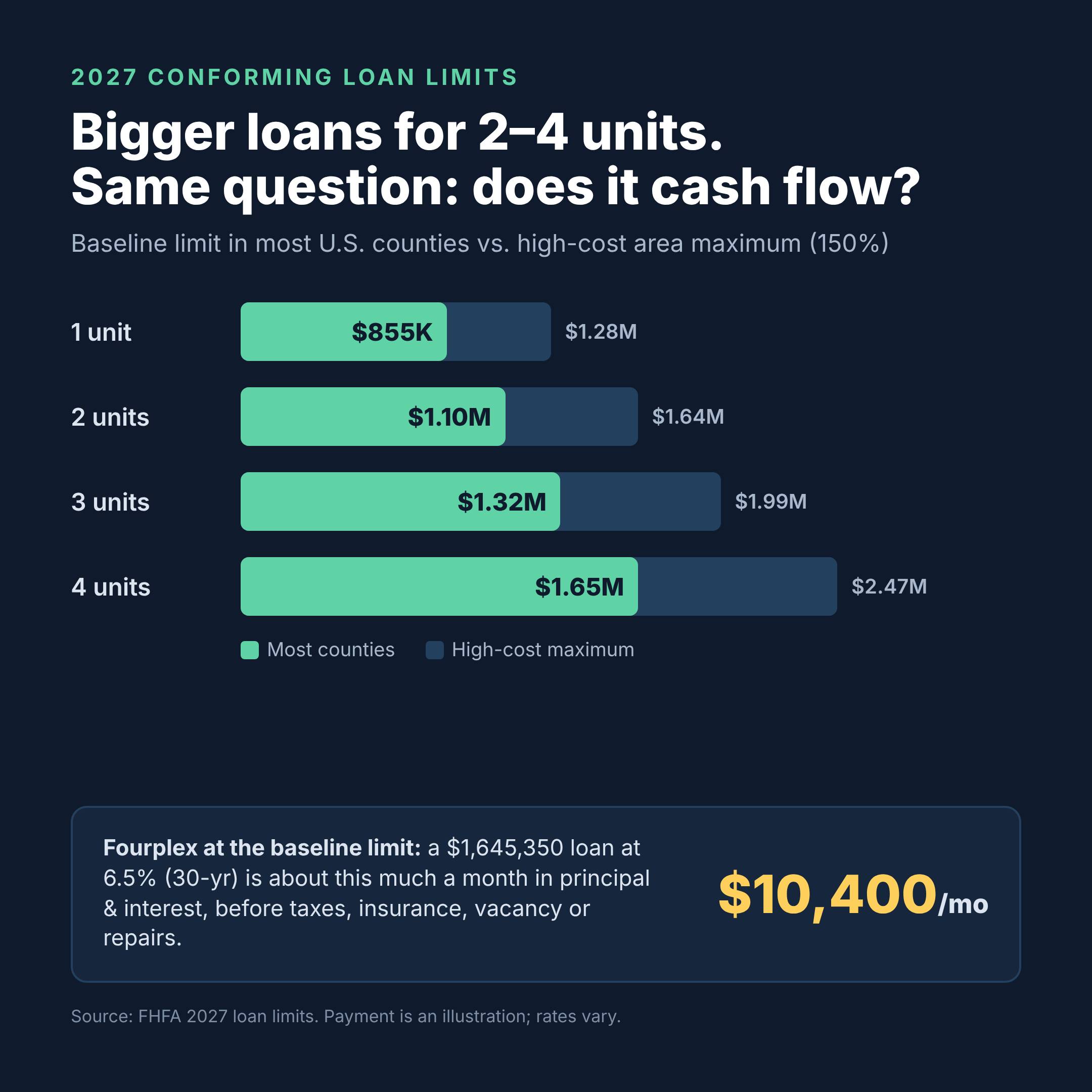
New 2027 conforming loan limits are out. In most counties, you can now get a conforming loan of up to about $1.645M on a fourplex, $1.32M on a triplex and $1.095M on a duplex. In high cost areas, the limits go up to 150% of those amounts.

Quick reality check, though: a $1.645M loan at 6.5% works out to about $10,400 a month in principal and interest. That's before taxes, insurance, vacancy or repairs. A bigger loan doesn't mean the property pays for itself.

The first thing I look at on any 2-4 unit property is what's left each month after all of that. For those of you buying 2-4 units right now, what are you seeing? Are any of them actually cash flowing at today's rates? Post your numbers and I'll help break them down.
0Reply
459 views

11 Replies

Jump to latestLatest
  • Real Estate Broker · Sacramento, CA · Member since 2021 · 661 posts · 476 votes
    1d

    short answer is the higher limit helps you buy more, it doesn't fix cash flow on its own. on that $1.645m fourplex at 6.5% the paymment alone is about $10,400 a month before taxes, insurance and vacancy, so rents have to be well above that to work. tradeoff is you get more leverage in high cost areas but the monthly nut is brutal if rents don't keep up. run it at a lower price or as a house hack first and see if the numbers still hold

    Hope this helps

    Noah Laker, Real Estate Broker, Sacramento CA, DRE 02085666

  • Ryan BakerBusiness Member
    Lender · Strongsville / Cleveland, OH · Member since 2026 · 238 posts · 66 votes
    1d

    Short answer: the higher limits don't change whether a 2-4 unit cash flows. They change how much you can borrow before you're out of conforming loan territory. Cash flow still comes down to the building's actual rents against the full payment, taxes, insurance and reserves at today's rates.

    The gotcha people miss on a house hack: the lender only counts part of the other units' rent toward qualifying, and 2-4 units usually need more reserves than a single family. On a pure rental, a DSCR loan qualifies on the property's rent instead of your income, but expect a bigger down payment.

    Run the real numbers on the specific building before deciding. If you have one in mind, give me a call and I'll show you how it pencils out under each loan type.

    – Ryan

  • Technology · New York, NY · Member since 2026 · 99 posts · 34 votes
    1d

    Masoud, your instinct is right but the thread drifted into the wrong arithmetic. Noah and Ryan both restate the payment, neither runs it back to a yield. Here is the balance-sheet version.

    $1.645M at 6.5% over 30 years is a 7.58% debt constant, $124,760 of annual debt service. A 1.25x DSCR floor requires $155,950 of NOI. At a 35% expense ratio on small multi (taxes, insurance, reserves, common area), that demands roughly $240,000 of gross rent, or $5,000 per unit per month on a fourplex. That is the number. Not the loan limit.

    Then test LTC against LTARV. $1.645M at 65% LTC implies a $2.53M basis. To clear that same 1.25x DSCR at a 5.50% cap, the asset must appraise at $2.84M. You are $310K short at origination. The limit did not create capacity, it widened the spread between what you can borrow and what the rent roll can carry. On ground-up, add the S-curve: carry runs 18 to 24 months pre-stabilization, and horizontal infrastructure per pad (water, sewer, power, paving) is a fixed cost per door that does not shrink when you cut unit count. Leverage quietly eats the equity there.

    Ryan is correct that house-hack qualification haircuts and reserve requirements bind first. So: what is your all-in basis per unit, and does the stabilized rent roll clear 1.25x DSCR at a 7.58% constant with zero rent growth?

  • Jim BlackburnBusiness Member
    Lender · Florida Based (48 states Puerto Rico) · Member since 2017 · 364 posts · 133 votes
    23h

    Good breakdown in this thread already. Two things that trip people up on 2-4 units that haven't come up yet.

    If you're house hacking a 3 or 4 unit with FHA, there's a self-sufficiency test. Roughly speaking, 75% of the projected rent from all units has to cover the full payment, including taxes and insurance. A lot of triplexes and fourplexes that look fine on paper fail that test, so run it before you get attached to a property.

    Second, the conforming limit and the FHA limit are not the same number. FHA limits are set by county and are usually lower, so a buyer planning to use FHA on a bigger fourplex may run out of room before the conforming limit even matters.

    In Florida I'd add insurance as its own line item on any older small multi. A 4-point inspection and the roof age can move the monthly number more than the loan limit does.

    Stairway Mortgage, a Division of NEXA Mortgage LLC598 Reviews
  • Flipper/Rehabber · Tacoma, WA · Member since 2026 · 57 posts · 9 votes
    23h

    About $4,600 a unit. Jim's 75% figure isn't only an FHA thing: Fannie Mae also counts 75% of gross rent from the subject property (Selling Guide B3-3.8-02), and that rent has to be supported on Form 1025. So if you live in one unit and rent the other three, each rented unit needs to gross roughly $4,600 just for the lender's math to cover the $10,400 P&I on a $1.645M fourplex loan. Taxes and insurance come on top.

    For California specifically, the assumption I'd stress-test is rent growth. A lot of house-hack pro formas treat today's rents as a starting point that catches up later. Under AB 1482 (Civil Code 1947.12), the statewide cap is 5% plus CPI, max 10% a year, for buildings more than 15 years old. The owner-occupied exemption covers a duplex where you live in one unit, not a triplex or fourplex. So on a 4-unit, inherited tenants below market can only be walked up within the cap, and just-cause rules apply once a tenant has been there 12 months. Check whether your city has its own ordinance on top of the state one.

    That flips the buy-side question. The loan limit sets how much you can borrow, but the price on a California 2-4 should come off the rent roll you can actually reach in two or three years under the cap, not off market rent for vacant units.

    FHFA's 2027 baseline is $855,400 for one unit (announced Nov. 24), and high-cost counties like Alameda go up to 150% of baseline, so loan sizes like these are reachable in the Tri-Valley. Are the fourplexes you're looking at mostly occupied at old rents, or delivered vacant?

  • Matthew MorrowBusiness Member
    Investor · PA - NY - NJ · Member since 2019 · 1k+ posts · 382 votes
    19h

    @Masoud Arouni a bigger limit doesn't help much if the purchase price is wrong. Out here in eastern PA we're still seeing small multis somewhere around $150-160K a door, with lower taxes than NY or NJ, so the math looks a lot different than a $1.6M fourplex. Price is still the first number I look at. Everything else kind of follows from it.

    CORE Team | Realty ONE Group Supreme4.950 Reviews
  • Masoud ArouniPro Member
    OP
    Investor · Pleasanton, CA · Member since 2026 · 141 posts · 58 votes
    18h

    Good stuff everyone. @Matthew Morrow you're right price comes first, but thats kind of the irony here. At $150k a door you dont need the higher limit at all. The bigger limits really only matter in expensive markets like the Bay Area, and thats exactly where the rents cant carry the payment.
    @Max Comperatore Comperatore your $5k a unit is the number that says it all. Fourplex I'm looking at in Concord (Bay Area) right now rents ~$2100/unit, so the gap is huge no matter how much the lender lets you borrow.
    @Yi Xu mostly occupied at older rents, which makes your point even stronger. With the rent cap you're not getting to market rent anytime soon, so whatever you pay has to work on the rents in place

    • Flipper/Rehabber · Tacoma, WA · Member since 2026 · 57 posts · 9 votes
      16h

      Masoud, "whatever you pay has to work on the rents in place" is even tighter in Concord than under the state cap. Concord's own ordinance (Municipal Code 19.40.040) switched to a flat 5% maximum annual increase starting April 1, 2025, and the city's tighter number controls over AB 1482's 5% + CPI. It covers units whose certificate of occupancy was issued before February 1, 1995 (19.40.020), so most older fourplexes are in.

      On $2,100 a unit, three straight years of maximum increases gets you to about $2,430. Costa-Hawkins still lets you reset to market when a tenant leaves on their own, but you can't create that turnover cheaply: Concord requires just cause to terminate, and an owner move-in, Ellis Act withdrawal or demolition triggers relocation of three times the HUD Fair Market Rent for that unit size plus a moving stipend (19.40.080).

      So I'd underwrite two versions: rents growing at 5% with zero voluntary turnover, and one natural turnover per year at market. If the deal only works in the second, the price is assuming tenants leave on your schedule.

      Do you know the year on the certificate of occupancy for the Concord fourplex, or is it old enough that the question never comes up?

    • Matthew MorrowBusiness Member
      Investor · PA - NY - NJ · Member since 2019 · 1k+ posts · 382 votes
      1h

      @Masoud Arouni yeah, fair point. Out here the higher limit mostly doesn't come into play. Kind of funny that it helps most in the markets where the rents were never going to carry it anyway.

      CORE Team | Realty ONE Group Supreme4.950 Reviews
  • Realtor · Columbus, Franklin County · Member since 2026 · 226 posts · 80 votes
    16h

    @Masoud Arouni Agreed, the limit is about leverage, not cash flow. The test I'd add is to run it backward. Start from in-place and leased-comp rents, take out taxes, insurance, vacancy, management and capex reserves, and see what loan amount that NOI actually supports at a 1.20-1.25x DSCR and today's rate. Freddie Mac's 30-year average was 7.21% this week (Nov 25), and investor loans usually price above that. In a lot of Midwest markets, the real cap on a 2-4 is the loan the NOI supports, not the conforming limit. Are you seeing any Bay Area 2-4s that clear 1.20x at full leverage?

  • Masoud ArouniPro Member
    OP
    Investor · Pleasanton, CA · Member since 2026 · 141 posts · 58 votes
    15h

    Yi Xu good math, $2430 in 3 years still doesnt come anywhere near making it to work. And yes its old enough that the question never comes up, so its covered. Either way the price has to work on todays rents, nobody should be paying for the turnover scenario upfront.

    @BJ Everson short answer no, not even close. That Concord fourplex was asking $1.45M back in May with about $8,460/mo in rent. Even with 43% down at 7.75%, after expenses the rent only covers about 86% of the payment and its almost $10k negative year one. Rates are a bit better now but the price probably went up too, so it doesnt change much. At full leverage forget it. In the Bay Area the rent sets the real loan size way before any conforming limit does, exactly like you said.

Join the conversationCreate a free account to reply, vote on answers and follow this thread.