Cash flow vs. Appreciation

Cash flow vs. Appreciation

Investor · San Antonio, TX · Member since 2020 · 5 posts · 4 votes

Starting out in the San Antonio market and having difficulty finding SFHs that cash flow well. Is this a function of the current market? Should I look elsewhere? Or are most investors still investing here despite poor cash flow because of the potential for significant appreciation in the coming years? Would love to hear how others are currently approaching this and nearby markets.

2Reply
131 views

Most Popular Reply

Real Estate Broker · Minneapolis, MN · Member since 2011 · 5k+ posts · 6k+ votes
3y

Ok, so a little correction here. 

We are talking an Investment Property, cash-flow IS appreciation. 

Ok, I will run down this rabbit hole for all those scratching the head. 

Investment Real Estate is a business, full-stop. If it were a sandwich shop, how do you place a value on it to sell/buy it? Is it the "value" of the cooler? Maybe what kind of chairs they have? NO, it's the REVENUES right? Show-Me-The-MONEY! We look at the gross revenues, all the operational expenses, and that "value" is based on what the net profit is, and what it takes to get that, right. 

Investment Real Estate is a BUSINESS. It's value is it's REVENUE, all the lovely expenses, and what the profit is, and what it takes to make that. 

AND similarly by all business's, a "value-add" is looking at that business and saying "Hey, look at that, if I just tweak a bit here, tinker a bit there, vhwallah, i can increase revenues 20% and MAKE MORE!". 

A standard rental properties value is on the profits it generates today, or tomorrows, all depending on what a person is looking for/at. 

All of that, rests on cash-flow. 

As cash-flow goes up, via rent increases, the "value" of the property goes up. Why? Because it's revenue generation has gone up, yes? making sense here? 

And similarly, if it's cap-x goes up, maintenance goes up, that DECREASES it's value. Why? Because it's more expense, more inputs to get that revenue generation. 

So, you DON'T get 1 without the other. They are tied at the hip. Rents stay flat, costs go up, the "value" goes down. Rents go up, expenses stay flat, value goes UP. 

This whole concept that the 2 are separate is only possible by using O.O. metrics for part of analysis and REI metrics for the other. Well, that's just ****** analysis input so of course only manure is going to come out the other end.

ALSO, it is called Real Estate INVESTING, it is NOT buying a paycheck. Basing the entire venture on just yr 1 numbers is NOT investing. I will happily, with a giant smile on my face, buy a property that has a minor negative cash-flow year 1, and jump for joy at the acquisition, if my prospectus is good. Where yr 2 is maybe net-0 and after tax benefits it's a nice profit. yr 3 now it's well into the green on cash-flow and so on where yr 5 people are calling it a cash-cow. 

INVESTING has a lot longer vision that month 1 year 1. 

I have a property we picked up just over 3 yrs ago now. The day we went under contract we projected a monthly net loss of $200 on cash-flow. Fortune shined on us at after closing, got a great tenant and that turned into a whopping whole $25 mnth net cash-flow. This was epic, you see $25 and ask how is that epic.  

Well, because we had a whole lot more vision than 1" in front of us. The market was a red-hot market, rapidly developing. by end of yr 1 we clocked over $40k in equitable gains from market appreciation, and the annual rent increase kicked in for yr2 and that monthly net on cash-flow jumped too a bit over $200. Yr 2 was even more favorable as we clocked another ~ $60k equitable gains and annual rent increase hit and it's a touch over $500mnth net cash-flow. 

And every year we enjoyed the depreciation write-offs that is in the tens of thousands $ in our pocket. 

So now, my biggest problem is going to be selling this thing in 2-3yrs. because it's going to be a cash-cow. What started many would have said it made no sense, and now all say "oh, I wish I could find those", lol, there all over the place, I have zero shortage of them, it just takes some wisdom, foresight and a touch of patience. 

Yeah, it doesn't work to this magnitude with any-ole property out there but this whole obsession with significant cash-flow day 1 is the problem, it does not work in this market cycle. This market cycle is about PATH OF PROGRESS. Yes, it requires patience to get a cash-cow, but guess how many you get sitting the sidelines, 0, ever. I am happy to wait a few years for a "meah" property to "bloom" into it's production. 

Every "Big Dog" on BP, has a constant story of a property they got "back when" that now is just amazing. The countless horde on BP hears of those properties and says how envious they are of that property. Yeah, well, it wasn't cash-flowing day 1 like it is year 11. If you want something that produces like that yr11 property, you gotta start with day 1. That's how it works, you don't get to skip a decade of appreciation. 

See this reply in the discussion

29 Replies

Jump to latestLatest
  • Investor · Charleston, SC · Member since 2011 · 606 posts · 413 votes
    3y

    San Antonio is a good market and like many markets are going up in value and more difficult to get sufficient Cash Flow. However compared to many other cities it still is reasonably priced and easier to cash flow than many other similar sized cities.  I would stay in the area you live until you build up is solid portfolio of houses. If you lived in San Diego I might tell you differently. I would not buy houses based on potential "appreciation" since that is speculation and I consider appreciation icing on the cake.  I would buy houses based on free cash flow which is my favorite KPI.  

  • Hamp Lee IIIPro Member
    Real Estate Agent · San Antonio, TX · Member since 2019 · 1k+ posts · 832 votes
    3y

    What I'm finding in a lot cases is of that fewer properties over $200K will cashflow without a significant downpayment. You may have to consider running the property as a STR or MTR…or a property requiring rehab.

    There are deals out here. But it’ll be important to be specific about your strategy and dialing in the areas you want to target based on that strategy.

    If you need help, let’s jump on a call.

  • Investor · San Antonio, TX · Member since 2020 · 5 posts · 4 votes
    3y
    Quote from @Hamp Lee III:

    What I'm finding in a lot cases is of that fewer properties over $200K will cashflow without a significant downpayment. You may have to consider running the property as a STR or MTR…or a property requiring rehab.

    There are deals out here. But it’ll be important to be specific about your strategy and dialing in the areas you want to target based on that strategy.

    If you need help, let’s jump on a call.

    That's what I'm running into as well - to cash flow most properties I'm looking at seem to require 50% or more down.

  • Chattanooga, TN · Member since 2023 · 31 posts · 17 votes
    3y

    while you certainly CAN (and probably SHOULD) look in other markets, I thought it would be beneficial to remember, you marry the house, not the interest rate. SO, if you find a great property with decent but not great cashflow, but equity to be captured, you can certainly purchase it and then refinance it down the road when the interest rates are more favorable.

  • Hamp Lee IIIPro Member
    Real Estate Agent · San Antonio, TX · Member since 2019 · 1k+ posts · 832 votes
    3y

    I ran a quick search. There are several SFHs well under $150K that might work for you. Are you looking for a turnkey property?

  • Joe VilleneuvePro Member
    Plymouth, MI · Member since 2013 · 13k+ posts · 19k+ votes
    3y

    The question of CF vs equity should never come up in the fist place.  There is no legitimate "trade off".  It's both or don't invest.  If the market you are investigating doesn't have both at this time, then invest somewhere else.  The universe is large.

  • Rental Property Investor · Boston, MA · Member since 2019 · 2k+ posts · 1k+ votes
    3y

    BOTH! Don't settle. The deals are out there. If it doesn't do both, move on to the next 1.

  • Rental Property Investor · Columbus, OH · Member since 2017 · 3k+ posts · 3k+ votes
    3y
    Quote from @Kelly Elterman:

    Starting out in the San Antonio market and having difficulty finding SFHs that cash flow well. Is this a function of the current market? Should I look elsewhere? Or are most investors still investing here despite poor cash flow because of the potential for significant appreciation in the coming years? Would love to hear how others are currently approaching this and nearby markets.


     It always comes back to what are you after? There are great deals everywhere. Like in Ohio for example, Cleveland provides a great amount of Cashflow while Columbus offers huge potential in appreciation. 

  • Investor · Austin, TX · Member since 2021 · 9k+ posts · 5k+ votes
    3y

    The question should be cash flow or equity. Never appreciation.

  • Contractor · Nashville, TN · Member since 2014 · 1k+ posts · 1k+ votes
    3y

    An answer of "both" is missing the essence of the question. In every market, there will be some houses with more CF, and others with more appreciation. It's a seesaw. The OP is asking for strategy regarding this dilemma.

    I started out with cash flow leaning properties which helped build passive income to provide financial independence. Now I allow a little less cash flow roi if it's a good neighborhood with appreciation. 

    but yes this is mostly the status of the current market. prices have outpaced rent growth in most B and A class neighborhoods.

  • Bay area, CA · Member since 2021 · 383 posts · 306 votes
    3y

    In a hard economy, be grateful that you are in a position you can think of investing. Most people are losing jobs and their houses. 

    With that perspective in mind, be grateful that, properties are breaking even at a 7% interest rate. Entire Asia and Europe have no cash-positive properties in their economy.

    With this knowledge in mind, now look at the same property that is breaking even in your backyard, might appreciate well enough, you might learn to enjoy that, and embrace current economy, and buy that, and patiently wait to make money in a long run.
     

  • Nathan GesnerBusiness Member
    Moderator
    Real Estate Broker · Cody, WY · Member since 2010 · 28k+ posts · 41k+ votes
    3y
    Quote from @Kelly Elterman:

    Starting out in the San Antonio market and having difficulty finding SFHs that cash flow well. Is this a function of the current market? Should I look elsewhere? Or are most investors still investing here despite poor cash flow because of the potential for significant appreciation in the coming years? Would love to hear how others are currently approaching this and nearby markets.


    Listen to the BP Podcast, particularly "Seeing Green with David Greene" episodes where he answers viewer questions. He talks about this quite often and he talks very candidly about the current market vs. what we've seen for the last 10+ years.

    The DIY Landlord Book4.7248 Reviews
  • Sam McCormackBusiness Member
    Real Estate Agent · Cincinnati, OH/NKY · Member since 2021 · 1k+ posts · 833 votes
    3y

    @Kelly Elterman

    If you would like to stay there, I would recommend finding a beat up house and BRRRR/Flip it. Besides that, going OOS is a good option. You have many places to choose from, midwest being a good option for cash flow. Like in Ohio. You have 3 great cities that all are a bit different. Cleveland is cash flow king, Columbus has better appreciation, but Cincinnati generally has a mix of both, just depends on the area of Greater Cincinnati you are in. I am in Greater Cincinnati, let me know if any of what I told you peaks your interest!

    Sam McCormack Realtor
    View Page
  • Marc RiceBusiness Member
    Real Estate Agent · Columbus Cleveland Dayton, OH · Member since 2018 · 2k+ posts · 1k+ votes
    3y

    It's tough to cash flow in decent neighborhoods because usually you have to spend about $200-300k and it can only rent for $1500-2000/mo which is tight. You may want to look into worse locations and do a bit of value add so you're not competing against owner occupants. Columbus, OH and its surrounding suburbs have a lot of opportunities. 

    Marc Rice | Investor Friendly Agent at Reafco Tailwind Team574 Reviews
  • Realtor · Ogden, UT · Member since 2019 · 338 posts · 415 votes
    3y
    Quote from @Kelly Elterman:

    Starting out in the San Antonio market and having difficulty finding SFHs that cash flow well. Is this a function of the current market? Should I look elsewhere? Or are most investors still investing here despite poor cash flow because of the potential for significant appreciation in the coming years? Would love to hear how others are currently approaching this and nearby markets.

    Cashflow is more brutal to find than ever in this current market.  However, I'm still all-in on real estate.

    Don't forget that when investing in RE, you make money in four ways: cashflow, loan pay down, tax benefits, and appreciation.  If you're financially sound, don't be afraid to invest even with minimal cashflow because you don't want to forego the other awesome benefits of investing in RE.  Just make sure you have the funds prepped for vacancies and cap-ex.

    Good luck!
  • Patrick DruryBusiness Member
    Real Estate Agent · Columbus, OH & Cleveland OH · Member since 2021 · 1k+ posts · 2k+ votes
    3y

    @Kelly Elterman
    There are definitely still good deals out there that cashflow. Maybe not in the neighborhood you had in mind or that market, but they are out there. In the Columbus and Cleveland OH markets still finding solid cashflow. 

  • Jay ThomasPro Member
    Real Estate Agent · Houston, TX · Member since 2021 · 1k+ posts · 715 votes
    3y

    Real estate investing is always a complex endeavor, and there are a lot of factors to consider when looking for properties that will cashflow. Many times, it can be difficult to find investments over $200K that don't require a large downpayment. That's why it might be necessary to explore other options like short-term rentals (STR) or multi-family housing (MTR). You may even need to look into rehabbing properties.

  • Jay HinrichsBusiness Member
    Real Estate Consultant · Summerlin, NV · Member since 2014 · 45k+ posts · 66k+ votes
    3y
    Quote from @Joe Villeneuve:

    The question of CF vs equity should never come up in the fist place.  There is no legitimate "trade off".  It's both or don't invest.  If the market you are investigating doesn't have both at this time, then invest somewhere else.  The universe is large.


    yes,  I understand the cash flow component but I never understood how investor would invest in areas that will not or historically do not appreciate. 
  • Joe VilleneuvePro Member
    Plymouth, MI · Member since 2013 · 13k+ posts · 19k+ votes
    3y
    Quote from @Jay Hinrichs:
    Quote from @Joe Villeneuve:

    The question of CF vs equity should never come up in the fist place.  There is no legitimate "trade off".  It's both or don't invest.  If the market you are investigating doesn't have both at this time, then invest somewhere else.  The universe is large.


    yes,  I understand the cash flow component but I never understood how investor would invest in areas that will not or historically do not appreciate. 
    Rationalization that one, either one, can offset the other.
  • Real Estate Broker · Minneapolis, MN · Member since 2011 · 5k+ posts · 6k+ votes
    3y

    Ok, so a little correction here. 

    We are talking an Investment Property, cash-flow IS appreciation. 

    Ok, I will run down this rabbit hole for all those scratching the head. 

    Investment Real Estate is a business, full-stop. If it were a sandwich shop, how do you place a value on it to sell/buy it? Is it the "value" of the cooler? Maybe what kind of chairs they have? NO, it's the REVENUES right? Show-Me-The-MONEY! We look at the gross revenues, all the operational expenses, and that "value" is based on what the net profit is, and what it takes to get that, right. 

    Investment Real Estate is a BUSINESS. It's value is it's REVENUE, all the lovely expenses, and what the profit is, and what it takes to make that. 

    AND similarly by all business's, a "value-add" is looking at that business and saying "Hey, look at that, if I just tweak a bit here, tinker a bit there, vhwallah, i can increase revenues 20% and MAKE MORE!". 

    A standard rental properties value is on the profits it generates today, or tomorrows, all depending on what a person is looking for/at. 

    All of that, rests on cash-flow. 

    As cash-flow goes up, via rent increases, the "value" of the property goes up. Why? Because it's revenue generation has gone up, yes? making sense here? 

    And similarly, if it's cap-x goes up, maintenance goes up, that DECREASES it's value. Why? Because it's more expense, more inputs to get that revenue generation. 

    So, you DON'T get 1 without the other. They are tied at the hip. Rents stay flat, costs go up, the "value" goes down. Rents go up, expenses stay flat, value goes UP. 

    This whole concept that the 2 are separate is only possible by using O.O. metrics for part of analysis and REI metrics for the other. Well, that's just ****** analysis input so of course only manure is going to come out the other end.

    ALSO, it is called Real Estate INVESTING, it is NOT buying a paycheck. Basing the entire venture on just yr 1 numbers is NOT investing. I will happily, with a giant smile on my face, buy a property that has a minor negative cash-flow year 1, and jump for joy at the acquisition, if my prospectus is good. Where yr 2 is maybe net-0 and after tax benefits it's a nice profit. yr 3 now it's well into the green on cash-flow and so on where yr 5 people are calling it a cash-cow. 

    INVESTING has a lot longer vision that month 1 year 1. 

    I have a property we picked up just over 3 yrs ago now. The day we went under contract we projected a monthly net loss of $200 on cash-flow. Fortune shined on us at after closing, got a great tenant and that turned into a whopping whole $25 mnth net cash-flow. This was epic, you see $25 and ask how is that epic.  

    Well, because we had a whole lot more vision than 1" in front of us. The market was a red-hot market, rapidly developing. by end of yr 1 we clocked over $40k in equitable gains from market appreciation, and the annual rent increase kicked in for yr2 and that monthly net on cash-flow jumped too a bit over $200. Yr 2 was even more favorable as we clocked another ~ $60k equitable gains and annual rent increase hit and it's a touch over $500mnth net cash-flow. 

    And every year we enjoyed the depreciation write-offs that is in the tens of thousands $ in our pocket. 

    So now, my biggest problem is going to be selling this thing in 2-3yrs. because it's going to be a cash-cow. What started many would have said it made no sense, and now all say "oh, I wish I could find those", lol, there all over the place, I have zero shortage of them, it just takes some wisdom, foresight and a touch of patience. 

    Yeah, it doesn't work to this magnitude with any-ole property out there but this whole obsession with significant cash-flow day 1 is the problem, it does not work in this market cycle. This market cycle is about PATH OF PROGRESS. Yes, it requires patience to get a cash-cow, but guess how many you get sitting the sidelines, 0, ever. I am happy to wait a few years for a "meah" property to "bloom" into it's production. 

    Every "Big Dog" on BP, has a constant story of a property they got "back when" that now is just amazing. The countless horde on BP hears of those properties and says how envious they are of that property. Yeah, well, it wasn't cash-flowing day 1 like it is year 11. If you want something that produces like that yr11 property, you gotta start with day 1. That's how it works, you don't get to skip a decade of appreciation. 

  • Rental Property Investor · East Providence, RI · Member since 2018 · 1k+ posts · 1k+ votes
    3y

    I would pick Cashflow first. Appreciation is a bonus.
    I haven't looked at San Antonio lately. 
    If you plan on self managing you could see significant savings vs investing out of town or out of state.

  • Real Estate Agent · San Antonio, TX · Member since 2016 · 67 posts · 58 votes
    3y

    @James Hamling just laid down the topic's gavel! Well said! 

    And that's exactly how it should/can work. My 4 unit, I bought here in San Antonio, wasn't a great buy out of the gates in 2019. Now, it has grown in value (bc of the increased rents aka higher cashflow) by leaps and bounds since that time. 

    A healthy diet of realistic expectations, patience and some work should pay off more times than not.

  • Investor · Malakoff, TX · Member since 2017 · 2k+ posts · 2k+ votes
    3y

    Yen years of low interest financing has driven the price of homes up. And, has brought a lot more people into real estate investing (and to BP). Now interest rates have gone up, but prices haven't adjusted yet. Perhaps a lot of newer investors will be driven out of real estate. 

    Personally, I've gone into building new apartments, which I can do for 30% equity and decent cash flow.

  • Detroit, MI · Member since 2020 · 150 posts · 68 votes
    3y

    Great question and great topic ! 

    I personally believe people often overlook how important appreciation is - as they get hellbent on creating cash flow. 

    Nonetheless - i believe achieving both is actually possible.

    We've found that there are lot of pockets in the city of Detroit that offer great returns on investment and appreciation. 

    Perhaps check into those markets? 

  • Eric FernwoodBusiness Member
    Realtor · Las Vegas, NV · Member since 2014 · 995 posts · 1k+ votes
    3y

    Hello @Kelly Elterman,

    You posed a great question but not one with a simple answer. In this post I will address several aspects concerning the current situation and anticipated future changes. The topics include:

    • The goal of real estate investing
    • The current market situation.
    • Return calculation limitations
    • The foreseeable future

    The Goal of Real Estate Investing

    The goal of real estate investing is to achieve financial independence so you no longer depend upon a 9-to-5 job. There are two parts to financial independence. The first is having sufficient cash flow today that will replace your current income. The second is that rents increase fast enough so that they offset the effects of inflation. Unless both of these conditions are met, you will not have the financial freedom you want.

    Inflation is where future appreciation and rent growth come into play. Unless you invest in a location where rents keep pace with inflation, you will not be able to afford the inflated prices. So, you will not achieve your goal of financial freedom. Remember that metro averages are not what matters. What matters is how the specific area performed over the last few years.

    The Current Market Situation

    What is killing returns at this time is primarily high-interest rates. It is difficult to find properties that cash flow with only 25% down. We are finding a few in Las Vegas, but that is primarily due to the data mining software we developed. If we did not have the data mining software, I don't think we would find them either.

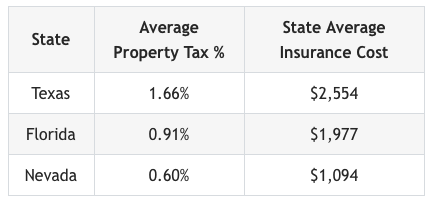
    High debt service, driven by high interest rates, is not the only cost that is bringing down returns. Property taxes and insurance costs also reduce profitability. I recently wrote an article comparing property tax and insurance costs in Texas, Florida, and Nevada. Below are the state averages. (These are state averages, individual cities may impose additional taxes.)
    https://www.lasvegasrealestateinvestmentgroup.com/nwassets/images/20220706-932.png

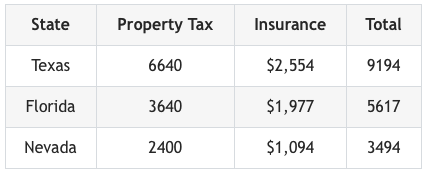
    To show the impact of taxes and insurance, I compared costs for a $400,000 property in the three states.
    https://www.lasvegasrealestateinvestmentgroup.com/nwassets/images/20220706-933.png

    To maximize profitability, consider a location with lower operating costs.

    Return Calculation Limitations

    Return calculations only predict how a property is likely to perform under ideal conditions on the first day. They do not provide any information about the future. Since you will likely hold a performing property for as long as you live, what happens after the first day is far more important.

    The Foreseeable Future

    Before I continue, know that predicting anything beyond yesterday is guessing. So take the following only as my opinion.

    I believe the politicians will do what is necessary to bring interest rates down as well as inflation because it will hurt their chances of reelection if they don't. I believe that within two years, interest rates will be lower than they are today. I was talking to a client about the situation, and here is what he said. "Higher interest rates are reducing my cash flow by about $300 per month. I believe interest rates will be significantly lower in one or two years. Assuming two years, that means I will actually pay $3600 ($300 per month times 2 years) more for the property. On a $400,000 property, $3600 is not significant. What is significant is locking in the price and then refinancing when rates are lower in the future.”

    Summary

    In my opinion, the best approach to real estate investment today is to purchase high-quality properties in areas where rents have consistently increased faster than inflation. It's also important to buy in a location with low operating costs. When interest rates fall, refinance. Real estate is a long-term investment, so short-term fluctuations are less significant.

    FERNWOOD Team, KW VIP Realty520 Reviews
Join the conversationCreate a free account to reply, vote on answers and follow this thread.