That’s a pretty solid setup to hold. A 4.75% loan with rent around $2k leaves a lot of room each month, and that kind of leverage is hard to replace today. Unless you’ve got a much better use for the equity, renting it out looks like the easy win here.
I would rent and do a refinance. Run numbers of course. An option if you sold would be doing a 1031 into something larger (make sure you qualify). A few scenarios to look at. If you are wanting to 1031 to trade up, network, see what deals are out there.
your capital gains doesn't appear to be much tax burden even if you don't have the exclusion. You've got a good rate and you likely won't find better yield now.
I'd rent it out for a few more years until you have more equity built up and then refi or sell.
That’s a pretty solid setup to hold. A 4.75% loan with rent around $2k leaves a lot of room each month, and that kind of leverage is hard to replace today. Unless you’ve got a much better use for the equity, renting it out looks like the easy win here.
Jackson, with that level of equity, a 4.75% interest rate and a projected rent of around $2,000 against a $920 mortgage, I would absolutely recommend renting, especially given the current slow for sale market. Holding the asset allows you to benefit from cash flow while preserving long term appreciation.
I am a real estate broker and property manager in Atlanta. If you need assistance with tenant placement and/or full service property management, feel free to reach out.
Hey Jackson this is a great problem to have! These are the things I would consider before moving forward.
1. What is the actual cash flow going to be after factoring in expenses, vacancy, and property management?
2. Do you have a plan to invest the 150K worth of equity immediately after selling?
3. Do you expect the area to continue to appreciate?
4. What would net profit after selling?
Based on the answer to these questions you could go multiple different directions. If you just rented the property out and lets say for round numbers you cash flowed 1k a month. Your ROE (Return on Equity) would be 8%, not bad at all.
If you have other plans for the equity in the property but really like the area and still see future growth. I would look at what the numbers say with a refinance. You will most likely lose all cash flow but will still own the asset and have all your capital back to invest else where. As time continues rents will go up and appreciation will give you more equity. *Based on the assumption it is located in a good area.
If you do not like the long term outlook of the area or property I would look into selling. It is not a great market to sell into right now but you will have to weigh your options.
My recommendation based on the market would be to rent it out for at least a year and see where you stand after 12 months. At that time you will still be able to sell without paying capital gains tax if that is what you chose. Jackson you have a lot of great options being in such a great position. I'd be happy to continue to talk through anything I mentioned if you'd like just reach out!
I have 150k worth of equity on a 4.75% loan. Mortgage is $920/m and projected rent around 2k/m.
I am often the contrarian, but this seems a poor rental.
There are a lot of numbers missing such as current value and if the mortgage payment is P&i or piti. In addition, what is the current appreciation since acquisition.
The only thing that leans toward hold is the interest rate. However, at low LTV the interest rate is less beneficial than at high LTV
For selling:
- 2 of 5 year cap gains exemption (assuming never a cash out refi, even if single it covers all gains)
- $150k, 920 mortgage, let's use $800 P&i implies a real low LTV. At low LTV, the loan benefit is not impactful.
- using 50% rule and same $800 P&i: $2k * 0.5 - $800 = $200/month projected cash flow. $2400/year cash flow. $2400/$150000=0.016 so 1.6% return from the cash flow. Let’s say I am off and only $600 is P&i the cash flow doubles and so would the return to 3.2%.
- it is rare for tenants to care for properties at same level as owner occupants.
- in general OO SFH are purchased to be good homes for the purchaser and not optimal rentals. In addition, the highest valuation is selling to an owner occupant. Making this a rental makes this more challenging.
Frankly, I question how much experience underwriting those who advocate making this rental have. It screams sell to me.
I have 150k worth of equity on a 4.75% loan. Mortgage is $920/m and projected rent around 2k/m.
Hello Jackson,
Those are great numbers. About whether to rent or sell - it depends on your goals. If you don't want to own rental properties anymore, then selling makes sense. If you want long-term financial freedom, that's a different choice.
I've helped real estate investors for over 17 years with more than 600 properties. Clients often ask me: should I sell, refinance, or do a 1031 exchange? I made a simple flowchart to help them decide.
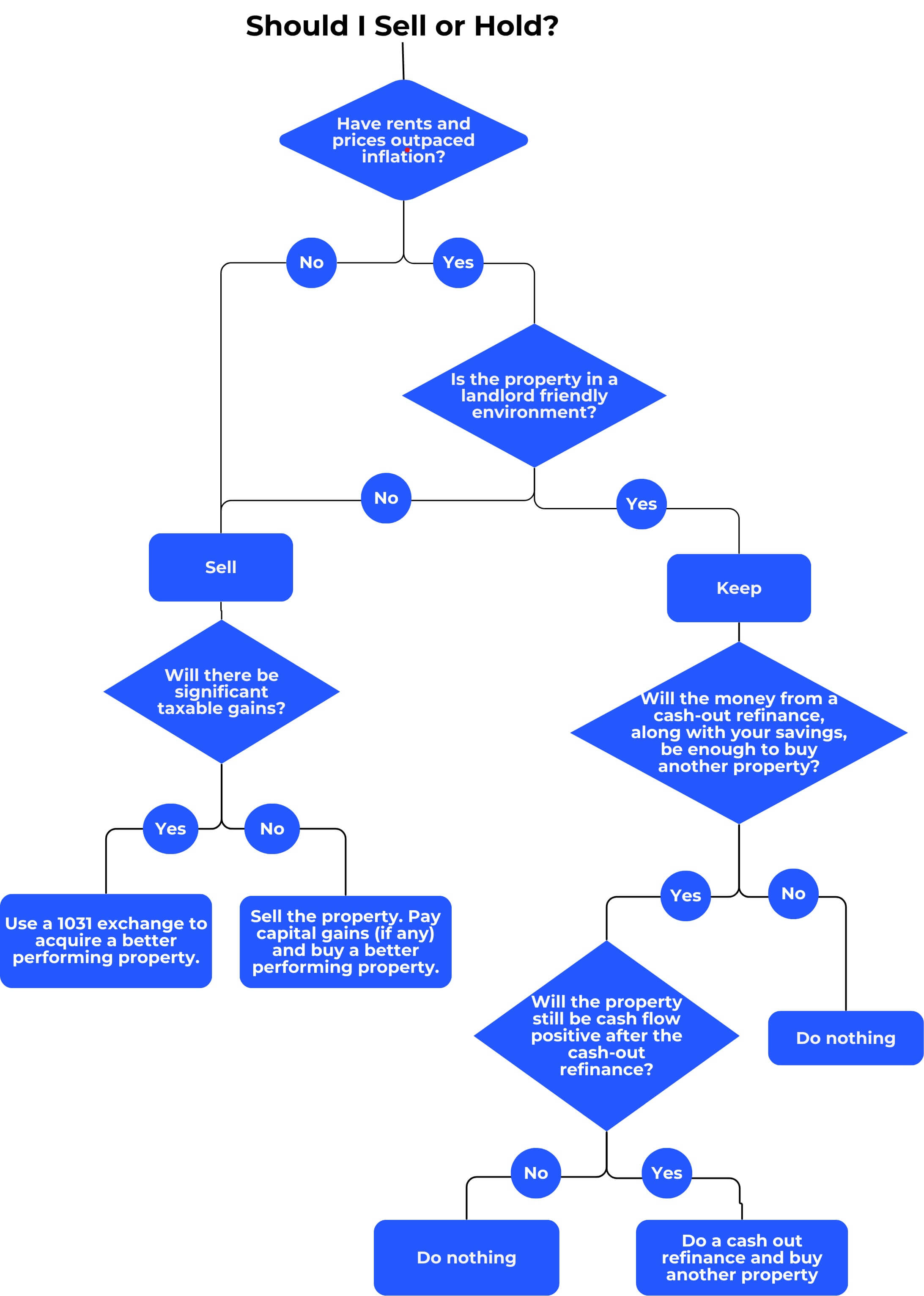
If your goal is long-term financial independence, the key question is: have rents and prices increased faster than inflation in the last 5 years? If not, the only way you can achieve long-term financial independence is if you invest in a city where rents and prices have outpaced inflation.
@Jackson Cook, If you decide to rent out the property, as you mentioned, you would have three years to take advantage of the primary residence exclusion and not pay tax up to $250K ($500K if married).
If you decided to rent out the property longer than three years, you would no longer get the primary exclusion tax-free, but since you would be converting the property to an investment, you could do a 1031 exchange and defer all the tax.
And if you rent and then sell the property within three years. You would qualify for both the 121 exclusion and also take advantage of a 1031 exchange if there is any additional tax left over.
My decision metric would be based on just how good a rental that property will be. I'd weigh that versus turning that 150K into tax-free and eliminating $30k ish of tax instantly. Convert it, rent it, and watch it for the next year or so.
I'm usually a fan of tax-free every time. And then buy a better rental with tax-free dollars and reset your depreciation clock.