Ken McElroy Doesn't Do Apartments At This Point!

Ken McElroy Doesn't Do Apartments At This Point!

Investor · Hendersonville, NC · Member since 2013 · 757 posts · 282 votes

In a 2018 video, Ken McElroy said he doesn't do apartment investing anymore. Talked about how it is too hard to make them work with the low cap rates, and instead he builds from the ground up. He's obviously a big name in the field so I gulped, because I heard from Ashcroft/Joe Fairless about a deal in WInter Park, FL that seemed so solid I pulled the trigger last month. My first-ever multifamily investment. 

Of course, Praxis is good, too. And I like 4 Mile Capital, and someone said something positive about Three Pillars. Neil Bawa certainly seems to know what he is doing. Ryan McKenna is all over deals these days. 

I'm just wondering if ya'll feel that Ken is mistaken, or being gimmicky. I mean, Joe F. says he has done this 27 times, and I haven't heard that Praxis is getting out of the game. I'm trying to use multifamily passive investing to build wealth and be my heavy hitter. I get that a lot of syndicators are in this space, and that cap rates are quite low. But a value-add investment not being able to "work", gosh I just doubt that Joe Fairless would be able to be convinced of that. 

Then again, sometimes a vehicle with a lot of inertia can't slow down if it wanted to. Perhaps that is why Rod Khleif lost $50,000,000 in SFDs in 2008; the idea of throwing in the towel just didn't occur to him.

6Reply
373 views

Most Popular Reply

Brian BurkePro Member
Investor · Santa Rosa, CA · Member since 2012 · 2k+ posts · 7k+ votes
7y
Originally posted by @Jason Merchey:

In a 2018 video, Ken McElroy said he doesn't do apartment investing anymore. Talked about how it is too hard to make them work with the low cap rates, and instead he builds from the ground up.  

To say that you don't invest in apartments, but build apartments from the ground up is a bit of a red herring.  Make no mistake, building apartments from the ground up is not only investing in apartments, it is doing so with a strategy carrying one of the highest risk profiles.

If prices fall (which means a reversal of the cap rates that are being faulted for making investing unattractive), developers would suffer just as bad as owners of existing buildings, and perhaps worse.

But Ken is selling investments in developments, so it is his job to articulate his reasons why his strategy is better.  I sell investments in multifamily value-add syndication investments, so it would be my job to market those by pointing out the availability of multifamily investments below replacement cost in the marketplace, and rising construction costs which make development less attractive.  But I suck at marketing, so I'll say that the truth is that there is room for both strategies and there is nothing wrong with either of them.

Developers and their investors are willing to accept higher risks to chase higher returns.  Value-add operators and their investors are willing to accept lower returns in exchange for lower risk.  In my observation, these are often two different investors.  We did a several-million dollar development fund last year and it oversubscribed in 30 hours.  But by and large, the investors subscribing to it were a different set of folks than typically invest in our acquisition vehicles.  So, to each their own--and no matter what the strategy, it works--until it doesn't.

See this reply in the discussion

69 Replies

Jump to latestLatest
  • Investor · Indianapolis, IN · Member since 2019 · 62 posts · 64 votes
    7y

    @Jason Merchey Building from the ground up can be a great strategy when cap rates are low because you get more value per $ spent. The problem is that it’s speculative and that it doesn’t cashflow. You are hoping that market dynamics stay favorable during the couple of years it takes to build and you get a big payout at the end. Fingers-crossed.

    Personally, I prefer buying proven businesses, class B and C apartments that have a history of cash flow and occupancy. Then maximizing those assets through a value-add strategy. This provides the perfect balance of mailbox money while you hold, less risk, and the flexibility to sell when the time is right.

  • Investor / Syndicator · Austin, TX · Member since 2015 · 367 posts · 220 votes
    7y

    @Joel Owens Well said! I sure hope brokers aren't giving input into underwriting deal structure. Gosh! That's a scary concept. But I'm sure it happens. 

  • Investor · Greenville, SC · Member since 2016 · 5k+ posts · 13k+ votes
    7y

    Did he sell his apartment portfolio? Likely not. Does he continue to invest in apartments (new development)? Yes. He seems pretty bullish on multifamily (at least relative to alternatives...or putting the cash under the mattress). Is he financially set for life and have the same needs and goals as we do? Nope.

    Apartments are hot as are many asset classes...have been for years. We have to be very careful and selective (and expand our opportunity pipeline). I have found better opportunities in MHP and SS for the past few years but that is a judgment call and those asset classes are hot as well. Targeting cash flow, good locations, prudent debt, reserves, and experience are all we can control. Good discussion.

  • Investor · Hendersonville, NC · Member since 2013 · 757 posts · 282 votes
    7y
    Originally posted by @Mike Krieg:

    @Todd Dexheimer @Jason Merchey

    Todd makes a good point about being cautious of companies with high deal flow in this market. I'm underwriting deals here in Texas and consistently seeing teams overpaying for properties by millions of dollars. I just underwrote a property here in Austin that absolutely does not work as a syndication for 11mm. Maybe at 10.5mm it could work, yet the buyer is paying 12mm. I do think that there is a class of buyer in the market right now that can beat the syndication buyer out every time. I'm referring to the wealth preservation buyer who can overpay b/c they're doing a 1031 exchange and do not need to satisfy LP appetites for a 15%+ IRR. If that's whose buying, then there is some rationale, but if it's syndicators who are buying, then I just can't see how they are making it work. Many will get hosed and their LP's also.


    I must say, when Ashcroft came up with two deals in two months, it scared me a bit. But I went for it.

  • Investor · Hendersonville, NC · Member since 2013 · 757 posts · 282 votes
    7y
    Originally posted by @Mike Dymski:

    Did he sell his apartment portfolio? Likely not. Does he continue to invest in apartments (new development)? Yes. He seems pretty bullish on multifamily (at least relative to alternatives...or putting the cash under the mattress). Is he financially set for life and have the same needs and goals as we do? Nope.

    Apartments are hot as are many asset classes...have been for years. We have to be very careful and selective (and expand our opportunity pipeline). I have found better opportunities in MHP and SS for the past few years but that is a judgment call and those asset classes are hot as well. Targeting cash flow, good locations, prudent debt, reserves, and experience are all we can control. Good discussion.

    Hi Mike, from Summerville. This probably sounds silly, but when you say MF syndications are "hot" are you saying that the cap rates are low and the returns are low and there can be a somewhat greater risk of not being able to cover your nut, as syndicator? I am taking it that "hot" is a relatively negative term but trying to figure out exactly how that is the case.

  • Investor · Hendersonville, NC · Member since 2013 · 757 posts · 282 votes
    7y

    @Joel Owens, you said "If you talk to lots of banks they love multifamily and their underwriters think the asset class can do no wrong. I saw it getting absolutely pounded the last down cycle. I mean it was getting crushed. It's just like food restaurants. Everyone has to eat and everyone needs a place to live but that doesn't mean it will be YOUR place or property."

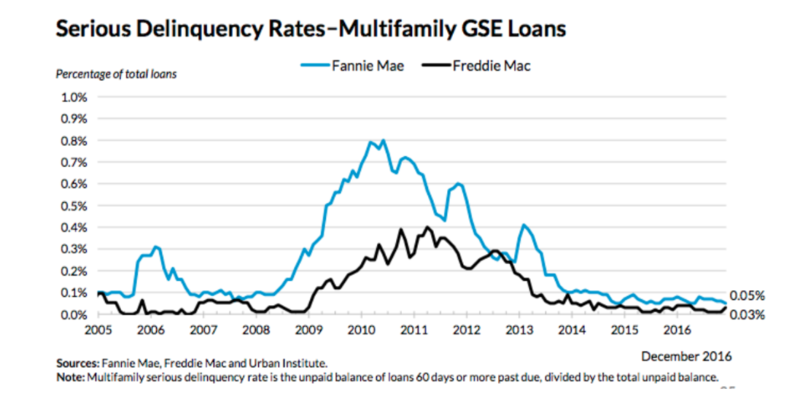
    Please explain. I am surprised by this. I believe it is a fact that the foreclosure rate on MF in 2008-2010 was 1%, compared to 4-5% for SFDs. As well, values for MF are based on cash flow, so if that dips 10%, to, say, 85% occupancy, you probably can still cover your nut and maybe even continue to pay LPs. However, with SFDs, esp. in Vegas or FL or CA, you might have seen a 40% drop in values in 2008-2012. So tell me what "getting crushed" means, if it doesn't mean "losing the asset". You mean it took most syndications right down to the nub such that they couldn't pay pref's for a couple years there, or had to wait for a while to get their occupancy back up to 90%? Now, the stock market got crushed. Rod Khleif lost like 2,000 SFDs, and that was getting crushed.

  • Joel OwensBusiness Member
    Moderator
    Real Estate Broker · Canton, GA · Member since 2010 · 15k+ posts · 11k+ votes
    7y

    I would like to see the data showing 1% foreclosure rate for MF.

    When down cycle happens there is a delayed affect asset class by asset class. SFR was first to fall. Not all asset classes cycle at the same time. There were also loan workouts happening at the start of the downturn. Operators thought they could keep going with a workout and for many it just kicked the can down the road 1 to 2 years. Additionally there were short sales that did not make it to foreclosure. So lot's of variables within multifamily for default percentages and when and how they were happening.

    I can tell you I saw it happen as I was selling some of these properties for property owners.   

  • Investor / Syndicator · Austin, TX · Member since 2015 · 367 posts · 220 votes
    7y

    @Joel Owens @Jason Merchey Joel, I believe Jason could be referring to this data here:

    While this chart demonstrates that single family homes performed far more poorly during the downturn, I do think many multifamily investors read too much into this. Joel, correct me if I'm misstating your position but a syndication does not need to get all the way to foreclosure to get into a bad situation. Syndicators can be forced to sell early and incur huge prepayment penalties, or see quite a bit of equity loss without undergoing a foreclosure. These debts can also be "assumed" by the buyer much easier than single family loans can. 

  • Brian BurkePro Member
    Investor · Santa Rosa, CA · Member since 2012 · 2k+ posts · 7k+ votes
    7y

    Back in the midst of the great financial collapse I remember a property I was struggling with where I used to joke that half of the units were empty, and the other half weren't paying.  That was a bit of an exaggeration, but it sure felt that way.  The property produced just enough cash flow to cover the expenses, but nothing left over for debt service.  To save my investors from a total loss, I covered the entire $15,000/mo mortgage payment out of my own pocket until the market came back (which took over three years!).  So make no mistake, multifamily investments aren't immune from challenge, and @Joel Owens is 100% correct when he says that just because "everyone needs somewhere to live" doesn't mean it will be in your apartment building.  

    Mine was 99% occupied when things were good, 65% when things were bad.  To add insult to injury, I had to lower rents, offer concessions to attract new prospects, and suffered large bad-debt losses from tenants who lost jobs or otherwise just couldn't pay rent.

    But what the market taketh away, it also giveth back.  I had the opportunity to acquire several foreclosed apartment complexes coming out of the downturn.  I bet all those owners once thought that everyone needed a place to live and that apartments were insulated from cash flow problems.  

    Seemed to me that the hardest-hit areas were ones that were once defined as "hot" prior to the downturn.  Markets such as Dallas and Phoenix attracted inexperienced California investors armed with 1031 money from single-family homes into their apartment markets.  Their lack of experience coupled with over-enthusiasm drove them to make unwise decisions and they were quickly over their heads when the market turned against them.  Foreclosures followed.  

    Owners that had deeper balance sheets, more experience, and/or lower debt managed to survive and came out the other side.  Good lesson to be learned from that--if you are investing in syndications, sponsors with deeper balance sheets, more experience and lower debt might be your safest option.

  • Jay HinrichsBusiness Member
    Real Estate Consultant · Summerlin, NV · Member since 2014 · 45k+ posts · 66k+ votes
    7y
    Originally posted by @Brian Burke:

    Back in the midst of the great financial collapse I remember a property I was struggling with where I used to joke that half of the units were empty, and the other half weren't paying.  That was a bit of an exaggeration, but it sure felt that way.  The property produced just enough cash flow to cover the expenses, but nothing left over for debt service.  To save my investors from a total loss, I covered the entire $15,000/mo mortgage payment out of my own pocket until the market came back (which took over three years!).  So make no mistake, multifamily investments aren't immune from challenge, and @Joel Owens is 100% correct when he says that just because "everyone needs somewhere to live" doesn't mean it will be in your apartment building.  

    Mine was 99% occupied when things were good, 65% when things were bad.  To add insult to injury, I had to lower rents, offer concessions to attract new prospects, and suffered large bad-debt losses from tenants who lost jobs or otherwise just couldn't pay rent.

    But what the market taketh away, it also giveth back.  I had the opportunity to acquire several foreclosed apartment complexes coming out of the downturn.  I bet all those owners once thought that everyone needed a place to live and that apartments were insulated from cash flow problems.  

    Seemed to me that the hardest-hit areas were ones that were once defined as "hot" prior to the downturn.  Markets such as Dallas and Phoenix attracted inexperienced California investors armed with 1031 money from single-family homes into their apartment markets.  Their lack of experience coupled with over-enthusiasm drove them to make unwise decisions and they were quickly over their heads when the market turned against them.  Foreclosures followed.  

    Owners that had deeper balance sheets, more experience, and/or lower debt managed to survive and came out the other side.  Good lesson to be learned from that--if you are investing in syndications, sponsors with deeper balance sheets, more experience and lower debt might be your safest option.

    There was a MF investor from Portland who cashed out in 05 100 plus million..and bought Vegas with max debt of course 

    by 2011 he had lost the entire portfolio.. And I don't think this was a syndicator it was a private investor.. 

    there is NO doubt in the down turn all assets in many markets went turtle.. and as Joel says in MF and the associated debt its handled in a completely different way than SFR debt that just goes straight to the court house steps.. the MF gets worked out in a number of ways the public never see's.

    Bottom line there will be syndicators or operators of MF that no matter what is going on just cant make a go of it.. Either bought bad or what I see bought low end thinking they could turn around a C class that was really D class and pump money into them only to revert to the mean.. I have a client here in Oregon that followed me to ATL to buy courthouse steps we killed it before the Hedges moved in and took over.. so then he thinks I will try apartments value add.. and proceeds to buy low end apartment in the deep south pump 500k into it.. never could get it stabilized and had to exit and lost all his money.. it happens.  it will happen today and tomorrow.. not every one is a rock star MF operator.  And or like you has the capacity to carry negative cash flow for an extended period of time.

  • Roni E.Pro Member
    Specialist · Earth 2.0 · Member since 2019 · 598 posts · 271 votes
    7y

    @Jason Merchey

    Winter park is very old money but do research as the some areas try to be part of winter park. Also some very rough areas

  • Investor · Hendersonville, NC · Member since 2013 · 757 posts · 282 votes
    7y
    Originally posted by @Joel Owens:

    I would like to see the data showing 1% foreclosure rate for MF.

    When down cycle happens there is a delayed affect asset class by asset class. SFR was first to fall. Not all asset classes cycle at the same time. There were also loan workouts happening at the start of the downturn. Operators thought they could keep going with a workout and for many it just kicked the can down the road 1 to 2 years. Additionally there were short sales that did not make it to foreclosure. So lot's of variables within multifamily for default percentages and when and how they were happening.

    I can tell you I saw it happen as I was selling some of these properties for property owners.   

    Hi Joel. Sure, I  can type out the paragraph I found that alluded to in a book entitled The Perfect Investment, by Paul Moore of Wellings Capital. A 2016 book. I will note that I made a mistake recalling his data, because it was NINE percent of houses that went to the chopping block due to 2008.

    "As we discussed before, the foreclosure rate of multifamily assets in the Great Recession was under one percent. Compare this to the non-performance rate of first liens for SFDs held by banks, which peaked at 9% in 2010). When you factor out the highly volatile sand states of Florida, Nevada, Arizona, and California, the foreclosure rate of multifamily properties was a fraction of that. Zeroing in on assets in solid, low-crime submarkets, run by a professional property manager, and the rate drops close to zero." 

    Perhaps he messed with the stats by partialling out those four bubbly states. 

    He cites a Freddie Mac report (p. 47) in graph format that shows a relatively flat line for multifamily delinquincy rates; it hovers at around zero from 2000 to 2009, then rises to about .5% in 2011, and is back down to like .25% in 2013, and by 2015 it's virtually zero again. SFDs went from a low of 1% in 2005 to a high of 4% in 2010, and were at 1.5% in 2015. It's on the magnitude of like 10:1. 

    The citations are Fannie Mae, Freddie Mac, and the Urban Institute. I believe he constructed the graph.

    So the question is, when you say that multifamily got crushed, are you saying that that occurred in Ca/Fl/Nv/Az, and that is how you two can disagree so substantially, or are you saying that he is citing data incorrectly? Perhaps you can show that overall in the U.S., more than 3-4% of multifamily properties were foreclosed upon by banks in a given year during the Great Recession.... Or that cumulatively, 5-10% of all apartment complexes were foreclosed upon in the years 2008, 2009, 2010, 2011, 2012, 2013, and 2014. 

    I am open to changing my mind if you can validate your claim, because I JUST read about Moore's opinion that value-add multifamily is the perfect investment like yesterday. It hasn't become part of my deeply-held belief system. Though, of course, I would be afraid, since I just put two chits on Ashcroft's Class A value-adds in Plano TX and Winter Park, FL. If I thought there was a 5-10% of seeing them go belly up - THAT would cause great distress to my current belief system because it will hit me in the pocketbook big-time. 

    @Theo Hicks perhaps as a Fairless compatriot, you would care to weigh in here?

  • Investor · Hendersonville, NC · Member since 2013 · 757 posts · 282 votes
    7y
    Originally posted by @Mike Krieg:

    @Joel Owens @Jason Merchey Joel, I believe Jason could be referring to this data here:

    While this chart demonstrates that single family homes performed far more poorly during the downturn, I do think many multifamily investors read too much into this. Joel, correct me if I'm misstating your position but a syndication does not need to get all the way to foreclosure to get into a bad situation. Syndicators can be forced to sell early and incur huge prepayment penalties, or see quite a bit of equity loss without undergoing a foreclosure. These debts can also be "assumed" by the buyer much easier than single family loans can. 

    Mike, yes those seem to be the data that Moore bases his claim on. Except in his graph, the lines, instead of looking like Pike's Peak, look like the hills we find in the Lowcountry of South Carolina - that is, more like a long line with a little uptick. Clearly the scale on the left is different because it ranges from .5% to 4.5%. The SFD foreclosure rate, indeed, looks like a mountain you would want to ski on.

    But I see what you mean that a syndicator has many more outs and isn't quite as likely to be caught standing when the music stopped. However, if capital preservation was the goal, I would guess that maybe a loss of 10-20% of principal occurred in some instances to the limited partners of projects. On the other hand, as Joe Fairless indicates, if you get cashflow right, and avoid operational breakdowns, and had a chance to implement some unit renovations, and so on, you can lay low during said downturn rather than "getting crushed."

  • Jay HinrichsBusiness Member
    Real Estate Consultant · Summerlin, NV · Member since 2014 · 45k+ posts · 66k+ votes
    7y
    Originally posted by @Jason Merchey:
    Originally posted by @Joel Owens:

    I would like to see the data showing 1% foreclosure rate for MF.

    When down cycle happens there is a delayed affect asset class by asset class. SFR was first to fall. Not all asset classes cycle at the same time. There were also loan workouts happening at the start of the downturn. Operators thought they could keep going with a workout and for many it just kicked the can down the road 1 to 2 years. Additionally there were short sales that did not make it to foreclosure. So lot's of variables within multifamily for default percentages and when and how they were happening.

    I can tell you I saw it happen as I was selling some of these properties for property owners.   

    Hi Joel. Sure, I  can type out the paragraph I found that alluded to in a book entitled The Perfect Investment, by Paul Moore of Wellings Capital. A 2016 book. I will note that I made a mistake recalling his data, because it was NINE percent of houses that went to the chopping block due to 2008.

    "As we discussed before, the foreclosure rate of multifamily assets in the Great Recession was under one percent. Compare this to the non-performance rate of first liens for SFDs held by banks, which peaked at 9% in 2010). When you factor out the highly volatile sand states of Florida, Nevada, Arizona, and California, the foreclosure rate of multifamily properties was a fraction of that. Zeroing in on assets in solid, low-crime submarkets, run by a professional property manager, and the rate drops close to zero." 

    Perhaps he messed with the stats by partialling out those four bubbly states. 

    He cites a Freddie Mac report (p. 47) in graph format that shows a relatively flat line for multifamily delinquincy rates; it hovers at around zero from 2000 to 2009, then rises to about .5% in 2011, and is back down to like .25% in 2013, and by 2015 it's virtually zero again. SFDs went from a low of 1% in 2005 to a high of 4% in 2010, and were at 1.5% in 2015. It's on the magnitude of like 10:1. 

    The citations are Fannie Mae, Freddie Mac, and the Urban Institute. I believe he constructed the graph.

    So the question is, when you say that multifamily got crushed, are you saying that that occurred in Ca/Fl/Nv/Az, and that is how you two can disagree so substantially, or are you saying that he is citing data incorrectly? Perhaps you can show that overall in the U.S., more than 3-4% of multifamily properties were foreclosed upon by banks in a given year during the Great Recession.... Or that cumulatively, 5-10% of all apartment complexes were foreclosed upon in the years 2008, 2009, 2010, 2011, 2012, 2013, and 2014. 

    I am open to changing my mind if you can validate your claim, because I JUST read about Moore's opinion that value-add multifamily is the perfect investment like yesterday. It hasn't become part of my deeply-held belief system. Though, of course, I would be afraid, since I just put two chits on Ashcroft's Class A value-adds in Plano TX and Winter Park, FL. If I thought there was a 5-10% of seeing them go belly up - THAT would cause great distress to my current belief system because it will hit me in the pocketbook big-time. 

    @Theo Hicks perhaps as a Fairless compatriot, you would care to weigh in here?
    keep in mind MF does not have to go into default to wipe out investors equity..  and I am not saying any of the people your investing in are going to get wiped out.. just commenting that the stats for the real world are skewed since so many commercial loans get some sort of work out behind the scenes.. the bank gets paid but those with 25 to 35% of the cash in the deal may not get their money back.. 

  • Investor · Hendersonville, NC · Member since 2013 · 757 posts · 282 votes
    7y
    Originally posted by @Brian Burke:

    ...Owners that had deeper balance sheets, more experience, and/or lower debt managed to survive and came out the other side.  Good lesson to be learned from that--if you are investing in syndications, sponsors with deeper balance sheets, more experience and lower debt might be your safest option.

    I think that is inarguable! And also, your forte! Bravo.

  • Investor · Hendersonville, NC · Member since 2013 · 757 posts · 282 votes
    7y

    @Jay Hinrichs

    keep in mind MF does not have to go into default to wipe out investors equity.. and I am not saying any of the people your investing in are going to get wiped out.. just commenting that the stats for the real world are skewed since so many commercial loans get some sort of work out behind the scenes.. the bank gets paid but those with 25 to 35% of the cash in the deal may not get their money back..

    True, true. I get the behind closed doors work-out thing, and also the "you can lose your investment without defaulting on the debt" thing. In fact, that is the very reason you suggested the HML outfit you did last week -- they have a "senior note" tranch that seems very insulated from damage. As well, on a prominent syndicator, on his last deal, offered Class A and B shares, and I'm not absolutely sure that I can divulge much about it but I will simply say that one is first in line in regard to seniority.

    I think the main point here, despite this little tangent, is that MF is not insulated from loss like the sector has some kind of magic talisman. But according to Moore and others, it is a very strong investment in the hands of good operators in good cities with good loans. I wouldn't, as a rule, invest with a poor operator or a bad city or a bad loan. The question is whether I know enough about cap rates and market cycles and operators and cities and loans to suss it all out and make a return on my investment. Time will tell, I suppose! "A fool and his money are soon separated," it is said.

  • Rental Property Investor · St. Paul, MN · Member since 2016 · 3k+ posts · 3k+ votes
    7y

    @Jason Merchey there are some guys out there that are being very aggressive as I stated earlier. I saw an experienced companies offering a few weeks ago in a market that I am very familiar with and a deal that I underwrote. The numbers looked awesome in their pro forma (19%+ IRR), however, they got it for roughly 10% more than my max price, which was showing a 14.3% IRR. Why the big difference? Well, first off their rent projections where of comps that appear to be close comps, but aren't in the same neighborhood, giving about a $75/unit rent bump, next they used 5% vacancy, which is accurate in todays market, but not historically. They also increased rent by 4%/year for the 5 year hold and expenses by only 2%. Repair and maintenance, marketing, unit turns, etc were also low.

    The final thing that made a huge difference was that they used the cap rate at acquisition as the "Market cap" and increased it by 50 basis points upon exit. This is a huge mistake that I see a lot of people making. First, they used their purchase cap as the starting point, but they bought just under a 5%cap and todays market is at 5.75% cap, so their exit cap rate 5 years from now is actually lower than todays market cap. Second they used a 10 basis point increase per year, which is a meaningless and thoughtless number. As operators we should be basing our exit caps more on historical cap rates vs a meaningless number. 

    Now if the market continues it bull run for 5 more year, which it very well could, they will look smart and I will look dumb, but if the market falters, well, that's your guess. 

  • Engineer · Portland, OR · Member since 2014 · 1k+ posts · 1k+ votes
    7y

    @Kent Ritter I think that is s great strategy. However we can probably both agree those type of deals are harder to find.

    Also for the couple of people on this thread that say “ignore metrics because time/the market will take care of that”, You’re courting disaster, The perpetual appreciation theorem doesn’t trump math.

  • Engineer · Portland, OR · Member since 2014 · 1k+ posts · 1k+ votes
    7y

    @Todd Dexheimer a sustained bull market facilitates the illogical wrong-think of investors accepting a smaller delta in the false belief that the good times will never end. All we know for sure about a long term bull cycle is we are closer to a bear cycle then we were a few years ago and people demanded better margins on deals then. So the math is exactly inverted from market realities.

  • Investor · Hendersonville, NC · Member since 2013 · 757 posts · 282 votes
    7y
    Originally posted by @Todd Dexheimer:

    @Jason Merchey there are some guys out there that are being very aggressive as I stated earlier. I saw an experienced companies offering a few weeks ago in a market that I am very familiar with and a deal that I underwrote. The numbers looked awesome in their pro forma (19%+ IRR), however, they got it for roughly 10% more than my max price, which was showing a 14.3% IRR. Why the big difference? Well, first off their rent projections where of comps that appear to be close comps, but aren't in the same neighborhood, giving about a $75/unit rent bump, next they used 5% vacancy, which is accurate in todays market, but not historically. They also increased rent by 4%/year for the 5 year hold and expenses by only 2%. Repair and maintenance, marketing, unit turns, etc were also low.

    The final thing that made a huge difference was that they used the cap rate at acquisition as the "Market cap" and increased it by 50 basis points upon exit. This is a huge mistake that I see a lot of people making. First, they used their purchase cap as the starting point, but they bought just under a 5%cap and todays market is at 5.75% cap, so their exit cap rate 5 years from now is actually lower than todays market cap. Second they used a 10 basis point increase per year, which is a meaningless and thoughtless number. As operators we should be basing our exit caps more on historical cap rates vs a meaningless number. 

    Now if the market continues it bull run for 5 more year, which it very well could, they will look smart and I will look dumb, but if the market falters, well, that's your guess. 

    On a recent Ashcroft acquisition of which I'm a part, they definitely bought at 4.5% and are exiting 5 years later at a presumed 5%. I knew that a 4.5% cap rate was fairly low (obviously, Dallas is a strong and growing market, and interest rates are low, and it's a nice community), and I guess that kind of is what it is. 6% would be better but....  As you point out, though, they do add 10 basis points per year which you call "a huge mistake." This is unsettling to me. 

    I fear that it's a mistake on Ashcroft's part. On the other hand, I think you might have a misunderstanding of the nature of the cap rate increase. The purpose of increasing it by a half-point or a point for five years' time is not, as many believe, to account for a possible expansion of cap rates in the foreseeable future. If you were going to try that it would probably be best just to forget it, since the efficient markets hypothesis indicates that the cap rate is the cap rate for good reason, and there is no reliable way to predict what will happen with it in 2, 3, or 4 years. Clearly there is no way to predict where it will naturally be in 5, 6, or 7 years. So that whole angle is kind of useless. ....Your opinion about anchoring cap rates to the median for the last 25 years or whatever notwithstanding.... 

    But the other reason that you might be mistaken, according to Teo Nicolais, a multifamily investor out of Denver and the heart of the Grad Cert in Real Estate at Harvard University Extension program, is that it is meant merely to account for obsolesence of the asset itself. Like a kind of depreciation. Thus it doesn't, according to this approach, have anything to do with either the market or historical rates or anything of that nature. 

    No disrespect. I hear what you are saying and it does make me nervous to think that you may be correct in your assessment.

  • Investor · Hendersonville, NC · Member since 2013 · 757 posts · 282 votes
    7y
    Originally posted by @Steve B.:


    Also for the couple of people on this thread that say “ignore metrics because time/the market will take care of that”, You’re courting disaster, The perpetual appreciation theorem doesn’t trump math.

    True, true. I think it is foolish to do so, and that is why I think the best operators don't count on appreciation. However, the bazooka in the arsenal of many operators is forced appreciation - the "value-add" component of the strategy. That is, if you find an undervalued asset in regard to the NOI because of, say, a bunch of amenities missing, or a bunch of additional revenue streams missing, or a bunch of expenses that can be shrunk, or especially a bunch of dated interiors (to a lesser degree, the exterior), one can find a legitimate and marketable way to raise rents, one could see a $50, $100, $150 per door rise in NOI. On a 300 unit complex, $100 per door is astronomical. At a 5% cap rate, that can account for a whopping SEVEN MILLION DOLLAR sale price bump. Astounding. 

    Hell, you could have a natural $10 decrease in rents due to economic issues in the submarket and all the other factors would easily trump that. That is, if the market is falling a bit but you beautified 100% of your interiors, you could still command a $90 net increase in rents on average per door per month.

    Two other things I would point out, though. 1) A great operator can make an average deal go decently well (vs. the fact that a poor operator can **** up a great deal), and 2) Location, location, location: areas that are growing in jobs and immigration and the micromarket/location of the complex can make a major impact on the numbers and save a project from ruin by an average operator or even, manager. Clearly you want a good operator and a good manager at minimum, but an area increasing in average rents by 4% a year and seeing a 3% per year influx of immigrants and with a plentiful and diverse jobs base can tolerate a little "sleeping at the wheel" on the part of operators. 

    Frank Roessler of Ashcroft believes that the main risk for the two latest deals are operational: that is, the fundamentals of the loan, the submarket, and the value-add opportunities are so propitious that the main risk is that they drop the ball. It's like, take the script of E.T. and put it in the hands of a given director and hope they can pull it off. You KNOW the script is amazing, the question is are you getting Roger Ebert/Valley of the Dolls-caliber of director, or Spielberg?

    All this brings me back to the main point of the OP about Ken McE: he says in that video that value-add multifamily is dead to him. I just don't quite see how if you snag a 250-unit complex and can reliably add $50 per unit in rents over 18 months in an area that is not at undue risk for decline in the future and you get a 3.9% 30 year loan for 10 years and you have a tried and true team, how it is likely to be a dud. That would equal a $2.5 million increase in value and might cost $1.25 million to execute. Unless you're seeing a natural decrease of rents by 3% a year, I think you're looking good. A 3% decline in rents, on average, for the submarket, is only $66,000 a year in NOI shrinkage - manageable. I mean, you do have to have an overall attractive complex to bring in those best renters, but that is the plan...

  • Engineer · Portland, OR · Member since 2014 · 1k+ posts · 1k+ votes
    7y

    @Jason Merchey right, I think most of these easy value-add apartment syndication deals have been picked over extensively at this point. Now we are in the realm of low-return value-add under the auspices that these marginal projects are acceptable due to this false perception of no- risk. So it makes sense when @Jay Hinrichs and @Brian Burke are building from the ground up, they are taking a accepted and informed risk for a relatively high return which seems a lot better pot odds then investing in the current crop of these low margin value-adds in which you are taking an unknown risk masquerading as low-risk for an acknowledged low return.

  • Investor · Hendersonville, NC · Member since 2013 · 757 posts · 282 votes
    7y

    Steve B, I will try to respect your opinion; you obviously have a lot of posts and votes. I'm not as sanguine as you about the feasibility of starting now to build a huge new Class A set of units for $300-$500 per unit on land that is expensive, using labor that is expensive, and using materials that are expensive. In the part of the real estate cycle that is teetering on recession. Oh and three years to payback. I know Neil Bawa is excited about this, too. Clearly Ken McE is. 

    I also know that the virtual CAUSE of housing market declines during recession are the huge time-delay from start to completion on commercial new development, and seeming inevitability of developers being unable to stop themselves from overbuilding. It just doesn't make as much sense to me, intuitively, to start a new project when overbuilding can and does lead to major difficulty filling units. A bird in the hand, man! 

    Now, maybe 2008 was a horrible anomaly, but I recall personally having invested in new condo development and having to sit with my (pencil) in my hand for YEARS to see a return - and this was after capital calls! 

    Frankly, I just don't see as much downside as you do to a great operator taking on fantastic agency debt to do some predictably-useful reno on a presently cash-flowing and mostly-full asset. Cap rates being low is not a great thing, and recession looming isn't a great thing. But this idea that building new starting new Class A for $200k a door now is advisable, I think that is false. There is a decent chance of "standing when the music stops." Your use of the phrase "an accepted and informed risk for a relatively high return [with good odds]" doesn't hold water.

  • Investor · Indianapolis, IN · Member since 2019 · 62 posts · 64 votes
    7y
    Originally posted by @Steve B.:

    @Kent Ritter I think that is s great strategy. However we can probably both agree those type of deals are harder to find.

    Also for the couple of people on this thread that say “ignore metrics because time/the market will take care of that”, You’re courting disaster, The perpetual appreciation theorem doesn’t trump math.

    Yes, I agree good value-add deals are harder to find, but not impossible. 

  • Rental Property Investor · St. Paul, MN · Member since 2016 · 3k+ posts · 3k+ votes
    7y
    Originally posted by @Jason Merchey:
    Originally posted by @Todd Dexheimer:

    @Jason Merchey there are some guys out there that are being very aggressive as I stated earlier. I saw an experienced companies offering a few weeks ago in a market that I am very familiar with and a deal that I underwrote. The numbers looked awesome in their pro forma (19%+ IRR), however, they got it for roughly 10% more than my max price, which was showing a 14.3% IRR. Why the big difference? Well, first off their rent projections where of comps that appear to be close comps, but aren't in the same neighborhood, giving about a $75/unit rent bump, next they used 5% vacancy, which is accurate in todays market, but not historically. They also increased rent by 4%/year for the 5 year hold and expenses by only 2%. Repair and maintenance, marketing, unit turns, etc were also low.

    The final thing that made a huge difference was that they used the cap rate at acquisition as the "Market cap" and increased it by 50 basis points upon exit. This is a huge mistake that I see a lot of people making. First, they used their purchase cap as the starting point, but they bought just under a 5%cap and todays market is at 5.75% cap, so their exit cap rate 5 years from now is actually lower than todays market cap. Second they used a 10 basis point increase per year, which is a meaningless and thoughtless number. As operators we should be basing our exit caps more on historical cap rates vs a meaningless number. 

    Now if the market continues it bull run for 5 more year, which it very well could, they will look smart and I will look dumb, but if the market falters, well, that's your guess. 

    On a recent Ashcroft acquisition of which I'm a part, they definitely bought at 4.5% and are exiting 5 years later at a presumed 5%. I knew that a 4.5% cap rate was fairly low (obviously, Dallas is a strong and growing market, and interest rates are low, and it's a nice community), and I guess that kind of is what it is. 6% would be better but....  As you point out, though, they do add 10 basis points per year which you call "a huge mistake." This is unsettling to me. 

    I fear that it's a mistake on Ashcroft's part. On the other hand, I think you might have a misunderstanding of the nature of the cap rate increase. The purpose of increasing it by a half-point or a point for five years' time is not, as many believe, to account for a possible expansion of cap rates in the foreseeable future. If you were going to try that it would probably be best just to forget it, since the efficient markets hypothesis indicates that the cap rate is the cap rate for good reason, and there is no reliable way to predict what will happen with it in 2, 3, or 4 years. Clearly there is no way to predict where it will naturally be in 5, 6, or 7 years. So that whole angle is kind of useless. ....Your opinion about anchoring cap rates to the median for the last 25 years or whatever notwithstanding.... 

    But the other reason that you might be mistaken, according to Teo Nicolais, a multifamily investor out of Denver and the heart of the Grad Cert in Real Estate at Harvard University Extension program, is that it is meant merely to account for obsolesence of the asset itself. Like a kind of depreciation. Thus it doesn't, according to this approach, have anything to do with either the market or historical rates or anything of that nature. 

    No disrespect. I hear what you are saying and it does make me nervous to think that you may be correct in your assessment.

    I don't know anything about the deals you have invested in. Ashcroft has been doing well for the past several years and I have nothing but respect for them. 

    I'm not really sure what you're trying to say on cap rates, but the fact is that properties are bought based on financial performance in a balanced market. Some random expansion of cap rates with no thought as to why is not the best practice in my opinion. You mention that "you might have a misunderstanding of the nature of the cap rate increase. The purpose of increasing it by a half-point or a point for five years' time is not, as many believe, to account for a possible expansion of cap rates in the foreseeable future." If that is the case, then why do sponsors use it in their underwriting to come up with a future sales price? 

    I agree that there is no way of predicting anything in the future, but that is what we as sponsors (and any business owner) are doing. My point is to be conservative, means putting some thought into the numbers. I like using historical data, with thought into shifts that have happened in the neighborhood, work force, etc. 

    I'm sure your investments will be just fine and I am not responding to tell you otherwise.

Join the conversationCreate a free account to reply, vote on answers and follow this thread.