Investor · Indianapolis, IN · Member since 2019 · 62 posts · 64 votes
For those passive investors out there, which matters more to you - That your sponsor has money in the deal or that he/she has a successful track record?
One challenge with this question is that "skin in the game" and "money in the deal" are two completely different things. Money in a deal does not represent skin in the game. Nor does it automatically align interests. In fact, it is possible for money in the deal to cause a misalignment of interest. Don't get me wrong, I have no problem with asking if a sponsor is investing in the deal, what I have a problem with is believing that it matters.
I think that the best combination is experience and actual skin in the game. Actual skin could be the sponsor signing on the loan covenants, rather than hiring that out to someone else, thus making them personally liable if they commit fraud, bankrupt the entity, or abscond with the money that was supposed to be allocated to other things such as property tax payments. Plus if the sponsor is the one signing on the carve-out guarantees and is the primary loan guarantor, it means that the sponsor has the financial capacity to qualify, i.e. has met the net worth and liquidity requirements of the lender. Sponsors who qualify and sign on their own are strongly disincentivized by the heavy hand of the lender to abandon the project or misappropriate funds.
Actual skin is also a sponsor's track record, which is likely far more valuable to them than, say, a $100K co-investment. Reputation risk is real for any sponsor that has been around long enough to have earned one. It takes a lifetime to build trust, and a second to destroy it. Inexperienced sponsors cannot bring such a track record to the table so by default they have a lot less to lose.
Investors don't measure a sponsor's cash investment in a deal because it's important, it has become important only because it can be measured. What is really important is the moral character of the sponsor. If they have a character flaw, the investment in inherently flawed. But character is hard to measure, so the natural path of least resistance is to use "money in the deal" to "check the box." Ultimately, this doesn't work.
For those passive investors out there, which matters more to you
- That your sponsor has money in the deal or that he/she has
a successful track record?
Both preferably! Yes and Yes. With that being said there are new operators that have surrounded themselves with a team with all the credibility they need to run the ship. I think the biggest thing from a passive investor standpoint is the character and credibility of the sponsor.
Do the sponsors have any previous business experience? Were they successful? Do they have any skills or traits the sponsor can easily transition in this space?
Track record and skin in the game is good, but at the same time credibility and character are everything.
@Kent Ritter Brian hit the nail on the head with this one. Newer passive investors continuously ask me if I invest in our deals. It such an irrelevant question in comparison to the bigger picture of the deal and really my company. The real alignment like Brian mentioned is the fact that we are the main guys signing on the loan and the lender is going to make sure I'm compliant. The other part is the fact that I cannot open up under a new llc if a deal tanks and screw over investors. With the digital world we live in today, it's nearly impossible to get yourself a restart in this business.
So to answer your question, track record and knowledge are far more important than the GP investing in the deal. Even if the GP doesn't invest in the deal they will have a fair amount of money already laid out in pursuit costs upfront prior to the deal closing. I do invest in our deals and passively as well but that's why I got in the business in the first place, not to use it as leverage and a talking point to our investors to say "I am aligned with you".
Fair - both are ideal, but would you invest with an experienced syndicator that isn't investing in the deal personally?
Sponsor's money in the deal is only one piece of a puzzle. I need to see the entire deal structure to make a decision. However, if a sponsor invests a significant portion of equity (e.g. 20%) I would feel more inclined to invest with them.
I'm listening to Sam Zell's autobiography right now (narrated by him and very interesting book, btw) and as big as he is and as big a reputation as he has to potentially lose, he always co-invests.
@Brian Burke and @Scott MorongellI think you both make very good points. There is more on the line for a sponsor than just the acquisition fee, including reputation and a lot of upfront time and costs to just close the deal. How do you help investors understand the point of view of the syndicator?
Track record and skin in the game is good, but at the same time credibility and character are everything.
@TJ Hines I agree that character is everything, but its difficult to quantify. How do you represent your character to your potential investors as you meet them?
@Brian Burke and @Scott MorongellI think you both make very good points. There is more on the line for a sponsor than just the acquisition fee, including reputation and a lot of upfront time and costs to just close the deal. How do you help investors understand the point of view of the syndicator?
A lot of it is getting on the phone with investors and having meaningful conversations. You need to understand what they value. If all they ever care about it what your making on fees or splits they are probably not a good fit for you unless your a new syndicator dying to get a deal across the finish line. The syndication business is like anything other business or product, you get what you pay for. Good sponsors don't work for free and often spend more time vetting the passive investors on a call more than the passive investor vetting the sponsor.
In every case where I am the sponsor, I have skin in the game. As Brian said, a sponsor with a good track record has a lot to lose.
Experienced apartment operators who have not lost money for their investors and made money in 2008-2009 Great Recession are few - and their track record is very important to them. In fact, to me - that's more important than money. I worked very hard to achieve that and no amount of money is big enough to risk my track record. That's why, I am very selective in the projects I work on. I choose projects with 30% IRR where I can control my costs (like construction and property management) because we're vertically integrated unlike a lot of apartment syndicators out there.
Now, even though character is hard to quantify, there are external things that show one's character. For example, a certain crowdfunding platform have very stringent criteria before they stake their reputation behind a syndicator. Below is a screen shot of what they check:
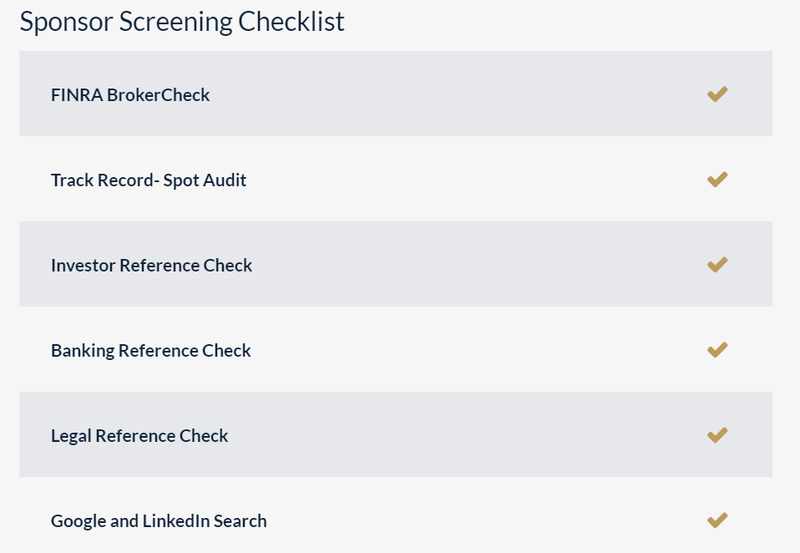
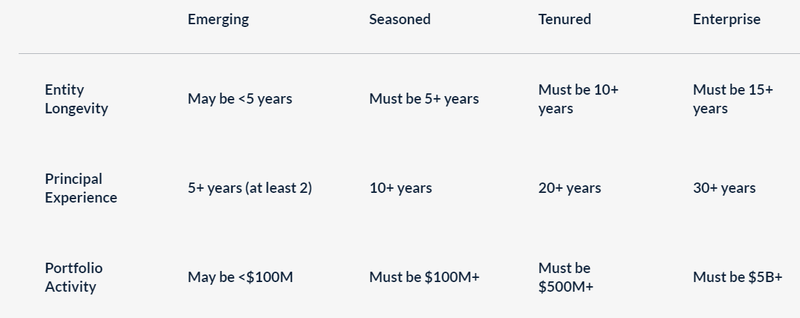
They prefer that the sponsor is at least "Seasoned" where the principal has at least a 10-year experience. Below are their classification.
If I want to choose the right sponsor, I would follow what this crowdfunding platform does. Their due diligence on the sponsor is excellent and they weed out 99% of the sponsors who apply with them.
Fair - both are ideal, but would you invest with an experienced syndicator that isn't investing in the deal personally?
I certainly would want to know why not. But, like others have already said, the sponsor's investment (often just the minimum) is overrated. Now, if they are signing on a full-recourse loan, then they are putting their whole net worth on the line, which to me is much more "skin in the game" than a measly $50,000 or $100,000 passive investment in their own deal. While it doesn't ensure the project's success, I think it almost guarantees the deal won't fail altogether. Surely the sponsor would do everything in their power to avoid foreclosure, or worse yet, writing a check to the bank. That's all hypothetical to me though. Anyone have first-hand experience with a such a situation (sponsor saved a failing deal because of the recourse loan)?
Scott nailed it. We have real conversations. We get to know them in addition to introducing ourselves. We also explain that we have plenty of cash involved in the deal whether it's invested or not--our lenders require specific net worth and liquidity. Maintaining liquidity means holding liquid investments--investing that cash in our real estate doesn't qualify. Our cash is used to secure the deal, make earnest money deposits, lender deposits, pay for third-party reports and all of the other costs associated with getting these things going. I sum it up this way, "our cash is the spark, your cash is the fuel." Having said that, I love to eat what I kill so I do invest what and when I can, but that investment has nothing to do with "skin in the game" or "alignment of interest." I think of it like a financial investment just like anyone else's.
As far as demonstrating character, that one is a lot more difficult. My background in law enforcement definitely gave me an advantage in terms of the character question...but for most of us showing past performance, time in business (careers are short if you screw up a lot), references from existing investors and talking about how we've overcome all sorts of challenges through several market cycles is the best way I know of to demonstrate character.
While this deal did have a recourse loan, my primary motivation was taking a bullet for my investors. Having never lost investor principal, I wasn't about to start. So I took the hit, and in the end everyone came out whole (plus a little). I suppose that knowing that defaulting on a recourse loan would be a career-ender was in the back of my mind...but losing investor money is a good path to a short career as well.
Either way, all of these things are exactly why I say that track record, experience, financial strength and signing on loan covenants are stronger alignment of interest than any investment in the deal.
@Kent Ritter Most of our passive investors like that we have skin in the game either through deploying our own capital in a deal and/or showing an alignment of interest through the fees and return structure of a deal.
Basically, you can tell a lot about a sponsor when it comes to the flow of capital either into the deal or out of the deal through fees.
Track record, to me, is a prerequisite.
Transparency + Track Record + Trust, the 3Ts are what we embody.
My investors like that we have our own money in the deal. That, and it just feels like the right thing to do. If we as sponsors believe in our deals we need to be comfortable putting up our own funds. I don't feel comfortable bringing on investors if I don't have my own money right alongside theirs.
@Kent Ritter, never show any signs of desperation! Always let them know that YOU want to take it one step at a time to nourish the relationship so that it can flourish. It's all about educating them to make sure they fully understand how your business model works and how it will benefit them.
Also, let them know that YOU don't work with everyone. It's about figuring out what their needs or wants are, so you can see if you have to offer may fit their needs. Hopefully this helps. Good luck
As @Brian Burkerepeatedly pointed out: it takes a while to build a reputation, and only a second to lose it. Btw, Warren Buffett said first, "It takes 20 years to build a reputation and five minutes to ruin it. If you think about that, you'll do things differently." So I'll give credit to both of these two gentlemen! :)
The reputation goes beyond the track record.
- It's how one lives their life; are they being a good citizen;
- are they making impact on the community they live in and/or beyond;
- are they working (not trying, rather taking action!) to make the world a better place. Note, the latter could be small steps, for instance, as little as volunteering in the local community but are they doing it on a regular basis.
- do they have a family of their own. it's ok if they don't but it's not ok if for instance they have children they have not seen for five years - that tells you something about a character!
So bottom line, look things they do not align with your views and how you perceive being a good member of a society. If you and the operator are aligned in that, then put a check mark and move on to the next verification point.
We are currently under contract and set to close in about 3 weeks on another community. My partner, @Sam Grooms and I are currently floating about $400,000. At the same time, the acquisition is oversubscribed by about $500,000.
Additionally, while we have left money in before, we won't in this one. I think this will be the best one yet, and the only reason we are not leaving money in it is that we just floated $100,000 to start-up our own construction company to handle all of our interior reno scope across the portfolio.
Question: Is there more value to the investors in my $100,000 in this deal, or in the start-up of the construction arm?
We lost 2 investors in this deal because when asked I told people we won't leave money in and why. I totally understand and respect this. Some folks need to check that box.
However, at the end of the day, this has absolutely zero to do with the success or failure of the enterprise - zero. Additionally, what we do is hard work, and I'll be damned if I continue to do it without being well paid.
I believe this so profoundly that whenever someone raises this point, I respectfully decline their investment. We see things too differently, which is OK, but we don't need to be working together...
So, @Kent Ritter - you've heard it all. What's your final call on this matter?
I vote experience. There are many pervious replies that answer why much better than I can.
Now, if you’re considering a less-experienced syndicator, the skin in the game is absolutely vital: both in terms of dollars invested and liability. Knowing my name is on the bottom line on the properties we have under management is not something I take lightly.
While this deal did have a recourse loan, my primary motivation was taking a bullet for my investors. Having never lost investor principal, I wasn't about to start. So I took the hit, and in the end everyone came out whole (plus a little). I suppose that knowing that defaulting on a recourse loan would be a career-ender was in the back of my mind...but losing investor money is a good path to a short career as well.
Either way, all of these things are exactly why I say that track record, experience, financial strength and signing on loan covenants are stronger alignment of interest than any investment in the deal.
Wow...everyone says track record is important, but where people might vary is what they want to see in that track record. A sponsor who has never had a bad deal might like to trumpet that fact, but I might rather see that there were indeed some struggles, and that the sponsor reacted properly, communicated the situation to investors, and every effort was made to avoid a loss.
Perhaps the biggest takeaway is that a sponsor who has the means to keep a struggling deal afloat is better than one who can't. One of the reasons syndication is so popular today is that it allows someone (or a group) to take down an eight-figure deal that they never could have done on their own. It's a double-edged sword though, since many sponsorship groups will not be able to front the money if and when times get tough. They can make a capital call, but that won't go over well with investors.