Owner Financing + Hard Money for Rehab - Is this Combo Possible?

Owner Financing + Hard Money for Rehab - Is this Combo Possible?

Rose BartolomePro Member
Member since 2026 · 5 posts · 1 vote

Hi, my name is Rose. I’m working on a BRRRR deal and want to sanity-check the financing structure before I move forward.

I found a property with a purchase price of $50,000, with the seller offering owner financing: $6,000 down, 12% interest, 2 points, 10-year amortization. The property needs rehab estimated between $24,000–$45,000 depending on scope (budget update vs. full renovation).

Some additional context on the deal itself:

• Estimated rent: $1,400–$1,800/month depending on rehab level

• Estimated ARV: roughly $75,000–$95,000 depending on rehab scope (budget vs. full reno)

• 3BR/1BA, ~1,300 sqft, single family, built early 1900s

• Property is in a lower-price-point Midwest market

My plan was to use the owner financing for the purchase and bring in a hard money lender to fund the rehab separately. Before I go further, I want to understand:

1. Is it realistic to get a hard money lender to fund rehab on a property where the seller already holds a 1st lien position via owner financing? My understanding is HMLs typically want 1st position, so I’m not sure this stacks the way I’m hoping.

2. Has anyone successfully negotiated a seller into 2nd lien position behind a HML, or gotten a HML to accept 2nd position behind a seller note?

3. If this structure isn’t workable, is it more common to just use one HML to cover both purchase + rehab, and skip owner financing altogether?

4. Given the rent-to-ARV numbers above, does this look more like a solid buy-and-hold than a true cash-out BRRRR to anyone with more experience running these numbers?

Would appreciate hearing from anyone who’s structured a deal this way, or from lenders who can speak to how they view lien position in these situations. Thanks in advance!


1Reply
1,705 views

Most Popular Reply

Chris SeveneyBusiness Member
Moderator
Investor · VA · Member since 2015 · 21k+ posts · 19k+ votes
2mo
Quote from @Rose Bartolome:

Hi, my name is Rose. I'm working on a BRRRR deal and want to sanity-check the financing structure before I move forward.

I found a property with a purchase price of $50,000, with the seller offering owner financing: $6,000 down, 12% interest, 2 points, 10-year amortization. The property needs rehab estimated between $24,000–$45,000 depending on scope (budget update vs. full renovation).

Some additional context on the deal itself:

• Estimated rent: $1,400–$1,800/month depending on rehab level

• Estimated ARV: roughly $75,000–$95,000 depending on rehab scope (budget vs. full reno)

• 3BR/1BA, ~1,300 sqft, single family, built early 1900s

• Property is in a lower-price-point Midwest market

My plan was to use the owner financing for the purchase and bring in a hard money lender to fund the rehab separately. Before I go further, I want to understand:

1. Is it realistic to get a hard money lender to fund rehab on a property where the seller already holds a 1st lien position via owner financing? My understanding is HMLs typically want 1st position, so I’m not sure this stacks the way I’m hoping.

2. Has anyone successfully negotiated a seller into 2nd lien position behind a HML, or gotten a HML to accept 2nd position behind a seller note?

3. If this structure isn’t workable, is it more common to just use one HML to cover both purchase + rehab, and skip owner financing altogether?

4. Given the rent-to-ARV numbers above, does this look more like a solid buy-and-hold than a true cash-out BRRRR to anyone with more experience running these numbers?

Would appreciate hearing from anyone who’s structured a deal this way, or from lenders who can speak to how they view lien position in these situations. Thanks in advance!


 These numbers do not work. if you are buying it for 50k and renovations are going to be greater than the value you will never be able to refinance out of either loan and end up getting foreclosed on. if it is worth 75k after rehab the property should sell for around 25k max. 

7e investments53 Reviews
See this reply in the discussion

28 Replies

Jump to latestLatest
  • Investor · Member since 2022 · 9 posts · 2 votes
    2mo

    Rose, I think the bigger issue here may actually be the BRRRR math rather than the lien position.

    Seller financing in 1st with a HML funding rehab in 2nd can be difficult because most hard money lenders want 1st position. You may have better luck negotiating for the seller to subordinate to the rehab lender, but both the seller and HML would have to agree to that structure.

    Personally, I'd also price out one HML/private lender funding the acquisition + rehab. It would be a much cleaner capital stack.

    The part that concerns me is the basis vs. ARV:

    $50K purchase + $24K rehab = $74K before financing/holding/closing costs.

    $50K purchase + $45K rehab = $95K before those costs.

    If the ARV is only $75K–$95K, there may not be enough equity created to execute a true cash-out BRRRR. Even at a $95K ARV, a 75% LTV refinance would only be about $71,250.

    The $1,400–$1,800 rent could make it an interesting buy-and-hold depending on taxes, insurance, maintenance, vacancy, etc., but I'd verify the rehab and ARV very carefully before trying to solve the financing structure.

    If the $95K ARV is solid, I'd really want to see the rehab come in much closer to the low end—or find a way to get the acquisition price down.

  • Investor · Member since 2022 · 9 posts · 2 votes
    2mo

    One structure you could explore is having the seller subordinate their lien to the rehab lender.

    With your numbers, you're putting $6K down, so the seller would carry approximately $44K. Instead of the seller remaining in 1st position, you could negotiate for the seller to allow the rehab/private lender to take 1st position and the seller's $44K note to move into 2nd position.

    For example:

    • 1st lien: Rehab/HML — $24K
    • 2nd lien: Seller — $44K
    • Your cash into purchase: $6K

    This would need to be approved by BOTH the seller and the rehab lender and documented with the appropriate mortgage/deed of trust and subordination agreement.

    The lender is still going to look at the total leverage, though. With a $24K rehab loan + $44K seller note, you'd have about $68K in secured debt. If the ARV really comes in at $95K, that's roughly 72% combined LTV, which may be much more workable than if the ARV comes in at $75K.

    Another option I'd ask lenders about is having the HML fund acquisition + rehab in 1st position and negotiating a smaller seller carry in 2nd.

    I would shop the structure to a few HML/private lenders BEFORE changing the seller-finance agreement. Tell them upfront there's a seller carry and ask exactly how much seller financing they'll permit behind their 1st lien.

    The deal may be structurable—the key is getting the seller, lender and title/closing attorney on the same page before closing.

  • Chris SeveneyBusiness Member
    Moderator
    Investor · VA · Member since 2015 · 21k+ posts · 19k+ votes
    2mo
    Quote from @Rose Bartolome:

    Hi, my name is Rose. I'm working on a BRRRR deal and want to sanity-check the financing structure before I move forward.

    I found a property with a purchase price of $50,000, with the seller offering owner financing: $6,000 down, 12% interest, 2 points, 10-year amortization. The property needs rehab estimated between $24,000–$45,000 depending on scope (budget update vs. full renovation).

    Some additional context on the deal itself:

    • Estimated rent: $1,400–$1,800/month depending on rehab level

    • Estimated ARV: roughly $75,000–$95,000 depending on rehab scope (budget vs. full reno)

    • 3BR/1BA, ~1,300 sqft, single family, built early 1900s

    • Property is in a lower-price-point Midwest market

    My plan was to use the owner financing for the purchase and bring in a hard money lender to fund the rehab separately. Before I go further, I want to understand:

    1. Is it realistic to get a hard money lender to fund rehab on a property where the seller already holds a 1st lien position via owner financing? My understanding is HMLs typically want 1st position, so I’m not sure this stacks the way I’m hoping.

    2. Has anyone successfully negotiated a seller into 2nd lien position behind a HML, or gotten a HML to accept 2nd position behind a seller note?

    3. If this structure isn’t workable, is it more common to just use one HML to cover both purchase + rehab, and skip owner financing altogether?

    4. Given the rent-to-ARV numbers above, does this look more like a solid buy-and-hold than a true cash-out BRRRR to anyone with more experience running these numbers?

    Would appreciate hearing from anyone who’s structured a deal this way, or from lenders who can speak to how they view lien position in these situations. Thanks in advance!


     These numbers do not work. if you are buying it for 50k and renovations are going to be greater than the value you will never be able to refinance out of either loan and end up getting foreclosed on. if it is worth 75k after rehab the property should sell for around 25k max. 

    7e investments53 Reviews
    • Investor · Malakoff, TX · Member since 2017 · 2k+ posts · 2k+ votes
      1mo
      Quote from @Chris Seveney:
      Quote from @Rose Bartolome:

      Hi, my name is Rose. I'm working on a BRRRR deal and want to sanity-check the financing structure before I move forward.

      I found a property with a purchase price of $50,000, with the seller offering owner financing: $6,000 down, 12% interest, 2 points, 10-year amortization. The property needs rehab estimated between $24,000–$45,000 depending on scope (budget update vs. full renovation).

      Some additional context on the deal itself:

      • Estimated rent: $1,400–$1,800/month depending on rehab level

      • Estimated ARV: roughly $75,000–$95,000 depending on rehab scope (budget vs. full reno)

      • 3BR/1BA, ~1,300 sqft, single family, built early 1900s

      • Property is in a lower-price-point Midwest market

      My plan was to use the owner financing for the purchase and bring in a hard money lender to fund the rehab separately. Before I go further, I want to understand:

      1. Is it realistic to get a hard money lender to fund rehab on a property where the seller already holds a 1st lien position via owner financing? My understanding is HMLs typically want 1st position, so I’m not sure this stacks the way I’m hoping.

      2. Has anyone successfully negotiated a seller into 2nd lien position behind a HML, or gotten a HML to accept 2nd position behind a seller note?

      3. If this structure isn’t workable, is it more common to just use one HML to cover both purchase + rehab, and skip owner financing altogether?

      4. Given the rent-to-ARV numbers above, does this look more like a solid buy-and-hold than a true cash-out BRRRR to anyone with more experience running these numbers?

      Would appreciate hearing from anyone who’s structured a deal this way, or from lenders who can speak to how they view lien position in these situations. Thanks in advance!


       These numbers do not work. if you are buying it for 50k and renovations are going to be greater than the value you will never be able to refinance out of either loan and end up getting foreclosed on. if it is worth 75k after rehab the property should sell for around 25k max. 


       This. Do not buy a house for $50k, spend $24k in rehab to have it be worth $75k. Just buy a rehabbed house for $75k and save the work and additional risk.

  • Rose BartolomePro Member
    OP
    Member since 2026 · 5 posts · 1 vote
    2mo
    Appreciate the pushback — to clarify, my plan is buy-and-hold, not flip/resale. I’m not expecting to fully cash out at refi, more looking at whether it works as a long-term rental with some capital left in. Does that change your read on the price, or is $50k still too high even for a hold?
    • Chris SeveneyBusiness Member
      Moderator
      Investor · VA · Member since 2015 · 21k+ posts · 19k+ votes
      2mo

      @Rose Bartolome - how do you pay the hard money lender off? He will not go more than a year on his loan. You cannot refinance once you completed the rehab due to being underwater- so where you getting the money to pay them off?

      7e investments53 Reviews
  • Real Estate Agent · Kansas City · Member since 2018 · 4k+ posts · 3k+ votes
    2mo

    What kind of area is this in? Screams D or F. I would not be a fan of that. On paper it might show "cashflow" but it will get wiped unless you have extensive experience. Also purchase price plus rehab equaling the ARV does not seem worth the squeeze. If this was an B or A class you can argue that. I'd pass

  • OH · Member since 2026 · 60 posts · 18 votes
    2mo

    The key issue is lien priority and whether the rehab lender's collateral position works after the seller note. I'd get the title company, seller, and lender aligned in writing before relying on the structure, then stress-test the deal at the high rehab number and a slower lease-up. If the project only works on the budget rehab and best-case ARV, that's a useful warning before closing.

  • Specialist · NJ · Member since 2022 · 1k+ posts · 653 votes
    2mo

    I'm telling you these low rehab estimates are all going to be off.  24k means it just needs to be refreshed, no real work.  And the margin isn't there.

    Let's say someone lent you 90k to buy and rehab this.  Now you are done and need to refinance out to pay off the loan.  Here is your issues:

    1) The value is under 100k. Finding a 30 year loan will be difficult as 100k min is the the standard at most lenders for DSCR.

    2) If you find a loan, your payoff is 90k and your loan amount is 75% of 90k, about 67k.  So you need to bring 23k to the table to close the refi.  

    This is a terrible deal, actually no deal at all.

    If you buy in this price range, 40k - 70k, you want to be able to do a nice 70k - 90k rehab and have the property be worth 200k - 225k.  Now there is room at the refi to payoff the loan and maybe even pull some money out.

    But, all in all, there is no rehab value.  The money put in gets you to it's actual value.

    It is very easy to tell what is a good deal and what is not once you know how. Rehab + Purchase Price/ ARV. If you are anywhere over 75% it's not going to be good. Under 75%, you have a chance to recoup most of your capital if everything works out how you penciled it. 70% - you have a tiny margin for error but you still need it all to work your way for a clean exit. 65% - You have a good chance to recoup all your capital if everything goes well. 60% - you have safety nets on time and cost, but the faster more efficient the job the more money you get to pull out over your capital. Under 60% - these are the great deals. Wiggle room on rehab time and cost and sale price, in a BRRRR situation you get to take a 60% DSCR and get all your money back while keeping your payment low and cash flow high. It is the supreme position but it takes sourcing by cash in alternative ways and then being able to run a rehab job yourself. That means connections to labor and the know how on the order of operations.

    Problems arise when you pencil out at 65% project cost but really it winds up being 80% because rehab was under estimated, time was under estimated, ARV was over estimated and all of a sudden your 65% project cost is 80% and now you're in trouble. This is how people get in too deep and drown. The numbers pencil out the way you want, and then the real numbers are skewed against you.

  • Nicholas L.Pro Member
    Flipper/Rehabber · Pittsburgh · Member since 2018 · 6k+ posts · 5k+ votes
    2mo

    @Rose Bartolome

    If the purchase price is $50K it is likely in a challenging area - this seems like a very, very high risk deal to start with...

    your rehab range also leads me to believe you don't know what it will cost to fix up.

    and as @Chris Seveney noted this won't work as a BRRRR - you are not increasing the ARV enough and you will have a very hard time finding lending.

    just being candid to try to assist you here

  • Investor · Pacific Northwest · Member since 2026 · 65 posts · 16 votes
    2mo

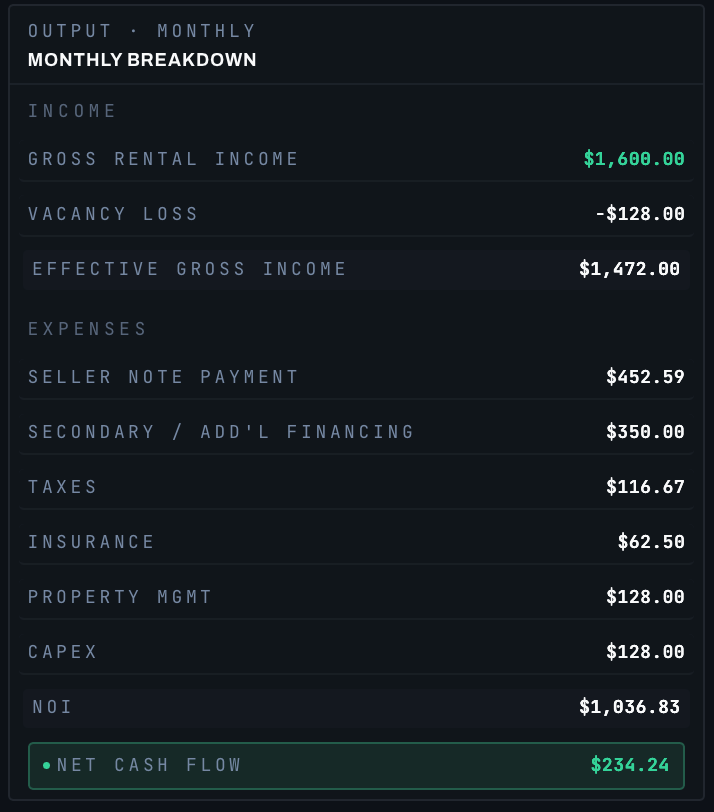
    $50k purchase, $6k down seller paper at 12% + 2 pts / 10yr amort, and hard money for rehab is doable, and per your numbers gets fairly decent DSCR and cash flow for your all-in price.

    Hard money is definitely realistic for the rehab and is actually one of the biggest reasons people pursue it. You get the money quickly without the slowdowns of the banks and can renovate the property, but usually you want to get that cash refinanced and back to them quickly. Why not consider a DSCR loan to cover your repairs instead? Your DSCR looks to be 1.99 which would qualify you for many DSCR lenders.
  • J CastroBusiness Member
    Lender · Florida · Member since 2025 · 698 posts · 253 votes
    2mo

    Hi@Rose Bartolome, welcome to BP!
    From a lender’s perspective, the biggest issue with the proposed structure is lien position, not necessarily the economics of the deal.

    If the seller is carrying the purchase financing and recording a 1st-position lien, most conventional hard-money lenders will not simply come in behind that seller note to fund the rehab. The lender wants its collateral position protected, particularly when it is advancing significant funds for improvements.

    A few things I’d consider:

    1. Owner financing + HML rehab financing can work—but the structure matters.
    A hard-money lender may consider the transaction if the seller is willing to subordinate its lien and allow the HML to take 1st position. That would need to be agreed upon and documented before closing. Some lenders may also require the seller note to be modified or have specific terms during the HML loan.

    2. A HML taking 2nd position is much less common.
    There are private lenders who may consider a 2nd-position loan, but the pricing, leverage, and underwriting requirements are generally much more conservative. From the lender’s perspective, you’re advancing $24K–$45K of new capital while someone else controls the first lien.

    3. The cleaner structure may be one loan covering acquisition + rehab.
    If the numbers support it, I’d investigate a single HML that finances the purchase and renovation. It creates a much cleaner collateral structure and gives the lender control over the entire project and construction draws.

    That said, your acquisition price is only $50,000, so I’d run the complete project economics before deciding which structure makes sense.

    For example, at the high end:

    $50,000 purchase

    • $45,000 rehab
      = $95,000 total basis

    Against a $95,000 ARV, there’s essentially no equity cushion after financing costs, closing costs, holding costs, and selling/refinancing costs.

    At the lower rehab scenario:

    $50,000 purchase

    • $24,000 rehab
      = $74,000 basis

    Against a $75,000 ARV, you’re again operating with very little margin.

    So from a lender’s perspective, the ARV and rehab assumptions need to be extremely well supported. The $75K–$95K ARV range is wide relative to the size of the project.

    The rental side is more interesting. If the property can realistically rent for $1,400–$1,800/month, I’d absolutely analyze it as a potential long-term rental. But don’t look at rent alone—factor in taxes, insurance, vacancy, maintenance, management, utilities, debt service, and capital expenditures.

    One thing I’d change before moving forward

    I’d get two independent opinions on the ARV and rehab budget before committing to the purchase.

    If the $95K ARV is realistic and the rehab can actually be completed for $24K–$30K, the deal may have a reasonable BRRRR component. If the true ARV is closer to $75K and the rehab is closer to $45K, I’d be much more cautious.

    From a lender’s perspective, I’d rather see a clean first-position loan with conservative leverage than a complicated first/second-lien structure that leaves very little equity cushion.

    And before signing the seller-financing documents, I’d have the proposed financing structure reviewed by the lender and the closing attorney/title company. You don’t want to close the purchase with the seller in first position and discover afterward that your rehab lender won’t fund behind them.

    JCREIG Capital Funding
  • Lender · Houston, TX · Member since 2026 · 73 posts · 11 votes
    2mo

    ARV funding is based on the advance as a percentage of the ARV — generally that advance is 70% — to arrive at the maximum loan amount. From there, closing costs and repair costs are deducted. Whatever is left over is what's available to pay the seller. Regardless of whether the HML funds the renovations or someone else does, those expenses are still going to be deducted from the ARV. Most HMLs aren't going to rely on someone else funding the repairs to justify their ARV.

    The better practice, and what I've seen work, is for the HML to pay the seller the amount available from that calculation, and the seller accepts that payoff to release their ownership. Whatever difference remains to satisfy what the seller actually wants for the home gets documented as a second lien and/or a promissory note.

    By the way, I'm assuming there's no existing mortgage and the home is free and clear — including no judgments, liens, etc.

  • Ashish AcharyaBusiness Member
    CPA, CFP®, PFS · FL · Member since 2017 · 5k+ posts · 3k+ votes
    2mo

    Rose, yes, the combo can be possible, but lien position is probably the first thing to solve before spending much more time on the structure.

    Many rehab/hard-money lenders want to be in first position. Some will allow seller financing behind them if the seller agrees to subordinate, while others will not permit secondary financing at all. One rehab lender, for example, explicitly requires a first mortgage only, while other hard-money lenders describe structures where another note can sit behind the first lien. So I’d talk to the hard-money lender before finalizing the seller note and ask specifically whether they allow seller financing in second position.

    On the deal itself, I'd be careful calling this a true BRRRR until you know the refinance numbers. At a $50K purchase plus $24K–$45K rehab, you're roughly $74K–$95K in before financing and holding costs. If the ARV lands closer to $75K than $95K, there may not be enough room to refinance most of your capital back out. I'd underwrite both ends of the rehab and ARV range before deciding.

    Since the end goal is a rental, keep the rehab costs separated by component from day one. Once the property is placed in service, I’d evaluate cost segregation to see whether qualifying components can be depreciated faster. But the important question is whether those accelerated losses will actually be usable under your passive-loss and material-participation situation.

    And because you’re doing a meaningful rehab, detailed tracking of replaced components may also create a partial disposition opportunity for tax purposes.

    I’d solve the lien structure first, then make sure the conservative refinance scenario still works before moving forward.

    Happy to connect!

    INVESTOR FRIENDLY CPA®5241 Reviews
    TaxMD® | Tax Planning Software
  • Shiloh LundahlPro Member
    Rental Property Investor · Gilbert, AZ · Member since 2016 · 3k+ posts · 4k+ votes
    2mo

    @Rose Bartolome what people are trying to say, Rose is that this may not be a good deal. if you're purchasing it as purely investment property, then you may want to pass on this one because this one will slow you down in your investing journey. 

    the person that's selling you, the property on seller financing is selling it to you on hard money terms. this is a good deal for him because he's selling it to you at value in poor condition and then you go and fix things with it and then you can't refinance it, which then makes it so you continue to pay him at hard money rates or even just takes the property back through foreclosure. so it is a good deal for somebody, it's just not a good deal for you. Are you connected with other investors in your area that may be able to help you recognize better deals from deals that aren't so good?

  • Josh HandlerPro Member
    Contractor · Memphis, TN · Member since 2026 · 67 posts · 78 votes
    2mo

    Rose, everybody here is arguing about lien position and nobody's said the thing that actually kills this deal, so I'll do it from the construction side.

    Your rehab number is $24k to $45k. That's not a range, that's a coin flip. Nobody who has actually walked that house has told you what it needs. A 1,300 square foot 3/1 built before 1920 has three questions that decide everything, and none of them show up in a walkthrough: what the drain line looks like on camera, what's behind the panel, and whether the floor is level. On a house that age I'd expect original cast iron or clay drain, some knob and tube or cloth wire, and a foundation that's moved. Any one of those is five figures by itself.

    The reason that matters more than the financing question: you're planning to borrow against an estimate you can't defend. If the real number is $45k and you financed for $30k, you don't have a lien problem, you have a half-finished house and no money, and that's when people lose the property.

    Before you spend another hour on subordination agreements, do this. Get a sewer scope, $200 to $400 in most markets. Get a real GC to walk it and put a line-item scope on paper, not a number scribbled on the back of a card. Then you'll know if this is a $24k house or a $45k house, and you'll have something a lender can actually underwrite instead of a range.

    And if the honest number comes back at $45k, the deal answers itself. You don't need to talk yourself into it.

    For context, I build and rehab for a living, so I read these budgets all week, and the spread in your estimate is the loudest thing in your post.

  • Drew SygitBusiness Member
    Property Manager · Royal Oak, MI · Member since 2012 · 12k+ posts · 9k+ votes
    2mo

    Are you actually investing the $6k down payment, or trying to get 100% financing?

    • Rose BartolomePro Member
      OP
      Member since 2026 · 5 posts · 1 vote
      2mo

      @Drew Sygit real cash- the $6k down is coming from my own funds, that is, IF I pursue it. 

    • Jay HinrichsBusiness Member
      Real Estate Consultant · Summerlin, NV · Member since 2014 · 45k+ posts · 66k+ votes
      2mo
      Quote from @Rose Bartolome:

      @Drew Sygit real cash- the $6k down is coming from my own funds, that is, IF Rose your wasting your time its nice that all these folks have commented on this thread but unless you have friends or family that will do the second position loan there is NO lender that is in business of making loans that is going to fund you in the scenario you presented. the best advice was from the POST were you get the seller to subordinate then you get a first and even then the loan is SO small that there are far and few real lenders that will even fool with it and as others mentioned this is probably in a very tough area or very rural so there is that to. Just sayin I fund a lot of BRRR in the mid west and have been since 2002 so I do have experience in thse exact assets. I would do first position for some one I

  • Vijay FriedmanBusiness Member
    Miami, FL · Member since 2026 · 766 posts · 122 votes
    2mo
    Quote from @Rose Bartolome:

    Hi, my name is Rose. I’m working on a BRRRR deal and want to sanity-check the financing structure before I move forward.

    I found a property with a purchase price of $50,000, with the seller offering owner financing: $6,000 down, 12% interest, 2 points, 10-year amortization. The property needs rehab estimated between $24,000–$45,000 depending on scope (budget update vs. full renovation).

    Some additional context on the deal itself:

    • Estimated rent: $1,400–$1,800/month depending on rehab level

    • Estimated ARV: roughly $75,000–$95,000 depending on rehab scope (budget vs. full reno)

    • 3BR/1BA, ~1,300 sqft, single family, built early 1900s

    • Property is in a lower-price-point Midwest market

    My plan was to use the owner financing for the purchase and bring in a hard money lender to fund the rehab separately. Before I go further, I want to understand:

    1. Is it realistic to get a hard money lender to fund rehab on a property where the seller already holds a 1st lien position via owner financing? My understanding is HMLs typically want 1st position, so I’m not sure this stacks the way I’m hoping.

    2. Has anyone successfully negotiated a seller into 2nd lien position behind a HML, or gotten a HML to accept 2nd position behind a seller note?

    3. If this structure isn’t workable, is it more common to just use one HML to cover both purchase + rehab, and skip owner financing altogether?

    4. Given the rent-to-ARV numbers above, does this look more like a solid buy-and-hold than a true cash-out BRRRR to anyone with more experience running these numbers?

    Would appreciate hearing from anyone who’s structured a deal this way, or from lenders who can speak to how they view lien position in these situations. Thanks in advance!

    @Rose Bartolome
    Your concern on lien position is valid. Most rehab lenders will want to be in first position, so having the seller hold the first and bringing in a rehab lender behind them can be difficult. I’d also compare that structure against using one rehab loan for the purchase + renovation, then refinancing once the property is stabilized. With your numbers, the loan size may be the bigger hurdle.

    DreamPoint Capital
  • Real Estate Broker · Coppell, TX · Member since 2011 · 5k+ posts · 4k+ votes
    1mo

    I think in most markets, don't buy 100 year old houses for investment.  Every time one of my investor clients tells me they want to do this, I ask them to go get a quote on what it takes to scrape, prep, repair rot, and paint that house.  That normally resolves the issue.

    I'm sure there are exceptions.

    Don't get blinded by the idea of seller financing. If the deal doesn't work with all HML then it doesn't work.

    Might be more interesting if you can find the Reno yourself and refinance out of the owner finance with DSCR or investment loan after rehab/rental. Another issue these days is to shop around in your area with local lenders who know your market well to see if you can finance that and what the requirements are.

  • Ryan ThomsonBusiness Member
    Real Estate Agent · Colorado Springs, CO · Member since 2018 · 1k+ posts · 1k+ votes
    1mo

    HMLs almost never take 2nd position behind a seller note. You can find private lenders who will, but the terms get ugly fast (15%+) and the pool of people willing to do it is small.

    The cleaner structure: find a HML that does purchase + rehab as a single all-in-one loan based on ARV. They take out the seller, fund the rehab, hold 1st position on everything. Most want you to cover the gap between their max loan (65-70% of ARV) and your total cost basis at closing.

    Before you go down that road, I'd look at the deal math. Budget scenario: $50k + $24k rehab = $74k all-in, ARV $75k. That's 99% of ARV before a single overrun. Full reno: $95k all-in, ARV $95k. That's not a BRRRR, that's treading water if everything goes perfectly.

    The 12% on the seller note is expensive carrying costs, and you're stacking HML rates on top during the hold period. The deal might not survive its own financing structure regardless of lien position.

    If the numbers do work after a closer look, another option is using a HML for the full purchase and rehab (skip the seller note), then refinancing into a DSCR loan after stabilization. Simpler stack, cleaner exit.

    The Assumable Guy544 Reviews
  • Nicholas FloydBusiness Member
    NY · Member since 2026 · 252 posts · 88 votes
    1mo

    Your read is pretty much on target. Most hard money lenders are going to want first lien position, so if you keep the seller financing, the cleaner structure is usually getting the seller to agree to subordinate behind the rehab lender. I’d also watch the total basis here, at a $50K purchase plus potentially $45K in rehab against a $75K–$95K ARV, the full-renovation scenario could get tight pretty quickly. I work on the funding side and would be happy to compare a couple different ways of structuring the capital stack if it would help.

  • Specialist · NJ · Member since 2022 · 1k+ posts · 653 votes
    1mo

    This is not a deal.  You'll wind up getting stuck in the hard money loan or have to bring a ton of money to the refi.

    To figure out if there is a deal or not, put the project cost over the ARV and get the %. Under 70% is decent, over 70% can be risky. You are at like 90%. That's a nightmare.

    To reverse engineer the real number. If the ARV is 95k, you need the total project cost to be around 67k. That means if you buy for 50k you have room for 17k in repairs.

  • Erik EstradaBusiness Member
    Lender · Member since 2022 · 6k+ posts · 1k+ votes
    1mo

    Your ARV is very tight on this deal and the spread of the rehab is nearly double... This might just be a pass. If you come across these deals often most lenders will cap you at 75 LTARV (maybe even 70 due to the low price point). Additionally depending on your experience and credit you may be required to put down 10-20% + closing costs. Most HMLs will not lend in 2nd position for rehab funds only.

    But if the numbers do work on the next one and you have a solid credit score or experience, you should be able to get 80-90% of the purchase price + 100% of the rehab costs, assuming that figure is below 70-75% of the ARV with a similar rate

    LuxePrivate Investments LLC 572 Reviews
  • Lender · Washington DC · Member since 2026 · 73 posts · 19 votes
    4w

    Rose, this is definitely a structure worth looking at before you move forward. The seller financing can potentially be useful, but the lien position and how the rehab capital is structured are the big pieces. I’m interested in deals like this and would be open to looking at the numbers with you to see if there’s a workable way to structure the acquisition and rehab. Feel free to DM me. I’d be interested in learning more about the property.

Join the conversationCreate a free account to reply, vote on answers and follow this thread.