Rental Property Investor · San Diego, CA · Member since 2014 · 80 posts · 44 votes
Hello, I have moved to a residence and plan to turn my old primary residence as short term rental to take advantage of the 100% bonus depreciation in the year of 2026. I purchased the property in 2013. I got conflicting information from different cost segaration company. One says that I am not eligible to take the 100% bonus depreciation because the property was purchased before Jan 19 2025 but another says only the service date matters. Anyone has experience on this? Appreciate for the feedback in advanced!
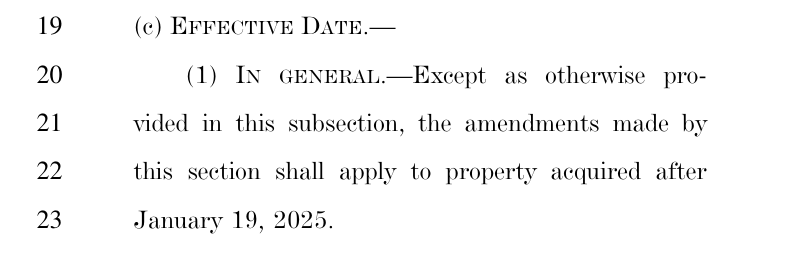
The current rule for 100% bonus is the asset must be BOTH acquired and put in service after Jan 19 2025.
The in-service date is normally what dictates the applicable depreciation for an asset; however not in this case.
I'm curious which cost segregation firm said only the in-service date mattered? You can DM me if you'd prefer not sharing it publicly.
Would any bonus-depreciation rates from the prior law still apply?
For example: primary residence was purchased in 2022 when bonus depreciation was 100%. If it’s converted to a rental and placed in service this year after the new bill renewed 100% bonus depreciation, would it satisfy the “acquired” and “placed in service” tests?
Hello, I have moved to a residence and plan to turn my old primary residence as short term rental to take advantage of the 100% bonus depreciation in the year of 2026. I purchased the property in 2013. I got conflicting information from different cost segaration company. One says that I am not eligible to take the 100% bonus depreciation because the property was purchased before Jan 19 2025 but another says only the service date matters. Anyone has experience on this? Appreciate for the feedback in advanced!
As @Natalie Kolodij mentioned, it's absolutely BOTH purchased + placed in service after 1/19/25.
Since you purchased the original property BEFORE Jan 19, 2025, you're subject to the old bonus depreciation rate. Unfortunately you're not eligible for the 100% bonus depreciation. To qualify for the 100% bonus rate, you must meet BOTH tests (the placed in service date and the acquisition rules).
@Wai Chan Great question and the others nailed the answer on the 100% bonus depreciation rules — both acquisition AND in-service dates need to be after 1/19/25, so the 2013 purchase unfortunately disqualifies you from the full bonus.
But don't overlook the alternative: even without 100% bonus depreciation, a cost segregation study on a property you're converting to STR can still be extremely valuable. You can reclassify components (appliances, flooring, landscaping, etc.) from the standard 27.5-year schedule into 5, 7, or 15-year categories. Combined with the STR material participation loophole (averaging 7+ days per guest stay and 100+ hours of your own participation), those accelerated deductions can offset active income — which is the real power move most investors miss.
Worth running the numbers with your CPA to see if a cost seg study still pencils out even without the bonus. For a primary-to-STR conversion, it often does.
depends on when the property was placed in service, it shouldnt Much matter about bonus depreciation. If you bought and placed the asset into service in 2013, all the 5 and 7 year property will be fully depreciated and the 15 year property would be nearly 100% depreciated.
I think you misread the post or skipped responses?
For current bonus acquisition date and in service matter. I shared a screenshot from the bill.
Also, in service determines the depreciable method overall and it was a primary until now, it was a primary in 2013 not in service as a rental so they haven't used up any depreciation.
@Natalie Kolodij got it. I recognize in service date and purchase date matter and agree he's not 100% eligible for bonus depreciation.
I didn't pick up that there was no prior depreciation as that appeared unclear initially. Now that I'm re-reading, I see my error. Thanks for the callout on that as well as clarification.
Hello, I have moved to a residence and plan to turn my old primary residence as short term rental to take advantage of the 100% bonus depreciation in the year of 2026. I purchased the property in 2013. I got conflicting information from different cost segaration company. One says that I am not eligible to take the 100% bonus depreciation because the property was purchased before Jan 19 2025 but another says only the service date matters. Anyone has experience on this? Appreciate for the feedback in advanced!
Hi @Wai Chan! Owner of Maven Cost Segregation here.
The first company gave you the correct advice, but there’s a major lining here that often gets missed.
Just to clarify, you cannot claim bonus depreciation on the original house basis. To qualify for bonus depreciation on "used" property, you cannot have had any prior use of the property (including personal use) before converting it. Since you bought and lived in it back in 2013, the original structure fails the acquisition test for bonus depreciation.
The Lining: You shouldn't scrap the strategy entirely. You can still benefit from a cost segregation study in two big ways:
Standard Accelerated Depreciation: We can still carve out the 5, 7, and 15-year assets from your 2013 basis and depreciate them on shorter schedules using standard MACRS. It’s not a year-one write-off, but it still beats 39-year straight-line depreciation.
New Improvements DO Qualify: Any new money you spend right now to get the property ready for the STR market like new furniture, appliances, landscaping, or non-structural interior renovations (QIP) will fully qualify for the current bonus depreciation rates because those are brand-new acquisitions placed in service in 2026.
Hope that helps!
Just to confirm — I think this is a key point. If bonus depreciation for "used" property is disallowed when the taxpayer previously used the property, then a primary residence converted to a rental would never qualify for bonus depreciation, even if both the acquisition and placed-in-service dates are after 1/19/2025. Am I understanding that correctly? Thanks.
Good question, and I would be careful with the word “never” here.
The rule is not simply that prior personal use automatically disqualifies the property from bonus depreciation. There is actually a change-in-use rule that allows property originally acquired for personal use and later converted to business or income-producing use to qualify for bonus depreciation, assuming all the other bonus depreciation requirements are met.
The bigger issue is what asset we are talking about.
The house/building itself generally will not qualify for bonus depreciation because residential rental real estate is 27.5-year property, and bonus depreciation generally applies to property with a recovery period of 20 years or less.
But if the property was acquired after 1/19/2025 and later converted to a rental, certain shorter-life assets identified through a cost segregation study may potentially qualify. Think 5-year personal property, certain 15-year land improvements, furnishings, appliances, equipment, etc., depending on the facts.
So I would frame it this way:
A converted primary residence is not automatically disqualified from bonus just because it was used personally first. However, the main dwelling structure itself generally does not qualify because it is 27.5-year residential rental property. The possible bonus depreciation opportunity is usually in the shorter-life components or newly purchased assets placed in service for the rental.
I would definitely have a CPA look at the acquisition date, placed-in-service date, conversion basis, cost-seg allocation, and passive activity rules before relying on the deduction.
Natalie and Christopher are spot on about the core rule, but there is a strategic nuance for new improvements that you can still leverage. I'm executing this exact strategy now: I bought a property in 2024 but started renovations after Jan 19th and placed it into STR service in March, meaning my original structure gets phased-down depreciation, but the newly acquired renovation costs and furnishings are fully eligible for the 100% bonus. Hope that helps!
@Wai Chan, hi. The confusion likely comes from mixing two different rules. For bonus depreciation, what generally matters is when the property or its components are placed in service as a rental, not the original purchase date. When a primary residence is converted to a short-term rental, it is considered placed in service when it becomes available for rent, and a cost segregation study may identify components eligible for bonus depreciation. However, the actual benefit depends on several factors, including the year of conversion, whether bonus depreciation is still 100% that year, material participation, and how the depreciable basis is determined at conversion. Because the basis becomes the lower of adjusted basis or fair market value at the time of conversion, running a tax projection before placing the property in service is usually important to confirm the strategy works as expected.
Hey Wai! This is a great question and one a lot of people get confused on. Natalie and some others gave you a really solid answer above.
I just wanted to add a little more color on the tax side. By default, short-term rental (STR) losses are still considered passive. But if you materially participate (Fulton touched on this above) in the activity (things like managing bookings, handling guest communication, coordinating cleanings, etc.), you may be able to treat that income and those losses as non-passive.
If you’re able to do that, those losses could potentially be used to offset other non-passive income, like W-2 or business income, which is where a lot of the tax benefit comes in.
That said, you also want to make sure it’s actually worth it in your situation, you need enough taxable income on the other side for those losses to have a real impact. Otherwise, you might be putting in extra effort without getting the full benefit.
Definitely something worth running by a CPA based on your specific numbers, but you’re thinking about it the right way. Happy to connect!
Hey Wai — just backing up what's already been said in the thread. Under the current 100% bonus depreciation rules, the asset has to clear two separate tests: it needs to be acquired after January 19, 2025 AND placed in service after that same date. Normally with depreciation it's just the placed-in-service date that controls things, but bonus depreciation layers its own acquisition-date hurdle on top of that. Since you originally bought the property back in 2013, the building doesn't pass the acquisition test no matter when you convert it to an STR, so 100% bonus depreciation isn't available on the original purchase basis.
We just helped someone with this recently. The answer is nuanced, but for the original house purchased in 2013, I would be very cautious assuming 100% bonus applies.
Placed in service date matters for starting rental depreciation, but bonus depreciation also has acquisition and prior use rules. Since you already owned and personally used the property before converting it, the existing building components from a cost seg may not qualify for 100% bonus.
That said, new furnishings, appliances, improvements, and other eligible property purchased and placed in service for the STR in 2026 may be a different story.
I’d make sure your CPA and cost seg firm are separating the converted home basis from newly acquired assets before relying on the deduction.