The Negative Cash Flow Club!!

The Negative Cash Flow Club!!

Real Estate Agent · Minot, ND · Member since 2021 · 131 posts · 223 votes

The numbers are in for 2021... 

6 doors acquired in 2021... 8 total doors owned (all SFR)

54k in rents, 24k expenses, 30k cap ex, and 30,500k in PITI...

For a grand total of -31k net cash flow!!!

but...

400k equity growth! I'd call that a win.

Know what you're getting into folks!! It's a long term game for buy & holders.

Cheers!!

25Reply
255 views

Most Popular Reply

J ScottPro Member
Moderator
Investor · Sarasota, FL · Member since 2008 · 17k+ posts · 17k+ votes
4y

Nothing wrong with cash flow negative, as long as you understand what you're getting into and have the reserves to cover the loss. 

That said, a lot of people go into negative cash flow without understanding the risks.  I know a lot of investors who were using this method to scale back in 2004-2007, and they learned the hard way that markets don't always go up.  Many of them were over-leveraged, under-capitalized, and weren't prepared for a spike in vacancies and bad debt.

It all boils down to your ability to absorb risk, and only you know what that looks like. 

See this reply in the discussion

65 Replies

Jump to latestLatest
  • Bruce WoodruffPro Member
    Contractor/Investor/Consultant · San Diego / Phoenix · Member since 2021 · 12k+ posts · 15k+ votes
    4y

    I like @Marcus Auerbach approach on this. Granted it's complicated and there a several right answers. But the way for the average person to achieve wealth, building equity is key. OF COURSE it is imperative that you buy/sell/hold at the right times.... :-)

  • Investor · NorCal · Member since 2015 · 281 posts · 240 votes
    4y

    I would only call it a win if you had sold with a $400k profit. But even if you would have sold, after paying all commissions, closing costs and capital gains taxes, on 8 properties there would’nt be too much left to take home of the $400k paper value…

  • Investor · NorCal · Member since 2015 · 281 posts · 240 votes
    4y

    You only locked in the loss of $31k, but you did not lock in the gain of $400k

  • Rental Property Investor · Winona, MN · Member since 2018 · 87 posts · 90 votes
    4y

    @Amy Raye Rogers, can you raise your rents? Or have tenants take care of utilities? We have 5 SFRs — gross rents are $6250/month and $75k/year; we self-manage. Tenants pay all utilities — including heat, electric, water, sewer, & trash. So, other than repairs/maintenance, our only expenses are PITIs which run about $4000/month. We put our “profits” back into our properties right now, as we both have full-time W-2s and are hoping to get updates completed before we retire and need the cash flow these rental produce.

  • Rental Property Investor · Member since 2021 · 335 posts · 193 votes
    4y

    @Amy Raye Rogers

    I appreciate your comments and see where you are coming from. My couple of thoughts / feedback:

    a) Your strategy in all equity works for the few. Example, if you have a high paying W2 or commissions job that is cash flowing to help off set your property monthly p&l losses, great! Otherwise, bleeding in red is not wise as it can cripple the typical folks who do not have enough accruals or high cash flow job.

    b) If no high paying job or other cash flow avenues, I think one should have property accruals in place to subsidize losses until one can raise rent. Otherwise, you’ll be stuck in pickle of properties value go down and you cannot offload the equity gain (i .e. Mini crash)

    I’m from CA. I see your valid points. My two rentals in CA experienced 100% in equity. However beginning years were tough on my and grind my W2 salary to offset. I’m still up but cash flow nothing near my other out of CA properties.

    In conclusion, I’m always a cash flow play in class A or B areas. So I’ll find markets that at least allows me to break even and has appreciation. Maybe I’m just too risk adverse… as a millennial who saw the 08 crash.

  • Joe VilleneuvePro Member
    Plymouth, MI · Member since 2013 · 13k+ posts · 19k+ votes
    4y
    Originally posted by @Bruce Woodruff:

    If you look at it that way, you are of course correct. However you're kinda comparing apples and oranges as well. No problem, I get your point and it should be considered by investors.....

     Not so much apples and oranges, as much as it is probably comparing two different types of apples.  LOL

  • Rental Property Investor · Member since 2021 · 335 posts · 193 votes
    4y

    @Joe Villeneuve

    Joe - you’re pretty active here and totally agree with you. See my latest post. Let me know you’re thoughts?

  • Joe VilleneuvePro Member
    Plymouth, MI · Member since 2013 · 13k+ posts · 19k+ votes
    4y
    Originally posted by @Allen Wu:

    @Joe Villeneuve

    Joe - you’re pretty active here and totally agree with you. See my latest post. Let me know you’re thoughts?

     Rationalizations don't balance out problems.  Saying "that by having another source of cash that offsets negative CF is like saying the following scenario is also OK:

    Since you have a fulltime job that pays you enough to have enough extra money, you would be perfectly willing to work a second job...and use your extra money from your first job to pay the employer of your second job for the privilege of working that second job.  If you wouldn't work at a job, and be willing to pay your employer to work there before you got the high paying job, why is it OK to do it in the reverse order?

    Same with REI. If you wouldn't buy a negative CF property without a positive CF property to cover the negative CF from the first property, why would you buy that negative CF property after you had the high CF property? The order doesn't of appearance make it right.

  • Investor · Las Vegas, NV · Member since 2013 · 8k+ posts · 10k+ votes
    4y

    So someone offers you a $360k property for $1,000/mo on a 30 year zero interest loan. The taxes and insurance are $200 so your total payment is $1200. And by magic you know for a fact that you will get exactly $1,100/mo in rent year one. It’s negative $1,200/year cashflow and you aren’t buying the property? You’re not willing to put in $1,200/year to make $10,800? A 900% return seems like a good deal. 

    While this exact scenario probably doesn’t occur often I can show you one that did.

    $460k lakefront townhome at 3% for 30 years $1940/mo payment. $550/mo insurance/taxes and $400/mo Hoa. $2890 total payment. year one rent $2700/mo, minus $190/mo cashflow or $2280/year. BUT, the loan was paid down $9600, and income of $7600, a 300% return. Plus a $16,700 depreciation write off making that income tax free and carrying forward another $9,000 future deduction worth the $2,000 I put in to the deal yearly. 

    Fast forward to year 7 (2021) rent is $3100, taxes are up $50/mo so my payment is $2940. Now it’s positive cashflow $160/mo $2000/year. But again,the big deals are loan paid down $11,500 for a profit of $13,500/year that is still tax free and counting with the $16,700 depreciation. Of course it’s appreciated more than a couple hundred thousand but that’s the bonus of buying rare lakefront near the cities, almost a given. Being a townhome meant zero capex, a TOTAL of $600 in repairs (garage door opener and a microwave) and a newly signed 2 year extension for $3,500/mo for 2022/2023 zero vacancy. 

    Comparing year 1 cashflow on a property you plan to hold for 30 years is like assuming the pay for year 1 in a profession you're considering is the same as year 30. If it is, choose a different profession/property. People assume negative cashflow in their IRA/ROTH/402k retirement plan. This was my retirement plan, the more you put in the more you eventually get out. The more you pull out early the less you eventually get.

    Unless you think they’re going to solve the inflation problem they said didn’t even exist, you want to borrow as much s you can afford. And to do that you borrow against expensive properties so you don’t run out of cheap loans. Imagine last years 10-20% price appreciation on 10 x $200k properties versus 10 x $400k properties. You’re basically getting a free property, why not make it a $400k one. 

    Sorry it got so long, feel free to skip. After all it’s just one guy’s experience and the internet is full of them. 
  • Joe S.Pro Member
    Investor · San Antonio · Member since 2020 · 3k+ posts · 3k+ votes
    4y
    Originally posted by @Bill B.:

    So someone offers you a $360k property for $1,000/mo on a 30 year zero interest loan. The taxes and insurance are $200 so your total payment is $1200. And by magic you know for a fact that you will get exactly $1,100/mo in rent year one. It’s negative $1,200/year cashflow and you aren’t buying the property? You’re not willing to put in $1,200/year to make $10,800? A 900% return seems like a good deal. 

    While this exact scenario probably doesn’t occur often I can show you one that did.

    $460k lakefront townhome at 3% for 30 years $1940/mo payment. $550/mo insurance/taxes and $400/mo Hoa. $2890 total payment. year one rent $2700/mo, minus $190/mo cashflow or $2280/year. BUT, the loan was paid down $9600, and income of $7600, a 300% return. Plus a $16,700 depreciation write off making that income tax free and carrying forward another $9,000 future deduction worth the $2,000 I put in to the deal yearly. 

    Fast forward to year 7 (2021) rent is $3100, taxes are up $50/mo so my payment is $2940. Now it’s positive cashflow $160/mo $2000/year. But again,the big deals are loan paid down $11,500 for a profit of $13,500/year that is still tax free and counting with the $16,700 depreciation. Of course it’s appreciated more than a couple hundred thousand but that’s the bonus of buying rare lakefront near the cities, almost a given. Being a townhome meant zero capex, a TOTAL of $600 in repairs (garage door opener and a microwave) and a newly signed 2 year extension for $3,500/mo for 2022/2023 zero vacancy. 

    Comparing year 1 cashflow on a property you plan to hold for 30 years is like assuming the pay for year 1 in a profession you're considering is the same as year 30. If it is, choose a different profession/property. People assume negative cashflow in their IRA/ROTH/402k retirement plan. This was my retirement plan, the more you put in the more you eventually get out. The more you pull out early the less you eventually get.

    Unless you think they’re going to solve the inflation problem they said didn’t even exist, you want to borrow as much s you can afford. And to do that you borrow against expensive properties so you don’t run out of cheap loans. Imagine last years 10-20% price appreciation on 10 x $200k properties versus 10 x $400k properties. You’re basically getting a free property, why not make it a $400k one. 

    Sorry it got so long, feel free to skip. After all it’s just one guy’s experience and the internet is full of them. 

    You made some very good points. How many of these kind of properties could you Subsidize until they threw off a profit?

  • J ScottPro Member
    Moderator
    Investor · Sarasota, FL · Member since 2008 · 17k+ posts · 17k+ votes
    4y
    Originally posted by @Joe Villeneuve:

    Locked up cash has no use when it's locked up.

    My $.02...

    Locked up cash has HUGE value as risk mitigation.  It's both catastrophic insurance and a long-term asset preservation strategy.  

    If what you say about locked up cash is true, the optimal strategy would always be to leverage as much as possible -- even greater than 100% LTV when possible. And again, for those of us investing back in 2008, we know that maximum leverage (especially at or above 100% LTV) isn't necessarily a good thing.

    My entire portfolio is leveraged at about 72% right now.  That 28% locked up equity/cash is what helps me sleep well at night.  It's my Plan B.  My cushion.  The cost of that locked up cash (inflation, opportunity cost) is well worth it to me.  

    That said, to each his own...

  • J ScottPro Member
    Moderator
    Investor · Sarasota, FL · Member since 2008 · 17k+ posts · 17k+ votes
    4y
    Originally posted by @Joe Splitrock:

    @Amy Raye Rogers I wouldn't include CAPEX in a cash flow calculation, because those are capital improvements.

    I'm guessing you'd agreed, Joe, but for the others reading that might not be as experienced...

    I wouldn't necessarily include the upfront capex required to get a property rent ready in cash flow calculations, but I *do* include a prorated ongoing/long-term capex as part of my cash flow assumptions.

    For example, if I'm going to spend $10,000 every 25 years on a new roof, that hits my cashflow an average of about $400/year, or about $33/month.  I would definitely count that $33/month for long-term roof capex as part of my cashflow.  In fact, I typically assume about $75-100/month for all prorated/long-term capex on each of my single family properties.

  • Investor · Las Vegas, NV · Member since 2013 · 8k+ posts · 10k+ votes
    4y

    @Joe S.

    In my example they’re only negative less than 5 years. I couldn’t buy enough houses to cause a big negative cashflow problem. I only bought a couple per year (one as a primary and one as a rental) every year for 5 years.  That means even with then of them I woulda have been negative $500/mo on average. That’s the same as one roof replacement or ac unit. 2 months of vacancy. Those are all expenses I didn’t have. Most people invest near their home. In Las Vegas I was blessed with 1-10 year old properties with stucco siding, tile roofs, no weather issues, no income tax, very low property tax and very cheap insurance rates. These are all expenses that are forever but people just accept them because that’s what it’s like in their market. 

    I’m not saying it’s the ideal investment strategy. Im saying so many people in real estate investing make enough money where cashflow being positive or negative $100 or $200/mo means NOTHING. That’s a nice meal, their cable tv bill, or much less than they spend on short vacation. More than 50% of people on BP don’t seem to realize that loan paydown is income, they only count cashflow. If you took one of these deals and made the loan interest only so it cashflowed they’d be excited about it. Even though it would be a worse deal. 

    Personally I’ve been doing this so long I’ve taken all these deals and paid them off. That is a TERRIBLE use of equity, ask anyone. But with a dozen properties I can live the life most people wish they could. And if 1 tenant pays their rent my expenses are covered. I’m doing the opposite of what I did, because I have enough. But I have enough because of what I did. This is another advantage of a dozen “expensive” properties over 24 or 36 or 50 cheaper properties, “where the high cashflow high returns are made.” I literally hear from each tenant every year or two when an appliance breaks or it’s time to renew the lease. 

  • Joe VilleneuvePro Member
    Plymouth, MI · Member since 2013 · 13k+ posts · 19k+ votes
    4y
    Originally posted by @J Scott:
    Originally posted by @Joe Villeneuve:

    Locked up cash has no use when it's locked up.

    My $.02...

    Locked up cash has HUGE value as risk mitigation.  It's both catastrophic insurance and a long-term asset preservation strategy.  

    If what you say about locked up cash is true, the optimal strategy would always be to leverage as much as possible -- even greater than 100% LTV when possible. And again, for those of us investing back in 2008, we know that maximum leverage (especially at or above 100% LTV) isn't necessarily a good thing.

    My entire portfolio is leveraged at about 72% right now.  That 28% locked up equity/cash is what helps me sleep well at night.  It's my Plan B.  My cushion.  The cost of that locked up cash (inflation, opportunity cost) is well worth it to me.  

    That said, to each his own...

     I'm not wrong when I speak of the value of equity, but your point regarding comfort level is also true.  Somewhere between value and comfort rests the optimum resting place for each investor.

  • Rental Property Investor · Brooke Park Drive · Member since 2018 · 1k+ posts · 2k+ votes
    4y

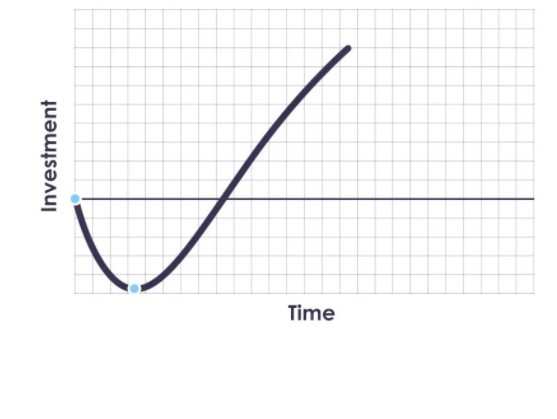
    That is the investment J-curve

  • Real Estate Agent · Chicago, IL · Member since 2017 · 2k+ posts · 2k+ votes
    4y

    Not a fan of these, there are plenty of positive (even slightly positive) cashflow properties that are a much safer buy. The market can fall and historically theres been times where assets took 12 years to make it back so make sure you have ample reserves if buying negative cashflow. 

  • Colin SmithBusiness Member
    Realtor · Colorado Springs, CO · Member since 2013 · 987 posts · 447 votes
    4y

    I would take these numbers any day. I try to explain this to so many new investors in the Colorado Springs market but all too often the only focus is ever on cash flow. Nice work!

  • Rental Property Investor · Seminole, FL · Member since 2014 · 85 posts · 68 votes
    4y

    I think I’ve negative cash flowed on my last three for the first year owned…. But after that, cash flow goes positive.  I don’t mind the year one hit considering we have 2 W2 incomes and we don’t spend any of our RE income

  • John MorganPro Member
    Rental Property Investor · Grand Prairie, TX · Member since 2018 · 2k+ posts · 2k+ votes
    4y

    @Amy Raye Rogers

    That’s a huge win with all that equity you just gained. Well done. So many negative people on here expecting big cash flowing grand slams with every purchase right away. I take a hit the first year or two on most of my properties with big rehabs. I’m ok being patient for a few years. Then happy to tap into that equity later if needed. It’s a get rich slow game. The patient ones that see the big picture always do well. Congrats!

  • Rental Property Investor · San Diego, CA · Member since 2010 · 366 posts · 314 votes
    4y

    I think the issue I have is with the title of this post. First year prep-to-rent costs really shouldn't be included in the cash-flow column; You are remedying defects the property had at purchase. I'd be inclined to put them in the "acquisition cost" column, as in "how much does it cost to acquire a rentable-to-my-standards property" (answer is purchase cost + repair cost). "Cash FLOW" usually means "how much cash goes into/out of my pocket every year from this property" (minus Capex/depreciation and so on and so forth).

  • Randall AlanPro Member
    Investor · Lakeland, FL · Member since 2017 · 1k+ posts · 1k+ votes
    4y
    Originally posted by @Maurice D.:

    How are you NOT hitting DTI issues on refi with all the mortgages and a large LOC pooling the equities?

     For us, the incomes on our properties offset the debt… the lender subtracts the rents from the debt servicing requirements.

    If your question is directly in relationship to the negative cash-flow scenario being discussed, I doubt the lenders link the cash outlays to the DTI calculations.

    What is sometimes harder is the reserve requirements that increase as you add properties in your name - especially when you split properties and income between yourself and your wife to have more Fannie Mae loan slots available.  Suddenly only the loans in your name count.  We have literally had to deed properties back and forth to make the equations work.  “Creative financing” at its best! 

    Randy


  • Luke AndersonPro Member
    Rental Property Investor · Enterprise, AL · Member since 2016 · 166 posts · 117 votes
    4y

    @Amy Raye Rogers you’ve got the right mindset. Buy and hold is a long game. Not every year will be profitable, but you’re always growing worth somewhere in the equation. Keep it up!

  • Member since 2018 · 1k+ posts · 1k+ votes
    4y

    "The ONLY reason why our offer was accepted was because we were able to close quickly using the LOC. There is value in using equity this way. I'd consider that a reasonable strategy. Also, we are able to refinance before paying a cent of interest."

    ---------------------------------------------------------

    I understand Joe V's posts and point of view, I just disagree with his philosophy of a high use of leverage. Here, however, Joe is right when he said that the property owns the equity, not you.  As for there being "value in using equity this way," do a thought experiment: What is the difference between you having $130k cash in the bank and no equity to put a line of credit against, and vice versa? Your refinancing would allow you to put the money back into the bank. No doubt Joe would say that you could assign your cash flow to the bank and borrow against that for those times when you needed to move fast.

  • Rental Property Investor · Escondido, CA · Member since 2017 · 679 posts · 550 votes
    4y

    @John Clark I stay out of your difference of opinion with Joe V but like to make you and anybody on this thread again aware that money in the bank or your bank account is not your money. Joe V. does not have to state that in the context of this post. Any money you put in a bank account belongs to the bank and when you read the fine print of your account opening agreement, you are lending that money to the bank. Often these day's you don't even get interest and pay fees for transactions, the bank is allowed to determine how much of your funds they deem reasonable to give to you on a daily or monthly basis. If they go bankrupt you have to get in line with all the other creditors to get pennies on the dollar back. Most people don't realize that they don't own the money they put in what they think is "their bank account and their money". Just saying...

  • Rental Property Investor · Escondido, CA · Member since 2017 · 679 posts · 550 votes
    4y

    @Amy Raye Rogers Congrats on closing these deals last year. I am a huge fan of buying properties that are turnkey. That way I am not even considering to account the improvements that lead to a point where you can lease the properties directly in the annual performance calculation.

    I would look at it this way:

    Purchase price = X

    Renovation cost = Y

    if done well, appraisal after reno is more than X+Y.

    Refi property to cover costs of Y and use any equity gained to buy the next property for X(New)

    Measure performance based on rental income, cash invested, expenses, and any reserves.

    For my case (or yours) determine the reserve size for a reasonable risk for costs in vacancy, maintenance, and CAPEX and put that amount into an account. In my case $30K.

    After that is use lease income - property management - PITI = cash flow x12 for an annual total

    Naturally everybody can develop their own plan, but this has worked for me and if we need to use any reserves I spread them over all properties for the year and get the details for each property from PM.

Join the conversationCreate a free account to reply, vote on answers and follow this thread.