How is anyone making $ right now?
Rental Property Investor · Grant, FL · Member since 2015 · 18 posts · 15 votes
Hi, I'm a new investor with 2 rental properties (Paid Cash, Full Renovations needed on both so that's where my experience comes from, now their successful rentals) & a fairly successful small multi-family flip out of state. I analyze multiple off-market deals thru wholesalers & my local network that know I'm a "Real" cash buyer on a daily basis and I can't get ANY deals to pencil out to cashflow if using the BRRRR method at 7-8% rates. Cut the purchase by 50% off asking, little to no renovation budget & still deals aren't cash flowing if you pull any money out. What am I missing? How are people making a "business" of investing using this method at this time? Those same deals with logical numbers I can flip & make $15-$20k estimated but personally that's not what I want to do....but is that what most are doing right now just to keep their Real Estate business flowing?
Obviously "real cash buyers" cash flow. People doing 1031's of paid off properties for replacements that are only 20-30% more expensive. People switching to MTR or STR are collecting 2-4x the rent. House hackers who are more concerned about saving rent or are doing rentals by room. LTR landlords are the most price sensitive and have to pay the least. They will only win by finding or making deals the others don't know about or taking a worse deal. Imagine if they accepted the same returns LTR landlords did. They'd be paying even higher prices.
Ps. I just did my first 1031 to buy my first new build. It equates to 60% down and a builder buy down of the rate plus closing help and it would still look like a bad investment to an outsider who didn’t know about the $100k in taxes I saved.
the best cash flow strategy is either a W2 job or a business.
BRRRR is an equity strategy as @Russell Brazil said.
if i can force 50-100K of equity on a deal, and then break even on the rent, i'll do that all day / all decade. or do 4 of those and sell 1. there's some cash flow.
@Ell Jay Lindsey you're not wrong, you're just trying to turn a screw with a hammer - wrong tool for your goals. BRRRR is all about building net worth & equity in properties that can serve you in future purchases - not about cashflow, at least not on day one. BRRRR into a break even deal or even a slightly negative cashflow deal, and get all your capital back for the next deal. Build your stack, and let time do its thing. Rents go up a heck of a lot more than expenses do.
As a quick illustration - my current "oldest" property is a 3 unit I purchased in North Beacon Hill in late 2016. After renovating it my gross rents were about $5,000 - now, 7 years later, they're over $7,000. BRRRR lets you recycle your capital and keep buying, but its TIME that brings you cashflow.

I am not brrr and new to REI, but my strategy is to take zero cash flow on turnkey properties with the expectation that rates will eventually drop back to 4-5% range (even if it takes 5-10 years) at which point I can refi into a 200-500 cash flow per door (or cash out refi to a 0 cash flow again and purchase more properties). If I attempt a brrr I suspect that will be my strategy as well with the expectation that I will be able have some instant equity. Currently I see BRRR having similar numbers as turnkey but I have to manage the renovations as well (and I don't really have time or desire to do that).
@Ell Jay Lindsey
Due to low inventory, we're competing with home owners that want to finally buy a home. There has been pent up demand the last couple years, and potential home owners realize they'll have to pay these high prices with high interest rates to own a home. The numbers now don't work for most investors, so most of us have throttled back. Who wants to be negative cash flow or have to put down 40% to break even!? I've bought 15 SFR in the last two years so have found some deals. Most of them were from wholesalers, but I have found a few off the MLS that cash flowed due to making them rentals by the room.
What markets are you looking in? I've found that midwest markets tend to have the best rent to price ratios. I have doors in Memphis and Detroit and I only target properties with a rent to price ration of 1% or better. This, usually, leads to cash flow from day 1.
We do 20 Flips/BRRRRs per year in Jacksonville FL and we use a hybrid approach. It is also very hard to "perfect BRRRR" here.
We BRRRR 8-10 per year and the flips supplement and money left in the BRRRRs.
How do we choose which ones to BRRRR? - Location. It is not about how much is left in the deal for me. It is about the long term appreciation of the asset.

The only answers here are you need different markets or better deals.
That said, if you're executing a true, full BRRRR it's a bit unrealistic to expect to get much cash flow after the fact.
If I can get all my capital back (or real close) I'm content with operating at break even. It's essentially a free property and rents will go up over time, etc.
We're still doing plenty of strong cash flowing deals in Detroit but there's a balance. The more cash you end up leaving in it after a BRRRR the less net cash flow is left (generally speaking).
Ell, I think we now hit on one of the factors for your frustrations, that you have a false idea of how the "business" is supposed to go.
No, the vast majority of business's, including service business, start-up's do NOT clear profit day, month, quarter, year 1.
What may be skewing your perception is your think of Self-Employed persons, say a plumber, electrician etc., who strike out on own as a "business". There is a significant difference between a "business" and "self-employed".
It's such a vast majority of start-up business's that DON'T clear a profit for the first several years, that's it's very literally a rule of thumb to consider and account for the start-up YEARS not month's of operating at net-loss.
This is why if you watch Shark Tank it's a question asked every time not of how much they are profiting but first IF they are operating net profit. And notice how the common expression is one of delight when they hear a "yes", because it is more rare in start-up.
If your thought's are aligned to "How can I get asset's under my control, to be operating with 100% levered capital, 0 capital investment held in enterprise, yet a "cash-flow" similar to that of having vested capital in it...... Well that's simply not realistic in any volume sense what so ever.
Yes, it "can" be done, but those are the outliers, the exceptions, the 1-off's.
Reality is it takes INVESTMENT to make a real estate investment "work" in almost every instance. And the above argument is how to have a real estate investment portfolio, without the "investment" portion.
Sure, building that equity via value-add is one measure but fact is getting a property where on can build a 30% equity position. Too many think that if the reno is 30% that's it, NO. Because it's the profit's from the reno, not the entire reno budget, that has to be 30%. So now think on that, if "profit" is a 20% margin from reno, how BIG does reno need to be vs ARV or acquisition price to get landed 30% equity position in the end???? Huge, it needs to be HUGE impacting reno right, not paint n carpet.
So, your model if getting out 100% financed and with great COC performance, it's not a realistic goal in any volume sense. ie non-sustainable business model.
We do 20 Flips/BRRRRs per year in Jacksonville FL and we use a hybrid approach. It is also very hard to "perfect BRRRR" here.
We BRRRR 8-10 per year and the flips supplement and money left in the BRRRRs.
How do we choose which ones to BRRRR? - Location. It is not about how much is left in the deal for me. It is about the long term appreciation of the asset.
This is what I figured & sounds like a viable way to keep a RE business going.
The only answers here are you need different markets or better deals.
That said, if you're executing a true, full BRRRR it's a bit unrealistic to expect to get much cash flow after the fact.
If I can get all my capital back (or real close) I'm content with operating at break even. It's essentially a free property and rents will go up over time, etc.
We're still doing plenty of strong cash flowing deals in Detroit but there's a balance. The more cash you end up leaving in it after a BRRRR the less net cash flow is left (generally speaking).
Ell, I think we now hit on one of the factors for your frustrations, that you have a false idea of how the "business" is supposed to go.
No, the vast majority of business's, including service business, start-up's do NOT clear profit day, month, quarter, year 1.
What may be skewing your perception is your think of Self-Employed persons, say a plumber, electrician etc., who strike out on own as a "business". There is a significant difference between a "business" and "self-employed".
It's such a vast majority of start-up business's that DON'T clear a profit for the first several years, that's it's very literally a rule of thumb to consider and account for the start-up YEARS not month's of operating at net-loss.
This is why if you watch Shark Tank it's a question asked every time not of how much they are profiting but first IF they are operating net profit. And notice how the common expression is one of delight when they hear a "yes", because it is more rare in start-up.
If your thought's are aligned to "How can I get asset's under my control, to be operating with 100% levered capital, 0 capital investment held in enterprise, yet a "cash-flow" similar to that of having vested capital in it...... Well that's simply not realistic in any volume sense what so ever.
Yes, it "can" be done, but those are the outliers, the exceptions, the 1-off's.
Reality is it takes INVESTMENT to make a real estate investment "work" in almost every instance. And the above argument is how to have a real estate investment portfolio, without the "investment" portion.
Sure, building that equity via value-add is one measure but fact is getting a property where on can build a 30% equity position. Too many think that if the reno is 30% that's it, NO. Because it's the profit's from the reno, not the entire reno budget, that has to be 30%. So now think on that, if "profit" is a 20% margin from reno, how BIG does reno need to be vs ARV or acquisition price to get landed 30% equity position in the end???? Huge, it needs to be HUGE impacting reno right, not paint n carpet.
So, your model if getting out 100% financed and with great COC performance, it's not a realistic goal in any volume sense. ie non-sustainable business model.
I personally understand...Just wanted to see where all the people are that are saying they can BRRR a property with $0 invested & still cash flow. I've seen a few posts & couldn't fathom it. Feedback on this post has shown my numbers aren't wrong...times have just changed & rates where they are have diminished the BRRR method as it was used the past few years.
What markets are you looking in? I've found that midwest markets tend to have the best rent to price ratios. I have doors in Memphis and Detroit and I only target properties with a rent to price ration of 1% or better. This, usually, leads to cash flow from day 1.
Central Florida. Some deals in D areas barely pencil but I'm not currently willing to risk dealing with those tenants.
Hi, I'm a new investor with 2 rental properties (Paid Cash, Full Renovations needed on both so that's where my experience comes from, now their successful rentals) & a fairly successful small multi-family flip out of state. I analyze multiple off-market deals thru wholesalers & my local network that know I'm a "Real" cash buyer on a daily basis and I can't get ANY deals to pencil out to cashflow if using the BRRRR method at 7-8% rates. Cut the purchase by 50% off asking, little to no renovation budget & still deals aren't cash flowing if you pull any money out. What am I missing? How are people making a "business" of investing using this method at this time? Those same deals with logical numbers I can flip & make $15-$20k estimated but personally that's not what I want to do....but is that what most are doing right now just to keep their Real Estate business flowing?
I think you need to consider doing things a bit differently if you want cash flow
Click to enlarge
Buying Traditionally vs Buying "Off Market"

Yea, Sub-To's are fine..just harder to find so would need to focus on it which currently I'm not.
the best cash flow strategy is either a W2 job or a business.
BRRRR is an equity strategy as @Russell Brazil said.
if i can force 50-100K of equity on a deal, and then break even on the rent, i'll do that all day / all decade. or do 4 of those and sell 1. there's some cash flow.
@Jonathan Pflueger who are you cold calling ? Property owners?
Yes. I am calling off a custom list. However, because I live one of the most expensive areas in the US (if not the most expensive) I employ a different strategy than most cold callers. I realized that I cannot complete with all cash offers that are $1 million plus, zero contingencies, and various other advantages that institutional and very wealthy buyers have to their advantage. I knew I needed an edge that would matter more to the sellers in my market that those aforementioned advantages if I was going to acquire deals that I considered worth my time.
So, I niched down.
I focused on the mountains surrounding my area (still medium home price of $850k) and really got to know the sellers - who they are, what they do, and most importantly, what they value. My cold calling focused in adding value and not pushing a sell - I got to know the ones who might be interested and added them to my CRM. I spent the next 18 months nurturing those leads and the ones I was getting in-between until I finally got a deal. I started this 24 months ago and have since closed 4 deals, 3 off-market, with another one in contract this week. Overall this has netted over 3/4 of a million in equity in that time (sure, not a realized gain but still amazing) and produced true cash flowing properties.
There is an infinite amount of ways to get and attain deals. Not all of those ways work in every situation. The real magic happens when you can drill down and really tailor marketing to your audience. And then repeating over and over and over again.
Yes. I am calling off a custom list. However, because I live one of the most expensive areas in the US (if not the most expensive) I employ a different strategy than most cold callers. I realized that I cannot complete with all cash offers that are $1 million plus, zero contingencies, and various other advantages that institutional and very wealthy buyers have to their advantage. I knew I needed an edge that would matter more to the sellers in my market that those aforementioned advantages if I was going to acquire deals that I considered worth my time.
So, I niched down.
I focused on the mountains surrounding my area (still medium home price of $850k) and really got to know the sellers - who they are, what they do, and most importantly, what they value. My cold calling focused in adding value and not pushing a sell - I got to know the ones who might be interested and added them to my CRM. I spent the next 18 months nurturing those leads and the ones I was getting in-between until I finally got a deal. I started this 24 months ago and have since closed 4 deals, 3 off-market, with another one in contract this week. Overall this has netted over 3/4 of a million in equity in that time (sure, not a realized gain but still amazing) and produced true cash flowing properties.
There is an infinite amount of ways to get and attain deals. Not all of those ways work in every situation. The real magic happens when you can drill down and really tailor marketing to your audience. And then repeating over and over and over again.
This is where it all started for my family my dad was selling lots out at Loch Lomand lake and the sales office was at the Trout Farm inn Circa 1965.. Not sure if its still up and running.. you have a very Niche market working I suspect from the skyline down to Scotts Valley its ruggest terrain and or antiquated subdivision lots with what was a lot of older summer cabins.. Most folks would not realize this all exists in and around the Bay Area.. its truly a niche that is exceedingly rare compared to 95% of BP investors that work urban cities and or suburban metro plex's.. Good Job love the Redwood forests and that area. I did way back in the day before I moved from Palo Alto to the Napa valley I brokered 3 or 4 acreage parcels in those mtns. And I did explore logging there but as you know the permit process is the toughest in all of the US of A..
Mr. Hinrichs! Yes, I am still waiting to buy you dinner at the Trout Farm Inn the next time you are in town (when are you coming through - seems like you have to now the Trout Farm is back in business). The market is very niche, which compliments my marketing and style and is an extreme example of what niching down can do. But finding any sort of niche and exploring it is a very powerful thing. People value service and if you can find a way to truly serve people (a servants mindset) by adding value you will find deals, lots of deals.
With that said, I just took on a partner and we are working on a plan to expand into other local markets doing something similar. Just like the mountains (really San Lorenzo Valley) the outlying cities like Santa Cruz, Aptos, Monterey (and so on) are also very niche in their own way and especially when compared to the rest of the country.
Mr. Hinrichs! Yes, I am still waiting to buy you dinner at the Trout Farm Inn the next time you are in town (when are you coming through - seems like you have to now the Trout Farm is back in business). The market is very niche, which compliments my marketing and style and is an extreme example of what niching down can do. But finding any sort of niche and exploring it is a very powerful thing. People value service and if you can find a way to truly serve people (a servants mindset) by adding value you will find deals, lots of deals.
With that said, I just took on a partner and we are working on a plan to expand into other local markets doing something similar. Just like the mountains (really San Lorenzo Valley) the outlying cities like Santa Cruz, Aptos, Monterey (and so on) are also very niche in their own way and especially when compared to the rest of the country.
@Ell Jay Lindsey, there are not a lot of people that are "living off their real estate" in a passive way, at least.
Part of it comes down to what you need to be comfortable. If you can live off $50k/yr comfortably, then doing one flip per year may be all you need to do to "live off real estate". But as Jay noted, true wealth comes from appreciation. Cash flow basically buys time for appreciation to happen.
We are also in a very challenging time in real estate. Rates are up dramatically over last 18 months, but prices have barely moved. There is big mismatch in buyer expectations and seller expectations. Until that works out, with one or both parties giving in, it will feel like you are going out on a limb.
Lastly, as someone noted, real estate is sort of back to the way it has been over the last several decades: a good storer of wealth, but it is no longer the "get rich quick" scheme that many people on these forums seem to think it is. It is capital intensive and a long play. For many, it is decades, not years, to get to a place where their real estate portfolio is supporting them. And often times it involves paying off loans and not refi'ing, especially in today's market where debt might cost you 8%, which is very close to your cash yield on the property anyways.
The only answers here are you need different markets or better deals.
That said, if you're executing a true, full BRRRR it's a bit unrealistic to expect to get much cash flow after the fact.
If I can get all my capital back (or real close) I'm content with operating at break even. It's essentially a free property and rents will go up over time, etc.
We're still doing plenty of strong cash flowing deals in Detroit but there's a balance. The more cash you end up leaving in it after a BRRRR the less net cash flow is left (generally speaking).
Ell, I think we now hit on one of the factors for your frustrations, that you have a false idea of how the "business" is supposed to go.
No, the vast majority of business's, including service business, start-up's do NOT clear profit day, month, quarter, year 1.
What may be skewing your perception is your think of Self-Employed persons, say a plumber, electrician etc., who strike out on own as a "business". There is a significant difference between a "business" and "self-employed".
It's such a vast majority of start-up business's that DON'T clear a profit for the first several years, that's it's very literally a rule of thumb to consider and account for the start-up YEARS not month's of operating at net-loss.
This is why if you watch Shark Tank it's a question asked every time not of how much they are profiting but first IF they are operating net profit. And notice how the common expression is one of delight when they hear a "yes", because it is more rare in start-up.
If your thought's are aligned to "How can I get asset's under my control, to be operating with 100% levered capital, 0 capital investment held in enterprise, yet a "cash-flow" similar to that of having vested capital in it...... Well that's simply not realistic in any volume sense what so ever.
Yes, it "can" be done, but those are the outliers, the exceptions, the 1-off's.
Reality is it takes INVESTMENT to make a real estate investment "work" in almost every instance. And the above argument is how to have a real estate investment portfolio, without the "investment" portion.
Sure, building that equity via value-add is one measure but fact is getting a property where on can build a 30% equity position. Too many think that if the reno is 30% that's it, NO. Because it's the profit's from the reno, not the entire reno budget, that has to be 30%. So now think on that, if "profit" is a 20% margin from reno, how BIG does reno need to be vs ARV or acquisition price to get landed 30% equity position in the end???? Huge, it needs to be HUGE impacting reno right, not paint n carpet.
So, your model if getting out 100% financed and with great COC performance, it's not a realistic goal in any volume sense. ie non-sustainable business model.
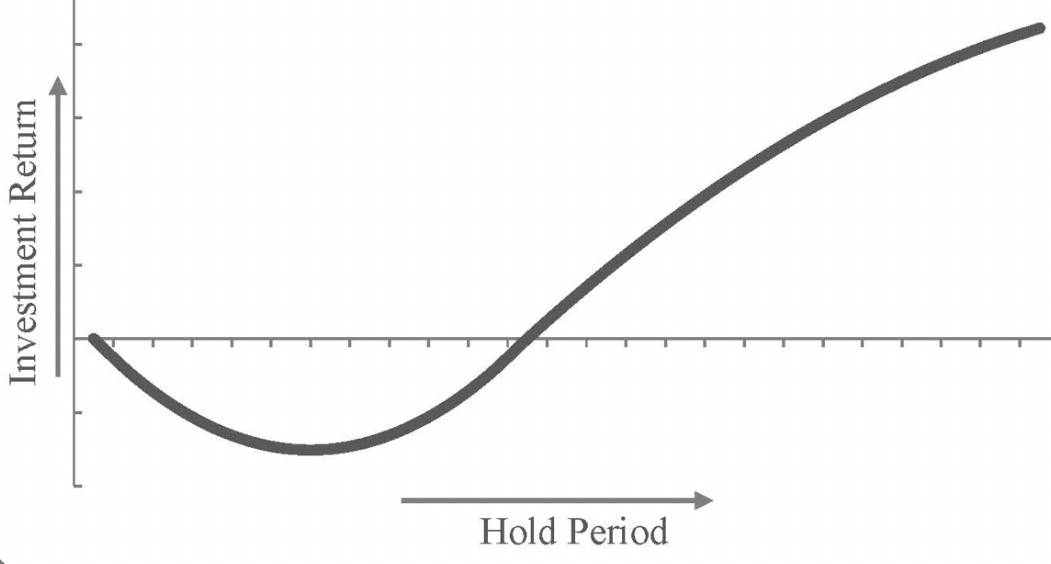
The “J curve”
Im in the orlando market aswell and you have to get creative with it my latest purchase 2 weeks ago was a former single family utilized as a duplex and I am putting 2 new tenants in with signed leases already for $2,350 and $1,350 so $3,700 total monthly minus insurance tax and utilities I would bring in about $2,800 monthly for a property that costed me 195k 2 weeks ago. As for the cashflow and mortgage I am expecting a $240k appraisal so a refinance reimbursement of about 170k and a mortgage amount of $1,600 monthly. So $1,200 cashflow and a low cost in. If it was not "house hacked" it would bring in about $2,400 instead of $2,800 dropping the cashflow to $800. Bottom line what im doing right now is still brrring very unique deals I have duplexes utilized as quads with the same concept.
Im in the orlando market aswell and you have to get creative with it my latest purchase 2 weeks ago was a former single family utilized as a duplex and I am putting 2 new tenants in with signed leases already for $2,350 and $1,350 so $3,700 total monthly minus insurance tax and utilities I would bring in about $2,800 monthly for a property that costed me 195k 2 weeks ago. As for the cashflow and mortgage I am expecting a $240k appraisal so a refinance reimbursement of about 170k and a mortgage amount of $1,600 monthly. So $1,200 cashflow and a low cost in. If it was not "house hacked" it would bring in about $2,400 instead of $2,800 dropping the cashflow to $800. Bottom line what im doing right now is still brrring very unique deals I have duplexes utilized as quads with the same concept.
Yea, sounds like you found a deal. On OBT or near OBT?
The only answers here are you need different markets or better deals.
That said, if you're executing a true, full BRRRR it's a bit unrealistic to expect to get much cash flow after the fact.
If I can get all my capital back (or real close) I'm content with operating at break even. It's essentially a free property and rents will go up over time, etc.
We're still doing plenty of strong cash flowing deals in Detroit but there's a balance. The more cash you end up leaving in it after a BRRRR the less net cash flow is left (generally speaking).
Ell, I think we now hit on one of the factors for your frustrations, that you have a false idea of how the "business" is supposed to go.
No, the vast majority of business's, including service business, start-up's do NOT clear profit day, month, quarter, year 1.
What may be skewing your perception is your think of Self-Employed persons, say a plumber, electrician etc., who strike out on own as a "business". There is a significant difference between a "business" and "self-employed".
It's such a vast majority of start-up business's that DON'T clear a profit for the first several years, that's it's very literally a rule of thumb to consider and account for the start-up YEARS not month's of operating at net-loss.
This is why if you watch Shark Tank it's a question asked every time not of how much they are profiting but first IF they are operating net profit. And notice how the common expression is one of delight when they hear a "yes", because it is more rare in start-up.
If your thought's are aligned to "How can I get asset's under my control, to be operating with 100% levered capital, 0 capital investment held in enterprise, yet a "cash-flow" similar to that of having vested capital in it...... Well that's simply not realistic in any volume sense what so ever.
Yes, it "can" be done, but those are the outliers, the exceptions, the 1-off's.
Reality is it takes INVESTMENT to make a real estate investment "work" in almost every instance. And the above argument is how to have a real estate investment portfolio, without the "investment" portion.
Sure, building that equity via value-add is one measure but fact is getting a property where on can build a 30% equity position. Too many think that if the reno is 30% that's it, NO. Because it's the profit's from the reno, not the entire reno budget, that has to be 30%. So now think on that, if "profit" is a 20% margin from reno, how BIG does reno need to be vs ARV or acquisition price to get landed 30% equity position in the end???? Huge, it needs to be HUGE impacting reno right, not paint n carpet.
So, your model if getting out 100% financed and with great COC performance, it's not a realistic goal in any volume sense. ie non-sustainable business model.
The “J curve”
100% Michael, I just never mention to this economic item as most on BP are not familiar with economics and won't take actions to look these things up and read on them to learn.
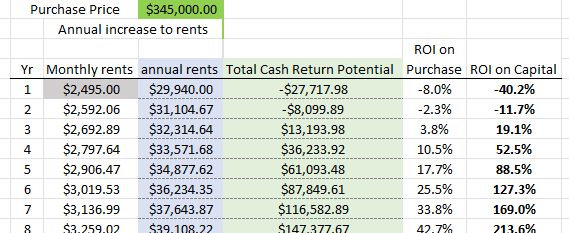
It's an item I see, and honestly MUST see, in our analysis spreadsheet that below is a condensed snipet from a recent one. The below does not account for tax benefit's, depreciation and mortgage pay-down, that is a separate page coined "icing on the cake" and with aggregate returns. It DOES account for allocations such as vacancy, Pm etc.. One can see right there in the #'s the J-curve.
This is an analysis on a NEW built near luxury townhome unit. AAA-Strategy. So planned exit is yr5-7 too "Pyramid" gains, and reset cap-x to 0-day to ideally stay in that flippin awesome 0-cap-x 0-maint. cycle of things. I gotta admit once get used to that cycle it's hard to go back to the maintenance/cap-x grind.
The only answers here are you need different markets or better deals.
That said, if you're executing a true, full BRRRR it's a bit unrealistic to expect to get much cash flow after the fact.
If I can get all my capital back (or real close) I'm content with operating at break even. It's essentially a free property and rents will go up over time, etc.
We're still doing plenty of strong cash flowing deals in Detroit but there's a balance. The more cash you end up leaving in it after a BRRRR the less net cash flow is left (generally speaking).
Ell, I think we now hit on one of the factors for your frustrations, that you have a false idea of how the "business" is supposed to go.
No, the vast majority of business's, including service business, start-up's do NOT clear profit day, month, quarter, year 1.
What may be skewing your perception is your think of Self-Employed persons, say a plumber, electrician etc., who strike out on own as a "business". There is a significant difference between a "business" and "self-employed".
It's such a vast majority of start-up business's that DON'T clear a profit for the first several years, that's it's very literally a rule of thumb to consider and account for the start-up YEARS not month's of operating at net-loss.
This is why if you watch Shark Tank it's a question asked every time not of how much they are profiting but first IF they are operating net profit. And notice how the common expression is one of delight when they hear a "yes", because it is more rare in start-up.
If your thought's are aligned to "How can I get asset's under my control, to be operating with 100% levered capital, 0 capital investment held in enterprise, yet a "cash-flow" similar to that of having vested capital in it...... Well that's simply not realistic in any volume sense what so ever.
Yes, it "can" be done, but those are the outliers, the exceptions, the 1-off's.
Reality is it takes INVESTMENT to make a real estate investment "work" in almost every instance. And the above argument is how to have a real estate investment portfolio, without the "investment" portion.
Sure, building that equity via value-add is one measure but fact is getting a property where on can build a 30% equity position. Too many think that if the reno is 30% that's it, NO. Because it's the profit's from the reno, not the entire reno budget, that has to be 30%. So now think on that, if "profit" is a 20% margin from reno, how BIG does reno need to be vs ARV or acquisition price to get landed 30% equity position in the end???? Huge, it needs to be HUGE impacting reno right, not paint n carpet.
So, your model if getting out 100% financed and with great COC performance, it's not a realistic goal in any volume sense. ie non-sustainable business model.
I personally understand...Just wanted to see where all the people are that are saying they can BRRR a property with $0 invested & still cash flow. I've seen a few posts & couldn't fathom it. Feedback on this post has shown my numbers aren't wrong...times have just changed & rates where they are have diminished the BRRR method as it was used the past few years.
Ell your confusing things.
BRRR is still very much alive and well, and very profitable. What's changed is the bar of required professionalism has raised, significantly.
And this is a general status of things across the board for REI, the bar of professionalism has GREATLY increased.
Years back the world of REI was artificially "nerf'd" down for complexity and simplicity. Many persons, myself included, warned people to ACT UPON THE OPPORTUNATIES during those times with all haste because we knew with mathematical certainty it would not last. But, many got greedy, lazy, and expecting it to stand in perpetuity where one could throw up a city MLS map on the wall and randomly throw dart's after drink 7 and just buy those, and make $. That is gone.
Today is a much more "normal" environment.
Reality is starting a business is hard. And for obvious reasons. If it were easy to do, and easy to make $, then masses of people do it, and as competition grows profit's decline via competition.
That is BRRR's today. You are competing with GC's, who have all the operations to BRRR a property internally. They have no GC cost's because they are the GC. They keep the GC profit which is in the 20%-30% range meaning they can out-bid you or any other without that savings on any acquisition and still make dang good $.
Raising the bar of professionalism to operate viably in that space.
So the strategy remains very viable, nothing wrong with the strategy, it's the Operations that have changed, competition has changed.
So to do such, competition demands that you must operate the GC side of things, proficiently.
Picture it this way Ell:
Instead of Real Estate let's say it's a hamburger stand. And you want to sell burgers for profit.
If you buy your meat at the local grocer, and a competing burger stand buy's at Westlunds (who sells to the local grocer) making there cost of operations significant less than yours, what happens? Is the business of a burger stand "bad"? No. It's simply a market requirement of how one operates a burger stand, that one MUST do better, be more efficient in operations, to remain competitive and profitable.
When there was only 4 burger stands int he city, it was easy to makes $. One could have the worst operations in the world and profit, because lack of competition. But now, with 200 burger stands in city, on has to run a proficient, efficient operation.
So for you Ell, I suggest you stop focusing on the problem and focus on the SOLUTIONS. How can you make this "issue" a profit center?
For example, you could reach out to newer GC's in your area, network, find out if they have an interest in REI, most do. Than pitch a JV. That you bring the investor side, they the reno side. You both do open book and net-o, and split profit's. Now your capital is just on transactional side, they fund reno side, so not only have you cut expenses but also lowered capital requirement per "deal". Not only solving your issue but lending added bandwidth potential for volume. So maybe make a 2nd JV in next city over with another GC, then another, and another, etc etc..
See, thing is weather you see the problem, or the opportunity, you'll be right. Only question is, which you choose to see and engage in.
I built my entire REI "empire" in 2008/2009 after having lost an "empire" in new home MFH development. I fell a LOOONG way, and it was a hard HARD landing. I spent a few month's pouting and feeling sorry for myself, whining and complaining until one day, sitting with associates of similar position all having a good complaining-fest over it something snapped in me, I stood up and declared "NOPE! No! I REFUSE to participate in a down economy!". And I restated it, because I looked like a crazy person, lol, just jumping up and yelling this. I all but started chanting this. Every time someone started talking about the negativity I immediately cut them off and stated my declaration "I REFUSE to participate in a down economy?". People started laughing, asking what it meant, I had no idea, but it was mine, my choosing. And, it lead to everything else. Because it pressed me to ONLY see opportunities. F the problems, problems do no service to me, I need opportunities. I must have restated that declaration 10,000 times. And a decade later, I had built nearly a dozen organizations in arguably the worst economy of near 100 years, employed dozens upon dozens, created financial security for my family, funded IDK how much charity actions (it was needed in those years) and all of it because of 1 acorn: "I REFUSE to participate in a down economy".
I challenge you Ell to make a choice. What do you choose to participate in?
Markets always cycle with different investing strategies. I acquired and repositioned over 5,000 apartments using the BRRRR method. But that was before interest rates increased so dramatically. The BRRRR doesn't work with higher interest rates, so you need to change up your strategy based on what sort of financing is available.
We've pivoted heavily to a lot of creative financing strategies like: seller financing in first lien position, seller financing in second lien position, seller coming back in as our equity investor, loan assumptions, installment contracts and more.
The key skillsets to learn are: how to market and find deals, and creative finance. If you have multiple tools in your belt with those two skillsets, you'll be able to do deals regardless of market conditions. There's a lot of great conversations in the BP forums in order to learn more strategies along those lines!
Im in the orlando market aswell and you have to get creative with it my latest purchase 2 weeks ago was a former single family utilized as a duplex and I am putting 2 new tenants in with signed leases already for $2,350 and $1,350 so $3,700 total monthly minus insurance tax and utilities I would bring in about $2,800 monthly for a property that costed me 195k 2 weeks ago. As for the cashflow and mortgage I am expecting a $240k appraisal so a refinance reimbursement of about 170k and a mortgage amount of $1,600 monthly. So $1,200 cashflow and a low cost in. If it was not "house hacked" it would bring in about $2,400 instead of $2,800 dropping the cashflow to $800. Bottom line what im doing right now is still brrring very unique deals I have duplexes utilized as quads with the same concept.
Yea, sounds like you found a deal. On OBT or near OBT?
Off of Rio Grande Ave.
