Your brother shouldn't really be focused on, "Should I invest in real estate?" at the outset, if he is at the outset. He should first focus on having or getting a financial plan for his goals. Identify specific goals with dollars and income streams associated with them over time. That sets the roadmap. Next comes income and investments to achieve the goals. Does your brother have this in place?
For most people, a W2 and savings plan are the first vehicles. Investments, such as funds, stocks, etc come next and a lot of folks stop there which is fine. What part of the plan is pushing your brother towards real estate? I would recommend pausing if it is "just make a buck." Real estate involves much more commitment in timeline and wealth than just "trying" the stock market or something like that. He has passive/active to think about, types of investments, etc. In short, it's real work unlike the stock and fund investments.
Does he genuinely want to be a flipper or landlord? Does he have a lot of cash or willingness to take on debt for a long term investment? Does he have patience and perseverence? There are a 1,000 more questions to ask, but none of them really matter without the plan and driver. The driver has to be beyond just make money. A REIT might be better if he isn't interested in these things.
A lot of folks get that "it might crash!" sentiment since virtually everything has crashed at some point. It's important to understand the drivers of a drop, as well as an increase, versus constantly worrying into paralysis.
Think of the stock market. There is massive data out there on it and no one knows what will happen tomorrow. It seems to have a big drop every 5-10 years, then comes back, but no one can reliably predict the inflection points. What if it didn't come back? Oh no, I'm paralyzed and just missed a great 10-year run. The long term track record is compelling, but investors have to think long term. Comparing the stock market to real estate shows the stock market wins, but sometimes at great stress. It can feel like a ponzi scheme in which folks hope they aren't the last fool in.
Think of real estate. I don't know that there has been a 10-year period in which real estate investing has lost money in aggregate, but there have certainly been scary times. I don't think they were nearly as scary as the stock market steep declines though because real estate values change slowly and vary by region. 2008 And COVID showed us the stock market can lose a third or half its value in a matter of days.
People don't invest in aggregate except in funds. It's a bad experience if someone doesn't do their homework and buys a bad stock. Likewise, buying in a bad area or a bad property will also be a bad experience. Real estate has more exposure to this since entry and exit is much harder and slower than a stock or fund. A stock investor might never know the company had a problem with a building. A real estate investor will be intimately familiar with the problem.
The driver for residential real estate is largely personal incomes. Interest rates get a lot of well deserved attention, but are largely short term noise. They are high until they are low, then back up again. There is a lot of recency bias with rate opinions. We are currently at about the historical norm for rates, but you wouldn't know that from the market sentiments.
Incomes are the primary driver for prices and rents. They tend to rise over time and with age. The typical 75-80% LTV mortgage limits mean a buyer can leverage income 4:1 or 5:1 depending on other debts, so someone making $100k might afford a $400k home, but a raise next year to $105k and maybe more savings may mean they can afford a $420k home - the same home! As bidders are stronger, prices and rents tend to go up. There are also a lot of first time homebuyer programs that support value and increase these ratios.
Home affordability gets a lot of attention and it always has. Younger buyers say housing is unaffordable. This has been a popular news topic for decades and there is always data to prove it and show that it is worse now than ever before. Maybe it is, but prices continue to rise and those younger people find ways to buy, then move up. Keep in mind there are many more property owners than buyers. I have never heard a property owner wish their property wasn't so valuable.
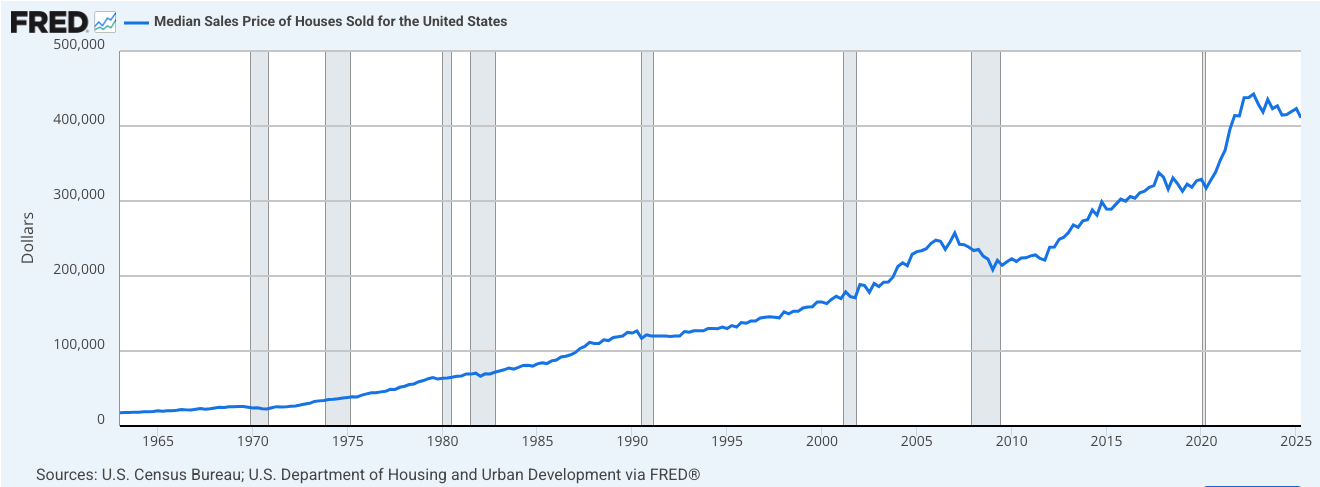
What does this mean for your brother or anyone? In brief, housing prices and rents are not going down in aggregate over longer time frames unless there is a radical change in USA economics. This will vary by region, but the drivers are directionally consistent.
Incomes are almost always rising. Rents and mortgage payments are related to each other. Incomes are rising and people can afford more which is an inflation driver. Inflation is almost always 2%+ per year and pushes up property values and rents. Housing demand exceeds supply and there is nothing on the horizon to change that. "They" aren't making any more land, so buyers/renters have a very difficult time getting a better place in-region without paying more or commuting further, a trade-off.
I bought my 1st rental in 2013. What a lousy time to invest. I heard lots about risks. We were coming out of the mortgage fraud debacle and prices were just starting to sustainably turn upward (2010 might be the ideal year to buy), but would it last? Everything might happen, just like today. It was actually an awesome time to invest!!! That property I bought for $67k is now worth about $200k. I pulled out more than I invested through refi's and it has great cash flow. Yet, at the time, there were plenty of people saying, "I dunnno.....it might go down...rates might go up....that clogged toilet on Christmas day...jobs, inflation, war, boogie man..." Those people always exist and are especially vocal to every new business owner. Listen, but tune them out. I now have 14, but none of them were slam dunk "This can't lose" investments.
There is always risk and hesitancy - and there should be! Starting a business is a big decision. Your brother should keep in mind that this is starting a business and he should want a business and understand the implications before starting one. Local real estate investor groups are great places to start getting exposure without commitment.