Is Real Estate Still the Best Asset Class?

Is Real Estate Still the Best Asset Class?

Dave MeyerPro Member
Head of Real Estate Investing at BiggerPockets · Seattle, WA · Member since 2015 · 355 posts · 829 votes

Real estate is harder than it's been in more than a decade -- we all know this. High prices + high mortgage rates + low inventory is making this a challenge. So my question is  -- in an era where you can get a 5% CoCR from bonds, money market accounts, or a high-yield savings account is RE still the best place to put your money? 

I'll give you my opinion below, but curious to hear what you all think. 

Here's my take, and you probably won't find this shocking, but RE is still the best asset class. I am what I would call a 'total return investor' -- which is that I don't care as much about cashflow, or tax benefits, or appreciation in particular -- I'm in it for the whole package. And when you look at it that way, RE is still the clear winner. 

I just put a deal under contract that was on market. It will generate about 4% CoCR, and 2% in amortization. Even with a very modest expectation of 2% annual appreciation, I will earn about 6% there (thanks leverage!), and tax benefits will give me another 1.5%. If I add that all up, I am getting somewhere between a 12-15% annualized return, for an on-market deal that just needs some cosmetic upgrades. 

Compare that to bonds (5%), or the average return in the stock market (8-10% depending on who you ask) and REI is a no-brainer to me. Am I missing something here?!?

Sure you could say that RE is at all-time highs and is going to come down. It's possible, but a big correction in residential RE is not likely, and over a long hold period, RE will appreciate. Plus, I am generating modest cashflow now + amortization and tax benefits.  Also, the same can be said about the stock market. It's also at all-time highs, and its historical far more volatile than RE. 

Now you may be thinking that owning RE is more work than the stock market, and that is undoubtedly true. But the difference between 10% and 12% over a long hold period is enormous. For an investment of $100,000, over a 10 year hold the difference in total return between a 10% annualized rate, and 12% is $51,000. For some that might be worth the work of REI, for others not so much. BUT -- if your hold period is 30 years the difference grows to $1.25M!! Gotta love compounding.


 So, back to my original question. Is RE still the best asset class? For me -- a 36 year old who plans to keep working for the next several decades -- there's no doubt in my mind. I will gladly take on the extra work of owning RE, given that, even with more difficult conditions, RE still has a very high probability of delivering me outsized returns over my investing career. 

What do you all think? 

23Reply
1,005 views

Most Popular Reply

Chris SeveneyBusiness Member
Moderator
Investor · VA · Member since 2015 · 21k+ posts · 19k+ votes
2y
Quote from @Russell Brazil:

In investing, there is no such thing as the best, or the worst. There is no such thing as good or bad.

Investing is deploying capital to get a return based on one's risk tolerance. There is merely varying degrees of risk. There is high risk, moderate risk, low risk. Risk is neither good or bad.

Real estate on average tends towards the low end of the spectrum, but of course real estate runs the gamut of risk.


 I could not have said it better myself. It may be best for person A but not for person B. I have been in real estate 25 years, my wife in finance for 25 years. Real Estate is the best for me, because I like to think I know what I am doing and can use my experience and knowledge along with being active in the space to enhance returns. My wife, she cannot - but she can do it with investing in the markets and other areas that there is no way I could do that. 

I met a guy who does selective breeding of snakes. He sells them for tens of thousands a pop and generates revenue of over $1M a year and has no overhead except his electric bill in his basement for the lighting, a part time employee and of course the food. He has someone take care of the snakes which is like an hour a day. He does whatever he wants. I was sitting next to him along with a group of others in real estate and were like - WTF are we doing dealing with people/tenants/borrowers and this guy is traveling the world while he breeds snakes and generates 7 figures with no debt...

7e investments53 Reviews
See this reply in the discussion

164 Replies

Jump to latestLatest
  • Member since 2021 · 401 posts · 254 votes
    2y
    Quote from @James De Stefano:
    Quote from @Eric Bilderback:

    Real estate is still the best investment for normal people to remove or at least cushion themselves against the rat race and build wealth.  I don't invest in the stock market (and suspect it is more BS then the real estate market) but from my experience real estate is the only asset that pays you to own it in a meaningful way.  Even with real estate as unaffordable as it has ever been I would encourage young people or anyone to buy good real estate, manage it well and wait.

    Pretty much 100%.   SNP 500 is super consistent and does well over time, but unless you are a lunatic who's using options ( playing with HOT fire ), you really can't leverage. 

    You can't leverage in the market but you can't compound in real estate so not a great argument.

  • Member since 2021 · 401 posts · 254 votes
    2y
    Quote from @Eric Bilderback:

    Real estate is still the best investment for normal people to remove or at least cushion themselves against the rat race and build wealth.  I don't invest in the stock market (and suspect it is more BS then the real estate market) but from my experience real estate is the only asset that pays you to own it in a meaningful way.  Even with real estate as unaffordable as it has ever been I would encourage young people or anyone to buy good real estate, manage it well and wait.

    Nothing said here can't be reversed to say that RE is more BS and dividens is the only asset that pays you to own it in a meaningful way.

    What matters to most people which is the reason why they purchase a condo or house is to make a return, period. And the historical market returns of 8% beats the historical real estate returns of 4%. Anything more than 4% and you're putting in the time and effort just to match that of the market. 
  • Member since 2021 · 401 posts · 254 votes
    2y
    Quote from @Dave Meyer:

    Real estate is harder than it's been in more than a decade -- we all know this. High prices + high mortgage rates + low inventory is making this a challenge. So my question is  -- in an era where you can get a 5% CoCR from bonds, money market accounts, or a high-yield savings account is RE still the best place to put your money? 

    I'll give you my opinion below, but curious to hear what you all think. ver my investing career. 

    What do you all think? 


    I did some quick math on a condo I purchased in cash 10 years ago for $140k. It has made me a total of $400k including my initial investment. Yet that same amount in the S&P500 would net 500k with zero maintenace or taxes. Of course I could reinvest the cashflow from the condo which would probably match the S&P 500 in my example but why when I can just set it and forget that the market approach provies. Lots of my colleages have retired off their long time market investments and are now traveling the world without owning a single home. Before someone says I forgot about leverage and gets upset, not many people leverage themselves. Most people just buy a property or two and regret it later. I just sold a condo to someone and it's back on the market 30 day later for break even. You don't hear from them, you only hear from the people that like to brag about their success and none that failed, thus creating a phenomenom called survivorship bias. Ask this question on a stock forum and see what you get.

    At least stocks are consistent for everybody. Real estate is like gambling. You might be successful by virtual of what zip code you live in but the broad market doesn't require that research, it won't turn ghetto, it doesn't have HOA fees or insurance to skyrocket, easier to do taxes on and is more protected from lawsuites.

    My advice, if anyone is asking if they should invest in RE or buy a property for investment purposes. then you should just put all that would be cash into the market and retire in 20 years with many times the amount  you would have if you owned a few properties. Theirs youtube videos outlining this with math and is pretty straight forward. 

  • Dan H.Pro Member
    Investor · Poway, CA · Member since 2015 · 7k+ posts · 8k+ votes
    2y
    Quote from @K S.:
    Being a real estate forum, I think you'll confirm your bias here. And I'm not sure if Real Estate was ever the best asset class? If you don't leverage yourself with millions of debt, then real estate will probably just barely beat the bond market but with a lot more maintenance and risk.

    I did some quick math on a condo I purchased in cash 10 years ago for $140k. It has made me a total of $400k including my initial investment. Yet that same amount in the S&P500 would net 500k with zero maintenace or taxes. Of course I could reinvest the cashflow from the condo which would probably match the S&P 500 in my example but why when I can just set it and forget that the market approach provies. Lots of my colleages have retired off their long time market investments and are now traveling the world without owning a single home. Before someone says I forgot about leverage and gets upset, not many people leverage themselves. Most people just buy a property or two and regret it later. I just sold a condo to someone and it's back on the market 30 day slater for break even. You don't hear from them, you only hear from the people that like to brag about their passive income and leverage thus creating a phenomenom called survivorship bias. Ask this question on a stock forum and see what you get.

     >not many people leverage themselves.

    according to NAR 80% of homebuyers last year used financing and this is down since 2021 (before the recent rate increases) when 87% used financing. Because you did not use financing does not mean others are not using financing. Assuming others act like yourself is social projection.

    If you choose not to use financing/leverage you are choosing not to use one of RE investors bigger return multipliers.  I suspect without this multiplier there are many RE markets that will not beat various index funds, but going with this is little different than stating I will not purchase stocks of companies that are growing and expecting to achieve the same return as those investors purchasing stock of companies that are growing. 

    The reality is most US RE markets with high use of leverage produced higher returns than virtually all index funds.   This is verifiable fact.  It does not matter what those on a stock forum indicate, the numbers are available to all.

    I fully agree that stocks are more passive than active residential RE investing and many other forms of RE investing.  More passive RE investment options are unlikely to produce the return of active RE investment options.  

  • Dan H.Pro Member
    Investor · Poway, CA · Member since 2015 · 7k+ posts · 8k+ votes
    2y
    Quote from @K S.:
    Quote from @Eric Bilderback:

    Real estate is still the best investment for normal people to remove or at least cushion themselves against the rat race and build wealth.  I don't invest in the stock market (and suspect it is more BS then the real estate market) but from my experience real estate is the only asset that pays you to own it in a meaningful way.  Even with real estate as unaffordable as it has ever been I would encourage young people or anyone to buy good real estate, manage it well and wait.

    Nothing said here can't be reversed to say that RE is more BS and dividens is the only asset that pays you to own it in a meaningful way.

    What matters to most people which is the reason why they purchase a condo or house is to make a return, period. And the historical market returns of 8% beats the historical real estate returns of 4%. Anything more than 4% and you're putting in the time and effort just to match that of the market. 

     What is the source of your 4% RE return?  Are you only counting unleveraged appreciation and not the cash flow?

    I know no one that would choose to invest in RE for 4% projected total return. 4% appreciation leveraged at 80% LTV would be a 20% return from the appreciation alone. Add the cash flow on top of that. I expect my RE to produce far better than 20% return and in general have achieved the infinite return (via BRRRR) on my active RE investments.

    If you purchased in 2014 at $140k to only be at $260k return including appreciation and cash flow, you invested in a market that far underperformed the national averages (it happens, but recognize it) as many of those years had double digit national RE appreciation.  Then add on the cash flow. 

    By the way 10 years is the low end of the range that I indicate purchasing is virtually guaranteed to be a good investment. I say RE hold less than 5 years to look at other options.  Between 5 and 10 years it will depend on various things and sometimes will be good and other times not (but 2012 to 2022 most RE investments in this duration would have performed well).  Starting at 10 years hold, RE investing usually/virtually  always has produced enough return to counter the high transaction costs.  Your hold is at the edge of the length of hold to be able to absorb transaction costs and still produce a good return.   My view is RE investing should be long term due to the transaction costs.


    good luck

  • Real Estate Agent · Sisters, OR · Member since 2014 · 1k+ posts · 1k+ votes
    2y
    Quote from @K S.:
    Quote from @Eric Bilderback:

    Real estate is still the best investment for normal people to remove or at least cushion themselves against the rat race and build wealth.  I don't invest in the stock market (and suspect it is more BS then the real estate market) but from my experience real estate is the only asset that pays you to own it in a meaningful way.  Even with real estate as unaffordable as it has ever been I would encourage young people or anyone to buy good real estate, manage it well and wait.

    Nothing said here can't be reversed to say that RE is more BS and dividens is the only asset that pays you to own it in a meaningful way.

    What matters to most people which is the reason why they purchase a condo or house is to make a return, period. And the historical market returns of 8% beats the historical real estate returns of 4%. Anything more than 4% and you're putting in the time and effort just to match that of the market. 

    Maybe, for me personally I know many people I've been their agent and they want another income stream and see someone giving them rent as the way to do it.  I don't know anyone who invests and lives off dividends if I was a stock broker I probably would.

  • Michael SloanBusiness Member
    Property Manager · Richardson, TX · Member since 2023 · 31 posts · 15 votes
    2y

    @Dave Meyer you’re leaving out Risk. What if it takes longer to find a tenant or something breaks, or you have to evict a tenant.

    The question should be compared to what? There are lots of ways to make money in Real Estate and it’s still going to create more millionaires than any other investment vehicle.

    With rates and prices where they are you just have to evaluate deals differently. Compared to what? That 5% CD doesn’t come with a lot of risk.

    Real Estate Investors need to understand there are risks involved and make sure they are being compensated accordingly.

    Brickyard Property Management LLC4.114 Reviews
  • James MurphyPro Member
    Real Estate Agent · Boston, MA · Member since 2024 · 18 posts · 16 votes
    2y

    Real estate can be a great investment for those who are willing to conduct thorough research, build a team of advisors, and make informed decisions. It's important to maintain reserves to handle potential market downturns or for capital expenditures that may arise in the future.

    I have pursued a diversified portfolio of real estate properties and stock index funds. However, I currently prioritize real estate as the main investment vehicle for my portfolio.  There have been many people in the past who generated wealth through real estate so it's a proven strategy!

  • Member since 2019 · 7k+ posts · 4k+ votes
    2y
    Quote from @Dave Meyer:

    Real estate is harder than it's been in more than a decade -- we all know this. High prices + high mortgage rates + low inventory is making this a challenge. So my question is  -- in an era where you can get a 5% CoCR from bonds, money market accounts, or a high-yield savings account is RE still the best place to put your money? 

    I'll give you my opinion below, but curious to hear what you all think. 

    Here's my take, and you probably won't find this shocking, but RE is still the best asset class. I am what I would call a 'total return investor' -- which is that I don't care as much about cashflow, or tax benefits, or appreciation in particular -- I'm in it for the whole package. And when you look at it that way, RE is still the clear winner. 

    I just put a deal under contract that was on market. It will generate about 4% CoCR, and 2% in amortization. Even with a very modest expectation of 2% annual appreciation, I will earn about 6% there (thanks leverage!), and tax benefits will give me another 1.5%. If I add that all up, I am getting somewhere between a 12-15% annualized return, for an on-market deal that just needs some cosmetic upgrades. 

    Compare that to bonds (5%), or the average return in the stock market (8-10% depending on who you ask) and REI is a no-brainer to me. Am I missing something here?!?

    Sure you could say that RE is at all-time highs and is going to come down. It's possible, but a big correction in residential RE is not likely, and over a long hold period, RE will appreciate. Plus, I am generating modest cashflow now + amortization and tax benefits.  Also, the same can be said about the stock market. It's also at all-time highs, and its historical far more volatile than RE. 

    Now you may be thinking that owning RE is more work than the stock market, and that is undoubtedly true. But the difference between 10% and 12% over a long hold period is enormous. For an investment of $100,000, over a 10 year hold the difference in total return between a 10% annualized rate, and 12% is $51,000. For some that might be worth the work of REI, for others not so much. BUT -- if your hold period is 30 years the difference grows to $1.25M!! Gotta love compounding.


     So, back to my original question. Is RE still the best asset class? For me -- a 36 year old who plans to keep working for the next several decades -- there's no doubt in my mind. I will gladly take on the extra work of owning RE, given that, even with more difficult conditions, RE still has a very high probability of delivering me outsized returns over my investing career. 

    What do you all think? 


     sorry want to reply from this article that's exactly replying your question here. It is just the explanation is so good. https://seekingalpha.com/article/4689343-most-investments-ar...

    Historical Real Estate Returns

    Real estate has long been known as a good long-term investment. But is it?

    Professor Aswath Damodaran's records show that $100 invested into U.S. real estate in 1928 would have turned into $5,360 by 2023. That's better than T-bills, but worse than T-bonds and worse than gold. If an investor levered it up they would have done much better, but we'll get to that topic later.

    To double-check this data, we can check Professor Robert Shiller's dataset on real estate that goes back to 1890. His data shows that the nominal home price index increased by 88x from 1890 to the present. Meanwhile, the price of a unit of gold increased by 123x during that period. If the homeowner/landowner paid a small maintenance rate each year, as well as a recurring property tax each year, then the gap between those two numbers would have been even wider.

    Of course, some real estate has performed very well. If someone bought Manhattan land at the turn of the 20th century, or land in Silicon Valley at the start of the venture era, those bets really paid off. Those were top percentile real estate performances.

    But in contrast, significant amounts of real estate goes to zero if the city they are near decreases in population and economic activity. For example, there are abandoned properties all around Detroit. These are large once-expensive homes that are now rotting on parcels of land that nobody wants. And real estate can't be moved if the economic situation or political situation in a region becomes untenable.

    Most real estate falls somewhere between those extremes. It performs decently, especially when considering that it can replace the owner's rental income or be rented out for cashflows, but after maintenance and taxes are considered, its unlevered total return from price appreciation and cashflow generation net of maintenance leaves something to be desired relative to gold.

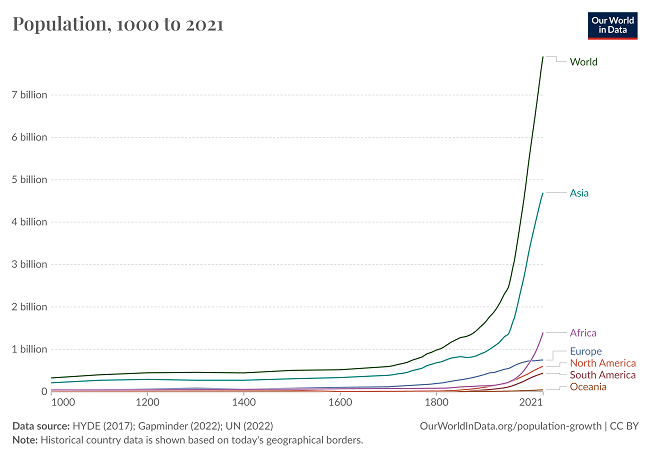
    And this mediocre performance in unlevered real estate occurred despite the massive population increase that occurred during the 19th and 20th centuries.

    Global Population

    Our World in Data

    Although rural and suburban residential land is rather abundant, if someone bought land in a good neighborhood near a city that grew substantially, their investment likely did well. But as population growth cools off, so do real estate prices. In Japan, there are millions of abandoned countryside homes that are nearly free. Many of them are in beautiful and safe rural areas, and yet there is insufficient demand for them. They have varying states of quality, but in aggregate they are now deteriorating due to abandonment.

    Putting this all together, literally all government bonds have underperformed gold over the long run, and most unlevered real estate has underperformed gold as well. Stocks as an asset class greatly outperform gold, but only because the top 4% of them in the best-performing market do all the heavy lifting while the other 96% as a group don't generate any excess returns.

    Owner-Operators are the Winners

  • Member since 2019 · 7k+ posts · 4k+ votes
    2y
    Quote from @K S.:
    Being a real estate forum, I think you'll confirm your bias here. And I'm not sure if Real Estate was ever the best asset class? If you don't leverage yourself with millions of debt, then real estate will probably just barely beat the bond market but with a lot more maintenance and risk.

    I did some quick math on a condo I purchased in cash 10 years ago for $140k. It has made me a total of $400k including my initial investment. Yet that same amount in the S&P500 would net 500k with zero maintenace or taxes. Of course I could reinvest the cashflow from the condo which would probably match the S&P 500 in my example but why when I can just set it and forget that the market approach provies. Lots of my colleages have retired off their long time market investments and are now traveling the world without owning a single home. Before someone says I forgot about leverage and gets upset, not many people leverage themselves. Most people just buy a property or two and regret it later. I just sold a condo to someone and it's back on the market 30 day slater for break even. You don't hear from them, you only hear from the people that like to brag about their passive income and leverage thus creating a phenomenom called survivorship bias. Ask this question on a stock forum and see what you get.

    You are right based on the assestment from the SeekingAlpha article that I sent.

    In general, if location of real estate is not good then the better asset would be :
    Gold > Tbonds/Tbill > Top 4 performing Stock > Stock Index > Real Estate.

    but if location is good then :

    Real Estate > Gold > Tbonds/Bills > Top 4 performing stock > Stock Index.

  • Dave MeyerPro Member
    OP
    Head of Real Estate Investing at BiggerPockets · Seattle, WA · Member since 2015 · 355 posts · 829 votes
    2y
    Quote from @Michael Sloan:

    @Dave Meyer you’re leaving out Risk. What if it takes longer to find a tenant or something breaks, or you have to evict a tenant.

    The question should be compared to what? There are lots of ways to make money in Real Estate and it’s still going to create more millionaires than any other investment vehicle.

    With rates and prices where they are you just have to evaluate deals differently. Compared to what? That 5% CD doesn’t come with a lot of risk.

    Real Estate Investors need to understand there are risks involved and make sure they are being compensated accordingly.


     I don’t think I am leaving out risk! I shared my cashflow estimates and those properly account for capex, maintenance, vacancies, turnover, etc. 

  • Dave MeyerPro Member
    OP
    Head of Real Estate Investing at BiggerPockets · Seattle, WA · Member since 2015 · 355 posts · 829 votes
    2y
    Quote from @Carlos Ptriawan:
    Quote from @K S.:
    Being a real estate forum, I think you'll confirm your bias here. And I'm not sure if Real Estate was ever the best asset class? If you don't leverage yourself with millions of debt, then real estate will probably just barely beat the bond market but with a lot more maintenance and risk.

    I did some quick math on a condo I purchased in cash 10 years ago for $140k. It has made me a total of $400k including my initial investment. Yet that same amount in the S&P500 would net 500k with zero maintenace or taxes. Of course I could reinvest the cashflow from the condo which would probably match the S&P 500 in my example but why when I can just set it and forget that the market approach provies. Lots of my colleages have retired off their long time market investments and are now traveling the world without owning a single home. Before someone says I forgot about leverage and gets upset, not many people leverage themselves. Most people just buy a property or two and regret it later. I just sold a condo to someone and it's back on the market 30 day slater for break even. You don't hear from them, you only hear from the people that like to brag about their passive income and leverage thus creating a phenomenom called survivorship bias. Ask this question on a stock forum and see what you get.

    You are right based on the assestment from the SeekingAlpha article that I sent.

    In general, if location of real estate is not good then the better asset would be :
    Gold > Tbonds/Tbill > Top 4 performing Stock > Stock Index > Real Estate.

    but if location is good then :

    Real Estate > Gold > Tbonds/Bills > Top 4 performing stock > Stock Index.

    Okay but why are we talking about unleveraged real estate. As my original post suggested, I am talking about leveraged appreciation + amortization + cashflow + the tax benefits. If you just look at un leveraged appreciation of course RE won’t perform well. But it ignores that many other benefits of RE. 

    My comments are based on the idea that if you can find a on market, leveraged deal today that throws off at least a few points of cashflow, it beats other asset classes. 

     
    I’d also challenge the idea that “significant amounts of RE goes to zero”. Where do you find that data?

  • Member since 2019 · 7k+ posts · 4k+ votes
    2y
    Quote from @Dave Meyer:
    Quote from @Carlos Ptriawan:
    Quote from @K S.:
    Being a real estate forum, I think you'll confirm your bias here. And I'm not sure if Real Estate was ever the best asset class? If you don't leverage yourself with millions of debt, then real estate will probably just barely beat the bond market but with a lot more maintenance and risk.

    I did some quick math on a condo I purchased in cash 10 years ago for $140k. It has made me a total of $400k including my initial investment. Yet that same amount in the S&P500 would net 500k with zero maintenace or taxes. Of course I could reinvest the cashflow from the condo which would probably match the S&P 500 in my example but why when I can just set it and forget that the market approach provies. Lots of my colleages have retired off their long time market investments and are now traveling the world without owning a single home. Before someone says I forgot about leverage and gets upset, not many people leverage themselves. Most people just buy a property or two and regret it later. I just sold a condo to someone and it's back on the market 30 day slater for break even. You don't hear from them, you only hear from the people that like to brag about their passive income and leverage thus creating a phenomenom called survivorship bias. Ask this question on a stock forum and see what you get.

    You are right based on the assestment from the SeekingAlpha article that I sent.

    In general, if location of real estate is not good then the better asset would be :
    Gold > Tbonds/Tbill > Top 4 performing Stock > Stock Index > Real Estate.

    but if location is good then :

    Real Estate > Gold > Tbonds/Bills > Top 4 performing stock > Stock Index.

    Okay but why are we talking about unleveraged real estate. As my original post suggested, I am talking about leveraged appreciation + amortization + cashflow + the tax benefits. If you just look at un leveraged appreciation of course RE won’t perform well. But it ignores that many other benefits of RE. 

    My comments are based on the idea that if you can find a on market, leveraged deal today that throws off at least a few points of cashflow, it beats other asset classes. 

     
    I’d also challenge the idea that “significant amounts of RE goes to zero”. Where do you find that data?


     need to read the whole explanation in this article (need to subscribe, it's pretty long):
    https://seekingalpha.com/article/4689343-most-investments-ar... 

    as per your question, that article is answering that in quite technical way :


    After maintenance and recurring taxes, the majority of unlevered real estate, even when rented out for cashflows, doesn't outperform gold. But unlike gold, 5-to-1 leverage makes real estate actually pretty good in many contexts, and historically allows it to outperform gold. Real estate's reputation as building wealth has been well-deserved in practice due to this fact. And of course, the true winning combination has been to own the top-decile performing properties and lever them.


    Basically they said to outperform the gold :
    - residential real estate must be leveraged
    - must be in good location 

    but if RE is not in good location, then gold investment *could* be better choice.

  • Investor · Atlanta, GA · Member since 2021 · 20 posts · 25 votes
    2y

    The last point is the key one - real estate investing is significantly more time investment than any of the comparison points. You're doing it full time, which is great, but for someone with a job and a family, it doesn't leave a lot of time to do all the work that goes into REI. Even if you have a property manager (which reduces that return), there's a lot of work that goes into finding and acquiring good properties.

    Alternatively, can put the money into the markets with transactions that take 2 minutes and watch nest egg grow. This is a real estate forum so I'm sure that's not as popular. 

    To each his own. 

  • Investor · Milwaukee - Mequon, WI · Member since 2010 · 5k+ posts · 7k+ votes
    2y
    Quote from @K S.:
    Being a real estate forum, I think you'll confirm your bias here. And I'm not sure if Real Estate was ever the best asset class? If you don't leverage yourself with millions of debt, then real estate will probably just barely beat the bond market but with a lot more maintenance and risk.

    I did some quick math on a condo I purchased in cash 10 years ago for $140k. It has made me a total of $400k including my initial investment. Yet that same amount in the S&P500 would net 500k with zero maintenace or taxes. Of course I could reinvest the cashflow from the condo which would probably match the S&P 500 in my example but why when I can just set it and forget that the market approach provies. Lots of my colleages have retired off their long time market investments and are now traveling the world without owning a single home. Before someone says I forgot about leverage and gets upset, not many people leverage themselves. Most people just buy a property or two and regret it later. I just sold a condo to someone and it's back on the market 30 day slater for break even. You don't hear from them, you only hear from the people that like to brag about their passive income and leverage thus creating a phenomenom called survivorship bias. Ask this question on a stock forum and see what you get.

    Real estate is not for everyone. You have to have a passion for owning bricks and land. If you are just in it for the ROI, the stock market is clearly better.

    But have you ever tried to buy stocks for 20% below their value? You can also not improve your stocks and make them worth more. And of course, there is leverage, which BTW almost nobody buys an investment property unleveraged.

    Most investors never grow beyond 2-4 properties. We have very good data about investors in Milwaukee, the vast majority is mom&pops. But the ones that keep growing will do significantly better than the stock market. I've been investing for 15 years and I have seen many get started. 

    You are right, there is some a survivorship bias here, but it's not so much that they failed. (I have known very few people who have actually lost money with a rental property, you have to actually try really hard to screw it up). It is that they never scaled it to the point where things start compounding. They remained at newbie level.

    Just because someone did not do it right, that does not mean it doesn't work.

  • Member since 2021 · 401 posts · 254 votes
    2y

    The source is Case Shiller lol. But you can literally look this up and find the same data from other financial institutions.

    And you don't cashflow in todays market with only 20% down. So you're relying on appreciation only. I guess if you were really leveraged with multiple properties, then you can count principle as well.

    I've said it before, it's a myth that real estate always gets better with time. It cost 30-40k to renovate my house after renting it for 15 years. People don't talk about this but if you want to keep the rents at market rates or sell at market prices, you must spend this amount after renting it out for some time. And like Carlos said, some neighborhoods turn ghetto plus you're carrying a lot of other risks over the decades that don't exist with the broad market S&P 500 has returned 12% over the last decade which nearly tripples any investment you made since 2014. However, my condos and house only doubled to 2.5 times. But selling it has cost me way more than stocks because I couldn't find an appropriate 1033 that made sense. I'm paying nearly 90k? in returned depreciation recapture, agents fees, selling fees, renovation, lost income during this process and what I left out. I sold because when it comes down to it, I think I was returning 8% over the last 15 years which came with headaches, a tree that keeps falling and nearly killing someone, hail storms that keep damaging the roof and increase property values that also increase the property taxes because Texas is 2.2% which is raising faster than rents can keep up with. Same reason I sold my condo, HOA fees increased faster than rents over the last 10 years.

    So no, real estate is not a long term investment. It's made for families. If you want a long term investment, invest in the broad market index like VOO or dividen funds.

    What people are doing today in RE is building new. This may be the next 2012 and nobody is talking about it. 

    Edit: I am building a 4 plex as my last effort into RE. I won't miss it as I'm excited to invest 100% into the market and be done with the hustle and maybe even delete this account. 

  • Member since 2021 · 401 posts · 254 votes
    2y

    I don't think people have a passion to drop tens of thousands to rent an ugly house out that you didn't build or suite your taste, and will never live in to a stranger that you never met. It's a business and work that you create for yourself in hopes of a return that beats the market. It's not exactly fun doing those kind of taxes at the end of the year or hiring property management companies, and contractors to fix things or the anxiety of what's the next major expense. Like I said, it's all about what can return more. I don't have fun doing all those things I mentioned. It's a means to an end. It's like insurance, you're trying to beat the gold standard of investments i.e. the broad market. People think they can but most don't beat the market and most don't and can't leverage themselves with a dozen properties. I had a hard time with a single house myself being that I work a lot and don't want to take calls. Nobody does unless you're unemployed and that is your job. That I can see one having a passion for, like a handy man. The rest of us are trying to beat the market. Nothing to do with passion. 

  • Real Estate Agent · Sisters, OR · Member since 2014 · 1k+ posts · 1k+ votes
    2y

    @Carlos Ptriawan @K S.

    More millionaires have been created through real estate by far than anything else.  The crooks on Wall St will ensure people grind their entire life.  Your investing with them is cashflow to Wall st.  If you love your job maybe that works, but for anyone who wants to one day have the opportunity to coach their kids baseball team, spend a significant amount of time on a passion they have that may not be very lucrative real estate can get you their.  Finance it, manage it, hold it, then let the politicians and bankers erode the currency.  I know this works I did this for myself and I have seen other people do it.  

    For most people I would argue the risk of not investing in real estate is greater then the risk of investing in real estate.  

  • Real Estate Agent · Washington DC · Member since 2016 · 847 posts · 656 votes
    2y
    Quote from @Dave Meyer:

    Real estate is harder than it's been in more than a decade -- we all know this. High prices + high mortgage rates + low inventory is making this a challenge. So my question is  -- in an era where you can get a 5% CoCR from bonds, money market accounts, or a high-yield savings account is RE still the best place to put your money? 

    I'll give you my opinion below, but curious to hear what you all think. 

    Here's my take, and you probably won't find this shocking, but RE is still the best asset class. I am what I would call a 'total return investor' -- which is that I don't care as much about cashflow, or tax benefits, or appreciation in particular -- I'm in it for the whole package. And when you look at it that way, RE is still the clear winner. 

    I just put a deal under contract that was on market. It will generate about 4% CoCR, and 2% in amortization. Even with a very modest expectation of 2% annual appreciation, I will earn about 6% there (thanks leverage!), and tax benefits will give me another 1.5%. If I add that all up, I am getting somewhere between a 12-15% annualized return, for an on-market deal that just needs some cosmetic upgrades. 

    Compare that to bonds (5%), or the average return in the stock market (8-10% depending on who you ask) and REI is a no-brainer to me. Am I missing something here?!?

    Sure you could say that RE is at all-time highs and is going to come down. It's possible, but a big correction in residential RE is not likely, and over a long hold period, RE will appreciate. Plus, I am generating modest cashflow now + amortization and tax benefits.  Also, the same can be said about the stock market. It's also at all-time highs, and its historical far more volatile than RE. 

    Now you may be thinking that owning RE is more work than the stock market, and that is undoubtedly true. But the difference between 10% and 12% over a long hold period is enormous. For an investment of $100,000, over a 10 year hold the difference in total return between a 10% annualized rate, and 12% is $51,000. For some that might be worth the work of REI, for others not so much. BUT -- if your hold period is 30 years the difference grows to $1.25M!! Gotta love compounding.


     So, back to my original question. Is RE still the best asset class? For me -- a 36 year old who plans to keep working for the next several decades -- there's no doubt in my mind. I will gladly take on the extra work of owning RE, given that, even with more difficult conditions, RE still has a very high probability of delivering me outsized returns over my investing career. 

    What do you all think? 

    I don’t think there is a clear answer here because you’d have to compare a specific property to potentially an entire asset class, when I buy the s&p I’m buying 500 stocks, when I buy a bond I’m buying a yield but each property is its own deal, what I will say is I think on average real estate is incredibly overrated asset right now (with the caviot that I do think the U.S. debt situation has some significant tail risk long term, and real estate is probably the best hedge against that) but I think to me it’s very basic in pretty much any market you are looking at even with 20% down significant negative cash flow, with housing so unaffordable it seems unlikely we have a ton of appreciation going forward, I can keep my cash liquid and still get over 5% risk free in a moneu market fund with zero effort or risk, I can invest in 500 great companies who can innovate there way to more profits, vs real estate which for better or worse is more of a fixed asset, I also have this theory that since anyone with extra money sitting around or a 401k just throws it into the market you can end up with higher multiple’s than you’d otherwise think vs housing which is again much more set by affordability than sticking some extra money in the market, all that is to say unless I find a deal that has above average returns I’d rather just collect money from some mix of stock and bonds vs paying money each month for the privilege of owning a property that may or may not go up in value. 
  • Member since 2019 · 7k+ posts · 4k+ votes
    2y
    Quote from @Eric Bilderback:

    @Carlos Ptriawan @K S.

    More millionaires have been created through real estate by far than anything else.  The crooks on Wall St will ensure people grind their entire life.  Your investing with them is cashflow to Wall st.  If you love your job maybe that works, but for anyone who wants to one day have the opportunity to coach their kids baseball team, spend a significant amount of time on a passion they have that may not be very lucrative real estate can get you their.  Finance it, manage it, hold it, then let the politicians and bankers erode the currency.  I know this works I did this for myself and I have seen other people do it.  

    For most people I would argue the risk of not investing in real estate is greater then the risk of investing in real estate.  

     Yea, so it's interesting for the answer from this article:
    https://seekingalpha.com/article/4689343-most-investments-ar... 

    For Real Estate to be worthed to invest more than stock/gold it should be :
    - leveraged
    - good location
    - also best if operator is active investor and not passive investor. 

    Having said that , like @Sam Shueh mentioned indirectly, if I purchase primary and maybe second home at Cupertino,CA , purchased it with 20% down, also don't use the PM, the profit is way way exceeding stock index and gold.

    But if I purchased one rental let say in Mildwest city like "Toledo,OH", as rental, now with 30% down, using PM as passive investor, then investing in stock/gold is way better. 

    Basically she said, if it's passive investment, just buy stock/index. 
    But if you'are active investor and live in very appreciating location like in Cupertino,CA ; then accumulate nearby housing is way better. 

    So both K.S. and Sam and author is all right, it all depends. It's actually my experience too.

    The OOS passive investment whatever is not that great
    . But the old concept of buying local (and fix,rehab,rent) is always working good for me.

  • Nicholas L.Pro Member
    Flipper/Rehabber · Pittsburgh · Member since 2018 · 6k+ posts · 5k+ votes
    2y

    @K S.

    I actually agree with most of what you're saying.  But I think what others are saying still holds - the more active / more time you put in, the better the returns you are going to get.  To your point: buy a random house on Zillow, rent it out, everything needs to be fixed, lose money every month, sell at a loss.  A lot of people do that!  I come on BiggerPockets primarily to tell California investors not to buy $62K houses in Ohio.  @Marcus Auerbach and Milwaukee =)

    But, I've done a couple of BRRRRs (before the big spike in rates) where I created equity / net worth for myself via the increase in value.  And since everything is brand new, I won't have any capex for years - AND they cash flow!  You just cannot do that with stocks or other passive investments.  It took a ton of work, though.  I was mowing the lawn, chasing contractors, fighting with the window company.  But I have a couple like this that were absolute home runs.  

    So to summarize: you are 100% correct comparing the more passive options.  But that's not what a lot of us are after.

  • Member since 2019 · 7k+ posts · 4k+ votes
    2y
    Quote from @Nicholas L.:

    @K S.

    I actually agree with most of what you're saying.  But I think what others are saying still holds - the more active / more time you put in, the better the returns you are going to get.  To your point: buy a random house on Zillow, rent it out, everything needs to be fixed, lose money every month, sell at a loss.  A lot of people do that!  I come on BiggerPockets primarily to tell California investors not to buy $62K houses in Ohio.  @Marcus Auerbach and Milwaukee =)

    But, I've done a couple of BRRRRs (before the big spike in rates) where I created equity / net worth for myself via the increase in value.  And since everything is brand new, I won't have any capex for years - AND they cash flow!  You just cannot do that with stocks or other passive investments.  It took a ton of work, though.  I was mowing the lawn, chasing contractors, fighting with the window company.  But I have a couple like this that were absolute home runs.  

    So to summarize: you are 100% correct comparing the more passive options.  But that's not what a lot of us are after.


     yes, it is the active investor like us that makes money and our active particpant is way exceeding gold, maybe the return curve is something like this :

    1. BRRR/ Flips Direct Real Estate Active investment
    2.
    3... Gold
    4....stock index
    5....passive direct real estate investor (rental,etc)
    6.
    ....
    10. .... CRE like in syndication especially in office should be here at the bottom

  • Dan H.Pro Member
    Investor · Poway, CA · Member since 2015 · 7k+ posts · 8k+ votes
    2y
    Quote from @K S.:

    The source is Case Shiller lol.But you can literally look this up and find the same data from other financial institutions.

    And you don't cashflow in todays market with only 20% down. So you're relying on appreciation only. I guess if you were really leveraged with multiple properties, then you can count principle as well.

    I've said it before, it's a myth that real estate always gets better with time. It cost 30-40k to renovate my house after renting it for 15 years. People don't talk about this but if you want to keep the rents at market rates or sell at market prices, you must spend this amount after renting it out for some time. And like Carlos said, some neighborhoods turn ghetto plus you're carrying a lot of other risks over the decades that don't exist with the broad market S&P 500 has returned 12% over the last decade which nearly tripples any investment you made since 2014. However, my condos and house only doubled to 2.5 times. But selling it has cost me way more than stocks because I couldn't find an appropriate 1033 that made sense. I'm paying nearly 90k? in returned depreciation recapture, agents fees, selling fees, renovation, lost income during this process and what I left out. I sold because when it comes down to it, I think I was returning 8% over the last 15 years which came with headaches, a tree that keeps falling and nearly killing someone, hail storms that keep damaging the roof and increase property values that also increase the property taxes because Texas is 2.2% which is raising faster than rents can keep up with. Same reason I sold my condo, HOA fees increased faster than rents over the last 10 years.

    So no, real estate is not a long term investment. It's made for families. If you want a long term investment, invest in the broad market index like VOO or dividen funds.

    What people are doing today in RE is building new. This may be the next 2012 and nobody is talking about it. 

    Edit: I am building a 4 plex as my last effort into RE. I won't miss it as I'm excited to invest 100% into the market and be done with the hustle and maybe even delete this account. 

    >The source is Case Shiller lol.

    I read pretty much everything case shiller puts out and never have seen them place a total ROI on RE at 4%. Can you post a link? I would believe that would be close to the unleveraged ROI from appreciation alone. Use of high leverage would place this average close to 20% return. You can pretty much look up recent national appreciation (last decade, this century, etc) and see universally numbers between 3% and 6%. Note this is national averages and includes historically non appreciation markets. Throw those markets out and the expected appreciation is higher.


     >It cost 30-40k to renovate my house after renting it for 15 years. People don't talk about this but if you want to keep the rents at market rates or sell at market prices, you must spend this amount after renting it out for some time.

    To me this comes down to underwriting.  I agree many/most newer investors under allocate for maintenance/cap ex.  You have to recognize kitchens are old at 15 years old.  Everything in a house has its lifespan. The RE calculators arr not helping.  They use a percentage when maintenance/cap ex is not primarily a function of rent.  In addition, the default percentages are too low for the majority of purchases and virtually all purchases that need to rely on these calculators.  I have posted many times about too low allocation projections for these expenses. 

    However, if the underwriting properly allocated for these expenses you actual cash flow was exceeding projected cash flow to the time when you have such a large cap ex expense.   Did you do a pro forma prior to purchase?   What did you allocate for maintenance/cap ex?   

    Here is why properties typically need long hold to do well: 1( the selling costs are significant.  You must have achieved return significant to cover selling cost.  This can happen with years of compounded appreciation or years of significant cash flow.  2) if you purchase fixed rate (or undefeated) the typically largest expense is fixed.  Rents rise, but a large portion of expenses do not.  3) in my market property tax is near fixed rate which again leads to better cash flow over time.  

    >S&P 500 has returned 12% over the last decade which nearly tripples any investment you made since 2014.

    All but one of my RE investments I achieved infinite return meaning after refi I extracted all value.  I would not choose active RE if I was projecting a return that was not significantly higher than 12%.  Active RE is not passive.  The return must justify the work and risk which for me requires much higher than 12%. 

    >real estate is not a long term investment.

    This is a case of false consensus bias.  You did not do great in your RE investing so it holds true that RE investing is not a good long term investment. The number of successful RE investors on this site alone would show the statement not to be true universally.  If you are trying to imply not everyone will be successful investing in RE, that is a true statement.  Active RE takes work and has risks.  However, I have multiple purchases that I had $0 invested after refi and am up over $1m.  To prove a statement false only requires a single counter example. However, a common belief (I have never seen the data proving such) that more millionaires reached that level via RE than any other means.  

    Building a 4 plex is a lot of work.  Hopefully it works out well for you.  

    Good luck

  • Rental Property Investor · New Braunfels, TX · Member since 2022 · 409 posts · 408 votes
    2y
    Quote from @Dave Meyer:


     So, back to my original question. Is RE still the best asset class? 

    What do you all think? 

    I had a 33 year career in semiconductor manufacturing in Austin and started putting 17% of my salary into a brand new thing called a 401K when I was 21. After the dot com bust in the late 90’s I really concentrated on diversifying my 401k and averaged a little over 12% per year for the next 16 years. When I retired in 2016 I turned that 33 year old 401K into 17 B class rental properties (I was tired of losing $50,000 a day in the stock market) and almost every one of those properties are at an infinite return now. Timing was a huge part of that, I couldn’t do the same thing in 2024 like I did in 2016/17 but I kind of wish I would have invested 17% of my salary into Austin real estate in the 1980’s instead of my 401K. Location, location, location…. 
  • Member since 2022 · 1k+ posts · 1k+ votes
    2y
    Quote from @Chris Seveney:
    Um, can someone put me in for 50k on the snake stock?

Join the conversationCreate a free account to reply, vote on answers and follow this thread.