Hi everyone just looking for some advise. I bought an out of state property in San Antonio in 2022 , market was different back then and now my tenant has left and looking for a new tenant. However it looks like rental market is now $150-200 less monthly and i will be in negative cashflow whereas before I was breaking even. Would it be better to sell in this case ? Thanks
Unless you are in a solid area where tenants are generally excellent and you are fairly certain the property will appreciate at a nice clip I would sell.
Accountant · Seattle, WA · Member since 2025 · 403 posts · 159 votes
7mo
I understand that a negative cash flow isn't ideal, Anthony. It's a good time to reevaluate your original goal or strategy for the property. If ongoing cash flow remains your priority, consider exploring different rental arrangements (e.g., short-term rental) that meet your cash flow expectations. Should you choose to sell, I recommend conducting a comprehensive assessment, including an evaluation of potential tax implications, especially if you anticipate capital gains.
Realtor · Columbus, OH · Member since 2023 · 1k+ posts · 1k+ votes
7mo
I wouldn’t sell just because rent is $150–$200 lower unless it’s going to stay negative long-term even after you re-lease fast and cut costs like insurance/taxes/PM. If it still doesn’t work after that, I’d sell and roll the equity into something that cash flows day one.
Rental Property Investor · Indianapolis, IN · Member since 2018 · 4k+ posts · 4k+ votes
7mo
@Anthony Kono Sell. Especially if you're sitting on equity and already OOS.
You could do a 1031 but given it's been 3 years (some appreciation, not much pay down) it's probably not worth it. I'd pay Uncle Sam and put some money in my pocket.
Real Estate Agent · Kansas City · Member since 2018 · 4k+ posts · 3k+ votes
7mo
If rents dropped have the property values too? Do you have equity or would it be a wash? TX overall saw a boom and now the market is slowing. Supply is trending up and the rental market is saturated. Long term wise it'll recover and it has strong fundamentals. That being said for the near future you'll be at negative cashflow. That means you'll be sinking money monthly along with any repairs. If you can handle that and limp it till the market rebounds then that would work. If it's a stress and too much for you, sell.
Real Estate Broker · New York, NY · Member since 2020 · 2k+ posts · 1k+ votes
7mo
Hey Anthony,
The sell vs hold decision really comes down to a few things: what's your equity position looking like since 2022, what does the negative cashflow actually amount to monthly, and do you have the reserves to carry it while you find a tenant?
Sometimes a small monthly negative is worth holding if you've got solid equity and appreciation working for you. Other times it makes more sense to take the gain off the table and redeploy it somewhere the numbers work better. I'd also factor in what a sale would look like net of commissions, taxes and closing costs before assuming it's the cleaner option.
On the tenant side — for future reference, especially with out-of-state properties, it helps to have a renewal process in place well before the lease ends. Reaching out 90-60 days before expiration, confirming their intentions early, and getting a renewal signed ahead of time gives you a runway to find a new tenant if they're leaving instead of getting hit with sudden vacancy. A good property manager should be doing this automatically so if yours wasn't that's worth addressing too.
Thank you all for the feedback. I honestly didn’t know the tenant had intentions to move out until I received email from my management company that they vacated and the property is listed for rent San time as the lease renews. Most likely will sell since numbers won’t work out in my favor.
Hi everyone just looking for some advise. I bought an out of state property in San Antonio in 2022 , market was different back then and now my tenant has left and looking for a new tenant. However it looks like rental market is now $150-200 less monthly and i will be in negative cashflow whereas before I was breaking even. Would it be better to sell in this case ? Thanks
Hey Anthony, sorry to hear about the shift in the market, that can definitely be frustrating. If you’re now facing negative cash flow and the rent has dropped significantly, selling could make sense if you’re not comfortable with the ongoing financial strain. However, before making that decision, take a moment to assess the long-term outlook of the San Antonio market—rents fluctuate, and the market could improve in a few months or a year. If you’ve got a good deal on the property and the appreciation potential is still strong, holding onto it might be a good idea, especially if you’re in it for the long-term. On the flip side, if you're just getting started or want to avoid further stress, selling might be a safer route to free up capital for a better investment opportunity. Ultimately, it comes down to whether you feel confident the market will rebound or if you’re okay with taking a loss and reinvesting elsewhere.
Hi everyone just looking for some advise. I bought an out of state property in San Antonio in 2022 , market was different back then and now my tenant has left and looking for a new tenant. However it looks like rental market is now $150-200 less monthly and i will be in negative cashflow whereas before I was breaking even. Would it be better to sell in this case ? Thanks
I wouldn’t rush to sell just yet. First, take some time to assess your situation. What I'd do is consider exploring alternative rental strategies, such as short-term rentals. Have you thought about whether you can adjust your expenses? Can you reduce costs by managing the property yourself? And if selling is an option, do you have enough equity to make it worthwhile to sell and invest in another property that cash flows?
Hi everyone just looking for some advise. I bought an out of state property in San Antonio in 2022 , market was different back then and now my tenant has left and looking for a new tenant. However it looks like rental market is now $150-200 less monthly and i will be in negative cashflow whereas before I was breaking even. Would it be better to sell in this case ? Thanks
Given the way you've asked the question, on a forum of strangers, it doesn't appear real estate investing is for you.
Real Estate Broker · Cape Coral, FL · Member since 2015 · 2k+ posts · 1k+ votes
7mo
It is a math question.
$200 * 12 months = $2,400/yr multiply by 10 years = $24,000 in losses.
If the house is worth $400,000 currently and on average it only appreciates by 2%/yr (on the very low end) than you will have about $100,000 in equity over the same 10 yrs.
$100,000 - $24,000 = $76,000 profit
Plus, the tenants paying off the mortgage, and the tax benefits = No brainer, keep it!
Investor · Jersey City, NJ · Member since 2016 · 84 posts · 11 votes
7mo
Hard to answer without numbers, but the decision usually comes down to the return on the equity you have tied up in the property.
A few things that matter here:
• Current property value
• Loan balance and interest rate
• Monthly rent and expenses
• What you could sell it for today
A lot of investors focus only on cash flow, but sometimes a property with a little negative cash flow still performs well if appreciation and leverage are working in your favor.
If you want, drop the numbers and I can run a quick hold vs sell analysis.
Investor · Buffalo, NY · Member since 2026 · 42 posts · 19 votes
7mo
assess the "why" for the decrease in rent. if it's trending down for a particular reason then the value of the property may follow. Holding onto something underperforming has opportunity cost.
I'm in a similar situation. Rent from 18 months ago drops by $250 now. I decided to continue to rent as there's no appreciation with the buying/selling market also down. I'm in Hawaii so with long distance issues, it was better to bring in some rent vs. leaving it vacant in a buyers market and having to sell at a discount from my purchase price. Negative monthly income but holding on.
If you DM me I can do some analysis for you as I have a tool I put together to assess different scenarios and I'm testing it. Thank you
Think long term. How much is the house worth now vs what you bought it for? What do you think long term rents will do?
Being short $50-100 a month is sustainable in the short term. Not much different than a one month vacancy in some cases. If the house appreciated a lot and you don't see that happening again, then perhaps sell. Don't throw the baby out with the bathe water. You have all sorts of costs associated with buying and selling, to sell due to a short term dip, isn't worth it.
A few more things.., the house has not increased in value since I bought it. My property manager offered their realty services and put the house up for sale parallel to listing it for rent and see which one gets preference. Is this common for property management to offer both services ? Or should I consider a separate realty company if I decide to sell ?
Hinton, WV · Member since 2026 · 132 posts · 40 votes
6mo
I am sorry you are in that spot, especially on an out of state place where you already feel less in control.
Before jumping straight to “should I sell,” I would zoom out and get super clear on the numbers. What is your true monthly negative if you re rent today at realistic market rent, including mortgage, taxes, insurance, property management, maintenance, and a small reserve. Then I would compare that to what you would actually walk away with if you sold after agent commissions, closing costs, and any make ready work.
If the negative is fairly small, you have a good fixed rate, the neighborhood is solid, and you can comfortably afford to float it, there is an argument for keeping it as a long term hold and letting principal paydown and future rent growth help you.
If the negative is big relative to your income, the area does not excite you, or you would be tying up equity that could earn a much better return in a different deal, selling can absolutely be the cleaner move, even if it stings.
The three questions I would be asking myself are: can I comfortably afford this monthly negative without stressing my finances, is this a property and market I am happy to own for 10 years, and if I freed up this equity, could I realistically do better somewhere else. When you run it through that lens, the answer usually gets clearer.
Insurance Agent · Dallas, TX · Member since 2013 · 743 posts · 462 votes
6mo
I wouldn’t sell over a $150–$200/month loss.
If you can afford it, hold—rents fluctuate, but long term they trend up and your tenant is still paying down your loan. Try to optimize rent first (pricing, marketing, small upgrades).
Sell only if you don’t want to feed it monthly or have a better place to deploy the equity.
Hinton, WV · Member since 2026 · 1k+ posts · 373 votes
6mo
San Antonio's been a tough market these past two years. Rents compressed, cap rates are thinner, and the inventory of properties for sale is higher than it was in 2022. So your question makes sense.
But here's what I'd focus on before deciding: look at your total return, not just monthly cash flow. If that property appreciated 10-15% since 2022 (and San Antonio probably did), you've made money even with negative cash flow. Your break-even point on a hold isn't when rent covers expenses -- it's when your appreciation + equity paydown beats what you'd make if you sold, paid taxes, and deployed that capital elsewhere.
So the math: What's your current basis, what's it worth now, and what are your total annual expenses (including insurance, taxes, maintenance reserve)? If you've got 50-100K in equity gain and the negative monthly is only 50-200, that property still works. You're essentially banking appreciation. But if you're bleeding 00/month and have no equity gain, yeah, it's probably time to exit.
One other angle: can you increase the rent by offering something different? Rick mentioned room rentals or STR. Not all properties work for those, but if you've got the square footage, even a temporary pivot can bridge the gap while the market stabilizes.
How much equity do you have in the property now, and are you planning to hold for 10+ years or are you looking to exit within the next 3-5?
CPA, CFP®, PFS · FL · Member since 2017 · 5k+ posts · 3k+ votes
4mo
Hey Anthony, I'm a little late to this one, but as others have mentioned above, it really depends on your long-term goals and overall tax picture. The math might look like it's not working out, but if you step back and look at the whole picture, it could still have some benefits for you.
A few things to think through... If you end up with passive losses on this property and you have other rentals or passive income to offset, it might actually work in your favor for a while. And like someone else mentioned above, a short-term rental could be a better fit for your tax situation if you have high W-2 income or business income you're trying to offset. San Antonio tends to attract tourists, so it could be a solid market for that.
Another option someone brought up is renting it out by the room, which can boost your gross rent enough to flip the cash flow back to positive.
If you haven't made a decision yet, I'd try running the numbers on a couple of these scenarios and definitely loop in a CPA before you sell. You don't want to miss any opportunities to save or offset, especially with the depreciation recapture and capital gains hit that would come with a sale. Happy to connect!
Property Manager · Bartlett, IL · Member since 2025 · 156 posts · 63 votes
4mo
Hey there,
Before deciding to sell I would run very specific numbers first. Calculate your true monthly negative cash flow after all expenses including the lower rent and make sure you can comfortably cover it for the next twelve to eighteen months. San Antonio has strong long-term population growth and job demand so many out-of-state owners are holding through this softer rental period and refinancing later when rates drop.
A few practical options that have helped others in your exact spot: lower the rent another fifty dollars and offer a one-month concession to get it rented fast, consider Section 8 if the property qualifies, or switch to a short-term rental platform for higher income while you decide. You could also explore a cash-out refinance if equity is still decent to lower your payment.
If the negative flow is too painful or you need that capital for something else then selling now to cut the losses is a smart move especially being out of state.
A vacant property in a softening rental market is exactly the moment to step back and reassess, rather than just rushing to find the next tenant.
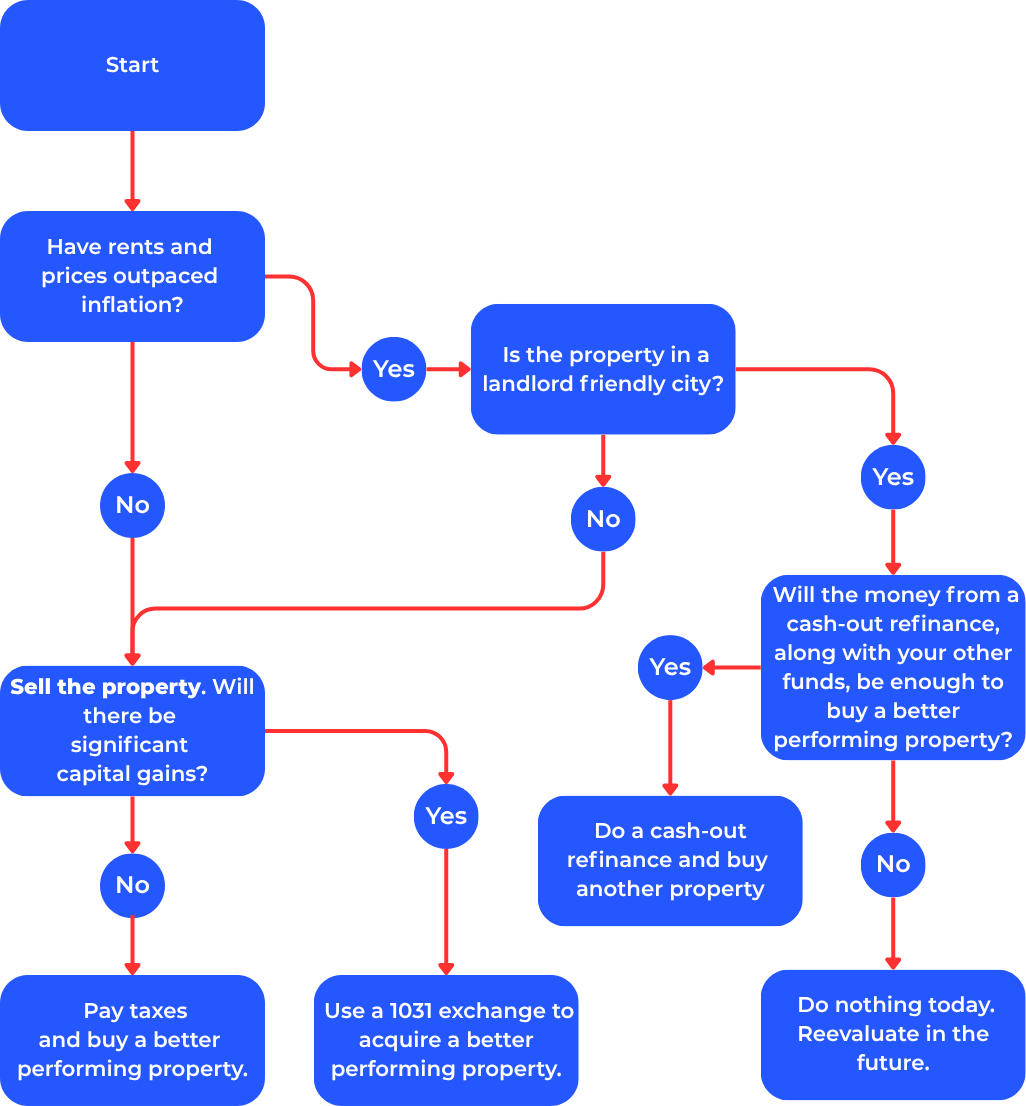
The short answer: this isn't just a "sell vs. rent" decision. There are actually four paths: hold and re-rent, refinance, sell, or 1031 exchange. The right answer depends on your equity, your tax position, your loan terms, and your confidence in San Antonio's long-term trajectory (key point).
The decision tree below may help you work through the logic:
The Texas Operating Cost Problem
Part of what makes Texas a tough cash-flow market isn't the rent — it's the operating cost situation. Texas has one of the highest property tax rates in the country, and when you combine that with the high insurance cost, the numbers work against you from the start.
Here's how Texas stacks up against Nevada and Florida:
For a $400,000 property, that translates to real dollars:
State
Insurance
Property Tax
Annual Total
Florida
$10,996
$3,640
$14,636
Texas
$2,317
$6,720
$9,037
Nevada
$965
$2,360
$3,325
Compared to a comparable Nevada property, a Texas investor needs $476/month more in gross rent just to break even on taxes and insurance alone — before debt service, property management, or maintenance enter the equation. That's the structural headwind you've been fighting since day one.
What I'd Recommend
The question I'd focus on first: how much equity have you built since 2022? Even in a flat market, four years of loan pay down and any appreciation could give you meaningful leverage to act.
If there's equity to work with, a 1031 exchange is worth serious consideration. You could exit the San Antonio property without triggering a capital gains tax event and redeploy into a market with lower operating costs and stronger growth projections. Based on over 90 exchanges we’ve done — many involving trading a single property for multiple properties — the difference in (real, not on paper) cash flow can be dramatic.
My suggested first step: get a current broker opinion of value on the San Antonio property so you know what you're working with. From there, you can run a proper comparison between holding, selling outright, and exchanging.
Accountant · Los Angeles, CA · Member since 2016 · 2k+ posts · 904 votes
4mo
Hey Anthony, the right move here really comes down to your full tax picture and long-term goals, not just the monthly cash flow on this one property. If you have other rentals or passive income, the losses on this one can sometimes offset that income and turn a soft year into a tax-positive one. A short-term rental conversion could also reshape the math, especially if you have higher W-2 or business income to offset, and San Antonio gets a steady tourist flow that can support that pivot. Renting by the room is another path some owners use to push negative cash flow back into positive territory. Whichever direction you go, I'd run through the depreciation recapture and capital gains exposure with your CPA before listing, since selling at the wrong moment can leave real money on the table. Every situation is different though, so it's worth running this through your own tax advisor before pulling the trigger.