Hello, I finally think I can post. New to BP. Inherited a property/rental 30 years ago from my mother. If we sell and take the proceeds do we have to pay the capital gains or do we have to do the 90 days to find a likeable property to do the 1031 exchange? I have an accountant saying if we take the proceeds we are subjected to the capital gains and should do the exchange. Where I have other people I know that claim if inherited from a parent you do not have to pay. Any help would be appreciated and I realize I may need to ask a real estate attorney/tax attorney. Thank you.
CPA| New Clients Welcome| 50 States · Member since 2016 · 430 posts · 93 votes
6mo
@Brian Hoerner, hi. Great question. When you inherit a property, you get a step-up in basis to the value at the date of death. So you are not taxed on the original purchase price, only on appreciation since inheritance.
If you sell → you may owe capital gains on post-inheritance appreciation
A 1031 is optional (only if you want to defer those gains)
Your accountant is partially right,but you are not automatically taxed on the full gain.
Happy to help you estimate your actual exposure before you decide.
CPA| New Clients Welcome| 50 States · Member since 2016 · 430 posts · 93 votes
6mo
@Brian Hoerner, hi. Great question. When you inherit a property, you get a step-up in basis to the value at the date of death. So you are not taxed on the original purchase price, only on appreciation since inheritance.
If you sell → you may owe capital gains on post-inheritance appreciation
A 1031 is optional (only if you want to defer those gains)
Your accountant is partially right,but you are not automatically taxed on the full gain.
Happy to help you estimate your actual exposure before you decide.
@Brian Hoerner, hi. Great question. When you inherit a property, you get a step-up in basis to the value at the date of death. So you are not taxed on the original purchase price, only on appreciation since inheritance.
If you sell → you may owe capital gains on post-inheritance appreciation
A 1031 is optional (only if you want to defer those gains)
Your accountant is partially right,but you are not automatically taxed on the full gain.
Happy to help you estimate your actual exposure before you decide.
Hello, I finally think I can post. New to BP. Inherited a property/rental 30 years ago from my mother. If we sell and take the proceeds do we have to pay the capital gains or do we have to do the 90 days to find a likeable property to do the 1031 exchange? I have an accountant saying if we take the proceeds we are subjected to the capital gains and should do the exchange. Where I have other people I know that claim if inherited from a parent you do not have to pay. Any help would be appreciated and I realize I may need to ask a real estate attorney/tax attorney. Thank you.
Have you looked into doing a cash-out refinance and letting the tenants pay down the mortgage on it?
Depending on your rental income is from tenants and what your mortgage would end up being, you can take out some cash and let the tenants pay down the mortgage for you and you won't have to pay taxes on it at all and you can maintain control over the asset and continue to let it appreciate for years to come.
Accountant · Los Angeles, CA · Member since 2016 · 2k+ posts · 898 votes
6mo
When you inherit a property, your tax basis is adjusted to its fair market value at the date of death, so you’re not taxed on the original purchase price—only on any appreciation that occurs after you inherit it. If you decide to sell, you would only owe capital gains on that post-inheritance increase in value, and doing a 1031 exchange is optional if your goal is to defer those gains. In other words, you’re not automatically taxed on the full gain, just the portion that happens after you take ownership.
Real Estate Agent · Seattle, WA · Member since 2020 · 161 posts · 105 votes
6mo
@Brian Hoerner as others have mentioned above, your capital gains may not be as steep due to the step-up in basis. Meaning, the starting value (value at inheritance) is much higher than the original purchase price. Your gain might be fairly small, making a 1031 exchange less important.
If you do decide to 1031 exchange, just know that there isn't a 90 day rule. It's a 45 day rule to identify a replacement property, and 180 days to close on it. A 1031 exchange feels complicated at first, but it's fairly straight forward once you get into the process. Happy to help guide you through it if you have any questions. I help folks do these all the time.
@Brian Hoerner, You will only be subject to the capital gain since you inherited the property from the stepped-up basis when the property was inherited. But that's 30 years' worth of appreciation, and it has probably been fully depreciated. So you can count on paying tax on just about the full amount of the sale. That's going to be a lot of tax, no matter how you slice it. If you sell the property, a 1031 exchange allows you to defer all of the tax you would pay on the capital gains and reinvest it into another investment property.
The 1031 does have some hoops to jump through. But they're not crazy. And, fortunately, one of those requirements is that you must use a Qualified intermediary (QI) in order to do a 1031 exchange. Your Qi will be there to guide you throughout the process, just like the professionals you work with in a normal real estate sale and purchase. I always tell my clients the hardest exchange you'll ever do is your first one.
Investor · Las Vegas, NV · Member since 2013 · 8k+ posts · 10k+ votes
6mo
Brian:
It’s been over 27.5 years since you inherited the property. So ever dollar over the original LAND basis when your mom bought it you receive after selling costs will be taxable. (Either as capital gains (probably 15%) or depreciation recapture (your regular tax bracket up to 25%.) Don’t forget. If you or the property are in a tax income state they’ll want their chunk. If you want to do a 1031, give Dave a shot. He did one for me a couple years ago and it turned out great.
You have to have him or another QI arranged BEFORE the sale completes, once it’s complete it’s too late, you owe the tax. The QI will hold on to the sales proceeds and you’ll have 45 days to pick up to 3 properties you ar considering. Then you have another 135 CALENDAR days (including holidays/weekends, etc.) to close on one of those identified properties. The replacement can be any kind of investment property. It can’t be a new home for you to live in. Any proceeds you don’t spend will be taxable. Good luck and please reach out with questions, you have a relatively straight forward “problem”.
CPA, CFP®, PFS · FL · Member since 2017 · 5k+ posts · 3k+ votes
5mo
Like Jason and others have mentioned an inherited property, you generally do not need to do a 1031 exchange to avoid paying capital gains taxes. When you inherit property, the IRS typically allows a "step-up" in basis to the market value at the time of inheritance, which can help reduce or even eliminate capital gains taxes when you sell. However, if you want to defer capital gains taxes, you could use a 1031 exchange to reinvest in a like-kind property within 180 days, though this would not apply to the inherited property's original cost basis.
If you plan to sell, the step-up in basis should allow you to avoid paying capital gains on any appreciation that occurred before your mother's passing. It’s always best to consult a tax professional or attorney who specializes in 1031 exchanges and inheritance to ensure the correct application of these rules in your case.
Because this is your first 1031 exchange, I’ll summarize:
What is a 1031 exchange?
The required process
The Two Critical Deadlines
The risk mitigation procedures we follow
My recommendation
What Is a 1031 Exchange?
A 1031 exchange allows an investor to defer capital gains taxes when selling an investment property, provided the proceeds are reinvested into another “like-kind” investment property.
The key word is defer. The tax is postponed — not eliminated.
The Required Process
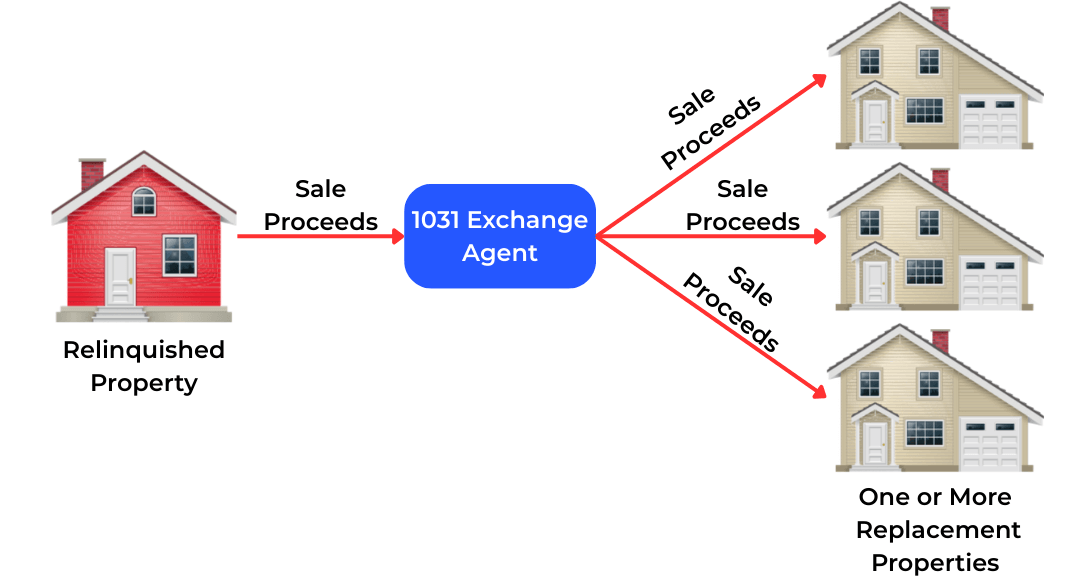
You sell the existing investment property (the “relinquished” property) and reinvest the proceeds into one or more replacement investment properties. The IRS requires strict adherence to timelines and handling procedures; there are no exceptions or delays allowed. The process diagram below shows how the proceeds flow; the proceeds must never come under your control.
The Two Critical Deadlines
There are two non-negotiable dates:
Day 45: Identification deadline
Day 180: Final closing deadline
See the timeline diagram below. Failure to meet either deadline typically results in loss of tax deferment. There are no extensions.
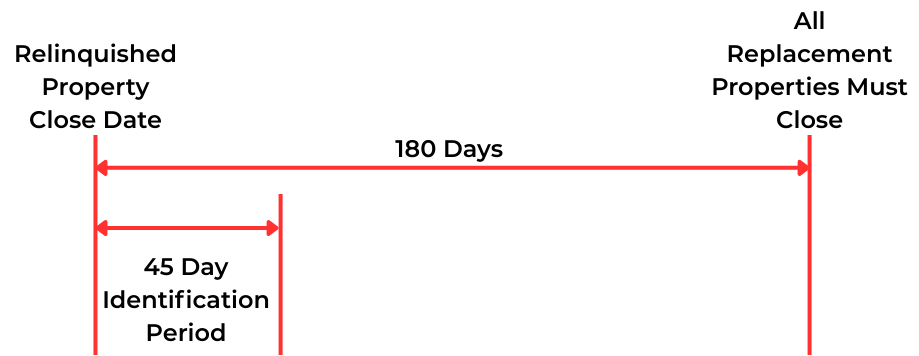
During the 45-day identification period, the rule is simple: identify up to three replacement properties. However, the real risk isn't identification—it's closing on all the necessary replacement properties. If one or more fails to close, the exchange can collapse. When that happens, the deferred gain becomes taxable.
The Risk Mitigation Procedures We Follow
We've developed procedures to minimize this risk. This becomes especially important when proceeds from one property are used to purchase multiple replacement properties. (The maximum we've handled is one property to seven replacements — you need all the time you can get in such situations.) More properties mean more potential failure points. The process we follow is illustrated below.
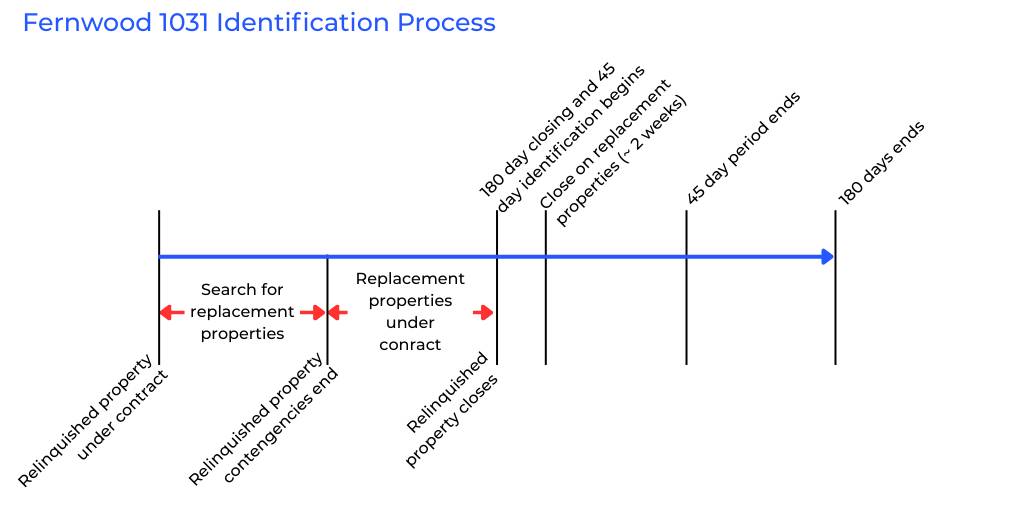
Once all contingencies on the relinquished property have cleared, we place replacement properties under contract. We typically close on the replacements within two weeks of closing the relinquished property. This timeline provides a cushion—if one or more replacement properties fall through, we still have time to secure alternatives before the 45-day identification deadline.
Using this process, we’ve completed over ninety 1031 exchanges with zero failures. This includes multiple one relinquished property to multiple (>6) replacement properties.
My Recommendation
Decide on your financial goal and work backward from there. If your goal is long-term financial independence, the most important investment decision will be the city where it can support your financial goals. The city defines all long term financial results. Live where you like but invest where you can achieve your financial goals.
Select a replacement property based on the tenant you want. Properties never pay rent; tenants do. Your financial success depends on consistently having reliable tenants. Reliable tenants stay for years, pay rent on time, and take good care of the property. Such tenants are not the norm. There is a process for achieving this goal. Reach out if you want the details.