Will housing crash in 2026 or has it already crashed? Expert called last two crashes.
Most Popular Reply
Investor · VA · Member since 2015 · 21k+ posts · 19k+ votes
2yQuote from @Jack B.:
This guy called the last two crashes, says there will be one in 2026 too. https://www.thisismoney.co.uk/money/mortgageshome/article-12...
But we have the lowest demand since the 90's, even lower than the 2008 crash. Prices in Seattle dropped 20% since rates went up. Did we already see a crash in 2022 and start a new 18 year cycle?
No one can predict if we will have a crash because there are too many macroeconomic issues.
If the government keeps printing trillions a year then yeah we will not have a crash.
Let me tell you what I am seeing and people can make their own assumptions:
1. Asset based lenders / lender to lender financing (those who provide financing to companies for equipment, operations, etc. They will not touch real estate. They have stopped lending to real estate or even lenders who lend on real estate)
2. Commercial is worse than what the media is telling you. This includes self storage and multifamily. People do not understand how impactful commercial is on the banks. This is a big big deal.
3. A large percentage of small businesses are defaulting on rents and their loans.
4. The job market is seeing multiple applicants per opening. Why? because the only jobs that were hired in last six months were auto unions back to work, government workers and healthcare workers. Other sectors are shedding jobs.
5. Incomes are not keeping up with the cost of housing. It is down from 38% to 32% but its still abnormally high.
6. In order to calm inflation, housing needs to soften as it comprises 30%+. So if housing stays strong, so does inflation and rates will remain higher. Fed will not cut rates if the economy is still "steaming along". Eventually the inflation and high rates is going to have ramifications.
Note this is not in every location nationwide, as some pockets are more resistant and some are less resistant.

7e investments53 Reviews
121 Replies
- Real Estate Agent · Puyallup, WA · Member since 2022 · 551 posts · 379 votes2y
I think that when we see rates drop down to about 5%, we see those sellers start to come out of the woodwork because even though that 3.5% interest they currently have looks great, a 5% interest on their dream home or next step up is a lot easier for them to swallow than a 7%.
At least in our area, demand is so high, but inventory is so low. You said that Seattle prices dropped by 20%. I believe it! Our market is so dependent on rates because the purchase prices are so high. Not many working class families have the money to be able to shell out a $4k mortgage payment. Then let's not forget how expensive our taxes and insurance are becoming as well.
To be honest, I have seen the market pick back up down here in the last couple of months. Part of me thinks because the "sticker shock" of higher interest is slowly dying down OR the fact that landlords are all nervous about the rent control rumors swirling around and quickly trying to play catch up and get their rents to/near market value. Every buyer that I have helped buy a home that is coming from a rental said the deciding factor that pushed them to buy was because their landlord jacked their rent up drastically.
- Chicago Area, IL · Member since 2024 · 54 posts · 49 votes2y
Predictions are a dime a dozen. Using a couple indicators loses sight of the fact that there are many other influences on the economy. Many are being controlled in ways that they have never been used before. I don't know what the future holds, but here are a few observations on some items that influence an economy.
1) Inflation - Government spending has been out of control, as they attempt to spend their way to keeping the economy going. While driving up the debt, they spend and claim the increased GDP means the economy is good. There are many in government that want to inflate their way out of the debt. The question is... can they continue, or will it cause a disaster? The 10 year Treasury rates during the early 80s peaked at 15.84% in 1981. Link When we were at $20tril debt, those rates would have eaten up the entire $3.5tril government income. We're now at about $4.5tril income, much of the increase due to government spending. If they stop, will the economy tank?
2) Employment - The current unemployment rate is meaningless without also including the participation rate. If someone isn't on unemployment, they are considered not looking. The participation rate is just part of analyzing employment trends. Many of the new jobs are part-time jobs that people who are already working need, just to keep up with inflation, but are counted as if they are unemployed people now employed. 10 years ago, 200k-300k new jobs was considered just keeping up with new young people entering the job market. Now it is touted as signs of a great economy.
3) Interest Rates - There are several rates to consider. T-Bill rates are what the government pays to get people to buy bonds. Currently, most bonds are shorter term and turnover of bonds is around 4-5 years. That means that in a couple years most government debt will be at the higher interest rates, since they didn't sell many long term bonds, but concentrated on shorter term bonds for the last few decades. Currently, about $1tril is spent on interest payments, and even if rates stay current, that will increase, since debt is increasing. Prime interest rates, or the rates the government lends to banks, affects what rates banks can lend out their money at, as well as many credit card and other rates that are based on it. Mortgage rates are affected by how much banks need to pay for the money. Prime rates, interest rates paid on customer bank accounts and CDs. And the housing market also affects these rates, as recently seen, as raising rates can kill movement in the housing market. At least the government wants to keep interest rates down so government interest payments don't eat all government income, but that may mean they don't raise them enough to keep inflation under control. Can they keep the juggling act going?
4) AI and automation - All expanding recently, and nobody knows to what extent they will affect employment. Will it make workers more efficient, or replace them and leave them jobless? As wages increase, companies will look for ways to replace labor, and make current workers more efficient, and give them more responsibilities. Will the new technologies create enough jobs to employ the workers they replace?
5) The Dollar as Reserve Currency - Inflating the dollar can cause other countries to look at other currencies to trade in. Being the Reserve Currency of the world has benefits to the U.S. and losing that status would be a hit on our economy. Although it is strange that other countries are looking to China, who devalued their currency just a few years ago.
Many forecasts I have seen look at a few indicators, but as you can see, there are many other pressures at work that could help investors, but could also cause a recession, or depression, if they fail in a big way. Inflation is great for investors, if everything else keeps up. You bought when property was low, and inflation causes property prices and rent to increase, and you pay off your loans with cheaper money.
As investors, all you can do is be picky about the properties you choose, get the best loan rates you can, and be aggressive about reducing every expense you can. Look at every method you can for reducing taxes, income and property taxes. Any way to reduce insurance. And any way to protect the money you have already made. And that all depends on how you have structured your investments.
- Investor · Milwaukee - Mequon, WI · Member since 2010 · 5k+ posts · 7k+ votes2y
Quote from @Jack B.:
That last sentence is key. It makes sense to buy and hold real estate at the right time, for a specific period. But over the long run, it's not the magic investment everyone thinks when you factor in that it merely keeps pace with inflation in the LONG run. If you time it right to get in and out, it's gold. But not holding forever.Quote from @Paul Azad:
no need to squabble over the charts above, they are actually the same, both by Dr Robert Shiller at Yale, the only difference is that one backs out inflation. Shiller did his PHD at MIT in 60s w fellow student Dr Jeremy Seigel, whose latest edition of Stocks for the Long Run does a deep dive into US inflation, basically we had none from 1809 till 1945, house prices flat, then post WW2, lots of inflation and house prices up, if you remove the inflation, the red line in last chart above, house prices nearly flat again. Almost all real estate historical studies show all real estate appreciates at rate of inflation. The famous Amsterdam study looked at bills of sale for >400 years on canal front homes in Amsterdam, and price appreciation exactly mirrored inflation rate, ie residential real estate or any real estate never goes up in Value only in Price because the currency its denominated in loses its value at same rate. As real estate investors we carefully surf the micro-fluctuations over several years and use leverage to amplify them.
It would be horrible if real estate would outpace inflation! Think about the consequences of that over 100 years. Most home buyer's first name would either be Jeff or Elon...
The "magic" comes from leverage, which gurantees an almost double digit return on your downpayment just from deleveraging. Also the ability to pull out equity, improve assets to force appreciation and from improving cash flow over time. And tax advanatges. Plenty of magic.
- 2yNicholas L.Pro MemberFlipper/Rehabber · Pittsburgh · Member since 2018 · 6k+ posts · 5k+ votes
agree with you. how do you think about (and you don't have to write a book on it - just a few sentences!) some of the peripheral questions @Jack B. is asking:
-optimizing your portfolio - potentially selling off either low performing or high appreciating assets, and
-diversification into other asset classes?
for example
I spoke to Michael Zuber a few weeks ago and he sold some his SFHs that had appreciated the most, to get more cash flow in the form of small to midsize apartment buildings. seems brilliant to me and a great way to optimize portfolio for appreciation + cash flow
@Jack B.
Commercial real estate such as offices maybe collapsing. That, however, comes from chaning work culture such as remote works and not soely from the fact they are in bubble.
I'm wondering how on earth houses could be trashed when people keep needing more house while the buying power of dollar keeps vanishing. In my opinion, what we are looking at is not a housing bubble. It is the debasing of dollar.
I don’t know anything other than my market for single family/duplexs.
We will hopefully see a slowdown from 10%yoy appreciation to something more manageable e.g. 5%.
With that said, the market is still red hot and there aren’t anywhere enough new builds to match demand in the suburbs. Houses are still going for 10-50% above asking with multiple offers. Median income in neighborhoods supports current prices with median housing price in the 2.5-3x median income. All this to say I don’t see a crash in my market. Even a dual income family with both folks working low wage jobs Eg amazon warehouses, can afford houses in safe neighborhoods with decent schools. Biggest issue is there isn’t enough houses.
- Residential Real Estate Investor · Kansas City, MO · Member since 2014 · 10k+ posts · 5k+ votes2y
Quote from @Minsu Kim:
@Jack B.
Commercial real estate such as offices maybe collapsing. That, however, comes from chaning work culture such as remote works and not soely from the fact they are in bubble.
I'm wondering how on earth houses could be trashed when people keep needing more house while the buying power of dollar keeps vanishing. In my opinion, what we are looking at is not a housing bubble. It is the debasing of dollar.
It's basically already collapsed in many coastal downtown areas, San Francisco being the worst. I think many will slowly be converted to residential (assuming they ever clean up downtown San Fran). Industrial is still strong and retail is OK, at least the Amazon-resistent retail (most notably grocery stores, restaurants, etc.) But commercial real estate is definitely in a slump that will likely get worse although I doubt it will all out crash (other than those downtown areas mentioned above.)
The median home price to median income ratio is much higher currently than it was in 2006 before the last crash, and way above historical norms. IMHO this is not sustainable. I look at appraisals from various markets around the country. It appears home prices are starting to trend down in many markets. I would build as large of a pile of cash as you can and wait until there is blood in the water. That is when the deals will be tremendous.
- 2yNicholas L.Pro MemberFlipper/Rehabber · Pittsburgh · Member since 2018 · 6k+ posts · 5k+ votes
one thing you're missing is that the price to income ratio only affects people looking to buy. it doesn't affect people who refinanced when interest rates were low, and it doesn't affect people with no mortgage.
https://finance.yahoo.com/news/housing-market-historically-u...
now to be clear, i'm not saying it's a good thing - it's not. but it impacts less of the population than you would think from the headlines.
Nicholas - So everyone is trapped in their current house which was purchased at a much lower price and much lower interest rate? What does that do to home prices? There has to be a connection between income and the price of housing. Last time it got this far out of skew we all know what happened.
I've been looking to purchase an investment property in the Columbus, OH area. Problem I'm running into is the rent to price ratio is way below 1%. None of the properties I have analyzed even come close to being cash flow neutral or positive. Another indicator home prices are inflated.
@Nicholas L. I'm scratching my head on that one... Yeah, its only the ones looking to buy that are affected... They are also the ones setting the market.
Lets face it, all real estate is really purchased by the monthly payment. the properties out west, more so pacific northwest, are dropping hard since their property taxes are relateively low and most of their PITI is the mortgage. So, since more of the payment is interest now, buyers just afford only lower total values...
The people staying in place are moot --- other than maybe helping to keep inventory low.
- Member since 2019 · 38 posts · 45 votes2y
Quote from @Greg Scott:
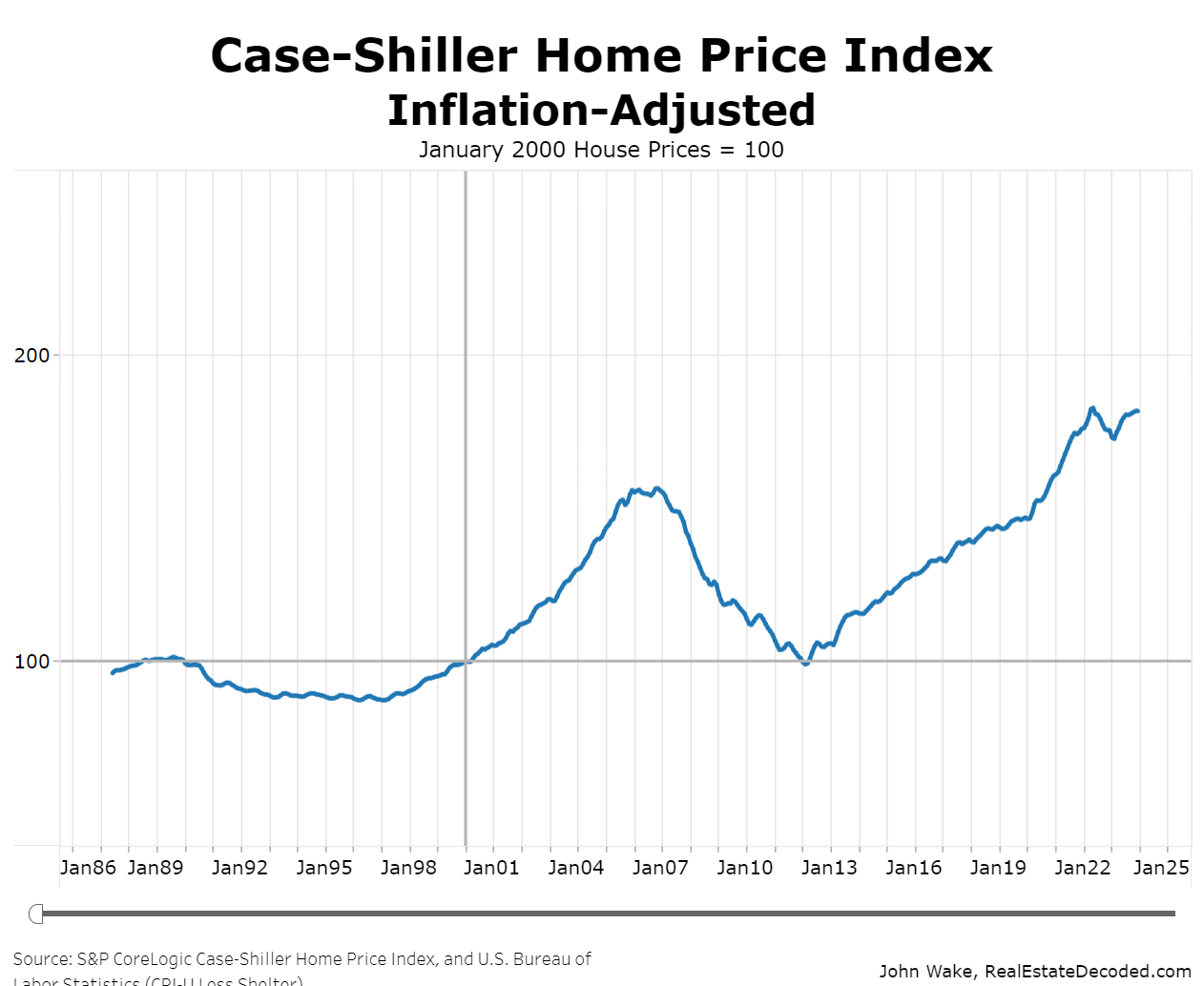
This chart is not logarithmic, so it's impossible to see anything that happened before 1980. But regardless, look at this - both logarithmic and adjusted for inflation. There absolutely was a very real downturn 18 years before the one in 2008.

Quote from @Mike K.:
Nicholas - So everyone is trapped in their current house which was purchased at a much lower price and much lower interest rate? What does that do to home prices? There has to be a connection between income and the price of housing. Last time it got this far out of skew we all know what happened.
I've been looking to purchase an investment property in the Columbus, OH area. Problem I'm running into is the rent to price ratio is way below 1%. None of the properties I have analyzed even come close to being cash flow neutral or positive. Another indicator home prices are inflated.
Being intrinsic isn't a signal that if home prices are inflated, infact I'd argue the opposite. Houses being intrinsic was anomalous and a total mix of tailwinds to the housing sector-- massive housing crash, leading to more rental demand and less overall capacity and low rates. That made a property intrinsic from 2008-12, and slowly less so all the way up until 2022.
In regards to median income to household ratio, it's gotten egregious relative to years past. But in a global landscape, this is nothing. I mean people in cities like Austin learned what New Yorkers face from 1985 up until the pandemic. Even a lot of Miami pre-covid had folks spending a large % of their income for just housing. Now those people move to the outer parts of Miami, cause the richest of the rich pay cash for the nicest spots. Rent for a luxury apartment in Houston is now akin to what New Yorkers were facing all of the mid 2010s from a income:rent perspective. There's a lot more room to grow on this, sadly.
I think the RTP tightens, but to say the the ratio is unsustainable simply isn't true. Go travel the world, you'll notice America's markets are relatively cheap. Go look at our same continent-- check out Vancouver and Toronto, you'll see a RTP/median income: household ratio that would show you more or less where America could get to and even exceed. Go check out Capetown, prices in the last 3 years skyrocketed from a RTP/median income:household ratio. Find a spot in Sydney, it skyrocketed from low 100 to low 130 in house price in income ratio, heck all of Australia was sub 100 and now north of 120.
The RTP over time will get wider, but in the short-term should tighten, but the premise of this is just wealth inequality. That's how it'll move and that's how it'll get wider. Not finding 1% in columbus is obvious, you have the most investor saturated market in America and wondering why you can't find intrinsic.
Quote from @David M.:
@Nicholas L. I'm scratching my head on that one... Yeah, its only the ones looking to buy that are affected... They are also the ones setting the market.
Lets face it, all real estate is really purchased by the monthly payment. the properties out west, more so pacific northwest, are dropping hard since their property taxes are relateively low and most of their PITI is the mortgage. So, since more of the payment is interest now, buyers just afford only lower total values...
The people staying in place are moot --- other than maybe helping to keep inventory low.
They're setting a market in a low transactional/low liquidity environment. In any (traded) market environment, you remain suspect when liquidity is low.
The mortgage trap is very real, and 2023 showed us it's not an inventory problem-- it's a rate problem. Go make mortgages 5% and see how many homebuyers are now amenable to selling. That alone will make inventory tick up, and you'll actually and likely see prices fall after a furious but short uplift. What happens when inventory goes from 3.5 months to 5 months to 7 months quickly as in within 6 months? Sellers will have to price lower. And in my opinion, this is how the RTP will tighten. Rent will slightly move up, as house prices will slightly move down(and net mortgages lower).
- With that comes the risk of lawsuits, foreclosure, etc. Even Robert Allen, the Nothing Down for the 90's guy ended up filing bankruptcy. Dave Ramsey as well. It's good to start out, at the right time. From 2012 to 2022 was a good time for rentals. Now? Not so much.
Quote from @Marcus Auerbach:
Quote from @Jack B.:
That last sentence is key. It makes sense to buy and hold real estate at the right time, for a specific period. But over the long run, it's not the magic investment everyone thinks when you factor in that it merely keeps pace with inflation in the LONG run. If you time it right to get in and out, it's gold. But not holding forever.Quote from @Paul Azad:
no need to squabble over the charts above, they are actually the same, both by Dr Robert Shiller at Yale, the only difference is that one backs out inflation. Shiller did his PHD at MIT in 60s w fellow student Dr Jeremy Seigel, whose latest edition of Stocks for the Long Run does a deep dive into US inflation, basically we had none from 1809 till 1945, house prices flat, then post WW2, lots of inflation and house prices up, if you remove the inflation, the red line in last chart above, house prices nearly flat again. Almost all real estate historical studies show all real estate appreciates at rate of inflation. The famous Amsterdam study looked at bills of sale for >400 years on canal front homes in Amsterdam, and price appreciation exactly mirrored inflation rate, ie residential real estate or any real estate never goes up in Value only in Price because the currency its denominated in loses its value at same rate. As real estate investors we carefully surf the micro-fluctuations over several years and use leverage to amplify them.
It would be horrible if real estate would outpace inflation! Think about the consequences of that over 100 years. Most home buyer's first name would either be Jeff or Elon...
The "magic" comes from leverage, which gurantees an almost double digit return on your downpayment just from deleveraging. Also the ability to pull out equity, improve assets to force appreciation and from improving cash flow over time. And tax advanatges. Plenty of magic.
You can also win at anything in life and if you keep gambling away with your proceeds, sooner or later you can have a bad loss.
It's hard to go bankrupt when you're not in debt. It's hard to get sued when you don't have rentals for people to trip on a leaf and say they can never work again because they stubbed their toe on the leaf. Yes I have insurance, but insurance companies can also deny your claim...happened to me for a car accident. They declined to pay the party (I wasn't even at fault!) and they sued me for 2 years. They lost, but still...insurance had to represent me (they didn't tell me that but I found out through a family friend who is an attorney). Quote from @Jack B.:
With that comes the risk of lawsuits, foreclosure, etc. Even Robert Allen, the Nothing Down for the 90's guy ended up filing bankruptcy. Dave Ramsey as well. It's good to start out, at the right time. From 2012 to 2022 was a good time for rentals. Now? Not so much.Quote from @Marcus Auerbach:
Quote from @Jack B.:
That last sentence is key. It makes sense to buy and hold real estate at the right time, for a specific period. But over the long run, it's not the magic investment everyone thinks when you factor in that it merely keeps pace with inflation in the LONG run. If you time it right to get in and out, it's gold. But not holding forever.Quote from @Paul Azad:
no need to squabble over the charts above, they are actually the same, both by Dr Robert Shiller at Yale, the only difference is that one backs out inflation. Shiller did his PHD at MIT in 60s w fellow student Dr Jeremy Seigel, whose latest edition of Stocks for the Long Run does a deep dive into US inflation, basically we had none from 1809 till 1945, house prices flat, then post WW2, lots of inflation and house prices up, if you remove the inflation, the red line in last chart above, house prices nearly flat again. Almost all real estate historical studies show all real estate appreciates at rate of inflation. The famous Amsterdam study looked at bills of sale for >400 years on canal front homes in Amsterdam, and price appreciation exactly mirrored inflation rate, ie residential real estate or any real estate never goes up in Value only in Price because the currency its denominated in loses its value at same rate. As real estate investors we carefully surf the micro-fluctuations over several years and use leverage to amplify them.
It would be horrible if real estate would outpace inflation! Think about the consequences of that over 100 years. Most home buyer's first name would either be Jeff or Elon...
The "magic" comes from leverage, which gurantees an almost double digit return on your downpayment just from deleveraging. Also the ability to pull out equity, improve assets to force appreciation and from improving cash flow over time. And tax advanatges. Plenty of magic.
You can also win at anything in life and if you keep gambling away with your proceeds, sooner or later you can have a bad loss.
It's hard to go bankrupt when you're not in debt. It's hard to get sued when you don't have rentals for people to trip on a leaf and say they can never work again because they stubbed their toe on the leaf. Yes I have insurance, but insurance companies can also deny your claim...happened to me for a car accident. They declined to pay the party (I wasn't even at fault!) and they sued me for 2 years. They lost, but still...insurance had to represent me (they didn't tell me that but I found out through a family friend who is an attorney).Now's a fine time, 2010-2022 was just an absolutely amazing time. The best time ever. You're still on the cusp of a net inventory short, massive migration from the global side to America, and a fiscal policy that's going to create a greater wealth divide. If you think that's bearish for hard assets, I'd beg to differ. Granted every RE investment is case by case, but the net view should be hard assets & infrastructure should be the long view.
Quote from @V.G Jason:
Quote from @David M.:
@Nicholas L. I'm scratching my head on that one... Yeah, its only the ones looking to buy that are affected... They are also the ones setting the market.
Lets face it, all real estate is really purchased by the monthly payment. the properties out west, more so pacific northwest, are dropping hard since their property taxes are relateively low and most of their PITI is the mortgage. So, since more of the payment is interest now, buyers just afford only lower total values...
The people staying in place are moot --- other than maybe helping to keep inventory low.
They're setting a market in a low transactional/low liquidity environment. In any (traded) market environment, you remain suspect when liquidity is low.
The mortgage trap is very real, and 2023 showed us it's not an inventory problem-- it's a rate problem. Go make mortgages 5% and see how many homebuyers are now amenable to selling. That alone will make inventory tick up, and you'll actually and likely see prices fall after a furious but short uplift. What happens when inventory goes from 3.5 months to 5 months to 7 months quickly as in within 6 months? Sellers will have to price lower. And in my opinion, this is how the RTP will tighten. Rent will slightly move up, as house prices will slightly move down(and net mortgages lower).
How do you figure this? Prices didn't fall when rates were 3%, much lower than 5%. Your theory that sellers would then list and prices would fall is strange to me. Sellers were listing in 2021 too, and they don't sell to go live in a box under a bridge, they trade up. Supply curve was essentially left unchanged as a result. Only demand doubled. As such prices rose. 5% rates would do the same. Sellers sell to trade up. As a result they put a house on the market that there is a buyer waiting for, but they then become a buyer again for house that they now want, and that new house they bought also had someone waiting for it. So instead of 2 buyers for 2 houses, one each, there are now 3 buyers and only 2 houses for sale. The person the seller buys from will also want to buy a new home.
Quote from @Jack B.:
Quote from @V.G Jason:
Quote from @David M.:
@Nicholas L. I'm scratching my head on that one... Yeah, its only the ones looking to buy that are affected... They are also the ones setting the market.
Lets face it, all real estate is really purchased by the monthly payment. the properties out west, more so pacific northwest, are dropping hard since their property taxes are relateively low and most of their PITI is the mortgage. So, since more of the payment is interest now, buyers just afford only lower total values...
The people staying in place are moot --- other than maybe helping to keep inventory low.
They're setting a market in a low transactional/low liquidity environment. In any (traded) market environment, you remain suspect when liquidity is low.
The mortgage trap is very real, and 2023 showed us it's not an inventory problem-- it's a rate problem. Go make mortgages 5% and see how many homebuyers are now amenable to selling. That alone will make inventory tick up, and you'll actually and likely see prices fall after a furious but short uplift. What happens when inventory goes from 3.5 months to 5 months to 7 months quickly as in within 6 months? Sellers will have to price lower. And in my opinion, this is how the RTP will tighten. Rent will slightly move up, as house prices will slightly move down(and net mortgages lower).
How do you figure this? Prices didn't fall when rates were 3%, much lower than 5%. Your theory that sellers would then list and prices would fall is strange to me. Sellers were listing in 2021 too, and they don't sell to go live in a box under a bridge, they trade up. Supply curve was essentially left unchanged as a result. Only demand doubled. As such prices rose. 5% rates would do the same. Sellers sell to trade up. As a result they put a house on the market that there is a buyer waiting for, but they then become a buyer again for house that they now want, and that new house they bought also had someone waiting for it. So instead of 2 buyers for 2 houses, one each, there are now 3 buyers and only 2 houses for sale. The person the seller buys from will also want to buy a new home.
That's a completely different environment. It's comparing apples to oranges, you literally went from a 5-day work week to complete remote work and housing as the #1 sought after target for any individual in America. Coupled with a massive money printing situation and savings/income at levels we haven't seen ever.
Now, you're going from 7% rates to 5% rates. With debt higher than ever, and savings to below pre-pandemic levels. How are these two situations anywhere related? Go ask a guy who bought a house in Q4 2020 at 3% if they'd pay 5%, they'd scoff at it. Go ask anyone in the last 18 months if they'd take 5%, they'd do whatever it takes. Recency bias is huge.
The #1 reason house prices are up is location and supply in that location,or lack thereof. What would make those house prices dip? You build more or more people open to selling. How do you get to that? You make rates lower or physically build more. The impact of rates are usually not drastic over night-- H2 '22 showed otherwise-- but this duration of high(er) rates will have it's impact later. I'm willing to bet in most markets, as soon as rates get low(er) to say 5% we'll see inventory pick up. The inventory/supply increase will create a tighter market.Quote from @V.G Jason:
Quote from @Jack B.:
With that comes the risk of lawsuits, foreclosure, etc. Even Robert Allen, the Nothing Down for the 90's guy ended up filing bankruptcy. Dave Ramsey as well. It's good to start out, at the right time. From 2012 to 2022 was a good time for rentals. Now? Not so much.Quote from @Marcus Auerbach:
Quote from @Jack B.:
That last sentence is key. It makes sense to buy and hold real estate at the right time, for a specific period. But over the long run, it's not the magic investment everyone thinks when you factor in that it merely keeps pace with inflation in the LONG run. If you time it right to get in and out, it's gold. But not holding forever.Quote from @Paul Azad:
no need to squabble over the charts above, they are actually the same, both by Dr Robert Shiller at Yale, the only difference is that one backs out inflation. Shiller did his PHD at MIT in 60s w fellow student Dr Jeremy Seigel, whose latest edition of Stocks for the Long Run does a deep dive into US inflation, basically we had none from 1809 till 1945, house prices flat, then post WW2, lots of inflation and house prices up, if you remove the inflation, the red line in last chart above, house prices nearly flat again. Almost all real estate historical studies show all real estate appreciates at rate of inflation. The famous Amsterdam study looked at bills of sale for >400 years on canal front homes in Amsterdam, and price appreciation exactly mirrored inflation rate, ie residential real estate or any real estate never goes up in Value only in Price because the currency its denominated in loses its value at same rate. As real estate investors we carefully surf the micro-fluctuations over several years and use leverage to amplify them.
It would be horrible if real estate would outpace inflation! Think about the consequences of that over 100 years. Most home buyer's first name would either be Jeff or Elon...
The "magic" comes from leverage, which gurantees an almost double digit return on your downpayment just from deleveraging. Also the ability to pull out equity, improve assets to force appreciation and from improving cash flow over time. And tax advanatges. Plenty of magic.
You can also win at anything in life and if you keep gambling away with your proceeds, sooner or later you can have a bad loss.
It's hard to go bankrupt when you're not in debt. It's hard to get sued when you don't have rentals for people to trip on a leaf and say they can never work again because they stubbed their toe on the leaf. Yes I have insurance, but insurance companies can also deny your claim...happened to me for a car accident. They declined to pay the party (I wasn't even at fault!) and they sued me for 2 years. They lost, but still...insurance had to represent me (they didn't tell me that but I found out through a family friend who is an attorney).Now's a fine time, 2010-2022 was just an absolutely amazing time. The best time ever. You're still on the cusp of a net inventory short, massive migration from the global side to America, and a fiscal policy that's going to create a greater wealth divide. If you think that's bearish for hard assets, I'd beg to differ. Granted every RE investment is case by case, but the net view should be hard assets & infrastructure should be the long view.
The low rates from 2008 to 2022 helped a lot. Real estate took until 2012 here to bottom out. If rates are low, it's a good time to buy and stay in. If rates are high and stay high, it's time to get out IMO. If rates end up staying at 5 or 6% I think appreciation will slow drastically. We will have another event eventually where they have to lend money for the price of a VCR, this won't be the last of the low rates we enjoyed...
Quote from @V.G Jason:
Quote from @Jack B.:
Quote from @V.G Jason:
Quote from @David M.:
@Nicholas L. I'm scratching my head on that one... Yeah, its only the ones looking to buy that are affected... They are also the ones setting the market.
Lets face it, all real estate is really purchased by the monthly payment. the properties out west, more so pacific northwest, are dropping hard since their property taxes are relateively low and most of their PITI is the mortgage. So, since more of the payment is interest now, buyers just afford only lower total values...
The people staying in place are moot --- other than maybe helping to keep inventory low.
They're setting a market in a low transactional/low liquidity environment. In any (traded) market environment, you remain suspect when liquidity is low.
The mortgage trap is very real, and 2023 showed us it's not an inventory problem-- it's a rate problem. Go make mortgages 5% and see how many homebuyers are now amenable to selling. That alone will make inventory tick up, and you'll actually and likely see prices fall after a furious but short uplift. What happens when inventory goes from 3.5 months to 5 months to 7 months quickly as in within 6 months? Sellers will have to price lower. And in my opinion, this is how the RTP will tighten. Rent will slightly move up, as house prices will slightly move down(and net mortgages lower).
How do you figure this? Prices didn't fall when rates were 3%, much lower than 5%. Your theory that sellers would then list and prices would fall is strange to me. Sellers were listing in 2021 too, and they don't sell to go live in a box under a bridge, they trade up. Supply curve was essentially left unchanged as a result. Only demand doubled. As such prices rose. 5% rates would do the same. Sellers sell to trade up. As a result they put a house on the market that there is a buyer waiting for, but they then become a buyer again for house that they now want, and that new house they bought also had someone waiting for it. So instead of 2 buyers for 2 houses, one each, there are now 3 buyers and only 2 houses for sale. The person the seller buys from will also want to buy a new home.
That's a completely different environment. It's comparing apples to oranges, you literally went from a 5-day work week to complete remote work and housing as the #1 sought after target for any individual in America. Coupled with a massive money printing situation and savings/income at levels we haven't seen ever.
Now, you're going from 7% rates to 5% rates. With debt higher than ever, and savings to below pre-pandemic levels. How are these two situations anywhere related? Go ask a guy who bought a house in Q4 2020 at 3% if they'd pay 5%, they'd scoff at it. Go ask anyone in the last 18 months if they'd take 5%, they'd do whatever it takes. Recency bias is huge.
The #1 reason house prices are up is location and supply in that location,or lack thereof. What would make those house prices dip? You build more or more people open to selling. How do you get to that? You make rates lower or physically build more. The impact of rates are usually not drastic over night-- H2 '22 showed otherwise-- but this duration of high(er) rates will have it's impact later. I'm willing to bet in most markets, as soon as rates get low(er) to say 5% we'll see inventory pick up. The inventory/supply increase will create a tighter market.
Quote from @V.G Jason:
"you literally went from a 5-day work week to complete remote work and housing as the #1 sought after target for any individual in America. Coupled with a massive money printing situation and savings/income at levels we haven't seen ever.
"
You say you went from a 5 day work week to complete remote work? Most of the US aren't office workers...it wasn't complete remote work for everyone nor was housing suddenly the #1 sought after thing in the country. Those are quite the claims but completely untrue. Money printing also didn't affect the supply of real estate, real estate is driven by supply and demand. Supply was still low from all the lack of building due to the last crash. Rates dropped, people who were high income white collar workers could now move anywhere. That increased demand where there was limited supply. I don't think you understand the micro economic factors of real estate pricing.
Quote from @V.G Jason:
"Now, you're going from 7% rates to 5% rates. With debt higher than ever, and savings to below pre-pandemic levels. How are these two situations anywhere related? Go ask a guy who bought a house in Q4 2020 at 3% if they'd pay 5%, they'd scoff at it. Go ask anyone in the last 18 months if they'd take 5%, they'd do whatever it takes. Recency bias is huge.
"You don't take into account appreciation of homes that they are sitting on, 5 % rate or not. A 5% rate when you have a 40% down payment using your equity makes the difference. Using your logic, people would not have bought homes for the last 12 years prior to the pandemic. I had primary residences at 4.375 in 2014...despite getting much lower rates prior to that, prices have also come down 20% in my area, because as demand dropped due to rates, prices came down too. Sure rates are higher but prices are lower. A 5% rate is not unreasonable, in fact it's a historical norm. In the 80's the housing market still quadrupled in many areas despite 18% rates.
Here new housing developments have sold out before they are even finished. At 7% rates...big difference, here my fellow tech brothers and sisters are easily clearing 3-400K salary between husband and wife. Rates aren't as much of an issue, in fact my buddy and his wife bought a house at these 7% rates and sold their old house. Life circumstances, tired of their neighbors, forced them to move. Ironically, the neighbors that were issues moved on after he bought a new place.
Quote from @V.G Jason:
"The #1 reason house prices are up is location and supply in that location,or lack thereof. What would make those house prices dip? You build more or more people open to selling. How do you get to that? You make rates lower or physically build more.
"You make a lot of claims but don't seem to truly understand microeconomics. House prices are driven by supply and demand, as with any other good. Not by their location as you claim, but because of the demand in that location and lack of supply in that location. Not by location and supply as you claim...
And again, you seem to for some reason think that when people sell their homes, they go live in a car or something. They sell and buy a new home...just like they have been for the last 14 years. I don't think you have a clue what you are talking about, you seem to struggle with the concept of supply and demand, you seem to think everything is about supply and location. No...it's supply and demand that drives housing prices and if your theory was true, everyone in history would have sold and lived in a box after selling. Makes ZERO sense. Low rates created high demand while there was limited supply due to under building as a result of 2008 crash. Your theory is poorly thought out and doesn't match any actual microeconomic principles actually taught anywhere...
Quote from @Carlos Ptriawan:
Quote from @Jack B.:
Quote from @Eric James:
Quote from @Marcus Auerbach:
Quote from @Jack B.:
Makes you question whether real estate is worth it as a LONG term investment. It's great buying in 2012 and riding it until 2022 with leverage. 10X your money, but might be good to get out after a while, I have another thread about that.
I am on the same boat with that opinion LOL
Yeah, and I wish I had realized that in 2021/2022 and sold. Back then it was part of my retirement plan. As I get older, I'm getting more and more tired of dealing with tenants, contractors, neighbors, etc. I've also wanted to escape Seattle but managing properties forces me to stay here. Hiring a PM would take all of my profits for what is a part time job to a PM.
As I've gotten into the stock market in a safer way in the last year (index funds, quality companies, etc.) I'm starting to see the stock market is truly passive, liquid, etc. I don't have a 10% cost to sell a property, months of waiting, etc. I can easily sell in an instant and for free. I'm not tied to an area. I can travel and be free from hassles of tenants, contractors, etc. Real estate is more of a business than an investment...I want truly passive at this stage.
I really don't think anyone has a "crystal ball" BUT the guys who were in the "Big Short" movie did seem to have really good G2. RE is mostly local as mentioned before in this forum. As Phoenix, Miami and others were "burning" in 08 others were doing okay (0 meltdown)
- Member since 2019 · 7k+ posts · 4k+ votes2y
Quote from @Jack B.:
Quote from @V.G Jason:
Quote from @Jack B.:
Quote from @V.G Jason:
Quote from @David M.:
Here new housing developments have sold out before they are even finished. At 7% rates...big difference, here my fellow tech brothers and sisters are easily clearing 3-400K salary between husband and wife. Rates aren't as much of an issue, in fact my buddy and his wife bought a house at these 7% rates and sold their old house. Life circumstances, tired of their neighbors, forced them to move. Ironically, the neighbors that were issues moved on after he bought a new place.
This is very interesting actually as there's no general trend.
With increased rate and increased supply in FL, we expect price to go down.
But with increased rate and decreased rate in CA, we still price going up.
There's supply/demand factor too but there's no general set trend.
What I noticed is that market with DOM less than 5 , the interest rate does not matter. But market with DOM higher than 20 then interest rate matter.

Join the conversationCreate a free account to reply, vote on answers and follow this thread.