Will housing crash in 2026 or has it already crashed? Expert called last two crashes.
Most Popular Reply
Investor · VA · Member since 2015 · 21k+ posts · 19k+ votes
2yQuote from @Jack B.:
This guy called the last two crashes, says there will be one in 2026 too. https://www.thisismoney.co.uk/money/mortgageshome/article-12...
But we have the lowest demand since the 90's, even lower than the 2008 crash. Prices in Seattle dropped 20% since rates went up. Did we already see a crash in 2022 and start a new 18 year cycle?
No one can predict if we will have a crash because there are too many macroeconomic issues.
If the government keeps printing trillions a year then yeah we will not have a crash.
Let me tell you what I am seeing and people can make their own assumptions:
1. Asset based lenders / lender to lender financing (those who provide financing to companies for equipment, operations, etc. They will not touch real estate. They have stopped lending to real estate or even lenders who lend on real estate)
2. Commercial is worse than what the media is telling you. This includes self storage and multifamily. People do not understand how impactful commercial is on the banks. This is a big big deal.
3. A large percentage of small businesses are defaulting on rents and their loans.
4. The job market is seeing multiple applicants per opening. Why? because the only jobs that were hired in last six months were auto unions back to work, government workers and healthcare workers. Other sectors are shedding jobs.
5. Incomes are not keeping up with the cost of housing. It is down from 38% to 32% but its still abnormally high.
6. In order to calm inflation, housing needs to soften as it comprises 30%+. So if housing stays strong, so does inflation and rates will remain higher. Fed will not cut rates if the economy is still "steaming along". Eventually the inflation and high rates is going to have ramifications.
Note this is not in every location nationwide, as some pockets are more resistant and some are less resistant.

7e investments53 Reviews
121 Replies
- Member since 2019 · 7k+ posts · 4k+ votes2y
Quote from @Jack B.:
Quote from @Carlos Ptriawan:
Quote from @Jack B.:
Quote from @Eric James:
Quote from @Marcus Auerbach:
Quote from @Jack B.:
Makes you question whether real estate is worth it as a LONG term investment. It's great buying in 2012 and riding it until 2022 with leverage. 10X your money, but might be good to get out after a while, I have another thread about that.
I am on the same boat with that opinion LOL
Yeah, and I wish I had realized that in 2021/2022 and sold. Back then it was part of my retirement plan. As I get older, I'm getting more and more tired of dealing with tenants, contractors, neighbors, etc. I've also wanted to escape Seattle but managing properties forces me to stay here. Hiring a PM would take all of my profits for what is a part time job to a PM.
As I've gotten into the stock market in a safer way in the last year (index funds, quality companies, etc.) I'm starting to see the stock market is truly passive, liquid, etc. I don't have a 10% cost to sell a property, months of waiting, etc. I can easily sell in an instant and for free. I'm not tied to an area. I can travel and be free from hassles of tenants, contractors, etc. Real estate is more of a business than an investment...I want truly passive at this stage.
In theory, if home appreciation is less than return of debt investment, lets say appreciation is 3% now and debt investment is now 8% conservatively, then your rate of return is higher with debt investment. You don't really need to have direct ownership of RE to generate 6-8% of income.
In term of appreciation, I am able to make 1 million in cash while doing nothing and following your suggestion above in 2009, key here to have multiple houses as leverage, that appreciate faster than mortgage rate/debt investment return.
Quote from @V.G Jason:
Quote from @Jack B.:
Quote from @V.G Jason:
Quote from @David M.:
@Nicholas L. I'm scratching my head on that one... Yeah, its only the ones looking to buy that are affected... They are also the ones setting the market.
Lets face it, all real estate is really purchased by the monthly payment. the properties out west, more so pacific northwest, are dropping hard since their property taxes are relateively low and most of their PITI is the mortgage. So, since more of the payment is interest now, buyers just afford only lower total values...
The people staying in place are moot --- other than maybe helping to keep inventory low.
They're setting a market in a low transactional/low liquidity environment. In any (traded) market environment, you remain suspect when liquidity is low.
The mortgage trap is very real, and 2023 showed us it's not an inventory problem-- it's a rate problem. Go make mortgages 5% and see how many homebuyers are now amenable to selling. That alone will make inventory tick up, and you'll actually and likely see prices fall after a furious but short uplift. What happens when inventory goes from 3.5 months to 5 months to 7 months quickly as in within 6 months? Sellers will have to price lower. And in my opinion, this is how the RTP will tighten. Rent will slightly move up, as house prices will slightly move down(and net mortgages lower).
How do you figure this? Prices didn't fall when rates were 3%, much lower than 5%. Your theory that sellers would then list and prices would fall is strange to me. Sellers were listing in 2021 too, and they don't sell to go live in a box under a bridge, they trade up. Supply curve was essentially left unchanged as a result. Only demand doubled. As such prices rose. 5% rates would do the same. Sellers sell to trade up. As a result they put a house on the market that there is a buyer waiting for, but they then become a buyer again for house that they now want, and that new house they bought also had someone waiting for it. So instead of 2 buyers for 2 houses, one each, there are now 3 buyers and only 2 houses for sale. The person the seller buys from will also want to buy a new home.
That's a completely different environment. It's comparing apples to oranges, you literally went from a 5-day work week to complete remote work and housing as the #1 sought after target for any individual in America. Coupled with a massive money printing situation and savings/income at levels we haven't seen ever.
Now, you're going from 7% rates to 5% rates. With debt higher than ever, and savings to below pre-pandemic levels. How are these two situations anywhere related? Go ask a guy who bought a house in Q4 2020 at 3% if they'd pay 5%, they'd scoff at it. Go ask anyone in the last 18 months if they'd take 5%, they'd do whatever it takes. Recency bias is huge.
The #1 reason house prices are up is location and supply in that location,or lack thereof. What would make those house prices dip? You build more or more people open to selling. How do you get to that? You make rates lower or physically build more. The impact of rates are usually not drastic over night-- H2 '22 showed otherwise-- but this duration of high(er) rates will have it's impact later. I'm willing to bet in most markets, as soon as rates get low(er) to say 5% we'll see inventory pick up. The inventory/supply increase will create a tighter market.The problem is that rates were low for SO LONG. A huge majority of homeowners have a mortgage rate significantly lower that current rates. Most of my kids are now out of the nest and we looked at downsizing. Found out we would have a higher mortgage payment on the smaller house than our current payment. Therefore, why would we do it? Many people are in the same situation.
Quote from @Jack B.:
This guy called the last two crashes, says there will be one in 2026 too. https://www.thisismoney.co.uk/money/mortgageshome/article-12...
But we have the lowest demand since the 90's, even lower than the 2008 crash. Prices in Seattle dropped 20% since rates went up. Did we already see a crash in 2022 and start a new 18 year cycle?
Hi, British guy here. Fred Harrison HAS predicted (certainly the UK) housing cycle, but has clearly stated that things like WW2 skewed it slightly. He is interviewed by Financial expert Merryn Somerset Webb about it all here https://uk-podcasts.co.uk/podcast/the-moneyweek-podcast/fred... Thanks
- Member since 2019 · 7k+ posts · 4k+ votes2y
Quote from @James W.:
Quote from @Jack B.:
This guy called the last two crashes, says there will be one in 2026 too. https://www.thisismoney.co.uk/money/mortgageshome/article-12...
But we have the lowest demand since the 90's, even lower than the 2008 crash. Prices in Seattle dropped 20% since rates went up. Did we already see a crash in 2022 and start a new 18 year cycle?
Hi, British guy here. Fred Harrison HAS predicted (certainly the UK) housing cycle, but has clearly stated that things like WW2 skewed it slightly. He is interviewed by Financial expert Merryn Somerset Webb about it all here https://uk-podcasts.co.uk/podcast/the-moneyweek-podcast/fred... Thanks
UK and the other country is different because most people in UK has to refi every 5 years, so any rate adjustment would be felt/impact the market.
US mortgage 30 year fix low rate and strict borrowing make this combination a very suitable/very stable housing after 2008. It's very very hard to artificially crash the residential market because of these reason alone. - 2yEngelo RumoraBusiness MemberInvestor · Toledo, OH · Member since 2013 · 4k+ posts · 2k+ votes
Quote from @Jack B.:
This guy called the last two crashes, says there will be one in 2026 too. https://www.thisismoney.co.uk/money/mortgageshome/article-12...
But we have the lowest demand since the 90's, even lower than the 2008 crash. Prices in Seattle dropped 20% since rates went up. Did we already see a crash in 2022 and start a new 18 year cycle?
Hey mate,
Here is my prediction lol
1) Lot's of pent up demand. Folks not selling due to low fixed interest rates. Folks can't buy due to lack of inventory and can't burrow as much due to high interest rates.
2) Over 4trillion sitting in money market accounts and ready to be deployed.
3) Fed starts reducing rates 3rd and 4th quarter this year.
4) Flood gates open for real estate again and activity starts.
5) Crypto boom after BTC halving (Already started last year).
6) Stock boom with AI and lower interest rates (Will become bubble IMO like Dotcom days).
7) Trump wins office and lowers company taxes.
8) War between Ukraine and Russia ends sending oil prices lower and inflation lower.
Next 2 years or so we could see a big boom across the board and if we do, I'd start getting worried that in late 2025 or 2026 something was bound to happen.
An unpredictable "Black Swan" kind off event per se.
So let's see how things unfold but interesting times for sure.
Just my opinion mate so take it with a grain of Pink Himalayan Salt lol
Thanks
Quote from @Carlos Ptriawan:
Quote from @James W.:
Quote from @Jack B.:
This guy called the last two crashes, says there will be one in 2026 too. https://www.thisismoney.co.uk/money/mortgageshome/article-12...
But we have the lowest demand since the 90's, even lower than the 2008 crash. Prices in Seattle dropped 20% since rates went up. Did we already see a crash in 2022 and start a new 18 year cycle?
Hi, British guy here. Fred Harrison HAS predicted (certainly the UK) housing cycle, but has clearly stated that things like WW2 skewed it slightly. He is interviewed by Financial expert Merryn Somerset Webb about it all here https://uk-podcasts.co.uk/podcast/the-moneyweek-podcast/fred... Thanks
UK and the other country is different because most people in UK has to refi every 5 years, so any rate adjustment would be felt/impact the market.
US mortgage 30 year fix low rate and strict borrowing make this combination a very suitable/very stable housing after 2008. It's very very hard to artificially crash the residential market because of these reason alone.You are precisely correct about refi every five years (often sooner). The Bank of England has done a poorer job of controlling inflation, but there WILL be a change of Prime Minister (from Conservative to Labour), and this could mean a new inflation target and probably a new Bank of England Governor (Equivalent to Powell). However as Labour need to tack to the center right in terms of economic policy, but to the left in terms of social policy it's not inconceivable that the banks will be forced not to foreclose so quickly, and that landlords (already getting beaten up by all political parties), will be regulated further out of the market. In the UK we see house prices rising and rents skyrocketing. It's VERY hard to evict non-payers so the 7% of property that is in the private rented sector is in huge demand, just at the time when sensible (or over-leveraged) landlords are selling up. It's a different situation totally from the USA, and I am personally a believer in the UK 18 year cycle- but for a personal home for my retirement. Thanks for reading!
- Member since 2019 · 7k+ posts · 4k+ votes2y
Quote from @Engelo Rumora:
Quote from @Jack B.:
This guy called the last two crashes, says there will be one in 2026 too. https://www.thisismoney.co.uk/money/mortgageshome/article-12...
But we have the lowest demand since the 90's, even lower than the 2008 crash. Prices in Seattle dropped 20% since rates went up. Did we already see a crash in 2022 and start a new 18 year cycle?
Hey mate,
Here is my prediction lol
1) Lot's of pent up demand. Folks not selling due to low fixed interest rates. Folks can't buy due to lack of inventory and can't burrow as much due to high interest rates.
2) Over 4trillion sitting in money market accounts and ready to be deployed.
3) Fed starts reducing rates 3rd and 4th quarter this year.
4) Flood gates open for real estate again and activity starts.
5) Crypto boom after BTC halving (Already started last year).
6) Stock boom with AI and lower interest rates (Will become bubble IMO like Dotcom days).
7) Trump wins office and lowers company taxes.
8) War between Ukraine and Russia ends sending oil prices lower and inflation lower.
Next 2 years or so we could see a big boom across the board and if we do, I'd start getting worried that in late 2025 or 2026 something was bound to happen.
An unpredictable "Black Swan" kind off event per se.
So let's see how things unfold but interesting times for sure.
Just my opinion mate so take it with a grain of Pink Himalayan Salt lol
Thanks
my pinky salt also saying that money market money would move to real estate again after they just slightly reducing the rate.
we're at pivot in US economy where most real business can't survive 5% rate while all other investment BS like stock/RE/crypto is all at all time high LOL
- 2yRemington LymanBusiness MemberReal Estate Agent · Columbus, OH · Member since 2017 · 6k+ posts · 7k+ votes
Quote from @Mike K.:
Nicholas - So everyone is trapped in their current house which was purchased at a much lower price and much lower interest rate? What does that do to home prices? There has to be a connection between income and the price of housing. Last time it got this far out of skew we all know what happened.
I've been looking to purchase an investment property in the Columbus, OH area. Problem I'm running into is the rent to price ratio is way below 1%. None of the properties I have analyzed even come close to being cash flow neutral or positive. Another indicator home prices are inflated.
How many offers have you been writing. You should just write offers under asking
- Member since 2019 · 7k+ posts · 4k+ votes2y
meant to say for guy or family that wanna do real hard job honest money, it's getting way difficult these days because company is collapsing or decaying slowly.......
...but for those who already acquired lot of cash and doesn't have spending issue and excellente in investment, these days are good.
very strange world, like you have good life in meta world but sucks in actual hard /real life. LOL
Quote from @Jack B.:
Quote from @V.G Jason:
Quote from @Jack B.:
Quote from @V.G Jason:
Quote from @David M.:
@Nicholas L. I'm scratching my head on that one... Yeah, its only the ones looking to buy that are affected... They are also the ones setting the market.
Lets face it, all real estate is really purchased by the monthly payment. the properties out west, more so pacific northwest, are dropping hard since their property taxes are relateively low and most of their PITI is the mortgage. So, since more of the payment is interest now, buyers just afford only lower total values...
The people staying in place are moot --- other than maybe helping to keep inventory low.
They're setting a market in a low transactional/low liquidity environment. In any (traded) market environment, you remain suspect when liquidity is low.
The mortgage trap is very real, and 2023 showed us it's not an inventory problem-- it's a rate problem. Go make mortgages 5% and see how many homebuyers are now amenable to selling. That alone will make inventory tick up, and you'll actually and likely see prices fall after a furious but short uplift. What happens when inventory goes from 3.5 months to 5 months to 7 months quickly as in within 6 months? Sellers will have to price lower. And in my opinion, this is how the RTP will tighten. Rent will slightly move up, as house prices will slightly move down(and net mortgages lower).
How do you figure this? Prices didn't fall when rates were 3%, much lower than 5%. Your theory that sellers would then list and prices would fall is strange to me. Sellers were listing in 2021 too, and they don't sell to go live in a box under a bridge, they trade up. Supply curve was essentially left unchanged as a result. Only demand doubled. As such prices rose. 5% rates would do the same. Sellers sell to trade up. As a result they put a house on the market that there is a buyer waiting for, but they then become a buyer again for house that they now want, and that new house they bought also had someone waiting for it. So instead of 2 buyers for 2 houses, one each, there are now 3 buyers and only 2 houses for sale. The person the seller buys from will also want to buy a new home.
That's a completely different environment. It's comparing apples to oranges, you literally went from a 5-day work week to complete remote work and housing as the #1 sought after target for any individual in America. Coupled with a massive money printing situation and savings/income at levels we haven't seen ever.
Now, you're going from 7% rates to 5% rates. With debt higher than ever, and savings to below pre-pandemic levels. How are these two situations anywhere related? Go ask a guy who bought a house in Q4 2020 at 3% if they'd pay 5%, they'd scoff at it. Go ask anyone in the last 18 months if they'd take 5%, they'd do whatever it takes. Recency bias is huge.
The #1 reason house prices are up is location and supply in that location,or lack thereof. What would make those house prices dip? You build more or more people open to selling. How do you get to that? You make rates lower or physically build more. The impact of rates are usually not drastic over night-- H2 '22 showed otherwise-- but this duration of high(er) rates will have it's impact later. I'm willing to bet in most markets, as soon as rates get low(er) to say 5% we'll see inventory pick up. The inventory/supply increase will create a tighter market.
Quote from @V.G Jason:
"you literally went from a 5-day work week to complete remote work and housing as the #1 sought after target for any individual in America. Coupled with a massive money printing situation and savings/income at levels we haven't seen ever.
"
You say you went from a 5 day work week to complete remote work? Most of the US aren't office workers...it wasn't complete remote work for everyone nor was housing suddenly the #1 sought after thing in the country. Those are quite the claims but completely untrue. Money printing also didn't affect the supply of real estate, real estate is driven by supply and demand. Supply was still low from all the lack of building due to the last crash. Rates dropped, people who were high income white collar workers could now move anywhere. That increased demand where there was limited supply. I don't think you understand the micro economic factors of real estate pricing.
Quote from @V.G Jason:
"Now, you're going from 7% rates to 5% rates. With debt higher than ever, and savings to below pre-pandemic levels. How are these two situations anywhere related? Go ask a guy who bought a house in Q4 2020 at 3% if they'd pay 5%, they'd scoff at it. Go ask anyone in the last 18 months if they'd take 5%, they'd do whatever it takes. Recency bias is huge.
"You don't take into account appreciation of homes that they are sitting on, 5 % rate or not. A 5% rate when you have a 40% down payment using your equity makes the difference. Using your logic, people would not have bought homes for the last 12 years prior to the pandemic. I had primary residences at 4.375 in 2014...despite getting much lower rates prior to that, prices have also come down 20% in my area, because as demand dropped due to rates, prices came down too. Sure rates are higher but prices are lower. A 5% rate is not unreasonable, in fact it's a historical norm. In the 80's the housing market still quadrupled in many areas despite 18% rates.
Here new housing developments have sold out before they are even finished. At 7% rates...big difference, here my fellow tech brothers and sisters are easily clearing 3-400K salary between husband and wife. Rates aren't as much of an issue, in fact my buddy and his wife bought a house at these 7% rates and sold their old house. Life circumstances, tired of their neighbors, forced them to move. Ironically, the neighbors that were issues moved on after he bought a new place.
Quote from @V.G Jason:
"The #1 reason house prices are up is location and supply in that location,or lack thereof. What would make those house prices dip? You build more or more people open to selling. How do you get to that? You make rates lower or physically build more.
"You make a lot of claims but don't seem to truly understand microeconomics. House prices are driven by supply and demand, as with any other good. Not by their location as you claim, but because of the demand in that location and lack of supply in that location. Not by location and supply as you claim...
And again, you seem to for some reason think that when people sell their homes, they go live in a car or something. They sell and buy a new home...just like they have been for the last 14 years. I don't think you have a clue what you are talking about, you seem to struggle with the concept of supply and demand, you seem to think everything is about supply and location. No...it's supply and demand that drives housing prices and if your theory was true, everyone in history would have sold and lived in a box after selling. Makes ZERO sense. Low rates created high demand while there was limited supply due to under building as a result of 2008 crash. Your theory is poorly thought out and doesn't match any actual microeconomic principles actually taught anywhere...
Do you have reading comprehension issues? Convoluting a lot of the points.
Here I'll quote you, like you quote me so you can maybe understand the points better.
You say you went from a 5 day work week to complete remote work? Most of the US aren't office workers...it wasn't complete remote work for everyone nor was housing suddenly the #1 sought after thing in the country. Those are quite the claims but completely untrue. Money printing also didn't affect the supply of real estate, real estate is driven by supply and demand. Supply was still low from all the lack of building due to the last crash. Rates dropped, people who were high income white collar workers could now move anywhere. That increased demand where there was limited supply. I don't think you understand the micro economic factors of real estate pricing.
Housing wasn't the most in-demand thing post-pandemic? Really, go check that out for yourself. And just for my own curiosity, what was? Hint: It's where you live.Money printing impacted the ability to buy real estate, which in turn impacted the amount of supply too. If you can't grasp that concept, then I'll back off.
Your supply point--yes the recession and lack of financing for it more or less created this housing boom. That demand point you basically just agreed with my point-- location. As it's the #1 subdriver of demand, 1a/1b with qualified mortgage buyers.
You don't take into account appreciation of homes that they are sitting on, 5 % rate or not. A 5% rate when you have a 40% down payment using your equity makes the difference. Using your logic, people would not have bought homes for the last 12 years prior to the pandemic. I had primary residences at 4.375 in 2014...despite getting much lower rates prior to that, prices have also come down 20% in my area, because as demand dropped due to rates, prices came down too. Sure rates are higher but prices are lower. A 5% rate is not unreasonable, in fact it's a historical norm. In the 80's the housing market still quadrupled in many areas despite 18% rates.My 7% to 5% scenario is using recent times, not post-pandemic with low rates or historical times. That logic woudn't apply 10-14 years ago. Where is the sense in comparing the two scenarios?
This is what I mean by convoluting the point. That's totally unrelated. I'm simply talking today, someone that saw a 5% would jump versus what they've seen the last 18 months. Do you disagree?
That's the buy side.
Now the sell side, someone wanting to sell instead of needing to(downsize, family upsize, job, etc.) will likely be more amenable to swap a 3.5% for 5%, versus a 3.5% for a 7%. Does that make sense?
If you assume everyone that sells will buy-- which is not true but for you other argument let's use it--then sure supply stays flat. But that won't be the case, it'll probably be .6-.8 of 1(ratio) that actually re-buys, some will rent, some will move in with others. And that's how you come up with more net supply. If you truly believe it's a 1:1 ratio, okay not sure what to say.
Here new housing developments have sold out before they are even finished. At 7% rates...big difference, here my fellow tech brothers and sisters are easily clearing 3-400K salary between husband and wife. Rates aren't as much of an issue, in fact my buddy and his wife bought a house at these 7% rates and sold their old house. Life circumstances, tired of their neighbors, forced them to move. Ironically, the neighbors that were issues moved on after he bought a new place.
New housing developments moved quicker because they can do rate paydowns. Are you comparing the average American to your tech brothers making $300-$400k? No **** rates aren't an issue for them, as much as the average american. How is this not understood? Like come on here.You make a lot of claims but don't seem to truly understand microeconomics. House prices are driven by supply and demand, as with any other good. Not by their location as you claim, but because of the demand in that location and lack of supply in that location. Not by location and supply as you claim...
And again, you seem to for some reason think that when people sell their homes, they go live in a car or something. They sell and buy a new home...just like they have been for the last 14 years. I don't think you have a clue what you are talking about, you seem to struggle with the concept of supply and demand, you seem to think everything is about supply and location. No...it's supply and demand that drives housing prices and if your theory was true, everyone in history would have sold and lived in a box after selling. Makes ZERO sense. Low rates created high demand while there was limited supply due to under building as a result of 2008 crash. Your theory is poorly thought out and doesn't match any actual microeconomic principles actually taught anywhere...
This has to got to be one of the dumbest things on this forum. Housing is driven by supply & demand, no ****. What drives demand and what drives supply?
Supply- House building & land
Demand- Location, rates, and affordability.So when I say location and supply, I'm literally talking the sub driver of demand. How you get to think differently is beyond me, yet I don't know microeconomics. This is literally an example of you not understanding microeconomics.
Live in a car? Where did I say that. If you assume everyone who sells, will buy. Then I think you are mistaken. It doesn't means others who rent won't look to buy, I'm simply isolating sellers. It won't be a 1:1 ratio, it'll likely be a .75 ratio for many reasons. And theoretically it can never be higher than a 1:1 ratio unless it's a divorce with both sides buying new houses.
Low rates and low housing development created the post-pandemic boom, I agree. High rates are keeping inventory off the market in 2023 & 2024. If you paid attention to real estate in 2023, or actually invested, you'd notice the anticipated supply was less than forecasted simply because of the rate issue. Folks don't want to swap interest rates, or break-even or be underwater on their property. Yet demand was higher, which forced YoY price increases.
So again, supply & demand. What happens when rates go down? Supply will go up, and demand will go up too but I don't think at the same rate because for a variety of reasons, but one being the buyers are losing their ability to be as qualified as years past. Does that make more sense to you now?
- 2yEngelo RumoraBusiness MemberInvestor · Toledo, OH · Member since 2013 · 4k+ posts · 2k+ votes
Quote from @Carlos Ptriawan:
Quote from @Engelo Rumora:
Quote from @Jack B.:
This guy called the last two crashes, says there will be one in 2026 too. https://www.thisismoney.co.uk/money/mortgageshome/article-12...
But we have the lowest demand since the 90's, even lower than the 2008 crash. Prices in Seattle dropped 20% since rates went up. Did we already see a crash in 2022 and start a new 18 year cycle?
Hey mate,
Here is my prediction lol
1) Lot's of pent up demand. Folks not selling due to low fixed interest rates. Folks can't buy due to lack of inventory and can't burrow as much due to high interest rates.
2) Over 4trillion sitting in money market accounts and ready to be deployed.
3) Fed starts reducing rates 3rd and 4th quarter this year.
4) Flood gates open for real estate again and activity starts.
5) Crypto boom after BTC halving (Already started last year).
6) Stock boom with AI and lower interest rates (Will become bubble IMO like Dotcom days).
7) Trump wins office and lowers company taxes.
8) War between Ukraine and Russia ends sending oil prices lower and inflation lower.
Next 2 years or so we could see a big boom across the board and if we do, I'd start getting worried that in late 2025 or 2026 something was bound to happen.
An unpredictable "Black Swan" kind off event per se.
So let's see how things unfold but interesting times for sure.
Just my opinion mate so take it with a grain of Pink Himalayan Salt lol
Thanks
my pinky salt also saying that money market money would move to real estate again after they just slightly reducing the rate.
we're at pivot in US economy where most real business can't survive 5% rate while all other investment BS like stock/RE/crypto is all at all time high LOL
It's all very weird mate and I'm having a tough time putting my pink finger on it hehe
MM moving into RE but also AI boom.
"Buy low, sell high" doesn't work for most.
They will chase the Nvidia's even tho that ship sailed years ago and is a Titanic short term IMO
Quote from @Mike K.:
Quote from @V.G Jason:
Quote from @Jack B.:
Quote from @V.G Jason:
Quote from @David M.:
@Nicholas L. I'm scratching my head on that one... Yeah, its only the ones looking to buy that are affected... They are also the ones setting the market.
Lets face it, all real estate is really purchased by the monthly payment. the properties out west, more so pacific northwest, are dropping hard since their property taxes are relateively low and most of their PITI is the mortgage. So, since more of the payment is interest now, buyers just afford only lower total values...
The people staying in place are moot --- other than maybe helping to keep inventory low.
They're setting a market in a low transactional/low liquidity environment. In any (traded) market environment, you remain suspect when liquidity is low.
The mortgage trap is very real, and 2023 showed us it's not an inventory problem-- it's a rate problem. Go make mortgages 5% and see how many homebuyers are now amenable to selling. That alone will make inventory tick up, and you'll actually and likely see prices fall after a furious but short uplift. What happens when inventory goes from 3.5 months to 5 months to 7 months quickly as in within 6 months? Sellers will have to price lower. And in my opinion, this is how the RTP will tighten. Rent will slightly move up, as house prices will slightly move down(and net mortgages lower).
How do you figure this? Prices didn't fall when rates were 3%, much lower than 5%. Your theory that sellers would then list and prices would fall is strange to me. Sellers were listing in 2021 too, and they don't sell to go live in a box under a bridge, they trade up. Supply curve was essentially left unchanged as a result. Only demand doubled. As such prices rose. 5% rates would do the same. Sellers sell to trade up. As a result they put a house on the market that there is a buyer waiting for, but they then become a buyer again for house that they now want, and that new house they bought also had someone waiting for it. So instead of 2 buyers for 2 houses, one each, there are now 3 buyers and only 2 houses for sale. The person the seller buys from will also want to buy a new home.
That's a completely different environment. It's comparing apples to oranges, you literally went from a 5-day work week to complete remote work and housing as the #1 sought after target for any individual in America. Coupled with a massive money printing situation and savings/income at levels we haven't seen ever.
Now, you're going from 7% rates to 5% rates. With debt higher than ever, and savings to below pre-pandemic levels. How are these two situations anywhere related? Go ask a guy who bought a house in Q4 2020 at 3% if they'd pay 5%, they'd scoff at it. Go ask anyone in the last 18 months if they'd take 5%, they'd do whatever it takes. Recency bias is huge.
The #1 reason house prices are up is location and supply in that location,or lack thereof. What would make those house prices dip? You build more or more people open to selling. How do you get to that? You make rates lower or physically build more. The impact of rates are usually not drastic over night-- H2 '22 showed otherwise-- but this duration of high(er) rates will have it's impact later. I'm willing to bet in most markets, as soon as rates get low(er) to say 5% we'll see inventory pick up. The inventory/supply increase will create a tighter market.The problem is that rates were low for SO LONG. A huge majority of homeowners have a mortgage rate significantly lower that current rates. Most of my kids are now out of the nest and we looked at downsizing. Found out we would have a higher mortgage payment on the smaller house than our current payment. Therefore, why would we do it? Many people are in the same situation.
Agreed. What happens if rates go down? You'd put yours up for sale as you look to buy a new one. Now do you think everyone who puts up for a sale, will buy a new one? I don't, hence why inventory will pick up.
Quote from @Engelo Rumora:
Quote from @Carlos Ptriawan:
Quote from @Engelo Rumora:
Quote from @Jack B.:
This guy called the last two crashes, says there will be one in 2026 too. https://www.thisismoney.co.uk/money/mortgageshome/article-12...
But we have the lowest demand since the 90's, even lower than the 2008 crash. Prices in Seattle dropped 20% since rates went up. Did we already see a crash in 2022 and start a new 18 year cycle?
Hey mate,
Here is my prediction lol
1) Lot's of pent up demand. Folks not selling due to low fixed interest rates. Folks can't buy due to lack of inventory and can't burrow as much due to high interest rates.
2) Over 4trillion sitting in money market accounts and ready to be deployed.
3) Fed starts reducing rates 3rd and 4th quarter this year.
4) Flood gates open for real estate again and activity starts.
5) Crypto boom after BTC halving (Already started last year).
6) Stock boom with AI and lower interest rates (Will become bubble IMO like Dotcom days).
7) Trump wins office and lowers company taxes.
8) War between Ukraine and Russia ends sending oil prices lower and inflation lower.
Next 2 years or so we could see a big boom across the board and if we do, I'd start getting worried that in late 2025 or 2026 something was bound to happen.
An unpredictable "Black Swan" kind off event per se.
So let's see how things unfold but interesting times for sure.
Just my opinion mate so take it with a grain of Pink Himalayan Salt lol
Thanks
my pinky salt also saying that money market money would move to real estate again after they just slightly reducing the rate.
we're at pivot in US economy where most real business can't survive 5% rate while all other investment BS like stock/RE/crypto is all at all time high LOL
It's all very weird mate and I'm having a tough time putting my pink finger on it hehe
MM moving into RE but also AI boom.
"Buy low, sell high" doesn't work for most.
They will chase the Nvidia's even tho that ship sailed years ago and is a Titanic short term IMO
It's not that weird, but definitely not normal.
When rates are high it's simply a flight to quality, when rates get lower you'll take more spec investments. For a NVIDIA example, you'll buy NVIDIA for it's cash flow and quality today. When rates dip, you'll sell NVIDIA and go into a small-cap growth stock or an emerging market etf/stock that could blow out. The top 6, forget TESLA it's not quality right now, are tilting the boat as we've seen. It's simply-- you're being paid to not take risk. That's all there is to it.
In REI it's similar, but a little different due to the fact it's where you live. The primo of primo of areas will go up due to scarcity and it's where you raise your family, the gutter areas will dip. The net maybe unch due to the varying differences at both. When rates go down, you'll see some divestment from high(er) quality REI into other asset forms. And you'll see less total investment into REI(not as low as the last 15 months, but less than pre-2022).
- Member since 2019 · 7k+ posts · 4k+ votes2y
Quote from @V.G Jason:
Quote from @Mike K.:
Quote from @V.G Jason:
Quote from @Jack B.:
Quote from @V.G Jason:
Quote from @David M.:
Agreed. What happens if rates go down? You'd put yours up for sale as you look to buy a new one. Now do you think everyone who puts up for a sale, will buy a new one? I don't, hence why inventory will pick up.
I think there's weak assumption here as thing is more complicated than that. I say every market has to be analyzed mostly the DOM because that would reflect the supply and demand.
We're in extremely weird situation where home price keeps getting bid while rate is high, unemployment is high and rate is high.
Some software analytic company has this metrics called sold/listing ratio which also measures the demand, currently we're in match between buyer and seller.But what you suggested also happened in Q1 2022 where massive supply increases when rate is going to all time low. But that's rare.
Quote from @Carlos Ptriawan:
Quote from @V.G Jason:
Quote from @Mike K.:
Quote from @V.G Jason:
Quote from @Jack B.:
Quote from @V.G Jason:
Quote from @David M.:
Agreed. What happens if rates go down? You'd put yours up for sale as you look to buy a new one. Now do you think everyone who puts up for a sale, will buy a new one? I don't, hence why inventory will pick up.
I think there's weak assumption here as thing is more complicated than that. I say every market has to be analyzed mostly the DOM because that would reflect the supply and demand.
We're in extremely weird situation where home price keeps getting bid while rate is high, unemployment is high and rate is high.
Some software analytic company has this metrics called sold/listing ratio which also measures the demand, currently we're in match between buyer and seller.But what you suggested also happened in Q1 2022 where massive supply increases when rate is going to all time low. But that's rare.
I don't expect massive.
I think to a degree of the inverse of 2023 is what I am expecting. Going into 2023, people thought either housing crash or correction. Instead what happened is demand slightly went up, as supply when a lot lower than expected. That killed the buying power, and made YoY go up.
Say for every 10 qualified buyers, only 7 homes available now as opposed to people thinking it'd be maybe 10 buyers and 12 houses. I think going forward in an average we'll see less qualified buyers and more homes available. So take it to 7-8 qualified buyers, and 8-9 homes available. Not a 180 but lot different dynamic. In the primo areas, it'll still be 7-10 buyers and 2 houses available though.
It's why i don't think we see crash, just correction. Flatish to a little low or negative yoy growth.
- 2yEngelo RumoraBusiness MemberInvestor · Toledo, OH · Member since 2013 · 4k+ posts · 2k+ votes
Quote from @V.G Jason:
Quote from @Engelo Rumora:
Quote from @Carlos Ptriawan:
Quote from @Engelo Rumora:
Quote from @Jack B.:
This guy called the last two crashes, says there will be one in 2026 too. https://www.thisismoney.co.uk/money/mortgageshome/article-12...
But we have the lowest demand since the 90's, even lower than the 2008 crash. Prices in Seattle dropped 20% since rates went up. Did we already see a crash in 2022 and start a new 18 year cycle?
Hey mate,
Here is my prediction lol
1) Lot's of pent up demand. Folks not selling due to low fixed interest rates. Folks can't buy due to lack of inventory and can't burrow as much due to high interest rates.
2) Over 4trillion sitting in money market accounts and ready to be deployed.
3) Fed starts reducing rates 3rd and 4th quarter this year.
4) Flood gates open for real estate again and activity starts.
5) Crypto boom after BTC halving (Already started last year).
6) Stock boom with AI and lower interest rates (Will become bubble IMO like Dotcom days).
7) Trump wins office and lowers company taxes.
8) War between Ukraine and Russia ends sending oil prices lower and inflation lower.
Next 2 years or so we could see a big boom across the board and if we do, I'd start getting worried that in late 2025 or 2026 something was bound to happen.
An unpredictable "Black Swan" kind off event per se.
So let's see how things unfold but interesting times for sure.
Just my opinion mate so take it with a grain of Pink Himalayan Salt lol
Thanks
my pinky salt also saying that money market money would move to real estate again after they just slightly reducing the rate.
we're at pivot in US economy where most real business can't survive 5% rate while all other investment BS like stock/RE/crypto is all at all time high LOL
It's all very weird mate and I'm having a tough time putting my pink finger on it hehe
MM moving into RE but also AI boom.
"Buy low, sell high" doesn't work for most.
They will chase the Nvidia's even tho that ship sailed years ago and is a Titanic short term IMO
It's not that weird, but definitely not normal.
When rates are high it's simply a flight to quality, when rates get lower you'll take more spec investments. For a NVIDIA example, you'll buy NVIDIA for it's cash flow and quality today. When rates dip, you'll sell NVIDIA and go into a small-cap growth stock or an emerging market etf/stock that could blow out. The top 6, forget TESLA it's not quality right now, are tilting the boat as we've seen. It's simply-- you're being paid to not take risk. That's all there is to it.
In REI it's similar, but a little different due to the fact it's where you live. The primo of primo of areas will go up due to scarcity and it's where you raise your family, the gutter areas will dip. The net maybe unch due to the varying differences at both. When rates go down, you'll see some divestment from high(er) quality REI into other asset forms. And you'll see less total investment into REI(not as low as the last 15 months, but less than pre-2022).
Indeed mate but at what cost?
"Quality" comes at a premium.
I've always preferred looking for quality at a discount.
For example, I'm heavy into regional banks now as IMO they are the back bone of small business.
Most of us small business owners prefer working with them due to proximity, better rates and service and the relational value they offer just to name a few.
Market has been dented due to the SVB, First Republic and now NYCB fiasco, etc...
Not systematic and just poor risk assessment by management.
A large majority are well capitalized, grow revenue, grow profits, pay dividends, set aside plenty of cash reserves for commercial loan BULLS#@% and trade at 2-3 times lower than book value.
So in my eyes this is quality at a discount but I could be wrong lol
I'll either be a "HERO" or "ZERO" with this investment lol
- Member since 2019 · 7k+ posts · 4k+ votes2y
Quote from @Engelo Rumora:
Quote from @V.G Jason:
Quote from @Engelo Rumora:
Market has been dented due to the SVB, First Republic and now NYCB fiasco, etc...
Well, it's easy, they're financial institution, problem with those banks are they are asset baggage holder.they are holding asset that the realtime valuation went down a lot , does not matter it is bond or real estate.
if every bank in USA has to use mark-to-market accounting, 100% of bank in US already default by now because they're holding HTM residential bonds or CRE asset that's crashing.
But for tech company we have large cash (that generate 5%) and lower number of employee but create more money per employee than any other industry, thus creating massive investment to the tech sector while real estate and financial is decaying.it's very strange indeed.
- Member since 2019 · 7k+ posts · 4k+ votes2y
Quote from @Engelo Rumora:
Quote from @V.G Jason:
Quote from @Engelo Rumora:
Quote from @Carlos Ptriawan:
Quote from @Engelo Rumora:
In REI it's similar, but a little different due to the fact it's where you live. The primo of primo of areas will go up due to scarcity and it's where you raise your family, the gutter areas will dip. The net maybe unch due to the varying differences at both. When rates go down, you'll see some divestment from high(er) quality REI into other asset forms. And you'll see less total investment into REI(not as low as the last 15 months, but less than pre-2022).
if we are looking at redfin, actually the non-quality housing like in Ohio is having the largest demand compared to the "quality" housing. Many business is also moving to the "non-quality" neighborhood as money is flowing to the cheaper place.
- Real Estate Agent · Chicago, IL · Member since 2018 · 1k+ posts · 1k+ votes2y
Quote from @Jack B.:
This guy called the last two crashes, says there will be one in 2026 too. https://www.thisismoney.co.uk/money/mortgageshome/article-12...
But we have the lowest demand since the 90's, even lower than the 2008 crash. Prices in Seattle dropped 20% since rates went up. Did we already see a crash in 2022 and start a new 18 year cycle?
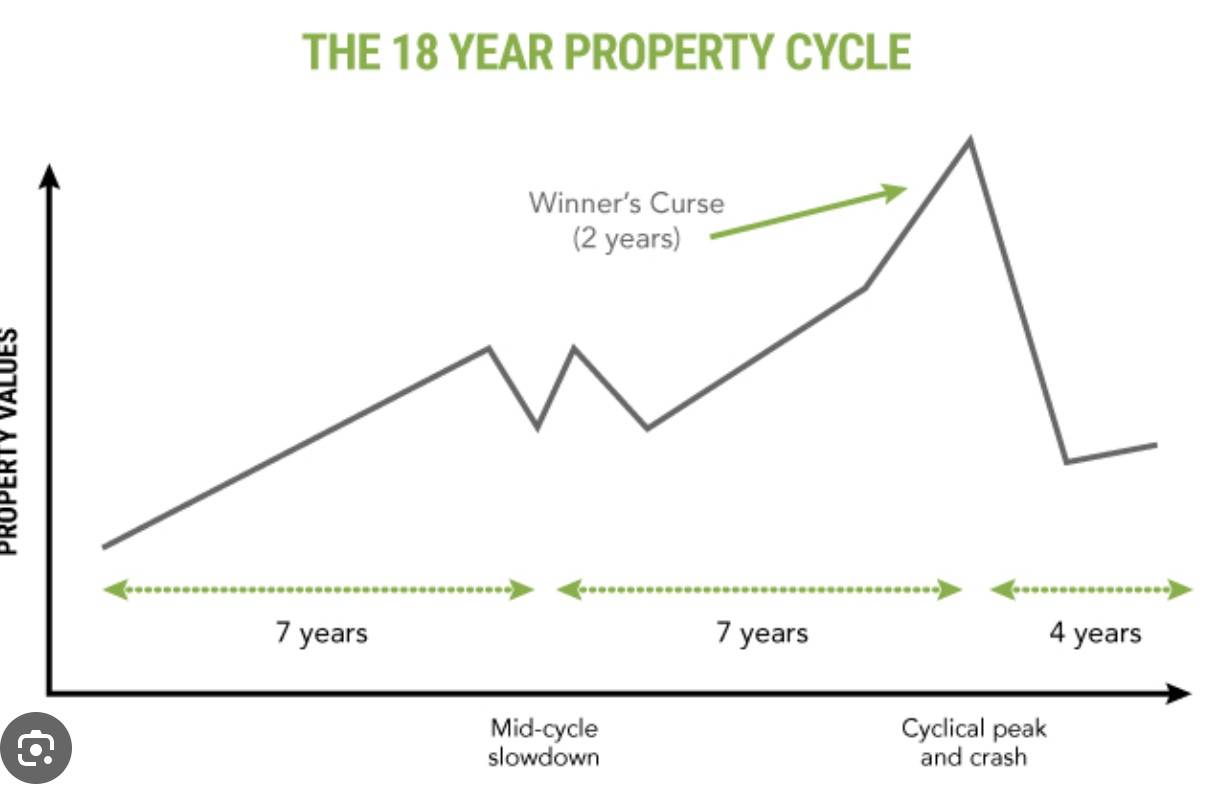
I read "The Secret Life of Real Estate and Banking" by Philip J Anderson and he frequently cites Fred Harrison's work on the 18 year real estate cycle. The book heavily investigates the 18 year cycle and it's actually really compelling and eye opening. It's a phenomenon that has been observed since 1800 when public land sales began in the United States.
Basically the premise is that the real estate cycle runs roughly in an 18 year term, although sometimes it can be a little bit shorter or longer. From the peak of the cycle, there is about 4 years of a decline or "down" market for real estate values and sales. After 4 years of that, there is generally 14 years of price growth with the last two years called "the winner's curse" where the market sees euphoria, lots of buying and real estate speculation. There is also typically a "mid cycle slowdown" about 7 years in.
The most recent example of this is when home prices peaked in about 2006 in the run up to the Great Recession. 2006 was the peak of the previous cycle in sales and prices.
Then, there was about 4 years of a declining or down market from about 2007 - 2011. Prices then began rising in 2012.
From 2012, we've seen real estate prices consistently trend upward and based on previous historical trends prices should continue increasing until roughly 2026. The pandemic boom (2020-2021) and bust (2022-2023) is the mid-cycle slowdown. A slowdown is usually marked by a rise in interest rates (2022 & 2023) and a decline in sales, which occurred in 2023 with a 28 year low of sales. So going off 2019-2021 and the mid-cycle slow down, we can reasonably expect home price growth to continue until about 2026 and maybe even 2027.
Obviously this isn't a "perfect" model for prediction because none exists. But this is all backed up by historical trends and data. While no cycle is exactly the same, they are fueled by the same human activities and psychology. It can be summed up as "the more things change, the more they stay the same." Society, technology, etc continue changing overtime but the way people act is still fundamentally the same, which is why the cycle will continue.
Summary:
2006: peak of the cycle and beginning of the 18 year cycle repeating itself
2007-2011: 4 years of decline
2012 - 2019: 7 years of an appreciating market plus 2020 & 2021 due to COVID and low rates.
2022-2023: mid cycle slowdown caused by rate hikes but home prices still rising
2024-2026+: Home price growth continues especially due to extremely low inventory, inflation, and other macro factors.
2012 - 2026: generally sees 14 years of price growth, completing the cycle.
Before everyone comes in and starts telling me I'm wrong, I encourage you to read the book and then see if you still feel the same way.

- Member since 2019 · 7k+ posts · 4k+ votes2y
Quote from @Paul De Luca:
Quote from @Jack B.:
This guy called the last two crashes, says there will be one in 2026 too. https://www.thisismoney.co.uk/money/mortgageshome/article-12...
But we have the lowest demand since the 90's, even lower than the 2008 crash. Prices in Seattle dropped 20% since rates went up. Did we already see a crash in 2022 and start a new 18 year cycle?
I read "The Secret Life of Real Estate and Banking" by Philip J Anderson and he frequently cites Fred Harrison's work on the 18 year real estate cycle. The book heavily investigates the 18 year cycle and it's actually really compelling and eye opening. It's a phenomenon that has been observed since 1800 when public land sales began in the United States.
Basically the premise is that the real estate cycle runs roughly in an 18 year term, although sometimes it can be a little bit shorter or longer. From the peak of the cycle, there is about 4 years of a decline or "down" market for real estate values and sales. After 4 years of that, there is generally 14 years of price growth with the last two years called "the winner's curse" where the market sees euphoria, lots of buying and real estate speculation. There is also typically a "mid cycle slowdown" about 7 years in.
The most recent example of this is when home prices peaked in about 2006 in the run up to the Great Recession. 2006 was the peak of the previous cycle in sales and prices.
Then, there was about 4 years of a declining or down market from about 2007 - 2011. Prices then began rising in 2012.
From 2012, we've seen real estate prices consistently trend upward and based on previous historical trends prices should continue increasing until roughly 2026. The pandemic boom (2020-2021) and bust (2022-2023) is the mid-cycle slowdown. A slowdown is usually marked by a rise in interest rates (2022 & 2023) and a decline in sales, which occurred in 2023 with a 28 year low of sales. So going off 2019-2021 and the mid-cycle slow down, we can reasonably expect home price growth to continue until about 2026 and maybe even 2027.
Obviously this isn't a "perfect" model for prediction because none exists. But this is all backed up by historical trends and data. While no cycle is exactly the same, they are fueled by the same human activities and psychology. It can be summed up as "the more things change, the more they stay the same." Society, technology, etc continue changing overtime but the way people act is still fundamentally the same, which is why the cycle will continue.
Summary:
2006: peak of the cycle and beginning of the 18 year cycle repeating itself
2007-2011: 4 years of decline
2012 - 2019: 7 years of an appreciating market plus 2020 & 2021 due to COVID and low rates.
2022-2023: mid cycle slowdown caused by rate hikes but home prices still rising
2024-2026+: Home price growth continues especially due to extremely low inventory, inflation, and other macro factors.
2012 - 2026: generally sees 14 years of price growth, completing the cycle.
Before everyone comes in and starts telling me I'm wrong, I encourage you to read the book and then see if you still feel the same way.
I found it's 15-16 years LOL.
So the first downturn was in 1992, followed by the increase until subprime stopped the party in 2008, then Bernanke Helicopter market saves the market, but Fed trying to increase the rate unsucessfuly in 2019, and then they use the covid inflation to pause the market in 2022.in my own analysis, these cycles are not created by nature but it's intentionally programmed by the Fed.
- 2yEngelo RumoraBusiness MemberInvestor · Toledo, OH · Member since 2013 · 4k+ posts · 2k+ votes
Quote from @Carlos Ptriawan:
Quote from @Engelo Rumora:
Quote from @V.G Jason:
Quote from @Engelo Rumora:
Market has been dented due to the SVB, First Republic and now NYCB fiasco, etc...
Well, it's easy, they're financial institution, problem with those banks are they are asset baggage holder.they are holding asset that the realtime valuation went down a lot , does not matter it is bond or real estate.
if every bank in USA has to use mark-to-market accounting, 100% of bank in US already default by now because they're holding HTM residential bonds or CRE asset that's crashing.
But for tech company we have large cash (that generate 5%) and lower number of employee but create more money per employee than any other industry, thus creating massive investment to the tech sector while real estate and financial is decaying.it's very strange indeed.
Most regionals aren't very exposed to CRE
Larger banks even less.
Might take a few years to reposition but since 2008, the banks are flush with cash due to various stress tests and must offset capital for any hiccup within the portfolio.
Trump might loosen this again and might have a fiasco in the future with the banks lol
Not a fan of tech. I don't see value in paying 100 PE
I won't live till 55 so what's the point of a 100 PE "before I get my money back" per se hehe
I see investing in stocks like buying the entire business. How long does it take to get my capital back in net earnings...
Always preferred value investing for the long term.
Not looking for 400% baggers, granted I'm contradicting myself because my regional bank horizon is maybe 2-3 years
Just my opinion mate and we shall see - Real Estate Agent · Chicago, IL · Member since 2018 · 1k+ posts · 1k+ votes2y
Quote from @Carlos Ptriawan:
Quote from @Paul De Luca:
Quote from @Jack B.:
This guy called the last two crashes, says there will be one in 2026 too. https://www.thisismoney.co.uk/money/mortgageshome/article-12...
But we have the lowest demand since the 90's, even lower than the 2008 crash. Prices in Seattle dropped 20% since rates went up. Did we already see a crash in 2022 and start a new 18 year cycle?
I read "The Secret Life of Real Estate and Banking" by Philip J Anderson and he frequently cites Fred Harrison's work on the 18 year real estate cycle. The book heavily investigates the 18 year cycle and it's actually really compelling and eye opening. It's a phenomenon that has been observed since 1800 when public land sales began in the United States.
Basically the premise is that the real estate cycle runs roughly in an 18 year term, although sometimes it can be a little bit shorter or longer. From the peak of the cycle, there is about 4 years of a decline or "down" market for real estate values and sales. After 4 years of that, there is generally 14 years of price growth with the last two years called "the winner's curse" where the market sees euphoria, lots of buying and real estate speculation. There is also typically a "mid cycle slowdown" about 7 years in.
The most recent example of this is when home prices peaked in about 2006 in the run up to the Great Recession. 2006 was the peak of the previous cycle in sales and prices.
Then, there was about 4 years of a declining or down market from about 2007 - 2011. Prices then began rising in 2012.
From 2012, we've seen real estate prices consistently trend upward and based on previous historical trends prices should continue increasing until roughly 2026. The pandemic boom (2020-2021) and bust (2022-2023) is the mid-cycle slowdown. A slowdown is usually marked by a rise in interest rates (2022 & 2023) and a decline in sales, which occurred in 2023 with a 28 year low of sales. So going off 2019-2021 and the mid-cycle slow down, we can reasonably expect home price growth to continue until about 2026 and maybe even 2027.
Obviously this isn't a "perfect" model for prediction because none exists. But this is all backed up by historical trends and data. While no cycle is exactly the same, they are fueled by the same human activities and psychology. It can be summed up as "the more things change, the more they stay the same." Society, technology, etc continue changing overtime but the way people act is still fundamentally the same, which is why the cycle will continue.
Summary:
2006: peak of the cycle and beginning of the 18 year cycle repeating itself
2007-2011: 4 years of decline
2012 - 2019: 7 years of an appreciating market plus 2020 & 2021 due to COVID and low rates.
2022-2023: mid cycle slowdown caused by rate hikes but home prices still rising
2024-2026+: Home price growth continues especially due to extremely low inventory, inflation, and other macro factors.
2012 - 2026: generally sees 14 years of price growth, completing the cycle.
Before everyone comes in and starts telling me I'm wrong, I encourage you to read the book and then see if you still feel the same way.
I found it's 15-16 years LOL.
So the first downturn was in 1992, followed by the increase until subprime stopped the party in 2008, then Bernanke Helicopter market saves the market, but Fed trying to increase the rate unsucessfuly in 2019, and then they use the covid inflation to pause the market in 2022.in my own analysis, these cycles are not created by nature but it's intentionally programmed by the Fed.
While it's tempting to believe the Federal Reserve "created" the cycle, that's not true. The real estate cycle in the US was first observed in the 1800s. Land sales began in 1800 and first peaked in 1818 and the panic of 1819 followed. Then the cycle again repeated by peaking in 1836 and then the panic of 1837 occurred.
The Federal Reserve does have an effect on the cycle, potentially lengthening it or shortening it by manipulating the money supply and interest rates, but ultimately the Fed does not control the real estate cycle.
- Member since 2019 · 7k+ posts · 4k+ votes2y
Quote from @Engelo Rumora:
Quote from @Carlos Ptriawan:
I won't live till 55 so what's the point of a 100 PE "before I get my money back" per se hehelol, i thought people wanna live til 99 here.
- 2yEngelo RumoraBusiness MemberInvestor · Toledo, OH · Member since 2013 · 4k+ posts · 2k+ votes
Quote from @Carlos Ptriawan:
Quote from @Engelo Rumora:
Quote from @Carlos Ptriawan:
I won't live till 55 so what's the point of a 100 PE "before I get my money back" per se hehelol, i thought people wanna live til 99 here.
55 and I'm done mate lol
I believe in the afterlife and believe it's a much better place than this 🙏
- Member since 2019 · 7k+ posts · 4k+ votes2y
Quote from @Paul De Luca:
Quote from @Carlos Ptriawan:
Quote from @Paul De Luca:
Quote from @Jack B.:
This guy called the last two crashes, says there will be one in 2026 too. https://www.thisismoney.co.uk/money/mortgageshome/article-12...
But we have the lowest demand since the 90's, even lower than the 2008 crash. Prices in Seattle dropped 20% since rates went up. Did we already see a crash in 2022 and start a new 18 year cycle?
I read "The Secret Life of Real Estate and Banking" by Philip J Anderson and he frequently cites Fred Harrison's work on the 18 year real estate cycle. The book heavily investigates the 18 year cycle and it's actually really compelling and eye opening. It's a phenomenon that has been observed since 1800 when public land sales began in the United States.
Basically the premise is that the real estate cycle runs roughly in an 18 year term, although sometimes it can be a little bit shorter or longer. From the peak of the cycle, there is about 4 years of a decline or "down" market for real estate values and sales. After 4 years of that, there is generally 14 years of price growth with the last two years called "the winner's curse" where the market sees euphoria, lots of buying and real estate speculation. There is also typically a "mid cycle slowdown" about 7 years in.
The most recent example of this is when home prices peaked in about 2006 in the run up to the Great Recession. 2006 was the peak of the previous cycle in sales and prices.
Then, there was about 4 years of a declining or down market from about 2007 - 2011. Prices then began rising in 2012.
From 2012, we've seen real estate prices consistently trend upward and based on previous historical trends prices should continue increasing until roughly 2026. The pandemic boom (2020-2021) and bust (2022-2023) is the mid-cycle slowdown. A slowdown is usually marked by a rise in interest rates (2022 & 2023) and a decline in sales, which occurred in 2023 with a 28 year low of sales. So going off 2019-2021 and the mid-cycle slow down, we can reasonably expect home price growth to continue until about 2026 and maybe even 2027.
Obviously this isn't a "perfect" model for prediction because none exists. But this is all backed up by historical trends and data. While no cycle is exactly the same, they are fueled by the same human activities and psychology. It can be summed up as "the more things change, the more they stay the same." Society, technology, etc continue changing overtime but the way people act is still fundamentally the same, which is why the cycle will continue.
Summary:
2006: peak of the cycle and beginning of the 18 year cycle repeating itself
2007-2011: 4 years of decline
2012 - 2019: 7 years of an appreciating market plus 2020 & 2021 due to COVID and low rates.
2022-2023: mid cycle slowdown caused by rate hikes but home prices still rising
2024-2026+: Home price growth continues especially due to extremely low inventory, inflation, and other macro factors.
2012 - 2026: generally sees 14 years of price growth, completing the cycle.
Before everyone comes in and starts telling me I'm wrong, I encourage you to read the book and then see if you still feel the same way.
I found it's 15-16 years LOL.
So the first downturn was in 1992, followed by the increase until subprime stopped the party in 2008, then Bernanke Helicopter market saves the market, but Fed trying to increase the rate unsucessfuly in 2019, and then they use the covid inflation to pause the market in 2022.in my own analysis, these cycles are not created by nature but it's intentionally programmed by the Fed.
While it's tempting to believe the Federal Reserve "created" the cycle, that's not true. The real estate cycle in the US was first observed in the 1800s. Land sales began in 1800 and first peaked in 1818 and the panic of 1819 followed. Then the cycle again repeated by peaking in 1836 and then the panic of 1837 occurred.
The Federal Reserve does have an effect on the cycle, potentially lengthening it or shortening it by manipulating the money supply and interest rates, but ultimately the Fed does not control the real estate cycle.
i think bigger question is.
a- when is the wave of 2009 ended ? is it at 2022 ? we do have mini crash in Q1 2022.
b- if yes then shall we purchase in 2023 or we should wait for further crash ? lolI'm really not sure about (b)


Join the conversationCreate a free account to reply, vote on answers and follow this thread.