Hey everyone — first post here, and I’m excited to hear your thoughts from an investor perspective.
My team and I are exploring a modern modular/container-based BTR community concept (not purchased yet — still in analysis mode). The more we study it, the more it feels like a direction worth taking seriously.
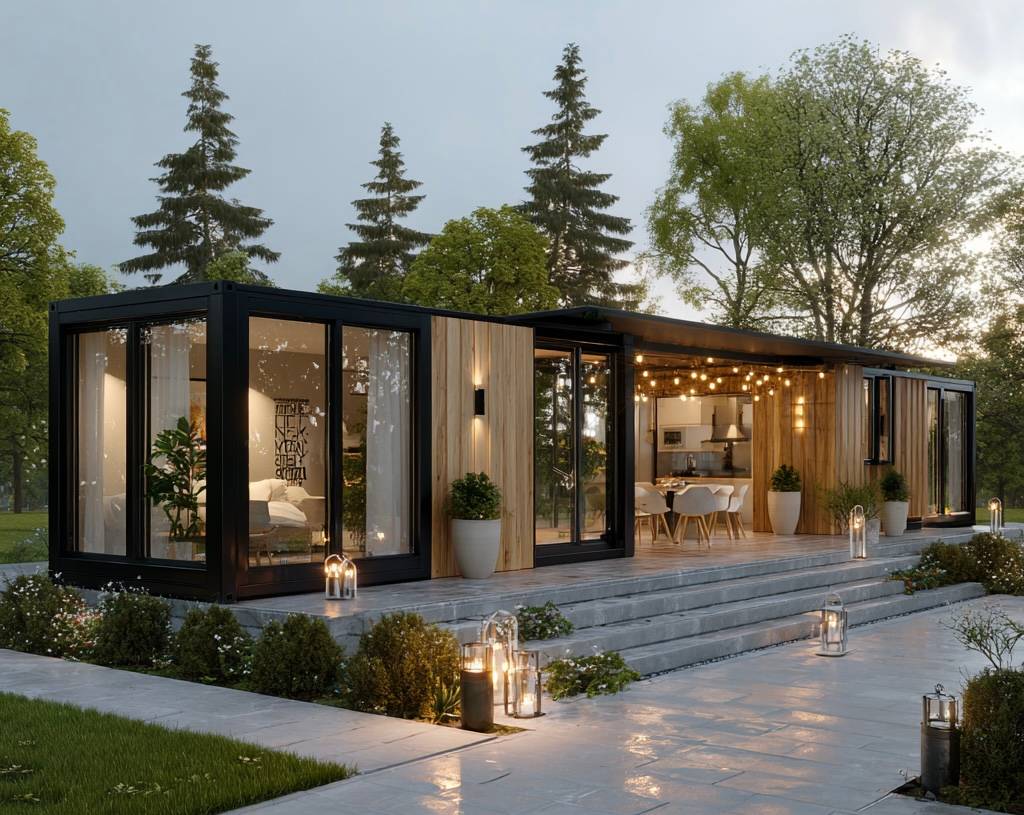
The idea is a 40-unit “modern modular village” using upgraded, architect-grade container homes — but with exteriors that look nothing like containers. Think clean lines, wood slat accents, luxury lighting, warm interiors, smart-home features, and landscaping that makes the community feel high-end.
We’re looking at modular because of the advantages that traditional construction just can’t compete with right now:
60–100 day delivery
predictable pricing
lower cost basis
high-end finish quality
phased build-out (instead of waiting 12–18 months)
fast lease-up / quick ROI
We’re considering 1BR, 2BR, and a few 3BR units. The goal is to create something that feels luxury and modern, but at a much more attainable cost — especially for renters in growing markets.
One thing surprising us:
The early ROI modeling looks stronger than we expected.
(That’s part of why we’re digging deeper before moving forward.)
I’d love to hear from investors, developers, and BTR operators:
Do you think a modern modular community like this would lease well?
Would tenants accept modular IF the design is beautiful and high-end?
Any concerns long-term?
Anyone here already building modular or exploring it?
We’re not rushing into anything — just collecting real feedback before we take the next steps.
If anyone wants to see the concept layouts or the sample designs we’ve been studying, feel free to DM me. Happy to share.
Appreciate all insights — good, bad, or brutally honest.
Hey everyone — first post here, and I’m excited to hear your thoughts from an investor perspective.
My team and I are exploring a modern modular/container-based BTR community concept (not purchased yet — still in analysis mode). The more we study it, the more it feels like a direction worth taking seriously.
The idea is a 40-unit “modern modular village” using upgraded, architect-grade container homes — but with exteriors that look nothing like containers. Think clean lines, wood slat accents, luxury lighting, warm interiors, smart-home features, and landscaping that makes the community feel high-end.
We’re looking at modular because of the advantages that traditional construction just can’t compete with right now:
60–100 day delivery
predictable pricing
lower cost basis
high-end finish quality
phased build-out (instead of waiting 12–18 months)
fast lease-up / quick ROI
We’re considering 1BR, 2BR, and a few 3BR units. The goal is to create something that feels luxury and modern, but at a much more attainable cost — especially for renters in growing markets.
One thing surprising us:
The early ROI modeling looks stronger than we expected.
(That’s part of why we’re digging deeper before moving forward.)
I’d love to hear from investors, developers, and BTR operators:
Do you think a modern modular community like this would lease well?
Would tenants accept modular IF the design is beautiful and high-end?
Any concerns long-term?
Anyone here already building modular or exploring it?
We’re not rushing into anything — just collecting real feedback before we take the next steps.
If anyone wants to see the concept layouts or the sample designs we’ve been studying, feel free to DM me. Happy to share.
Appreciate all insights — good, bad, or brutally honest.
Kozzi, really interesting concept, and appreciate you sharing it here. I think the idea itself has a ton of potential, especially if you’ve got a modular supplier who can actually deliver consistently within that 60–100 day window at a predictable price point. If that piece is solid, I’d be curious to look into it myself, maybe even test a unit, because the speed and cost advantages are definitely attractive in today’s construction environment.
A couple of thoughts from a practical/operator standpoint:
1. If you can, test ONE unit in the market before diving into an entire village.
Not saying you shouldn’t do the full community, but a single proof-of-concept install will tell you more than any spreadsheet ever will.
You’ll learn:
• how the city reacts
• what permitting looks like
• whether inspectors push back
• how neighbors respond
• whether appraisers understand it
• how tenants perceive it in your market
That small test can de-risk the whole project.
2. Municipal pushback can be a real challenge depending on the city.
I can’t speak for your area, but in the markets I’m in, the city would probably fight us tooth and nail if we tried to bring in modular or container-based homes, even high-end versions.
Not because anything is wrong with them, but because:
• they aren't “what the city is used to”
• staff doesn’t know how to classify them
• inspectors struggle with nontraditional anything
None of that may apply where you’re building, but it’s something to confirm early so you don’t end up in a multi-year entitlement battle.
3. From a tenant perspective, I think the product would lease well if the design is beautiful and the price point is right.
Most renters don’t care whether it’s modular, stick-built, or prefab.
They care about:
• layout
• finishes
• energy efficiency
• safety
• aesthetics
• good management
If you nail those, modular vs. traditional won’t matter.
4. Long-term value will depend on how you structure it.
If the homes are on permanent foundations and the community operates like a standard BTR project, any eventual valuation is going to be tied to rents and NOI, not to construction method.
An entire neighborhood built the same way becomes its own comp set.
5. Overall, I like the idea, just approach the municipality piece very carefully.
If zoning, permitting, and foundation requirements line up, then modular could genuinely be a competitive advantage. But if the city is even a little hesitant, that can become your biggest bottleneck.
Hey everyone — first post here, and I’m excited to hear your thoughts from an investor perspective.
My team and I are exploring a modern modular/container-based BTR community concept (not purchased yet — still in analysis mode). The more we study it, the more it feels like a direction worth taking seriously.
The idea is a 40-unit “modern modular village” using upgraded, architect-grade container homes — but with exteriors that look nothing like containers. Think clean lines, wood slat accents, luxury lighting, warm interiors, smart-home features, and landscaping that makes the community feel high-end.
We’re looking at modular because of the advantages that traditional construction just can’t compete with right now:
60–100 day delivery
predictable pricing
lower cost basis
high-end finish quality
phased build-out (instead of waiting 12–18 months)
fast lease-up / quick ROI
We’re considering 1BR, 2BR, and a few 3BR units. The goal is to create something that feels luxury and modern, but at a much more attainable cost — especially for renters in growing markets.
One thing surprising us:
The early ROI modeling looks stronger than we expected.
(That’s part of why we’re digging deeper before moving forward.)
I’d love to hear from investors, developers, and BTR operators:
Do you think a modern modular community like this would lease well?
Would tenants accept modular IF the design is beautiful and high-end?
Any concerns long-term?
Anyone here already building modular or exploring it?
We’re not rushing into anything — just collecting real feedback before we take the next steps.
If anyone wants to see the concept layouts or the sample designs we’ve been studying, feel free to DM me. Happy to share.
Appreciate all insights — good, bad, or brutally honest.
Kozzi, really interesting concept, and appreciate you sharing it here. I think the idea itself has a ton of potential, especially if you’ve got a modular supplier who can actually deliver consistently within that 60–100 day window at a predictable price point. If that piece is solid, I’d be curious to look into it myself, maybe even test a unit, because the speed and cost advantages are definitely attractive in today’s construction environment.
A couple of thoughts from a practical/operator standpoint:
1. If you can, test ONE unit in the market before diving into an entire village.
Not saying you shouldn’t do the full community, but a single proof-of-concept install will tell you more than any spreadsheet ever will.
You’ll learn:
• how the city reacts
• what permitting looks like
• whether inspectors push back
• how neighbors respond
• whether appraisers understand it
• how tenants perceive it in your market
That small test can de-risk the whole project.
2. Municipal pushback can be a real challenge depending on the city.
I can’t speak for your area, but in the markets I’m in, the city would probably fight us tooth and nail if we tried to bring in modular or container-based homes, even high-end versions.
Not because anything is wrong with them, but because:
• they aren't “what the city is used to”
• staff doesn’t know how to classify them
• inspectors struggle with nontraditional anything
None of that may apply where you’re building, but it’s something to confirm early so you don’t end up in a multi-year entitlement battle.
3. From a tenant perspective, I think the product would lease well if the design is beautiful and the price point is right.
Most renters don’t care whether it’s modular, stick-built, or prefab.
They care about:
• layout
• finishes
• energy efficiency
• safety
• aesthetics
• good management
If you nail those, modular vs. traditional won’t matter.
4. Long-term value will depend on how you structure it.
If the homes are on permanent foundations and the community operates like a standard BTR project, any eventual valuation is going to be tied to rents and NOI, not to construction method.
An entire neighborhood built the same way becomes its own comp set.
5. Overall, I like the idea, just approach the municipality piece very carefully.
If zoning, permitting, and foundation requirements line up, then modular could genuinely be a competitive advantage. But if the city is even a little hesitant, that can become your biggest bottleneck.
Developer · Cleveland / Akron, OH · Member since 2008 · 922 posts · 399 votes
9mo
We are buiding with SIP panels right now, and investigating full modular for a six townhome build. I have found that the customer doesn't care how the sausage is made, we just promote the energy efficiency, the timline, and the ultimate cost.
To your idea, you should look up the South Park Cottages outside Atlanta. It is a "tiny home" community, but more akin to smaller luxury units on full foundations, clustered tightly with communal parking along the exterior. It sold out before they broke ground. We are looking at a similar concept for a specific location here, as it has a specific customer and use case. I think that the design works well with SIP panels, or full on modular.
I am one of three partners trying to develop a 60 unit tiny home park in Upstate New York. We have been struggling with it for almost 3 years now because we are looking for investors to help out. We done our homework for over 20 years now. The biggest obsical we have is the Engineering drawings for the zoning department. They don't like change and just like Chase mentioned some areas won't like the modern look for their city. I live in a city and I was turned down twice for container units. I would first reach out to the community and see what they feel. I am also a wholesaler for tiny homes and a lot of my customers want to see them in person, so now after asking the community I learned they love the idea and now I am working with the SBA to get a loan lined up to buy the homes.
Its best to do your research especialy on the city or town level. When you pick out your designs make sure they are not just AI drawn. I get a lot of customers fall in love with photos that AI makes and they are completely wrong. Good Luck.