Investor · Member since 2025 · 30 posts · 23 votes
3 things I wish I knew before buying turnkey rentals:
“Passive” doesn’t mean no problems. The same risks are still present, you’re just outsourcing the work.
Property management can make or break the deal. A mediocre PM can quietly destroy your returns.
The real returns come from what you don’t see upfront. Vacancy, repairs, maintenance, tenant quality/turnover, and the trends of the location matter just as much, if not more, than the purchase price.
Turnkey wasn’t a bad decision for me, as it's what got me in the game. But if I were starting again today, I’d spend more time thinking about:
- Downside protection
- Operator quality
- Consistency of returns vs headline numbers (in my most recent post, I learned that if you verify the big three independently before writing an offer [tax assessment after sale at purchase price, a real insurance quote from a broker, and cross-checking the rent against closed lease comps, not active listings], you can avoid a lot of the headaches and surprises that plague many first-time turnkey investors! I would have loved to know that before I started :) )
Rental Property Investor · Somewhere over the Rainbow · Member since 2021 · 1k+ posts · 1k+ votes
4mo
Turnkey never made sense to me - I mean the majority of rental property investing is equity capture at the buy (aka buying at a discount). If you're not buying at a discount you're simply locking up your liquidity for crappy returns. Most of the "turn-key" investors probably have W2 jobs (that's why they do turn key investing) so they're not REPs so they're missing the tax deductions on top of it all.
Then comes the time, stress, vacancy, CapEx, repairs, and don't forget the selling costs when you decide after a few years that the returns suck, the cashflow is too low to move the needle, the tax deductions are essentially worthless etc.
I mean, I cannot imagine buying a house at market value lol. Absolutely horrible idea through and through
Real Estate Agent · Central New York · Member since 2023 · 207 posts · 96 votes
4mo
I completely and whole heartedly agree about PM making or breaking a deal, ESPECIALLY with remote investing. When comparing comps, I always recommend erring on the lower side of rental comps for a few reasons. 1) gives cushion when underwriting, and 2) tends to give higher number of applications and can help lead to a more ideal tenant profile. Nothing will kill an investment property quicker than carrying vacancies for whatever reason. Would happily take a $100-$200 lower rent for a tenant that will be long term, quiet, and will take care of the property.
Investor · Member since 2025 · 30 posts · 23 votes
4mo
@Kiernan LaFaver Thank you for your response! That's a good point on erring on the lower side of rental comps. I have noticed how big of a hit a vacancy can be, and that is certainly one way of mitigating it!
We have several clients who purchased turnkey rentals before working with our team. The comments below are based on what I have heard from them, along with my own research.
Buying a turnkey property is not an investment strategy. It is a purchase option. The strategy comes first. So before deciding whether to buy turnkey, start with the real question: what is your long-term investment goal? If your goal is long-term financial independence, two things matter.
First, rents must outpace inflation - Your rental income must increase faster than inflation, or your purchasing power will fall over time. Rent growth is not a property feature. It is a city-level outcome.
Think of the city as a harbor and rents as boats in the harbor. When the tide comes in, the boats rise. When population and job growth increase demand, rents tend to rise. When population declines or demand weakens, rents can stagnate or fall.
Second, the income must last your lifetime.
That means your tenants need stable jobs and rising incomes. If local wages stagnate, rent growth eventually stalls.
Most companies do not last forever. Strong cities keep attracting new employers that replace lost jobs. That is why you must look for cities with a metro population over one million, meaningful population growth, low crime, no rent control, and a business environment that can continue attracting employers.
So, the overall process is:
Select an investment city.
Identify a reliable tenant segment. Property manager interviews are one of the best ways to do this.
Determine what types of properties they already rent and where they rent them.
Buy similar properties.
Only after that should you decide how to buy.
Deciding on a Purchase Option
Once you know the city, tenant segment, and property profile, you can decide whether to buy through a turnkey provider or through an experienced local investment team.
Here are the questions I would ask before buying turnkey:
Does the turnkey provider offer properties that match the housing requirements of your target tenant segment?
Are you locked into using their property management company? I looked at the property manager reviews of one turn-key. They had one star rating with over 1,000 reviews.
Can you switch property managers if needed?
Can you hire your own independent licensed inspector? Were the major systems inspected properly, including plumbing, HVAC, electrical, roof, sewer line, and structural items?
Were the improvements cosmetic, or did they address the expensive systems?
This matters because many turnkey providers focus heavily on cosmetic improvements. Fresh paint, new flooring, and nice photos are easy to market. Plumbing, HVAC, electrical, and roof problems are much more expensive to fix and do not increase market appearance.
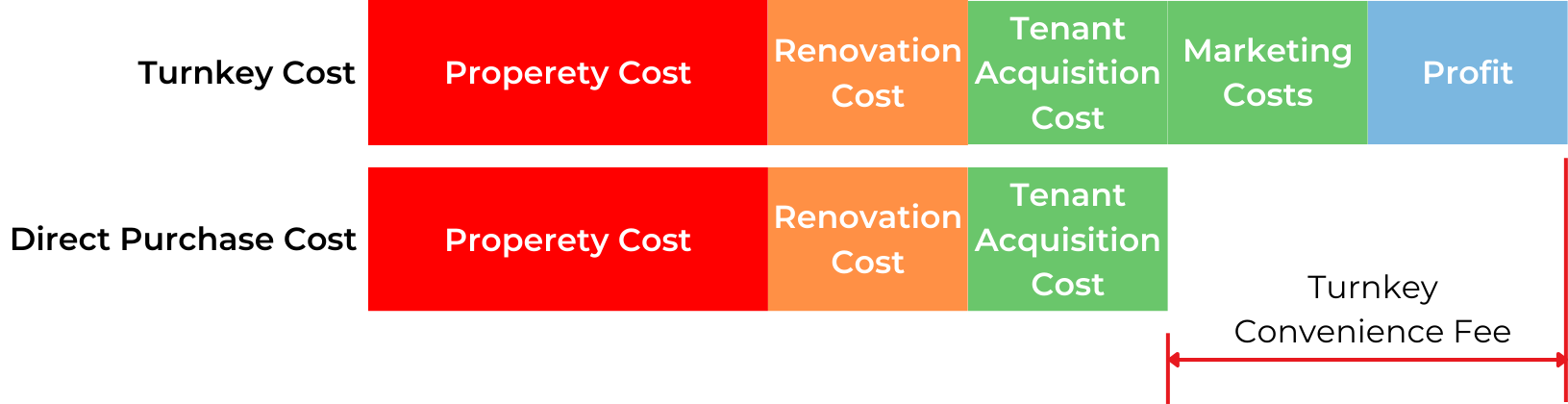
Turnkey purchases are also usually more expensive than buying directly through an experienced local investment team. The extra cost may be worth it in some cases, but investors should understand what they are paying for. The illustration below compares the estimated costs of a direct purchase through a local investment team versus a turnkey purchase.
Final Thoughts
Turnkey can be a valid purchase option, but it should not replace your investment strategy. The strategy is still the same: choose the right city, identify the right tenant segment, buy the type of property that segment already wants to rent, and use strong property management.
Do not make the decision based only on turnkey marketing materials. Do your own due diligence. The turnkey provider will not reimburse you if the wrong city, wrong tenant segment, or wrong property creates problems later.
Investor · Member since 2025 · 30 posts · 23 votes
4mo
@Eric Fernwood Thank you for the time and effort in writing out this detailed response! I appreciate your focus on emphasizing goals over purchase options. Turnkey isn't a strategy, it's a means to an end!
The questions to ask before buying turnkey are also key: it's immensely important that major systems (not just cosmetics) are updated/verified for long term success.
Not a fan. I think they appeal to those who think it is easy access without having to do any real work. New builds in general can be slower to appreciate and harder to sell especially if not in class A neighborhoods, when there are a high percentage of rental properties, multiples of a similar product for sale or lots available to build new. Perhaps the biggest turn off for me is not vetting prospective tenants myself. What should also be a turn off for these buyers is understanding that new build is not maintenance exempt.
Investor · Member since 2025 · 30 posts · 23 votes
4mo
@Jules Aton While I agree that turnkeys appeal to people looking for "passive" investments, and are definitely not maintenance exempt, they can also be a low-barrier-of-entry way to get started in real estate. They certainly served that purpose for me, giving me a good foundation before moving into other investment types like multi family/syndications.
Rental Property Investor · Somewhere over the Rainbow · Member since 2021 · 1k+ posts · 1k+ votes
4mo
Turnkey never made sense to me - I mean the majority of rental property investing is equity capture at the buy (aka buying at a discount). If you're not buying at a discount you're simply locking up your liquidity for crappy returns. Most of the "turn-key" investors probably have W2 jobs (that's why they do turn key investing) so they're not REPs so they're missing the tax deductions on top of it all.
Then comes the time, stress, vacancy, CapEx, repairs, and don't forget the selling costs when you decide after a few years that the returns suck, the cashflow is too low to move the needle, the tax deductions are essentially worthless etc.
I mean, I cannot imagine buying a house at market value lol. Absolutely horrible idea through and through
Investor · Member since 2025 · 30 posts · 23 votes
4mo
@Jeremy Horton I actually agree with part of what you’re saying: buying below market value and forcing appreciation is one of the best ways to create outsized returns in real estate. If someone has the time, expertise, contractor network, and desire to actively operate deals, that can absolutely outperform turnkey investing. But I don’t think that automatically makes turnkey a “horrible idea.”
For me, turnkey solved a different problem:
I wanted to get invested quickly
I had (and have!) a demanding W2 career
I valued scalability and simplicity over maximizing every dollar of IRR
I preferred stable, financeable assets over heavy rehabs
Also, buying “at market value” isn’t necessarily bad if:
the market itself appreciates
rents grow
debt amortizes
leverage magnifies returns
the property performs reliably for years
Plenty of people have built substantial wealth buying stabilized rentals in good markets and simply holding long term.
For busy professionals who want relatively passive exposure to residential real estate, turnkey can be a very reasonable entry point, especially compared to doing nothing or keeping all capital in index funds/cash.
Different strategies optimize for different things:
maximum ROI
time freedom
scalability
passivity
risk tolerance
predictability
Turnkey optimized for my situation at the time, and it got me into the game.
Watsonville California · Member since 2026 · 1 post · 0 votes
4mo
Victor
i agree with everything that you said in your post. My wife and I live in California. And we have a few rentals in the midwest, we started with turnkey properties as well.
it hasn't been a perfect journey by any means, but we were able to get in, and we're still here.
so many mistakes and lessons learned, how are the past 6 years? But I really don't think I would change anything.
3 things I wish I knew before buying turnkey rentals:
“Passive” doesn’t mean no problems. The same risks are still present, you’re just outsourcing the work.
Property management can make or break the deal. A mediocre PM can quietly destroy your returns.
The real returns come from what you don’t see upfront. Vacancy, repairs, maintenance, tenant quality/turnover, and the trends of the location matter just as much, if not more, than the purchase price.
Turnkey wasn’t a bad decision for me, as it's what got me in the game. But if I were starting again today, I’d spend more time thinking about:
- Downside protection
- Operator quality
- Consistency of returns vs headline numbers (in my most recent post, I learned that if you verify the big three independently before writing an offer [tax assessment after sale at purchase price, a real insurance quote from a broker, and cross-checking the rent against closed lease comps, not active listings], you can avoid a lot of the headaches and surprises that plague many first-time turnkey investors! I would have loved to know that before I started :) )
What surprised you most in your first deal?
The biggest shock for most people on their first deal is the realization that "pro-forma" is just a fancy word for "best-case scenario." When you buy turnkey, you’re often buying a polished story, and the "surprise" usually hits when that first major repair or turnover happens and you realize your property manager is basically a glorified middleman who doesn't share your sense of urgency. I’ve seen so many investors get crushed because they took the turnkey provider's "all-in" expense ratio at face value, only to find out that a single month of vacancy or a bad tenant placement completely wipes out two years of projected cash flow. The real game-changer is realizing that you aren't just buying a house; you’re hiring an operator—and if you don't vet the property management’s actual track record and "stress-test" those numbers with real-world quotes like you mentioned, you’re basically just gambling on a spreadsheet. I hope that helps.
Investor · Member since 2025 · 30 posts · 23 votes
4mo
@Alioune Camara Definitely agree on the importance of a great PM! Also second that it's very important to calculate your own expense ratio beyond what the turnkey provider gives as an estimate!
Lender · Florida · Member since 2025 · 661 posts · 239 votes
4mo
This is a great breakdown and honestly something a lot of newer investors need to hear. From a lending perspective, operator quality and property management are often just as important as the property itself. A clean turnkey property can still underperform quickly with poor management, high turnover, or weak market fundamentals.
One thing that surprises many first-time investors is how much small variances in taxes, insurance, maintenance, and vacancy can impact actual returns versus pro forma numbers. The investors who do the best long term are usually the ones who underwrite conservatively and focus on downside protection first.
Really solid point about independently verifying taxes, insurance, and rental comps before submitting offers. That alone can save investors from a lot of painful surprises later.
Investor · Member since 2025 · 30 posts · 23 votes
4mo
@J Castro Great point on how taxes, insurance, maintenance, and vacancy can impact actual returns! Even how the costs of each of those can change depending on which market (state/city/neighborhood) you invest in. My MS and TN properties have different tax/insurance profiles, despite being relatively close to one another!
@Victor Mora what is resale value looking like? That is always top on my list of purchase requirements. Some will say as with stocks it doesn't matter until you sell but if life changes as we all know it can being able to exit at any time without taking a bath is a key component.
Investor · Member since 2025 · 30 posts · 23 votes
4mo
@James Jones Definitely agree with your points here! As a new investor I didnt do a lot of prior due diligence and took the pro forma ARV/rent/tax/insurance numbers at face value. Now, I have my own buy box that more comfortably covers downside, and I'm ok with passing on a property that doesn't meet my criteria.
Investor · Member since 2025 · 30 posts · 23 votes
4mo
@Jules Aton Resale values are holding strong! The strategy I took for my turnkeys was less focused on appreciation and moreso on cash flow. As long as my properties keep up with inflation, that'll be just fine. I don't plan on selling, but might want to tap the equity to roll into more properties down the line.
@Jules Aton Resale values are holding strong! The strategy I took for my turnkeys was less focused on appreciation and moreso on cash flow. As long as my properties keep up with inflation, that'll be just fine. I don't plan on selling, but might want to tap the equity to roll into more properties down the line.
Many ways to get to same end. I always focused on appreciation and ease of resale because I felt that provided the opportunity for a larger net in the big picture. It also drove me to rehabs in class A neighborhoods that come with a solid, reliable tenant base which was necessary in the early days when I didn't have much extra money to subsidize vacancies or non-paying tenants.
Real Estate Agent · Los Angeles, United States · Member since 2021 · 392 posts · 162 votes
3mo
Victor's take here is balanced and real. Turnkey's value isn't zero — it's context-dependent. For a CA-based investor buying in the Midwest (which is most of my clients doing that play), the calculus is: yes, you're not buying at a discount, but you're also not flying out to find contractors, manage a rehab remotely, and deal with all the things that can go sideways on a value-add from 2,000 miles away. For certain investors at certain points in their journey, that tradeoff is worth it.
The PM point is the one I emphasize most. The turnkey provider might be great, but if the PM they hand you off to is mediocre, the deal suffers quietly for years. Before I ever recommend a turnkey option to anyone, I push them to independently verify the PM: actually call current tenants if possible, read the reviews critically, check their response time on maintenance requests from public data. The property is only as good as who's operating it.