Is deal analysis becoming more important than deal sourcing?
Virtual Assistant · Member since 2026 · 54 posts · 20 votes
Something I’ve been thinking about lately.
It feels like in today’s market, finding deals is no longer the hardest part — filtering and analyzing them quickly is.
Most investors I’ve spoken to are sitting on:
too many leads
inconsistent evaluation methods
and limited time to properly break down each opportunity
Which makes me wonder if the real advantage now is in decision speed + clarity, not just sourcing.
I’ve been experimenting with AI-assisted deal breakdown workflows to help simplify early-stage analysis, but I’m still validating how much of this is actually useful in real investor workflows.
Curious how others are handling volume today — are you more constrained by deal flow or analysis time?
Interesting question and I think the framing "analysis vs. sourcing" is actually a false binary — they're both equally important but they fail in different ways depending on where you are in your investing journey.
That said, I'd push back slightly on the premise. In my experience, most investors are NOT sitting on too many qualified leads. What they're sitting on is a lot of noise that looks like leads but isn't — overpriced wholesale deals, off-market properties that are still priced to retail comps, and owner calls from people who are curious but not truly motivated. The filtering problem isn't really about analysis speed; it's about having clear enough criteria to not waste time analyzing things that will never pencil.
When I work with new investors, the thing that slows them down most isn't that they can't crunch numbers fast enough — it's that they don't have a clearly defined buy box, so they're running full analysis on everything instead of pre-screening quickly and only going deep on the best candidates.
On the AI angle: Joe's point is sharp. AI tools are useful for organizing information and running scenario math faster, but they can't tell you whether the neighborhood is trending, what a realistic rent actually is for this specific block, or whether the seller's deferred maintenance is cosmetic or structural. The human judgment layer is still where you win or lose.
The real leverage is usually having a clear decision framework — what markets, what price range, what condition tolerance, what hold period — and being disciplined enough to quickly discard everything that doesn't fit before even opening a spreadsheet.
Happy to connect if you want to talk through deal screening frameworks — always an interesting conversation.
When has deal analysis not been more important? It's always been the most important thing in REI.
As far as AI goes, I've been working with my own AI setup for deal analysis. I think AI will eventually lead to stupid people (even more so than now), but it does have its usefulness up to a certain point in analysis. The problem is, and this is a blanket statement of AI, it can't make decisions...it can only give you the info to make them. It can, and will, become a substitute for thinking and reasoning, and will leave great deals off of the table as well as direct into bad ones just because what it collects is only as good as the questions and formulas that is input. Garbage in, garbage out, is even more defined in using AI.
When has deal analysis not been more important? It's always been the most important thing in REI.
As far as AI goes, I've been working with my own AI setup for deal analysis. I think AI will eventually lead to stupid people (even more so than now), but it does have its usefulness up to a certain point in analysis. The problem is, and this is a blanket statement of AI, it can't make decisions...it can only give you the info to make them. It can, and will, become a substitute for thinking and reasoning, and will leave great deals off of the table as well as direct into bad ones just because what it collects is only as good as the questions and formulas that is input. Garbage in, garbage out, is even more defined in using AI.
You make a really valid point and I agree completely — AI is only as good as the inputs and the person interpreting the outputs. I've found it useful for speeding up research and drafting outreach, but the actual deal decisions still require human judgment, local market knowledge and experience that no AI can replicate. The investor behind the analysis is what separates good deals from bad ones. What market are you investing in? Would love to connect and learn from someone with your perspective.
When has deal analysis not been more important? It's always been the most important thing in REI.
As far as AI goes, I've been working with my own AI setup for deal analysis. I think AI will eventually lead to stupid people (even more so than now), but it does have its usefulness up to a certain point in analysis. The problem is, and this is a blanket statement of AI, it can't make decisions...it can only give you the info to make them. It can, and will, become a substitute for thinking and reasoning, and will leave great deals off of the table as well as direct into bad ones just because what it collects is only as good as the questions and formulas that is input. Garbage in, garbage out, is even more defined in using AI.
You make a really valid point and I agree completely — AI is only as good as the inputs and the person interpreting the outputs. I've found it useful for speeding up research and drafting outreach, but the actual deal decisions still require human judgment, local market knowledge and experience that no AI can replicate. The investor behind the analysis is what separates good deals from bad ones. What market are you investing in? Would love to connect and learn from someone with your perspective.
Two of the forces you mentioned can work against each other if not managed properly...
AI is a powerful tool, but its *probabilistic*. So if you are looking to avoid "inconsistent evaluation methods" then just letting AI run wild will work against your goal.
However, AI with the proper *deterministic* harness, guardrails, and quality data allows you to move from spending hours iterating over listings/leads and spreadsheets, to nation-wide lists of quality deals rank ordered by an institutional-grade investment profile generated in seconds.
Interesting question and I think the framing "analysis vs. sourcing" is actually a false binary — they're both equally important but they fail in different ways depending on where you are in your investing journey.
That said, I'd push back slightly on the premise. In my experience, most investors are NOT sitting on too many qualified leads. What they're sitting on is a lot of noise that looks like leads but isn't — overpriced wholesale deals, off-market properties that are still priced to retail comps, and owner calls from people who are curious but not truly motivated. The filtering problem isn't really about analysis speed; it's about having clear enough criteria to not waste time analyzing things that will never pencil.
When I work with new investors, the thing that slows them down most isn't that they can't crunch numbers fast enough — it's that they don't have a clearly defined buy box, so they're running full analysis on everything instead of pre-screening quickly and only going deep on the best candidates.
On the AI angle: Joe's point is sharp. AI tools are useful for organizing information and running scenario math faster, but they can't tell you whether the neighborhood is trending, what a realistic rent actually is for this specific block, or whether the seller's deferred maintenance is cosmetic or structural. The human judgment layer is still where you win or lose.
The real leverage is usually having a clear decision framework — what markets, what price range, what condition tolerance, what hold period — and being disciplined enough to quickly discard everything that doesn't fit before even opening a spreadsheet.
Happy to connect if you want to talk through deal screening frameworks — always an interesting conversation.
Interesting question and I think the framing "analysis vs. sourcing" is actually a false binary — they're both equally important but they fail in different ways depending on where you are in your investing journey.
That said, I'd push back slightly on the premise. In my experience, most investors are NOT sitting on too many qualified leads. What they're sitting on is a lot of noise that looks like leads but isn't — overpriced wholesale deals, off-market properties that are still priced to retail comps, and owner calls from people who are curious but not truly motivated. The filtering problem isn't really about analysis speed; it's about having clear enough criteria to not waste time analyzing things that will never pencil.
When I work with new investors, the thing that slows them down most isn't that they can't crunch numbers fast enough — it's that they don't have a clearly defined buy box, so they're running full analysis on everything instead of pre-screening quickly and only going deep on the best candidates.
On the AI angle: Joe's point is sharp. AI tools are useful for organizing information and running scenario math faster, but they can't tell you whether the neighborhood is trending, what a realistic rent actually is for this specific block, or whether the seller's deferred maintenance is cosmetic or structural. The human judgment layer is still where you win or lose.
The real leverage is usually having a clear decision framework — what markets, what price range, what condition tolerance, what hold period — and being disciplined enough to quickly discard everything that doesn't fit before even opening a spreadsheet.
Happy to connect if you want to talk through deal screening frameworks — always an interesting conversation.
I actually agree with your take — especially on the filtering problem being more about bad inputs than analysis speed.
The “noise that looks like leads” point is exactly what I’ve been seeing too. A lot of beginners think they need more data or faster analysis, but the real issue is they don’t have a strict buy box or pre-screening system.
On the AI side, I also think people overestimate what automation can do in underwriting, but underestimate how powerful it is for organizing deal flow and enforcing discipline in the pipeline.
Curious — when you’re working with new investors, do you personally help them define their buy box first or refine it after they start analyzing deals?
Great question and honestly the answer is: both, but in a specific sequence.
I always start with a draft buy box before they analyze a single deal. But I'm upfront that it's a working hypothesis, not a finished product. The point isn't to get it perfect on day one — it's to force them to articulate their constraints and goals so they have a filter at all. Without that, every deal they look at becomes a blank canvas and they spend energy on things that should have been eliminated in 30 seconds.
The draft buy box usually covers: market(s) they're willing to operate in, price range based on what they can actually capitalize, property type, condition tolerance (turnkey vs. light rehab vs. heavy value-add), and their primary objective — cash flow, appreciation, or a blend. That alone cuts out probably 80% of what hits their inbox.
Then I tell them to analyze 20-30 deals and specifically look for where the box breaks. Because it always does. They'll find a deal type they didn't expect to like, or discover their condition tolerance was too conservative, or realize their price range was based on wishful thinking about financing. That feedback loop is where the buy box actually gets built — through real friction with real deals.
The mistake I see is investors who skip step one entirely and just "see what's out there," then try to reverse-engineer a buy box from the deals they happen to like. That usually ends in paralysis or inconsistency, and it's where a lot of the "noise that looks like leads" problem comes from — they can't pre-screen because they don't know what they're screening for.
The framework first, then refine with real deal exposure. That's the sequence that actually sticks.
Garrett's buy box framework and Joe's "garbage in, garbage out" point are both right — they're describing the problem, not the solution.
The inconsistency problem isn't about AI being probabilistic. It's about what's underneath it. Most tools don't encode actual institutional underwriting standards. They give you a cap rate and call it analysis.
What actually moves the needle is deterministic domain logic applied before any AI touches the output. Things like:
When those formulas are the foundation, AI becomes useful — not for making decisions, but for surfacing which deals even deserve a second look. The grading comes from the math, not from a language model guessing.
Joe is right that AI can't make decisions. But neither can a spreadsheet someone built wrong three years ago. The leverage is in the underlying model — not the interface on top of it.
What metrics are people actually using to pre-screen before going deep?
Something I’ve been thinking about lately.
It feels like in today’s market, finding deals is no longer the hardest part — filtering and analyzing them quickly is.
Most investors I’ve spoken to are sitting on:
too many leads
inconsistent evaluation methods
and limited time to properly break down each opportunity
Which makes me wonder if the real advantage now is in decision speed + clarity, not just sourcing.
I’ve been experimenting with AI-assisted deal breakdown workflows to help simplify early-stage analysis, but I’m still validating how much of this is actually useful in real investor workflows.
Curious how others are handling volume today — are you more constrained by deal flow or analysis time?
There are millions of homes on the market at all times. If you don't know what is, and is not, a good deal, what's it matter?
There’s tons of potential deals out there but running your numbers sharply makes all the difference and determines if it’s truly a deal or not.
I always like to co-analyze with investor clients of mine when we see something worth looking into a bit further. I don’t prefer to put all of the analysis on them.
Sometimes we see a deal that looks good on paper, then there’s other factors we account for like vacancy rates, or maintenance, that can really affect your cash-on-cash. Sometimes it could be as simple as making a pivot and targeting a borough adjacent to another because of a substantial difference in property taxes. I’d rather account for anything and everything.
That way anything extra (as far as cash flow goes) is candy for my clients.
Analysis will always be important and having a system of sifting through what's BS and what's valid is what makes an investor stand out. Having a clearly define buy box will filter out a lot of the analysis for you. I do not consider anything if it's not in the exact neighborhoods, within certain sq footage, certain number of bedroom/bathrooms, within certain price point, and listed for minimum amount of days. Of course, other investors with different resources will have different requirements. These are just mine at the moment as a newer investor.
100% agree — the numbers never lie, but you have to run ALL the numbers. Vacancy and maintenance alone can turn a 'great deal' into a breakeven nightmare. That borough/tax pivot is underrated too, most investors overlook property tax differences between neighboring areas until it's too late. Having someone co-analyze is a game changer — accountability on both sides keeps emotions out of it. What market are you mainly working in?
100% agree — the numbers never lie, but you have to run ALL the numbers. Vacancy and maintenance alone can turn a 'great deal' into a breakeven nightmare. That borough/tax pivot is underrated too, most investors overlook property tax differences between neighboring areas until it's too late. Having someone co-analyze is a game changer — accountability on both sides keeps emotions out of it. What market are you mainly working in?
Great point, Jace. That's exactly why I try not to rely on headline numbers alone. A deal can look amazing until you factor in vacancy, maintenance, taxes, holding costs, and unexpected repairs.
The tax point is especially overlooked by newer investors. Two similar properties can produce very different returns once local taxes and expenses are factored in.
I'm mainly focused on Ohio and Tennessee markets right now, working with investors looking at single-family opportunities. Out of curiosity, what's the most common mistake you see wholesalers make when analyzing deals?
I think a lot of investors are realizing that more deal flow is no longer an automatic advantage.
The bottleneck today isn’t finding leads—it’s filtering out “false positives” before wasting hours underwriting them. A property can look incredible on a spreadsheet, but fail miserably once you stress-test the assumptions underneath: optimistic rehab costs, underestimated insurance trajectories, liquidity risk, weak exit demand, or rent growth copied from peak-cycle comps.
AI can definitely help speed up early-stage screening, but the real constraint is still judgment—understanding which variables actually matter in this specific phase of the cycle and which risks are being ignored by the broader market. To me, macro matters less as a timing tool and more as a pressure test for assumptions.
In a slower market, the investors performing the best right now aren’t the ones analyzing the most deals. They’re the ones rejecting the bad ones the fastest.
I think a lot of investors are realizing that more deal flow is no longer an automatic advantage.
The bottleneck today isn’t finding leads—it’s filtering out “false positives” before wasting hours underwriting them. A property can look incredible on a spreadsheet, but fail miserably once you stress-test the assumptions underneath: optimistic rehab costs, underestimated insurance trajectories, liquidity risk, weak exit demand, or rent growth copied from peak-cycle comps.
AI can definitely help speed up early-stage screening, but the real constraint is still judgment—understanding which variables actually matter in this specific phase of the cycle and which risks are being ignored by the broader market. To me, macro matters less as a timing tool and more as a pressure test for assumptions.
In a slower market, the investors performing the best right now aren’t the ones analyzing the most deals. They’re the ones rejecting the bad ones the fastest.
Usually, the first thing I challenge is the exit assumption.
In slower markets, too many “home runs” still rely on resale velocity, buyer demand, or rent growth assumptions that may no longer exist by the time the asset actually hits the market 6–12 months later. If the deal only works if everything goes perfectly, it’s probably not a great deal.
Beyond that, I pay close attention to execution friction. Two projects can look nearly identical on a spreadsheet, but behave completely differently in reality. Financing extensions, insurance repricing, permitting delays, contractor issues, or a thinner buyer pool can completely change the outcome.
A lot of deals still work on paper. The real question is whether they still work once reality introduces friction.
Something I’ve been thinking about lately.
It feels like in today’s market, finding deals is no longer the hardest part — filtering and analyzing them quickly is.
Most investors I’ve spoken to are sitting on:
too many leads
inconsistent evaluation methods
and limited time to properly break down each opportunity
Which makes me wonder if the real advantage now is in decision speed + clarity, not just sourcing.
I’ve been experimenting with AI-assisted deal breakdown workflows to help simplify early-stage analysis, but I’m still validating how much of this is actually useful in real investor workflows.
Curious how others are handling volume today — are you more constrained by deal flow or analysis time?
Definitely more constrained by deal flow, rather than analysis. A lot of the deals in my local market are priced as if we are still in the RE market of 21-22-23-24 and early 25.
In terms of the analysis it really isn't complicated to set up some systems that can automate and really increase the speed at which you can analyze deals. Half a day to a day TOPS on excel/google sheets and you can have a very robust tool with fairly limited inputs that can act as a initial filter to decide if something is worth looking further into.
Example below from my sheet:
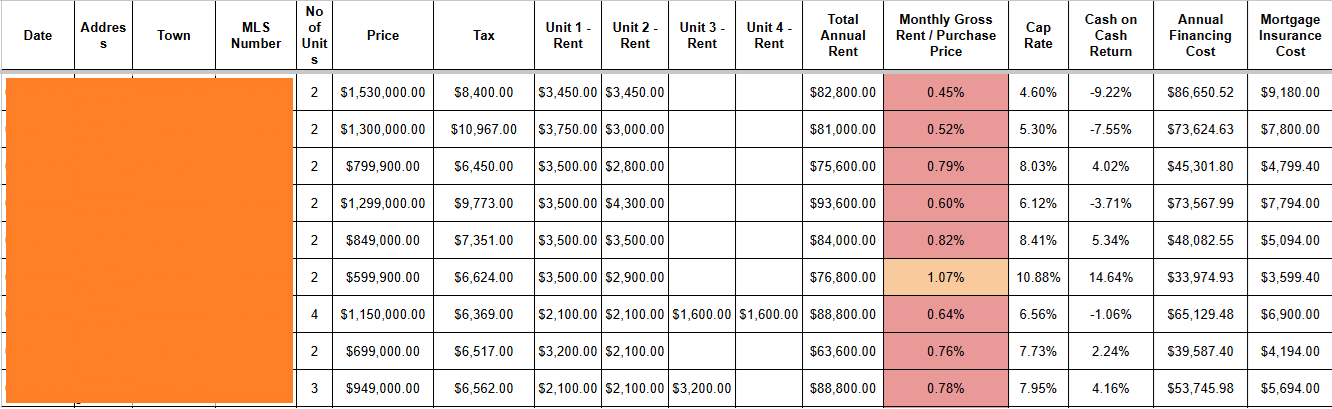
This helps me quickly evaluate properties and build a muscle of looking at the numbers at MLS alone and deciding if its worth it or not.
I have a separate tab I call "assumptions" - It where I can alter the downpayment, LTV, simple coef for the total 1st year mortgage payment, vacancy, closing costs, Maintenance costs(incl capex) and the current mortgage rate.
NOTE: The Example sheet i have shown is just tracking some metrics that are important to me, you are obviously welcome to do your own thing. There are ways this can be adapted for flips and BRRRR.
If a deal passes this first step and the eye test, then I book a viewing and spend another 20-30 mins stress testing assumptions and numbers, on a separate more detailed sheet with a 10 year horizon with DCF, BTCF, NPV, depreciation and so on.
These tools can certainly take time to set up and get working to your liking, but in the long run the time savings are insane.
Before I propose a deal to a client or close on a deal for my self, I always cross reference numbers and calculations with the Bigger Pockets calculator.
Something I’ve been thinking about lately.
It feels like in today’s market, finding deals is no longer the hardest part — filtering and analyzing them quickly is.
Most investors I’ve spoken to are sitting on:
too many leads
inconsistent evaluation methods
and limited time to properly break down each opportunity
Which makes me wonder if the real advantage now is in decision speed + clarity, not just sourcing.
I’ve been experimenting with AI-assisted deal breakdown workflows to help simplify early-stage analysis, but I’m still validating how much of this is actually useful in real investor workflows.
Curious how others are handling volume today — are you more constrained by deal flow or analysis time?
Definitely more constrained by deal flow, rather than analysis. A lot of the deals in my local market are priced as if we are still in the RE market of 21-22-23-24 and early 25.
In terms of the analysis it really isn't complicated to set up some systems that can automate and really increase the speed at which you can analyze deals. Half a day to a day TOPS on excel/google sheets and you can have a very robust tool with fairly limited inputs that can act as a initial filter to decide if something is worth looking further into.
Example below from my sheet:
This helps me quickly evaluate properties and build a muscle of looking at the numbers at MLS alone and deciding if its worth it or not.
I have a separate tab I call "assumptions" - It where I can alter the downpayment, LTV, simple coef for the total 1st year mortgage payment, vacancy, closing costs, Maintenance costs(incl capex) and the current mortgage rate.
NOTE: The Example sheet i have shown is just tracking some metrics that are important to me, you are obviously welcome to do your own thing. There are ways this can be adapted for flips and BRRRR.
If a deal passes this first step and the eye test, then I book a viewing and spend another 20-30 mins stress testing assumptions and numbers, on a separate more detailed sheet with a 10 year horizon with DCF, BTCF, NPV, depreciation and so on.
These tools can certainly take time to set up and get working to your liking, but in the long run the time savings are insane.
Before I propose a deal to a client or close on a deal for my self, I always cross reference numbers and calculations with the Bigger Pockets calculator.
That's a solid process, and I think that's where a lot of investors eventually end up—building systems that eliminate as much manual work as possible.
I like the distinction between the initial filter and the deeper underwriting stage. Most deals probably don't deserve a full DCF model until they've already passed a quick screening process.
The interesting part is that many newer investors never get around to building those systems, so they end up evaluating every deal manually. Even a basic framework can dramatically speed up decision-making and help maintain consistency.
Out of curiosity, when you built your spreadsheet, what was the biggest bottleneck you were trying to eliminate—data entry, calculations, or simply making faster go/no-go decisions?
Something I’ve been thinking about lately.
It feels like in today’s market, finding deals is no longer the hardest part — filtering and analyzing them quickly is.
Most investors I’ve spoken to are sitting on:
too many leads
inconsistent evaluation methods
and limited time to properly break down each opportunity
Which makes me wonder if the real advantage now is in decision speed + clarity, not just sourcing.
I’ve been experimenting with AI-assisted deal breakdown workflows to help simplify early-stage analysis, but I’m still validating how much of this is actually useful in real investor workflows.
Curious how others are handling volume today — are you more constrained by deal flow or analysis time?
Definitely more constrained by deal flow, rather than analysis. A lot of the deals in my local market are priced as if we are still in the RE market of 21-22-23-24 and early 25.
In terms of the analysis it really isn't complicated to set up some systems that can automate and really increase the speed at which you can analyze deals. Half a day to a day TOPS on excel/google sheets and you can have a very robust tool with fairly limited inputs that can act as a initial filter to decide if something is worth looking further into.
Example below from my sheet:
This helps me quickly evaluate properties and build a muscle of looking at the numbers at MLS alone and deciding if its worth it or not.
I have a separate tab I call "assumptions" - It where I can alter the downpayment, LTV, simple coef for the total 1st year mortgage payment, vacancy, closing costs, Maintenance costs(incl capex) and the current mortgage rate.
NOTE: The Example sheet i have shown is just tracking some metrics that are important to me, you are obviously welcome to do your own thing. There are ways this can be adapted for flips and BRRRR.
If a deal passes this first step and the eye test, then I book a viewing and spend another 20-30 mins stress testing assumptions and numbers, on a separate more detailed sheet with a 10 year horizon with DCF, BTCF, NPV, depreciation and so on.
These tools can certainly take time to set up and get working to your liking, but in the long run the time savings are insane.
Before I propose a deal to a client or close on a deal for my self, I always cross reference numbers and calculations with the Bigger Pockets calculator.
That's a solid process, and I think that's where a lot of investors eventually end up—building systems that eliminate as much manual work as possible.
I like the distinction between the initial filter and the deeper underwriting stage. Most deals probably don't deserve a full DCF model until they've already passed a quick screening process.
The interesting part is that many newer investors never get around to building those systems, so they end up evaluating every deal manually. Even a basic framework can dramatically speed up decision-making and help maintain consistency.
Out of curiosity, when you built your spreadsheet, what was the biggest bottleneck you were trying to eliminate—data entry, calculations, or simply making faster go/no-go decisions?
Good question. I have used the spreadsheet or some variation of it for around 2 years now since a began my RE investing journey and became an agent. Initially the goal was to make faster go/no go decisions and to train my "eye" - if you will to what a good deal looks like or not. I designed it to require minimal data entry so I can power trough all new added deals in 20 minutes a day.
Now 2 years later I still use it, but less often. Mainly as initial screen of deals that might look good to my eye (aka I don't do it for every thing posted on the MLS anymore).
Honestly, analysis being the bottleneck feels more like a systems problem than a market problem. If you have a clear buy box and a repeatable process, most deals should filter themselves out quickly — you're not deeply analyzing everything, you're mostly saying no fast.
The harder constraint, in my experience, is finding deals that actually fit your specific criteria. There's no shortage of listings or leads, but the overlap between what's available and what actually works for your market, your numbers, and your strategy is a much smaller set than people expect.
The real edge tends to come from partnering with market experts who surface the right opportunities early — not from processing more deals faster.
This reminded me of a concept that stuck with me from reading The Road Less Stupid. I read it as part of a mastermind and did not expect much from it, but one idea stayed with me:
You do not always win by doing more. Sometimes you win by making fewer mistakes.
Real estate feels like that.
If someone does 100 flips and loses money on 20, and someone else does 50 flips and loses on none, who actually wins?
I think the market over the last few years taught that lesson. Deals got hurt because rates moved, timelines stretched, construction costs changed, and assumptions stopped improving.
We manage about 1,350 units across Massachusetts, New Hampshire, Maine, Connecticut, and soon Rhode Island. One of the biggest improvements we made was not finding more deals. It was building better filters and underwriting.
AI is interesting because I think it can speed up early analysis and create consistency, but faster is not always better.
My take: deal sourcing creates opportunities. Deal analysis helps you stay in the game long enough to compound.
One thing I enjoy about investor meetups is hearing enough deal postmortems that eventually you start spotting mistakes before making them yourself.
I think there's a lot of truth to that. As a co-founder of a co-investing club, we see plenty of deals. The challenge usually isn't finding opportunities; it's determining which ones deserve deeper attention.The investors I know who make the best decisions tend to have a consistent process for screening deals quickly. Whether that's AI, a spreadsheet, or a checklist matters less than having a repeatable framework.
For us, the biggest constraint is usually time spent on due diligence and verification, not deal flow. It's relatively easy to find deals. It's much harder to determine which ones are actually worth investing in.
Something I’ve been thinking about lately.
It feels like in today’s market, finding deals is no longer the hardest part — filtering and analyzing them quickly is.
Most investors I’ve spoken to are sitting on:
too many leads
inconsistent evaluation methods
and limited time to properly break down each opportunity
Which makes me wonder if the real advantage now is in decision speed + clarity, not just sourcing.
I’ve been experimenting with AI-assisted deal breakdown workflows to help simplify early-stage analysis, but I’m still validating how much of this is actually useful in real investor workflows.
Curious how others are handling volume today — are you more constrained by deal flow or analysis time?

Something I’ve been thinking about lately.
It feels like in today’s market, finding deals is no longer the hardest part — filtering and analyzing them quickly is.
Most investors I’ve spoken to are sitting on:
too many leads
inconsistent evaluation methods
and limited time to properly break down each opportunity
Which makes me wonder if the real advantage now is in decision speed + clarity, not just sourcing.
I’ve been experimenting with AI-assisted deal breakdown workflows to help simplify early-stage analysis, but I’m still validating how much of this is actually useful in real investor workflows.
Curious how others are handling volume today — are you more constrained by deal flow or analysis time?
Jimmy, I think that's a great way to frame it.
The point about having predefined criteria before a deal even arrives seems to be a recurring theme among experienced investors. The more conversations I have, the more it appears that speed isn't really about rushing decisions—it's about eliminating opportunities that don't fit your buy box as early as possible.
I also agree that AI is probably most useful in the screening and organization phase rather than the final decision itself. It can help reduce the time spent gathering information and highlighting assumptions, but local market knowledge is still what determines whether those assumptions are realistic.
Your comment about being willing to miss a few deals rather than move too quickly on a bad one also resonates. In your experience, what's the single factor that most often causes a deal that initially looks attractive to get rejected during deeper analysis?
The framing of decision speed + clarity over sourcing is the right one for this market. When deals are moving fast, the investor who can evaluate and respond first has a structural advantage regardless of how good their sourcing is.
The "too many leads, limited time" problem is interesting because it's actually two separate bottlenecks. The analysis side is one — but there's an earlier one that often gets missed: what happens to the lead in the first few minutes after it comes in. You can have the best analysis workflow in the world but if the seller or opportunity sits unacknowledged for hours while you're busy with something else, someone who responded faster already has the relationship.
Decision speed matters at the analysis stage — but response speed matters even earlier.
@Justice Okpara — in the AI-assisted workflows you've been testing, are you focused more on the analysis side or have you looked at the intake and response side as well?
The framing of decision speed + clarity over sourcing is the right one for this market. When deals are moving fast, the investor who can evaluate and respond first has a structural advantage regardless of how good their sourcing is.
The "too many leads, limited time" problem is interesting because it's actually two separate bottlenecks. The analysis side is one — but there's an earlier one that often gets missed: what happens to the lead in the first few minutes after it comes in. You can have the best analysis workflow in the world but if the seller or opportunity sits unacknowledged for hours while you're busy with something else, someone who responded faster already has the relationship.
Decision speed matters at the analysis stage — but response speed matters even earlier.
@Justice Okpara — in the AI-assisted workflows you've been testing, are you focused more on the analysis side or have you looked at the intake and response side as well?
That's a great distinction.
Most of my focus started on the analysis side because that's where I initially saw investors spending a lot of time—running numbers, comparing scenarios, and deciding whether a deal deserved deeper attention.
But the more conversations I have with investors, the more I realize the intake and response side may be just as important. A great opportunity can be lost before underwriting even begins if the lead sits untouched while someone else makes first contact.
What I've been exploring lately is the idea that the entire workflow is really one system: lead intake, initial response, qualification, and then analysis. Improving only one part creates a bottleneck somewhere else.
In a competitive market, being the first person to respond doesn't guarantee you'll get the deal, but it does guarantee you'll have the opportunity to have the conversation. After that, analysis and judgment determine whether it's worth pursuing.
I'm curious—have you seen investors gain more leverage from improving response speed, or from improving their screening and underwriting process?
@Justice Okpara that framing of it being one system rather than separate stages is exactly right — and it's the part most people miss when they try to optimize in isolation.
To your question — in my experience the leverage usually comes from response speed first, simply because it's a gate. Better screening only matters if you're actually in the conversation. I've seen investors with mediocre underwriting still win deals consistently because they were first to respond and built trust early in the process. Meanwhile sharper analysts who took hours to reply lost access to deals before their analysis was ever relevant.
That said, the two compound each other. Fast response gets you the conversation. Good screening means you're not wasting that fast response on deals that were never going to work. One without the other caps your results either way.
Given how much you're thinking about this as one system, would be great to connect — sounds like there could be some interesting overlap in what we're each exploring.
@Justice Okpara that framing of it being one system rather than separate stages is exactly right — and it's the part most people miss when they try to optimize in isolation.
To your question — in my experience the leverage usually comes from response speed first, simply because it's a gate. Better screening only matters if you're actually in the conversation. I've seen investors with mediocre underwriting still win deals consistently because they were first to respond and built trust early in the process. Meanwhile sharper analysts who took hours to reply lost access to deals before their analysis was ever relevant.
That said, the two compound each other. Fast response gets you the conversation. Good screening means you're not wasting that fast response on deals that were never going to work. One without the other caps your results either way.
Given how much you're thinking about this as one system, would be great to connect — sounds like there could be some interesting overlap in what we're each exploring.
It's really important to have and implement your process to decide which deals deserve your time. We've found that due diligence is where investments are won or lost. The initial screen can be done with AI, a spreadsheet, or a checklist, but that's just the starting point. The real work is verifying the numbers, reviewing the collateral, understanding the risks, and making sure the story matches the facts. That's why we put so much emphasis on having a repeatable due diligence process. Deals will always be there, but consistently making good investment decisions comes from following the process, not chasing every opportunity.

