Sam,
I don't think you're missing something basic.
I think you're being given some very useful information by the market, and you're interpreting it as a question about rent.
The market has already answered you.
You just haven't asked it the right question yet.
You have a 1,250-square-foot, 3-bedroom, 1.5-bath unit in rural eastern Connecticut that you put at $2,250 and had roughly 25 inquiries, 10+ applications and a tenant in nine days.
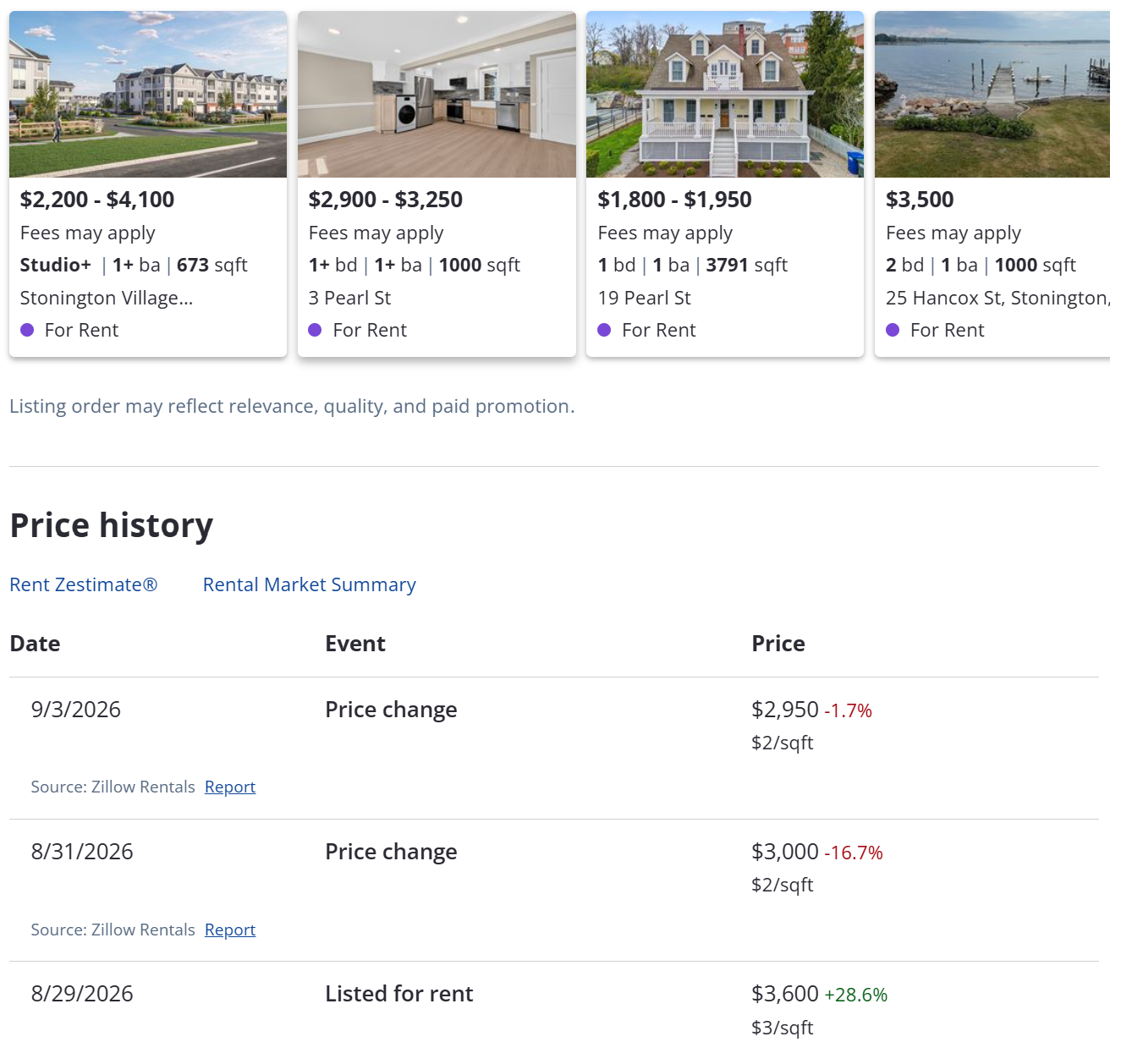
Then you have a somewhat larger unit—1,300 square feet—in Stonington Borough, ten minutes from the beach, five minutes from downtown, surrounded by amenities, and you've received essentially nothing at $2,950.
That's interesting.
Because if the only variable were square footage and rent, your conclusion would be fairly simple.
But it isn't.
You're not renting square footage. You're renting a proposition.
And before I dropped the rent by $350, I'd diagnose exactly where the proposition is failing.
There are really only a handful of places this can break:
Nobody sees it.
People see it but don't click.
They click but don't inquire.
They inquire but don't schedule.
They schedule but don't apply.
They apply but don't qualify.
They qualify but don't sign.
Those are not the same problem.
And each one tells you something different.
If you're getting almost no listing views, you've got a distribution problem.
If you're getting views but very few saves or clicks, I'd look hard at price and the first impression.
If people are clicking through the photographs and description but aren't contacting you, I'd suspect the value proposition isn't surviving the comparison.
If you're getting inquiries but people disappear when you mention the rent, that's a much stronger indication of price resistance.
If you're getting showings but no applications, I'd investigate the property itself—condition, layout, parking, laundry, noise, heating costs, neighborhood quirks, whatever they're discovering once the internet fantasy meets physical reality.
And if you're getting qualified applications but people aren't signing, then I'd start looking at terms, competition, tenant hesitation, or something in the transaction itself.
That's your diagnostic tree.
Don't treat all silence as "rent is too high."
Silence has causes.
Now, your particular situation makes me suspicious of the presentation and positioning before I'd assume the $2,950 is wrong.
You've already told us the photographs aren't very good.
That matters more than people think.
In a market where the surrounding rental inventory is predominantly furnished short-term and mid-term product, your property isn't competing merely against other long-term apartments.
It's competing against an experience.
That's a different animal.
Someone looking at Stonington Borough isn't necessarily shopping for "1,300 square feet, 3 bedrooms, 1.5 baths."
They're shopping for Stonington.
Walkability.
Beach access.
Restaurants.
The village.
Convenience.
Charm.
Lifestyle.
And if your photographs don't communicate that immediately, you've essentially taken a beautiful steak, put it on a paper plate under fluorescent lighting and then wondered why nobody is ordering dinner.
Your listing has to sell the thing they're actually buying.
Now, does that mean $2,950 is the right rent?
I have no idea yet.
And I wouldn't lower it to $2,600 simply because you aren't getting inquiries.
That's reacting to the symptom before diagnosing the patient.
I'd want to know what the actual long-term rental comparables are—not the summer rentals, not the furnished units, and not what somebody wishes their property were worth.
I'd want to know:
What are comparable unfurnished annual rentals actually asking?
What have they actually rented for?
How long did they sit?
What concessions were offered?
What condition were they in?
How good were the photographs?
Did they include utilities, parking, laundry, outdoor space, storage, pet accommodations, or anything else that changes the proposition?
And then I'd run a very simple experiment.
Change one major variable at a time.
First, fix the presentation.
Better photography. Better opening photograph. Better description. Make Stonington itself part of the product rather than merely the address at the top of the listing.
Then watch the funnel.
If exposure is good but engagement is terrible, investigate the price/presentation combination.
If engagement is good but inquiries are weak, investigate the value proposition.
If inquiries are strong but showings are weak, investigate friction and expectations.
If showings are strong but applications are weak, investigate the physical property or tenant qualification requirements.
If applications are coming in and people are walking away, investigate terms and transaction friction.
And if the property is beautifully presented, correctly exposed, generating attention, and still getting almost no qualified interest at $2,950?
Then I'd lower the price.
Not emotionally.
Not because somebody on BiggerPockets said, "Just drop it."
Because you've gathered evidence.
That's the important distinction.
And there's another possibility I'd investigate.
You may have stumbled into a market where scarcity doesn't mean demand.
Being the only unfurnished long-term rental in an area sounds wonderful.
Until you ask why you're the only one.
Sometimes you're the only product because nobody wants that product.
Sometimes you're the only product because you've found an extraordinary niche.
Those are very different discoveries.
So don't let the eastern Connecticut property become your psychological anchor.
You aren't selling the same thing simply because both properties have three bedrooms.
A $2,250 rural unit and a $2,950 coastal-town unit can exist in completely different economic universes.
The question isn't:
"Why would somebody pay $700 more for this?"
The better question is:
"What does the $700 buy them?"
If the answer is obvious, you've got a marketing problem.
If the answer isn't obvious, you've got a positioning problem.
If the answer is obvious and the market still won't pay it, you've got a pricing problem.
And if people love the property but can't get through your application process or don't like the terms, you've got a transaction problem.
Now we know what we're fixing.
That's why I wouldn't start by lowering the rent.
I'd start by finding where the funnel breaks.
Once you know that, the market usually gets considerably less mysterious.
And Sam, don't make the mistake of trying to find the rent that makes somebody finally say yes.
Find the highest rent the market will say yes to reliably.
That's the number worth knowing.
DC Dobbs
Gulf Coast Emerald, LLC